Volume 2 / Part 3 — PART THIRD. HISTORY OF THE HIGHLAND REGIMENTS. (continued 7)
Reading edition
After the surrender of Charleston on the 12th of May 1780, to the forces under Sir Henry Clinton, Lord Cornwallis was appointed to the command of the southern provinces. Having projected an excursion into the interior, he was joined by the 71st, which had remained at Savannah in quarters during the winter. In the beginning of June, the army, amounting to 2500, reached Cambden, and encamped in the neighbourhood, the general making that place his head quarters. The American general, Gates, having, in July, assembled a force of 7000 men, took up a position at Rugley’s Mill, nearly twelve miles from Cambden. Determined to surprise and attack the enemy, the British general moved forward on the night of the 15th of August; whilst, by a singular coincidence, the American commander left his position at the very same hour, with the same intention. It was full moon, and the sky was unclouded. Before three o’clock in the morning, the advanced guards met half-way, and exchanged some shots; but both generals, ignorant of each other’s strength, declined a general action, and lay on their arms till morning. The ground on which the armies lay was a sandy plain, with straggling trees, but a part on the left of the British was soft and boggy. Each army prepared for battle, by forming line. The British right consisted of the light infantry and the Welsh fusileers; the 33d regiment and the volunteers of Ireland formed the centre; and the provincials composed the left, having the marshy ground in their front. Whilst this formation was going on, Captain Charles Campbell, who commanded the Highland light companies on the right, mounted the stump of an old tree to reconnoitre, and perceiving the enemy in motion, as if they intended to turn his flank, he leaped down, muttering to himself, “I’ll see you damned first,” and calling to his men, said, “Remember you are light infantry; remember you are Highlanders:—charge!” The Highlanders instantly rushed forward, and such was the impetuosity of the attack, that the division of the enemy which was to have surrounded the right of the British was completely broken, and driven from the field before the battle commenced in the other parts of the line. In the contest which took place between these, the centre of the enemy gained ground; but neither party seeming disposed to advance, a pause of a few minutes took place, as if by mutual consent, during which both parties remained stationary without firing a shot. Whilst matters were in this state Lord Cornwallis ordered the corps in the centre to open their right and left; and when a considerable space intervened, he directed the Highlanders, who were getting impatient at being left in the rear, whilst their friends were fighting in front, to advance and occupy the vacant space. When the Highlanders had taken their ground, his lordship cried out, “My brave Highlanders, now is your time!” The words were scarcely uttered, when they rushed forward, accompanied by the 33d, and the volunteers of Ireland. The charge was irresistible, and the centre of the enemy was completely overthrown. Meanwhile the right of the enemy, which was enveloped in the smoke of the fire, advanced unperceived, and gained the ground on which the Highlanders had been formerly posted as a reserve. Unaware of the fate of their companions, they gave three cheers for victory; but their joy was of short duration, for, the smoke immediately clearing up, they saw their mistake; and a party of Highlanders turning on them, the greater part threw down their arms, whilst the remainder flew in all directions. The loss of the British in this decisive action was 3 officers and 66 men killed, and 17 officers and 226 rank and file wounded. Lieutenant Archibald Campbell and 3 soldiers of the 71st were killed, and Captain Hugh Campbell, Lieutenant John Grant, 2 sergeants, and 30 privates wounded.[385]
Though the battle of the 16th of August was decisive, yet as General Sumpter with a strong corps occupied positions on the Catawba river, which commanded the road to Charleston, it was necessary to dislodge him. For this purpose Colonel Tarleton was directed to proceed with the cavalry, and a corps of light infantry, under Captain Charles Campbell of the 71st. On the morning of the 18th they came in sight of Fishing Creek, and observing some smoke at a short distance on their right, the sergeant of the advanced guard halted his party, and went forward to reconnoitre. He observed an encampment with arms piled, and, with the exception of a few sentinels and some persons employed in cooking, the soldiers were reposing in groups apparently asleep. The sergeant reporting what he had seen to Captain Campbell, the latter, who commanded in front, fearing a discovery, formed such of the cavalry as had come up, and with 40 of the Highlander light infantry rushed quickly forward, secured the piled arms, and surprised the camp. The success was complete; a few men were killed, nearly 500 surrendered prisoners, and the rest fled in all directions. The loss was trifling, but the Highlanders had in an especial manner to regret the death of Captain Campbell, who was killed by a random shot.
The American general, Morgan, having entered South Carolina, in December 1780, with about 1100 men, Colonel Tarleton was detached with some infantry, of which the first battalion of the 71st formed a part, and a small body of cavalry. On the morning of the 17th of January 1781, intelligence was received that General Morgan was posted on a rising ground in front, which was thinly covered with pine trees. The front line was drawn up on the top of the rising ground, and the second, four hundred paces in rear of the first. Colonel Tarleton instantly formed in order of battle. In front he placed the 7th, or fusileers, the infantry of the British legion, and the light infantry; the Highlanders and cavalry formed the reserve. The line, exhausted by running at a rapid pace, received the fire of the enemy at the distance of thirty or forty yards, which did considerable execution. The fire was returned, but without spirit and with little effect; and it was kept up on both sides for ten or twelve minutes, neither party advancing. The light infantry then made two attempts to charge, but were repulsed with loss. In this state of matters the Highlanders were ordered up, and advancing rapidly to the charge, the enemy’s front line instantly gave way; and this retrograde motion being observed by the second line, which had not yet been engaged, it immediately faced to the right and inclined backwards, and by this skilful manœuvre opened a space by which the front line retreated. Eager to pursue, the Highlanders followed the front line, when Colonel Howard, who commanded the enemy’s reserve, threw in a destructive fire upon the 71st, when within forty yards of the hostile force. So disastrous was the effect of this fire, that nearly one half of the Highlanders fell; and the rest were so scattered over the ground, on which they pursued, that they could not be united to form a charge with the bayonet. Though checked, the Highlanders did not fall back, probably expecting that the first line and the cavalry would come up to their support; but they were mistaken: and after some irregular firing between them and Colonel Howard’s reserve, the front line of the Americans rallied, returned to the field, and pushed forward to the right flank of the Highlanders. Alone, and unsupported, and almost overpowered by the increasing numbers of the enemy, the Highlanders “began to retire, and at length to run, the first instance (may it be the only one!) of a Highland regiment running from an enemy!!”[386] A general rout ensued; few of the infantry escaped, but the cavalry saved themselves by the speed of their horses. The loss of the British, in this disastrous affair, exceeded 400 men. The Highland officers were perfectly satisfied with the conduct of their men, and imputing the disaster altogether to the bad dispositions of Colonel Tarleton, made a representation to Lord Cornwallis, not to be employed again under the same officer, a request with which his lordship complied.
The main body of the American army under General Green retreated northward after this action, and Lord Cornwallis made every exertion to follow them. Previous to the march the two battalions of the 71st, being greatly reduced, were consolidated into one, and formed in brigade with the Welsh fusileers and 33d regiment. General Green retreated to Guildford Court-house, where on the 16th of March he prepared for battle. He drew up his army in three lines: the first occupied the edge of a wood with a fence in front of Hogstie farm; the second a wood of stunted oaks at some distance in the rear; and the third line was drawn up in the more open parts of the woods and upon cleared ground. The front line of the British was formed of the German regiment of De Bos, the Highlanders and guards under the Honourable General Leslie on the right; and the Welsh fusileers, 33d regiment, and 2d battalion of guards under Brigadier-General Charles O’Hara, on the left. The cavalry were in the rear, supported by the light infantry of the guards and the German Jagers.
The order of battle being completed, the attack began at one o’clock. The Americans, covered by the fence in their front, reserved their fire till the British were within thirty or forty paces, at which distance they opened a most destructive fire, which annihilated nearly one-third of Colonel Webster’s brigade. The fire was returned by the brigade, who rushed forward on the enemy. These abandoned their fence, and retreated on the second line. The contest was maintained with greater pertinacity on the more open ground, where the regiment of De Bos and the 33d retreated and advanced repeatedly before they succeeded in driving the enemy from the field. A party of the guards pressing forward without observing a body of cavalry placed in the right flank as a reserve, were charged in flank, had their line broken, and lost several men. The enemy, who had retreated, emboldened by the effect of this charge, halted, turned their face to the field, and recommenced firing. Whilst matters were in this state, and the Hessians warmly engaged, the Highlanders, who had rapidly pushed round the flank, appeared on a rising ground in rear of the enemy’s left, and rushing forward with shouts, made such an impression on the Americans that they immediately fled, leaving their guns and ammunition behind. In this well-contested action every corps fought separately, each depending on its own firmness; and having to sustain the weight of so greatly superior numbers, the issue was for some time doubtful. The British had 7 officers and 102 non-commissioned officers and rank and file killed, among whom were Ensign Grant and 11 soldiers of the 71st; and 20 officers and 419 non-commissioned officers and rank and file wounded, including 4 sergeants and 46 soldiers of the same regiment.
No solid advantage was gained by this battle, as Lord Cornwallis found it necessary to retreat, and was even obliged to leave his wounded behind in a house in the neighbourhood. The British took the direction of Cross Creek, followed close in the rear by the Americans. The settlement of Cross Creek was possessed by emigrant Highlanders, who had evinced great loyalty during the war; and they now offered to bring 1500 men into the field, and to furnish every necessary except arms and ammunition, but stipulated that they should be commanded by officers from the line. This reasonable offer was declined; but it was proposed to form them into what was called a provincial corps of the line. This proposition was rejected by the emigrant Highlanders, who retired to their settlements, after a negotiation of twelve days. The army then marched for Wilmington, where it arrived on the 17th of April. Here Lord Cornwallis halted till the 26th, when he proceeded on the route to Peterborough. After traversing several hundred miles of a country chiefly hostile, he arrived at Peterborough on the 20th of May, where he formed a junction with Major-general Philips, who had recently arrived from New York with 3000 men. With the united forces, which amounted to 6000 men, Lord Cornwallis proceeded to Portsmouth, and whilst he was preparing to cross the river at St James’s island, the Marquis de la Fayette, ignorant of the strength of the British army, gallantly attacked Colonel Thomas Dundas’s brigade, with 2000 men. The Marquis was repulsed, but not without a warm contest.
Arriving at Portsmouth, Lord Cornwallis continued his march to Yorktown, and took up a position on the York river, on the 22d of August. The place selected was an elevated platform, on the banks of the river, nearly level. On the right of the position, extending from the river, was a ravine about forty feet in depth, and upwards of one hundred yards in breadth; a line of entrenchments, with a horn-work, formed the centre. Beyond the ravine, on the right of the position, was an extensive redoubt, and two smaller ones on the left, also advanced beyond the entrenchments. These defences, which constituted the chief strength of the camp, were not completed when General Washington, who had been lately joined by the Count de Rochambeau, took up a position at the distance of two miles from the British lines. His force consisted of 7000 French and 12,000 Americans, being thrice as numerous as that of the British, which did not exceed 5950 men.
General Washington immediately proceeded to erect batteries, and to make his approaches. He first directed his fire against the redoubt on the right, which after four days’ bombardment was reduced to a heap of sand. He did not, however, attempt an assault on this point of the position, but turned his whole force against the redoubts on the left, which he carried by storm, and turned the guns of the redoubts on the other parts of the entrenchments. Some soldiers of the 71st, who had manned one of these redoubts, conceiving that the honour of the regiment was compromised by their expulsion from the redoubt, sent a petition through the commanding officer to Lord Cornwallis, for permission to retake it; but as his lordship did not think that the acquisition would be of much importance, under existing circumstances, he declined.
Finding his position quite untenable, and his situation becoming every hour more critical, the British commander determined to decamp at midnight with the elite of his army, to cross the river, and leave a small force in the works to capitulate for the sick and wounded, the former being very numerous. The plan would have succeeded had not the passage of the river been rendered dangerous, if not impracticable, by a squall of wind. The first division was embarked, and some of the boats had reached Gloucester Point on the opposite shore, when the General countermanded the enterprise in consequence of a storm which arose. Judging farther resistance hopeless, Lord Cornwallis made proposals of capitulation, and the terms being adjusted, the British troops marched out with their arms and baggage on the 8th of October 1781, and were afterwards sent to different parts of the country. The garrison had 6 officers and 150 non-commissioned officers and rank and file killed, and 6 officers and 319 non-commissioned officers and rank and file wounded. Lieutenant Fraser and 9 soldiers of the 71st were killed, and 3 drummers and 19 soldiers wounded.
The military services of this army, which were now closed, had been most arduous. In less than twelve months they had marched and counter-marched nearly 2000 miles, had been subjected to many severe hardships, and besides numerous skirmishes had fought two pitched battles, in all of which they had been victorious; yet all their exertions were unavailing in the general contest.
With this misfortune also ended the military career of the Fraser Highlanders, who remained prisoners till the conclusion of the war. True to their allegiance, they resisted to a man the solicitations of the Americans to join their standard and settle among them, thus exhibiting a striking contrast to many soldiers of other corps, who, in violation of their oath, entered the American ranks. In other respects the conduct of the Highlanders was in perfect keeping with this high state of moral feeling and daring, not one instance of disgraceful conduct ever having occurred in the old 71st. The only case of military insubordination was that which happened at Leith in April 1779, of which an account has been given in the history of the 42d regiment; but it is clear that no fault was attributable to the men of the detachment in question who merely insisted on the fulfilment of the engagement which had been entered into with them.[387]
The regiment returned to Scotland on the termination of hostilities, and was discharged at Perth in 1783.
FOOTNOTES:
KEITH’S AND CAMPBELL’S HIGHLANDERS,
OR
THE OLD EIGHTY-SEVENTH AND EIGHTY-EIGHTH REGIMENTS.
1759–1763.
Keith’s Highlanders—Germany—Campbell’s Highlanders—Germany—Zeirenberg—Fellinghausen—Continental Notions of Highlanders—Brucher Mühl—Reduction of regiments.
The first of these regiments consisted of three companies of 105 men each. A relation of the celebrated Field-Marshal Keith, Major Robert Murray Keith, who had served in the Scotch Brigade in Holland, was appointed to the command. About the end of the year 1759 this regiment joined the allied army in Germany under Prince Frederick of Brunswick.
The Highlanders were not long in the allied camp when they were brought into action. On the 3d of January 1760 the Marquis de Vogue attacked and carried the town of Herborn, and made a small detachment of the allies who were posted there prisoners. At the same time the Marquis Dauvet made himself master of Dillenburg, the garrison of the allied troops retiring into the castle, where they were closely besieged. Prince Ferdinand no sooner understood their situation than he began to march with a strong detachment for their relief on the 7th of January, when he attacked and defeated the besiegers. On the same day “the Highlanders under Major Keith, supported by the hussars of Luckner, who commanded the whole detachment, attacked the village of Eybach, where Beau Fremonte’s regiment of dragoons was posted, and routed them with great slaughter. The greater part of the regiment was killed, and many prisoners were taken, together with two hundred horses and all their baggage. The Highlanders distinguished themselves on this occasion by their intrepidity, which was the more remarkable, as they were no other than raw recruits, just arrived from their own country, and altogether unacquainted with discipline.” The Highlanders had 4 men killed and 7 wounded.[388] Prince Ferdinand was so well satisfied with the conduct of this body, that he recommended to the governor not only to increase it to 800 men, but to raise another regiment of equal strength, to be placed under his serene highness. This recommendation was instantly attended to, and, in a few weeks, the requisite number of men was raised in the counties of Argyle, Perth, Inverness, Ross, and Sutherland. The command of the new regiment was conferred on John Campbell of Dunoon; but power was reserved to the Earls of Sutherland and Breadalbane, the lairds of Macleod and Innes, and other gentlemen in the north, to appoint captains and subalterns to companies raised on their respective estates. Major Macnab, son of the laird of Macnab; Captain Archibald Campbell, brother of Achallader; John Campbell of Auch, and other officers, were recommended by Lord Breadalbane; and Macleod, who raised a company in Skye, appointed his nephew, Captain Fothringham of Powrie to it. Sir James Innes, chief of that name, who succeeded to the estates and Dukedom of Roxburgh in the year 1810, was also appointed to a company.
Keith’s regiment was embodied at Perth and Campbell’s at Stirling, and being embodied at the same time, and ordered on the same service, an interchange of officers took place. Embarking for Germany they joined the allied army, under Prince Ferdinand, in 1760, and were distinguished by being placed in the grenadier brigade.
The allied army moved from Kalle on the 30th of July 1760, in consequence of the advance of the French, who took up a position on the river Dymel. The hereditary prince of Brunswick, who had passed that river the preceding day, was directed by Prince Ferdinand to turn the left of the enemy, who were posted between Warburg and Ochsendorff, whilst he himself advanced in front with the main body of the army. The French were attacked almost at the same moment both in flank and rear, and defeated with considerable loss. In an account of the battle written by Prince Ferdinand to George II., he says, “that the loss of the allies, which was moderate, fell chiefly upon Maxwell’s brave battalion of English grenadiers and the two regiments of Scots Highlanders, which did wonders. Colonel Beckwith, who commanded the whole brigade formed of English grenadiers and Scots Highlanders, distinguished himself greatly.” None of the Highlanders were killed, but Lieutenant Walter Ogilvie, and two privates were wounded.
Another affair soon occurred in which the Highlanders also distinguished themselves. Prince Ferdinand, having determined to beat up the quarters of a large French detachment stationed at Zeirenberg, pitched upon five battalions, with a detachment of the Highlanders and eight regiments of dragoons, for this service. This body began their march on the night of the 5th of August, and when within two miles of the town the corps proceeded by three different roads—Maxwell’s brigade of grenadiers, the regiment of Kingsby, and the Highlanders, keeping together. They marched in profound silence, and though their tramp was at last heard by the French, the surprise was too sudden for effectual resistance. “The Scots Highlanders mounted the breaches sword in hand, supported by the Chasseurs. The column of English grenadiers advanced in good order and with the greatest silence. In short, the service was complete, and the troops displayed equal courage, soldier-like conduct, and activity.”[389] The loss of the Highlanders in this affair was 3 privates killed and 6 wounded.
The hereditary prince being hard pressed by Marshal de Castries, was reinforced from the camp at Warburg. The Highlanders joined him on the 14th of October shortly after he had been attacked by the Marshal, who had compelled him to retire. The prince now attacked the French commander in his turn, but was unsuccessful, being obliged again to retire after a warm contest, which lasted from five till nine in the morning. The Highlanders, who “were in the first column of attack, were the last to retreat, and kept their ground in the face of every disadvantage, even after the troops on their right and left had retired. The Highlanders were so exasperated with the loss they sustained that it was with difficulty they could be withdrawn, when Colonel Campbell received orders from an aide-de-camp sent by the prince, desiring him to retreat as to persist in maintaining his position longer would be a useless waste of human life.” In this action Lieutenants William Ogilvie and Alexander Macleod of the Highlanders, 4 sergeants, and 37 rank and file were killed, and Captain Archibald Campbell of Achallader, Lieutenants Gordon Clunes, Archibald Stewart, Angus Mackintosh of Killachy, and Walter Barland, and 10 rank and file wounded.[390]
On the preceding night an attempt was made by Major Pollock, with 100 grenadiers and the same number of Keith’s Highlanders, to surprise the convent of Closter Camp, where a detachment of the enemy was posted, and where, it was supposed, the French commander and some of his officers were to pass the night; but this attempt miscarried. On reaching the sentinel of the main-guard Major Pollock rushed upon him and ran him through the body with his sword. The wounded man, before falling, turned round upon his antagonist and shot him with a pistol, upon which they both fell dead.
The next affair in which the Highlanders were engaged was the battle of Fellinghausen, in July 1762. The commander in chief, in a general order, thus expressed his approbation of the conduct of the corps in this action: “His serene highness, Duke Ferdinand of Brunswick, has been graciously pleased to order Colonel Beckwith to signify to the brigade he has the honour to command his entire approbation of their conduct on the 15th and 16th of July. The soldier-like perseverance of the Highland regiments in resisting and repulsing the repeated attacks of the chosen troops of France, has deservedly gained them the highest honour. The ardour and activity with which the grenadiers pushed and pursued the enemy, and the trophies they have taken, justly entitle them to the highest encomiums. The intrepidity of the little band of Highlanders merits the greatest praise.” Colonel Beckwith, in making his communication, added, that “the humanity and generosity with which the soldiers treated the great flock of prisoners they took, did them as much honour as their subduing the enemy.” In this action Major Archibald Campbell of Achallader, who had been promoted only a week before,[391] and Lieutenants William Ross and John Grant, and 31 rank and file, were killed; and Major Archibald Macnab, Captain James Fraser, Lieutenants Archibald Macarthur, Patrick Campbell, and John Mackintosh, brother of Killachy and father of Sir James Mackintosh, 2 sergeants, and 70 privates, were wounded.
No enterprise of any moment was attempted till the 28th of June 1762, when Prince Ferdinand attacked the French army at Graibenstein, and defeated them. The French lost upwards of 4000 men in killed, wounded, and prisoners, including 200 officers, whilst that sustained by the allies did not exceed 700 men. The British troops, who were under the command of the Marquis of Granby, “behaved with a bravery not to be paralleled, especially our grenadiers and Highlanders.”
The Highlanders, from the distinction they had earned in these different encounters, now began to attract the especial notice of the Germans. At a time when an entire ignorance prevailed among the people of England respecting the Highlanders, it is not to be wondered at that the Germans should have formed the most extraordinary notions of these mountaineers. In common with the English they looked upon the Highlanders as savages; but their ignorance went farther, for the people of Germany actually believed that the Highlanders were still strangers to Christianity. “The Scotch Highlanders,” says an article which appeared in the Vienna Gazette of 1762, “are a people totally different in their dress, manners, and temper from the other inhabitants of Britain. They are caught in the mountains when young, and still run with a surprising degree of swiftness. As they are strangers to fear, they make very good soldiers when disciplined. The men are of low stature, and the most of them old or very young. They discover an extraordinary submission and love for their officers, who are all young and handsome. From the goodness of their dispositions in every thing—for the boors are much better treated by these savages than by the polished French and English; from the goodness of their disposition, which, by the by, shows the rectitude of human nature before it is vitiated by example or prejudice, it is to be hoped that their king’s laudable, though late, endeavours to civilise and instruct them in the principles of Christianity will meet with success!” The article adds, that the “French held them at first in great contempt, but they have met with them so often of late, and seen them in the front of so many battles, that they firmly believe that there are twelve battalions of them in the army instead of two. Broglio himself has lately said that he once wished that he was a man of six feet high, but that now he is reconciled to his size since he has seen the wonders performed by the little mountaineers.” An acquaintance with the Highlanders soon dissipated the illusions under which the Germans laboured.
The Highlanders were not engaged in the battle of Johannisberg, in which the allies were worsted; but on the 21st of September, in the subsequent action at Brucher Mühl, they took a part. The French occupied a mill on one side of the road, and the allies a redoubt on the other, and the great object of both parties was to obtain possession of a small post which defended the bridge at Brucher Mühl. At first a slight cannonade was opened from a few guns, but these were speedily augmented to twenty-five heavy pieces on each side. In the post occupied by the allies there was only at first 100, but during the action, which lasted without intermission for fifteen hours, no less than seventeen regiments were successively brought forward, replacing one another after they had spent their ammunition. Both sides remained in their respective positions, and although the contest was long and severe the allies lost only 600 in killed and wounded. The Highland corps had Major Alexander Maclean and 21 rank and file killed, and Captain Patrick Campbell and Lieutenant Walter Barland, 3 sergeants, and 58 rank and file wounded.
On the conclusion of hostilities in November 1762 the Highlanders were ordered home. In the three campaigns in which they had served they had established a well-earned reputation for bravery; and so great was the estimation in which they were held by the Dutch, that, on their march through Holland, they were welcomed with acclamations, particularly by the women, who presented them with laurel leaves;—a feeling which, it is said, was in some measure owing to the friendly intercourse which had previously existed between the inhabitants and the Scotch brigade.
After landing at Tilbury Fort, the regiments marched for Scotland, and were received everywhere on their route with the most marked attention, particularly at Derby, the inhabitants of which town presented the men with gratuities in money. Among various reasons assigned for the remarkable predilection shown by the people of Derby, the most probable is, a feeling of gratitude for the respect shown by the Highlanders to the persons and properties of the inhabitants when visited by them in the year 1745.
Keith’s regiment was marched to Perth and Campbell’s to Linlithgow, and they were reduced in July 1763.
The total loss of these corps was 150 men besides 7 officers killed; and 170 men, and 13 officers, wounded.
FOOTNOTES:
EIGHTY-NINTH HIGHLAND REGIMENT.
1759–1765.
Raising of the Regiment—India—Reduction.
The war in which Great Britain was engaged requiring at this time increased exertions on the part of the government, it was resolved to raise, in addition to Keith’s Highlanders, another regiment in those parts of the Highlands where the influence of the Gordon family prevailed. At the solicitation of the Dowager Duchess of Gordon, Major Staates Long Morris, to whom she had been lately married, was appointed to raise the regiment; and to strengthen his interest amongst the youth of the North, her eldest son by her former husband, the late Duke of Gordon, then a youth at college, was appointed a captain; his brother, Lord William, a lieutenant; and his younger brother, Lord George, an ensign. The object of the duchess in obtaining these appointments was to counteract the political influence of the Duke of Argyle during the minority of her son. Major Morris was so successful that, in a few weeks, 760 men were collected at Gordon Castle, who, in December 1759, were marched to Aberdeen.
The regiment embarked at Portsmouth for the East Indies in December 1760, and arrived at Bombay in November following. The Duke of Gordon was desirous of accompanying the regiment, but his mother, at the especial request of George II., induced him to remain at home to finish his education.
The 89th had no particular station assigned it, but kept moving from place to place till a strong detachment under Major Hector Munro joined the army under the command of Major Carnac, in the neighbourhood of Patna. Major Munro then assumed the command, and being well supported by his men, quelled a formidable mutiny among the troops. After the ringleaders had been executed, and discipline restored, Major Munro attacked the enemy at Buxar, on the 23d of October 1764, and though the force opposed to him was five times as numerous as his own, he overthrew and dispersed it. The enemy had 6000 men killed, and left 130 pieces of cannon on the field, whilst his majesty’s troops had only 2 officers and 4 rank and file killed. Major Munro received a letter of thanks on the occasion from the President and Council of Calcutta. “The signal victory you gained,” they say, “so as at one blow utterly to defeat the designs of the enemy against these provinces, is an event which does so much honour to yourself, Sir, in particular, and to all the officers and men under your command, and which, at the same time, is attended with such particular advantages to the Company, as call upon us to return you our sincere thanks.” For this important service Major Munro was immediately promoted to the brevet rank of Lieutenant-colonel.
COLONELS OF THE 71ST AND 72ND HIGHLANDERS.
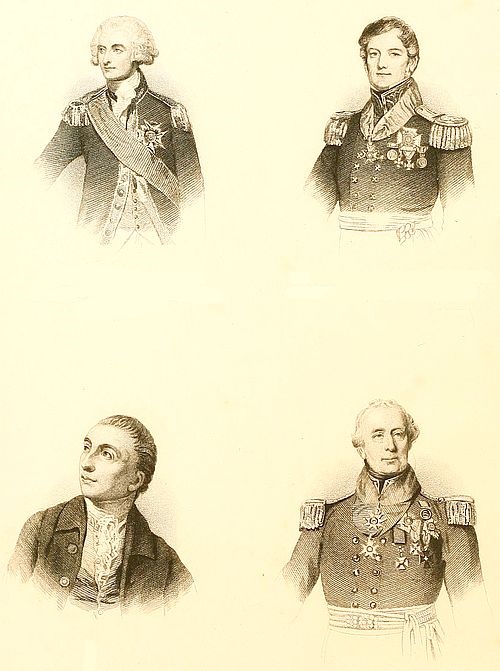
A. Fullarton & Co London & Edinburgh.
UPPER
JOHN, LORD MACLEOD. Col. of 71st Highlrs 18th Dec. 1777—2nd April 1789. First Colonel.
SIR THOMAS REYNELL, BT. K.C.B. Col. of 71st Highlrs 15th March 1841—10th Feb. 1848.
LOWER
KENNETH, EARL OF SEAFORTH. Col. of 72nd Highlrs 29th Dec. 1777—Augt 1781. First Colonel.
SIR NEIL DOUGLAS, K.C.B., K.C.H. Col. of 72nd Highlrs 12th July 1847—29th Dec. 1851. Also Col. of 78th Highlrs 29th Dec. 1851—1st Sep.t 1853.
The services of the regiment being no longer required, it was ordered home, and was reduced in the year 1765. It has been remarked, as a singular circumstance attending their service, that although five years embodied, four of which were spent in India, or on the passage going and returning, none of the officers died, nor was there any promotion or other change among them, except the change of Lord William Gordon to the 76th regiment, and the promotion of his successor to his lieutenancy. The same good conduct which distinguished the other Highland corps was not less conspicuous in this,—not one man out of eight of the companies, numbering in all 780, having been brought to the halberts. Of the whole regiment only six men suffered corporal punishment.
JOHNSTONE’S HIGHLANDERS,
OR
ONE HUNDRED AND FIRST REGIMENT.
1760–1763.
This regiment, which consisted of five companies, of 5 sergeants and 105 rank and file each, was raised in the year 1760 by the following gentlemen, viz. Colin Graham of Drainie, James Cuthbert of Milncraigs, Peter Gordon of Knockespic, Ludovick Grant of the family of Rothiemurchus, and Robert Campbell, son of Ballivolin. These all received captain’s commissions.
After the companies were completed they assembled at Perth, and thence were marched to Newcastle, where they remained till near the end of the year 1761, when they were sent to Germany, to reinforce Keith’s and Campbell’s Highlanders. Their officers did not accompany them, but were ordered back to the Highlands to raise six additional companies of the same strength as the other five. This service was soon performed, 600 men having assembled at Perth in a few months. Major, afterwards Sir James Johstone of Westerhall was appointed to the command of the corps, with the rank of major-commandant. The major, Adjutant Macveah, and Sergeant-major Coxwell, were the only persons in the 101st regiment not Highlanders. Lieutenant-general Lord George Beauclerk reviewed the regiment at Perth in 1762, and declared that he had never seen a body of men in a more “efficient state, and better fitted to meet the enemy.” They had, however, no opportunity of realizing the expectations formed of them, not having been called into active service. The regiment was reduced at Perth in August 1763.
LORD MACLEOD’S HIGHLANDERS,
FORMERLY SEVENTY-THIRD REGIMENT, NOW SEVENTY-FIRST OR GLASGOW HIGHLAND LIGHT INFANTRY.
I. 1777–1818.
Raising of the Regiment—First Battalion in India—Perambaucum—Porto-Novo—Cuddalore—Number of Regiment changed to 71st—War with Tippoo Saib—Bangalore—Seringapatam—Nundydroog—Savendroog—Seringapatam—Ceylon—Home—Cape of Good-Hope—Buenos Ayres—Home—Peninsula—Roleia—Vimiera—Corunna—Flushing—Sobral—Zibriera—Fuentes d’Onor—Albuera—Arroyo-del-Molinos—Ciudad Rodrigo—Badajoz—Almaraz—Fort-Napoleon—Salamanca—Alba-de-Tormes—Vittoria—La Puebla—Maya—Lizasso—Eguaros—Doña Maria—Pyrenees—Altobispo—The Nive—St Pierre—Sauveterre—Orthes—Aire—Tarbes—Toulouse—Waterloo—Champs Elysées.
This regiment took its original name from Lord Macleod, eldest son of the Earl of Cromarty, both of whom were engaged in the rebellion of 1745. Having on account of his youth, received an unconditional pardon for his share in that transaction, Lord Macleod went abroad in quest of employment in foreign service. He sojourned some time at Berlin with Field Marshal Keith, through whose interest, it is believed, he obtained a commission in the Swedish army. At this time his means were so limited that he was unable to equip himself for the service, but the Chevalier de St George, on the recommendation of Lord George Murray, sent him a sum of money to defray the expenses of his outfit. He is described by Lord George as “a young man of real merit,” who, he was hopeful, would gain the good opinion of those under whom he was to serve. This expectation was fully realized, and after serving the crown of Sweden twenty-seven years with distinguished efficiency, he obtained the rank of Lieutenant-general.
Though exiled so long from his native country, his attachment to the land of his birth was not in the least abated, and, desirous of revisiting it, he returned to England in the year 1777, and was presented to George III., who received him very graciously. At the suggestion of Colonel Duff of Muirtown, who had served in Keith’s Highlanders, and encouraged by the favourable reception he met with in the North, he offered his services to raise a regiment. The offer was accepted, and although without property or political consequence, yet so great was the influence of his name, that 840 Highlanders were raised and marched to Elgin in a very short time. In addition to these, 236 Lowlanders were raised by Captains the Honourable John Lindsay, David Baird, James Fowlis, and other officers, besides 34 English and Irish, who were enlisted in Glasgow, making in all 1100 men. The corps was embodied at Elgin, and inspected there by General Skene in April 1778. About this time letters of service were issued for raising a second battalion of the same size as the first,—a service which was speedily performed. The men of both battalions, of whom nearly 1800 were from those parts of the Highlands where the interest of Lord Macleod’s family had once predominated, were of a robust constitution and of exemplary behaviour.
First Battalion.
Colonel—John Lord Macleod.
Lieut.-Colonel—Duncan M’Pherson.
Majors.
John Elphinston.
James Mackenzie.
Captains.
George Mackenzie.
Alexander Gilchrist.
John Shaw.
Charles Dalrymple.
Hugh Lamont.
Hon. James Lindsay.
David Baird.
Captain Lieutenant and Captain, David Campbell.
Lieutenants.
A. Geddes Mackenzie.
Hon. John Lindsay.
Abraham Mackenzie, Adjt.
Alexander Mackenzie.
James Robertson.
John Hamilton.
John Hamilton.
Lewis Urquhart.
George Ogilvie.
Innis Munro.
Simon Mackenzie.
Philip Melvill.
John Mackenzie.
John Borthwick.
William Gunn.
William Charles Gorrie.
Hugh Sibbald.
David Rainnie.
Charles Munro.
Ensigns.
James Duncan.
Simon Mackenzie.
Alexander Mackenzie.
John Sinclair.
George Sutherland.
James Thrail.
Hugh Dalrymple.
Chaplain—Colin Mackenzie.
Adjutant—Abraham Mackenzie.
Quartermaster—John Lytrott.
Surgeon—Alexander MacDougall.
Second Battalion.
Colonel—John Lord Macleod.
Lieut.-Colonel—The Hon. George Mackenzie.
Majors.
Hamilton Maxwell.
Norman Macleod.
Captains.
Hon. Colin Lindsay.
John Mackintosh.
James Foulis.
Robert Sinclair.
Mackay Hugh Baillie.
Stair Park Dalrymple.
David Ross.
Adam Colt.
Lieutenants.
Norman Maclean.
John Irving.
Rod. Mackenzie, senior.
Charles Douglas.
Rod. Mackenzie, junior.
Phineas Mackintosh.
John Mackenzie, senior.
Alexander Mackenzie.
Phipps Wharton.
Laughlan MacLaughlan.
Kenneth Mackenzie.
Angus Mackintosh.
John Fraser.
Robert Arbuthnot.
David MacCulloch.
Murdoch Mackenzie.
George Fraser.
John Mackenzie, junior.
Martin Eccles Lindsay.
John Dallas.
David Ross.
William Erskine.
Ensigns.
John Fraser.
John MacDougal.
Hugh Gray.
John Mackenzie.
John Forbes.
Æneas Fraser.
William Rose.
Simon Fraser, Adjutant.
Chaplain—Æneas Macleod.
Adjutant—Simon Fraser.
Quartermaster—Charles Clark.
Surgeon—Andrew Cairncross.
The first battalion, under Lord Macleod, embarked for the East Indies in January 1779, and arrived in Madras Roads on the 20th of January 1780. The second battalion, under the command of the Honourable Lieut.-Colonel George Mackenzie, brother of Lord Macleod, was sent to Gibraltar, where it landed two days before the arrival of the first battalion at Madras.
The second battalion formed part of the garrison of Gibraltar during the siege, which lasted upwards of three years. In this, the only service in which it was engaged, the battalion had 30 privates killed and 7 sergeants, and 121 rank and file wounded. In May 1783 it returned to England, and was reduced at Stirling in October following. The officers who were regimentally senior in rank had liberty granted to join the first battalion in India.
The first battalion joined the army under Major-General Sir Hector Munro, and assembled at St Thomas’s Mount, near Madras, in July 1780. This force amounted to 5209 men, and, with the exception of one battalion of the Company’s European troops and the Grenadiers of another and 800 Highlanders, consisted of native troops.
This young and untried regiment had scarcely arrived in India, when Hyder Ali, forcing his way through the Ghauts, at the head of 100,000 men, burst like a mountain torrent into the Carnatic. He had interposed his vast army between that of the British, commanded by Sir Hector Monro, and a smaller force, under the command of Colonel Baillie, which were endeavouring to form a junction. The latter having, though victorious, sustained a serious loss in an engagement with Hyder Ali’s troops, sent to the commander an account of his difficult position, stating that, from the loss he had sustained and his total want of provisions, he was equally unable to advance or remain in his then situation. With the advice of a council of war, Sir Hector judged the only course was to endeavour to aid Colonel Baillie, with such a reinforcement as would enable him to push forward in defiance of the enemy. The detachment selected for this enterprise consisted of about 1,000 men under Colonel Fletcher; and its main force was composed of the grenadier and infantry companies of Lord Macleod’s regiment, commanded by Captain Baird. Hyder Ali having gained intelligence of this movement, sent a strong body to cut them off on their way, but, by adopting a long circuitous route, and marching by night, they at length safely effected a junction with Colonel Baillie. With the most consummate skill, however, Hyder, determining that they should never return, prepared an ambuscade, into which, early on the morning of the 10th of September, they unwarily advanced. The enemy, with admirable coolness and self-command, reserved their fire till the unhappy British were in the very midst of them. The army under the command of Colonels Baillie and Fletcher, and Captain Baird, marched in column. On a sudden, whilst in a narrow defile, a battery of twelve guns opened upon them, and, loaded with grape-shot, poured in upon their right flank. The British faced about; another battery opened immediately upon their rear. They had no choice therefore, but to advance; other batteries met them here likewise, and in less than half an hour fifty-seven pieces of cannon, brought to bear on them at all points, penetrated into every part of the British line. By seven o’clock in the morning, the enemy poured down upon them in thousands: Captain Baird and his grenadiers fought with the greatest heroism. Surrounded and attacked on all sides, by 25,000 cavalry, by thirty regiments of Sepoy infantry, besides Hyder’s European corps, and a numerous artillery playing upon them from all quarters, within grape shot distance, yet did this gallant column stand firm and undaunted, alternately facing their enemies on every side of attack. The French officers in Hyder’s camp beheld with astonishment the British Grenadiers, under Captain Baird’s command, performing their evolutions in the midst of all the tumult and extreme peril, with as much precision, coolness, and steadiness, as if upon a parade ground. The little army, so unexpectedly assailed, had only ten pieces of cannon, but these made such havoc amongst the enemy, that after a doubtful contest of three hours, from six in the morning till nine, victory began to declare for the British. The flower of the Mysore cavalry, after many bloody repulses, were at length entirely defeated, with great slaughter, and the right wing, composed of Hyder’s best forces, was thrown into disorder. Hyder himself was about to give orders for retreat, and the French officer who directed the artillery began to draw it off, when an unforeseen and unavoidable disaster occurred, which totally changed the fortune of the day. By some unhappy accident the tumbrils which contained the ammunition suddenly blew up in the centre of the British lines. One whole face of their column was thus entirely laid open, and their artillery overturned and destroyed. The destruction of men was great, but the total loss of their ammunition was still more fatal to the survivors. Tippoo Saib, the son of Hyder, instantly seized the moment of advantage, and without waiting for orders, fell with the utmost rapidity, at the head of the Mogul and Carnatic horse, into the broken square, which had not had time to recover its form and order. This attack by the enemy’s cavalry being immediately seconded by the French corps, and by the first line of infantry, determined at once the fate of our unfortunate army. After successive prodigies of valour, the brave Sepoys were almost to a man cut to pieces. Colonels Baillie and Fletcher, assisted by Captain Baird, made one more desperate effort. They rallied the Europeans, and, under the fire of the whole immense artillery of the enemy, gained a little eminence, and formed themselves into a new square. In this form did this intrepid band, though totally without ammunition, the officers fighting only with their swords and the soldiers with their bayonets, resist and repulse the myriads of the enemy in thirteen different attacks; until at length, incapable of withstanding the successive torrents of fresh troops which were continually pouring upon them, they were fairly borne down and trampled upon, many of them still continuing to fight under the very legs of the horses and elephants. To save the lives of the few brave men who survived, Colonel Baillie had displayed his handkerchief on his sword, as a flag of truce; quarter was promised, but no sooner had the troops laid down their arms than they were attacked with savage fury by the enemy. By the humane interference, however, of the French officers in Hyder’s service, many lives were saved. Colonel Fletcher was slain on the field. Colonel Baillie, severely wounded, and several other officers, with two hundred Europeans, were made prisoners. When brought into the presence of Hyder, he, with true Asiatic barbarism, received them with the most insolent triumph. The British officers, with a spirit worthy of their country, retorted with an indignant coolness and contempt. “Your son will inform you,” said Colonel Baillie, “that you owe the victory to our disaster, rather than to our defeat.” Hyder angrily ordered them from his presence, and commanded them instantly to prison. Captain Baird had received two sabre-wounds on his head, a ball in his thigh, and a pike-wound in his arm. He lay a long time on the field of battle, narrowly escaping death from some of the more ferocious of the Mysore cavalry, who traversed the field spearing the wounded, and at last being unable to reach the force under Munro, he was obliged to surrender to the enemy.
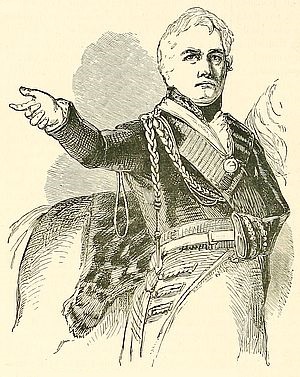
Sir David Baird, from a painting by Raeburn.
The result of this battle was the immediate retreat of the main army under Sir Hector Munro to Madras. Colonel Baillie, Captain Baird, and five other British officers were marched to one of Hyder’s nearest forts, and afterwards removed to Seringapatam, where they were joined by others of their captive countrymen, and subjected to a most horrible and protracted imprisonment. It was commonly believed in Scotland that Captain Baird was chained by the leg to another man; and Sir Walter Scott, writing in May 1821 to his son, then a cornet of dragoons, with his regiment in Ireland, when Sir David was commander of the forces there, says, “I remember a story that when report came to Europe that Tippoo’s prisoners (of whom Baird was one) were chained together two and two, his mother said, ‘God pity the poor lad that’s chained to our Davie!’” She knew him to be active, spirited and daring, and probably thought that he would make some desperate effort to escape. But it was not the case that he was chained to another. On the 10th of May all the prisoners had been put in irons except Captain Baird; this indignity he was not subjected to till the 10th of November following. “When they were about,” says his biographer, “to put the irons on Captain Baird, who was completely disabled in his right leg, in which the wound was still open, and whence the ball had just then been extracted, his friend Captain Lucas, who spoke the language perfectly, sprang forward, and represented in very strong terms to the Myar the barbarity of fettering him while in such a dreadful state, and assured him that death would be the inevitable termination of Captain Baird’s sufferings if the intention were persisted in. The Myar replied that the Circar had sent as many pairs of irons as there were prisoners, and they must be put on. Captain Lucas then offered to wear two sets himself, in order to save his friend. This noble act of generosity moved the compassion even of the Myar, who said he would send to the Kellidar, (commander of the fort,) to open the book of fate. He did so, and when the messenger returned, he said the book had been opened, and Captain Baird’s fate was good; and the irons were in consequence not put on at that time. Could they really have looked into the volume of futurity, Baird would undoubtedly have been the last man to be spared.”[392] Each pair of irons was nine pounds weight. Captain Lucas died in prison. Captain Baird lived to revenge the sufferings which he and his fellow-prisoners endured by the glorious conquest of Seringapatam on the 4th of May, 1799.
Some time after the battle of Conjeveram, Lord Macleod took ship for England, having, it is said, differed in opinion with General Munro on the subject of his movements, particularly those preceding Colonel Baillie’s disaster. He was succeeded in the command of the 73d by Colonel James Crawford, who, with the regiment now reduced to 500 men, joined the army under Sir Eyre Coote on the morning of the 1st of July 1781, when about to attack the enemy at Porto Novo.
General Coote’s army did not exceed 8000 men, of which the 73d was the only British regiment. The force under Hyder Ali consisted of 25 battalions of infantry, 400 Europeans, between 40,000 and 50,000 horse, and above 100,000 matchlock men, peons, and polygars, with 47 pieces of cannon. Notwithstanding this immense disparity of force, Sir Eyre Coote determined to attack Hyder, and, accordingly, drew up his army in two lines, the first commanded by Major-general Hector Munro, and the second by Major-general James Stewart. A plain divided the two armies, beyond which the enemy were drawn up on ground strengthened by front and flanking redoubts and batteries. General Coote advanced to the attack at nine o’clock, and, after a contest of eight hours, the enemy was forced from all his entrenchments, and compelled to retire.
The 73d was on the right of the first line, and led all the attacks, to the full approbation of General Coote, whose notice was particularly attracted by one of the pipers, who always blew up his most warlike sounds whenever the fire became hotter than ordinary. This so pleased the General that he cried aloud, “Well done, my brave fellow, you shall have a pair of silver pipes for this!” The promise was not forgotten, and a handsome pair of pipes was presented to the regiment, with an inscription in testimony of the General’s esteem for its conduct and character.
After a variety of movements, both armies again met, August 27th, near Perambaucum, the spot so fatal to Colonel Baillie’s detachment.
“Perhaps there come not within the wide range of human imagination scenes more affecting, or circumstances more touching, than many of our army had that day to witness and to bear. On the very spot where they stood lay strewed amongst their feet the relics of their dearest fellow soldiers and friends, who near twelve months before had been slain by the hands of those very inhuman monsters that now appeared a second time eager to complete the work of blood. One poor soldier, with the tear of affection glistening in his eye, picked up the decaying spatterdash of his valued brother, with the name yet entire upon it, which the tinge of blood and effects of weather had kindly spared. Another discovered the club or plaited hair of his bosom friend, which he himself had helped to form, and knew by the tie and still remaining colour. A third mournfully recognised the feather which had decorated the cap of his inseparable companion. The scattered clothes and wings of the flank companies of the 73d were everywhere perceptible, as also their helmets and skulls, both of which bore the marks of many furrowed cuts.
“These horrid spectacles, too melancholy to dwell upon, while they melted the hardest hearts, inflamed our soldiers with an enthusiasm and thirst of revenge such as render men invincible; but their ardour was necessarily checked by the involved situation of the army.”[393]
Hyder Ali, in anticipation of an attack, had taken up a strong position on ground intersected by deep water courses and ravines. The British commander formed his line of battle under a heavy fire, which the troops bore with firmness. An obstinate contest took place, which lasted from nine in the morning till sunset. Hyder then abandoned his position, leaving General Coote master of the field of battle. The loss of the British was upwards of 400 killed and wounded, almost all native troops.
Colonel Crawford having become second in command, in consequence of the departure of General Munro for England, and the disabling of General Stewart in the last-mentioned action, Captain Shaw assumed the command of the 73d regiment. It continued attached to General Coote’s army, and was present at the battles of Sholungar on the 27th of September 1781, and of Arnee on the 2d of June 1782.[394]
Having obtained reinforcements from England, General Stewart, who had recovered from his wounds, and succeeded to the command of the army on the death of General Coote, who died in April 1783, resolved to attack Cuddalore, the garrison of which had also obtained considerable additions from the Isle of France. General Stuart accordingly appeared before the place on the 6th of June 1783, and as M. Bussy, who commanded the garrison, was active in increasing his means of defence, he determined to make a speedy attack, and fixed the morning of the 13th for that purpose. The firing of three guns from a hill was to be the signal for a simultaneous assault at three different points; but in consequence of the noise of the cannonade which was immediately opened, the signals were not distinguished, and the attacks were not made at the same time. The enemy were thus enabled to direct their whole forces against each successive attack, and the result was, that one of the divisions was driven back. In the ardour of the pursuit, the besieged evacuated their redoubts, which were instantly taken possession of by Lieutenant-colonel Cathcart with the Grenadiers, and Lieutenant-colonel Stuart “with the precious remains of the 73d regiment.” Though Colonel Stuart’s party were forced to retire from the more advanced posts, yet as they retained possession of the principal redoubts, the advantage already was on the side of the British. In the belief that the French would retire from all their advanced posts during the night, General Stuart did not attempt to carry them. This expectation was realised. In this affair the 73d had Captains Alexander Mackenzie, and the Honourable James Lindsay, Lieutenants Simon Mackenzie and James Trail, 4 sergeants and 80 rank and file killed; and Captain John Hamilton, Lieutenants Charles Gorrie, David Rannie, John Sinclair, James Duncan, and George Sutherland, 5 sergeants, and 107 rank and file wounded. The casualties of the enemy exceeded 1000 men.
The following flattering compliment formed part of the general orders issued by the Commander-in-chief at the conclusion of the battle:—“I am also grateful to Captain Lamont and the officers under his command, who gallantly led the precious remains of the 73d regiment through the most perilous road to glory, until exactly one half of the officers and men of the battalion were either killed or wounded.”
With the aid of 2400 men from the fleet, under Admiral Suffrein, Bussy made a spirited sortie on the 25th of June, but was driven back with great loss. Hostilities terminated on the 1st of July in consequence of accounts of the signature of preliminaries of peace between Great Britain and France having been received. The army returned to St Thomas’s Mount at the conclusion of the definitive treaty of peace, in March, 1784.
In consequence of the arrangements made when the second battalion was reduced, the Honourable Lieutenant-Colonel George Mackenzie, and some other officers of that corps, joined the regiment in 1785. Next year the number of the regiment was changed to the 71st, on which occasion it received new colours. The same year the corps sustained a heavy loss by the death of Colonel Mackenzie, when Captain (afterwards General Sir David) Baird was appointed Major. Lord Macleod died in 1789, and was succeeded in the Colonelcy by the Honourable Major-General William Gordon. The strength of the regiment was at this time about 800 men, having been kept up to that number by occasional detachments from Scotland.
The war between Tippoo Saib and the East India Company, which broke out in 1790, brought the regiment again into active service. In May of that year, the 71st and Seaforth’s Highlanders (now the 72d), joined a large army assembled at Trichinopoly, the command of which was assumed by Major-General Meadows. The right wing was commanded by Lieutenant-Colonel James Stuart, and the left by Lieutenant-Colonel Bridges, while the two Highland regiments formed the second brigade. In the campaign against Tippoo, the 71st followed all the movements of the army. The flank companies were employed in the attack on Dundegul, and the regiment was after the capture of that place, engaged in the siege of Palacatcherry.
Lord Cornwallis joined the army early in 1791 as Commander-in-chief, and, after various movements, encamped close to Bangalore on the 5th of March. He made an assault on the 21st, and carried the place with little loss. The attack was led by the flank companies, including those of the 71st, all under the command of the Honourable John Lindsay and Captain James Robertson, son of Principal Robertson the historian.
Having obtained a reinforcement of 10,000 well-mounted native cavalry and some European troops from the Carnatic, Lord Cornwallis advanced upon Seringapatam, and on the 13th of May came within sight of the enemy, drawn up a few miles from the town, having the river on their right, and the heights of Carrighaut on their left. On the 15th the enemy were forced from a strong position, and driven across the river into the island on which the capital stands. In this affair the 71st had Lieutenant Roderick Mackenzie, and 7 rank and file killed; and Ensign (afterwards Lieutenant-Colonel of the 50th regiment[395]) Chas. Stewart, and 74 rank and file wounded.
The advanced state of the season, and other unfavourable circumstances operating against a siege, Lord Cornwallis retired to Bangalore. From this place he detached Major Gowdie to attack Nundydroog, a strong fortified granite rock of great height. Except on one side this fortress was inaccessible, and care had been taken to strengthen that part by a double line of ramparts; and an outwork covered the gate by a flanking fire. Notwithstanding its great elevation, and very steep ascent, Nundydroog could still be approached, though it required immense labour to render the approaches available. After fourteen days’ intense exertion, the besiegers succeeded in drawing up some guns, and erecting batteries on the face of a craggy precipice, from which they made two breaches, one on the re-entering angle of the outwork, and the other in the curtain of the outer wall.
Moving with his whole army towards Nundydroog, on the 18th of October, Lord Cornwallis made preparations for storming the place. An assault by night having been determined upon, Lieutenant Hugh Mackenzie, (afterwards paymaster of the 71st,) with twenty grenadiers of the 36th and 71st regiments, was to lead the attack on the right, and Lieutenant Moore, with twenty light infantry, and two flank companies of the same regiment, under the command of Lieutenants Duncan and Kenneth Mackenzie, was to lead the left. The whole was under the command of Captain (afterwards Lieutenant-General) James Robertson, supported by Captain (afterwards Major-General) Burns, with the grenadiers, and Captain Hartly with the light infantry of the 36th regiment. Whilst waiting the signal to advance, one of the soldiers whispered something about a mine. General Meadows overhearing the observation, took advantage of the circumstance, by intimating that there was a mine, but it was “a mine of gold.” This remark was not thrown away upon the troops.
Apprehensive of an assault, the enemy had provided themselves with huge masses of granite, to hurl down upon the besiegers when they should attempt to ascend the rock. The assault was made on the morning of the 19th of October, in a clear moonlight, and in spite of every obstacle the assailants effected a lodgement within one hundred yards of the breach. Driven from the outward rocks, the enemy attempted to barricade the gate of the inner rampart; but it was soon forced, and the place carried with the loss of 30 men amongst the native troops killed and wounded, principally from the stones which were rolled down the rock.
Encouraged by this success, Lord Cornwallis next laid siege to Savendroog, the strongest rock in the Mysore, and hitherto deemed impregnable. This stronghold was considerably higher than Nundydroog, and was separated by a chasm into two parts at the top, on each of which parts was a fort, but each independent of the other. The arduous duty of reducing this stronghold was intrusted to Lieutenant-Colonel Stuart, who had already distinguished himself in other enterprises. Some of the outworks were battered, preparatory to an assault, which was fixed for the 21st of December. Accordingly on the morning of that day, the flank companies of the 52d, the two Highland regiments and the 76th, were assembled under the command of Lieutenant-Colonel Nisbet of the 52d, and at eleven o’clock in the forenoon, the party advanced to the assault to the air of Britons Strike Home, performed by the band of the 52d regiment. The assailants then ascended the rock, clambering up a precipice which was so nearly perpendicular, that after the capture of the place the men were afraid to descend. The citadel on the eastern top was soon carried, and eventually the whole of the rock, the assailants losing only two men. This success was soon followed by the capture of all the other strongholds in the Mysore.
Bent upon the capture of the Sultan’s capital, the possession of which would, it was supposed, finish the war, Lord Cornwallis, in the month of January 1792, put his army in motion for Seringapatam, of which place he came in sight on the 4th of February. On the evening of the 6th he formed his army into three columns; the right column consisting of the 36th and 76th regiments, being under the command of General Meadows; the centre one, consisting of the 52d, with the 71st and 74th Highland regiments, under Lord Cornwallis, with Lieutenant-Colonels James Stuart and the Honourable John Knox; and the left column, being the 72d Highland regiment under Lieutenant-Colonel Maxwell. The native troops were divided in proportion to each column. General Meadows was to penetrate the enemy’s left, after which he was to attempt to open and preserve the communication with Lord Cornwallis’s division, by directing all his efforts towards the centre. Part of the centre division, under Colonel Stewart, was to pierce through the centre of the enemy’s camp, and attack the works on the island, while Colonel Maxwell with the left wing was directed to force the works on Carrighaut Hill, and descending thence to turn the right of the main division, and unite with Colonel Stuart. The three columns began to move at eight o’clock in the evening. “The head of the centre column led by the flank companies of the regiment, after twice crossing the Lockary, which covered the right wing of the enemy, came in contact with their first line, which was instantly driven across the north branch of the Cavery, at the foot of the glacis of the fort of Seringapatam. Captain Lindsay, with the grenadiers of the 71st, attempted to push into the body of the place, but was prevented by the raising of the drawbridge a few minutes before he advanced. He was here joined by some grenadiers and light infantry of the 52d and 76th regiments. With this united force he pushed down to the Loll Bang, where he was fiercely attacked by a body of the enemy, whom he quickly drove back with the bayonet. His numbers were soon afterwards increased by the grenadier company of the 74th, when he attempted to force his way into the Pettah (or town,) but was opposed by such overwhelming numbers that he did not succeed. He then took post in a small redoubt, where he maintained himself till morning, when he moved to the north bank of the river, and joined Lieutenant-Colonels Knox and Baird, with the troops who formed the left of the attack. During these operations the battalion companies of the 52d, 71st, and 72d regiments forced their way across the river to the island, overpowering all that opposed them. At this moment, Captain Archdeacon, commanding a battalion of Bengal sepoys, was killed. This threw the corps into some confusion, and caused it to fall back on the 71st, at the moment that Major Dalrymple was preparing to attack the Sultan’s redoubt, and thus impeded his movements. However, the redoubt was attacked, and instantly carried. The command was given to Captain Sibbald, who had led the attack with his company of the 71st. The animating example and courage of this officer made the men equally irresistible in attack, and firm in the defence of the post they had gained. The enemy made several vain attempts to retake it. In one of these the brave Captain Sibbald was killed. Out of compliment to this officer, the Commander-in-chief changed the name from Sultan’s to Sibbald’s redoubt. In this obstinate defence the men had consumed their ammunition, when, by a fortunate circumstance, two loaded oxen of the enemy, frightened by the firing, broke loose from their drivers, and taking shelter in the ditch of this redoubt, afforded an ample and seasonable supply. The command of this post was assumed by Major Kelly of the 74th regiment, who had gone up with orders from the Commander-in-chief, and remained there after the death of Captain Sibbald. The Sultan seemed determined to recover this redoubt distinguished by his own name, and directed the French troops to attack it. But they met with no better success than the former, notwithstanding their superior discipline.”[396]
The loss of the enemy in this affair was estimated at 4000 men and 80 pieces of cannon. That on the side of the assailants was 535 men killed and wounded. Of the 71st, Captain Sibbald and Lieutenant Baine, 2 sergeants, and 34 rank and file were killed; and Ensigns Duncan Mackenzie, and William Baillie, 3 sergeants, and 67 rank and file wounded.
On the 9th of February Major-General Robert Abercromby, with the army from Bombay, consisting of the 73d and 75th Highland, and 77th, besides some native regiments, joined the besieging army. Operations for the siege were begun the same day; but nothing particular occurred till the 18th, when Major Dalrymple, to cover the opening of the trenches, crossed the Cavery at nine o’clock at night, and surprised and routed a camp of Tippoo’s horse. During the three following days traverses were finished; and on the 22d, the enemy, after a warm contest, were defeated by a part of the Bombay army under General Abercromby. This was the last effort of the Sultan, who sued for peace, and obtained it at the expense of nearly one-half of his dominions, which he ceded to the East India Company.
On the termination of the war, the 71st, now under the command of Lieutenant-colonel David Baird, was marched to the neighbourhood of Trichinopoly, where they remained till the breaking out of the war with France, in 1793. The flank companies were employed on the expedition against Ceylon, in the month of August that year, in which enterprise Captain Gorrie was severely wounded, and 11 men were killed and wounded.
On the 2d of January 1797, the regiment was inspected by Major-general Clarke, who issued the following general order:—
“Major-General Clarke has experienced infinite satisfaction, this morning, at the review of His Majesty’s 71st regiment.
“He cannot say that on any occasion of field exercise he ever was present at a more perfect performance.
“When a corps is so striking in appearance, and so complete in every branch of its discipline, little can occur to the Commander in-chief to particularise. He cannot but notice, however, that the 71st regiment has excited his admiration for its expertness in those parts of its exercise which are most essential, and most difficult to execute. He alludes to its order and regularity when moving in line; its extreme accuracy in preserving distances, and the neatness and promptitude that are so evident in all its formations. So much perfection in a corps, whose services in India will long be held in remembrance, does the greatest honour to Lieut.-Colonel Baird and all his officers, to whom, and the corps at large, the Commander-in-chief desires to offer his best thanks.”
In October 1797, in consequence of orders, all the soldiers fit for service, amounting to 560 men, were drafted into the 73d and 74th regiments; those unfit for service, along with the officers and non-commissioned officers, sailed from Madras for England on the 17th of October, and arrived in the Thames in August 1798. The regiment was then removed to Leith, and thence to Stirling, after an absence of nearly 18 years from Scotland.[397]
As a mark of indulgence, a general leave of 2 months was granted to the officers and men of the 71st, to enable them to visit their friends and families, after so long an absence from their native country.
The regiment remained in Scotland till June, 1800, when it was removed to Ireland, having previously received an accession of 600 volunteers from the Scottish fencible regiments. This augmented the corps to 800 men, of whom 600 were Highlanders. On the 24th of April, 1801, Lieutenant-Colonel Pack joined and assumed command of the regiment. In August 1803, Major-General Sir John Francis Cradock was appointed Colonel of the 71st, in succession to General the Honourable William Gordon. A second battalion was ordered to be embodied at Dumbarton, in the year 1804. From the success with which the recruiting for this battalion was carried on in Glasgow, and the favour shown to the men by the inhabitants, the corps acquired the name of the “Glasgow Highland Light Infantry.”
The first battalion sailed from Cork on the 5th of August, 1805, on the expedition against the Cape of Good Hope, (of which an account will be found under the head of the Sutherland Regiment,) and reached its destination on the 4th of January 1806. On this service the regiment had 6 rank and file killed, and Brevet-Lieutenant-Colonel Robert Campbell, 5 sergeants, and 67 rank and file wounded.
This enterprise was followed by that against Buenos Ayres, of which the 71st formed the chief force. The expedition reached the Rio de la Plata on the 8th of June, and passing Monte Video, anchored opposite to the city of Buenos Ayres, on the 24th. The troops and the marines of the fleet, amounting together to about 1400 men, landed the following evening without opposition. Next forenoon the troops moved forward to the village of Reduction in full view of the enemy, who were posted on the brow of an adjoining eminence. The enemy, after firing a few shots, retired into the city. On the 27th the passage of the Rio Chuelo was forced, and the result was that the city surrendered. The Spaniards, however, soon attempted to regain what they had lost, and in the beginning of August collected a force of 1500 men in the neighbourhood; but these were attacked and dispersed by General Beresford, with a detachment of the 71st, and the corps of St Helena. Notwithstanding their dispersion, however, these troops collected again, and on the 10th of August, surprised and cut off a sergeant’s guard. Next day the town was abandoned by the British, who retired to the fort, and seeing no prospect of relief, capitulated the same evening. The 71st lost in this expedition Lieutenant Mitchell and Ensign Lucas, and 91 non-commissioned officers and privates were killed and wounded.
After the capitulation of General Whitelock’s army, the regiment was restored to liberty, and embarked with the troops for England. The regiment landed in Ireland and marched to Middleton and afterwards to Cork, where it received a reinforcement of 200 men from the second battalion, by which the effective force was increased to 920 men. On the 21st of April, 1808, the regiment received new colours instead of those they had surrendered at Buenos Ayres. The colours were presented by General Floyd, a veteran officer, who had frequently witnessed the gallantry of the 71st in India. He made an eloquent speech on the occasion, the conclusion of which was as follows:—
“Seventy-first,
“I am directed to perform the honourable duty of presenting your colours.
“Brave Seventy-first! The world is well acquainted with your gallant conduct at the capture of Buenos Ayres, in South America, under one of His Majesty’s bravest generals.
“It is well known that you defended your conquest with the utmost courage, good conduct, and discipline to the last extremity. When diminished to a handful, hopeless of succour, and destitute of provisions, you were overwhelmed by multitudes, and reduced by the fortune of war to lose your liberty, and your well-defended colours, but not your honour. Your honour, Seventy-first regiment, remains unsullied. Your last act in the field covered you with glory. Your generous despair, calling upon your general to suffer you to die with arms in your hands proceeded from the genuine spirit of British soldiers. Your behaviour in prosperity,—your sufferings in captivity,—and your faithful discharge of your duty to your King and country, are appreciated by all.
“You who now stand on this parade, in defiance of the allurements held out to base desertion, are endeared to the army and to the country, and your conduct will ensure you the esteem of all true soldiers,—of all worthy men,—and fill every one of you with honest martial pride.
“It has been my good fortune to have witnessed, in a remote part of the world, the early glories and gallant conduct of the Seventy-first regiment in the field; and it is with great satisfaction I meet you again, with replenished ranks, and with good arms in your hands, and with stout hearts in your bosoms.
“Look forward, officers and soldiers, to the achievement of new honours and the acquirement of fresh fame.
“Officers, be the friends and guardians of these brave fellows committed to your charge.
“Soldiers, give your confidence to your officers. They have shared with you the chances of war; they have bravely bled along with you; they will always do honour to themselves and you. Preserve your regiment’s reputation for valour in the field and regularity in quarters.
“I have now the honour to present the
Royal Colour. This is the King’s Colour.
“I have now the honour to present your
Regimental Colour.
“This is the colour of the Seventy-first regiment.
“May victory for ever crown these colours.”
The expectations which General Floyd had formed of the regiment were soon to be realised. In the month of June the first battalion of the regiment embarked at Cork for Portugal, in the expedition under Sir Arthur Wellesley, which sailed on the 13th of July. The fleet arrived in Mondego Bay on the 29th, and the forces, amounting to 10,000 men, landed early in August. In a few days a body of 5000 troops from Gibraltar joined the army. General Wellesley made a forward movement towards Lisbon on the 9th of August, and was joined on the 11th by 6000 Portuguese, but being destitute of provisions and military stores he could not proceed. The British army reached Caldas on the 14th—four companies of the 60th and Rifle corps pushing forward to the village of Brilos, then in possession of the enemy. An affair of advanced posts now took place, which ended in the occupation of the village by the British. This was the commencement of a series of battles and operations which raised the military fame of Great Britain to the highest pitch, overtopping all the glories of Marlborough’s campaigns. Lieutenant Bunbury and a few privates of the Rifle corps were killed on this occasion.
The French under General Laborde, amounting to upwards of 5000 men, took up a position on the heights of Roleia, whither they were followed by the British on the 17th. These heights were steep and very difficult of access, with only a narrow path leading to the summit; but notwithstanding the almost insuperable obstacles which presented themselves, the position was carried by the British, after a gallant resistance by the French, who were forced to retreat at all points. The light company of the 71st was the only part of the regiment engaged, the remainder being employed in manœuvring on the right flank of the French. The company had only one man killed and one wounded.
The regiment acted a conspicuous part in the battle of Vimeira, which took place on the 21st of August 1808.
It was Sunday morning, and the men were engaged in washing their clothes, cleaning their firelocks, and in other employments, when the French columns made their appearance on the opposite hills, about half-past eight. “To arms” was sounded, and everything being packed up as soon as possible, the 71st, along with the other brigaded regiments, left the camp ground, and moved across a valley to the heights on the east of Vimeira.
The grenadier company of the 71st greatly distinguished itself, in conjunction with a sub-division of the light company of the 36th regiment. Captain Alexander Forbes, who commanded the grenadier company, was ordered to the support of some British artillery, and, seizing a favourable opportunity, made a dash at a battery of the enemy’s artillery immediately in his front. He succeeded in capturing five guns and a howitzer, with horses, caissons, and equipment complete. In this affair alone the grenadier company had Lieutenants John Pratt and Ralph Dudgeon and 13 rank and file wounded, together with 2 men killed.[398]
The French made a daring effort to retake their artillery, both with cavalry and infantry; but the gallant conduct of the grenadier company, and the advance of Major-General Ferguson’s brigade, finally left the guns in the possession of those who had so gallantly captured them.
George Clark, one of the pipers of the regiment, and afterwards piper to the Highland Society of London, was wounded in this action, and being unable to accompany his corps in the advance against the enemy, put his pipes in order, and struck up a favourite regimental air, to the great delight of his comrades. This is the second instance in which the pipers of the 71st have behaved with particular gallantry, and evinced high feeling for the credit and honour of the corps.
During the advance of the battalion, several prisoners were taken, among whom was the French general, Brennier. Corporal John M’Kay, of the 71st, who took him, was afterwards promoted to an ensigncy in the Fourth West India Regiment.
The result of this battle was the total defeat of the enemy, who subsequently retreated on Lisbon, with the loss of twenty-one pieces of cannon, twenty-three ammunition waggons, with powder, shells, stores of all descriptions, and 20,000 rounds of musket ammunition, together with a great many officers and soldiers killed, wounded, and taken prisoners.
The conduct of the battalion, and of its commanding officer, Lieut.-Colonel Pack, was noticed in the public despatches, and the thanks of both Houses of Parliament were conferred on the troops.
The following officers of the 71st were wounded in the battle of Vimeira:—Captains Arthur Jones and Maxwell Mackenzie; Lieutenants John Pratt, William Hartley, Augustus M’Intyre, and Ralph Dudgeon; Ensign James Campbell, and Acting Adjutant R. M’Alpin.
The 71st subsequently received the royal authority to bear the word “Vimeira” on the regimental colour and appointments, in commemoration of this battle.
The “Convention of Cintra,” signed on the 30th of August, was the result of this victory. By its provisions the French army evacuated Portugal, which thus became freed from its oppressors.
In September, Lieutenant-General Sir John Moore assumed the command and made dispositions for entering Spain. The 71st was brigaded with the 36th and 92d regiments under Brigadier-General Catlin Crawfurd, and placed in the division under the command of Lieutenant-General the Honourable John Hope, afterwards the Earl of Hopetoun. On the 27th October the division left Lisbon, and joined the forces under Moore at Salamanca. The regiment took part in the disastrous retreat under Sir John Moore to Corunna, and along with the rest of the army suffered dreadfully from the severity of the weather, want of food and clothing, and disease.
“At this period the situation of the British army was dispiriting in the extreme. In the midst of winter, in a dreary and desolate country, the soldiers, chilled and drenched with the heavy rains, and wearied by long and rapid marches, were almost destitute of fuel to cook their victuals, and it was with extreme difficulty that they could procure shelter. Provisions were scarce, irregularly issued, and difficult of attainment. The waggons, in which were their magazines, baggage, and stores, were often deserted in the night by the Spanish drivers, who were terrified by the approach of the French. Thus baggage, ammunition, stores, and even money were destroyed to prevent them falling into the hands of the enemy; and the weak, the sick, and the wounded were necessarily left behind. The 71st suffered in proportion with the rest, and by weakness, sickness, and fatigue, lost about 93 men.”[399]
In January 1809, Lieutenant-General Francis Dundas was appointed from the 94th regiment to be Colonel of the 71st, in succession to Sir John Francis Cradock, removed to the 43d.
On the 11th of January the army under Moore arrived at Corunna, where the furious battle was fought in which this famous leader got his death-wound. We have already, in our account of the 42d, given sufficient details of this engagement. While waiting for the transports some skirmishing took place with the French, in which four companies of the 71st were warmly engaged, and lost several men in killed and wounded. In the general battle on the 16th, the 71st, being placed on the extreme left of the British line, had little to do therein. In commemoration of this battle, and of the conduct of the regiment during the expedition, the 71st was authorised to bear the word Corunna on the regimental colours and appointments.
On the 17th of January the army embarked for England, and reached Plymouth about the end of the month, where the men were received by the people with the utmost enthusiasm, and were welcomed into every house as if they had been relations.[400] The battalion in which was the 71st was marched to Ashford barracks, where it remained for some time. In June the first battalion was increased by the addition of several officers and 311 non-commissioned officers and men from the second battalion which continued to be stationed in Scotland, and by a number of volunteers from the militia.
In March 1809, the royal authority was granted for the 71st to be formed into a light infantry regiment, when it was directed that the clothing, arming, and discipline should be the same as those of other regiments of a similar kind. However, it cannot be said to have ceased to be a Highland regiment, for the men were permitted to retain such parts of the national dress as might not be inconsistent with their duties as a light corps. Lieutenant-Colonel Pack wrote to the Adjutant-General, in April 1810, on the subject, and received the following reply from headquarters:—
“Horse Guards, 12th April 1810.
“Sir,—Having submitted to the Commander-in Chief your letter of the 4th instant, I am directed to state, that there is no objection to the 71st being denominated Highland Light Infantry Regiment, or to the retaining of their pipes, and the Highland garb for the pipers; and that they will, of course, be permitted to wear caps according to the pattern which was lately approved and sealed by authority.[401]
“I have, &c.
“William Wynyard,
“Deputy-Adjutant-General.
“Lieut.-Colonel Pack, “71st Regiment.“
The 71st was next employed on the disastrous expedition to Walcheren, for which the most gigantic preparations had been made. The troops amounted to 40,000 men, commanded by Lieutenant-General the Earl of Chatham, while the naval portion consisted of 39 ships of the line, 36 frigates, and numerous gun-boats and bomb-vessels, and other small craft, under Admiral Sir James Strachan.
On the 16th of July, the first battalion of the 71st, consisting of 3 field-officers, 6 captains, 27 subalterns, 48 sergeants, and 974 drummers and rank and file, embarked at Portsmouth on board the Belleisle and Impérieuse. The expedition sailed from the Downs on the 28th of July, and in about thirty hours reached Roompet Channel, when the 71st was the first to disembark. It was brigaded with the 68th and 85th regiments, under the command of Brigadier-General the Baron de Rottenburg, in the division commanded by Lieutenant-General Alexander Mackenzie-Fraser, and the corps of Lieutenant-General Sir Eyre Coote. The light brigade, consisting of the 71st, 68th, and 85th light infantry, were landed under cover of the fire of some small craft, and immediately on landing came in contact with the enemy’s sharpshooters, who fell back skirmishing. Two of the companies of the 71st captured four guns and several prisoners. A battery and flagstaff on the coast were taken possession of by the 10th company of the 71st, and in place of a flag, a soldier’s red jacket was hoisted on it. Further details of this expedition we take the liberty of copying from Cannon’s history of this regiment.
“This advance having succeeded at all points, and the enemy having fallen back on Flushing and Middelburg, the army was disembarked. The advance then dividing, proceeded by different routes. The 71st moved by the sea dyke on a fort called Ter Veer, the situation and strength of which was not sufficiently known, an enemy’s deserter having given but imperfect intelligence respecting it.
“After nightfall the column continued to advance in perfect silence, with orders to attack with the bayonet, when, on a sudden, the advance-guard fell in with an enemy’s party, who came out for the purpose of firing some houses which overlooked the works. The column following the advance-guard had entered an avenue or road leading to the fort, when the advance commenced the action with the enemy, who, retiring within the place, opened a tremendous fire from his works with artillery and musketry. Some guns pointing down the road by which the battalion advanced did great execution, and the 71st had Surgeon Charles Henry Quin killed, and about 18 men killed and wounded. The column, after some firing, retired, and the place was the next day regularly invested by sea and land. It took three days to reduce it, when it capitulated, with its stores, and a garrison of 800 men.
“Flushing having been invested on the 1st of August, the 71st, after the surrender of Ter Veer, were ordered into the line of circumvallation, and placed on the extreme left, resting on the Scheldt. The preparations for the attack on the town having been completed, on the 13th a dreadful fire was opened from the batteries and bomb-vessels, and congreve rockets having been thrown into the town, it was on fire in many places. The ships having joined in the attack, the enemy’s fire gradually slackened, and at length ceased. A summons being sent in, a delay was demanded, but being rejected, the firing recommenced.
“On the 14th of August one of the outworks was carried at the point of the bayonet by a party of detachments and two companies of the 71st under Lieutenant-Colonel Pack.
“In this affair Ensign Donald Sinclair, of the 71st, was killed; Captain George Spottiswoode and a few men were wounded.
“Flushing, with its garrison of 6000 men, capitulated on the 15th of August, and the right gate was occupied by a detachment of 300 men of the first or Royal Scots, and the left gate by a detachment of similar strength of the 71st under Major Arthur Jones. The naval arsenal, and some vessels of war which were on the stocks, fell into the hands of the British.
“The 71st shortly after proceeded to Middelburg, where the battalion remained for a few days, when it was ordered to occupy Ter Veer, of which place Lieutenant-Colonel Pack was appointed commandant, and Lieutenant Henry Clements, of the 71st, town major. The battalion remained doing duty in the garrison until this island, after the works, &c., were destroyed, was finally evacuated on the 22d of December.
“On the 23d of December, the battalion embarked in transports, and sailed for England, after a service of five months in a very unhealthy climate, which cost the battalion the loss of the following officers and men:—
Officers.Sergeants, Drummers,
and Rank and File.
Died on service157
Killed219
Died after return home2 9
——
Total585
“In passing Cadsand, that fort opened a fire on the transports, one of which, having part of the 71st on board, was struck by a round shot, which carried off Sergeant Steele’s legs above the knees.
“On the 25th of December, the first battalion of the 71st disembarked at Deal, and marched to Brabourne-Lees Barracks, in Kent, where it was again brigaded with the 68th and 85th light infantry, and was occupied in putting itself in an efficient state for active service.”[402]
In May 1810, the battalion removed to Deal Barracks, and while here Lieutenant-Colonel Pack was removed from the regiment to become a brigadier in the Portuguese army. In the early part of September the battalion received orders to prepare six companies for foreign service, which was done by drafting into the 1st, 2d, 3d, 4th, 6th, and 10th companies the most effective officers and men belonging to the other companies. When completed, the companies altogether consisted of 30 officers, 42 sergeants, and 615 rank and file. These companies sailed on the 15th September from the Downs in two frigates, and disembarked at Lisbon on the 26th of the same month, when the men were quartered in two convents. “To my great joy,” says the Journal of a Soldier of the 71st, “we paraded in the grand square, on the seventh day after our arrival, and marched in sections, to the music of our bugles, to join the army: having got our camp equipments, consisting of a camp-kettle and bill-hook, to every six men; a blanket, a canteen, and haversack, to each man. Orders had been given that each soldier, on his march, should carry along with him three days’ provision. Our mess of six cast lots who should be cook the first day, as we were to carry the kettle day about; the lot fell to me. My knapsack contained two shirts, two pairs of stockings, one pair of overalls, two shoe-brushes, a shaving box, one pair of spare shoes, and a few other articles; my great-coat and blanket above the knapsack; my canteen with water was slung over my shoulder, on one side; my haversack, with beef and bread, on the other; sixty round of ball-cartridge, and the camp-kettle above all.”[403]
At Mafra, to which place the detachment marched on the 2nd of October, it was joined by Lieutenant-Colonel the Honourable Henry Cadogan, who assumed the command. The detachment joined the army under Wellington at Sobral on the 10th, and was brigaded with the 50th and 92d regiments, under Major-General Sir William Erskine, in the first division under Lieutenant-General Sir Brent Spencer. We cannot do better than quote from the simple but graphic journal already referred to:—
“We had not been three hours in the town, and were busy cooking, when the alarm sounded. There were nine British and three Portuguese regiments in the town. We were all drawn up and remained under arms, expecting every moment to receive the enemy, whose skirmishers covered Windmill Hill. In about an hour the light companies of all the regiments were ordered out, along with the 71st. Colonel Cadogan called to us, at the foot of the hill, ‘My lads, this is the first affair I have ever been in with you; show me what you can do, now or never.’ We gave a hurra, and advanced up the hill, driving their advanced skirmishers before us, until about half-way up, when we commenced a heavy fire, and were as hotly received. In the meantime the remaining regiments evacuated the town. The enemy pressed so hard upon us, we were forced to make the best of our way down the hill, and were closely followed by the French, through the town, up Gallows Hill. We got behind a mud wall, and kept our ground in spite of their utmost efforts. Here we lay upon our arms all night.
“Next morning, by day-break, there was not a Frenchman to be seen. As soon as the sun was fairly up, we advanced into the town, and began a search for provisions, which had now become very scarce; and, to our great joy, we found a large store-house full of dry fish, flour, rice, and sugar, besides bales of cloth. All now became bustle and mirth; fires were kindled, and every man became a cook. Scones[404] were the order of the day, Neither flour nor sugar were wanting, and the water was plenty; so I fell to bake myself a flour scone. Mine was mixed and laid upon the fire, and I, hungry enough, watching it. Though neither neat nor comely, I was anticipating the moment when it would be eatable. Scarce was it warm ere the bugle sounded to arms. Then was the joy that reigned a moment before turned to execrations. I snatched my scone off the fire, raw as it was, put it into my haversack, and formed. We remained under arms until dark, and then took up our old quarters upon Gallows Hill, where I ate my raw scone, sweetly seasoned by hunger. In our advance to the town we were much entertained by some of our men who had got over a wall the day before, when the enemy were in the rear; and now were put to their shifts to get over again, and scarce could make it out.