Volume 2 / Part 3 — PART THIRD. HISTORY OF THE HIGHLAND REGIMENTS. (continued 8)
Reading edition
“Next morning the French advanced to a mud wall, about forty yards in front of the one we lay behind. It rained heavily this day, and there was very little firing. During the night we received orders to cover the bugle and tartans of our bonnets with black crape, which had been served out to us during the day, and to put on our great-coats. Next morning the French, seeing us thus, thought we had retired, and left Portuguese to guard the heights. With dreadful shouts they leaped over that wall before which they had stood, when guarded by British. We were scarce able to withstand their fury. To retreat was impossible; all behind being ploughed land, rendered deep by the rain. There was not a moment to hesitate. To it we fell, pell-mell, French and British mixed together. It was a trial of strength in single combat: every man had his opponent, many had two.” In the first of these affairs the detachment had 8 men killed and 34 wounded. In Wellington’s despatch concerning the affair of the 14th, the names of Lieutenant-Colonels Cadogan and Reynell were particularly mentioned. John Rea, a soldier of the 6th company of the 71st behaved on this occasion with so much gallantry, and so particularly distinguished himself, that he received a silver medal, inscribed ‘To John Rea, for his exemplary courage and good conduct as a soldier at Sobral, 14th October 1810.’
“On the 15th October the 71st retired between the lines at Tibreira, a continuation of those at Torres Vedras. Here the detachment remained along with the other regiments watching Marshal Massena, until the latter was compelled to retire from want of provisions in the nights between the 14th and 15th November. He was followed by the allied forces, and the 71st, along with the rest of its division, were quartered in and about Almoster from the 20th to the 26th. Massena took up a position in the vicinity of Santarem, and Wellington, after some manœuvring, placed himself in front of the enemy, having his headquarters at Cartano. The 71st was quartered in a convent at Alquintrinha, where the detachment remained until March 1811. In this month two companies of the 1st battalion arrived in the Peninsula to reinforce the regiment, other two coming out in July. On the night of the 5th of March, the French gave the British army the slip, deceiving the latter by placing wooden guns in their batteries, and stuffing old clothes with straw, which they put in place of their sentinels. It was two days before the trick was discovered. The British army immediately followed in pursuit, but did not come up with the enemy until they reached the Aguida on the 9th of April. The division, in which was the 71st, was posted at Abergaria, a small town on the frontiers of Spain, where it remained till the 30th April, when, on account of the movements of the enemy, the British army was moved out of its cantonments, and was formed in line on the high ground about two miles in rear of Fuentes d’Onor.
“On the 3rd of May, at day-break, all the cavalry and sixteen light companies occupied the town. We stood under arms until three o’clock, when a staff-officer rode up to our colonel, and gave orders for our advance. Colonel Cadogan put himself at our head, saying, ‘My lads, you have had no provisions these two days; there is plenty in the hollow in front, let us down and divide.’ We advanced as quick as we could run, and met the light companies retreating as fast as they could. We continued to advance at double-quick time, our firelocks at the trail, our bonnets in our hands. They called to us, ‘Seventy-first, you will come back quicker than you advance.’ We soon came full in front of the enemy. The colonel cried, ‘Here is food, my lads; cut away.’ Thrice we waved our bonnets, and thrice we cheered; brought our firelocks to the charge, and forced them back through the town.
“How different the duty of the French officers from ours! They, stimulating the men by their example; the men vociferating, each chafing each until they appear in a fury, shouting, to the points of our bayonets. After the first huzza, the British officers, restraining their men, still as death—‘Steady, lads, steady,’ is all you hear, and that in an under tone.
“During this day the loss of men was great. In our retreat back to the town, when we halted to check the enemy, who bore hard upon us, in their attempts to break our line, often was I obliged to stand with a foot upon each side of a wounded man, who wrung my soul with prayers I could not answer, and pierced my heart with his cries to be lifted out of the way of the cavalry. While my heart bled for them, I have shaken them rudely off.
“We kept up our fire until long after dark. About one o’clock in the morning we got four ounces of bread served out to each man, which had been collected out of the haversacks of the Foot Guards. After the firing had ceased, we began to search through the town, and found plenty of flour, bacon, and sausages, on which we feasted heartily, and lay down in our blankets, wearied to death. Soon as it was light the firing commenced, and was kept up until about ten o’clock, when Lieutenant Stewart, of our regiment, was sent with a flag of truce, for leave to carry off our wounded from the enemy’s lines, which was granted; and, at the same time, they carried off theirs from ours. We lay down, fully accoutred, as usual, and slept in our blankets. An hour before day we were ready to receive the enemy.
“About half-past nine o’clock, a great gun from the French line, which was answered by one from ours, was the signal to engage. Down they came, shouting as usual. We kept them at bay, in spite of their cries and formidable looks. How different their appearance from ours! their hats set round with feathers, their beards long and black, gave them a fierce look. Their stature was superior to ours; most of us were young. We looked like boys; they like savages. But we had the true spirit in us. We foiled them in every attempt to take the town, until about eleven o’clock, when we were overpowered, and forced through the streets, contesting every inch.
“During the preceding night we had been reinforced by the 79th regiment, Colonel Cameron commanding, who was killed about this time. Notwithstanding all our efforts, the enemy forced us out of the town, then halted, and formed close column betwixt us and it. While they stood thus the havoc amongst them was dreadful. Gap after gap was made by our cannon, and as quickly filled up. Our loss was not so severe, as we stood in open files. While we stood thus, firing at each other as quick as we could, the 88th regiment advanced from the lines, charged the enemy, and forced them to give way. As we passed over the ground where they had stood, it lay two and three deep of dead and wounded. While we drove them before us through the town, in turn, they were reinforced, which only served to increase the slaughter. We forced them out, and kept possession all day.”[405]
The 71st took 10 officers and 100 men prisoners, but lost about half their number in killed and wounded. Those killed were Lieutenants John Consell, William Houston, and John Graham, and Ensign Donald John Kearns, together with 4 serjeants and 22 rank and file.
Captains Peter Adamson and James M’Intyre, Lieutenants William M’Craw, Humphrey Fox, and Robert Law (Adjutant), Ensigns Charles Cox, John Vandeleur, and Carique Lewin, 6 serjeants, 3 buglers, and 100 rank and file, were wounded. Two officers, with several men, were taken prisoners.
In commemoration of the gallantry displayed in this prolonged action, the 71st subsequently received the royal authority to bear the words “Fuentes d’Onor” on the regimental colour and appointments.
Viscount Wellington particularly mentioned the name of Lieut.-Colonel the Honourable Henry Cadogan in his despatch, and being highly gratified with the conduct of the 71st on this occasion, directed that a non-commissioned officer should be selected for a commission. According to his Lordship’s recommendation, Quartermaster-Serjeant William Gavin was shortly afterwards promoted to an ensigncy in the regiment.[406]
The 71st, on the 14th of May, returned to Albergaria, where it remained till the 26th, when it was marched to reinforce Marshal Beresford’s army, then besieging Badajos. After a variety of marchings, the battalion went into camp at Toro de Moro, where it remained a month, and was recruited by a detachment of 350 from the 2d battalion, stationed at Deal. The battalion returned along with Wellington’s army on the 20th of July to Borba, where it remained until the 1st of September, when it removed to Portalegre, and thence marched to Castello de Vido on October 4th.
“On the 22nd of October, we received information that General Girard, with 4000 men, infantry and cavalry, was collecting contributions in Estremadura, and had cut off part of our baggage and supplies. We immediately set off from Portalegre, along with the brigade commanded by General Hill, and, after a most fatiguing march, the weather being very bad, we arrived at Malpartida. The French were only ten miles distant. By a near cut, on the Merida road, through Aldea del Cano, we got close up to them, on the 27th, at Alcuesca, and were drawn up in columns, with great guns ready to receive them. They had heard nothing of our approach. We went into the town. It was now nigh ten o’clock; the enemy were in Arroyo del Molino, only three miles distant. We got half a pound of rice served out to each man, to be cooked immediately. Hunger made little cooking necessary. The officers had orders to keep their men silent. We were placed in the houses; but our wet and heavy accoutrements were, on no account, to be taken off. At twelve o’clock we received our allowance of rum; and, shortly after, the serjeants tapped at the doors, calling not above their breath. We turned out, and at slow time continued our march.
“The whole night was one continued pour of rain. Weary, and wet to the skin, we trudged on, without exchanging a word; nothing breaking the silence of the night save the howling of the wolves. The tread of the men was drowned by the pattering of the rain. When day at length broke we were close upon the town. The French posts had been withdrawn into it, but the embers still glowed in their fires. During the whole march the 71st had been with the cavalry and horse-artillery, as an advanced guard.
“General Hill rode up to our colonel, and ordered him to make us clean out our pans (as the rain had wet all the priming), form square, and retire a short distance, lest the French cavalry had seen us, and should make an attack; however, the drift was so thick, they could not—it blew right in their faces when they looked our way. The Colonel told us off in three divisions, and gave us orders to charge up three separate streets of the town, and force our way, without halting, to the other side. We shouldered our arms. The general, taking off his hat, said, ‘God be with you—quick march.’ On reaching the gates, we gave three cheers, and in we went; the inhabitants calling, ‘Live the English,’ our piper playing ‘Hey Johnny Cope;’ the French swearing, fighting in confusion, running here and there, some in their shirts, some half accoutred. The streets were crowded with baggage, and men ready to march, all now in one heap of confusion. On we drove: our orders were to take no prisoners, neither to turn to the right nor left, until we reached the other side of the town.
“As we advanced I saw the French general come out of a house, frantic with rage. Never shall I forget the grotesque figure he made, as he threw his cocked hat upon the ground, and stamping upon it, gnashed his teeth. When I got the first glance of him he had many medals on his breast. In a minute his coat was as bare as a private’s.
“We formed under cover of some old walls. A brigade of French stood in view. We got orders to fire: not ten pieces in a company went off, the powder was again so wet with the rain. A brigade of Portuguese artillery came up. We gave the enemy another volley, leaped the wall, formed column, and drove them over the hill; down which they threw all their baggage, before they surrendered. In this affair we took about 3000 prisoners, 1600 horse, and 6 pieces of artillery, with a great quantity of baggage, &c.
“We were again marched back to Portalegre, where the horses were sold and divided amongst the men according to their rank. I got 2s. 6d.”[407]
The 71st remained in Portalegre till March 1812, having taken part, during the January of that year, in the expulsion of the French from Estremadura. After the capture of Badajos by Wellington on the 6th of April, the 71st, and the other troops under the command of Lieutenant-General Sir Rowland Hill, retired into Andalusia. Wellington, having armed the Tagus against Marshal Marmont, Sir Rowland Hill’s force took post at Almendralejos for the purpose of watching Marshal Soult. Here the 71st remained from the 13th April to the 11th May, when it along with the rest of Sir R. Hill’s corps marched to Almaraz to destroy the bridge of boats there. On the 18th of May it reached the height on which the castle of Mirabete stands, five miles from Almaraz.
“On the evening of the third day, General Hill ordered our left companies to move down to the valley, to cover his reconnaissance. When he returned, the officers were called. A scaling ladder was given to each section of a company of the left wing, with the exception of two companies. We moved down the hill in a dismal manner; it was so dark we could not see three yards before us. The hill was very steep, and we were forced to wade through whins and scramble down rocks, still carrying the ladders. When day-light, on the morning of the 19th, at length showed us to each other, we were scattered all over the foot of the hill like strayed sheep, not more in one place than were held together by a ladder. We halted, formed, and collected the ladders, then moved on. We had a hollow to pass through to get at the battery. The French had cut a part of the brae-face away, and had a gun that swept right through into the hollow. We made a rush past it, to get under the brae on the other side. The French were busy cooking, and preparing to support the other fort, thinking we would attack it first, as we had lain next it.
“On our approach the French sentinel fired and retired. We halted, fixed bayonets, and moved on in double-quick time. We did not receive above four shots from the battery, until we were under the works, and had the ladders placed to the walls. Their entrenchment proved deeper than we expected, which caused us to splice our ladders under the wall; during which time they annoyed us much, by throwing grenades, stones, and logs over it; for we stood with our pieces cocked and presented. As soon as the ladders were spliced, we forced them from the works, and out of the town, at the point of the bayonet, down the hill and over the bridge. They were in such haste, they cut the bridge before all their men had got over, and numbers were either drowned or taken prisoners. One of our men had the honour to be the first to mount the works.
“Fort Napoleon fired two or three shots into Fort Almaraz. We took the hint from this circumstance, and turned the guns of Almaraz on Fort Napoleon, and forced the enemy to leave it.
“We moved forward to the village of Almaraz, and found plenty of provisions, which had been very scarce with us for some days.”[408]
The whole of this brilliant affair was concluded in about 15 minutes, the regiment losing Captain Lewis Grant, 1 sergeant, and 7 rank and file, killed; Lieutenants William Lockwood and Donald Ross, 3 sergeants, and 29 rank and file wounded. The names of 36 non-commissioned officers and soldiers were inserted in regimental orders for conspicuous bravery on this occasion, and “Almaraz” was henceforth inscribed upon the regimental colours. Both in the Brigade and General Orders, the 71st was particularly mentioned.
From this time to the 7th of November the 71st was occupied with many tedious marchings and countermarchings in accordance with the movements of the enemy. It occupied Alba de Tormes from the 7th till the 13th of November, and during that period sustained a loss, in action with the enemy, of 1 sergeant and 6 rank and file killed, and 1 bugler and 5 rank and file wounded. The army retired from this part and began to return on Portugal; and after various slight skirmishes with the enemy, reached Puerto de Baños in December, where it remained till April 1812, being then removed to Bejar, which it occupied till May 21st. In December the 1st battalion was joined by a draft of 150 men from the 2nd. On the 20th of June the battalion along with the rest of its division encamped at La Puebla, in the neighbourhood of Vitoria.
On the morning of the 21st, the two armies being in position, the 71st was ordered to ascend the heights of La Puebla to support the Spanish forces under General Morillo. Forward they moved up the hill under a very heavy fire, in which fell mortally wounded their commander Colonel Cadogan, who, in falling, requested to be carried to a neighbouring height, from which he might take a last farewell of the regiment and the field.
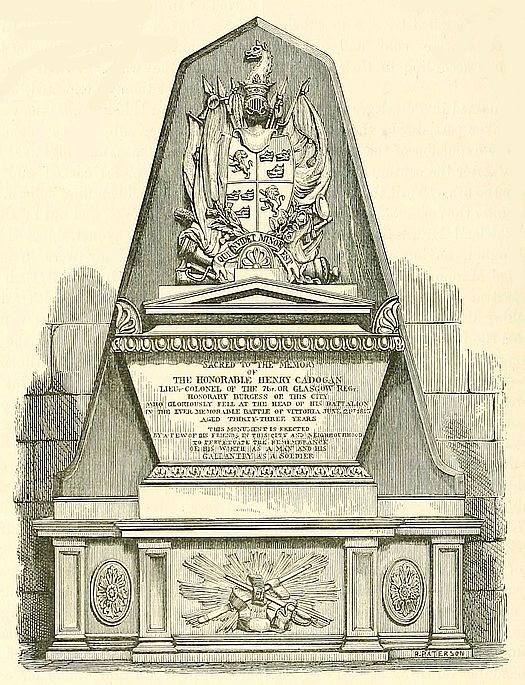
Monument in Glasgow Cathedral to Colonel the Honourable Henry Cadogan.
“The French had possession of the top, but we soon forced them back, and drew up in column on the height, sending out four companies to our left to skirmish. The remainder moved on to the opposite height.
“Scarce were we upon the height, when a heavy column, dressed in great-coats, with white covers on their hats, exactly resembling the Spanish, gave us a volley, which put us to the right about at double-quick time down the hill, the French close behind, through the whins. The four companies got the word, the French were on them. They likewise thought them Spaniards, until they got a volley that killed or wounded almost every one of them. We retired to the height, covered by the 50th, who gave the pursuing column a volley which checked their speed. We moved up the remains of our shattered regiment to the height. Being in great want of ammunition, we were again served with sixty rounds a man, and kept up our fire for some time, until the bugle sounded to cease firing.
“We lay on the height for some time. Our drought was excessive; there was no water upon the height, save one small spring, which was rendered useless. At this time the major had the command, our second colonel being wounded. There were not 300 of us on the height able to do duty, out of above 1000 who drew rations in the morning. The cries of the wounded were most heart-rending.
“The French, on the opposite height, were getting under arms: we could give no assistance, as the enemy appeared to be six to one of us. Our orders were to maintain the height while there was a man of us. The word was given to shoulder arms. The French at the same moment got under arms. The engagement began in the plains. The French were amazed, and soon put to the right about, through Vitoria. We followed, as quick as our weary limbs would carry us. Our legs were full of thorns, and our feet bruised upon the roots of the trees. Coming to a bean field at the bottom of the heights, the column was immediately broken, and every man filled his haversack. We continued to advance until it was dark, and then encamped on a height above Vitoria.
“This was the dullest encampment I ever made. We had left 700 men behind. None spoke; each hung his head, mourning the loss of a friend and comrade. About twelve o’clock a man of each company was sent to receive half a pound of flour for each man at the rate of our morning’s strength, so that there was more than could be used by those who had escaped. I had fired 108 rounds this day.”[409]
The loss of the regiment in the battle of Vitoria was dreadful. Colonel the Honourable Henry Cadogan, Captain Hall, Lieutenants Fox and Mackenzie, 6 serjeants, 1 bugler, and 78 rank and file were killed; Brevet Lieutenant-Colonel Cother; Captains Reed, Pidgeon, and Grant; Lieutenants Duff, Richards, M’Intyre, Cox, Torriano, Campbell, and Cummeline; 13 serjeants, 2 buglers, and 255 rank and file were wounded.
The enemy retired to Pampeluna, followed by the British, who afterwards marched towards the Pyrenees, the 71st reaching Maya upon the 8th of July. At Maya, on July 25th,—of which, as of other Peninsular battles, details will be found in the account of the 42nd,—the 71st behaved with marked bravery, maintaining their position to the last, and, when their ammunition was exhausted, hurling stones upon the enemy to impede their advance. The 71st had 3 sergeants and 54 rank and file killed, and 6 sergeants and 77 rank and file wounded.
The army under General Hill continued retiring until the 30th of July, when a strong position was taken up at Lizasso. Here they were attacked by the French, the 71st taking an active part in the engagement, and losing 1 sergeant, and 23 rank and file killed, and 2 sergeants and 34 rank and file wounded.
In the action in the pass of Doña Maria on the 31st, the 71st distinguished itself, and had 1 sergeant and 29 rank and file killed, and 2 sergeants and 45 rank and file wounded. For the part taken in these engagements the 71st was authorised to bear the word “Pyrenees” on its colours and appointments. Between the 14th of June and the 7th August, the regiment lost in killed and wounded, 33 officers, 6 buglers, and 553 rank and file.
For nearly three months after the last engagement the regiment was encamped on the heights of Roncesvalles, where the men were principally engaged in the construction of block-houses and batteries, and in the formation of roads for artillery, during which they suffered dreadfully from the inclemency of the weather. On the night of October 11th a strong party of the French made an attack upon an advance of 15 men of the 71st under Sergeant James Ross, but the small band, favoured somewhat by their position and the darkness, maintained its ground, and forced the enemy to retire. At the request of Lieutenant-General Sir William Stewart, each of the 16 men was presented with a medal.
After the battle of Nivelle, in which the 71st did not take part, the regiment occupied part of the town of Cambo, and was there joined by a detachment of 16 men of the 2nd battalion (then in Glasgow), under the command of Lieutenant Charles Henderson. On the 9th of December the 71st crossed the Nive without loss, the regiment forming upon the top of the opposite height, and sending out two companies after the enemy, who, however, eluded pursuit. The enemy retired on Bayonne, and General Hill disposed his army with the right on the Adour, the left above the Nive, and the centre, in which was the 71st, at St Pierre, across the high road to St Jean Pied-de-Port.
“All the night of the 11th December we lay in camp upon the face of a height, near the Spaniards. In the afternoon of the 12th, we received orders to move round towards Bayonne, where we were quartered along the main road. There we remained until we received orders to march to our own right, to assist a Spanish force which was engaged with superior numbers. We set off by day-light on the morning of the 13th towards them, and were moving on, when General Hill sent an aide-de-camp after us, saying, ‘That is not the direction,—follow me.’ We put to right-about, to the main road towards Bayonne. We soon came to the scene of action, and were immediately engaged. We had continued firing, without intermission, for five hours, advancing and retreating, and lost a great number of men, but could not gain a bit of ground. Towards evening we were relieved by a brigade which belonged to another division. As many of us as could be collected were drawn up. General Hill gave us great praise for our behaviour this day, and ordered an extra allowance of liquor to each man. We were marched back to our old quarters along the road-side. We lay upon the road-side for two or three days, having two companies three leagues to the rear, carrying the wounded to the hospital. We were next cantoned three leagues above Bayonne, along the side of the river. We had strong picquets planted along the banks. The French were cantoned upon the other side. Never a night passed that we were not molested by boats passing up and down the river, with provisions and necessaries to the town. Our orders were to turn out and keep up a constant fire upon them while passing. We had two grasshopper guns planted upon the side of the river, by means of which we one night sunk a boat loaded with clothing for the army, setting it on fire with red-hot shot.
“Next day we were encamped in the rear of the town, being relieved by a brigade of Portuguese. We remained in camp two or three days, expecting to be attacked, the enemy having crossed above us on the river. We posted picquets in the town, near our camp. At length, receiving orders to march, we moved on, until we came to a river on our right, which ran very swift. Part of the regiment having crossed, we got orders to come to the right-about, and were marched back to our old campground. Next morning we received orders to take another road toward Salvatierra, where we encamped that night, and remained until the whole army assembled the following day.
“About two o’clock in the afternoon we were under arms, and moved towards the river, covered by a brigade of artillery. We forded, and continued to skirmish along the heights until the town was taken. We lost only one man during the whole time. We encamped upon the other side of the town; and next morning followed the line of march, until we came before a town called Aris. We had severe fighting before we got into it. We were led on by an aide-de-camp. The contest lasted until after dark. We planted picquets in different streets of the town; the enemy did the same in others. Different patroles were sent out during the night, but the French were always found on the alert. They retired before day-light, and we marched into the town with our music at the head of the regiments. The town appeared then quite desolate, not worth twopence; but we were not three days in it, until the French inhabitants came back, opened their shops and houses, and it became a fine lively place.”[410]
In the action of the 13th December the 71st lost Lieutenant-Colonel Mackenzie, Lieutenants Campbell and Henderson, 2 sergeants, and 24 men killed; Captains Barclay and Grant, Lieutenants M’Intyre and Torriano, and 37 men wounded. For these services the regiment bears “Nive” on its colours. On the 26th February 1814 the regiment was in action at Sauveterre, and on the 27th took part in the battle of Orthez, although it appears that in the latter it sustained little or no loss. It bears “Orthez” on its colours.
Two divisions of the French army having retired to Aire, after the action of the 27th of February, Lieutenant-General Sir Rowland Hill moved upon that town to dislodge them. Upon the 2d of March the French were found strongly posted upon a ridge of hills, extending across the great road in front of the town, having their right on the Adour. The second division attacked them along the road, seconded by a Portuguese brigade, and drove them from their position in gallant style. Lieutenant James Anderson and 17 rank and file were killed; Lieutenant Henry Frederick Lockyer, 1 sergeant, and 19 rank and file, were wounded.
A detachment from the second battalion, consisting of 1 captain, 4 subalterns, and 134 rank and file, under the command of Major Arthur Jones, joined at Aire.
On the 25th of March part of the battalion was engaged in an affair at Tarbes, in which Lieutenant Robert Law was wounded, and upon the 10th of April was in position at Toulouse, where some of the companies were employed skirmishing, and sustained a loss of 1 sergeant and 3 rank and file killed; 6 rank and file were wounded.[411]
On the 10th of April the regiment marched to Toulouse, in order to attack it. It was drawn up in column behind a house, and sent out the flank companies to skirmish; the French, however, evacuated Toulouse on the night of the 11th, when the 71st and the other regiments entered the town. The following interesting incident, in connection with the attack on Toulouse, is narrated by a soldier of the 71st in his Journal:—
“I shall ever remember an adventure that happened to me, towards the afternoon. We were in extended order, firing and retiring. I had just risen to run behind my file, when a spent shot struck me on the groin, and took the breath from me. ‘God receive my soul!’ I said, and sat down resigned. The French were advancing fast. I laid my musket down and gasped for breath. I was sick, and put my canteen to my head, but could not taste the water; however, I washed my mouth, and grew less faint. I looked to my thigh, and seeing no blood, took resolution to put my hand to the part, to feel the wound. My hand was unstained by blood, but the part was so painful that I could not touch it. At this moment of helplessness the French came up. One of them made a charge at me, as I sat pale as death. In another moment I would have been transfixed, had not his next man forced the point past me: ‘Do not touch the good Scot,’ said he; and then addressing himself to me, added, ‘Do you remember me?’ I had not recovered my breath sufficiently to speak distinctly: I answered, ‘No.’ ‘I saw you at Sobral,’ he replied. Immediately I recognised him to be a soldier whose life I had saved from a Portuguese, who was going to kill him as he lay wounded. ‘Yes, I know you,’ I replied. ‘God bless you!’ cried he; and, giving me a pancake out of his hat, moved on with his fellows; the rear of whom took my knapsack, and left me lying. I had fallen down for greater security. I soon recovered so far as to walk, though with pain, and joined the regiment next advance.”[412]
On the afternoon of April 12th word came that Napoleon had abdicated, and shortly after peace was proclaimed, and a treaty concluded between France and England.
The 71st marched from Toulouse to Blaachfort, where it was encamped for about a fortnight, after which it proceeded to Bordeaux, where it embarked on the 15th of July, arriving in Cork on the 28th of that month. Shortly afterwards the regiment proceeded to Limerick, where it lay for the rest of the year, and where Colonel Reynell assumed the command in December. In January 1815 the first battalion of the 71st embarked at Cork, and proceeded to America; but peace having been concluded with the United States, its destination was changed, in consequence of Napoleon having again broken loose, and resumed his former dignity of Emperor of the French. Thus England was once more embroiled in war. The 71st was in consequence transhipped in a small craft, and sent to Ostend, where it disembarked on April 22nd. It was then marched to Leuze, where, quartered in the surrounding villages, it lay till June 16th, 1815, under the command of Colonel Reynell. It was brigaded with the first battalion of the 52nd, and eight companies of the 95th regiment (Rifles), the brigade being commanded by Major-General Frederick Adam, and the division by Lieutenant-General Sir Henry Clinton. The first battalion had at this time 997 rank and file. The regiment was drilled every day, and on the morning of June 16 was proceeding to its drill-ground as usual, when it was ordered immediately to advance upon Nivelles, where it arrived late at night. On the same day Blucher had been attacked at Ligny, and Wellington had successfully met Marshal Ney at Quatre Bras, in which action the 71st had no chance of taking part, although they had their own share of the fighting at Waterloo. On the morning of the 17th the 71st took the road to Waterloo, and along with the other regiments of the brigade took up a position behind Hougoumont, where they lay under arms, amid pouring rain, all night. Two hours after daybreak, General Hill came down and took away the 10th company to cover his reconnaissance, and shortly after, the regiment set to cleaning their arms, and preparing for action. All the opposite heights were covered by the enemy.
“The artillery had been tearing away since daybreak in different parts of the line. About twelve o’clock we received orders to fall in for attack. We then marched up to our position, where we lay on the face of a brae, covering a brigade of guns. We were so overcome by the fatigue of the two days’ march, that scarce had we lain down until many of us fell asleep. We lay thus about an hour and a half, under a dreadful fire, which cost us about 60 men, while we had never fired a shot. The balls were falling thick amongst us.
“About two o’clock a squadron of lancers came down, hurrahing, to charge the brigade of guns: they knew not what was in the rear. The general gave the word, ‘Form square.’ In a moment the whole brigade were on their feet, ready to receive the enemy. The general said, ‘Seventy-first, I have often heard of your bravery, I hope it will not be worse to-day than it has been.’ Down they came upon our square. We soon put them to the right-about.
“Shortly after we received orders to move to the heights. Onwards we marched, and stood, for a short time, in square, receiving cavalry every now and then. The noise and smoke were dreadful. We then moved on in column for a considerable way, and formed line, gave three cheers, fired a few volleys, charged the enemy, and drove them back.
“At this moment a squadron of cavalry rode furiously down upon our line. Scarce had we time to form. The square was only complete in front when they were upon the points of our bayonets. Many of our men were out of place. There was a good deal of jostling for a minute or two, and a good deal of laughing. Our quarter-master lost his bonnet in riding into the square; got it up, put it on, back foremost, and wore it thus all day. Not a moment had we to regard our dress. A French general lay dead in the square; he had a number of ornaments upon his breast. Our men fell to plucking them off, pushing each other as they passed, and snatching at them.
“We stood in square for some time, whilst the 13th dragoons and a squadron of French dragoons were engaged. The 13th dragoons retiring to the rear of our column, we gave the French a volley, which put them to the right-about; then the 13th at them again. They did this for some time; we cheering the 13th, and feeling every blow they received.
“The whole army retired to the heights in the rear; the French closely pursuing to our formation, where we stood, four deep, for a considerable time. As we fell back, a shot cut the straps of the knapsack of one near me: it fell, and was rolling away. He snatched it up, saying ‘I am not to lose you that way, you are all I have in the world,’ tied it on the best manner he could, and marched on.
“Lord Wellington came riding up. We formed square, with him in our centre, to receive cavalry. Shortly the whole army received orders to advance. We moved forwards in two columns, four deep, the French retiring at the same time. We were charged several times in our advance. This was our last effort; nothing could impede us. The whole of the enemy retired, leaving their guns and ammunition, and every other thing behind. We moved on towards a village, and charged right through, killing great numbers, the village was so crowded. We then formed on the other side of it, and lay down under the canopy of heaven, hungry and weary to death. We had been oppressed, all day, by the weight of our blankets and great-coats, which were drenched with rain, and lay upon our shoulders like logs of wood.”[413]
“The 71st had Brevet Major Edmund L’Estrange, aide-de-camp to Major-General Sir Denis Pack, and Ensign John Tod killed. The following officers were wounded: the Lieutenant-Colonel commanding the battalion, Colonel Thomas Reynell; Brevet Lieutenant-Colonel Arthur Jones; Captains Samuel Reed, Donald Campbell, William Alexander Grant, James Henderson, and Brevet Major Charles Johnstone; Lieutenants Joseph Barrallier, Robert Lind, John Roberts, James Coates, Robert Law, Carique Lewin, and Lieutenant and Adjutant William Anderson.
The number of serjeants, buglers, and rank and file killed amounted to 29; 166 were wounded, and 36 died of their wounds.”[414]
The 71st afterwards marched to Paris with the rest of the army, and was encamped in the Champs Elysées, continuing there till the beginning of November, when it proceeded to Versailles, and to Viarmes in December. On the 21st of December the second battalion was disbanded at Glasgow, the effective officers and men being transferred to the first battalion.
In January 1816 the regiment marched to the Pas de Calais, where it was cantoned in several villages. On the 21st of June the 71st was formed in hollow square upon the bruyère of Rombly for the purpose of receiving the medals which had been granted by the Prince Regent to the officers and men for their services at Waterloo, when Colonel Reynell addressed the regiment as follows:—
“Seventy-first,—The deep interest which you will all give me credit for feeling in everything that affects the corps, cannot fail to be awakened upon an occasion such as the present, when holding in my hands, to transfer to yours, these honourable rewards bestowed by your sovereign for your share in the great and glorious exertions of the army of His Grace the Duke of Wellington upon the field of Waterloo, when the utmost efforts of the army of France, directed by Napoleon, reputed to be the first captain of the age, were not only paralysed at the moment, but blasted beyond the power of even a second struggle.
“To have participated in a contest crowned with victory so decisive, and productive of consequences that have diffused peace, security, and happiness throughout Europe, may be to each of you a source of honourable pride, as well as of gratitude to the Omnipotent Arbiter of all human contests, who preserved you in such peril, and without whose protecting hand the battle belongs not to the strong, nor the race to the swift.
“I acknowledge to feel an honest and, I trust, excusable exultation in having had the honour to command you on that day; and in dispensing these medals, destined to record in your families the share you had in the ever memorable battle of Waterloo, it is a peculiar satisfaction to me that I can present them to those by whom they have been fairly and honourably earned, and that I can here solemnly declare that, in the course of that eventful day, I did not observe a soldier of this good regiment whose conduct was not only creditable to the English nation, but such as his dearest friends could desire.
“Under such agreeable reflections, I request you to accept these medals, and to wear them with becoming pride, as they are incontestable proofs of a faithful discharge of your duty to your king and your country. I trust that they will act as powerful talismans, to keep you, in your future lives, in the paths of honour, sobriety, and virtue.”
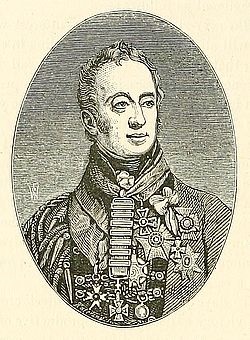
Major-General Sir Denis Pack, K.C.B. From a painting in possession of Mrs Reynell Pack.
The regiment received new colours on the 13th of January 1817; they were presented by Major-General Sir Denis Pack, a name intimately associated with some of our Highland regiments. On this occasion he addressed them as follows:—
“Seventy-first Regiment,—Officers, non-commissioned officers, and soldiers, it affords me the greatest satisfaction, at the request of your commanding officer, Colonel Reynell, to have the honour of presenting these colours to you.
“There are many who could perform the office with a better grace, but there is no one, believe me, who is more sensible of the merit of the corps, or who is more anxious for its honour and welfare.
“I might justly pay to the valour and good conduct of those present the compliments usual on such occasions, but I had rather offer the expression of my regard and admiration of that excellent esprit-de-corps and real worth which a ten years’ intimate knowledge of the regiment has taught me so highly to appreciate. I shall always look back with pleasure to that long period in which I had the good fortune to be your commanding officer, and during which time I received from the officers the most cordial and zealous assistance in support of discipline; from the non-commissioned officers proofs of the most disinterested regard for His Majesty’s service and the welfare of their regiment; and I witnessed on the part of the privates and the corps at large a fidelity to their colours in South America, as remarkable under such trying circumstances as their valour has at all times been conspicuous in the field. I am most happy to think that there is no drawback to the pleasure all should feel on this occasion. Your former colours were mislaid after a fête given in London to celebrate the Duke of Wellington’s return after his glorious termination of the peninsular war, and your colonel, General Francis Dundas, has sent you three very handsome ones to replace them. On them are emblazoned some of His Grace’s victories, in which the 71st bore a most distinguished part, and more might be enumerated which the corps may well be proud of. There are still in our ranks valuable officers who have witnessed the early glories of the regiment in the East, and its splendid career since is fresh in the memory of all. Never, indeed, did the character of the corps stand higher; never was the fame of the British arms, or the glory of the British empire more pre-eminent than at this moment, an enthusiastic recollection of which the sight of these colours must always inspire.
“While you have your present commanding officer to lead you, it is unnecessary for me to add anything to excite such a spirit; but were I called upon to do so, I should have only to hold up the example of those who have fallen in your ranks, and, above all, point to the memory of that hero who so gloriously fell at your head.”[415]
After remaining in France until the end of October 1818, the 71st embarked for England, and arrived at Dover on the 29th of that month, proceeding to Chelmsford, where the establishment was reduced from 810 to 650 rank and file.
From 1818 to 1822 this regiment performed garrison duties at various places in England, a mere enumeration of which would not be interesting, and is needless here. While at Chatham in 1821, the strength of the regiment was reduced to 576 rank and file. In 1822 it sailed from Liverpool for Dublin, where it arrived on the 3rd of May, and remained there till the beginning of October, when it was marched to the south of Ireland. Here it remained until May 1824, having its headquarters at Fermoy, with detachments stationed at various villages in order that disturbances might be suppressed and order maintained. The nature of the duties which the regiment had to perform can be seen by reference to our account of the 42nd about this period. In January 1824 Lieutenant-General Sir Gordon Drummond was removed from the colonelcy of the 88th to that of the 71st, vacant by the death of General Francis Dundas.
In May the regiment proceeded to Cork to re-embark for North America; but before doing so, Colonel Sir Thomas Arbuthnot, commanding the regiment, received very gratifying addresses from the magistrates and inhabitants of Fermoy, praising highly the conduct of the regiment, which had now the esteem of all classes. The 71st embarked at Cork for North America on the 14th, 16th, 17th, and 18th of May 1824, and arrived at Quebec about a month thereafter, at which place the headquarters of the regiment was stationed. The 71st remained in America performing garrison duty at various places till 1831. In May 1827 the headquarters was removed to Montreal; preparatory to the change, the service companies were inspected by Lieutenant-General the Earl of Dalhousie, who assured Lieutenant-Colonel Jones that he never had seen any regiment in more perfect order. In May 1828 the regiment removed to Kingston, where it remained for a year, and where it suffered much from fever and ague. From this place headquarters removed to Toronto in June 1829, and companies were sent out to occupy various posts; the 71st remained there for two years.
In June 1825 the strength of the regiment had been increased to 710 rank and file, who were formed into 6 service and 4 depôt companies, the latter stationed in England; the movements of the former we have been narrating. In August 1829 the depôt companies removed from Gravesend to Berwick-on-Tweed, and in June 1830 from the latter place to Edinburgh Castle. In September 1829 Major-General Sir Colin Halkett succeeded General Drummond as colonel of the 71st.
In May 1831 the service companies returned to Quebec, where they stayed four months, sailing in October for Bermuda, where they were stationed till September 1834. While at Bermuda, in February 1834, the tartan plaid scarf was restored to the 71st by authority of the King. In September of that year the 6 service companies left Bermuda for Britain, arriving at Leith on October 19th. The regiment was stationed at Edinburgh till May 1836, when it embarked for Ireland, and was stationed at Dublin till June 1837, when it proceeded to Kilkenny. The regiment remained in Ireland till April 1838, on the 16th of which month the 6 service companies again sailed from Cork to Canada. The four depôt companies remained in Ireland till June 1839, when they sailed from Cork to Scotland, and were stationed at Stirling. While in Ireland, March 1838, Major-General Sir Samuel Ford Whittingham succeeded Sir Colin Halkett to the colonelcy of the regiment, and he again was succeeded in March 1841 by Lieutenant-General Sir Thomas Reynell, formerly so intimately associated with the regiment as its lieutenant-colonel. The strength of the regiment was in August 1838 increased to 800.
During 1840 the 6 service companies were stationed at St John’s, Lower Canada.
The service companies proceeded from St John’s to Montreal, in two divisions, on the 27th and 28th of April 1842.
In consequence of the augmentation which took place in the army at this period, the 71st regiment was ordered to be divided into two battalions, the 6 service companies being termed the first battalion, and the depôt, augmented by two new companies, being styled the reserve battalion. The depôt was accordingly moved from Stirling to Chichester in 1842, and after receiving 180 volunteers from other corps, was there organised into a battalion for foreign service.
The reserve battalion of the 71st, under the command of Lieutenant-Colonel James England, embarked at Portsmouth in Her Majesty’s troop-ship “Resistance,” which sailed for Canada on the 13th of August 1842, and landed at Montreal on the 23d of September, where the first battalion was likewise stationed, under the command of Major William Denny, who, upon the arrival of Lieutenant-Colonel England, took charge of the reserve battalion.
The reserve battalion marched from Montreal to Chambly on the 5th of May 1843, and arrived there on the same day.
The first battalion, under the command of Lieutenant-Colonel England, embarked at Quebec for the West Indies in the “Java” transport, on the 20th of October 1843. The headquarters disembarked at Grenada on the 15th of December following.
The headquarters of the first battalion embarked on the 25th of December 1844, at Grenada, for Antigua,[416] where it remained till April 1846. It proceeded to Barbadoes, leaving that in December for England, arriving at Spithead, January 25th 1847. The first battalion, on landing, proceeded to Winchester, where it remained till July, when it was removed to Glasgow, and in December left the latter place for Edinburgh. Here it remained till April 1848, when it was removed to Ireland.
In February 1848, on the death of Sir Thos. Reynell, Lieutenant-General Sir Thos. Arbuthnot succeeded to the colonelcy of the 71st, and on his death, in January 1849, it was conferred on Lieutenant-General Sir James Macdonell.
In compliance with instructions received upon the occasion of Her Majesty’s visit to Dublin, the headquarters of the first battalion, with the effectives of three companies, proceeded from Naas to that garrison on the 28th of July, and were encamped in the Phœnix Park. The three detached companies also joined at the encampment on the same day. On the 13th of August the head-quarters and three companies returned to Naas.
The headquarters and two companies of the reserve battalion, under the command of Lieutenant-Colonel Sir Hew Dalrymple, Bart., proceeded from St John’s to Montreal in aid of the civil power, on the 28th of April 1849. The headquarters and three companies quitted Montreal and encamped on the Island of St Helen’s on the 30th of June, but returned to St John’s on the 16th of July. On the 17th of August 1849, the headquarters and two companies proceeded from St John’s to Montreal in aid of the civil power, and returned to St John’s on the 6th of September.
In April 1850 the first battalion proceeded from Naas to Dublin.
The headquarters and two companies of the reserve battalion quitted St John’s and Chambly on the 21st of May 1850, and arrived at Toronto on the 23rd of that month, where the battalion was joined by the other companies, and it continued there during the remainder of the year.
In May 1852 the reserve battalion proceeded from Toronto to Kingston. On the 8th of June following, Lieutenant-Colonel Hew Dalrymple, Bart., retired from the service by the sale of his commission, and was succeeded by Lieutenant-Colonel Nathaniel Massey Stack.[417]
On the 18th of February 1848, Lieutenant-General Sir Thomas Arbuthnot, K.C.B., from the 9th Foot, was appointed colonel of the regiment in room of Lieutenant-General Sir Thomas Reynell, Bart., who had died; and on the death of the new colonel, about a year after, Lieutenant-General Sir James Macdonell, K.C.B., from the 79th Foot, was appointed to the colonelcy of the regiment.
Instructions having been received for the battalion to embark at Glasgow for Ireland, three companies proceeded to Dublin on the 27th, and the headquarters, with the three remaining companies, embarked on board the “Viceroy” steamer on the 1st of May, and arrived at Dublin on the 2nd. Companies were detached to various places, and the headquarters proceeded from Dublin to Naas on the 20th of May.
On the 4th of July Lieutenant-Colonel William Denny, having arrived from Canada, assumed the command of the battalion, when Lieutenant-Colonel Sir Hew Dalrymple, Bart., proceeded to join the reserve battalion.
H.R.H. Major-General Prince George of Cambridge, commanding the Dublin district, made the autumn half-yearly inspection of the regiment on the 13th of October, on which occasion H.R.H. expressed personally to the regiment his satisfaction and approbation of their appearance and steadiness under arms, and the marked improvement that had been effected.
In compliance with instructions received, on the occasion of the expected visit of Her Majesty to Dublin, the headquarters, with the effectives of three companies, moved from Naas to Dublin on the 28th of July, and encamped in the Phœnix Park. The three detached companies also joined the encampment on the same day.
The Queen having arrived on the 6th of August, the battalion had the honour of sharing in the grand review which took place in the park on the 9th, in presence of Her Majesty and Prince Albert, after which a highly complimentary general order was issued, expressing the high approval of Her Majesty and Prince Albert of the conduct of the troops present at the review.
On the 10th of August Her Majesty and Prince Albert and the Royal Family left Dublin, and the 71st furnished a guard of honour under Captain T. H. Colville, at the railway station; and on the 11th, the lieutenant-general commanding marked his very high appreciation of the services of the troops stationed in Dublin during the above auspicious occasion, by publishing another highly complimentary general order.
In addition to the remarks in the general order of Lieutenant-General Sir Edward Blackeney, which reflected so much credit on the 71st Highland Light Infantry, in common with the other regiments in garrison, Major-General H.R.H. Prince George of Cambridge was graciously pleased to express his approbation of the high state of efficiency and good conduct of the battalion; and as its stay in Dublin was intended to be during Her Majesty’s visit, the headquarters and three companies returned to Naas on the 13th of August, detaching on the same day three companies to Maryborough, Carlow, and Newbridge.
During the months of March and April 1850, the various scattered companies of the 71st were removed to Dublin, where the whole battalion was stationed at the Richmond Barracks.
A draft of the reserve battalion, consisting of 2 subalterns, 2 sergeants, and 90 rank and file, embarked at Cork for Canada on the 4th of May of the same year.
The state of discipline in the regiment was reported to be good on its arrival in Dublin, and during its stay in that garrison it was most favourably reported upon. The accompanying extracts, which were conveyed to the commanding officer, by order, are creditable to the character of the regiment:—
“Asst. Adjt.-General’s Office, “Dublin, 21st July 1851.
“The Commander-in-Chief is glad to find that his Royal Highness considers the recruits lately joined to be of a superior description, and that he is enabled to speak with unqualified praise on the state of the discipline to which the regiment has arrived since it formed part of the garrison of Dublin.
“George Mylins, “Asst. Adj.-Gen.
“Officer Commanding “1st Bat. 71st Regt.”
The following is an extract from a letter received from the Adjutant-General of the Forces, having reference to the confidential report of H.R.H. the Duke of Cambridge, of the 1st battalion of the 71st Highland Light Infantry, for the second period of 1850:—
“Asst. Adjt.-General’s Office, “Dublin, 28th January 1851.
“The progress made by this battalion during the half year is extremely satisfactory to the Commander-in-Chief, and in the highest degree creditable to Lieutenant-Colonel Denny and his officers, who may congratulate themselves on having brought the battalion into a state of efficiency of which it certainly could not boast when the lieutenant-colonel assumed the command.
“W. F. Forster, A. A.-G.”
During 1851 and 1852 the regiment remained in Ireland, moving about in detachments from place to place, and performing efficiently a variety of duties, agreeable and disagreeable, in that disturbed country, and sending off now and then small parties to join the reserve battalion in Canada. In August the regiment removed to Kilkenny.
On the 1st of November 1852, a communication was received for the battalion to be held in readiness for embarkation for the Mediterranean, and in compliance therewith, the service and depôt companies were formed on the 1st of January 1853; and on the 3rd the battalion received new colours. On the arrival of the battalion at Cork, the old colours were placed over a tablet erected at Kinsale, to the memory of the late Lieutenant-General Sir Thomas Arbuthnot, a native of that place, who commanded the regiment for many years. During February and March the regiment sailed in detachments for Corfu.
By a War Office letter of 20th of February 1854, the regiment was to be augmented, from the 1st of April, by one pipe-major and five pipers.
The reserve battalion remained in Canada from 1849 to 1853, having been stationed successively at St John’s, Toronto, Kingston, and Quebec, returning from Canada in 1854, and forming the depôt of the regiment at Canterbury in October.
On the outbreak of the Crimean war all the effectives, with a proportion of officers, consisting of 1 major, 3 captains, 6 subalterns, 20 serjeants, 6 buglers, and 391 rank and file—total, 417—were ordered to proceed to the Crimea, and embarked at Portsmouth, on board the “Royal Albert,” November 24, and landed at Balaclava on the 20th of December. The first battalion joined the reserve in February 1855.
Major-General A. F. Mackintosh, Commander of the Forces in the Ionian Islands, issued the following order prior to the embarkation of the first battalion from Corfu for the Crimea, in January 1855:—
“General Order.
“Deputy Qr.-Master General’s Office, “Corfu, 24th January 1855.
“The Major-General commanding addresses a few words to the 71st Light Infantry on their departure for the seat of war.
“The Major-General first saw the 71st a good many years ago, on a day when their commanding officer fell at their head; he has since often met the regiment in various parts of the world, and has always remarked among both the officers and men of the regiment that high military spirit and personal activity still conspicuous, which caused it to be selected and organised as a light corps.
“They are now about to appear on a scene where their predecessors in the regiment have so often distinguished themselves—the field of battle,—and the Major-General wishes them a prosperous passage, followed by a glorious career.
“R. Walpole, “Dep. Qr.-Mr. General.”
During the time the 71st was in the Crimea, it had no chance of distinguishing itself in any great action, as had the 42d, and the other two Highland regiments with which it was brigaded. Nevertheless, the 71st had many fatiguing and critical duties to perform, which it did with efficiency; as will be seen, it was mainly occupied in expeditions to various parts of the Crimea.
The regiment embarked on the 3rd of May on board the “Furious” and the “Gladiator” steam frigates, forming part of the first expedition to Kertch, returning to Balaclava on the 8th. The regiment moved to the front on the 9th of May, and joined the third brigade of the fourth division in camp, before Sebastopol, performing satisfactorily the very trying duties in the trenches. Here, however, it did not long remain, as on May 22nd it embarked at Balaclava, on board the steam frigates “Sidon” and “Valorous,” and proceeded to Kertch with the expeditionary force of the allied army.
Landing at Kamiesch Bouroun, about five miles from Kertch, on the 24th of May, under cover of the gun-boats, it bivouacked that night, and marched to Kertch the following morning, proceeding the same day to Yenikali, where it encamped.
The regiment re-embarked at Yenikali on the 10th of June on board the steam frigates “Sidon” and “Valorous,” to return to the headquarters of the army, but was again disembarked—the headquarters and right wing at Yenikali on June the 12th, and the left wing at Cape St Paul on the 14th—to protect these points, in conjunction with a French and Turkish force. One company moved into Kertch from Yenikali, August 4th, and the left wing from Cape St Paul to Kertch, September 22nd.
Three companies, under Major Hunter, embarked at Kertch, September 24th, and proceeded with the French on a joint expedition to Taman. Taman and Phanagoria were bombarded by the French and English gun-boats, and taken possession of by the allied expeditionary force on the same day. A large supply of hutting material and fuel was obtained for the use of the troops from these places, after which they were fired and abandoned. The expedition returned to Kertch on the 3rd of October.
A draft, consisting of 1 captain, 5 subalterns, 4 sergeants, and 121 rank and file from the reserve companies at Malta, landed at Balaclava in August, was moved to the front, and attached to the Highland division in camp before Sebastopol. It was present at the fall of Sebastopol, under the command of Major Campbell, and joined the headquarters of the regiment at Yenikali on the 2nd of October.
Until the 22nd of June 1856, the various companies were kept moving between Yenikali and Kertch. On that date Kertch and Cape St Paul were handed over by the regiment to the Russian authorities, the whole of the French and Turkish forces having previously evacuated that part of the Crimea.
The headquarters and six companies embarked on board the steamship “Pacific,” and two companies on board the “Gibraltar,” on the 22nd of June, for passage to Malta.
During the stay of the 71st in Malta, from July 1856 to January 1858, there is nothing of importance to record.
The regiment received orders by telegram from England to proceed overland to India on the evening of the 2nd of January 1858, and on the morning of the 4th it embarked on board H.M. ship “Princess Royal” and the steam frigate “Vulture.” The headquarters and right wing arrived at Bombay on February 6th, and the left wing on the 8th; the right wing proceeding to Mhow by bullock train in detachments of about forty daily, the first of which left Bombay on the 26th of February, and the last arrived at Mhow, March 17th. It marched from Mhow on the 30th March to join the Central India Field Force, and joined the second brigade at Mote on May 3rd. It was present at the action in Rose’s attack on the enemy at Koonch, May 7th, when eight men fell dead in the ranks, and upwards of twenty officers and men had to be carried from the field on account of the heat of the sun. It was present also at the actions at Muttra and Deapoora, 16th and 17th May; at the latter places the principal attacks of the enemy were repulsed by this regiment. Lieutenant-Colonel Campbell commanding the brigade, Major Rich commanding the regiment, and Battalion Major Loftus, were specially mentioned by the major-general. The regiment was present at the battle of Gowlowlee, May 22nd, the occupation of Calpee, May 23rd, and it marched on Gwalior with the 1st Brigade Central India Field Force; at the action of Moorar on the 16th of June, in which the 71st took a prominent part. It was while rushing on at the head of a company of this regiment that Lieutenant Wyndham Neave fell mortally wounded, and that Sergeant Hugh M’Gill, 1 corporal, and 2 privates were killed. Lieutenant-Colonel Campbell, Major Rich, and Lieutenant Scott were specially mentioned; and Sergeant Ewing and Private George Rodgers were recommended for the Victoria Cross.
On the evening of the 18th of June the regiment formed part of a column for the support of Brigadier Smith’s brigade, and advanced on Gwalior with the whole force on the 19th and 20th.
After the capture of Gwalior on the 20th of June, the headquarter’s wing marched back to Moorar cantonments, where it was stationed till the 12th of August, when it returned to Gwalior, and was stationed at the Lushker and Phool Bagh, and returned again to Moorar on the 6th of June 1859.
On the 11th of November 1858, a detachment from headquarters went on field-service to the Sind River, had two skirmishes with the rebels, and returned to Gwalior on the 9th of February 1859.
On the 29th of November 1858, another detachment from headquarters went on field service, and had skirmishes with the rebels at Ranode and Nainewass. At the latter place three were killed. This detachment returned to Gwalior on 27th of May 1859.
The left wing marched from Bombay on the 11th of March 1858, and arrived at Mhow on 17th of April, and on the 9th of June a company was detached from Mhow to Indore. The greater portion of the left wing proceeded on field-service, under Major-General Michel, C.B., and on 2nd September 1858 was present at the action at Rajghur. In the action at Mongrowlee, on September the 15th, the 71st had one private killed. In the action at Sindwaho on October the 19th, and that at Koorai on October the 25th, the 71st had no casualties. The left wing arrived at Bhopal on the 17th of November 1858, and marched to Goonah on the 17th of January 1859.
On the 25th of November a party of 50 rank and file left Mhow on camels, with a column under command of Major Sutherland, 92d Highlanders, and were engaged with the rebels at Rajpore on the same day, after which they returned to Mhow.
On the 1st of January 1859, the company stationed at Indore marched from that place en route to join a column on service under Brigadier-General Sir R. Napier, K.C.B., and was present at the attack of the Fort of Naharghur, 17th of January, where two privates were wounded. Captain Lambton was specially mentioned for his daring attack.
The headquarters of the regiment were inspected by the Commander-in-Chief, Lord Clyde, on the 2nd of December 1859. His Excellency expressed his satisfaction, both with what he himself saw and the reports which he had received regarding the state of the regiment from other sources. The report made by Lord Clyde to H.R.H. the General Commanding-in-Chief, produced the following letter from the Adjutant-General of the Forces, highly complimentary to the commanding officer and all ranks of the regiment:—
“Horse Guards, “24th January 1860.
“Sir,—His Royal Highness the General Commanding-in-Chief is much gratified to hear from General Lord Clyde, Commander-in-Chief in India, that at his Lordship’s last visit to the station occupied by the regiment under your command, he found it in the highest order.
“After the recent arduous and continuous duties on which it has been employed, great credit is due to its commanding officer, Colonel William Hope, and to every rank in the corps, and H.R.H. requests that his opinion may be communicated to them accordingly.—I have the honour to be, &c.
“G. A. Wetheral, “Adjutant-General.
“Officer Commanding “71st Highlanders.”
In the month of January 1860, intimation was received of the death of Lieutenant-Colonel R. D. Campbell, C.B., in London, on the 4th of December 1859, and the command of the 71st devolved on Lieutenant-Colonel Hope, C.B.
On the 22nd of July cholera broke out in the regiment. It first appeared in the hospital in cantonments, but the next day spread to the barracks, and, two or three days later, reached the fortress of Gwalior. The companies in cantonments, with the exception of one, moved under canvas; two of those in the fort moved down into quarters at the Phool Bagh. Notwithstanding these movements, the epidemic continued until the beginning of September, and did not finally disappear until the 16th of that month, having carried off 1 colour-sergeant, 2 sergeants, 2 corporals, 1 piper, 1 bugler, and 62 men, 11 women and 11 children.
On the 11th of November 1860 the order for the relief was received, and on the 20th of the next month the regiment marched for Sealkote, Punjab, having been relieved at Gwalior by the 27th Inniskillings.
The state of discipline of the regiment while in the Gwalior district can be gathered from the following extract from a report from the Political Agent, Gwalior, to the Government of India, dated 15th June 1860:—
“When it was determined in June last to post a British force at the Lushker, the people expected with dread and deprecation a violent and dangerous, at least a rude and overbearing soldiery; but Her Majesty’s 71st Highlanders soon dispelled their fears and created pleasant feelings.
“His Highness and the best informed men of the Durbar have assured me that those soldiers who passed ten months in the Phool Bagh have, by their manners, habits, dealings, and whole demeanour, so conciliated the respect and regards of all, that nothing would be more acceptable than the domestication of such a force in the capital.
“The Durbar considers further, that it would bring to Gwalior incalculable industrial advantages, through affording a constant supply of superintendents of public works and skilled labourers.
“I venture to express the hope, that his Excellency may consider the Durbar’s view of the conduct of Her Majesty’s 71st, commanded by Lieutenant-Colonel Campbell, C.B., a very high and true compliment, as worthy of express recognition as good conduct in the field. It is in my humble judgment a most fully deserved compliment.
“Ad. A. Charters Macpherson, “Political Agent.”
“Camp Agra, “29th November 1859.
“My Lord,—As your Lordship is going to Gwalior, I trust you will not think that I exceed my office, if I venture to send you an extract from a report of June last, in which I attract the attention of the Government to the admirable conduct of Her Majesty’s 71st Highlanders, and to its appreciation by Maharajah Scindia and his people.
“The importance of such conduct on the part of the first British troops stationed at the capital of Gwalior might scarcely be over stated.
“Having lived with the 71st at the Phool Bagh for about twelve months, my pride in them as soldiers and countrymen must be my excuse to your Lordship for venturing upon this irregular communication of my impressions. General Napier’s views will, I trust, confirm them.
“Ad. A. Charters Macpherson, “Political Agent.”
Various drafts joined the service companies in 1860. The regiment marched into Sealkote on Sunday, the 17th of February 1861.
The brigadier-general, commanding the Lahore division, made his first half-yearly inspection of the regiment on the 26th of April 1861, and published the following order on the conclusion of this duty:—
“Extract from Station Orders, dated Sealkote, 27th April 1871.
“Brigadier-General Ferryman, C.B., having completed the inspection of the 71st Highland Light Infantry, begs to express to Lieut.-Col. Rich and the regiment his great satisfaction with everything he has seen. The drill is excellent; it could not be better; and the officers are well instructed. He will, therefore, have much pleasure in making a very high report to the Commander-in-Chief of everything he has witnessed.”
The regiment remained at Sealkote till the 1st of November 1862, when headquarters and seven companies marched en route to Nowshera, and arrived at that station on the 21st of the same month, having detached one company at Attock to garrison the fortress.
On the 14th of October 1863, headquarters, under Lieut.-Col. Hope, C.B., moved from Nowa-Killa in the Yuzufzai country, arriving on the 18th of October at Nowshera, where the sick were left. At Nowa-Killa was assembled the force about to be employed in the hill country to the eastward, and the command was assumed by Brigadier-General Sir Neville Chamberlain, K.C.B. The object of the expedition was to destroy Mulka, on the Mahabun Mountains, the stronghold of certain Hindostanee refugees, generally known as the Sitana Fanatics, who infested our frontier and preyed on the villages. Mulka is just beyond our frontier line, and in the territory of the Indoons.
The direct route to Mulka by the Chinglae Pass being reported to be stockaded, it was decided to take the more circuitous one by the Umbeylah Pass and the Chumla Valley. The brigadier-general decided on having a small native force at Nowa-Killa, and forming a depôt for the European troops at Roostum, which is near the entrance to the Umbeylah Pass, and directed the sick and the regimental band to remain there accordingly. 99 men of the 71st of all ranks were detached to remain at Roostum under Lieut. Boulderson.
The force marched in two divisions,—the first, all of native troops under command of Lieut.-Col. Wilde, C.B., of the corps of Guides, on 19th October; and the second, which included all the European troops, on the 20th of October, under the brigadier-general.
The pass was seized by Lieut.-Col. Wilde without difficulty, but owing to the rugged nature of the ground, the so-called road being merely a path hardly practicable for loaded cattle, the troops were not concentrated at the crest of the pass until nearly 8 o’clock in the evening, and the baggage, of which much was lost or destroyed, was not all up for four days. The heavy guns were shifted on to elephants at the bottom of the pass, and got up without much difficulty.
On the 21st more ground to the front was taken, and the regiment marched down in the direction of Umbeylah about a quarter of a mile, and encamped on a small piece of level ground, and not far from a small stream of water. On the 22nd a reconnaissance was made in the Chumla Valley under the orders of Lieut.-Col. Taylor, C.E., with a small body of native cavalry, supported by the 20th Native Infantry. This party penetrated some distance into the valley without being molested; but on its return near sunset it was attacked near the village of Umbeylah, and sustained some loss. Their assailants, who were chiefly of the Boneyir tribe, followed up the 20th Native Infantry in great numbers, and commenced a general attack upon the force, which was immediately turned out and placed in position with some difficulty owing to the darkness. The attack was, however, repulsed with heavy loss to the enemy and slight loss on the British side, the 71st sustaining none. This attack by the Boneyir was not anticipated.
There was no intention of entering the Boneyir Valley, the pass of which is close to the village of Umbeylah; but this had not been explained to them. They were doubtless unwilling to allow a force to enter even the Chumla Valley, the inhabitants of which are closely connected with them, and the opportunity of attacking the invaders at a disadvantage, as they thought, was not to be lost by these warlike mountaineers.
The unexpected hostility of this numerous and warlike tribe, superadded to the difficulty regarding the baggage, and the delay now become necessary to bring up additional supplies, entirely changed the aspect of affairs, and it became apparent that the force must remain on its present ground for some days at least; orders were accordingly given to throw up breastworks along the front and flanks. The front line, which was across the valley or pass, was chiefly occupied by the European troops; while the flanks, which were on the hills on each side, were entirely occupied by native troops, until the 26th.
On the 25th, 100 men under command of Captain Aldridge, and 15 marksmen, were employed in meeting a slight attack made on the right flank; but no casualty occurred in the 71st. On the 26th, the marksmen, 1 sergeant and 15 men, were with an equal number of the 101st Royal Bengal Fusiliers ordered up to the left flank, which was threatened. Shortly afterwards, Major Parker with 150 men of the 71st proceeded as a further reinforcement. Both these parties obtained great praise for steadiness and gallantry in this, the most serious attack that had yet occurred. The marksmen occupied the post called the Eagle’s Nest, which was several times attacked by the enemy in great numbers, and with great determination. Many were shot down when close to the breastwork.
Major Brownlow, 20th Native Infantry commanding the post, made a most favourable report of the conduct of this small party, and especially named privates William Clapperton and George Stewart as having exhibited great gallantry and coolness. These men’s names afterwards appeared in General Orders, and they were recommended for the “medal for service in the field.”
The conduct of the party under Major Parker was also eulogised by Lieut.-Col. Vaughan, who commanded the picquets on the left flank, and Major Parker’s name was afterwards specially brought to the notice of the Commander-in-Chief. On this day the casualties were, 1 killed and 5 wounded. Major Parker’s party remained on the heights during the 26th and 27th, and was relieved on the 28th by equal numbers of the 101st regiment.
On the 30th the regiment assisted in repulsing a very spirited, but not well-sustained attack made by the enemy about dawn on the front line of the picquets in the valley, when 3 men were wounded.
On several days the regiment furnished a strong working party to make a new road, leading from the right flank to the village of Umbeylah. On the 6th of November an armed party, under Ensign C.B. Murray, was ordered out to cover the working party, and about a mile from the nearest post it soon became evident that the enemy intended to molest the party. Accordingly, about 11 A.M. a reinforcement of 50 men, under Captain Mounsey, proceeded to the threatened point. Captain Mounsey was placed by the commanding officer, Major Harding, at a point considerably higher than that occupied by Ensign Murray, and nearer to camp, where he materially assisted in protecting Ensign Murray’s left flank, which was threatened. Soon after 1 o’clock the working party was withdrawn. Corresponding orders were, however, omitted to be sent to Ensign Murray’s party, which consequently held its ground along with a party of the 20th Native Infantry; and Captain Mounsey having been ordered to take up a fresh position still higher up the hill, the party under Ensign Murray, no longer assisted by the flank fire of the other, could only hold its ground, and was nearly surrounded.
About 2 P.M. Ensign Murray was killed, and other casualties having occurred, Major Harding, who had joined soon after, decided on holding the ground till dark, when he hoped to be able to carry off the wounded, which could not be done under the enemy’s fire. Major Harding finally retired without the wounded, but was killed in the retreat. Captain Mounsey having proceeded to the point to which he was directed, assisted by parties of the Guide corps and 1st Punjab Infantry, twice charged and drove the enemy off; and, without casualty to his own party, protected some wounded officers and men until they could be removed. For this service he was specially mentioned to the Commander-in-Chief, as was also Lieutenant Davidson of the Indian army, attached to, and doing duty with the 71st, for gallantry in assisting a wounded officer. In addition to the above-named officers, sergeant J. B. Adams and 2 privates were killed, and 5 wounded.
On the 18th of November, at daylight, a change of position was effected, and the whole force was concentrated on the heights, which up to that time had been on the right flank. The movement was completed by 8 o’clock A.M., without molestation, and apparently without the knowledge of the enemy, who soon afterwards appeared in great force in the valley and occupied the abandoned position.
An attack on Captain Griffan’s battery, which was supported by two companies of the 71st, was at first threatened, but the enemy soon turned his attention to the post occupied by the 14th Native Infantry, commanded by Major Ross, and which had now become our advanced post on the left. Repeated attacks were made on this post. Reinforcements being called for, Captain Smith’s company, 2 officers and 34 bayonets, was pushed forward about 2 P.M. The enemy was in great force, and between 5 and 6 P.M. the picquets were obliged to retire to a second line of breastwork. During its occupation of the advance line and in the retreat, Captain Smith’s company suffered severely. The captain himself had his leg broken by a matchlock ball, and was cut down. Lieutenant Gore Jones of the 79th, who was attached to the company, was shot in the head. The picquet reformed in the second line, and were joined by two companies of the 71st under Major Parker, who resumed command. They were furiously attacked, but after a severe hand-to-hand struggle repulsed the enemy at all points, and retained possession of the ground until after nightfall, when the whole were withdrawn by the brigadier-general, as the occupation of this point was not considered necessary or advisable. Major Parker was specially mentioned for this service.
There were killed on this occasion Captain C. F. Smith, Lieutenant Gore Jones, and 4 privates; the wounded were Sergeant John Hunter and 4 privates.
On the morning of the 19th Captain Aldridge was shot, when returning from visiting the advance sentries of the Lalloo picquet. Four companies of the regiment relieved an equal number of the 101st on the upper picquet, on which the enemy continued firing all day, when 2 privates were wounded.
The 101st took the picquets of the upper camp, and also held the advanced post known as the Craig picquet. About 3 P.M. the enemy made a sudden and furious attack in great force on the Craig picquet, and succeeded in obtaining possession of it. The 71st was at once ordered to re-take it. This post was situated on the apex of a very steep and rocky hill, of which the enemy had disputed possession on several occasions. Supported by a concentrated artillery fire and by two native corps, the 5th Ghoorkas and the 5th Punjab Infantry, the regiment, led by Colonel Hope, C.B., soon regained possession, and the combined force drove the enemy back over the nearest hill. A heavy flanking fire was maintained on the enemy by the water picquet, which also suffered some loss. The loss of the regiment was severe. The post was held that night by 270 of the 71st, under Major Parker, who also assumed command of the regiment. Brigadier-General Sir N. Chamberlain was wounded in the attack, and eventually had to resign command of the force to Major-General Garvock.
His Excellency the Commander in-Chief, Sir Hugh Rose, signified his entire approval of the gallantry of the regiment and of all the troops employed on this occasion. Casualties on the 20th of November 1863,—killed, 6 privates; wounded, Colonel W. Hope, C.B., 2 sergeants, 3 corporals, and 20 privates.
After his repulse with very heavy loss on the 20th, the enemy refrained from attacking any of our posts until the 15th of December, during which interval Major-General Garvock took command, and the 7th Fusiliers and the 93rd Highlanders having arrived, the duty became less severe. Previous to the arrival of these regiments no soldier in camp could be said to be off duty day or night. An exchange of posts from the upper camp to the lower was the only relief, the upper camp being much more exposed.
On the 15th December, the regiment being on picquet duty, did not accompany the portion of the force which, under the major-general, with Brigadiers Turner and Wilde commanding brigades, advanced and drove the enemy from all its posts in front, and from the village of Lalloo, but assisted in repulsing a very determined counter attack made by a strong force on the Craig picquet and upper camp generally.
On the 16th the major-general advanced and again defeated the enemy at the village of Umbeylah, which with Lalloo was burned. On the following morning the enemy sent into the major-general’s camp and tendered submission, which was accepted. A small force was detached with a strong party of Boneyirs co-operating, to destroy Mulka. This was done without actual opposition, but this force was very critically situated for a short time.
The regiment returned to Nowa-Killa, and reached Nowshera on the 30th, whence it marched on the 4th of January 1864, reaching Peshawur on the 5th.
On the 21st the regiment was inspected by His Excellency, Sir Hugh Rose, G.C.B., Commander-in-chief, who expressed himself in the most complimentary manner with reference to the conduct of the regiment in the late campaign. He called the three men whose names had appeared in General Orders—privates Malcolm, Clapperton, and Stewart—to the front, and addressed some words of approval and encouragement to them.
On the 28th of April the regiment was inspected by Major-General Garvock, who also spoke in high terms of its conduct and discipline.
On the 23rd of October, pursuant to orders from England, the regiment marched to Calcutta for embarkation. It arrived at Rawul Pindee on the 30th; and on the 1st of November the half-yearly inspection was made by Sir John Garvock, G.C.B.
The regiment having been called on to furnish volunteers to regiments serving in the Bengal Presidency, 200 men volunteered, and were transferred to other regiments.
On the 9th of November the regiment resumed its march by Lahore, Umritsur, and Loodiana to Umballa, where it arrived on the 13th of December; and on the following day was present at a general parade of the troops in the station, where medals for gallant service in the field were presented by Major-General Lord George Paget to Sergeant-Major John Blackwood, and privates Macdonald, Malcolm, Clapperton, and Stewart, for distinguished conduct in the field. The Sergeant-Major was also granted a pension of £15 in addition to the medal.
The regiment arrived at Delhi on the 26th of December; and on the 4th of January 1865, one wing proceeded by rail to Allahabad, and was followed next day by the other wing.
On the 21st and 23d the regiment proceeded by rail to Chinsurah, 25 miles from Calcutta, where it remained until it embarked—the right wing and head-quarters, under the command of Colonel Hope, on the 4th of February, in the steamship “Mauritius,” and the left wing, commanded by Major Gore, in the “Albert Victor,” on the 14th of February. The right wing arrived and disembarked at Plymouth on the 29th of May, having touched at Madras, the Cape, and Fayal. It remained at Plymouth until the 7th of June, when it was sent to Leith in H.M.’s ship “Urgent,” and arrived in Edinburgh on the 12th, where it occupied the Castle.
The left wing arrived at Gravesend on the 19th of June, where it landed, and was afterwards taken round to Leith by the “Urgent,” and joined the head-quarters in Edinburgh Castle on the 25th of June.
The following General and Divisional Orders were published previous to the regiment quitting India:—
Extract of Divisional Order by Major-General Sir John Garvock, K.C.B., commanding Peshawur Division.
“Rawul Pindee, 1st November 1864.
“The 71st Highland Light Infantry being about to leave the Peshawur Division, en route to England, the Major-General commanding desires to offer them his best wishes on the occasion.
“He has known the regiment for a number of years. He was very intimately associated with it in the Mediterranean, and his interest in it is now naturally increased in no small degree by its having served under him in the field and done its part, and done it well, in obtaining for him those honours which Her Majesty has been pleased to confer.
“The Major-General had not assumed the command of the Yuzufzai Field Force when the 71st re-captured the Craig Picquet, but he well knows that it was a most gallant exploit.
“Sir John Garvock, K.C.B., begs Colonel Hope, C.B., and the officers, non-commissioned officers, and soldiers of the 71st Highland Light Infantry, to believe that, although they will be soon no longer under his command, he will continue to take the liveliest interest in their career; and he now wishes them a speedy and prosperous voyage.”
General Orders By His Excellency the Commander-in-chief.
“Head-Quarters, Calcutta, 27th January 1865.
“The services of the 71st Highland Light Infantry in India entitle them, on their departure for England, to honourable mention in general orders.
“A wing of the regiment on their arrival in India in 1858 joined the Central India Field Force, and His Excellency is therefore enabled to bear testimony to the good services which they performed, and the excellent spirit which they displayed during that campaign.
“The regiment more recently distinguished itself under their commanding officer, Colonel Hope, C.B., in the late operations on the frontier.
“Sir Hugh Rose cannot, in justice to military merit, speak of the 71st in a General Order without reverting to an earlier period, when in two great campaigns in Europe they won a reputation which has earned them an honoured page in history.
“Sir Hugh Rose’s best wishes attend this distinguished regiment on their leaving his command for home.
“By order of His Excellency the Commander-in-chief.
“E. Haythorn, “Colonel, Adjutant-General.”
The depot companies, commanded by Brevet-Major Lambton, joined the regiment in Edinburgh, and the establishment of the regiment was fixed at 12 companies, with 54 sergeants, 31 buglers and pipers, and 700 rank and file.
The autumn inspection was made by Major-General Walker, on the 4th of October 1865.
“Horse-Guards, 13th February 1866.
“Sir,
“Referring to your confidential report on the 71st regiment, dated the 4th of October last, in which you represent that a sword is worn by the officers which is not regulation, I am directed by the Field-Marshal Commander-in-chief, to acquaint you that H.R.H. having seen the sword in question, has no objection to the continuance of its use, the 71st being a Light Infantry Regiment.
“For levees, &c., the basket hilt should be worn, which, it is understood, can be made removable, and the cross-bar substituted at pleasure.
“I have, &c., “J. Trowbridge, D.A.G.
“Major-General Walker, C.B., “Commanding North Britain.”
In October 1865, during the stay of the regiment in Edinburgh Castle, it sustained the loss by death of Brevet Lieutenant-Colonel Parker, on which occasion the following Regimental Order was published by Colonel Hope:—
“The Commanding Officer regrets to have to announce to the regiment the demise of Brevet Lieutenant-Colonel Parker, which occurred this morning at 8 A.M. Colonel Hope feels certain that the announcement will be received with the deepest regret for the loss sustained, as well by the regiment, as by Her Majesty’s service generally. Lieutenant-Colonel Parker has departed after a service of twenty-three years in the regiment, many of which he passed in distant countries and in active services against the enemies of his country. On more than one occasion, and as recently as 1863, his services in the field met with such approbation from general officers under whom he served, as to induce them to name him in public despatches.
“Colonel Hope can only express his opinion that no officer more faithfully and ably sustained the honour and reputation of the regiment than did Lieutenant-Colonel Parker, and that none better merited the honours done him.”
In February 1866, the regiment removed to Aldershot, where the spring inspection was made on the 2nd of May 1866; and also the autumn inspection by Brigadier-General Sir Alfred Horsford, K.C.B., who was pleased to comment highly on the appearance and discipline of the regiment.
In December the regiment removed to Ireland, and was distributed in Fermoy, Cork, and Ballincollig; head-quarters being at Fermoy.
On the 27th November 1867, Colonel Hope retired from the command of the regiment, which he had held for many years, and in which capacity he had gained alike the esteem and love both of officers and men. His retirement, which was forced upon him by his continued ill health, was felt to be an occasion upon which each individual member of the regiment lost a valued friend as well as a brave commander. On leaving he issued the following Order:—
“Colonel Hope has this day (18th of November 1867), relinquished the command of the regiment, which he has held for eight years, and handed it over to Major Macdonnell, who also will be his successor.
“Having served so many years—in fact, from his boyhood—in the regiment, and having commanded for the last eight years, he need hardly say that he quits the 71st with the greatest sorrow and regret.
“It has been his anxious wish at all times to maintain intact the reputation of the regiment as it was received by him; and this wish has, he believes, been gratified.
“Since the regiment was embodied, now 90 years ago, in all parts of the world,—in India, in the Cape of Good Hope, in South America, in Spain,—the 71st has been equally renowned for conduct and discipline—in the field before the enemy, during a long peace, and in quarters at home and abroad. It has also received the approbation of superior military authorities.
“Since the breaking out of the war with Russia, it has seen service in the Crimea, and the Indian Mutiny brought it once more to India, where its early laurels were won.
“In the Central Indian Campaign of 1858, the regiment served under Sir Hugh Rose, and received commendations from that distinguished officer (now Lord Strathnairn), as it did with other commanders, with whom that desultory campaign brought it into contact.
“1863 again saw the regiment in the Yuzufzai Hills, opposed to the warlike tribes of Central Asia. Colonel Hope can never forget the devotion of all officers and soldiers in the short but arduous campaign, nor the handsome terms in which Lord Strathnairn, then the Commander-in-Chief in India, acknowledged their services on its termination.
“Colonel Hope is well aware that this short recital of the regimental history is well known to all the older officers and soldiers, many of whom took part in the exploits of the 71st during the last twelve years, but he mentions them now that they may be known and remembered by the younger members, and with the confident hope that it will never be forgotten that the 71st has a reputation and a name in the British army, which must be maintained at all hazards.
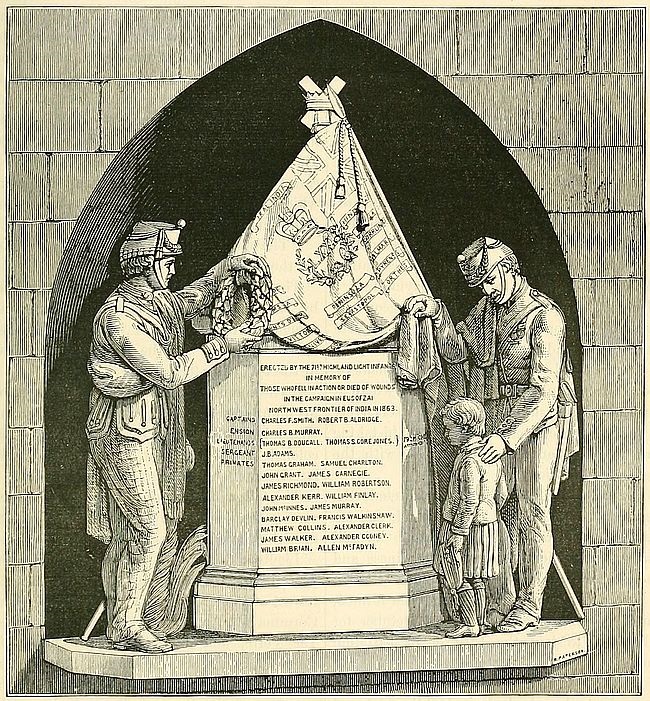
Monument erected in Glasgow Cathedral. William Brodie, R.S.A., Sculptor
“Colonel Hope now bids farewell to all his comrade officers and soldiers with every good wish for their prosperity and happiness.”
The command of the regiment now devolved upon Major John Ignatius Macdonnell, who obtained his promotion to Lieutenant-Colonel by Colonel Hope’s retirement. He took over the command with the good wishes and confidence of every one, having served in the regiment from the date of his first commission, on the 26th of April 1844, and been with it during the Crimea, Central Indian, and Yuzufzai campaigns.