Volume 2 / Part 3 — PART THIRD. HISTORY OF THE HIGHLAND REGIMENTS. (continued 16)
Reading edition
On the 1st of June 1859 Colonel Walter Hamilton was appointed to be Inspecting Field Officer of a recruiting district, by which the command of the regiment fell to Colonel Stisted, who, on the 30th of the following September, exchanged to the 93rd Highlanders with Colonel J. A. Ewart, C.B., aide-de-camp to the Queen.
The regiment being once more assembled on the borders of Ross-shire (the county from which it received its name), after an absence of twenty years, was received on all sides with a most hearty and spontaneous and certainly thoroughly well-deserved welcome. The northern counties vied with each other in showing civility to the regiment by giving banquets to the men and balls to the officers. Into the details of these fêtes we cannot of course enter. One of the most characteristic of these entertainments was a banquet given at Brahan Castle, by the Honourable Mrs Stewart Mackenzie, daughter of the Earl of Seaforth who raised the regiment, when a large family gathering of the Mackenzies of Seaforth assembled to do honour to the corps raised by their ancestors, on its return from the Indian wars. The regiment as a body was fêted by the inhabitants of the town and county of Nairn, and by the noblemen and gentlemen of the northern countries and burgh of Inverness at the latter town. The freedom of the burgh of Nairn was also conferred on Lieutenant-Colonel M’Intyre, and in both cases addresses were presented to the regiment, showing a high and well-deserved appreciation of the noble work done by the “Saviours of India.” On entering Inverness, Colonel M’Intyre halted the regiment in front of the house of General John Mackenzie, the oldest officer then in the British army, and who originally raised the light company of the 78th Highlanders. The men gave three cheers for the gallant veteran before proceeding along the streets appointed for the procession to the banqueting hall.
In the month of November a large meeting was held at Dingwall, for the purpose of considering the propriety of presenting some lasting testimonial from all classes in the county of Ross to the Ross-shire Buffs. The result of the meeting will appear in the sequel.
Shortly after this, Nos. 11 and 12 companies were formed into a dépôt, numbering 4 officers and 96 men, who, under Captain M’Andrew, proceeded to Aberdeen to join the 23rd dépôt battalion at that place.
The medals for the Persian campaign were received in February 1860, and on the 18th of that month were issued to the regiment. Out of the 36 officers and 866 men who served in Persia in the early part of the year 1857, only 15 officers and 445 men at this time remained on the strength of the regiment.
The 78th left Fort-George in two detachments, on the 21st and 24th of February, for Edinburgh, where its reception was most enthusiastic. The streets were rendered almost impassable by the people that thronged in thousands to witness the arrival of the famous 78th. In Edinburgh, as when at Fort-George, the people showed their appreciation of the services of the regiment by fêting officers and men. On the 23rd of March the officers were entertained at banquet given by the Royal Company of Archers, Queen’s Body-Guard for Scotland; and on the 21st of April a grand banquet was given to the officers and men by the citizens of Edinburgh, in the Corn Exchange.
The 78th remained in Edinburgh till April 1861, furnishing detachments to Greenlaw and Hamilton. The detachment stationed at the latter place was duly banqueted, and the freedom of the borough conferred upon Lieutenant-Colonel M’Intyre, C.B.
While in Edinburgh, in accordance with a circular from the Horse-Guards, dated May 30th, 1860, directing that all distinction between flank and battalion companies be abolished, the grenadiers and light companies ceased to exist, as such; the green heckles, grenades, and bugles being done away with, together with all distinction as to the size of the men, &c. This step, though no doubt conducive to the greater efficiency of the service, was not a little grievous to old officers, who as a rule took considerable pride in the stalwart men of the grenadier companies.
On the 2nd of June, General Sir William Chalmers, K.C.B., died at Dundee, and was succeeded in the colonelcy of the regiment by Lieutenant-General Roderick M’Neil, formerly an officer of the 78th Highlanders.
On the 9th of August the medals granted for the suppression of the Indian mutiny were presented to the regiment by Lady Havelock (widow of the late Sir Henry Havelock), who happened to be in Edinburgh at the time. Out of about 900 of all ranks, who commenced the Indian campaign with the 78th in May 1857, only 350 remained at this time in the strength of the service companies, a few also being at the depôt at Aberdeen.
The 78th left Edinburgh for Aldershot in detachments between April 27th and May 8th, 1861, remaining in huts till the end of August, when it removed into the permanent barracks. After staying a year at Aldershot it was removed on the 15th of May 1862 to Shorncliffe, where it spent about another year, removing to Dover on the 26th of May 1863. Here it was quartered on the Western Heights, furnishing detachments regularly to the Castle Hill Fort, to be employed as engineer working parties. After staying in Dover until August 1864, the 78th embarked on the 5th of that month, under command of Colonel J. A. Ewart, C.B., for Ireland, disembarking at Kingstown on the 8th, and proceeding to Dublin. Here the regiment remained for another year, when it received the route for Gibraltar. During this period there is little to record in connection with the peaceful career of the 78th.
Since the return of the regiment from India, it had, of course, been regularly inspected, the inspecting officers, as was naturally to be expected, having nothing but praise to bestow upon its appearance, discipline, and interior economy. Shortly after the arrival of the 78th at Aldershot, it was inspected by H.R.H. the Duke of Cambridge, who spoke of it in terms of the highest praise; “it was a noble regiment and admirably drilled,” the Duke said.
On the 19th of November 1861, an authority was received for an additional year’s service to be granted to those officers and soldiers of the 78th Highlanders who formed part of the column that entered Lucknow under Sir Henry Havelock; and on the 6th of March, in the same year, a similar reward was granted to those who were left by Sir Henry Havelock in defence of the Alum Bagh post on the 25th of September 1857.
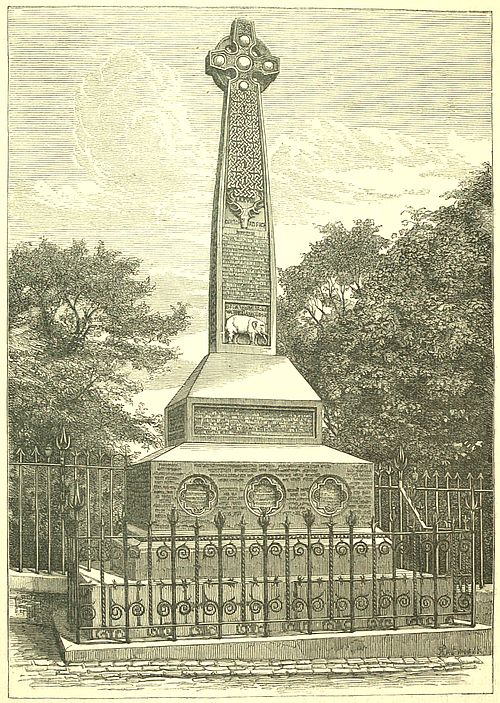
Monument on the Castle-Hill, Edinburgh.
Sacred to the Memory of the Officers, Non-commissioned Officers, and Private Soldiers of the lxxviii Regiment who fell in the suppression of the Mutiny of the Native Army of India in the years mdccclvii and mdccclviii, this Memorial is erected as a Tribute of respect by their surviving brother officers and comrades, and by many officers who formerly belonged to the Regiment.—Anno Domini mdccclxi.
On the 15th of April 1862, a monument to the memory of the officers, non-commissioned officers, and privates of the 78th Highlanders, who fell in India during the suppression of the mutiny in 1857–58, and which had been erected on the Castle Esplanade at Edinburgh by the officers and men of the regiment, and others who had formerly served in the Ross-shire Buffs, was publicly inaugurated by Major-General Walker, C.B., commanding the troops in Scotland, in presence of the Scots Greys, the 26th Cameronians, and the Royal Artillery. The monument is in the form of a handsome and tasteful large Runic cross, an illustration of which we are glad to be able to give on the preceding page.
We mentioned above that a meeting had been held at Dingwall, to consider the propriety of presenting some testimonial to the Ross-shire Buffs from the county which gives the regiment its distinctive name. The outcome of the meeting was that, while the regiment was at Shorncliffe, on the 26th of June 1862, two magnificent pieces of plate, subscribed for by the inhabitants of the counties of Ross and Cromarty, were presented to the 78th by a deputation consisting of Keith Stewart Mackenzie (a descendant of Kenneth, Earl of Seaforth, who raised and equipped the regiment), Macleod of Cadbol, Major F. Fraser, and Lord Ashburton. The plate consists of a Centre Piece for the officers’ mess, and a cup for the sergeants’ mess, and bears the following inscription:—
Presented by the Counties of Ross and Cromarty to the 78th Highlanders or Ross-shire Buffs, in admiration of the gallantry of the regiment and of its uniform devotion to the service of the country.—1859.
A very handsome flag for the pipe-major was also presented by Keith Stewart Mackenzie of Seaforth to the regiment, which has six pipers.
While at Dover, on the 17th of October 1863, the first issue of the Lucknow prize-money was made, a private’s share amounting to £1, 14s.; that of the various other ranks, from a corporal upwards, increasing in regular proportion, up to the Lieutenant-Colonel, who received 17 shares, amounting to £28, 18s.
On the 22nd of this month died the colonel of the 78th, General Roderick Macneil (of Barra), to whom succeeded Lieutenant-General Sir Patrick Grant, G.C.B.[507] In October of the following year, Lieutenant-Colonel Ewart, who had had command of the regiment for five years, retired on half-pay, and was succeeded by Major and Brevet-Colonel Colin Campbell M’Intyre, C.B.
It may be interesting to note here, that in compliance with a circular memorandum, dated Horse-Guards, 10th June 1865, the companies of the regiment, from July 17th, were designated by letters from A to M (excluding J), for all purposes of interior economy, instead of by numbers as hitherto.
The 78th had been at home for nearly six years, when on the 2nd of August 1865, it embarked at Kingstown for Gibraltar, the whole strength of the regiment at the time being 33 officers, 713 men, 74 women, and 95 children. Asiatic cholera was prevalent at Gibraltar at the time of the regiment’s arrival, and it therefore encamped on Windmill Hill until the 18th of October. The loss of the regiment from cholera was only 5 men, 1 woman, and 1 child.
During the two years that the 78th remained at Gibraltar, in performance of the tedious routine duties incident to that station, the only event worthy of record here is the retirement on full pay, in October 1866, of Colonel M’Intyre, who had been so long connected with the regiment, and who, as we have seen, performed such distinguished service in India. He was succeeded by Lieutenant-Colonel Lockhart, C.B., who, in assuming the command of the regiment, paid, in a regimental order, a high and just compliment to his predecessor.
On the 6th of July 1867 the 78th embarked at Gibraltar for Canada. Previous to embarkation the regiment paraded on the Alameda, where his Excellency Lieutenant-General Sir Richard Airey, G.C.B., Governor of Gibraltar, bade the 78th “good-bye” in a short address highly complimentary to the regiment, and especially to Colonel Lockhart, who also, before his old regiment sailed, had to say farewell to it. Colonel Lockhart, after being connected with the 78th for thirty years, was about to retire on full pay, and therefore on the morning of the 8th, before the vessel quitted the bay, he handed over the command of the regiment to Major Mackenzie; and on the evening of that day his farewell regimental order was issued, in which he exhibited the deepest feeling at having to bid farewell to his dear old regiment, as well as intense anxiety for the highest welfare of the men. The address is, indeed, very impressive, and we are sorry that space does not permit us to quote it here. “If any 78th man meets me in Scotland,” the colonel said, “where, by God’s permission, I hope to spend many happy days, I shall expect he will not pass me by; I shall not him.”
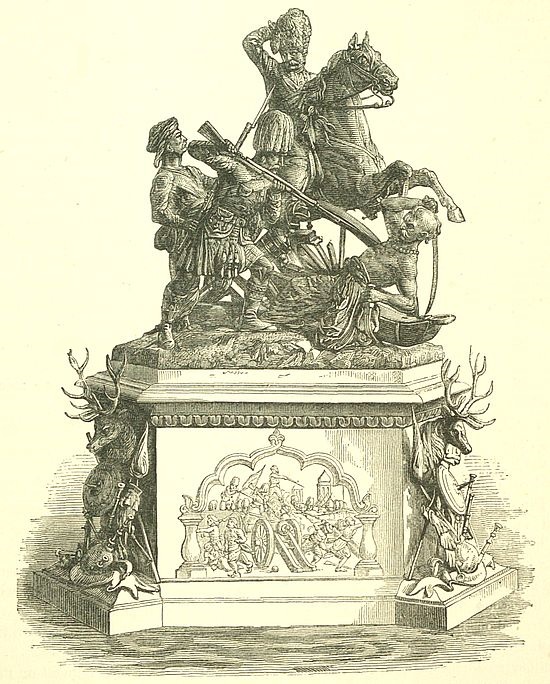
Centre Piece of Plate for the Officers’ Mess.
After being transhipped at Quebec on board a river steamer, the regiment landed at Montreal on the 23rd of July. The regular routine of garrison duty at Montreal was relieved by a course of musketry instruction at Chambly, and by a sojourn in camp at Point Levis, on the fortification of which place the regiment was for some time engaged.
The only notable incident that happened during the stay of the regiment in Canada was the presentation to it of new colours, the old ones being sadly tattered and riddled, and stained with the life-blood of many a gallant officer. The new colours were presented to the regiment by Lady Windham, in the Champ de Mars, on the 30th of May 1868, amid a concourse of nearly ten thousand spectators. After the usual ceremony with regard to the old colours, and a prayer for God’s blessing on the new by the Rev. Joshua Fraser, Lady Windham, in a few neat, brief, and forcible words, presented the new colours to Ensigns Waugh and Fordyce. Lieutenant-General C. A. Windham, the commander-in-chief, also addressed the regiment in highly complimentary terms. “Though he had not a drop of Scotch blood in his veins,” he said, “he had exceedingly strong Scottish sympathies. It was under Scotchmen that he got his first military start in life, and under succeeding Scotchmen he had made his earlier way in the service.... The 78th Highlanders had always conducted themselves bravely and with unsullied loyalty.” At the déjeuner which followed, General Windham said that in the whole course of his service he had never seen a regiment which pulled together so well as the 78th, and among whom there were so few differences. All the toasts were, of course, drunk with Highland honours, and all went off most harmoniously down to the toast of the “Ladies,” to which Lieutenant Colin Mackenzie had the honour to reply, advising his young brothers in arms to lose no time in coming under the sway of the “dashing white sergeant.”
The old colours of the Ross-shire Buffs were sent to Dingwall, in Ross-shire, there to be deposited in the County Buildings or the Parish Church.
On the 8th of May 1869 the regiment left Montreal; and, after being transhipped at Quebec, proceeded to Halifax, Nova Scotia, where it arrived on the 14th of May. Previous to the regiment’s leaving Montreal, a very warm and affectionate address was presented to it by the St Andrew’s Society.
The regiment remained in Nova Scotia till November 1871, furnishing detachments regularly to St John’s, New Brunswick. On several occasions since its return from India, the strength of the regiment had been reduced; and while at Halifax, on the 21st of April 1870, a general order was received, notifying a further reduction, and the division of the regiment into two depôts and eight service companies, consisting in all of 34 officers, 49 sergeants, 21 drummers, 6 pipers, and 600 rank and file. This involved a redistribution of the men of some of the companies; and, moreover, depôt battalions having been broken up on the 1st of April, the depôt companies of the 78th Highlanders were attached to the 93rd Highlanders.
Lieutenant-General Sir Charles Hastings Doyle, K.C.M.G., commanding the forces in British North America, inspected the regiment on the 11th of October 1870, a day or two after which the following very gratifying letter was received by Lieutenant-Colonel Mackenzie, C.B., from Brigade-Major Wilsome Black:—“The general desires me to say that he is not in the habit of making flourishing speeches at half-yearly inspections of Queen’s troops (although he does so to militia and volunteers), because her Majesty expects that all corps shall be in perfect order. When they are not, they are sure to hear from him, and a report made accordingly to the Horse Guards; but when nothing is said, a commanding officer will naturally take for granted that his regiment is in good order. The general, however, cannot refrain from saying to you, and begs you will communicate to the officers and men of the regiment under your command, that he was perfectly satisfied with everything that came under his observation at his inspection of your regiment on Tuesday last.”
In compliance with orders received, the 78th, under the command of Lieutenant-Colonel Alexander Mackenzie, C.B., embarked on board H.M.’s troop-ship “Orontes,” on the 25th of November 1871, and arrived at Queenstown, Ireland, on the 17th of December, where the regiment was transhipped and conveyed to Belfast, arriving in Belfast Lough on the 20th, and disembarking next day.
The strength of the regiment on its arrival in the United Kingdom was 32 officers and 472 non-commissioned officers and men, which on the 22nd of December was augmented by the arrival of the depôt battalion from Edinburgh, consisting of 2 officers and 45 non-commissioned officers and men. Shortly afterwards the strength of the regiment was augmented to 33 officers and 592 non-commissioned officers and privates; and in accordance with the Royal Warrant, dated October 30th, 1871, all the ensigns of the regiment were raised to the rank of lieutenant, the rank of ensign having been abolished in the army.
During its stay at Belfast the 78th regularly furnished detachments to Londonderry; and on several occasions it had the very unpleasant and delicate duty to perform of aiding the civil power in the suppression of riots caused by the rancour existing between Orangemen and Roman Catholics in the North of Ireland. This trying duty the regiment performed on both occasions to the entire satisfaction of the Irish authorities as well as of the War Office authorities, receiving from both quarters high and well-deserved praise for its prudent conduct, which was the means of preventing greatly the destruction of life and property.
Under the new system of localisation of regiments, it was notified in a Horse Guards General Order, that the 71st Highland Light Infantry and the 78th Highlanders would form the line portion of the 55th infantry sub-district, and be associated for the purposes of enlistment and service. The counties included in this sub-district are Orkney and Shetland, Sutherland, Caithness, Ross and Cromarty, Inverness, Nairn, and Elgin, and the station assigned to the brigade depôt is Fort George. In accordance with this scheme, Major Feilden, with a small detachment, proceeded to Fort-George on the 9th of April, to form part of the brigade depôt.
The 78th embarked at Belfast on the 3rd of May 1873, under command of Colonel Mackenzie, C.B. The streets were densely crowded, and the people gave vent to their good feeling by cheering repeatedly as the regiment marched from the barracks to the quay. The regiment was transferred to the “Himalaya,” which sailed on the 4th round the west and north coast of Scotland, and anchored in Cromarty Bay on the evening of the 7th, headquarters and six companies disembarking opposite Fort George next day. Two companies remained on board and proceeded to Aberdeen, there to be stationed. A detachment of the companies at Aberdeen proceeded to Ballater on the 15th of May, as a guard of honour to her Majesty the Queen, and again on the 14th of August.
The regiment was inspected by Major-General Sir John Douglas, K.C.B., on the 19th of May, the report of the inspection being considered by H.R.H. the Field-Marshal Commanding-in-Chief as most satisfactory.
The 78th remained at Fort George for only one year, embarking on the 11th of May 1874, under command of Colonel Mackenzie, C.B., for conveyance to Portsmouth, en route to Aldershot. The regiment disembarked at Portsmouth on the 15th of May, and proceeded by special train to Farnborough, marching thence to Aldershot. A period of exactly twelve years had elapsed since the 78th was last at this camp.
On the 19th of May the 78th was brigaded with the 42nd, 79th, and 93rd Highlanders, at a review which took place in the presence of the Czar of Russia; and it is worthy of note that these four kilted regiments are those that represented Scotland at the siege and fall of Lucknow. It is also a curious coincidence that Colonels Macleod, Mackenzie, M’Bean, and Miller all served with the regiments they led on this occasion before the Czar.
Major-General William Parke, C.B., commanding the 1st brigade, inspected the regiment on the 21st of May, and expressed himself highly pleased with the appearance and drill of the Ross-shire Buffs.
At the time we write, the establishment of this most distinguished regiment consists of 27 officers, 64 non-commissioned officers, drummers, and pipers, 40 corporals, and 480 privates,—the total of all ranks thus being 611.
We have the gratification of being able to present our readers with two authentic portraits on steel of two of the most eminent colonels of the Ross-shire Buffs. That of the first colonel, Francis Humberstone Mackenzie, Lord Seaforth, is from the original painting in the possession of Colonel Mackenzie-Fraser, of Castle-Fraser; and that of Sir Patrick Grant, G.C.B., G.C.M.G., is from a photograph by Bassano, kindly sent to us by Sir Patrick himself.
SUCCESSION LIST OF COLONELS AND FIELD OFFICERS OF THE 78th HIGHLANDERS.
COLONELS
NAMES.Date of Appointment.Remarks.
Francis Humberstone Mackenzie, afterwards Lord SeaforthMarch7,1793Resigned command of the regiment, retaining his rank. Died, 11th January 1815.
Alex. Mackenzie of Belmaduthy, took the name of Fraser of Castle FraserMay3,1796Died a Lieutenant-General, September 1809, from fever contracted in the Walcheren expedition.
Sir James Henry Craig, K.C.B.September15,1809Died, 1812.
Sir Samuel Auchmuty, G.C.B.January13,1812Died, 1822.
Sir Edward Barnes, G.C.B.August25,1822Appointed to 31st Foot, 10th October 1834.
Sir L. Smith, Bart., K.C.B., G.C.H.October10,1834Appointed to the 40th Foot, 9th February 1837.
Paul Anderson, C.B., K.C.February9,1837Died, 28th December 1851.
Sir Neil Douglas, K.C.B., K.C.H.December28,1851From Colonel 72nd. Died, 30th Sept. 1853.
Sir W. Chalmers, C.B., K.C.H.September30,1853Died, 2d June 1860.
Roderick MacneilJune3,1860Died, 22d October 1863.
Sir Patrick Grant, G.C.B., G.C.M.G.October23,1863Governor of Chelsea Hospital (1874).
LIEUTENANT-COLONELS.
Alex. Mackenzie of BelmaduthyJuly24,1793Promoted Colonel-Commandant 27th Feb. 1796.
Alex. Mackenzie of FairburnFebruary10,17942nd Battalion of 1794. To 36th Regiment, 1797.
John Randoll Mackenzie of SuddieFebruary27,1796A Col. in the army in 1794; he became a Major-General, and was killed at Talavera, 1809.
Alexander Malcolm1795Died, 1798.
John Mackenzie, Gairloch1795Placed on Half-pay, 1799.[508]
John Mackenzie, junior1795Placed on Half-pay, 1795.
Hay MacdowallMay22,1797Col. in the army in 1795, Major-General in 1798,and was promoted to 40th Regiment, 1802. Lost on passage from India, 1809.
Alexander AdamsApril7,1802Promoted Major-General, 1814.
Patrick Macleod, GeaniesApril17,18042nd Bat. 1804; Killed at El-Hamet, 21st Ap. 1807.
Hercules Scott, BenholmJuly23,1807To 103rd, 1808. Killed in Canada, 1814.
John Macleod, C.B.May12,18082nd Battalion of 1804. Major-General, 1819.
James Macdonell, GlengarrySeptember7,1809Exchanged to Coldstream Guards, 1810.
Sir Edward Michael Ryan,Kt.February21,1811Died in 1812.
James FraserMay1,1812Killed at Probolingo in Java, 1813.
Martin Lindsay, C.B.November25,1813Succeeded Colonel John Macleod in command, 12th Aug. 1819, and retired 27th April 1837.
David ForbesJuly28,1814Reduced on Half-pay, 1816.
Henry N. DouglasApril28,1837Died, 1st October 1849.
Martin G. T. LindsayApril8,1842Exchanged, 15th April 1842.
Roderick MacneilApril15,1842Colonel in the army June 17, 1828, and was promoted Major-General, 9th November 1846.
Jonathan ForbesNovember9,1846Retired, 10th December 1847.
E. TwopenyDecember10,1847Exchanged to 10th Foot.
Walter Hamilton, C.B.October2,1849Appointed Inspecting Field Officer, 1st June 1859.
Henry W. Stisted, C.B.April19,1850Exchanged to 93d Highlanders, 30th Sept. 1859.
John Alexander Ewart, C.B.September30,1859Retired on Half-pay, 28th October 1864.
Colin Campbell M’Intyre, C.B.October28,1864Retired on Full-pay, 2d October 1866.
Græme A. Lockhart, C.B.October2,1866Retired on Full-pay, 13th July 1867.
Alexander Mackenzie, C.B.July13,1867—
MAJORS.
Alex. Mackenzie, BelmaduthyMarch8,1793Promoted Colonel-Commandant, 27th Feb. 1796.
George, Earl of ErrolJuly24,1793To 1st Regiment Foot Guards, 1794. Died, 1799.
Alex. Mackenzie of FairburnJuly24,1793To command of 2nd Battalion, 10th Feb. 1794.
John Randoll Mackenzie of SuddieFebruary10,1794Promoted, 1794.
Michael MonypennyOctober28,1794Promoted to 73rd Regiment, 1798. Died, 1808.
Alexander MalcolmMay2,1794Promoted, 1795.
John Mackenzie, GairlochMay3,1794Promoted, 1795.
John Mackenzie, junior1794Promoted, 1795.
Alexander Grant1795Retired, 1798. Died, 1807.
William Montgomery1795Promoted to 64th Regiment. Died 1800.
Alexander AdamsAugust30,1798Promoted, 1802.
Hercules Scott, BenholmMay9,1800Promoted, 1807.
Patrick Macleod, GeaniesNovember18,1802To command of 2nd Battalion, 17th April 1804.
David Stewart, GarthApril17,1804Promoted to Royal West Indian Rangers, 1808. Author of the Sketches.
James Macdonell, GlengarryApril17,1804Promoted, 1809.
William CampbellDecember13,1804Killed at taking Fort Cornelis, in Java, 1810.
James FraserJuly23,1807Promoted, 1813.
Robert HamiltonApril21,1808Retired, 1810.
Martin LindsayJanuary4,1810Promoted, 1813.
David ForbesAugust29,1811Promoted, 1814.
Duncan MacphersonNovember7,1811Major of the regiment in 1820.
James MacbeanDecember14,1811Major of the regiment in 1820.
Duncan MacgregorNovember25,1813Reduced on Half-pay in 1816.
Colin Campbell Mackay, BighouseAugust11,1814Reduced on Half-pay in 1816.
Joseph BethuneJune14,1821—
C. G. FalconerJune26,1823—
Henry N. DouglasOctober22,1825Promoted, 28th April 1837.
James MillApril8,1826—
Benjamin AdamsMay7,1829Retired, 17th May 1838.
Martin G. T. LindsayApril28,1837Promoted, 8th April 1842.
Jonathan ForbesMay18,1838Promoted, 9th November 1846.
E. TwopenyApril8,1842Promoted, 10th December 1847.
R. J. P. VassallNovember9,1846Exchanged to Half-pay.
Walter HamiltonDecember10,1847Promoted, 2d October 1849.
J. BurnsMay23,1848Exchanged to 2nd Foot.
Henry W. StistedMay26,1848Promoted, 19th April 1850.
T. J. TaylorOctober2,1849Died, 18th June 1850.
Henry Hamilton, C.B.April19,1850Appointed to the Staff, 1st July 1862.
Colin Campbell M’Intyre, C.B.June19,1850Promoted, 28th October 1864.
Græme A. Lockhart, C.B.July1,1862Promoted, 2d October 1866.
Alexander MackenzieOctober28,1864Promoted, 13th July 1867.
Oswald B. FeildenOctober2,1866—
Augustus E. WarrenJuly13,1867—
ADJUTANTS.
James FraserMarch8,1793Retired, 1794.
James HansonFebruary10,17942nd Battalion of 1794. Became Adjutant of the consolidated Battalion in 1796. Retired.
Donald FraserOctober1,1794—
Alexander WishartOctober20,1797Promoted.
John HayDecember30,1800Died in India, 1803.
Joseph BethuneJune25,1803Promoted.
William MackenzieApril17,18042nd Battalion of 1804. Promoted.
Thomas HamiltonSeptember26,1805Deceased.
John CooperOctober15,1807Adjutant of the regiment till succeeded by Bull.
James FraserJune15,1810—
William SmithJune24,1813Adjutant of the 2nd Battalion when reduced.
J. E. N. BullMay4,1826Promoted, 19th October 1838.
S. M. EdingtonOctober19,1838Resigned, 31st August 1839.
C. PattisonAugust31,1839Promoted in Newfoundland Companies.
Hamilton Douglas GordonJune16,1848Promoted, 10th October 1850.
Laurence Pleydell BouverieOctober10,1850Promoted, 22nd December 1854.
Herbert T. Macpherson, V.C.December22,1854Promoted, 6th October 1857.
Andrew C. Bogle, V.C.October6,1857Promoted, 5th November 1858.
G. D. BarkerNovember5,1858Promoted, 2nd April 1861.
Thomas MackenzieApril2,1861Resigned, 16th May 1862.
Richard P. ButlerMay16,1862Retired, 21st November 1865.
George E. LeckyNovember21,1865Resigned, 27th February 1867.
Robert Lockhart DalglishFebruary27,1867Retired, 20th July 1867.
E. P. StewartJuly20,1867Promoted, 7th July 1869.
C. E. Croker-KingJuly7,1869Promoted, 17th July 1872.
Arthur Dingwall FordyceAugust21,1872—
PAYMASTERS.
Alexander BannermanFebruary25,1804—
James FergusonMarch21,18052nd Battalion of 1804. Deceased.
John ChisholmDecember11,1817Retired. Succeeded by Paymaster Taylor.
M. G. TaylorAugust26,1836Exchanged to 45th Foot.
E. EvansJuly7,1846Retired, 22nd April 1853.
Joseph WebsterApril22,1853Retired, 1st April 1864.
Charles SkrineApril1,1864—
QUARTER-MASTERS.
Archibald MacdougalMarch8,1793Retired.
Alexander WishartFebruary10,17942nd Battalion of 1794. Establishment reduced.
Duncan MacraeJanuary23,1801To 76th Foot as Ensign.
John LeavochFebruary11,1804Promoted from Paymaster’s Clerk. He carried the Queen’s colour at Assaye and Argaum.
John MacphersonApril17,18042nd Battalion of 1804. Retired.
Alexander WatersJune30,1808—
William SmithApril19,1810—
William GunnAugust6,1812Paymaster in Cape Mounted Rifles, May 31, 1839.
Joseph WebsterMay31,1839Promoted Paymaster, 22nd April 1853.
Patrick CarrollApril22,1853Retired on Full-pay, 12th September 1856.
Charles SkrineSeptember12,1856Promoted Paymaster, 1st April 1864.
Alexander WeirApril26,1864—
SURGEONS.
Thomas BaillieMarch8,1793Died in India, 1802.
William Kennedy17942nd Battalion of 1794.
John MacandieNovember17,1802—
Thomas DraperApril17,18042nd Battalion of 1804. Promoted Deputy Inspector-General.
Neil CurrieSeptember1,1808—
William MunroJune3,1813To Half-pay.
John M’Roberts, M.D.November13,1817—
Robert Henry Bolton, M.D.October30,1823—
Duncan HendersonMarch23,1826Exchanged to 14th Foot.
John M’AndrewFebruary15,1833Appointed to 40th Foot.
James BurtJuly29,1836Appointed to 16th Dragoons.
Archibald AlexanderOctober3,1845Exchanged to 50th Foot.
Arthur C. WebsterMarch23,1849Transferred to 10th Hussars.
Joseph Jee, V.C. & C.B.June23,1854Exchanged to 1st Dragoons, 20th Sept. 1864.
L. C. StewartSeptember20,1864Promoted, 17th March 1867.
J. MeaneMarch8,1867Appointed to the Staff, 6th March 1869.
V. M. M’Master, V.C.March6,1869Died, 22nd January 1872.
A. W. Beveridge, M.D.February17,1872—
Assistant-Surgeons.—John Macandie (1795), Alex. Young (1795), John Bowen (1803), Wm. Munro (1805), Alex. Leslie (1805), Walter Irwin (1810), John Hughes (1811), Wm. Macleod (1814), George Maclean (1814), Duncan Henderson, M.D. (1817), Alex Duncan (1826), James Thomson (1826), Arthur Wood, M.D. (1826), James Young (1826), Wm. Robertson (1832), W. H. Allman (1842), John Innes (1842), G. Archer, M.D. (1839), J. Mitchell, M.D. (1843), D. R. M’Kinnon (1844), W. Bowie, M.D. (1844), J. Leitch, M.D. (1846), J. M’Nab, M.D. (1847), A. S. Willocks (1852), E. K. O’Neill (1854), V. M. M’Master (1855), S. S. Skipton, M.D. (1857), A. W. Beveridge, M.D. (1857), P. Kilgour (1866), N. Wade (1867), W. Johnston, M.D. (1872).
DRESS OF THE 78TH HIGHLANDERS,
THE FULL HIGHLAND COSTUME.
Officers.—Kilt and belted plaid of Mackenzie tartan; scarlet Highland doublet, trimmed with gold lace according to rank, buff facings (patrol jacket and trews for fatigue dress); bonnet of black ostrich plumes, with white vulture hackle; Menzies tartan hose, red garter knots, and white spatterdashes (shoes and gold buckles, and Mackenzie tartan hose and green garter knots for ball dress); sporran of white goat’s hair, with eight gold tassels (two long black tassels undress); buff leather shoulder-belt, with gilt breast plate; red morocco dirk belt, embroidered with gold thistles; dirk and skean-dhu, mounted in cairngorm and silver gilt; the claymore, with steel scabbard; round silver-gilt shoulder brooch, surmounted by a crown. The field officers wear trews, shoulder plaid, and waist belt. The Cabar Feidh on all appointments, with the Elephant, superscribed “Assaye.”
Mess Dress.—Scarlet shell jacket, with buff rolling collar and facings, and gold shoulder-knots; Mackenzie tartan vest, with cairngorm buttons.
Sergeants.—Same as privates, with the exception of finer cloth and tartan. Staff sergeants wear the buff cross-belt and claymore, and shoulder plaid with brooch.
Privates.—Kilt and fly of Mackenzie tartan; scarlet Highland doublet, buff facings (buff jacket and trews for fatigue dress); bonnet of black ostrich plumes, with white hackle; sporran of white goat’s hair, with two long black tassels; Menzies tartan hose, red garter knots, and white spatterdashes; the Cabar Feidh and the Elephant on the appointments.
Band.—Same as privates, with the exception of red hackles, grey sporrans, buff waist-belts and dirks, and shoulder plaids and brooch.
Pipers.—Same as privates, with the exception of green doublets, green hackles, Mackenzie tartan hose, green garter knots, grey sporrans, black shoulder and dirk belts, claymore, dirk, and skean-dhu, and shoulder plaids with round brooch.
FOOTNOTES:
THE 79TH QUEEN’S OWN CAMERON HIGHLANDERS.
I. 1793–1853.
The Clan Cameron—Raising of the Regiment—Flanders—West Indies—Holland—Ferrol and Cadiz—Egypt—Ireland—A 2nd battalion—Proposed abolition of the kilt—Denmark—Sweden—Portugal—Corunna—Spain—The Peninsular War—Busaco—Foz d’Arouce—Fuentes d’Onor—Death of Colonel Philip Cameron—Lord Wellington’s opinion of the 79th—Salamanca—Siege of Burgos—Vittoria—Pyrenees—Nivelle—Nive—Orthes—Toulouse—Home—Quatre Bras—Waterloo—France—Home—Chichester—Portsmouth—Jersey—Ireland—Canada—New Colours—Scotland—England—Gibraltar—“Bailie Nicol Jarvie”—Canada—Scotland—Chobham—Portsmouth.
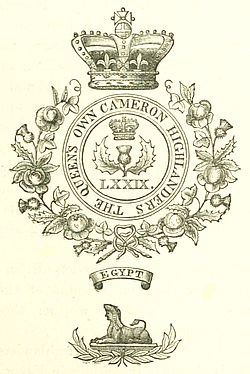
Egmont-op-Zee. Egypt (with Sphinx). Fuentes D’Onor. Salamanca. Pyrenees. Nivelle.
Nive. Toulouse. Peninsula. Waterloo. Alma. Sebastopol.
Lucknow.
The Camerons are well known as one of the bravest and most chivalrous of the Highland clans. They held out to the very last as steadfast adherents to the cause of the Stuarts, and the names of Ewen Cameron, Donald the “gentle Lochiel,” and the unfortunate Dr Cameron, must be associated in the minds of all Scotchmen with everything that is brave, and chivalrous, and generous, and unyieldingly loyal. The clan itself was at one time one of the most powerful in the Highlands; and the regiment which is now known by the clan name has most faithfully upheld the credit of the clan for bravery and loyalty; it has proved a practical comment on the old song, “A Cameron never can yield.”
This regiment was raised by Alan Cameron of Erracht, to whom letters of service were granted on the 17th of August 1793. No bounty was allowed by Government, as was the case with other regiments raised in this manner, the men being recruited solely at the expense of the officers. The regiment was inspected at Stirling in January 1794, and at the end of the same month its strength was raised to 1000 men, Alan Cameron being appointed Lieutenant-Colonel Commandant.[509] The 79th was at first designated the “Cameronian Volunteers,” but this designation was subsequently changed to “Cameron Highlanders.”
The following is the original list of the officers of the 79th:—
Major-Commandant—Alan Cameron.
Major—George Rowley.
Captains.
Neil Campbell
Patrick M’Dowall.
Donald Cameron.
George Carnegie.
Captain-Lieutenant and Captain—Archibald Maclean.
Lieutenants.
Archibald Maclean.
Alexander Macdonell.
Duncan Stewart.
John Urquhart.
Colin Maclean.
Joseph Dewer.
Charles MacVicar.
Ensigns.
Neil Campbell.
Gordon Cameron.
Archibald Macdonell.
Archibald Campbell.
Donald Maclean.
Archibald Cameron.
Alexander Grant.
William Graham.
Chaplain—Thomas Thompson.
Adjutant—Archibald Maclean.
Quartermaster—Duncan Stewart,
Surgeon—John Maclean.
After spending a short time in Ireland and the south of England, the 79th embarked in August 1794 for Flanders. During the following few months it shared in all the disasters of the unfortunate campaign in that country, losing 200 men from privation and the severity of the climate.[510]
Shortly afterwards the regiment returned to England, and landed in the Isle of Wight, in April 1795. Its strength was ordered to be completed to 1000 men, preparatory to its embarkation for India. While Colonel Cameron was making every exertion to fulfil this order, he received an intimation that directions had been given to draft the Cameron Highlanders into four other regiments. This impolitic order naturally roused the indignation of the colonel, who in an interview[511] with the commander-in-chief deprecated in the strongest terms any such unfeeling and unwise proceeding. His representations were successful, and the destination of the regiment was changed to the West Indies, for which it embarked in the summer of 1795. The 79th remained in Martinique till July 1797, but suffered so much from the climate that an offer was made to such of the men as were fit for duty to volunteer into other corps, the consequence being that upwards of 200 entered the 42nd, while about a dozen joined four other regiments. The officers, with the remainder of the regiment, returned home, landing at Gravesend in August, and taking up their quarters in Chatham barracks. Orders were issued to fill up the ranks of the 79th, and by the exertions of Colonel Cameron and his officers a fresh body of 780 men was raised, who assembled at Stirling in June 1798. In the following year it was ordered to form part of the expedition to the Helder, landing at Helder Point, in North Holland, in August, when it was brigaded with the 2nd battalion Royals, the 25th, 49th, and 92nd Regiments, under the command of Major-General Moore. After various movements, the fourth division, under the command of Sir Ralph Abercromby, came up, on the 2nd of October, with the enemy, strongly posted near the village of Egmont-op-Zee. Notwithstanding the unfavourable nature of the ground, consisting of loose sand-hills, General Moore’s brigade made such a vigorous attack with the bayonet, that the enemy were quickly driven from their position, and pursued over the sand-hills till night prevented further operations. In this enterprise, Captain James Campbell, Lieutenant Stair Rose, and 13 rank and file, were killed; and Colonel Cameron, Lieutenants Colin Macdonald, Donald Macniel, 4 sergeants, and 54 rank and file wounded. The regiment was specially complimented for its conduct both by the commander-in-chief and by General Moore; the former declaring that nothing could do the regiment more credit than its conduct that day. It embarked in the end of October, and landed in England on the 1st of November.
In August 1800 the 79th embarked at Southampton as part of the expedition fitted out to destroy the Spanish shipping in the harbours of Ferrol and Cadiz. It arrived before Ferrol on the 25th, and shortly afterwards the brigade of which the regiment formed part, forced the enemy from their position and took possession of the heights of Brion and Balon, which completely commanded the town and harbour of Ferrol. Lieutenant-General Sir James Pulteney, however, did not see meet to follow out the advantage thus gained, and abandoned the enterprise. In this “insignificant service,” as Captain Jameson calls it, the 79th had only Captain Fraser, 2 sergeants, and 2 rank and file wounded.
On the 6th of October the expedition landed before Cadiz, but on account of the very unfavourable state of the weather, the enterprise was abandoned.
In 1801 the Cameron Highlanders took part in the famous operations in Egypt, under Sir Ralph Abercromby; but as minute details of this campaign are given in the histories of the 42nd and 92nd Regiments, it will be unnecessary to repeat the story here. The 79th was brigaded with the 2nd and 50th Regiments, and took an active part in the action of March 13th, in which it had 5 rank and file killed, and Lieutenant-Colonel Patrick M’Dowall, Lieutenants George Sutherland and John Stewart, Volunteer Alexander Cameron, 2 sergeants, and 56 rank and file wounded.
In the general engagement of March 21st, in which the brave Abercromby got his death-wound, the light companies of the 79th and the other regiments of its brigade kept the enemy’s riflemen in check in front, while the fight was raging hotly on the right. The regiment lost one sergeant killed, and Lieutenant Patrick Ross, 2 sergeants, and 18 rank and file wounded.
While proceeding towards Cairo with Major-General Craddock’s brigade (to which the Cameron Highlanders had been transferred) and a division of Turks, they had a brush on the 9th of May with a French force, in which the 79th had Captain M’Dowall and one private wounded. At Cairo the regiment had the honour of being selected to take possession of the advanced gate, the “Gate of the Pyramids,” surrendered to the British in terms of a convention with the French.
For its distinguished services during the Egyptian campaign, the Cameron Highlanders, besides receiving the thanks of the king and parliament, was one of the regiments which received the honour of bearing the figure of a Sphinx, with the word “Egypt,” on its colours and appointments.
After staying a short time at Minorca, the regiment returned to Scotland in August 1802, whence, after filling up its thinned ranks, it was removed to Ireland in the beginning of 1803. In 1804 a second battalion was raised, but was never employed on active service, being used only to fill up vacancies as they occurred in the first battalion, until 1815, when it was reduced at Dundee.
In 1804 the question of abolishing the kilt seems to have been under the consideration of the military authorities, and a correspondence on the subject took place between the Horse-Guards and Colonel Cameron, which deserves to be reproduced for the sake of the Highland Colonel’s intensely characteristic reply. In a letter dated “Horse Guards, 13th October 1804,” Colonel Cameron was requested to state his “private opinion as to the expediency of abolishing the kilt in Highland regiments, and substituting in lieu thereof the tartan trews.” To this Colonel Cameron replied in four sentences as follows:—
“Glasgow, 27th October 1804.
“Sir,—On my return hither some days ago from Stirling, I received your letter of the 13th inst. (by General Calvert’s orders) respecting the propriety of an alteration in the mode of clothing Highland regiments, in reply to which I beg to state, freely and fully, my sentiments upon that subject, without a particle of prejudice in either way, but merely founded upon facts as applicable to these corps—at least as far as I am capable, from thirty years’ experience, twenty years of which I have been upon actual service in all climates, with the description of men in question, which, independent of being myself a Highlander, and well knowing all the convenience and inconvenience of our native garb in the field and otherwise, and perhaps, also, aware of the probable source and clashing motives from which the suggestion now under consideration originally arose. I have to observe progressively, that in the course of the late war several gentlemen proposed to raise Highland regiments, some for general service, but chiefly for home defence; but most of these corps were called from all quarters, and thereby adulterated with every description of men, that rendered them anything but real Highlanders, or even Scotchmen (which is not strictly synonymous), and the colonels themselves being generally unacquainted with the language and habits of Highlanders, while prejudiced in favour of, and accustomed to wear breeches, consequently averse to that free congenial circulation of pure wholesome air (as an exhilarating native bracer) which has hitherto so peculiarly befitted the Highlander for activity, and all the other necessary qualities of a soldier, whether for hardship upon scanty fare, readiness in accoutring, or making forced marches, &c., besides the exclusive advantage, when halted, of drenching his kilt, &c., in the next brook, as well as washing his limbs, and drying both, as it were, by constant fanning, without injury to either, but, on the contrary, feeling clean and comfortable, while the buffoon tartan pantaloon, &c., with all its fringed frippery (as some mongrel Highlanders would have it) sticking wet and dirty to the skin, is not very easily pulled off, and less so to get on again in case of alarm or any other hurry, and all this time absorbing both wet and dirt, followed up by rheumatism and fevers, which ultimately make great havoc in hot and cold climates; while it consists with knowledge, that the Highlander in his native garb always appeared more cleanly, and maintained better health in both climates than those who wore even the thick cloth pantaloon. Independent of these circumstances, I feel no hesitation in saying, that the proposed alteration must have proceeded from a whimsical idea, more than from the real comfort of the Highland soldier, and a wish to lay aside that national martial garb, the very sight of which has, upon many occasions, struck the enemy with terror and confusion,—and now metamorphose the Highlander from his real characteristic appearance and comfort in an odious incompatible dress, to which it will, in my opinion, be difficult to reconcile him, as a poignant grievance to, and a galling reflection upon, Highland corps, &c., as levelling that martial distinction by which they have been hitherto noticed and respected,—and from my own experience I feel well founded in saying, that if anything was wanted to aid the rack-renting Highland landlords in destroying that source, which has hitherto proved so fruitful for keeping up Highland corps, it will be that of abolishing their native garb, which His Royal Highness the Commander-in-chief and the Adjutant-General may rest assured will prove a complete death-warrant to the recruiting service in that respect. But I sincerely hope His Royal Highness will never acquiesce in so painful and degrading an idea (come from whatever quarter it may) as to strip us of our native garb (admitted hitherto our regimental uniform) and stuff us into a harlequin tartan pantaloon, which, composed of the usual quality that continues, as at present worn, useful and becoming for twelve months, will not endure six weeks fair wear as a pantaloon, and when patched makes a horrible appearance—besides that the necessary quantity to serve decently throughout the year would become extremely expensive, but, above all, take away completely the appearance and conceit of a Highland soldier, in which case I would rather see him stuffed in breeches, and abolish the distinction at once.—I have the honour to be, &c.
(Signed) “Alan Cameron, “Colonel 79th or Cameron Highlanders.
“To Henry Thorpe, Esq.”
The regiment remained in Ireland till November 1805, when it was removed to England, where it did duty at various places till July 1807. In that month the 79th formed part of the expedition against Denmark, where it remained till the following November, the only casualties being four men wounded, during the bombardment of Copenhagen.
After a fruitless expedition to Sweden in May 1808, under Lt.-General Sir John Moore, the regiment was ordered, with other reinforcements, to proceed to Portugal, where it landed August 26th, 1808, and immediately joined the army encamped near Lisbon. After the convention of Cintra, the 79th, as part of Major-General Fane’s brigade, joined the army under Sir John Moore, whose object was to drive the French out of Spain. Moore, being joined by the division under Sir David Baird, at Mayorga, had proceeded as far as Sahagun, when he deemed it advisable to commence the ever memorable retreat to Corunna, details of which have already been given. At Corunna, on the 16th of January 1809, the 79th had no chance of distinguishing itself in action, its duty being, as part of Lt.-General Fraser’s division, to hold the heights immediately in front of the gates of Corunna; but “they also serve who only stand and wait.” The embarkation was effected in safety, and on the army arriving in England in February, the 79th marched to Weeley Barracks, in Essex, about 10 miles from Chelmsford, where many of the men were shortly afterwards attacked with fever, though not a man died.[512]
While in Portugal, Colonel Cameron, who had been appointed commandant of Lisbon with the rank of Brigadier-General, retired from the personal command of the regiment, after leading it in every engagement and sharing all its privations for fifteen years; “his almost paternal anxiety,” as Captain Jameson says, “for his native Highlanders had never permitted him to be absent from their head.” He was succeeded in the command of the regiment by his eldest son, Lt.-Colonel Philip Cameron.
After taking part in the siege of Flushing, in August 1809, the regiment returned to England, and again took up its quarters in Weeley Barracks, where it was attacked with fever, which carried off a number of men, and prostrated many more, upwards of 40 having to be left behind when the regiment embarked for Portugal in January 1810, to join the army acting under Sir Arthur Wellesley.
Meanwhile a number of men of the 79th, who had been left behind in Portugal on the retreat to Corunna, had, along with several officers and men belonging to other regiments, been formed into a corps designated the 1st battalion of detachments. The detachment of the 79th consisted of 5 officers, 4 sergeants, and 45 rank and file; and out of this small number who were engaged at Talavera de la Reyna on July 27th and 28th, 1809, 14 rank and file were killed, and one sergeant and 27 rank and file wounded.
Shortly after landing at Lisbon, the regiment was ordered to proceed to Spain to assist in the defence of Cadiz, where it remained till the middle of August 1810, having had Lts. Patrick M’Crummen, Donald Cameron, and 25 rank and file wounded in performing a small service against the enemy. After its return to Lisbon, the 79th was equipped for the field, and joined the army under Lord Wellington at Busaco on the 25th of September. The 79th was here brigaded with the 7th and 61st Regiments, under the command of Major-General Alan Cameron.
The regiment had not long to wait before taking part in the active operations carried on against the French by England’s great general. Wellington had taken up a strong position along the Sierra de Busaco, to prevent the further advance of Marshal Massena; and the division of which the 79th formed part was posted at the extreme right of the British line. At daybreak on the 27th of Sept. the French columns, preceded by a swarm of skirmishers, who had nearly surrounded and cut off the picket of the 79th, advanced against the British right, when Captain Neil Douglas gallantly volunteered his company to its support, and opening fire from a favourable position, checked the enemy’s advance, and enabled the picket to retire in good order. As the enemy’s attack was changed to the centre and left, the 79th had no other opportunity that day of distinguishing itself in action. It, however, lost Captain Alexander Cameron[513] and 7 rank and file killed, Captain Neil Douglas, and 41 rank and file wounded.
After this battle, Wellington deemed it prudent to retire within the strong lines of Torres Vedras, whither he was followed by Massena, who remained there till the 14th of November, when he suddenly broke up his camp and retired upon Santarem, followed by Wellington. The French again commenced their retreat in the beginning of March 1811, closely pursued by the British army. During the pursuit several small skirmishes took place, and in a sharp contest at Foz d’Arouce, the light company of the 79th had 2 men killed, and 7 wounded. In this affair, Lt. Kenneth Cameron of the 79th captured the Lieutenant-Colonel of the 39th French infantry.
On the 2nd of May, Massena, desirous of relieving Almeida, which Wellington had invested, took up a position in front of Dos Casas and Fuentes d’Onor. “The English position,” says Jameson, “was a line whose left extended beyond the brook of Onoro, resting on a hill supported by Fort Conception; the right, which was more accessible, was at Nave d’Aver, and the centre at Villa Formosa.”
On the 3rd of May, Massena commenced his attack upon the English position, his strongest efforts being directed against the village of Fuentes d’Onor, which he seemed determined to get possession of. The defence of the position was entrusted to the 79th, along with the 71st Highlanders, with the 24th regiment and several light companies in support, the whole commanded by Lieutenant-Colonel Philip Cameron of the 79th. During the whole of the day the enemy in superior numbers made several desperate attempts to take the village, and indeed did manage to get temporary possession of several parts, “but after a succession of most bloody hand to hand encounters, he was completely driven from it at nightfall, when darkness put an end to the conflict.”[514]
Early on the morning of the 5th of May, Massena, who in the meantime had been making dispositions for a renewal of the contest, again directed his strongest efforts against the position held by the 79th and its comrades. By the force of overwhelming numbers the French did succeed in carrying the lower portion of the village, at the same time surrounding and taking prisoners two companies of the 79th, which had got separated from the main body. Meantime, in the upper portion of the village a fierce and deadly contest was being waged between the French Grenadiers and the Highlanders, the latter, according to Captain Jameson, in numerous instances using their muskets as clubs instead of acting with the bayonet, so close and deadly was the strife maintained. “About this period of the action, a French soldier was observed to slip aside into a doorway and take deliberate aim at Colonel Cameron, who fell from his horse mortally wounded. A cry of grief, intermingled with shouts for revenge, arose from the rearmost Highlanders, who witnessed the fall of their commanding officer, and was rapidly communicated to those in front. As Colonel Cameron was being conveyed to the rear by his sorrowing clansmen, the 88th regiment, detached to reinforce the troops at this point, arrived in double-quick time; the men were now at the highest pitch of excitement, and a charge being ordered by Brigadier-General Mackinnon, the enemy was driven out of the village with great slaughter. The post was maintained until the evening, when the battle terminated, and the Highlanders being withdrawn, were replaced by a brigade of the light division.”[515]
In these fierce contests, besides Lt.-Colonel Cameron, who died of his wound, the 79th had Captain William Imlach, one sergeant, and 30 rank and file killed; Captains Malcolm Fraser and Sinclair Davidson, Lts. James Sinclair, John Calder, Archibald Fraser, Alexander Cameron, John Webb, and Fulton Robertson, Ensigns Charles Brown and Duncan Cameron, 6 sergeants, and 138 rank and file wounded, besides about 100 missing, many of whom were afterwards reported as killed.
The grief for the loss of Colonel Cameron, son of Major-General Alan Cameron, former and first colonel of the 79th, was deep and wide-spread. Wellington, with all his staff and a large number of general officers, notwithstanding the critical state of matters, attended his funeral, which was conducted with military honours. Sir Walter Scott, in his “Vision of Don Roderick,” thus alludes to Colonel Cameron’s death:—
“And what avails thee that, for Cameron slain, Wild from his plaided ranks the yell was given? Vengeance and grief gave mountain-rage the rein, And, at the bloody spear-point headlong driven, The despot’s giant guards fled like the rack of heaven.”[516]
Wellington,—and many other officers of high rank,—sent a special letter of condolence to the colonel’s father, Major-General Cameron, in which he speaks of his son in terms of the highest praise. “I cannot conceive,” he says, “a string of circumstances more honourable and glorious than these in which he lost his life in the cause of his country.”
Cameron was succeeded in the command of the regiment by Major Alexander Petrie, who, besides receiving a gold medal, had the brevet rank of Lt.-Colonel conferred on him; and the senior captain, Andrew Brown, was promoted to the brevet rank of Major.
How highly Lord Wellington esteemed the services performed by the 79th on these two bloody days, will be seen from the following letter:—
“Villa Formosa, 8th May, 1811.
“Sir,—I am directed by Lord Wellington to acquaint you that he will have great pleasure in submitting to the Commander-in-Chief for a commission the name of any non-commissioned officer of the 79th regiment whom you may recommend, as his lordship is anxious to mark the sense of the conduct of the 79th during the late engagement with the enemy.
“I have the honour to be, &c., (Signed) “Fitzroy Somerset.
“Major Petrie, Commanding “79th Highlanders,” &c.
Sergeant Donald M’Intosh was selected for this distinguished honour, and, on the 4th of June 1811, was appointed ensign in the 88th Regiment.
The 79th did not take part in any other engagement till the 22nd of July 1812, when it was present as part of the reserve division under Major-General Campbell at the great victory of Salamanca. Its services, however, were not brought into requisition till the close of the day, and its casualties were only two men wounded. Still it was deemed worthy of having the honour of bearing the word “Salamanca” on its colours and appointments, and a gold medal was conferred upon the commanding officer, Lt.-Colonel Robert Fulton, who had joined the regiment at Vellajes in September 1811, with a draft of 5 sergeants, and 231 rank and file from the 2nd battalion.
In the interval between Fuentes d’Onor and Salamanca the 79th was moved about to various places, and twice was severely attacked with epidemic sickness.
After the battle of Salamanca, the 79th, along with the rest of the allied army, entered Madrid about the middle of August, where it remained till the end of that month.
On the 1st of September the 79th, along with the rest of the army, left Madrid under Lord Wellington, to lay siege to Burgos, before which it arrived on the 18th; and on the morning of the 19th, the light battalion, formed by the several light companies of the 24th, 42nd, 58th, 60th, and 79th regiments, commanded by Major the Hon. E. C. Cocks of the 79th, was selected for the purpose of driving the enemy from their defences on the heights of St Michael’s, consisting of a horn-work and flèches commanding the approach to the castle on the right.
“The attack was made by a simultaneous movement on the two advanced flèches, which were carried in the most gallant manner by the light companies of the 42nd and 79th; but a small post, close to and on the left of the horn-work, was still occupied by the enemy, from which he opened a fire upon the attacking party. Lieut. Hugh Grant, with a detachment of the 79th light company, was sent forward to dislodge him, but finding himself opposed to continually increasing numbers, he found it impossible to advance; but being equally resolved not to retire, he drew up his small party under cover of an embankment, and, possessing himself of the musket of a wounded soldier, he fired together with his men and gallantly maintained himself. The remainder of the company now coming up, the enemy was driven within the works; but this brave young officer was unfortunately mortally wounded, and died a few days afterwards, sincerely and deeply regretted.
“The two light companies maintained the position until nightfall, when the light battalion was assembled at this point, and orders were issued to storm the horn-work at 11 P.M. A detachment of the 42nd and a Portuguese regiment were directed to enter the ditch on the left of the work, and to attempt the escalade of both demi-bastions, the fire from which was to be kept in check by a direct attack in front by the remainder of the 42nd. The light battalion was to advance along the slope of the hill, parallel to the left flank of the work, which it was to endeavour to enter by its gorge. The attack by the 42nd was to be the signal for the advance of the light battalion, the command of the whole being entrusted to Major-General Sir Denis Pack.[517]
“In execution of these arrangements, the troops at the appointed hour proceeded to the assault. The light companies, on arriving at the gorge of the work, were received with a brisk fire of musketry through the opening in the palisades, causing severe loss; they, however, continued to advance, and, without waiting for the application of the felling-axes and ladders, with which they were provided, the foremost in the attack were actually lifted over the palisades on each other’s shoulders. In this manner, the first man who entered the work was Sergeant John Mackenzie of the 79th; Major Cocks, the brave leader of the storming party, next followed, and several others in succession.
“In this manner, and by means of the scaling-ladders, the light battalion was, in a few minutes, formed within the work; and a guard, consisting of Sergeant Donald Mackenzie and twelve men of the 79th, having been placed at the gate leading to the castle, a charge was made on the garrison, which, numbering between 400 and 500 men, having by this time formed itself into a solid mass, defied every attempt to compel a surrender; in this manner the French troops rushed towards the gate, where, meeting with the small guard of the 79th, they were enabled, from their overwhelming numbers to overcome every opposition, and to effect their escape to the castle.
“Sergeant Mackenzie, who was severely wounded in this affair,[518] and his small party behaved with the greatest bravery in their endeavours to prevent the escape of the French garrison; and bugler Charles Bogle of the 79th, a man of colour, was afterwards found dead at the gate, near a French soldier, the sword of the former and bayonet of the latter through each other’s bodies.
“The front attack had in the meantime completely failed, and a severe loss was sustained.”[519]
The enemy having opened a destructive fire from the castle on the horn-work, the light battalion was withdrawn to the ditch of the curtain; and strong parties were employed during the night in forming a parapet in the gorge.
Afterwards a series of assaults was made against the castle, with but little success. In one of these Major Andrew Lawrie of the 79th was killed while entering a ditch, and encouraging on the party he led by escalade; and the Hon. Major Cocks met with a similar fate while rallying his picket during a night sortie of the French. The death of this officer was very much regretted by Wellington, who in his despatch of October 11, 1812, said he considered “his loss as one of the greatest importance to this army and to His Majesty’s service.” The army continued before Burgos till Oct. 21, when, being threatened by the advance of strong reinforcements of the enemy, it was deemed advisable to retreat towards the frontiers of Portugal.
At the siege of Burgos, besides the two officers just mentioned, the 79th had one sergeant and 27 rank and file killed; Captain William Marshall, Lt. Hugh Grant, Kewan J. Leslie, and Angus Macdonald, 5 sergeants, 1 drummer, and 79 rank and file wounded.
The regiment, with the rest of the army, remained in cantonments till the middle of May 1813; and in February of that year Lt.-Colonel Fulton retired from the command of the regiment, which was assumed by Lt.-Colonel Neil Douglas,[520] from the 2nd battalion.
Breaking up from winter-quarters about the middle of May, the army advanced against the enemy, who occupied various strong positions on the north of the Douro, which, however, were precipitately evacuated during the advance of the British army. The enemy retired towards the north-east, in the direction of Burgos, which the British found had been completely destroyed by the French. In the action at Vittoria, in which the enemy was completely routed on the 21st of June, the 79th had not a chance of distinguishing itself in action, as it formed part of Major-General Pakenham’s division, whose duty it was to cover the march of the magazines and stores at Medina de Pomar.
At the battle of the “Pyrenees,” on the 28th of July, the 6th division, to which the 79th belonged, was assigned a position across the valley of the Lanz, which it had scarcely assumed when it was attacked by a superior French force, which it gallantly repulsed with severe loss; a similar result occurred at all points, nearly every regiment charging with the bayonet. The loss of the 79th was 1 sergeant and 16 rank and file killed; Lieutenant J. Kynock, 2 sergeants, and 38 rank and file wounded. Lt.-Colonel Neil Douglas had a horse shot under him, and in consequence of his services he was awarded a gold medal; and Major Andrew Brown was promoted to the brevet rank of Lt.-Colonel for his gallantry.
Along with the rest of the army, the 79th followed the enemy towards the French frontier, the next action in which it took part being that of Nivelle, November 19, 1813, fully described elsewhere. Here the steadiness of its line in advancing up a hill to meet the enemy excited the admiration of Sir Rowland Hill, and although its casualties were few, the part it took in the action gained for the regiment the distinction of inscribing “Nivelle” on its colours and appointments. Its loss was 1 man killed, and Ensign John Thomson and 5 men wounded.
Continuing to advance with its division, the 79th shared, on the 10th of December, in the successful attack on the enemy’s entrenchments on the banks of the Nive, when it had 5 men killed, and Lt. Alexander Robertson, 2 sergeants, and 24 rank and file wounded.[521]
The enemy having retired to the Gave d’Oléron, and the severity of the weather preventing further operations, the 79th went into quarters at St Pierre d’Yurbe, and while here, in Feb. 1814, it marched over to the seaport town of St Jean de Luz to get a new supply of clothing, of which it stood very much in need.
In the battle of Orthes, on February 25th, the 79th had no opportunity of taking part, but took an active share, and suffered severely, in the final engagement at Toulouse.
Early on the morning of the 10th, the 6th division, of which the 79th, under the command of Sir Henry Clinton, formed part, along with the 42nd and 91st regiments, constituting the Highland Brigade of Sir Denis Pack, crossed the Garonne and the Ers at Croix d’Orade, following the 4th division, and halted near the northern extremity of the height (between and running parallel with the canal of Languedoc, and the river Ers) on which the enemy was posted, strongly fortified by entrenchments and redoubts. Arrangements were here made for a combined attack, the 6th division, continuing its march along the left bank of the Ers, filed by threes in double-quick time, close under the enemy’s guns, from which a heavy cannonade of round and grape-shot was opened, occasioning considerable loss. “The Highland Brigade of Sir Denis Pack,” Captain Jameson says, “halted about midway to the position, formed line to the right, and proceeded to ascend the hill. The light companies were now ordered out, and directed to conform to the movements of the brigade, General Pack having mingled with the former, and cheering them on.” The grenadier company of the 79th was brought up as a reinforcement to the light troops; and after a vigorous resistance, the enemy was driven to a considerable distance down the opposite slope of the ridge. The pursuit was then discontinued, and a slackened and desultory fire of advanced posts succeeded.
The brigade had, in the meantime, formed on the Balma road across the height, the light companies were recalled, and final arrangements completed for an attack on the two centre redoubts of the enemy’s position, designated respectively La Colombette and Le Tour des Augustins. The attack of the former or most advanced redoubt was assigned to the 42nd, and the latter to the 79th, the 91st and 12th Portuguese being in reserve. Both these redoubts were carried at a run, in the most gallant style, in the face of a terrific fire of round shot, grape, and musketry, by which a very severe loss was sustained. About 100 men of the 79th, headed by several officers, now left the captured work to encounter the enemy on the ridge of the plateau; but, suddenly perceiving a discharge of musketry in the redoubt captured by the 42nd in their rear, and also seeing it again in possession of the enemy, they immediately fell back on the Redoubt des Augustins. The Colombette had been suddenly attacked and entered by a fresh and numerous column of the enemy, when the 42nd was compelled to give way and, continuing to retire by a narrow and deep road leading through the redoubt occupied by the 79th (closely pursued by an overwhelming force of the enemy), the alarm communicated itself from one regiment to the other, and both, for a moment, quitted the works.[522]
At this critical juncture, Lt.-Colonel Douglas having succeeded in rallying the 79th, the regiment again advanced, and in a few minutes succeeded in retaking, not only its own former position, but also the redoubt from which the 42nd had been driven. For this service, Lt.-Colonel Douglas received on the field the thanks of Generals Clinton and Pack, commanding the division and brigade; and the regiments in reserve having by this time come up, the brigade was moved to the right, for the purpose of carrying, in conjunction with the Spaniards, the two remaining redoubts on the left of the position. While, however, the necessary preparations were making for this attack, the enemy was observed to be in the act of abandoning them, thus leaving the British army in complete possession of the plateau and its works. The 79th occupied the Redoubt Colombette during the night of the 10th of April 1814.[523]
The importance of the positions captured by the 42nd and the 79th was so great, and the behaviour of these regiments so intrepid and gallant, that they won special commendation from Wellington, being two of the four regiments particularly mentioned in his despatch of the 12th of April 1814.
The 79th lost Captains Patrick Purves and John Cameron, Lt. Duncan Cameron, and 16 rank and file killed; the wounded were Captains Thomas Mylne, Peter Innes, James Campbell, and William Marshall; Lts. William M’Barnet, Donald Cameron, James Fraser, Ewen Cameron (1st), John Kynock, Ewen Cameron (2nd), Duncan Macpherson, Charles M’Arthur, and Allan Macdonald; Ensign Allan Maclean, Adjutant and Lt. Kenneth Cameron, 12 sergeants, 2 drummers, and 182 rank and file. Of those wounded, Lts. M’Barnet, Ewen Cameron (2nd), and 23 men died of their wounds. Of the 494 officers and men of the 79th who went into action at Toulouse, only 263 came out unwounded.
Lt.-Colonel Neil Douglas received the decoration of a gold cross for this action, in substitution of all his former distinctions; Major Duncan Cameron received the brevet rank of Lt.-Colonel in the army; and the 79th was permitted by royal authority to bear on its colours and appointments the word Toulouse, in addition to its other inscriptions. As a proof, likewise, of the distinction earned by it during the successive campaigns in the Peninsula, it was subsequently authorised to have the word Peninsula inscribed on its colours and appointments.
Napoleon Buonaparte’s abdication having put an end to further hostilities, the regiment, after remaining a few weeks in the south of France, embarked in July 1814, arriving at Cork on the 26th, and taking up its quarters in the barracks there. While here, in December, its ranks were filled up by a large draft from the 2nd battalion, and in the beginning of Feb. 1815, it set sail, along with several other regiments, for North America, but was driven back by contrary winds; the same happened to the expedition when attempting to sail again on the 1st of March. On the 3rd, the expedition was countermanded; and on the 17th the 79th sailed for the north of Ireland, to take up its quarters at Belfast, where it remained till May, when, with all the other available forces of Britain, it was called upon to take part in that final and fierce struggle with the great disturber of the peace of Europe, and assist in putting an end to his bloody machinations against the peace of civilised nations. The 79th, having joined Wellington’s army at Brussels, was brigaded with the 28th, 32nd, and 95th Regiments, under the command of Major-General Sir James Kempt, the three regiments forming the first brigade of the fifth, or Sir Thomas Picton’s division, the Royal Scots, 42nd, 44th, and 92nd regiments forming the other brigade under Major-General Pack.
The events from the night of the 15th to the 18th of June 1815 are so well known, and so many details are given in connection with the 42nd and 92nd Regiments, that it will be sufficient here to indicate the part taken in them by the 79th. The alarm having been rapidly spread of the approach of the French on the night of the 15th—the night of the famous ball well known to all readers of Byron,—preparations were immediately made for marching out, and by four o’clock on the morning of the 16th, the regiment, with its division, provisioned for three days, was on the road to Charleroi. In the passage of Childe Harold where Byron’s famous description of the episode preceding Quatre Bras occurs, the poet thus refers to the Cameron Highlanders:—
“And wild and high the ‘Cameron’s Gathering’ rose, The war-note of Lochiel, which Albyn’s hills Have heard, and heard, too, have her Saxon foes:— How in the noon of night that pibroch thrills Savage and shrill! But with the breath which fills Their mountain-pipe, so fill the mountaineers With the fierce native daring which instils The stirring memory of a thousand years, And Evan’s,[524] Donald’s fame rings in each clansman’s ears!”
The division halted near the village of Waterloo to cook its provisions; but before this could be accomplished it was ordered forward towards Quatre Bras, where it halted on the road, at the distance of about half a mile from the enemy, from whom the column was separated by a rising ground. After the two brigade companies had halted for a very short time on this road the division broke off to the left, lining the Namur Road, the banks of which were from ten to fifteen feet high on each side. The Cameron Highlanders formed the extreme left of the British army, and the 92nd the right of the division, being posted immediately in front of Quatre Bras.
Scarcely had this position been taken up, when the enemy advanced in great force, sending out “a cloud of sharpshooters,” who were met by the light companies of the first brigade, along with the 8th company and marksmen of the 79th. These maintained their ground bravely, despite the fearful execution done upon them by the overwhelming numbers of the enemy’s sharpshooters, who picked out the officers especially, and the artillerymen serving the only two guns yet brought into action. At about four o’clock in the afternoon, the Cameron Highlanders had the honour of being ordered forward to cover the guns and drive the enemy from his advanced position, and gallantly did the regiment perform the service.
“The regiment,” says Captain Jameson,[525] “cleared the bank in its front, fired a volley, and, charging with the bayonet, drove the French advanced troops with great precipitation and in disorder to a hedge about a hundred yards in their rear, where they attempted to re-form, but were followed up with such alacrity that they again gave way, pursued to another hedge about the same distance, from which they were a second time driven in confusion upon their main column, which was formed in great strength upon the opposite rising ground. The regiment, now joined by its detached companies, commenced firing volleys upon the enemy from behind the last-mentioned hedge, and in the course of fifteen minutes expended nearly all its ammunition. Whilst in this exposed situation, it was ordered to retire, which it accomplished without confusion, although it had a broad ditch to leap, and the first hedge to repass, when it formed line about fifty yards in front of its original position. Being here much exposed to the fire of the enemy’s guns, it was ordered to lie down, and it continued thus for nearly an hour, when it was again directed to resume its first position on the road, and form in column as circumstances might require. Being afterwards repeatedly threatened by cavalry, it formed and moved forward in square, but without being attacked.”
Meantime all the other regiments of the division were engaged; indeed, each battalion of the British army had to sustain, in several instances separately and independently, the whole weight of the superior French masses which bore down upon it. The enemy, however, notwithstanding the many advantages he had, seems to have failed in almost every attack, and the contest for that day ended about dusk decidedly in favour of the British.
The loss of the 79th was Captain John Sinclair, Lt. and Adjutant John Kynock, and 28 rank and file killed; Lt.-Colonel Neil Douglas, Brevet Lt.-Colonels Andrew Brown and Duncan Cameron; Captains Thomas Mylne, Neil Campbell, William Marshall, Malcolm Fraser, William Bruce, and Robert Mackay; Lieuts. Thomas Brown, William Maddock, William Leaper, James Fraser, Donald MacPhee, and William A. Riach; Ensign James Robertson, Volunteer Alexander Cameron, 10 sergeants, and 248 rank and file wounded. All the field officers, according to Captain Jameson, in addition to severe wounds, had their horses shot under them.
At dusk on the 17th the division took up its position among some corn-fields near the farm La Haye Sainte, under cover of a rising ground, the ridge opposite to which was lined by the enemy’s columns. The 28th and 79th formed the centre of Picton’s division, the left of the division extending towards Ohain, its right resting on the Brussels road.
About half-past ten on the morning of the 18th of June, the French began to move forward to the attack, under cover of a tremendous cannonade, spiritedly answered by the British artillery, posted in advance of a road which ran along the crest of the rising ground in front of the division, and on each side of which was a hedge. Kempt’s brigade, deploying into line, advanced to this road, the light companies and the rifles descending into the valley, and maintaining a severe contest against overwhelming numbers. Meantime a heavy column of the enemy’s infantry, advancing towards the right of the division, was warmly received by the 28th; and the 32nd and 79th, following up the advantage, each attacking the column opposed to it, a close and obstinate engagement followed, “shedding lasting honour on Kempt’s brigade,” till at length the enemy gave way in the greatest confusion. It was during this contest that General Picton was killed and General Kempt severely wounded; but although unable, from the severity of the wound, to sit on horseback, the latter would not allow himself to be carried off the field. The column of the enemy thus routed was shortly afterwards surrounded and taken captive by Ponsonby’s brigade of cavalry.
Shortly after this the first brigade, being threatened by a body of the enemy’s cavalry, formed into squares, and soon afterwards returned to its former position on the road,[526] lining the hedge nearest the enemy, where it was exposed to a galling and destructive fire, both from the guns and sharpshooters, against whom the light companies of Kempt’s brigade and the division rifles were several times sent.
After falling back for a supply of ammunition, the first brigade again moved forward, and a general charge having been made along the whole line about seven o’clock, the enemy gave way in all directions, pursued by the Prussians and the English cavalry. The fifth division rested for the night near the farm of La Belle Alliance.
The loss of the 79th was Captain John Cameron, Lts. Duncan Macpherson, Donald Cameron, and Ewen Kennedy, 2 sergeants, and 27 rank and file killed; Captains James Campbell, senior, Neil Campbell; Lts. Alexander Cameron, Ewen Cameron, Alexander Forbes, Charles Macarthur, and John Powling; Ensigns A. J. Crawford and J. Nash, 7 sergeants, 4 drummers, and 121 rank and file wounded. Captain Neil Campbell, Lts. Donald Cameron, John Powling, and 48 men died soon afterwards. The total number of officers and men who entered the engagement on the 16th was 776, and out of that only 297 came out on the 18th unwounded; the loss of the 79th exceeded by one that of any other regiment in the army, except the 3rd battalion of the 1st Foot Guards, which was almost annihilated.
Wellington, in his despatch of the 19th, mentions the regiment in terms of high praise; and, as in the case of Toulouse, it was one of the only four British regiments—the 28th, 42nd, 79th, and 92nd—specially mentioned in the despatch. The distinction of a Companionship of the Bath was conferred upon Lt.-Colonel Neil Douglas, and upon Brevet Lt.-Colonels Andrew Brown and Duncan Cameron; Capt. Thomas Mylne was promoted by brevet to be major in the army; and Lt. Alexander Cameron, upon whom, from the great loss sustained in superior officers, the command of the regiment ultimately devolved, was promoted to the brevet rank of major for his distinguished conduct. Each surviving officer and soldier received the decoration of the “Waterloo” silver medal, and was allowed to reckon two additional years’ service.
The regiment, along with the rest of the army, proceeded on the 19th in pursuit of the enemy, arriving on July 8th at Paris, near which it was encamped till the beginning of December. While here, on the 17th of August, at the special request of the Emperor of Russia, Sergeant Thomas Campbell of the grenadiers, a man of gigantic stature, with Private John Fraser and Piper Kenneth Mackay, all of the 79th, accompanied by a like number of each rank from the 42nd and 92nd Highlanders, proceeded to the Palais Elysée in Paris, to gratify the Emperor’s desire of examining the dress and equipments of the Highland regiments. Sergeant Campbell especially was most minutely inspected by the Emperor, who, says Campbell, “examined my hose, gaiters, legs, and pinched my skin, thinking I wore something under my kilt, and had the curiosity to lift my kilt to my navel, so that he might not be deceived.” After asking Campbell many questions, the Emperor “requested Lord Cathcart to order me to put John Fraser through the ‘manual and platoon’ exercise, at which performance he was highly pleased. He then requested the pipers to play up, and Lord Cathcart desired them to play the Highland tune ‘Cògaidh nà Sith’ (‘war or peace’), which he explained to the Emperor, who seemed highly delighted with the music. After the Emperor had done with me, the veteran Count Plutoff came up to me, and, taking me by the hand, told me in broken English that I was a good and brave soldier, and all my countrymen were. He then pressed my hand to his breast, and gave me his to press to mine.”
In the beginning of December 1815, the 79th, as part of the Army of Occupation, went into cantonments in Pas de Calais, where it remained till the end of October 1818, when it embarked for England, taking up its quarters at Chichester on the 8th of November.
After moving from Chichester to Portsmouth, and Portsmouth to Jersey, the regiment, in May 1820, embarked at Plymouth for Ireland, where it took part in the critical and not very agreeable duty necessitated by the disturbed state of the country, details of which will be found in our account of the 42nd Royal Highlanders, who were in Ireland at the same time.
On quitting Jersey, the “States of the Island” transmitted to the commanding officer of the 79th an address, praising the regiment in the highest terms for its exemplary conduct while stationed in the island.
The 79th remained in Ireland till August 1825, being quartered successively at Fermoy, Limerick, Templemore, Naas, Dublin, and Kilkenny, furnishing detachments at each of these places to the district and towns in the neighbourhood. The regiment seems to have discharged its unpleasant duties as delicately and satisfactorily as did the 42nd Highlanders, and to have merited the esteem and respect of the people among whom it was stationed. On leaving Limerick, where it was quartered for nearly two years, the magistrates and council presented an address to the commanding officer, Lt.-Colonel Douglas, in which they say,—
“The mild manners and military deportment of the officers, as well as the excellent discipline and moral order of the brave men whom you so well command, are happily evinced in the general order which their uniform good conduct has excited in this city; and we beg of you to convey to them the expression of our highest approbation.”
In April 1825, the regiment was augmented from eight to ten companies, of 740 rank and file, and in August, the six service companies embarked at Cork for Canada, under the command of Colonel Sir Neil Douglas, arriving at Quebec in the month of October, where they remained till June 1828. During this time, with the exception of a few months in Glasgow, the dépôt companies were stationed at various places in Ireland.
On the 24th of March 1828, Lt.-General Sir R. C. Ferguson, G.C.B.,[527] was appointed colonel of the regiment, in succession to Lt.-General Sir Alan Cameron, K.C.B., who had died at Fulham, Middlesex, on the 9th, after being connected with the regiment for about thirty-five years.
On the 18th of June 1828, the anniversary of Waterloo, the 79th, which in that month had removed to Montreal, was presented with new colours, the gift of its new Colonel, Lt.-General Ferguson. The presentation, which was performed by Lady Douglas, took place on the Champs de Mars, in presence of a very numerous assemblage of the élite of the inhabitants of Montreal.
The regiment returned to Quebec in 1833, where it remained till its embarkation for England in 1836. In the October of that year, the service companies were joined at Glasgow by the dépôt companies, which had in the meantime been moving about from place to place in Ireland, England, and Scotland, being stationed for most of the time at various towns in the last mentioned country.
In September 1833, by the retirement of Sir Neil Douglas on half-pay, Brevet Lt.-Colonel Duncan Macdougal succeeded to the command of the regiment; and on the latter’s retirement in March 1835, he was succeeded by Major Robert Ferguson.
The regiment remained in Glasgow till June 1837, removing thence to Edinburgh, where it was stationed till the following June, when it proceeded to Dublin. On account of the disturbed state of the manufacturing districts in the north of England in 1839, the regiment was ordered to proceed thither, being quartered at various places. Here it remained till about the end of 1840, when it was again ordered on foreign service, embarking at Deptford for Gibraltar, where it arrived in January 1841, and where it remained performing garrison duty till June 1848.
In April 1841, on the death of Sir R. C. Ferguson, Major-General the Honourable John Ramsay was appointed Colonel of the 79th, and was succeeded, on his death in July 1842, by Lt.-General Sir James Macdonell, G.C.B., whose portrait will be found on the plate of Colonels of the 78th and 79th Regiments. Meantime, on the retirement, in June 1841, of Lt.-Colonel Robert Ferguson, Major Andrew Brown succeeded to the command of the regiment, but exchanged in October following with Colonel John Carter, K.H., from the 1st Royals, who retired in June 1842, and was succeeded by Major the Hon. Lauderdale Maule.
“The monotony of a regiment’s life at Gibraltar is well known to every corps that has had to perform garrison duty on the Rock. This monotony falls much more heavily on the men than on the officers of a regiment; the former, although they may leave the garrison gate under certain restrictions, cannot pass the lines which separate the neutral ground from Spanish territory.
“A few of the more gifted, therefore, of the 79th, during its seven years’ sojourn at Gibraltar, tried from time to time to enliven the community by such means as were at their command, which were slender enough, but went a long way when properly utilised and duly encouraged. Among these, the most popular, perhaps, was the performance of private theatricals by a small company selected from more or less qualified volunteers; and in truth the way in which they contrived to put small pieces of a broad farcical nature on their improvised stage, did no small credit to their natural histrionic abilities. These performances at first took place in the schoolroom, or such other well-sized apartments as could be made available, and “the house” was at all times crammed with a most appreciative audience, comprising all ranks, and representing every corps in the garrison.[528]
“At a later period the amateurs of the 79th having discovered their strength, and the real merits of one or two stars (of whom more presently), engaged the town theatre, and gave one or two performances of the national drama ‘Rob Roy,’ in a manner which would not have disgraced the boards of many a provincial theatre at home. The one ‘bright particular star’ of the company undoubtedly was a bandsman of the regiment, named C——. His rôle was broad comedy, and the Liston-like gravity of his immovable features gave irresistible point to the humour of such parts as he was accustomed to fill. But the one special character with which he became identified in his limited circle, nearly as completely as the late Mr Mackay was with the Edinburgh public, was ‘Bailie Nicol Jarvie.’ Dignity of position, bluntness of perception, dyspepsia itself, were not proof against his quaint delineation of this well-known character.
“In 1849 or ’50 the dramatic corps had been playing ‘Rob Roy’ with much acceptance in an improvised theatre at Quebec, being a large room used for public meetings and so forth in the principal hotel there. The city is, or was, full of Scotchmen, most of them enthusiastically national, and the performances had been a great success. Unfortunately certain festivities, which were scarcely included in the programme submitted to the commanding officer, followed in connection with these entertainments, and poor C——, among others, was not entirely proof against their seductions. The members of the dramatic corps showed symptoms of falling into habits which could not but be detrimental both to their own welfare and the discipline of the regiment; and the performances after a while had to be stopped.
“Shortly after this, one fine morning, as the commanding officer, accompanied by the adjutant and one or two other officers, was crossing the barrack square on his way from the orderly-room, the party encountered the unfortunate quondam Thespian in a state of considerable elevation, between two men of the guard, who were conveying him to durance vile. As his dim eye fell on the form of the commanding officer, a gleam of tipsy humour for a moment lighted up his somewhat grotesque lineaments; John Barleycorn had, for the time, extinguished all terrors of the august presence. ‘Hang a bailie!’ hiccuped poor C—— as he passed the group, who were carefully ignoring his vicinity: ‘Hang a bailie! ma conscience!’ It is scarcely necessary to say that, when brought up for judgment some four-and-twenty hours afterwards, the unfortunate magistrate was dealt with as lightly as the code of military discipline permitted. C—— was discharged soon afterwards, having served his time; and his subsequent career was never, we believe, traced by his former comrades of the 79th.”
On leaving Gibraltar, in June 1848, the regiment proceeded to Canada, but before embarking, the officers and men erected by voluntary subscription a handsome marble tablet, in the Wesleyan Chapel at Gibraltar (where divine service was held for the Presbyterian soldiers of the garrison), to the memory of those non-commissioned officers and soldiers who died during their period of service on the Rock. The regiment arrived at Quebec on the 27th of July 1848, and remained in Canada till August 1851, when it embarked for England, arriving in Leith Roads at the end of the month. On disembarking the headquarters proceeded to Stirling Castle and formed a junction with the dépôt, while three companies were detached to Perth and three to Dundee.
Previous to embarking for England, a highly complimentary letter was addressed to Lieutenant-Colonel the Honourable Lauderdale Maule, by the magistrates and council of Quebec. “It is,” says this letter, “with great pleasure that the magistrates bear testimony to the excellent conduct of the men of your regiment during their sojourn in Quebec, where they will be long and favourably remembered.” Here also did the officers and men of the 79th erect, in the Scotch Presbyterian Church of St Andrew’s, a handsome marble tablet to the memory of the non-commissioned officers and soldiers who died during the period of service in Canada.
In February 1849, Major-General James Hay, C.B., was appointed Colonel in succession to Lt.-General Sir James Macdonell, appointed to the Colonelcy of the 71st Regiment; and in December 1852, Major Edmund James Elliot succeeded to the command of the regiment as Lt.-Colonel by the retirement of the Hon. Lauderdale Maule on half-pay.
In February 1852 the regiment removed to Edinburgh Castle, where it remained till April 1853, and after spending some time at Bury, Preston, and Weedon, it joined the encampment at Chobham in July, where it was brigaded with the 19th and 97th regiments, under the command of Colonel Lockyer, K.H. Here the regiment remained till the 20th of August, when the encampment was broken up, and the 79th proceeded to Portsmouth.
II. 1853–1874.
War with Russia—New Colours—the 79th parts with some of its best men to the 93rd—ordered to the Crimea—the Highland Brigade—The Alma—Sebastopol—Balaklava—Valley of Death—Kertch—Yenikali—Sir Colin Campbell—Dr Mackenzie—Home—Madras—Allahabad—Lucknow—Boodaoon—End of the Indian Mutiny—Meeanmeer—Peshawur—Rawul Pindee—Earl of Mayo—Jubbulpoor—the 93rd Highlanders—Nagpoor—Kamptee—Bombay—Home—Isle of Wight—the Queen’s attentions and honours—Colonel Hodgson—Colonel Miller—Ashantee—Coomassie.
The Cameron Highlanders had had a long rest from active service since those two glorious days at Quatre Bras and Waterloo, in the events of which it bore such a prominent and gallant part and lost so many of its braves; now once again the declaration of war with Russia, on the 1st of March 1854, was to afford its untried men a chance to show what stuff they were made of. The 79th was destined to form part of that famous “Highland Brigade,” which, under Sir Colin Campbell, did its duty so gallantly with the allied army in the Crimea.
Previous to its embarkation for the East, Lt. General W. H. Sewell, C.B., was in March appointed colonel in succession to the deceased Lt.-General James Hay; and on April 21st, new colours were, without ceremony, committed to its keeping by Lt.-Col. Edmund James Elliot.
The 79th embarked for active service under rather disheartening circumstances. Only a few weeks before, while it remained uncertain whether it would form part of the expedition, the regiment had been called upon to furnish volunteers to the 93rd regiment, which had received its orders, and was short of its complement. That strange feeling of restlessness which at all times characterises soldiers, added to the natural and praiseworthy wish to be where hot work was expected, had its result in depriving the 79th of some of its best soldiers. Many of the finest flank-company men took the opportunity of changing their tartan, and the officers of the grenadiers and light company were to be seen one fine morning, like Achilles, “arming, weeping, cursing,” to attend the parade which was to see their “best and bravest” handed over to a rival corps. Then speedily came similar orders for the 79th, and volunteers for it were hastily summoned. In obedience to the above natural laws forth they came as fast as they were wanted, but not exactly the sort of men to replace those who had gone. However, they did their duty well and bravely throughout the hard days that were in store for them, and it would be wronging them deeply to say a slighting word.
The regiment embarked at Portsmouth in H.M. ship “Simoom” on the 4th of May, and arrived at Scutari on the 20th. Here it was encamped on the plain of Scutari, and was brigaded with the 93rd regiment, the two being joined on June 7th by the 42nd Royal Highlanders; the three regiments, as we have indicated, forming the Highland Brigade under Brigadier General Sir Colin Campbell, and along with the brigade of Guards the 1st division of our army in the East. The regiment remained at Scutari till June 13th, when along with the other regiments of the division it was removed to Varna, where it encamped on the plain overlooking Lake Devnos, about a mile south of the town. While stationed here, it had the misfortune to lose its two senior field-officers, Lt.-Col. E. J. Elliot, and Brevet Lt.-Col. James Ferguson, from fever. About the same time also died Colonel the Hon. L. Maule, who for many years commanded the regiment, and who was now Assistant Adjutant-General to the second division.
Lt.-Col. Elliot was on August 13th succeeded by Major John Douglas. The regiment remained in the district about Varna till the end of August, the strength of many of the men being very much reduced by fever.
On the 29th of August the 79th embarked at Varna, and along with the rest of the allied army arrived at Kalamita Bay on Sept. 14th, disembarking on the same day. Along with the other regiments of its division it marched four miles inland, and bivouacked for the night near Lake Tuzla.
On the 19th, the army was put in motion along the coast towards Sebastopol. For details as to the order of march and incidents by the way, including the slight skirmish near the Bulganak River, we must refer the reader to our account of the 42nd. This regiment, along with the rest of the army, bivouacked near the Bulganak on the night of the 19th, and on the morning of the 20th advanced towards the River Alma, on the heights forming the left bank of which the Russians had taken up what they thought an impregnable position, and were awaiting the arrival of the invading army, never doubting but that, ere night, it should be utterly routed, if not extinguished.
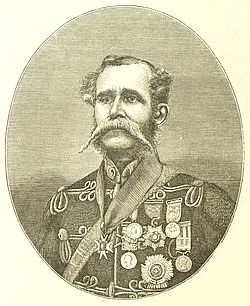
Major-General Sir John Douglas, K.C.B. From a photograph.
About half-past one o’clock the action commenced by the Russians opening fire from the redoubt on the left upon the French, who were attempting to assail their position in that direction. The British forces then formed in line, and proceeded to cross the river about the village of Burliuk. The light and second divisions led the way preceded by the skirmishers of the Rifle Brigade, who advanced through the vineyards beyond the village, and spreading themselves along the margin of the river, engaged the Russian riflemen on the opposite bank.
The first division, which formed the left of the allied army, advancing in support, traversed the vineyard and crossed the river, protected by its overhanging banks. On reaching the slope of the hill, the three Highland regiments formed line in échelon, and, “with the precision of a field-day advanced to the attack, the 42nd Royal Highlanders on the right, and the 79th Cameron Highlanders on the left, the extreme left of the allied army.”[529]
From its position, the 79th was the last of the Highland regiments to mount the slope on the Russian side of the river, and its appearance on the crest of the slope was opportune; it came in time to relieve the mind of Sir Colin, who trembled for the left flank of the 93rd, down upon which was bearing a heavy column of the enemy—the left Sousdal column. “Above the crest or swell of the ground,” Kinglake tells, “on the left rear of the 93rd, yet another array of the tall bending plumes began to rise up in a long ceaseless line, stretching far into the east, and presently, with all the grace and beauty that marks a Highland regiment when it springs up the side of a hill, the 79th came bounding forward. Without a halt, or with only the halt that was needed for dressing the ranks, it sprang at the flank of the right Sousdal column, and caught it in its sin—caught it daring to march across the front of a battalion advancing in line. Wrapped in the fire thus poured upon its flank, the hapless column could not march, could not live. It broke, and began to fall back in great confusion; and the left Sousdal column being almost at the same time overthrown by the 93rd, and the two columns which had engaged the Black Watch being now in full retreat, the spurs of the hill and the winding dale beyond became thronged with the enemy’s disordered masses.”[530]