Volume 2 / Part 2 — CHAPTER VII. (continued 2)
Reading edition
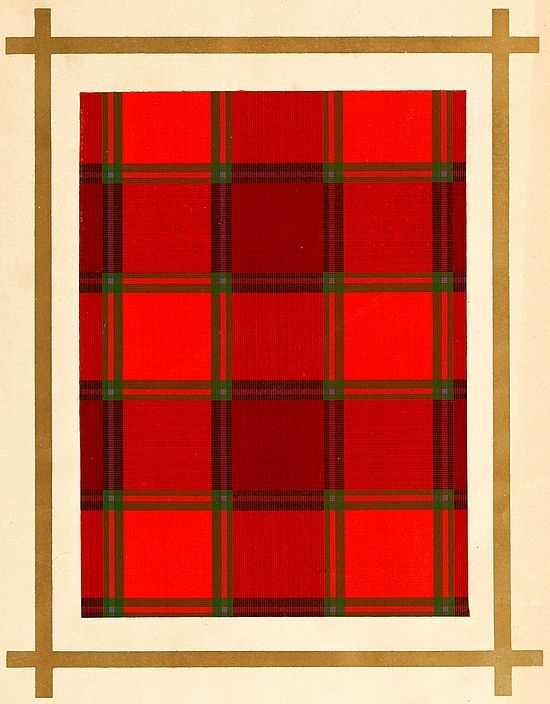
MACNAB.
His son, Finlay Macnab, styled of Bovain, as well as “of that ilk,” died in the reign of James I. He is said to have been a famous bard. According to tradition he composed one of the Gaelic poems which Macpherson attributed to Ossian. He was the father of Patrick Macnab of Bovain and of that ilk, whose son was named Finlay Macnab, after his grandfather. Indeed, Finlay appears to have been, at this time, a favourite name of the chief, as the next three lairds were so designated. Upon his father’s resignation, he got a charter, under the great seal, in the reign of James III., of the lands of Ardchyle, and Wester Duinish, in the barony of Glendochart and county of Perth, dated January 1, 1486. He had also a charter from James IV., of the lands of Ewir and Leiragan, in the same barony, dated January 9, 1502, He died soon thereafter, leaving a son, Finlay Macnab, fifth laird of Macnab, who is witness in a charter, under the great seal, to Duncan Campbell of Glenorchy, wherein he is designed “Finlaus Macnab, dominus de eodem,” &c., Sept. 18, 1511. He died about the close of the reign of James V.
His son, Finlay Macnab of Bovain and of that ilk, sixth chief from Gilbert, alienated or mortgaged a great portion of his lands to Campbell of Glenorchy, ancestor of the Marquis of Breadalbane, as appears by a charter to “Colin Campbell of Glenorchy, his heirs and assignees whatever, according to the deed granted to him by Finlay Macnab of Bovain, 24th November 1552, of all and sundry the lands of Bovain and Ardchyle, &c., confirmed by a charter under the great seal from Mary, dated 27th June 1553.” Glenorchy’s right of superiority the Macnabs always refused to acknowledge.
His son, Finlay Macnab, the seventh laird, who lived in the reign of James VI., was the chief who entered into the bond of friendship and manrent with his cousin, Lauchlan Mackinnon of Strathairdle, 12th July 1606. This chief carried on a deadly feud with the Neishes or M’Ilduys, a tribe which possessed the upper parts of Strathearn, and inhabited an island in the lower part of Loch Earn, called from them Neish Island. Many battles were fought between them, with various success. The last was at Glenboultachan, about two miles north of Loch Earn foot, in which the Macnabs were victorious, and the Neishes cut off almost to a man. A small remnant of them, however, still lived in the island referred to, the head of which was an old man, who subsisted by plundering the people in the neighbourhood. One Christmas, the chief of the Macnabs had sent his servant to Crieff for provisions, but, on his return, he was waylaid, and robbed of all his purchases. He went home, therefore, empty-handed, and told his tale to the laird. Macnab had twelve sons, all men of great strength, but one in particular exceedingly athletic, who was called for a bye-name, Iain mion Mac an Appa, or “Smooth John Macnab.” In the evening, these men were gloomily meditating some signal revenge on their old enemies, when their father entered, and said in Gaelic, “The night is the night, if the lads were but lads!” Each man instantly started to his feet, and belted on his dirk, his claymore, and his pistols. Led by their brother John, they set out, taking a fishing-boat on their shoulders from Loch Tay, carrying it over the mountains and glens till they reached Loch Earn, where they launched it, and passed over to the island. All was silent in the habitation of Neish. Having all the boats at the island secured, they had gone to sleep without fear of surprise. Smooth John, with his foot dashed open the door of Neish’s house; and the party, rushing in, attacked the unfortunate family, every one of whom was put to the sword, with the exception of one man and a boy, who concealed themselves under a bed. Carrying off the heads of the Neishes, and any plunder they could secure, the youths presented themselves to their father, while the piper struck up the pibroch of victory.
The next laird, “Smooth John,” the son of this Finlay, made a distinguished figure in the reign of Charles I., and suffered many hardships on account of his attachment to the royal cause. He was killed at the battle of Worcester in 1651. During the commonwealth, his castle of Eilan Rowan was burned, his estates ravaged and sequestrated, and the family papers again lost. Taking advantage of the troubles of the times, his powerful neighbour, Campbell of Glenorchy, in the heart of whose possessions Macnab’s lands were situated, on the pretence that he had sustained considerable losses from the clan Macnab, got possession of the estates in recompense thereof.
The chief of the Macnabs married a daughter of Campbell of Glenlyon, and with one daughter, had a son, Alexander Macnab, ninth laird, who was only four years old when his father was killed on Worcester battle-field. His mother and friends applied to General Monk for some relief from the family estates for herself and children. That general made a favourable report on the application, but it had no effect.
After the Restoration, application was made to the Scottish estates, by Lady Macnab and her son, for redress, and in 1661 they received a considerable portion of their lands, which the family enjoyed till the beginning of the present century, when they were sold.
By his wife, Elizabeth, a sister of Sir Alexander Menzies of Weem, Baronet, Alexander Macnab of that ilk had a son and heir, Robert Macnab, tenth laird, who married Anne Campbell, sister of the Earl of Breadalbane. Of several children only two survived, John, who succeeded his father, and Archibald. The elder son, John, held a commission in the Black Watch, and was taken prisoner at the battle of Prestonpans, and, with several others, confined in Doune Castle, under the charge of Macgregor of Glengyle, where he remained till after the battle of Culloden. The majority of the clan took the side of the house of Stuart, and were led by Allister Macnab of Inshewan and Archibald Macnab of Acharne.
John Macnab, the eleventh laird, married the only sister of Francis Buchanan, Esq. of Arnprior, and had a son, Francis, twelfth laird.
Francis, twelfth laird, died, unmarried, at Callander, Perthshire, May 25, 1816, in his 82d year. One of the most eccentric men of his time, many anecdotes are related of his curious sayings and doings.
We give the following as a specimen, for which we are indebted to Mr Smibert’s excellent work on the clans:—
“Macnab had an intense antipathy to excisemen, whom he looked on as a race of intruders, commissioned to suck the blood of his country: he never gave them any better name than vermin. One day, early in the last war, he was marching to Stirling at the head of a corps of fencibles, of which he was commander. In those days the Highlanders were notorious for incurable smuggling propensities; and an excursion to the Lowlands, whatever might be its cause or import, was an opportunity by no means to be neglected. The Breadalbane men had accordingly contrived to stow a considerable quantity of the genuine ‘peat reek’ (whisky) into the baggage carts. All went well with the party for some time. On passing Alloa, however, the excisemen there having got a hint as to what the carts contained, hurried out by a shorter path to intercept them. In the meantime, Macnab, accompanied by a gillie, in the true feudal style, was proceeding slowly at the head of his men, not far in the rear of the baggage. Soon after leaving Alloa, one of the party in charge of the carts came running back and informed their chief that they had all been seized by a posse of excisemen. This intelligence at once roused the blood of Macnab. ‘Did the lousy villains dare to obstruct the march of the Breadalbane Highlanders!’ he exclaimed, inspired with the wrath of a thousand heroes; and away he rushed to the scene of contention. There, sure enough, he found a party of excisemen in possession of the carts. ‘Who the devil are you?’ demanded the angry chieftain. ‘Gentlemen of the excise,’ was the answer. ‘Robbers! thieves! you mean; how dare you lay hands on His Majesty’s stores? If you be gaugers, show me your commissions.’ Unfortunately for the excisemen, they had not deemed it necessary in their haste to bring such documents with them. In vain they asserted their authority, and declared they were well known in the neighbourhood. ‘Ay, just what I took ye for; a parcel of highway robbers and scoundrels. Come, my good fellows,’ (addressing the soldiers in charge of the baggage, and extending his voice with the lungs of a stentor,) ‘prime!—load!—’ The excisemen did not wait the completion of the sentence; away they fled at top speed towards Alloa, no doubt glad they had not caused the waste of His Majesty’s ammunition. ‘Now, my lads,’ said Macnab, ‘proceed—your whisky’s safe.’”
He was a man of gigantic height and strong originality of character, and cherished many of the manners and ideas of a Highland gentleman, having in particular a high notion of the dignity of the chieftainship. He left numerous illegitimate children.
The only portion of the property of the Macnabs remaining is the small islet of Innis-Buie, formed by the parting of the water of the Dochart just before it issues into Loch Tay, in which is the most ancient burial place of the family; and outside there are numerous gravestones of other members of the clan. The lands of the town of Callander chiefly belong to a descendant of this laird, not in marriage.
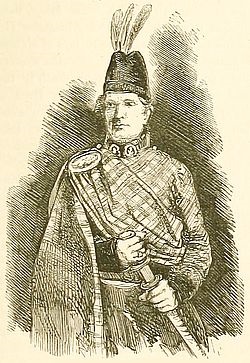
The last Laird of Macnab.
Archibald Macnab of Macnab, nephew of Francis, succeeded as thirteenth chief. The estates being considerably encumbered, he was obliged to sell his property for behoof of his creditors.
Many of the clan having emigrated to Canada about the beginning of the nineteenth century, and being very successful, 300 of those remaining in Scotland were induced about 1817 to try their fortunes in America, and in 1821, the chief himself, with some more of the clan, took their departure for Canada. He returned in 1853, and died at Lannion, Cotes du Nord, France, Aug. 12, 1860, aged 83. Subjoined is his portrait, from a daguerreotype, taken at Saratoga, United States of America, in 1848.
He left a widow, and one surviving daughter, Sophia Frances.
The next Macnabs by descent entitled to the chiefship are believed to be Sir Allan Napier Macnab, Bart., Canada; Dr Robert Macnab, 5th Fusileers; and Mr John Macnab, Glenmavis, Bathgate.
The lairds of Macnab, previous to the reign of Charles I., intermarried with the families of Lord Gray of Kilfauns, Gleneagles, Inchbraco, Robertson of Strowan, &c.
The chief cadets of the family were the Macnabs of Dundurn, Acharne, Newton, Cowie, and Inchewen.
Clan Duffie or Macfie.
The clan Duffie (in Gaelic, clann Dhubhie means “the coloured tribe”) or Macphie (generally spelt Macfie) appear to have been the original inhabitants of the island of Colonsay, which they held till the middle of the 17th century, when they were dispossessed of it by the Macdonalds. They were probably a branch of the ancient Albionic race of Scotland, and their genealogy given in the MS. of 1450, according to Skene, evinces their connection by descent with the Macgregors and Mackinnons.
On the south side of the church of the monastery of St Augustine in Colonsay, according to Martin (writing in 1703), “lie the tombs of Macduffie, and of the cadets of his family; there is a ship under sail, and a two handed sword engraven on the principal tombstone, and this inscription: ‘Hic jacet Malcolumbus Macduffie de Collonsay;’ his coat of arms and colour-staff is fixed in a stone, through which a hole is made to hold it. About a quarter of a mile on the south side of the church there is a cairn, in which there is a stone cross fixed, called Macduffie’s cross; for when any of the heads of this family were to be interred, their corpses were laid on this cross for some moments, in their way toward the church.”
Donald Macduffie is witness to a charter by John, Earl of Ross, and Lord of the Isles, dated at the Earl’s castle of Dingwall, 12th April 1463.[225] After the forfeiture of the Lordship of the Isles in 1493, the clan Duffie followed the Macdonalds of Isla. The name of the Macduffie chief in 1531 was Murroch. In 1609 Donald Macfie in Colonsay was one of the twelve chiefs and gentlemen who met the bishop of the Isles, the king’s representative, at Iona, when, with their consent, the nine celebrated “Statutes of Icolmkill” were enacted. In 1615, Malcolm Macfie of Colonsay joined Sir James Macdonald of Isla, after his escape from the castle of Edinburgh, and was one of the principal leaders in his subsequent rebellion. He and eighteen others were delivered up by Coll Macgillespick Macdonald, the celebrated Colkitto, to the Earl of Argyll, by whom he was brought before the privy council. He appears afterwards to have been slain by Colkitto, as by the Council Records for 1623 we learn that the latter was accused, with several of his followers, of being “art and pairt guilty of the felonie and cruell slaughter of umquhill Malcolm Macphie of Collonsay.”
“From this period,” says Skene, “their estate seems to have gone into the possession of the Macdonalds, and afterwards of the Macneills, by whom it is still held; while the clan gradually sunk until they were only to be found, as at present, forming a small part of the inhabitants of Colonsay.”
A branch of the clan Duffie, after they had lost their inheritance, followed Cameron of Lochiel, and settled in Lochaber.
MACQUARRIE.
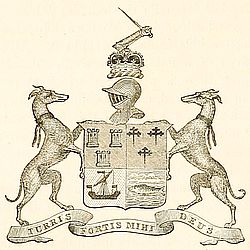
Badge—Pine.
The clan Quarrie or Macquarrie is another clan held by Mr Skene to belong to the ancient stock of Alpine, their possessions being the small island of Ulva, and a portion of Mull.
The Gaelic MS. of 1450 deduces their descent from Guarie or Godfrey, called by the Highland Sennachies, Gor or Gorbred, said to have been “a brother of Fingon, ancestor of the Mackinnons, and Anrias or Andrew, ancestor of the Macgregors.” This is the belief of Mr Skene, who adds, “The history of the Macquarries resembles that of the Mackinnons in many respects; like them they had migrated far from the head-quarters of their race, they became dependent on the Lords of the Isles, and followed them as if they had become a branch of the clan.”
Mr Smibert, however, thinks this origin highly improbable, and is inclined to believe that they constituted one branch of the Celto-Irish immigrants. “Their mere name,” he says, “connects them strongly with Ireland—the tribe of the Macquarries, Macquires, Macguires (for the names are the same), being very numerous at this day in that island, and having indeed been so at all times.” We do not think he makes out a very strong case in behalf of this origin.
According to a history of the family, by one of its members, in 1249 Cormac Mohr, then “chief of Ulva’s Isle,” joined Alexander II., with his followers and three galleys of sixteen oars each, in his expedition against the western islands, and after that monarch’s death in the Island of Kerrera, was attacked by Haco of Norway, defeated and slain. His two sons, Allan and Gregor, were compelled to take refuge in Ireland, where the latter, surnamed Garbh or the rough, is said to have founded the powerful tribe of the MacGuires, the chief of which at one time possessed the title of Lord Inniskillen. Allan returned to Scotland, and his descendant, Hector Macquarrie of Ulva, chief in the time of Robert the Bruce, fought with his clan at Bannockburn.
The first chief of whom there is any notice in the public records was John Macquarrie of Ulva, who died in 1473.[226] His son, Dunslaff, was chief when the last Lord of the Isles was forfeited twenty years afterwards. After that event, the Macquarries, like the other vassal tribes of the Macdonalds, became independent. In war, however, they followed the banner of their neighbour, Maclean of Dowart. With the latter, Dunslaff supported the claims of Donald Dubh to the Lordship of the Isles, in the beginning of the sixteenth century, and in 1504, “MacGorry of Ullowaa” was summoned, with some other chiefs, before the Estates of the kingdom, to answer for his share in Donald Dubh’s rebellion.
His son, John Macquarrie of Ulva, was one of the thirteen chiefs who were denounced the same year for carrying on a traitorous correspondence with the king of England, with the view of transferring their allegiance to him.
Allan Macquarrie of Ulva was slain, with most of his followers, at the battle of Inverkeithing against the English parliamentary troops, 20th July 1651, when the Scots army was defeated, and a free passage opened to Cromwell to the whole north of Scotland.
According to tradition one of the chiefs of Ulva preserved his life and estate by the exercise of a timely hospitality under the following circumstances:—Maclean of Dowart had a natural son by a beautiful young woman of his own clan, and the boy having been born in a barn was named, from his birth-place, Allan-a-Sop, or Allan of the straw. The girl afterwards became the wife of Maclean of Torloisk, residing in Mull, but though he loved the mother he cared nothing for her boy, and when the latter came to see her, he was very unkind to him. One morning the lady saw from her window her son approaching and hastened to put a cake on the fire for his breakfast. Her husband noticed this, and snatching the cake hot from the girdle, thrust it into his stepson’s hands, forcibly clasping them on the burning bread. The lad’s hands were severely burnt, and in consequence he refrained from going again to Torloisk. As he grew up Allan became a mariner, and joined the Danish pirates who infested the western isles. From his courage he soon got the command of one galley, and subsequently of a flotilla, and made his name both feared and famous. Of him it may be said that—
“Sir Ralph the Rover sailed away, He scoured the seas for many a day, And now, grown rich with plunder’d store, He steers his way for Scotland’s shore.”
The thought of his mother brought him back once more to the island of Mull, and one morning he anchored his galleys in front of the house of Torloisk. His mother had been long dead, but his stepfather hastened to the shore, and welcomed him with apparent kindness. The crafty old man had a feud with Macquarrie of Ulva, and thought this a favourable opportunity to execute his vengeance on that chief. With this object he suggested to Allan that it was time he should settle on land, and said that he could easily get possession of the island of Ulva, by only putting to death the laird, who was old and useless. Allan agreed to the proposal, and, setting sail next morning, appeared before Macquarrie’s house. The chief of Ulva was greatly alarmed when he saw the pirate galleys, but he resolved to receive their commander hospitably, in the hope that good treatment would induce him to go away, without plundering his house or doing him any injury. He caused a splendid feast to be prepared, and welcomed Allan to Ulva with every appearance of sincerity. After feasting together the whole day, in the evening the pirate-chief, when about to retire to his ships, thanked the chief for his entertainment, remarking, at the same time, that it had cost him dear. “How so?” said Macquarrie, “when I bestowed this entertainment upon you in free good will.” “It is true,” said Allan, who, notwithstanding his being a pirate, seems to have been of a frank and generous disposition, “but it has disarranged all my plans, and quite altered the purpose for which I came hither, which was to put you to death, seize your castle and lands, and settle myself here in your stead.” Macquarrie replied that he was sure such a suggestion was not his own, but must have originated with his stepfather, old Torloisk, who was his personal enemy. He then reminded him that he had made but an indifferent husband to his mother, and was a cruel stepfather to himself, adding, “Consider this matter better, Allan, and you will see that the estate and harbour of Torloisk lie as conveniently for you as those of Ulva, and if you must make a settlement by force, it is much better you should do so at the expense of the old churl, who never showed you kindness, than of a friend like me who always loved and honoured you.”
Allan-a-Sop, remembering his scorched fingers, straightway sailed back to Torloisk, and meeting his stepfather, who came eagerly expecting to hear of Macquarrie’s death, thus accosted him: “You hoary old villain, you instigated me to murder a better man than yourself. Have you forgotten how you scorched my fingers twenty years ago with a burning cake? The day has come when that breakfast must be paid for.” So saying, with one stroke of his battle-axe he cut down his stepfather, took possession of his castle and property, and established there that branch of the clan Maclean afterwards represented by Mr Clephane Maclean.
Hector, brother of Allan Macquarrie of Ulva, and second son of Donald the twelfth chief of the Macquarries, by his wife, a daughter of Lauchlan Oig Maclean, founder of the Macleans of Torloisk, obtained from his father the lands of Ormaig in Ulva, and was the first of the Macquarries of Ormaig. This family frequently intermarried with the Macleans, both of Lochbuy and Dowart. Lauchlan, Donald’s third son, was ancestor of the Macquarries of Laggan, and John, the fourth son, of those of Ballighartan.
Lauchlan Macquarrie of Ulva, the sixteenth chief in regular succession, was compelled to dispose of his lands for behoof of his creditors, and in 1778, at the age of 63, he entered the army. He served in the American war, and died in 1818, at the age of 103, without male issue. He was the last chief of the Macquarries, and was the proprietor of Ulva when Dr Samuel Johnson and Mr Boswell visited that island in 1773.
A large portion of the ancient patrimonial property was repurchased by General Macquarrie, long governor of New South Wales, and from whom Macquarrie county, Macquarrie river, and Port Macquarrie in that colony, Macquarrie’s harbour, and Macquarrie’s island in the South Pacific, derive their name. He was the eldest cadet of his family, and was twice married, first, to Miss Baillie of Jerviswood, and secondly, to a daughter of Sir John Campbell of Airds, by whom he had an only son, Lauchlan, who died without issue.
MacAulay.
The last clan claimed by Mr Skene as belonging to the Siol Alpine is the minor one of MacAulay, or clan Aula. Many formerly held that the MacAulays derived their origin from the ancient earls of Lennox, and that their ancestor was Maurice, brother of Earl Maldouin and son of Aulay, whose name appears in the Ragman Roll as having sworn fealty to Edward I. in 1296. According to Skene, these Aulays were of the family of De Fasselan, who afterwards succeeded to the earldom.
The MacAulays consider themselves a sept of the clan Gregor, their chief being designed of Ardincaple from his residence in Dumbartonshire. That property was in their possession in the reign of Edward I. They early settled in the Lennox, and their names often occur in the Lennox chartulary, hence the very natural supposition that they sprung from that distinguished house. In a bond of manrent, or deed of clanship, entered into between MacGregor of Glenstrae and MacAulay of Ardincaple, of date 27th May 1591, the latter acknowledges his being a cadet of the former, and agrees to pay him the “calp,” that is, a tribute of cattle given in acknowledgment of superiority. In 1694, in a similar bond given to Sir Duncan Campbell of Auchinbreck, they again declared themselves MacGregors. “Their connection with the MacGregors,” says Mr Skene, “led them to take some part in the feuds that unfortunate race were at all times engaged in, but the protection of the Earls of Lennox seems to have relieved the MacAulays from the consequences which fell so heavily on the MacGregors.”
Mr Joseph Irving, in his History of Dumbartonshire (p. 418), states that the surname of the family was originally Ardincaple of that ilk, and seems inclined to believe in their descent from the Earl of Lennox. He says, “A Celtic derivation may be claimed for this family, founded on the agreement entered into between the chief of the clan Gregor and Ardincaple in 1591, where they describe themselves as originally descended from the same stock, ‘M’Alpins of auld,’ but the theory most in harmony with the annals of the house (of Ardincaple of that ilk) fixes their descent from a younger son of the second Alwyn, Earl of Lennox.” Alexander de Ardincaple who lived in the reign of James V., son of Aulay de Ardincaple, was the first to assume the name of MacAulay, as stated in the Historical and Critical Remarks on the Ragman Roll,[227] “to humour a patronymical designation, as being more agreeable to the head of a clan than the designation of Ardincaple of that ilk.”
When the MacGregors fell under the ban of the law, Sir Aulay MacAulay, the then chief, became conspicuous by the energy with which he turned against them, probably to avert suspicion from himself, as a bond of caution was entered into on his account on Sept. 8, 1610. He died in Dec. 1617, and was succeeded by his cousin-german, Alexander.
Walter MacAulay, the son of Alexander, was twice sheriff of Dumbarton.
With Aulay MacAulay, his son and successor, commenced the decline of the family. He and his successors indulged in a system of extravagant living, which compelled them to dispose, piece by piece, of every acre of their once large possessions. Although attached to Episcopacy, he was by no means a partisan of James VII., for in 1689 he raised a company of fencibles in aid of William and Mary.
Aulay MacAulay, the twelfth and last chief of the MacAulays, having seen the patrimony of his house sold, and his castle roofless, died about 1767. Ardincaple had been purchased by John, fourth Duke of Argyll, and now belongs to the Argyll family.
About the beginning of the 18th century, a number of MacAulays settled in Caithness and Sutherland. Others went into Argyleshire, and some of the MacPheiderans of that county acknowledged their descent from the MacAulays.
A tribe of MacAulays were settled at Uig, Ross-shire, in the south-west of the island of Lewis, and many were the feuds which they had with the Morrisons, or clan Alle Mhuire, the tribe of the servant or disciple of Marg, who were located at Ness, at the north end of the same island. In the reign of James VI., one of the Lewis MacAulays, Donald Cam, so called from being blind of one eye, renowned for his great strength, distinguished himself on the patriotic side, in the troubles that took place, first with the Fifeshire colonies at Stornoway. Donald Cam Macaulay had a son, Fear Bhreinis, “The Man,” or Tacksman “of Brenish,” of whose feats of strength many songs and stories are told. His son, Aulay MacAulay, minister of Harris, had six sons and some daughters. Five of his sons were educated for the church, and one named Zachary he bred for the bar.
One of Aulay MacAulay’s sons was the Rev. John Macaulay, A.M., was grandfather of the celebrated orator, statesman, and historian, Lord Macaulay. One of his sons entered the East India Company’s military service, and attained the rank of general.
Another son, Aulay Macaulay, was known as a miscellaneous writer. In 1796 he was presented to the vicarage of Rothley, by Thomas Babington, Esq., M.P., who had married his sister Jane. He died February 24, 1819.
Zachary, a third son, was for some years a merchant at Sierra Leone. On his return to London, he became a prominent member of the Anti-slavery Society, and obtained a monument in Westminster Abbey. He married Miss Mills, daughter of a Bristol merchant, and had a son, Thomas Babington Macaulay, Lord Macaulay, author of “The History of England,” “Lays of Ancient Rome,” &c., and M.P. for the city of Edinburgh.