Volume 2 / Part 3 — PART THIRD. HISTORY OF THE HIGHLAND REGIMENTS. (continued 2)
Reading edition
The loss sustained by the regiment during the seven years it was employed in North America and the West Indies was as follows:—
KILLED.
In Officers,13
Sergeants,12
Rank and File,382
——
Total,407
WOUNDED.
In Officers,33
Sergeants,22
Rank and File,508
——
Total,563
——
Grand Total,970
With the exception of the unfortunate affair at Ticonderoga, the loss sustained by the 42d in the field during this war was comparatively smaller than that of any other corps. The moderate loss the Highlanders suffered was accounted for by several officers who served in the corps, from the celerity of their attack and the use of the broadsword, which the enemy could never withstand. “This likewise,” says General Stewart, “was the opinion of an old gentleman, one of the original soldiers of the Black Watch, in the ranks of which, although a gentleman by birth and education, he served till the peace of 1748. He informed me that although it was believed at home that the regiment had been nearly destroyed at Fontenoy, the thing was quite the reverse; and that it was the subject of general observation in the army that their loss should have been so small, considering how actively they were engaged in different parts of the field. ‘On one occasion,’ said the respectable veteran, who was animated with the subject, ‘a brigade of Dutch were ordered to attack a rising ground, on which were posted the troops called the King of France’s Own Guards. The Highlanders were to support them. The Dutch conducted their march and attack as if they did not know the road, halting and firing, and halting every twenty paces. The Highlanders, losing all patience with this kind of fighting, which gave the enemy such time and opportunity to fire at their leisure, dashed forward, passed the Dutch, and the first ranks giving their firelocks to the rear rank, they drew their swords, and soon drove the French from their ground. When the attack was concluded, it was found that of the Highlanders not above a dozen men were killed and wounded, while the Dutch, who had not come up at all, lost more than five times that number.’”
On the arrival of the regiment at Cork, recruiting parties were sent to the Highlands, and so eager were the youths there to enter the corps, that in May following the regiment was fully completed.[296] When the battle of Fontenoy was fought, there was not a soldier in the regiment born south of the Grampians, and at this period they were all, except two, born north of the Tay.[297]
At the period of their arrival in Ireland the uniform of the regiment had a very sombre appearance. “The jackets were of a dull rusty-coloured red, and no part of the accoutrements was of a light colour. Economy was strictly observed in the article of clothing. The old jacket, after being worn a year, was converted into a waistcoat, and the plaid, at the end of two years, was reduced to the philibeg. The hose supplied were of so bad a quality that the men advanced an additional sum to the government price, in order to supply themselves with a better sort. Instead of feathers for their bonnets, they were allowed only a piece of black bear-skin; but the men supplied themselves with ostrich feathers in the modern fashion,[298] and spared no expense in fitting up their bonnets handsomely. The sword-belts were of black leather, two inches and a half in breadth; and a small cartouch-box, fitted only for thirty-two rounds of cartridges, was worn in front above the purse, and fixed round the loins with a thick belt, in which hung the bayonet. In these heavy colours and dark-blue facings the regiment had a far less splendid appearance at a short distance than English regiments with white breeches and belts; but on a closer view the line was imposing and warlike. The men possessed what an ingenious author calls ‘the attractive beauties of a soldier; sun burnt complexions, a hardy weather-beaten visage, with a penetrating eye, and firm expressive countenance, sinewy and elastic limbs, traces of muscles strongly impressed, indicating capacity of action, and marking experience of service.’[299] The personal appearance of the men has, no doubt, varied according as attention was paid to a proper selection of recruits. The appointments have also been different. The first alteration in this respect was made in the year 1769, when the regiment removed to Dublin. At this period the men received white cloth waistcoats, and the colonel supplied them with white goat-skin and buff leather purses, which were deemed an improvement on the vests of red cloth, and the purses made of badgers’ skin.
“The officers also improved their dress, by having their jackets embroidered. During the war, however, they wore only a narrow edging of gold-lace round the borders of the facings, and very often no lace at all, epaulettes and all glittering ornaments being laid aside, to render them less conspicuous to the Indians, who always aimed particularly at the officers. During their stay in Ireland the dress of the men underwent very little alteration. The officers had only one suit of embroidery; this fashion being found too expensive was given up, and gold-lace substituted in its stead. Upon ordinary occasions they wore light hangers, using the basket-hilted broadsword only in full dress. They also carried fusils. The sergeants were furnished with carbines instead of the Lochaber axe or halbert, which they formerly carried. The soldiers were provided with new arms when on Dublin duty in 1774. The sergeants had silver-lace on their coats, which they furnished, however, at their own expense.”[300]
The regiment remained in Ireland after its return from North America about eight years, in the course of which it was occasionally occupied in different parts of that country in aid of the civil power,—a service in which, from their conciliatory disposition, they were found very useful. While in Ireland, a new company was added, as was the case with all the other regiments on the Irish establishment. Captain James Macpherson, Lieutenant Campbell, and Ensign John Grant, were in consequence appointed to the 42d.
In 1775 the regiment embarked at Donaghadee, and landed at Port Patrick, after an absence from Scotland of thirty-two years. Impelled by characteristic attachment to the country of their birth, many of the old soldiers leaped on shore with enthusiasm, and kissed the earth, which they held up in handfuls. From Port Patrick the regiment marched to Glasgow.
The conduct of the regiment and its mode of discipline while in Ireland is depicted by an intelligent officer who served in it at that time, and for many years both before and after that period, in a communication to General Stewart. He describes the regiment as still possessing the character which it had acquired in Germany and America, although there were not more than eighty of the men remaining who had served in America, and only a few individuals of those who had served in Germany previously to the year 1748. Their attachment to their native dress, and their peculiarity of language, habits, and manners contributed to preserve them a race of men separate from others of the same profession, and to give to their system of regimental discipline a distinctive and peculiar character. Their messes were managed by the non-commissioned officers, or old soldiers, who had charge of the barrack-room; and these messes were always so arranged that in each room the men were in friendship or intimacy with each other, or belonged to the same glen or district, or were connected by some similar tie. By these means every barrack-room was like a family establishment. After the weekly allowances for breakfast, dinner, and small necessaries had been provided, the surplus pay was deposited in a stock purse, each member of the mess drawing for it in his turn. The stock thus acquired was soon found worth preserving, and instead of hoarding, they lent it out to the inhabitants, who seemed greatly surprised at seeing a soldier save money. Their accounts with their officers were settled once in three months, and, with the exception of a few careless spendthrifts, all the men purchased their own necessaries, with which they were always abundantly provided. At every settlement of accounts they enjoyed themselves very heartily, but with a strict observance of propriety and good humour; and as the members of each mess considered themselves in a manner answerable for one another’s conduct, they animadverted on any impropriety with such severity as to render the interference of further authority unnecessary.
Shortly after the arrival of the regiment in Glasgow two companies were added, and the establishment of the whole regiment augmented to 100 rank and file each company. The battalion, when complete, amounted to 1075 men, including sergeants and drummers. Little inducement was required to fill the ranks, as men were always to be found ready to join a corps in such high estimation. At this time the bounty was a guinea and a crown. It was afterwards increased to three guineas; but this advance had little effect in the north where the esprit du corps had greater influence than gold.
Hitherto the officers had been entirely Highland and Scotch; but the lord-lieutenant of Ireland, contrary to the remonstrances of Lord John Murray, who saw the advantage of officering the regiment with natives of Scotland, prevailed with the government to admit two English officers into the regiment. His excellency even went so far as to get two lieutenants’ commissions in favour of Scotchmen cancelled, although they had been gazetted.
In consequence of hostilities with America, the regiment was ordered to embark for that country. Before its departure the recruits were taught the use of the firelock, and, from the shortness of the time allowed, were drilled even by candle-light. Few arms and accoutrements were supplied to the men by the government, and the colonel furnished them with broadswords and pistols, iron-stocked, at his own expense. The regiment was reviewed on the 10th of April 1776 by General Sir Adolphus Oughton, and being reported quite complete and unexceptionable, embarked on the 14th at Greenock, along with Fraser’s Highlanders.[301]
II. 1776–1795.
The 42d goes to America—Battle of Brooklyn, 1776—Broadswords and pistols laid aside—Skirmish near New York—White Plains—Capture of Fort Washington and Fort Lee—Skirmish at Trenton—Defeat of Mawhood’s detachment—Pisquatua—Chesapeak—Battle of Brandy Wine—Skirmish at Monmouth—New Plymouth—Portsmouth—Verplanks and Stony Point, 1779—Mutiny of a detachment at Leith—Charlestown—Paulus Hook—Desertion, 1783—Halifax—Cape Breton—Return of the regiment to England—Proceeds to Flanders—The “red heckle”—England—Coast of France—Ostend—Nimeguen—Gilderwalsen—Return of the regiment to England.
In conjunction with Fraser’s Highlanders, the 42d embarked at Greenock on the 14th of April 1776, to join an expedition under General Howe against the American revolutionists. The transports separated in a gale of wind, but they all reached their destination in Staten Island, where the main body of the army had assembled.[302] A grenadier battalion was immediately formed under the command of the Hon. Major (afterwards General) Sir Charles Stewart, the staff appointments to which, out of respect to the 42d, were taken by the commander-in-chief from that regiment. A light infantry corps was also formed, to the command of which Lieutenant-colonel Musgrave was appointed. The flank companies of the 42d were attached to these battalions. “The Highland grenadiers were remarkable for strength and height, and considered equal to any company in the army: the light infantry were quite the reverse in point of personal appearance, as the commanding officer would not allow a choice of men for them. The battalion companies were formed into two temporary battalions, the command of one being given to Major William Murray (Lintrose), and that of the other to Major William Grant (Rothiemurchus), with an adjutant quarter-master in each battalion; the whole being under the command of Lieutenant-colonel Thomas Stirling. These grenadiers were placed in the reserve with the grenadiers of the army, under the command of Earl Cornwallis. To these were added the 33d, his lordship’s own regiment.”[303]
The whole of the British force under the command of Sir William Howe, including 13,000 Hessians and Waldeckers, amounted to 30,000 men. The campaign opened by a landing on Long Island on the 22d of August 1776. The whole army encamped in front of the villages of Gravesend and Utrecht. The American army, under General Putnam, was encamped at Brooklyn, a few miles distant. A range of woody hills, which intersected the country from east to west, divided the two armies.
The British general having resolved to attack the enemy in three divisions, the right wing, under General Clinton, seized, on the 26th of August, at night-fall, a pass on the heights, about three miles from Bedford. The main body then passed through, and descended to the level country which lay between the hills and General Putnam’s lines. Whilst this movement was going on, Major-general Grant (Ballindalloch) with his brigade (the 4th), supported by the Royal Highlanders from the reserve, was directed to march from the left along the coast to the Narrows, and attack the enemy in that quarter. The right wing having reached Bedford at nine o’clock next morning, attacked the left of the American army, which, after a short resistance, retired to their lines in great confusion, pursued by the British troops, Colonel Stuart leading with his battalion of Highland grenadiers. The Hessians, who had remained at Flat Bush, on hearing the fire at Bedford, advanced, and, attacking the centre of the American army, drove them, after a short engagement, through the woods, and captured three pieces of cannon. General Grant had previously attacked the right of the enemy, and a cannonade had been kept up near the Narrows on both sides, till the Americans heard the firing at Bedford, when they retreated in disorder. Notwithstanding these advantages, neither General Howe nor General Grant ventured to follow them up by pursuing the enemy, and attacking them in their lines, although they could have made no effectual resistance. The enemy lost 2000 men, killed, drowned, and taken prisoners. The British had 5 officers, and 56 non-commissioned officers and privates killed; and 12 officers and 245 non-commissioned officers and privates wounded. Among the latter was Lieutenant Crammond and 9 rank and file of the 42d.
About this time the broadswords and pistols which the men received in Glasgow were ordered to be laid aside. The pistols being considered unnecessary, except in the field, were not intended, like the swords, to be worn by the men in quarters. The reason for discontinuing the broadswords was that they retarded the men by getting entangled in the brushwood. “Admitting that the objection was well-founded, so far as regarded the swords, it certainly could not apply to the pistols. In a close woody country, where troops are liable to sudden attacks and surprises by a hidden enemy, such a weapon is peculiarly useful. It is, therefore, difficult to discover a good reason for laying them aside. I have been told by several old officers and soldiers, who bore a part in these attacks, that an enemy who stood for many hours the fire of musketry, invariably gave way when an advance was made sword in hand. They were never restored, and the regiment has had neither swords nor pistols since.”[304]
The army encamped in front of the enemy’s lines in the evening of the 27th of August, and next day broke ground opposite their left redoubt. General Washington had crossed over from New York during the action at Brooklyn, and seeing resistance hopeless, resolved to retreat. With surprising skill he transported 9000 men, with guns, ammunition, and stores, in the course of one night, over to New York; and such was the secrecy with which this movement was effected, that the British army knew nothing of it till next morning, when the last of the rear-guard were seen in their boats crossing the broad ferry and out of danger.
Active operations were not resumed till the 15th of September, when the reserve, including the Royal Highlanders, crossed over to New York, and, after some opposition, took possession of the heights above the town. The Highlanders and Hessians fell in with and captured a body of New England men and Virginians. Next day the light infantry were sent out to dislodge a party of the enemy from a wood opposite the British left. A smart action ensued, and, the enemy pushing forward reinforcements, the Highlanders were sent to support the light infantry. The Americans were then driven back to their entrenchments; but they renewed the attack with an increased force, and were again repulsed with considerable loss. The British had 14 men killed, and 5 officers and 70 men wounded. The 42d had 1 sergeant and 5 privates killed; and Captains Duncan Macpherson and John Mackintosh, and Ensign Alexander Mackenzie (who died of his wounds), and 1 piper, 2 drummers, and 47 privates wounded.
General Howe, in expectation of an attack, threw up entrenchments; but General Washington having no such intention, made a general movement, and took up a strong position on the heights in the rear of the White Plains. To induce the enemy to quit their ground, General Howe resolved to make a movement, and accordingly embarked his army on the 12th of October in flat-bottomed boats, and passing through the intricate narrow called Hell Gate, disembarked the same evening at Frogsneck, near West Chester. In consequence of the bridge which connected the latter place with the mainland having been broken down by the enemy, the general re-embarked his troops next day, and landed at Pell’s Point, at the mouth of Hudson’s river. On the 14th he reached the White Plains in front of the enemy’s position. As a preliminary to a general engagement, General Howe attacked a post on a rising ground occupied by 4000 of the enemy, which he carried; but General Washington declining battle, the British general gave up the attempt, and proceeded against Fort Washington, the possession of which was necessary in order to open the communication between New York and the continent, to the eastward and northward of Hudson’s river. The fort, the garrison of which consisted of 3000 men, was protected by strong grounds covered with lines and works. The Hessians, under General Knyphausen, supported by the whole of the reserve, under Major-General Earl Percy, with the exception of the 42d, who were to make a feint on the east side of the fort, were to make the principal attack. The Royal Highlanders embarked in boats on the 16th of November, before day-break, and landed in a small creek at the foot of the rock, in the face of a smart fire. The Highlanders had now discharged the duty assigned them, but determined to have a full share in the honour of the day, they resolved upon an assault, and assisted by each other, and by the brushwood and shrubs which grew out of the crevices of the rocks, scrambled up the precipice. On gaining the summit, they rushed forward, and attacked the enemy with such rapidity, that upwards of 200, unable to escape, threw down their arms; whilst the Highlanders, following up their advantage, penetrated across the table of the hill, and met Lord Percy’s brigade as they were coming up on the opposite side. On seeing the Hessians approach in another direction, the enemy surrendered at discretion. In this affair the Royal Highlanders had 1 sergeant and 10 privates killed; and Lieutenants Patrick Graham (Inchbrakie), Norman Macleod,[305] and Alexander Grant, and 4 sergeants and 66 rank and file wounded.
To secure the entire command of the North river, and to open an easy entrance into the Jerseys, Fort Lee was next reduced, in which service the Royal Highlanders were employed. The enemy, pursued by the detachment which captured that post, retired successively to Newbridge, Elizabeth Town, Newark, and Brunswick. On the 17th of November General Howe entered Prince Town with the main body of the army, an hour after it was evacuated by General Washington. Winter having now set in, General Howe put his army into winter quarters. The advanced posts, which extended from Trenton to Mount-holly, were occupied by the Hessians and the Royal Highlanders, who were the only British regiments in front.
If, instead of suspending active operations, General Howe had continued occasionally to beat up the quarters of the Americans whilst dispirited by their late reverses, it is thought that he would have reduced them to the last extremity. General Washington availed himself of the inactivity of the British commander, and by making partial attacks on the advanced posts, he not only improved the discipline of his army, but, in consequence of the success which sometimes attended these attacks, revived the drooping spirits of his men. On the 22d of January 1777, he surprised and completely defeated the detachment of Hessians stationed at Trenton; in consequence of which reverse, the Royal Highlanders, who formed the left of the line of defence at Mount-holly, fell back on the light infantry at Prince Town.
During the remainder of the season the Royal Highlanders were stationed in the village of Pisquatua, on the line of communication between New York and Brunswick by Amboy. The duty was severe, from the rigour of the season and the want of accommodation. The houses in the village not being sufficient to contain one-half of the men, the officers and soldiers were intermixed in barns and sheds, and they always slept in their body-clothes, as the enemy were constantly sending down nocturnal parties to fire at the sentinels and picquets. The Americans, however, always kept at a respectful distance, and did not make any regular attack on the post till the 10th of May 1777, on which day, at four o’clock in the afternoon, a body of 2000 men, under the command of Maxwell and Stephens, American generals, attempted to surprise the Highlanders. Advancing with great secrecy, and being completely covered by the rugged nature of the country, their approach was not perceived till they had gained a small level piece of ground in front of the picquets, when they rushed forward, and attacked them with such promptitude, that the picquets had hardly time to seize their arms. At this time the soldiers were either all differently employed, or taking the rest they could not obtain at night; but the picquets, by disputing every inch of ground, gave time to the soldiers to assemble, who drove the enemy back with great precipitation, leaving behind them upwards of 200 men in killed and wounded. On this occasion the 42d had 3 sergeants and 9 privates killed; and Captain Duncan Macpherson, Lieutenant William Stewart, 3 sergeants, and 35 privates wounded.[306]
The British troops again took the field about the middle of June, when General Howe attempted to draw Washington from his station at Middle Brook; but the American commander knew too well the value of such a strong position to abandon it. Not judging it prudent to attack it, the British general resolved to change the seat of war. Pursuant to this resolution, he embarked 36 battalions of British and Hessians, including the flank battalions of the grenadiers and light infantry, and sailed for the Chesapeak. Before the embarkation the Royal Highlanders received an accession of 170 recruits from Scotland.
The army landed at Elk Ferry on the 24th of August, after a tedious voyage. It was not till the 3d of September that they began their march for Philadelphia. The delay enabled Washington to cross the country, and to take an advantageous position at Red Clay Creek, whence he pushed forward detachments to harass the British troops on their march. General Howe did not reach the Brandy Wine River till the middle of September, in consequence of the difficulties he met with in traversing a country covered with wood and full of defiles. On reaching that river, he found that the enemy had taken up a strong position beyond it, with the view of opposing the further advance of the royal army. The Americans had secured all the fording places, and in expectation that the British would attempt to cross at Chad’s Ford, they had erected batteries and thrown up entrenchments at that place to command the passage. Making a circuit of some miles, Lord Cornwallis crossed Jeffrey’s Ford with one division of the army without opposition, and turning down the river fell in with the American general, Sullivan, who had been detached by Washington to oppose him. An action took place, and the Americans were driven from all their posts through the woods towards the main army. Meanwhile General Knyphausen, with his division, made demonstrations for crossing the river at Chad’s Ford, and as soon as he knew from the firing of cannon that Lord Cornwallis’s movement had succeeded, he passed the river, and carried the batteries and entrenchments of the enemy. A general rout ensued, and Washington, with the corps he was able to keep together, fled with his baggage and cannon to Chester. The British had 50 officers killed and wounded in the battle of Brandy Wine, and 438 rank and file, including non-commissioned officers. The flank companies of the 42d, being the only ones engaged, had 6 privates killed, and 1 sergeant and 15 privates wounded.
On the 25th, the army marched to German Town, and the following morning the grenadiers took peaceable possession of Philadelphia. The 42d took part in the operations, by which the British commander endeavoured to bring the enemy to a general engagement at White Marsh, and was afterwards quartered at Philadelphia.[307]
The next enterprise in which the Royal Highlanders were engaged, was under Major-General Charles Grey, who embarked with the grenadiers, the light infantry brigade, and the 42d regiment, for the purpose of destroying a number of privateers, with their prizes, at New Plymouth. The troops landed on the banks of the Acushnet river on the 5th of September, and having destroyed seventy vessels, with all the stores, cargoes, wharfs, and buildings, along the whole extent of the river, the whole were re-embarked the following day, and returned to New York.
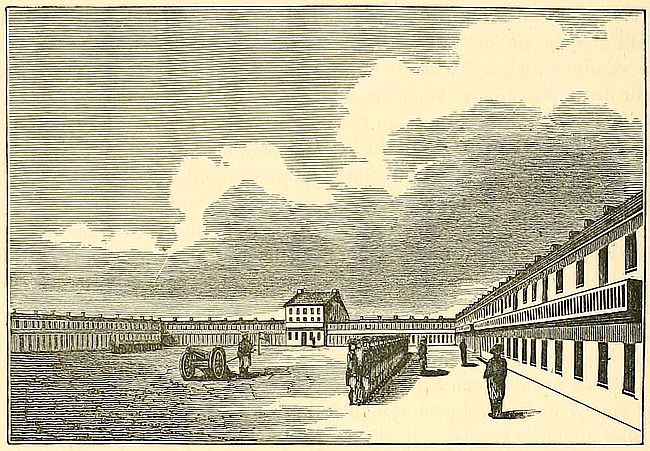
British Barracks, Philadelphia. From Watson’s Annals of Philadelphia.
Matters remained quiescent till the 25th of February 1779, when Colonel Stirling, with a detachment consisting of the light infantry of the Guards and the 42d regiment, was ordered to attack a post at Elizabeth Town, which was taken without opposition. In April following, the Highland regiment was employed in an expedition to the Chesapeak, to destroy the stores and merchandise at Portsmouth in Virginia. They were again employed with the Guards and a corps of Hessians in another expedition under General Mathews, which sailed on the 30th, under the convoy of Sir George Collier, in the Reasonable and several ships of war. This expedition reached its destination on the 10th of May, when the troops landed on the glebe on the western bank of Elizabeth. They returned to New York after fulfilling the object of the expedition.
The campaign of 1779 was begun by the capture, on the part of the British, of Verplanks and Stony Point. A garrison of 600 men, among whom were two companies of Fraser’s Highlanders, took possession of this last post; but owing to the too great confidence of the commander, it was surprised and re-captured. Flushed with this success, the American general, Wayne, made an immediate attack upon Verplanks, which was garrisoned by the 33d regiment; but receiving accounts of the advance of Colonel Stirling with the light infantry of the 42d, he retreated from Verplanks and abandoned Stony Point, of which Colonel Stirling took possession. This officer being shortly thereafter appointed aide-de-camp to the king, and a brigadier-general, the command of the 42d regiment devolved on Major Charles Graham.
About this time a circumstance occurred which tended greatly to deteriorate, for several years, the hitherto irreproachable character of the Royal Highland regiment. By order of the inspector-general at Chatham, a body of 150 recruits, raised principally from the refuse of the population of London and Dublin, was embarked for the regiment in the autumn of this year. Of such dissipated habits had these men been, that 16 died on the voyage, and 75 were sent to the hospital as soon as they disembarked.[308] The infusion of such immoral ingredients could not have failed to taint the whole mass, and General Stirling made a strong representation to the commander-in-chief to avert such a calamity from the regiment, by removing the recruits to another corps. They were, in consequence, drafted into the 26th, in exchange for the same number of Scotchmen; but the introduction of these men into the regiment dissolved the charm which, for nearly forty years, had preserved the Highlanders from contamination. During that long period there were few courts-martial, and, for many years, no instance of corporal punishment occurred. So nice were their notions of honour, that, “if a soldier was brought to the halberts, he became degraded, and little more good was to be expected of him. After being publicly disgraced, he could no longer associate with his comrades; and, in several instances, the privates of a company have, from their pay, subscribed to procure the discharge of an obnoxious individual.” But “punishments being found indispensable for the men newly introduced, and others becoming more habituated to the sight, much of the sense of honour was necessarily lost.”[309]
An illustration of the strong national feeling with which the corps was regarded by the Highlanders, and of the expediency of keeping it unmixed, occurred in April of the same year, when two strong detachments of recruits belonging to the 42d and 71st regiments arrived at Leith from Stirling Castle, for the purpose of embarking to join their respective regiments in North America. Being told that they were to be turned over to the 80th and 82d, the Edinburgh and Hamilton regiments, the men remonstrated, and declared openly and firmly that they were determined to serve only in the corps for which they were enlisted. After some negotiation, troops were sent to Leith with orders to convey the refractory Highlanders as prisoners to Edinburgh Castle, if they persisted in their determination. As they still refused to forego their resolution, attempts were made to enforce the orders; but the Highlanders refused to submit, and flying to arms, a desperate conflict ensued, in which Captain Mansfield of the South Fencible regiment and 9 men were killed, and 31 soldiers wounded. Being at last overpowered, the mutineers were carried to the castle.
In the month of May following, three of these prisoners, Charles Williamson and Archibald Macivor, soldiers of the 42d regiment, and Robert Budge, soldier of the 71st, were brought before a court-martial, “charged with having been guilty of a mutiny at Leith, upon Tuesday the 20th of April last past, and of having instigated others to be guilty of the same, in which mutiny several of his majesty’s subjects were killed, and many wounded.”
Their reasons for resisting the orders to embark are thus stated in their defence:—“The prisoners, Archibald Macivor and Charles Williamson, enlisted as soldiers in the 42d, being an old Highland regiment, wearing the Highland dress. Their native language was Gaelic,—the one being a native of the northern parts of Argyleshire, and the other of the western parts of Inverness-shire, where the language of the country is Gaelic only. They have never used any other language, and are so ignorant of the English tongue that they cannot avail themselves of it for any purpose of life. They have always been accustomed to the Highland habit, so far as never to have worn breeches, a thing so inconvenient, and even so impossible for a native Highlander to do, that, when the Highland dress was prohibited by act of parliament, though the philibeg was one of the forbidden parts of the dress, yet it was necessary to connive at the use of it, provided only that it was made of a stuff of one colour and not of tartan, as is well known to all acquainted with the Highlands, particularly with the more mountainous parts of the country. These circumstance made it more necessary for them to serve in a Highland regiment only, as they neither could have understood the language, nor have used their arms, or marched in the dress of any other regiment.”
The other prisoner, Budge, stated that he was a native of the upper parts of Caithness, and being ignorant of the English language, and accustomed to wear the Highland garb, he enlisted to serve in Fraser’s Highlanders, and in no other regiment. In continuation, the three prisoners stated, that, “when they arrived at Leith, they were informed by their officer, Captain Innes, who had conducted them, that they were now to consider the officers of the 82d, or Duke of Hamilton’s regiment, a regiment wearing the Lowland dress and speaking the tongue, as their officers; but how this happened they were not informed. No order from the commander-in-chief for their being drafted was read or explained to them, but they were told that they must immediately join the Hamilton and Edinburgh regiments. A great number of the detachment represented, without any disorder or mutinous behaviour, that they were altogether unfit for service in any other corps than Highland ones, particularly that they were incapable of wearing breeches as a part of their dress. At the same time, they declared their willingness to be regularly transferred to any other Highland regiment, or to continue to serve in those regiments into which they had been regularly enlisted. But no regard was paid to these remonstrances, which, if they had had an opportunity, they would have laid before the commander-in-chief. But an order for an immediate embarkation prevented this. The idea that naturally suggested itself to them was, that they should insist on serving in the same regiment in which they had been enlisted, and not to go abroad as part of the Duke of Hamilton’s regiment till such time as these difficulties were removed. They accordingly drew up under arms on the shore of Leith, each respective corps by itself. The prisoners were informed that the orders issued were to take them prisoners to the castle: had these orders been explained to them, they would have submitted, and, with proper humility, have laid their case before those that could have given them redress. But, unfortunately, the sergeant who undertook to explain to them in Gaelic, represented that they were immediately to go on board as part of the Hamilton regiment, but which they do with great deference say, that they did not at the time conceive they could lawfully have done.” After the defence was read, “Captain Innes of the 71st regiment showed an attestation to the court, which he said was in the uniform style of the attestations for that regiment; and it expressly bore, that the persons thereby attested were to serve in the 71st regiment, commanded by General Simon Fraser of Lovat, and that they were to serve for three years only, or during the continuance of the present war.”
Having been found guilty, the prisoners were sentenced to be shot. The king gave them a free pardon, “in full confidence that they would endeavour, by a prompt obedience and orderly behaviour, to atone for this atrocious offence.” These men, along with the rest of the detachment, joined the second battalion of the 42d. The prisoners justified the confidence of his majesty by steadiness and good conduct in the regiment.
With the intention of pushing the war with vigour, the new commander-in-chief resolved to attack Charlestown, the capital of South Carolina. Leaving General Knyphausen in command, he embarked part of his army, and after a boisterous and protracted voyage of nearly seven weeks, during which some of his transports were lost or taken, he landed at John’s Island, 30 miles from Charlestown, on the 11th of February 1780. Owing to various impediments, he did not reach Charlestown till the end of March. After a siege of six weeks the place surrendered. The loss of the British did not exceed 300 men. Lieutenant Macleod of the 42d, and 9 privates, were killed; and Lieutenant Alexander Grant of the same regiment, son of Colonel Grant of Moy, was wounded by a six-pound ball, which struck him on the back in a slanting direction, near the right shoulder, and carried away the entire scapula with several other bones. The surgeons considered his case as utterly hopeless, but to their surprise they found him alive next morning, and free from fever and all bad symptoms. He recovered completely, and served many years in perfect good health. 14 privates were wounded.
The Royal Highlanders, with the Grenadiers and Hessians, re-embarked on the 4th of June for New York, and, after several movements in the province went into winter quarters. Here they received an accession of 100 recruits from Scotland. The regiment was not again employed in any active service during the remainder of the war.
Whilst the war lasted, the Americans held out every allurement to the British soldiers to induce them to desert their ranks and join the cause of American independence. Many were, in consequence, seduced from their allegiance; but during five campaigns, and until the unfortunate draft of men from the 26th regiment, not one man from the 42d deserted its ranks. About the close of the war the regiment was stationed at Paulus Hook, an advanced post from New York leading to the Jerseys, and here, for the first time, several of the men deserted to the enemy. One of these deserters, by name Anderson, was afterwards taken, tried by a court-martial, and shot.
After the peace the establishment of the regiment was reduced to 8 companies of 50 men each. The officers of the ninth and tenth companies were not put on half-pay, but kept as supernumeraries to fill up vacancies as they occurred in the regiment. Many of the men having been discharged at their own request, their places were supplied by drafts from Fraser’s and Macdonald’s Highlanders, and from the Edinburgh and Hamilton regiments, some of the men in these corps having preferred rather to remain in America than return home with their regiments.
During the American revolutionary war the loss of the Royal Highlanders was as follows:—
KILLED.
In Officers,2
Sergeants,9
Rank and File, including Drummers,72
——
Total,83
WOUNDED.
In Officers,12
Sergeants,18
Rank and File, including Drummers,256
——
Total,286
——
Grand Total,369
In October 1783, the regiment was sent to Halifax, in Nova Scotia, where it remained till the year 1786, when six companies were removed to the island of Cape Breton, the remaining two companies being detached to the island of St John. Next year two companies were added to the regiment, in consequence of preparations for war with Holland. Captains William Johnstone and Robert Christie succeeded to these companies. Lieutenant Robert Macdonald, brother of Macdonald of Sanda, from the half-pay of Fraser’s regiment, and Ensign James Rose, were appointed lieutenants; and Ensign David Stewart (afterwards major-general, and author of the Sketches,) and James Stewart, nephew of the Earl of Moray, ensigns.
On the 1st of January 1785, new colours were presented to the regiment by Major-General John Campbell, commanding the Forces in Nova Scotia, who made an eloquent address on that occasion:—
“Forty-second, Royal Highlanders,—With particular pleasure I address you on this occasion, and congratulate you on the service you have done your country, and the honour you have procured yourselves, by protecting your old colours, and defending them from your enemies in different engagements during the late unnatural rebellion.
“From those ragged, but honourable, remains, you are now to transfer your allegiance and fidelity to these new National and Regimental Standards of Honour, now consecrated and solemnly dedicated to the service of our King and Country. These Colours are committed to your immediate care and protection; and I trust you will, on all occasions, defend them from your enemies, with honour to yourselves, and service to your country,—with that distinguished and noble bravery which has always characterised the Royal Highlanders in the field of battle.
“With what pleasure, with what peculiar satisfaction,—nay, with what pride, would I enumerate the different memorable actions where the regiment distinguished itself. To particularise the whole would exceed the bounds of this address: let me therefore beg your indulgence while I take notice only of a few of them.”
He then in glowing language alluded to the numerous engagements in which the regiment had distinguished itself, from Fontenoy to Pisquata, and concluded by urging upon the men ever to try to sustain the high character of the regiment, and never to forget they were citizens of a great country, and Christians as well as soldiers.
About this time the regiment had to regret the loss of its colonel, Lord John Murray, who died on the 1st of June 1787, after commanding the corps forty-one years. He was the steady friend of the officers and men. Major-General Sir Hector Monro succeeded him in the command.[310]
The regiment embarked for England in August 1789, and landed in Portsmouth in October, after an absence of fourteen years. They wintered in Tynemouth barracks, where they received a reinforcement of 245 young recruits. At this time a small alteration was made in the military appointments of the men. Instead of the black leather belts for the bayonet, white buff belts were substituted. The epaulettes of the officers, formerly very small, were then enlarged.[311]
The regiment was removed to Glasgow in the month of May 1790, where they were received with great cordiality by the inhabitants. From an ill-judged hospitality on the part of the citizens, who compelled some of the soldiers to drink copiously of ardent spirits, the discipline of the regiment was relaxed; but its removal to Edinburgh Castle in the month of November cured the evil.
Warlike preparations having been made in 1790, in expectation of a rupture with Spain, orders were received to augment the regiment; but, from recent occurrences in the Highlands, the regiment was not successful in recruiting. Several independent companies were raised, one of which, a fine body of young Highlanders, recruited by the Marquis of Huntly (afterwards Duke of Gordon), joined the regiment along with his lordship, who had exchanged with Captain Alexander Grant.
The regiment was reviewed in June 1791, by Lord Adam Gordon, the commander-in-chief in Scotland, and was marched to the north in October following. The head quarters were at Fort George; one company was stationed at Dundee, another at Montrose, two at Aberdeen, and one at Banff. The regiment assembled at Fort George in the spring of 1792, and after having been marched south to Stirling, and reviewed by the Hon. Lieutenant-General Leslie, returned to their former cantonments along the coast. The men had however scarcely returned to their quarters, when they were ordered to proceed by forced marches into Ross-shire, to quell some tumults among the tenantry who had been cruelly ejected from their farms. Fortunately, however, there was no occasion for the exercise of such an unpleasant duty, as the poor people separated and concealed themselves on hearing of the approach of the military. After a series of marches and countermarches, the regiment returned to its former cantonments.
In consequence of the war with France, the whole regiment was ordered south, and, preparatory to their march, assembled at Montrose in April 1793. An attempt to increase the establishment by recruiting proved unsuccessful, the result, in some degree, of the depopulating system which had lately been commenced in Ross-shire, and which soured the kindly dispositions of the Highlanders. The corps at this time scarcely exceeded 400 men, and to make up for deficiencies in recruiting, two independent companies, raised by Captains David Hunter of Burnside, and Alexander Campbell of Ardchattan, were ordered to join the regiment.
On the 8th of May, the regiment embarked at Musselburgh for Hull, the inhabitants of which received the Highlanders most kindly, and were so well pleased with their good conduct that, after they embarked for Flanders, the town sent each man a present of a pair of shoes, a flannel shirt, and worsted socks. The regiment joined the army under his Royal Highness the Duke of York, then encamped in the neighbourhood of Menin, on the 3d of October.
The first enterprise in which the Highlanders were engaged was in conjunction with the light companies of the 19th, 27th, and 57th regiments, in the month of October, when they marched to the relief of Nieuport, then garrisoned by the 53d regiment, and a small battalion of Hessians. On the appearance of this reinforcement, the besiegers retired. The Highlanders had 1 sergeant and 1 private killed, and 2 privates wounded. After this the regiment was re-embarked for England, along with the three others just mentioned, to join an expedition then preparing against the French colonies in the West Indies; but on arriving at Portsmouth, the 42d was ordered to join another expedition then fitting out against the coast of France, under the command of the Earl of Moira. Colonel Graham, who had held the command of the regiment since the year 1791, being at this time appointed to the command of a brigade, the command devolved on Major George Dalrymple.
The expedition sailed on the 30th of November; but although it reached the coast of France to the eastward of Cape la Hogue, no landing took place. The expedition, after stopping some time at Guernsey, returned to Portsmouth in the beginning of January 1794. The troops remained in England till the 18th of June, when they were re-embarked for Flanders, under the command of the Earl of Moira. They landed at Ostend on the 26th. At this time the allied armies, in consequence of the advance of a large French army and the partial defection of Prussia, were placed in a very critical situation, particularly the small division under the Duke of York encamped at Malines. A junction with the duke became a primary object with Lord Moira, who accordingly resolved to abandon Ostend. He embarked all the stores and the garrison, and whilst the embarkation was proceeding, the troops were ordered under arms on the sand hills in the neighbourhood in light marching order. The officers left all their luggage behind, except what they carried on their backs. In the evening of the 28th the troops moved forward, and halting ten miles beyond the town, proceeded at midnight towards Ostaker, and reached Alost on the 3d of July. Whilst these troops remained here, about 400 of the enemy’s cavalry entered the town, and being mistaken for Hessians, passed unmolested to the market-place. One of them made an attempt to cut down a Highlander named Macdonald, who was passing through the market-place with a basket on his head. The dragoon having wounded the man severely in the hand which held the basket, the enraged mountaineer drew his bayonet with the other hand and attacked the horseman, who fled. Macdonald thereupon continued his course, venting his regret as he went along that he had not a broadsword to cut down the intruder. On being recognised, the enemy were driven out by some dragoons and picquets.
After a fatiguing march in presence of a superior force under General Vandamme, the reinforcement joined the Duke of York on the 9th of July. A succession of petty skirmishes occurred until the 20th, when Lord Moira resigned the command. He was succeeded by Lieutenant-General Ralph Abercromby, to whom the command of the third brigade, or reserve, in which were the Highlanders, was assigned. The army crossed the Waal at Nimeguen on the 8th of October. Several smart affairs took place between the advanced posts of the two armies till the 20th, when the enemy attacked the whole of the British advanced posts. They were repulsed, but the 77th regiment sustained a severe loss in officers and men. By incessant attacks, however, the enemy established themselves in front of Nimeguen, and began to erect batteries preparatory to a siege; but on the 4th of November they were driven from their works, after an obstinate resistance. The enemy still persevering with great energy to push their preparations for a siege, it was found necessary to evacuate the town.
This evacuation took place on the 7th of November, and the army was cantoned along the banks of the river. They suffered greatly from the severity of the weather, and so intense was the frost, that the enemy crossed the Waal on the ice. They took post at Thuyl; but although the place was surrounded with entrenchments, and the approach flanked by batteries placed on the isle of Bommell, they were forced from all their posts, and obliged to repass the Waal, by a body of 8000 British, among whom was the third brigade. The loss of the British was trifling. The enemy again crossed the Waal on the 4th of January 1795, and retook Thuyl, from which it was now found impossible to dislodge them. In an attack which they made on the forces under General David Dundas at Gildermaslen, they were repulsed with the loss of 200 men, whilst that of the British was only about one-fourth of that number. The 42d had 1 private killed, and Lieutenant-Colonel Lamond and 7 privates wounded.
Compelled by the severity of the weather, and the increasing numbers of the French, to retreat, the British troops retired behind the Leck, after the division under Lord Cathcart had repulsed an attack made by the enemy on the 8th.
Disease, the result of a want of necessaries and proper clothing, had greatly diminished the ranks of the British; and the men, whose robustness of constitution had hitherto enabled them to withstand the rigours of one of the severest winters ever remembered, at last sank under the accumulated hardships which beset them. Such was the state of the British army when General Pichegru, crossing the Waal in great force, made a general attack on the 14th of January along the whole line, from Arnheim to Amerougen. After a continued resistance till morning, the British began the disastrous retreat to Deventer, the miseries of which have only been exceeded by the sufferings of the French in their disastrous retreat from Moscow.[312] The inhumanity of the Dutch boors, who uniformly shut their doors against the unfortunate sufferers, will ever remain a disgrace on the Dutch nation. The hospitable conduct of the inhabitants of Bremen, where the remains of this luckless army arrived in the beginning of April, formed a noble contrast to that of the selfish and unfeeling Dutch.
In no former campaign was the superiority of the Highlanders over their companions in arms, in enduring privations and fatigues, more conspicuous than in this; for whilst some of the newly-raised regiments lost more than 300 men by disease alone, the 42d, which had 300 young recruits in its ranks, lost only 25, including those killed in battle, from the time of their disembarkation at Ostend till their embarkation at Bremen, on the 14th of April.
The Royal Highlanders having landed at Harwich were marched to Chelmsford, and encamped in June 1795 in the neighbourhood of Danbury. In September the regiment was augmented to 1000 men, by drafts from the Strathspey and Perthshire Highlanders, and the regiments of Colonel Duncan Cameron and Colonel Simon Fraser, which had been raised the preceding year, and were now broken up. “Although these drafts,” says General Stewart, “furnished many good and serviceable men, they were, in many respects, very inferior to former recruits. This difference of character was more particularly marked in their habits and manners in quarters, than in their conduct in the field, which was always unexceptionable. Having been embodied for upwards of eighteen months, and having been subject to a greater mixture of character than was usual in Highland battalions, these corps had lost much of their original manners, and of that strict attention to religious and moral duties which distinguished the Highland youths on quitting their native glens, and which, when in corps unmixed with men of different characters, they always retained. This intermixture produced a sensible change in the moral conduct and character of the regiment.”
Since 1795 the soldiers of the 42d have worn a red feather or “heckle” in their bonnets, being in this respect distinguished from all the other Highland regiments. The following is the story of the “glorious old red heckle,” as told by Lieutenant-Colonel Wheatley, who, we believe, had his information directly from those who took part in the exploit on account of which the Black Watch is entitled to wear the plume.
In December 1794, when the Forty-Second were quartered at Thuyl, as above mentioned, they received orders for the night of the 31st to march upon Bommell, distant some miles on the opposite side of the river Waal, which they reached by four o’clock on the morning of 1st January 1795. Here they were joined by a number of other regiments, and lay on their arms until daybreak, when they attacked the French army, and drove them across the river on the ice. The British held their position on the banks of the river until the evening of the 3d, when (the French having been reinforced) a partial retreat took place early on the morning of the 4th. The British retired upon the village of Guildermalson, where the 42d, with a number of other regiments, halted, and formed up to cover the retreat through the village. The French cavalry, however, cut through the retreating picquets, and made their way up to the regiments stationed at the village, where they were met and repulsed, and a number of them taken prisoners.[313] Two field-pieces were placed in front of the village to protect the retreat of the picquets; but instead of resisting the charge of cavalry, they (the picquets) retreated to the rear of the village, leaving their guns in possession of the French, who commenced dragging them off. An A.D.C. (Major Rose) ordered Major Dalrymple, commanding the 42d, to charge with his regiment, and retake the guns; which was immediately done, with the loss of 1 man killed and 3 wounded. The guns were thus rescued and dragged in by the 42d, the horses having been disabled and the harness cut.
There was little or no notice taken of this affair at the time, as all was bustle; but after their arrival in England, it was rumoured that the 42d were to get some distinctive badge for their conduct in retaking the guns on the 4th of January; but the nature of the honour was kept a profound secret. On the 4th of June 1795, as the regiment, then quartered at Royston, Cambridgeshire, was out on parade to fire three rounds in honour of his Majesty’s birthday, the men were surprised and delighted when a large box was brought on to the field, and a red feather distributed to each soldier. This distinctive ornament has ever since adorned the otherwise funereal head-dress of the old Black Watch.
In 1822, from a mistaken direction in a book of dress for the guidance of the army, some of the other Highland regiments concluded that they also had a right to wear “a red vulture feather.” The 42d, however, remonstrated, and their representations at headquarters called forth the following memorandum:—
“For Officers commanding Highland Regiments.
“Horse Guards, 20th Aug. 1822.
“The red vulture feather prescribed by the recent regulations for Highland regiments is intended to be used exclusively by the Forty-Second Regiment: other Highland corps will be allowed to continue to wear the same description of feather that may have been hitherto in use.
“H. Torrens, Adjutant-General.”
III. 1795–1811.
Expedition to the West Indies—England, Gibraltar, Minorca, 1798—Expedition to Egypt, 1800—Battle of the 13th March 1801—Battle of the 21st—Death of Sir Ralph Abercromby—Capture of Rosetta—Surrender of Grand Cairo and of Alexandria—England—Misunderstanding between the 42d and the Highland Society of London—The regiment reviewed by George III.—Return of the 42d to Scotland—Embarks at Leith for Weeley in Essex—Second battalion—Gibraltar—Portugal—Spain—Retreat to Corunna—Battle of Corunna—Death of Sir John Moore—England, 1809—Walcheren—Scotland, 1810—England, 1811.
Government having determined to reduce the French and Dutch possessions in the West Indies, a large armament was fitted out under the command of Lieutenant-General Sir Ralph Abercromby. The land forces consisted of 460 cavalry and 16,479 infantry. The Royal Highlanders formed part of this expedition. Another expedition, destined also for the West Indies, consisting of 2600 cavalry and 5680 foot, assembled at Cork during the embarkation of the first. Great care was taken to furnish the troops with everything necessary for the voyage, and particular attention was paid to their clothing. To protect them from the damps and chills of midnight, they were supplied with flannel, and various changes were made in their clothing to guard them against the effects of the yellow fever. Among other changes, the plaid kilt and bonnet of the Highlanders were laid aside, and their place supplied by Russian duck pantaloons and a round hat; but experience showed that the Highland dress was better suited to a campaign in the West Indies during the rainy season, than the articles which superseded it.
The embarkation was completed by the 27th of October 1795; but in consequence of damage sustained by some of the ships in a hurricane, and the loss of others, the expedition did not sail till the 11th of November. On that day the fleet, amounting to 328 sail, got under weigh with a favourable breeze. Owing to accidents which befell two of the ships, the fleet did not clear the channel till the 13th of December; but it had scarcely got out when a violent storm arose, which continued almost without intermission for several weeks. The greater part of the fleet was scattered, and many of the ships took refuge in different ports in England. Admiral Crichton struggled with such of the ships as remained with him till the end of January, but was at last obliged, from the disabled state of some of the ships, to return to Portsmouth, where he arrived on the 29th of that month with about 50 sail. Seventy-eight of the ships which kept the sea proceeded on their voyage, and reached Barbadoes in a straggling manner. Had the troops been sent off in detachments as they embarked, these misfortunes would have been avoided.
After the partial return of the expedition, the destination of some of the returned regiments was changed. Five companies of the Highlanders were in a few weeks embarked for Gibraltar, under the commanded of Lieutenant-Colonel Dickson. The other five companies reached Barbadoes on the 9th of February in the Middlesex East Indiaman, one of the straggling ships which had proceeded on the voyage. The expedition again put to sea on the 14th of February, and arrived at Barbadoes on the 14th of March. By the great care of Sir Ralph Abercromby, in ordering the transports to be properly ventilated on their arrival, and by enforcing cleanliness and exercise among the troops, few deaths occurred; and of the five Highland companies, none died, and only 4 men with trifling complaints were left on board when the troops disembarked at St Lucia in April. The troops from Cork, though favoured with better weather, were less fortunate in their voyage, several officers and a great many men having died.
The first enterprise was against the Dutch colonies of Demerara and Berbice, which surrendered to a part of the Cork division under Major-General White on the 22d of April. On the same day the expedition sailed from Barbadoes, and appeared off St Lucia on the 26th, it being considered imprudent to attempt Guadaloupe with a force which had been so much diminished.
The troops landed in four divisions at Longueville Bay, Pigeon Island, Chock Bay, and Ance la Raze. The Highlanders, under the command of Brigadier-General John Moore, landed in a small bay close under Pigeon Island. The army moved forward on the 27th to close in upon Morne Fortunée, the principal post in the island. To enable them to invest this place, it became necessary to obtain possession of Morne Chabot, a strong and commanding position overlooking the principal approach. Detachments under the command of Brigadier-Generals Moore and the Hon. John Hope, were accordingly ordered to attack this post on two different points. General Moore advanced at midnight, and General Hope followed an hour after by a less circuitous route; but falling in with the enemy sooner than he expected, General Moore carried the Morne, after a short but obstinate resistance, before General Hope came up. Next day General Moore took possession of Morne Duchassaux. By the advance of Major-General Morshead from Ance la Raze, Morne Fortunée was completely invested, but not until several officers and about 50 of the grenadiers, who formed the advanced post under Lieutenant-Colonel Macdonald, had been killed and wounded.
To dispossess the enemy of the batteries they had erected on the Cul de Sac, Major-General Morshead’s division was ordered to advance against two batteries on the left; whilst Major-General Hope, with the five companies of the Highlanders, the light infantry of the 57th regiment, and a detachment of Malcolm’s Rangers, supported by the 55th regiment, was to attack the battery of Secke, close to the works of Morne Fortunée. The light infantry and the rangers quickly drove the enemy from the battery; but they were obliged to retire from the battery in their turn under the cover of the Highlanders, in consequence of the other divisions under Brigadier-General Perryn and Colonel Riddle having been obstructed in their advance. In this affair Colonel Malcolm, a brave officer, was killed, and Lieutenant J. J. Fraser of the 42d, and a few men, wounded. The other divisions suffered severely.
So great were the difficulties which presented themselves from the steep and rugged nature of the ground, that the first battery was not ready to open till the 14th of May. In an attempt which the 31st regiment made upon a fortified ridge called the Vizie, on the evening of the 17th, they were repulsed with great loss; but the grenadiers, who had pushed forward to support them, compelled the enemy to retire. For six days a constant fire was kept up between the batteries and the fort. Having ineffectually attempted to drive back the 27th regiment from a lodgment they had formed within 500 yards of the garrison, the enemy applied for and obtained a suspension of hostilities. This was soon followed by a capitulation and the surrender of the whole island. The garrison marched out on the 29th, and became prisoners of war. The loss of the British was 2 field officers, 3 captains, 5 subalterns, and 184 non-commissioned officers and rank and file killed; and 4 field officers, 12 captains, 15 subalterns, and 523 non-commissioned officers and rank and file wounded and missing.
As an instance of the influence of the mind on bodily health, and of the effect of mental activity in preventing disease, General Stewart adduces this expedition as a striking illustration:—“During the operations which, from the nature of the country, were extremely harassing, the troops continued remarkably healthy; but immediately after the cessation of hostilities they began to droop. The five companies of Highlanders, who landed 508 men, sent few to the hospital until the third day subsequent to the surrender; but after this event, so sudden was the change in their health, that upwards of 60 men were laid up within the space of seven days. This change may be, in part, ascribed to the sudden transition from incessant activity to repose, but its principal cause must have been the relaxation of the mental and physical energies, after the motives which stimulated them had subsided.”
The next enterprise was against St Vincent, where the expedition, consisting of the Buffs, the 14th, 34th, 42d, 53d, 54th, 59th, and 63d regiments, and the 2d West Indian Regiment, landed on the 8th of June. The enemy had erected four redoubts on a high ridge, called the Vizie, on which they had taken up a position. The arrangements for an attack having been completed on the 10th, the troops were drawn up in two divisions under Major-Generals Hunter and William Morshed, at a short distance from the ridge. Another division formed on the opposite side of the hill. The attack was commenced by a fire from some field-pieces on the redoubts, which was kept up for some hours, apparently with little effect. As a feint, the Highlanders and some of the Rangers in the meantime moved forward to the bottom of a woody steep which terminated the ridge, on the top of which stood one of the redoubts, the first in the range. Pushing their way up the steep, the 42d turned the feint into a real assault, and, with the assistance of the Buffs, by whom they were supported, drove the enemy successively from the first three redoubts in less than half an hour. Some of the Highlanders had pushed close under the last and principal redoubt, but the general, seeing that he had the enemy in his power, and wishing to spare the lives of his troops, recalled the Highlanders, and offered the enemy terms of capitulation, which were accepted. The conditions, inter alia, were, that the enemy should embark as prisoners of war; but several hundreds of them broke the capitulation by escaping into the woods the following night. The total loss of the British on this occasion was 181 in killed and wounded. The Highlanders had 1 sergeant and 12 rank and file killed; and 1 officer (Lieutenant Simon Fraser), 2 sergeants, 1 drummer, and 29 rank and file wounded.[314]
In order to subjugate the island, the troops were divided and sent to different stations, and military posts were established in the neighbourhood of the country possessed by the Caribs and brigands. Favoured by the natural strength of the country, the enemy carried on a petty warfare with the troops among the woods till the month of September, when they surrendered. The French, including the brigands, were sent prisoners to England, and the Indians or Caribs, amounting to upwards of 5000, were transported to Ratan, an island in the gulf of Mexico.[315]
In September, Sir Ralph Abercromby returned to England, when the temporary command of the army devolved upon Major-General Charles Graham, who was promoted this year from the lieutenant-colonelcy of the 42d to the colonelcy of the 5th West India Regiment. He was succeeded in the lieutenant-colonelcy by Major James Stewart. The commander-in-chief returned from England in February 1797, and immediately collected a force for an attack on Trinidad, which surrendered without opposition. He, thereafter, assembled a body of troops, consisting of the 26th light dragoons dismounted, the 14th, 42d, 53d, and some other corps, at St Christopher’s, for an attack on Porto Rico, whither they proceeded on the 15th of April, and anchored off Congregus’s Point on the 17th. The enemy made a slight opposition to the landing, but retired when the troops disembarked. As the inhabitants of Porto Rico, who had been represented as favourable, did not show any disposition to surrender, and as the Moro or castle was too strong to be attacked with such an inconsiderable force, which was insufficient to blockade more than one of its sides, the commander-in-chief resolved to give up the attempt, and accordingly re-embarked his troops on the 30th of April. This was the last enterprise against the enemy in that quarter during the rest of the war. The Highlanders were sent to Martinique, where they embarked for England, free from sickness, after having the casualties of the two preceding years more than supplied by volunteers from the 79th Highlanders, then stationed in Martinique. The Royal Highlanders landed at Portsmouth on the 30th of July in good health, and were marched to Hillsea barracks. After remaining a few weeks there, the five companies embarked for Gibraltar, where they joined the five other companies, whose destination had been changed by their return to port after the sailing of the expedition to the West Indies. The regiment was now 1100 men strong.
The next service in which the Royal Highlanders were engaged was on an expedition against the island of Minorca, under the command of Lieutenant-General the Hon. Sir Charles Stewart, in the month of November 1798. The British troops having invested Cittadella, the principal fortress in the island, on the 14th of November, the Spanish commander, who had concentrated his forces in that garrison, surrendered on the following day. The Spanish general, whose force greatly exceeded that of the invaders, was deceived as to their numbers, which, from the artful mode in which they were dispersed over the adjoining eminences, he believed to amount to at least 10,000 men.
The possession of Minorca was of considerable importance, as it was made the rendezvous of a large force about to be employed on the coast of the Mediterranean, in support of our allies, in the year 1800. The command of this army was given to Sir Ralph Abercromby, who arrived on the 22d of June 1799, accompanied by Major-Generals Hutchinson and Moore. A part of the army was embarked for the relief of Genoa, then closely besieged by the French, and a detachment was also sent to Colonel Thomas Graham of Balgowan, who blockaded the garrison of La Vallette in the island of Malta.
Genoa having surrendered before the reinforcement arrived, the troops returned to Minorca, and were afterwards embarked for Gibraltar, where they arrived on the 14th of September, when accounts were received of the surrender of Malta, after a blockade of nearly two years. Early in October the armament sailed for Cadiz, to take possession of the city, and the Spanish fleet in the harbour of Carraccas, and was joined by the army under Sir James Pulteney from Ferrol; but when the Highlanders and part of the reserve were about landing in the boats, a gun from Cadiz announced the approach of a flag of truce. The town was suffering dreadfully from the ravages of the pestilence, and the object of the communication was to implore the British commander to desist from the attack. Sir Ralph Abercromby, with his characteristic humanity, could not withstand the appeal, and accordingly suspended the attack. The fleet got under weigh the following morning for the bay of Tetuan, on the coast of Barbary, and after being tossed about in a violent gale, during which it was obliged to take refuge under the lee of Cape Spartell, the fleet returned to Gibraltar.
Government having determined to make an attempt to drive the French out of Egypt, despatched orders to the commander-in-chief to proceed to Malta, where, on their arrival, the troops were informed of their destination. Tired of confinement on board the transports, they were all greatly elevated on receiving this intelligence, and looked forward to a contest on the plains of Egypt with the hitherto victorious legions of France, with the feelings of men anxious to support the honour of their country. The whole of the British land forces amounted to 13,234 men and 630 artillery, but the efficient force was only 12,334. The French force amounted to 32,000 men, besides several thousand native auxiliaries.
The fleet sailed in two divisions for Marmorice, a bay on the coast of Greece, on the 20th and 21st of December, in the year 1800. The Turks were to have a reinforcement of men and horses at that place. The first division arrived on the 28th of December, and the second on the 1st of January following. Having received the Turkish supplies, which were in every respect deficient, the fleet again got under weigh on the 23d of February, and on the morning of Sunday the 1st of March the low and sandy coast of Egypt was descried. The fleet came to anchor in the evening of 1st March 1801 in Aboukir bay, on the spot where the battle of the Nile had been fought nearly three years before. After the fleet had anchored, a violent gale sprung up, which continued without intermission till the evening of the 7th, when it moderated.
As a disembarkation could not be attempted during the continuance of the gale, the French had ample time to prepare themselves, and to throw every obstacle which they could devise in the way of a landing. No situation could be more embarrassing than that of Sir Ralph Abercromby on the present occasion; but his strength of mind carried him through every difficulty. He had to force a landing in an unknown country, in the face of an enemy more than double his numbers, and nearly three times as numerous as they were previously believed to be—an enemy, moreover, in full possession of the country, occupying all its fortified positions, having a numerous and well-appointed cavalry, inured to the climate, and a powerful artillery,—an enemy who knew every point where a landing could, with any prospect of success, be attempted, and who had taken advantage of the unavoidable delay, already mentioned, to erect batteries and bring guns and ammunition to the point where they expected the attempt would be made. In short, the general had to encounter embarrassments and bear up under difficulties which would have paralysed the mind of a man less firm and less confident of the devotion and bravery of his troops. These disadvantages, however, served only to strengthen his resolution. He knew that his army was determined to conquer, or to perish with him; and, aware of the high hopes which the country had placed in both, he resolved to proceed in the face of obstacles which some would have deemed insurmountable.[316]
The first division destined to effect a landing consisted of the flank companies of the 40th, and Welsh Fusileers on the right, the 28th, 42d, and 58th, in the centre, the brigade of Guards, Corsican Rangers, and a part of the 1st brigade, consisting of the Royals and 54th, on the left,—amounting altogether to 5230 men. As there was not a sufficiency of boats, all this force did not land at once; and one company of Highlanders, and detachments of other regiments, did not get on shore till the return of the boats. The troops fixed upon to lead the way got into the boats at two o’clock on the morning of the 8th of March, and formed in the rear of the Mondovi, Captain John Stewart, which was anchored out of reach of shot from the shore. By an admirable arrangement, each boat was placed in such a manner, that, when the landing was effected, every brigade, every regiment, and even every company, found itself in the proper station assigned to it. As such an arrangement required time to complete it, it was eight o’clock before the boats were ready to move forward. Expectation was wound up to the highest pitch, when, at nine o’clock, a signal was given, and the whole boats, with a simultaneous movement, sprung forward, under the command of the Hon. Captain Alexander Cochrane. Although the rowers strained every nerve, such was the regularity of their pace, that no boat got a-head of the rest.
At first the enemy did not believe that the British would attempt a landing in the face of their lines and defences; but when the boats had come within range of their batteries, they began to perceive their mistake, and then opened a heavy fire from their batteries in front, and from the castle of Aboukir in flank. To the showers of grape and shells, the enemy added a fire of musketry from 2500 men, on the near approach of the boats to the shore. In a short time the boats on the right, containing the 23d, 28th, 42d, and 58th regiments, with the flank companies of the 40th, got under the elevated position of the enemy’s batteries, so as to be sheltered from their fire, and meeting with no opposition from the enemy, who did not descend to the beach, these troops disembarked and formed in line on the sea shore. Lest an irregular fire might have created confusion in the ranks, no orders were given to load, but the men were directed to rush up the face of the hill and charge the enemy.
When the word was given to advance, the soldiers sprung up the ascent, but their progress was retarded by the loose dry sand which so deeply covered the ascent, that the soldiers fell back half a pace every step they advanced. When about half way to the summit, they came in sight of the enemy, who poured down upon them a destructive volley of musketry. Redoubling their exertions, they gained the height before the enemy could reload their pieces; and, though exhausted with fatigue, and almost breathless, they drove the enemy from their position at the point of the bayonet. A squadron of cavalry then advanced and attacked the Highlanders, but they were instantly repulsed, with the loss of their commander. A scattered fire was kept up for some time by a party of the enemy from behind a second line of small sand-hills, but they fled in confusion on the advance of the troops. The Guards and first brigade having landed on ground nearly on a level with the water, were immediately attacked,—the first by cavalry, and the 54th by a body of infantry, who advanced with fixed bayonets. The assailants were repulsed.[317]
In this brilliant affair the British had 4 officers, 4 sergeants, and 94 rank and file killed, among whom were 31 Highlanders; 26 officers, 34 sergeants, 5 drummers, and 450 rank and file wounded; among whom were, of the Highlanders, Lieutenant-Colonel James Stewart, Captain Charles Macquarrie, Lieutenants Alexander Campbell, John Dick, Frederick Campbell, Stewart Campbell, Charles Campbell, Ensign Wilson, 7 sergeants, 4 drummers, and 140 rank and file.[318]
The venerable commander-in-chief, anxious to be at the head of his troops, immediately left the admiral’s ship, and on reaching the shore, leaped from the boat with the vigour of youth. Taking his station on a little sand-hill, he received the congratulations of the officers by whom he was surrounded, on the ability and firmness with which he had conducted the enterprise. The general, on his part, expressed his gratitude to them for “an intrepidity scarcely to be paralleled,” and which had enabled them to overcome every difficulty.
The remainder of the army landed in the course of the evening, but three days elapsed before the provisions and stores were disembarked. Menou, the French commander, availed himself of this interval to collect more troops and strengthen his position; so that on moving forward on the evening of the 12th, the British found him strongly posted among sand-hills, and palm and date trees, about three miles east of Alexandria, with a force of upwards of 5000 infantry, 600 cavalry, and 30 pieces of artillery.
Early on the morning of the 13th, the troops moved forward to the attack in three columns of regiments. At the head of the first column was the 90th or Perthshire regiment; the 92d or Gordon Highlanders formed the advance of the second; and the reserve marching in column covered the movements of the first line, to which it ran parallel. When the army had cleared the date trees, the enemy, leaving the heights, moved down with great boldness on the 92d, which had just formed in line. They opened a heavy fire of cannon and musketry, which the 92d quickly returned; and although repeatedly attacked by the French line, supported by a powerful artillery, they maintained their ground singly till the whole line came up. Whilst the 92d was sustaining these attacks from the infantry, the French cavalry attempted to charge the 90th regiment down a declivity with great impetuosity. The regiment stood waiting their approach with cool intrepidity, and after allowing the cavalry to come within fifty yards of them, they poured in upon them a well-directed volley, which so completely broke the charge that only a few of the cavalry reached the regiment, and the greater part of these were instantly bayoneted; the rest fled to their left, and retreated in confusion. Sir Ralph Abercromby, who was always in front, had his horse shot under him, and was rescued by the 90th regiment when nearly surrounded by the enemy’s cavalry.
After forming in line, the two divisions moved forward—the reserve remaining in column to cover the right flank. The enemy retreated to their lines in front of Alexandria, followed by the British army. After reconnoitring their works, the British commander, conceiving the difficulties of an attack insuperable, retired, and took up a position about a league from Alexandria. The British suffered severely on this occasion. The Royal Highlanders, who were only exposed to distant shot, had only 3 rank and file killed, and Lieutenant-Colonel Dickson, Captain Archibald Argyll Campbell, Lieutenant Simon Fraser, 3 sergeants, 1 drummer, and 23 rank and file wounded.
In the position now occupied by the British general, he had the sea on his right flank, and the Lake Maadie on his left. On the right the reserve was placed as an advanced post; the 58th possessed an extensive ruin, supposed to have been the palace of the Ptolemies. On the outside of the ruin, a few paces onward and close on the left, was a redoubt, occupied by the 28th regiment. The 23d, the flank companies of the 40th, the 42d, and the Corsican Rangers, were posted 500 yards towards the rear, ready to support the two corps in front. To the left of this redoubt a sandy plain extended about 300 yards, and then sloped into a valley. Here, a little retired towards the rear, stood the cavalry of the reserve; and still farther to the left, on a rising ground beyond the valley, the Guards were posted, with a redoubt thrown up on their right, a battery on their left, and a small ditch or embankment in front, which connected both. To the left of the Guards, in echelon, were posted the Royals, 54th (two battalions), and the 92d; then the 8th or Kings, 18th or Royal Irish, 90th, and 13th. To the left of the line, and facing the lake at right angles, were drawn up the 27th or Enniskillen, 79th or Cameron Highlanders, and 50th regiment. On the left of the second line were posted the 30th, 89th, 44th, Dillon’s, De Roll’s, and Stuart’s regiments; the dismounted cavalry of the 12th and 26th dragoons completed the second line to the right. The whole was flanked on the right by four cutters, stationed close to the shore. Such was the disposition of the army from the 14th till the evening of the 20th, during which time the whole was kept in constant employment, either in performing military duties, strengthening the position—which had few natural advantages—by the erection of batteries, or in bringing forward cannon, stores, and provisions. Along the whole extent of the line were arranged two 24 pounders, thirty-two field-pieces, and one 24 pounder in the redoubt occupied by the 28th.
The enemy occupied a parallel position on a ridge of hills extending from the sea beyond the left of the British line, having the town of Alexandria, Fort Caffarell, and Pharos, in the rear. General Lanusse was on the left of Menou’s army with four demi-brigades of infantry, and a considerable body of cavalry commanded by General Roise. General Regnier was on the right with two demi-brigades and two regiments of cavalry, and the centre was occupied by five demi-brigades. The advanced guard, which consisted of one demi-brigade, some light troops, and a detachment of cavalry, was commanded by General D’Estain.
Meanwhile, the fort of Aboukir was blockaded by the Queen’s regiment, and, after a slight resistance, surrendered to Lord Dalhousie on the 18th. To replace the Gordon Highlanders, who had been much reduced by previous sickness, and by the action of the 13th, the Queen’s regiment was ordered up on the evening of the 20th. The same evening the British general received accounts that General Menou had arrived at Alexandria with a large reinforcement from Cairo, and was preparing to attack him.
Anticipating this attack, the British army was under arms at an early hour in the morning of the 21st of March, and at three o’clock every man was at his post. For half an hour no movement took place on either side, till the report of a musket, followed by that of some cannon, was heard on the left of the line. Upon this signal the enemy immediately advanced, and took possession of a small picquet, occupied by part of Stuart’s regiment; but they were instantly driven back. For a time silence again prevailed, but it was a stillness which portended a deadly struggle. As soon as he heard the firing, General Moore, who happened to be the general officer on duty during the night, had galloped off to the left; but an idea having struck him as he proceeded, that this was a false attack, he turned back, and had hardly returned to his brigade when a loud huzza, succeeded by a roar of musketry, showed that he was not mistaken. The morning was unusually dark, cloudy, and close. The enemy advanced in silence until they approached the picquets, when they gave a shout and pushed forward. At this moment Major Sinclair, as directed by Major-General Oakes, advanced with the left wing of the 42d, and took post on the open ground lately occupied by the 28th regiment, which was now ordered within the redoubt. Whilst the left wing of the Highlanders was thus drawn up, with its right supported by the redoubt, Lieutenant-Colonel Alexander Stewart was directed to remain with the right wing 200 yards in the rear, but exactly parallel to the left wing. The Welsh Fusileers and the flank companies of the 40th moved forward, at the same time, to support the 58th, stationed in the ruin. This regiment had drawn up in the chasms of the ruined walls, which were in some parts from ten to twenty feet high, under cover of some loose stones which the soldiers had raised for their defence, and which, though sufficiently open for the fire of musketry, formed a perfect protection against the entrance of cavalry or infantry. The attack on the ruin, the redoubt, and the left wing of the Highlanders, was made at the same moment, and with the greatest impetuosity; but the fire of the regiments stationed there, and of the left wing of the 42d, under Major Stirling, quickly checked the ardour of the enemy. Lieutenant-Colonels Paget of the 28th, and Houston of the 58th, after allowing the enemy to come quite close, directed their regiments to open a fire, which was so well-directed and effective, that the enemy were obliged to retire precipitately to a hollow in their rear.[319]
During this contest in front, a column of the enemy, which bore the name of the “Invincibles,” preceded by a six-pounder, came silently along the hollow interval from which the cavalry picquet had retired, and passed between the left of the 42d and the right of the Guards. Though it was still so dark that an object could not be properly distinguished at the distance of two yards, yet, with such precision did this column calculate its distance and line of march, that on coming in line with the left wing of the Highlanders, it wheeled to its left, and marched in between the right and left wings of the regiment, which were drawn up in parallel lines. As soon as the enemy were discovered passing between the two lines, Lieutenant-Colonel Alexander Stewart instantly charged them with the right wing to his proper front, whilst the rear-rank of Major Stirling’s force, facing to the right about, charged to the rear. Being thus placed between two fires, the enemy rushed forward with an intention of entering the ruin, which they supposed was unoccupied. As they passed the rear of the redoubt the 28th faced about and fired upon them. Continuing their course, they reached the ruin, through the openings of which they rushed, followed by the Highlanders, when the 58th and 48th, facing about as the 28th had done, also fired upon them. The survivors (about 200), unable to withstand this combined attack, threw down their arms and surrendered. Generals Moore and Oakes were both wounded in the ruin, but were still able to continue in the exercise of their duty. The former, on the surrender of the “Invincibles,” left the ruin, and hurried to the left of the redoubt, where part of the left wing of the 42d was busily engaged with the enemy after the rear rank had followed the latter into the ruins. At this time the enemy were seen advancing in great force on the left of the redoubt, apparently with an intention of making another attempt to turn it. On perceiving their approach, General Moore immediately ordered the Highlanders out of the ruins, and directed them to form line in battalion on the flat on which Major Stirling had originally formed, with their right supported by the redoubt. By thus extending their line they were enabled to present a greater front to the enemy; but, in consequence of the rapid advance of the latter, it was found necessary to check their progress even before the battalion had completely formed in line. Orders were therefore given to drive the enemy back, which were instantly performed with complete success.
Encouraged by the commander-in-chief, who called out from his station, “My brave Highlanders, remember your country, remember your forefathers!” they pursued the enemy along the plain; but they had not proceeded far, when General Moore, whose eye was keen, perceived through the increasing clearness of the atmosphere, fresh columns of the enemy drawn up on the plain beyond with three squadrons of cavalry, as if ready to charge through the intervals of their retreating infantry. As no time was to be lost, the general ordered the regiment to retire from their advanced position, and re-form on the left of the redoubt. This order, although repeated by Colonel Stewart, was only partially heard in consequence of the noise of the firing; and the result was, that whilst the companies who heard it retired on the redoubt, the rest hesitated to follow. The enemy observing the intervals between these companies, resolved to avail themselves of the circumstance, and advanced in great force. Broken as the line was by the separation of the companies, it seemed almost impossible to resist with effect an impetuous charge of cavalry; yet every man stood firm. Many of the enemy were killed in the advance. The companies, who stood in compact bodies, drove back all who charged them, with great loss. Part of the cavalry passed through the intervals, and wheeling to their left, as the “Invincibles” had done early in the morning, were received by the 28th, who, facing to their rear, poured on them a destructive fire, which killed many of them. It is extraordinary that in this onset only 13 Highlanders were wounded by the sabre,—a circumstance to be ascribed to the firmness with which they stood, first endeavouring to bring down the horse, before the rider came within sword-length, and then despatching him with the bayonet, before he had time to recover his legs from the fall of the horse.[320]
Enraged at the disaster which had befallen the elite of his cavalry, General Menou ordered forward a column of infantry, supported by cavalry, to make a second attempt on the position; but this body was repulsed at all points by the Highlanders. Another body of cavalry now dashed forward as the former had done, and met with a similar reception, numbers falling, and others passing through to the rear, where they were again overpowered by the 28th. It was impossible for the Highlanders to withstand much longer such repeated attacks, particularly as they were reduced to the necessity of fighting every man on his own ground, and unless supported they must soon have been destroyed. The fortunate arrival of the brigade of Brigadier-General Stuart, which advanced from the second line, and formed on the left of the Highlanders, probably saved them from destruction. At this time the enemy were advancing in great force, both in cavalry and infantry, apparently determined to overwhelm the handful of men who had hitherto baffled all their efforts. Though surprised to find a fresh and more numerous body of troops opposed to them, they nevertheless ventured to charge, but were again driven back with great precipitation.
It was now eight o’clock in the morning; but nothing decisive had been effected on either side. About this time the British had spent the whole of their ammunition; and not being able to procure an immediate supply, owing to the distance of the ordnance-stores, their fire ceased,—a circumstance which surprised the enemy, who, ignorant of the cause, ascribed the cessation to design. Meanwhile, the French kept up a heavy and constant cannonade from their great guns, and a straggling fire from their sharp-shooters in the hollows, and behind some sand-hills in front of the redoubt and ruins. The army suffered greatly from the fire of the enemy, particularly the Highlanders, and the right of General Stuart’s brigade, who were exposed to its full effect, being posted on a level piece of ground over which the cannon-shot rolled after striking the ground, and carried off a file of men at every successive rebound. Yet notwithstanding this havoc no man moved from his position except to close up the gap made by the shot, when his right or left hand man was struck down.
At this stage of the battle the proceedings of the centre may be shortly detailed. The enemy pushed forward a heavy column of infantry, before the dawn of day, towards the position occupied by the Guards. After allowing them to approach very close to his front, General Ludlow ordered his fire to be opened, and his orders were executed with such effect, that the enemy retired with precipitation. Foiled in this attempt, they next endeavoured to turn the left of the position; but they were received and driven back with such spirit by the Royals and the right wing of the 54th, that they desisted from all further attempts to carry it. They, however, kept up an irregular fire from their cannon and sharp-shooters, which did some execution. As General Regnier, who commanded the right of the French line, did not advance, the left of the British was never engaged. He made up for this forbearance by keeping up a heavy cannonade, which did considerable injury.
Emboldened by the temporary cessation of the British fire on the right, the French sharp-shooters came close to the redoubt; but they were thwarted in their designs by the opportune arrival of ammunition. A fire was immediately opened from the redoubt, which made them retreat with expedition. The whole line followed, and by ten o’clock the enemy had resumed their original position in front of Alexandria. After this, the enemy despairing of success, gave up all idea of renewing the attack, and the loss of the commander-in-chief, among other considerations, made the British desist from any attempt to force the enemy to engage again.
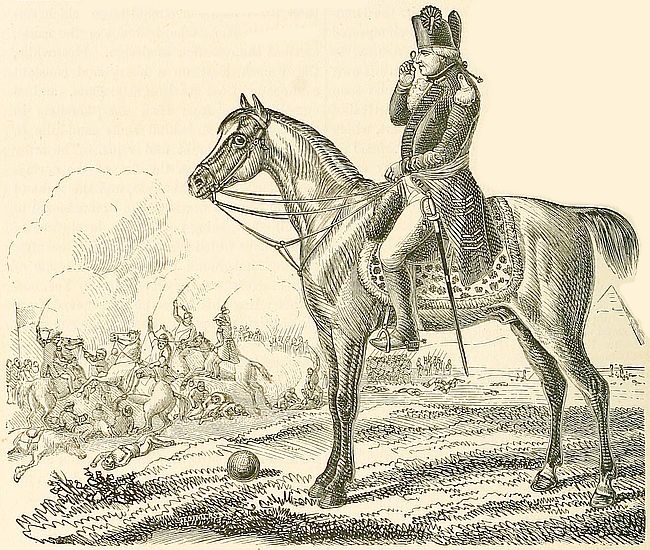
Sir Ralph Abercromby in Egypt. From Kay’s Edinburgh Portraits.
Sir Ralph Abercromby, who had taken his station in front early in the day between the right of the Highlanders and the left of the redoubt, having detached the whole of his staff, was left alone. In this situation two of the enemy’s dragoons dashed forward, and drawing up on each side, attempted to lead him away prisoner. In a struggle which ensued, he received a blow on the breast; but with the vigour and strength of arm for which he was distinguished, he seized the sabre of one of his assailants, and forced it out of his hand. A corporal (Barker) of the 42d coming up to his support at this instant, for lack of other ammunition, charged his piece with powder and his ramrod, shot one of the dragoons, and the other retired. The general afterwards dismounted from his horse though with difficulty; but no person knew that he was wounded, till some of the staff who joined him observed the blood trickling down his thigh. A musket-ball had entered his groin, and lodged deep in the hip-joint. Notwithstanding the acute pain which a wound in such a place must have occasioned, he had, during the interval between the time he had been wounded and the last charge of cavalry, walked with a firm and steady step along the line of the Highlanders and General Stuart’s brigade, to the position of the Guards in the centre of the line, where, from its elevated position, he had a full view of the whole field of battle, and from which place he gave his orders as if nothing had happened to him. In his anxiety about the result of the battle, he seemed to forget that he had been hurt; but after victory had declared in favour of the British army, he became alive to the danger of his situation, and in a state of exhaustion, lay down on a little sand-hill near the battery.