Volume 2 / Part 2 — CHAPTER II. (continued 2)
Reading edition
In the great civil war the Clanranald of Lochaber were very active on the king’s side. Soon after the Restoration, Alexander Macdonald Glas, the young chief of Keppoch, and his brother were murdered by some of their own discontented followers. Coll Macdonald was the next chief. Previous to the Revolution of 1688, the feud between his clan and the Mackintoshes, regarding the lands he occupied, led to the last clan battle that was ever fought in the Highlands. The Mackintoshes having invaded Lochaber, were defeated on a height called Mulroy. So violent had been Keppoch’s armed proceedings before this event that the government had issued a commission of fire and sword against him. After the defeat of the Mackintoshes, he advanced to Inverness, to wreak his vengeance on the inhabitants of that town for supporting the former against him, if they did not purchase his forbearance by paying a large sum as a fine. Dundee, however, anxious to secure the friendship of the people of Inverness, granted Keppoch his own bond in behalf of the town, obliging himself to see Keppoch paid 2000 dollars, as a compensation for the losses and injuries he alleged he had sustained from the Mackintoshes. Keppoch brought to the aid of Dundee 1000 Highlanders, and as Mackintosh refused to attend a friendly interview solicited by Dundee, Keppoch, at the desire of the latter, drove away his cattle. We are told that Dundee “used to call him Coll of the cowes, because he found them out when they were driven to the hills out of the way.” He fought at the battle of Killiecrankie, and, on the breaking out of the rebellion of 1715, he joined the Earl of Mar, with whom he fought at Sheriffmuir. His son, Alexander Macdonald of Keppoch, on the arrival of Prince Charles in Scotland in 1745, at once declared for him, and at a meeting of the chiefs to consult as to the course they should pursue, he gave it as his opinion that as the prince had risked his person, and generously thrown himself into the hands of his friends, they were bound, in duty at least, to raise men instantly for the protection of his person, whatever might be the consequences.
At the battle of Culloden, on the three Macdonald regiments giving way, Keppoch, seeing himself abandoned by his clan, advanced with his drawn sword in one hand and his pistol in the other, but was brought to the ground by a musket shot. Donald Roy Macdonald, a captain in Clanranald’s regiment, followed him, and entreated him not to throw away his life, assuring him that his wound was not mortal, and that he might easily rejoin his regiment in the retreat, but Keppoch, after recommending him to take care of himself, received another shot, which killed him on the spot. There are still numerous cadets of this family in Lochaber, but the principal house, says Mr Gregory,[156] if not yet extinct, has lost all influence in that district. Latterly they changed their name to Macdonnell.
CLANRANALD.
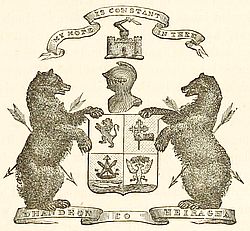
Badge.—Heath.
The Clanranald Macdonalds of Garmoran are descended from Ranald, younger son of John, first Lord of the Isles, by his first wife, Amy, heiress of the MacRorys or Macruaries of Garmoran. In 1373 he received a grant of the North Isles, Garmoran, and other lands, to be held of John, Lord of the Isles, and his heirs. His descendants comprehended the families of Moydart, Morar, Knoydart, and Glengarry, and came in time to form the most numerous tribe of the Clandonald. Alexander Macruari of Moydart, chief of the Clanranald, was one of the principal chiefs seized by James I. at Inverness in 1427, and soon after beheaded. The great-grandson of Ranald, named Allan Macruari, who became chief of the Clanranald in 1481, was one of the principal supporters of Angus, the young Lord of the Isles, at the battle of Bloody Bay, and he likewise followed Alexander of Lochalsh, nephew of the Lord of the Isles, in his invasion of Ross and Cromarty in 1491, when he received a large portion of the booty taken on the occasion.[157] In 1495, on the second expedition of James IV. to the Isles, Allan Macruari was one of the chiefs who made their submission.
During the whole of the 15th century the Clanranald had been engaged in feuds regarding the lands of Garmoran and Uist; first, with the Siol Gorrie, or race of Godfrey, eldest brother of Ranald, the founder of the tribe, and afterwards with the Macdonalds or Clanhuistein of Sleat, and it was not till 1506, that they succeeded in acquiring a legal title to the disputed lands. John, eldest son of Hugh of Sleat, having no issue, made over all his estates to the Clanranald, including the lands occupied by them. Archibald, or Gillespock, Dubh, natural brother of John, having slain Donald Gallach and another of John’s brothers, endeavoured to seize the lands of Sleat, but was expelled from the North Isles by Ranald Bane Allanson of Moydart, eldest son of the chief of Clanranald. The latter married Florence, daughter of MacIan of Ardnamurchan, and had four sons—1. Ranald Bane; 2. Alexander, who had three sons, John, Farquhar, and Angus, and a daughter; 3. Ranald Oig; and 4. Angus Reochson. Angus Reoch, the youngest son, had a son named Dowle or Coull, who had a son named Allan, whose son, Alexander, was the ancestor of the Macdonells of Morar.
In 1509 Allan Macruari was tried, convicted, and executed, in presence of the king at Blair-Athol, but for what crime is not known. His eldest son, Ranald Bane, obtained a charter of the lands of Moydart and Arisaig, Dec. 14, 1540, and died in 1541. He married a daughter of Lord Lovat, and had one son, Ranald Galda, or the stranger, from his being fostered by his mother’s relations, the Frasers.
On the death of Ranald Bane, the fifth chief, the clan, who had resolved to defeat his son’s right to succeed, in consequence of his relations, the Frasers, having joined the Earl of Huntly, lieutenant of the north, against the Macdonalds, chose the next heir to the estate as their chief. This was the young Ranald’s cousin-german, John Moydartach, or John of Moydart, eldest son of Alexander Allanson, second son of Allan Macruari, and John was, accordingly, acknowledged by the clan captain of Clanranald. Lovat, apprised of the intentions of the clan against his grandchild, before their scheme was ripe for execution, marched to Castletirrim, and, by the assistance of the Frasers, placed Ranald Galda in possession of the lands. The Clanranald, assisted by the Macdonalds of Keppoch and the Clan Cameron, having laid waste and plundered the districts of Abertarf and Stratherrick, belonging to Lovat, and the lands of Urquhart and Glenmoriston, the property of the Grants, the Earl of Huntly, the king’s lieutenant in the north, to drive them back and put an end to their ravages, was obliged to raise a numerous force. He penetrated as far as Inverlochy in Lochaber, and then returned to his own territories. The battle of Kinloch-lochy, called Blar-nan-leine, “the field of shirts,” followed, as related in the account of the clan Fraser. The Macdonalds being the victors, the result was that John Moydartach was maintained in possession of the chiefship and estates, and transmitted the same to his descendants. On the return of Huntly with an army, into Lochaber, John Moydartach fled to the Isles, where he remained for some time.
The Clanranald distinguished themselves under the Marquis of Montrose in the civil wars of the 17th century. At the battle of Killiecrankie, their chief, then only fourteen years of age, fought under Dundee, with 500 of his men. They were also at Sheriffmuir. In the rebellion of 1745, the Clanranald took an active part. Macdonald of Boisdale, the brother of the chief, then from age and infirmities unfit to be of any service, had an interview with Prince Charles, on his arrival off the island of Eriska, and positively refused to aid his enterprise. On the following day, however, young Clanranald, accompanied by his kinsmen, Alexander Macdonald of Glenaladale and Æneas Macdonald of Dalily, the author of a Journal and Memoirs of the Expedition, went on board the prince’s vessel, and readily offered him his services. He afterwards joined him with 200 of his clan, and was with him throughout the rebellion.
At the battles of Preston and Falkirk, the Macdonalds were on the right, which they claimed as their due, but at Culloden the three Macdonald regiments of Clanranald, Keppoch, and Glengarry, formed the left. It was probably their feeling of dissatisfaction at being placed on the left of the line that caused the Macdonald regiments, on observing that the right and centre had given way, to turn their backs and fly from the fatal field without striking a blow.
At Glenboisdale, whither Charles retreated, after the defeat at Culloden, he was joined by young Clanranald, and several other adherents, who endeavoured to persuade him from embarking for the Isles, but in vain. In the act of indemnity passed in June 1747, young Clanranald was one of those who were specially excepted from pardon.
The ancestor of the Macdonalds of Benbecula was Ranald, brother of Donald Macallan, who was captain of the Clanranald in the latter part of the reign of James VI. The Macdonalds of Boisdale are cadets of Benbecula, and those of Staffa of Boisdale. On the failure of Donald’s descendants, the family of Benbecula succeeded to the barony of Castletirrim, and the captainship of the Clanranald, represented by Reginald George Macdonald of Clanranald.
From John, another brother of Donald Macallan, came the family of Kinlochmoidart, which terminated in an heiress. This lady married Colonel Robertson, who, in her right, assumed the name of Macdonald.
From John Oig, uncle of Donald Macallan, descended the Macdonalds of Glenaladale. “The head of this family,” says Mr Gregory, “John Macdonald of Glenaladale, being obliged to quit Scotland about 1772, in consequence of family misfortunes, sold his Scottish estates to his cousin (also a Macdonald), and emigrating to Prince Edward’s Island, with about 200 followers, purchased a tract of 40,000 acres there, while the 200 Highlanders have increased to 3000.”
One of the attendants of Prince Charles, who, after Culloden, embarked with him for France, was Neil MacEachan Macdonald, a gentleman sprung from the branch of the Clanranald in Uist. He served in France as a lieutenant in the Scottish regiment of Ogilvie, and was father of Stephen James Joseph Macdonald, marshal of France, and Duke of Tarentum, born Nov. 17, 1765; died Sept. 24, 1840.
The Macdonalds of Glencoe are descended from John Og, surnamed Fraoch, natural son of Angus Og of Isla, and brother of John, first Lord of the Isles. He settled in Glencoe, which is a wild and gloomy vale in the district of Lorn, Argyleshire, as a vassal under his brother, and some of his descendants still possess lands there. This branch of the Macdonalds was known as the clan Ian Abrach, it is supposed from one of the family being fostered in Lochaber. After the Revolution, MacIan or Alexander Macdonald of Glencoe, was one of the chiefs who supported the cause of King James, having joined Dundee in Lochaber at the head of his clan, and a mournful interest attaches to the history of this tribe from the dreadful massacre, by which it was attempted to exterminate it in February 1692. The story has often been told, but as full details have been given in the former part of this work, it is unnecessary to repeat them here.
The Macdonalds of Glencoe joined Prince Charles on the breaking out of the rebellion in 1745, and General Stewart, in his Sketches of the Highlanders, relates that when the insurgent army lay at Kirkliston, near the seat of the Earl of Stair, grandson of Secretary Dalrymple, the prince, anxious to save his lordship’s house and property, and to remove from his followers all excitement and revenge, proposed that the Glencoe-men should be marched to a distance, lest the remembrance of the share which his grandfather had in the order for the massacre of the clan should rouse them to retaliate on his descendant. Indignant at being supposed capable of wreaking their vengeance on an innocent man, they declared their resolution of returning home, and it was not without much explanation and great persuasion that they were prevented from marching away the following morning.
MACDONNELL OF GLENGARRY.
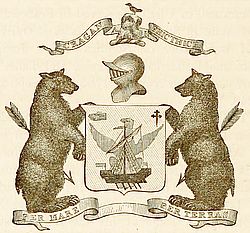
Badge.—Heath.
The Glengarry branch of the Macdonalds spell their name Macdonnell. The word Dhonuill, whence the name Donald is derived, is said to signify “brown eye.” The most proper way, says Mr Gregory, of spelling the name, according to the pronunciation, was that formerly employed by the Macdonalds of Dunyveg and the Glens, who used Macdonnell. Sir James Macdonald, however, the last of this family in the direct male line, signed Makdonall.[158]
The family of Glengarry are descended from Alister, second son of Donald, who was eldest son of Reginald or Ranald (progenitor also of the Clanranald), youngest son of John, lord of the Isles, by Amy, heiress of MacRory. Alexander Macdonnell, who was chief of Glengarry at the beginning of the 16th century, supported the claims of Sir Donald Macdonald of Lochalsh to the lordship of the Isles, and in November 1513 assisted him, with Chisholm of Comer, in expelling the garrison and seizing the Castle of Urquhart in Loch Ness. In 1527 the Earl of Argyll, lieutenant of the Isles, received from Alexander Macranald of Glengarry and North Morar, a bond of manrent or service; and in 1545 he was among the lords and barons of the Isles who, at Knockfergus in Ireland, took the oath of allegiance to the king of England, “at the command of the Earl of Lennox.” He married Margaret, eldest daughter of Celestine, brother of John Earl of Ross, and one of the three sisters and coheiresses of Sir Donald Macdonald of Lochalsh. His son, Angus or Æneas Macdonnell of Glengarry, the representative, through his mother, of the house of Lochalsh, which had become extinct in the male line on the death of Sir Donald in 1518, married Janet, only daughter of Sir Hector Maclean of Dowart, and had a son, Donald Macdonnell of Glengarry, styled Donald MacAngus MacAlister.
In 1581 a serious feud broke out between the chief of Glengarry, who had inherited one half of the districts of Lochalsh, Lochcarron, and Lochbroom in Wester Ross, and Colin Mackenzie of Kintail, who was in possession of the other half. The Mackenzies, having made aggressions upon Glengarry’s portion, the latter, to maintain his rights, took up his temporary residence in Lochcarron, and placed a small garrison in the castle of Strone in that district. With some of his followers he unfortunately fell into the hands of a party of the Mackenzies, and after being detained in captivity for a considerable time, only procured his release by yielding the castle of Lochcarron to the Mackenzies. The other prisoners, including several of his near kinsmen, were put to death. On complaining to the privy council, they caused Mackenzie of Kintail to be detained for a time at Edinburgh, and subsequently in the castle of Blackness. In 1602, Glengarry, from his ignorance of the laws, was, by the craft of the clan Kenzie, as Sir Robert Gordon says, “easalie intrapped within the compass thereof,” on which they procured a warrant for citing him to appear before the justiciary court at Edinburgh. Glengarry, however, paid no attention to it, but went about revenging the slaughter of two of his kinsmen, whom the Mackenzies had killed after the summons had been issued. The consequence was that he and some of his followers were outlawed, and Kenneth Mackenzie, who was now lord of Kintail, procured a commission of fire and sword against Glengarry and his men, in virtue of which he invaded and wasted the district of North Morar, and carried off all the cattle. In retaliation the Macdonalds plundered the district of Applecross, and, on a subsequent occasion, they landed on the coast of Lochalsh, with the intention of burning and destroying all Mackenzie’s lands, as far as Easter Ross, but their leader, Allaster MacGorrie, having been killed, they returned home. To revenge the death of his kinsman, Angus Macdonnell, the young chief of Glengarry, at the head of his followers, proceeded north to Lochcarron, where his tribe held the castle of Strone, now in ruins. After burning many of the houses in the district, and killing the inhabitants, he loaded his boats with the plunder, and prepared to return. In the absence of their chief, the Mackenzies, encouraged by the example of his lady, posted themselves at the narrow strait or kyle which separates Skye from the mainland, for the purpose of intercepting them. Night had fallen, however, before they made their appearance, and taking advantage of the darkness, some of the Mackenzies rowed out in two boats towards a large galley, on board of which was young Glengarry, which was then passing the kyle. This they suddenly attacked with a volley of musketry and arrows. Those on board in their alarm crowding to one side, the galley overset, and all on board were thrown into the water. Such of them as were able to reach the shore were immediately despatched by the Mackenzies, and among the slain was the young chief of Glengarry himself. The rest of the Macdonnells, on reaching Strathaird in Skye, left their boats, and proceeded on foot to Morar. Finding that the chief of the Mackenzies had not returned from Mull, a large party was sent to an island near which he must pass, which he did next day in Maclean’s great galley, but he contrived to elude them, and was soon out of reach of pursuit. He subsequently laid siege to the castle of Strone, which surrendered to him, and was blown up.
In 1603, “the Clanranald of Glengarry, under Allan Macranald of Lundie, made an irruption into Brae Ross, and plundered the lands of Kilchrist, and others adjacent, belonging to the Mackenzies. This foray was signalized by the merciless burning of a whole congregation in the church of Kilchrist, while Glengarry’s piper marched round the building, mocking the cries of the unfortunate inmates with the well-known pibroch, which has been known, ever since, under the name of Kilchrist, as the family tune of the Clanranald of Glengarry.”[159] Eventually, Kenneth Mackenzie, afterwards Lord Kintail, succeeded in obtaining a crown charter to the disputed districts of Lochalsh, Lochcarron, and others, dated in 1607.
Donald MacAngus of Glengarry died in 1603. By his wife, Margaret, daughter of Alexander Macdonald, Captain of Clanranald, he had, besides Angus above mentioned, two other sons, Alexander, who died soon after his father, and Donald Macdonnell of Scothouse.
Alexander, by his wife, Jean, daughter of Allan Cameron of Lochiel, had a son, Æneas Macdonnell of Glengarry, who was one of the first in 1644 to join the royalist army under Montrose, and never left that great commander, “for which,” says Bishop Wishart, “he deserves a singular commendation for his bravery and steady loyalty to the king, and his peculiar attachment to Montrose.”[160] Glengarry also adhered faithfully to the cause of Charles II., and was forfeited by Cromwell in 1651. As a reward for his faithful services he was at the Restoration created a peer by the title of Lord Macdonnell and Aross, by patent dated at Whitehall, 20th December 1660, the honours being limited to the heirs male of his body. This led him to claim not only the chiefship of Clanranald, but likewise that of the whole Clandonald, as being the representative of Donald, the common ancestor of the clan: and on 18th July 1672, the privy council issued an order, commanding him as chief to exhibit before the council several persons of the name of Macdonald, to find caution to keep the peace.
The three branches of the Clanranald engaged in all the attempts which were made for the restoration of the Stuarts. On 27th August 1715, Glengarry was one of the chiefs who attended the pretended grand hunting match at Braemar, appointed by the Earl of Mar, previous to the breaking out of the rebellion of that year. After the suppression of the rebellion, the chief of Glengarry made his submission to General Cadogan at Inverness. He died in 1724. By his wife, Lady Mary Mackenzie, daughter of the third Earl of Seaforth, he had a son, John Macdonnell, who succeeded him.
In 1745, six hundred of the Macdonnells of Glengarry joined Prince Charles, under the command of Macdonnell of Lochgarry, who afterwards escaped to France with the prince, and were at the battles of Preston, Falkirk, and Culloden. The chief himself seems not to have engaged in the rebellion. He was however arrested, and sent to London.
General Sir James Macdonnell, G.C.B., who distinguished himself when lieut.-col. in the guards, by the bravery with which he held the buildings of Hougomont, at the battle of Waterloo, was third son of Duncan Macdonnell, Esq. of Glengarry. He was born at the family seat, Inverness-shire, and died May 15, 1857.
Colonel Alexander Ranaldson Macdonnell of Glengarry, who, in January 1822, married Rebecca, second daughter of Sir William Forbes of Pitsligo, baronet, was the last genuine specimen of a Highland chief. His character in its more favourable features was drawn by Sir Walter Scott, in his romance of Waverley, as Fergus MacIvor. He always wore the dress and adhered to the style of living of his ancestors, and when away from home in any of the Highland towns, he was followed by a body of retainers, who were regularly posted as sentinels at his door. He revived the claims of his family to the chiefship of the Macdonalds, styling himself also of Clanranald. In January 1828 he perished in endeavouring to escape from a steamer which had gone ashore. As his estate was very much mortgaged and encumbered, his son was compelled to dispose of it, and to emigrate to Australia, with his family and clan. The estate was purchased by the Marquis of Huntly from the chief, and in 1840 it was sold to Lord Ward (Earl of Dudley, Feb. 13, 1860,) for £91,000. In 1860 his lordship sold it to Edward Ellice, Esq. of Glenquoich, for £120,000.
The principal families descended from the house of Glengarry, were the Macdonnells of Barrisdale, in Knoydart, Greenfield, and Lundie.
The strength of the Macdonalds has at all times been considerable. In 1427, the Macdonnells of Garmoran and Lochaber mustered 2000 men; in 1715, the whole clan furnished 2820; and in 1745, 2330. In a memorial drawn up by President Forbes of Culloden, and transmitted to the government soon after the insurrection in 1745, the force of every clan is detailed, according to the best information which the author of the report could procure at the time. This enumeration, which proceeds upon the supposition that the chieftain calculated on the military services of the youthful, the most hardy, and the bravest of his followers, omitting those who, from advanced age, tender years, or natural debility, were unable to carry arms, gives the following statement of the respective forces of the different branches of the Macdonalds:—
Men.
Macdonald of Sleat,700
Macdonald of Clanranald,700
Macdonell of Glengarry,500
Macdonell of Keppoch,300
Macdonald of Glencoe,130
——
In all,2330
Next to the Campbells, therefore, who could muster about 5000 men, the Macdonalds were by far the most numerous and powerful clan in the Highlands of Scotland.
“The clans or septs,” says Mr Smibert,[161] “sprung from the Macdonalds, or adhering to and incorporated with that family, though bearing subsidiary names, were very numerous. One point peculiarly marks the Gael of the coasts, as this great connection has already been called, and that is the device of a Lymphad or old-fashioned Oared Galley, assumed and borne in their arms. It indicates strongly a common origin and site. The Macdonalds, Maclachlans, Macdougals, Macneils, Macleans, and Campbells, as well as the Macphersons, Mackintoshes, and others, carry, and have always carried, such a galley in their armorial shields. Some families of Macdonald descent do not bear it; and indeed, at most, it simply proves a common coast origin, or an early location by the western lochs and lakes.”