Volume 2 — CHAPTER XLV. (continued 3)
Reading edition
The same is true of the poetry of the modern bards. Song-singing in the Highlands was usually social. Few songs on any subject were composed without a chorus, and the intention was that the chorus should be taken up by all the company present. A verse was sung in the interval by the individual singer, but the object of the chorus was to be sung by all. It is necessary to keep this in view in judging of the spirit and effect of Gaelic song. Sung as songs usually are, the object of the bard is lost sight of, and much of the action of the music is entirely overlooked. But what was intended chiefly to be said was, that the compositions of the modern bards were all intended to be linked with music, sung for the most part socially. We do not at this moment know one single piece of Gaelic poetry which was intended merely for recitation, unless it be found among a certain class of modern compositions which are becoming numerous, and which are English in everything but the language.
The music to which these compositions were sung was peculiar; one can recognise a Gaelic air at once, among a thousand. Quaint and pathetic, irregular and moving on with the most singular intervals, the movement is still self-contained and impressive,—to the Celt eminently so. It is beyond a question that what is called Scottish music has been derived from the Gaelic race. Its characteristics are purely Celtic. So far as the poetry of Burns is concerned, his songs were composed in many cases to airs borrowed from the Highlands, and nothing could fit in better than the poetry and the music. But Scottish Lowland music, so much and so deservedly admired, is a legacy from the Celtic muse throughout. There is nothing in it which it holds in common with any Saxon race in existence. Compare it with the common melodies in use among the English, and the two are proved totally distinct. The airs to which “Scots wha hae,” “Auld Langsyne,” “Roy’s Wife,” “O’ a’ the airts,” and “Ye Banks and Braes,” are sung, are airs to which nothing similar can be found in England. They are Scottish, and only Scottish, and can be recognised as such at once. But airs of a precisely similar character can be found among all the Celtic races. In Ireland, melodies almost identical with those of Scotland are found. In fact, the Irish claim such tunes as “The Legacy,” “The Highland Laddie,” and others. So with the Isle of Man. The national air of the Island, “Mollacharane,” has all the distinctive characteristics of a Scottish tune. The melodies of Wales have a similar type. Such a tune as “The Men of Harlech” might at any time be mistaken for a Scottish melody. And if we cross to Brittany and hear a party of Bretons of a night singing a national air along the street, as they often do, the type of the air will be found to be largely Scottish. These facts go far to prove the paternity of what is called Scottish music, and show to conviction that this music, so sweet, so touching, is the ancient inheritance of the Celt.
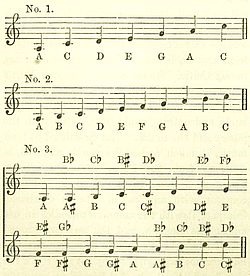
No. 1. A C D E G A C No. 2. A B C D E F G A B C No. 3.
The ancient Scottish scale consists of six notes, as shown in the annexed exemplification, No. 1. The lowest note A, was afterwards added, to admit of the minor key in wind instruments. The notes in the diatonic scale, No. 2, were added about the beginning of the fifteenth century, and when music arrived at its present state of perfection, the notes in the chromatic scale, No. 3, were farther added. Although many of the Scottish airs have had the notes last mentioned introduced into them, to please modern taste they can be played without them, and without altering the character of the melody. Any person who understands the ancient scale can at once detect the later additions.
“The Gaelic music consists of different kinds or species. 1. Martial music, the Golltraidheacht of the Irish, and the Brosnachadh Catha of the Gael, consisting of a spirit-stirring measure short and rapid. 2. The Geantraidheacht, or plaintive or sorrowful, a kind of music to which the Highlanders are very partial. The Coronach, or Lament, sung at funerals, is the most noted of this sort. 3. The Suantraidheacht, or composing, calculated to calm the mind, and to lull the person to sleep. 4. Songs of peace, sung at the conclusion of a war. 5. Songs of victory sung by the bards before the king on gaining a victory. 6. Love songs. These last form a considerable part of the national music, the sensibility and tenderness of which excite the passion of love, and stimulated by its influence, the Gael indulge a spirit of the most romantic attachment and adventure, which the peasantry of perhaps no other country exhibit.”
The last paragraph is quoted from Mr Logan’s eloquent and patriotic work on the Scottish Gael,[104] and represents the state of Gaelic music when more flourishing and more cultivated than it is to-day.
The following quotation is from the same source, and is also distinguished by the accuracy of its description.
“The ancient Gael were fond of singing whether in a sad or cheerful frame of mind. Bacon justly remarks, ‘that music feedeth that disposition which it findeth:’ it was a sure sign of brewing mischief, when a Caledonian warrior was heard to ‘hum his surly hymn.’ This race, in all their labours, used appropriate songs, and accompanied their harps with their voices. At harvest the reapers kept time by singing; at sea the boatmen did the same; and while the women were graddaning, performing the luadhadh, or waulking of cloth, or at any rural labour, they enlivened their work by certain airs called luinneags. When milking, they sung a certain plaintive melody, to which the animals listened with calm attention. The attachment which the natives of Celtic origin have to their music, is strengthened by its intimate connection with the national songs. The influence of both on the Scots character is confessedly great—the pictures of heroism, love, and happiness, exhibited in their songs, are indelibly impressed on the memory, and elevate the mind of the humblest peasant. The songs, united with their appropriate music, affect the sons of Scotia, particularly when far distant from their native glens and majestic mountains, with indescribable feelings, and excite a spirit of the most romantic adventure. In this respect, the Swiss, who inhabit a country of like character, and who resemble the Highlanders in many particulars, experience similar emotions. On hearing the national Ranz de vaches, their bowels yearn to revisit the ever dear scenes of their youth. So powerfully is the amor patriæ awakened by this celebrated air, that it was found necessary to prohibit its being played, under pain of death, among the troops, who would burst into tears on hearing it, desert their colours, and even die.
“No songs could be more happily constructed for singing during labour than those of the Highlanders, every person being able to join in them, sufficient intervals being allowed for breathing time. In a certain part of the song, the leader stops to take breath, when all the others strike in and complete the air with a chorus of words and syllables, generally without signification, but admirably adapted to give effect to the time.” The description proceeds to give a picture of a social meeting in the Highlands where this style of singing is practised, and refers to the effect with which such a composition as “Fhir à bhàta,” or the Boatman, may be thus sung.
Poetical compositions associated with music are of various kinds. First of all is the Laoidh, or lay, originally signifying a stately solemn composition, by one of the great bards of antiquity. Thus we have “Laoidh Dhiarmaid,” The lay of Diarmad; “Laoidh Oscair,” The lay of Oscar; “Laoidh nan Ceann,” The lay of the heads; and many others. The word is now made use of to describe a religious hymn; a fact which proves the dignity with which this composition was invested in the popular sentiment. Then there was the “Marbhrann,” or elegy. Few men of any mark but had their elegy composed by some bard of note. Chiefs and chieftains were sung of after their deaths in words and music the most mournful which the Celt, with so deep a vein of pathos in his soul, could devise. There is an elegy on one of the lairds of Macleod by a famous poetess “Mairi nighean Alasdair Ruaidh,” or Mary M’Leod, which is exquisitely touching. Many similar compositions exist. In modern times these elegies are mainly confined to the religious field, and ministers and other men of mark in that field are often sung of and sung sweetly by such bards as still remain. Then there are compositions called “Iorrams” usually confined to sea songs; “Luinneags,” or ordinary lyrics, and such like. These are all “wedded” to music, which is the reason for noticing them here, and the music must be known in order to have the full relish of the poetry.
There are several collections of Highland music which are well worthy of being better known to the musical world than they are. The oldest is that by the Rev. Peter Macdonald of Kilmore, who was a famous musician in his day. More recently Captain Simon Fraser, of Inverness, published an admirable collection; and collections of pipe music have been made by Macdonald, Mackay, and, more recently, Ross, the two latter pipers to her Majesty, all of which are reported of as good.
The secular music of the Highlands, as existing now, may be divided into that usually called by the Highlanders “An Ceol mòr,” the great music, and in English pibrochs. This music is entirely composed for the Highland bagpipe, and does not suit any other instrument well. It is composed of a slow movement, with which it begins, the movement proceeding more rapidly through several variations, until it attains a speed and an energy which gives room for the exercise of the most delicate and accurate fingering. Some of these pieces are of great antiquity, such as “Mackintosh’s Lament” and “Cogadh na Sith,” Peace or War, and are altogether remarkable compositions. Mendelssohn, on his visit to the Highlands, was impressed by them, and introduced a portion of a pibroch into one of his finest compositions. Few musicians take the trouble of examining into the structure of these pieces, and they are condemned often with little real discrimination. Next to these we have the military music of the Highlands, also for the most part composed for the pipe, and now in general employed by the pipers of Highland regiments. This kind of music is eminently characteristic, having features altogether distinctive of itself, and is much relished by Scotsmen from all parts of the country. Recently a large amount of music of this class has been adapted to the bagpipe which is utterly unfit for it, and the effect is the opposite of favourable to the good name either of the instrument or the music. This practice is in a large measure confined to regimental pipe music. Such tunes as “I’m wearying awa’, Jean,” or “Miss Forbes’ Farewell to Banff,” have no earthly power of adaptation to the notes of the bagpipe, and the performance of such music on that instrument is a violation of good taste and all musical propriety. One cannot help being struck with the peculiar good taste that pervades all the compositions of the M’Crimmons, the famous pipers of the Macleods, and how wonderfully the music and the instrument are adapted to each other throughout. This cannot be said of all pibroch music, and the violation of the principle in military music is frequently most offensive to an accurate ear. This has, no doubt, led to the unpopularity of the bagpipe and its music among a large class of the English-speaking community, who speak of its discordant notes, a reflection to which it is not in the least liable in the case of compositions adapted to its scale.
Next to these two kinds follows the song-music of the Gael, to which reference has been made already. It abounds in all parts of the Highlands, and is partly secular, partly sacred. There are beautiful, simple, touching airs, to which the common songs of the country are sung, and there are airs of a similar class, but distinct, which are used with the religious hymns of Buchanan, Matheson, Grant, and other writers of hymns, of whom there are many. The dance music of the Highlands is also distinct from that of any other country, and broadly marked by its own peculiar features. There is the strathspey confined to Scotland, a moderately rapid movement well known to every Scotchman; there is the jig in 6/8th time, common to Scotland with Ireland; and there is the reel, pretty much of the same class with the Strathspey, but marked by greater rapidity of motion.
There is one thing which strikes the hearer in this music, that there is a vein of pathos runs through the whole of it. The Celtic mind is largely tinged with pathos. If a musical symbol might be employed to represent them, the mind of the Saxon may be said to be cast in the mould of the major mode, and the mind of the Celt in the minor. The majority of the ordinary airs in the Highlands are in the minor mode, and in the most rapid kinds of music, the jig and the reel, an acute ear will detect the vein of pathos running through the whole.
In sacred music there is not much that is distinctive of the Celt. In forming their metrical version of the Gaelic Psalms, the Synod of Argyll say that one of the greatest difficulties they had to contend with was in adapting their poetry to the forms of the English psalm tunes. There were no psalm tunes which belonged to the Highlands, and it was necessary after the Reformation to borrow such as had been introduced among other Protestants, whether at home or abroad. More lately a peculiar form of psalm tune has developed itself in the North Highlands, which is deserving of notice. It is not a class of new tunes that has appeared, but a peculiar method of singing the old ones. The tunes in use are only six, all taken from the old Psalter of Scotland. They are—French, Dundee, Elgin, York, Martyrs, and Old London. The principal notes of the original tunes are retained, but they are attended with such a number of variations, that the tune in its new dress can hardly be at all recognised. These tunes may not be musically accurate, and artists may make light of them, but sung by a large body of people, they are eminently impressive and admirably adapted to purposes of worship. Sung on a Communion Sabbath by a crowd of worshippers in the open air, on the green sward of a Highland valley, old Dundee is incomparable, and exercises over the Highland mind a powerful influence. And truly, effect cannot be left out of view as an element in judging of the character of any music. The pity is that this music is fast going out of use even in the Highlands. It has always been confined to the counties of Caithness, Sutherland, Ross, and part of Inverness. Some say that this music took its complexion from the old chants of the mediæval Church. One thing is true of this and all Gaelic psalmody, that the practice of chanting the line is rigidly adhered to, although from the more advanced state of general education in the Highlands the necessity that once existed for it is now passed away.
Connected with the Gaelic music, the musical instruments of the Celts remain to be noticed; but we shall confine our observations to the harp and to the bagpipe, the latter of which has long since superseded the former in the Highlands. The harp is the most noted instrument of antiquity, and was in use among many nations. It was, in particular, the favourite instrument of the Celts. The Irish were great proficients in harp music, and they are said to have made great improvements on the instrument itself. So honourable was the occupation of a harper among the Irish, that none but freemen were permitted to play on the harp, and it was reckoned a disgrace for a gentleman not to have a harp, and be able to play on it. The royal household always included a harper, who bore a distinguished rank. Even kings did not disdain to relieve the cares of royalty by touching the strings of the harp; and we are told by Major that James I., who died in 1437, excelled the best harpers among the Irish and the Scotch Highlanders. But harpers were not confined to the houses of kings, for every chief had his harper as well as his bard.
“The precise period when the harp was superseded by the bagpipe, it is not easy to ascertain. Roderick Morrison, usually called Ruaraidh Dall, or Blind Roderick, was one of the last native harpers; he was harper to the Laird of M’Leod. On the death of his master, Morrison led an itinerant life, and in 1650 he paid a visit to Robertson of Lude, on which occasion he composed a Port or air, called Suipeir Thighearna Leoid or The Laird of Lude’s Supper, which, with other pieces, is still preserved. M’Intosh, the compiler of the Gaelic Proverbs, relates the following anecdote of Mr Robertson, who, it appears, was a harp-player himself of some eminence:—‘One night my father, James M’Intosh, said to Lude that he would be happy to hear him play on the harp, which at that time began to give place to the violin. After supper Lude and he retired to another room, in which there was a couple of harps, one of which belonged to Queen Mary. James, says Lude, here are two harps; the largest one is the loudest, but the small one is the sweetest, which do you wish to hear played? James answered the small one, which Lude took up and played upon till daylight.’
“The last harper, as is commonly supposed, was Murdoch M’Donald, harper to M’Lean of Coll. He received instructions in playing from Rory Dall in Skye, and afterwards in Ireland; and from accounts of payments made to him by M’Lean, still extant, Murdoch seems to have continued in his family till the year 1734, when he appears to have gone to Quinish, in Mull, where he died.”
The history of the bagpipe is curious and interesting, but such history does not fall within the scope of this work. Although a very ancient instrument, it does not appear to have been known to the Celtic nations. It was in use among the Trojans, Greeks, and Romans, but how, or in what manner it came to be introduced into the Highlands is a question which cannot be solved. Two suppositions have been started on this point, either that it was brought in by the Romans or by the northern nations. The latter conjecture appears to be the most probable, for we cannot possibly imagine that if the bagpipe had been introduced so early as the Roman epoch, no notice should have been taken of that instrument by the more early annalists and poets. But if the bagpipe was an imported instrument, how does it happen that the great Highland pipe is peculiar to the Highlands, and is perhaps the only national instrument in Europe? If it was introduced by the Romans, or by the people of Scandinavia, how has it happened that no traces of that instrument in its present shape are to be found anywhere except in the Highlands? There is, indeed, some plausibility in these interrogatories, but they are easily answered, by supposing, what is very probable, that the great bagpipe in its present form is the work of modern improvement, and that originally the instrument was much the same as is still seen in Belgium and Italy.
The effects of this national instrument in arousing the feelings of those who have from infancy been accustomed to its wild and warlike tunes are truly astonishing. In halls of joy and in scenes of mourning it has prevailed; it has animated Scotland’s warriors in battle, and welcomed them back after their toils to the homes of their love and the hills of their nativity. Its strains were the first sounded on the ears of infancy, and they are the last to be forgotten in the wanderings of age. Even Highlanders will allow that it is not the quietest of instruments, but when far from their mountain homes, what sounds, however melodious, could thrill round their heart like one burst of their own wild native pipe? The feelings which other instruments awaken are general and undefined, because they talk alike to Frenchmen, Spaniards, Germans, and Highlanders, for they are common to all; but the bagpipe is sacred to Scotland, and speaks a language which Scotsmen only feel. It talks to them of home and all the past, and brings before them, on the burning shores of India, the wild hills and oft-frequented streams of Caledonia, the friends that are thinking of them, and the sweethearts and wives that are weeping for them there; and need it be told here to how many fields of danger and victory its proud strains have led! There is not a battle that is honourable to Britain in which its war-blast has not sounded. When every other instrument has been hushed by the confusion and carnage of the scene, it has been borne into the thick of battle, and, far in the advance, its bleeding but devoted bearer, sinking on the earth, has sounded at once encouragement to his countrymen and his own coronach.
CATALOGUE OF GAELIC AND IRISH MANUSCRIPTS.
As connected with the literary history of the Gaelic Celts, the following lists of Gaelic and Irish manuscripts will, it is thought, be considered interesting.
CATALOGUE OF ANCIENT GAELIC MSS. IN THE POSSESSION OF THE HIGHLAND SOCIETY OF SCOTLAND.
1. A folio MS., beautifully written on parchment or vellum, from the collection of the late Major Maclauchlan of Kilbride. This is the oldest MS. in the possession of the Highland Society of Scotland. It is marked Vo. A. No. I. The following remark is written on the margin of the fourth leaf of the MS.:—“Oidche bealtne ann a coimhtech mo Pupu Muirciusa agus as olc lium nach marunn diol in linesi dem dub Misi Fithil acc furnuidhe na scoile.” Thus Englished by the late Dr Donald Smith:—“The night of the first of May in Coenobium of my Pope Murchus, and I regret that there is not left of my ink enough to fill up this line. I am Fithil, an attendant on the school.” This MS., which, from its orthography, is supposed to be as old as the eighth or ninth century, “consists (says Dr Smith) of a poem, moral and religious, some short historical anecdotes, a critical exposition of the Tain, an Irish tale, which was composed in the time of Diarmad, son of Cearval, who reigned over Ireland from the year 544 to 565; and the Tain itself, which claims respect, as exceeding in point of antiquity, every production of any other vernacular tongue in Europe.”[105]
On the first page of the vellum, which was originally left blank, there are genealogies of the families of Argyll and Mac Leod in the Gaelic handwriting of the sixteenth century. The genealogy of the Argyll family ends with Archibald, who succeeded to the earldom in 1542, and died in 1588.[106] This is supposed to be the oldest Gaelic MS. extant. Dr Smith conjectures that it may have come into the possession of the Maclachlans of Kilbride in the sixteenth century, as a Ferquhard, son of Ferquhard Maclachlan, was bishop of the Isles, and had Iona or I Colum Kille in commendam from 1530 to 1544.—See Keith’s Catalogue of Scottish Bishops.
To the Tain is prefixed the following critical exposition, giving a brief account of it in the technical terms of the Scots literature of the remote age in which it was written. “Ceathardha connagur in cach ealathuin is cuincda don tsairsisi na Tana. Loc di cedumus lighe Fercusa mhic Roich ait in rou hathnachd four mach Nai. Tempus umorro Diarmuta mhic Ceruailt in rigno Ibeirnia. Pearsa umorro Fergusa mhic Roich air is e rou tirchan do na hecsib ar chenu. A tucaid scriuint dia ndeachai Seanchan Toirpda cona III. ri ecces ... do saighe Cuaire rig Condacht.” That is—the four things which are requisite to be known in every regular composition are to be noticed in this work of the Tain. The place of its origin is the stone of Fergus, son of Roich, where he was buried on the plain of Nai. The time of it, besides, is that in which Diarmad, son of Cervail, reigned over Ireland. The author, too, is Fergus, son of Roich; for he it was that prompted it forthwith to the bards. The cause of writing it was a visit which Shenachan Torbda, with three chief bards, made to Guaire, king of Connaught.[107]
O’Flaherty thus concisely and accurately describes the subject and character of the Tain:—“Fergusius Rogius solo pariter ac solio Ultoniæ exterminatus, in Connactiam ad Ollilum et Maudam ibidem regnantes profugit; quibus patrocinantibus, memorabile exarsit bellum septannale inter Connacticos et Ultonios multis poeticis figmentis, ut ea ferebat ætas, adornatum. Hujus belli circiter medium, octennio ante caput æræ Christianæ Mauda regina Connactiæ, Fergusio Rogio ductore, immensam bonum prœdam conspicuis agentium et insectantium virtutibus memorabilem, e Cualgnio in agro Louthiano re portavit.”[108]
From the expression, “Ut ea ferebat ætas,” Dr Smith thinks that O’Flaherty considered the tale of the Tain as a composition of the age to which it relates; and that of course he must not have seen the Critical Exposition prefixed to the copy here described. From the silence of the Irish antiquaries respecting this Exposition, it is supposed that it must have been either unknown to, or overlooked by them, and consequently that it was written in Scotland.
The Exposition states, that Sheannachan, with the three bards and those in their retinue, when about to depart from the court of Guaire, being called upon to relate the history of the Tain bho, or cattle spoil of Cuailgne, acknowledged their ignorance of it, and that having ineffectually made the round of Ireland and Scotland in quest of it, Eimin and Muircheartach, two of their number, repaired to the grave of Fergus, son of Roich, who, being invoked, appeared at the end of three days in terrific grandeur, and related the whole of the Tain, as given in the twelve Reimsgeala or Portions of which it consists. In the historical anecdotes allusion is made to Ossian, the son of Fingal, who is represented as showing, when young, an inclination to indulge in solitude his natural propensity for meditation and song. A fac simile of the characters of this MS. is given in the Highland Society’s Report upon Ossian, Plate I., fig. 1, 2, and in Plate II.
2. Another parchment MS. in quarto, equally beautiful as the former, from the same collection. It consists of an Almanack bound up with a paper list of all the holidays, festivals, and most remarkable saints’ days in verse throughout the year—A Treatise on Anatomy, abridged from Galen—Observations on the Secretions, &c.—The Schola Salernitana, in Leonine verse, drawn up about the year 1100, for the use of Robert, Duke of Normandy, the son of William the Conqueror, by the famous medical school of Salerno. The Latin text is accompanied with a Gaelic explanation, which is considered equally faithful and elegant, of which the following is a specimen:—
Caput I.—Anglorum regi scripsit schola tota Salerni.
1. As iat scol Salerni go hulidhe do seriou na fearsadh so do chum rig sag san do choimhed a shlainnte.
Si vis incolumem, si vis te reddere sanum; Curas tolle graves, irasci crede prophanum.
Madh ail bhidh fallann, agus madh aill bhidh slan; Cuir na himsnimha troma dhit, agus creit gurub diomhain duit fearg do dhenumh.
The words Leabhar Giollacholaim Meigbeathadh are written on the last page of this MS., which being in the same form and hand, with the same words on a paper MS. bound up with a number of others written upon vellum in the Advocates’ Library, and before which is written Liber Malcolmi Bethune, it has been conjectured that both works originally belonged to Malcolm Bethune, a member of a family distinguished for learning, which supplied the Western Isles for many ages with physicians.[109]
3. A small quarto paper MS. from the same collection, written at Dunstaffnage by Ewen Macphaill, 12th October 1603. It consists of a tale in prose concerning a King of Lochlin and the Heroes of Fingal: An Address to Gaul, the son of Morni, beginning—
Goll mear mileant— Ceap na Crodhachta—
An Elegy on one of the earls of Argyle, beginning—
A Mhic Cailin a chosg lochd;
and a poem in praise of a young lady.
4. A small octavo paper MS. from the same collection, written by Eamonn or Edmond Mac Lachlan, 1654–5. This consists of a miscellaneous collection of sonnets, odes, and poetical epistles, partly Scots, and partly Irish. There is an Ogham or alphabet of secret writing near the end of it.
5. A quarto paper MS. from same collection. It wants ninety pages at the beginning, and part of the end. What remains consists of some ancient and modern tales and poems. The names of the authors are not given, but an older MS. (that of the Dean of Lismore) ascribes one of the poems to Conal, son of Edirskeol. This MS. was written at Aird-Chonail upon Lochowe, in the years 1690 and 1691, by Ewan Mac Lean for Colin Campbell. “Caillain Caimpbel leis in leis in leabharan. 1, Caillin mac Dhonchai mhic Dhughil mhic Chaillain oig.” Colin Campbell is the owner of this book, namely Colin, son of Duncan, son of Dougal, son of Colin the younger. The above Gaelic inscription appears on the 79th leaf of the MS.
6. A quarto paper MS., which belonged to the Rev. James MacGregor, Dean of Lismore, the metropolitan church of the see of Argyle, dated, page 27, 1512, written by Duncan the son of Dougal, son of Ewen the Grizzled. This MS. consists of a large collection of Gaelic poetry, upwards of 11,000 verses. It is said to have been written “out of the books of the History of the Kings.” Part of the MS., however, which closes an obituary, commencing in 1077, of the kings of Scotland, and other eminent persons of Scotland, particularly of the shires of Argyle and Perth, was not written till 1527. The poetical pieces are from the times of the most ancient bards down to the beginning of the sixteenth century. The more ancient pieces are poems of Conal, son of Edirskeol, Ossian, son of Fingal, Fearghas Fili (Fergus the bard), and Caoilt, son of Ronan, the friends and contemporaries of Ossian. This collection also contains the works of Sir Duncan Campbell of Glenurchay, who fell in the battle of Flodden, and Lady Isabel Campbell, daughter of the Earl of Argyle, and wife of Gilbert, Earl of Cassilis.[110] “The writer of this MS. (says Dr Smith) rejected the ancient character for the current handwriting of the time, and adopted a new mode of spelling conformable to the Latin and English sounds of his own age and country, but retained the aspirate mark (’).... The Welsh had long before made a similar change in their ancient orthography. Mr Edward Lhuyd recommended it, with some variation, in a letter to the Scots and Irish, prefixed to his Dictionary of their language in the Archæologia Britannica. The bishop of Sodor and Man observed it in the devotional exercises, admonition, and catechism, which he published for the use of his diocese. It was continued in the Manx translation of the Scriptures, and it has lately been adopted by Dr Reilly, titular Primate of Ireland, in his Tagasg Kreesty, or Christian Doctrine. But yet it must be acknowledged to be much inferior to the ancient mode of orthography, which has not only the advantage of being grounded on a knowledge of the principles of grammar, and philosophy of language, but of being also more plain and easy. This volume of the Dean’s is curious, as distinguishing the genuine poetry of Ossian from the imitations made of it by later bards, and as ascertaining the degree of accuracy with which ancient poems have been transmitted by tradition for the last three hundred years, during a century of which the order of bards has been extinct, and ancient manners and customs have suffered a great and rapid change in the Highlands.”[111] A fac simile of the writing is given in the Report of the Committee of the Highland Society, plate III. No. 5. Since the above was written, the whole of this manuscript, with a few unimportant exceptions, has been transcribed, translated, and annotated by the Rev. Dr M’Lauchlan, Edinburgh, and an introductory chapter was furnished by W. F. Skene, Esq., LL.D. The work has been published by Messrs Edmonston & Douglas, of Edinburgh, and is a valuable addition to our Gaelic literature.
7. A quarto paper MS. written in a very beautiful regular hand, without date or the name of the writer. It is supposed to be at least two hundred years old, and consists of a number of ancient tales and short poems. These appear to be transcribed from a much older MS., as there is a vocabulary of ancient words in the middle of the MS. Some of the poetry is ascribed to Cuchulin.
8. Another quarto paper MS. the beginning and end of which have been lost. It consists partly of prose, partly of poetry. With the exception of two loose leaves, which appear much older, the whole appears to have been written in the 17th century. The poetry, though ancient, is not Fingalian. The name, Tadg Og CC., before one of the poems near the end, is the only one to be seen upon it.
9. A quarto parchment MS. consisting of 42 leaves, written by different hands, with illuminated capitals. It appears at one time to have consisted of four different MSS. bound to together and covered with skin, to preserve them. This MS. is very ancient and beautiful, though much soiled. In this collection is a life of St Columba, supposed, from the character, (being similar to No. 27,) to be of the twelfth or thirteenth century.
10. A quarto parchment medical MS. beautifully written. No date or name, but the MS. appears to be very ancient.
11. A quarto paper MS., partly prose, partly verse, written in a very coarse and indifferent hand. No date or name.
12. A small quarto MS. coarse. Bears date 1647, without name.
13. A small long octavo paper MS. the beginning and end lost, and without any date. It is supposed to have been written by the Macvurichs of the fifteenth century. Two of the poems are ascribed to Tadg Mac Daire Bruaidheadh, others to Brian O’Donalan.
14. A large folio parchment MS. in two columns, containing a tale upon Cuchullin and Conal, two of Ossian’s heroes. Without date or name and very ancient.
15. A large quarto parchment of 7½ leaves, supposed by Mr Astle, author of the work on the origin and progress of writing, to be of the ninth or tenth century. Its title is Emanuel, a name commonly given by the old Gaelic writers to many of their miscellaneous writings. Engraved specimens of this MS. are to be seen in the first edition of Mr Astle’s work above-mentioned, 18th plate, Nos. 1 and 2, and in his second edition, plate 22. Some of the capitals in the MS. are painted red. It is written in a strong beautiful hand, in the same character as the rest. This MS. is only the fragment of a large work on ancient history, written on the authority of Greek and Roman writers, and interspersed with notices of the arts, armour, dress, superstitions, manners, and usages, of the Scots of the author’s own time. In this MS. there is a chapter titled, “Slogha Chesair an Inis Bhreatan,” or Cæsar’s expedition to the island of Britain, in which Lechlin, a country celebrated in the ancient poems and tales of the Gäel, is mentioned as separated from Gaul by “the clear current of the Rhine.” Dr Donald Smith had a complete copy of this work.
16. A small octavo parchment MS. consisting of a tale in prose, imperfect. Supposed to be nearly as old as the last mentioned MS.
17. A small octavo paper MS. stitched, imperfect; written by the Macvurichs. It begins with a poem upon Darthula, different from Macpherson’s, and contains poems written by Cathal and Nial Mor Macvurich, (whose names appear at the beginning of some of the poems,) composed in the reign of King James the Fifth, Mary, and King Charles the First. It also contains some Ossianic poems, such as Cnoc an àir, &c. i. e. The Hill of Slaughter, supposed to be part of Macpherson’s Fingal. It is the story of a woman who came walking alone to the Fingalians for protection from Taile, who was in pursuit of her. Taile fought them, and was killed by Oscar. There was another copy of this poem in Clanranald’s little book—not the Red book, as erroneously supposed by Laing. The Highland Society are also in possession of several copies taken from oral tradition. The second Ossianic poem in this MS. begins thus:
Sè la gus an dè O nach fhaca mi fein Fionn. It is now six days yesterday Since I have not seen Fingal.
18. An octavo paper MS. consisting chiefly of poetry, but very much defaced. Supposed to have been written by the last of the Macvurichs, but without date. The names of Tadg Og and Lauchlan Mac Taidg occur upon it. It is supposed to have been copied from a more ancient MS. as the poetry is good.
19. A very small octavo MS. written by some of the Macvurichs. Part of it is a copy of Clanranald’s book, and contains the genealogy of the Lords of the Isles and others of that great clan. The second part consists of a genealogy of the kings of Ireland (ancestors of the Macdonalds) from Scota and Gathelic. The last date upon it is 1616.
20. A paper MS. consisting of a genealogy of the kings of Ireland, of a few leaves only, and without date.
21. A paper MS. consisting of detached leaves of different sizes, and containing, 1. The conclusion of a Gaelic chronicle of the kings of Scotland down to King Robert III.; 2. A Fingalian tale, in which the heroes are Fingal, Goll Mac Morni, Oscar, Ossian, and Conan; 3. A poem by Macdonald of Benbecula, dated 1722, upon the unwritten part of a letter sent to Donald Macvurich of Stialgary; 4. A poem by Donald Mackenzie; 5. Another by Tadg Og CC, copied from some other MS.; 6. A poem by Donald Macvurich upon Ronald Macdonald of Clanranald. Besides several hymns by Tadg, and other poems by the Macvurichs and others.
22. A paper MS. consisting of religious tracts and genealogy, without name or date.
23. A paper MS. containing instruction for children in Gaelic and English. Modern, and without date.
24. Fragments of a paper MS., with the name of Cathelus Macvurich upon some of the leaves, and Niall Macvurich upon some others. Conn Mac an Deirg, a well known ancient poem, is written in the Roman character by the last Niall Macvurich, the last Highland bard, and is the only one among all the Gaelic MSS. in that character.
With the exception of the first five numbers, all the before mentioned MSS. were presented by the Highland Society of London to the Highland Society of Scotland in January, 1803, on the application of the committee appointed to inquire into the nature and authenticity of the poems of Ossian. All these MSS. (with the single exception of the Dean of Lismore’s volume,) are written in the very ancient form of character which was common of old to Britain and Ireland, and supposed to have been adopted by the Saxons at the time of their conversion to Christianity. This form of writing has been discontinued for nearly eighty years in Scotland, as the last specimen which the Highland Society of Scotland received of it consists of a volume of songs, supposed to have been written between the years 1752 and 1768, as it contains a song written by Duncan Macintyre, titled, An Taileir Mac Neachdain, which he composed the former year, the first edition of Macintyre’s songs having been published during the latter year.[112]
25. Besides these, the Society possesses a collection of MS. Gaelic poems made by Mr Duncan Kennedy, formerly schoolmaster at Craignish in Argyleshire, in three thin folio volumes. Two of them are written out fair from the various poems he had collected about sixty years ago. This collection consists of the following poems, viz., Luachair Leothaid, Sgiathan mac Sgairbh, An Gruagach, Rochd, Sithallan, Mùr Bheura, Tiomban, Sealg na Cluana, Gleanncruadhach, Uirnigh Oisein, Earragan, (resembling Macpherson’s Battle of Lora,) Manus, Maire Borb, (Maid of Craca,) Cath Sisear, Sliabh nam Beann Sionn, Bas Dheirg, Bas Chuinn, Righ Liur, Sealg na Leana, Dun an Oir, An Cu dubh, Gleann Diamhair, Conal, Bas Chiuinlaich Diarmad, Carril, Bas Ghuill (different from the Death of Gaul published by Dr Smith,) Garaibh, Bas Oscair, (part of which is the same narrative with the opening of Macpherson’s Temora,) in three parts; Tuiridh nam Fian, and Bass Osein. To each of these poems Kennedy has prefixed a dissertation containing some account of the Sgealachd story, or argument of the poem which is to follow. It was very common for the reciter, or history-man, as he was termed in the Highlands, to repeat the Sgealachds to his hearers before reciting the poems to which they related. Several of the poems in this collection correspond pretty nearly with the ancient MS. above mentioned, which belonged to the Dean of Lismore.[113]
26. A paper, medical, MS. in the old Gaelic character, a thick volume, written by Angus Connacher at Ardconel, Lochow-side, Argyleshire, 1612, presented to the Highland Society of Scotland by the late William Macdonald, Esq. of St Martins, W.S.
27. A beautiful parchment MS., greatly mutilated, in the same character, presented to the Society by the late Lord Bannatyne, one of the judges of the Court of Session. The supposed date upon the cover is 1238, is written in black letter, but it is in a comparatively modern hand. “Gleann Masain an cuige la deag do an ... Mh : : : do bhlian ar tsaoirse Mile da chead, trichid sa hocht.” That is, Glen-Masan, the 15th day of the ... of M : : : of the year of our Redemption 1238. It is supposed that the date has been taken from the MS. when in a more entire state. Glenmasan, where it was written, is a valley in the district of Cowal. From a note on the margin of the 15th leaf, it would appear to have formerly belonged to the Rev. William Campbell, minister of Kilchrenan and Dalavich, and a native of Cowal, and to whom Dr D. Smith supposes it may, perhaps, have descended from his grand-uncle, Mr Robert Campbell, in Cowal, an accomplished scholar and poet, who wrote the eighth address prefixed to Lhuyd’s Archæologia.
The MS. consists of some mutilated tales in prose, interspersed with verse, one of which is part of the poem of “Clan Uisneachan,” called by Macpherson Darthula, from the lady who makes the principal figure in it. The name of this lady in Gaelic is Deirdir, or Dearduil. A fac simile of the writing is given in the appendix to the Highland Society’s Report on Ossian. Plate iii. No. 4.
28. A paper MS. in the same character, consisting of an ancient tale in prose, presented to the Society by Mr Norman Macleod, son of the Rev. Mr Macleod of Morven.
29. A small paper MS. in the same character, on religion.
30. A paper MS. in the same character, presented to the Highland Society by James Grant, Esquire of Corymony. It consists of the history of the wars of Cuchullin, in prose and verse. This MS. is much worn at the ends and edges. It formerly belonged to Mr Grant’s mother, said to have been an excellent Gaelic scholar.
CATALOGUE OF ANCIENT GAELIC MSS. WHICH BELONGED TO THE LATE MAJOR MACLAUCHLAN OF KILBRIDE, BESIDES THE FIVE FIRST ENUMERATED IN THE FOREGOING LIST, AND WHICH ARE NOW IN THE ADVOCATES’ LIBRARY, EDINBURGH.
1. A beautiful medical MS. with the other MSS. formerly belonging to the collection. The titles of the different articles are in Latin, as are all the medical Gaelic MSS., being translations from Galen and other ancient physicians. The capital letters are flourished and painted red.
2. A thick folio paper MS., medical, written by Duncan Conacher, at Dunollie, Argyleshire, 1511.
3. A folio parchment MS. consisting of ancient Scottish and Irish history, very old.
4. A folio parchment medical MS. beautifully written. It is older than the other medical MSS.
5. A folio parchment medical MS. of equal beauty with the last.
6. A folio parchment MS. upon the same subject, and nearly of the same age with the former.
7. A folio parchment, partly religious, partly medical.
8. A folio parchment MS. consisting of the Histories of Scotland and Ireland, much damaged.
9. A folio parchment medical MS., very old.
10. A folio parchment MS. Irish history and poetry.
11. A quarto parchment MS., very old.
12. A long duodecimo parchment MS. consisting of hymns and maxims. It is a very beautiful MS., and may be as old as the time of St Columba.
13. A duodecimo parchment MS. much damaged and illegible.
14. A duodecimo parchment MS. consisting of poetry, but not Ossianic. Hardly legible.
15. A duodecimo parchment MS. much injured by vermin. It consists of a miscellaneous collection of history and poetry.
16. A duodecimo parchment MS. in large beautiful letter, very old and difficult to be understood.
17. A folio parchment MS. consisting of the genealogies of the Macdonalds, Macniels, Macdougals, Maclauchlans, &c.
All these MSS. are written in the old Gaelic character, and, with the exception of No. 2, have neither date nor name attached to them.
Besides those enumerated, there are, it is believed, many ancient Gaelic MSS. existing in private libraries. The following are known:—
A Deed of Fosterage between Sir Norman Macleod of Bernera, and John Mackenzie, executed in the year 1640. This circumstance shows that the Gaelic language was in use in legal obligations at that period in the Highlands. This MS. was in the possession of the late Lord Bannatyne.
A variety of parchment MSS. on medicine, in the Gaelic character, formerly in the possession of the late Dr Donald Smith. He was also possessed of a complete copy of the Emanuel MS. before mentioned, and of copies of many other MSS., which he made at different times from other MSS.
Two paper MS. Gaelic grammars, in the same character, formerly in the possession of the late Dr Wright of Edinburgh.
Two ancient parchment MSS. in the same character, formerly in the possession of the late Rev. James Maclagan, at Blair-Athole. Now in possession of his family. It is chiefly Irish history.
A paper MS. written in the Roman character, in the possession of Mr Matheson of Fearnaig, Ross-shire. It is dated in 1688, and consists of songs and hymns by different persons, some by Carswell, Bishop of the Isles. There is reason to fear that this MS. has been lost.
A paper MS. formerly in the possession of a Mr Simpson in Leith.
The Lilium Medecinæ, a paper folio MS. written and translated by one of the Bethunes, the physicians of Skye, at the foot of Mount Peliop. It was given to the Antiquarian Society of London by the late Dr Macqueen of Kilmore, in Skye.
Two treatises, one on astronomy, the other on medicine, written in the latter end of the thirteenth or beginning of the fourteenth century, formerly in the possession of Mr Astle.
GAELIC AND IRISH MSS. IN PUBLIC LIBRARIES.
IN THE ADVOCATES’ LIBRARY.
Three volumes MS. in the old character, chiefly medical, with some fragments of Scottish and Irish history; and the life of St Columba, said to have been translated from the Latin into Gaelic, by Father Calohoran.
IN THE HARLEIAN LIBRARY.
A MS. volume (No. 5280) containing twenty-one Gaelic or Irish treatises, of which Mr Astle has given some account. One of these treats of the Irish militia, under Fion Maccumhail, in the reign of Cormac-MacAirt, king of Ireland, and of the course of probation or exercise which each soldier was to go through before his admission therein. Mr Astle has given a fac simile of the writing, being the thirteenth specimen of Plate xxii.
IN THE BODLEIAN LIBRARY, OXFORD.
An old Irish MS. on parchment, containing, among other tracts, An account of the Conquest of Britain by the Romans:—Of the Saxon Conquest and their Heptarchy:—An account of the Irish Saints, in verse, written in the tenth century:—The Saints of the Roman Breviary:—An account of the Conversion of the Irish and English to Christianity, with some other subjects. Laud. F. 92. This book, as is common in old Irish manuscripts, has here and there some Latin notes intermixed with Irish, and may possibly contain some hints of the doctrines of the Druids.
An old vellum MS. of 140 pages, in the form of a music-book, containing the works of St Columba, in verse, with some account of his own life; his exhortations to princes and his prophecies. Laud. D. 17.
A chronological history of Ireland, by Jeffrey Keating, D.D.
Among the Clarendon MSS. at Oxford are—
Annales Ultonienses, sic dicti quod precipué contineant res gestas Ultoniensium. Codex antiquissimus caractere Hibernico scriptus; sed sermone, partim Hibernico, partim Latino. Fol. membr. The 16th and 17th specimens in Plate xxii. of Astle’s work are taken from this MS., which is numbered 31 of Dr Rawlinson’s MSS.
Annales Tigernaci (Erenaci. ut opiniatur Warœus Clonmanaisensis. Vid. Annal. Ulton. ad an. 1088), mutili in initio et alibi. Liber charactere et lingua Hibernicis scriptus. Memb.
These annals, which are written in the old Irish character, were originally collected by Sir James Ware, and came into the possession successively of the Earl of Clarendon, the Duke of Chandos, and of Dr Rawlinson.
Miscellanea de Rebus Hibernicis, metricè. Lingua partim Latina, partim Hibernica; collecta per Œngusium O’Colode (fortè Colidium). Hic liber vulgò Psalter Na rann appellatur.
Elegiæ Hibernicæ in Obitus quorundam Nobilium fo. 50.
Notæ quædam Philosophicæ, partim Latiné, partim Hibernicé, Characteribus Hibernicis, fo. 69. Membr.
Anonymi cujusdàm Tractatus de varies apud Hibernos veteres occultis scribendi Formulis, Hibernicé Ogum dictis.
Finleachi O Catalai Gigantomachia (vel potiùs Acta Finni Mac Cuil, cum Prœlio de Fintra), Hibernicé. Colloquia quædam de Rebus Hibernicis in quibus colloquentes introducuntur S. Patricius, Coillius, et Ossenus Hibernicé f. 12. Leges Ecclesiasticæ Hibernicé f. 53. Membr.
Vitæ Sanctorum Hibernicorum, per Magnum sive Manum, filium Hugonis O’Donnel, Hibernigé descriptæ. An. 1532, Fol. Membr.
Calieni Prophetiæ, in Lingua Hibernica. Ejusdem libri exemplar extat in Bibl. Cotton, f. 22. b.
Extracto ex Libro Killensi, Lingua Hibernica, f. 39.
Historica quædam, Hibernicé, ab An. 130, ad An. 1317, f. 231.
A Book of Irish Poetry, f. 16.
Tractatus de Scriptoribus Hibernicis.
Dr Keating’s History of Ireland.
Irish MSS. in Trinity College, Dublin:—
Extracto ex Libro de Kells Hibernicé.
A book in Irish, treating,—1. Of the Building of Babel. 2. Of Grammar. 3. Of Physic. 4. Of Chirurgery. Fol. D. 10.
A book containing several ancient historical matters, especially of the coming of Milesius out of Spain. B. 35.
The book of Balimote, containing,—1. The Genealogies of all the ancient Families in Ireland. 2. The Uracept, or a book for the education of youth, written by K. Comfoilus Sapiens. 3. The Ogma, or Art of Writing in Characters. 4. The History of the Wars of Troy, with other historical matters contained in the book of Lecane, D. 18. The book of Lecane, alias Sligo, contains the following treatises:—1. A treatise of Ireland and its divisions into provinces, with the history of the Irish kings and sovereigns, answerable to the general history; but nine leaves are wanting. 2. How the race of Milesius came into Ireland, and of their adventures since Moses’s passing through the Red Sea. 3. Of the descent and years of the ancient fathers. 4. A catalogue of the kings of Ireland in verse. 5. The maternal genealogies and degrees of the Irish saints. 6. The genealogies of our Lady, Joseph, and several other saints mentioned in the Scripture. 7. An alphabetic catalogue of Irish saints. 8. The sacred antiquity of the Irish saints in verse. 9. Cormac’s life. 10. Several transactions of the monarchs of Ireland and their provincial kings. 11. The history of Eogain M’or, Knight; as also of his children and posterity. 12. O’Neil’s pedigree. 13. Several battles of the Sept of Cinet Ogen, or tribe of Owen, from Owen Mac Neile Mac Donnoch. 14. Manne, the son of King Neal, of the nine hostages and his family. 15. Fiacha, the son of Mac Neil and his Sept. 16. Leogarius, son of Nelus Magnus, and his tribe. 17. The Connaught book. 18. The book of Fiatrach. 19. The book of Uriel. 20. The Leinster book. 21. The descent of the Fochards, or the Nolans. 22. The descent of those of Leix, or the O’Mores. 23. The descent of Decyes of Munster, or the Ophelans. 24. The coming of Muscrey to Moybreagh. 25. A commentary upon the antiquity of Albany, now called Scotland. 26. The descent of some Septs of the Irish, different from those of the most known sort, that is, of the posterity of Lugadh Frith. 27. The Ulster book. 28. The British book. 29. The Uracept, or a book for the education of youth, written by K. Comfoilus Sapiens. 30. The genealogies of St Patrick and other saints, as also an etymology of the hard words in the said treatise. 31. A treatise of several prophecies. 32. The laws, customs, exploits, and tributes of the Irish kings and provincials. 33. A treatise of Eva, and the famous women of ancient times. 34. A poem that treats of Adam and his posterity. 35. The Munster book. 36. A book containing the etymology of all the names of the chief territories and notable places in Ireland. 37. Of the several invasions of Clan-Partholan, Clan-nan vies, Firbolhg, Tu’atha de Danaan, and the Milesians into Ireland. 38. A treatise of the most considerable men in Ireland, from the time of Leogarius the son of Nelus Magnus, alias Neale of the nine hostages in the time of Roderic O’Conner, monarch of Ireland, fol. parchment. D. 19.
De Chirurgia. De Infirmitatibus Corporis humane, Hibernicé, f. Membr. C. 1.
Excerpta quædam de antiquitatibus Incolarum, Dublin ex libris Bellemorensi et Sligantino, Hibernicé.
Hymni in laudem B. Patricii, Brigidæ et Columbiæ, Hibern. plerumque. Invocationes Apostolorum et SS. cum not. Hibern. interlin. et margin. Orationes quædam excerptæ ex Psalmis; partim Latiné, partim Hibernicé, fol. Membr. I. 125.
Opera Galeni et Hippocratis de Chirurgia, Hibernicé, fol. Membr. C. 29.
A book of Postils in Irish, fol. Membr. D. 24.
Certain prayers, with the argument of the four Gospels and the Acts, in Irish (10.), ’Fiechi Slebthiensis. Hymnus in laudem S. Patricii, Hibernicé (12.), A hymn on St Bridget, in Irish, made by Columkill in the time of Eda Mac Ainmireck, cum Regibus Hibern. et success. S. Patricii (14.), Sanctani Hymnus. Hibern.
Reverendissimi D. Bedelli Translatio Hibernica S. Bibliorum.
BRITISH MUSEUM.
In addition to the above, there has been a considerable collection of Gaelic MSS. made at the British Museum. They were all catalogued a few years ago by the late Eugene O’Curry, Esq. It is unnecessary to give the list here, but Mr O’Curry’s catalogue will be found an admirable directory for any inquirer at the Museum. Foreign libraries also contain many such MSS.