Volume 2 / Part 3 — PART THIRD. HISTORY OF THE HIGHLAND REGIMENTS. (continued 5)
Reading edition
The battle commenced on the morning of the 6th with the roar of Windham’s guns from the intrenchment. After a few hours this tremendous cannonade slackened, and the rattle of Greathed’s musketry was heard closing rapidly on the side of the canal. Walpole’s riflemen pushed on in haste; and Hope and Inglis’s brigades, in parallel lines, advanced directly against the high brick mound, behind which the enemy were formed in great masses, and their guns, worked with great precision, sent a shower of shot and shell upon the plain. The field batteries on the British side opened briskly, whilst the cavalry were seen moving on the left. The 42d skirmishers now rushed on and closed upon the mound, from which the enemy fell back to the bridge. Lieutenant-Colonel Thorold, commanding, riding in front of the centre of the regiment, here had his horse shot under him by a round shot, which swept through the line and killed private Mark Grant. The gallant old Colonel sprung to his feet, and with his drawn sword in hand, marched in front of the regiment during the remainder of the action, and the pursuit of the flying enemy.
After a moment’s pause, the infantry again pushed on, and rushed upon the bridge. The fire was heavy in the extreme, when the sound of heavy guns was heard, and Peel’s noble sailors, dragging with them their heavy 24-pounders, came up to the bridge, and brought them into action. The enthusiasm of the men was now indescribable; they rushed on, either crossing the bridge or fording the canal, came upon the enemy’s camp, and took some guns at the point of the bayonet. A Bengal field-battery galloped up and opened fire at easy range, sending volleys of grape through the tents. The enemy, completely surprised at the onslaught, fled in great haste, leaving everything in their camp as it stood;—the rout was complete. The cavalry and horse artillery coming down on the flank of the flying enemy, cut up great numbers of them, and pursued along the Calpee road, followed by the 42d, 53d, and Sikhs, for 14 miles. The slaughter was great, till at last, the rebels despairing of effecting their retreat by the road, threw away their arms and accoutrements, dispersed over the country into the jungle, and hid themselves from the sabres and lances of the horsemen. Night coming on, the wearied forces returned to Cawnpore, carrying with them 17 captured guns. The strength and courage of the young men of the Royal Highlanders was remarkable. Many of them were mere lads, and had never seen a shot fired before, yet during the whole of this day’s action and long march, not a single man fell out, or complained of his hardships.
As soon as the Gwalior contingent was routed on the right, a severe contest took place with the Nana Sahib’s men in the town, at a place called the Sonbadar’s Tank, but before nightfall all Cawnpore was in our possession.
The Nana’s men fled in great confusion along the road to Bithoor, whither they were pursued on the 8th by Brigadier-General Hope Grant, at the head of the cavalry, light artillery, and Hope’s brigade of infantry (42d and 93d Highlanders, 53d, and 4th Punjaub rifles). Bithoor was evacuated, but the force pushed on, marching all night, and came upon the enemy at the ferry of Seria-Ghat on the Ganges, 25 miles from Cawnpore, at daylight on the 9th. The rebels had reached the ferry, but had not time to cross. They received the British force with a heavy cannonade, and tried to capture the guns with a charge of cavalry, but the horsemen of the British drove them away. Their infantry got amongst the enclosures and trees; but the whole of the guns, amounting to 15 pieces, were captured, together with a large quantity of provisions, camp equipage, and ammunition.
Lieutenant-Colonel Thorold, commanding the regiment, and Captain J. C. M’Leod, commanding the rear guard, are honourably mentioned by Brigadier-General Hope Grant, in his despatch dated 11th December 1857.
The grenadier company, when destroying some baggage-carts, &c., found a very large gong, which was kept as a trophy by the regiment. The troops encamped near the Ghat on the 9th and 10th, and on the 11th marched back to Bithoor, where they were employed till the 28th December, destroying the palace of the Nana Sahib, and searching for treasure,—a great quantity of which was found in a tank,—with a considerable amount of labour, the flow of water being so great that 200 men were employed night and day baling it out, so as to keep it sufficiently low to enable the sappers to work.
The remainder of the regiment—Nos. 2, 4, 5, 6, and 7 companies—under the command of Major Wilkinson, joined at Bithoor on the 22d December 1857. Lieutenant-Colonel Cameron and Major Priestley, who had been left at Calcutta, joined head-quarters on the 12th December.
The Commander-in-chief with the forces at Cawnpore, marched towards Futteghur on the 25th December, and the column at Bithoor followed on the 28th, overtaking the head-quarter’s column on the 29th at Merukie Serai. The regiment marched from the latter place, and at 1 o’clock, P.M. joined the head-quarters camp at Jooshia-Gunge—the whole force a few days after proceeding to Futteghur. After various skirmishes with the enemy during January 1858, about Futteghur, the force on the 1st February commenced a retrograde march on Cawnpore, which it reached on the 7th. On the 10th the 42d and 93d Highlanders crossed the Ganges into Oudh, as a guard on the immense siege-train which had been collected in Cawnpore for service at Lucknow. On the 11th they marched to Onao, where, with other troops the regiment remained, acting as convoy escort to the immense train of provisions and military materials being sent forward towards Lucknow.
On the 21st the regiment moved forward, and on the morning of the 26th, met their old companions in arms, the 79th Highlanders, at Camp Purneah. A cordial greeting took place between old comrades, after which the regiments proceeded together to Bunteerah the same morning. Here the whole of the Commander-in-chief’s force assembled. The siege train, &c., was gradually brought forward, and all necessary preparations made for the attack on Lucknow.
The force marched from Bunteerah on the 1st March, and passing through Alum Bagh (the post held by Major-General Sir George Outram) and by the old fort of Jellalahabad on the left, soon met the enemy’s outposts, which, after a few rounds from their field-guns, retired to the city. The palace of Dalkoosha was seized without opposition, and being close to the river Goomptee, formed the right of the British position. The intervening space between this and the Alum Bagh on the left was held by strong bodies of troops posted under cover, for the hour of action had not yet arrived.
Lucknow had been fortified by every means that native art could devise to make a strong defence. The canal was scarped, and an immense parapet of earth raised on the inner side, which was loop-holed in all directions. Every street was barricaded, and every house loop-holed. The Kazerbagh was so strengthened as to form a kind of citadel, and the place was alive with its 50,000 mutinous sepoys, besides a population in arms of one kind or other of double that number.
Brigadier Franks, who had marched from Benares with a column, by way of Sultanpore, having been joined by the Nepaulese contingent under General Jung Bahadoor, reached Lucknow on the 5th March; and on the 6th a division, under command of Sir James Outram, crossed the Goomptee, opposite the Dalkoosha park, and moved round towards the old Presidency, driving in the enemy’s posts. Sir James Outram, from his position on the opposite bank of the river, was enabled to enfilade, and take in reverse a great portion of the great canal embankment, and effectually to shell the enemy within his works.
The enemy’s most advanced position was La Martinière, a large public building surrounded on three sides by high walls and ruined houses, and its front covered by the river.
The plan of attack having been arranged, the 42d Highlanders were ordered to storm the Martinière, which they did in gallant style on the 9th. Four companies, under Major E. R. Priestley, advanced in extended order, the remaining five advanced in line under Lieutenant-Colonel Cameron. The Highlanders went steadily on until within two hundred yards of the place, when, giving three cheers, they rushed on in double time, the pipers playing “The Campbells are coming.” The enemy became so alarmed, that they bolted from their trenches without waiting to fire more than their first round. Thus, the first position in Lucknow was gained without the loss of a single man.
Till the flying enemy, having been joined by reinforcements at their second line of intrenchment, summoned fresh courage, and showed battle to the four skirmishing companies who had followed up; a very smart affair ensued, in which the regiment suffered several calamities. The enemy from behind their works were enabled to do this without themselves being seen.
The five companies under Lieutenant-Colonel Cameron were ordered to take position in an old village to the right of La Martinière about 300 yards, in passing to which they were exposed to a heavy fire upon the great parapet of the canal; but on reaching the village it was observed that the parapet near the river was undefended, having at that end been enfiladed by General Outram’s guns. The 42d, with the 4th Punjaub rifles, under Major Wyld, making steps in the face of the parapet with bayonets, &c., scrambled up, and taking ground to the left, cleared the line of work as far nearly as Bank’s bungalow. Reinforcements were brought up, and the position was held for the night. Early next morning, the several companies of the regiment were collected together, and the order was given to occupy Bank’s bungalow and the houses and gardens adjacent. These points were also carried with little opposition, the enemy nowhere attempting to stand, but keeping up a constant fire of all kind of missiles from the tops of houses, loop-holes, and other points.
The regiment was now close under the Begum Kootee, an extensive mass of solid buildings, comprising several courts, a mosque, bazaar, &c. This place was strongly fortified, and became an important post. Two 68-pound naval guns were at once brought up and commenced breaching; within Bank’s bungalow were placed 16 mortars and cohorns, from which shells were pitched at the Kootee that day, and all night, until the following day about 2 o’clock (March 11th), when the 93d Highlanders stormed the breach, and carried the place in gallant style. Upwards of 500 corpses told the slaughter which took place within those princely courts. During the attack, the 42d grenadier and light companies were ordered to protect the left flank of the 93d, in doing which several casualties took place, caused by the fire of the enemy from a loop-holed gateway near which the light company had to pass. After occupying Bank’s bungalow, two companies of the 42d were sent under Major Priestley to clear and occupy some ruined houses on the left front. This party, having advanced rather farther than this point, got hotly engaged with the enemy, but held their original ground.
A large section of the city being now in possession of the British, operations were commenced against the Kaizer Bagh, from the direction of the Begum Kootee, as well as from Sir James Outram’s side. He took the Mess-house by storm, and other outworks in that direction, and on the morning of the 14th got into this great palace. The place was now almost wholly in possession of the British forces; at no one point did the enemy attempt to make a stand, but fled in every direction.
By the 20th the rebels had been everywhere put down, and peace partially restored. On the 22d the 42d Royal Highlanders were moved to the Observatory Mess-house and old Presidency, where they remained doing duty until the 2d April. During this time the men suffered greatly from fever, brought on by hardship and exposure to the sun. They had now been a whole month constantly on duty, their uniform and accoutrements never off their backs; and the effluvium arising from the many putrid half-buried carcases in the city, especially about the Presidency, rendered the air very impure. Notwithstanding the hard work performed by the regiment at Lucknow, only 5 rank and file were killed, and Lieutenant F. E. H. Farquharson and 41 non-commissioned officers and privates wounded. Lieutenant Farquharson was awarded the Victoria Cross “for a distinguished act of bravery at Lucknow, 9th March 1858.”
On the evening of the 2d April, the regiment marched to camp at the Dalkoosha, having been ordered to form part of the Rohilcund field force under Brigadier Walpole. On the morning of the 8th the regiment marched from camp, accompanied by the 79th and 93d Highlanders, to the Moosha Bagh, a short distance beyond which the brigade encamped; and having been joined by the remainder of the force and the new Brigadier, commenced a march through Oudh, keeping the line of the Ganges. Nothing of note occurred until the 15th. On reaching Rhoadamow, Nurpert Sing, a celebrated rebel chief, shut up in Fort Ruhya, refused to give his submission. The fort was situated in a dense jungle, which almost completely hid it from view. Four companies of the 42d, with the 4th Punjaub rifles, were sent forward in extended order, to cover the guns and reconnoitre, and were brought so much under the enemy’s fire from the parapet and the tops of trees, that a great many casualties occurred in a very short time. Brigadier Adrian Hope and Lieutenants Douglas and Bramley here received their death wounds. After remaining in this exposed condition for six hours, and after losing so many men, the Brigadier withdrew his force about sunset, and encamped about two miles off. During the night, the rebel chief retired quietly with all his men and material. Besides the two officers above mentioned, 1 sergeant and 6 privates were killed, and 3 sergeants and 34 privates wounded. Quarter-Master Sergeant John Simpson, Lance-Corporal Alexander Thompson, and Private James Davis were awarded the Victoria Cross.
Nothing of importance occurred till the force reached Bareilly, when they came up with the enemy’s outposts at daybreak on the 5th May. After a short cannonade for about half-an-hour, the enemy fell back from the bridge and nullah, and occupied the topes (clumps of trees) and ruined houses in the cantonments. In this position it was necessary to shell every tope and house before advancing, which caused considerable delay: all the time the sun was shining on the troops with full force. About 10 A.M. the enemy made a bold attempt to turn the British left flank, and the 42d were ordered forward in support of the 4th Punjaub rifles, who had been sent to occupy the old cavalry lines, but were there surprised by the enemy in great numbers. Just as the 42d reached the old lines, they were met by the Punjabees in full flight, followed by a lot of Gazees carrying tulwars and shields. These rushed furiously on, and the men for a moment were undecided whether they should fire on them or not, their friends the Punjabees being mixed up with them when, as if by magic, the Commander-in-chief appeared behind the line, and his familiar voice, loud and clear, was heard calling out, “Fire away, men; shoot them down, every man jack of them!” Then the line opened fire upon them; but in the meantime, some of these Gazees had even reached the line, and cut at the men, wounding several. Four of them seized Colonel Cameron in rear of the line, and would have dragged him off his horse, when Colour-Sergeant Gardner stepped from the ranks and bayoneted them, the Colonel escaping with only a slight wound on his wrist. For this act of bravery Gardner was awarded the Victoria Cross. In this affair 1 private was killed, and 2 officers, 1 sergeant, and 12 privates wounded. No. 5 company 42d took possession of the fort which was abandoned, and a line of piquets of the 42d and 79th Highlanders was posted from the fort to the extreme right of the Commander-in-chief’s camp. Next day the place was cleared of rebels.
The regiment was told off as a part of the Bareilly brigade, and on the 5th June detached a wing to Mooradabad under command of Lieutenant Colonel Wilkinson. This wing marched to Bedaon with a squadron of carbineers, and joined Brigadier Coke’s force, but received orders to leave the carbineers with Brigadier Coke, and proceed to Mooradabad. On this march the men suffered from exhaustion and the heat. Indeed, the men who were still under canvas now began to suffer very much from sun-stroke, fevers, diarrhœa, &c. Every exertion was made to get them into temporary barracks, but this was not effected until the middle of July, just in time to escape the rains.
Lieutenant Colonel Alexander Cameron died of fever on the 9th August, and Lieutenant Colonel F. G. Wilkinson succeeded to the command of the regiment.
The headquarters and left wing were ordered to Peeleebheet on the 14th October, where it remained encamped till the 24th November, when, in order the better to guard against the rebels crossing from Oudh into Rohilkund, Colonel Smyth, Bengal Artillery, in command of a small column, was ordered to take up a position on the banks of the Sarda, to watch the Ghauts. No. 6, Captain Lawson’s company, joined Colonel Smyth’s column. At the same time, Major M’Leod was ordered, with the troops under his command, viz., 4 companies 42d Royal Highlanders, 2 squadrons Punjaub cavalry, 1 company Kumaon levies, and 2 guns, to proceed to Madho-Tandu, being a central position whence support might be sent in any direction required. This force subsequently moved close to the Sarda, in consequence of the numerous reports of the approach of the enemy, but all remained quiet until the morning of the 15th January 1859. The enemy having been pursued in the Khyrugher district by a force under command of Colonel Dennis, attempted to force his way into Rohilkund, with the view, as was supposed, of getting into Rampore. Early on the morning of the 15th the enemy, about 2000 strong, effected the passage of the Sarda, at Maylah Ghaut, about three miles above Colonel Smyth’s camp, at daylight. The alarm having been given, the whole of the troops in camp moved out with all speed, and attacked the rebels in the dense jungle, close to the river. Ensign Coleridge, 42d, was detached in command of a piquet of 40 men of Captain Lawson’s company, and 40 men Kumaon levies, and was so placed as to be cut off from the remainder of the force. The jungle was so dense, that the cavalry could not act; the Kumaon levies were all raw recruits, who were with difficulty kept to their posts, so the fighting fell almost wholly to the lot of the 37 men under command of Captain Lawson. The enemy, desperate, and emboldened by the appearance of so small a force before them, made repeated attempts to break through the thin line of skirmishers, but the latter nobly held their ground. Captain Lawson received a gun-shot wound in his left knee, early in the day; Colour Sergeant Landles was shot and cut to pieces, two corporals—Ritchie and Thompson—were also killed, and several other casualties had greatly weakened them. The company now without either officers or non-commissioned officers, yet bravely held on their ground, and, cheered on by the old soldiers, kept the enemy at bay from sunrise to sunset. Privates Walter Cook and Duncan Miller, for their conspicuous bravery during this affair were awarded the Victoria Cross.
Major M’Leod’s force was then at a place called Sunguree on the Sarda, 22 miles from Colonel Smyth’s force. About 8 A.M. when the numbers and nature of the enemy’s attack were discovered, a Sowar was despatched to Major M’Leod (in temporary command) for a reinforcement of two companies, and ordering the remainder of the force to proceed with all speed to Madho-Tanda to await the result of the battle. No. 7 and 8 companies were dispatched from Sunguree about noon, but did not reach the scene of action till after 5 P.M. Their arrival turned the tide of battle altogether. Such of the enemy as could recrossed the river in the dark, and next morning nothing remained on the field, but the dead and dying, 2 small guns, and some cattle belonging to the rebels. Lord Clyde complimented the regiment very highly on this occasion, and in particular, spoke of Captain Lawson’s company as a pattern of valour and discipline.
General Walpole having received intelligence about the 22d that a body of rebels were hovering about, under Goolah Sing, in the Khyrugher jungles, two companies of the 42d Royal Highlanders at Colonel Smyth’s camp, a squadron of the Punjaub cavalry, a squadron of Crossman’s Horse, and three companies of Ghoorkhas, under command of Colonel Wilkinson, were ordered to cross the river at the spot where the rebels came over, and march to Gulori, 40 miles in the interior, under the Nepaul hills. Gulori was reached in 4 days, but Goolah Sing had secured himself in a fort under Nepaulese protection. Colonel Dennis, with a force from Sultanpore had orders to march on a village 20 miles from Gulori, and also sweep the jungles and communicate with Colonel Wilkinson. As he never arrived, and the jungles being free from rebels, the force recrossed the river and returned to camp.
The left wing of the 42d remained on the Sarda until the 14th of March, when it returned to Bareilly, and joined the right wing, which had returned from Mooradabad on the 18th February, having been relieved by a wing of the 82d regiment; but information having been received that the rebels were again appearing in force in the Khyrugher districts, the right wing, under command of Lieutenant Colonel Priestley, was sent to the Sarda to join Colonel Smyth on the 13th March, where it remained until the 15th May 1859, when it returned to Bareilly, the weather being by this time very hot and the district perfectly quiet. About this time, Lieutenant-Colonel Wilkinson went on leave to England, and was appointed to a depot battalion, and on the 27th September Lieutenant-Colonel Priestley succeeded to the command of the regiment.
The regiment occupied the temporary barracks at the old Kutchery, Berkley’s House, and the Jail, during the hot and rainy seasons. The men were remarkably healthy, and very few casualties occurred.
His Excellency, Sir Hugh Rose, Commander-in-chief in India having been invited on the 18th September, by Lieutenant-Colonel Priestley in the name of the officers and soldiers of the 42d Royal Highlanders, to present new colours to the regiment, arrived in Bareilly for that purpose on the 1st of January 1861. After the old colours had been lodged, and the new been presented by His Excellency, and trooped with the usual ceremonies, Sir Hugh Rose addressed the regiment in the following speech:—
“42d Royal Highlanders,
“I do not ask you to defend the colours I have presented to you this day. It would be superfluous: you have defended them for nearly 150 years with the best blood of Scotland.
“I do not ask you to carry these colours to the front should you again be called into the field; you have borne them round the world with success. But I do ask the officers and soldiers of this gallant and devoted regiment not to forget, because they are of ancient date, but to treasure in their memories the recollection of the brilliant deeds of arms of their forefathers and kinsmen, the scenes of which are inscribed on these colours. There is not a name on them which is not a study; there is not a name on them which is not connected with the most important events of the world’s history, or with the pages of the military annals of England.
“The soldiers of the 42d cannot have a better or more instructive history than their regimental records. They tell how, 100 years ago, the 42d won the honoured name of ‘Royal’ at Ticonderoga in America, losing, although one battalion, 647 killed and wounded. How the 42d gained the ‘Red Heckle’ in Flanders. How Abercromby and Moore in Egypt and in Spain, dying in the arms of victory, thanked, with parting breath, the 42d. Well might the heroes do so! The fields of honour on which they were expiring were strewed with the dead and wounded soldiers of the 42d.
“The 42d enjoy the greatest distinction to which British regiments can aspire. They have been led and commanded by the great Master in War, the Duke of Wellington. Look at your colours: their badges will tell you how often—and this distinction is the more to be valued, because his Grace, so soldierlike and just was he, never would sanction a regiment’s wearing a badge, if the battle in which they had been engaged, no matter how bravely they may have fought in it, was not only an important one, but a victory.
“In the Crimea, in the late campaign in this country, the 42d again did excellent service under my very gallant and distinguished predecessor, Lord Clyde. The last entry in the regimental records shews that the spirit of the ‘Black Watch’ of 1729 was the same in 1859, when No. 6 company of the 42d, aided only by a company of the Kumaon levy, four guns, and a squadron of irregular cavalry, under Sir Robert Walpole, beat back, after several hours obstinate fighting, and with severe loss, 2000 rebels of all arms, and gained the day. Lord Clyde bestowed the highest praise on the company that a general can do,—His Lordship thanked them for their valour and their discipline.
“I am sincerely obliged to Lieutenant-Colonel Priestley for having, on the part of the 42d Royal Highlanders, requested me to present them with their new colours. It is an honour and a favour which I highly prize, the more so, because I am of Highland origin, and have worn for many years the tartan of another regiment which does undying honour to Scotland—the 92d Highlanders.
“I have chosen this day—New Year’s day—for the presentation of colours, because on New Year’s day in 1785 the colours were given to the 42d under which they won their red plume. Besides, New Year’s day, all over the world, particularly in Scotland, is a happy day. Heaven grant that it may be a fortunate one for this regiment!”
On the 3d, after inspecting the regiment, His Excellency desired Lieutenant-Colonel Priestley to thank them for the admirable condition in which he found them, and for their regularity and good conduct. His Excellency further called several officers and soldiers to the front of the battalion and thanked them for their gallant conduct on various occasions, and No. 6 company for the valour and discipline evinced by them on the occasion alluded to in His Excellency’s speech.
On the 8th of March three companies were detached to Futteghur. On 23d March headquarters moved from Bareilly to Agra, where they arrived on the 8th of April, and were garrisoned along with the 107th regiment. On 27th July the regiment moved into camp, on account of cholera having broken out, and returned to barracks on 12th August, having lost from cholera 1 officer and 40 non-commissioned officers and men. After returning to barracks, the regiment was prostrated by fever and ague, so many as 450 men having been at one time unfit for duty out of seven companies.
On 12th September the regiment was delighted by having its old name reconferred upon it, as a distinguished mark of honour. A notification was received that on 8th July 1861 Her Majesty had been pleased graciously to authorise The Royal Highland Regiment to be distinguished, in addition to that title, by the name by which it was first known—“The Black Watch.”
In March 1862, Lieutenant-General, the Marquis of Tweeddale, was appointed Colonel in place of the deceased Sir James Douglas. The Marquis, however, in September of the following year, removed to the 2d Lifeguards, and was succeeded by the regiment’s former commander, who led them up the slopes of Alma—Major-General Sir Duncan Cameron.
On 6th December 1863, the Black Watch marched by forced marches from Lahore to Rawal Pundee, on account of active operations having been commenced against some of the hill tribes. It arrived at the latter place on December 19. Affairs on the frontier having, however, assumed a favourable aspect, the regiment returned to Dugshai, which it reached on the 13th February 1864, but returned to Rawal Pundee, where on 14th December it was put into garrison with the 79th. It left the latter place in October 1865, and proceeded to Peshawur, where it was in garrison with the first battalion of the 19th regiment, and subsequently with the 77th. In 1867, while at Peshawur, cholera broke out in the cantonments, and on the 21st of May five companies, under Major Macpherson, were removed to camp; these were followed on the 25th by headquarters and the other five companies. From the 20th to the 31st May, 66 men, 1 woman, and 4 children died of cholera. On the 1st of June the regiment commenced its march to Cheroat, a mountain of the Kultoch range, where headquarters was established on the 15th. The health of the regiment was not, however, immediately restored, and the number of deaths at Cheroat were 1 officer, 15 non-commissioned officers and men, 2 women, and 1 child. The total deaths in the regiment, from 20th May to 17th October, including casualties at depot, were 2 officers, 86 non-commissioned officers and men, 5 women, and 9 children;—altogether 102, or nearly one-sixth of the whole regiment.
On 17th October was commenced the march towards Kurrachee, preparatory to embarkation for England. On January 17, 1868, the regiment embarked at Kurrachee for Bombay, and on the 21st was trans-shipped to the Indian troopship “Euphrates,” which landed it at Suez on 15th February. On the 18th it embarked at Alexandria on board the “Serapis,” which reached Portsmouth on the 4th of March, when the regiment immediately left by sea for Scotland and landed at Burntisland on the 7th, headquarters and 1 company proceeding to Stirling Castle, 5 companies to Perth, and 4 to Dundee. Colonel Priestley came home with the regiment from India, and carried on his duties till the 24th of March, the day before his death. He was succeeded by Brevet Lieutenant-Colonel M’Leod, who joined the regiment in 1846. On 12th October headquarters moved by rail from Stirling to Edinburgh Castle, and the detachments from Perth and Dundee followed soon after. The reception accorded to Scotland’s favourite and oldest regiment, on its arrival in Edinburgh, was as overwhelmingly enthusiastic as in the days of old, when the military spirit was in its glory. The reader will have an idea of the enthusiasm with which this regiment is still regarded, and will be so so long as its ranks are mainly recruited from Scotland, by the following account of its reception, for which we are indebted to the Scotsman newspaper of the day following the regiment’s arrival:—“The train arrived at the station about 10 minutes past 1 P.M., but long before that hour large and anxious crowds had collected on the Waverley Bridge, in Princes Street Garden, on the Mound, the Calton Hill, the Castle, and every other point from which a view of the passing regiment could be obtained. The crowd collected on the Waverley Bridge above must have numbered several thousands. The scene altogether was very imposing and animated. Such a turn-out of spectators has not been witnessed on the occasion of the arrival of any regiment here since the 78th Highlanders came from India, nearly ten years ago. Immediately after the train entered the station, the bugle sounded, and the men were arranged in companies, under the command of their respective captains. The regiment was under the command of Lieutenant-Colonel J. C. M’Leod, assisted by Major Cluny M’Pherson, Major F. C. Scott, and Adjutant J. E. Christie, and was drawn up in 8 companies. On emerging from the station the band struck up ‘Scotland yet,’ and the appearance of the regiment was hailed with hearty cheers from the spectators. The crowd in Canal Street was so great that it was with some difficulty the soldiers managed to keep their ranks. Their line of march lay along Princes Street, and every window and housetop from which a view of the gallant 42d could be obtained was crowded with spectators. The regiment proceeded by the Mound, Bank Street, and Lawnmarket, and was loudly cheered at every turn. On the Castle esplanade the crowd was, if possible, more dense than anywhere else. A large number of people had taken up their position on the top of the Reservoir, while every staircase from which a view could be obtained was thronged with anxious spectators. Large numbers had also gained admission to the Castle, and all the parapets and embrasures commanding a view of the route were crowded with people.
“On the regiment arriving at this point, loud cheers were raised by the immense crowd assembled on the esplanade, which were immediately taken up by those in the Castle, and enthusiastically continued. On arriving at the Castle gate, the band ceased playing, and the pipes struck up a merry tune. Even after the regiment had passed into the Castle, large numbers of people, including many relatives of the soldiers, continued to linger about the esplanade. It is now thirty-two years since the regiment was in Edinburgh, and certainly the reception which they received yesterday was a very enthusiastic one. Four companies came from Perth, and joined the headquarters at Stirling, and the whole regiment proceeded from thence to Edinburgh.”
We cannot refrain here from quoting some verses of a short poem on the Black Watch, which appeared about this time, so happy and spirited that it deserves a more permanent resting-place than a newspaper.
THE BLACK WATCH.
A Historic Ode, by Dugald Dhu.
Written for Waterloo Day, 1868.
Hail, gallant regiment! Freiceadan Dubh! Whenever Albion needs thine aid, “Aye ready” for whatever foe, Shall dare to meet “the black brigade!” Witness disastrous Fontenoy, When all seemed lost, who brought us through? Who saved defeat? secured retreat? And bore the brunt?—the “Forty-Two!” So, at Corunna’s grand retreat, When, far outnumbered by the foe, The patriot Moore made glorious halt, Like setting sun in fiery glow. Before us foam’d the rolling sea, Behind, the carrion eagles flew; But Scotland’s “Watch” proved Gallia’s match, And won the game by “Forty-Two!” The last time France stood British fire “The Watch” gained glory at its cost; At Quatre Bras and Hugomont, Three dreadful days they kept their post. Ten hundred there, who form’d in square, Before the close a handful grew; The little phalanx never flinched, Till “Boney” ran from Waterloo! The “Forty-Second” never dies— It hath a regimental soul; Fond Scotia, weeping, filled the blanks Which Quatre Bras left in its roll. At Alma, at Sevastopol, At Lucknow, waved its bonnets blue! Its dark green tartan, who but knows? What heart but warms to “Forty-Two?” But while we glory in the corps, We’ll mind their martial brethren too; The Ninety-Second, Seventy-Ninth, And Seventy-First—all Waterloo! The Seventy-Second, Seventy-Fourth— The Ninety-Third—all tried and true! The Seventy-Eight, real, “men of Ross;” Come, count their honours, “Forty-Two!” Eight noble regiments of the Queen, God grant they long support her crown! “Shoulder to shoulder,” Hielandmen! United rivals in renown! We’ll wreath the rose with heath that blows Where barley-rigs yield mountain dew; And pledge the Celt, in trews or kilt, Whence Scotland drafts her “Forty-Two!”
It is worthy of remark, that from the time that the regiment embarked at Leith for England in May 1803, until October 1868, a period of upwards of 65 years, it was quartered in Edinburgh only 15 months—6 months in 1816, and 9 months in 1836–7. At its last visit it remained only about a year, taking its departure on November 9, 1869, when it embarked at Granton in the troop-ship “Orontes,” for Portsmouth, en route for the camp at Aldershot, where it arrived on the 12th. The enthusiasm of the inhabitants of Edinburgh appears to have been even far greater to the Black Watch on its departure than on its entry into the northern metropolis. During their residence in Edinburgh the Highlanders conducted themselves in such a manner as to win the favourable opinions of all classes of the community, and to keep up the ancient prestige and unbroken good name of the regiment. The following is the Scotsman’s account of its departure:
“After a sojourn in Scotland of eighteen months, twelve of which have been passed in Edinburgh, the 42d Royal Highlanders departed yesterday from the city, taking with them the best wishes of the inhabitants. Since the arrival of the 78th Highlanders, immediately after the close of the Indian mutiny, such a degree of excitement as was displayed yesterday has not been witnessed in connection with any military event in the metropolis. It was generally known that 9 A.M. had been fixed for the evacuation of the Castle by the Highlanders, and long before that hour the Lawnmarket and the esplanade were crowded with an eager and excited multitude. At 9 o’clock the crowd increased fourfold, by the thousands of work-people, who, set free at that time, determined to spend their breakfast-hour in witnessing the departure of the gallant ‘Black Watch.’ At half-past nine, the regiment, which had assembled in heavy marching order in the Castle Square, began to move off under the command of Colonel M’Leod, the band playing ‘Scotland Yet,’ and afterwards ‘Bonnets o’ Blue.’ As the waving plumes were seen slowly wending down the serpentine path which leads to the esplanade, an enthusiastic and prolonged cheer burst from the spectators. As soon as the regiment had passed the drawbridge, a rush was made by the onlookers to get clear of the Esplanade. The narrow opening leading to the Lawnmarket was speedily blocked, and the manner in which the living mass swayed to and fro was most alarming—the din created by the crowd completely drowning the music of the band. The pressure of the crowd was so great that for a time the ranks of the regiment were broken, and a word of praise is due to the Highlanders for their forbearance under the jostling which they received from their perhaps too demonstratively affectionate friends. The line of route taken was Lawnmarket, Bank Street, the Mound, Hanover Street, Pitt Street, Brandon Street, to Inverleith Row, and thence by the highway to Granton. The whole way to the port of embarkation the regiment had literally to force its passage through the dense masses which blocked the streets, and every now and again a parting cheer was raised by the spectators. The crowd, as has already been mentioned, was the largest that has been seen in Edinburgh for many years, and has been roughly estimated as numbering from fifty to sixty thousand persons. During the march to Inverleith toll, the band played ‘Scotland for Ever,’ the ‘Red, White, and Blue,’ ‘Home, sweet Home,’ and ‘London’s bonnie Woods and Braes.’ Shortly after pressing through the toll, and when within a mile of Granton, the Highlanders were met by the 90th Regiment of Foot (Perthshire Volunteers), who were en route to Edinburgh to succeed the ‘Black Watch’ as the garrison of the Castle. According to military custom, the junior regiment drew up alongside the roadway, and presented arms to the Highlanders, who fixed bayonets and brought their rifles to the shoulder as they marched past. At this interesting ceremony the band of the Highlanders played ‘Blue Bonnets over the Border,’ while that of the 90th struck up the ‘Gathering of the Grahams.’ Granton was reached about 11 o’clock, and as the Highlanders marched along the pier, ‘Auld Langsyne’ was appropriately played by the band. The slopes leading down to the harbour and the wharfs were thickly covered with spectators, who lustily cheered the Highlanders, and who showed the liveliest interest in the process of embarkation.”
VIII. 1817–1873.
Account of Variations in Dress of the Black Watch—Regimental Pets—“Pincher”—“Donald the Deer”—“The Grenadiers’ Cat”—Monument to Black Watch in Dunkeld Cathedral—Conclusion.
Before concluding our history of this, the oldest Highland regiment, we shall present a brief account of the variations which have from time to time taken place in the dress of the regiment, and wind up with short biographies of the regimental pets. For our information on both these matters, as well as for the greater part of the modern history of the regiment, we must again express our large indebtedness to the manuscript memorials of Lieutenant-Colonel Wheatley.
It is a curious study to note the many alterations that have taken place in the uniform of officers and men since 1817. In 1817 the officers had a short-skirted coatee, elaborately covered with rich gold lace, about nine bars on the breast over blue lappels, hooked in the centre. It was also thickly covered with lace on the collar, cuffs, and skirts. All ranks wore two heavy epaulets of rich bullion. The field officers only wore scarves, which were their distinguishing mark of rank. All the officers wore richly braided scarlet waistcoats, and frills plaited very small, the shirt collar well exposed above the black silk stock. Sky-blue cloth trousers, with a broad stripe of gold lace edged with scarlet was the usual parade uniform; and parade invariably took place morning and afternoon, every officer present, and in the above-mentioned uniform, and with feathered bonnet. The gold-laced trousers were abolished in 1823, and blue-gray substituted without lace, which was continued until 1829, when Sir Charles Gordon introduced the trews of regimental tartan, which were fringed round the bottom, and up the outer seams. The fringe system was continued for some years, when it was also done away with.
The undress in barracks was in general a light gray long frock coat; but leaving the barracks, the officers invariably appeared in the coatee and a tartan bonnet without feathers, with a short red heckle in front, confined by a gold ring about one-third up. This handy bonnet was also worn on the line of march with the coatee. It was replaced in 1824 by a tartan shako, with black silk cord ornaments and a heavy red ostrich plume, which again gave way to the regular forage cap in 1826, first introduced with a broad top, and stiff in appearance, with a small gold embroidered thistle in front. Before 1830, when the single-breasted blue frock-coat, without any shoulder ornaments, was introduced into the army, a richly braided blue frock-coat was worn; but it was optional. White Cashmere trousers, narrow at the ankles with a gold stripe edged with scarlet, silk socks, and long quartered shoes with buckles, was also permitted for the evening (about 1819–20).
Before the adoption of the tartan trousers, the officers’ dress was a strange mixture of Highland and line. For instance, at the guard mounting parade in Dublin in 1819–20, could anything, in the way of dress, be more absurd in a Highland regiment than to see the officers for the Castle guards in full Highland dress, and the five or six for other guards, the field officer, adjutant, quarter-master, and medical officer, in white Cashmere pantaloons, and short (under the knee) Hessian tassled boots, and that with a feathered bonnet? All officers for guard ought to have been in the full dress of the regiment, but it was put on by them with the greatest reluctance, and so seldom, that the officers could not dress themselves, and their remarks reached the barrack rooms, through their servants, which caused the dislike to the dress to descend to the men, and for years had the direct effect of causing the men to rail much against it. Since 1843, officers and men alike wear it on duty and on parade, which ought always to have been the case. In 1823–24 the officers all wore wings, rich and heavy, which were discontinued in 1830, by order, and epaulets, with bullion according to rank (for the first time) substituted; and it is a singular fact that the men were authorised to wear wings, by regulation, the same year; and still more singular, until the epaulets were abolished 25 years afterwards, the non-commissioned officers and men wore wings, and the officers epaulets. The laced lappels and braided waistcoats disappeared in 1830, when lace was generally done away with on the breast of the coat in the army. When the regiment returned from the Peninsula in 1814, from being so long in the field, the feathers had disappeared from the bonnet, and a little red feather on the front, the same as on a shako, had been adopted. When the bonnets were renewed, the rank and file were not allowed to have foxtails, under the impression that it caused an unsteady appearance in the ranks. Why not the officers and sergeants cause an unsteady appearance? Be that as it may, to the disgust of the men, and a source of amusement to all the other Highland regiments, was our “craw’s wing,” a wirework 8 inches above the cloth, covered with flats (almost free of anything like ostrich feathers) having a large unmeaning open gap at the right side, famous for catching the wind, which was ornamented with a large loose worsted tuft of white for the grenadiers, green for the light company, and red for the others. Yet this hideous thing was continued until the summer of 1821, when most willingly the men paid about thirty shillings each to have the addition of “foxtails;” yet these were a draw back, as the tails were not to hang lower than the top of the dice of the tartan. The grand point was, however, gained in getting rid of the frightful “craw’s wing,” and by degrees the tails descended to a proper length. At this time there were a variety of heckles worn in the bonnet, another piece of bad taste—white for the grenadiers, green for the light company, the band white, and the drummers yellow, with each of them two inches of red at the top, and the other eight companies (called battalion companies) red. On going to Dublin in 1825, from Buttevant, the colonel of the regiment, Sir George Murray, was the commander of the forces, and at the first garrison parade, noticing the extraordinary variety of heckles, asked an explanation as to the reason of any heckle being worn in the regiment other than the red, it being “a special mark of distinction,” and desired that all other colours should disappear. The next day every officer and man was in possession of a red heckle.
The white jacket was first worn with the kilt in 1821, which was considered at first to be very odd. Up to 1819, it was sometimes served out without sleeves; and when sleeves became general, the soldiers were charged 1s. 3d. for them, “for the colonel’s credit.” Until 1821 it was used as a waistcoat, or for barrack-room wear. It is still in use in the Guards and Highland regiments, notwithstanding its being a most useless article to the soldier. Instead of being used, it has to be carefully put up ready for the next parade. Moreover, why were the Guards and Highlanders left to suffer under it, when the reason for doing away with it in 1830 was—“It having been represented to the general commanding-in-chief, that the frequent use of dry pipe-clay, in the cleaning of the white jacket, is prejudicial to the health of the soldiers?” Surely the lungs of the Guards and Highlanders were as vulnerable as those of the rest of the army, and their health and lives equally precious. Many a time it was brought to notice; but “to be like the Guards” was sufficient to continue it. Yet there is no doubt the honour would be willingly dispensed with, and the getting rid of it would be much to the men’s comfort. Let us hope it will soon disappear, as well as the white coats of the band, still in use for all the army in 1873.
Until about 1840, never more than 4 yards of tartan were put into the kilt, and until lately, it never exceeded 4½ to 5. The plaid up to 1830 contained about 2½ yards, for no use or purpose but to be pushed up under the waist of the coat, taking from the figure of the man.
Until 1822, to have trousers was optional, even on guard at night. Many men were without them, and cloth of all colours, and fustian, was to be seen. From soon after the return of the regiment to Edinburgh after Waterloo, long-quartered shoes and buckles were worn on all occasions. The shoes were deserving of the name given to them—“toe cases.” To such a ridiculous extent was the use of shoes and buckles carried, that after a marching order parade, the spats had to be taken off, and buckles put on before being permitted to leave the barracks. The red and white hose cloth up to 1813 was of a warm, woolly, genial stuff; but, for appearance, a hard cold thin article was encouraged, and soon became so general, that it was finally adopted, and the warm articles put out of use. At this time the regiment was in Richmond Barracks, Dublin (1819–20), and, consequently had to go to the Royal Barracks for guard mounting, and often from a mile or two farther to the guard, in the shoe already described. In rainy weather, it was quite a common occurrence to see men reach the guard almost shoeless, with the hose entirely spoiled, and no change for twenty-four hours; yet, bad as this was, it had its consolation, that “it was better than breeches and leggings,” the guard and review dress for the infantry at this time. Had gaiters been taken into use, even in winter, and the strong shoe, it would have added much to the comfort of the men. The hose being made out of the piece, with coarse seams, were also badly adapted for the march, and not a man in twenty had half hose and socks. The soldier in general is thoughtless, and at this time no consideration for his comfort was taken by those whose duty it was do so, either in eating or clothing. As a proof of it, we have seen that no breakfast mess was established until 1819.
It was at Gibraltar, in the beginning of 1826, that the gaiters were taken into daily wear and for guard; and the frill, the pest of the men (because of the care that had to be taken of it), and the soldiers’ wives who did the washing. There were individuals who rejoiced in these frills, and to excel, paid from 2s. 6d. to 4s. for them. White leather pipe-clayed gloves were also part of the soldier’s dress at all parades, and “gloves off” became a regular word of command before “the manual and platoon.” In short, what with shoes and buckles, frills, a stock up to the ears, about six yards of garters on each leg, muskets with clear locks (burnished in many cases), and well bees-waxed stocks and barrels, they were a most singularly equipped set of soldiers. Yet such was the force of habit, and what the eye had been accustomed to, when the frills and buckles disappeared, many (officers) considered it as an unwarrantable innovation; but not so the soldiers, who derived more comfort from the change than can well be imagined.
In 1820, shoulder tufts, about four inches, were substituted for the smaller ones hitherto worn by the battalion companies. The following year they became a little longer. In 1824, though still short of a regular wing, a shell was added, but without lace, stiffened with pasteboard. In 1827 a little lace was added, and in 1830 the ambition of having wings was consummated, as it became regulation for the non-commissioned officers and men of Highland regiments to wear wings, although, as already mentioned, the officers continued to wear epaulets.
Patent leather chin straps were first used in 1822. Before that a few only had narrow tape, which was not always approved of, it resting upon the whim of the officers or sergeant-major.
Until about 1840, the lace on the coats of both cavalry and infantry was of great variety, a few corps having it all white, but, in general with a “worm” of one or two colours of from one-fifth to one-third of the breadth of the lace. The 42d wore white lace, with a red “worm” three-fourths of the white on one side of the red, and one-fourth on the other. The 73d had the same lace, continued from the time it was the 2d battalion of the regiment.
The breast, cuffs, collars, and skirts were covered with lace, the cause of much dry pipe-claying. Some corps had it with square bars, others in “frogs.” The 42d had the latter. Its abolition about 1830 was regretted by many, because it was an old-established custom, and also that it added much to the appearance of the sergeants’ uniform; but when it came to be worn at a cost of from six to seven pounds for lace and fringe, it was, without doubt, a hardship, and Sir Charles Gordon did well in abolishing it.[362]
All the staff-sergeants wore the turned-back blue lappels, barred with square lace, and hooked in the middle, which was particularly handsome, and much admired. They ceased to wear the silver at the same time as the others, more to their regret, as a coat served many of them for years. The sergeant-major and quarter-sergeant only continued it, being furnished to them, with handsome bullion wings, along with their clothing.
The only changes of late years have been the Highland jacket and dark hose, both for the better, and the bonnet much reduced in size, also a decided improvement, all introduced after the Crimean war. The kilt is also more ample, and better made, adding to the better figure and appearance of the men, who are in all better dressed at present (1873) than at any previous period. May they always continue to be the pattern, as they ought to be, to all the Highland regiments, and that not only in dress, but also in all the qualities of good soldiers.
Out of the many pets of the regiment, we present our readers with the lives of these three, as being on the whole most worthy of record,—the dog “Pincher,” “Donald” the Deer, and the “Grenadiers’ Cat.”
“Pincher” was a small smooth-skinned terrier that attached himself to the regiment on the march in Ireland, at some stage near to Naas, its destination on coming home after the Peninsular war in 1814. Pincher was truly a regimental dog. If he had any partiality, it was slightly towards the light company. He marched to Kilkenny with the regiment, back from Naas, remained with it during the winter, and embarked for Flanders in the spring; went into action with it at Quatre Bras, and was wounded somewhat severely in the neck and shoulder, but, like a good soldier, would not quit the field. He was again in action at Waterloo, accompanied his regiment to Paris, and, amidst armies of all nations, Pincher never lost himself, came home, kept to his post, and went over to his native country in 1817. Late in that year, or early in 1818, he went with some men going on furlough to Scotland, who were landed at Irvine. Poor Pincher ran after some rabbits in an open warren, and was shot by a keeper, to the general grief of the regiment, when the intelligence reached it, which was not until one of the men returned from Scotland to join. In the meantime, Pincher had hardly been missed. There was some wonder at Armagh, and remarks made that Pincher was long on his rounds, but no anxiety regarding him, because it was well known, that from the time of his joining the regiment in 1814, it mattered not how many detachments were out from headquarters, in turn he visited them all; and it was often a matter of wonder how he arrived, and by what instinct he found them out. Poor Pincher was a good and faithful soldier’s dog, and, like many a good soldier, died an inglorious death. His memory was respected while his generation existed in the regiment.
“Donald” the Deer was with the depot which awaited the regiment when it went into Edinburgh Castle in September 1836 after landing at Granton from Corfu. He was a youth at the time, and not so formidable as to cause his antlers to be cut, which had to be done afterwards. He marched the three days to Glasgow in June 1837. He was somewhat mischievous that year, sometimes stopping the way when he chose to make his lair, or with the meddlers and intruders on the Green when the regiment was out at exercise. But it was in Dublin, in the summer of 1838, that Donald came out. Without any training, he took his place at the head of the regiment alongside of the sergeant-major. Whether marching to and from the Phœnix Park for exercise, marching out in winter, or at guard mounting on the day the 42d furnished the band and staff, Donald was never absent. He accompanied the regiment to all garrison field-days, went to feed until the time came for going home, was often a mile from them, but always at his post when the time came. With one exception, about the third field-day, the 79th were there for the first time, and Donald trotted up to them when marching off. He somehow discovered his mistake, and became uneasy and bumptious, and on reaching Island Bridge, when the 79th had to turn off to Richmond Barracks, declined to accompany his new friends any farther. Colonel Ferguson desired half a dozen men to hand over their muskets to their comrades, and to drive Donald towards the Royal Barracks. He went willingly, and happened to rejoin his own corps at the Park gate, evidently delighted. He never committed a similar mistake. When the regiment had the duty, he invariably went with the guard to the Castle; and whether going or coming, the crowd was always dense, although a daily occurrence, but Donald made his way, and kept it clear too, and the roughs knew better than to attempt to annoy him. Indeed, he has been known to single out an individual who did so, and give chase after him through the crowd. There was never any concern about him, as he could well defend himself. The Greys were in the Royal Barracks with the 42d, and permitted Donald to make his bed, even by tossing down their litter, fed him with oats daily, &c. But early in 1839 the Greys left, and the Bays succeeded them. It was very soon evident that Donald and the new comers did not understand each other. The Bays would not allow him to make his bed, nor did they give oats, and Donald declared war against all Bays, when and wherever they came near him, till at last a Bay man could hardly venture to cross the Royal square, without looking out that Donald was out of the way. It gave rise to a clever sketch made on the wall of the officers’ room at the Bank guard of the “Stag at Bay,” where Donald was represented as having one of them up against a wall. In May 1839, he made nine days’ march to Limerick, although very footsore and out of temper, and woe to the ostlers in the hotel-yard who interfered with him after a day’s march. Donald had another failing, which his countrymen are accused of, which was a great liking for whisky or sherry. He suffered after a debauch, and it was forbidden to indulge Donald in his liking in that way. At Limerick, as soon as the officers’ dinner pipe went, he made his way to the mess-room windows, which were on the ground floor, to look for sherry, until a high fine had to be made on any one who gave it to him. Donald afterwards marched to Templemore, and finally to Cork. He had by this time become so formidable in his temper, particularly to strangers, that it was clear he could not be taken on board a ship to Corfu, even if the captain of the troopship would permit it; and, to the regret of all, it was decided that Donald must be transferred to strangers. Colonel Johnstone arranged with Lord Bandon, who promised that Donald should have the run of his fine park at Bandon Castle while he lived, and it was Donald’s own fault that it was not so. It was really an effecting sight to see poor Donald thrown over and tied with ropes by those he loved so well, and put into a cart to be carried off. His cries were pitiful, and he actually shed tears, and so did some of his friends, for Donald was a universal favourite. Thus the regiment parted with dear old Donald, and nothing more was heard of him for many years.
In 1862, nearly 22 years afterwards, Lieutenant-Colonel Wheatley being appointed to the Cork district, soon after arriving at Cork, took steps to ascertain the subsequent history of Donald. The reply was, “That from the day he was set at liberty in the park, he declined having any intercourse with either man or beast. That summer and winter he kept in out-of-the-way places to which no one could approach; and that there had been so many complaints against him, that about the end of two years his lordship reluctantly sanctioned his being shot.” Poor Donald! the regiment and its ways was the only home he ever knew, and his happiness left him when separated from it. So has it been with many others besides Donald.
The “Grenadier’s Cat” was picked up by the company in one of the encampments in Bulgaria, probably in Gevrecklar, and was embarked at Varna for the Crimea. Having seen it at the bivouac at Lake Touzla, Lieutenant-Colonel Wheatley was induced, after the action at Alma had commenced, to ask what had become of poor puss, when one of No. 1 company called, “It is here, sir,” and opening his haversack, the animal looked out quite contented. It was shut up again, and on making inquiry next morning, it was found that “Bell” had escaped both death and wounds, and was amongst them in the bivouac, well taken care of in so far as having an ample share of the rations. It appears that the man who carried the cat and took care of it, was exempted by the company from fatigue duties, or his turn of carrying the cooking-kettles, &c. Like all the pets, it did not come to a peaceful end. It finally became an inmate of the regimental hospital, being the only quiet place to be found for it, got worried, and died at Balaclava. Such was the end of Bulgarian “Bell,” the only instance, probably, of a cat going into action.
On 2d April 1872 took place one of the most interesting events in connection with the history of the Black Watch, viz., the unveiling in Dunkeld Cathedral of a magnificent monument (a plate of which we give) to the memory of the officers, non-commissioned officers, and men of the regiment, who fell in war from the creation of the regiment to the close of the Indian mutiny. The monument, which had been in preparation for several years, was subscribed for by the officers of the regiment, and was executed by Mr John Steell, R.S.A., the celebrated Scottish sculptor. It is placed in the vestibule of the cathedral, at the east end of the choir, and is the largest and one of the finest mural monuments ever erected in Scotland.
The monument, as we have indicated, is a mural one, having for its principal feature a beautiful piece of sculpture in alto relievo. As originally designed by the artist, this composition was on a comparatively small scale. When, however, the sketch came to be submitted to the officers of the regiment, they were so much pleased with the idea embodied in it that they resolved to have the figures executed of life size, and increased their contributions accordingly. Standing out against a large pointed panel of white marble, the sculptured group, which is worked out in the same material as the background, represents an officer of the 42d visiting a battle-field at the close of an engagement to look for some missing comrade. The point of time selected is the moment in which the searcher, having just discovered the body of his friend, stands with uncovered head, paying mute homage to departed valour. The central figure of the composition is admirably modelled, the expression of the soldier’s countenance being in fine keeping with the calm and subdued tone which pervades the whole work. On the left, beneath the remains of a shattered gun-carriage, lies the body of a young ensign, his hand still grasping the flag he had stoutly defended, and his face wearing a peaceful expression, as befitted a man who had died at his post. Other accessories combine with those just mentioned to suggest the grim realities of war; but the artist has so toned his composition that the mind is insensibly led to dwell on that other aspect of the battlefield in which it speaks of danger braved and duty nobly done. A slab underneath the sculpture bears the following inscription:—
In Memory of THE OFFICERS, NON-COMMISSIONED OFFICERS, AND PRIVATE SOLDIERS OF THE 42d ROYAL HIGHLANDERS—THE BLACK WATCH— WHO FELL IN WAR FROM THE CREATION OF THE REGIMENT TO THE CLOSE OF THE INDIAN MUTINY, 1859. THE TEN INDEPENDENT COMPANIES OF THE FREACADAN DUBH, OR BLACK WATCH, WERE FORMED INTO A REGIMENT ON THE 25TH OCTOBER 1739, AND THE FIRST MUSTER TOOK PLACE IN MAY 1740, IN A FIELD BETWEEN TAYBRIDGE AND ABERFELDY. Here, ’mong the hills that nursed each hardy Gael, Our votive marble tells the soldier’s tale; Art’s magic power each perished friend recalls, And heroes haunt these old Cathedral walls. Erected by the Officers of the Corps. 1872.
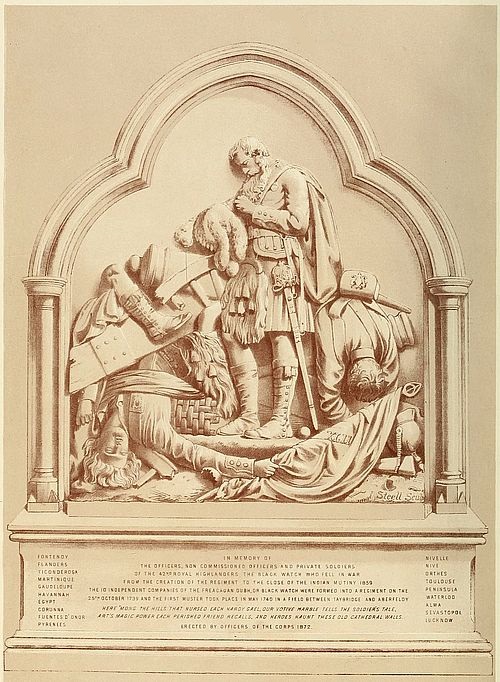
MONUMENT IN DUNKELD CATHEDRAL.
On either side of the above inscription are recorded the names of the hard-fought fields in which the regiment gained its enviable reputation. How many memories are recalled as one reads the long roll of historic battle-grounds—“Fontenoy, Flanders, Ticonderoga, Martinique, Guadaloupe, Havannah, Egypt, Corunna, Fuentes D’Onor, Pyrenees, Nivelle, Nive, Orthes, Toulouse, Peninsula, Waterloo, Alma, Sebastopol, Lucknow!” The selection of a site for the monument was determined by considerations connected with the history of the regiment. The gallant 42d having been originally drawn chiefly from Perthshire, it was felt to be appropriate that the memorial intended to commemorate its fallen heroes should be erected in that county; and all will concur in the propriety of the arrangement by which a shrine has been found for it within the venerable Cathedral of Dunkeld.
For the following account of the ceremony we are indebted to the Scotsman of 3d April 1872:—
A detachment of the 42d, under the command of Major Macpherson, had been sent down from Devonport to perform the ceremony of handing over the monument to the custody of the Duke of Athole, and also to place over it the colours under which the regiment had fought on many a bloody field. In the vestibule of the cathedral were the Duke and Duchess of Athole, the Duchess Dowager of Athole, and many other distinguished persons.
Upon entering the vestibule, Major Macpherson, younger of Cluny, placed the old colours of the regiment over the monument. He then requested the Duchess-Dowager to unveil the monument; which having been done,
Major Macpherson said—May it please your Grace, ladies, and gentlemen—We, a detachment of the 42d Royal Highlanders, have come here to deposit the old colours of the regiment in Dunkeld Cathedral—a place which has been selected by the regiment as the most fitting receptacle for the colours of the 42d—a regiment which has been essentially connected with Perthshire. In the name of the officers of the regiment, I have to express to his Grace the Duke of Athole our kindest thanks for the great interest he has taken in this memorial, which I have had the too great honour to ask the Duchess-Dowager to unveil; and if I may be allowed, I would express to your Grace the kindest thanks of the regiment for the great interest the late Duke of Athole took in this monument.
The Duke of Athole then said—You have this day paid a great compliment to the county of Perth, and to this district in particular. By the placing of this beautiful monument in our cathedral you have enhanced its value, and by placing over it your time and battle-worn colours. I can assure you we shall value the possession of this monument excessively, and do our utmost to preserve it from all harm. I trust that the cloud which is now hanging over the connection between the 42d and Perthshire will yet be dispelled, and that the old ties may not be broken, and that we may yet see the ‘Freiceadan Dubh’ localised in Perth.[363] I need not allude to the services of the 42d—they are far too well known to require comment on my part. One of the earliest colonels of the regiment was one of my own family—Lord John Murray; and at different times a great many men from Athole have served in your ranks. Members of almost every large family in Athole have at one time or other been officers in the corps. Many relatives and friends of my own have likewise served with the regiment. His Grace concluded by asking Major Macpherson to convey to the officers of the 42d the thanks of the county of Perth for the honour they had done to the county.
At the close of the proceedings a salute of 21 guns was fired from a battery placed on Stanley Hill.
After the ceremony the Duchess-Dowager entertained a select party at her residence to lunch. The detachment of the 42d and the Athole Highlanders at the same time partook of dinner in the Servants’ Hall. When the dinner had been concluded, the Duchess-Dowager, the Duke and Duchess of Athole, and party, entered the Servants’ Hall, where the Dowager-Duchess proposed the health of the 42d, a detachment of which regiment had come such a long distance in order to place their beautiful colours in the Cathedral of Dunkeld. Her Grace having made a touching allusion to the various battles in which the colours had been borne, remarked that there was no better place where the regiment could lodge them than the old historical cathedral of the city where the corps was chiefly raised. The colours had been given in charge to the Athole Highlanders, and she was sure that they would be as proud to look upon them hanging on the walls of the Cathedral as the 42d themselves would be to see them in the midst of battle, and she might assure the detachment that the utmost care would be taken of them.
Major Macpherson returned thanks on behalf of the officers and men of the 42d. He stated that the officers had taken a vote as to where the colours should be lodged, and the majority were in favour of having them placed over this monument in Dunkeld Cathedral, on the banks of the Tay, where the regiment was originally formed. He begged, on behalf of the officers and men, to thank her Grace for the exceedingly kind reception which had been accorded to them during their stay in Dunkeld, and concluded by calling upon the men to drink to the health of the Duchess-Dowager of Athole. The original colours of the 42d are in the Tower of London.
The colours placed in Dunkeld Cathedral were carried through the Crimean campaign and the Indian Mutiny. The colours which the regiment presently possesses were presented by the Commander-in-Chief at Aldershot in 1871.
In the autumnal manœuvres of 1871, the Black Watch, as might be surmised, performed their part brilliantly, and to the satisfaction and gratification of all present, the foreign officers especially awarding them the palm as models in every respect of what soldiers ought to be; indeed, their praises were in the mouths of all.
In September 1871 the regiment went to Devonport; and when, in February 1873, in accordance with the scheme for the establishment of military centres, the 42d were allocated to Perth in conjunction with the 79th, we believe both corps felt the greatest gratification, as they had stood “shoulder to shoulder” in many a hard-fought field, always indeed in the same brigade—in Egypt, the Peninsula, Waterloo, the Crimea, and last of all in the Indian Mutiny.
We cannot help expressing our gratification at being able to present our readers with a group of authentic steel portraits of four of the most eminent Colonels of the Black Watch. That of the first Colonel, John, Earl of Crawford, is from the original in the possession of the Earl of Crawford and Balcarres, at Haigh Hall, Wigan. The Earl is represented in a Russian or Hungarian dress. That of Sir George Murray, so long and intimately associated with the regiment, is from an original painting by H. W. Pickersgill, R.A. The portrait of Sir John Macdonald, his successor, is taken from the original in possession of Mrs Burt, Edinburgh: And that of the present brave and much respected Colonel, Sir Duncan Alexander Cameron, from a photograph taken expressly for this work; and Sir Duncan’s modest reluctance, we ought to say, to allow his portrait to be published, was not easily overcome.
Here may we fitly end the story of the brave Black Watch, which nearly a century and a half ago was originated not far from Perth by the chivalry of the North. In these later days of rapid advance in military science, when the blind enthusiasm of our forefathers is spoken lightly of, have the highest military authorities come to the conclusion, after much discussion and cogitation, that it is wise after all to give way occasionally to sentiment; and thus have they been led to assign to the old Black Watch, after a glorious but chequered career, a permanent recruiting home in the country of its birth, not many miles from the spot where it was first embodied.
SUCCESSION LISTS OF COLONELS, FIELD AND STAFF OFFICERS, &c.
COLONELS.
John, Earl of Crawford, 25th October 1739.
Hugh Lord Sempill, 14th January 1741.
Lord John Murray, 25th April 1745.
Sir Hector Munro, K.B., 1st June 1787.
George, Marquis of Huntly, 3d January 1806.
John, Earl of Hopetoun, G.C.B., 29th January 1820.
The Right Hon. Sir George Murray, G.C.B., G.C.H., 6th September 1823.
Removed to the First, or the Royal Regiment of Foot, on the 29th December 1843.
Sir John Macdonald, K.C.B., 15th January 1844.
Died 28th March 1850.
Sir James Douglas, K.C.B., 10th April 1850.
Died 6th March 1862.
George, Marquis of Tweeddale, K.T., 7th March 1862.
Removed to 2d Life Guards 9th September 1863.
Major General Sir Duncan Alexander Cameron, K.C.B., 9th September 1863.
Sir Duncan Alexander Cameron, K.C.B., joined the Regiment in 1825 as Ensign, and has never served in any other.—He was appointed Brigadier in
Turkey, (local rank) on the24th October 1854.
Major-General, (local)5th October 1855.
Major-General, (local) in England,24th July 1856.
Major-General,25th March 1859.
Colonel of the 42d,9th Sept. 1863.
Lieutenant-General,1st May 1868.
He served throughout the Eastern campaign of 1854–1855; commanded the regiment at the battle of Alma, and the Highland Brigade at the battle of Balaklava, on the expedition to Kertch—Siege and fall of Sebastopol and assault on the outworks 18th June—Was appointed president of the Council of Education in 1857—Commander-in-chief in Scotland in 1860—Commander of the forces in New Zealand, with the local rank of Lieut.-General 1861, and of the Australian Colonies and New Zealand in 1863—Governor of The Royal Military College at Sandhurst in 1865, which he still holds (1873).
LIEUTENANT-COLONELS.
Sir Robert Munro, 25th October 1739.
Promoted to Colonelcy Ponsonby’s Regiment, 17th June 1745.
John Monroe, 17th July 1745.
Died in 1749.
John Campbell, 24th May 1749.
Promoted to Colonelcy of 56th Foot, 23d December 1755.
Francis Grant, 17th December 1755.
Promoted to be Colonel-Commandant of 90th Regiment, 19th February 1762.
Gordon Graham, 9th July 1762.
Retired 12th December 1770.
Thomas Græme, 12th December 1770.
Retired 7th September 1771.
Thomas Stirling, 7th September 1771.
Promoted to 71st Regiment, 13th February 1782.
Norman Macleod, 21st March 1780.
Removed to 73d in 1786, which regiment was formed from second battalion of the 42d Regiment.
Charles Graham, 28th April 1782.
Promoted to a regiment serving in the West Indies, 30th November 1796.
William Dickson, 1st September 1795.
Retired 3d March 1808.
James Stewart, 14th December 1796.
Retired 19th September 1804.
James Stirling, 7th September 1804.
Promoted to rank of Major-General, 4th June 1814.
Robert Lord Blantyre, 19th September 1804.
Exchanged to half-pay, late Eighth Garrison Battalion, 6th May 1813.
John Farquharson, 3d March 1808.
Retired 16th April 1812.
Robert Macara, 16th April 1812.
Killed in action, 16th June 1815.
Sir George Leith, Bart, 6th May 1813.
Placed on Half-pay, 25th December 1814.
Robert Henry Dick, 18th June 1815.
Exchanged to Half-pay, 25th November 1828.
Honourable Sir Charles Gordon, 25th November 1828.
William Middleton, 23d October 1835.
George Johnstone, 23d August 1839.
Henry Earl of Uxbridge, 5th September 1843.
Duncan Alexander Cameron, 5th September 1843.
James Macdougall, 14th April 1846.
Charles Dunsmure, 15th February 1850.
Thomas Tulloch, 9th March 1855.
Alexander Cameron, 9th October 1855.
George Edward Thorold, 28th July 1857.
Frederick Green Wilkinson, 5th March 1858.
Edward Ramsden Priestley, 10th August 1858.
John Chetham M’Leod, 26th March 1868.
The Lieut.-Colonels from 1815 are also included in the general alphabetical list.
MAJORS.
George Grant, 25th October 1739.
Died in 1742.
James Colquhoun, 24th June 1742.
Retired in 1745.
Francis Grant, 1st October 1745.
Promoted December 17, 1755.
Duncan Campbell, 17th December 1755.
Killed at Ticonderoga.
Gordon Graham, 17th July 1758.
Promoted July 9, 1762.
John Reid, 1st August 1759.
Exchanged to half-pay, February 10, 1770.
John M’Neil, 9th July 1762.
Died in 1762.
Allan Campbell, 15th August 1762.
Placed on half-pay on the reduction of the regiment, March 18, 1763.
John Murray, 10th February 1770.
Retired March 31, 1770.
Thomas Græme, 31st March 1770.
Promoted December 12, 1770.
Thomas Stirling, 12th December 1770.
Promoted September 7, 1771.
William Murray, 7th September 1771.
Promoted to Twenty-seventh Regiment, October 5, 1777.
William Grant, 5th October 1777.
Retired August 25, 1778.
Charles Graham, 25th August 1778.
Promoted April 28, 1782.
Patrick Graham, 21st March 1780.
Died October 22, 1781.
Walter Home, 28th April 1782.
Retired March 16, 1791.
John Campbell, 23d October 1781.
Died March 23, 1784.
Hay Macdowall, 24th March 1784.
Removed in 1786 to Seventy-third, which corps was formed from second battalion Forty-second Regiment.
George Dalrymple, 16th March 1791.
Promoted to Nineteenth Foot, December 31, 1794.
William Dickson, 14th January 1795.
Promoted September 1, 1795.
Robert Pigot Christie, 1st September 1795.
Died June 23, 1796.
William Munro, 2d September 1795.
Promoted to Caithness Legion Fencibles, October 21, 1795.
James Stewart, 21st October 1795.
Promoted December 14, 1796.
Alexander Stewart, 24th June 1796.
Retired September 7, 1804.
James Stirling, 14th December 1796.
Promoted September 7, 1804.
John Farquharson, 9th July 1803.
Promoted March 3, 1808.
Archibald Argyll Campbell, 9th July 1803.
Died in February 1809.
Charles Macquarie, 7th September 1804.
Retired May 2, 1811.
James Grant, 7th September 1804.
Retired November 14, 1805.
Robert Macara, 14th November 1805.
Promoted April 16, 1812.
Thomas Johnston, 3d March 1808.
Exchanged to half-pay, Bradshaw’s Levy, July 14, 1808.
Robert Henry Dick, 14th July 1808.
Promoted June 18, 1815.
Hamilton Rose, 9th February 1809.
Died in October 1811.
William Munro, 2d May 1811.
Exchanged to half-pay, Royal Regiment of Malta, May 30, 1811.
William Cowell, 30th May 1811.
Retired April 8, 1826.
Maxwell Grant, 10th October 1811.
Placed on half-pay, December 25, 1814.
Robert Anstruther, 16th April 1812.
Placed on half-pay, December 25, 1814.
Archibald Menzies, 18th June 1815.
James Brander, 8th April 1826.
William Middleton, 15th August 1826.
John Malcolm, 25th December 1828.
Hugh Andrew Fraser, 3d December 1829.
George Johnstone, 4th May 1832.
James Macdougall, 23d October 1835.
Duncan Alexander Cameron, 23d August 1839.
Charles Dunsmure, 5th September 1843.
Daniel Frazer, 14th April 1846.
George Burell Cumberland, 15th February 1850.
Thomas Tulloch, 20th May 1853.
John Cameron Macpherson, 29th December 1854.
The Honourable Robert Rollo, 5th January 1855.
Alexander Cameron, 24th April 1855.
Charles Murray, 10th August 1855.
Frederick Green Wilkinson, 9th October 1855.
Andrew Pitcairn, 12th September 1856.
Edward Ramsden Priestley, 17th July 1857.
John Chetham M’Leod, 16th March 1858.
John Drysdale, 10th August 1858.
Duncan Macpherson, 5th July 1865.
Francis Cunningham Scott, 26th March 1868.
The Majors from 1815 are also included in the alphabetical list.
PAYMASTERS.
John Home, 21st March 1800—the first appointment of that rank to the Regiment.
Alexander Aitken, 25th December 1818.
Charles Wardell, 22d February 1821.
Stephen Blake, 3d July 1828.
William A. M’Dougall, 23d August 1833.
John Wheatley, 12th October 1838.
James A. Bazalgette, 24th April 1855.
Frank Samwell, 15th Dec. 1869.
ADJUTANTS.
Gilbert Stewart, 25th October 1739.
Lieut. James Grant, 26th June 1751.
“ Alexander Donaldson, 20th March 1759.
“ John Gregor, 27th August 1760.
“ William Gregor, 22d October 1761.
“ Duncan Cameron, 6th October 1762.
“ John M’Intosh, 1st November 1768.
“ Hugh Fraser, 20th March 1776.
“ Robert Leslie, (2d Battalion), 21st March 1780.
“ John Farquharson, 6th April 1791.
“ John Fraser, 5th October 1795.
“ Simon Fraser, 21st March 1800.
“ James Walker, 5th April 1801.
“ Archibald Menzies, 9th July 1803.
“ James Hunter, 28th September 1804.
“ James Swanson, 6th June 1805.
“ John Innes (Killed at Orthes), 8th December 1808.
“ James White, 8th June 1809.
“ Colin M’Dougall, 13th February 1812.
Lieutenant James Young, from 18th March 1814.
Lieutenant James Robertson, 14th September 1815.
Ensign (from Sergeant Major) William Duff, 14th April 1825.
Lieutenant William Dick Macfarlane, 16th July 1829.
Ensign (from Acting Sergeant-Major) John Wheatley, 20th July 1832.
Ensign Duncan Cameron, 30th October 1838.
Lieut. Atholl Wentworth Macdonald, 8th May 1840.
Lieut. Archibald Colin Campbell, 31st March 1843.
Lieut. Thomas Robert Drummond Hay, 24th January 1845.
Lieutenant Andrew Pitcairn, 28th August 1846.
Lieut. William John Cunninghame, 9th March 1849.
Ensign John Drysdale, 25th June 1852.
Ensign (from Quarter-Master) William Wood, 16th February 1855.
Lieutenant James Edmund Christie, 4th May 1863.
Andrew Gilbert Wauchope, 5th April 1870.
The Adjutants from 1814 are also included in the alphabetical list.
QUARTERMASTERS FROM 1795.
David Rawlins, 5th October 1795.
Donald M’Intosh, 9th July 1803.
Finlay King, from Sergt. Major, 31st December 1818.
Edward Patou, from Quarter-Master Sergt., 19th June 1840.
Charles Fraser, from Ensign, 28th August 1846.
William Wood, from Sergeant-Major, 5th May 1854.
Alexander M’Gregor, from Quarter-Master Sergeant, 25th May 1855.
John Simpson, V.C. from Quarter-Master Sergeant, 7th October 1859.
All, with the exception of the first, are included in the general alphabetical list.
SUCCESSION OF SURGEONS FROM 1800.
Alexander Grant, 26th September 1795.
Swinton Macleod, 9th July 1803.
Brinsley Nicholson, M.D., 15th November 1829.
James Paterson, M.D. 19th June 1835.
James M’Gregor, 26th February 1841.
John Gillespie Wood, M.D. 12th March 1852.
John Sheldon Furlong, M.D. 9th February 1855.
James Edmund Clutterbuck, M.D. 14th June 1864.
All, with the exception of the first, are included in the general alphabetical list.
SUCCESSION OF SERGEANT-MAJORS.
Sergeant-Major James, was killed in action at Toulouse, 10th April 1814.
Sergeant-Major Perie, was killed in action at Quatre Bras (Waterloo), on the 16th June 1815.
Finlay King, 16th June 1815, to Quarter-Master, 1818.
William Duff, 31st December 1818, to Adjutant, 1825.
John Macdonald, 14th April 1825. Discharged to pension, 10th December 1834. Died the following year.
John Wheatley, appointed Acting, on the 15th November 1827; at the regiment (the Sergeant-Major being at the Depot), to Adjutant, 1832.
Thomas Penny, acting with service companies, from 20th July 1832—Sergeant-Major, 11th December 1834. Discharged to Pension 1839. Died at Glasgow 15th February 1865.
Charles Fraser, 12th December 1839, to Ensign, 1843.
Alexander Geddes, appointed to Reserve Battalion 1st April 1843. Discharged to Pension 22d October 1851—appointed Quarter-Master of the Perth Militia 22d November 1856.
John Drysdale, 5th September 1843, to Ensign, 1847.
James Ranken, 22d June 1847. Discharged to Pension 10th November 1853. Quarter-Master Argyll Militia 14th April 1869.
William Wood, 11th November 1853, to Quarter-Master, 1854.
John Wilson, 5th May 1854, to Ensign, 1854.
William Lawson, 10th August 1854, to Ensign, 1854.
John Granger, 18th January 1855, to Lieutenant Land Transport Corps, 1855.
Peter White, 7th September 1855. Discharged to Pension 25th July 1865.
John Forbes, 26th July 1865.
The Sergeant-Majors who were promoted to be Officers are included in the general alphabetical list.
LIST OF OFFICERS
Who have served in the 42d Royal Highlanders, “The Black Watch,” from the date of the Muster taken at Armagh on the 28th of May 1817, the day of marching in from Glasgow, for the period ended on the 24th of May up to the 31st of December 1872.[364] From Lieut.-Colonel Wheatley’s MS.
Abercromby, Samuel Douglas, Lieut.—3d June 1842, Ensign. Died at Bermuda 16th May 1847.
Ainslie, Montague, Ensign, 20th May 1843. Died at Gosport, 18th Oct. 1853.
Aitken, Alex., Paymaster, 25th Dec. 1818.—Half-pay 7th February 1821. Died at Brighton, 13th May 1871.
Aitken, Walker, Lieut.—3d Dec. 1861, Ensign—Lieut. 19th Dec. 1865.
Alexander, Sir James Edward, Major-General.—9th March 1832, Captain—Half-Pay 24th April 1838.
Allan, Fife, Ensign 23d Sept. 1855. Retired 12th Dec. 1856.
Baird, William, Bt.-Major.—17th Nov. 1854, Ensign—Captain 22d May 1857—Bt.-Major 5th July 1872.
Balfour, James William, Captain.—2nd March 1847, Ensign. On Reduction to 89th, Lieut. Retired Captain from 7th Dragoon Guards 16th June 1857.
Balguy, Charles Yelverton.—24th Feb. 1854, Captain from 41st. Retired 24th April 1855.
Barnett, John Osborne, Lieut.—16th Nov. 1841, Ensign. Retired 12th Nov. 1847.
Bayly, Richard Kerr, Captain.—16th Mar. 1855, Ensign—Captain 5th July 1865.
Bazalgette, James Arnold.—24th April 1855, Paymaster.—Half-pay—1869.
Beales, William, Lieut.-Colonel.—24th April 1838, Captain—To Half-Pay 30th August 1844, Captain. Died at St Heliers, Jersey, on retired full pay, 23d April 1868.
Bedingfield, William.—9th Dec. 1862, Ensign from 58th Regiment—To 7th Hussars, Cornet, 22d Nov. 1864.
Bennett, William Henry.—27th May 1853, Lieut. from 30th Regiment. Retired 11th May 1855.
Berwick, William Alex., Lieut.—17th Feb. 1869, Ensign from 16th Foot.—Lieut. 28th Oct. 1871.
Bethune, Alex, (of Blebo), Lieut.—20th May 1842, Ensign. Retired 2d March 1847.
Black, Wilsone, Major.—11th August 1854, Ensign—Half-pay on reduction, 9th Jan. 1857—To 6th Foot 17th Nov. 1857—Brevet-Major 14th April 1873.
Blake, Stephen, Paymaster.—3d July 1828, Paymaster—Exchanged to 7th Fusiliers 23d Aug. 1833. Died Paymaster of the 93d at Dublin, 5th Oct. 1848.
Borrowes, Peter Robert.—2d Sept. 1845, Lieut, from 13th Foot. Retired 16th June 1848. Died in Dublin 1854.
Bosworth, Percie Mackie, Lieut.—23d March 1855, Ensign—Lieut. 2d Oct. 1855. Died at Nynee, India, 19th June 1858.
Boyle, Robert, Captain.—5th April 1806, Ensign—Half-Pay 31st May 1821. Died in London 11th July 1821.
Bramly, Alfred Jennings, Lieut.—15th March 1855, Ensign—Lieut. 2d Oct. 1855. Killed in action at Rooyah, India, 15th April 1858.
Bramly, Henry Jennings, Lieut.—30th Dec. 1859, Ensign. Retired Lieut. 3d March 1865. Died at Tunbridge Wells 19th Feb. 1870.
Brander, James, Major.—14th Dec. 1809, Ensign—To Half-pay, Lieut.-Colonel, 15th Aug. 1826. Died at Pitgaveny House, Elgin, 23d March 1854.
Brereton, Robert, Captain.—8th Dec. 1825, Captain, to Half-pay 9th March 1832. Retired 12th May 1842.—Dead.
Brickenden, Richard H. Lambert, Lieut.—18th July 1865, Ensign—Lieut. 11th Jan. 1867.
Brooke, Henry, Ensign.—5th Aug. 1859. Retired 9th Dec. 1862.
Brophy, N. Winsland, Lieut.—30th Jan. 1866, Ensign from 6th Regiment—Lieut. 17th March 1869.
Cameron, Alexander, Lieut.-Colonel.—24th Feb. 1832, Ensign. Died Lieut.-Colonel Commanding at Bareilly, India, 9th Aug. 1858.
Cameron, Duncan (of Inverailort), Lieut.—23d Oct. 1835, Ensign. Retired 8th May 1840.
Cameron, Sir Duncan Alexander, Lieut.-General.—8th April 1825, Ensign—In the Regiment until promoted to Major-General in 1855—Colonel of the Regiment 9th Sept. 1863.
Cameron, Wm. Gordon, C.B., Colonel.—24th May 1844, Ensign—To Grenadier Guards, Lieut. 12th May 1847—4th Foot, Major, 23d Oct. 1857—Lieut.-Colonel 1st April 1873.
Campbell, Archibald (of Glendaruel), Captain.—26th Nov. 1825, Ensign. Retired Captain 6th March 1840.
Campbell, Arch. Colin (Renton), Brevet-Major.—24th Feb. 1837, Ensign. Retired Captain and Brevet-Major 7th Sept. 1855. Died at Mordington House, Berwickshire, 23d Nov. 1866.
Campbell, Colin (Southhall family), Lieut.—8th April 1826, Ensign. Retired Lieut. 27th Sept. 1839. Died at Auchan, Isle of Man, 10th Oct. 1859.
Campbell, Colin George (of Stonefield), Lieut.—31st Dec. 1829, Ensign. Retired Lieut. 24th April 1838.
Campbell, Farquhard (of Aros), Captain.—30th Nov. 1838, Ensign. Retired Captain 26th Oct. 1849.
Campbell, George Frederick, Lieut.—11th Jan. 1867, Ensign—Lieut. 25th March 1871, to 51st Regiment 31st Oct. 1871.
Campbell, John, Colonel.—3d Dec. 1807, Captain from 35th—Half-pay Major and Brevet Lieut.-Colonel 22d April 1826. Died at Marseilles, 31st March 1841.
Campbell, John Charles, M. B.—29th March 1861, Assistant-Surgeon, from 4th Hussars—To Half-pay 2d July 1861.
Campbell, John Gordon, Captain.—17th Nov. 1848. Ensign. Retired 9th May 1856. Died at Peebles 30th Nov. 1865.
Campbell, Patrick, Captain.—24th Aug. 1815, Ensign—To Half-pay 3d Sept. 1829. Died at Ford near Dalkeith, 24th Feb. 1856.
Ceely, Arthur James, Lieut.—10th Aug. 1855, Ensign—Lieut. 20th June 1858. Died at Point de Galle, Ceylon, Sick from India, 29th Dec. 1866.
Chawner, Edward Hoare, Captain.—9th June 1825, Ensign—Exchanged to 4th Dragoon Guards, Lieut.—Half-pay, Captain, 7th Sept. 1832. Died 23d Nov. 1868.
Childers, William, Captain.—5th June 1826, Captain. Retired 14th Sept. 1832. Died at St Heliers, Jersey, 28th Feb. 1861.
Chisholm, Arch. Macra, Captain.—17th April 1842, Ensign. Retired Captain 6th April 1855.
Chisholm, Donald, Captain.—10th Oct. 1805, Lieut. from 30th—To 4th Veteran Battalion, Captain, 24th Feb. 1820. Died at Portobello, Edinburgh, 21st Aug. 1853.
Christie, James Edmund, Captain.—10th Aug. 1855, Ensign—Captain, Half-pay 1st April 1870.
Clark, James, Ensign.—26th Aug. 1819, Ensign—To Half-Pay 2d Sept. 1824. Died 12th Dec. 1838.
Clarke, Alfred T. Stafford, M.D. 8th Aug. 1862, Assistant-Surgeon, from Staff—To Royal Artillery, 20th Sept. 1864.
Clarke, Charles Christopher, Lieut.—2d Aug. 1815, Ensign—To Half-Pay 1st Nov. 1827. Died in the 33d Regiment in Jamaica, 23d Sept. 1831.
Clavering, Ernest, F.G. Lieut.—15th April 1842, Ensign. Retired 6th July 1849. Died in Edinburgh 9th Aug. 1852.
Clutterbuck, James Edward, M.D.—14th June 1864, Surgeon from Staff—Surgeon-Major, 22d Dec. 1868.
Cockburn, George William, Captain.—23d Feb. 1855, Ensign—Captain 24th March 1863—Exchanged to 83d, 28th Jan. 1870. Retired 30th Nov. 1870.
Cockburn, Thomas Hugh, Lieut.-Colonel.—6th March 1840, Ensign—Exchanged Captain to 43d—Half-Pay Major 29th May 1863. Retired with rank of Lieut.-Colonel 18th April 1865.
Coleridge, Francis George, Captain.—11th Jan. 1856. Ensign—Lieut. in 25th 13th Dec. 1859. Retired as Captain 28th June 1871.
Colquhoun, Alan John, Lieut.—15th Oct. 1861.—Ensign, from Cornet 16th Lancers—Lieut. 13th Nov. 1865. Retired 23d Jan. 1869.
Cooper, Egbert William, Captain.—From 2d West India Regiment, 30th July 1869.
Coveny, Robert Charles, Lieut.—2d Sept. 1862, Ensign—from 23d Regiment, Lieut. 30th Jan. 1866.
Cowell, William, Major from H. P., and Brevet Lieut.-Colonel—30th May 1811, Major. Retired 8th April 1826. Died at Portarlington, Ireland, 29th May 1847.
Creagh, A. Michael. Lieut.—16th April 1861, Ensign from 58th—Lieut. 3d March 1865.
Crompton, William Henry, (Now Crompton-Stansfield), Lieut.-Colonel.—17th Aug. 1854, Ensign—To Half-Pay Captain on reduction 7th Nov. 1856—11th Foot 9th Jan. 1858—Lieut.-Colonel, 22d July 1871.
Crosse, Robert Legh, 18th June 1861, Ensign.—To 52d, 3d Dec. 1861.
Cumberland, George Bentinck Macleod, Lieut.—22d Nov. 1864, Ensign—Lieut. 29th Dec. 1866.
Cumberland, George Barrel, Major.—28th May 1829, Lieut. Retired Major 5th Jan. 1855. Died at Wolvers Dean, Andover, 22d May 1865.
Cumming, Alex. Ensign.—17th July 1814, Ensign—To Half-Pay, 26th Aug. 1819. Died Jan. 1853.
Cunninghame, Robert Campbell, Captain.—29th Aug. 1846, Ensign. Sent from the Crimea. Died at Malta, 5th Sept. 1855.
Cunninghame, William John, Lieut.—25th Oct. 1844, Ensign. Died at Halifax on sick leave from Bermuda, 21st June 1850.
Daniel, John Hinton—22d May 1846, Captain from 49th. Retired 23d July 1852. Died in London 8th May 1863.
Davidson, Wm. Alex., M.D., Surgeon.—28th March 1854, Assistant Surgeon—To 1st Royal Dragoons 31st July 1855.
Dawson, Charles, M.D.—9th Oct. 1840, Assistant-Surgeon—To Surgeon into the 54th, 9th Oct. 1846. Died at Antigua, West Indies, 13th Nov. 1849.
Dempster, James, M.D., Surgeon.—14th April 1825, Assistant Surgeon—To 94th Surgeon 27th Sept. 1827.
Dick, Sir Robert Henry, Major-General,—22d Nov. 1800, Ensign—Half-Pay Colonel, 25th Nov. 1828—Killed in action at Sobraon, 10th Feb. 1846.
Douglas, Arthur Henry Johnstone—27th Nov. 1866, Ensign. Retired 23d July 1869.
Douglas, Charles.—23d March 1855, Lieutenant from Canadian Rifles. Died of wounds at Rooyah, India, 17th April 1858.
Douglas, Henry Sholto, Captain.—31st May 1839, Ensign. Retired Captain 17th Nov. 1838.
Douglas, Sir James, General.—10th April 1850, Colonel. Died at Clifton, 6th March 1862.
Douglas, William, Lieut.—1st Nov. 1827, Lieut.—Retired 20th July 1832.—Dead.
Drake, John Allat, 18th July 1865, Lieut.—from Bengal Staff Corps. Retired 9th Nov. 1866.
Drummond, Henry Maurice, Colonel, (now Drummond Hay) of Seggieden.—4th Dec. 1832, Ensign.—Retired Captain, 8th June 1852.—Lieut.-Colonel, Royal Perth Rifles, 5th Nov. 1855. Retired with the rank of Colonel, 21st Nov. 1870.
Drummond, Malcolm, (Viscount Forth), 4th Nov. 1853, Ensign. Retired 17th Nov. 1854. Died at Gloucester 8th Oct. 1861.
Drysdale, John, Brevet Lieut.-Colonel.—Joined the Regiment 28th June 1836—Ensign from Sergeant-Major, 22d June 1847—Major 10th Aug. 1858.—Brevet Lieut.-Colonel on the day that he died, viz, 4th July 1865, at Uphall, near Edinburgh, on sick leave from India.
Duff, William, Lieut.—Joined the Regiment 16th Aug. 1806—Ensign and Adjutant from Sergeant-Major 14th April 1825.—To Half-pay 16th July 1829. Died at Ayr 8th Oct. 1833.
Dunbar, Alex., Lieut.—25th July 1807, Ensign,—To Half-pay 3d March 1825. Died at Inverness, 15th Feb. 1832.
Dunbar, Sir Frederick Wm., Bart.—24th April 1838, Ensign. Retired 10th Jan. 1840. Died Dec. 1841
Dunbar, Rothes Lennox, Captain.—13th May 1854, Ensign. Retired Captain 7th Sept. 1856. Died in London, 31st Jan. 1857.
Dunsmure, Charles, Lieut.-Colonel.—9th April 1825, Ensign—Reduced Lieut.-Colonel 1st April 1850, with the Reserve Battalion. Retired 8th June 1852.
Dundas, Charles Whitely Dean, Lieut.—25th Dec. 1828, Ensign—To Coldstream Guards, 3d Aug. 1830. Retired 21st April 1837. Died at Edinburgh, 11th April 1856.
Eden, Charles John, Lieut.—20th Oct. 1865, Ensign from the 30th—Lieut. 23d March 1867.
Elgin, Edward Arthur, Lieut.—from 17th Foot, 10th July 1860. Died at Agra, 28th July 1861.
Fairlie, William, Lieut.—22d June 1815, Ensign—Half-pay 10th Sept. 1819. Died 18th May 1824.
Farquharson, Francis Edward Henry, V.C. Captain.—19th Jan. 1855, Ensign—Captain 28th June 1862.
Feilden, Henry Wemys, Lieut.—1st Feb. 1856, Ensign. Retired Lieut. 27th Sept. 1861.
Ferguson, Adam, Captain.—18th Aug. 1854, Ensign.—Captain 1st May 1857. Died in India, 11th Sept. 1865.
Fergusson, James Muir (of Middlehaugh). Lieut.—9th Nov. 1826, Ensign. Retired Lieut. 29th May 1839. Died at Perth, 20th May 1867.
Fletcher, Duncan Downie—2d April 1851, Ensign. Retired 6th May 1853. Died at Killarney, 20th May 1855.
Foley, H.R. Stanhope, Lieut.—14th June 1864, Ensign—Lieut. 9th Nov. 1866. Retired 16th March 1869.
Fraser, Alex., Captain.—26th May 1803, Ensign—Half-Pay 8th Dec. 1825. Died in Edinburgh, 24th June 1835.
Fraser, Charles, Captain.—Joined the Regiment 21st April 1813—From Sergeant-Major, Ensign 5th Sept. 1843—Quarter-Master, 28th Aug. 1846—Reduced with Reserve Battalion, 1st April 1850, appointed to 49th—To Half-Pay with the rank of Captain.—30th June 1854.
Fraser, George, Captain.—6th July 1849, Ensign. Died in India, Captain 27th June 1862.