DICTIONARY OF ISLĀM. (continued 9)
Reading edition
Sūratu ʾr-Raʿd. Chapter xiii. 13.
(Given at al-Madīnah.)
“It is He who maketh the lightning to appear unto you, [causing] fear and hope of rain, and formeth the pregnant clouds.
“And the thunder proclaimeth His perfection with His praise; and [likewise] the angels, in fear of Him. And He sendeth the thunderbolts, and striketh with them whom He pleaseth, whilst they dispute concerning God; for He is mighty in power.”
Sūratu ʾn-Nisāʾ. Chapter iv. 51.
(Given at al-Madīnah.)
“Verily God will not forgive the associating with Him [any other being as a god], but will forgive other sins unto whom He pleaseth; and whoso associateth [another] with God hath wrought a great wickedness.”
The following is an interpretation of the Muslim belief in the existence and nature of God, by the famous scholastic divine, the Imām al-G͟hazzālī, in his book entitled al-Maqṣadu ʾl-asnā, an extract from which Ockley has translated from Pocock’s Specimen Historiæ Arabum:—
“Praise be to God the Creator and Restorer of all things; who does whatsoever He pleases, who is master of the glorious throne and mighty force, and directs His sincere servants into the right way and the straight path; who favoureth them, who have once borne testimony to the unity, by preserving their confessions from the darkness of doubt and hesitation; who directs them to follow His chosen apostle, upon whom be the blessing and peace of God; and to go after His most honourable companions, to whom he hath vouchsafed His assistance and direction which is revealed to them in His essence and operations by the excellencies of His attributes, to the knowledge whereof no man attains but he that hath been taught by hearing. To these, as touching His essence, He maketh known that He is one, and hath no partner; singular, without anything like Him; uniform, having no contrary; separate, having no equal. He is ancient, having no first; eternal, having no beginning; remaining for ever, having no end; continuing to eternity, without any termination. He persists, without ceasing to be; remains without failing, and never did cease, nor ever shall cease to be described by glorious attributes, nor is subject to any decree so as to be determined by any precise limits or set times, but is the First and the Last, and is within and without.
“(What God is not.) He, glorified be His name, is not a body endued with form, nor a substance circumscribed with limits or determined by measure; neither does He resemble bodies, as they are capable of being measured or divided. Neither is He a substance, neither do substances exist in Him; neither is He an accident, nor do accidents exist in Him. Neither is he like to anything that exists, neither is anything like to Him; nor is he determinate in quantity nor comprehended by bounds, nor circumscribed by the differences of situation, nor contained in the heavens. He sits upon the throne, after that manner which He Himself hath described, and in that same sense which He Himself means, which is a sitting far removed from any notion of contact, or resting upon, or local situation; but both the throne itself, and whatsoever is upon it, are sustained by the goodness of his power, and are subject to the grasp of His hand. But He is above the throne, and above all things, even to the utmost ends of the earth; but so above as at the same time not to be a whit nearer the throne and the heaven; since He is exalted by (infinite) degrees above the throne no less than He is exalted above the earth, and at the same time is near to everything that hath a being; nay, ‘nearer to man than their jugular veins, and is witness to everything’: though His nearness is not like the nearness of bodies, as neither is His essence like the essence of bodies. Neither doth He exist in anything, neither doth anything exist in Him; but He is too high to be contained in any place, and too holy to be determined by time; for He was before time and place were created, and is now after the same manner as He always was. He is also distinct from the creatures by His attributes, neither is there anything besides Himself in His essence, nor is His essence in any other besides Him. He is too holy to be subject to change, or any local motion; neither do any accidents dwell in Him, nor any contingencies befall Him; but He abides through all generations with His glorious attributes, free from all danger of dissolution. As to the attribute of perfection, He wants no addition of His perfection. As to being, He is known to exist by the apprehension of the understanding; and He is seen as He is by an ocular intuition, which will be vouchsafed out of His mercy and grace to the holy in the eternal mansion, completing their joy by the vision of His glorious presence.
“(His power.) He, praised be His name, is living, powerful, mighty, omnipotent, not liable to any defect or impotence; neither slumbering nor sleeping, nor being obnoxious to decay or death. To Him belongs the kingdom, and the power, and the might. His is the dominion, and the excellency, and the creation, and the command thereof. The heavens are folded up in His right hand, and all creatures are couched within His grasp. His excellency consists in His creating and producing, and His unity in communicating existence and a beginning of being. He created men and their works, and measured out their maintenance and their determined times. Nothing that is possible can escape His grasp, nor can the vicissitudes of things elude his power. The effects of his might are innumerable, and the objects of his knowledge infinite.
“(His knowledge.) He, praised be His name, knows all things that can be understood, and comprehends whatsoever comes to pass, from the extremities of the earth to the highest heavens. Even the weight of a pismire could not escape Him either in earth or heaven; but He would perceive the creeping of the black pismire in the dark night upon the hard stone, and discern the motion of an atom in the open air. He knows what is secret and conceals it, and views the conceptions of the minds, and the motions of the thoughts, and the inmost recesses of secrets, by a knowledge ancient and eternal, that never ceased to be His attribute from eternal eternity, and not by any new knowledge, superadded to His essence, either inhering or adventitious.
“(His will.) He, praised be His name, doth will those things to be that are, and disposes of all accidents. Nothing passes in the empire, nor the kingdom, neither little nor much, nor small nor great, nor good nor evil, nor profitable nor hurtful, nor faith nor infidelity, nor knowledge nor ignorance, nor prosperity nor adversity, nor increase nor decrease, nor obedience nor rebellion, but by His determinate counsel and decree, and His definite sentence and will. Nor doth the wink of him that seeth, nor the subtlety of him that thinketh, exceed the bounds of His will; but it is He who gave all things their beginning; He is the creator and restorer, the sole operator of what He pleases; there is no reversing His decree nor delaying what He hath determined, nor is there any refuge to man from his rebellion against Him, but only His help and mercy; nor hath any man any power to perform any duty towards Him, but through His love and will. Though men, genii, angels and devils, should conspire together either to put one single atom in motion, or cause it to cease its motion, without His will and approbation, they would not be able to do it. His will subsists in His essence amongst the rest of His attributes, and was from eternity one of His eternal attributes, by which He willed from eternity the existence of those things that He had decreed, which were produced in their proper seasons according to His eternal will, without any before or after, and in agreement both with His knowledge and will, and not by methodising of thoughts, nor waiting for a proper time, for which reason no one thing is in Him a hindrance from another.
“(His hearing and sight.) And He, praised be His name, is hearing and seeing, and heareth and seeth. No audible object, how still soever, escapeth His hearing; nor is any thing visible so small as to escape his sight; for distance is no hindrance to His hearing, nor darkness to His sight. He sees without pupil or eye-lid, and hears without any passage or ear, even as He knoweth without a heart, and performs His actions without the assistance of any corporeal limb, and creates without any instrument, for His attributes (or properties) are not like those of men, any more than His essence is like theirs.
“(His word.) Furthermore, He doth speak, command, forbid, promise, and threaten by an eternal, ancient word, subsisting in His essence. Neither is it like to the word of the creatures, nor doth it consist in a voice arising from the commotion of the air and the collision of bodies, nor letters which are separated by the joining together of the lips or the motion of the tongue. The Qurʾān, the Law, the Gospel, and the Psalter, are books sent down by Him to His apostles, and the Qurʾān, indeed, is read with tongues, written in books, and kept in hearts: yet as subsisting in the essence of God, it doth not become liable to separation and division whilst it is transferred into the hearts and the papers. Thus Moses also heard the Word of God without voice or letter, even as the saints behold the essence of God without substance or accident. And since these are His attributes, He liveth and knoweth, is powerful and willeth and operateth, and seeth and speaketh, by life and knowledge, and will and hearing, and sight and word, not by His simple essence.
“(His works.) He, praised be His name, exists after such a manner that nothing besides Him hath any being but what is produced by His operation, and floweth from His justice after the best, most excellent, most perfect, and most just model. He is, moreover, wise in His works, and just in His decrees. But His justice is not to be compared with the justice of men. For a man may be supposed to act unjustly by invading the possession of another; but no injustice can be conceived by God, inasmuch as there is nothing that belongs to any other besides Himself, so that wrong is not imputable to Him as meddling with things not appertaining to Him. All things, Himself only excepted, genii, men, the devil, angels, heaven, earth, animals, plants, substance, accident, intelligible, sensible, were all created originally by Him. He created them by His power out of mere privation, and brought them into light, when as yet they were nothing at all, but He alone existing from eternity, neither was there any other with Him. Now He created all things in the beginning for the manifestation of His power, and His will, and the confirmation of His word, which was true from all eternity. Not that He stood in need of them, nor wanted them; but He manifestly declared His glory in creating and producing, and commanding, without being under any obligation, nor out of necessity. Loving kindness, the showing favour and grace, and beneficence, belong to Him; whereas it is in His power to pour forth upon men a variety of torments, and afflict them with various kinds of sorrows and diseases, which, if He were to do, His justice could not be arraigned, nor would He be chargeable with injustice. Yet He rewards those that worship Him for their obedience on account of his promise and beneficence, not of their merit nor of necessity, since there is nothing which He can be tied to perform; nor can any injustice be supposed in Him, nor can He be under any obligation to any person whatsoever. That His creatures, however, should be bound to serve Him, ariseth from His having declared by the tongues of the prophets that it was due to Him from them. The worship of Him is not simply the dictate of the understanding, but He sent messengers to carry to men His commands, and promises, and threats, whose veracity He proved by manifest miracles, whereby men are obliged to give credit to them in those things that they relate.”
Included in the attributes of God as given in His ninety-nine titles or names, there are the Haft ṣifāt, or Seven Attributes; Muḥammad al-Barqawī has expressed them as follows:—
(1) Ḥayāt, or Life. God Most High is alone to be adored. He has neither associate nor equal. He is free from the imperfections of humanity. He is neither begotten nor does He beget. He is invisible. He is without figure, form, colour or parts. His existence has neither beginning nor end. He is immutable. If He so wills, He can annihilate the world in a moment of time and, if it seem good to Him, recreate it in an instant. Nothing is difficult to Him, whether it be the creation of a fly or that of the seven heavens. He receives neither profit nor loss from whatever may happen. If all the Infidels became believers and all the irreligious pious, He would gain no advantage. On the other hand, if all Believers became infidels, He would suffer no loss.
(2) ʿIlm, or Knowledge. He has knowledge of all things hidden or manifest, whether in heaven or on earth. He knows the number of the leaves of the trees, of the grains of wheat and of sand. Events past and future are known to Him. He knows what enters into the heart of man and what he utters with his mouth. He alone, except those to whom He has revealed them, knows the invisible things. He is free from forgetfulness, negligence and error. His knowledge is eternal: it is not posterior to His essence.
(3) Qudrah, or Power. He is Almighty. If He wills, He can raise the dead, make stones talk, trees walk, annihilate the heavens and the earth, and recreate of gold or of silver thousands similar to those destroyed. He can transport a man in a moment of time from the east to the west, or from the west to the east, or to the seventh heaven. His power is eternal a priori and a posteriori. It is not posterior to His essence.
(4) Irādah, or Will. He can do what He wills, and whatever He wills comes to pass. He is not obliged to act. Everything, good or evil, in this world exists by His will. He wills the faith of the believer and the piety of the religious. If He were to change His will there would be neither a true believer nor a pious man. He willeth also the unbelief of the unbeliever and the irreligion of the wicked and, without that will, there would neither be unbelief nor irreligion. All we do we do by His will: what He willeth not does not come to pass. If one should ask why God does not will that all men should believe, we answer: “We have no right to enquire about what God wills and does. He is perfectly free to will and to do what He pleases.” In creating unbelievers, in willing that they should remain in that state; in making serpents, scorpions and pigs: in willing, in short, all that is evil, God has wise ends in view which it is not necessary that we should know. We must acknowledge that the will of God is eternal and that it is not posterior to His essence.
(5) Samʿ, or Hearing. He hears all sounds whether low or loud. He hears without an ear, for His attributes are not like those of men.
(6) Baṣar, or Seeing. He sees all things, even the steps of a black ant on a black stone in a dark night; yet He has no eye as men have.
(7) Kalām, or Speech. He speaks, but not with a tongue as men do. He speaks to some of His servants without the intervention of another, even as He spoke to Moses, and to Muḥammad on the night of the ascension to heaven. He speaks to others by the instrumentality of Gabriel, and this is the usual way in which He communicates His will to the prophets. It follows from this that the Qurʾān is the word of God, and is eternal and uncreated. (Sale’s Faith of Islam.)
With regard to the Muḥammadan belief in the Supreme Being, Mr. Palgrave, the well-known Oriental traveller, thus expresses himself:—
“ ‘There is no god but God,’ are words simply tantamount in English to the negation of any deity save one alone; and thus much they certainly mean in Arabic, but they imply much more also. Their full sense is, not only to deny absolutely and unreservedly all plurality, whether of nature or of person, in the Supreme Being, not only to establish the unity of the Unbegetting and Unbegot, in all its simple and uncommunicable Oneness; but besides this, the words in Arabic and among Arabs imply that this one Supreme Being is also the only Agent, the only Force, the only Act existing throughout the universe, and leave to all beings else, matter or spirit, instinct or intelligence, physical or moral, nothing but pure unconditional passiveness, alike in movement or in quiescence, in action or in capacity. The sole power, the sole motor, movement, energy, and deed, is God; the rest is downright inertia and mere instrumentality, from the highest archangel down to the simplest atom of creation. Hence, in this one sentence, is summed up a system which, for want of a better name, I may be permitted to call the Pantheism of Force, or of Act, thus exclusively assigned to God, Who absorbs it all, exercises it all, and to Whom alone it can be ascribed, whether for preserving or for destroying, for relative evil or for equally relative good. I say ‘relative,’ because it is clear that in such a theology no place is left for absolute good or evil, reason or extravagance, all is abridged in the autocratical will of the One great Agent: ‘sic volo, sic jubeo, stet pro ratione voluntas’; or, more significantly still, in Arabic Kema yeshao (ka-mā yashāʾu), ‘as He wills it,’ to quote the constantly recurring expression of the Coran.
“Thus immeasureably and eternally exalted above, and dissimilar from, all creatures, which lie levelled before Him on one common plane of instrumentality and inertness, God is One in the totality of omnipotent and omnipresent action, which acknowledges no rule, standard, or limit, save His own sole and absolute will. He communicates nothing to His creatures, for their seeming power and act ever remain His alone, and in return He receives nothing from them; for whatever they may be, that they are in Him, by Him, and from Him only. And, secondly, no superiority, no distinction, no pre-eminence, can be lawfully claimed by one creature over its fellow, in the utter equalisation of their unexceptional servitude and abasement; all are alike tools of the one solitary Force which employs them to crush or to benefit, to truth or to error, to honour or shame, to happiness or misery, quite independently of their individual fitness, deserts, or advantage, and simply because ‘He wills it,’ and ‘as He wills it.’
“One might at first sight think that this tremendous Autocrat, this uncontrolled and unsympathising Power, would be far above anything like passions, desires, or inclinations. Yet such is not the case, for He has with respect to His creatures one main feeling and source of action, namely, jealousy of them, lest they should perchance attribute to themselves something of what is His alone, and thus encroach on His all-engrossing kingdom. Hence He is ever more prone to punish than to reward, to inflict pain than to bestow pleasure, to ruin than to build. It is His singular satisfaction to let created beings continually feel that they are nothing else than His slaves, His tools, and contemptible tools also, that thus they may the better acknowledge His superiority, and know His power to be above their power, His cunning above their cunning, His will above their will, His pride above their pride; or rather, that there is no power, cunning, will, or pride, save His own.
“But He Himself, sterile in His inaccessible height, neither loving nor enjoying aught save His own and self-measured decree, without son, companion, or counsellor, is no less barren of Himself than for His creatures, and His own barrenness and lone egoism in Himself is the cause and rule of His indifferent and unregarding despotism around. The first note is the key of the whole tune, and the primal idea of God runs through and modifies the whole system and creed that centres in Him.
“That the notion here given of the Deity, monstrous and blasphemous as it may appear, is exactly and literally that which the Coran conveys or intends to convey, I at present take for granted. But that it indeed is so, no one who has attentively perused and thought over the Arabic text (for mere cursory reading, especially in a translation, will not suffice), can hesitate to allow. In fact, every phrase of the preceding sentences, every touch in this odious portrait, has been taken, to the best of my ability, word for word, or at least meaning for meaning, from the ‘Book,’ the truest mirror of the mind and scope of its writer.
“And that such was in reality Mahomet’s mind and idea, is fully confirmed by the witness-tongue of contemporary tradition. Of this we have many authentic samples: the Saheeh (Ṣaḥīḥ), the Commentary of Beydāwi (al-Baiẓāwī), the Mishkat ul Masabih, and fifty similar works, afford ample testimony on this point. But for the benefit of my readers in general, all of whom may not have drunk equally deep at the fountain-heads of Islamic dogma, I will subjoin a specimen, known perhaps to many Orientalists, yet too characteristic to be here omitted, a repetition of which I have endured times out of number from admiring and approving Wahhābīs in Nejed.
“ ‘Accordingly, when God’—so runs the tradition: I had better said, the blasphemy—‘resolved to create the human race, He took into His hands a mass of earth, the same whence all mankind were to be formed, and in which they after a manner pre-existed; and having then divided the clod into two equal portions, He threw the one half into hell, saying, “These to eternal fire, and I care not”; and projected the other half into heaven, adding, “and these to Paradise, I care not.” ’ (See Mishkātu ʾl-Maṣābīḥ, Bābu ʾl-Qadr.)
“Commentary would here be superfluous. But in this we have before us the adequate idea of predestination, or, to give it a truer name, pre-damnation, held and taught in the school of the Coran. Paradise and hell are at once totally independent of love or hatred on the part of the Deity, and of merits or demerits, of good or evil conduct, on the part of the creature; and, in the corresponding theory, rightly so, since the very actions which we call good or ill-deserving, right or wrong, wicked or virtuous, are in their essence all one and of one, and accordingly merit neither praise nor blame, punishment nor recompense, except and simply after the arbitrary value which the all-regulating will of the great despot may choose to assign or impute to them. In a word, He burns one individual through all eternity amid red-hot chains and seas of molten fire, and seats another in the plenary enjoyment of an everlasting brothel between forty celestial concubines, just and equally for His own good pleasure, and because He wills it.
“Men are thus all on one common level, here and hereafter, in their physical, social, and moral light—the level of slaves to one sole Master, of tools to one universal Agent. But the equalising process does not stop here: beasts, birds, fishes, insects, all participate of the same honour or debasement; all are, like man, the slaves of God, the tools and automata of His will; and hence Mahomet is simply logical and self-consistent when in the Coran he informs his followers, that birds, beasts, and the rest are ‘nations’ like themselves, nor does any intrinsic distinction exist between them and the human species, except what accidental diversity the ‘King, the Proud One, the Mighty, the Giant,’ &c., as he styles his God, may have been pleased to make, just as He willed it, and so long as He may will it.
“However, should any one think himself aggrieved by such association, he may console himself by reflecting that, on the other hand, angels, archangels, genii, devils, and whatever other spiritual beings may exist, are no less on his level also; and that if he himself be no better than a camel, he is, however, no worse than Gabriel or any seraph. And then, over all and above all, ‘There is no god but God.’ ”—(Central and Eastern Arabia, vol. i. p. 365.)
GOG AND MAGOG. Arabic Yājūj wa Mājūj, also spelt Maʾjūj wa Yaʾjūj (ياجوج و ماجوج). A barbarous people of Central Asia, perhaps the Turkomans, who are in the Qurʾān represented as doing evil in the land in the days of Ẕū ʾl-Qarnain (or Alexander). See Sūrah xviii. 93–97:—
“They said, ‘O Ẕū ʾl-Qarnain! verily Gog and Magog waste this land; shall we then pay thee tribute, so thou build a rampart between us and them?’
“He said, ‘Better than your tribute is the might wherewith my Lord hath strengthened me; but help me strenuously, and I will set a barrier between you and them.
“ ‘Bring me blocks of iron,’—until when it filled the space between the mountain sides—‘Ply,’ said he, ‘your bellows,’—until when he had made it red with heat (fire), he said,—‘Bring me molten brass that I may pour upon it.’
“And Gog and Magog were not able to scale it, neither were they able to dig through it.
“ ‘This,’ said he, ‘is a mercy from my Lord.’ ”
They are also spoken of in Sūrah xxi. 95, 96, as a people who shall appear in the last days:—
“There is a ban on every city which we shall have destroyed, that they shall not arise again,
“Until a way is opened for Gog and Magog, and they shall hasten from every high land.”
Al-Baiẓāwī says Yājūj and Mājūj are two tribes descended from Japheth the son of Noah, and some say Yājūj belong to the Turks and Mājūj to the Jīls. (Comp. Ezekiel xxxviii. 2; xxxix. 1; Rev. xvi. 14; xx. 8.)
GOLD. Arabic ẕahab (ذهب); Heb. זהב. The zakāt imposed upon gold is upon twenty mis̤qāls one-half mis̤qāl, and upon every four mis̤qāls in excess, one qīrāt̤, because the alms upon gold is one fortieth of the whole. This is due upon all gold, whether it be in coin or in ornaments. But ash-Shāfiʿī says it is not due upon the ornaments of women or the rings of men. (Hidāyah, vol. i. p. 27.)
The sale of gold is only lawful when it is exactly equal in point of weight, for Muḥammad said, “Sell gold for gold, from hand to hand, at an equal rate according to weight, for any inequality in point of weight is usury.” (Idem, vol. ii. 552.)
“It is not lawful for a man or woman to eat or drink out of gold or silver vessels.” (Idem, vol. vi. 86.)
GOLIATH. Arabic Jālūt (جالوت). The giant whom King David slew. Mentioned in the Qurʾān, Sūrah ii. 251: “And when they went forth to battle against Jālūt and his army, they said, ‘O Lord, give us patience, and strengthen our feet, and help us against the infidels!’ Therefore they discomfited them by the will of God, and David slew Jālūt.”
The commentators have not ventured to give any account of Jālūt.
GOMORRAH. Arabic G͟hamūrah (غمورة). Not mentioned by name in the Qurʾān; but Sadūm wa G͟hamūrah are understood to be the “overturned cities” referred to in Sūrahs ix. 71, lxix. 9.
GOOD WORKS. Arabic aṣ-Ṣāliḥāt (الـصـالحات). According to the teaching of the Qurʾān, good works without faith will not save from the torments of hell.
Sūrah xviii. 103–5: “Shall we tell you who are they that have lost their labour most; whose efforts in the present life have been mistaken, and who deemed that what they did was right? They are those who believed not in the signs of the Lord, or that they should ever meet Him. Vain, therefore, are their works; and no weight will we allow them on the day of Resurrection.”
Faith in the above is belief in the mission of Muḥammad: all Muslims being considered in a state of grace, no matter what their actions may be. With reference to the good deeds of Muslims, the following is the teaching of Muḥammad, as recorded in the Traditions (Mishkāt, book x. chap. iii.):—
“When a man is brought to Islām and he performs it well, God covers all his former sins, and he gets ten rewards for every good act, up to seven hundred, and even more than that, whereas the reward of misdeeds is as one to one, unless God passes that over likewise.”
“There are three persons whose actions are not written; one a person asleep until he awakes; the second, a boy not arrived at puberty; the third, a madman until he recovers his reason.”
“Verily, God recordeth both the good deeds and the evil deeds. He who has proposed to do evil and did not do it, for him God recordeth one perfectly good deed. And he who intended to do good and put his intentions into practice, for him God recordeth from ten to seven hundred good deeds (according to their merits). And he who intended to do evil but did it not, God recordeth one good act; but he who intendeth to do evil and doeth it, for him God recordeth one evil deed.”
“Verily, the condition of that person who does evil and after that good deeds, is like the condition of a man with tight armour on, which has troubled him. He does one good deed and the rings of the armour become open. He does another good deed, and the armour falls from his body.”
“Verily there was a man amongst those who were before you to whom the angel of death came to take his soul, and he was asked ‘Have you done any good act?’ He said in answer, ‘I do not remember that I have done any good.’ It was said to him, ‘Look well into yourself, and consider if you have done any good work.’ He said, ‘I do not find any good in myself, except that I used to buy and sell in the world and used to claim my right from the rich, but allowed them their leisure to pay me when they liked, and I forgave the poor.’ Then God brought that man into paradise.”
“An adulteress was forgiven, who passed by a dog at a well, and the dog was holding out his tongue from thirst, which was near killing him. The woman drew off her boot and tied it to the end of her veil, and drew water for the dog, and gave him to drink, and she was forgiven on account of that act. It was asked the Prophet, ‘Verily, are there rewards for our doing good to quadrupeds, and giving them water to drink?’ He said, ‘There are rewards for benefiting every animal having a moist liver.’ ”
“Your smiling in your brother’s face is alms; and your exhorting mankind to virtuous deeds is alms; and your prohibiting the forbidden is alms; and your showing men the road when they lose it is alms; and your assisting the blind is alms; and your removing stones, thorns, and bones, which are inconvenient to man is alms; and your pouring water from your bucket into that of your brother is alms for you.”
GOSHAH-NISHĪN (گوشه نشين). Lit. “One who sits in a corner.” A Persian term for a devout person who in retirement engages in the contemplation of the Deity.
GOSPEL. Arabic Injīl (انجيل). A term applied to the whole of the New Testament scriptures. [NEW TESTAMENT.]
GRAMMAR. [ILMU ʾL-ADAB.]
GRANDFATHER. Arabic jadd (جد). If a father die without appointing an executor, the grandfather represents the father. And in making contracts of marriage, the grandfather has precedence of an executor, although the executor takes precedence in managing the property. (Hidāyah, vol. iv. p. 555.) In case of the father being poor, it is the duty of the grandfather to act for his grandchild in the distribution of alms, &c. (Idem, vol. ii. p. 244.)
GRANDMOTHER. Arabic jaddah (جدة). If the mother of an infant die, the right ḥiẓānah, or guardianship, rests with the maternal grandmother in preference to the paternal; but if she be not living, the paternal grandmother has the right prior to any other relation. The paternal grandmother is also entitled to a sixth of the effects of a child of her son, if the child’s mother be dead, as being the mother’s share. (Hidāyah, vol. i. p. 386.)
GRAVE. Arabic qabr (قبر); Heb. קבר. The graves of Muḥammadans are so dug as to allow the body to lie with its face towards Makkah; consequently in India they are dug from north to south. It is usual to dig a grave the depth equal to the height of the breast of a middle-sized man, and to make a recess at the bottom, which is called laḥd, in which the body is placed. The body having been placed in this recess, it is closed with unburnt bricks, and the grave is filled with earth and a mound raised over it.
The Traditions of Muḥammad, as well as the works of Muslim doctors, all teach that a dead body is conscious of pain, and therefore great care is taken to prevent any pressure upon the body.
ʿĀmir relates that his father Saʿd ibn Abī Waqqāṣ said on his death-bed, “Make a laḥd for me towards Makkah, and put unburnt bricks upon my grave, as was done in the case of the Prophet” (Ṣaḥīḥu Muslim, p. 211).
Sufyān at-Tammār relates that he “saw the Prophet’s grave, and the top of it was like a camel’s back.” (Ṣaḥīḥu ʾl-Buk͟hārī.)
Ibn ʿAbbās says “a red cloth was placed upon the Prophet’s grave.” (Mishkāt, book v. c. vi.)
Jābir says “the Prophet prohibited building with mortar on graves, and also placing inscriptions upon them.” (Mishkāt, book v. c. vi.) But notwithstanding this tradition (which is acted upon by the Wahhābīs), masonry tombs are most common in all parts of Islām, and form some of the most striking specimens of Muḥammadan architecture. [TOMBS.]
GRAVE, The Punishments of the. [ʿAZABU ʾL-QABR.]
GREEKS. Arabic ar-Rūm (الروم), by which is meant the Byzantine or Eastern Empire. In the XXXth chapter of the Qurʾān, entitled the Sūratu ʾr-Rūm, or the “Chapter of the Greeks,” there is a reference to the defeat of the Byzantine power by the Persians with a supposed prophecy of future successes. The chapter begins thus:—
“Alif. Lām. Mīm. THE GREEKS have been defeated
“In a land hard by: But after their defeat they shall defeat their foes,
“In a few years. First and last is the affair with God. And on that day shall the faithful rejoice
“In the aid of their God: He aideth whom He will; and He is the Mighty, the Merciful.
“It is the promise of God: To his promise God will not be untrue: but most men know it not.”
Following al-Baiẓāwī, the Jalālān, and other commentators, Sale remarks that—
The accomplishment of the prophecy contained in this passage, which is very famous among the Muḥammadans, being insisted on by their doctors as a convincing proof that the Qurʾān really came down from heaven, it may be excusable to be a little particular.
The passage is said to have been revealed on occasion of a great victory obtained by the Persians over the Greeks, the news whereof coming to Makkah, the infidels became strangely elated, and began to abuse Muḥammad and his followers, imagining that this success of the Persians, who, like themselves, were idolators, and supposed to have no scriptures, against the Christians, who pretended as well as Muḥammad to worship one God, and to have divine scriptures, was an earnest of their own future successes against the Prophet, and those of his religion, to check which vain hopes it was foretold in the words of the text, that how improbable soever it might seem, yet the scale should be turned in a few years, and the vanquished Greeks prevail as remarkably against the Persians. That this prophecy was exactly fulfilled, the commentators fail not to observe, though they do not exactly agree in the accounts they give of its accomplishment, the number of years between the two actions being not precisely determined. Some place the victory gained by the Persians in the fifth year before the Hijrah, and their defeat by the Greeks in the second year after it, when the battle of Badr was fought; others place the former in the third or fourth year before the Hijrah, and the latter in the end of the sixth or beginning of the seventh year after it, when the expedition of al-Ḥudaibiyah was undertaken. The date of the victory gained by the Greeks in the first of these accounts, interferes with a story which the commentators tell, of a wager laid by Abū Bakr with Ubaiy ibn K͟half, who turned this prophecy into ridicule. Abū Bakr at first laid ten young camels that the Persians should receive an overthrow within three years, but on his acquainting Muḥammad with what he had done, that Prophet told him that the word biʿẓ, made use of in this passage, signified no determinate number of years, but any number from three to nine (though some suppose the tenth year is included), and therefore advised him to prolong the time and to raise the wager, which he accordingly proposed to Ubaiy, and they agreed that the time assigned should be nine years and the wager a hundred camels. Before the time was elapsed, Ubaiy died of a wound received at Uḥud, in the third year of the Hijrah; but the event afterwards showing that Abū Bakr had won, he received the camels of Ubay’s heirs, and brought them in triumph to Muḥammad. History informs us that the successes of K͟hosrū Parviz, King of Persia, who carried on a terrible war against the Greek empire, to revenge the death of Maurice, his father-in-law, slain by Phocas, were very great, and continued in an uninterrupted course for two-and-twenty years. Particularly in the year of Christ 615, about the beginning of the sixth year before the Hijrah, the Persians, having the preceding year conquered Syria, made themselves masters of Palestine and took Jerusalem, which seems to be that signal advantage gained over the Greeks mentioned in this passage, as agreeing best with the terms here used, and most likely to alarm the Arabs by reason of their vicinity to the scene of action; and there was so little probability at that time of the Greeks being able to retrieve their losses, much less to distress the Persians, that in the following years the arms of the latter made still farther and more considerable progresses, and at length they laid siege to Constantinople itself. But in the year 625, in which the fourth year of the Hijrah began, about ten years after the taking of Jerusalem, the Greeks, when it was least expected, gained a remarkable victory over the Persians, and not only obliged them to quit the territories of the empire, by carrying the war into their own country, but drove them to the last extremity, and spoiled the capital city al-Madāyin; Heraclius enjoying thenceforward a continued series of good fortune, to the deposition and death of K͟hosrū. (Sale’s Koran, in loco.)
GROVE, The. Arabic Aikah (ايكة). The Aṣḥābu ʾl-Aikah, or “the people of the Grove,” are mentioned four times in the Qurʾān, Sūrahs xv. 78, xxvi. 176, xxviii. 21, l. 13, as being a tribe or class of people who treated the prophets as liars. The following particulars regarding them are given in Sūrah xxvi. 170:—
“The people of the grove of Madyan treated the Apostles as liars.
“When Shuʿaib their brother said to them, ‘Will ye not fear God?
“I truly am your trustworthy Apostle.
“Fear God, then, and obey me:
“No reward ask I of you for this: my reward is of the Lord of the Worlds alone.”
GUARDIANSHIP. Guardianship over a minor is of two kinds: wilāyah (ولاية), or guardianship of the property and education and marriage of the ward, and ḥiẓānah (حضانة), or guardianship over the rearing and bringing up of the child.
Guardians are either so by natural right or by testament, or by appointment by a judge.
The guardianship of a minor for the management and preservation of his property devolves first on his or her father, then on the father’s executor, next on the paternal grandfather, then on his executor, then on the executors of such executors, next on the ruling power or his representative, the Qāẓī, or judge. In default of a father, father’s father, and their executors, as above, all of whom are termed near guardians, it rests in the Qāẓī to appoint a guardian of an infant’s property. The other paternal kinsmen who are termed remote kindred, and the mother succeed, according to proximity, to the guardianship of an infant for the purpose of education and marriage; they have no right to be guardians of his property, unless appointed to be so by the ruling authority, or in the original proprietor’s will, proved by competent witnesses. The mother’s right of guardianship is, however, forfeited upon her being remarried to a stranger, but regained when she is divorced by him, and has again become a widow.
In default of the mother as well as of the paternal kindred of a minor, his maternal relations are, according to proximity, entitled to guardianship for the purposes of education and marriage, and not for the management of his property, unless so appointed in the late owner’s will or by the Qāẓī.
The general rule is that a guardian, executor, or anyone who has the care of the person and property of a minor, can enter into a contract which is or likely to be advantageous and not injurious to his ward.
A guardian may sell or purchase moveables on account of his ward, either for an equivalent or at such a rate as to occasion an inconsiderable loss, but not at such a rate as to make the loss great and apparent. (Hidāyah, vol. iv. p. 553.)
A guardian is allowed to borrow money for the support and education of his ward, even by pawning the minor’s property; the debt so contracted must be paid out of his (the minor’s) estate, or by him when he comes of age.
It is not lawful for a guardian to pledge into his own hands goods belonging to his ward on account of a debt due to him, or into the hands of his child being an infant, or into the hands of his slave being a merchant and free from debt. (Hidāyah, vol. iv. p. 214.)
A father can pawn the goods of his infant child into his own hands for a debt due from the child, or into the hands of another of his children being an infant.
A father may also pawn on account of his own debt the goods belonging to his minor son, who on coming of age will redeem the goods discharging the debt, and have a claim on the father for the sum.
The contract of pawn entered into by a father with respect to his minor child’s goods cannot be annulled by the minor, even if it were not for his own debt or for his own benefit.
The mother is, of all the persons, the best entitled to the custody (ḥiẓānah) of her infant child during marriage and after separation from her husband, unless she be an apostate, or wicked, or unworthy to be trusted. (Fatāwā-i-ʿĀlamgīrī, vol. i. p. 728.)
Next the mother’s mother how high soever is entitled to the custody (ḥiẓānah) of a child; failing her by death, or marriage to a stranger, the full sister is entitled; failing her by death or marriage to a stranger, the half-sister by the mother. On failure of her in the same way the daughter of the full sister, then the daughter of the half-sister by the mother. Next the maternal aunt in the same way, and then the paternal aunts also in like manner. (Fatāwā-i-ʿĀlamgīrī, vol. i. p. 728.)
An umm-i-walad (or a female slave who has borne a child to her master), when emancipated, obtains the right of taking her child. (Hidāyah, vol. i. p. 389.)
When it is necessary to remove a boy from the custody of women, or there is no woman of his own people to take charge of him, he is to be given up to his agnate male relatives (ʿaṣābah). Of these the father is the first, then the paternal grandfather, how high soever, then the full brother, then the half-brother by the father, then the son of the full brother, then the son of the half-brother by the father, then the full paternal uncle, then the half paternal uncle by the father, then the sons of paternal uncles in the same order. But though a boy may be given up to the son of his paternal uncle, a girl should not be entrusted to him.
No male has any right to the custody of a female child, but one who is within the prohibited degrees of relationship to her; and an ʿaṣābah who is profligate has no right to her custody. (Fatāwā-i-ʿĀlamgīrī, vol. i. p. 729.)
A female’s custody of a boy terminates when he is seven years old, and of a girl at her puberty.
Male custody of a boy continues till puberty, of a female not only till puberty, but till she can be safely left to herself and trusted to take care of herself.
When a female has neither father nor grandfather nor any of her ʿaṣābah to take charge of her, or the ʿaṣābah is profligate, it is the duty of the judge to take cognizance of her condition; and if she can be trusted to take care of herself, he should allow her to live alone, whether she be a virgin or a saiyidah, and if not, he should place her with some female amīn, or trustee, in whom he has confidence; for he is the superintendent of all Muslims. (Fatāwā-i-ʿĀlamgīrī, vol. i. p. 730.)
When a mother refuses to take charge of a child without hire, it may be committed to another.
A boy or girl having passed the period of ḥiẓānah, has no option to be with one parent in preference to the other, but must necessarily thenceforth remain in charge of the father. (Hidāyah, vol. i. p. 389.)
Before the completion of ʿiddah, or dissolution of marriage, the proper place of ḥiẓānah is that where the husband and wife live, and the former cannot take away the child out of the custody of the latter. After completion of her ʿiddah, and separation from her husband, a woman can take her child to the place of her nativity, provided the marriage had been contracted there, or it is so near from the place of separation or husband’s residence, that if the husband should leave the latter in the morning to visit the child, he can return to his residence before night. There is also no objection to her removing with the child from a village to the city or chief town of the district, the same being advantageous to the child, and in no respect injurious to the father. If the child’s mother be dead, and its ḥiẓānah or custody has passed to the maternal grandfather, she cannot remove the child to her own city, though the marriage had taken place there. Other women than the grandmother are like her in respect to the place of ḥiẓānah.
When an umm-i-walad has been emancipated, she has no right to take her child from the city in which the father is residing.
(Hidāyah, vol. i.; Fatāwā-i-ʿĀlamgīrī, vol. i.; Durru ʾl-Muk͟htār, p. 846; Jāmiʿu ʾr-Rumūz; Tagore Lectures, 1879; Baillie’s Digest, p. 430.)
GUEST. Arabic ẓaif (ضـيـف). [HOSPITALITY.]
GURZ (گرز). (1) The Persian word for the mit̤raqah, or iron mace, wherewith the infidel dead are smitten in their graves by the angels Munkar and Nakīr. [ʿAZABU ʾL-QABR.]
(2) An iron mace pointed at one end and having a knob at the other covered with spikes, and used by the Gurz Mār, or Rufaʿī faqīrs, for striking against their breasts in their devotional exercises. (Qānūn-i-Islām, p. 291.)
H.
HABĀʾ (هباء). “Dust,” especially the finer particles which fly about and are only conspicuous in the sun’s rays.
A term used by the Ṣūfī mystics for those portions of matter (hayūla) which God has distributed in creation. (ʿAbdu ʾr-Razzāq’s Dict. of Ṣūfī Terms.)
HABĪB AN-NAJJĀR (حبيب النجار). “Ḥabīb the Carpenter,” whose story is told in the Qurʾān (Sūrah xxxvi. 12), as follows:—
“Set forth to them the instance of the people of the city (i.e. of Antioch) when the Sent Ones came to it.
“When we sent two (i.e. John and Jude) unto them and they charged them both with imposture—therefore with a third (i.e. Simon Peter) we strengthened them: and they said, ‘Verily we are the Sent unto you of God.’
“They said, ‘Ye are only men like us: Nought hath the God of Mercy sent down. Ye do nothing but lie.’
“They said, ‘Our Lord knoweth that we are surely sent unto you;
“ ‘To proclaim a clear message is our only duty.’
“They said, ‘Of a truth we augur ill from you: if ye desist not we will surely stone you, and a grievous punishment will surely befall you from us.’
“They said, ‘Your augury of ill is with yourselves. Will ye be warned? Nay, ye are an erring people.’
“Then from the end of the city a man (i.e. Ḥabīb, the carpenter) came running: He said, ‘O my people! follow the Sent Ones;
“ ‘Follow those who ask not of you a recompence, and who are rightly guided.
“ ‘And why should I not worship Him who made me, and to whom ye shall be brought back?
“ ‘Shall I take gods beside Him? If the God of mercy be pleased to afflict me, their intercession will not avert from me aught, nor will they deliver:
“ ‘Truly then should I be in a manifest error.
“ ‘Verily, in your Lord have I believed; therefore hear me.’
“—It was said to him, ‘Enter thou into Paradise’ (i.e. after they had stoned him to death). And he said, ‘Oh that my people knew
“ ‘How gracious God hath been to me, and that He hath made me one of His honoured ones.’
“But no army sent we down out of heaven after his death, nor were we then sending down our angels—
“There was but one shout from Gabriel, and lo! they were extinct.
“Oh! the misery that rests upon my servants! No apostle cometh to them but they laugh him to scorn.”
Al-Baiẓāwī, the commentator, says the people of the City of Antioch were idolaters, and that Jesus sent two of his disciples, Yaḥyā and Yūnas (John and Jude) to preach to them. And when they arrived, they met Ḥabīb, the carpenter, to whom they made known their mission. Ḥabīb said, “What signs can ye show that ye are sent of God?” And the disciples replied, “We can heal the sick and give sight to those who are born blind, and cure the leprosy.” Then Ḥabīb brought his sick son to them, and they laid their hands upon him and he was healed. And Ḥabīb believed in Jesus, and he made known the gospel to the people of the city. Many of the people then came to the disciples and were also healed. The news then reached the ear of the governor of the city, and he sent for the two disciples and they preached to him. He replied, “Is your God different from our God?” They said, “Yes. He it is who made thee and thy gods.” The governor then sent them away and put them in prison. When they were in prison, Jesus sent Shamʿūn (Simon Peter), and he came secretly and made friends with the servants of the governor, and in time gained access to the governor’s presence, and performed a miracle in the presence of the governor by raising a child who had been dead seven days. The child when raised from the dead, said he had seen Jesus Christ in heaven, and that he had interceded for the three disciples in prison. The governor believed and many others with him. Those who did not believe raised a disturbance in the city, and Ḥabīb the carpenter exhorted them to believe. For this he was stoned, and, having died, entered into Paradise.
Ḥabīb’s tomb is still seen at Antioch, and is visited by Muḥammadans as a shrine.
HABĪL (هبيل). [ABEL.]
ḤABWAH (حبوة). The posture of sitting with the legs and thighs contracted towards the belly, the back bent forwards, and supported in that position by the arms crossed over the knees. Muslims are forbidden to sit in this posture during the recital of the K͟hut̤bah on Fridays (Mishkāt, book iv. p. 45, pt. 2) as it inclines to drowsiness.
ḤADAS̤. (حدث). State of an unclean person, of one who has not performed the usual ablutions before prayer.
ḤADD (حد), pl. ḥudūd. In its primitive sense ḥadd signifies “obstruction,” whence a porter or gate-keeper is called ḥaddād, or “obstructer,” from his office of prohibiting people from entering. In law it expresses the punishments, the limits of which have been defined by Muḥammad either in the Qurʾān or in the Ḥadīs̤. These punishments are (1) For adultery, stoning; (2) For fornication, a hundred stripes; (3) For the false accusation of a married person with adultery (or Qaẕf), eighty stripes; (4) For apostasy, death; (5) For drinking wine, eighty stripes; (6) For theft, the cutting off of the right hand; (7) For highway robbery: for simple robbery on the highway, the loss of hands and feet; for robbery with murder, death, either by the sword or by crucifixion. (Hidāyah, vol. ii. p. 1.) [PUNISHMENT.]
AL-ḤADĪD (الحديد). “Iron.” The title of the LVIIth Sūrah of the Qurʾān, in which the word occurs (verse 25): “We sent down iron in which are both keen violence and advantages to men.”
ḤĀDIS̤ (حادث). What happens for the first time; new, fresh. That which is born in time as opposed to qadīm, or that which is without a beginning, as God.
ḤADĪS̤ (حديث), pl. aḥādīs̤. [TRADITION.]
ḤADĪS̤ QUDSĪ (حديث قدسى). A divine saying. A term used for a ḥadīs̤ which relates a revelation from God in the language of the Prophet. An example is found in the Mishkāt (book i. c. i. pt. 1): “Abū Hurairah said, ‘The Prophet of God related these words of God, “The sons of Adam vex me, and abuse the age, whereas I am The AGE itself: In my hands are all events: I have made the day and night.” ’ ”
HADĪYAH (هدية). A present or offering made to persons of consequence, kings or rulers.
HADY (هدى). Cattle sacrificed at Makkah during the Pilgrimage, as distinguished from animals sacrificed on the Great Festival, which are called uẓḥīyah. These animals are branded and sent off with strings round their necks, as offerings to the sacred temple. They may be bullocks, or camels, or sheep, or goats. (Mishkāt, book xi. c. viii.)
ḤĀFIZ̤ (حافظ). Lit. “A guardian” or protector. (1) One of the names of God, al-Ḥāfiz̤. (2) A governor, e.g. Ḥāfiz̤u ʾl-Bait; the guardian of the Makkan temple. (3) One who has committed the whole of the Qurʾān to memory.
ʿUs̤mān relates that the Prophet said: “The best person amongst you is he who has learnt the Qurʾān and teaches it. (Mishkāt, book vii. c. i.) In the east it is usual for blind men to commit the Qurʾān to memory, and to thus obtain the honourable distinction of Ḥāfiz̤.
ḤAFṢAH (حفصة). One of Muḥammad’s wives. She was the daughter of ʿUmar, and the widow of K͟hunais, an early convert to Islām. She married Muḥammad about six months after her former husband’s death. During the lifetime of the Prophet she was a person of considerable influence in his counsels, being the daughter of ʿUmar. She survived Muḥammad some years, and has recorded several traditions of his sayings.
HAGAR. Arabic Hājar (هاجر). The slave wife of Abraham and the mother of Ishmael. Al-Baiẓāwī says that Hājar was the slave girl of Sarah, the wife of Abraham, and she admitted her to Abraham, and from her was born Ishmael. Sarah became jealous of Hājar (because she had a son), and she demanded of Abraham that he should put both the mother and child away, and he sent them away in the direction of Makkah, and at Makkah God produced for them the spring Zamzam [ZAMZAM]. When the tribe of Jurhum saw that there was water in that place, they said to Hājar, “If you will share with us the water of this spring, we will share with you the milk of our herds,” and from that time Makkah became a place of importance. (Tafsīru ʾl-Baiẓāwī, p. 424.)
HAIR. Arabic shaʿr, shaʿar (شعر). Heb. שֵׂעָר.
The sale of human hair is unlawful in the same manner as the use of it for any purpose is unlawful. Being a part of the human body, it is necessary to preserve it from disgrace, to which an exposure of it to sale necessarily subjects it. It is related in the traditions that God has cursed women who use false hair. (Hidāyah, vol. ii. p. 439.) [HEAD.]
ḤĀʾIT̤ĪYAH (حائطية). A sect of Muslims founded by Aḥmad ibn Ḥāʾit̤, who said there were two Gods, one whose existence is from eternity (qadīm), i.e. Allāh, and the other who is created in time (muḥaddas̤), i.e. al-Masīḥ (Christ), and that it is he who will judge the world in the last day. And he maintained that this is the meaning of the words which occur in the traditions: “God created man in his own image.” (Kitābu ʾl-Taʿrīfāt, in loco.)
ḤAIWĀN (حيوان). The animal creation; which is divided into ḥaiwān nāt̤iq, or rational beings; and ḥaiwān sākit, or irrational beings. [ANIMALS, BEINGS.]
AL-ḤAIY (الحى); Heb. חַי. “The Living One.” One of the ninety-nine attributes of God. The term frequently occurs in the Qurʾān.
ḤĀʾIẒAH (حائضة). A menstruous woman. [MENSTRUATION.]
HĀJAR (هاجر). [HAGAR.]
AL-ḤAJARU ʾL-ASWAD (الحجر الاسود). Lit. “The Black Stone.” The famous black stone which forms part of the sharp angle of the Kaʿbah in the temple at Makkah. Mr. Burkhardt says, “It is an irregular oval, about seven inches in diameter, with an undulating surface, composed of about a dozen smaller stones of different sizes and shapes, well joined together with a small quantity of cement, and perfectly well smoothed; it looks as if the whole had been broken into as many pieces by a violent blow, and then united again. It is very difficult to determine accurately the quality of this stone, which has been worn to its present surface by the millions of touches and kisses it has received. It appeared to me like a lava, containing several small extraneous particles of a whitish and of a yellow substance. Its colour is now a deep reddish brown approaching to black. It is surrounded on all sides by a border composed of a substance which I took to be a close cement of pitch and gravel of a similar, but not quite the same, brownish colour. This border serves to support its detached pieces; it is two or three inches in breadth, and rises a little above the surface of the stone. Both the border and the stone itself are encircled by a silver band, broader below than above, and on the two sides, with a considerable swelling below, as if a part of the stone were hidden under it. The lower part of the border is studded with silver nails.”
Captain Burton remarks, “The colour appeared to me black and metallic, and the centre of the stone was sunk about two inches below the metallic circle. Round the sides was a reddish brown cement, almost level with the metal, and sloping down to the middle of the stone. The band is now a massive arch of gold or silver gilt. I found the aperture in which the stone is, one span and three fingers broad.”
According to Ibn ʿAbbās, Muḥammad said the black stone came down from Paradise, and at the time of its descent it was whiter than milk, but that the sins of the children of Adam have caused it to be black, by their touching it. That on the Day of Resurrection, when it will have two eyes, by which it will see and know all those who touched it and kissed it, and when it will have a tongue to speak, it will give evidence in favour of those who touched and kissed it.
Maximus Tyrius, who wrote in the second century, says, “The Arabians pay homage to I know not what god, which they represent by a quadrangular stone,” alluding to the Kaʿbah or temple which contains the black stone. The Guebars or Ancient Persians, assert that the Black Stone was amongst the images and relics left by Mahabad and his successors in the Kaʿbah, and that it was an emblem of Saturn. It is probably an aërolite, and owes its reputation, like many others, to its fall from the sky. Its existence as an object of adoration in an iconoclastic religious system, can only be accounted for by Muḥammad’s attempt to conciliate the idolaters of Arabia.
A complete list of the falls of aërolites and meteoric stones through the atmosphere, is published in the Edinburgh Philosophical Journal, from a work by Chladni in German, in which the subject is ably and fully treated.
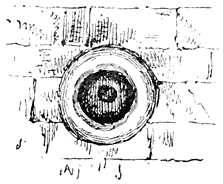
THE HAJARU ʾL-ASWAD. (Burton.)
ḤAJB (حجب). A legal term in the Muḥammadan law of inheritance, signifying the cutting off of an heir from his portion.
ḤĀJĪ (حاجى), also ḥājj. A person who has performed the ḥajj, or pilgrimage to Makkah. It is retained as a title of honour by those who have performed the pilgrimage, e.g. Ḥājī Qāsim, i.e. “Qāsim the Pilgrim.” [HAJJ.]
ḤAJJ (حج). Lit. “setting out,” “tending towards.” The pilgrimage to Makkah performed in the month of Ẕū ʾl-Ḥijjah, or the twelfth month of the Muḥammadan year. It is the fifth pillar of Muḥammadan practical religion, and an incumbent religious duty, founded upon express injunctions in the Qurʾān. According to Muḥammad it is a divine institution, and has the following authority in the Qurʾān for its due observance:—
(It is noticeable that all the verses in the Qurʾān with regard to the pilgrimage are in the later Sūrahs, when they are arranged in their chronological order.)
Sūrah xxii. 28:—
“And proclaim to the peoples a PILGRIMAGE (ḥajj). Let them come to thee on foot and on every fleet camel, arriving by every deep defile:
“That they may bear witness of its benefits to them, and may make mention of God’s name on the appointed days (i.e. the ten first days of Ẕū ʾl-Ḥijjah), over the brute beasts with which He hath supplied them for sustenance: Therefore eat thereof yourselves, and feed the needy, the poor:
“Then let them bring the neglect of their persons to a close, and let them pay their vows, and circuit the ancient House.
“This do. And he that respecteth the sacred ordinances of God, this will be best for him with his Lord.”
Sūrah ii. 153:—
“Verily, as-Ṣafā and al-Marwah are among the signs of God: whoever then maketh a pilgrimage (ḥajj) to the temple, or visiteth it, shall not be to blame if he go round about them both. And as for him who of his own accord doeth what is good—God is Grateful, Knowing.”
Idem, 192:—
“Accomplish the pilgrimage (ḥajj), and the visitation (ʿumrah) for God: and if ye be hemmed in by foes, send whatever sacrifice shall be the easiest, and shave not your heads until the offering reach the place of sacrifice. But whoever among you is sick or has an ailment of the head, must expiate by fasting, alms, or an offering.
“And when ye are safe from foes, he who contents himself with the visitation (ʿumrah) until the pilgrimage (ḥajj), shall bring whatever offering shall be the easiest. But he who findeth nothing to offer, shall fast three days in the pilgrimage itself, and seven days when ye return: they shall be ten days in all. This is binding on him whose family shall not be present at the sacred Mosque (al-Masjidu ʾl-ḥarām). And fear God, and know that God is terrible in punishing.
“Let the pilgrimage be made in the months already known (i.e. Shawwāl, Ẕū ʾl-Qaʿdah, and Ẕū ʾl-Ḥijjah): whoever therefore undertaketh the pilgrimage therein, let him not know a woman, nor transgress, nor wrangle in the pilgrimage. The good which ye do, God knoweth it. And provide for your journey; but the best provision is the fear of God: fear me, then, O men of understanding!
“It shall be no crime in you if ye seek an increase from your Lord (i.e. to trade); and when ye pass swiftly on from ʿArafāt, then remember God near the holy temple (al-Masjidu ʾl-ḥarām); and remember Him, because He hath guided you who before this were of those who went astray:
“Then pass on quickly where the people quickly pass (i.e. from ʿArafāt), and ask pardon of God, for God is Forgiving, Merciful.
“And when ye have finished your holy rites, remember God as ye remember your own fathers, or with a yet more intense remembrance! Some men there are who say, ‘O our Lord! give us our portion in this world:’ but such shall have no portion in the next life:
“And some say, ‘O our Lord! give us good in this world and good in the next, and keep us from the torment of the fire.’
“They shall have the lot which they have merited: and God is swift to reckon.
“Bear God in mind during the stated days: but if any haste away in two days (i.e. after the ḥajj), it shall be no fault in him: And if any tarry longer, it shall be no fault in him, if he fear God. Fear God, then, and know that to Him shall ye be gathered.”
Sūrah iii. 90:—
“The first temple that was founded for mankind, was that in Bakkah (i.e. Makkah)—Blessed, and a guidance to human beings.
“In it are evident signs, even the standing-place of Abraham (Maqāmu Ibrāhīm): and he who entereth it is safe. And the pilgrimage to the temple, is a service due to God from those who are able to journey thither.”
Sūrah v. 2:—
“O Believers! violate neither the rites of God, nor the sacred month, nor the offering, nor its ornaments, (i.e. on the necks of animals), nor those who press on to the sacred house (al-Baitu ʾl-Ḥarām), seeking favour from their Lord and his good pleasure in them.”
The performance of the pilgrimage is incumbent upon every Muslim, once in his lifetime, if he be an adult, free, sane, well in health, and has sufficient money for the expenses of the journey and for the support of his family during his absence.
If a woman perform the pilgrimage she must do it in company with her husband, or a near relative (maḥram). If she can obtain the protection of a near relative and has the necessary expenses for the journey, it is not lawful for her husband to prevent her performing the pilgrimage. This maḥram is a near relative whom it is not lawful for her to marry.
The Imām ash-Shāfiʿī denies the necessity of such attendance, stating that the Qurʾān makes no such restriction. His objection is, however, met by a Tradition. “A certain man came to the Prophet and said: ‘My wife is about to make the ḥajj, but I am called to go on a warlike expedition.’ The Prophet said: ‘Turn away from the war and accompany thy wife in the ḥajj.’ ”
For a lawful ḥajj there are three actions which are farẓ, and five which are wājib; all the rest are sunnah or mustaḥabb. The farẓ are: to wear no other garment except the iḥrām; to stand in ʿArafāt; to make the t̤awāf, or circuit round the Kaʿbah.
The wājib duties are: to stay in al-Muzdalifah; to run between Mount aṣ-Ṣafā and Mount al-Marwah; to perform the Ramyu ʾr-Rijām, or the casting of the pebbles; if the pilgrims are non-Meccans, to make an extra t̤awāf; to shave the head after the pilgrimage is over.
The ḥajj must be made at the appointed season. Sūrah ii. 193: “Let the pilgrimage be made in the months already known.” These months are Shawwāl, Ẕū ʾl-Qaʿdah, and the first ten days of Ẕū ʾl-Ḥijjah. The actual ḥajj must be in the month Ẕū ʾl-Ḥijjah, but the preparations for, and the nīyah, or intention of the ḥajj can be made in the two preceding months. The ʿumrah, or ordinary visitation [ʿUMRAH], can be done at any time of the year except on the ninth and four succeeding days of Ẕū ʾl-Ḥijjah. On each of the various roads leading to Makkah, there are at a distance of about five or six miles from the city stages called Mīqāt. The following are the names. On the Madīnah road, the stage is called Ẕū ʾl-Ḥalīfah; on the ʿIrāq road, Ẕātu ʿArq; on the Syrian road, Hujfah; on the Najd road, Qarn; on the Yaman road, Yalamlam.
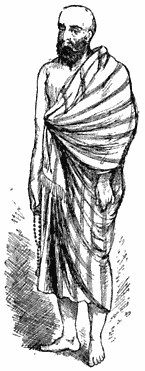
THE PILGRIM.
The following is the orthodox way of performing the pilgrimage, founded upon the example of the Prophet himself. (See Ṣaḥīḥu ʾl-Buk͟hārī, Kitābu ʾl-Manāsik, p. 205.)
Upon the pilgrim’s arrival at the last stage near Makkah, he bathes himself, and performs two rakʿah prayers, and then divesting himself of his clothes, he assumes the pilgrim’s sacred robe, which is called iḥrām. This garment consists of two seamless wrappers, one being wrapped round the waist, and the other thrown loosely over the shoulder, the head being left uncovered. Sandals may also be worn, but not shoes or boots. After he has assumed the pilgrim’s garb, he must not anoint his head, shave any part of his body, pare his nails, nor wear any other garment than the iḥrām. The pilgrim having now entered upon the ḥajj, faces Makkah, and makes the nīyah (intention), and says: “O God, I purpose to make the ḥajj; make this service easy to me and accept it from me.” He then proceeds on his journey to the sacred city and on his way, as well as at different periods in the pilgrimage, he recites, or sings with a loud voice, the pilgrim’s song, called the Talbiyah (a word signifying waiting or standing for orders). In Arabic it runs thus (as given in the Ṣaḥīḥu ʾl-Buk͟hārī, p. 210):—
“Labbaika! Allāhumma! Labbaika!
Labbaika! Lā Shārika laka! Labbaika!
Inna ʾl-ḥamda wa ʾn-niʿmata laka, wa ʾl-mulku laka!
Lā shārika laka!”
Which, following the Persian commentator, ʿAbdu ʾl-Ḥaqq, may be translated as follows:—
“I stand up for Thy service, O God! I stand up!
I stand up! There is no partner with Thee! I stand up!
Verily Thine is the Praise, the Blessing and the Kingdom!
There is no partner with Thee!”
Immediately on his arrival at Makkah he performs legal ablutions in the Masjidu ʾl-ḥarām, and then kisses the black stone (al-Ḥajaru ʾl-aswad). He then encompasses the Kaʿbah seven times; three times at a quick step or run, and four times at a slow pace. These acts are called the t̤awāf and are performed by commencing on the right and leaving the Kaʿbah on the left. Each time as the pilgrim passes round the Kaʿbah, he touches the Ruknu ʾl-Yamānī, or the Yamānī corner, and kisses the sacred black stone. He then proceeds to the Maqāmu Ibrāhīm (the place of Abraham), where he recites the 119th verse of the IInd Sūrah of the Qurʾān, “Take ye the station of Abraham for a place of prayer,” and performs two rakʿah prayers, after which he returns to the black stone and kisses it. He then goes to the gate of the temple leading to Mount aṣ-Ṣafā, and from it ascends the hill, reciting the 153rd verse of the IInd Sūrah of the Qurʾān, “Verily aṣ-Ṣafā and al-Marwah are the signs of God.” Having arrived at the summit of the mount, turning towards the Kaʿbah, he recites the following:—
“There is no deity but only God! God is great! There is no deity but God alone! He hath performed His promise, and hath aided His servant and hath put to flight the hosts of infidels by Himself alone!”
These words are recited thrice. He then runs from the top of Mount aṣ-Ṣafā to the summit of Mount al-Marwah seven times, repeating the aforesaid prayers on the top of each hill. This is the sixth day, the evening of which is spent at Makkah, where he again encompasses the Kaʿbah.
Upon the seventh day he listens to the k͟hut̤bah, or oration, in the great mosque, in which are set forth the excellences of the pilgrimage and the necessary duties required of all true Muslims on the following days.
On the eighth day, which is called Tarwiyah, he proceeds with his fellow pilgrims to Mina, where he stays and performs the usual services of the Muslim ritual, and remains the night.
The next day (the ninth), after morning prayer, he proceeds to Mount ʿArafāt, where he recites the usual prayers and listens to another k͟hut̤bah. He then leaves for al-Muzdalifah, a place midway between Mina and ʿArafāt, where he should arrive for the sunset prayer.
The next day, the tenth, is the Yaumu ʾn-Naḥr, or the “Day of Sacrifice,” known all through the Muslim world and celebrated as the ʿĪdu ʾl-Aẓḥā. Early in the morning, the pilgrims having said their prayers at Muzdalifah, then proceed in a body to three pillars in Mina, the first of which is called the Shait̤ānu ʾl-Kabīr, or “Great Devil.” The pilgrim casts seven stones at each of these pillars, the ceremony being called the Ramyu ʾr-Rijām, or casting of stones. Holding the rajm, or pebble between the thumb and fore-finger of the right hand, the pilgrim throws it at a distance of not less than fifteen feet, and says—“In the name of God, the Almighty, I do this, and in hatred of the devil and his shame.” The remaining six stones are thrown in the same way. It is said that this ceremony has been performed ever since the days of Abraham. The pilgrim then returns to Mina and performs the sacrifice of the ʿĪdu ʾl-Aẓḥā. The victim may be a sheep, or a goat, or a cow, or a camel, according to the means of the pilgrim.
Placing its head towards the Kaʿbah, its fore-legs being bandaged together, the pilgrim stands on the right side of his victim and plunges the knife into its throat with great force, and cries with a loud voice, “Allāhu Akbar!” “God is great! O God, accept this sacrifice from me!”
This ceremony concludes the pilgrimage, and the ḥājī or pilgrim then gets himself shaved and his nails pared, and the iḥrām or pilgrim garment is removed. Although the pilgrimage is over, he should still rest at Makkah the three following days, which are known as the Ayyāmu ʾt-Tashrīq, or the days of drying up of the blood of the sacrifice. Three well-earned days of rest after the peripatetic performance of the last four days.
Before he leaves Makkah he should once more perform the circuits round the Kaʿbah and throw stones at the Satanic pillars at Mina, seven times. He should also drink of the water of the zamzam well.
Most Muslims then go to al-Madīnah, and make their salutations at the shrine of Muḥammad. This is regarded as an incumbent duty by all except the Wahhābīs, who hold that to make the visitation of the Prophet’s tomb a religious ceremony is shirk, or associating the creature with God.
From the time the pilgrim has assumed the iḥrām until he takes it off, he must abstain from worldly affairs and devote himself entirely to the duties of the ḥajj. He is not allowed to hunt, though he may catch fish if he can. “O Believers, kill no game while ye are on pilgrimage.” (Sūrah v. 96.) The Prophet also said: “He who shows the place where game is to be found is equally as bad as the man who kills it.” The ḥājī must not scratch himself, lest vermin be destroyed, or a hair be uprooted. Should he feel uncomfortable, he must rub himself with the open palm of his hand. The face and head must be left uncovered, the hair on the head and beard unwashed and uncut. “Shave not your heads until the offering reach the place of sacrifice.” (Sūrah ii. 192.) On arriving at an elevated place, on descending a valley, on meeting any one, on entering the city of Makkah or the sacred temple, the ḥājī should continually repeat the word “Labbaika, Labbaika”; and whenever he sees the Kaʿbah he should recite the Takbīr, “God is great!” and the Taʾlīh “There is no deity but God!”
The pilgrimage known as the ḥajj, as has been already stated, can only be made on the appointed days of the month of Ẕū ʾl-Ḥijjah. A visit at any other time is called the ʿUmrah. [ʿUMRAH.] If the pilgrim arrives as late as the ninth day, and is in time to spend that day, he can still perform the pilgrimage legally.
The pilgrimage cannot be performed by proxy by Sunnī Muslims, but is allowed by the Shīʿahs, and it is by both considered a meritorious act to pay the expenses of one who cannot afford to perform it. But if a Muḥammadan on his death-bed bequeath a sum of money to be paid to a certain person to perform the pilgrimage, it is considered to satisfy the claims of the Muslim law. If a Muslim have the means of performing the pilgrimage, and omit to do so, its omission is equal to a kabīrah, or mortal sin.
According to the saying of the Prophet (Mishkāt, book xi. ch. 1), the merits of a pilgrimage to Makkah are very great:—
“He who makes a pilgrimage for God’s sake, and does not talk loosely, nor act wickedly, shall return as pure from sin as the day on which he was born.” “Verily, they (the ḥajj and the ʿumrah) put away poverty and sin like the fires of a forge removes dross. The reward of a pilgrimage is paradise.” “When you see a pilgrim, salute and embrace him, and request him to ask pardon of God for you, for his own sins have been forgiven and his supplications will be accepted.”
For a philological and technical explanation of the following terms which occur in this account of the ḥajj, refer to the words as they occur in this dictionary: ʿARAFAH, AYYAMU ʾT-TASHRIQ, HAJARU ʾL-ASWAD, HAJI, IHRAM, MARWAH, MASJIDU ʾL-HARAM, MAQAMU IBRAHIM, MAHRAM, MIQAT, MUZDALIFAH, TAWAF, ʿUMRAH, RAMYU ʾL-JIMAR, ZAMZAM, TALBIYAH, RUKNU ʾL-YAMANI, TARWIYAH, KHUTBAH, ʿIDU ʾL-AZHA, SAFA.
The Muslim who has performed the pilgrimage is called a ḥājī, which title he retains, e.g. Ḥājī Qāsim, the Pilgrim Qāsim.
Only five Englishmen are known to have visited Makkah, and to have witnessed the ceremonies of the pilgrimage:—Joseph Pitts, of Exeter, A.D. 1678; John Lewis Burckhardt, A.D. 1814; Lieutenant Richard Burton, of the Bombay Army, A.D. 1853; Mr. H. Bicknell, A.D. 1862; Mr. T. F. Keane, 1880. The narratives of each of these “pilgrims” have been published. The first account in English of the visit of a European to Makkah, is that of Lodovico Bartema, a gentleman of Rome, who visited Makkah in 1503. His narrative was published in Willes and Eden’s Decades, A.D. 1555.
Professor Palmer (“Introduction” to the Qurʾān, p. liii.) says:—“The ceremonies of the pilgrimage could not be entirely done away with. The universal reverence of the Arab for the Kaabah was too favourable and obvious a means for uniting all the tribes into one confederation with one common purpose in view. The traditions of Abraham the father of their race, and the founder of Muhammad’s own religion, as he always declared it to be, no doubt gave the ancient temple a peculiar sanctity in the Prophet’s eyes, and although he first settled upon Jerusalem as his qiblah, he afterwards reverted to the Kaabah itself. Here, then, Muhammad found a shrine, to which, as well as at which, devotion had been paid from time immemorial; it was one thing which the scattered Arabian nation had in common—the one thing which gave them even the shadow of a national feeling; and to have dreamed of abolishing it, or even of diminishing the honours paid to it, would have been madness and ruin to his enterprise. He therefore did the next best thing, he cleared it of idols and dedicated it to the service of God.”
Mr. Stanley Lane Poole (Introduction to Lane’s Selections, p. lxxxiv.) remarks:—
“This same pilgrimage is often urged as a sign of Moḥammad’s tendency to superstition and even idolatry. It is asked how the destroyer of idols could have reconciled his conscience to the circuits of the Kaʿbah and the veneration of the black stone covered with adoring kisses. The rites of the pilgrimage cannot certainly be defended against the charge of superstition; but it is easy to see why Moḥammad enjoined them. They were hallowed to him by the memories of his ancestors, who had been the guardians of the sacred temple, and by the traditional reverence of all his people; and besides this tie of association, which in itself was enough to make it impossible for him to do away with the rites, Moḥammad perceived that the worship in the Kaʿbah would prove of real value to his religion. He swept away the more idolatrous and immoral part of the ceremonies, but he retained the pilgrimage to Mekka and the old veneration of the temple for reasons of which it is impossible to dispute the wisdom. He well knew the consolidating effect of forming a centre to which his followers should gather; and hence he reasserted the sanctity of the black stone that ‘came down from heaven’; he ordained that everywhere throughout the world the Muslim should pray looking towards the Kaʿbah, and he enjoined him to make the pilgrimage thither. Mekka is to the Muslim what Jerusalem is to the Jew. It bears with it all the influence of centuries of associations. It carries the Muslim back to the cradle of his faith, the childhood of his prophet; it reminds him of the struggle between the old faith and the new, of the overthrow of the idols, and the establishment of the worship of the One God. And, most of all, it bids him remember that all his brother Muslims are worshipping towards the same sacred spot; that he is one of a great company of believers, united by one faith, filled with the same hopes, reverencing the same thing, worshipping the same God. Moḥammad showed his knowledge of the religious emotions in man when he preserved the sanctity of the temple of Islām.”
The Makkan pilgrimage admits of no other explanation than this, that the Prophet of Arabia found it expedient to compromise with Arabian idolatry. And hence we find the superstition and silly customs of the Ḥajj grafted on to a religion which professes to be both monotheistic in its principle, and iconoclastic in its practices.
A careful and critical study of Islām will, we think, convince any candid mind that at first Muḥammad intended to construct his religion on the lines of the Old Testament. Abraham, the true Muslim, was his prototype, Moses his law-giver, and Jerusalem his Qiblah. But circumstances were ever wont to change not only the Prophet’s revelations, but also his moral standards. Makkah became the Qiblah; and the spectacle of the Muslim world bowing in the direction of a black stone, whilst they worship the one God, marks Islām, with its Makkan pilgrimage, as a religion of compromise.
Apologists of Islām have endeavoured to shield Muḥammad from the solemn charge of having “forged the name of God,” but we know of nothing which can justify the act of giving the stupid and unmeaning ceremonies of the pilgrimage all the force and solemnity of a divine enactment.
The Wahhābīs, the Puritans of Islām, regard the circumambulation of the Prophet’s tomb as superstitious (as shirk, or associating something with God, in fact), but how can they justify the foolish ceremonies of the ḥajj? If reverence for the Prophet’s tomb is shirk, what are the runnings at aṣ-Ṣafā and al-Marwah, the stonings of the pillars, and the kissings of the black stone? No Muslim has ever yet attempted to give a spiritual explanation of the ceremonies of the Makkan pilgrimage, for in attempting to do so he would be charged with the heresy of shirk!
Mr. W. S. Blunt in his Future of Islām, has given some interesting statistics regarding the pilgrimage to Makkah in the year 1880, which he obtained during a residence at Cairo, Damascus, and Jiddah. The figures, he says, are taken principally from an official record kept for some years past at Jiddah, and checked as far as European subjects are concerned, by reference to the consular agents residing there.
Table of the Mecca Pilgrimage of 1880.
Nationality of Pilgrims. Arriving by Sea. Arriving by Land. Total of Mussulman population represented.
Ottoman subjects including pilgrims from Syria and Irak, but not from Egypt or Arabia proper 8,500 1,000 22,000,000
Egyptians 5,000 1,000 5,000,000
Mogrebbins (“people of the West”), that is to say, Arabic-speaking Mussalmans from the Barbary States, Tripoli, Tunis, Algiers, and Morocco. These are always classed together and are not easily distinguishable from each other 6,000 — 18,000,000
Arabs from Yemen 3,000 — 2,500,000
Arabs,, from,, Oman and Hadramaut 3,000 — 3,000,000
Arabs,, from,, Nejd, Assir, and Hasa, most of them Wahhabites — 5,000 4,000,000
Arabs,, from,, Hejaz, of these perhaps 10.000 Meccans — 22,000 2,000,000
Negroes from Soudan 2,000 — 10,000,000(?)
Negroes,, from,, Zanzibar 1,000 — 1,500,000
Malabari from the Cape of Good Hope 150 —
Persians 6,000 2,500 8,000,000
Indians (British subjects) 15,000 — 40,000,000
Malays, chiefly from Java and Dutch subjects 12,000 — 30,000,000
Chinese 100 — 15,000,000
Mongols from the Khanates, included in the Ottoman Haj — — 6,000,000
Lazis, Circassians, Tartars, &c. (Russian subjects), included in the Ottoman Haj — — 5,000,000
Independent Afghans and Beluchis, included in the Indian and Persian Hajs — — 3,000,000

Total of pilgrims present at Arafat 93,250.
Total Census of Islam 175,000,000
ḤAJJATU ʾL-WADĀʿ (حجة الوداع). The last or farewell pilgrimage performed by Muḥammad, and which is taken as the model of an orthodox ḥajj. It is called the Ḥajju ʾl-Akbar, or Greater Pilgrimage, in the Qurʾān, Sūrah ix. 3. (See Mishkāt, book xi. ch. iii., and Muir’s Life of Mahomet.) It is supposed to have commenced February 23, A.D. 632.
ḤAJJ MABRŪR (حج مبرور). An approved or accepted pilgrimage (Mishkāt, book xi. ch. i. pt. 2). A pilgrimage to Makkah performed according to the conditions of Muslim law.
ḤAKAM (حكم). An arbitrator appointed by a qāẓī to settle disputes. It is not lawful to appoint either a slave or an unbeliever, or a slanderer, or an infant, as an arbitrator. (Hidāyah, vol. ii. p. 638.)
According to the Qurʾān, Sūrah iv. 39, domestic quarrels should be settled by an arbitrator:—“If ye fear a breach between the two (i.e. husband and wife) then appoint an arbitrator from his people, and an arbitrator from her people.”
Al-Ḥakam, the Arbitrator, is one of the ninety-nine attributes of God, although it is not so employed in the Qurʾān.
ḤĀKIM (حاكم). “A just ruler.” The term Aḥkamu ʾl-Ḥākimīn, “the Most Just of Rulers,” is used for God, Qurʾān, Sūrah xcv. 8; also, K͟hairu ʾl-Ḥākimīn, i.e. “Best of Rulers,” Sūrah vii. 85.
ḤAKĪM (حكيم), pl. ḥukamāʾ; Heb. חָכָם. Lit. “A wise person.” (1) A philosopher. (2) A doctor of medicine. (3) Al-Ḥakīm, “The Wise One.” One of the ninety-nine attributes of God. It frequently occurs in the Qurʾān, e.g. Sūrah ii. 123: “Thou art the Mighty and the Wise!”
ḤĀL (حال). A state, or condition. A term used by the Ṣūfī mystics for those thoughts and conditions which come upon the heart of man without his intention or desire, such as sorrow, or fear, or pleasure, or desire, or lust. If these conditions are stable and intransient, they are called malkah or maqām; but if they are transient and fleeting, they are called ḥāl. (ʿAbdu ʾr-Razzāq’s Dictionary of Ṣūfī Terms.)
A state of ecstasy induced by continued contemplation of God. It is considered a divine gift and a sure prognostication of speedily arriving at “The Truth.”
Professor Palmer says (Oriental Mysticism, p. 66), “This assiduous contemplation of startling metaphysical theories is exceedingly attractive to an Oriental mind, and not unfrequently produces a state of mental excitement akin to the phenomena observed during the recent religious revivals. Such ecstatic state is considered a sure prognostication of direct illumination of the heart by God, and constitutes the fifth stage (in the mystic journey) called ḥāl or ecstasy.”
ḤALĀL (حلال). Lit. “That which is untied or loosed.” That which is lawful, as distinguished from ḥarām, or that which is unlawful.
AL-ḤALĪM (الحليم). “The Clement.” One of the ninety-nine attributes of God. It occurs in the Qurʾān, e.g. Sūrah ii. 225: “God is forgiving and clement.”
ḤAMĀʾIL (حمائل). Lit. “Things suspended.” An amulet or charm. [AMULET.]
ḤAMĀLAH (حـمالة). Compensation for manslaughter or murder, called also diyah. [DIYAH.]
ḤAMALATU ʾL-ʿARSH (حـمـلـة العرش). Lit. “Those who bear the throne.” Certain angels mentioned in the Qurʾān, Sūrah xl. 7: “Those who bear the throne (i.e. the Ḥamalatu ʾl-ʿArsh) and those around it (i.e. the Karūbīn) celebrate the praise of their Lord, and believe in Him, and ask pardon for those who believe.”
Al-Bag͟hawī, the commentator, says they are eight angels of the highest rank. They are so tall that their feet stand on the lowest strata of the earth and their heads reach the highest heavens, the universe does not reach up to their navels, and it is a journey of seven hundred years from their ears to their shoulders! (Al-Bag͟hawī, Bombay edition, vol. ii. p. 23.)
HĀMĀN (هـامـان). The prime minister of Pharaoh. Mentioned in the Qurʾān in three different chapters.
Sūrah xxviii. 7: “For sinners were Pharaoh and Hāmān.”
Sūrah xxix. 38: “Korah (Qārūn) and Pharaoh and Hāmān! with proofs of his mission did Moses come to them and they behaved proudly on the earth.”
Sūrah xl. 38:—
“And Pharaoh said, ‘O Hāmān, build for me a tower that I may reach the avenues,
“ ‘The avenues of the heavens, and may mount to the God of Moses, for I verily deem him a liar.’ ”
Some European critics think that Muḥammad has here made Hāmān the favourite of Ahasuerus and the enemy of the Jews, the vizier of Pharaoh. The Rabbins make this vizier to have been Korah, Jethro, or Balaam. (Midr. Jalkut on Ex. ch. 1, Sect. 162–168.)
In the Mishkāt (book iv. ch. i. pt. 3), there is a tradition that Muḥammad said he who neglects prayers will be in hell with Korah, Pharaoh, Hāmān, and Ubaiy ibn K͟half (an infidel whom Muḥammad slew with his own hand at the battle of Uḥud.)
AL-ḤAMD (الحمد), the “Praise.” A title of the first chapter of the Qurʾān. According to Kitābu ʾt-Taʿrifāt, “praise” (ḥamd) of God is of three kinds:—
(1) Al-ḥamdu ʾl-Qaulī, the praise of God with the tongue, with those attributes with which He has made known Himself. (2) Al-ḥamdu ʾl-Fiʿlī, the praise of God with the body according to the will of God. (3) Al-ḥamdu ʾl-Ḥālī, the praise of God with the heart and spirit.
AL-ḤAMĪD (الحميد). “The Laudable.” The One worthy of praise. One of the ninety-nine attributes of God. It frequently occurs in the Qurʾān, e.g. Sūrah xi. 76, “Verily He is to be praised.”
ḤĀ MĪM (حا ميم). Seven Sūrahs of the Qurʾān begin with the letters ح ḥ, م m, and are called al-Ḥawāmīm. They are the XL, XLI, XLII, XLIII, XLIV, XLV, and XLVI. Various opinions are held by Muḥammadan commentators as to the meaning of these mysterious letters. Jalālu ʾd-dīn as-Suyūt̤ī in his Itqān, says these letters are simply initial letters, the meaning of which is known only to God, but Ibn ʿAbbās says the letters ح ḥ, and م m, stand for الرحمان ar-Raḥmān, “the Merciful,” one of the attributes of God.
Mr. Rodwell, in his Introduction to the Ḳorân, says, “Possibly the letters Hā, Mīm, which are prefixed to numerous successive Suras were private marks, or initial letters, attached by their proprietor to the copies furnished to Said when effecting his recension of the text under Othman. In the same way, the letters prefixed to other Suras may be monograms, or abbreviations, or initial letters of the names of the persons to whom the copies of the respective Suras belonged.”
ḤAMRĀU ʾL-ĀSĀD (حمرا الاساد). A village or small town, the scene of one of Muḥammad’s expeditions against the Quraish. Having reached this spot he kindled five hundred fires to make the Quraish believe that the pursuing force was very large, and, contenting himself with this demonstration, he returned to al-Madīnah, from which it was about 60 miles. According to Burton, it is the modern Wasitah.
“At Hamrâ al Asād, Mahomet made prisoner one of the enemy, the poet Abu Ozza, who had loitered behind the rest. He had been taken prisoner at Bedr, and, having five daughters dependent on him, had been freely released, on the promise that he would not again bear arms in the war against the Prophet. He now sought for mercy: ‘O Mahomet!’ he prayed, ‘forgive me of thy grace.’ ‘Nay, verily,’ said the Prophet, ‘a believer may not be twice bitten from the same hole. Thou shalt never return to Mecca, stroke thy beard and say, I have again deceived Mahomet. Lead him forth to execution!’ So saying, he motioned to a bystander, who with his sword struck off the captive’s head.” (Muir’s Life of Mahomet, new ed. p. 276.)
ḤAMZAH (حمزة). Muḥammad’s uncle, who embraced Islām and became one of its bravest champions. He was at the battle of Uḥud and slew ʿUs̤mān, one of the leaders of the Quraish, but was soon afterwards himself killed by a wild negro named Waḥshī, and his dead body shamefully mutilated. At his death Muḥammad is recorded to have said that Ḥamzah was “the lion of God and of His Apostle.” The warlike deeds of Ḥamzah are recorded in Persian poetry, in which he is celebrated as Amīr Ḥamzah.