DICTIONARY OF ISLĀM. (continued 27)
Reading edition
“Some of the verses in Arabic poetry (as in all Eastern poetry) are of a nature such as precludes translation. Had they been composed by a female on a youth whom she loved, they would seldom offer anything objectionable; but as the case is not so, they are utterly repugnant to European readers. It must not, however, be supposed that they are always the produce of a degraded passion; in many cases they were the usual expression of simple friendship and affection, or of those platonic attachments which the translated works of some Greek philosophers first taught the Moslims. Indeed, love and friendship are so closely confounded by them, that they designate both feelings by the same word, and it is not uncommon to meet epistles addressed by one aged doctor to another, and containing sentiments of the strongest kind, but which are the expression of friendship only. It often happens, also, that a poet describes his mistress under the attributes of the other sex, lest he should offend that excessive prudery of Oriental feelings which, since the fourth century of Islamism, scarcely allows an allusion to women, and more particularly in poetry, and this rigidness is still carried so far, that at Cairo public singers dare not amuse their auditors with a song in which the beloved is indicated as a female. Some of those pieces have also a mystic import, as the commentators of Hafiz, Saadi, and Shebisteri, have not failed to observe.” (Ib., p. xxxiii. et seq.)
POLL-TAX. [JIZYAH.]
POLYGAMY. In Muḥammadanism, polygamy has the express sanction of the Qurʾān, and is, therefore, held to be a divine institution. Vide Sūratu ʾn-Nisāʾ, or Chapter iv. 3:—
“But if ye cannot do justice between orphans, then marry what seems good to you of women, by twos, or threes, or fours: and if ye fear that ye cannot be equitable, then only one, or what your right hand possesses” (i.e. female slaves).
Compare this with the teaching of the Talmud:—
“A man may marry many wives, for Rabba saith it is lawful to do so, if he can provide for them. Nevertheless, the wise men have given good advice, that a man should not marry more than four wives.” (Arbah. Turim. Ev. Hazaer, 1.)
But although permission to indulge in polygamy is clear and unmistakable, the opening verse of the Sūrah from which the above is taken, seems to imply some slight leaning to monogamy as the highest form of married life, for it reads thus:—
“O ye men! fear your Lord, who created you from one soul, and created therefrom its mate, and diffused from them twain numerous men and women.”
In the Ain-i-Akbari, it is related that a certain Mujtahid, or enlightened doctor, married eighteen wives, for he rendered the Arabic word mas̤na, “double,” and read the text already quoted, “Marry whatever women you like two and two, three and three, and four and four.” And in the same work it is said that another learned Maulawī married eight wives, because he read the verse—“two + three + four = nine”!
Al-Baiẓāwī, the Jalālān, and other Sunnī commentators, are all agreed that the true reading of the verse limits the number of lawful wives to four. The Shīʿahs also hold the same opinion, but they sanction Mutʿah, or “temporary marriages.” [MUʿTAH.]
In the face of the united testimony of Islām founded upon the express injunctions of the Qurʾān, Syed Ameer Ali has the audacity to state in his Critical Examination of the Life and Teachings of Muhammad, p. 223, that “the greatest and most reprehensible mistake committed by Christian writers, is to suppose that Muhammad either adopted or legalised polygamy. The old idea of his having introduced it—a sign only of the ignorance of those who hold it—is by this time exploded, but the opinion that he adopted and legalised the custom is still maintained by the common masses as by many learned in Christendom. No belief can be more false”!
In his more recent work on the Personal Law of the Muḥammadans, the same writer remarks:—
“Muhammad restrained polygamy by limiting the maximum number of contemporaneous marriages, and by making absolute equity towards all obligatory on the man. It is worthy of note that the clause in the Qurán, which contains the permission to contract four contemporaneous marriages is immediately followed by a sentence which cuts down the significance of the preceding passage to its normal and legitimate dimensions. The former passage says, ‘You may marry two, three, or four wives, but not more.’ The subsequent lines declare, ‘but if you cannot deal equitably and justly with all you shall marry only one.’ The extreme importance of this proviso, bearing especially in mind the meaning which is attached to the word ‘equity’ (ʿadl) in the Quranic teachings, has not been lost sight of by the great thinkers of the Moslem world. Even so early as the third century of the era of the Hijra during the reign of al-Mâmûn, the first Motazalite doctors taught that the developed Quranic laws inculcated monogamy. And though the cruel persecutions of the mad bigot, Mutawwakil, prevented the general diffusion of their teachings, the conviction is gradually forcing itself on all sides, in all advanced Moslem communities, that polygamy is as much opposed to the Islâmic laws as it is to the general progress of civilised society and true culture. In India especially, this idea is becoming a strong moral, if not a religious conviction, and many extraneous circumstances in combination with this growing feeling are tending to root out the existence of polygamy from among the Mussulmans. A custom has grown up in that country, which is largely followed by all classes of the community, of drawing up a marriage deed containing a formal renunciation, on the part of the future husband, of any right or semblance of right which he might possess or claim to possess to contract a second marriage during the existence of the first. This custom serves as a most efficacious check upon the growth and the perpetuation of the institution of polygamy. In India more than ninety-five per cent. of Muhammadans are at the present moment, either by conviction or necessity, monogamists. Among the educated classes, versed in the history of their ancestors, and able to compare it with the records of other nations, the custom is regarded with disapprobation, amounting almost to disgust. In Persia, according to Colonel Macgregor’s statement, only two per cent. of the population enjoy the questionable luxury of plurality of wives. It is earnestly to be hoped that before long a general synod of Moslem doctors will authoritatively declare that polygamy, like slavery, is abhorrent to the laws of Islam.” (Personal Law of the Muhammadans, p. 28.)
Syud Ahmad Khan Bahadur, in his essay, Whether Islam has been beneficial or injurious to Society in general, on the contrary, defends the institution of polygamy as divine, and quotes John Milton, Mr. Davenport, and Mr. Higgins, as Christian writers who defended the practice.
The Prophet claimed considerable indulgence for himself in the matter, and married eleven wives. [WIVES OF THE PROPHET.]
The views of Dr. Marcus Dods in his Mohammed, Buddha, and Christ (p. 55), give an able and interesting summary of the subject:—
“The defence of polygamy has been undertaken from various points of view, and with varying degrees of insight and of earnestness. But one cannot detect much progress among its defenders. F. W. Newman has nothing to say in its favour which had not previously been suggested by Voltaire; nothing, we may say, which does not occur to anyone who wishes to present the argument for a plurality of wives. It is somewhat late in the day to be called upon to argue for monogamy as abstractly right. Speculators like Aristotle (Econ. i. 2, 8), who have viewed the subject both as statesmen having a regard to what is practicable and will conduce to social prosperity, and as philosophers reasoning from first principles, have long ago demanded for their ideal society, not only monogamy, but also that mutual respect and love, and that strict purity and modesty, which polygamy kills. Let us say briefly that the only ground conscience recognises as warranting two persons to become one in flesh is that they be, first of all, one in spirit. That absolute surrender of the person which constitutes marriage is justified only by the circumstances that it is a surrender of the heart as well, and that it is mutual. To an ideal love, polygamy is abhorrent and impossible. As Mohammed himself, in another connection, and with more than his usual profundity, said, ‘God has not put two hearts in you.’ This is the grand law imbedded in our nature, and by which it is secured that the children born into the world be the fruit of the devoted surrender of one human spirit to another; by which, in other words, it is secured that love, the root principle of all human virtue and duty, be transmitted to the child and born in it. This is the beneficent law expressed in monogamy, and this law is traversed and robbed of its effects precisely in so far as even monogamous marriages are prompted by fleshly or worldly rather than by spiritual motives. The utilitarian argument Mr. Lecky (Hist. European Morals, vol. ii. p. 295) has summed up in three sentences: ‘Nature, by making the number of males and females nearly equal, indicates it as natural. In no other form of marriage can the government of the family, which is one of the chief ends of marriage, be so happily sustained; and in no other does the woman assume the position of the equal of man.’ But we have here to do only with Mohammedan apologists, and their reasonings are somewhat perplexing; for they first maintain that nature intended us to be polygamists (see Syud Ahmad’s Essay, p. 8; Syud Ameer Ali’s Crit. Exam., p. 225), and then, secondly, declare that ‘the greatest and most reprehensible mistake committed by Christian writers is to suppose that Mohammed either adopted or legalised polygamy.’ Probably the most that can be said for Mohammed in regard to this matter, is that he restricted polygamy, and that its abolition was impossible and unsuitable to the population he had to do with.
“The allegation, however, that Mohammed confined polygamy within narrower limits than the Arabs had previously recognised, though true, is immaterial. For, in the first place, he restricted polygamy indeed in others, but not in his own case; and thus left upon the minds of his followers the inevitable impression that an unrestricted polygamy was the higher state of the two.
“In the second place, while he restricted the number of lawful wives, he did not restrict the number of slave-concubines. In the third place, his restriction was practically of little value, because very few men could afford to keep more than four wives. And, lastly, as to the principle, he left it precisely where it was, for as Mr. Freeman justly observes (Lectures, p. 69): ‘This is one of the cases in which the first step is everything. The difference between one wife and two is everything; that between four and five thousand is comparatively nothing.’
“And if the principle be defended as at least relatively good, nothing is to be urged against this as matter of fact; although the circumstance has been overlooked, that already very many thousands of Christian Arabs had found it quite possible to live in monogamy. But that polygamy is not incompatible with a sound, if not perfectly developed, morality, and with the highest tone of feeling, no one who has read the history of Israel will be disposed to deny. That it may suit a race in a certain stage of its development, and may in that stage lead to purer living and surer moral growth than its prohibition would, may be granted. But necessarily the religion which incorporates in its code of morals such allowances, stamps itself as something short of the final religion.”
[MARRIAGE, MUTʿAH, WIVES, WOMEN.]
POTIPHAR. Arabic Qit̤fīr (قطفير), or It̤fīr (اطفير). The treasurer of Egypt in the time of Joseph, and the husband of Zulaik͟hah. [JOSEPH.]
PRAYER. Arabic ṣalāt (صلوة), pl. ṣalawāt. Persian namāz (نماز), pl. namāzhā.
Prayer is the second of the five foundations, or pillars, of practical religion in Islām, and is a devotional exercise which every Muslim is required to render to God at least five times a day, namely, at the early morning, midday, afternoon, evening, and night.
The general duty of prayer is frequently enjoined in the Qurʾān, but it is remarkable that in no single passage are the five periods mentioned.
See Sūratu ʾr-Rūm (xxx.), 17: “Glorify God when it is evening (masāʾ) and at morning (ṣubḥ),—and to Him be praise in the heavens and the earth,—and at afternoon (ʿashī), and at noon-tide (z̤uhr).” (But all commentators are agreed that masāʾ includes both sunset and after sunset; and, therefore, both the Mag͟hrib and ʿAshīyah prayers.)
Sūrah xi. 116: “Observe prayer at early morning, at the close of the day, and at the approach of night; for the good deeds drive away the evil deeds.”
Sūrah xx. 130: “Put up then with what they say; and celebrate the praise of thy Lord before the sunrise, and before its setting; and some time in the night do thou praise Him, and in the extremes of the day, that thou haply mayest please Him.”
Sūrah xvii. 80: “Observe prayer at sunset, till the first darkening of the night, and the daybreak reading—for the daybreak reading hath its witnesses, and watch unto it in the night: this shall be an excess in service.”
Sūrah ii. 42: “Seek aid with patience and prayer.”
Sūrah iv. 1–4: “When ye have fulfilled your prayer, remember God standing and sitting, and lying on your sides; and when ye are in safety, then be steadfast in prayer. Verily prayer is for the believers prescribed and timed.”
According to the Traditions, Muḥammad professed to have received instructions to recite prayers five times a day, during his miʿrāj, or ascent to heaven. The tradition runs thus:—
“The divine injunctions for prayer were originally fifty times a day. And as I passed Moses (in heaven, during my ascent), Moses said to me, ‘What have you been ordered?’ I replied, ‘Fifty times!’ Then Moses said, ‘Verily your people will never be able to bear it, for I tried the children of Israel with fifty times a day, but they could not manage it.’ Then I returned to the Lord and asked for some remission. And ten prayers were taken off. Then I pleaded again and ten more were remitted. And so on until at last they were reduced to five times. Then I went to Moses, and he said, ‘And how many prayers have you been ordered?’ And I replied ‘Five.’ And Moses said, ‘Verily I tried the children of Israel with even five, but it did not succeed. Return to your Lord, and ask for a further remission.’ But I said, ‘I have asked until I am quite ashamed, and I cannot ask again.’ ” (See Ṣaḥīḥu Muslim, vol. i. p. 91.)
This Ṣalāt, or liturgical service, has thus become one of the most prominent features of the Muḥammadan religion, and very numerous are the injunctions regarding it which have been handed down in the traditions. There are various minor differences amongst the numerous sects of Islām regarding the formula, but its main features are alike in all countries.
We shall describe prayer according to the Ḥanafī sect of Sunnī Muslims.
It is absolutely necessary that the service should be performed in Arabic; and that the clothes and body of the worshipper should be clean, and that the praying-place should be free from all impurity. It may be said either privately, or in company, or in a mosque—although services in a mosque are more meritorious than those elsewhere.
The stated prayers are always preceded by the ablution of the face, hands, and feet. [ABLUTION.]
At the time of public prayer, the muʾaẕẕin, or “crier,” ascends the minaret, or stands at the side of the mosque nearest the public thoroughfare, and gives the azān, or “call to prayer,” as follows:—
“God is great! God is great! God is great! God is great!
I bear witness that there is no god but God!
I bear witness that there is no god but God!
I bear witness that Muḥammad is the Apostle of God!
I bear witness that Muḥammad is the Apostle of God!
Come to prayers! Come to prayers!
Come to salvation! Come to salvation!
(The Shīʿahs add “Come to good works!”)
There is no other god but God!”
(The Shīʿahs recite the last sentence twice.)
In the early morning the following sentence is added: “Prayers are better than sleep!”
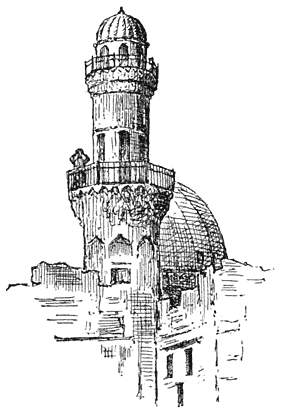
THE MUʾAZZIN CALLING THE AẔĀN FROM A MINARET. (A. F. Hole.)
When the prayers are said in a congregation or in the mosque, they begin with the Iqāmah, which is a recitation of the same words as the azān, with the addition of the sentence, “Prayers are now ready!” The regular form of prayer then begins with the Nīyah, which is said standing, with the hands on either side:—
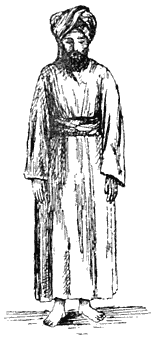
THE NIYAH.
“I have purposed to offer up to God only, with a sincere heart this morning (or, as the case may be), with my face Qiblah-wards, two (or, as the case may be) rakʿah prayers Farẓ (Sunnah, or Nafl).”
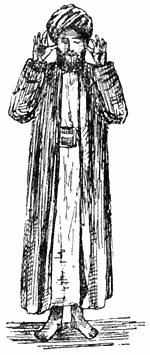
THE TAKBIR-I-TAHRIMAH.
Then follows the Takbīr-i-Taḥrīmah, said with the thumbs touching the lobules of the ears and the open hands on each side of the face:—
“God is great!”
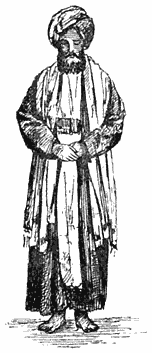
THE QIYAM
The Qiyām, or standing position. The right hand placed upon the left, below the navel (the Shāfiʿīs, and the two other orthodox sects, place their hands on their breasts, as also the Wahhābīs; the Shīʿahs keep their hands on either side. In all the sects the women perform the Qiyām with their hands on their breasts), and the eyes looking to the ground in self-abasement. During which is said the Subḥān (the Shīʿahs omit the Subḥān):—
“Holiness to Thee, O God!
And praise be to Thee!
Great is Thy name!
Great is Thy greatness!
There is no deity but Thee!”
The Taʿawwuẕ, or Aʿūẕubillah, is then said as follows:—
“I seek refuge from God from cursed Satan.”
After which the Tasmiyah is repeated:—
“In the name of God, the compassionate, the merciful.”
Then follows the Fātiḥah, viz. the first chapter of the Qurʾān:—
“Praise be to God, Lord of all the worlds!
The compassionate, the merciful!
King of the day of reckoning!
Thee only do we worship, and to Thee only do we cry for help.
Guide Thou us in the straight path,
The path of those to whom Thou hast been gracious;
With whom Thou art not angry,
And who go not astray.—Amen.”
After this the worshipper can repeat as many chapters of the Qurʾān as he may wish; he should, at least, recite one long or two short verses. The following chapter is usually recited, namely, the Sūratu ʾl-Ik͟hlāṣ, or the 112th chapter:
“Say: He is God alone:
God the Eternal!
He begetteth not,
And is not begotten;
And there is none like unto Him.”
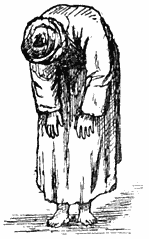
THE RUKUʿ.
The Takbīr-i-Rukūʿ, said whilst making an inclination of the head and body and placing the hands upon the knees, separating the fingers a little.
“God is great!”
The Tasbīḥ-i-Rukūʿ, said in the same posture.
“I extol the holiness of my Lord, the Great!
(The Shīʿahs here add “and with His praise.” This is also added by the Shīʿahs to the Tasbīḥ-i-Sijdah.)
“I extol the holiness of my Lord, the Great!
“I extol the holiness of my Lord, the Great!”
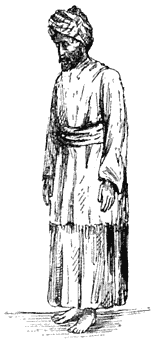
THE TASMIʿ.
The Qiyām-i-Samiʿ Ullah or Tasmīʿ, said with the body erect, but, unlike the former Qiyām, the hands being placed on either side. The Imām says aloud (when the prayers are said by a person alone, he recites both sentences):—
“God hears him who praises Him.”
The people then respond in a low voice—
“O Lord, Thou art praised.”

TAKBIRU ʾS-SIJDAH.
Takbīr-i-Sijdah, said as the worshipper drops on his knees.
“God is great!”
Tasbīḥ-i-Sijdah, recited as the worshipper puts first his nose and then his forehead to the ground.
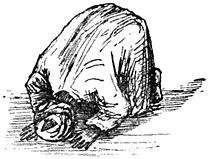
THE TASBIH-I-SIJDAH.
“I extol the holiness of my Lord, the most High!
“I extol the holiness of my Lord, the most High!
“I extol the holiness of my Lord, the most High!”
Then raising his head and body and sinking backward upon his heels, and placing his hands upon his thighs, he says the Takbīr-i-Jalsah (the Shīʿahs here omit the Takbīr, and say instead, “I rise and sit by the power of God!”)
“God is great!”
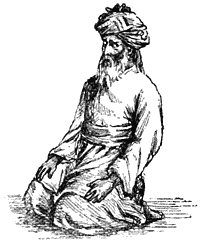
THE TAKBIR-I-JALSAH.
Then, whilst prostrating as before, he says the Takbīr-i-Sijdah.
“God is great!”
And then during the prostration the Tasbīḥ-i-Sijdah as before.
“I extol the holiness of my Lord, the most High!
“I extol the holiness of my Lord, the most High!
“I extol the holiness of my Lord, the most High!”
Then, if at the close of one rakʿah, he repeats the Takbīr standing, when it is called Takbīr-i-Qiyām; but at the end of two rakʿahs, and at the close of the prayer, he repeats it sitting, when it is called Takbīr-i-Quʿūd. (The Shīʿahs here recite the Takbīr:—“God is great!” with the thumbs touching the lobules of the ear, and add, “I seek forgiveness from God, my Lord, and I repent before Him!”)
“God is great!”

THE TAHIYAH.
Here ends one rakʿah or form of prayer. The next rakʿah begins with the Fātiḥah or 1st chapter of the Qurʾān. At the close of every two rakʿahs he recites the Taḥīyah, which is said whilst kneeling upon the ground. His left foot bent under him he sits upon it, and places his hands upon his knees and says (the Shīʿahs omit the Taḥīyah):—
“The adorations of the tongue are for God, and also the adorations of the body, and alms-giving!
“Peace be on thee, O Prophet, with the mercy of God and His blessing!
“Peace be upon us and upon God’s righteous servants!”
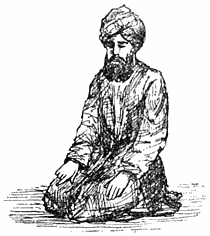
THE TASHAHHUD.
Then raising the first finger of the right hand he recites the Tashahhūd:—
“I testify that there is no deity but God (the Shīʿahs add, “who has no partner”); and I testify that Muḥammad is the servant of God, and the messenger of God!”
(Every two rakʿahs close with the Tashahhud. The Darūd is said whilst in the same posture.)
“O God, have mercy on Muḥammad and on his descendants (the Shīʿahs merely recite: “God have mercy on Muḥammad and his descendants”; and omit the rest), as Thou didst have mercy on Abraham and on his descendants. Thou art to be praised, and Thou art great. O God, bless Muḥammad and his descendants, as Thou didst bless Abraham and his descendants!
“Thou art to be praised, and Thou art great!”
Then the Duʿāʾ:—
“O God our Lord, give us the blessings of this life, and also the blessings of life everlasting. Save us from the torments of fire.”
(The Duʿāʾ is omitted by the Shīʿahs, who recite the following instead: “Peace be on thee, O Prophet, with the mercy of God and His blessing! Peace be upon us, and upon God’s righteous servants!”)
He then closes with the Salām.
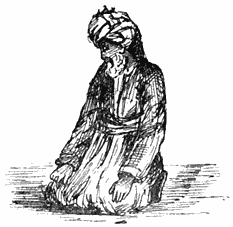
THE SALAM.
Turning the head round to the right, he says:—
“The peace and mercy of God be with you.”
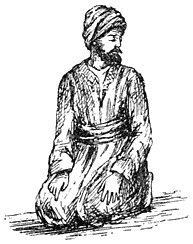
THE SALAM.
Turning the head round to the left, he says:—
“The peace and mercy of God be with you.”
At the close of the whole set of prayers, that is of Farẓ, Sunnah, Nafl, or Witr, the worshipper raises his hands and offers up a Munājāt, or “supplication.” This usually consists of prayers selected from the Qurʾān or Ḥadīs̤. They ought to be said in Arabic, although they are frequently offered up in the vernacular.
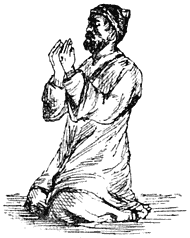
THE MUNAJAT.
Such supplications were highly commended by Muḥammad, who is related to have said:—
“Supplication is the marrow of worship.”
“There is nothing better before God than supplication.”
“Supplicate God when ye are certain of its approval, and know that God accepts not the supplication of a negligent heart.”
“Verily your Lord is ashamed of his servants when they raise up their hands to Him in supplication to return them empty.”
These daily prayers are either Farẓ, Sunnah, Nafl, or Witr. Farẓ, are those rakʿahs (or forms of prayer), said to be enjoined by God. Sunnah, those founded on the practice of Muḥammad. Nafl, the voluntary performance of two rakʿahs, or more, which may be omitted without sin. Witr, an odd number of rakʿahs, either one, three, five, or seven, said after the night prayer. These divisions of prayer are entirely distinct from each other. They each begin afresh with the Nīyah, and worshippers may rest for a while between them, but not converse on worldly subjects. The Wahhābīs think it correct to say the Sunnah prayers in their houses and only the Farẓ prayers in the mosque.
The five times of prayer are known as Z̤uhr, ʿAṣr, Mag͟hrib, ʿIshāʾ, and Fajr. There are also three voluntary periods called Ishrāq, Ẓuḥā, and Tahajjud.
The following is a table showing the exact number of rakʿahs to be performed at each service:—
No. Time. The Names of the Time of Prayer. The Number of Rakʿahs said.
Arabic. Persian. Urdu. Sunnat-i-g͟hair-i-muʾakkadah. Sunnat-i-muʾakkadah. Farz. Sunnah after Farz. Nafl. Witr.
The Five Periods of Prayer. 1 From dawn to sunrise. Ṣalātu ʾl-Fajr. Namāz-i-Subḥ. Fajr Kī Namāz. 2 2

2 When the sun has begun to decline. Ṣalātu ʾz̤-Z̤uhr. Namāz-i-Peshīn. Z̤uhr Kī Namāz. 4 4 2 2
3 Midway between No. 2 and 4. Ṣalātu ʾl-ʿAṣr. Namāz-i-Dīgar. ʿAṣr Kī Namāz. 4 4
4 A few minutes after sunset. Ṣalātu ʾl-Mag͟hrib. Namāz-i-Shām. Mag͟hrib Kī Namāz. 3 2 2
5 When the night has closed in. Ṣalātu ʾl-ʿIshā. Namāz-i-K͟huftan. ʿIshāʾ Kī Namāz. 4 4 2 2 7
The periods which are voluntary. 1 When the sun has well risen. Ṣalātu ʾl-ʿIshrāq. Namāz-i-ʿIshrāq. ʿIshrāq Kī Namāz. 8

2 About 11 o’clock A.M. Ṣalātu ʾẓ-Ẓuḥā. Namāz-i-Chast. Ẓuḥā Kī Namāz. 8
3 After midnight. Ṣalātu ʾt-Tahajjud. Namāz-i-Tahajjud. Tahajjud Kī Namāz. 9
According to the above table, a devout Muslim recites the same form of prayer at least seventy-five times in the day.
ʿAbdu ʾllāh ibn ʿUmar relates that the Prophet said, “The time for Z̤uhr prayers begins from the inclination of the sun towards the west and closes at the time when the shadow of a person shall be the length of his own stature, which time marks the beginning of the ʿAṣr prayers, and the time of the ʿAṣr prayers is from that time till the sun assumes a yellow appearance. The time of Mag͟hrib prayers is from sunset as long as the red appearance in the horizon remains. The time of ʿIshāʾ prayers is from that time till midnight. And the time of the Fajr prayers is from the break of day till the sun rises. Therefore, when the sun has risen you must not recite the morning prayer, for the sun rises between the horns of the devil.” (Mishkāt, book iv. ch. ii.)
It is the ordinary custom of Muslims to say their prayers with their feet uncovered, but strictly according to the Traditions it is lawful to cover the feet with boots or shoes during prayer, provided they are free from impurity.
Shaddād ibn Aus relates that Muḥammad said, “Act the reverse of the Jews in your prayer, for they do not pray in boots and shoes.”
Abū Saʿīd al-K͟hudrī relates that “the Prophet said prayers with his companions, and all on a sudden took off his shoes, and put them down on his left side, and when the people observed it, they took off theirs also; and when the Prophet had finished the prayers, he said, ‘What caused you to take off your shoes?’ They replied, ‘We did so in order to follow your example.’ And the Prophet said, ‘Verily Gabriel came to me and told me there was a little filth upon my shoes; therefore, when any one of you goes into a Masjid, look well at your shoes first; and if you perceive any dirt, wipe it off, and then say your prayers in them.’ ” (Mishkāt, book iv. ch. ix. pt. 2.)
Any wandering of the eyes, or of the mind, a coughing or the like, answering a question, or any action not prescribed to be performed, must be strictly avoided (unless it is between the Sunnah prayers and the farẓ, or be difficult to avoid; for it is held allowable to make three slight irregular motions, or deviations from correct deportment); otherwise, the worshipper must begin again and recite his prayers with due reverence.
If a person arrive late, he merely recites the Nīyah and Takbīr, and then joins the congregation in that part of the service in which they are engaged.
The Muslim may say his five daily prayers in his home, or shop, or in the street or road, but there are said to be special blessings attending prayer recited in a congregation.
In addition to the daily prayers, the following are special services for special occasions:—
Ṣalātu ʾl-Jumʿah.—“The Friday Prayer.” It consists of two rakʿahs after the daily meridian prayer.
Ṣalātu ʾl-Musāfir.—“Prayers for a traveller.” Two rakʿahs instead of the usual number at the meridian, afternoon, and night prayers.
Ṣalātu ʾl-K͟hauf.—“The prayers of fear.” Said in time of war. They are two rakʿahs recited first by one regiment or company and then by the other.
Ṣalātu ʾl-Tarāwīḥ.—Twenty rakʿahs recited every evening during the Ramaẓān, immediately after the fifth daily prayer.
Ṣalātu ʾl-Istik͟hārah.—Prayers for success or guidance. The person who is about to undertake any special business performs two rakʿah prayers and then goes to sleep. During his slumbers he may expect to have “ilhām,” or inspiration, as to the undertaking for which he seeks guidance!
Ṣalātu ʾl-K͟husūf.—Two rakʿahs said at the time of an eclipse of the moon.
Ṣalātu ʾl-Kusūf.—Two rakʿahs said at the time of an eclipse of the sun.
Ṣalātu ʾl-Istisqāʾ.—Prayer in time of drought, consisting of two rakʿahs.
Ṣalātu ʾl-Janāzah.—Prayers at a funeral. [JANAZAH.]
The liturgical service of the Muslim is not given in the Qurʾān, but is founded upon very minute instructions given by the Prophet, and which are recorded in the Traditions, and for which the Arabic scholar can refer to Ṣaḥīḥu ʾl-Buk͟hārī, vol. i. p. 50; Ṣaḥīḥu Muslim, vol. i. p. 164; Sunanu ʾt-Tirmiẕī, p. 22; Sunanu Abū Dāʾūd, p. 56; Sunanu Muwat̤t̤aʾ, p. 50; and the English reader to Matthew’s Mishkāt, book iv.
The following are selections from the sayings of Muḥammad with reference to the Liturgical prayers (vide Mishkāt, book iv.):—
“That which leads a creature into infidelity is neglect of prayers.”
“Not one of you must say your prayers in a garment without covering your whole body.”
“God accepts not the prayers of a woman arrived at puberty unless she covers her head.”
“People must not lift up their eyes whilst saying their prayers, or they will become blind.”
“The prayers which are said in congregation increase the rewards of those said alone by twenty seven degrees.” [MOSQUE.]
“The five stated prayers erase the sins which have been committed during the intervals between them, if they have not been mortal sins.”
“That prayer preparatory to which the teeth shall have been cleaned with the Miswāk is more excellent than the prayer without Miswāk by seventy.” [MISWAK.]
“The prayers of a person will not be accepted who has broken his ablution until he completes another ablution.”
“That person who leaves even one hair without washing after uncleanness, will be punished in hell accordingly.”
“When any one of you stands up for prayer, he must not smooth the ground by wiping away pebbles, because the compassion of God descends upon him at that time.”
“Order your children to say the stated prayers when they are seven years of age, and beat them if they do not do so when they are ten years old; and when they reach ten years, divide their beds.”
“When you stand up to prayer, spit not in front, because you are then in God’s presence; neither spit on your right side, because an angel is there. Spit, therefore either on your left side or under your feet, and then throw earth over it.”
“Whoever says twelve rakʿahs of Sunnah prayers in the day and night, will have a house built for him in Paradise; four rakʿahs before the noon-day prayer, and two rakʿahs after it, and two after sunset prayer, and two rakʿahs after evening prayer, and two before morning prayer.”
“ ‘Tell me if any one of you had a rivulet before his door and bathed five times a day in it, whether any dirt would remain upon his body.’ The Companions said, ‘Nothing would remain.’ The Prophet said, ‘In this manner will the five daily prayers as ordered by God erase all little sins.’ ”
“When any one of you says his prayers, he must have something in front of him, but if he cannot find anything for that purpose, he must put his walking-stick into the ground; but if the ground be hard, then let him place it lengthways in front of him; but if he has no staff, he must draw a line on the ground, after which there will be no detriment in the prayers from anyone passing in front of it.” [SUTRAH.]
“The best prayers for God were those of David the prophet, and the best fast are his also. David used to sleep half the night and would be woke, and in prayer a third part of the night and would fast one day and eat another.”
The form of prayer, or rakʿahs, as given above, admit of no variations whether they are used in private or public, and consequently, notwithstanding the beauty of its devotional language, it is simply a superstitious act, having very little in common with the Christian idea of prayer.
We translate the Arabic Ṣalāt, and the Persian Namāz by the English word prayer, although this “second foundation” of the religion of Muḥammad is something quite distinct from that prayer which the Christian poet so well describes as the “soul’s sincere desire uttered or unexpressed.” It would be more correct to speak of the Muḥammadan Ṣalāt as a service; “prayer” being more correctly rendered by the Arabic duʿāʾ. In Islām prayer is reduced to a mechanical act, as distinct from a mental act; and in judging of the spiritual character of Muḥammadanism, we must take into careful consideration the precise character of that devotional service which every Muslim is required to render to God at least five times a day, and which undoubtedly, exercise so great an influence upon the character of the followers of Muḥammad.
The devotions of Islām are essentially “vain repetitions,” for they must be said in the Arabic language, and admit of no change or variety. The effect of such a constant round of devotional forms, which are but the service of the lips, on the vast majority of Muḥammadans, can be easily imagined. The absence of anything like true devotion from these services, accounts for the fact that religion and true piety stand so far apart in the practice of Islām.
The late Dean Stanley remarks (Eastern Church, p. 279), “The ceremonial character of the religion of Musalmāns is, in spite of its simplicity, carried to a pitch beyond the utmost demands either of Rome or of Russia.… Prayer is reduced to a mechanical act as distinct from a mental act, beyond any ritual observances in the West. It is striking to see the figures along the banks of the Nile going through their prostrations, at the rising of the sun, with the uniformity and regularity of clockwork; but it resembles the worship of machines rather than of reasonable beings.”
PRAYERS FOR THE DEAD. According to the teaching of Muḥammad, it is the duty of all true Muslims to pray for the dead. (Durru ʾl-Muk͟htār, p. 135.) See also Mishkāt, book v. chap. iii.
“God most certainly exalts the degree of a virtuous servant in Paradise, and the virtuous servant says, ‘O my Lord, from whence is this exalted degree for me?’ and God says, ‘It is on account of your children asking pardon for you.’”
“The Prophet passed by graves in al-Madīnah and turned his face towards them, and said, ‘Peace be to you, O inhabitants of the graves! may God forgive us and you. Ye have passed on before us, and we are following you.’”
“A dead person in the grave is like one over his head in water, who calls to somebody to take him by the hand. For he has hope that his father or mother, or his brother, or his friend will pray for him. For when the prayer reaches the dead person, it is more esteemed by him than the whole world, and all that is in it; and verily God most certainly gives to the dead, on account of the prayers of the people of the earth, rewards like mountains, for verily the offerings of the living for the dead are asking forgiveness for them.”
Sūrah lxxi. 29: “And Noah said, O my God, forgive me and my parents.”
Sūrah ix. 114, 115: “It is not for the Prophet to pray for the forgiveness of those, who, even though they be near of kin, associate other gods with God, after it hath been made clear to them that they are to be the inmates of hell. For neither did Abraham ask forgiveness for his father, but in pursuance of a promise which he had promised him, and when it was shown him that he was an enemy of God, he declared himself clear of him: yet Abraham was pitiful and kind.”
It is related in the Traditions that the Prophet visited his mother’s grave, and wept in such a way as to cause those who were standing around him to weep also. And the Prophet said, “I have asked my benefactor permission to ask pardon for my mother, which was not granted then. I asked my Lord’s permission to visit her grave and it was granted, therefore do ye visit graves, because they remind you of death.”
PREACHER. Preaching. There are four words generally used for a preacher: k͟hat̤īb (خطيب), muẕakkir (مذكر), wāʿiz̤ (واعظ), and nāṣiḥ (ناصح).
K͟hat̤īb is always applied to the official who recites the k͟hut̤bah, or oration, in the Friday service. The other three terms are applied generally to preachers.
In the present day, preaching seldom takes place in a mosque except on Fridays, when the k͟hut̤bah is recited, although it is not forbidden, and Muḥammad was frequently in the habit of addressing his people after the prayers were over.
No Maulawī of reputation preaches in the street, but paid preachers sometimes undertake the office.
PREDESTINATION. Arabic qadar (قدر), the word generally used in the Ḥadīs̤; taqdīr (تقدير), the word usually employed in theological works. Expressions which mean “measuring out,” or “preordering.”
Taqdīr, or the absolute decree of good and evil, is the sixth article of the Muḥammadan creed, and the orthodox believe that whatever has, or shall come to pass in this world, whether it be good or bad, proceeds entirely from the Divine Will, and has been irrevocably fixed and recorded on a preserved tablet by the pen of fate. The doctrine, which forms a very important feature in the Muslim system, is thus taught in the Qurʾān:—
Sūrah liv. 49: “All things have been created after fixed decree” (qadar).
Sūrah iii. 139: “No one can die except by God’s permission according to the book that fixeth the term of life.”
Sūrah lxxxvii. 2: “The Lord hath created and balanced all things and hath fixed their destinies and guided them.”
Sūrah viii. 17: “God slew them, and those shafts were God’s, not thine.”
Sūrah ix. 51: “By no means can aught befall us but what God has destined for us.”
Sūrah xiii. 30: “All sovereignty is in the hands of God.”
Sūrah xiv. 4: “God misleadeth whom He will, and whom He will He guideth.”
Sūrah xviii. 101: “The infidels whose eyes were veiled from my warning and had no power to hear.”
The teaching of Muḥammad, as given in the Traditions handed down by al-Buk͟hārī and Muslim, is as follows:—
“God created Adam, and touched his back with his right hand, and brought forth from it a family; and God said to Adam, ‘I have created this family for Paradise, and their actions will be like unto those of the people of Paradise.’ Then God touched the back of Adam, and brought forth another family, and said, ‘I have created this for hell, and their actions will be like unto those of the people of hell.’ Then a man said to the Prophet, ‘Of what use will deeds of any kind be?’ He said, ‘When God createth His servant for Paradise, his actions will be deserving of it until he die, when he will enter therein; and when God createth one for the fire, his actions will be like those of the people of hell till he die, when he will enter therein.’ ”
“ ‘There is not one amongst you whose place is not written by God, whether in the fire or in Paradise.’ The Companions said, ‘O Prophet! since God hath appointed our places, may we confide in this and abandon our religious and moral duties?’ He said, ‘No; because the righteous will do good works and the wicked will do bad works.’ After which the Prophet read this verse from the Qurʾān: ‘To him who giveth alms, and feareth God, and yieldeth assent to the excellent creed, to him will we make easy the path to happiness. But to him who is worldly and is indifferent, and who does not believe in the excellent creed, to him will we make easy the path of misery.’ ”
“The first thing which God created was a pen, and He said to it ‘Write’; it said, ‘What shall I write?’ And God said, ‘Write down the quantity of every individual thing to be created,’ and it wrote all that was and that will be, to eternity.”
“God hath pre-ordained five things on his servants; the duration of life, their actions, their dwelling-places, their travels, and their portions.”
“When God hath ordered a creature to die in any particular place, he causeth his wants to direct him to that.”
“There is not one born but is created to Islām, but it is their fathers and mothers who make them Jews and Christians and Majūsī.”
“It was said, ‘O Prophet of God! inform me respecting charms, and the medicines which I swallow, and the shields which I make use of for protection, whether they prevent any of the decrees of God?’ Muḥammad said, ‘These also are by the decree of God.’ ”
“Verily God created Adam from a handful of earth, taken from all parts, and the children of Adam became different, like the earth; some of them red, some white, and some black, some between red, white and black, some gentle, and some severe, some impure and some pure.”
“The Prophet of God was asked about the children of polytheists who might die in their infancy, whether they would go to heaven or hell. He said, ‘God knoweth best what their actions would have been had they lived; it depends on this.’ ”
“The Prophet of God came out of his house when the Companions were debating about fate, and he was angry, and became red in the face, to such a degree that you would say the seeds of a pomegranate had been bruised on it. And he said, ‘Hath God ordered you to debate of fate? Was I sent to you for this? Your forefathers were destroyed for debating about fate and destiny; I adjure you not to argue on those points.’ ”
(See Aḥādīs̤u ʾl-Buk͟hārī and Muslim, in loco.) [PRESERVED TABLET.]
The doctrine is expressed in an Arabic treatise on the subject, as follows:—
“Faith in the decrees of God, is that we believe in our heart and confess with our tongue that the Most High God hath decreed all things; so that nothing can happen in the world, whether it respects the conditions and operations of things, or good and evil, or obedience and disobedience, or faith and infidelity, or sickness and health, or riches and poverty, or life and death, that is not contained in the written tablet of the decrees of God. But God hath so decreed good works, obedience, and faith, that He ordains and wills them, and that they may be under His decree, His salutary direction, His good pleasure and command. On the contrary, God hath decreed, and does ordain and determine evil, disobedience and infidelity; yet without His salutary direction, good pleasure, and command; but being only by way of seduction, indignation, and prohibition. But whosoever shall say that God is not delighted with good faith, or that God hath not an indignation against evil and unbelief, he is certainly an infidel.”
The Rev. E. Sell, in his Faith of Islám, page 173, says:—
“There are three well-defined schools of thought on the subject.
“First.—The Jabríans (Jabarīyūn), so called from the word “jabr”, compulsion, deny all free agency in man and say that man is necessarily constrained by the force of God’s eternal and immutable decree to act as he does. They hold that as God is the absolute Lord, He can, if He so wills, admit all men into Paradise, or cast all into hell. This sect is one of the branches of the Ashʾaríans with whom on most points they agree.
“Secondly.—The Qadríans (Qadarīyūn), who deny Al-Qadr, or God’s absolute decree, say that evil and injustice ought not to be attributed to God but to man, who is altogether a free agent. God has given him the power to do or not to do an act. This sect is generally considered to be a branch of the Mutazilite body (Muʿtazilah), though in reality it existed before Wásil quitted the school of his master Hasan. As Wásil, however, followed the opinions of Mábad-al-Johní, the leading Qadrían divine, the Mutazilites and Qadríans are practically one and the same.
“Thirdly.—The Ashʾaríans maintain that God has one eternal will which is applied to whatsoever He willeth, both of His own actions and those of men; that He willeth that which He knoweth and what is written on the preserved table; that He willeth both good and evil. So far they agree with the Jabríans; but then they seem to allow some power to man. The orthodox, or Sunní belief is theoretically Ashʾarían, but practically the Sunnís are confirmed Jabríans. The Mutazilite doctrines are looked upon as quite heretical.
“No subject has been more warmly discussed in Islám than that of predestination. The following abstract of some lengthy discussions will present the points of difference.
“The Ashʾaríans, who in this matter represent in the main orthodox views, formulate their objections to the Mutazilite system thus:—
“(i.) If man is the causer of an action by the force of his own will, then he should also have the power of controlling the result of that action.
“(ii.) If it be granted that man has the power to originate an act, it is necessary that he should know all acts, because a creator should be independent in act and choice. Intention must be conditioned by knowledge. To this the Mutazilites well reply that a man need not know the length of a road before he walks, or the structure of the throat before he talks.
“(iii.) Suppose a man wills to move his body and God at the same time wills it to be steady, then if both intentions come to pass there will be a collection of opposites; if neither, a removal of opposites; if the exaltation of the first, an unreasonable preference.
“(iv.) If man can create an act, some of his works will be better than some of the works of God, e.g. a man determines to have faith: now faith is a better thing than reptiles, which are created by God.
“(v.) If man is free to act, why can he not make at once a human body; why does he need to thank God for grace and faith?
“(vi.) But better far than all argument, the orthodox say, is the testimony of the Book. ‘All things have we created under a fixed decree.’ (Súra liv. 49.) ‘When God created you and that ye make.’ (Súra xxxvii. 94.) ‘Some of them there were whom God guided and there were others decreed to err.’ (Súra xvi. 38.) As God decrees faith and obedience He must be the causer of it, for ‘on the hearts of these hath God graven the Faith.’ (Súra lviii. 22.) ‘It is he who causeth you to laugh and weep, to die and make alive.’ (Súra liii. 44.) ‘If God pleased He would surely bring them, one and all, to the guidance.’ (Súra vi. 36.) ‘Had God pleased, He had guided you all aright.’ (Súra vi. 150.) ‘Had the Lord pleased, He would have made mankind of one religion.’ (Súra xi. 120.) ‘God will mislead whom He pleaseth, and whom He pleaseth He will place upon the straight path.’ (Súra vi. 39.) Tradition records that the Prophet said, ‘God is the maker of all makers and of their actions.’
“The Mutazilites took up the opposite side of this great question and said:—
“(i) If man has no power to will or to do, then what is the difference between praising God and sinning against Him; between faith and infidelity; good and evil; what is the use of commands and prohibitions; rewards and punishments; promises and threats; what is the use of prophets, books, &c.
“(ii.) Some acts of men are bad, such as tyranny and polytheism. If these are created by God, it follows that to tyrannise and to ascribe plurality to the Deity is to render obedience. To this the Ashʾaríans reply that orders are of two kinds, immediate and mediate. The former, which they call ‘Amr-i-takwíní,’ is the order, ‘Be and it was.’ This comprehends all existences and according to it whatever is ordered must come to pass. The latter they call ‘Amr-i-tashríʾí,’ an order given in the Law. This comes to men through prophets and thus is to be obeyed. True obedience is to act according to that which is revealed, not according to the secret intention of God, for that we know not.
“(iii.) If God decrees the acts of men, He should bear the name of that which he decrees. Thus the causer of infidelity is an infidel; of tyranny a tyrant, and so on; but to speak thus of God is blasphemy.
“(iv.) If infidelity is decreed by God He must wish it; but a prophet desires faith and obedience and so is opposed to God. To this the orthodox reply, that God knows by His eternal knowledge that such a man will die an infidel. If a prophet intends by bringing the message of salvation to such an one to make God’s knowledge become ignorance, he would be doing wrong; but as he does not know the secret decrees of God, his duty is to deliver his message according to the Hadís: ‘A prophet has only to deliver the clear message.’
“(v.) The Mutazilites claimed as on their side all verses of the Qurán, in which the words to do, to construct, to renew, to create, &c., are applied to men. Such are the verses: ‘Whatever is in the heavens and the earth is God’s that He may reward those who do evil according to their deeds: and those who do good will He reward with good things.’ (Súra liii. 32.) ‘Whoso shall have wrought evil shall not be recompensed but with its like: but whoso shall have done the things that are right, whether male or female and is a believer, these shall enter Paradise.’ (Súra xl. 43.) ‘Say: the truth is from the Lord; let him then who will, believe; and let him who will, be an infidel.’ (Súra xviii. 28.) ‘Those who add gods to God will say: ‘If God had pleased neither we nor our fathers had given Him companions.’ ‘Say: Verily ye follow only a conceit, ye utter lies.’ (Súra vi. 149.) The Hadís is also very plain. ‘All good is in Thy hands and evil is not to Thee.’
“The Ashʾaríans have one famous text which they bring to bear against all this reasoning and evidence. It is: ‘This truly is a warning; and whoso willeth, taketh the way of his Lord; but will it ye shall not, unless God will it, for God is knowing, wise.’ (Súra lxxvi. 29, 30.) To the Hadís they reply (1) that there is a difference between acquiescence in evil and decreeing it. Thus the expression ‘God willeth not tyranny for His servants,’ does not mean that God hath not decreed it, but that tyranny is not one of His attributes: so ‘evil is not to Thee’ means it is not an attribute of God; and (2) the Hadís must be explained in accordance with the teaching of the Qurán.
“The Muslim philosophers tried to find a way out of the difficulty. Averhoes says: ‘We are free to act in this way or that, but our will is always determined by some exterior cause. For example, we see something which pleases us, we are drawn to it in spite of ourselves. Our will is thus bound by exterior causes. These causes exist according to a certain order of things which is founded on the general laws of nature. God alone knows beforehand the necessary connection which to us is a mystery. The connection of our will with exterior causes is determined by the laws of nature. It is this which in theology we call, ‘decrees and predestination.’ ” (Mélanges de Philosophie Juive et Arabe, par S. Munk, p. 458.)
PRE-EMPTION. Arabic Shufʿah (شفعة). Lit. “Adjunction.” The right of pre-emption is a power of possessing property which is for sale, and is established upon the teaching of Muḥammad. It applies not to movable property but to immovable property (ʿaqār). This right of pre-emption appertains in the first place to the co-sharer or partner in the property; secondly, to a sharer in the immunities and appendages of the property, such as the right to water, or to roads; and thirdly, to the neighbour. (Hidāyah, vol. iii. p. 594.)
PRE-EXISTENCE OF SOULS is taught both in the Qurʾān and the Traditions.
ʿĀyishah relates that Muḥammad said, “Souls before they became united with bodies were like assembled armies, and afterwards they were dispersed and sent into the bodies of mankind.” (Mishkāt, book xxii. ch. xvi.)
There is said to be a reference to this doctrine in the Qurʾān:—
Sūrah vii. 171: “And when the Lord drew forth their posterity from the loins of the sons of Adam.…”
The commentator, al-Baiẓāwī, says, “God stroked Adam’s back and extracted from his loins his whole posterity, which should come into the world until the Resurrection, one generation after another; and that these souls were all assembled together like small ants, and after they had in the presence of the angels confessed their dependence upon God, they were again caused to return into the loins of Adam.” (See Tafsīru ʾl-Baiẓāwī, in loco.)
PRESERVED TABLET. According to the teaching of Muḥammad, both the actions of men and the Qurʾān were recorded before creation upon a preserved tablet called Lauḥ Maḥfuz̤ (لوح محفوظ), Sūrah xxxv. 22: “And if they treat thee as a liar, so did those who were before them treat their Apostles who came to them with the proofs of their mission, and with the Scriptures and with the clear Book”; and Imām Mubīn (امام مبين), Sūrah xxxvi. 11: “Verily, it is We who will quicken the dead, and write down the works which they have sent on before them, and the traces which they shall have left behind them: and everything have we set down in the clear Book of our decrees.” [PREDESTINATION, QURʾAN.]
PRIDE, Arabic kibr (كبر), is forbidden in the Qurʾān, see Sūrah xvii. 39: “Walk not proudly on the earth; truly thou canst by no means cleave the earth, neither canst thou reach the mountains in height: all this is evil with thy Lord and odious.”
PRIEST. There is no sacerdotal class of ministers in the Muḥammadan religion. The leader of the daily prayers is called an Imām. [IMAM.]
PRIVACY OF DWELLINGS is established by the teaching of Muḥammad, and it is therefore unlawful to enter the house without Istiʾẕān, or “asking permission.” The injunction is given in the Qurʾān, Sūrah xxiv. 27–29:—
“O ye who believe! enter not into other houses than your own, until ye have asked leave, and have saluted its inmates. This will be best for you: haply ye will bear this in mind. And if ye find no one therein, then enter it not till leave be given you; and if it be said to you, ‘Go ye back,’ then go ye back. This will be more blameless in you, and God knoweth what ye do. There shall be no harm in your entering houses in which no one dwelleth, for the supply of your needs: and God knoweth what ye do openly and what ye hide.”
ʿAtāʾ ibn Yasār relates that “A man once asked the Prophet, ‘Must I ask leave to go into the room of my mother?’ The Prophet said, ‘Yes.’ Then the man said, ‘But I live in the same home.’ The Prophet said, ‘Yes, even if you live in the same home.’ The man said, ‘But I wait upon her!’ The Prophet, ‘But you must ask permission; for, what! would you like to see your mother naked?’ ”
It is further related that Muḥammad always went first to the right and then to the left of a door which had no curtain, and salamed several times before he entered. (Mishkāt, book xxii. ch. ii.)
This has become an established rule in the East, and it is considered very rude to enter any dwelling without first giving notice.
PROHIBITED DEGREES OF MARRIAGE. According to the Qurʾān they are seven: 1, mother; 2, daughter; 3, sister; 4, paternal aunt; 5, maternal aunt; 6, sister’s daughter; 7, brother’s daughter. And the same with regard to the other sex. It is also unlawful for a Muslim to marry his wife’s sister (see Lev. xviii. 18) or his wife’s aunt during the lifetime of his wife. Fosterage in Muslim law establishes relationship, and therefore a foster-sister or a foster-brother is unlawful in marriage. [MARRIAGE.]
PROPHET. The Arabic words used to express the prophetic office are nabī (نبى), pl. ambīyāʾ; rasūl (رسول), pl. rusul; and mursal (مرسل), pl. mursalūn. In Persian, the three titles are invariably translated by the word paig͟hambar (پيغمبر) (i.e. a messenger).
Nabī is the Hebrew nābī נָבִיא, which Gesenius says means “one who bubbles forth” as a fountain. The Arabic lexicon, the Qāmūs, derives the word from nubūʾ, “to be exalted.”
According to Muḥammadan writers a nabī is anyone directly inspired by God, and rasūl and mursal, one to whom a special mission has been entrusted.
Muḥammad is related to have said (Mishkāt, book xxiv. ch. i. pt. 3) that there were 124,000 ambiyāʾ, or prophets, and 315 apostles or messengers. Nine of these special messengers are entitled Ūlū ʾl-ʿAzm, or “possessors of constancy,” namely, Noah, Abraham, David, Jacob, Joseph, Job, Moses, Jesus, and Muḥammad. Six are dignified with special titles: Adam, Ṣafīyu ʾllāh, the Chosen of God; Noah, Nabīyu ʾllāh, the Preacher of God; Abraham, K͟halīlu ʾllāh, the Friend of God; Moses, Kalīmu ʾllāh, the Converser with God; Jesus, Rūḥu ʾllāh, the Spirit of God; Muḥammad, Rasūlu ʾllāh, the Messenger of God.
The number of sacred books delivered to mankind is said to have been 104 (see Majālisu ʾl-Abrār, p. 55); of these, ten were given to Adam, fifty to Seth (a name not mentioned in the Qurʾān), thirty to Enoch, ten to Abraham, the Taurāt to Moses, the Zabūr to David, the Injīl to Jesus, and the Qurʾān to Muḥammad.
The one hundred scriptures given to Adam, Seth, Enoch, and Abraham are termed Ṣaḥīfah (a pamphlet), and the other four Kitāb (a book); but all that is necessary for the Muslim to know of these inspired records is supposed to have been retained in the Qurʾān.
Muḥammad’s enumeration of the Old and New Testament prophets, both as to name and chronological order, is exceedingly confused, and it is acknowledged to be a matter of doubt amongst Muslim commentators whether or not Alexander the Great and Æsop were inspired prophets.
The names of twenty-eight prophets are said to occur in the Qurʾān:—
Adam, Adam; Idrīs, Enoch; Nūḥ, Noah; Hūd, Heber?; Ṣāliḥ, Methusaleh; Ibrāhīm, Abraham; Ismāʿīl, Ishmael; Isḥāq, Isaac; Yaʿqūb, Jacob; Yūsuf, Joseph; Lūt̤, Lot; Mūsā, Moses; Hārūn, Aaron; Shuʿaib, Jethro?; Zakarīyā, Zacharias, the father of John the Baptist; Yaḥyā, John Baptist; ʿĪsā, Jesus; Dāʾūd, David; Sulaimān, Solomon; Ilyās, Elias; Alyasaʿ, Elisha; Aiyūb, Job; Yūnus, Jonah; ʿUzair, Ezra; Luqmān, Æsop? more likely Balaam; Ẕū ʾl-Kifl, Isaiah or Obadiah?; Ẕū ʾl-Qarnain, Alexander the Great.
An account of these prophets will be found under their respective names.
A Persian book, entitled the Qiṣaṣu ʾl-Ambiyāʾ, the “Tales of the Prophets,” professes to give an account of the prophets mentioned in the Qurʾān, but the utter recklessness of the writer passes all description; for example, it is a matter of uncertainty whether Ẕū ʾl-Qarnain is Alexander the Great or some celebrity who lived in the days of Abraham!
PROPHETESSES. It is said that only three women have been prophetesses: Sarah, the mother of Moses, and Mary, the daughter of ʿImrān; for Sarah received by revelation the news of Isaac’s birth, the birth of Moses was divinely communicated to his mother, and Mary received from an angel the happy tidings of the birth of Jesus. (See Hist. of Temple of Jerusalem, translated from the Arabic.)
PSALMS OF DAVID, The. [ZABUR.]
PUBERTY. Arabic bulūg͟h (بلوغ) bulug͟hīyat (بلوغية). The puberty of a boy is established as soon as the usual signs of manhood are known to exist; but if none of these signs exist, his puberty is not clearly established until he have completed his eighteenth year. The puberty of a girl is established in the same way; but if the usual signs of womanhood are known not to exist, her puberty is not established until her seventeenth year has been completed. This is according to the teaching of the Imām Abū Ḥanīfah. But his two disciples maintain that upon either a boy or girl completing the fifteenth year, they are to be declared adult. The Imām ash-Shāfiʿī concurs in this opinion, and it is said there is also a report of Abū Ḥanīfah to the same effect. The earliest period of puberty with respect to a boy is twelve years, and with respect to a girl nine years.
When a boy or girl approaches the age of puberty and they declare themselves adult, their declaration must be credited, and they then become subject to all the laws affecting adults, and must observe all the ordinances of the Muslim faith. (Hidāyah, Hamilton’s Translation, vol. iii. p. 483; Jāmiʿu ʾr-Rumūz, Durru ʾl-Muk͟htār.)
Syed Ameer Ali says:—
“The validity of marriages contracted for minors by any guardian other than the father or the grandfather, is not established until ratified by the parties on arriving at puberty. Such ratification in the case of males must be express, and in the case of females may be either express or implied. On arriving at puberty, both the parties have the right of either ratifying the contract entered into during their minority or of cancelling it. According to the Sunnis, in order to effect a dissolution of the matrimonial tie, in exercise of the right of option reserved to the parties, it is necessary that there should be a decree of the judge; and until such decree is made, the marriage remains intact. If before a decree has been obtained one of the parties should die, the survivor would be entitled to inherit from the deceased.
“The Shiahs differ materially from the Sunnis on this. They hold that a marriage contracted on behalf of minors by any unauthorised person (fazûlî), i.e. any person other than a father or a grandfather, remains in absolute suspension or abeyance until assented to by the parties on arriving at puberty; that, in fact, no legal effect arises from it until such ratification, and if in the interval previous to ratification, one of the parties should die, the contract would fall to the ground and there would be no right of inheritance in the survivor.” (Personal Law of the Mahommedans, p. 269.)
PULPIT. The pulpit or mimbar (منبر) used for the recital of the k͟hut̤bah on Fridays in the chief mosque is usually a wooden structure of three steps and movable, but in the large mosques of Turkey and Egypt it is a fixture of brick or stone.
It is related that the Prophet, when addressing the people, stood on the uttermost step, Abū Bakr on the second, and ʿUmar on the third or lowest. ʿUs̤mān being the most humble of men, would gladly have descended lower, but this being impossible, he fixed upon the second step, from which it is now usual to recite the k͟hut̤bah on Fridays and on the two great festivals. [MOSQUE, MIMBAR.]
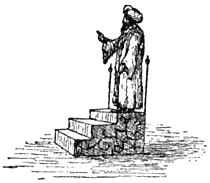
A MIMBAR.
(W. S. Chadwick.)
PUNISHMENT is divided into three classes: (1) Ḥadd (حد), (2) Qiṣāṣ (قصاص), (3) Taʿẕīb (تعذيب).
(1) Ḥadd (حد), pl. Ḥudūd (lit. “That which is defined”), is that punishment the limits of which have been defined in the Qurʾān and Ḥadīs̤. The following belong to this class:—
(a) Adultery, zināʾ (زناء), for which the adulterer must be stoned, rajm (رجم). (Mishkāt, book xv. ch. 1.)
(b) Fornication, zināʾ (زناء), for which the guilty persons must receive one hundred stripes. (Qurʾān, Sūrah xxiv. 2.)
(c) The false accusation of a married person with adultery, qaẕf (قذف), for which the offender must receive eighty stripes (Qurʾān, Sūrah xxiv. 4.)
(d) Apostacy, irtidād (ارتداد), which is punishable with death. (Mishkāt, book xiv. ch. v.)
(e) Drinking wine, shurb (شرب), for which the offender must receive eighty lashes. (Mishkāt, book xv. ch. iv.)
(f) Theft, sariqah (سرقة), which is punished by cutting off the right hand. (Qurʾān, Sūrah v. 42.)
(g) Highway robbery, qat̤ʿu ʾt̤-t̤arīq (قطع الطريق): for robbery only, the loss of hands and feet, and for robbery with murder, death, either by the sword or crucifixion. (Qurʾān, Sūrah v. 37.)
(2) Qiṣāṣ (قصاص), lit. “retaliation,” is that punishment which, although fixed by the law, can be remitted by the person offended against, or, in the case of a murdered person, by his heirs. It is applicable to cases of murder and of wounding. Qiṣāṣ is the lex talionis of Moses: “Eye for eye, tooth for tooth, burning for burning, wound for wound, stripe for stripe” (Exodus xxi. 24); but in allowing a money compensation, Muḥammad departed from the Jewish Code. (Qurʾān, Sūrah ii. 173.)
(3) Taʿẕīb (تعذيب), is the punishment which is left to the discretion of the Qāẓī or Judge. [HADD, QISAS, TAʿZIB.]
PUNISHMENTS OF THE GRAVE. [AZABU ʾL-QABR.]
PURGATORY. [BARZAKH.]
PURIFICATIONS. Arabic t̤ahārah (طهارة). The legal methods of purification under the Muḥammadan law vary but slightly from those which were enjoined in the Talmudic law of the Jews; with the remarkable difference that whilst with the Muslim the simple act of purification suffices, the Jew was taught by the use of expiatory offering to discern to its full extent the connection between the outward sign and the inward fount of impurity.
The most minute regulations with reference to the subject of legal purification, were laid down in the Jewish law, and are found in a treatise of the Mishna entitled Yadaim. See also Leviticus xv.
The following are the different acts of purification existing in Muḥammadan law:—
1. G͟husl (غسل). The washing of the whole body to absolve it from uncleanliness and to prepare it for the exercise of prayer, after the following acts: pollutio nocturna, menses, coitus, puerperium. [GHUSL.]
2. G͟husl-masnūn (غسل مسنون). Such washings of the whole body as are founded upon the sunnah or practice and precept of Muḥammad, although they are not supposed to be of divine institution, namely, upon the admission of a convert to Islām; before the Friday prayer, on the festivals; after washing the dead; and after blood-letting. [GHUSL MASNUN.]
3. Waẓūʾ (وضوء), or the simple ablution of hands, arms, ears, face, mouth, &c., before the recital of the usual prayers. [ABLUTION.]
4. Tayyammum (تيمم), or the use of sand or dust instead of water for the waẓūʾ. [TAYAMMUM.]
5. Istinjāʾ (استنجاء), or the abstersion of the private parts. [ISTINJAʾ.]
6. Miswāk (مسواك), or the cleansing of the teeth. [MISWAK.]
7. Masaḥ (مسح), or the touching of the boots whereby they become purified for prayer. [MASAH.]
8. Tat̤hīr (تطهير), or the cleansing of vessels, articles of clothing, &c., from impurity, which is generally done by applying either water, or sand and dust, the mere sprinkling being sufficient. [TATHIR.]
Q.
QABĀLAH, QIBĀLAH (قبالة). A deed of conveyance or transfer of right or property. Any contract or bargain or sale signed by a judge. (Hidāyah, vol. ii. p. 569.)
QĀBA QAUSAIN (قاب قوسين). Lit. “Two bows’ length.” An expression which occurs in the Qurʾān, Sūrah liii. 8–10: “Then he drew near and hovered o’er; until he was two bows’ length off or nigher still. Then he revealed to his servant what he revealed him.” Commentators understand this to refer to the angel Gabriel. Mystic writers use the term to express a state of nearness to God. (See ʿAbdu ʾr-Razzāq’s Dict. of Ṣūfī Terms.)
QĀBĪL (قابيل). [CAIN.]
AL-QĀBIẒ (القابض). “The Restrainer.” One of the ninety-nine attributes of God. But the word does not occur in the Qurʾān.
QABR (قبر). A grave. [GRAVE, TOMB.]
QABŪL (قبول). “Consent.” A term in the Muḥammadan law of marriage, contracts, &c.
QABẒ WA BAST̤ (قبض و بسط). Two terms which are employed to express two opposite states of the heart; qabẓ being a contraction, and bast̤, an expansion, of the spiritual state. (See ʿAbdu ʾr-Razzāq’s Dict. of Ṣūfī Terms.)
QAʿDAH (قعدة). The sitting posture in the daily prayer, when the tashahhūd is recited. [TASHAHHUD.]
QADAR (قدر). Lit. “Measuring.” (1) The word generally used in the Ḥadīs̤ for fate, or predestination. (2) Al-Qadar, the title of the XCVIIth Sūrah of the Qurʾān. [TAQDIR, PREDESTINATION.]
QADARĪYAH (قدرية). A sect of Muḥammadans who deny absolute predestination and believe in the power (qadr) of man’s free will. They were the ancient Muʿtazilahs before al-Wāṣil separated from the school of Ḥasan al-Baṣrī.
QADĪM (قديم). “Ancient; old.” Al-Qadīm, “The one without beginning.” Qadīmu ʾl-Aiyām, “Ancient of days.” God.
AL-QĀDIR (القادر). “The Powerful.” One of the ninety-nine attributes of God. The word occurs in the Qurʾān, at Sūrah ii. 19, “God is mighty over all,” and in many other passages.
QĀDIRĪYAH (قادرية). An ascetic order of Faqīrs instituted A.H. 561, by Saiyid ʿAbdu ʾl-Qādir al-Jilānī, surnamed Pīr Dastagīr, whose shrine is at Bag͟hdād. It is the most popular religious order amongst the Sunnīs of Asia. [FAQIR, ZIKR.]
QĀF (قاف). (1) The twenty-first letter of the Arabic alphabet. (2) The title of the Lth Sūrah of the Qurʾān. (3) The circle of mountains which Easterns fancy encompass the world. The Muḥammadan belief being that they are inhabited by demons and jinn, and that the mountain range is of emerald which gives an azure hue to the sky. Hence in Persian az qāf tā qāf means the whole world. The name is also used for Mount Caucasus.
AL-QAHHĀR (القهار). “The Dominant.” One of the ninety-nine names of God. It occurs in the Qurʾān, Sūrah xiii. 17: “He is the One, the Dominant.”
QĀʾIF (قائف). Lit. “Skilful in knowing footsteps.” One who can judge of character from the outward appearance.
One instance of the kind is related in the Traditions, namely, ʿĀyishah relates, “One day the Prophet came home in high spirits, and said, ‘O ʿĀyishah, verily Mujazziz al-Mudliji came and saw Usāmah and Zaid covered over with a cloth, except their feet; and he said, “Verily, I know from these feet the relationship of father and son.” ’ ” (Mishkāt, book xiii. ch. xv. pt. 1.) This knowledge is called ʿIlmu ʾl-Qiyāfah.
QAINUQĀʿ (قينقاع). A Jewish tribe near al-Madīnah in the time of Muḥammad. He besieged them in their stronghold in the second year of the Hijrah, and, having conquered them, sent most of them into exile. (See Muir’s Life of Mahomet, vol. iii. p. 134.)
QAIṢAR (قيصر). [CÆSAR.]
QAIS IBN SAʿD (قيس بن سعد). One of the leading companions. He was of the tribe K͟hazraj and the son of Saʿd, a Companion of note. He was a man of large stature and corpulent, eminent for learning, wisdom, and courage. He commanded the Prophet’s body-guard, and under the K͟halīfah ʿAlī he was made Governor of Egypt. Died at al-Madīnah, A.H. 60.
AL-QAIYŪM (القيوم). “The Self-Subsisting.” One of the ninety-nine attributes of God. It occurs in the Qurʾān, Sūrah iii. 1: “There is no deity but God, the living, the self-subsisting.”
QALAM (قلم). Lit. “A (reed) pen.” (1) The pen with which God is said to have pre-recorded the actions of men. The Prophet said the first thing which God created was the Pen (qalam), and that it wrote down the quantity of every individual thing to be created, all that was and all that will be to all eternity. (See Mishkāt.) (2) Al-Qalam, the title of the LXVIIIth Sūrah of the Qurʾān.
QALANDAR (قلندر). A Persian title to an order of faqīrs or darwīshes. An Ascetic.
AL-QAMAR (القمر). “The moon.” The title of the LIVth Sūrah of the Qurʾān, in the first verse of which the word occurs. “And the moon hath been split in sunder.” [MOON, SHAQQU ʾL-QAMAR.]
QANĀʿAH (قناعة). Contentment; resignation.
QĀNIT (قانت). Lit. “One who stands in prayer or in the service of God.” Godly, devout, prayerful. The term is used twice in the Qurʾān:—
Sūrah xvi. 121: “Verily, Abraham was a leader in religion and obedient to God.”
Sūrah xxxix. 12: “He who observeth the hours of the night in devotion.”
QĀNŪN (قانون). Κάνων. Canon; a rule, a regulation, a law, a statute.
QARĀBAH (قرابة). Lit. “Proximity.” A legal term in Muḥammadan law for relationship.
QĀRIʾ (قارى), pl. qurrāʾ. “A reader.” A term used for one who reads the Qurʾān correctly, and is acquainted with the ʿIlmu ʾt-Tajwīd, or the science of reading the Qurʾān. In the history of Islām there are seven celebrated Qurrāʾ, or “readers,” who are known as al-Qurrāʾu ʾs-Sabʿah, or “the seven readers.” They are—
1. Imām Ibn Kas̤īr. Died at Makkah, A.H. 120.
2. Imām ʿĀsim of al-Kūfah, who learnt the way of reading the Qurʾān from ʿAbdu ʾr-Raḥmān as-Salāmī, who was taught by the K͟halīfahs ʿUs̤mān and ʿAlī. He died at al-Kūfah, A.H. 127.
3. Imām Abū ʿUmr was born at Makkah, A.H. 70, and died at al-Kūfah, A.H. 154. It is on his authority that the following important statement has been handed down: “When the first copy of the Qurʾān was written out and presented to the K͟halīfah ʿUs̤mān, he said, ‘There are faults of language in it, let the Arabs of the desert rectify them with their tongues.’” The meaning of this is that they should pronounce the words correctly but not alter the written copy.
4. Imām Ḥamzah of al-Kūfah was born A.H. 80, and died A.H. 156.
5. Imām al-Kisāʾī who had a great reputation as a Qāriʾ, but none as a poet. It was a common saying, among the learned in grammar, that there was no one who knew so little poetry as al-Kisāʾī. He is said to have died at T̤ūs about the year A.H. 182.
6. Imām Nāfiʿ, a native of al-Madīnah, who died A.H. 169.
7. Imām Ibn ʿĀmir, who was a native of Syria. His date is uncertain.
AL-QĀRIʿAH (القارعة). “The Striking.” The title of the CIst Sūrah of the Qurʾān, which begins with the words, “The Striking! What is the Striking? And what shall make thee understand how terrible the striking will be.”
Jalālu ʾd-dīn says it is one of the epithets given to the last day, because it will strike the hearts of all creatures with terror.
QARĪN (قرين). Lit. “The one united.” The demon which is said to be indissolubly united with every man. (See Mishkāt, book xiii. ch. xv.; also Qurʾān, Sūrah xli. 24; Sūrah xliii. 35; Sūrah l. 22.)
QARĪNAH (قرينة). The context. A term used in theological and exegetical works.
QĀRŪN (قارون). [KORAH.]
QARẒ (قرض). Lit. “Cutting.” (1) A word used in the Qurʾān for good deeds done for God, for which a future recompense will be awarded, e.g. Sūrah v. 15: “Lend God a liberal loan and I will surely put away from you your evil deeds, and will cause you to enter gardens through which rivers flow.”
(2) Money advanced as a loan without interest, to be repaid at the pleasure of the borrower.
(3) The word is used in Persian, Urdū, and Pushtoo for money lent at interest, but the legal term for such a debt is ribā.
QASAM (قسم). [OATH.]
QASĀMAH (قسامة). Lit. “Taking an oath.” An oath under the following circumstances:—
When a person is found slain in a place, and it is not known who was the murderer, and his heirs demand satisfaction for his blood from the inhabitants of the district, then fifty of the inhabitants selected by the next of kin, must be put to their oaths and depose to this effect: “I swear by God that I did not kill him, nor do I know the murderer.”
This custom is founded upon the Mosaic law. See Deut. xxi. 1–9.
AL-QAṢAṢ (القصص). “The narrative.” The title of the XXVIIIth Sūrah of the Qurʾān. So called because in the 25th verse of this chapter Moses is said to have related the narrative of his adventures to Shuʿaib.
QASM (قسم). Lit. “To divide.” A division of conjugal rights, which is enjoined by the Muslim law. (See Mishkāt, book xiii. ch. x.)
AL-QAṢWĀʾ (القصواء). Lit. “One whose ears are cropt.” Muḥammad’s celebrated she-camel who conveyed him in the flight from Makkah.
QATL (قتل). [MURDER.]
QATTĀT (قتات). A slanderer. A tale-bearer, who, according to the Traditions, will not enter the kingdom of heaven; for the Prophet has said, “A tale-bearer shall not enter Paradise.” (Mishkāt, book xxii. ch. x. pt. 1.)
QAT̤ʿU ʾT̤-T̤ARĪQ (قطع الطريق). [HIGHWAY ROBBERY.]
QAUL (قول). A saying; a promise; a covenant. The word occurs in the Qurʾān frequently in these senses.
QAULU ʾL-ḤAQQ (قول الحق). “The Word of Truth.” A title given to Jesus Christ in the Qurʾān, Sūrah xix. 35: “This was Jesus the son of Mary, the word of truth concerning whom they doubt.” By the commentators Ḥusain, al-Kamālān, and ʿAbdu ʾl-Qādir, the words are understood to refer to the statement made, but al-Baiẓāwī says it is a title applied to Jesus the son of Mary. [JESUS CHRIST.]
QAWAD (قود). “Retaliation.” Lex talionis. [MURDER, QISAS, RETALIATION.]
AL-QAWĪ (القوى). “The Strong.” One of the ninety-nine attributes of God. It occurs in the Qurʾān, Sūrah xi. 69: “Thy Lord is the Strong, the Mighty.”
QAẒĀʾ (قضاء), pl. aqẓiyah. Lit. “Consummating.” (1) The office of a Qāẓī, or judge. (2) The sentence of a Qāẓī. (3) Repeating prayers to make up for having omitted them at the appointed time. (4) Making up for an omission in religious duties, such as fasting, &c. (5) The decree existing in the Divine mind from all eternity, and the execution and declaration of a decree at the appointed time. (6) Sudden death.
QAẔF (قذف). Lit. “Throwing at.” Accusing a virtuous man or woman of adultery; the punishment for which is eighty lashes, or, in the case of a slave, forty lashes. This punishment was established by a supposed revelation from heaven, when the Prophet’s favourite wife, ʿĀyishah, was accused of improper intimacy with Ṣafwān Ibnu ʾl-Muʿat̤t̤il. Vide Qurʾān, Sūratu ʾn-Nūr (xxiv.), 4: “But to those who accuse married persons of adultery and produce not four witnesses, them shall ye scourge with four-score stripes.” (Hidāyah, vol. ii. p. 58.)
QIBLAH (قبلة). “Anything opposite.” The direction in which all Muḥammadans must pray, whether in their public or in their private devotions, namely, towards Makkah. It is established by the express injunction of the Qurʾān, contained in the Sūratu ʾl-Baqarah (ii.), 136–145:—
“Fools among men will say, What has turned them from their Qiblah on which they were agreed? Say, God’s is the east and the west, He guides whom He will unto the right path. Thus have we made you a middle nation to be witnesses against men, and that the apostle may be a witness against you. We have not appointed the qiblah on which thou wert agreed, save that we might know who follows the Apostle from him who turns upon his heels, although it is a great thing save to those whom God doth guide. But God will not waste your faith, for verily God with men is kind and merciful. We see thee often turn about thy face in the heavens, but we will surely turn thee to a qiblah thou shalt like. Turn, then, thy face towards the Sacred Mosque, wherever ye be turn your faces towards it, for verily those who have the Book know that it is the truth from their Lord. God is not careless of that which ye do. And if thou shouldst bring to those who have been given the Book every sign, they would not follow your qiblah, nor do some of them follow the qiblah of the others; and if thou followest their lusts after the knowledge that has come to thee, then art thou of the evil-doers. Those whom we have given the Book know him as they know their sons, although a sect of them do surely hide the truth the while they know. The truth (is) from thy Lord, be not therefore one of those who doubt thereof. Every sect has some one side to which they turn (in prayer), but do ye hasten onwards to good works, wherever ye are, God will bring you all together. Verily, God is mighty over all. From whencesoever thou comest forth, there turn thy face towards the Sacred Mosque; for it is surely truth from thy Lord, God is not careless about what ye do. And from whencesoever thou comest forth, there turn thy face towards the Sacred Mosque, and wheresoever ye are, turn your faces towards it, that men may have no argument against you, save only those of them who are unjust, and fear them not, but fear me, and I will fulfil my favour to you; perchance ye may be guided yet.”
In explanation of these verses (which are allowed to be of different periods), and the change of Qiblah, al-Baiẓāwī, the commentator, remarks that when Muḥammad was in Makkah he always worshipped towards the Kaʿbah; but after the flight to al-Madīnah, he was ordered by God to change his Qiblah towards aṣ-Ṣak͟hrah, the rock at Jerusalem on which the Temple was formerly erected, in order to conciliate the Jews, but that, about sixteen months after his arrival in al-Madīnah, Muḥammad longed once more to pray towards Makkah, and he besought the Lord to this effect, and then the instructions were revealed, “Verily we have seen thee turning thy face,” &c., as given above. (See al-Baiẓāwī, in loco.)
This temporary change of the Qiblah to Jerusalem is now regarded as “a trial of faith,” and it is asserted that Makkah was always the true Qiblah. But it is impossible for any non-Muslim not to see in this transaction a piece of worldly wisdom on the part of the Prophet.
Jalālu ʾd-dīn as-Suyūt̤ī admits that the 110th verse of the IInd Sūrah—which reads: “The east and the west is God’s, therefore whichever way ye turn is the face of God”—has been abrogated by a more recent verse, and that at one time in the history of Muḥammad’s mission there was no Qiblah at all.
Major Osborne remarks in his Islām under the Arabs, p. 58:—
“There have been few incidents more disastrous in their consequences to the human race than this decree of Muhammad, changing the Kibla from Jerusalem to Mekka. Had he remained true to his earlier and better faith, the Arabs would have entered the religious community of the nations as peace-makers, not as enemies and destroyers. To all alike—Jews, Christians, and Muhammadans—there would have been a single centre of holiness and devotion; but the Arab would have brought with him just that element of conviction which was needed to enlarge and vivify the preceding religions. To the Jew he would have been a living witness that the God who spake in times past to his fathers by the prophets still sent messengers to men, though not taken from the chosen seeds—the very testimony which they needed to rise out of the conception of a national deity to that of a God of all men.
“To the Christians, his deep and ardent conviction of God as a present living and working power, would have been a voice recalling them from their petty sectarian squabbles and virtual idolatry, to the presence of the living Christ. By the change of the Kibla, Islam was placed in direct antagonism to Judaism and Christianity. It became a rival faith, possessing an independent centre of existence. It ceased to draw its authenticity from the same wells of inspiration. Jew and Christian could learn nothing from a creed which they knew only as an exterminator; and the Muhammadan was condemned to a moral and intellectual isolation. And so long as he remains true to his creed, he cannot participate in the onward march of men. The keystone of that creed is a black pebble in a heathen temple. All the ordinances of his faith, all the history of it, are so grouped round and connected with this stone, that were the odour of sanctity dispelled which surrounds it, the whole religion would inevitably perish. The farther and the faster men progress elsewhere, the more hopeless becomes the position of the Muslim. He can only hate the knowledge which would gently lead him to the light. Chained to a black stone in a barren wilderness, the heart and reason of the Muhammadan world would seem to have taken the similitude of the objects they reverence; and the refreshing dews and genial sunshines which fertilise all else, seek in vain for anything to quicken there.” (Islam under the Arabs, p. 58.)
QIBT̤Ī (قبطى). Copt. The Christian descendants of the Ancient Egyptians, derived from Coptos, a great city in Upper Egypt now called Gooft. The favourite slave of Muḥammad, Māriyah, was a Copt, and is known in Muslim history as Māriyatu ʾl-Qibt̤īyah. [MUHAMMAD, WIVES OF.]
For an account of the manners and customs of the Coptic Christians, see Lane’s Modern Egyptians.
QIMĀR (قمار). Dice or any game at chance. It is forbidden by the Muḥammadan religion. (Mishkāt, book xvii. ch. ii. pt. 2.)
QINN (قن). A slave, especially one born in the family and whose father and mother are slaves.
QINT̤ĀR (قنطار). A talent. A sum of money mentioned in the Qurʾān, Sūrah ii. 67: “And of the people of the Book there are some of them who if thou entrust them with a qint̤ār give it back to you.”
Muḥammad T̤āhir, the author of the Majmaʿu ʾl-Biḥār, p. 173, says a qint̤ār is a very large sum of money. As much gold as will go into the hide of a cow! or, according to others, 4,000 dīnārs. Others say it is an unlimited sum, which implies a considerable amount of money.
QIRĀʾAH (قراءة). Lit. “Reading.” A term given to the different methods of reading the Qurʾān. A science which is termed ʿIlmu ʾt-Tajwīd. [QURʾAN.]
QIRĀN (قران). Lit. “Conjunction.” (1) The conjunction of two planets. (2) The performance of the Ḥajj and the ʿUmrah at the same time.
QIṢĀṢ (قصاص). From qaṣaṣ. Lit. “Tracking the footsteps of an enemy.” The law of retaliation. The lex talionis of the Mosaic law, with the important difference that in the Muslim law the next of kin can accept a money compensation for wilful murder.
The subject of retaliation must be considered, first, as to occasions affecting life, and, secondly, as to retaliation in matters short of life.
(1) In occasions affecting life, retaliation is incurred by wilfully killing a person whose blood is under continual protection, such as a Muslim or a Ẕimmī, in opposition to aliens who have only an occasional or temporary protection. A freeman is to be slain for a freeman, and a slave for a slave; but according to Abū Ḥanīfah, a freeman is to be slain for the murder of a slave if the slave be the property of another. A Muslim is also slain for the murder of a ẕimmī, according to Abū Ḥanīfah, but ash-Shāfiʿī disputes this, because the Prophet said a Muslim is not to be put to death for an infidel. A man is slain for a woman, an adult for an infant, and a sound person for one who is blind, infirm, dismembered, lame, or insane. A father is not to be slain for his child, because the Prophet has said, “Retaliation must not be executed upon the parent for his offspring”; but a child is slain for the murder of his parent. A master is not slain for his slave, and if one of two partners in a slave kill such a slave, retaliation is not incurred. If a person inherit the right of retaliating upon his parent, the retaliation fails. Retaliation is to be executed by the next of kin with some mortal weapon or sharp instrument capable of inflicting a mortal wound.
If a person immerse another, whether an infant or an adult, into water from which it is impossible to escape, retaliation, according to Abū Ḥanīfah, is not incurred, but his two disciples maintain otherwise.
(2) Of retaliation short of life. If a person wilfully strike off the hand of another, his hand is to be struck off in return, because it is said in the Qurʾān (Sūrah v. 49), “There is retaliation in case of wounds.” If a person strike off the foot of another, or cut off the nose, retaliation is inflicted in return. If a person strike another on the eye, so as to force the member, with its vessels, out of the socket, there is no retaliation; it is impossible to preserve a perfect equality in extracting an eye. If, on the contrary, the eye remain in its place, but the faculty of seeing be destroyed, retaliation is to be inflicted, as in this case equality may be effected by extinguishing the sight of the offender’s corresponding eye with a hot iron. If a person strike out the teeth of another, he incurs retaliation; for it is said in the Qurʾān, “A tooth for a tooth.” (Sūrah v. 49.)
Retaliation is not to be inflicted in the case of breaking any bones except teeth, because it is impossible to observe an equality in other fractures. There is no retaliation, in offences short of life, between a man and a woman, a free person and a slave, or one slave and another slave; but ash-Shāfiʿī maintains that retaliation holds in these cases. Retaliation for parts of the body holds between a Muslim and an unbeliever, both being upon an equality between each other with respect to fines for the offences in question.
If the corresponding member of the maimer be defective, nothing more than retaliation on that defective member, or a fine; and if such member be in the meantime lost, nothing whatever is due.
There is no retaliation for the tongue or the virile member.
(3) Retaliation may be commuted for a sum of money. When the heirs of a murdered person enter into a composition with the murderer for a certain sum, retaliation is remitted, and the sum agreed to is due, to whatever amount. This is founded upon an express injunction of the Qurʾān: “Where the heir of the murdered person is offered anything, by way of compensation, out of the property of the murderer, let him take it.” And also in the Traditions, it is related that Muḥammad said (Mishkāt, book xiv.): “The heir of the murdered person is at liberty either to take retaliation, or a fine with the murderer’s consent.” Moreover, it is maintained by Muḥammadan jurists that retaliation is purely a matter which rests with the next of kin, who are at liberty to remit entirely by pardon, and that therefore a compensation can be accepted which is advantageous to the heirs and also to the murderer.
When a person who has incurred retaliation dies, the right to retaliation necessarily ceases, and consequently no fine is due from the murderer’s estate. [MURDER.]
QISSĪS (قسيس). Persian kashīsh. A Christian presbyter or priest. The word occurs once in the Qurʾān, Sūrah v. 85: “Thou shalt certainly find those to be nearest in affection to them who say, ‘We are Christians.’ This because some of them are priests (qissīsūn) and monks (ruhbān), and because they are free from pride.”
QIT̤FĪR (قطفير). Potiphar. Alluded to in the Qurʾān, Sūrah xii. 21, as “the man from Egypt who had bought him” (Joseph). Al-Baiẓāwī, the commentator, says his name was Qit̤fīr.
QIYĀM (قيام). Lit. “Standing.” (1) The standing in the Muḥammadan prayers when the Subḥān, the Taʿawwuẕ, the Tasmiyah, the Fātiḥah, and certain portions of the Qurʾān, are recited. [PRAYER.] (2) Yaumu ʾl-Qiyām, the Day of Judgment.
AL-QIYĀMAH (القيامة). Lit. “The Standing up.” (1) The Day of Resurrection. [RESURRECTION.] (2) The title of the LXXVth Sūrah of the Qurʾān. (3) The Ṣūfīs use the term in a spiritual sense for the state of a man who, having counted himself dead to the world, “stands up” in a new life in God. (See ʿAbdu ʾr-Razzāq’s Dict. of Ṣūfī Terms.)
QIYĀS (قياس). Lit. “To compare.” The fourth foundation of Islām, that is to say, the analogical reasoning of the learned with regard to the teaching of the Qurʾān, Ḥadīs̤, and Ijmāʿ.
There are four conditions of Qiyās: (1) That the precept or practice upon which it is founded must be of common (ʿāmm) and not of special (k͟hāṣṣ) application; (2) The cause (ʿillah) of the injunction must be known and understood; (3) The decision must be based upon either the Qurʾān, the Ḥadīs̤, or the Ijmāʿ; (4) The decision arrived at must not be contrary to anything declared elsewhere in the Qurʾān and Ḥadīs̤.
Qiyās is of two kinds, Qiyās-i-Jalī, or evident, and Qiyās-i-K͟hafī, or hidden.
An example of Qiyās-i-Jalī is as follows: Wine is forbidden in the Qurʾān under the word k͟hamr, which literally means anything intoxicating; it is, therefore, evident that opium and all intoxicating drugs are also forbidden.
Qiyās-i-K͟hafī is seen in the following example:—In the Ḥadīs̤ it is enjoined that one goat in forty must be given to God. To some poor persons the money may be more acceptable; therefore, the value of the goat may be given instead of the goat.