DICTIONARY OF ISLĀM. (continued 24)
Reading edition
A MUHARRAM TABUT. (A. F. Hole.)
“The martyrdom of Hasan and Husain is celebrated by the Shiahs all over India, during the first ten days of the month of Mohurrum. Attached to every Shiah’s house is an Imambarrah, a hall or inclosure built expressly for the celebration of the anniversary of the death of Husain. The enclosure is generally arcaded along its side, and in most instances it is covered in with a domed roof. Against the side of the Imambarrah, directed towards Mecca, is set the tabut—also called tazia (taʿziyah), or model of the tombs at Kerbela. In the houses of the wealthier Shiahs, these tabuts are fixtures, and are beautifully fashioned of silver and gold, or of ivory and ebony, embellished all over with inlaid work. The poorer Shiahs provide themselves with a tabut made for the occasion of lath and plaster, tricked out in mica and tinsel. A week before the new moon of the Mohurrum, they enclose a space, called the tabut khana, in which the tabut is prepared; and the very moment the new moon is seen, a spade is struck into the ground before “the enclosure of the tombs,” where a pit is afterwards dug, in which a bonfire is lighted, and kept burning through all the ten days of the Mohurrum solemnities. Those who cannot afford to erect a tabut khana, or even to put up a little tabut or taziah in their dwelling-house, always have a Mohurrum fire lighted, if it consist only of a night-light floating at the bottom of an earthen pot or basin sunk in the ground. It is doubtful whether this custom refers to the trench of fire Husain set blazing behind his camp, or is a survival from the older Ashura (ten days) festival, which is said to have been instituted in commemoration of the deliverance of the Hebrew Arabs from Pharaoh and his host at the Red Sea; or from the yet more ancient Bael fire. But, in India, these Mohurrum fires, especially among the more ignorant populace, Hindus as well as Mohammedans, are regarded with the most superstitious reverence, and have a greater hold on them even than the tabuts. All day long the passers by stop before the fires and make their vows over them, and all night long the crowds dance round them, and leap through the flames and scatter about the burning brands snatched from them. The tabut is lighted up like an altar, with innumerable green wax candles, and nothing can be more brilliant than the appearance of an Imambarrah of white stone, or polished white stucco, picked out in green, lighted up with glass chandeliers, sconces, and oil-lamps, arranged along the leading architectural lines of the building, with its tabut on one side, dazzling to blindness. Before the tabut are placed the “properties” to be used by the celebrants in the “Passion Play,” the bows and arrows, the sword and spear, and the banners of Husain, &c.; and in front of it is set a movable pulpit, also made of the richest materials, and covered with rich brocades in green and gold. Such is the theatre in which twice daily during the first ten days of the month of Mohurrum, the deaths of the first martyrs of Islam are yearly commemorated in India. Each day has its special solemnity, corresponding with the succession of events during the ten days that Husain was encamped on the fatal plain of Kerbela; but the prescribed order of the services in the daily development of the great Shiah function of the Mohurrum would appear not to be always strictly observed in Bombay.” (Pelly’s Miracle Play of Hasan and Husain, Preface, p. xvii.)
The drama, or “Miracle Play” which is recited in Persia during the Muḥarram, has been rendered into English by Colonel Sir Lewis Pelly, K.C.B. (Allen & Co., 1879), from which we take the death scene of al-Ḥusain on the battle-field of Karbalāʾ, a scene which, the historian Gibbon (Decline and Fall, vol. ix. ch. 341) says, “in a distant age and climate, will awaken the sympathy of the coldest reader.”
“Husain.—I am sore distressed at the unkind treatment received at the hands of the cruel heavens. Pitiful tyranny is exercised towards me by a cruel, unbelieving army! All the sorrows and troubles of this world have overwhelmed me! I am become a butt for the arrow of affliction and trouble. I am a holy bird stript of its quills and feathers by the hand of the archer of tyranny, and am become, O friends, utterly disabled, and unable to fly to my sacred nest. They are going to kill me mercilessly, for no other crime or guilt except that I happen to be a prophet’s grandson.
“Shimar (challenging him).—O Husain, why dost thou not appear in the field? Why dost not thy majesty show thy face in battle? How long art thou going to sit still without displaying thy valour in war? Why dost thou not put on thy robe of martyrdom and come forth? If thou art indeed so magnanimous as not to fear death, if thou carest not about the whistling sounds of the arrows when let fly from the bow, mount thou, quickly, thy swift horse named Zúʾl janáh, and deliver thy soul from so many troubles. Yea, come to the field of battle, be it as it may. Enter soon among thy women, and with tears bid them a last farewell; then come forth to war, and show us thy great fortitude.
“Husain (talking to himself).—Although the accursed fellow, Shimar, will put me to death in an hour’s time, yet the reproachful language of the enemy seems to be worse than destruction itself. It is better that the foe should sever my head cruelly from the body, than make me hear these abusive words. What can I do? I have no one left to help me, no Kásim to hold my stirrup for a minute when about to mount. All are gone! Look around if thou canst find anyone to defend the descendant of Muhammad, the chosen of God—if thou canst see any ready to assist the holy family of God’s Prophet! In this land of trials there is no kind protector to have compassion on the household of the Apostle of God, and befriend them.
“Zainab.—May I be offered for the sad tones of thy voice, dear brother! Time has thrown on my head the black earth of sorrow. It has grieved me to the quick. Wait, brother, do not go till thy Kásim arrives. Have patience for a minute, my ʾAlí Akbar is coming.
“Husain (looking around).—Is there one who wishes to please God, his Maker? Is there any willing to behave faithfully towards his real friends? Is there a person ready to give up his life for our sake, to save us, to defend us in this dreadful struggle of Karbalá?
“Zainab.—O Lord, Zainab’s brother has no one to assist or support him! Occasions of his sorrows are innumerable, without anyone to sympathise with him in the least? Sad and desolate, he is leaning on his spear! He has bent his neck in a calamitous manner; he has no famous ʾAlí Akbar, no renowned ʾAbbás any more!
“Husain.—Is there anyone to pity our condition, to help us in this terrible conflict of Karbalá? Is there a kind soul to give us a hand of assistance for God’s sake?
“Zainab.—Brave cavalier of Karbalá, it is not fitting for thee to be so hurried. Go a little more slowly; troubles will come quickly enough. Didst thou ever say thou hadst a Zainab in the tent? Is not this poor creature weeping and mourning for thee?
“The Imam Husain.—Dear sister, thou rest of my disquieted, broken heart, smite on thy head and mourn, thou thousand-noted nightingale. To-day I shall be killed by the ignoble Shimar. To-day shall the rose be turned out of its delightful spot by the tyranny of the thistle. Dear sister, if any dust happen to settle on the rosy cheeks of my lovely daughter Sukainah, be pleased to wash it away most tenderly with the rose-water of thy tears? My daughter has been accustomed to sit always in the dear lap of her father whenever she wished to rest; for my sake, receive and caress her in thy bosom.
“Zainab.—O thou intimate friend of this assembly of poor afflicted strangers, the flaming effect of thy speech has left no rest in my mind. Tell me, what have we done that thou shouldest so reward us? Who is the criminal among us for whose sake we must suffer thus? Take us back, brother, to Madínah, to the sacred monument of our noble grandfather; let us go home, and live like queens in our own country.
“Husain.—O my afflicted, distressed, tormented sister, would to God there were a way of escape for me! Notwithstanding they have cruelly cut down the cypress-like stature of my dear son ʾAlí Akbar; notwithstanding Kásim my lovely nephew tinged himself with his own blood; still they are intent to kill me also. They do not allow me to go back from ʾIrák, nor do they let me turn elsewhere. They will neither permit me to go to India, nor the capital of China. I cannot set out for the territory of Abyssinia, or take refuge in Zanzibar.
“Zainab.—Oh, how am I vexed in my mind, dear brother, on hearing these sad things! May I die, rather than listen to such affecting words any more! What shall we, an assembly of desolate widows and orphans, do after thou art gone? Oh! how can we live?
“Husain.—O miserable creature, weep not now, nor be so very much upset; thou shalt cry plentifully hereafter, owing to the wickedness of time. When the wicked Shimar shall sever my head from the body; when thou shalt be made a captive prisoner, and forced to ride on an unsaddled camel; when my body shall be trampled under foot by the enemy’s horses, and trodden under their hoofs; when my beloved Sukainah shall be cruelly struck by Shimar, my wicked murderer; when they shall lead thee away captive from Karbalá to Shám; and when they shall make thee and others live there in a horrible, ruined place; yea, when thou shalt see all this, then thou mayest, and verily wilt, cry. But I admonish thee, sister, since this sad case has no remedy but patience, to resign the whole matter, submissively, to the Lord, the good Maker of all! Mourn not for my misfortune, but bear it patiently, without giving occasion to the enemy to rejoice triumphantly on this account, or speak reproachfully concerning us.
“Kulsúm.—Thou struttest about gaily, O Husain, thou beloved of my heart. Look a little behind thee; see how Kulsúm is sighing after thee with tearful eyes! I am strewing pearls in thy way, precious jewels from the sea of my eyes! Let me put my head on the hoof of thy winged steed, Zúʾl janáh.
“Husain.—Beloved sister, kindle not a fire in my heart by so doing. Take away thy head from under the hoof of my steed. O thousand-noted nightingale, sing not such a sad-toned melody. I am going away; be thou the kind keeper of my helpless ones.
“Kulsúm.—Behold what the heavens have at length brought on me! what they have done also to my brother! Him they have made to have parched lips through thirst, and me they have caused to melt into water, and gush out like tears from the eyes! Harsh severity is mingled with tyrannous cruelty.
“Husain.—Trials, afflictions, and pains, the thicker they fall on man, the better, dear sister, do they prepare him for his journey heavenward. We rejoice in tribulations, seeing they are but temporary, and yet they work out an eternal and blissful end. Though it is predestined that I should suffer martyrdom in this shameful manner, yet the treasury of everlasting happiness shall be at my disposal as a consequent reward. Thou must think of that, and be no longer sorry. The dust raised in the field of such battles is as highly esteemed by me, O sister, as the philosopher’s stone was, in former times, by the alchemists; and the soil of Karbalá is the sure remedy of my inward pains.
“Kulsúm.—May I be sacrificed for thee! Since this occurrence is thus inevitable, I pray thee describe to thy poor sister Kulsúm her duty after thy death. Tell me, where shall I go, or in what direction set my face? What am I to do? and which of thy orphan children am I to caress most?
“Husain.—Show thy utmost kindness, good sister, to Sukainah, my darling girl, for the pain of being fatherless is most severely felt by children too much fondled by their parents, especially girls. I have regard to all my children, to be sure, but I love Sukainah most.
“An old Female Slave of Husain’s mother.—Dignified master, I am sick and weary in heart at the bare idea of separation from thee. Have a kind regard to me, an old slave, much stricken with age! Master, by thy soul do I swear that I am altogether weary of life. I have grown old in thy service; pardon me, please, all the faults ever committed by me.
“Husain.—Yes, thou hast served us, indeed, for a very long time. Thou hast shown much affection and love toward me and my children, O handmaid of my dear mother Fátimah; thou hast verily suffered much in our house: how often didst thou grind corn with thine own hand for my mother! Thou hast also dandled Husain most caressingly in thy arms. Thou art black-faced, that is true, but thou hast, I opine, a pure white heart, and art much esteemed by us. To-day I am about to leave thee, owing thee, at the same time, innumerable thanks for the good services thou hast performed; but I beg thy pardon for all inconsiderate actions on my part.
“The Maid.—May I be a sacrifice for thee, thou royal ruler of the capital of faith! turn not my days black, like my face, thou benevolent master. Truly I have had many troubles on thy behalf. How many nights have I spent in watchfulness at thy cradle! At one moment I would caress thee in my arms, at another I would fondle thee in my bosom. I became prematurely old by my diligent service, O Husain! Is it proper now that thou shouldst put round my poor neck the heavy chain of thy intolerable absence? Is this, dear master, the reward of the services I have done thee?
“Husain.—Though thy body, O maid, is now broken down by age and infirmity, yet thou hast served us all the days of thy life with sincerity and love; thou must know, therefore, that thy diligence and vigilance will never be disregarded by us. Excuse me to-day, when I am offering my body and soul in the cause of God, and cannot help thee at all; but be sure I will fully pay the reward of thy services in the day of universal account.
“The Maid.—Dost thou remember, good sir, how many troubles I have suffered with thee for the dear sake of ʾAlí Akbar, the light of thine eyes? Though I have not suckled him with my own breasts, to be sure, yet I laboured hard for him till he reached the age of eighteen years and came here to Karbalá. But, alas! dear flourishing ʾAlí Akbar has been this day cruelly killed—what a pity! and I strove so much for his sake, yet all, as it were, in vain. Yea, what a sad loss!
“Husain.—Speak not of my ʾAlí Akbar any more, O maiden, nor set fire to the granary of my patience and make it flame. (Tuning to his sister.) Poor distressed Zainab, have the goodness to be kind always to my mother’s old maid, for she has experienced many troubles in our family; she has laboured hard in training ʾAlí Akbar my son.
“Umm Lailah (the mother of ʾAlí Akbar).—The elegant stature of my Akbar fell on the ground; like as a beautiful cypress tree it was forcibly felled! Alas for the memory of thy upright stature! Alas, O my youthful son of handsome form and appearance! Alas my troubles at night-time for thee! How often did I watch thy bed, singing lullabies for thee until the morning! How sweet is the memory of those times! yea, how pleasant the very thought of those days! Alas! where art thou now, dear child? O thou who art ever remembered by me, come and see thy mother’s wretched condition, come!
“Husain.—O Lord, why is this mournful voice so affecting? Methinks the owner of it, the bemoaning person, has a flame in her heart. It resembles the doleful tone of a lapwing whose wings are burned! like as when a miraculous lapwing, the companion of Solomon the wise, the king of God’s holy people, received intelligence suddenly about the death of its royal guardian!
“Umm Lailah.—Again I am put in mind of my dear son! O my heart, melted into blood, pour thyself forth! Dear son, whilst thou wast alive, I had some honour and respect, everybody had some regard for me; but since thou art gone, I am altogether abandoned. Woe be to me! woe be to me! I am despised and rejected. Woe unto me! woe unto me!
“Husain.—Do not set fire to the harvest of my soul any further. Husain is, before God, greatly ashamed of his shortcomings towards thee. Come out from the tent, for it is the last meeting previous to separating from one another for ever; thy distress is an additional weight to the heavy burden of my grief.
“The Mother of ʾAlí Akbar.—I humbly state it, O glory of all ages, that I did not expect from thy saintship that thou wouldest disregard thy handmaid in such a way. Thou dost show thy kind regard and favour to all except me. Dost thou not remember my sincere services done to thee? Am I not by birth a descendant of the glorious kings of Persia, brought as a captive to Arabia when the former empire fell and gave place to the new-born monarchy of the latter kingdom? The Judge, the living Creator, was pleased to grant me an offspring, whom we called ʾAlí Akbar, this day lost to us for ever. May I be offered for thee! While ʾAlí Akbar my son was alive, I had indeed a sort of esteem and credit with thee; but now that my cypress, my newly-sprung-up cedar, is unjustly felled, I have fallen from credit too, and must therefore shed tears.
“Husain.—Be it known unto thee, O thou violet of the flower-garden of modesty, that thou art altogether mistaken. I swear by the holy enlightened dust of my mother Zahrah’s grave, that thou art more honourable and dearer now than ever. I well remember the affectionate recommendations of ʾAlí Akbar. our son, concerning thee. How much he was mindful of thee at the moment of his parting! How tenderly he cared for thee, and spoke concerning thee to every one of his family!
“ʾAlí Akbar’s Mother.—O gracious Lord, I adjure thee, by the merit of my son, ʾAlí Akbar, never to lessen the shadow of Husain from over my head. May no one ever be in my miserable condition—never be a desolate, homeless woman, like me!
“Husain.—O thou unfortunate Zainab, my sister, the hour of separation is come! The day of joy is gone for ever! the night of affliction has drawn near! Drooping, withering sister, yet most blest in thy temper, I have a request from thee which I fear to make known.
“Zainab.—May I be a sacrifice for thy heart, thou moon-faced, glorious sun! there is nobody here, if thou hast a private matter to disclose to thy sister.
“Husain.—Dear unfortunate sister, who art already severely vexed in heart, if I tell thee what my request is, what will be thy condition then? Though I cannot restrain myself from speaking, still I am in doubt as to which is better, to speak, or to forbear.
“Zainab.—My breast is pierced! My heart boils within me like a cauldron, owing to this thy conversation. Thou soul of thy sister, hold not back from Zainab what thou hast in thy mind.
“Husain.—My poor sister, I am covered with shame before thee, I cannot lift up my head. Though the request is a trifle, yet I know it is grievous to thee to grant. It is this; bring me an old, dirty, ragged garment to put on. But do not ask me, I pray thee, the reason why, until I myself think it proper to tell thee.
“Zainab.—I am now going to the tent to fetch thee what thou seekest; but I am utterly astonished, brother, as to why thou dost want this loathsome thing. (Returning with a tattered shirt.) Take it, here is the ragged robe for which thou didst ask. I wonder what thou wilt do with it.
“Husain.—Do not remain here, dear sister. Go for awhile to thine own tent; for if thou see that which I am about to do, thou wilt be grievously disturbed. Turn to thy tent, poor miserable sister, listen to what I say, and leave me, I pray thee, alone.
“Zainab (going away).—I am gone, but I am sorry I cannot tell what this enigma means. It is puzzling indeed! Remain thou with thy mysterious coat, O Husain! May all of us be offered as a ransom for thee, dear brother! Thou art without any to assist or befriend thee! Thou art surrounded by the wicked enemy! Yes, thy kind helpers have all been killed by the unbelieving nation!
“Husain (putting on the garment).—The term of life has no perpetual duration in itself. Who ever saw in a flower-garden a rose without its thorn! I will put on this old robe close to my skin, and place over it my new apparel, though neither the old nor the new of this world can be depended on. I hope Zainab has not been observing what I have been doing, for, poor creature, she can scarcely bear the sight of any such like thing.
“Zainab.—Alas! I do not know what is the matter with Husain, my brother. What has an old garment to do with being a king? Dost thou desire, O Husain, that the enemy should come to know this thing and reproach thy sister about it? Put off, I pray thee, this old ragged garment, otherwise I shall pull off my head-dress, and uncover my head for shame.
“Husain.—Rend not thy dress, modest sister, nor pull off thy head-covering. There is a mystery involved in my action. Know that what Husain has done has a good meaning in it. His putting on an old garment is not without its signification.
“Zainab.—What mystery can be in this work, thou perfect high priest of faith? I will never admit any until thou shalt have fully explained the thing according to my capacity.
“The Imám.—To-day, dear sister, Shimar will behave cruelly towards me. He will sever my dear head from the body. His dagger not cutting my throat, he will be obliged to sever my head from behind. After he has killed me, when he begins to strip me of my clothes, he may perchance be ashamed to take off this ragged robe and thereby leave my body naked on the ground.
“Zainab.—O Lord, have mercy on my distracted heart! Thou alone art aware of the state of my mind. Gracious Creator, preserve the soul of Husain! Let not heaven pull down my house over me!
“Sukainah.—Dear father, by our Lord it is a painful thing to be fatherless; a misery, a great calamity to be helpless, bleeding in the heart, and an outcast! Dismount from the saddle, and make me sit by thy side. To pass over me or neglect me at such a time is very distressing. Let me put my head on thy dear lap, O father. It is sad thou shouldst not be aware of thy dear child’s condition.
“Husain.—Bend not thy neck on one side, thou my beloved child; nor weep so sadly, like an orphan. Neither moan so melodiously, like a disconsolate nightingale. Come, lay thy dear head on my knees once more, and shed not so copiously a flood of tears from thine eyes, thou spirit of my life.
“Sukainah.—Dear father, thou whose lot is but grief, have mercy on me, mercy! O thou my physician in every pain and trouble, have pity on me! have pity on me! Alas, my heart, for the mention of the word separation! Alas, my grievance, for what is unbearable!
“Husain.—Groan not, wail not, my dear Sukainah, my poor oppressed, distressed girl. Go to thy tent and sleep soundly in thy bed until thy father gets thee some water to drink.
“Zainab.—Alas! alas! woe to me! my Husain is gone from me! Alas! alas! the arrow of my heart is shot away from the hand! Woe unto me, a thousand woes! I am to remain without Husain! The worshipper of truth is gone to meet his destined fate with a blood-stained shroud!
“Husain.—My disconsolate Zainab, be not so impatient. My homeless sister, show not thyself so fretful. Have patience, sister, the reward of the patient believers is the best of all. Render God thanks, the crown of intercession is fitted for our head only.
“Zainab.—O my afflicted mother, thou best of all women, pass a minute by those in Karbalá! see thy daughters prisoners of sorrow! behold them amidst strangers and foreigners. Come out awhile from thy pavilion in Paradise, O Fátimah, and weep affectionately over the state of us, thy children!
“Husain.—I have become friendless and without any helper, in a most strange manner. I have lost my troop and army in a wonderful way. Where is Akbar my son? let him come to me and hold the bridle of my horse, that I may mount. Where is Kásim my nephew? will he not help me and get ready my stirrup to make me cheerful? Why should I not shed much blood from mine eyes, seeing I cannot behold ʾAbbás my standard-bearer? A brother is for the day of misfortune and calamity! A brother is better than a hundred diadems and thrones! A brother is the essence of life in the world! He who has a brother, though he be old, yet is young. Who is there to bring my horse for me? there is none. There is none even to weep for me in this state of misery!
“Kulsúm.—Because there is no ʾAlí Akbar, dear brother, to help thee, Zainab, thy sister, will hold the horse for thee; and seeing ʾAbbás, thy brother, is no longer to be found, I myself will bear the standard before thy winged steed instead of him.
“Zainab.—Let Zainab mourn bitterly for her brother’s desolation. Who ever saw a woman, a gentlewoman, doing the duty of a groom or servant? Who can know, O Lord, besides Thee, the sad state of Husain in Karbalá, where his people so deserted him that a woman like myself is obliged to act as a servant for him?
“Kulsúm.—I am a standard-bearer for Husain, the martyr of Karbalá, O Lord God. I am the sister of ʾAbbás; yea, the miserable sister of both. O friends, it being the tenth day of Muharram, I am therefore assisting Husain. I am bearing the ensign for him instead of ʾAbbás my brother, his standard-bearer.
“Zainab.—Uncover your breasts a minute, O ye tear-shedding people, for it is time to beat the drum, seeing the king is going to ride. O Solomon the Prophet, where is thy glory? what has become of thy pompous retinue? Where are thy brothers, nephews, and companions?
“Husain.—There are none left to help me. My sister Zainab holds the bridle of the horse, and walks before me. Who ever saw a lady acting thus?
“Zainab.—Thou art going all alone! May the souls of all be a ransom for thee! and may thy departure make souls quit their bodies! A resurrection will be produced in thy tent by the cry of orphans and widows.
“Husain.—Sister, though it grieves me to go, yet I do it; peradventure I may see the face of Ashgar and the countenance of Akbar, those cypresses, those roses of Paradise.
“Zainab.—Would to God Zainab had died this very minute before thy face, in thy sight, that she might not behold such elegant bodies, such beautiful forms, rolling in their own blood!
“Husain.—O poor sister, if thou die here in this land in that sudden way that thou desirest, then who will ride in thy stead, in the city of Kúfah, on the camel’s back?
“Zainab.—Slight not my pain, dear brother, for Zainab is somewhat alarmed as to the import of thy speech. What shall I do with thy family—with the poor widows and young children?
“Husain.—O afflicted one, it is decreed I should be killed by means of daggers and swords; henceforth, dear sister, thou shalt not see me. Behold, this is separation between me and thee!
“The nephew of Husain.—Dear uncle, thou hast resolved to journey. Thou art going once again to make me an orphan. To whom else wilt thou entrust us? Who is expected to take care of us? Thou wast, dear uncle, instead of my father Hasan, a defence to this helpless exiled creature.
“Husain.—Sorrow not, thou faithful child, thou shalt be killed too in this plain of trials. Return thou now to thy tent in peace, without grieving my soul any further, poor orphan!
“The Darwísh from Kábul.—O Lord God, wherefore is the outward appearance of a man of God usually without decoration or ornament? And why is the lap of the man of this world generally full of gold and jewels? On what account is the pillow of this great person the black dust of the road? and for what reason are the bed and the cushion of the rebellious made of velvet and stuffed with down? Either Islám, the religion of peace and charity, has no true foundation in the world, or this young man, who is so wounded and suffers from thirst, is still an infidel.
“Husain.—Why are thine eyes pouring down tears, young darwísh? Hast thou also lost an Akbar in the prime of his youth? Thou art immersed, as a water-fowl, in thy tears. Has thine ʾAbbás been slain, thirsting, on the bank of the River Euphrates, that thou cryest so piteously? But if thou art sad only on account of my misfortune, then it matters not. Let me know whence comest thou, and whither is thy face set?
“The Darwísh.—It happened, young man, that last night I arrived in this valley, and made my lodging there. When one-half of the night had passed, of a sudden a great difficulty befell me, for I heard a child bemoaning and complaining of thirst, having given up altogether the idea of living any longer in this world. Sometimes it would beat its head and cry out for water; at other times it appeared to fall on the ground, fainting and motionless. I have, therefore, brought some water in this cup for that poor child, that it may drink and be refreshed a little. So I humbly beg thee, dear sir, to direct me to the place where the young child may be found, and tell me what is its name.
“Husain.—O God, let no man be ever in my pitiful condition, nor any family in this sad and deplorable state to which I am reduced. O young man, the child mentioned by thee is the peace of my troubled mind; it is my poor, miserable little girl.
“The Darwísh.—May I be offered for thee, dear sir, and for thy tearful eyes! Why should thy daughter be so sadly mourning and complaining? My heart is overwhelmed with grief for the abundance of tears running down thy cheeks. Why should the daughter of one like thee, a generous soul, suffer from thirst?
“Husain.—Know, O young man, that we are never in need of the water of this life. Thou art quite mistaken if thou hast supposed us to be of this world. If I will, I can make the moon, or any other celestial orb, fall down on the earth; how much more can I get water for my children. Look at the hollow made in the ground with my spear; water would gush out of it if I were to like. I voluntarily die of thirst to obtain a crown of glory from God. I die parched, and offer myself a sacrifice for the sins of my people, that they should be saved from the wrath to come.
“The Darwísh.—What is thy name, sir? I perceive that thou art one of the chief saints of the most beneficent God. It is evident to me that thou art the brightness of the Lord’s image, but I cannot tell to which sacred garden thy holy rose belongs.
“Husain.—O darwísh, thou wilt soon be informed of the whole matter, for thou shalt be a martyr thyself; for thy plans and the result thereof have been revealed to me. Tell me, O darwísh, what is the end thou hast in view in this thy hazardous enterprise? When thou shalt have told me that, I will disclose to thee who I am.
“The Darwísh.—I intend, noble sir, after I have known the mystery of thy affairs, to set out, if God wills, from Karbalá to Najaf, namely, to the place where ʾAlí, the highly exalted king of religion, the sovereign lord of the empire of existence, the supreme master of all the darwíshes, is buried. Yea, I am going to visit the tomb of ʾAlí, the successor of the chosen of God, the son-in-law of the Prophet, the lion of the true Lord, the prince of believers, Haidar, the champion of faith.
“Husain.—Be it known unto thee, O darwísh, that I, who am so sad and sorrowful, am the rose of the garden of that prince. I am of the family of the believers thou hast mentioned. I am Husain, the intercessor on the Day of Resurrection, the rose of the garden of glory.
“The Darwísh.—May I be offered a sacrifice for thy blessed arrival! Pardon me my fault, and give me permission to fight the battle of faith, for I am weary of life. It is better for me to be killed, and delivered at once from so many vexations of spirit. Martyrdom is, in fact, one of the glories of my faith.
“Husain.—Go forth, O atom, which aspirest to the glory of the sun; go forth, thou hast become at last worthy to know the hidden mysteries of faith. He who is slain for the sake of Husain shall have an abundant reward from God; yea, he shall be raised to life with ʾAlí Akbar the sweet son of Husain.
“The Darwísh (addressing Husain’s antagonists).—You cruel people have no religion at all. You are fire-worshippers, ignorant of God and His law. How long will you act unjustly towards the offspring of the priesthood? Is the account of the Day of Resurrection all false?
“Ibn Saʾd (the general of Yazíd’s army).—O ye brave soldiers of Yazíd, deprive this fellow of his fund of life. Make his friends ready to mourn for him.
“Husain.—Is there anyone to help me? Is there any assistant to lend me his aid?
“Jaʾfar (the king of jinns, with his troops, coming to Husain’s assistance).—O king of men and jinns, O Husain, peace be on thee! O judge of corporeal and spiritual beings, peace be on thee!
“Husain.—On thee be peace, thou handsome youth! Who art thou, that salutest us at such a time? Though thine affairs are not hidden from me at all, still it is advisable to ask thy name.
“Jaʾfar.—O lord of men and jinns, I am the least of thy servants, and my name is Jaʾfar, the chief ruler of all the tribes of jinns. To-day, while I was sitting on the glorious throne of my majesty, easy in mind, without any sad idea or thought whatever, I suddenly heard thy voice, when thou didst sadly implore assistance; and on hearing thee I lost my patience and senses. And, behold, I have come out with troops of jinns, of various abilities and qualifications, to lend thee help if necessary.
“Husain.—In the old abbey of this perishable kingdom, none can ever, O Jaʾfar, attain to immortality. What can I do with the empire of the world, or its tempting glories, after my dear ones have all died and gone? Is it proper that I, an old man, should live, and Akbar, a blooming youth, die in the prime of age? Return thou, Jaʾfar, to thy home, and weep for me as much as thou canst.
“Jaʾfar (returning).—Alas for Husain’s exile and helplessness! Alas for his continual groans and sighs!
“Husain (coming back from the field, dismounts his horse, and making a heap of dust, lays his head on it).—O earth of Karbalá, do thou assist me, I pray! since I have no mother, be thou to me instead of one.
“Ibn Saʾd (orders the army to stone Husain).—O ye men of valour, Husain the son of ʾAlí has tumbled down from the winged horse; if I be not mistaken, heaven has fallen to earth! It is better for you to stone him most cruelly. Dispatch him soon, with stones, to his companions.
“Husain.—Ah, woe to me! my forehead is broken; blood runs down my luminous face.
“Ibn Saʾd.—Who is that brave soldier, who, in order to show his gratitude to Yazíd his sovereign lord, will step forward and, with a blow of his scymetar, slay Husain the son of ʾAlí?
“Shimar.—I am he whose dagger is famous for bloodshed. My mother has borne me for this work alone. I care not about the conflict of the Day of Judgment; I am a worshipper of Yazíd, and have no fear of God. I can make the great throne of the Lord to shake and tremble. I alone can sever from the body the head of Husain the son of ʾAlí. I am he who has no share in Islám. I will strike the chest of Husain, the ark of God’s knowledge, with my boots, without any fear of punishment.
“Husain.—Oh, how wounds caused by arrows and daggers do smart! O God, have mercy in the Day of Judgment on my people for my sake. The time of death has arrived, but I have not my Akbar with me. Would to God my grandfather the Prophet were now here to see me!
“The Prophet (appearing).—Dear Husain, thy grandfather the Prophet of God has come to see thee. I am here to behold the mortal wounds of thy delicate body. Dear child, thou hast at length suffered martyrdom by the cruel hand of my own people! This was the reward I expected from them; thanks be to God! Open thine eyes, dear son, and behold thy grandfather with dishevelled hair. If thou hast any desire in thy heart, speak it out to me.
“Husain.—Dear grandfather, I abhor life; I would rather go and visit my dear ones in the next world. I earnestly desire to see my companions and friends—above all, my dearly beloved son ʾAlí Akbar.
“The Prophet.—Be not grieved that ʾAlí Akbar thy son was killed, since it tends to the good of my sinful people on the day of universal gathering.
“Husain.—Seeing ʾAlí Akbar’s martyrdom contributes to the happiness of thy people, seeing my own sufferings give validity to thy office of mediation, and seeing thy rest consists in my being troubled in this way, I would offer my soul, not once or twice, but a thousand times, for the salvation of thy people!
“The Prophet.—Sorrow not, dear grandchild; thou shalt be a mediator, too, in that day. At present thou art thirsty, but to-morrow thou shalt be the distributor of the water of Al Kausar.
“Husain.—O Lord God, besides Husain, who has happened to be thus situated? Every one when he dies has at least a mother at his head. But my mother is not here to rend her garments for me; she is not alive, that she might close my eyes when I die.
“Fátimah, his mother (appearing).—I am come to see thee, my child, my child! May I die another time, my child, my child! How shall I see thee slain, my son, my son! Rolling in thine own blood, my child, my child!
“Husain.—Come, dear mother, I am anxiously waiting for thee. Come, come! I have partly to complain of thee. How is it that thou hast altogether forsaken thy son? How is it thou camest so late to visit me?
“Fátimah.—May I be offered for thy wounded, defaced body! Tell me, what dost thou wish thy mother to do now for thee?
“Husain.—I am now, dear mother, at the point of death. The ark of life is going to be cast on shore, mother. It is time that my soul should leave the body. Come, mother, close my eyes with thy kind hand.
“Fátimah.—O Lord, how difficult for a mother to see her dear child dying! I am Zahrah who am making this sad noise, because I have to close the eyes of my son Husain, who is on the point of death. Oh, tell me if thou hast any desire long cherished in thy heart, for I am distressed in mind owing to thy sad sighs!
“Husain.—Go, mother, my soul is come to my throat; go, I had no other desire except one, with which I must rise in the Day of Resurrection, namely, to see ʾAlí Akbar’s wedding.
“Shimar.—Make thy confession, for I want to sever thy head, and cause a perpetual separation between it and the body.
“Zainab.—O Shimar, do not go beyond thy limit; let me bind something on my brother’s eyes.
“Husain.—Go to thy tent, sister, I am already undone. Go away; Zahrah my mother has already closed my eyes. Show to Sukainah my daughter always the tenderness of a mother. Be very kind to my child after me.
“Shimar (addressing Husain).—Stretch forth thy feet toward the holy Kiblah, the sacred temple of Makkah. See how my dagger waves over thee! It is time to cut thy throat.
“Husain.—O Lord, for the merit of me, the dear child of thy Prophet; O Lord, for the sad groaning of my miserable sister; O Lord, for the sake of young ʾAbbás rolling in his blood, even that young brother of mine that was equal to my soul, I pray thee, in the Day of Judgment, forgive, O merciful Lord, the sins of my grandfather’s people, and grant me, bountifully, the key of the treasure of intercession. (Dies.)”—(Pelly’s Miracle Play, vol. ii. p. 81 seqq.)
MUḤARRAMĀT (محرمات), pl. of Muḥarramah. Those persons with whom it is not lawful to contract marriage. [MARRIAGE.]
MUHĀYĀT (مهاياة). A legal term used for the partition of usufruct. According to the Hidāyah, vol. iv. 31:—
Partition of property is more effectual than partition of usufruct in accomplishing the enjoyment of the use; for which reason, if one partner apply for a partition of property, and another for a partition of usufruct, the Qāẓī must grant the request of the former, and if a partition of usufruct should have taken place with respect to a thing capable of a partition of property (such as a house or a piece of ground), and afterwards one of the partners apply for a partition of property, the Qāẓī must grant a partition of property and annul the partition of usufruct.
MUḤĀẒARAH (محاضرة). Lit. “Being present.” A term used by the Ṣūfīs for presenting of the soul to God in the service of ẕikr in order to obtain all the spiritual blessing possible from a contemplation of the ninety-nine attributes and titles of God. [ZIKR, GOD.]
MUḤRIM (محرم). The pilgrim in a state of Iḥrām, that is, after he has assumed the pilgrim’s dress. [PILGRIMAGE.]
AL-MUḤṢĪ (المحصى). “The Counter.” One of the ninety-nine names or attributes of God. It is referred to in the Qurʾān, Sūrah xxxvi. 11: “Verily We quicken the dead and write down what they have done before, and the traces which they leave behind, and everything do We set down (lit. reckon up) in the clear Book of our decrees.”
MUḤTAKIR (محتكر). Lit. “A forestaller.” One who monopolises grain and other necessaries of life, which is unlawful. [MONOPOLY.]
MUḤTASIB (محتسب). The public censor of religion and morals, who is appointed by a Muslim ruler, to punish Muslims for neglecting the rites of their religion.
Sir Alexander Burnes, in his Travels in Bokhara (vol. i. p. 313), relates that he saw persons publicly scourged because they had slept during prayer-time and smoked on Friday. [DIRRAH.]
Burckhardt, in his account of the Wahhābīs (vol. ii. p. 146), says, the neglect of religious duty is always severely punished.… When Saʿūd took al-Madīnah, he ordered some of his people after prayers in the mosque to call over the names of all the grown up inhabitants of the town who were to answer individually. He then commanded them to attend prayers regularly; and if any one absented himself two or three times, Saʿūd sent some of his Arabs to beat the man in his own house. At Makkah, when the hour of prayer arrived, he ordered the people to patrol the streets, armed with large sticks, and to drive all the inhabitants by force into the mosque; a harsh proceeding, but justified by the notorious irreligion of the Makkans.
Dr. Bellew, in his Kashmīr and Kashgār (p. 281), gives an animated account of the way in which the Muḥtasib performed his duties in the streets of Kashgār.
AL-MUḤYĪ (المحيى). “The giver of life.” One of the ninety-nine names or attributes of God. It occurs twice in the Qurʾān:—
Sūrah xxx. 49: “Look then to the vestiges of God’s mercy, how he quickens the earth after its death; verily He is the quickener of the dead.”
Sūrah xli. 39: “Verily, he who quickens (the earth) will surely quicken the dead.”
AL-MUʿĪD (المعيد). “The Restorer” (to life). One of the ninety-nine names or attributes of God. The word does not occur in the Qurʾān, but the idea is expressed in Sūrah lxxxv. 13, and many other places, “Verily He produces and restores.”
AL-MUʿIZZ (المعز). “The One who giveth honour.” One of the ninety-nine names or attributes of God. The word does not occur in the Qurʾān, but the attribute is referred to in Sūrah iii. 25: “Thou honourest whom Thou pleasest.”
AL-MUJĀDILAH (المجادلة). Lit. “She who disputed.” The title of the LVIIIth Sūrah of the Qurʾān, in which the expression occurs: “Now hath God heard the speech of her who disputed with thee concerning her husband.” Which refers to K͟haulah bint S̤aʿlabah, the wife of Aus ibn Ṣāmit, who being divorced by her husband in the “time of ignorance,” came to ask whether the divorce was lawful.
MUJĀHID (مجاهد). A warrior in the cause of religion. [JIHAD.]
AL-MUJĪB (المجيب). “The One who answers to” (a prayer). One of the ninety-nine names or attributes of God. It occurs in the Qurʾān, Sūrah xi. 64: “Verily my Lord is nigh and answers” (prayer).
MUʿJIZAH (معجزة). [MIRACLES.]
MUJTAHID (مجتهد), pl. mujtahidūn. Lit., “One who strives” to attain to a high position of scholarship and learning.
The highest degree amongst Muḥammadan divines which is conferred either by the people or the ruler of a Muslim country upon eminent persons. The four doctors of the Sunnīs and their disciples were of this degree, but there are none of these enlightened teachers amongst the Sunnīs of the present day. They still exist in Persia, and are appointed by the people, the appointment being confirmed by the king. Malcolm, in his account of Persia, says:—
“There are seldom more than three or four priests of the dignity of Mujtahid in Persia. Their conduct is expected to be exemplary, and to show no worldly bias; neither must they connect themselves with the king or the officers of Government. They seldom depart from that character to which they owe their rank. The reason is obvious; the moment they deviate, the charm is broken which constitutes their power; men no longer solicit their advice or implore their protection; nor can they hope to see the monarch of the country courting popularity by walking to their humble dwellings, and placing them on the seat of honour when they condescend to visit his court. When a Mujtahid dies, his successor is always a person of the most eminent rank in the ecclesiastical order; and, though he may be pointed out to the populace by others of the same class seeking him as an associate, it is rare to hear of any intrigues being employed to obtain this enviable dignity.
“The Mujtahids of Persia exercise a great, though undefined, power over the courts of law, the judges of which constantly submit cases to their superior knowledge; and their sentence is deemed irrevocable, unless by a Mujtahid whose learning and sanctity are of acknowledged higher repute than that of the person by whom judgment has been pronounced. But the benefits which the inhabitants of Persia derive from the influence of these high priests, is not limited to their occasional aid of the courts of justice. The law is respected on account of the character of its ministers; kings fear to attack the decrees of tribunals over which they may be said to preside, and frequently endeavour to obtain popularity by referring cases to their decision. The sovereign, when no others dare approach him, cannot refuse to listen to a revered Mujtahid when he becomes an intercessor for the guilty. The habitations of this high order of priesthood are deemed sanctuaries for the oppressed; and the hand of despotic power is sometimes taken off a city, because the monarch will not offend a Mujtahid who has chosen it for his residence, but who refuses to dwell amid violence and injustice.”
There is a common opinion that the title of Mujtahid can only be granted to those who are masters of seventy sciences. A full account of the conditions of obtaining this rank, as expressed by a modern Muslim writer, will be found in the article on Ijmāʿ. [IJMAʿ.]
MUKĀRĪ (مكارى). A legal term for a person who lets horses, camels, &c., to hire. (Hidāyah, vol. iii. p. 371.)
MUKĀTAB (مكاتب). A slave who ransoms himself or herself, with the permission of the owner. [SLAVERY.]
MUK͟HADDARAH (مخدرة). A legal term for a woman in a state of purity. It is also used for a veiled woman, the word being derived from k͟hidr, a “curtain or veil.”
MUK͟HĀLAT̤AH (مخالطة). Lit. “Intermingling,” or mixing together. A term used for general intercourse, but specially applied to intercourse with those who are ceremonially unclean.
MULES. Arabic bag͟hl (بغل), pl. big͟hāl.
Muḥammad forbade the breeding of mules, for Ibn ʿAbbās says the three special injunctions which he received were (1) to perform the ablutions thoroughly, (2) not to take alms, (3) not to breed mules. (Mishkāt, book xvii. ch. ii.)
The flesh of a mule is unlawful. (Hidāyah, vol. iv. p. 74.)
They are not liable to zakāt. (Hidāyah, vol. i. p. 16.)
MULḤAQ (ملحق). Lit. “Joined.” A term used by the Ṣūfīs for the condition of the human soul when “it is absorbed into the essence of God.” (ʿAbdu ʾr-Razzāq’s Dictionary of Ṣūfī Terms.)
MULḤID (ملحد). An infidel. Lit. “One who has deviated, or turned aside from the truth.”
AL-MULK (الملك). Lit. “The Kingdom.” The title of the LXVIIth Sūrah of the Qurʾān in the first verse of which the word occurs: “Blessed is He in whose hand is the kingdom.”
MULLĀ (ملا). A Persian form used for the Arabic Maulawī, “a learned man, a scholar.”
In the G͟hiyās̤u ʾl-Lug͟hah it is said that a learned man is called a Mullā because he is “filled” with knowledge; from malaʾ, “to fill.”
MUʾMIN (مومن), pl. Muʾminūn; from Īmān, “faith.” One who believes.
(1) A term generally used for Muḥammadans in the Qurʾān and in all Muslim books.
(2) Al-Muʾmin. The title of the XLth Sūrah of the Qurʾān, in the 29th verse of which the word occurs: “A man of the family of Pharaoh who was a believer, but hid his faith.”
(3) Al-Muʾmin, “The Faithful.” One of the ninety-nine names or attributes of God. It occurs in the Qurʾān, Sūrah lix. 28: “He is … the Faithful.”
AL-MUʾMINŪN (المومنون). Lit. “The Believers.” The title of the XXIIIrd Sūrah of the Qurʾān, in the first verse of which the word occurs: “Prosperous are the believers.”
AL-MUMĪT (المميت). “The Killer.” One of the ninety-nine names or attributes of God. It is referred to in the Qurʾān, Sūrah ii. 26: “He will kill you and then make you alive.”
MUMSIK (ممسك). Lit. “One who withholds, a miser.” Used for a miserly person in contradistinction to munfiq, “a liberal person.” [MUNFIQ.]
AL-MUMTAḤINAH (الممتحنة). Lit. “She who is tried.” The title of the LXth Sūrah of the Qurʾān, from the expression in the 10th verse: “O believers! when believing women come over to you as refugees, then make trial of them.”
Al-Baiẓāwī says: “When such women sought an asylum at al-Madīnah, Muḥammad obliged them to swear that they were prompted only by a desire of embracing Islām, and that hatred of their husbands, or love of some Muslim, had not any influence on their conduct.”
MUNĀFIQ (منافق), pl. munāfiqūn. “Hypocrite.” A term especially given to those who in the time of the Prophet, whilst outwardly professing to believe in his mission, secretly denied the faith. They form the subject of the LXIIIrd Sūrah of the Qurʾān, which hence is termed the Sūratu ʾl-Munāfiqūn.
AL-MUNĀFIQŪN (المنافقون). “The Hypocrites.” Title of the LXIIIrd Sūrah of the Qurʾān, whose opening verses are:—
“When the Hypocrites come to thee, they say, ‘We bear witness that thou art the Sent One of God.’ God knoweth that thou art His Sent One: but God beareth witness that the hypocrites do surely lie. Their faith have they used as a cloak, and they turn aside others from the way of God! Evil are all their doings. This, for that they believed, then became unbelievers! Therefore hath a seal been set upon their hearts, and they understand not.”
MUNĀJĀT (مناجاة). Lit. “Whispering to, confidential talk.” Generally used for the extempore prayer offered after the usual liturgical form has been recited. [PRAYERS.]
MUNAṢṢAF (منصف). Lit. “Reduced to one-half.” A species of prohibited liquor. The juice of grapes boiled until a quantity less than two-thirds evaporates. (Hidāyah, vol. iv. 158.)
MUNF, MANF (منف). The ancient Memphis. Mentioned in the Commentary of the Jalālān on the Qurʾān, Sūrah xxviii. 14, as the city in which Moses killed the Egyptian.
MUNFIQ (منفق). Lit. “One who spends.” A charitable person. Qurʾān, Sūrah iii. 15: “Upon the patient, the truthful, the devout, the charitable, and those who ask for pardon at the dawn.” [MUMSIK.]
MUNKAR and NAKĪR (منكر و نكير). “The Unknown” and “The Repudiating.” The two angels who are said by Muḥammad to visit the dead in their graves and to interrogate them as to their belief in the Prophet and his religion.
They are described as two black angels with blue eyes. (Mishkāt, book i. ch. v.) [PUNISHMENTS OF THE GRAVE.]
AL-MUNTAQIM (المنتقم). “The Avenger.” One of the ninety-nine names or attributes of God. It is referred to in the Qurʾān, Sūrah xxxii. 22: “Verily We will take vengeance on the sinners.” Also Sūrahs xliii. 40, and xliv. 15.
AL-MUQADDIM (المقدم). “The Bringer-forward.” One of the ninety-nine names or attributes of God. It does not occur in the Qurʾān, but is given in the Ḥadīs̤.
MUQAUQIS (مقوقس). The Roman Viceroy of Egypt; al-Muqauqis being his official title.
Muḥammad, in the year A.H. 7 (A.D. 628), sent an embassy to this official, inviting him to Islām. The Governor received the embassy kindly, and sent the following reply, “I am aware that a prophet is yet to arise; but I am of opinion he will appear in Syria. Thy messenger hath been received with honour. I send for thine acceptance two female slaves, who are much admired by the Copts, and also a present of raiment, and a mule for thee to ride on.”
Mary, the fairest of the Coptic damsels, Muḥammad kept for himself, and gave the other to Ḥassān the poet. [MUHAMMAD, MARY THE COPT.]
MUQĀYAẒAH (مقايضة). Exchanging, bartering, giving an equivalent in anything but money. (Hidāyah, Arabic ed., vol. iii. p. 8.)
AL-MUQĪT (المقيت). “The Mighty or Guardian.” One of the ninety-nine names or attributes of God. Sūrah iv. 88: “Verily God keepeth watch over everything.”
AL-MUQSIT̤ (المقسط). “The Equitable.” One of the ninety-nine names or attributes of God. It does not occur in the Qurʾān, but is given in the Ḥadīs̤.
MUQTADĀ (مقتدى). Lit. “Followed, worthy to be followed.” An exemplary person, as being eminent for sanctity of character.
MUQTADĪ (مقتدى). “Follower.” The person who stands behind the Imām in the usual prayers and recites the Iqāmah. [IQAMAH.]
AL-MUQTADIR (المقتدر). “The Powerful or Prevailing.” One of the ninety-nine names or attributes of God. It occurs three times in the Qurʾān:—
Sūrah xviii. 43: “For God is powerful over all.”
Sūrah liv. 42: “As he only can punish, who is the Mighty, the Strong.”
Sūrah v. 55: “With the powerful king.”
MURĀBAḤAH (مرابحة). A legal term for selling a thing for a profit, when the seller distinctly states that he purchased it for so much and sells it for so much.
MURĀHAQAH (مراهقة). Arriving at Makkah when the ceremonies of the ḥajj are nearly finished. [HAJJ.]
MURĀHIQ (مراهق). A legal term for a boy or girl who is near the age of puberty.
MURĀQABAH (مراقبة). Meditation; contemplation. An act of devotion performed by the Ṣūfīs. [SUFI.]
MURDER. Arabic qatl (قتل). Homicide of which Muḥammadan law takes cognisance is of five kinds: (1) Qatlu ʾl-ʿAmd; (2) Qatl shibhu ʾl-ʿAmd; (3) Qatlu ʾl-K͟hat̤āʾ; (4) Qatl qāʾim maqāma ʾl-K͟hat̤āʾ; (5) Qatl bi-Sabab.
(1) Qatlu ʾl-ʿAmd (قتل العمد), or “wilful murder,” is where the perpetrator wilfully kills a person with a weapon, or something that serves for a weapon, such as a club, a sharp stone, or fire. If a person commit wilful murder, two points are established: first, that the murderer is a sinner deserving of hell, for it is written in the Qurʾān (Sūrah iv. 95), “Whosoever slayeth a believer purposely, his reward is hell”; and, secondly, that he is liable to retaliation, because it is written in the Qurʾān (Sūrah ii. 173), “It is incumbent on you to execute retaliation (Qiṣāṣ) for murder.” But although retaliation is the punishment for wilful murder, still the heir or next of kin can either forgive or compound the offence; as the verse already quoted continues—“Yet he who is pardoned at all by his brother must be prosecuted in reason, and made to pay with kindness.” In this respect Muḥammad departed from the Old Testament law, which made the retaliation compulsory on the next of kin.
One effect of wilful murder is that the murderer is excluded from being heir to the murdered person.
According to Abū Ḥanīfah, there is no expiation for wilful murder, but ash-Shāfiʿī maintains that expiation is incumbent as an act of piety.
(2) Qatl shibhu ʾl-ʿAmd (قتل شبه العمد), or “manslaughter,” or, as Hamilton more correctly renders it, “A semblance of wilful murder, is when the perpetrator strike a man with something which is neither a weapon nor serves as such.”
The argument adduced by Abū Ḥanīfah is a saying of the Prophet: “Killing with a rod or stick is not murder, but only manslaughter, and the fine for it is a hundred camels, payable within three years.”
Manslaughter is held to be sinful and to require expiation, and it excludes the manslayer from inheriting the property of the slain.
(3) Qatlu ʾl-K͟hat̤āʾ (قتل الخطاء), or “homicide by misadventure,” is of two kinds: error in intention, and error in the act. Error in the act is where a person intends a particular act, and another act is thereby occasioned; as where, for instance, a person shoots an arrow at a mark and it hits a man. Error in intention, on the other hand, is where the mistake occurs not in the act, but with respect to the subject; as where a person shoots an arrow at a man supposing him to be game; or at a Muslim, supposing him to be a hostile infidel. The slayer by misadventure is required to free a Muslim slave, or fast two months successively, and to pay a fine within three years. He is also excluded from inheriting the property of the slain.
(4) Qatl qāʾim maqāma ʾl-K͟hat̤āʾ (قتل قائم مقام الخطاء), or “homicide of a similar nature to homicide by misadventure,” is where, for example, a person walking in his sleep falls upon another, so as to kill him by the fall. It is subject to the same rules with homicide by misadventure.
(5) Qatl bi-Sabab (قتل بسبب), or, “homicide by intermediate cause,” is where, for instance, a man digs a well, or sets up a stone, and another falls into the well, or over the stone, and dies. In this case a fine must be paid, but it does not exclude from inheritance, nor does it require expiation.
No special mention is made in either the Qurʾān or in Muḥammadan law books, of taking the life by poison. (The same remark applies to the Mosaic law. See Smith’s Dictionary of the Bible, Article “Murder.”)
With regard to retaliation, a freeman is slain for a freeman, and a slave for a slave; a freeman is also slain for the wilful murder of a slave the property of another.
According to Abū Ḥanīfah, a Muslim is put to death for killing an unbeliever, but ash-Shāfiʿī maintains otherwise, because the Prophet said, “A Muslim shall not suffer death for an unbeliever.”
A man is slain for a woman; a father is not slain for his child, but a child is slain for the murder of his father; a master is not slain for the murder of his own slave, or for the slave of his child.
If a person immerse another into water whence it is impossible for him to escape by swimming, according to Abū Ḥanīfah, retaliation is not incurred, but ash-Shāfiʿī maintains that the murderer should be drowned.
Al-Baiẓāwī the commentator, in writing on Sūrah ii. 174, “This is an alleviation from your Lord and a mercy,” says that in the Jewish law retaliation for murder was compulsory, but in the law of Christ the Christians were enjoined to forgive the murderer, whilst in the Qurʾān the choice is given of either retaliation or forgiveness.
MURĪD (مريد). Lit. “One who is desirous or willing.” A disciple of some murshid, or leader, of a mystic order. Any student of divinity. [SUFI.]
MURJĪYAH, MURJIʾAH (مرجية). Lit. “The Procrastinators.” A sect of Muslims who teach that the judgment of every true believer, who hath been guilty of a grievous sin, will be deferred till the Resurrection; for which reason they pass no sentence on him in this world, either of absolution or condemnation. They also hold that disobedience with faith hurteth not, and that, on the other hand, obedience with infidelity profiteth not. As to the reason of their name the learned differ, because of the different significations of its root, each of which they accommodate to some opinion of the sect. Some think them so called because they postpone works to intention, that is, esteem works to be inferior in degree to intention, and profession of the faith; others, because they allow hope, by asserting that disobedience with faith hurteth not, &c.; others take the reason of the name to be, their deferring the sentence of the heinous sinner till the Resurrection; and others, their degrading of ʿAlī, or removing him from the first degree to the fourth for the Murjīyahs in some points relating to the office of Imām, agree with the K͟hārijīyahs. This sect is divided into four classes, three of which, according as they happen to agree in particular dogmas with the K͟hārijīyahs, the Qādirīyahs, or the Jabarīyahs, are distinguished as Murjīyahs of those sects, and the fourth is that of the pure Murjīyahs, which last class is again subdivided into five others. The opinions of Mukātil and Bashar, both of a sect of the Murjīyahs called S̤aubanians, should not be omitted. The former asserted that disobedience hurts not him who professes the unity of God, and is endued with faith; and that no true believer shall be cast into hell; he also thought that God will surely forgive all crimes except infidelity; and that a disobedient believer will be punished at the Day of Resurrection, on the bridge Sirāt̤, laid over the midst of hell, where the flames of hell-fire shall catch hold on him, and torment him in proportion to his disobedience, and that he shall then be admitted into Paradise.
The latter held, that if God do cast the believers guilty of grievous sins into hell, yet they will be delivered thence after they shall have been sufficiently punished; but that it is neither possible nor consistent with justice that they should remain therein for ever.
MURSAL (مرسل), pl. mursalūn. A messenger or apostle. A term frequently used in the Qurʾān for the prophets. It is only applied to those who are said to be bringers of inspired books. [PROPHET.]
AL-MURSALĀT (المرسلات). Lit. “Those who are sent.” The title of the LXXVIIth Sūrah of the Qurʾān, in the first verse of which the word occurs. “By the angels who are sent by God, following one another.”
MURSHID (مرشد). A guide. From rashād, “a straight road.” The title given to the spiritual director of any religious order. [SUFI.]
MURTADD (مرتد). [APOSTATE.]
AL-MUSABBIḤĀT (المسبحات). “The Praisers.” A title given to those Sūrahs of the Qurʾān, which begin with Subḥāna (Glory to), or Sabbaḥa (he glorified), or Yusabbiḥu (he glorifies), or Sabbiḥ (glorify thou), viz. Sūrahs xvii., lvii., lix., lxi., lxii., lxiv., lxxxvii.
ʿIrbāẓ ibn Sāriyah relates that Muḥammad used to repeat the Musabbiḥāt before going to sleep, and that he said, “In them there is a verse which is better than a thousand.” Most writers say this verse is concealed like the Lailatu ʾl-Qadr (the night of power), or the Sāʿatu ʾl-Jumʿah (the hour on Friday), but ʿAbdu ʾl-Ḥaqq says it is most probably either the last verse of the Sūratu ʾl-Ḥashr (lix.), “He is God, the Pardoner, the Maker, the Fashioner! To him are ascribed excellent titles,” &c. Or, the first verse of the Sūratu ʾl-Ḥadīd (lvii.), “All that is in the Heavens and in the Earth praiseth God.” (See Majmaʿu ʾl-Biḥār, p. 86; Mishkāt, book viii. ch. i.)
MUṢADDIQ (مصدق). The collector of the zakāt and ṣadaqah, or legal alms. In Muḥammadan states he is appointed by the state. This officer does not now exist in Hindustan under British rule.
MUṢĀFAḤAH (مصافحة). Taking the hand. Joining or shaking hands. A custom expressly enjoined by Muḥammad, who said, “If two Muslims meet and join hands (i.e. shake hands), their sins will be forgiven before they separate.” (Mishkāt, book xxii. ch. iii. pt. 2.)
MUSAILAMAH (مسيلمة). An impostor who appeared in the time of Muḥammad, and claimed the Prophetic office, surnamed Musailamatu ʾl-Kaẕẕāb, or, “Musailamah the Liar.” He headed an embassy sent by his tribe to Muḥammad in the ninth year of the Hijrah, and professed himself a Muslim; but on his return home, considering that he might possibly share with Muḥammad in his power, the next year he set up for a prophet also, pretending to join with him in the commission to recall mankind from idolatry to the worship of the true God; and he published written revelations, in imitation of the Qurʾān, of which Abū ʾl-Faraj has preserved the following passage, viz. “Now hath God been gracious unto her that was with child, and hath brought forth from her the soul which runneth between the peritonœum and the bowels.”
Musailamah, having formed a considerable party, began to think himself upon equal terms with Muḥammad, and sent him a letter, offering to go halves with him, in these words: “From Musailamah, the Apostle of God, to Muḥammad, the Apostle of God. Now let the earth be half mine and half thine.” But Muḥammad, thinking himself too well established to need a partner, wrote him this answer: “From Muḥammad, the Apostle of God, to Musailamah, the Liar. The earth is God’s; He giveth the same for inheritance unto such of His servants as He pleaseth; and the happy issue shall attend those who fear Him.”
During the few months which Muḥammad lived after this revolt, Musailamah rather gained than lost ground, and grew very formidable; but Abū Bakr, in the eleventh year of the Hijrah, sent a great army against him, under the command of that consummate general K͟hālid ibn al-Walīd, who engaged Musailamah in a bloody battle, wherein the false prophet happening to be slain by Waḥshī, the negro slave who had killed Ḥamzah at Uḥud, and by the same lance, the Muslims gained an entire victory, ten thousand of the apostates being left dead on the spot, and the rest returning to Muḥammadanism.
MUṢALLĀ (مصلا). The small mat, cloth, or carpet on which a Muslim prays. The term sajjādah is used in Egypt. In Persia Jai-namaz.
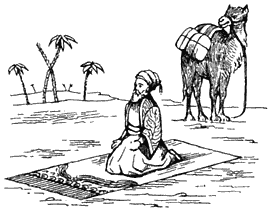
A MUSALLA.
MUS̤ALLAS̤ (مثلث). Lit. “Made into three, or into a third.” An aromatic wine composed of new wine boiled to a third part and then mixed with sweet herbs. It is said by Abū Ḥanīfah to be a lawful drink. (Hidāyah, vol. iv. p. 162.)
MUSALMĀN (مسلمان). The Persian form of the word Muslim. A Muḥammadan. [MUHAMMADANISM.]
MUSĀMARAH (مسامرة). Lit. “Holding night conversations.” A term used by the Ṣūfīs for God’s converse with the heart of man. (ʿAbdu ʾr-Razzāq’s Dict. of Ṣūfī Terms.)
MUSAQĀT (مساقاة). A compact entered into by two persons, by which it is agreed that the one shall deliver over to the other his fruit trees, on condition that the other shall take care of them, and whatever is produced shall belong to them both, in the proportions of one half, one third, or the like, as may be stipulated. (Hidāyah, vol. iv., p. 54.)
AL-MUṢAWWIR (المصور). “The Fashioner.” One of the ninety-nine names or attributes of God. It occurs once in the Qurʾān, Sūrah lix. 24: “He is God, the Creator, the Maker, the Fashioner.”
MUSHABBIHAH (مشبهة). Lit. “The Assimilators.” A sect of Muḥammadans who allowed a resemblance between God and His creatures, supposing Him to be a figure composed of members or parts, and capable of local motion. Some of the Shīʿahs belong to this sect.
MUSHĀHADAH (مشاهدة). A vision or revelation. A Sūfīistic expression for spiritual enlightenment.
MUSHRIK (مشرك), pl. mushrikūn. Those who give companions to God. It is used by modern Muslims for both Christians and idolaters, for those who believe in the Holy Trinity as well as for those who worship idols. The Wahhābīs also call their religious opponents Mushrikūn, because they pray to saints for assistance. In the Qurʾān the term is always used for the Makkan idolaters, and the Imām al-Bag͟hawī says, in his commentary on Sūrah xcviii. 1, that the term Ahlu ʾl-Kitāb is always used for the Jews and Christians and Mushrikūn for those who worship idols.
MUSHROOMS. Arabic kamʾ (كمء), pl. akmuʾ, kamʾah. Abū Hurairah relates that Muḥammad said: “Mushrooms are a kind of manna which God sent to Moses, and its water is a cure for sore eyes.” (Mishkāt, book xxi. ch. i.)
MUSIC. Arabic mūsīqā (موسيقا), mūsīqī (موسيقى), which the author of the G͟hiyās̤u ʾl-Lug͟hah says is a Syriac word. It is generally held by Muḥammadans to be contrary to the teachings of the Prophet; for Nāfiʿ relates that when he was walking with Ibn ʿUmar on a road, they heard the music of a pipe, and that Ibn ʿUmar put his fingers into his ears, and went on another road. Nāfiʿ then asked Ibn ʿUmar why he did so, and he said, “I was with the Prophet, and when he heard the noise of a musical pipe, he put his fingers into his ears; and this happened when I was a child.” (Mishkāt, book xxii. ch. ix., pt. 3.)
Muḥammadan doctors, however, are not agreed on the subject, for Abū Ḥanīfah says, “If a person break a lute or tabor, or pipe, or cymbal belonging to a Muslim, he is responsible, because the sale of such articles is lawful.” But his two disciples, Imāms Muḥammad and Abū Yūsuf, do not agree with him. (Hidāyah, vol. iii. p. 558.)
MUS̤LAH (مثلة). The mutilation of the body, which is forbidden by Muslim law, except in the case of retaliation. (Mishkāt, book xii. ch. ii.)
MUSLIM (مسلم), from Islām. One who has received Islām. A Muḥammadan. [MUHAMMADANISM, ISLAM.]
MUSLIM (مسلم). Abū ʾl-Ḥusain Muslim, son of al-Ḥajjāj al-Qushairī, the compiler of the collection of the Traditions known as the Ṣaḥīḥu Muslim, was born at Naishapūr, A.H. 204, and died A.H. 261. His book of traditions ranks amongst the Sunnīs as but second in authority to the Ṣaḥīḥu ʾ-Buk͟hārī. The two works being styled the Ṣaḥīḥān, or the “two authentics.” It is said to contain 3,000 authentic traditions. [TRADITIONS.]
MUSTAḤĀẒAH (مستحاضة). A woman who has an issue of blood (istiḥāẓah), independent of the menses or of the cleansings after parturition. A mustaḥāẓah is not considered junub, or unclean, but may say her prayers and perform the other religious offices. Compare Leviticus xv. 3.
MUṢT̤ALIQ (مصطلق). Banū Muṣt̤aliq. An Arabian tribe in the time of Muḥammad. He attacked the Banū Muṣt̤aliq in A.H. 5, and took many of them prisoners. (Muir’s Life of Mahomet, vol. iii. p. 237). They embraced Islām at an early period.
MUSTAʾMIN (مستامن). Lit. “One who seeks security.” One who, being a foreigner, and not a Muslim, enters Muḥammadan territory, and claims safe conduct and immunity from hostilities.
AL-MUTAʿĀLĪ (المتعالى). “The Exalted.” One of the ninety-nine names or attributes of God. It occurs in the Qurʾān, Sūrah xiii. 10: “He knows the unseen, and the visible,—the Great, the Lofty One.”
MUʿTADDAH (معتدة). A woman in her ʿiddah, or period of probation, after the death of her husband, or after her divorce.
MUTʿAH (متعة). Lit. “Usufruct, enjoyment.” A marriage contracted for a limited period, for a certain sum of money. Such marriages are still legal amongst the Shīʿahs, and exist in Persia (Malcolm’s Persia, vol. ii. p. 591) to the present day, but they are said to be unlawful by the Sunnīs. They were permitted by the Arabian Prophet at Aut̤ās, and are undoubtedly the greatest stain upon his moral legislation; but the Sunnīs say that he afterwards prohibited a mutʿah marriage at K͟haibar. (Vide Mishkāt, book xiii. ch. iv. pt. 2.)
The Shīʿahs establish the legality of mutʿah not only upon the traditions, but also upon the following verse in the Qurʾān, the meaning of which, according to the commentary Tafsīr-i-Maz̤harī, is disputed. Sūrah iv. 28: “Forbidden to you also are married women, except those who are in your hands as slaves. This is the law of God for you. And it is allowed you, beside this, to seek out wives by means of your wealth, with modest conduct, and without fornication. And give those with whom ye have cohabited their dowry. This is the law. But it shall be no crime in you to make agreements over and above the law. Verily, God is Knowing, Wise!”
According to the Imāmīyah Code of Jurisprudence, the following are the conditions of Mutʿah, or “temporary marriages.” There must be declaration and acceptance, as in the case of nikāḥ, and the subject of the contract must be either a Muslimah, a Christian, or a Jewess, or (according to some) a Majūsī; she should be chaste, and due inquiries should be made into her conduct, as it is abominable to enter into contract with a woman addicted to fornication, nor is it lawful to make such a contract with a virgin who has no father. Some dower must be specified, and if there is a failure in this respect, the contract is void. There must also be a fixed period, but its extent is left entirely to the parties: it may be a year, a month, or a day, only some limit must be distinctly specified, so as to guard the period from any extension or diminution. The practice of ʿazl (extrahere ante emissionem seminis) is lawful, but if, notwithstanding this the woman becomes pregnant, the child is the temporary husband’s; but if he should deny the child, the denial is sustained by the law. Mutʿah marriages do not admit of divorce or repudiation, but the parties become absolutely separated on the expiration of the period. (Baillie’s Digest.)
There is a curious account of a discussion at the Court of the Emperor Akbar with reference to the subject of Mutʿah marriages in the ʿAīn-i-Akbari (Translation by H. Blochmann, M.A., p. 173). At one of the meetings for discussion, the Emperor asked how many free-born women a man may legally marry. The lawyers answered that four was the limit fixed by the Prophet. His Majesty thereupon remarked that, from the time he had come of age he had not restricted himself to that number, and in justice to his wives, of whom he had a large number, both free-born and slaves, he now wanted to know what remedy the law provided for his case. Most of the Maulawīs present expressed their opinions, when the Emperor remarked that Shaik͟h ʿAbdu ʾn-Nabī had once told him that one of the Mujtahids had had as many as nine wives. Some of those present said that some learned men had allowed even eighteen from a too literal translation of the second verse of Sūratu ʾn-Nisāʾ in the Qurʾān. [MARRIAGE.] After much discussion, the learned men present, having collected every tradition on the subject, decreed, first, that by mutʿah a man may marry any number of wives; and, secondly, that mutʿah marriages were sanctioned by the Imām Mālik; but a copy of the Muwat̤t̤aʾ of the Imām Mālik was brought, and a passage cited from that collection of traditions against the legality of mutʿah marriages.
The disputation was again revived at a subsequent meeting, when at the request of the Emperor, Badāʾonī gave the following summary of the discussion: “Imām Mālik, and the Shīʿahs are unanimous in looking upon mutʿah marriages as legal; Imām ash-Shāfiʿī and the great Imām Abū Ḥanīfah look upon mutʿah marriages as illegal. But should at any time a Qāẓī of the Malakī sect decide that mutʿah is legal, it is legal, according to the common belief, even for Shāfiʿīs and Ḥanafīs. Every other opinion on this subject is idle talk.” This saying pleased the Emperor, and he at once appointed a Qāẓī, who gave a decree which made mutʿah marriages legal.
In permitting these usufructuary marriages Muḥammad appears but to have given Divine (?) sanction to one of the abominable practices of ancient Arabia, for Burckhardt (vol. ii. p. 378) says, it was a custom of their forefathers to assign to a traveller who became their guest for the night, some female of the family, most commonly the host’s own wife!
AL-MUTAKABBIR (المتكبر). “The Great.” (When used of a human being it implies haughtiness.) One of the ninety-nine names or attributes of God. It occurs in the Qurʾān, Sūrah lix. 23: “He is … the Great One!”
MUʿTAMIR (معتمر). A performer of the ʿUmrah. [UMRAH.]
MUʿTAQ (معتق). An emancipated slave. [SLAVERY.]
MUTAQĀDIM (متقادم). Such a distance of time as suffices to prevent punishment. It operates in a way somewhat similar to the English statutory limitations.
MUTAWALLĪ (متولى). Lit. “A person endowed with authority.” A legal term used for a person entrusted with the management of a religious foundation. [MASJID.]
MUʿTAZILAH (معتزلة). Lit. “The Separatists.” A sect of Muḥammadans founded by Wāṣil ibn ʿAt̤āʾ, who separated from the school of Ḥasan al-Baṣrī (A.H. 110). The following are their chief tenets: (1) They entirely reject all eternal attributes of God, to avoid the distinction of persons made by the Christians; saying that eternity is the proper or formal attribute of his essence; that God knows by His essence, and not by His knowledge: and the same they affirm of His other attributes (though all the Muʿtazilahs do not understand these words in one sense). Hence this sect is also named Muʿat̤t̤ilī, from their divesting God of His attributes; for they went so far as to say, that to affirm these attributes is the same thing as to make more eternals than one, and that the unity of God is inconsistent with such an opinion. This was the true doctrine of Wāṣil, their master, who declared that whoever asserted an eternal attribute asserted there were two gods. This point of speculation concerning the divine attributes was not ripe at first, but was at length brought to maturity by Wāṣil’s followers, after they had read the books of the philosophers. (2) They believe the word of God to have been created in subjecto (as the schoolmen term it), and to consist of letters and sound; copies thereof being written in books, to express or imitate the original. (3) They also go farther, and affirm that whatever was created in subjecto is also an accident, and liable to perish. They deny absolute predestination, holding that God is not the author of evil, but of good only; and that man is a free agent; which is the opinion of the Qadarīyah sect. On account of this tenet and the first, the Muʿtazilahs look on themselves as the defenders of the unity and justice of God. (4) They hold that if a professor of the true religion be guilty of a grievous sin, and die without repentance, he will be eternally damned, though his punishment will be lighter than that of the infidels. (5) They deny all vision of God in Paradise by the corporeal eye, and reject all comparisons or similitudes applied to God.
According to Shahrastānī, the Muʿtazilah hold:—
“That God is eternal; and that eternity is the peculiar property of His essence; but they deny the existence of any eternal attributes (as distinct from His nature). For they say, He is Omniscient as to His nature; Living as to His nature; Almighty as to His nature; but not through any knowledge, power or life existing in Him as eternal attributes; for knowledge, power and life are part of His essence, otherwise, if they are to be looked upon as eternal attributes of the Deity, it will give rise to a multiplicity of eternal entities.
“They maintain that the knowledge of God is as much within the province of reason as that of any other entity: that He cannot be beheld with the corporeal sight; and, with the exception of Himself, everything else is liable to change or to suffer extinction. They also maintain that Justice is the animating principle of human actions: Justice according to them being the dictates of Reason and the concordance of the ultimate results of this conduct of man with such dictates.
“Again, they hold that there is no eternal law as regards human actions; that the divine ordinances which regulate the conduct of men are the results of growth and development; that God has commanded and forbidden, promised and threatened by a law which grew gradually. At the same time, say they, he who works righteousness merits rewards, and he who works evil deserves punishment. They also say that all knowledge is attained through reason, and must necessarily be so obtained. They hold that the cognition of good and evil is also within the province of reason; that nothing is known to be right or wrong until reason has enlightened us as to the distinction; and that thankfulness for the blessings of the Benefactor is made obligatory by reason, even before the promulgation of any law upon the subject. They also maintain that man has perfect freedom; is the author of his actions both good and evil, and deserves reward or punishment hereafter accordingly.”
During the reigns of the Abbaside K͟halīfahs al-Maʾmūn, al-Muʿtaṣim, and al-Was̤iq (A.H. 198–228) at Bag͟hdād, the Muʿtazilah were in high favour. Mr. Syed Ameer Ali Moulvi, M.A., LL.B., in the preface to his book, The Personal Law of the Mahommedans (W. H. Allen and Co.), claims to belong to “the little known, though not unimportant philosophical and legal school of the Mutazalas,” and he adds, “the young generation is tending unconsciously toward the Mutazalite doctrines.”
According to the Sharḥu ʾl-Muwāqif, the Muʿtazilah are divided into twenty sects, viz.: Waṣilīyah, ʿUmarīyah, Huẕailīyah, Naz̤āmīyah, Aswārīyah, Askāfīyah, Jāfarīyah, Basharīyah, Mazdārīyah, Hishāmīyah, Ṣālhīyah, Hābit̤īyah, Hadbīyah, Maʿmarīyah, S̤amāmīyah, K͟haiyāt̤īyah, Jāhiẓīyah, Kaʿbīyah, Jubāʾīyah, and Buhshamīyah.
AL-MUʿT̤Ī (المعطى). “The Giver.” One of the ninety-nine names or attributes of God. It is referred to in the Qurʾān, Sūrah cviii. verse 1: “Verily we have given thee al-Kaus̤ar.”
MUTILATION. [THEFT.]
MUʿTIQ (معتق). The master who emancipates a slave. [SLAVERY.]
MUWAḤḤID (موحد), pl. muwaḥḥidūn. A believer in one God. A term often used by Muslims to express their belief as Unitarians.
MUWAT̤T̤Aʾ (موطاء). Lit. “That which has been compiled.” A title given to the book of traditions compiled by the Imām Mālik (died A.H. 179). It is the earliest compilation of traditions, and is placed by some amongst the Kutubu ʾs-Sittah, or the “six (correct) books.” [TRADITIONS.]
MUZĀBANAH (مزابنة). Lit. “Repelling or pushing back.” Selling without measure, for example, selling green dates upon trees in exchange for dry ones in the house, and the seller saying that the loss or gain rests with him. This kind of sale is forbidden. (Mishkāt, book xii. ch. 5.)
MUZĀRAʿAH (مزارعة). Giving over land to the charge of another party on condition of receiving a fixed proportion of its produce.
MUẒĀRABAH (مضاربة). In the language of the law, Muẓārabah signifies a contract of copartnership, of which the one party (namely, the proprietor) is entitled to a profit on account of the stock, he being denominated Rabbu ʾl-Māl, or proprietor of the stock (which is termed Rāsu ʾl-Māl), and the other party is entitled to a profit on account of his labour, and this last is denominated the muẓārib (or manager), inasmuch as he derives a benefit from his own labour and endeavours. A contract of muẓārabah, therefore, cannot be established without a participation in the profit, for if the whole of the profit be stipulated to the proprietor of the stock, then it is considered as a biẓāʿah; or, if the whole be stipulated to the immediate manager, it must be considered as a loan.
AL-MUẔILL (المذل). “The One who abases.” One of the ninety-nine names or attributes of God referred to in the Qurʾān, Sūrah iii. 25: “Thou honourest whom Thou pleasest and abasest whom Thou pleasest.”
AL-MUZZAMMIL (المزمل). Lit. “The Wrapped up.” The title of the LXXIVth Sūrah of the Qurʾān, in the first verse of which the word occurs. “O Thou, enwrapped, arise to prayer.” It is said the chapter was revealed to Muḥammad when he was wrapped up in a blanket at night.
MYSTICISM. The word mysticism is of a vague signification, but it is generally applied to all those tendencies in religion which aspire to a direct communication between man and his God, not through the medium of the senses, but through the inward perception of the mind. Consequently the term is applied to the Pantheism of the ancient Hindu, to the Gnosticism of the ancient Greek, to the Quietism of Madame Guyon and Fénelon, to the Pietism of Molinos, to the doctrines of the Illuminati of Germany, to the visions of Swedenborg, as well as to the peculiar manifestations of mystic views amongst some modern Christian sects. It is a form of error which mistakes the operations of a merely human faculty for a divine manifestation, although it is often but a blind protest in behalf of what is highest and best in human nature.
The earliest mystics known are those of India, the best exposition of their system being the Bhāgavad-gītā (see Wilkins’ translation). Sir William Jones says:—“A figurative mode of expressing the fervour of devotion, the ardent love of created spirits, toward their Beneficent Creator, has prevailed from time immemorial in Asia; particularly among the Persian Theists, both ancient Hushangis and modern Sufis, who seem to have borrowed it from the Indian philosophers of the Vedanta School, and their doctrines are also believed to be the source of that sublime but poetical theology which glows and sparkles in the writings of the old Academics. ‘Plato travelled into Italy and Egypt,’ says Blande Fleury, ‘to learn the Theology of the Pagans at its fountain head.’ Its true fountain, however, was neither in Italy nor in Egypt though considerable streams of it had been conducted thither by Pythagoras, and by the family of Misra, but in Persia or India, which the founder of the Italic sect had visited with a similar design.”
Almost the only religion in the world in which we should have concluded, before examination, that the Pantheistic and mystic spirit of Hinduism was impossible, is the stern unbending religious system of Muḥammad and his followers. But even amongst Muslims there have ever been those who seek for divine intuition in individual souls, to the partial or entire rejection of the demands of creeds and ceremonies. These mystics are called Ṣūfīs, and have always included the philosophers, the poets, and the enthusiasts of Islām. For an account of these Muslims, see the article on SUFIISM.
N.
AN-NABAʾ (النباء). “The information.” The title of the LXXVIIIth Sūrah of the Qurʾān, in the second verse of which the word occurs: “Of the mighty information whereon they do dispute.”
NĀBĀLIG͟H (نابالغ). A Persian term used for a minor. [PUBERTY.]
NABBĀSH (نباش). A plunderer or stripper of the dead. According to the Imāms Abū Yūsuf and ash-Shāfiʿī, the hand of a plunderer of the dead should be struck off, but Abū Ḥanīfah and the Imām Muḥammad are of the contrary opinion. (Hidāyah, vol. ii. p. 94.)
NABĪ (نبى). Heb. נָבִיא. A prophet. One who has received direct inspiration (waḥy) by means of an angel, or by the inspiration of the heart (ilhām); or has seen the things of God in a dream. (Vide Kitābu ʾt-Taʿrīfāt.) A rasūl, or “messenger,” is one who has received a book through the angel Gabriel. [PROPHETS.]
NABĪẔ (نبيذ). A kind of wine made from dates, which is lawful. (Hidāyah, vol. iv. p. 155.)
NĀD-I-ʿALĪ (ناد على). Persian. An amulet on which is inscribed a prayer to ʿAlī. It is much used by the Shīʿahs, and runs thus:—
“Cry aloud to ʿAlī, who is the possessor of wonders!
From him you will find help from trouble!
He takes away very quickly all grief and anxiety!
By the mission of Muḥammad and his own sanctity!”
NAFAQAH (نـفـقـة). [MAINTENANCE.]
AN-NĀFIʿ (النافع). “The Profiter.” One of the ninety-nine names or attributes of God. It does not occur in the Qurʾān.
NĀFIʿ (نافع). A slave belonging to Ibn ʿUmar. Many traditions have been handed down by him, and his authority is highly respected. Died, A.H. 117.
NAFK͟H (نفخ). “Blowing.” The blast on the Day of Judgment which will be sounded by Isrāfīl.
NAFL (نفل). “A voluntary act.” A term applied to such acts of devotion as are not enjoined by the teaching of Muḥammad, or by his example. A work of supererogation. [PRAYER.]
NAFS̤ (نفث). Blowing as a necromancer when making incantations.
(1) It occurs in this sense in the Qurʾān, Sūrah cxiii. 4: “I seek refuge … from the evil of the blowers upon knots.” Referring to those witches who make knots in a string and blow upon them, uttering some incantation.
(2) It is also used for the inspiration which Muḥammad professed to have received from Gabriel. (Majmaʿu ʾl-Biḥār, p. 376.)
NAFS (نفس). Animal life; soul; substance; desire. A word which occurs in the Qurʾān and the Traditions for the human conscience. [CONSCIENCE.]
NAFSĀʾ (نفساء). A woman in the condition of nifās, or the period after childbirth.
NAHJU ʾL-BALĀG͟HAH (نـهـج البلاغة). “The Road of Eloquence.” A celebrated book of Muḥammadan traditions compiled by ash-Sharīf Abū ʾl-Qāṣim al-Murtaẓā, A.H. 406, or his brother ash-Sharīf ar-Raẓī al-Bag͟hdādī. (See Kashfu ʾz̤-Z̤unūn, vol. vi. p. 406.)
AN-NAḤL (النحل). “The Bee.” The title of the XVIth Sūrah of the Qurʾān, in the 70th verse of which the word occurs: “And thy Lord inspired the bee.”
NAḤR (نحر). The lawful slaughtering of a camel, namely, by spearing it in the hollow of the throat, near the breast-bone. (Hidāyah, vol. iv. p. 72.)
NĀʾIB (نائب). A deputy, a lieutenant. A K͟halīfah is the nāʾib, or lieutenant, of Muḥammad. It is also used for the Viceroy of Egypt, who is the nāʾib, or deputy, of the Sult̤ān. (Lane’s Arabian Nights, Intro. p. 8.)
NAJĀSAH (نجاسة). A legal term for an impurity of any kind.
NAJĀSHĪ (نجاشى). Negus. The King of Abyssinia, often mentioned in the history of Muḥammad. At̤-T̤abarī, in his history, p. 127, says: “Now a just king was there (Abyssinia) named an-Najāshī. It was a land where the Quraish used to do merchandise, because they found abundance of food, protection, and good traffic.” (Muir’s Life of Mahomet, vol. ii. p. 133.)
NAJD (نجد). “High.” The highlands of Arabia. The name of the central province of Arabia. One of its cities, Riyāẓ, is celebrated as the seat of the Wahhābīs. (See Central and Eastern Arabia, by W. G. Palgrave, London, 1865; Journey to the Wahabee Capital, by Colonel Lewis Pelly, Bombay, 1866.)
AN-NĀJIYAH (الناجية). “The Saved.” A term given to the orthodox sect of Muḥammadans, and consequently each sect arrogates to itself the title of an-Nājiyah, or “the saved.”
AN-NAJJĀRĪYAH (النجارية). A sect of Muḥammadans founded by Muḥammad ibn Ḥusain an-Najjār, who agreed with the Muʿtazilah in rejecting all eternal attributes of God, to avoid distinction of persons as taught by the Christians, and in holding that the Word of God was created in subjecto (as the schoolmen term it), and to consist of letters and sound, and that God will not be seen in Paradise with the corporeal eye; but they did not receive the doctrines of that sect with regard to the decrees and predestination of God, but held the views of the orthodox party on this subject. According to the Sharḥu ʾl-Muwāqif, they are divided into three sects, viz.: Burg͟hūs̤īyah, Zaʿfarānīyah, and Mustadrikah.
AN-NAJM (النجم). “The Star.” The title of the LIIIrd Sūrah of the Qurʾān, which begins with the words, “By the star when it falls.”
NAJRĀN (نجران). A district between Yaman and Najd, inhabited by a Christian tribe, whose endurance and constancy in their Christian belief are the subject of the following verses in the Qurʾān. Sūrah lxxxv. 4–11. (The verses are said to have been revealed at an early date, and indicate Muḥammad’s kind feeling towards the Christians):—
“Cursed be the diggers of the pit,
“Of the fuel-fed fire,
“When they sat around it
“Witnesses of what they inflicted on the believers!
“Nor did they torment them but for their faith in God, the Mighty, the Praiseworthy:
“His the kingdom of the Heavens and of the Earth; and God is the witness of everything.
“Verily, those who vexed the believers, men and women, and repented not, doth the torment of Hell, and the torment of the burning, await.
“But for those who shall have believed and done the things that be right, are the Gardens beneath whose shades the rivers flow. This is the immense bliss!”