DICTIONARY OF ISLĀM. (continued 37)
Reading edition
TROVES, Arabic luqt̤ah (لقطة), signifies property which a person finds on the ground, and takes away for the purpose of preserving it in the manner of a trust. A trove under ten dirhams must be advertised for some days, or as long as he may deem expedient; but if it exceed ten dirhams in value, he must advertise it for a year. (Hamilton’s Hidāyah, vol. ii. p. 266.)
TRUMPET. Arabic ṣūr (صور). According to the Qurʾān, Sūrah xxxix. 68, the trumpet at the Day of Resurrection shall be blown twice. “The trumpet shall be blown (first), and those who are in the heavens and in the earth shall swoon (or die), save whom God pleases. Then it shall be blown again, and, lo! they shall rise again and look on.”
Al-Baiẓāwī says there will only be these two blasts, but Traditionists assert there will be three. The blast of consternation, the blast of examination, and the blast of resurrection, for an account of which, see the article on RESURRECTION.
TUBBAʿ (تبع). A tribe of Ḥimyarite Arabs, whose kings were called Tubbaʿ, or “Successors,” and who are mentioned in the Qurʾān, Sūrah xliv. 35: “Are they better than the people of Tubbaʿ and those before them? Verily, they were sinners, and we destroyed them.”
T̤UHR (طهر). The period of purity in a woman. [DIVORCE, PURIFICATION.]
T̤ULAIḤAH (طليحة). A chief of the Banū Asad, a warrior of note and influence in Najd, who claimed to have a divine commission in the days of Muḥammad, but who was afterwards subdued by K͟hālid under the K͟halīfate of Abū Bakr, and embraced Islām. (Muir’s Life of Mahomet, vol. iv. p. 246.)
T̤ŪR (طور). Chaldee טוּר. (1) A mount. At̤-T̤ūr, the mountain mentioned in the Qurʾān, Sūrah ii. 60: “When we took a covenant (mīs̤āq) with you, and held the mountain (ready to fall) over you.” This is generally understood to mean T̤ūru Saināʾ, or Mount Sinai, but al-Baiẓāwī says it was Jabal Zubail. In Persian, the mountain is called Koh-i-T̤ūr, or the Mount of T̤ūr. In Arabia, the name is given to the Mount Sinai of Scripture.
(2) The title of the LIInd Sūrah of the Qurʾān.
TURBAN. Arabic ʿimāmah (عمامة), Persian dastār (دستار), Hindūstānī pagṛī (پگڑى). The turban, which consists of a stiff round cap, occasionally rising to a considerable height, and a long piece of muslin, often as much as twenty-four yards in length, wound round it, is amongst all Muḥammadan nations a sign of authority and honour, and it is held to be disrespectful to stand in the presence of a person of respectability, or to worship God, with the head uncovered. Shaik͟hs and persons of religious pretensions wear green turbans. The Coptic Christians in Egypt wear a blue turban, having been compelled to do so by an edict published in A.D. 1301. In some parts of Islām, it is usual to set apart a Maulawī, or to appoint a chief or ruler, by placing a turban on his head.
The mitre, bonnet, hood, and diadem of the Old Testament are but varieties of the head-dress known in the East as the turban. Canon Cook, in the Speaker’s Commentary, on Exodus xxviii. 4, 37, says the mitznepheth, or “mitre” of the Hebrew Bible, “according to the derivation of the word, and from the statement in verse 39, was a twisted band of linen coiled into a cap, to which the name mitre in its original sense closely answers, but which in modern usage would rather be called a turban.”
The term used in the Hebrew Bible for putting on the tzaniph or the peer, “bonnet,” in Ex. xxix. 9, Lev. viii. 13, is חָבַשׁ k͟hāvash, “to bind round,” and would therefore indicate that even in the earliest periods of Jewish history the head-dress was similar in character to that now seen amongst the different Muslim tribes of the world.
Josephus’ account of the high priest’s mitre is peculiar; he says (Antiquities, book iii. ch. vii. p. 3): “Its make is such that it seems to be a crown, being made of thick swathes, but the contexture is of linen, and it is doubled many times, and sewn together; besides which, a piece of fine linen covers the whole cap from the upper part, and reaches down to the forehead and the seams of the swathes, which would otherwise appear indecently; this adheres closely upon the solid part of the head, and is thereto so firmly fixed that it may not fall off during the sacred service about the sacrifices.”
The varieties of turban worn in the East are very great, and their peculiarities are best illustrated by the accompanying drawing, giving seventeen different styles of tying up the turban. In books written upon the subject in Eastern languages, it is said that there are not fewer than a thousand methods of binding the turban. It is in the peculiar method of tying on, and of arranging this head-dress, that not only tribal and religious distinctions are seen, but even peculiarities of disposition. The humility or pride, the virtue or vice, as well as the social standing of the individual, is supposed to be indicated in his method of binding the turban upon his head. And travellers in the East can at once distinguish the different races by their turbans. [DRESS.]
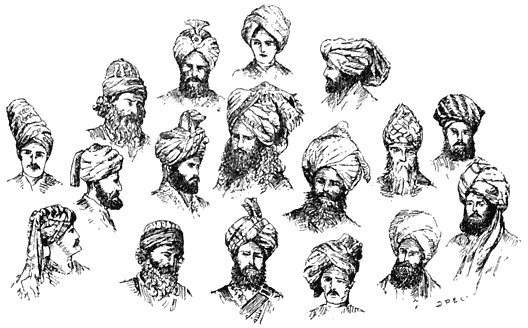
MUSLIM TURBANS. (A. F. Hole.)
TURK. Arabic tark or turk (ترك), pl. atrāk. (1) A term applied by European writers to express Muḥammadans of all nationalities. (See Book of Common Prayer, Collect for Good Friday.)
(2) An inhabitant of Turkomania, Turkistān or Transoxania, so named from Tur, eldest son of Farīdūn, to whom his father gave it for an inheritance. Also of those numerous races of Tartars who claim to be descended from Turk, a son of Japhet. Turki chin, a Chinese Tartar.
(3) A native of European or Asiatic Turkey. Halaku, the Turk, a grandson of Jengiz K͟hān, took Bag͟hdād A.D. 1258, and about forty years afterwards ʿUs̤mān (Othman) founded the ʿUs̤mānī or Turk dynasty at Constantinople, A.D. 1299. Hence Muḥammadans were known to the European Christians as Turks.
The word Turk is also frequently used by Sikh writers to express Muḥammadans in general. The terms Turk and Musulmān are employed interchangeably. [KHALIFAH.]
T̤UWĀ (طوى). A sacred valley mentioned in the Qurʾān:—
Sūrah xx. 12: “O Moses! verily I am thy Lord, so take off thy sandals; thou art in the sacred valley of T̤uwā, and I have chosen thee.”
Sūrah lxxix. 16: “Has the story of Moses reached you? when his Lord addressed him in the holy valley of T̤uwā.”
U.
ʿUBĀDAH IBN AṢ-ṢĀMIT (عبادة بن الصامت). One of the Anṣārs of al-Madīnah, who was afterwards employed by Abū Bakr to collect the scattered sentences of the Qurʾān.
ʿUBŪDĪYAH (عبودية). [SLAVERY.]
AL-UFUQU ʾL-AʿLĀ (الافق الاعلى). Lit. “The Loftiest Tract.” (1) The place in which it is said Gabriel was when he taught Muḥammad, see Sūrah liii. 7: “One mighty in power (Shadīdu ʾl-Quwā) taught him, endowed with sound understanding, and appeared, he being in the loftiest tract.”
(2) According to the Ṣūfīs, it is the highest spiritual state a man can attain in the mystic life.
UḤNŪK͟H (احنوخ). The Enoch of the Old Testament, supposed to be the Idrīs of the Qurʾān. A full account of this personage will be found in the article on IDRIS.
UḤUD (احد). Ohod. A hill about three miles distant from al-Madīnah, and described by Burckhardt as a rugged and almost insulated offshoot of the great mountain range. Celebrated for the battle fought by Muḥammad and the victory gained over the Muslims by the Quraish, A.H. 3. (Muir’s Life of Mahomet, new ed. p. 266 seqq.) [MUHAMMAD.]
ʿŪJ (عوج). The son of ʿŪq. A giant who is said to have been born in the days of Adam, and lived through the Deluge, as the water only came up to his waist, and to have died in the days of Moses, the great lawgiver having smitten him on the foot with his rod. He lived 3,500 years. (G͟hiyās̤u ʾl-Lug͟hāt, in loco.) The Og of the Bible, concerning whom as-Suyūt̤ī wrote a long book taken chiefly from Rabbinic traditions. (Ewald, Gesch. i. 306.) An apocryphal book of Og was condemned by Pope Gelasius. (Dec. vi. 13.)
UKAIDAR (اكيدر). The Christian chief of Dūmah, who was taken prisoner by K͟hālid, A.H. 9. (Muir’s Life of Mahomet, new ed. p. 458.)
In the Traditions it is said: “K͟hālid took Ukaidar prisoner because the Prophet forbade killing him. And the Prophet did not kill him, but made peace with him, when he paid the poll-tax.” (Mishkāt, book xvii. ch. ix.)
Sir W. Muir says he became a Muslim, but revolted after the death of Muḥammad.
ʿUKĀZ̤ (عكاظ). An annual fair of twenty-one days, which was held between at̤-T̤āʾif and Nak͟hlah, and which was opened on the first day of the month of Ẕū ʾl-Qaʿdah, at the commencement of the three sacred months. It was abolished by Muḥammad.
Mr. Stanley Lane Poole says (Selections from the Ḳur-án):—
“There was one place where, above all others, the Ḳaṣeedehs (Qaṣīdahs) of the ancient Arabs were recited: this was ʾOkádh (ʿUkāz̤), the Olympia of Arabia, where there was held a great annual Fair, to which not merely the merchants of Mekka and the south, but the poet-heroes of all the land resorted. The Fair of ʾOkádh was held during the sacred months,—a sort of ‘God’s Truce,’ when blood could not be shed without a violation of the ancient customs and faiths of the Bedawees. Thither went the poets of rival clans, who had as often locked spears as hurled rhythmical curses. There was little fear of a bloody ending to the poetic contest, for those heroes who might meet there with enemies or blood-avengers are said to have worn masks or veils, and their poems were recited by a public orator at their dictation. That these precautions and the sacredness of the time could not always prevent the ill-feeling evoked by the pointed personalities of rival singers leading to a fray and bloodshed is proved by recorded instances; but such results were uncommon, and as a rule the customs of the time and place were respected. In spite of occasional broils on the spot, and the lasting feuds which these poetic contests must have excited, the Fair of ʾOkádh was a grand institution. It served as a focus for the literature of all Arabia: everyone with any pretensions to poetic power came, and if he could not himself gain the applause of the assembled people, at least he could form one of the critical audience on whose verdict rested the fame or the shame of every poet. The Fair of ʾOkádh was a literary congress, without formal judges, but with unbounded influence. It was here that the polished heroes of the desert determined points of grammar and prosody; here the seven Golden Songs were recited, although (alas for the charming legend!) they were not afterwards ‘suspended’ on the Kaabeh; and here ‘a magical language, the language of the Ḥijáz,’ was built out of the dialects of Arabia, and was made ready to the skilful hand of Moḥammad, that he might conquer the world with his Ḳur-án.
“The Fair of ʾOkádh was not merely a centre of emulation for Arab poets: it was also an annual review of Bedawee virtues. It was there that the Arab nation once-a-year inspected itself, so to say, and brought forth and criticised its ideals of the noble and the beautiful in life and in poetry. For it was in poetry that the Arab—and for that matter each man all the world over—expressed his highest thoughts, and it was at ʾOkádh that these thoughts were measured by the standard of the Bedawee ideal. The Fair not only maintained the highest standard of poetry that the Arabic language has ever reached: it also upheld the noblest idea of life and duty that the Arab nation has yet set forth and obeyed. ʾOkádh was the press, the stage, the pulpit, the Parliament, and the Académie Française of the Arab people; and when, in his fear of the infidel poets (whom Imra-el-Keys was to usher to hell), Moḥammad abolished the Fair, he destroyed the Arab nation, even whilst he created his own new nation of Muslims; and the Muslims cannot sit in the places of the old pagan Arabs.”
ʿUKŪF (عكوف). Lit. “Remaining behind.” A term used to express a life of prayer of one who remains constantly in the mosque.
ʿULAMĀʾ (علماء), pl. of ʿālim. “One who knows; learned; a scholar.” In this plural form the word is used as the title of those bodies of learned doctors in Muḥammadan divinity and law, who, headed by their Shaik͟hu ʾl-Islām, form the theocratic element of the government in Muslim countries, and who by their fatwās or decisions in questions touching private and public matters of importance, regulate the life of the Muḥammadan community. Foremost in influence and authority are naturally reckoned the ʿUlamāʾ of Constantinople, the seat of the K͟halīfah, and of Makkah, the Holy City of Islām. Like the Aṣḥāb or Companions of the Prophet under his immediate successors, they correspond in a certain measure to what we would call the representative system of our modern constitutions, in partially limiting and checking the autocratism of an otherwise absolute Oriental ruler.
ULŪHĪYAH (الوهية). “Divinity; godhead.”
ULŪ ʾL-ʿAZM (اولو العزم). “The Possessors of Constancy.” A title given to certain prophets in the Qurʾān, said by the commentators to have been Noah, Abraham, David, Jacob, Joseph, Job, Moses, Jesus, and Muḥammad. (Vide G͟hiyās̤u ʾl-Lug͟hāt.) See Sūrah xlvi. 34: “Then be thou constant, as the Apostles endowed with a purpose were constant, and hasten not on.”
UMANĀʾ (امناء), pl. of amīn. “Faithful Ones.” A title given by the Ṣūfīs to those pious persons who do not make their religious experiences known. They are known also as the Malāmatīyah, or those who are willing to undergo misrepresentation rather than boast of their piety.
ʿUMAR (عمر) IBN AL-K͟HAT̤T̤ĀB. (Omar) the second K͟halīfah, who succeeded Abū Bakr, A.H. 13 (A.D. 634), and was assassinated by Fīroz, a Persian slave, A.H. 23 (A.D. 644), after a prosperous reign of ten years. His conversion to Islām took place in the sixth year of Muḥammad’s mission, and the Prophet took ʿUmar’s daughter Ḥafṣah as his third wife.
ʿUmar is eminent amongst the early K͟halīfahs for having chiefly contributed to the spread of Islām. Under him the great generals, Abū ʿUbaidah, K͟hālid ibn al-Walīd, Yazīd, drove the Greeks out of Syria and Phœnicia; Saʿd ibn Abī Waqqāṣ, Qaqāʾah, Nuʿmān, completed the conquest of the two ʿIrāqs and the overthrow of the Persian Empire; ʿAmr ibn al-ʿĀṣ (commonly called Amru) subdued Egypt and part of the Libyan coast, after having, as commander in Palestine, prepared by his victories and a severe siege, the surrender of Jerusalem [JERUSALEM] into the K͟halīfah’s own hands. ʿUmar’s name is, moreover, intimately connected with the history of Islām, by the initiatory and important share which he took in the first collection of the Qurʾān, under Abū Bakr, by the official introduction of the Muḥammadan era of the Hijrah, and by the first organisation of the dīwān, or civil list of the Muḥammadans. The two former subjects have been treated of in this Dictionary in their proper places; the third institution, which laid the foundation to the marvellous successes of the Muslim arms under this and the succeeding Governments, is ably explained in the following extract from Sir W. Muir’s Annals of the Early Caliphate:—
“The Arabian nation was the champion of Islam, and to fight its battles every Arab was jealously reserved. He must be the soldier, and nothing else. He might not settle down in any conquered province as cultivator of the soil; and for merchandise or other labour, a busy warlike life offered but little leisure. Neither was there any need. The Arabs lived on the fat of the conquered land, and captive natives served them. Of the booty taken in war, four parts were distributed to the army in the field; the fifth was reserved for the State; and even that, after discharging public obligations, was shared among the Arabian people. In the reign of Abu Bakr, this was a simple matter. But in the Caliphate of Omar, the spoil of Syria and of Persia began in ever-increasing volume to pour into the treasury of Medîna, where it was distributed almost as soon as received. What was easy in small beginnings, by equal sharing or discretionary preference, became now a heavy task. And there began, also, to arise new sources of revenue in the land assessment, and the poll-tax of subject countries, which, after defraying civil and military charges, had to be accounted for to the Central Government; the surplus being, like the royal fifth, the patrimony of the Arab nation.
“At length, in the second or third year of his Caliphate, Omar determined that the distribution should be regulated on a fixed and systematic scale. The income of the commonwealth was to be divided, as heretofore, amongst the Faithful as their heritage, but upon a rule of precedence befitting the military and theocratic groundwork of Islam. For this end three points only were considered: priority of conversion, affinity to the Prophet, and military service. The widows of Mahomet, ‘Mothers of the Faithful,’ took the precedence with an annual allowance of 10,000 pieces each; and all his kinsmen were with a corresponding liberality provided for. The famous Three Hundred of Bedr had 5,000 each; presence at Hodeibia (Ḥudaibīyah) and the Pledge of the Tree, gave a claim to 4,000; such as took part in quelling the Rebellion (immediately after Muḥammad’s death), had 3,000; and those engaged in the great battles of Syria and Irâc, as well as sons of the men of Bedr, 2,000; those taking the field after the actions of Câdesîya and the Yermûk, 1,000. Warriors of distinction received an extra grant of 500. And so they graduated downwards to 200 pieces for the latest levies. Nor were the households forgotten. Women had, as a rule, one-tenth of a man’s share. Wives, widows, and children had each their proper stipend; and in the register, every infant, as soon as born, had the title to be entered, with a minimum allowance of ten pieces, rising with advancing age to its proper place. Even Arab slaves (so long as any of that race remained) had, strange to say, their portion.
* * *
“The Arabian aristocracy thus created was recognised by the whole Moslem world. The rank and stipend now assigned descended in the direct line of birth. Even rewards given for special gallantry in the field were heritable. By making thus the revenues of Islam the heritage of the nation militant, their martial genius was maintained, and their employment perpetuated as the standing army of the Caliphate.
* * *
“To carry out this vast design, a register had to be drawn and kept up of every man, woman and child, entitled to a stipend from the State—in other words, of the whole Arab race employed in the interests of Islam. This was easy enough for the higher grades, but a herculean task for the hundreds and thousands of ordinary fighting men and their families who kept streaming forth from the Peninsula; and who, by the extravagant indulgence of polygamy, were multiplying rapidly. But the task was simplified by the strictly tribal composition and disposition of the forces. Men of a tribe, or branch of a tribe, fought together; and the several corps and brigades being thus territorially arranged in clans, the Register assumed the same form. Every soul was entered under the stock and tribe and class whose lineage it claimed. And to this exhaustive classification we owe in great measure the elaborate genealogies and tribal traditions of Arabia before Islam. The Register itself, as well as the office for its maintenance and for pensionary account was called the Dewân (Dīwān), or Department of the Exchequer.” (Sir W. Muir, Annals of the Early Caliphate, London, 1883, p. 228.)
It was fortunate for Islām, that the reign of Abū Bakr, short in duration, but pregnant with decisive issues, should precede that of ʿUmar. During the critical period, immediately after Muḥammad’s death, when three false prophets and a prophetess gathered increasing numbers round their rebellious standards, when in the north, east, and south of the Peninsula, tribe after tribe, apostatized from the newly-adopted creed, and when al-Madīnah itself was repeatedly threatened by hostile invasions of the neighbouring clans, it needed all the spirit of compromise and conciliation which blended in Abū Bakr’s character with penetrating shrewdness and dauntless courage, to steer the bark of the Muslim commonwealth through the dangers which were surrounding it on every side. ʿUmar’s irrepressible impetuosity would, at that time, probably have caused more harm than good, while, on the other hand, the unprecedented success which crowned Abū Bakr’s wise and temporising politics, taught him to temper his own impulses of bold enterprise with prudence and cautiousness, when, in his turn, the responsibilities of office rested on his shoulders.
The original violent bent of Umar’s nature is forcibly illustrated by the history of his conversion, as it is told in various traditions. In his youth and early manhood, a zealous and devoted adherent of the religion of his forefathers, he hated and persecuted Muḥammad as a dangerous innovator, who had come to lead his people astray, and to sow discord between them. Infuriated at some fresh success of the pretended Prophet, he sallied forth one day to kill him, when he met his kinsman, Nuʿaim ibn ʿAbdi ʾllāh, who, seeing him armed and fiercely excited, asked him: “Whither goest thou, and what is thy intent?” “I seek Muḥammad,” was ʿUmar’s reply, “and I will slay him; he has vilified our gods and dishonoured our ancestors.” “Passion blinds thee,” retorted Nuʿaim; “knowest thou not that, if thou killest Muḥammad, thou wilt draw the vengeance of the Hāshimites and the Banū Mut̤t̤alib upon thy head? Better far it would be for thee, to heed the welfare of thy own family, and to bring back to the right path those members of it who have forsworn their ancestral religion.” “And who are they,” asked ʿUmar. “Thy brother-in-law, Saʿīd ibn Zaid, and Fāt̤imah, thy very own sister,” answered Nuʿaim.
Forthwith the incensed man hurried on to the house of the culprits. Here K͟habbāb ibn al-Aratt, a devoted disciple of Muḥammad, the same who had made them acquainted with his teaching and won them over to Islām unknown to ʿUmar, was reading with them at that moment a new fragment of the Qurʾān. When he heard ʿUmar coming, he concealed himself, and Fāt̤imah tried to hide the manuscript in the bosom of her dress. On entering, ʿUmar asked: “What have you been reading just now? I heard your voices!” “Nothing,” she replied, “thou art mistaken.” “You have been reading something, and I am told that you belong to the sect of Muḥammad.” With these words he threw himself upon his brother-in-law, and struck him. Fāt̤imah rushed in between them. Both husband and wife boldly confessed: “Yes, we are Muslims; we believe that there is no god but God, and that Muḥammad is his sent one; kill us, if thou wilt.”
No sooner had ʿUmar seen the blood flowing from a wound which he had inflicted on his sister, than shame for his own unmanly act, coupled with admiration of their courageous conduct, brought about a powerful revulsion of his feelings. He asked to be shown the manuscript, and when, after his solemn promise not to destroy it, the fragment was handed over to him, he read:—
“Not to sadden thee have We sent down this Qurʾān to thee,
But as a warning for him who feareth;
A missive from Him who hath made the earth and the lofty heavens,
The God of Mercy who sitteth on His throne!
His, whatsoever is in the heavens and whatsoever is in the earth, and whatsoever is between them both, and whatsoever is beneath the humid soil!
And thou needest not raise thy voice in prayer: He verily knoweth the secret whisper, and the yet more hidden!
God! there is no God but Him! Most excellent His titles!”
(Sūrah xx. 1–7.)
“How nobly said and how sublime!” exclaimed ʿUmar, when he had read the passage. Thereupon K͟habbāb came forth from his place of concealment, and summoned him to testify to the teaching of Muḥammad. ʿUmar asked where Muḥammad was, went to him, and made his profession of faith to the Prophet himself.
Henceforth ʿUmar remained attached to the person of Muḥammad with the most devoted friendship, and embraced the cause of Islām with all the energies of his strong nature. We find ʿUmar, immediately after Muḥammad’s death, unable at first to grasp the reality of the fact. When the news was imparted to him, he exclaimed wildly before the assembly of the faithful: “The Prophet is not dead; he has only swooned away.” And, again, when Mug͟hīrah tried to convince him that he was mistaken—“Thou liest!” he cried, “the Prophet of the Lord shall not die, until he have rooted out every hypocrite and unbeliever.” At this point Abū Bakr quoted the verses of the Qurʾān, revealed after the defeat at Uḥud: “Muḥammad is no more than an Apostle; verily the other apostles have gone before him. What then! If he were to die or be killed, would you turn back on your heels?” And he added the memorable appeal: “Let him then know, whosoever worshippeth Muḥammad, that Muḥammad indeed is dead; but whoso worshippeth God, let him know that the Lord liveth and doth not die.”
Then, and only then, on hearing those words, spoken by the book, as if he had never heard them before, the truth burst upon ʿUmar with crushing force. “By the Lord,” he would tell in later days, “it was so that when I heard Abū Bakr reciting those verses, I was horror-struck, my limbs trembled, I dropped down, and I knew of a certainty that Muḥammad indeed was dead.”
The paramount ascendency which Muḥammad, during his lifetime, exercised over ʿUmar, could not fail to soften his passionate and vehement nature, and to train him to those habits of self-command, which form one of the most essential elements in the character of a good ruler. If it was an act of wise foresight on the part of Muḥammad to designate, at the approach of death, the older and sedater Abū Bakr as his successor, by appointing him to conduct the public prayers during his last illness, he could at the same time feel assured that ʿUmar, far from contesting the choice of his dying friend, would respect it and make it respected against any defection or rival ambition by his cordial and powerful support. But it was equally natural and wise on the part of Abū Bakr, when the time had come, to fix the choice of his own successor upon ʿUmar. It is related that, feeling his end to be near, and willing to fortify his own conviction by the sense of others, he first consulted ʿAbdu ʾr-Raḥmān, the son of ʿAuf, who praised ʿUmar “as the fittest man, but withal inclined to be severe.” “Which,” responded the dying K͟halīfah, “is because he saw me soft and tender-hearted, when himself the Master, he will forego much of what thou sayest. I have watched him narrowly. If I were angry with one, he would intercede in his behalf; if over-lenient, then he would be severe.” ʿUs̤mān, too, confirmed Abū Bakr’s choice. “What is hidden of ʿUmar,” he said, “is better than that which doth appear. There is not his equal amongst us all.”
And so it was: as in bodily stature ʿUmar towered high above his fellow-men, so he excelled in every quality required in an imposing commander of the Faithful (Amīr al-Muʾminīn), this being the title which he adopted in preference to the more cumbersome of “Successor of the Apostle of God” (K͟halīfatu ʾr-Rasūli ʾllāh). It lies outside the scope of the present work to give a complete biography of ʿUmar, and we must refer the reader who should wish to make himself acquainted with it, to the above-quoted attractive volume of Sir W. Muir, Annals of the Early Caliphate. Our less ambitious object here has merely been to sketch, as it were, in a few salient traits culled from it, the picture of a man, who, as a founder of Islām, was second only to Muḥammad himself. Gifted with a high and penetrating intellect, and possessed of a strong sense of justice, he was impartial, skilful, and fortunate in the choice of his military and civil agents, and had learnt to temper severity with clemency and wise forbearance. While it was he who, in his earlier days, after the battle of Badr, had advised that the prisoners should all be put to death, his later resentment against K͟hālid, with whose name the cruel fate of Mālik ibn Nuwairah and the gory tale of the “River of Blood” are linked in history, on the contrary, took rise in K͟hālid’s unscrupulous and savage treatment of a fallen foe. And the fanatic intolerance of some of the Muslim captains is favourably contrasted with ʿUmar’s treatment of the Christianised Arab tribe of the Banū Tag͟hlib. They had tendered their submission to Walīd ibn ʿUqbah, who, solicitous for the adhesion to Islām of this great and famous race, pressed them with some rigour to abjure their ancient faith. ʿUmar was much displeased at this—“Leave them,” he wrote, “in the profession of the Gospel. It is only within the bounds of the peninsula, where are the Holy Places, that no polytheist tribe is permitted to remain.” Walīd was removed from his command; and it was enjoined on his successor to stipulate only that the usual tribute should be paid, that no member of the tribe should be hindered from embracing Islām, and that the children should not be educated in the Christian faith. The last condition can only have been meant as a nominal indication of the supremacy of Islām, for if it had been enforced, we should not read of the Banū Tag͟hlib continuing in the profession of Christianity under the next two dynasties and even later. The tribe, deeming in its pride the payment of tribute (jazyah) an indignity, sent a deputation to the K͟halīfah, declaring their willingness to pay the tax if only it were levied under the same name as that taken from the Muslims. ʿUmar evinced his liberality by allowing the concession; and so the Banū Tag͟hlib enjoyed the singular privilege of being assessed as Christians at a “double tithe” (ʿushr), instead of paying jazyah, the obnoxious badge of subjugation. (Sir W. Muir, Annals, p. 218.)
As the original asperity of ʿUmar’s character had been mellowed in the school of life and in close communion with Muḥammad and Abū Bakr, so the same influences, together with the responsibilities of his position, tended to blend his natural boldness and impetuosity with prudence and cautiousness. While his captains in Syria and the ʿIrāq were continually urging him to push on his conquests to the north and east, he would not allow any advance to be ventured upon, before the Muslim rule in the occupied provinces was well established and firmly consolidated. In like manner he evinced a singular dread of naval enterprise, ever after an expedition sent to Abyssinia across the Red Sea in the seventh year of his reign had met with a signal disaster; and he was countenanced in this aversion for the treacherous element by a not less daring general than ʿAmr, son of al-ʿĀṣ, who, consulted on the subject, wrote to him:—
“The sea is a boundless expanse, whereon great ships look but tiny specks; there is nought saving the heavens above and the waters beneath. Trust it little, fear it much. Man at sea is an insect floating on a splinter; if the splinter break, the insect perisheth.”
When the wily ʿAmr wished to raise his people in the estimation of the Egyptians, he had a feast prepared of slaughtered camels, after the Bedouin fashion; and the Egyptians looked on with wonder, while the army satisfied themselves with the rude repast. Next day he commanded a sumptuous banquet to be set before them, with all the dainties of the Egyptian table; and here again the warriors fell to with equal zest. On the third day, there was a grand parade of all the troops in battle array, and the people flocked to see it. Then ʿAmr addressed them, saying: “The first day’s entertainment was to let you see the plain and simple manner of our life at home; the second, to show you that we can not the less enjoy the good things of the lands we enter; and yet retain, as ye see in the spectacle here before you, our martial vigour notwithstanding.”
ʿAmr gained his end, for the Copts retired, saying one to the other, “See ye not that the Arabs have but to raise their heel upon us, and it is enough!” ʿUmar was delighted with his lieutenant’s device, and said of him, “Of a truth it is on wisdom and resolve, as well as on mere force, that the success of warfare doth depend.”
But, at the same time, ʿUmar was much too thoughtful and far-seeing himself not to recognise the danger for the future of Islām, which was lurking in this sudden acquisition of unmeasured riches. On one occasion, when he was about to distribute the fifth of some Persian spoils, he was seen to weep. “What,” it was said to him, “a time of joy and thankfulness, and thou sheddest tears.” “Yea,” replied the simple-minded K͟halīfah, “it is not for this I weep; but I foresee that the wealth which the Lord hath bestowed upon us will become a spring of worldliness and envy, and in the end a calamity to my people.”
Moreover, the luxury and ostentation which was thus engendered in the enriched leaders, was utterly repulsive to his own frugal habits and homely nature. On his first visit to Syria, Abū ʿUbaidah, Yazīd, and K͟hālid, met him in state to welcome him. A brilliant cavalcade, robed in Syrian brocade, and mounted on steeds richly caparisoned, they rode forth as he approached. At the sight of all their finery, ʿUmar’s spirit was stirred within him. He stooped down, and, gathering a handful of gravel, flung it at the astonished chiefs. “Avaunt!” he cried; “is it thus attired that ye come out to meet me? All changed thus in the space of two short years! Verily, had it been after two hundred, ye would have deserved to be degraded.”
This primitive simplicity of the Arab chieftain is another grand and highly captivating feature in ʿUmar’s character. We see in our mind’s eye the mighty mover of armies, at the time when the destinies of Islām were trembling in the balance on the battle-field of Qādisīyah, issuing on foot from the gates of al-Medīnah in the early morning, if perchance he might meet some messenger from the scene of combat. At last a courier arrived outside the city, who to ʿUmar’s question replied shortly, “The Lord has discomfited the Persian host.” Unrecognised, ʿUmar followed the messenger, leading the camel, and with his long strides keeping pace with the high-stepping animal, to glean from him the outline of the great battle. When they entered al-Madīnah, the people crowded round the K͟halīfah, saluting him, and hearing the happy news, wished him joy of the triumph. The courier, abashed, cried out, “O Commander of the Faithful, why didst thou not tell me?” but his mind was instantly set at rest by the K͟halīfah’s kindly answer: “It is well, my brother.”
Or we may fancy him perambulating, whip in hand, the streets and markets of al-Madīnah, ready to punish the offenders on the spot, may be his own son and his boon companions, who had indulged in the use of wine. For on this head ʿUmar did not brook pleasantry. When news of some arch-transgressors on this score was sent from Damascus, and indulgence from the strict enforcement of the law was claimed for them on the plea of their exalted position and military merits, he wrote back: “Gather an assembly and bring them forth. Then ask, Is wine lawful, or is it forbidden? If they say forbidden, lay eighty stripes upon each of them; if they say lawful, then behead them every one.” The punishment, if inflicted by ʿUmar’s own hand, was telling, for it became a proverb: ʿUmar’s whip is more terrible than another’s sword.
Or, again, with the groan of repentance of the well-chastised offender still ringing in our ears, we may watch the same ʿUmar, as journeying in Arabia in the year of famine, he comes upon a poor woman, seated with her hungry and weeping children round a fire, whereon is an empty pot. He hurries to the next village, procures bread and meat, fills the pot, and cooks an ample meal, leaving the little ones laughing and at play.
Such a man was ʿUmar, the great K͟halīfah, brave, wise, pious. No fitter epitaph could adorn his tombstone, than his dying words:—“It had gone hard with my soul, if I had not been a Muslim.” [DAMASCUS, JERUSALEM, JIHAD, MUHAMMAD.]
(The Editor is indebted to Dr. Steingass, the learned author of the English-Arabic Dictionary, A.D. 1882, and Arabic-English Dictionary, A.D. 1884 (W. H. Allen & Co., London), for this review of ʿUmar’s influence on the Muslim religion.)
UMM (ام), pl. ummāt, ummahāt. “Mother.” Heb. אֵם ēm. A word which frequently occurs in combination with other words, e.g. Ummu ʾl-Qurā, “the mother of villages,” the metropolis Makkah; Ummu ʾl-ʿUlūm, “the mother of sciences,” grammar.
UMMAH (امة). Heb. אֻמָּה ummāh. A people, a nation, a sect. The word occurs about forty times in the Qurʾān.
Ummatu Ibrāhīm, the people of Abraham.
Ummatu ʿĪsā, the people of Jesus.
Ummatu Muḥammad, the people of Muḥammad.
UMMĪ (امى). The title assumed by Muḥammad, and which occurs in the Qurʾān, Sūrah viii. 156: “Who shall follow the Apostle, the illiterate Prophet (an-Nabīyu ʾl-ummī)”; and in the 158th verse of the same Sūrah.
Commentators are not agreed as to the derivation of this word, the following are the three most common derivations of it:—
(1) From Umm, “mother,” i.e. one just as he came from his mother’s womb.
(2) From Ummah, “people,” i.e. a gentile, one who was ignorant; alluding to the time of Muḥammad’s ignorance.
(3) From Ummu ʾl-qurā, “the mother of villages,” a name given to Makkah; i.e. a native of Makkah.
Muḥammad appears to have wished to be thought ignorant and illiterate, in order to raise the elegance of the Qurʾān into a miracle.
UMMU ḤABĪBAH (ام حبيبة). One of Muḥammad’s wives. She was the daughter of Abū Ṣufyān, and the widow of ʿUbaidu ʾllāh, one of the “Four Inquirers,” who, after emigrating as a Muslim to Abyssinia, embraced Christianity there, and died in profession of that faith.
UMMU KULS̤ŪM (ام كلثوم). The youngest daughter of Muḥammad by his wife K͟hadījah. She had been married to her cousin ʿUtaibah, son of Abū Lahab, but separated from him and became, after the death of her sister Ruqaiyah, the second wife of ʿUs̤mān, the later K͟halīfah. She died a year or two before Muḥammad, who used, after her death, to say he so dearly loved ʿUs̤mān, that had there been a third daughter, he would have given her also in marriage to him.
UMMU ʾL-KITĀB (ام الكتاب). Lit. “The Mother of the Book.”
(1) A title given in the Ḥadīs̤ to the first Sūrah of the Qurʾān.
(2) In the Sūratu Ahli ʿImrān (iii.) 5, it is used for the Qurʾān itself.
(3) In the Sūratu ʾr-Raʿd (xiii.) 39, it seems to be applied to the preserved tablet, on which were written the decrees of God and the fate of every human being.
UMMU ʾL-MUʾMINĪN (ام المومنين). “A mother of the Faithful.” A title which English authors restrict either to the Prophet’s wife K͟hadījah, or to ʿĀyishah; but it is a title applied to each of the wives of Muḥammad. Qurʾān, Sūrah xxxiii. 6: “His wives are their mothers.”
UMMU ʾL-QURA (ام القرى). Lit. “Mother of Villages.” A name given to Makkah. The Metropolis.
UMMU ʾL-WALAD (ام الولد). A term used in Muḥammadan law for a female slave who has borne a child to her master, and who is consequently free at his death. [SLAVERY.]
UMMU SALMAH (ام سلمة). One of the wives of the Prophet. The widow of Abū Salmah, to whom she had borne several children. Abū Salmah was killed at Uḥud, and Muḥammad married his widow four months afterwards.
ʿUMRĀ (عمرى). A life grant, or interest in anything, e.g. if the proprietor of a house says to another, “This is yours as long as you live.”
ʿUMRAH (عمرة). A Lesser Pilgrimage, or a visitation to the sacred mosque at Makkah, with the ceremonies of encompassing the Kaʿbah and running between al-Marwah and aṣ-Ṣafā, but omitting the sacrifices, &c. It is a meritorious act, but it has not the supposed merit of the Ḥajj or Pilgrimage. It can be performed at any time except the eighth, ninth, and tenth days of the month Ẕū ʾl-Ḥijjah, these being the days of the Ḥajj or Greater Pilgrimage. [HAJJ.]
UMŪMĪYAH (امومية). “Maternity.” A term used in Muslim law. (Hidāyah, vol. iii. p. 417.)
UNBELIEVERS. There are several terms used in Islām for those who are unbelievers in the mission of Muḥammad, e.g.:—
Kāfir (كافر), One who hides the truth. A term generally applied to idolaters, and not to Jews or Christians.
Mushrik (مشرك), One who gives companions to God. Believers in the Blessed Trinity are so called. The term is also applied by the Wahhābīs to any Muslim who observes ceremonies which are not clearly enjoined in the precepts of the Muslim religion, as visiting shrines, &c.
Mulḥid (ملحد), One who has deviated from the truth.
Murtadd (مرتد), An apostate from Islām.
Dahrī (دهرى), An Atheist.
(For further explanations, refer to the words in their places.)
UNCLEAN MEATS. [FOOD.]
UNCLEANNESS. [PURIFICATION.]
UNITY OF GOD. [TAUHID.]
UNLAWFUL. Arabic ḥarām (حرام). [LAW.]
ʿUQĀB (عقاب). A black eagle. A celebrated standard belonging to Muḥammad. (See Ḥayātu ʾl-Qulūb, p. 88, Merrick’s edition.) [STANDARDS.]
ʿUQBĀ (عقبى). Lit. “End.” A reward or punishment. Hence used to express the life to come either of good or evil. [PARADISE, HELL.]
ʿUQBAH (عقبة) IBN ʿĀMIR AL-JUHANĪ. A Companion of great celebrity. He was afterwards Governor of Egypt, where he died, A.H. 58.
UQNŪM (اقنوم), pl. aqānīm. According to Muslim lexicographers, it is “a word which means the root or principle of a thing, and, according to the Naṣārā (Nazarenes), there are three Aqānīm, namely, wujūd (entity or substance), ḥayāt (life), and ʿilm (knowledge); and also, Ab (Father), Ibn (Son), and Rūḥu ʾ-Quds (Holy Spirit); and it is also the name of a book amongst the Nazarenes which treats of these three. (See G͟hiyās̤u ʾl-Lug͟hāt, in loco.) [TRINITY.]
ʿUQŪBAH (عقوبة). “Punishment; chastisement.” A legal term for punishment inflicted at the discretion of the magistrate. ʿUqūbah shadīdah is severe punishment extending to death. [TAZIR.]
AL-ʿUQŪLU ʾL-ʿASHARAH (العقول العشرة). Lit. “The Ten Intelligences.” Ten angels who, according to the philosophers, were created by God in the following manner: First, He created one angel; who then created one heaven and one angel, this second angel then created a second heaven and a third angel; and so on until there were created nine heavens and ten angels. The tenth angel then, by the order of God, created the whole world. (See G͟hiyās̤u ʾl-Lug͟hāt, in loco.)
ʿURS (عرس). (1) Marriage festivities, as distinguished from nikāḥ, “the marriage ceremony.” [MARRIAGE.]
(2) A term also used for the ceremonies observed at the anniversary of the death of any celebrated saint or murshid.
ʿUSHR (عشر), pl. aʿshār and ʿushūr. A tenth or tithe given to the Muslim State or Baitu ʾl-Māl. [BAITU ʾL-MAL.]
ʿUS̤MĀN (عثمان) IBN ʿAFFĀN. The third K͟halīfah, who succeeded ʿUmar A.H. 23 (A.D. 643), and was slain by Muḥammad, son of Abū Bakr and other conspirators on the 18th of Ẕū ʾl-Ḥijjah, A.H. 35 (June 17th, A.D. 656), aged eighty-two, and having reigned twelve years. He is known amongst Muslims as Ẕū ʾn-Nūrain, “The Possessor of the Two Lights,” because he married two of the Prophet’s daughters, Ruqaiyah and Ummu Kuls̤ūm. His chief merit with regard to the cause of Islām was the second and final revision of the sacred book, which he caused to be made, and of which an exhaustive account has been given in our article on the Qurʾān.
Although Muḥammadan historians distinguish the reigns of the first four K͟halīfahs as founded on faith (dīnī), from those of the later ones, as based on the world and its passions and vanities (dunyawī), it must be admitted that worldly motives entered already largely into the politics of ʿUs̤mān and ʿAlī, as contrasted with Abū Bakr and ʿUmar. ʿUs̤mān, by his weakness and nepotism, ʿAlī by holding aloof with culpable indifference, during the protracted death-struggle of his predecessor, by abetting his murderers in the open field, and by his vacillating spirit, where firmness of purpose was needed, gave rise to those fierce dissensions between rival religious and political parties, which led, for the time being, to the establishment of the Umaiyah dynasty, and eventually caused the division of Islām into the two great sects of the Sunnīs and Shīʿahs.
UṢŪL (اصول), pl. of aṣl. Lit. “Roots.” The roots or fundamentals of the Muḥammadan religion, as opposed to furūʿ (فروع), “branches,” a term used for Muḥammadan law, civil, ceremonial, and religious. The uṣūl of Islām are universally held to be four: (1) The Qurʾān, (2) The Ḥadīs̤, (3) Ijmāʿ, and (4) Qiyās, terms which will be found explained under their respective titles.
ʿIlmu ʾl-Uṣūl is the science of interpretation or exegesis of these four fundamentals.
USURY. Arabic ribā (ربا). A word which, like the Hebrew נֶשֶׁךְ neshek, includes all gain upon loans, whether from the loan of money, or goods, or property of any kind. In the Mosaic law, conditions of gain for the loan of money or goods, were rigorously prohibited: “If thou lend money to any of my people that is poor by thee, thou shalt not be to him as an usurer, neither shalt thou lay upon him usury.” (Exodus xxii. 25.) “If thy brother be waxen poor … take no usury of him or increase: but fear thy God; that thy brother may live with thee. Thou shalt not give him thy money upon usury, nor lend him thy victuals for increase.” (Leviticus xxv. 35–37.)
(1) The teaching of the Qurʾān on the subject is given in Sūrah ii. 276: “They who swallow down usury, shall arise in the Last Day only as he ariseth, whom Satan has infected by his touch. This for that they say, ‘Selling is only the like of usury,’ and yet God hath allowed selling and forbidden usury; and whosoever receiveth this admonition from his Lord, and abstaineth from it, shall have pardon for the past and his lot shall be with God. But they who return to usury, shall be given over to the Fire,—therein to abide for ever.”
(2) In the Traditions, Muḥammad is related to have said:—
“Cursed be the taker of usury, the giver of usury, the writer of usury, and the witness of usury, for they are all equal.”
“Verily the wealth that is gained in usury, although it be great, is of small advantage.” (Ṣaḥīḥu Muslim, Bābu ʾr-Ribaʾ).
(3) Ribaʾ, in the language of the law, signifies “an excess,” according to a legal standard of measurement or weight, in one of two homogeneous articles (of weight or measurement of capacity) opposed to each other in a contract of exchange, and in which such excess is stipulated as an obligatory condition on one of the parties, without any return, that is, without anything being opposed to it. The sale, therefore, of two loads of barley, for instance, in exchange for one load of wheat, does not constitute usury, since these articles are not homogeneous; and, on the other hand, the sale of ten yards of cloth in exchange for five yards of cloth, is not usury, since although these articles be homogeneous, still they are not estimable by weight or measurement of capacity.
Usury, then, as an illegal transaction, is occasioned (according to most Muḥammadan doctors) by rate, united with species, where, however, it must be observed, that rate, amongst the Musalmāns, applies only to articles of weight or measurement of capacity, and not to articles of longitudinal measurement, such as cloth, &c., or of tale, such as eggs, dates, walnuts, &c., when exchanged from hand to hand. Ash-Shāfiʿī maintains that usury takes place only in things of an esculent nature, or in money, and according to him, therefore, articles of the last-mentioned description would give occasion to usury. It is, furthermore, to be observed, that superiority or inferiority in the quality has no effect in the establishment of the usury; and hence it is lawful to sell a quantity of the better sort of any article in exchange for an equal quantity of an inferior sort. Nor does usury exist where the qualities of an article of weight or measurement by capacity are not ascertained by some known standard of measurement. Thus it is lawful to sell one handful of wheat in exchange for two handfuls, or two handfuls for four, because, in such case, the measurement not having been made according to a legal standard, the superiority of measurement, establishing usury, has not taken place, and, since the law has fixed no standard of measure beneath half a ṣāʿ, any quantity less than such is considered equivalent to a handful.
Where the quality of being weighable or measureable by capacity, and correspondence of species (being the causes of usury) both exist, the stipulation of inequality or of suspension of payment to a future period, are both usurious. Thus it is usurious to sell either one measure of wheat in exchange for two measures,—or one measure of wheat for one measure deliverable at a future period. If, on the contrary, neither of these circumstances exist (as in the sale of wheat for money), it is lawful, either to stipulate a superiority of rate, or the payment at a future period. If, on the other hand, one of these circumstances only exist (as in the sale of wheat for barley, or the sale of one slave for another), then a superiority in the rate may legally be stipulated, but not a suspension in the payment. Thus one measure of wheat may lawfully be sold for two measures of barley, or one slave for two slaves: but it is not lawful to sell one measure of wheat for one measure of barley, payable at a future period; nor one slave for another, deliverable at a future period.
According to the majority of doctors, everything in which the usuriousness of an excess has been established by the Prophet on the ground of measurement of capacity (such as wheat, barley, dates and salt), or on the ground of weight (like gold or silver), is for ever to be considered as of that nature, although mankind should forsake this mode of estimation; because the custom of mankind, which regulates the measurement, is of inferior force to the declaration of the Prophet; and a superior court cannot yield to an inferior. Abū Yūsuf, however, is of opinion that in all things practice or custom ought to prevail, although in opposition to the ordinances of the Prophet; for the ordinance of the Prophet was founded on usage and practice of his own time. In ordinances, therefore, the prevalent customs among mankind are to be regarded; and as these are liable to alter, they must be attended to rather than the letter of an ordinance.
Usury cannot take place between a master and his slave, because whatever is in the possession of the slave is the property of the master, so that no sale can possibly take place between them, and hence the possibility of usury is excluded à fortiori. Nor can it take place between a Muslim and a hostile infidel in a hostile country, in accordance with the saying of the Prophet: “There is no usury between a Muslim and a hostile infidel in a foreign land,” and on the further ground, that the property of a hostile infidel being free to the Muslim, it follows that it is lawful to take it by whatever mode may be possible, provided there be no deceit used. It is otherwise with respect to a ẕimmī, or protected alien, as his property is not of a neutral nature, because of the protection that has been accorded to him, and, therefore, usury is as unlawful in his case as in that of a Muslim. Abū Yūsuf and ash-Shāfiʿī conceive an analogy between the case of a hostile infidel, in a hostile country, and that of a ẕimmī, and hence they hold, contrary to the other Muslim doctors, that usury can take place also between a Muslim and a hostile infidel in a foreign land.
The testimony of a person who receives usury is inadmissible in a court of law. It is recorded in the Mabsūt̤, however, that the evidence of a usurer is inadmissible only in case of his being so in a notorious degree; because mankind often make invalid contracts, and these are in some degree usurious. (Hidāyah, Grady’s edition, p. 362.)
For further information on the subject of usury and for cases, illustrative of the above-stated principles, see Hidāyah, Hamilton’s translation, vol. ii., p. 489 seqq.; Grady’s edition, p. 289 seqq.; the Durru ʾl-Muk͟htār; the Fatāwā-i-ʿĀlamgīrī, in loco.
USWAH, also ISWAH (اسوة). “An example.” The word occurs in the Qurʾān, Sūrah xxxiii. 21: “Ye had in the Apostle of God a good example” (uṣwatun ḥasanatun). Ar-Rāg͟hib says it is the condition in which a man is in respect of another’s imitating him.
UTERINE RELATIONS. Arabic ẕawū ʾl-arḥām (ذوو الارحام), called by the English lawyers “distant kindred.”
They are divided into four classes:—
(1) Persons descended from the deceased, how low soever, i.e. the children of daughters or of son’s daughters.
(2) Those from whom the deceased is descended, how high soever, i.e. False grand-parents, in contradistinction from the True, a true grandfather being one between whom and the deceased no female intervenes; a true grandmother, one between whom and the deceased no false grandfather intervenes.
(3) Those descended from the parents of the deceased, how low soever, i.e. the daughters of full-brothers and of half-brothers (by the same father only), the children of half-brothers (by the same mother only), and the children of sisters.
(4) The children of the two grandfathers and two grandmothers of the deceased, i.e. father’s half-brothers and sisters by the same mother only and their children; the deceased’s paternal aunts and their children; maternal uncles and aunts and their children; the daughters of full paternal uncles and half-paternal uncles by the same father only.
This classification, however, does not exhaust the distant kindred, which, in the language of the law, are defined as those relations of a deceased person who are neither sharers nor residuaries. [INHERITANCE.] Thus, cousins who are children of residuaries, but are not residuaries themselves (e.g. paternal uncles’ daughters) are distant kindred, though not members of any of the foregoing classes, or related through any member of such a class.
When the distant kindred succeed, in consequence of the absence of sharers and residuaries, they are admitted according to the order of their classes. Within the limits of each particular class, it is a general rule that a person nearer in degree succeeds in preference to one more remote; and in all classes, if there be several of an equal degree, the property goes equally among them if they are of the same sex. There is, however, some disagreement as to cases in which persons through whom they are related to the deceased are of different sexes or of different blood; and it is maintained by Muḥammad, against Abū Yūsuf, that regard must be had partly to the “roots” or intermediate relations, and not only to the “branches,” or actual claimants. Thus all are agreed that if a man leave a daughter’s son and a daughter’s daughter, the male will have a double portion, for there is no difference of sex in the intermediate relations; but if there be a daughter’s son’s daughter and a daughter’s daughter’s son, it is said by Abū Yūsuf that the male will have a double portion, on account of his sex; but by Muḥammad, that the female, instead of the male, will take the double portion, by reason of her father’s sex. And on the other hand, all are agreed that if there be two daughters of different brothers, they will take equally between them; but if there be a daughter of a brother and a daughter of a half-brother by the father only, Muḥammad rules that the latter will take nothing; for having regard to the circumstances that a brother excludes a half-brother by the father only, he considers that there is nothing to be handed down to the descendant of the latter, and that the whole will go to the descendant of the former.
This rule of Muḥammad, which in its application to the different classes of the distant kindred, leads to curious results of a complex character, seems to deserve a particular notice, as resting to a large extent on the principle of representation, which otherwise is all but foreign to the Muḥammadan law of inheritance. (A. Rumsey, Moohummudan Law of Inheritance, p. 56; Syed Ameer Ali, Personal Law, p. 52; Durru ʾl-Muk͟htār, p. 873.)
ʿUZAIR (عزير). [EZRA.]
UẒḤĪYAH (اضحية). [SACRIFICE.]
ʿUZLAH (عزلة). “Retirement.” A term used by the Ṣūfīs for a religious life of retirement from the world.
ʿUẔR (عذر). “An excuse.” A legal term for a claim or an objection.
AL-ʿUZZĀ (العزى). An idol mentioned in the Qurʾān, Sūrah liii. 19: “What think ye then of al-Lāt and al-ʿUzzā, and Manāt, the third idol besides.” According to Ḥusain, it was an idol of the tribe of G͟hat̤afān. For a discussion on the subject, see the article on LAT.
V.
VEILS. [DRESS.]
VESSELS. In the early days of Islām, there were four kinds of drinking-vessels forbidden to Muḥammadans on account of their being used for wine, namely, ḥantam (حنتم), a green vessel; dubbā (دبا), a large gourd hollowed out; naqīr (نقير), a cup made from the hollowed root of a tree; muzaffat (مزفت), a vessel covered with a kind of black pitch, or the glutinous substance with which the bottom of boats are payed. (Mishkāt, book i. ch. i. pt. i.) But, according to Muslim law, the vessels used by Christians and Jews, and even by idolaters, are lawful, but they must be free from the taste or smell of wine.
VIGIL. Arabic ʿarafah (عرفة). The only Muḥammadan festival which has a vigil is the ʿIdu ʾl-Aẓḥā, or “Feast of Sacrifice.” [ʿIDU ʾL-AZHA.]
VISITING THE SICK. Arabic ʿiyādah (عيادة). An incumbent religious duty enjoined by Muḥammad on his followers. The following traditions illustrate his teaching on the subject (Mishkāt, book v. ch. i.):—
“When a Muslim visits a sick brother, he gathers the fruits of Paradise from the time he leaves his home until he returns.”
“If a Muslim visit a sick person, and say seven times, ‘I ask the Almighty God, who is Lord of the great throne, to give thee health,’ the prayer shall be granted, unless the appointed time of his death hath surely come.”
“Verily God will say at the Day of Resurrection, ‘O sons of Adam! I was sick and ye did not visit me.’ And the sons of Adam will say, ‘O our Defender! how could we visit thee, for Thou art the Lord of the universe and art free from sickness?’ And God will say, ‘O men! did you not know that such a one of my servants was sick, and you did not visit him? Do you not know that had you visited that servant you would have met me there?’ ”
ʿĀyishah says: “When any one of us was sick, the Prophet used to rub his hands upon the sick person’s body, after which he would say, ‘O Lord of man! take away this pain and give health; for Thou art the giver of health; there is no health but thine, that health which leaveth no sickness.’
“When any person complained of being out of order, or having a wound or sore, the Prophet would say, when passing his finger over the part affected, ‘In the name of God, the earth of our ground mixed with the spittle of our mouth; we have done this in order to restore the sick to health, by permission of our Lord.’ ”
VOWS. Arabic naẕr (نذر), pl. nuẕūr. Heb. נֶדֶר neder. They who fulfil their vows are amongst those who drink of the waters of Kafūr in Paradise (Qurʾān, Sūrah lxxvi. 7); and the non-performance of a vow is sin (Mishkāt, book xiii. ch. xxii.). But the Prophet is related to have said, “Do not make a vow for it cannot alter fate; still it does extract something from the wealth of the stingy.”
The atonement for a vow which has not been performed is the same as for an oath, namely, the freeing of a slave, or clothing ten poor persons, or feeding ten persons, or three days fast. (Hidāyah, Arabic ed., vol. i. p. 350.) [OATH.]
W.
WADĪʿAH (وديعة). Lit. “A thing put down.” The legal term for a deposit. (See Hamilton’s Hidāyah, vol. iii. p. 259.)
AL-WADŪD (الودود). “The Loving One,” or “The Beloved One.” One of the ninety-nine special attributes of God. It occurs twice in the Qurʾān:—
Sūrah xi. 92: “My Lord is Merciful and Loving.”
Sūrah lxxxv. 14: “He is the Forgiving, the Loving.”
Al-Maliku ʾl-Wadūd, the “King of Love.”
WAḤDANĪYAH (وحدنية). (1) A theological term for the doctrine of the Unity of God. (2) The name of a sect of Ṣūfīs. [GOD, SIKHISM, SUFI.]
WAḤDATU ʾL-WUJŪDĪYAH (وحدة الوجودية). A pantheistic sect of Ṣūfīs, who say that everything is God, and of the same essence.
AL-WAHHĀB (الوهاب). “The Bestower of gifts.” One of the ninety-nine special attributes of God. It occurs in the Qurʾān, e.g. Sūrah iii. 6: “Thou art He who bestoweth gifts.”
WAHHĀBĪ (وهابى). A sect of Muslim revivalists founded by Muḥammad, son of ʿAbdu ʾl-Wahhāb, but as their opponents could not call them Muḥammadans, they have been distinguished by the name of the father of the founder of their sect, and are called Wahhābīs.
Muḥammad ibn ʿAbdu ʾl-Wahhāb was born at Ayīnah in Najd in A.D. 1691. Carefully instructed by his father in the tenets of the Muslim faith, according to the Ḥanbalī sect, the strictest of the four great schools of interpretation, the son of ʿAbdu ʾl-Wahhāb determined to increase his knowledge by visiting the schools of Makkah, al-Baṣrah and Bag͟hdād. The libraries of these celebrated centres of Muḥammadanism placed within the reach of the zealous student those ponderous folios of tradition known as the “six correct books,” and also gave him access to numerous manuscript volumes of Muslim law. Having performed the pilgrimage to Makkah with his father, and visited the Prophet’s tomb at al-Madīnah, he remained at the latter place to sit at the feet of Shaik͟h ʿAbdu ʾllāh ibn Ibrāhīm, by whom he was carefully instructed in all the intricacies of the exegetical rules laid down for the exposition of ethics and jurisprudence.
For some years he resided with his father at Horemelah, a place which, according to Palgrave, claims the honour of his birth; but after his father’s death, he returned to his native village, Ayīnah, where he assumed the position of a religious leader.
In his various travels, Muḥammad ibn ʿAbdu ʾl-Wahhāb had observed the laxities and superstitions of those who, whilst they professed to accept the stern unbending precepts of the Prophet of Arabia, had succeeded in stretching the rigid lines of Islām almost to breaking. Omens and auguries, sacred shrines and richly ornamented tombs, the use of intoxicating drugs, the silks and satins of the wealthy, all seemed to the earnest reformer lamentable departures from the first principles of Islām, and unwarrantable concessions to the luxury, idolatry, and superstitions of the age. Having carefully studied the teachings of the Qurʾān and the sacred traditions, he thought he had learned to distinguish between the essential elements of Islām and its recent admixtures, and now, once more in the home of his childhood, he determined to teach and to propagate nothing but the “pure faith” as laid down by the precepts and practice of the Prophet himself. The Muslim world had departed from the worship of the Unity, and had yielded a blind allegiance to Walīs, Pīrs, and Saints, and all because the teachings of the sacred traditions had been neglected for that of learned but ambitious teachers.
To accept any doctrine other than that of those “Companions” who received their instructions from the Prophet’s lips, was simply the blind leading the blind; and, therefore, the Reformer, refusing to join his faith to the uncertain leading-strings of even the four orthodox doctors, determined to establish the right of private judgment in the interpretation of those two great foundations of Islām—the Qurʾān and the Aḥādīs̤.
His teaching met with acceptance, but his increasing influence excited the opposition of the ruler of his district, and he was compelled to seek an asylum at Deraiah, under the protection of Muḥammad ibn Ṣaʿud, a chief of considerable influence. The protection of the religious teacher was made a pretext for more ambitious designs, and that which the zealous cleric had failed to accomplish by his persuasive eloquence, the warrior chief now sought to attain by the power of the sword; and he thus established in his own person that Wahhābī dynasty which, after a chequered existence of more than a hundred years, still exercises so powerful an influence not only in Central and Eastern Arabia, but wherever the Muḥammadan creed is professed. Like other great men before him, the Chief of Deraiah strengthened his position by a matrimonial alliance, which united the interests of his own family with that of the reformer. He married the daughter of Muḥammad ibn ʿAbdu ʾl-Wahhāb, and she became the mother of the celebrated Wahhābī chief ʿAbdu ʾl-ʿAzīz, who, upon the death of his father (A.D. 1765), led the Wahhābī army to victory, and succeeded in pushing his conquests to the remotest corners of Arabia.
ʿAbdu ʾl-ʿAzīz was not only a brave warrior, but a pious Muslim, and it is said that he fell a victim to the scrupulous regularity with which he performed his devotions in public. A Persian fanatic plunged his sharp K͟hurasān dagger into his side, just as he was prostrating himself in prayer in the mosque of Deraiah (A.D. 1803).
But the great military champion of the reformed doctrines was Saʿud, the eldest son of ʿAbdu ʾl-ʿAzīz, who during the lifetime of his father led the Wahhābī armies to victory, and threatened even the conquest of the whole Turkish empire. He is said to have been a remarkably handsome man, praised for his wisdom in counsel and skill in war. Having wielded the sword from his youth (for he fought his first battle when a lad of twelve), he was regarded by the wild Arabs of the desert as a fit instrument to effect the conversion of the world, and men from all parts of Arabia flocked round his standard.
Saʿud gained several decisive victories over Sulaimān Pasha, and afterwards, with an army of 20,000 men, marched against Karbalāʾ, the famed city of the East, which contains the tombs of the Shīʿah K͟halīfahs. The city was entered with the Wahhābī cry, “Kill and strangle all infidels which give companions to God,” and every vestige of supposed idolatry, from the bright golden dome of al-Ḥusain’s tomb to the smallest tobacco pipe, was ground to the very dust, whilst the offerings of the numerous devotees, which formed the rich treasure of the sacred shrines, served to replenish the impoverished exchequer of the Wahhābī chief.
The following year the fanatical army effected the conquest of Makkah, and, on the 27th April 1803, Saʿud made his formal entry into the sacred city of the Kaʿbah. The sanctity of the place subdued the barbarous spirit of the conquerors, and not the slightest excesses were committed against the people. The stern principles of the reformed doctrines were, however, strictly enforced. Piles of green ḥuqqas and Persian pipes were collected, rosaries and amulets were forcibly taken from the devotees, silk and satin dresses were demanded from the wealthy and worldly, and the whole, collected into the one heterogeneous mass, was burnt by the infuriated reformers. So strong was the feeling against the pipes, and so necessary did a public example seem to be, that a respectable lady, whose delinquency had well nigh escaped the vigilant eye of the Muḥtasib, was seized and placed on an ass, with a green pipe suspended from her neck, and paraded through the public streets—a terrible warning to all of her sex who may be inclined to indulge in forbidden luxuries. When the usual hours of prayer arrived, the myrmidons of the law sallied forth, and with leathern whips drove all slothful Muslims to their devotions. The mosques were filled. Never since the days of the Prophet had the sacred city witnessed so much piety and devotion. Not one pipe, not a single tobacco-stopper, was to be seen in the streets or found in the houses, and the whole population of Makkah prostrated themselves at least five times a day in solemn adoration. Having carried out his mission with fidelity, Saʿud hastened to convey the news of his success to the Sult̤ān of Turkey in the following characteristic letter:—
“Saʿud to Salīm.—I entered Makkah on the fourth day of Muḥarram in the 1218th year of the Hijrah. I kept peace towards the inhabitants, I destroyed all things that were idolatrously worshipped. I abolished all taxes except those required by the law. I confirmed the Qāẓī whom you had appointed agreeably to the commands of the Prophet of God. I desire that you will give orders to the rulers of Damascus and Cairo not to come up to the sacred city with the Maḥmal and with trumpets and drums. Religion is not profited by these things. May the peace and blessing of God be with you.” [MAHMAL.]
Before the close of the year, al-Madīnah was added to the Wahhābī conquests, and so thoroughly did Saʿud carry out the work of reform, that even the Ḥujrah, containing the tomb of the Prophet, did not escape. Its richly ornamented dome was destroyed, and the curtain which covered the Prophet’s grave would have been removed, had not the Leader of the Faithful been warned in his dreams not to commit so monstrous a sacrilege. [HUJRAH.]
For nine years did the Wahhābī rule exist at Makkah, and so strong was the position occupied by the Wahhābī army, and so rapidly did Wahhābī opinions spread amongst the people, that the Sultan of Turkey began to entertain the worst fears for the safety of his empire. ʿAlī Pasha was therefore ordered by the Sultan of Turkey to collect a strong army to suppress the Wahhābī movement; and eventually, Makkah and al-Madīnah were taken from the fanatics.
Upon the death of Saʿud (A.D. 1814), his son, ʿAbdu ʾllāh, became the Leader of the Faithful. He was even more distinguished than his father for personal bravery, but he lacked that knowledge of men which was so necessary for one called upon to lead the undisciplined nomadic tribes of the Arabian deserts. ʿAbdu ʾllāh and his army met with a series of reverses, and he was at last taken prisoner by Ibrāhīm Pasha and sent to Constantinople. He was executed in the public square of St. Sophia, December 19th, 1818. Turkī, the son of ʿAbdu ʾllāh, abandoned all hope of regaining the position, and fled to Riyāẓ, where he was afterwards assassinated. Faizul succeeded his father A.D. 1830, and established the Wahhābī rule in Eastern Arabia, making Riyāẓ the capital of his kingdom. It was this chief who entertained the traveller Palgrave in 1863, and received Lieutenant-Colonel (now Sir) Lewis Pelly, as Her Majesty’s representative, in 1865. Faizul died in 1866, soon after Sir Lewis Pelly’s visit, and was succeeded by his son ʿAbdu ʾllāh.
But although the great political and military power of the Wahhābīs had been well nigh crushed, and the rule of the dynasty of Saʿud circumscribed within the limits of the province of Najd, the principles laid down by Muḥammad ibn ʿAbdu ʾl-Wahhāb were still zealously maintained by certain religious teachers within the sacred mosque itself. And so it came to pass that when a restless spirit from India was endeavouring to redeem a lawless life by performing the pilgrimage to Makkah, he fell in with teachers who had imbibed Wahhābī doctrines and were secretly disseminating them amongst the pilgrims. Saiyid Aḥmad, the freebooter and bandit of Rai Bareli, having performed the sacred rites of the Pilgrimage, returned from Makkah (A.D. 1822), resolved to reclaim the whole of North India to the Faith of Islām. Being a direct descendant from the Prophet, he possessed (unlike the Wahhābī of Najd) the necessary qualification for a Leader of the Faithful, and the Muslims of India at once hailed him as the true K͟halīfah or al-Mahdī. Unheeded by the British Government, he traversed our provinces with a numerous retinue of devoted disciples, and converted the populace to his reformed doctrines by thousands. He appointed deputies at Patna, and then proceeded to Delhi, where he met with a ready listener in Muḥammad Ismāʾīl, who became his most devoted disciple, and recorded the sayings of the new K͟halīfah in the well-known Wahhābī book, entitled the Ṣirāt̤u ʾl-Mustaqīm.
On the 21st December 1826, Saiyid Aḥmad, the Leader of the Faithful, declared a religious war, or Jihād, against the Sikhs, and, hoping to unite the hosts of Islām in Central Asia under his banner, he commenced an insurrection on the Peshawar frontier. A fanatical war of varied successes followed, and lasted for four years; but the Wahhābī army was soon reduced in strength, and its disasters culminated in the death of its chief, who was slain by Sher Singh in an engagement at Balakot in Hazarah, May 1831. The remnant of the Saiyid’s army fled across the border and settled at Sattāna, where in 1857, their numbers were augmented by mutineers, who joined their camp. They were eventually displaced by the British Government in the Umbeyla War of 1863, but there are still some three hundred of them residing at Palosi on the banks of the Indus, where they are ruled by Shaik͟h ʿAbdu ʾllāh, an old mutineer of 1857, who has recently married his daughter to a former Imām of the Peshawar, Sadar Bāzār, in order to combine the Wahhābī influences of Peshawar with those of the Palosi settlement.
But as in the case of the Wahhābīs of Najd, so with the Wahhābīs of India. The religious tenets of the reformers did not die with their political leader. What Saʿud of Najd and Aḥmad of Bareli failed to accomplish with the sword, the cheapness of lithographic printing has enabled less daring leaders to accomplish with the pen. The reformed doctrines, as embodied in the Ṣirāt̤u ʿl-Mustaqīm and the Taqwiyatu ʾl-Īmān, still exercise a powerful influence upon Muḥammadan thought in India.
Wahhābīism has sometimes been designated the Protestantism of Islām, and so it really is, although with this remarkable difference, that whilst Christian Protestantism is the assertion of the paramount authority of sacred scripture to the rejection of traditional teachings, Wahhābīism is the assertion of the paramount authority of the Qurʾān with the Traditions. But both systems contend for first principles, and if there appears to be any incongruity in applying the term Protestant to a sect which receives, instead of rejects, tradition, it arises from the very important fact that what is called “tradition” in Islām occupies a totally different place in the Muḥammadan system from that which it does in the Christian, Tradition in Islām being nothing less than the supposed inspired sayings of the Prophet, recorded and handed down by uninspired writers, and being absolutely necessary to complete the structure of the faith. The daily prayer, the customs of the pilgrimage, and numerous other duties and dogmas held to be of Divine institution, being found not in the Qurʾān but in the Aḥādīs̤, or Traditions. Hence it is that the Wahhābīs of Najd and India call themselves Ahl-i-Ḥadīs̤, or the people of Tradition, and promote in every way they can the study of those records. [TRADITION.]
The Wahhābīs speak of themselves as Muwaḥḥid, or “Unitarians,” and call all others Mushrik, or those who associate another with God; and the following are some of their distinctive religious tenets:—
1. They do not receive the decisions of the four orthodox sects, but say that any man who can read and understand the Qurʾān and the sacred Ḥadīs̤ can judge for himself in matters of doctrine. They, therefore, reject Ijmāʿ after the death of the Companions of the Prophet.
2. That no one but God can know the secrets of men, and that prayers should not be offered to any prophet, walī, pīr, or saint; but that God may be asked to grant a petition for the sake of a saint.
3. That at the Last Day, Muḥammad will obtain permission (iẕn) of God to intercede for his people. The Sunnīs believe that permission has already been given.
4. That it is unlawful to illuminate the shrines of departed saints, or to prostrate before them, or to perambulate (t̤awāf) round them, they do not even perform any act of reverence at the Prophet’s tomb at al-Madīnah.
5. That women should not be allowed to visit the graves of the dead, on account of their immoderate weeping.
6. That only four festivals ought to be observed, namely, ʿĪdu ʾl-Fit̤r, ʿĪdu ʾl-Aẓḥā, ʿĀshūrā, and al-Lailatu ʾl-Mubārakah.
7. They do not observe the ceremonies of Maulūd, which are celebrated on the anniversary of Muḥammad’s birth.
8. They do not present offerings (Naẕr) at any shrine.
9. They count the ninety-nine names of God on their fingers, and not on a rosary.
10. They understand the terms “sitting of God” (Arabic Istiwāʾ), and “hand of God” (Yadu ʾllāh), which occur in the Qurʾān, in their literal (Ḥaqīqī) sense, and not figuratively (Majāzī); but, at the same time, they say it is not revealed how God sits, or in what sense he has a hand, &c., and on this account the Christian doctrines of the Trinity and the Sonship of Christ do not present the same difficulties to the mind of a Wahhābī which they do to that of a Sunnī.
Mr. Wilfrid Blunt, in his Future of Islam, says:—
“I believe it is hardly now recognized by Mohammedans how near Abd el Wahhab was to complete success. Before the close of the eighteenth century, the chiefs of the Ibn Saouds, champions of Unitarian Islam, had established their authority over all Northern Arabia as far as the Euphrates, and in 1808 they took Mecca and Medina. In the meanwhile, the Wahhabite doctrines were gaining ground still further afield. India was at one time very near conversion, and in Egypt, and North Africa, and even in Turkey, many secretly subscribed to the new doctrines. Two things, however, marred the plan of general reform and prevented its full accomplishment. In the first place, the reform was too completely reactive. It took no account whatever of the progress of modern thought, and directly it attempted to leave Arabia it found itself face to face with difficulties which only political as well as religious success could overcome. It was impossible, except by force of arms, to Arabianise the world again, and nothing less than this was in contemplation. Its second mistake, and that was one that a little of the Prophet’s prudence which always went hand in hand with his zeal might have avoided, was a too rigid insistence upon trifles. Abd el Wahhab condemned minarets and tombstones because neither were in use during the first years of Islam. The minarets, therefore, were everywhere thrown down, and when the holy places of Hejaz fell into the hands of his followers, the tombs of saints which had for centuries been revered as objects of pilgrimage were levelled to the ground. Even the Prophet’s tomb at Medina was laid waste and the treasures it contained distributed among the soldiers of Ibn Saoud. This roused the indignation of all Islam, and turned the tide of the Wahhabite fortunes. Respectable feeling which had hitherto been on their side now declared itself against them, and they never after regained their position as moral and social reformers. Politically, too, it was the cause of their ruin. The outside Musalman world, looking upon them as sacrilegious barbarians, was afraid to visit Mecca, and the pilgrimage declined so rapidly that the Hejazi became alarmed. The source of their revenue they found cut off, and it seemed on the point of ceasing altogether. Then they appealed to Constantinople, urging the Sultan to vindicate his claim to be protector of the holy places. What followed is well known. After the peace of Paris, Sultan Mahmud commissioned Mehemet Ali to deliver Mecca and Medina from the Wahhabite heretics, and this he in time effected. The war was carried into Nejd; Deriyeh, their capital, was sacked, and Ibn Saoud himself taken prisoner and decapitated in front of St. Sophia at Constantinople. The movement of reform in Islam was thus put back for, perhaps, another hundred years.
“Still, the seed cast by Abd el Wahhab has not been entirely without fruit. Wahhabism, as a political regeneration of the world, has failed, but the spirit of reform has remained. Indeed, the present unquiet attitude of expectation in Islam has been its indirect result. Just as the Lutheran reformation in Europe, though it failed to convert the Christian Church, caused its real reform, so Wahhabism has produced a real desire for reform if not yet reform itself in Mussulmans. Islam is no longer asleep, and were another and a wiser Abd el Wahhab to appear, not as a heretic, but in the body of the orthodox sect, he might play the part of Loyola or Borromeo with success.
“The present condition of the Wahhabites as a sect is one of decline. In India, and I believe in other parts of Southern Asia, their missionaries still make converts and their preachers are held in high esteem. But at home in Arabia, their zeal has waxed cold, giving place to liberal ideas which in truth are far more congenial to the Arabian mind. The Ibn Saoud dynasty no longer holds the first position in Nejd, and Ibn Rashid who has taken their place, though nominally a Wahhabite, has little of the Wahhabite fanaticism. He is in fact a popular and national rather than a religious leader, and though still designated at Constantinople as a pestilent heretic, is counted as their ally by the more liberal Sunites. It is probable that he would not withhold his allegiance from a Caliph of the legitimate house of Koreysh.”
(The following English works may be consulted on the subject of Wahhābīism: Burckhardt’s Bedouins and Wahhabys; Brydge’s Brief History of the Wahhabis; Sir Lewis Pelly’s Political Mission to Najd; Hunter’s Musalmāns of India; Palgrave’s Central and Eastern Arabia; Lady Ann Blunt’s Pilgrimage to Najd; Dr. Badger’s Imāms and Seyyids of ʾOmān; Blunt’s Future of Islam.)
AL-WĀḤID (الواحد). “The One.” One of the ninety-nine special attributes of the Almighty. It occurs frequently in the Qurʾān, e.g. Sūrah ii. 158: “Your God is One God.”
WAḤY (وحى). [INSPIRATION.]
WĀʿIZ̤ (واعظ). “A preacher.” The word k͟hat̤īb is generally applied to the Maulawī who recites the k͟hut̤bah on Fridays; wāʿiz̤ is of more general application. In the Qāmūs dictionary, the wāʿiz̤ is defined as one who reminds mankind of those punishments and rewards which soften the heart. The usual time for preaching is on Fridays, and in the months of Muḥarram and Ramaẓān. [KHUTBAH.]
WAJD (وجد). “Ecstasy.” A Ṣūfī term for the fifth stage of the mystic journey, when the spiritual traveller attains to a state of mental excitement which is supposed to indicate a high state of divine illumination. [SUFI.]
WAJH (وجه). Lit. “Presence; face.” The word occurs in the Qurʾān for the presence of God. Sūrah ii. 109: “Wherever ye turn there is the face of God (Wajhu ʾllāh).”
WĀJIB (واجب). Lit. “That which is obligatory.” A term used in Muḥammadan law for those injunctions, the non-observance of which constitutes sin, but the denial of which does not attain to downright infidelity. For example, that Muslim who does not offer the sacrifice on the day of the Great Festival [IDU ʾL-AZHA] commits a sin, and if he says the sacrifice is not a divine institution, he is a sinner, but not an infidel; and he who does not observe the fast [RAMAZAN] is a sinner, but if he deny that the fast is a divine institution, he is an infidel. The sacrifice being wājib, whilst the fast is farẓ. [LAW.]
(2) A term which frequently occurs in combination with others. For example, al-Wājibu ʾl-wujūd, “the necessary existence”—God; Wājibu ʾl-ittibāʿ, “worthy to be obeyed,” as a teacher or prophet; Wājibu ʾl-adāʾ, “necessary to be discharged,” as a debt or duty.
AL-WĀJID (الواجد). “The Finder, Inventor, or Maker.” One of the ninety-nine attributes of God, but the word does not occur in the Qurʾān.
WAKĀLAH, WIKĀLAH (وكالة). The office of substitute. An embassy; an agency; attorneyship. For the Muḥammadan law, with regard to agency for sale, see Hamilton’s Hidāyah, vol. iii. pp. 1–62. [AGENT, BAIL, SALE.]
WAKĪL (وكيل). An attorney, an agent, an ambassador. [AGENT.]
AL-WAKĪL (الوكيل). “The Guardian.” One of the ninety-nine special attributes of God. It occurs in the Qurʾān, Sūrah iv. 83: “For God is all sufficient for a Guardian.”
WALĀʾ (ولاء). Lit. “Proximity, kin, friendship.” A peculiar relationship voluntarily established, and which confers a right of inheritance on one or both parties connected. It is of two kinds:—
(1) Walāʾu ʾl-ʿAtāqah (ولاء العتاقة), Relationship between a master and a manumitted slave, in which the former inherits any property the latter may acquire after emancipation.
(2) Walāʾu ʾl-Muwālāt (ولاء الموالاة), The connection arising out of mutual friendship, especially between a Muḥammadan and a convert. (See Hidāyah, Grady’s edition, p. 513.)
WALAHĀN (ولهان). The demon who troubles people when they are performing their ablutions. (Mishkāt, book ii. ch. 7.) The name signifies grief or distraction of mind. (See Muntaha ʾl-ʿArab.)
WALĪ (ولى), pl. auliyāʾ, “One who is very near.” (1) Saints, or holy men, e.g. Sūrah x. 63: “Are not, verily, friends (auliyāʾ) of God they on whom there is no fear?” [SAINTS.]
(2) Next of kin or kindred, e.g. Sūrah viii. 73: “These shall be next of kin to each other.”
Walī ʿahd, an heir, especially to a sovereignty.
Walī baʿīd, a legal guardian of a more remote degree than father, brother, or uncle.
Walī jabīr, an authoritative guardian recognised by law.
Walī niʿmat, a title of respect for a father, a patron, a benefactor.
Walīyu ʾd-dam, a relative entitled to exact retaliation.
(3) A benefactor or helper, e.g. Sūrah ii. 114: “Thou hast no helper but God.”
(4) Al-Walī, “the Helper.” One of the ninety-nine special attributes of God.
WĀLĪ (والى), pl. wulāt. A prince or governor. A term used for the ruler of a country. It is assumed by the Ameer of Afghanistan in his treaties.
The title implies one who rules a Muslim country as an Amīr, or in behalf of the K͟halīfah of Islām.
(2) God. Qurʾān, Sūrah xiii. 12: “Nor have they any governor beside Him.”
AL-WALĪD IBN ʿUQBAH (الوليد بن عقبة). A celebrated Companion. A brother to the K͟halīfah ʿUs̤mān, who was Governor of al-Kūfah, and died in the reign of Muʿāwiyah.
WALĪMAH (وليمة). The nuptial feast. The wedding breakfast, which is generally given on the morning after the marriage. The custom is founded on the example of Muḥammad, who is related to have given a feast of dates and a meal on the occasion of his marriage with Ṣafīyah.
Ibn Masʿūd says the Prophet regarded the wedding feast as of divine authority, and he who is invited on such an occasion must accept the invitation. (Mishkāt, book xiii. ch. ix. pt. 1.)
WALIYU ʾL-ʿAHD (ولى العهد). Vulg. Waliʿahd. The heir to a kingdom or state.
WALKING. [DEPORTMENT.]
WAQF (وقف). Lit. “Standing, stopping, halting.” (1) A term which in the language of the law signifies the appropriation or dedication of property to charitable uses and the service of God. An endowment. The object of such an endowment or appropriation must be of a perpetual nature, and such property or land cannot be sold or transferred. If a person build a mosque his right of property is extinguished as soon as prayers have been recited in the building.
According to the Imām Abū Yūsuf, if the place in which a mosque is situated should become deserted or uninhabited, inasmuch as there is no further use for the mosque, no person coming to worship therein, still the property does not revert to the original owner and founder. But Imām Muḥammad alleges that in such a case the land and the material (bricks, &c.) again become the property of the founder or his heir.
If a person construct a reservoir or well for public use, or a caravansera, for travellers, or a hostel on an infidel frontier for the accommodation of Muslim warriors, or dedicate ground as a burying-place, his right is not extinguished until the magistrate, at his request, issues a decree to that effect. This is the opinion of Imām Abū Ḥanīfah, but Imām Abū Yūsuf maintains that the person’s right of property ceases on the instant of his saying: “I have made over this for such and such purposes.” Whilst Imām Muḥammad asserts that as soon as the property is used for the purpose to which it is dedicated, it ceases to be the property of the original owner. (See Hamilton’s Hidāyah, vol. ii. p. 334.)
(2) A term used for a full pause, and particularly for certain pauses in the reading of the Qurʾān, which are marked with the letters قف in the text.
WĀQIʿAH (واقعة). Lit. The “inevitable.” (1) A term generally used for an accident or an unavoidable circumstance in life.
(2) The Day of Judgment. See Qurʾān, Sūrah lvi. 2: “When the inevitable happens none shall call its happening a lie.”
(3) The title of the LVIth Sūrah of the Qurʾān.
AL-WĀQIDĪ (الواقدى). His full name: Abū ʿAbdi ʾllāh Muḥammad ibn ʿUmar al-Wāqidī. A celebrated Muslim historian, much quoted by Muir in his Life of Mahomet. Born at al-Madīnah A.H. 130, died A.H. 207. He is said to have left a library of 600 boxes of books.
WAQṢ (وقص), pl. auqāṣ. Any property under the regulated value or number upon which zakāt or legal alms is due.
WAQT (وقت). The present time as distinguished from al-Waqtu ʾd-Dāʾim, or the eternal existence of God.
AL-WAQTU ʾD-DĀʾIM (الوقت الدائم). Lit. “The Everlasting Time.” A Ṣūfī term for the extent of the existence of the Eternal One. (ʿAbdu ʾr-Razzāq’s Dictionary of Ṣūfī Terms.)
WARAQAH (ورقة). Waraqah ibn Naufal ibn Asad ibn ʿAbdi ʾl-ʿUzzā. The cousin of K͟hadījah; to whom she first made known the supposed revelation, or dream, of Muḥammad, and who is related to have said that the Prophet must have seen the Nāmūs which God sent to Moses. (Mishkāt, book xxiv. ch. v. pt. 1.)
In the Arabic Dictionary al-Qāmūs, it is stated that Waraqah was the son of one of K͟hadījah’s uncles, and that it is not certain if he ever embraced Islām. ʿAbdu ʾl-Ḥaqq, the commentator on the Mishkāt, says he had embraced Christianity and had translated the Gospels into Arabic. There does not seem to be any good authority for the supposition that he was originally a Jew. He appears to have died soon after the incident in the cave at Ḥirāʾ. [MUHAMMAD.]
WARFARE. There are three terms used in the Traditions for warfare.
(1) Jihād (جهاد), warfare carried on by Muslims for the extension of Islām.
(2) Fitan (فتن), seditions and commotions which will precede the Resurrection.
(3) Malāḥim (ملاحم), pl. of malḥamah, warfare carried on between Muslim nations and tribes. These are also signs of the Resurrection. [FITAN, JIHAD, MALAHIM.]
AL-WĀRIS̤ (الوارث). “The Heir” (of all things). One of the ninety-nine attributes of the Almighty.
WAS̤AN (وثن), pl. aus̤ān. An idol. [IDOLATRY.]
WAS̤ANĪ (وثنى), from was̤an, an idol. An idolater. [IDOLATER.]
WAṢĀYĀ (وصايا), pl. of waṣīyah. Lit. “Precepts.” Used in Muslim law for wills and regulations concerning them. [WILLS.]
AL-WĀSIʿ (الواسع). “The Capacious.” One of the ninety-nine attributes of God. It occurs in the Qurʾān, Sūrah ii. 248: “God is the Capacious one and knows.”
WASĪLAH (وسيلة). Lit. “Nearness.” The name of the highest station in Paradise, which Muḥammad said was reserved for one person only, and which he hoped to obtain for himself. (Mishkāt, book xxiv. ch. ii. pt. 2.)
It is usual for religious Muḥammadans to pray, after the call to prayer (aẕān) has been concluded, that Muḥammad may obtain this station of Wasīlah. Hence the place of intercession, and the office of mediator. That which effects nearness to God.
WĀSIT̤AH (واسطة). A thing or person intervening; an agent; a broker. Hence, a mediator.
WAṢL (وصل). “Meeting; union.” A Ṣūfī term used for the seventh stage in the spiritual journey, when the mystic, as it were, sees the Divine One face to face. The stage previous to fanāʾ, or extinction in the essence of the Eternal One. [SUFI.]
WASWASAH (وسوسة). Lit. “Inspiring,” or “suggesting.” A suggestion from the devil. The machinations of the devil, to the consideration of which a chapter is devoted in the Traditions. (Mishkāt, book i. ch. iii.)
Muḥammad said, “There is not a single child of man, except Mary and her son, who is not touched by the devil at the time of his birth, and hence the child makes a loud cry when he is born, nor is there one human being who has not a devil appointed to attend him. The devil sticks close to the sons of Adam, and also an angel; the business of the devil is to do evil, and that of the angel to guide them unto truth.”
WATER. Arabic māʾ (ماء), pl. miyāh, amwāh. Heb. מַיִם mayim, waters. In the Qurʾān, Sūrah xxi. 31, it is said, “We clave them (the heavens and the earth) asunder, and by means of water, We gave life to everything.” Which, as Sprenger (vol. i. p. 30n) remarks, is one of the principles of the Ebionite doctrine. Al-Baiẓāwī says it means either that God made all animals from water, or that the chief element in animal life is water, or that animal life is supported chiefly by water.
Muḥammadan writers say there are seven kinds of water which are lawful for the purposes of purification and drinking:—
Māʾu ʾl-mat̤ar, rain-water.
Māʾu ʾl-ʿain, spring-water.
Māʾu ʾl-bīʾr, well-water.
Māʾu ʾl-barad, hail-water.
Māʾu ʾs̤-s̤alj, snow-water.
Māʾu ʾl-baḥr, sea-water.
Māʾu ʾn-nahr, river-water.
Water which is considered lawful for ablution is also lawful for drinking, and vice versâ. Ibn ʿUmar relates that Muḥammad was asked about the water of the plains in which animals go to drink, &c., and he said, “When the water is equal to two qullahs, it is not impure.” ʿAbdu ʾl-Ḥaqq says two qullahs are equal to 250 mans. (Mishkāt, Matthew’s ed., vol. i. p. 107.) [WELLS.]