DICTIONARY OF ISLĀM. (continued 2)
Reading edition
The tribes of Jadīs and T̤asm owe their extinction to a different cause. A certain despot, a T̤asmite, but sovereign of both tribes, had rendered himself detested by a voluptuous law claiming for himself a priority of right over all the brides of the Jadīsites. This insult was not to be tolerated. A conspiracy was formed. The king and his chiefs were invited to an entertainment. The avengers had privately hidden their swords in the sand, and in the moment of mirth and festivity they fell upon the tyrant and his retinue, and finally extirpated the greater part of his subjects.
II.—The pure Arabs are those who claim to be descended from Joktan or Qaḥt̤ān, whom the present Arabs regard as their principal founder. The members of this genuine stock are styled al-ʿArabu ʾl-ʿĀribah, the genuine Arabs. According to their genealogy of this patriarch, his descendants formed two distinct branches. Yaʿrub, one of his sons, founded the kingdom of al-Yaman, and Jurhum that of al-Ḥijāz. These two are the only sons spoken of by the Arabs. Their names do not occur in Scripture; but it has been conjectured that they were the Jerah and Hadoram mentioned by Moses as among the thirteen planters of Arabia (Gen. x. 26).
In the division of their nation into tribes the Arabs resemble the Jews. From an early era they have retained the distinction of separate and independent families. This partition was adverse to the consolidation of power or political influence, but it furnishes our chief guide into the dark abyss of their antiquities. The posterity of Yaʿrub spread and multiplied into innumerable clans. New accessions rendered new subdivisions necessary. In the genealogical tables of Sale, Gagnier, and Saiyid Aḥmad K͟hān, are enumerated nearly three-score tribes of genuine Arabs, many of whom became celebrated long before the time of Muḥammad, and some of them retain their names even at the present day.
III.—The ʿArabu ʾl-Mustaʿribah, the mixed Arabs, claim to be descended from Ishmael and the daughter of al-Muẓāẓ, King of al-Ḥijāz, whom he took to wife, and was of the ninth generation from Jurhum, the founder of that kingdom. Of the Jurhumites, till the time of Ishmael, little is recorded, except the names of their princes or chiefs, and that they had possession of the territory of al-Ḥijāz. But as Muḥammad traces his descent to this alliance, the Arabs have been more than usually careful to preserve and adorn his genealogy. The want of a pure ancestry is, in their estimation, more than compensated by the dignity of so sacred a connexion; for they boast as much as the Jews of being reckoned the children of Abraham. This circumstance will account for the preference with which they uniformly regard this branch of their pedigree, and for the many romantic legends they have grafted upon it. It is not improbable that the old giants and idolaters suffered an imaginary extinction to make way for a more favoured race, and that Divine chastisements always overtook those who dared to invade their consecrated territories.
The Scripture account of the expulsion and destiny of this venerated progenitor of the Arabs is brief, but simple and affecting. Ishmael was the son of Abraham by Hagar, an Egyptian slave. When fourteen years of age, he was supplanted in the hopes and affections of his father by the birth of Isaac, through whom the promises were to descend. This event made it necessary to remove the unhappy female and her child, who were accordingly sent forth to seek their fortune in some of the surrounding unoccupied districts. A small supply of provisions, and a bottle of water on her shoulder, was all she carried from the tent of her master. Directing her steps towards her native country, she wandered with the lad in the wilderness of Beer-sheba, which was destitute of springs. Here her stock failed, and it seemed impossible to avoid perishing by hunger or thirst. She resigned herself to her melancholy prospects, but the feelings of the mother were more acute than the agonies of want and despair. Unable to witness her son’s death, she laid him under one of the shrubs, took an affecting leave of him, and retired to a distance. “And she went, and sat her down over against him, a good way off, as it were a bow-shot; for she said, Let me not see the death of the child. And she sat over against him, and lifted up her voice and wept.” (Gen. xxi. 16.) At this moment an angel directed her to a well of water close at hand,—a discovery to which they owed the preservation of their lives. A promise formerly given was renewed, that Ishmael was to become a great nation—that he was to be a wild man—his hand against every man, and every man’s hand against him. The travellers continued their journey to the wilderness of Paran, and there took up their residence. In due time the lad grew to manhood, and greatly distinguished himself as an archer, and his mother took him a wife out of her own land. Here the sacred narrative breaks off abruptly, the main object of Moses being to follow the history of Abraham’s descendants through the line of Isaac. The Arabs, in their version of Ishmael’s history, have mixed a great deal of romance with the narrative of Scripture. They assert that al-Ḥijāz was the district where he settled, and that Makkah, then an arid wilderness, was the identical spot where his life was providentially saved, and where Hagar died and was buried. The well pointed out by the angel, they believe to be the famous Zamzam, of which all pious Muslims drink to this day. They make no allusion to his alliance with the Egyptian woman, by whom he had twelve sons (Gen. xxv. 12–18), the chiefs of as many nations, and the possessors of separate towns; but as polygamy was common in his age and country, it is not improbable he may have had more wives than one.
It was, say they, to commemorate the miraculous preservation of Ishmael that God commanded Abraham to build the Kaʿbah, and his son to furnish the necessary materials.
Muḥammadan writers give the following account of Ishmael and his descendants:—Ishmael was constituted the prince and first high-priest of Makkah, and, during half a century he preached to the incredulous Arabs. At his death, which happened forty-eight years after that of Abraham, and in the 137th of his age, he was buried in the tomb of his mother Hagar. Between the erection of the Kaʿbah and the birth of their Prophet, the Arabs reckon about 2,740 years. Ishmael was succeeded in the regal and sacerdotal office by his eldest son Nebat, although the pedigree of Muḥammad is traced from Kedar, a younger brother. But his family did not long enjoy this double authority; for, in progress of time, the Jurhumites seized the government and the guardianship of the temple, which they maintained about 300 years. These last, again, having corrupted the true worship, were assailed, as a punishment of their crimes, first by the scimitars of the Ishmaelites, who drove them from Makkah, and then by divers maladies, by which the whole race finally perished. Before quitting Makkah, however, they committed every kind of sacrilege and indignity. They filled up the Zamzam well, after having thrown into it the treasures and sacred utensils of the temple, the black stone, the swords and cuirasses of Qalaʿah, the two golden gazelles presented by one of the kings of Arabia, the sacred image of the ram substituted for Isaac, and all the precious movables, forming at once the object and the workmanship of a superstitious devotion. For several centuries the posterity of Ishmael kept possession of the supreme dignity.
The following is the list of chiefs who are said to have ruled the Ḥijāz, and to have been the lineal ancestors of Muḥammad, as far as ʿAdnān:—
A.D. 538 ʿAbdu ʾllāh, the father of Muḥammad.
505 ʿAbdu ʾl-Mut̤t̤alib.
472 Hāshim.
439 ʿAbd Manāf.
406 Quṣaiy.
373 Kilāb.
340 Murrah.
307 Kaʿab.
274 Luwaiy.
241 Ghālib.
208 Fihr or Quraish.
175 Mālik.
142 an-Naẓr.
109 Kinānah.
76 Khuzaimah.
43 Mudrikah.
10 al-Yaʾs.
B.C. 23 Muẓar.
56 Nizār.
89 Maʿadd.
122 ʿAdnān.
The period between Ishmael and ʿAdnān is variously estimated, some reckoning forty, others only seven, generations. The authority of Abū ʾl-Fidāʾ, who makes it ten, is that generally followed by the Arabs, being founded on a tradition of one of Muḥammad’s wives. Making every allowance, however, for patriarchal longevity, even forty generations are insufficient to extend over a space of nearly 2,500 years. From ʿAdnān to Muḥammad the genealogy is considered certain, comprehending twenty-one generations, and nearly 160 different tribes, all branching off from the same parent stem.
(See Abū ʾl-Fidāʾ; Gagnier’s Vie de Mahomet; Pocock, Specim. Arab. Hist.; Saiyid Ahmad K͟hān’s Essays; Sale’s Koran, Prelim. Dis.; Crichton’s Hist. Arabia.)
ARABIC. Lisānu-ʾl-ʿArab; Lug͟hatu ʾl-ʿArab. The classical language of Arabia is held to be the language of the Qurʾān, and of the Traditions of Muḥammad, and by reason of its incomparable excellence is called اللغة al-lug͟hah, or “the language.” (See Qurʾān, Sūrah xvi. 105, “They say, Surely a person teacheth him [i.e. Muḥammad]. But the tongue of him at whom they hint is foreign, while this [i.e. the Qurʾān] is plain Arabic.”)
This classical language is often termed, by the Arabians themselves, the language of Maʿadd, and the language of Muẓar, and is a compound of many sister dialects, very often differing among themselves, which were spoken throughout the whole of the Peninsula before the religion of Muḥammad incited the nation to spread its conquering armies over foreign countries. Before that period, feuds among the tribes, throughout the whole extent of their territory, had prevented the blending of their dialects into one uniform language; but this effect of disunion was counteracted in a great measure by the institution of the sacred months, in which all acts of hostility were most strictly interdicted, and by the annual pilgrimage, and the yearly fair held at ʿUkāz̤, at which the poets of the various tribes contended for the meed of general admiration.
Qatādah says that the Quraish tribe used to cull what was most excellent in the dialects of Arabia, so that their dialect became the best of all. This assertion, however, is not altogether correct, for many of the children of the tribe of Quraish, in the time of Muḥammad, were sent into the desert to be there nursed, in order to acquire the utmost chasteness of speech. Muḥammad himself was sent to be brought up among the tribe of Saʿd ibn Bakr ibn Hawāzin, descendants of Muẓar, but not in the line of Quraish; and he is said to have urged the facts of his being a Quraish, and having also grown up among the tribe of Saʿd, as the grounds of his claim to be the most chaste in speech of the Arabs. Certain it is that the language of Maʿadd was characterised by the highest degree of perfection, copiousness, and uniformity, in the time of Muḥammad, although it afterwards declined.
The language of the Qurʾān is universally acknowledged to be the most perfect form of Arabic speech. At the same time we must not forget that the acknowledged claims of the Qurʾān to be the direct utterance of the Divinity have made it impossible for any Muslim to criticise the work, and it has become the standard by which other literary compositions have to be judged. (See Lane’s Introduction to his Arabic Dictionary, and Palmer’s Qurʾān.)
ARABIC LEXICONS. The first Arabic lexicon is that which is generally ascribed to al-K͟halīl, and entitled Kitābu ʾl ʿAin. The following are the most celebrated Arabic dictionaries composed after the ʿAin.
The Jamharah, by Ibn Duraid, died A.H. 321.
The Tahẕīb, by al-Azhari, died A.H. 370.
The Muḥīt̤, by the Ṣāḥib Ibn ʿAbbād, died A.H. 385.
The Mujmal, by Ibn Fāris, died A.H. 395.
The Ṣiḥāḥ, by al-Jauharī, died A.H. 398.
The Jāmiʿ, by al-Qazzāz, died A.H. 412.
The Mūʿab, by Abū G͟hālib, died A.H. 436.
The Muḥkam, by Ibn Sīdah, died A.H. 458.
The Asās, by az-Zamak͟hsharī, died A.H. 538.
The Mughrib, by al-Mut̤arrizī, died A.H. 610.
The ʿUbāb, by aṣ-Ṣāghānī, died A.H. 660.
The Lisānu ʾl-ʿArab, by Ibn Mukarram, died A.H. 711.
The Tahẕību ʾt-Tahẕīb, by Maḥmūd at-Tanūk͟hi, died A.H. 723.
The Miṣbāḥ, by Aḥmad ibn Muḥammad al-Faiyūmī, compiled A.H. 734.
The Mughni ʾl-Labīb, by Ibn Hishām, died A.H. 761.
The Qāmūs, by al-Fairūzābādī, died A.H. 816.
The Ṣiḥāḥ (says Mr. Lane in his Preface to his Dictionary), is among the books of lexicology like the Ṣaḥīḥ of Al-Buk͟hārī amongst the books of traditions; for the point on which turns the title to reliance is not the copiousness of the collection, but the condition of genuineness and correctness.
Two well-known dictionaries, compiled in modern times in Hindustān, are the G͟hiyās̤u ʾl-Lug͟hat, by Maulawī G͟hiyās̤u ʾd-dīn of Rāmpūr, and the Muntaha ʾl-ʿArab, by ʿAbdu ʾr-Raḥīm ibn ʿAbdu ʾl-Karīm of Ṣafīpūr. These are both Arabic and Persian lexicons.
The Arabic-Latin dictionary of Jacob Golius, was printed at Leyden, A.D. 1653; that of Freytag at Halle, A.D. 1830–35.
The Arabic-English and English-Arabic dictionaries extant are—
Richardson’s Persian-Arabic-English, A.D. 1777.
Richardson’s English-Persian-Arabic, A.D. 1810.
Francis Johnson’s Persian-Arabic-English, A.D. 1852.
Catafago’s Arabic-English and English-Arabic, new edition, 1873.
Lane’s Arabic-English, A.D. 1863 to 1882, imperfect.
Dr. Badger’s English-Arabic, A.D. 1881.
Dr. Steingass’s English-Arabic, A.D. 1882.
AL-AʿRĀF (الاعراف). (1) The partition between heaven and hell, described in the Qurʾān, Sūrah vii. 44, “Betwixt the two (heaven and hell) there is a partition; and on al-Aʿrāf are men who know all by their marks; and they shall cry out to the inhabitants of Paradise, ‘Peace be upon you!’ (but) they have not (yet) entered it, although they so desire. And when their sight is turned towards the dwellers in the Fire, they say, ‘O our Lord, place us not with the unjust people.’ ” According to Sale, al-Aʿrāf is derived from the verb ʿarafa, which signifies “to distinguish between things, or to part them”; though some commentators give another reason for the imposition of this name, because, say they, those who stand on this partition will know and distinguish the blessed from the damned by their respective marks or characteristics: and others say the word properly intends anything that is elevated, as such a wall of separation must be supposed to be. Some imagine it to be a sort of limbo for the patriarchs and prophets, or for the martyrs and those who have been most eminent for sanctity. Others place here those whose good and evil works are so equal that they exactly counterpoise each other, and therefore deserve neither reward nor punishment; and these, say they, will on the last day be admitted into Paradise, after they shall have performed an act of adoration, which will be imputed to them as a merit, and will make the scale of their good works to preponderate. Others suppose this intermediate space will be a receptacle for those who have gone to war, without their parents’ leave, and therein suffered martyrdom; being excluded from Paradise for their disobedience, and escaping hell because they are martyrs. (2) The title of Sūrah vii. (3) A term used by Ṣūfī mystics to express a condition of the mind and soul when meditating on the existence of God in all things.
ʿARAFAH (عرفة). The vigil of the ʿĪdu ʾl-Aẓḥā, or Feast of Sacrifice, when the pilgrims proceed to Mount ʿArafāt. [ʿIDU ʾL-AZHA.]
ʿARAFĀT (عرفات), or ʿArafah. The “Mount of Recognition,” situated twelve miles from Makkah; the place where the pilgrims stay on the ninth day of the pilgrimage, and recite the mid-day and afternoon prayers, and hear the K͟hut̤bah or sermon. Hence it is a name given to the ninth day of the month Ẕū ʾl-Ḥijjah. Upon the origin of the name given to this mountain, Burton says, “The Holy Hill owes its name to the following legend:—When our first parents forfeited heaven for eating wheat, which deprived them of their primeval purity, they were cast down upon earth. The serpent descended upon Ispahān, the peacock at Cābul; Satan at Bilbays (others say Semnān or Seistān), Eve upon ʿArafāt, and Adam at Ceylon (Sarandīb). The latter, determining to seek his wife, began a journey, to which the earth owes its present mottled appearance. Wherever our first father placed his foot, which was large, a town afterwards arose; and between the strides will always be country. Wandering for many years, he came to the Mountain of Mercy, where our common mother was continually calling upon his name, and their recognition of each other gave the place the name of ʿArafah.”
ARĀẒĪ (اراضى). Lit. “lands”; the sale of lands. Tombs are not included in the sale of lands. A place or station for casting the harvest is not considered to be amongst the rights and advantages of land, and therefore does not enter into the sale of it. (Baillie’s Law of Sale, pages 54, 55.) [LAND.]
ARCHITECTURE. The term Saracenic is usually applied by English writers to Muḥammadan architecture. But though the style may be traced to the Arabians, they cannot themselves be considered the inventors of it. They had, in fact, no distinctive style of their own when they made their rapid conquests, but adapted existing styles of architecture to meet the religious and national feelings of the Muslims.
Muḥammad built a mosque at al-Madīnah, but it was an exceedingly simple structure, and he left no directions in the Qurʾān or in the Traditions on the subject.
The typical varieties of the earlier Muḥammadan architecture are those which appeared in Spain and in Egypt; its later form appeared in Constantinople. The oldest specimen of Saracenic architecture in Spain is the mosque of Cordova, which now serves as the cathedral of the city. It was commenced by the K͟halīfah ʿAbdu ʾr-Raḥmān, 786 A.D., with the avowed intention that it should be the finest mosque in the world, and Byzantine architects are said to have been specially invited to superintend its construction.

IN THE SANCTUARY OF THE CATHEDRAL OF CORDOVA.
The earliest of the Muḥammadan buildings in Egypt, of which any portions still remain, is the Mosque of ʿAmr at old Cairo, begun about A.D. 642, but greatly altered or rebuilt about sixty years later.
On the capture of Constantinople, St. Sophia was converted by the Muslim conquerors into their chief Mosque, and made their architectural model. The older Saracenic style, as seen at Cordova and old Cairo, continued to be the basis of the new, but it was modified throughout by Byzantine influence. In Persia we may clearly trace in Muḥammadan buildings the older Persian type, and in India the Saracenic architects showed the same pliancy in adopting the styles of the various peoples amongst whom they settled. It thus happens (says Fergusson, in his History of Indian Architecture), that we have at least twelve or fifteen different styles of Muḥammadan architecture in Central Asia and in India.
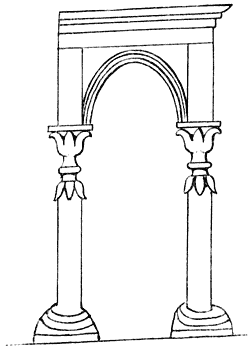
IN S. SOPHIA, CONSTANTINOPLE.
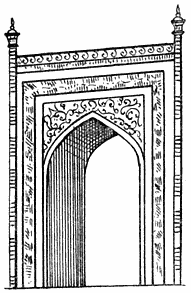
IN THE TAJ MAHALL, AGRA.
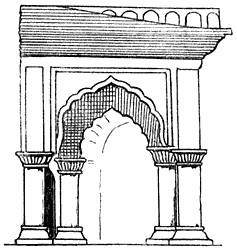
IN THE MOTI MASJID, AGRA.

EARLY PATHAN STYLE IN THE QUTB BUILDINGS AT DELHI.
A striking and distinctive feature in early Muḥammadan architecture is the horse-shoe arch, which in time gives way to a cusped or scalloped arch, strictly so termed, the outline being produced by intersecting semi-arches. Another variety of Saracenic arch is the circular-headed and stilted form. The pillars are commonly of exceedingly slender proportions, almost to apparent insecurity; but owing to the style of the embellishment, this lightness of particular forms tends to heighten the general luxuriance. Some have imagined that this element of slenderness in regard to pillars indicates a tent origin of the style. This tent-like character has been further kept up by concave ceilings and cupolas, emblazoned with painting and gilding. Decorations composed of animal and human figures, being interdicted by Muḥammadan law [PICTURES] are not found in Saracenic architecture; but their geometrical patterns exhibit singular beauty and complexity, inexhaustible variety of combinations, and a wonderful degree of harmonious intricacy, arising out of very simple elements. Lattice or open trellis work is another fertile source of embellishment, and is similar to the tracery met with in Gothic buildings. Another characteristic of Saracenic style is that of the dome. For the most part domes occur in mosques and tombs, and are of Byzantine origin. Minarets are also a special feature in Muḥammadan mosques, and contribute much to the picturesqueness of these buildings. They are found in mosques of the later Saracenic style. (See Fergusson’s Indian and Eastern Architecture, Mr. Owen Jones’s Alhambra Palace, Hersemer’s Arabische Bauverzierungen.)

IN A HOUSE IN PESHAWAR.
ʿARĪYAH (عرية). A kind of sale permitted in Islām, namely, when a person computes what quantity of fruit there is on a tree and sells it before it is plucked. (Mishkāt, xii. c. v.)
ʿĀRĪYAH (عارية) (1) A loan for the use of anything of which Qarẓ cannot be made: e.g. the loan of a horse is ʿĀrīyah; the loan of money is Qarẓ. (2) A gift, of which the following is an example:—A person makes a gift to another of the dates of a palm-tree in his garden; but having afterwards some doubt of the propriety of that person coming daily to his garden where his family usually are, and being at the same time unwilling to depart from his promise, or to retract his gift, he gives some of the dates that have already been pulled in lieu of those upon the tree. (Baillie’s Law of Sale, p. 300.)
ARK, NOAH’S (فلك نوح). It is mentioned in the history of the Deluge, as recorded in the Qurʾān, in two places—Sūrah xi. 39, “Build the ark under our eye and after our revelation,” and Sūrah xxiii. 27. There is also supposed to be an allusion to the ark in Sūrah xxxvi. 41, “And a sign to them is that we bare their offspring in the laden ship.”
Al-Baiẓāwī says that Noah was two years building the ark, which was 300 cubits long, 50 wide, and 30 broad, and which was made of Indian plane-tree; that it consisted of three storeys, the lowest for beasts, the middle for men and women (who were separated from each other), and the highest for birds.
The ark is said to have rested on the mountain al-Jūdī. [NOAH.]
ARK OF THE COVENANT. The Hebrew word for “Ark” is תֵּבָה (i.e. a chest, a coffer), Chald. תֵּיבוּתָא, Arabic تابوت, تابوة. See Qurʾān, Sūrah ii. 249, “The sign of his (Saul’s) kingdom is that there shall come unto you the ark (Tābūt); in it shall be security (or the Shechinah, sakīnah, Heb. שְׁכִינָה) from your Lord, and the relics of what the family of Moses and the family of Aaron left; the angels shall bear it.” Jalālu ʾd-dīn says this ark contained the images of the prophets, and was sent down from heaven to Adam, and at length came to the Israelites, who put great confidence therein, and continually carried it in front of their army, till it was taken by the Amalekites. But on this occasion the angels brought it back in the sight of all the people, and placed it at the feet of Saul (T̤ālūt), who was thereupon unanimously received as king.
ARMS, The Sale of. The sale of armour or warlike stores to rebels, or in their camp, is forbidden, because selling arms into the hands of rebels is an assistance to defection. But it is not forbidden to sell the materials for making arms to such persons. (Hamilton’s Hidāyah, vol. ii. 225.)
ARSH (ارش). (1.) A legal term for compensation. (2.) A mulct; a fine; particularly that which is paid for shedding of blood. (3.) A gift for conciliating the favour of a judge; a bribe. (4.) Whatever a purchaser receives from a seller after discovering a fault in the article bought.
ʿARSH (عرش). The term used in the Qurʾān for the throne of God. Sūrah ix. 131, “He is the Lord of the mighty throne.” Husainī, the commentator, says the throne has 8,000 pillars, and the distance between each pillar is 3,000,000 miles.
ʿAṢABAH (عصبة). A legal term for male relatives by the father’s side, agnates.
ĀṢAF (اصف). The wazīr or prime minister of Solomon. Alluded to in the Qurʾān, Sūrah xxvii. 40, as “He with whom was knowledge of the scripture.” Muḥammadan commentators say he was the son of Bark͟hīya.
AS̤AR (اثر). Relating; handing down by tradition. Generally used for a Ḥadīs̤ related by one of the Companions, as distinguished from one of the Prophet’s own.
AL-AS̤ARU ʾSH-SHARĪF (الاثر الشريف). The sacred relic. A hair of either the beard or mustachios of Muḥammad, or a foot-print of the Prophet. One of these sacred relics (a hair of his beard) is exhibited in the great mosque at Delhi, another in a mosque in Cashmere.
AṢḤĀB (اصحاب), pl. of Ṣāḥib. The Companions or Associates of Muḥammad. The term used for a single companion is ṣaḥābī. Concerning the title of “Companion,” there is considerable controversy as to the persons to whom it can be applied. Saʿīd ibn al-Musaiyab reckoned none a “Companion,” but those who had been a year or more with Muḥammad, and had gone on a warlike expedition with him. Some say that everyone who had attained puberty, had embraced Islām, and had seen the Prophet, was a “Companion,” even though he had attended Muḥammad but an hour. Others, however, affirm that none could be a “Companion” unless Muḥammad chose him and he chose Muḥammad, and he adhered to the Prophet at all times. The general opinion is that every one who embraced Islām, saw the Prophet, and accompanied him, even for a short time, was a “Companion.”
It is related that the Prophet marched to Makkah with 10,000 Muslims, to Ḥunain with 12,000, and that 40,000 accompanied him on the farewell pilgrimage. The number of the “Companions” at his death is said to have been 144,000.
In point of merit, the refugees (Muhājirūn) are more worthy than the auxiliaries (Anṣār); but by way of precedence, the auxiliaries are more worthy than the later refugees.
The “Companions” have been arranged in thirteen classes, which are given by Abū ʾl-Fidāʾ as follows:—I. Those who first embraced Islām, such as K͟hadījah, ʿAlī, Zaid, and Abū Bakr, and those who did not delay till he had established his mission. II. The Companions who believed in him after his mission had been fully established, amongst whom was ʿUmar. III. Those who fled to Abyssinia. IV. The first Companions of ʿAqabah, who preceded the Auxiliaries. V. The second Companions of ʿAqabah. VI. The third Companions of ʿAqabah, who were seventy. VII. The refugees who went to the Prophet after his flight, when he was at Qubā, before the erection of the temple. VIII. The soldiers of the great battle of Badr. IX. Those who joined Islām between Badr and Hudaibiyah. X. Those who took the oath of fealty under the acacia tree at Hudaibiyah. XI. Those who joined after the treaty of Hudaibiyah, but before the conquest. XII. Those that embraced Islām on the day of conquest. XIII. Those who were children in the time of the Prophet, and had seen him.
Muḥammad frequently commended the “Companions,” and spoke of their excellences and virtues, a chapter in the Traditions being devoted to this subject. (Mishkāt, xxiv. c. xiii.) He is related to have said, “My companions are like stars by which roads are found, for which ever companion you follow you will find the right road.”
AL-AṢḤĀBU ʾL-FĪL (اصحاب الفيل). “The Companions of the Elephant.” A term used in the Chapter of the Elephant, or the CVth Sūrah:—“Hast thou not seen how thy Lord dealt with the companions of the elephant? Did He not cause their stratagem to miscarry? And He sent against them birds in flocks, small stones did they hurl down upon them, and he made them like stubble eaten down!”
This refers to the army of Abrahah, the Christian king of Abyssinia and Arabia Felix, said to have been lost, in the year of Muḥammad’s birth, in an expedition against Makkah for the purpose of destroying the Kaʿbah. This army was cut off by small-pox, and there is no doubt, as the Arabic word for small-pox also means “small stones,” in reference to the hard gravelly feeling of the pustules, what is the true interpretation of the fourth verse of this Sūrah, which, like many other poetical passages in the Qurʾān, has formed the starting point for the most puerile and extravagant legends.
AṢḤĀBU ʾL-KAHF (اصحاب الكهف). “The Companions of the Cave,” i.e. the Seven Sleepers, mentioned in the Sūratu ʾl-kahf, or Chapter xviii. of the Qurʾān. The story, as told by early Christian writers, is given by Gibbon (Rise and Fall, Chapter xxxi.). When the Emperor Decius persecuted the Christians, seven noble youths of Ephesus are said to have concealed themselves in a cave in the side of a mountain, where they were doomed to perish by the tyrant, who gave orders that the entrance should be firmly secured with a pile of huge stones. They immediately fell into a deep slumber, which was miraculously prolonged, without injuring the powers of life, during a period of 187 years. This popular tale, which Muḥammad must have heard when he drove his camels to the fairs of Syria, is introduced into the Qurʾān as a divine revelation.
AṢḤĀBU ʾṢ-ṢUFFAH (اصحاب الصفة). “The sitters on the bench” of the temple at Makkah. They are thus described by Abū ʾl-Fidāʾ: “They were poor strangers, without friends or place of abode, who claimed the promises of the Apostle of God and implored his protection. Thus the porch of the temple became their mansion, and thence they obtained their name. When Muḥammad went to meals, he used to call some of them to partake with him; and he selected others to eat with his companions.”
ʾASHARAH MUBASHSHARAH (عشرة مبشرة). “The ten who received glad tidings.” Ten of the most distinguished of Muḥammad’s followers, whose certain entrance into Paradise he is said to have foretold. They are Abū Bakr, ʿUmar, Us̤mān, ʿAlī, T̤alḥah, az-Zubair, ʿAbdu ʾr-Raḥmān, Saʿd-ibn-Abū-Waqqāṣ, Saʿīd ibn Zaid, Abū ʿUbaidah ibn al-Jarrāḥ. (Mishkāt, book xxiv. c. xx., part ii.) Muḥammad declared it presumption for anyone to count upon an entrance into heaven with absolute certainty, but he made an exception in favour of these ten distinguished persons.
AL-ASHʿARĪYAH (الاشعرية). A sect formed by Abū ʾl-Ḥasan ʿAlī ibn Ismāʿīl al-Ashʿarī, born A.H. 260 (A.D. 873–4).
They hold that the attributes of God are distinct from His essence, yet in such a way as to forbid any comparison being made between God and His creatures. They say they are not “ʿain nor g͟hair:” not of His essence, nor distinct from it: i.e. they cannot be compared with any other things. They also hold that God has one eternal will, from which proceed all things, the good and the evil, the useful and the hurtful. The destiny of man was written on the eternal table before the world was created. So far they go with the Ṣifātīs, but in order to preserve the moral responsibility of man, they say that he has power to convert will into action. But this power cannot create anything new, for then God’s sovereignty would be impaired; so they say that God in His providence so orders matters that whenever “a man desires to do a certain thing, good or bad, the action corresponding to the desire is, there and then, created by God, and, as it were, fitted on to the desire.” Thus it seems as if it came naturally from the will of the man, whereas it does not. This action is called Kasb (acquisition), because it is acquired by a special creative act of God. It is an act directed to the obtaining of profit or the removing of injury: the term is therefore inapplicable to the Deity. Abū Bakr al-Bakillānī, a disciple of al-Ashʿarī, says: “The essence or substance of the action is the effect of the power of God, but its being a action of obedience, such as prayer, or an action of disobedience, such as fornication, are qualities of the action, which proceed from the power of man.” The Imām Al-Ḥaramain (A.H. 419–478) held “that the actions of men were effected by the power which God has created in man.” Abū Isḥaq al-Isfarāyinī says: “That which maketh impression, or hath influence on action, is a compound of the power of God and the power of man.” They also believe that the word of God is eternal, though they acknowledge that the vocal sounds used in the Qurʾān, which are the manifestation of that word, are created. They say, in short, that the Qurʾān contains (1) the eternal word which existed in the essence of God before time was; and (2) the word which consists of sounds and combinations of letters. This last they call the created word.
Thus Al-Ashʿarī traversed the main positions of the Mutazilites, denying that man can, by the aid of his reason alone, rise to the knowledge of good and evil. He must exercise no judgment, but accept all that is revealed. He has no right to apply the moral laws which affect men to the actions of God. It cannot be asserted by the human reason that the good will be rewarded or the bad punished in a future world. Man must always approach God as a slave, in whom there is no light or knowledge to judge of the actions of the Supreme. Whether God will accept the penitent sinner or not cannot be asserted, for He is an absolute Sovereign, above all law. (Sale, from Ibn K͟haldun; Die Muʿtaziliten oder die Freidenker in Islām, von H. Steiner, 1865; Zur Geschichte Abu ʾl-Ḥasan al-ashʿarīsh, von W. Spitta, 1876; De Strijd over het Dogma in den Islām tot op El-ashʿarī, door Dr. M. Th. Houtsma, Leiden, 1875; and Exposé de la Réforme de l’Islamisme, by M. A. F. Mehren, Leiden, 1878.)
ʿĀSHŪRĀʾ (عاشوراء). Lit. “the tenth.” A voluntary fast day, observed on the tenth of the month of Muḥarram. It is related that Muḥammad observed it, and said it was a day respected by Jews and Christians. (Mishkāt, vii. c. vii. 1.)
It is the only day of Muḥarram observed by the Sunnī Muslims, being the day on which it is said God created Adam and Eve, heaven and hell, the tablet of decree, the pen, life, and death. It is kept by the Sunnīs as a fast. [MUHARRAM.]
ĀSIYAH (آسية). The wife of Pharaoh. One of the four perfect women (the Virgin Mary, K͟hadījah, and Fāt̤imah, being the other three). See Mishkātu ʾl-Masābīḥ, xxiv. c. 22. She is mentioned in the Qurʾān (Sūrah lxvi. 11): “And God striketh out a parable for those who believe: the wife of Pharaoh, when she said, ‘My Lord, build for me a house with Thee in Paradise, and save me from Pharaoh and his works, and save me from the unjust people.’”
AṢL (اصل). Cause, first principle, foundation. Aṣl-wafarʿ, “cause and effect,” “fundamental and derivative principle.”
ASMĀʾU ʾLLĀH (آسماء الله). [GOD, NAMES OF.]
ʿASR (عصر). The afternoon prayer. [PRAYERS.] The title of the CIIIrd Sūrah of the Qurʾān.
ASS. According to the Imām Abū Ḥanīfah, the ass is an unclean animal, and its flesh and milk are unlawful; nor is zakāt to be given on an ass. (Hamilton’s Hidāyah, vol. i. 16, iv. 74, 86.)
ASSISTANTS. [ANSAR.]
ASTROLOGY. Arabic ʿIlmu ʾn-nujūm. Qatādah says, referring to the Qurʾān, that God has created stars for three uses: (1) as an ornament to the heavens (Sūrah lxvii. 5); (2) to stone the Devil with (Sūrah lxvii. 5); and (3) to direct travellers through the forests and on the sea (Sūrah xv. 16). Muḥammad condemns those who study the stars for any other purpose (Mishkāt, xxi. c. iii. pt. iii.), and consequently the science of Astrology is not considered lawful in Islām.
ATHEIST. [DAHRI.]
ʿATĪRAH (عتيرة). The sacrifice offered by the idolatrous Arabs in the month of Rajab. It was allowed by the Prophet at the commencement of his mission, but was afterwards abolished. Mishkāt, book iv. c. 50, “Let there be no Faraʿ nor ʿAtīrah.”
AT-TAḤĪYĀT (التحيات). Lit. “the greetings.” A part of the stated prayers, recited after the Takbīru ʾl-Quʿūd, after every two rakʿahs. It is recited whilst the worshipper kneels upon the ground. His left foot bent under him, he sits upon it, and places his hands upon his knees, and says:—“The adorations (i.e. at-taḥīyātu) of the tongue are for God, and also of the body and of alms-giving. Peace be on thee, O Prophet, with the mercy of God and His blessing. Peace be upon us, and upon God’s righteous servants.” (Mishkāt, iv., c. xvi.) [PRAYER.]
AUGURY. [FAʾL.]
AULĪYĀʾ (اولياء), pl. of walī. “Favourites of God.” The expression occurs in the Qurʾān in the following verse, “Are not the favourites of God those on whom no fear shall come, nor shall they be put to grief?” (Sūrah x. 63).
AUTĀD (اوتاد). Lit. “props or pillars.” A term used by the Ṣūfīs for the four saints, by whom the four corners of the world are said to be supported.
AʿŪẔU BILLĀH (اعوذ بالله). Another name for the Taʿauwuẕ, or the prayer in the daily liturgy: “I seek refuge with God from the cursed Satan.” [PRAYER.]
AVENGER OF BLOOD. In the Muḥammadan law, as in the Jewish, the punishment for wilful murder is left to the next of kin; but in the Jewish code the avenger of blood was compelled to take the life of the murderer, whilst in the Muslim code he may accept compensation, vide Qurʾān, Sūrah ii. 173, “O believers! retaliation (Qiṣāṣ) for blood-shedding is prescribed to you: the free man for the free, and the slave for the slave, and the woman for the woman; but he to whom his brother shall make any remission is to be dealt with equitably; and a payment should be made to him with liberality. This is a relaxation (i.e. of the stricter lex talionis) from your Lord, and a mercy.” [QISAS.]
ĀYAH (آية). Lit. “a sign, or miracle.” The term used for one of the smaller portions of the chapters of the Qurʾān, which we call verses. The number of verses is often set down after the title of the chapter, but the verses are not marked in the text as they are in our English Bibles. The number of verses in the Qurʾān is variously estimated, but they are generally said to be about six thousand two hundred. [QURʾAN.]
AL-AʿYĀNU ʾS̤-S̤ĀBITAH (الاعيان الثابتة), pl. of ʿayn, in the sense of “the essence” of a thing. The established essences. A term used by the Ṣūfī mystics to express figures emblematic of the names of God. (ʿAbdu ʾr-Razzāq’s Dictionary of Technical Terms of the Ṣūfīs. Sprenger’s edition.)
ĀYATU ʾL-FATḤ (اية الفتح). Lit. “The verse of victory.” The fifty-ninth verse of the Sūratu ʾl-Anʿām (vi.) of the Qurʾān. The powers of this verse are said to be so great, that if a person constantly recite it he will obtain his desires. It is generally recited with this object forty times after each season of prayer. It is as follows:—“And with Him are the keys of the secret things; none knoweth them but He; and He knoweth whatever is on the land and in the sea; and no leaf falleth but He knoweth it; neither is there a grain in the darknesses of the earth, nor a green thing nor a dry thing, but it is noted in a clear book.”
ĀYĀTU ʾL-ḤIFZ̤ (ايات الحفظ). “The verses of protection.” Certain verses of the Qurʾān which are usually inscribed on amulets. They are:—Sūrah ii. 256, “And the preservation of both (heaven and earth) is no burden unto Him.” Sūrah xii. 64, “God is the best protector.” Sūrah xiii. 12, “They guard him by the command of God.” Sūrah xv. 17, “We guard him from every devil driven away by stones.” Sūrah xxxvii. 7, “A protection against every rebellious devil.”
ĀYATU ʾL-KURSĪ (اية الكرسى). “The verse of the throne.” Verse 256 of the Sūratu ʾl-Baqarah, or chap. ii. of the Qurʾān. It is related (Mishkāt, book iv., c. xix., part iii.) that ʿAlī heard Muḥammad say in the pulpit, “that person who repeats the Āyatu ʾl-Kursī after every prayer, nothing prevents him entering into Paradise but life; and whoever says it when he goes to his bed-chamber, God will keep him in safety, together with his house and the house of his neighbour. The verse is as follows:—“God! There is no God but He; the Living, the Abiding. Neither slumber seizeth Him, nor sleep. To Him belongeth whatsoever is in heaven and whatsoever is in earth. Who is he that can intercede with Him but by His own permission? He knoweth what hath been before them, and what shall be after them; yet nought of His knowledge do they comprehend, save what He willeth. His THRONE reacheth over the heavens and the earth, and the upholding of both burdeneth Him not; and He is the High, the Great.”
ĀYATUʾL-MAWĀRĪS̤ (اية المواريث). “The verse of inheritances.” The twelfth verse of the Sūratu ʾn-nisā, or fourth chapter of the Qurʾān. It relates to inheritance, and is the foundation of the Muslim law on the subject. It is given in the article on Inheritance. [INHERITANCE.]
AYIMMATUʾL-ASMĀʾ (ائمة الاسماء). “The leading names.” The seven principal names or titles of God, namely:—
Al-Ḥayy The Living.
Al-ʿAlīm The Knowing.
Al-Murīd The Purposer.
Al-Qādir The Powerful.
As-Samīʿ The Hearer.
Al-Baṣīr The Seer.
Al-Mutakallim The Speaker.
ʿĀYISHAH (عائشة). The daughter of Abū Bakr, and the favourite wife of Muḥammad, to whom she was married when only nine years of age. She survived her husband many years, and died at al-Madīnah, A.H. 58 (A.D. 678), aged sixty-seven, and obtained the title of Ummu ʾl-Muʾminīn, “The Mother of the Believers.”
AYMĀN (ايمان), pl. of Yamīn. [OATHS.]
AYYĀMUʾL-BĪẒ (ايام البيض). “The days of the bright nights,” mentioned in the Mishkāt (book vii. c. 7, part 3), as days on which Muḥammad did not eat, whether halting or marching. They are the 13th, 14th, and 15th nights of the month. (See Lane’s Dict., p. 284.)
AYYĀMU ʾL-QARR (ايام القر). The day of rest after the day of sacrifice at the Pilgrimage. [HAJJ.]
AYYĀMU ʾN-NAḤR (ايام النحر). The season of sacrifice at the Pilgrimage. [HAJJ.]
AYYĀMU ʾT-TASHRĪQ (ايــام التشريق). The three days after the feast of sacrifice at Minā during the Pilgrimage. So called because the flesh of the victims is then dried, or because they are not slain until after sun-rise. [HAJJ, PILGRIMAGE.]
AYYIM (ايم). A legal term for a woman having no husband, whether she be a virgin or a widow.
ʿAẔĀBU ʾL-QABR (عذاب القبر). “The punishment of the grave.” That all persons, whether believers or not, undergo some punishment in their graves, is a fundamental article of the Muslim belief. These punishments are described in the following Ḥadīs̤ on the authority of Abū Hurairah:—
“The Prophet of God said, When a corpse is placed in its grave, two black angels come to it, with blue eyes. The name of the one is Munkar and of the other Nakīr, and they interrogate the dead person concerning the Prophet of God. If he be a Muslim, he will bear witness to the Unity of God and the mission of Muḥammad. The angels will then say, ‘We knew thou wouldst say so’; and the grave will then expand seventy times seventy yards in length, and seventy times seventy in breadth. A light will then be given for the grave, and it will be said, ‘Sleep.’ Then the dead person will say, ‘Shall I return to my brethren and inform them of this?’ Then the angels will say, ‘Sleep like the bridegroom, till God shall raise thee up from the grave on the Day of Resurrection.’ But if the corpse be that of an unbeliever, it will be asked, ‘What sayest thou about the Prophet?’ and he will reply, ‘I know him not.’ And then the angels will say, ‘We knew thou wouldst say so.’ Then the ground will be ordered to close in upon him, and it will break his sides, and turn his right side to his left, and he will suffer perpetual punishment till God raise him therefrom.” In another tradition, recorded by ʿAnas, it is said, “The wicked will be struck with a rod (mit̤raqah), and they will roar out, and their cries will be heard by all animals that may be near the grave excepting man and the genii.” (Mishkāt, book i., c. v.).
All Muḥammadan doctors of the orthodox schools (whether we apply the term orthodox to Sunnī or Shīʿah) believe in the literal interpretation of these punishments in the grave, which are said to take place as soon as the funeral party has left the grave-yard. A perusal of the various traditions on the subject must convince any unprejudiced mind that Muḥammad intended to teach a literal interpretation of his sayings on this subject. It is related that on one occasion, when the Prophet was riding through a grave-yard, his mule, hearing the groans of the dead, tried to throw his master. On that occasion, Muḥammad said, “If I were not afraid that you would leave off burying, I would ask God to give you the power of hearing what I hear.” Shaik͟h ʿAbdu ʾl-Ḥaqq, in his commentary on the Mishkāt, says, “The accounts which are here given of the punishment of the grave, are undoubtedly true, and they are not either imaginary or figurative.” (Mishkāt, book i., chap. v.; see Persian edition with ʿAbdu ʾl-Ḥaqq’s commentary.)
AZAL (ازل). Eternity with respect to the past, as distinguished from abad (ابد), eternity without end.
AẔĀN (اذان). Lit. “announcement.” The call or summons to public prayers proclaimed by the Muʾaẕẕin (or crier)—in small mosques from the side of the building or at the door, and in large mosques from the minaret.
It is in Arabic as follows:—
الله اكبر — الله اكبر — الله اكبر — الله اكبر — اشهد ان لا اله الا الله — اشهد ان لا اله الا الله — اشهد ان محمدا رسول الله — اشهد ان محمدا رسول الله — حى على الصلوة — حى على الصلوة — حى على الفلاح — حى على الفلاح — الله اكبر — الله اكبر — لا اله الا الله.
Allāhu akbar! Allāhu akbar! Allāhu akbar! Allāhu akbar! Ashhadu an lā ilāha illa ʾllāh! Ashhadu an lā ilāha illa ʾllāh! Ashhadu anna Muḥammadan rasūlu-llāh! Ashhadu anna Muḥammadan rasūlu-llāh! Ḥayya ʿala ʾṣ-ṣalāti! Ḥayya ʿala ʾṣ-ṣalāti! Ḥayya ʿala ʾl-falāḥ! Ḥayya ʿala ʾl-falāḥ! Allāhu akbar! Allāhu akbar! Lā ilāha illa ʾllāh!
Which is translated:—
“God is most great! God is most great! God is most great! God is most great! I testify that there is no god but God! I testify that there is no god but God! I testify that Muḥammad is the Apostle of God! I testify that Muḥammad is the Apostle of God! Come to prayer! Come to prayer! Come to salvation! Come to salvation! God is most great! God is most great! There is no god but God!”
In the Aẕān in the early morning, after the words, “Come to salvation!” is added الصلوة خير من النوم — الصلوة خير من النوم. Aṣ-ṣalātu k͟hairun mina ʾn-naumi! Aṣ-ṣalātu k͟hairun mina ʾn-naumi! “Prayer is better than sleep! Prayer is better than sleep!”
The Shīʿahs make a slight alteration in the Aẕān, by adding the words, حى على خير العمل — حى على خير العمل Ḥayya ʿalā k͟hairi ʾl-ʿamali! Ḥayya ʿalā k͟hairi ʾl-ʿamali! “Come to the best of works! Come to the best of works!” and by repeating the last sentence of the Aẕān, “There is no god but God,” twice instead of once, as in the Sunnī Aẕān.
When the Aẕān is recited, it is usual for men of piety and religious feeling to respond to each call, as, for example, when the Muʾaẕẕin cries:—
“Allāhu akbar! Allāhu akbar! Allāhu akbar! Allāhu akbar!”
Those who hear it repeat:—
“Allāhu akbar! Allāhu akbar! Allāhu akbar! Allāhu akbar!”
The Muʾaẕẕin says:—
“I testify that there is no god but God; I testify that there is no god but God.”
They reply:—
“I testify that there is no god but God; I testify that there is no god but God.”
Muʾaẕẕin.—“I testify that Muḥammad is the Apostle of God.”
Reply.—“I testify that Muḥammad is the Apostle of God.”
Muʾaẕẕin.—“Come to prayer.”
Reply.—“I have no power nor strength but from God the most High and Great.”
Muʾaẕẕin.—“Come to salvation.”
Reply.—“What God willeth will be; what He willeth not willeth not be.”
The recital of the Aẕān must be listened to with great reverence. If a person be walking at the time, he should stand still; if reclining, sit up. Mr. Lane, in his Modern Egyptians, says, “Most of the Muʾaẕẕins of Cairo have harmonious and sonorous voices, which they strain to the utmost pitch; yet there is a simple and solemn melody in their chants which is very striking, particularly in the stillness of the night.” But Vambéry remarks that “the Turkistānees most carefully avoid all tune and melody. The manner in which the Aẕān is cried in the west is here (in Bokhārā) declared sinful, and the beautiful melancholy notes which, in the silent hour of a moonlit evening, are heard from the slender minarets on the Bosphorus, fascinating every hearer, would be listened to by the Bok͟hariot with feelings only of detestation.”
The summons to prayer was at first the simple cry, “Come to public prayer.” After the Qiblah was changed, Muḥammad bethought himself of a more formal call. Some suggested the Jewish trumpet, others the Christian bell; but neither was grateful to the Prophet’s ear. The Aẕān, or call to prayer was then established. Tradition claims for it a supernatural origin, thus:—“While the matter was under discussion, ʿAbdu ʾllāh, a Khazrajite, dreamed that he met a man clad in green raiment, carrying a bell. ʿAbdu ʾllāh sought to buy it, saying that it would do well for bringing together the assembly of the faithful. ‘I will show thee a better way,’ replied the stranger; ‘let a crier cry aloud, “God is most great,” &c.’ Waking from sleep, ʿAbdu ʾllāh proceeded to Muḥammad, and told him his dream.” (Muir, from Kātibu ʾl-Wākidī.) Hishāmi recites the story as if ʿAbdu ʾllāh had actually met the man.
Bingham, in his Antiquities (vol. ii., book viii. chap. vii.), relates that, in the monastery of virgins which Paula, the famous Roman lady, set up and governed at Jerusalem, the signal for prayer was given by one going about and singing “Hallelujah!” for that was their call to church, as St. Jerome informs us.
The Aẕān is proclaimed before the stated times of prayer, either by one of the congregation, or by the Muʾaẕẕin or crier, who is paid for the purpose. He must stand with his face towards Makkah, with the points of his forefingers in his ears, and recite the formula which has been given above.
It must not be recited by an unclean person, a drunkard, a madman, or a woman.
ĀZAR (آزر). Terah, the father of Abraham. Sūrah vi. 74, “And when Ābrahīm said to his father Āzar, Takest thou images as gods?”
“The Eastern authors unanimously agree that he was a statuary, or carver of idols; and he is represented as the first who made images of clay, pictures only having been in use before, and taught that they were to be adored as gods. However, we are told his employment was a very honourable one, and that he was a great lord, and in high favour with Nimrod, whose son-in-law he was, because he made his idols for him, and was excellent in his art. Some of the Rabbins say Terah was a priest and chief of the order.”—(Sale.)
AL-AZĀRIQAH (الازارقة). A sect of heretics founded by Nāfiʿ ibn al-Azraq, who say that ʿAlī was an infidel, and that his assassin was right in killing him. (See ash-Shahrastānī, ed. Cureton, p. ٨٩, Haarbruecker’s translation, I., p. 133.)
AL-ʿAẒBĀʾ (العضباء). The slit-eared; one of Muḥammad’s favourite camels.
AL-AẒḤĀ (الاضحى). [ʿIDUʾL-AZHA.]
AL-ʿAZ̤ĪM (العظيم). One of the ninety-nine special names of God. “The great One.”
ʿAZĪMAH (عزيمة). An incantation. [EXORCISM.]
AL-ʿAZĪZ (العزيز). One of the ninety-nine special names of God. It frequently occurs in the Qurʾān. It means “the powerful, or the mighty One.”
ʿAZRĀʾĪL (عزرائيل). The angel of Death. Mentioned in the Qurʾān under the title of Malaku ʾl-Maut, Sūrah xxxii. 11, “The angel of death who is charged with you shall cause you to die.” [MALAKU ʾL-MAUT.]
B.
BABEL. Arabic بابل Bābil. Mentioned once in the Qurʾān, Sūrah ii. 96: “Sorcery did they teach to men, and what had been revealed to the two angels Hārūt and Mārūt at Bābil.” Babel is regarded by the Muslims as the fountain-head of the science of magic. They suppose Hārūt and Mārūt to be two angels who, in consequence of their want of compassion for the frailties of mankind, were sent down to earth to be tempted. They both sinned, and, being permitted to choose whether they would be punished now or hereafter, chose the former, and are still suspended by the feet at Babel in a rocky pit, and are the great teachers of magic. (Lane’s Thousand and One Nights, ch. iii. note 14.) Vide Tafsīr-i-ʿAzīzī in loco.
BĀBU ʾL-ABWĀB (باب الابواب). Lit. “The door of doors.” A term used by the Ṣūfīs for repentance. (ʿAbdu ʾr-Razzāq’s Dictionary of Ṣūfī Terms.)
BĀBU ʾS-SALĀM (باب السلام). “The Gate of Peace.” The gateway in the sacred mosque at Makkah through which Muḥammad entered when he was elected by the Quraish to decide the question as to which section of the tribe should lift the Black Stone into its place. It was originally called the Bāb Banī Shaibah, “the Gate of the Banū Shaibah,” the family of Shaibah ibn ʿUs̤mān, to whom Muḥammad gave the key of the Kaʿbah. Burkhardt says that there are now two gateways called by this name. Burton says, “The Bābu ʾs-Salām resembles in its isolation a triumphal arch, and is built of cut stone.” (Burton’s Pilgrimage, vol. ii. p. 174. See Muir’s Life of Mahomet, pp. 28, 29.)
BĀBU ʾN-NISĀʾ (باب النساء). “The Women’s Gate.” In later years, as Muḥammad added to the number of his wives, he provided for each a room or house on the same side of the mosque at al-Madīnah. From these he had a private entrance into the mosque, used only by himself, and the eastern gate still bears in its name, Bābu ʾn-Nisāʾ, the memory of the arrangement. (Muir’s Life of Mahomet, iii. p. 20.)
BACKBITING. Anything secretly whispered of an absent person which is calculated to injure him, and which is true, is called G͟hībah, a false accusation being expressed by Buhtān. Abū Hurairah says, “The question was put to the Prophet, ‘Do you know what backbiting is?’ and he replied, ‘It is saying anything bad of a Muslim.’ It was then said, ‘But what is it if it is true?’ And he said, ‘If it is true it is G͟hībah, and if it is a false accusation, it is Buhtān (i.e. slander).’ ” (Mishkāt, xxii. c. x.)
The following are sayings of Muḥammad on the subject:—“The best of God’s servants are those who when you meet them speak of God. The worst of God’s servants are those who carry tales about, to do mischief and separate friends, and seek out the defects of good people.” “He who wears two faces in this world shall have two tongues of fire in the day of the Resurrection.” “It is unworthy of a believer to injure people’s reputations, or to curse anyone, or to abuse anyone, or to talk vainly.” “The best atonement you can make for backbiting is to say, ‘O God pardon me and him (whom I have injured).’ ” Mishkāt, xxii. c. x.
BADAWĪ (بدوى). A name given to the Bedouin Arabs, or the Arabs of the desert. Bedouin is only a corruption of the plural of this word, which is derived from Badw = Bādiyah, “a desert.”
AL-BADĪʿ (البديع) is one of the ninety-nine special names of God. It means “He who originates.” It occurs in the Qurʾān, Sūrah ii. 111, “He is the wonderful originator of the heavens and the earth; when He decreeth a matter, He doth but say to it, ‘Be,’ and it is.”
BADR, The battle of. Arabic, G͟hazwatu ʾl-Badr. The first battle of Badr was fought in the month of Ramaẓān, A.H. 2 (March, A.D. 624), between Muḥammad and the Quraish. Many of the principal men of the Quraish were slain, including Abū Jahl, whose head was brought to the Prophet, and when it was cast at his feet, he exclaimed, “It is more acceptable to me than the choicest camel of Arabia.” After the battle was over, some of the prisoners were cruelly murdered. Ḥusain says the losses of the Quraish at Badr were seventy killed and seventy prisoners. This victory at Badr consolidated the power of Muḥammad, and it is regarded by Muslim historians as one of the most important events of history. An account of this celebrated battle will be found in the article on Muḥammad.
The second battle of Badr was a bloodless victory, and took place in the month Ẕū ʾl-Qaʿdah, A.H. 4 (April, A.D. 626).
BAḤĪRĀ (بحيرا). A Nestorian monk whom Muḥammad met when he was journeying back from Syria to Makkah, and who is said to have perceived by various signs that he was a prophet. His Christian name is supposed to have been Sergius (or Georgius).
Sprenger thinks that Baḥīrā remained with Muḥammad, and it has been suggested that there is an allusion to this monk in the Qurʾān, Sūrah xvi. 105: “We know that they say, ‘It is only a man who teacheth him.’ ” Ḥusain the commentator says on this passage that the Prophet was in the habit of going every evening to a Christian to hear the Taurāt and Injīl. (Tafsīr-i-Ḥusainī; Sale, p. 228; Muir’s Life of Mahomet, p. 72.)
BAḤĪRAH (بحيرة). (1.) A she-camel, she-goat or ewe, which had given birth to a tenth young one. (2.) A she-camel, the mother of which had brought forth ten females consecutively before her.
In these and similar cases, the pagan Arabs observed certain religious ceremonies, such as slitting the animal’s ear, &c., all of which are forbidden in the Qurʾān: “God hath not ordained any Baḥīrah.” (Sūrah v. 102.)
BAIʿ (بيع, pl. بيوع buyūʿ). A sale; commercial dealing; barter. Baiʿ, or “sale,” in the language of the law, signifies an exchange of property for property with the mutual consent of parties. For the rules concerning sales and barter, see Hamilton’s Hidāyah, vol. ii. 360; Baillie’s Muḥammadan Law of Sale; The Fatāwā ʿĀlamgīrī.
Sale, in its ordinary acceptation, is a transfer of property in consideration of a price in money. The word has a more comprehensive meaning in the Muḥammadan law, and is applied to every exchange of property for property with mutual consent. It, therefore, includes barter as well as sale, and also loan, when the articles lent are intended to be consumed, and replaced to the lender by a similar quantity of the same kind. This transaction, which is truly an exchange of property for property, is termed qarz̤ in the Muḥammadan law.
Between barter and sale there is no essential distinction in most systems of law, and the joint subject may in general be considerably simplified by being treated of solely as a sale. A course has been adopted in the Muḥammadan law, which obliges the reader to fix his attention on both sides of the contract. This may at first appear to him to be an unnecessary complication of the subject, but when he becomes acquainted with the definition of price, and the rules for the prohibition of excess in the exchange of a large class of commodities, which apply to every form of the contract, he will probably be of opinion that to treat of the subject in any other way would be attended with at least equal difficulties.
The first point which seems to require his attention is the meaning of the word “property” as it occurs in the definition of sale. The original term (māl), which has been thus translated, is defined by Muḥammadan lawyers to be “that which can be taken possession of and secured.” This definition seems to imply that it is tangible or corporeal, and things or substances are accordingly the proper subjects of sale. Mere rights are not māl, and cannot therefore be lawfully sold apart from the corporeal things with which they may happen to be connected. Of such rights one of the most important is the right of a creditor to exact payment of a debt, which is not a proper subject of sale. In other words, debts cannot, by the Muḥammadan law, any more than by the common laws of England and Scotland, be lawfully sold.
Things are commonly divided into moveable and immoveable, the latter comprehending land and things permanently attached to it. But the distinction is not of much importance in the Muḥammadan law, as the transfer of land is in nowise distinguished from that of other kinds of property.
A more important division of things is that into mis̤lī and kammī. The former are things which, when they happen to perish, are to be replaced by an equal quantity of something similar to them; and the latter are things which, in the same circumstances, are to be replaced by their value. These two classes have been aptly styled “similars” and “dissimilars” by Mr. Hamilton, in his translation of the Hidāyah. Similars are things which are usually sold or exchanged by weight, or by measurement of capacity, that is, by dry or liquid measure; and dissimilars are things which are not sold or exchanged in either of these ways. Articles which are nearly alike, and are commonly sold or exchanged by number or tale, are classed with the first division of things, and may be termed “similars of tale”; while articles which differ materially from each other, yet are still usually sold or exchanged by number, belong to the second division, and may be called “dissimilars of tale.” Dirhams and dīnārs, the only coined money known to the old Arabs, are included among similars of weight.
Similars of weight and capacity are distinguished in the Muḥammadan law from all other descriptions of property in a very remarkable way. When one article of weight is sold or exchanged for another article of weight, or one of measure is sold or exchanged for another of measure, the delivery of both must be immediate from hand to hand, and any delay of delivery in one of them is unlawful and prohibited. Where, again, the articles exchanged are also of the same kind, as when wheat is sold for wheat, or silver for silver, there must not only be reciprocal and immediate delivery of both before the separation of the parties, but also absolute equality of weight or measure, according as the articles are weighable or measurable, and any excess on either side is also unlawful and prohibited. These two prohibitions constitute in brief the doctrine of reba, or “usury,” which is a marked characteristic of the Muḥammadan law of sale. The word reba properly signifies “excess,” and there are no terms in the Muḥammadan law which correspond to the words “interest” and “usury,” in the sense attached to them in the English language; but it was expressly prohibited by Muḥammad to his followers to derive any advantage from loans, and that particular kind of advantage which is called by us interest, and consists in the receiving back from the borrower a larger quantity than was actually lent to him, was effectually prevented by the two rules above-mentioned. These, like some other principles of Muḥammadan law, are applied with a rigour and minuteness that may to us seem incommensurate with their importance, but are easily accounted for when we know that they are believed to be of divine origin.
Similars of weight and capacity have a common feature of resemblance, which distinguishes them in their own nature from other commodities, and marks with further peculiarity their treatment in the Muḥammadan law. They are aggregates of minute parts, which are either exactly alike, or so nearly resemble each other, that the difference between them may be safely disregarded. For this reason they are usually dealt with in bulk, regard being had only to the whole of a stipulated quantity, and not to the individual parts of which it is composed. When sold in this manner they are said to be indeterminate. They may, however, be rendered specific in several ways. Actual delivery, or production with distinct reference at the time of contract, seems to be sufficient for that purpose in all cases. But something short of this would suffice for all similars but money. Thus, flour, or any kind of grain, may be rendered specific by being enclosed in a sack; or oil, or any liquid, by being put into casks or jars; and though the vessels are not actually produced at the time of contract, their contents may be sufficiently particularised by description of the vessels and their locality. Money is not susceptible of being thus particularised, and dirhams and dīnārs are frequently referred to in the following pages as things which cannot be rendered specific by description, or specification, as it is more literally termed. Hence, money is said to be always indeterminate. Other similars, including similars of tale, are sometimes specific and sometimes indeterminate. Dissimilars, including those of tale, are always specific.
When similars are sold indeterminately, the purchaser has no right to any specific portion of them until it be separated from a general mass, and marked or identified as the subject of the contract. From the moment of offer till actual delivery, he has nothing to rely upon but the seller’s obligation, which may, therefore, be considered the direct subject of the contract. Similars taken indeterminately are accordingly termed dayn, or “obligations,” in the Muḥammadan law. When taken specifically, they are classed with dissimilars, under the general name of ʿayn. The literal meaning of this term is “substance or thing”; but when opposed to dayn it means something determinate or specific. The subject of traffic may thus be divided into two classes, specific and indeterminate; or, if we substitute for the latter the word “obligation,” and omit the word “specific” as unnecessary when not opposed to “indeterminate,” these classes may, according to the view of Muḥammadan lawyers, be described as things and obligations.
There is some degree of presumption in using a word in any other than its ordinary acceptation; and it is not without hesitation that (Mr. Baillie says) I have ventured to employ the word “obligation” to signify indeterminate things. My reasons for doing so are these: first it expresses the exact meaning of the Arabic word dayn, and yet distinguishes this use of it from another sense, in which it is also employed in the Muḥammadan law; second, it preserves consistency in the law. Thus, it will be found hereafter that the effect of sale is said to be to induce a right in the buyer to the thing sold, and in the seller to the price, and that this effect follows the contract immediately before reciprocal possession by the contracting parties. Now, it is obvious that this is impossible with regard to things that are indeterminate, if the things themselves are considered the subject of the contract, and cases are mentioned where it is expressly stated that there is no transfer of property to the purchaser, when similars of weight or capacity are sold without being distinctly specified, until actual possession takes place. The difficulty disappears if we consider not the thing itself but the obligation to render it to be the subject of contract; for a right to the obligation passes immediately to the purchaser, and the seller may be compelled to perform it. If we now revert to the division of things into similars and dissimilars, money—which, it has been remarked, is always indeterminate—is therefore an obligation; dissimilars, which are always specific, are never obligations; and other similars, except money, being sometimes specific and sometimes indeterminate, are at one time obligations, and at another time things or substances.
Before proceeding farther it is necessary to advert more particularly to the other sense in which the word dayn is frequently employed in the Muḥammadan law. It means strictly “obligation,” as already observed; but the obligation may be either that of the contracting party himself, or of another. In the former sense dayn is not only a proper subject of traffic, but forms the sole subject of one important kind of sale, hereafter to be noticed. But when dayn is used to signify the obligation of another than the contracting party, it is not a proper subject of traffic, and, as already observed, cannot be lawfully sold. In the following pages dayn has been always translated by the word “debt” when it signifies the obligation of a third party, and generally by the word “obligation,” when it signifies the engagement of the contracting party himself, though when the things represented by the obligation are more prominently brought forward, it has sometimes been found necessary to substitute the expression, “indeterminate things.”
Though barter and sale for a price, are confounded under one general name in the Muḥammadan law, it is sometimes necessary to consider one of the things exchanged as more strictly the subject of sale, or thing sold, and the other as the price. In this view the former is termed mabīʿ, and the latter S̤aman. S̤aman, or “price,” is defined to be dayn fī ẕimmah, or, literally, an “obligation in responsibility.” From which, unless the expression is a mere pleonasm, it would appear that the word dayn is sometimes used abstractly, and in a sense distinct from the idea of liability. That idea, however, is necessary to constitute price; for though cloth, when properly described, may, by reason of its divisibility and the similarity of its parts, be sometimes assumed to perform the function of price in a contract of sale, it is only when it is not immediately delivered, but is to remain for some time on the responsibility of the contracting party, that it can be adopted for that purpose.
It is a general principle of the Muḥammadan law of sale, founded on a declaration of the Prophet, that credit cannot be opposed to credit, that is, that both the things exchanged cannot be allowed to remain on the responsibility of the parties. Hence, it is only with regard to one of them that any stipulation for delay in its delivery is lawful. Price, from its definition above given, admits of being left on responsibility, and accordingly a stipulation for delay in the payment of the price is quite lawful and valid. It follows that a stipulation for delay in the delivery of the things sold cannot be lawful. And this is the case, with the exception of one particular kind of sale, hereafter to be noticed, in which the thing sold is always indeterminate, and the price is paid in advance. It may, therefore, be said of all specific things when the subject of sale, that a stipulation for delay in their delivery is illegal, and would invalidate a sale. The object of this rule may have been to prevent any change of the thing sold before delivery, and the disputes which might in consequence arise between the parties. But if they were allowed to select whichever they pleased of the articles exchanged to stand for the price, and the other for the thing sold, without any regard to their qualities, the object of the last-mentioned rule, whatever it may have been, might be defeated. This seems to have led to another arrangement of things into different classes, according to their capacities for supporting the functions of price or of the thing sold in a contract of sale. The first class comprehends dirhams and dīnārs, which are always price. The second class comprises the whole division of dissimilars (with the single exception of cloth), which are always the thing sold, or subject of sale, in a contract. The third class comprises, first, all similars of capacity; second, all similars of weight, except dirhams and dīnārs; and, third, all similars of tale. The whole of this class is capable of supporting both functions, and is sometimes the thing sold, and sometimes the price. The fourth class comprises cloth, and the copper coin called fulūs.
Sale implies a reciprocal vesting of the price in the seller and of the thing sold in the purchaser. This, as already remarked, is called its legal effect, and sale may be divided into different stages or degrees of completeness, according as this effect is immediate, suspended, invalid, or obligatory. Thus, sale must first of all be duly constituted or contracted. After that, there may still be some bar to its operation, which occasions a suspension of its effect. This generally arises from a defect of power in the seller, who may not be fully competent to act for himself, or may have insufficient authority, or no authority whatever, over the subject of sale. In this class of sales the effect is dependent on the assent or ratification of some other person than the party actually contracting. But whether the effect of a sale be immediate or suspended, there may be some taint of illegality in the mode of constituting it, or in its subject, or there may be other circumstances connected with it, which render it invalid. The causes of illegality are many and various. But even though a sale should be unimpeachable on the previous grounds, that is, though it should be duly constituted, operative or immediate in its effect, and free from any ground of illegality, still it may not be absolutely binding on the parties. This brings us to another remarkable peculiarity of the Muḥammadan law, viz. the doctrine of option, or right of cancellation. The Prophet himself recommended one of his followers to reserve a locus penitentiæ, or option, for three days in all his purchases. This has led to the option by stipulation, which may be reserved by either of the parties. But besides this, the purchaser has an option without any stipulation, with regard to things which he has purchased without seeing, and also on account of defects in the thing sold. The greatest of all defects is a want of title or right in the seller. The two last options to the purchase constitute a complete warranty of title and against all defects on the part of the seller, in which respect the Muḥammadan more nearly resembles the Scotch than the English law of sale.
There are many different kinds of sale. Twenty or more have been enumerated in the Nihāyah, of which eight are mentioned and explained. Four of these, which have reference to the thing sold, may require some notice in this place. The first, called Muqāyaẓah, is described as a sale of things for things, and corresponds nearly with barter; but the word “thing” (ʿayn) is here opposed to obligations, and muqāyaẓah is therefore properly an exchange of specific for specific things. So that if the goods exchanged were on both sides or on either side indeterminate, the transaction would not, I think, be a muqāyaẓah, though still barter. The second sale is called ṣarf, and is defined to be an exchange of obligations for obligations. The usual objects of this contract are dirhams and dīnārs, which being obligations, the definition is generally correct. But an exchange of money for bullion, or bullion for bullion, is also a ṣarf, and every sale of an obligation for an obligation is not a ṣarf, so that the definition is redundant as well as defective. It is essential to the legality of this kind of sale, that both the things exchanged should be delivered and taken possession of before the separation of the parties, and that when they are of the same kind, as silver for silver, or gold for gold, they should also be exactly equal by weight. These rules are necessary for the avoidance of reba, or “usury,” as already explained; and the whole of ṣarf, which is treated of at a length quite disproportionate to its importance, may be considered as a continued illustration of the doctrine of reba. The third kind of sale is salam. It has been already observed that there can be no lawful stipulation for a postponement of the delivery of the thing sold, except under one particular form of sale. The form alluded to is salam. This word means, literally, “an advance”; and in a salam sale the price is immediately advanced for the goods to be delivered at a future fixed time. It is only things of the class of similars that can be sold in this way, and as they must necessarily be indeterminate, the proper subject of sale is an obligation; while, on the other hand, as the price must be actually paid or delivered at the time of the contract, before the separation of the parties, and must, therefore, even in the case of its being money, be produced, and in consequence be particularised or specific, a salam sale is strictly and properly the sale of an obligation for a thing, as defined above. Until actual payment or delivery of the price, however, it retains its character of an obligation, and for this reason the price and the goods are both termed “debts,” and are adduced in the same chapter as examples of the principle that the sale of a debt, that is, of the money or goods which a person is under engagement to pay or deliver, before possession, is invalid. The last of the sales referred to is the ordinary exchange of goods for money, which being an obligation, the transaction is defined to be the sale of things for obligations.
There is another transaction which comes within the definition of sale, and has been already noticed, but may be further adverted to in this place. It is that which is called Qarẓ in the Arabic, and “loan” in the English language. The borrower acquires an absolute right of property in the things lent, and comes under an engagement to return an equal quantity of things of the same kind. The transaction is therefore necessarily limited to similars, whether of weight, capacity, or tale, and the things lent and repaid being of the same kind, the two rules already mentioned for the prevention of reba, or “usury,” must be strictly observed. Hence it follows that any stipulation on the part of the borrower for delay or forbearance by the lender, or any stipulation by the lender for interest to be paid by the borrower are alike unlawful.
Notwithstanding the stringency of the rules for preventing usury, or the taking any interest on the loan of money, methods were found for evading them and still keeping within the letter of the law. It had always been considered lawful to take a pledge to secure the repayment of a debt. Pledges were ordinarily of movable property; when given as security for a debt, and the pledge happened to perish in the hands of the pawnee, the debt was held to be released to the extent of the value of the pledge. Land, though scarcely liable to this incident, was sometimes made the subject of pledge, and devices were adopted for enabling the lender to derive some advantage from its possession while in the state of pledge. But the moderate advantage to be derived in this way does not seem to have contented the money-lenders, who in all ages and countries have been of a grasping disposition, and the expedient of a sale with a condition for redemption was adopted, which very closely resembles an English mortgage. In the latter, the condition is usually expressed in one of two ways, viz. either that the sale shall become void, or that the lender shall resell to the seller, on payment of principal and interest at an assigned term. The first of these forms would be inconsistent with the nature of sale under the Muḥammadan law, but a sale with a covenant by the lender to reconvey to the seller on repayment of the loan seems to have been in use probably long before the form was adopted in Europe. It is probable that a term was fixed within which the repayment should be made. If repayment were made at the assigned term, the lender was obliged to reconvey; but if not, the property would remain his own, and the difference between its value and the price or sum lent might have been made an ample compensation for the loss of interest. This form of sale, which was called Baiʿu ʾl-Wafāʾ, seems to have been strictly legal according to the most approved authorities, though held to be what the law calls abominable, as a device for obtaining what it prohibits.
In constituting sale there is no material difference between the Muḥammadan and other systems of law. The offer and acceptance, which are expressed or implied in all cases, must be so connected as to obviate any doubt of the one being intended to apply to the other. For this purpose the Muḥammadan law requires that both shall be interchanged at the same meeting of the parties, and that no other business shall be suffered to intervene between an offer and its acceptance. A very slight interruption is sufficient to break the continuity of a negotiation, and to terminate the meeting in a technical sense, though the parties should still remain in personal communication. An acceptance after the interruption of an offer made before it would be insufficient to constitute a sale. This has led to distinctions of the meeting which may appear unnecessarily minute to a reader unacquainted with the manners of Eastern countries, where the people are often very dilatory in their bargains, interspersing them with conversation on indifferent topics. It is only when a meeting has reference to the act of contracting that its meaning is thus liable to be restricted; for when the word occurs in other parts of the law, as, for instance, when it is said of a ṣarf contract that the things exchanged must be taken possession of at the meeting, the whole period that the parties may remain together is to be understood. As personal communication may be inconvenient in some cases, and impossible in others, the integrity of the meeting is held to be sufficiently preserved when a party who receives an offer by message or letter declares his acceptance of it on receiving the communication and apprehending its contents.
When a sale is lawfully contracted, the property in the things exchanged passes immediately from and to the parties respectively. In a legal sale, delivery and possession are not necessary for this purpose. Until possession is taken, however, the purchaser is not liable for accidental loss, and the seller has a lien for the price on the thing sold. Delivery by one party is in general tantamount to possession taken by the other. It is, therefore, sometimes of great importance to ascertain when there is a sufficient delivery; and many cases, real or imaginary, on the subject, are inserted in the Fatāwā ʿĀlamgīrī. It sometimes happens that a person purchases a thing of which he is already in possession, and it then becomes important to determine in what cases his previous possession is convertible into a possession under the purchase. Unless so converted, it would be held that there is no delivery under the sale, and the seller would of course retain his lien and remain liable for accidental loss.
Though possession is not necessary to complete the transfer of property under a legal sale, the case is different where the contract is illegal; for here property does not pass till possession is taken. The sale, however, though so far effectual, is still invalid, and liable to be set aside by a judge, at the instance of either of the parties, without any reference to the fact of the person complaining being able to come before him with what in legal phraseology is termed clean hands. A Muḥammadan judge is obliged by his law to interfere for the sake of the law itself, or, as it is more solemnly termed, for the right of God, which it is the duty of the judge to vindicate, though by so doing he may afford assistance to a party who personally may have no just claim to his interference. (The Muhammadan Law of Sale, according to the Haneefee Code, from the Fatawa Alamgiri, by Neil B. E. Baillie. Smith, Elder & Co., London.)
BAIL. Arabic كفالة kafālah. Bail is of two descriptions: Kafālah bi-ʾn-nafs, or “security for the person”; Kafālah bi-ʾl-māl, or “security for property.” In the English courts in India, bail for the person is termed Ḥāẓir-ẓamānī, and bail for property Ẓamānah, or “security.” Bail for the person is lawful except in cases of punishment (Ḥudūd) and retaliation (Qiṣāṣ). (Hidāyah, vol. ii. p. 576.)
AL-BĀʿIS̤ (الباعث). One of the ninety-nine special names of God. It means “He who awakes”; “The Awakener” (in the Day of Resurrection).
BAITU ʾL-ḤAMD (بيت الحمد). “The House of Praise.” An expression which occurs in the Traditions (Mishkāt v. 7). When the soul of a child is taken, God says, “Build a house for my servant in Paradise and call it a house of praise.”
BAITU ʾL-ḤARĀM (بيت الحرام). “The Sacred House.” A name given to the Meccan mosque. [MASJIDU ʾL-HARAM.]
BAITU ʾL-ḤIKMAH (بيت الحكمة). Lit. “The House of Wisdom.” A term used by Ṣūfīs for the heart of the sincere seekers after God. (ʿAbdu ʾr-Razzāq’s Dictionary of Ṣūfī Terms.)
BAITU ʾL-LĀH (بيت الله). “The House of God.” A name given to the Meccan mosque. [MASJIDU ʾL-HARAM.]
BAITU ʾL-MĀL (بيت المال). Lit. “The House of Property.” The public treasury of a Muslim state, which the ruler is not allowed to use for his personal expenses, but only for the public good.
The sources of income are: (1) Zakāt, or the legal tax raised upon land, personal property, and merchandise, which, after deducting the expense of collecting, should be expended in the support of the poor and destitute. (2) The fifth of all spoils and booty taken in war. (3) The produce of mines and of treasure-trove. (4) Property for which there is no owner. (5) The Jizyah, or tax levied on unbelievers. (Hidāyah, Arabic ed., vol. i. p. 452.)
AL-BAITU ʾL-MAʿMŪR (البيت المعمور). Lit. “The Inhabited House.” A house in the seventh heaven, visited by Muḥammad during the Miʿrāj or night-journey. It is said to be immediately over the sacred temple at Makkah. [MIʿRAJ.]
BAITU ʾL-MIDRĀS (بيت المدراس). “The House of Instruction.” A term (used in a tradition given by Abū Hurairah) for a Jewish school. (Mishkāt, xvii. c. xi.) In Heb. בֵּית הַמִּדְרָשׁ.
AL-BAITU ʾL-MUQADDAS (البيت المقدس). “The Holy House.” A name given to the temple at Jerusalem. [AL-MASJIDU ʾL-AQSA.]
BAITU ʾL-QUDS (بيت القدس). Lit. “The House of Holiness.” A term used by the Ṣūfīs for the heart of the true seeker after God when it is absorbed in meditation. (ʿAbdu ʾr-Razzāq’s Dictionary of Ṣūfī Terms.)
BAIʿU ʾL-WAFĀʾ (بيع الوفاء). The word wafā means the performance of a promise, and the Baiʿu ʾl-Wafāʾ is a sale with a promise to be performed. It is, in fact, a pledge in the hands of the pawnee, who is not its proprietor, nor is he free to make use of it without the permission of the owner. There are different opinions about the legality of this form of sale, but it is now the common form of mortgage in use in India, where it is usually styled Baiʿ bi-ʾl-wafā. (See Baillie’s Muḥammadan Law of Sale, p. 303.)
AL-BAIYINAH (البينة). Lit. “The Evidence.” A title given to the XCVIIIth Sūrah of the Qurʾān, in which the word occurs.
BAʿL (بعل), Heb. הַבַּעַל, i.e. “Lord.” The chief deity worshipped by the Syro-Phœnician nations. It is known to the Muḥammadans as an idol worshipped in the days of the Prophet Elisha. (See G͟hiyās̤u ʾl-Lug͟hah.)
BALAAM. There is said to be an allusion to Balaam in the Qurʾān, Sūrah vii. 174, “Recite to them the story of him to whom we gave our signs, and he departed therefrom, and Satan followed him, and he was of those who were beguiled.”
The commentary of the Jalālain says that he was a learned man amongst the Israelites, who was requested by the Canaanites to curse Moses at the time when he was about to attack the Jabbārūn or “giants,” a tribe of the Canaanites. Balaam at first refused to do so but at last yielded, when valuable presents were made to him. (See Tafsīru ʾl-Jalālain, p. 142.)
BALAD (بلد). Lit. Any country, district, or town, regarded as an habitation. Al-Balad, the sacred territory of Makkah. A title given to the XCth Sūrah, in which the word occurs.
BĀLIGH (بالغ). “Of years of legal maturity; adult.” [PUBERTY.]
BANISHMENT. Arabic تغريب Tag͟hrīb. Expatriation for fornication is enjoined by Muḥammadan law, according to the Imām ash-Shāfiʿī, although it is not allowed by the other doctors of the law, and it is also a punishment inflicted upon highway robbers.
BANKRUPT. There is no provision in the Muḥammadan law for declaring a person bankrupt, and so placing him beyond the reach of his creditors; but the Qāẓī can declare a debtor insolvent, and free him from the obligation of zakāt and almsgiving.
BANŪ ISRĀʾĪL (بنو اسرآئيل). “The Children of Israel.” A title of the XVIIth Sūrah or chapter of the Qurʾān, called also Sūratu ʾl-Miʿrāj.
BANŪN (بنون). The plural of ibn (Heb. בָּנִים). “Sons; posterity; tribe.” The word is more familiar to English readers in its inflected form Banī. The tribes whose names occur frequently in the early history of Islām, and are mentioned in the Traditions, are the Banū-Quraish, Banū ʾn-Najjār, Banū-Quraiẓah, Banū-Kinānah, Banū ʾn-Naẓr, Banū-K͟huzāʿah, Banū-Bakrʾ, Banū-ʿĀmir, Banū-Asad, Banū-Fazārah, Banū-Liḥyān, Banū-Tamīm, Banū-Umaiyah, Banū-Zahrah, and Banū-Isrāʾīl.
BAPTISM. The only allusion to baptism in the Qurʾān is found in Sūrah ii. 132: “(We have) the baptism of God, and who is better to baptise than God?” The word here translated baptism is ṣibg͟hah, lit. “dye,” which, the commentators al-Jalālain and al-Baiẓāwī say, may, by comparison, refer to Christian baptism, “for,” says al-Baiẓāwī, “the Naṣārā (Christians) were in the habit of dipping their offspring in a yellow water which they called al-Maʿmūdiyah and said it purified them and confirmed them as Christians.” (See Tafsīru ʾl-Jalālain and Tafsīru ʾl-Baiẓāwī, in loco.)
AL-BĀQĪ (الباقى). One of the ninety-nine special names of God. It means “He who remains;” “The Everlasting One.”
AL-BAQARAH (البقرة). “The Cow.” The title of the second Sūrah of the Qurʾān, occasioned by the story of the red heifer mentioned in verse 63, “When Moses said to his people, God commandeth you to sacrifice a cow.”
BAQĪʿU ʾL-G͟HARQAD (بقيع الغرقد), or for shortness al-Baqī (البقيع). The burying-ground at al-Madīnah, which Muḥammad used to frequent at night to pray for forgiveness for the dead. (Mishkāt, iv. c. 28.)
BARĀʾAH (براءة). “Immunity, or security.” A title given to the IXth Chapter of the Qurʾān, called also Sūratu ʾt-Taubah, “The Chapter of Repentance.” It is remarkable as being the only Sūrah without the introductory form, “In the name of God, the Merciful, the Compassionate.” Various reasons are assigned for this omission. Some commentators say that the prayer of mercy is not placed at the head of a chapter which speaks chiefly of God’s wrath.
BĀRAH-I-WAFĀT (باره وفات). Bārah (Urdū) “twelve,” and Wafāt. The twelfth day of the month Rabīʿu ʾl-Awwal, observed in commemoration of Muḥammad’s death.
It seems to be a day instituted by the Muḥammadans of India, and is not observed universally amongst the Muslims of all countries. On this day Fātiḥahs are recited for Muḥammad’s soul, and both in private houses and mosques portions of the Traditions and other works in praise of the Prophet’s excellences are read.
The Wahhābīs do not observe this day, as it is believed to be an innovation, not having been kept by the early Muslims.
AL-BARĀʾ IBN ʿĀZIB (البراء بن عازب). One of the Companions who accompanied Muḥammad at the battle of the Ditch, and in most of his subsequent engagements. He assisted in conquering the district of Rai, A.H. 22, and was with the K͟halīfah ʿAlī at the battle of the Camel, A.H. 36.
AL-BĀRĪʾ (البارىء). “The Maker.” One of the ninety-nine special names of God. It occurs in the Qurʾān, Sūrah lix. 24: “He is God the Creator, the Maker, the Fashioner. His are the excellent names.”
BĀRIQAH (بارقة). Lit. “Refulgence, lightning.” A term used by the Ṣūfīs for that enlightenment of the soul, which at first comes to the true Muslim as an earnest of greater enlightenment. (ʿAbdu ʾr-Razzāq’s Dictionary of Ṣūfī Terms.)
BARNABAS, the Gospel of. The Muḥammadans assert that a gospel of Barnabas existed in Arabic, and it is believed by some that Muḥammad obtained his account of Christianity from this spurious gospel.
“Of this gospel the Moriscoes in Africa have a translation in Spanish, and there is in the library of Prince Eugene of Savoy a manuscript of some antiquity, containing an Italian translation of the same gospel, made, it is supposed, for the use of renegades. This book appears to be no original forgery of the Muḥammadans, though they have no doubt interpolated and altered it since, the better to serve their purpose; and in particular, instead of the Paraclete or Comforter (St. John xiv. 16, 26; xv. 26; xvi. 7), they have in this apocryphal gospel inserted the word Periclyte, that is, “the famous or illustrious,” by which they pretend their prophet was foretold by name, that being the signification of Muḥammad in Arabic; and this they say to justify that passage in the Qurʾān (Sūrah 61) where Jesus is formally asserted to have foretold his coming, under his other name of Aḥmad, which is derived from the same root as Muḥammad, and of the same import. From these or some other forgeries of the same stamp, it is that Muḥammadans quote several passages of which there are not the least footsteps in the New Testament.” (Sale.)
After Mr. Sale had written the extract which we have quoted, he inspected a Spanish translation of the Italian copy of this apocryphal gospel, of which he gives the following account:—
“The book is a moderate quarto, in Spanish, written in a very legible hand, but a little damaged towards the latter end. It contains two hundred and twenty-two chapters of unequal length, and four hundred and twenty pages; and is said, in the front, to be translated from the Italian by an Aragonian Moslem named Moṣtafā de Aranda. There is a preface prefixed to it, wherein the discoverer of the original MS., who was a Christian monk called Fra Marino, tells us that, having accidentally met with a writing of Irenæus (among others), wherein he speaks against St. Paul, alleging for his authority the gospel of St. Barnabas, he became exceedingly desirous to find this gospel; and that God, of his mercy, having made him very intimate with Pope Sixtus V., one day, as they were together in that Pope’s library, his Holiness fell asleep, and he, to employ himself, reaching down a book to read, the first he laid his hand on proved to be the very gospel he wanted; overjoyed at the discovery, he scrupled not to hide his prize in his sleeve, and on the Pope’s awaking, took leave of him, carrying with him that celestial treasure, by reading of which he became a convert to Muḥammadanism.