DICTIONARY OF ISLĀM. (continued 39)
Reading edition
6 س ـس سـ ـسـ s, sh
7 ص ـص صـ ـصـ ṣ, ẓ
8 ط ـط طـ ـطـ t̤, z̤
9 ع ـع عـ ـعـ ʿ, g͟h
10 ڡ ـڡ ڡـ ـڡـ f, q
11 ك ـك كـ ـكـ k
12 ل ـل لـ ـلـ l
13 م ـم مـ ـمـ m
14 ن ـن نـ ـنـ n
15 ه ـه هـ ـهـ h
16 و ـو وـ ـوـ w
17 ى ـى يـ ـيـ y
A further examination of this reduced list shows, that the characters, 1, 4, 5 and 16, ا, د, ر and و, do not admit of the horizontal prolongation towards the left which serves to connect a letter with a following one, or, in other words, that they can only be joined to a preceding letter, and that the characters 14 and 17, viz. ن and ى, in their initial and medial form, differ from the character b only by the superadded dots, and may therefore count for one with it, finally limiting the number of characters to fifteen. Thus the whole Arabic alphabet resolves itself into the four signs
ا د ر و
which can be joined to a preceding letter, but must, even in the middle of a word, remain separate from a following one, and the eleven signs
ٮحسصطعڡكلمه
which can be connected either way.
These, then, are the graphical elements, in their simplest expression, by means of which Arabic, etymologically perhaps the richest language in existence, was originally written, and which were expected to transmit the sacred text of the inspired book to the coming generations. The first in the above series of connectible characters (ٮـ) represents five different sounds, b, t, s̤, n, and y; the second (حـ) three sounds, ḥ, j, and k͟h; the next five (سـ, صـ, طـ, عـ, ڡـ), together with د and ر two sounds each, s and sh, ṣ and ẓ, t̤ and z̤, ʿ and g͟h, f and q, d and ẕ, r and z, respectively, and only five out of the whole number of fifteen (و, مـ, لـ, كـ, ا) are single signs for a single consonantal sound each. As for the vowels, only the long ones, ā, ū, and ī, were in this system of writing graphically expressed, being represented by the so-called weak consonants, ا, و, and ى, which, in this case, act as letters of prolongation. Yet the corresponding short vowels, a, u, and i, were of the utmost importance for the correct reading of a text, for the whole system of Arabic inflection is based upon them, and their faulty employment in the recital of the Qurʾān would frequently lead to grave mistakes, or, at all events, grievously shock the pious and the learned.
So it will be easily understood that the want of additional signs was soon felt, to obviate this double insufficiency of the original alphabet, that is to say, on the one hand to distinguish between letters of the same form but of different sound, and on the other hand to show with what vowel a letter was to be enounced in accordance with the rules of the Iʿrāb or grammatical inflection.
Accounts differ as to when and by whom these signs were invented and introduced into the sacred as well as the secular writing. We must here at once remark that the form in which they now appear is by no means their oldest form, as we have also, with regard to the characters of the alphabet themselves, to distinguish between two styles of writing, the one called Cufic, used in inscriptions on monuments and coins, in copies of the Qurʾān, and documents of importance, the other of a more cursive character, better adapted to the exigencies of daily life. This latter style, it is true, seems to have existed, like the former, long before Muḥammad, and resembles in a document of the second century of the Hijrah, which has come down to us, already very much the so-called Nask͟hī character now in use. But the two kept from the first quite apart, and developed independently from each other up to the middle of the fourth century of the Muḥammadan era, when the more popular system began to supplant the older one, which it finally superseded even in the transcriptions of the sacred book.
In tracing the origin of the vowel-marks and the diacritical signs, as we may now call them, in the first instance of the Cufic alphabet, we will follow Ibn K͟hallikān, whose information on the subject seems the most intelligible and self-consistent that has reached us. In his celebrated biographical dictionary, he relates that Ziyād, a natural brother of the first Umaiyah K͟halīfah Muʿāwiyah, and then Governor of the two ʿIrāqs, directed Abū Aswad ad-Duʾilī, one of the most eminent of the Tābiʿūn, to compose something to serve as a guide to the public, and enable them to understand “the book of God,” meaning thereby a treatise on Grammar, the elements of which Abū Aswad was said to have learned from ʿAlī, the son-in-law of the Prophet himself. He at first asked to be excused, but when he heard a man, on reciting the passage (Sūrah ix. 3): Anna ʿllāha bariʾun mina ʾl-mushrikīna wa rasūluhu, pronounce the last word rasūlihi, which changes the meaning of the passage from “That God is clear of the idolaters, and His Apostle also,” into “That God is clear of the idolaters and of His Apostle,” he exclaimed, “I never thought that things would have come to such a pass.” He then went to Ziyād and said, “I shall do what you ordered; find me an intelligent scribe who will follow my directions.” On this a scribe belonging to the tribe of ʿAbdu ʾl-Qais was brought to him, but did not give him satisfaction: another then came, and ʿAbdu ʾl-Aswad said to him: “When you see me open (fataḥ) my mouth in pronouncing a letter, place a point over it; when I close (ẓamm) my mouth, place a point before the letter, and when I pucker up (kasar) my mouth, place a point under the letter.” Nöldeke, the learned author of Geschichte des Qorâns, rejects this part of the story as a fable, and it is certainly not to be taken in the literal sense, that each time a letter was pronounced, the scribe was supposed to watch the action of the dictater’s lips. But it seems reasonable enough to assume that in cases where much depended on the correct vocalisation of a word, and where the reciter would naturally put a particular emphasis on it, Abū Aswad should instruct his amanuensis not to rely upon his ears only in fixing upon the sound, but also call the testimony of his eyes to his aid. At any rate, the name of the vowel-points: Fatḥah, “opening,” for a, ẓammah, “contraction,” for u, and kasrah, “fracture” (as the puckering up of the mouth may fitly be called), is well explained, and the notation itself: for fatḥah, for ẓammah and for kasrah, is that which we still find in some of the old Cufic manuscripts of the Qurʾān marked in red ink or pigment. We refer the reader to the first specimen of Cufic writing given below (p. 687), which he is requested to compare with the transcript in the modern Arabic character and with our Roman transliteration, when he will readily perceive that the points or dots in the Cufic fragment correspond to the short vowels of the transliteration, while, in the Arabic transcript, they serve to distinguish the consonants. Take, for instance, the point above the second letter of the third word, and it will at once be seen that in the Cufic form it expresses the a after the n of tanazzalat, for it recurs again after the l in the last syllable, and that in the Nask͟hī character it distinguishes the n (نـ) itself from the preceding double-pointed t (تـ), both which letters remain without a distinctive sign in the Cufic.


To return to Ibn K͟hallikān: he relates in another place, after Abū Aḥmad al-ʿAskarī, that in the days of ʿAbdu ʾl-Malik ibn Marwān, the fifth K͟halīfah of the Umaiyah dynasty, the erroneous readings of the Qurʾān had become numerous and spread through ʿIrāq. This obliged the governor, al-Ḥajjāj ibn Yūsuf, to have recourse to his kātibs, for the purpose of putting distinctive marks on the words of uncertain pronunciation; and it is said that Naṣr ibn ʿĀṣim undertook that duty and imagined single and double points (nuqat̤, pl. of nuqt̤ah, “drop,” “dot”), which he placed in different manners. The people then passed some time without making any copies of the Qurʾān but with points, the usage of which did not, however, prevent some false readings from taking place, and for this reason they invented the Iʿjām (signs serving to distinguish the letters of the same form from one another), and they thus placed the iʿjām posteriorly to the nuqat̤.
Primâ facie, this seems to contradict the passage quoted previously, according to which Abū Aswad would be the inventor of the nuqat̤ or vowel-points, and the same remark applies to another account of the same author, which we shall adduce presently. Pending our attempt to reconcile the different statements, we notice here two fresh particulars of some importance. For the first time mention is made of double points, and we shall scarcely be wrong if we refer this to the way in which the Nunnation or Tanwīn, that is the sounding of an n after the vowels, is expressed in the early writing. It is simply by doubling the vowel-signs in the same position in which the single points are placed: for an, for un, and for in. Secondly, we meet with the distinct assertion that the invention of the iʿjām or diacritical signs followed that of the nuqat̤ or vowel-points. Nöldeke thinks the reverse more probable, not only because the letter b (ب) is found already pointed on coins of ʿAbdu ʾl-Malik, but also because the diacritical signs are in the ancient manuscripts, like the letters themselves, written with black ink, while the vowel-points are always of a different colour. But the early use of a pointed b does not prove that the other letters were similarly marked at the same time. On the contrary, if such a distinction was once established for the b, which would be most liable to be confounded with one of its four sister-forms, the other characters of a like shape could for some time dispense with distinctive signs, as for an Arabian reader accustomed to hear, see, and think certain groups of consonants together, and deeply imbued with an instinctive consciousness of the phonetic laws of his language, the danger of mistaking one letter for another would not be by far so great as it appears to us. And as for the argument taken from the different colour of the ink, Nöldeke himself remarks that it was natural to use the same tint for the consonants and their distinctive signs, which form only a part of them, while the vowel-points are an entirely new element.


According to a third tradition, it was Yaḥyā ibn Yaʿmar (died A.H. 129) and al-Ḥasan al-Baṣrī (died A.H. 110), by whom al-Ḥajjāj caused the Qurʾān to be pointed, and it is stated that Ibn Shīrīn possessed a copy of it, in which Yaḥyā ibn Yaʿmar had marked the vowel points. He was remarkable as a Shīʿah of the primitive class, to use Ibn K͟hallikān’s expression: one of those who, in asserting the superior merit of the People of the House, abstained from depreciating the merit of those Companions who did not belong to that family. It is related by ʿĀṣim ibn Abī ʾn-Najūd, the Qurʾān reader (died A.H. 127), that al-Ḥajjāj summoned Yaḥyā on that account into his presence and thus addressed him:—
“Do you pretend that al-Ḥasan and al-Ḥusain were of the posterity of the Apostle of God? By Allāh, I shall cast to the ground that part of you which has the most hair on it (that is: I shall strike off your head), unless you exculpate yourself.” “If I do so,” said Yaḥyā, “shall I have amnesty?” “You shall,” replied al-Ḥajjāj. “Well,” said Yaḥyā, “God, may His praise be exalted! said:
“‘And We gave him (Abraham) Isaac and Jacob, and guided both aright; and We had before guided Noah; and of his posterity, David and Solomon, and Job, and Joseph, and Moses and Aaron: Thus do We reward the righteous: And Zachariah, John, Jesus, and Elias: all were just persons.’ (Sūrah vi. 84, 85).
“Now, the space of time between Jesus and Abraham is greater than that which separated al-Ḥasan and al-Ḥusain from Muḥammad, on all of whom be the blessing of God and his salvation!” Al-Ḥajjāj answered, “I must admit that you have got out of the difficulty; I read that before, but did not understand it.” In the further course of conversation, al-Ḥajjāj said to him: “Tell me if I commit faults in speaking.” Yaḥyā remained silent, but as al-Ḥajjāj insisted on having an answer, he at length replied: “O Emir, since you ask me, I must say that you exalt what should be depressed, and depress what should be exalted.” This has the grammatical meaning: You put in the nominative (rafʿ) what should be in the accusative (naṣb), and vice versâ; but it is, at the same time an epigrammatical stricture on al-Ḥajjāj’s arbitrary rulership, which, it is said, won for Yaḥyā the appointment as Qāẓī in Marw, that is to say, a honorary banishment from the former’s court.
According to other sources, Yaḥyā had acquired his knowledge of grammar from Abū Aswad ad-Duʾilī. It is related that, when Abū Aswad drew up the chapter on the agent and patient (fāʿil, subject, and mafʿūl, object of the verb), a man of the tribe of Lais̤ made some additions to it, and that Abū Aswad, having found on examination that there existed, in the language of the desert Arabs, some expressions which could not be made to enter into that section, he stopped short and abandoned the work. Ibn K͟hallikān thinks it possible that this person was Yaḥyā ibn Yaʿmar, who, having contracted an alliance by oath with the tribe of Lais̤, was considered as one of its members. But it is equally possible that the before-mentioned Naṣr ibn ʿĀṣim, whose patronymic was al-Lais̤ī, may have been that man, and this supposition would enable us to bring the different statements which we have quoted into some harmony. To Abū Aswad the honour can scarcely be contested of having invented the simple vowel-points or nuqat̤. Naṣr ibn ʿĀṣim, walking in his track, may have added the double points to designate the Tanwīn. Lastly, Yaḥyā would have completed the system by devising the iʿjām, or diacritical signs of the consonants, and introduced it to a fuller extent into the writing of the Qurʾān, in which task he may have been assisted by al-Ḥasan al-Baṣrī, one of the most learned and accomplished Qurʾān-readers amongst the Tābiʿūn.
But whoever may have been the inventor of the diacritical signs in their earlier form, we must again remark that their shape in Cufic manuscripts, like that of the vowel-points, is essentially different from the dots which are now employed for the same purpose. They have the form of accents (), or of horizontal lines (), or of triangular points, either resting on their basis or with their apex turned to the right (). As it cannot be our intention to give here an exhaustive treatise on Arabic writing, we pass over the remaining orthographical signs made use of in the old copies of the Qurʾān, in order to say a few words on the system of notation which is employed in the Nask͟hī character and our modern Arabic type.


If, with regard to the Cufic alphabet, we have spoken of diacritical signs to distinguish between the consonants, and of vowel-points, we must now reverse these expressions, calling the former diacritical points, the latter vowel-signs. For, as already has been seen from the synopsis of the alphabet on p. 681, the point or dot is there made use of for the distinction of consonants, while the vowels, which in the Greek and Latin alphabets rank as letters equally with the consonants, have no place in that synopsis. As this style of writing was to serve the purposes of daily life, it is probable that the want of some means of fixing the value of the consonants was here more immediately felt, and that therefore the use of points for this end preceded the introduction of the vowel marks, or to speak more accurately, of marks for the short vowels. For the long vowels ā, ī, and ū, were, as in the Cufic writing, also expressed by the weak consonants ا, ى and و taken as letters of prolongation.
When, later on, the necessity arose to represent the short vowels equally in writing, the point or dot, as a distinctive mark, was disposed of, and other signs had to be invented for that purpose. This was accomplished, we are told, by al-K͟halīl, the celebrated founder of the Science of Arabic Prosody and Metric. His device was simply to place the abbreviated form of the before-mentioned weak consonants themselves above or beneath the letter after which any short vowel was to be pronounced. The origin of the ẓammah or u ( _ُ_ ) from the و is at once evident. The sign for the fatḥah or a ( _َ_ ) differs only by its slanting position from the form which the ا assumes frequently in such words as اللٰه for اللاه; and the kasrah or i ( _ِ_ ) is derived from the bend towards the right which the letter ى takes in its older shape ( ے ). The Tanwīn was then, as in the Cufic writing, expressed by doubling the signs for the simple vowels: _ً_ for an, _ُ_ُ_ or _ٌ_ for un, and _ٍ_ for in.
There remains a third set of signs supplementary to the Arabic alphabet, which may be called orthographical signs, and which, in their present form, were probably also invented and introduced by al-K͟halīl; at all events, this is distinctly stated with regard to two of them, the Hamzah and the Tashdīd. The Hamzah, to be well understood, must be considered in connection with the letter ʿain (ع) of which its sign (ء) is the abbreviated form. If the latter assertion needed proof against the erroneous opinion, put forth by some writers, that the Hamzah is derived from the ى, this proof would be afforded by the following anecdote. The K͟halīfah Hārūnu ʾr-Rashīd was sitting one day with a favourite negro concubine, called K͟hāliṣah, when the poet Abū Nuwās entered into his presence and recited some verses in his praise. Absorbed in conversation with the fascinating slave-girl, the K͟halīfah paid no attention to the poet, who, leaving him in anger, wrote upon ar-Rashīd’s door:—
لقد ضاع شعرى على بابكم كما ضاع عقد على خالصة
Laqad ẓāʿa shiʿrī ʿala bābikum, kamā ẓāʿa ʿiqdun ʿala K͟hāliṣah.
“Forsooth, my poetry is thrown away at your door, as the jewels are thrown away on the neck of K͟hāliṣah.”
When this was reported to Hārūn, he ordered Abū Nuwās to be called back. On re-entering the room, Abū Nuwās effaced the final stroke of the ع in the word ضاع (ẓāʿa, “is lost” or “thrown away”), changing it thereby into ضاء (ẓāʾa), written with the Hamzah and entirely different in meaning. For when the K͟halīfah asked: “What have you written upon the door?” the answer was now:
“Truly, my poetry sparkles upon your door, as the jewels sparkle on the neck of K͟hāliṣah.”
The fact is, that both the letter ʿain and the Hamzah are different degrees of the distinct effort, which we all make with the muscles of the throat, in endeavouring to pronounce a vowel without a consonant. In the case of the ʿain, this effort is so strong for the Arabic organ of speech, that it partakes in itself of the nature of a consonant, and found, as such, from the first, a representative in the written alphabet, while the slighter effort, embodied in the Hamzah, was left to the utterance of the speaker. But when their language became the object of a favourite study with the learned Arabs, this difference not only called for a graphical expression, but led even to a further distinction between what is called Hamzatu ʾl-Qat̤ʿ or Hamzah of Disjunction, and Hamzatu ʾl-Waṣl or Hamzah of Conjunction. We will try shortly to explain this difference.
If we take the word امير amīr, “a commander or chief,” the initial a remains the same, whether the word begins the sentence or is preceded by another word: we say أَميرٌ قالَ amīrun qāla, “a commander said” (according to the Arabic construction literally “as for a commander, he said”), as well as قالَ أَميرٌ qāla amīrun, “there said a commander” (in Arabic literally “he said, namely, a commander”). Here the Hamzah (ء), with the Alif (ا) as its prop and the fatḥah or a as its vowel, is called Hamzatu ʾl-Qat̤ʿ, because in the latter case it disjoins or cuts off, as it were, the initial a of the word amīrun from the final a of the word qāla; and the same holds good if the Hamzah is pronounced with i, as in إمارة imārah, “commandership,” or with u, as in أُمراء umarāʾ, “commanders,” plural of amīr. But it would be otherwise with the a of the article أَل al, if joined with the word amīr. In أَلاميرُ قالَ al-amīru qāla, “the commander said,” it would preserve its original sound, because it begins the sentence; but if we invert the order of words, we must drop it in pronunciation altogether, and only sound the final a of qāla instead, thus: qāla ʾl-amīru, “said the commander,” and the same would take place if the preceding word terminated in another vowel, as yaqūlu ʾl-amīru, “says the commander,” or bi-qauli ʾl-amīri, “by the word of the commander.” Here the Hamzah would no longer be written but (قالَ ٱلامير, etc.), and would be called Hamzatu ʾl-Waṣl or Hamzatu ʾṣ-Ṣilah, because it joins the two words together in closest connection.


In the article, as it has been stated above, and in the word aimān, “oath,” the original sound of the Hamzatu ʾl-Waṣl is fatḥah, a; it occurs besides in a few nouns, in several derived forms of the verb, and in the Imperative of the primitive triliteral verb, in all of which cases it is sounded with kasrah or i, except in the Imperative of those triliteral verbs whose aorist takes ẓammah or u for the vowel of the second radical, where the Hamzah is also pronounced with ẓammah (أُسكُتْ uskut, “be silent”). But the reader must always keep in mind that it preserves this original pronunciation only at the beginning of a sentence; if it is preceded by any other word, the final vowel of that preceding word takes the place of the Hamzah, and if this word terminates in a consonant, the Hamzah is generally pronounced with i. We say generally, because the only exceptions are after the preposition من min, where it is sounded with a, and after the pronominal affixes of the second and third person plural, كُم kum and هُم hum, where it takes u.
We can pass over more rapidly the other signs of this class, which are the Maddah, the Tashdīd, and the Jazmah or Sukūn. If in consequence of any grammatical operation an Alif, as prop of a Hamzah sounded with fatḥah, comes to stand before another such Alif, we write آ pronounced ā, instead of أَأَ, and the upper horizontal sign is called Maddah or Madd, “lengthening,” “prolongation.” While thus the Maddah is the sign for the doubling of an Alif, the Tashdīd ( _ّ_ ) is the sign for the doubling of a consonant (ـبّـ = bb). If, lastly, a consonant is not to be followed by a vowel, the sign _ْ_ or , named Jazmah (cutting off) or Sukūn (rest), is placed above it, and the consonant is called “quiescent” (sākinah), in contradistinction from a “moved” consonant (muḥarrakah), that is, one sounded with a vowel (ḥarakah, “motion”).

We have seen that the Hamzatu ʾl-Qat̤ʿ () is an abbreviated form of the letter ʿAin (ع). In similar manner, the sign for the Hamzatu ʾl-Waṣl or Hamzatu ʾṣ-Ṣilah () is an abbreviated form of the initial صـ (ṣ) of the word Ṣilah. The sign for the Maddah (), as written in old manuscripts, seems to be a stretched out form for the word Madd (مد) itself, and the sign for the Tashdīd ( _ّ_ ) represents the initial شـ of the word Shiddah, which is the technical term for it. The original sign for the Jazmah () is the cypher or zero, employed to indicate the absence of a vowel sound. A native Arab scholar of our days, the late Nāṣif al-Yazijī of Beyrout, has combined the vowel marks as well as the last-mentioned orthographical signs in the words:

أَخَطُّ ٱلْهِجاَٰ
Ak͟hat̤t̤u ʾl-hijāʾa.
“I write out the Alphabet,”
and these words, together with the two formulas given on page 682 (ادرو and ٮحسصطعڡكلمه), and the dot as a diacritical sign, contain the whole system of Arabic writing, as it were, in a nut-shell.
However indispensable these various supplementary signs may seem to us for fixing the meaning of an Arabic text, educated Arabs themselves look at them in a different light. Although the need for them was from the first most urgently felt for the purpose of securing the correct reading of the Qurʾān, several of the learned doctors of early Islām strongly opposed their introduction into the sacred book as a profane innovation. The great Sunnī traditionist, Mālik ibn Anas (died A.H. 179), prohibited their use in the copies employed at the religious service in the mosque (ummahātu ʾl-maṣāḥif), and allowed them only in the smaller copies, destined for the instruction of the young in schools. In course of time, however, when even the office of reading the Qurʾān publicly more and more frequently devolved upon persons who had not received a special theological training, the necessity of carefully marking the text with these signs all through went on increasing, and became at last a generally acknowledged principle. In secular literature and in epistolary intercourse amongst the educated, on the contrary, their use should, according to the competent authorities, be limited to those cases where ambiguity is to be apprehended from their omission. If there is no danger of miscomprehension, we are told by Ḥājī K͟halīfah, it is preferable to omit them, especially in addressing persons of consequence and refinement, whom it would be impolite not to suppose endued with a perfect knowledge of the written language. Moreover, to a chastened taste, a superabundance of those extraneous signs seems to disfigure the graceful outline of the Arabic character. When a piece of highly elaborate penmanship was presented to ʿAbdu ʾllāh ibn T̤āhir, the accomplished governor of K͟hūrasān under the Abbaside K͟halīfah al-Maʾmūn, he exclaimed, “How beautiful this would be if there were not so much coriander seed scattered over it.” The diacritical points of the consonants, of course, are now always added, for they have grown to be considered as integral elements of the alphabet itself. Their absence, or their accidental misapplication, gave rise, in former times, to numberless ludicrous or serious perplexities and mistakes, instances of which abound in Muḥammadan history. Al-Balādorī, e.g., relates that the poet al-Farazdaq (died A.H. 110) interceded by letter with Tamīm, governor of the boundaries of Sind, in order to obtain release from military service for the son of a poor woman of the tribe of T̤aiy. The youth’s name was Ḥubaish حبيش; but as the diacritical points were not marked in al-Farazdaq’s letter, Tamīm was at a loss whether to read Ḥubaish or K͟hunais خنيس, and solved the difficulty by sending home all soldiers whose names contained the dubious letters. A more tragical event is recorded by Ḥājī K͟halīfah, to which we would fain apply the Italian saying: Sè non è vero, è ben trovato. The K͟halīfah al-Mutawakkil is said to have sent an order to one of his officials to ascertain the number of Ẕimmīs in his province, and to report the amount. Unfortunately, “a drop fell,” as the Arabic original expresses it, upon the second letter of the word احصى (aḥṣī, “count”), and the result was, that the officious functionary submitted the ill-fated Ẕimmīs to a certain painful and degrading operation, in consequence of which they all died but two.
On the other hand, the employment of these signs in the Qurʾān, together with several others, to mark its division into verses, chapters, sections, and portions of sections, to call attention to the pauses that should be observed in reciting it, and to indicate the number of rukūʿ or inclinations with which the recital is to be accompanied, gave occasion for graphical embellishment of various kinds. Brilliantly coloured ink or a solution of gold to write with, delicately tinted and smoothly pressed pergament or paper, frequently overspread with gold or silver dust, highly finished ornamental designs of that fanciful and elegant description which has received the name of arabesques, such are the means which serve to render the copies of the Qurʾān of the halcyon days of Islām gorgeous and oftentimes artistically beautiful. Writing became indeed an art, diligently cultivated, and eloquently treated upon in prose and verse by its possessors, to whom it opened access to the most exalted positions in the State. Amongst the most celebrated calligraphists are mentioned the Wazīr Muḥammad ibn ʿAlī ibn Muqlah (died A.H. 328), ʿAlī ibn Hilāl, surnamed al-Bauwāb (died A.H. 413), and Abū ʾd-Durr Yāqūt ibn Yāqūt ibn ʿAbdi ʾllāh ar-Rūmī al-Mustʿaṣamī (died A.H. 698), whose father and grandfather had excelled in the art before him, but who, according to Ḥājī K͟halīfah, was never surpassed in it by any of his successors.
It was a natural consequence of the general development of the art of writing, that various styles were invented and cultivated independently of each other, and it will now be our task shortly to speak of the principal varieties, trying to describe their distinguishing features by help of a few illustrations chosen from Bresnier’s Cours de Langue Arabe. Along with the fundamental distinction already mentioned, of the Cufic or monumental, and the Nask͟hī or manuscript style, there runs, in the first instance, that of the Mag͟hrib-Berber or Western, and Mashriq or Eastern style. It must, however be remarked, that the Western Nask͟hī stands in closer connection and has preserved a greater resemblance with the Western Cufic, than is the case with the Eastern Nask͟hī in reference to the Eastern Cufic, as the reader will scarcely fail to perceive on comparing the following specimens.
The first is the before-mentioned fragment of the Qurʾān, written in the Cufic manuscript style, and provided with the vowel-points as invented by Abū Aswad ad-Duʾilī (or Naṣr ibn ʿĀṣim, see page 682). Like the remainder of our specimens, we accompany it with a transcript in modern type, a transliteration in Roman character, and a rendering into English.
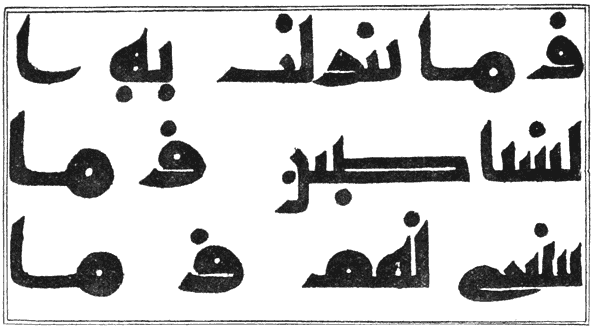
No. 1.
CUFIC MANUSCRIPT CHARACTER.
وَ مَا تَنَزَّلَتْ بِهِ ٱ لْشَّيَاطِينُ وَ مَا يَنْبَغىِ لَهُمْ و مَا (يَسْتَطِيعوُنَ)
Wa mā tanazzalat bi-hi ash-shayāt̤īnu wa mā yanbag͟hī la-hum wa mā (yastat̤īʿūna).
“The Satans were not sent down with it (the Qurʾān): it beseemed them not, and they had not the power.”
(Sūrah xxvi. 210; the words in italics correspond to the word yastat̤īʿūna, which is not contained in the Cufic original.)
The next two specimens illustrate the Cufic style, as it is employed on monuments, and more particularly so its Maghrebian development.

No. 2.
CUFIC MONUMENTAL CHARACTER.
No. 2 is part of an inscription copied from a public building in Tarragona in Spain. It reads:—
بسم الله بركة من الله لعبد الله عبد الرحمان امير المومنين اطال الله (بقاءه)
Bi-smi ʾllāhi! barakatun mina ʾllāhi li-ʿabdi ʾllāhi ʿabdi ʾr-raḥmāni amīri ʾl-muʾminīna at̤āla ʾllāhu (baqāʾa-hu).
“In the name of God! May a blessing from God be upon ʿAbdillāh ʿAbdur-raḥmān, Commander of the Faithful; may God lengthen his life.”
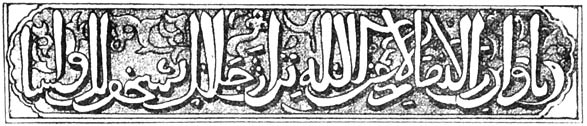
No. 3.
MAGHRIB MONUMENTAL CHARACTER.
No. 3, an inscription taken from the Alhambra, exhibits a style of monumental writing which can scarcely be called Cufic any longer, so much resembles it the Nask͟hī character. While in the previous specimen neither vowel points nor diacritical signs are made use of, here we find them employed in the shape, which they assume in manuscripts written in that hand. The reader will not have much difficulty in tracing the component letters by comparison with the following transcript and transliteration:—
يا وارث الانصار لا عن كلالة تراث جلال تستخف الرواسيا
Yā wāris̤a ʾl-anṣāri lā ʿan kalālatin turās̤a jalālin tastak͟hiffu ʾr-rawāsiyā.
“O thou who inheritest from the Anṣārs, and not by way of distant kindred, a heirloom of glory that makes every summit of fame appear low.”
It will be noticed that the فـ (f) of the word tastak͟hiffu is left without the diacritical point which distinguishes this letter from the letter قـ (q). This tallies with a remark of Ḥājī K͟halīfah, according to which the diacritical points of these two letters may be put or omitted ad libitum; and we seem therefore justified in concluding that the necessity for their distinction was latest felt and provided for. Hence arises one of the peculiarities which at once mark the difference between the Western and Eastern styles of writing, and which the reader will observe in the next three specimens, presenting instances of the Mag͟hrib manuscript character.
The first (No. 4) is written in a bolder hand, and consequently shows more strikingly the close relationship with the monumental style of the Western Arabs.
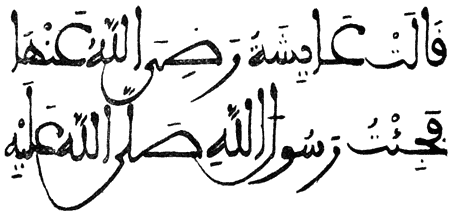
No. 4.
TYPICAL FORM OF THE MAGHRIB MANUSCRIPT CHARACTER.
قالت عائشة رضى الَّله عنها فجئْت رسول الَّله صلَّى الَّله عليه
Qālat ʿĀyishatu raẓiya ʾllāhu ʿan-hā fa-jiʾtu rasūla ʾllāhi ṣalla ʾllāhu ʿalai-hi.
“ʿĀyishah, may God be gracious to her, related: I went to the Apostle of God, may God’s blessing be upon him,” &c.
On comparing the initial letter of either line, it will be found that the one is قـ (in qālat), the other فـ (in fa-jiʾtu); but in the Maghrebian original, the former is marked by a dot above, the latter by a dot beneath the character, instead of the superscribed double and single point respectively in the transcript. This is the distinguishing feature between the two styles previously alluded to, and it seems to prove that the use of the diacritical points for these two letters is of later origin, and dates from a time when the two great divisions of the nation had definitely separated and followed each their own destinies. Another point to which we draw attention, is the different form of the Tashdīd, as seen in the word Allāh. The Mag͟hrib form is instead of ; and while in the Oriental writing the vowel signs are placed over it, the Western style places the sign for the Tashdīd and for the vowel frequently side by side, as it is done here.


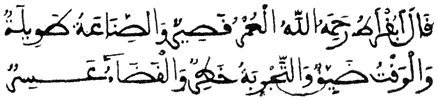
No. 5.
GOOD MAGHRIB WRITING.
قال ابقراط رحمه الله العمر قصير والصناءة طويلة والوقت ضيق والتجربة خطر والقضاء عسر
Qāla Abuqrāt̤u raḥima-hu ʾllāhu ʾl-ʿumru qaṣīrun wa ʾṣ-ṣināʾatu t̤awīlatun wa ʾl-waqtu ẓaiyiqun wa ʾt-tajribatu k͟hat̤irun wa ʾl-qaẓāʾu ʿasirun.
“Hippocrates, may God have compassion upon him, said: Life is short, art is long, Time is narrow, experience dangerous, judgment difficult.”
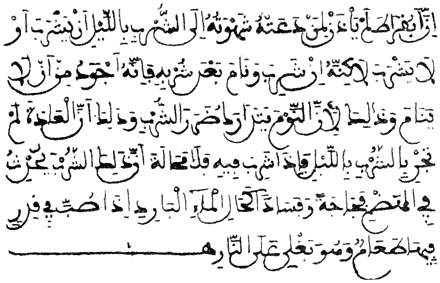
No. 6.
SUPERIOR MAGHRIB WRITING.
ان ابقراط لم ياذن لمن دعته شهوته الى الشرب بالليل ان يشرب او لا يشرب لكنه ان شرب ونام بعد شربه فانه اجود من ان لا ينام وذلك لان النوم يتدارك ضرر الشرب وذلك ان العادة لم تجر بالشرب بالليل فاذا شرب فيه فلا محالة ان ذلك الشرب يحدث فى الهضم فجاجة وفسادا كحال الماء البارد اذا صب فى قدر فيها طعام وهو يغلى على النار
Inna Abuqrāt̤a lam yaʾẕan li-man daʿat-hu shahwatu-hu ilā ʾsh-shurbi bi-ʾl-laili an yashraba aw lā yashraba lakinna-hu in shariba wa nāma baʿda shurbi-hi faʾinna-hu ajwadu min an lā yanāma wa ẕālika liʾanna ʾn-nauma yatadāraku ẓarara ʾsh-shurbi wa ẕālika anna ʾl-ʿādata lam tajri bi-ʾsh-shurbi bi-ʾl-laili fa ʾiẕā shariba fī-hi fa-lā maḥālata anna ẕālika ʾsh-shurba yuḥdis̤u fī ʾl-haẓmi fajājatan wa fasādan ka-ḥāli ʾl-māʾi ʾl-bāridi iẕā ṣubba fī qadrin fī-hā t̤aʿāmun wa huwa yag͟hlī ʿala ʾn-nāri.
“Hippocrates neither allows nor forbids a man, who has a desire to drink at night-time, to satisfy his desire. If, however, he drinks, and sleeps after drinking, it is better than not to sleep, this being so because sleep counteracts, in this case, the evil effect of drinking; for it is not customary to drink at night-time, and if one does so, this will of necessity produce a disturbance and derangement in the digestion, just as if cold water were poured into a vessel containing food that is being boiled.”
These two fragments scarcely call forth any further remark, except that in the last both forms of the Tashdīd are employed, the ordinary form even more frequently than the Maghrebian; for the latter occurs only twice, in bi-ʾsh-shurbi, which is the second word in the fourth line, and in ash-shurba, which is the last word but one in the same line. Moreover, it will be useful to notice the peculiar shape which the letters د (d) and ذ (ẕ) take in the Mag͟hrib character, as in the words ajwadu towards the end of the second line, and yaʾẕan near the beginning of the first.
Dismissing the Mag͟hrib-Berber style of Arabic writing, with its numerous local varieties, as less interesting for the English reader, we now turn to the Oriental style, where we meet again with a bipartition, viz. into the Eastern Nask͟hī, as it is written in Arabia itself, Egypt, and Syria, and the T̤aʿlīq, current in Persia, India, and Central Asia.
No. 7 is a specimen of the Nask͟hī in the more limited sense of the word, meaning the style generally employed in manuscripts, and derived from nask͟h or nusk͟hah, “copy.”
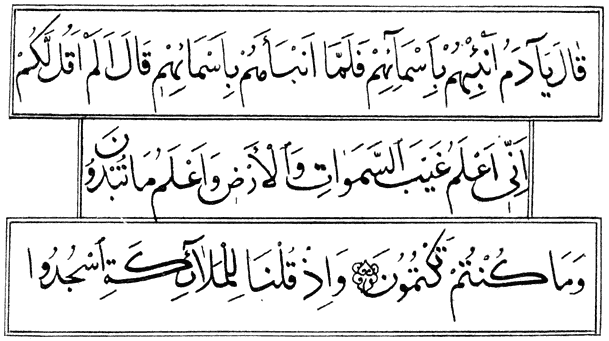
No 7.
NASKHI CHARACTER FROM A GOOD EGYPTIAN MANUSCRIPT.
قال يا آدم انبئهم باسمائهم فلما انباهم باسمائهم قال الم اقل لكم
انى اعلم غيب السموات والارض واعلم ما تبدون
وما كنتم تكتمون * واذ قلنا للملائكت اسجدوا
Qāla yā Ādamu ʾnbiʾ-him bi-asmāʾi-him falammā anbaʾa-hum bi-ʾasmāʾi-him qāla alam aqul la-kum
Annī aʿlamu g͟haiba ʾs-samawāti wa ʾl-arẓi wa aʿlamu mā tabdūna
Wa mā kuntum taktumūna. Wa iẕ qulnā li-ʾl-malāʾi-kati ʾsjudū.
“He said: ‘O Adam, inform them of their names,’ and when he had informed them of their names, He said: ‘Did I not say to you, That I know the hidden things of the heavens and of the earth, and know what ye bring to light, And what ye hide?’ And when we said to the angels: ‘Bow down’.…”
(Sūrah ii. 31, 32.)
From this ordinary Nask͟hī several more ornate manuscript styles are derived, as the Rīḥānī, Yāqūtī, and S̤ulus̤. They are distinguished principally by the relative proportions of the characters; and in the S̤ulus̤ in particular, of which we give a specimen under No. 8, the letters are three times the size of the ordinary Nask͟hī, while the Rīḥānī and Yāqūtī show intermediate proportions between the two.
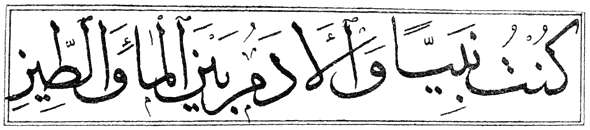
No. 8.
SULUS STYLE.
كنت نبيا والادم بين الماء والطين
Kuntu nabīyan wa ʾl-adamu baina ʾl-māʾi wa ʾt̤-t̤īni.
“I was a prophet, when man was yet a mixture of water and clay.”
It will be observed that beneath the م (m) of the words الادم (al-adamu) and الماء (al-māʾi), in the S̤ulus̤ fragment, the letter is written a second time in a smaller character, and that, moreover, in the word الادم it is surmounted by the sign , which in Mag͟hrib writing, as we have seen, generally represents the Tashdīd. This is done in the above-mentioned ornate styles, especially with those letters which admit of diacritical points, viz. ح, د, ر, س, ص, ط, ع, &c. To indicate that no such diacritical point is intended, the sign is placed on the top of the letter, or to make still surer of preventing a mistake, the letter itself is repeated in a minute shape at the bottom. Only the letter ه (h), as distinguished from ة (t), is, in this case, written above the line, because it frequently occurs as abbreviation of هو huwa, “He,” or الله Allāh, “God,” and it would therefore be considered irreverential towards the Deity to write it beneath the other letters. As a feature common to this division of the Eastern Arabic manuscript style, we lastly point out the inclination of the characters from the left to the right, in contradistinction both to the Mag͟hrib and T̤aʿlīq writing, where the letters are traced perpendicularly, or even with a slight bend from the right to the left.
Two other deviations from the pure Nask͟hī style are the Jarī and Dīwānī, officially employed in Turkey, and exhibited in the specimen No. 9:—
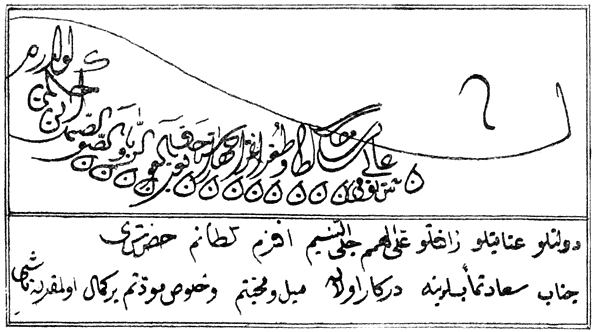
No. 9.
JARI AND DIWANI.
The Jarī fragment in the upper division is a facsimile of the formula which accompanies the seal of the Sultān, and runs as follows:—
نشان شريف عاليشان سامى مكان وطغراى غراى جهان اراى ستان خاقان نفذ بالعون الربانى والصون الصمدانى حكمى اولدر كه
Nishāni sharīfi ʿālīshān sāmī makān wa tug͟hrāʾī g͟harrāʾī jihān arāʾī sitāni k͟hāqān nufiẕa bi ʾl-ʿaun ar-rabbānī wa ʾṣ-ṣaun aṣ ṣamadānī ḥukmī oldur ki.…
“This is the noble, exalted, brilliant sign-manual, the world-illuminating and adorning cipher of the K͟hāqān (may it be made efficient by the aid of the Lord and the protection of the Eternal). His order is that, etc.”
The beauty of this style is considered to consist in its being written either diagonally from the top to the bottom of the page, or ascending elliptically from the bottom to the top.
The Dīwānī style, of which the lower division gives an example, is used in the official correspondence of the Turkish administration. The final letters, and even words, are placed on the top of one another, and in its more intricate varieties the letters run together in a fanciful manner, which renders the decipherment of this writing frequently very difficult.
Finally, we present in No. 10 a specimen of the Persian T̤aʿlīq writing:—
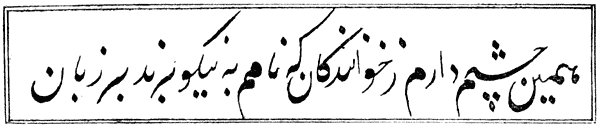
No. 10.
TAʿLIQ CHARACTER.
همين چشم دارم ز خوانندگان كه نامم به نيكو برند بر زبان
Hamīn chashmi dāram zi k͟hwānandagān Ki nāmam ba nīkū barand bar zabān.
“Such hope I cherish that in minstrel’s lay, With right fair fame my name will live for aye!”
(Firdausī.)
From this style of writing the Shikastah is derived, and bears the same relation to it which the Dīwānī bears to Nask͟hī. While in general preserving the peculiar outline of the T̤aʿlīq, it superposes finals and words, and joins letters in a similar way to the Dīwānī, with which, however, it contrasts favourably by a far more elegant and graceful delineation of the characters.
It remains now only to add a few words on the writing materials which the Arabs, and Orientals in general, make use of. From the nature of the character and from the direction of the writing from the right to the left, it will be easily understood that our quill and steel pens would answer the purpose rather indifferently. The bolder stroke requires a broader nib, and, at the same time, the edges of the writing instrument should be smooth enough to glide with ease over the paper, so as to enable the hand to give that fine swing and swell to the curved lines, which form one of the chief beauties of the Arabic writing. These conditions are admirably fulfilled by the qalam or reed pen. For the same reasons their ink is richer and their paper more glossy than those which we employ ourselves. The best ink is said to be made of lamp-black and vinegar or verjuice, to which red ochre is added, well beaten up and mixed with yellow arsenic and camphor. The paper, before being used for writing, is submitted to the action of the press, or made smooth by placing it on a well-levelled board of chestnut wood, and polishing it with an egg of crystal of about half a pound’s weight.
We cannot here enter into further particulars on the subject. The reader who might feel interested in it, will find some curious details in a short poem by Abū ʾl-Ḥasan ʿAlī ibn al-Bauwāb, which De Sacy has published and translated in his Chrestomathie. As mentioned before, this calligraphist was one of the greatest masters of his art, so much so that when he died, A.H. 413 or 423, the following lines were written in his praise:—
“Thy loss was felt by the writers of former times, and each successive day justifies their grief. The ink-bottles are therefore black with sorrow, and the pens are rent through affliction.”
Ibn K͟hallikān, from whom we quote, finds these verses very fine. Without disparaging his taste, we can happily assure our readers that Ibn al-Bauwāb’s verses are finer. With regard to the qalam, however, he rather mystifies us on the very point which would be most interesting, namely, the manner in which the nib should be cut or made. He says:—
“Give your whole attention to the making of your nib, for on this, verily, all else depends.
“But do not flatter yourself that I am going to reveal this secret; it is a secret which I guard with a miser’s jealousy.
“All that I will tell is, that you must observe the golden mean between a too much rounded and too much pointed form.”
Disappointed as we are at this oracular saying, we will condone him for his niggardly reticence on account of his final lines, with which we will also terminate our article:—
“Let your hand devote its fingers to writing only useful things that you will leave behind you on quitting this abode of illusion;
“For man will find, when the book of his actions will be unrolled before him, all that he has done during the days of his life.”
WUJŪD (وجود). An existence. Philosophers say existences are of three kinds:—
Wājibu ʾl-Wujūd, necessary existence—God.
Mumkinu ʾl-Wujūd, a possible existence—Creation.
Mumtaniʿu ʾl-Wujūd, an impossible existence—an Associate with God.
WUQŪF (وقوف). “Standing.” A name given to those ceremonies of the Pilgrimage which are performed on Mount ʿArafah. (Burton, Pilgrimage, vol. ii. p. 383.)
WUẒŪʾ (وضوء). The ablution made before saying the appointed prayers. Those which are said to be of divine institution are four in number, namely: to wash (1) the face from the top of the forehead to the chin, and as far as each ear; and (2) the hands and arms up to the elbow; (3) to rub (masaḥ) with the wet hand a fourth part of the head; also (4) the feet to the ankles. The authority for these actions is the Qurʾān, Sūrah v. 8: “O Believers! when ye address yourselves to prayer, wash your hands up to the elbow, and wipe your heads, and your feet to the ankles.” The Sunnīs wash the feet: the Shīʿahs are apparently more correct, for they only wipe, or rather rub (masaḥ) them. In these ablutions, if the least portion of the specified part is left untouched, the whole act becomes useless and the prayer which follows is vain.
The Sunnah regulations (or those established on the example of Muḥammad) regarding it are fourteen in number. (1) to make the intention or nīyah of wuẓūʾ, thus: “I make this wuẓūʾ for the purpose of putting away impurity”; (2) to wash the hand up to the wrist, but care must be taken not to put the hands entirely into the water, until each has been rubbed three times with water poured on it; (3) to say one of the names of God at the commencement of the wuẓūʾ, thus: “In the name of the Great God,” or “Thanks be to God”; (4) to clean the teeth (miswāk); (5) to rinse the mouth three times; (6) to put water into the nostrils three times; (7) to do all the above in proper order; (8) to do all without any delay between the various acts; (9) each part is to be purified three times; (10) the space between the fingers of one hand must be rubbed with the wet fingers of the other; (11) the beard must be combed with the fingers; (12) the whole head must be rubbed once; (13) the ears must be washed with the water remaining on the fingers after the last operation; (14) to rub under and between the toes with the little finger of the left hand, drawing it from the little toe of the right foot and between each toe in succession. [ABLUTION, PRAYER, WATER.]
Y.
YADU ʾLLĀH (يد الله). “Hand of God.” The expression occurs in the Qurʾan:—
Sūrah xlviii. 10: “God’s hand is above their hands.”
Sūrah v. 69: “The Jews say, ‘God’s hand is fettered.’”
The expression is a subject of controversy amongst the Muḥammadans. The Wahhābīs maintain that it is wrong to hold that it is merely a figurative expression, but rather that God doth possess a hand in such a manner as it exists, without attempting to explain the manner how. On the other hand, some maintain that it is merely a figurative expression for God’s power.
YAG͟HŪS̤ (يغوث). An idol mentioned in the Qurʾān, Sūrah lxxi. 23. Professor Palmer says it was in the figure of a lion. Al-Baiẓāwī says it was the name of a hero who lived between the days of Adam and Noah, who was afterwards worshipped in an idol of the name.
YĀ HŪ (يا هو). “O He!” that is, “O God.” An exclamation often recited by faqīrs or darveshes in their religious ẕikrs. The third personal pronoun singular, hū (huwa), “He” being a name for God, i.e. “He who exists.” [ZIKR.]
YAHŪD (يهود), the plural of Yahūdī. Heb. יְהוּדִי. Jews. The word used in the Qurʾān (together with Banū Isrāʾīl) for the Jews. [JEWS, JUDAISM.]
YAḤYĀ (يحيى). John the Baptist. The son of Zachariah, whose birth is mentioned in the Qurʾān, Sūrah xix. 1; iii. 34; and who is said in the latter Sūrah to have been sent with glad tidings “to confirm the Word from God (Jesus), a chief and a chaste one and a prophet from the righteous.” And in Sūrah vi. 85, his name occurs with that of Zachariah, Jesus, and Elias, as one of the “righteous ones.” [JOHN THE BAPTIST.]
YAʾJŪJ WA MAʾJŪJ (ياجوج و ماجوج). [GOG AND MAGOG.]
YALAMLAM (يلملم). The mīqāt or stage where the pilgrims from al-Yaman assume the pilgrim’s garb at the pilgrimage. [HAJJ.]
YAMĀMAH (يمامة). A province in the eastern portion of the Ḥijāz frequently mentioned in the history of Muḥammad.
AL-YAMAN (اليمن). The south-western province of Arabia. It is considered the most fertile part of the country, and is called the garden of Arabia.
YAMĪN يمين. [OATH.]
AL-YAQĪN (اليقين). “The certainty.” (1) A term which implies belief, sure knowledge, and which occurs in the Qurʾān to express the hour of death.
Sūrah lxxiv. 43–48: “They shall say, ‘We were not of those who prayed, we did not feed the poor; but we did plunge into discussion with those who plunged, and we called the Judgment Day a lie until the certainty did come upon us.’ ”
Sūrah xv. 99: “Serve the Lord until the certainty come upon thee.”
Muslims say there are three degrees of spiritual knowledge:—
1. ʿIlmu ʾl-Yaqīn (علم اليقين), that which a man apprehends with his intellectual faculties.
2. ʿAinu ʾl-Yaqīn (عين اليقين), that which he sees with the eye.
3. Ḥaqqu ʾl-Yaqīn (حق اليقين), that which he fully embraces with the heart; the highest form of spiritual knowledge, especially of the Unity of God.
YAQT̤ĪN (يقطين). Heb. קִיקָיוֹן. The gourd tree under which Jonah sheltered after he escaped from the belly of the fish. Sūrah xxxvii. 145, 146: “We cast him on a barren shore: and he was sick: and we made to grow over him a gourd tree.”
YAʿQŪB (يعقوب). [JACOB.]
YĀ SĪN (يا سين). The two Arabic letters ى and س corresponding to the English y and s. The title of the XXXVIth Sūrah of the Qurʾān, which begins with these two letters, the mystic import of which is said to be unknown. Al-Baiẓāwī says perhaps they mean Yā Insān! (يا انسان), “O Man!” Ḥusain suggests that they mean Yā Saiyid! (يا سيد), “O Saiyid!” whilst the Jalālān think the meaning is known alone to God. Muḥammad said this chapter was the Qalbu ʾl-Qurʾān, “the heart of the Qurʾān,” and it is consequently held in high estimation. It is usually read to dying persons.
Yā Sīn is a title given to Muḥammad with the belief that he is referred to as “O Saiyid,” in the first verse of the Sūrah referred to.
YAS̤RIB (يثرب). The ancient name of al-Madīnah, mentioned once in the Qurʾān, viz. Sūrah xxxiii. 13. According to the traditionist, the Prophet changed the name from Yas̤rib to Madīnatu ʾn-Nabī, “the City of the Prophet,” because Yas̤rib was a name of shame and reproach. (Majmaʿu ʾl-Biḥār, vol. iii. p. 499.)
YAʿSŪB (يعسوب). Lit. “A prince or chief.” The King of the Bees. A title given to ʿAlī. (Majmaʿu ʾl-Biḥār, vol. iii. p. 502.) A name of one of Muḥammad’s horses. (Richardson’s Dictionary.)
YATHRIB. [YASRIB.]
YATĪM (يتيم). [ORPHAN.]
YAUM (يوم). A day of twenty-four hours; pl. aiyām. In contradiction to lail wa nahār, “night and day.”
The seven days of the week are known as:
Yaumu ʾl-aḥad, first day, Sunday.
Yaumu ʾl-is̤nain, second day, Monday.
Yaumu ʾl-s̤alās̤āʾ, third day, Tuesday.
Yaumu ʾl-arbaʿāʾ, fourth day, Wednesday.
Yaumu ʾl-k͟hamīs, fifth day, Thursday.
Yaumu ʾl-jumʿah, day of Assembly, Friday.
Yaumu ʾs-sabt, Sabbath day, Saturday.
YAUMU ʾD-DĪN (يوم الدين). “Day of Judgment.”
Sūrah i. 4: “The King of the Day of Judgment.”
Sūrah lxxxiii. 17: “What shall make thee know what the Day of Judgment is?”
AL-YAUMU ʾL-ĀK͟HIR (اليوم الاخر). “The Last Day.” A name given in the Qurʾān to the Day of Judgment.
YAUMU ʾL-ʿĀSHŪRAʾ (يــوم العاشوراء). The tenth day of the month of Muḥarram. [ʿASHURAʾ.]
YAUMU ʾL-FAṢL (يوم الفصل). “Day of Severing.” The Day of Judgment. Sūrah lxxvii. 13, 14: “For the Day of Severing! and who shall teach thee what the Day of Severing is?”
YAUMU ʾL-FIT̤R (يوم الفطر). “The Day of breaking the fast.” [ʿIDU ʾL-FITR.]
YAUMU ʾL-ḤARĀʾ (يوم الحراء). “The day of the stony country” mentioned in the Traditions. (Mishkātu ʾl-Maṣābiḥ, book xxiv. ch. ix.) The day on which Yazīd sent an army to al-Madīnah and laid it in ruins. (See Ockley’s Saracens, p. 425.)
YAUMU ʾL-ḤASHR (يوم الحشر). “Day of Assembly.” The Day of Judgment.
YAUMU ʾL-ḤISĀB (يوم الحساب). “Day of Reckoning.” The Day of Judgment. Sūrah xl. 28: “And Moses said, Verily, I will take refuge in my Lord and your Lord from every one who is big with pride, and believes not on the Day of Reckoning.”
YAUMU ʾL-INQIT̤Āʿ (يوم الانقطاع). “The Day of Cessation.” The day on which anything terminates. In law, the last day on which anyone who has become possessed of property illegally may restore it, or make compensation to the owner.
YAUMU ʾL-JAMʿ (يوم الجمع). “Day of Gathering.” The Day of Judgment. Sūrah lxiv. 9: “On the day when He shall gather you to the Day of Gathering.”
YAUMU ʾL-K͟HULŪD (يوم الخلود). “Day of Eternity.” Sūrah l. 34: “Enter into it in peace: this is the Day of Eternity.”
YAUMU ʾL-K͟HURŪJ (يوم الخروج). “The Day of Exodus.” The Day of Judgment. Sūrah l. 41: “The day when they shall hear the shout in truth; that is, the Day of Coming Forth.”
YAUMU ʾL-QARR (يوم القر). “The Day of Rest.” The day after the sacrifice at the Ḥajj, when the pilgrims rest.
YAUMU ʾL-QIYĀMAH (يــوم القيامة). “Day of Standing up.” The Day of Resurrection. [RESURRECTION.]
YAUMU ʾL-WAʿĪD (يوم الوعيد). “The Day of Threatenings.” The Day of Judgment. Sūrah l. 19: “And the trumpet shall be blown!—that is the threatened day.”
YAUMUN MAʿLŪMUN (يوم معلوم). “A Known Day,” i.e. known to God. The Day of Judgment. Sūrah lvi. 50: “Gathered shall they surely be for the tryst of a known day.”
YAUMU ʾN-NAḤR (يوم النحر). “Day of Sacrifice.” A term used for the Feast of Sacrifice. [ʿIDU ʾL-AZHA.]
YAUMU ʾS-SABUʿ (يوم السبع). The “Day of Sabuʿ,” mentioned in the following tradition (Mishkātu ʾl-Maṣābiḥ, book xxiv. ch.16):—
“Abū Hurairah says, ‘Whilst a man was with his goats, behold a wolf came in amongst them, and took a goat; and the man released it. And the wolf said to the man, “Who is to guard these goats on the day of Sabuʿ, when there will be no shepherd but me.” And the people said, “The wolf speaks.” And the Prophet said, “I believe that the wolf did speak.” Abū Bakr and ʿUmar also said so.’ ”
ʿAbdu ʾl-Ḥaqq says there is a difference of opinion as to what the Day of Sabuʿ is, either it is a day of insurrection, or a festival amongst the ancient Arabs, when the flocks were left to themselves.
YAUMU ʾT-TAG͟HĀBUN (يوم التغابن). “Day of Mutual Deceit.” The Day of Judgment. Sūrah lxiv. 9: “On that day when he shall gather you to the Day of Gathering, that is the Day of Mutual Deceit.”
Al-Baiẓāwī says: “Both the righteous and the wicked will disappoint each other by reversing their positions, the wicked being punished, while the righteous are in bliss.”
YAUMU ʾT-TALĀQ (يوم التلاق). “Day of Meeting.” The Day of Judgment. Sūrah xl. 15: “He throws the Spirit by his bidding upon whom He will of His servants, to give warning of the Day of Meeting.”
YAUMU ʾT-TANĀD (يوم التناد). “A Day of Mutual Outcry.” A name given to the Day of Judgment in the Qurʾān, Sūrah xl. 34: “O my people! verily I fear for you the day of crying out to one another.”
YAʿŪQ (يعوق). An idol mentioned in the Qurʾān, Sūrah lxxi. 23. Professor Palmer says it was in the figure of a horse. Al-Baiẓāwī says it is the name of a certain hero who lived between the days of Adam and Noah, and was afterwards worshipped in an idol of the name.
YAWNING. Arabic tas̤āwub (تثاوب). From the Traditions it appears yawning is regarded as an evil; for Abū Hurairah relates that Muḥammad said, “God loves sneezing and hates yawning. As for yawning, it is of the devil. Therefore, if any of you yawn, let him suppress it as much as possible. If he cannot stop it, let him put the back of his left hand upon his mouth; for, verily, when anyone yawns and opens his mouth, the devil laughs.” (Mishkāt, book xxii. ch. vi.)
YAZĪD (يزيد). The son of Muʿāwiyah. The second K͟halīfah of the house of Umaiyah (Ommiyah), who reigned from A.D. 679 to A.D. 683 (A.H. 60–64). He is celebrated in Muslim history as the opponent of al-Ḥusain. (See Ockley’s Hist. Saracens, p. 393.)
YEAR. Arabic sanah (سنة), pl. sanūn, sanawāt; ʿām (عام), pl. aʿwām; ḥaul (حول), pl. aḥwāl; Persian sāl (سال), pl. sālhā.
The ancient Arabian year is supposed to have consisted of twelve lunar months, as now observed by the Muḥammadans; but about the year A.D. 412, the Arabians introduced a system of intercalation, whereby one month was intercalated into every three years. (See M. de Perceval, vol. i. p. 242). This system of intercalation existed in the time of Muḥammad; but it is related that, at the farewell pilgrimage, the Prophet recited the k͟hut̤bah on the Day of Sacrifice, and said: “A year is twelve months only, as at the time of the creation,” and thus again introduced the lunar year. (See Mishkāt, book xi. ch. xi.) The Muḥammadan year, therefore, consists of twelve lunar months, without any intercalation to make it correspond with the course of the sun, and amounts very nearly to 354 days and 9 hours. Hence the Muḥammadan New Year’s Day, Nau Roz, will happen every year about eleven days earlier than in the preceding year.
There also existed amongst the Arabians a system of commutation whereby the Muḥarram, the last of the three continuous sacred months [MONTHS], became secular, and Ṣafar sacred. Some traditions say that the power also existed of commuting the isolated sacred month Rajab, for the one succeeding it, Shaʿbān. When this was done, it became lawful to war in the sacred months of Muḥarram and Rajab; and Ṣafar and Shaʿbān acquired the sacredness of the months for which they had been substituted. It is with reference to this custom that Muḥammad says in the Qurʾān (Sūrah ix. 36, 37):—
“Verily, twelve months is the number of months with God, according to God’s Book, ever since the day when He created the Heavens and the Earth; of these, four are sacred: this is the right usage. Therefore, wrong not yourselves therein, and attack those who join gods with God, one and all, as they attack you one and all; and know that God is with those who fear Him. To carry over a sacred month to another is only an increase of unbelief. They who do not believe are led in error by it. They allow it one year and forbid it another, that they may make good the number of months which God hath hallowed, and they allow that which God hath prohibited.”
This system of commutation is said to have been introduced by Quṣaiy, who wished, by abridging the long three months’ cessation of hostilities, to humour the warlike Arabs, as well as to obtain the power of making a sacred month secular when it might best suit his purpose; but Sir William Muir is inclined to think that this system of commutation was an ancient one, and merely restored by Quṣaiy. (Muir’s Mahomet, vol. i. p. ccviii.)
Both in India and in Egypt, in the present day, the Muḥammadans use the lunar year for their religious observances and the ordinary affairs of life; but for the purposes of agriculture and other calculations, for which the lunar year is inconvenient, they employ the Julian calendar.
To find the number of solar years elapsed since any given Muḥammadan date, subtract the given year of the Hijrah from the current year of the Hijrah, and from the remainder deduct three per cent.; the remainder will be the number of solar years which have elapsed. Thus, suppose we see a manuscript written A.H. 681, and wish to know its real age in Christian or solar years, we subtract, in the first place, the number 681 from the current year of the Hijrah, say 1256, and there remains 575; from this last we deduct three per cent., or 17, and there remains 558, which at that period is the real age of the manuscript in solar years.
If the object, however, be to find the precise Christian date corresponding to any given year of the Hijrah, apply the following rule:—From the given number of Musalmān years, deduct three per cent., and to the remainder add the number 621·54; the sum is the period of the Christian era at which the given current Musalmān year ends. For example: from A.H. 942, deduct three per cent., or 28·26, and the remainder is 913·74. To this last add 621·54, and the sum is 1535·28, which shows that A.H. 942 ended in the spring of A.D. 1536. This simple rule is founded on the fact that 100 lunar years are very nearly equal to 97 solar years, there being only eight days of excess in the former period; hence to the result found, as just stated, it will be requisite to add 8 days, as a correction for every century.
The following is a more accurate rule. Express the Muḥammadan date in years and decimals of a year; multiply by ·970225; to the product add 621·54, and the sum will be the precise period of the Christian era. (Dr. Forbes.)
If it is desired to find the year of the Hijrah which comes in in a given year of the Christian era, it is sufficient to subtract 621 from the year given, and to multiply the remainder by 10,307. (Murray.)
YŪḤANNĀ (يوحنا). The Arabic Christian name for John the Baptist, and John the Apostle, the corresponding Muslim name being Yaḥyā. [YAHYA.]
YŪNUS (يونس). [JONAH.]
YŪSHAʿ (يوشع). [JOSHUA.]
YŪSUF (يوسف). [JOSEPH.]
Z.
ẔABḤ (ذبح). Heb. זֶבַח zebak͟h. Arabic lexicographers define the word to mean the act of cutting the throat. In the language of the law, it denotes the act of slaying an animal agreeably to the prescribed forms, without which its flesh is not lawful for the food of man. See Qurʾān, Sūrah ii. 167, 168:—
“Eat of the good things wherewith we have provided you, and give thanks unto God, if ye are His worshippers. He has only forbidden for you that which is dead, and blood, and flesh of swine, and whatsoever has been consecrated to other than God; but he who is forced, neither revolting nor transgressing, it is no sin for him: for verily God is forgiving and merciful.”
The injunctions in the Traditions are more explicit (Mishkāt, book xviii. ch. i.), for example: Abū T̤ufail relates that ʿAlī was once asked, “Has the Prophet ever told you anything with regard to religion which he has not told others?” And ʿAlī replied, “Nothing, unless it be that which I have in the scabbard of my sword.” Then ʿAlī brought out of his scabbard a piece of paper, and thereon was written: “May God curse those who slay without repeating the name of God, in the same manner as the polytheists did in the names of their idols; may God curse those who remove their neighbours’ landmarks; may God curse those who curse their fathers; may God curse those who harbour innovators in matters of religion.”
According to Sunnī law, ẕabḥ is of two kinds: (1) Ik͟htiyārī, of choice; and (2) Iẓt̤irārī, of necessity.
The first is effected by cutting the throat above the breast and reciting the words Allāhu akbar, “God is most great”; and the second by reciting these words upon shooting an arrow or discharging a gun.
The latter act, however, is merely a substitute for the former, and accordingly is not of any account unless the former be impracticable; for the proper ẕabḥ is held to be by the shedding of blood, and the former method is most effectual for this purpose.
It is absolutely necessary that the person who slays the animal should be a Muslim or a kitābī (i.e. a Jew or a Christian), and that he should do it in the name of God alone; it signifies not whether the person be a man or a woman, or an infant, or an idiot, or an uncircumcised person.
An animal slain by a Magian is unlawful, as also that slain by an idolater or a polytheist. Ẕabḥ performed by an apostate from the Muslim faith (who is worthy of death) is also unlawful; but, according to Abū Ḥanīfah, if a Jew or a Christian become an apostate from his own creed, his ẕabḥ is lawful, for the Muslim law still regards him, with respect to ẕabḥ, in the same light as formerly.
If the slayer wilfully omit the invocation, “In the name of the most great God,” the flesh of the animal is unlawful; but if he omit the invocation through forgetfulness, it is lawful, although there is some difference of opinion on this subject amongst the Sunnī doctors. Ash-Shāfiʿī is of opinion that the animal is lawful in either case, but the Imām Mālik maintains that it is unlawful in both.
Abū Yūsuf and all the Ḥanafī doctors have declared, that an animal slain under a wilful omission of the invocation is utterly unlawful, and that the magistrate must forbid the sale of meat so killed.
It is a condition of ẕabḥ ik͟htiyārī that the invocation be pronounced over the animal at the time of slaying it; but in the case of ẕabḥ iẓt̤irārī (i.e. when a person slays an animal in hunting), the condition is that the invocation be pronounced at the time of letting loose the hound or hawk, or of shooting the arrow or gun, or casting the spear.
It is a condition of ẕabḥ that nothing but the invocation Bismi ʾllāhi Allāhi akbar, “In the name of God, God the most great,” should be said. That is, no prayer or other matter must be mentioned.
The place for slaying is betwixt the throat and the head of the breast-bone (Arabic labbah), and the vessels it is requisite to cut are four, al-hulqūm, “the wind-pipe,” al-marīʾ, “the gullet,” and al-warīdān, or al-wadajān, “the two jugular veins.”
Ash-Shāfiʿī holds that if a man slay an animal with a nail or horn or teeth, the flesh is unlawful, but this is not the opinion of other doctors. (See Durru ʾl-Muk͟htār and Hidāyah, in loco.)
AZ-ZABĀNĪYAH (الزبانية). Lit. “Guards.” The angels in charge of hell, of whom Mālik is said to be the chief. Sūrah xcvi. 17, 18: “So let him call his council: we will call the guards of hell (az-Zabānīyah).”
ẔABĪḤAH (ذبيحة). Lit. “Cut or divided lengthways.” Heb. זֶבַח zebak͟h. An animal slaughtered according to the law; a sacrifice. [LAWFUL FOOD, SACRIFICES.]
ZABĪR (زبير). A name for Mount Sinai. Al-Baiẓāwī says it is the mountain on which the Lord conversed with Moses. [SINAI, TUR.]
ẒABT̤ (ضبط). “Occupation, seizure.” In Muḥammadan law it means attachment, distraint, or sequestration; taking lands under the management of Government officers.
ZABŪR (زبور), pl. zubur. Also zubūr, pl. of zibr. From the Heb. זִמְרָה zimrāh, “a psalm or chant” (Psa. lxxxi. 2, xcviii. 5). The title given to the Psalms of David in the Qurʾān, where it occurs only three times.
Sūratu ʾn-Nisāʾ (iv.) 161: “And to David we gave Psalms (zabūran).”
Sūratu ʾl-Miʿrāj (xvii.) 57: “And Psalms (zabūran) we gave to David.”
Sūratu ʾl-Ambiyāʾ (xxi.) 105: “And now, since the exhortation (ẕikr) was given, have we written in the Psalms (fī ʾz-zabūri) that my servants the righteous shall inherit the earth.”
Both Sale and Rodwell take this last to be a quotation from Psa. xxxvii. 29 (it appears to be the only direct quotation from either the Old or New Testament in the whole of the Qurʾān), and they have both translated the Arabic ẕikr “the law,” meaning, of course, the Taurāt. Amongst Muslim commentators, there is considerable difference of opinion as to what is meant in this verse by ẕikr and zabūr.
The commentator al-Baiẓāwī says there are three views. Said ibn Jubair and Mujaiyid explained the word zabūr to mean all inspired books, and that by ẕikr was meant the Preserved Tablet (al-Lauḥu ʾl-Maḥfūz̤). Ibn ʿAbbās and aẓ-Ẓaḥḥāk said by zabūr was meant the Taurāt, and by ẕikr those books which came after. And Shaʿbī said the zabūr was the Book of David, and the ẕikr that of Moses.
Al-Bag͟hawī and al-Jalālān decide in favour of the first interpretation, Ḥusain decides in favour of the third, whilst al-Baiẓāwī leaves it an open question.
Jalālu ʾd-dīn as-Suyūt̤ī gives the word zabūr as one of the fifty-five titles of the Qurʾān.
ZACHARIAS. Arabic Zakarīyāʾ (زكرياء). [ZAKARIYAʾ.]
ZAFĪR (زفير). Lit. “Drawing back the breath because of distress; groaning.” In the Qurʾān, for the groans of hell. Sūrah xi. 108: “In the Fire, there shall they groan.”
ẔAʿFIRĀNĪYAH (ذعفرانية). A sect of Muslims, who say the Qurʾān is a created thing, the orthodox school maintaining that the Word of God is uncreated. (Kitābu ʾt-Taʿrīfāt, in loco.)
ZAḤF (زحف). Lit. “A swarming multitude.” An army; a military force arrayed for battle.
Qurʾān, Sūrah viii. 15: “O ye who believe! when ye meet the marshalled hosts of the unbelievers, turn not your backs to them.” Hence, battle, combat.
ZĀHID (زاهد). Lit. “Abstinent; continent.” An ascetic person. Zāhid-i-k͟hushk, Persian, “a dissembler, a hypocrite.”
Z̤ĀHIR (ظاهر). “Outward, exterior, manifest.” A word much used in Muslim theology to express that which is manifest, as distinguished from bāt̤in, “interior,” or k͟hafī, “that which is hidden.”
AZ̤-Z̤ĀHIR (الظاهر). “The Evident.” One of the ninety-nine attributes of God.
Qurʾān, Sūrah lviii. 3: “He is the First and the Last, the Evident and the Hidden.”
Z̤ĀHIRU ʾL-MAẔHAB (ظاهر المذهب). An expression used by Ḥanafī Muslims for those theological questions which are decided in the four well-known Sunnī books: al-Mabsūt̤, al-Jāmiʿu ʾl-Kabīr, al-Jāmiʿu ʾṣ-Ṣag͟hīr, as-Sairu ʾl-Kabīr.
Z̤ĀHIRU ʾL-MUMKINĀT (ظاهر الممكنات). An expression used by theologians for the proofs of God’s existence, power, and attributes, as exhibited in nature.
ZAID IBN AL-HĀRIS̤ (زيد بن الــحــارث). Muḥammad’s freedman and adopted son. Muḥammad having seen and admired Zaid’s wife Zainab, her husband divorced her. The relations of the ancient Arabs to their adopted children were very strict, and Muḥammad’s marriage with the divorced wife of his adopted son occasioned much scandal amongst his contemporaries. A revelation was consequently produced which revoked the inconvenient restrictions.
Sūrah xxxiii. 37: “And when Zaid had settled the necessary matter of her divorce, we did wed her to thee, that it might not be a crime in the faithful to marry the wives of their adopted sons, when they have settled the necessary affair concerning them.”
Zaid was slain at the battle of Mūtah, as he carried the standard of Islām, A.H. 8.
ZAIDĪYAH (زيدية). A Shīʿah sect. Those who followed Zaid the son of ʿAlī ibn al-Ḥusain instead of the other son Jaʿfar aṣ-Ṣādiq. [SHIʿAH.]
ZAIG͟H (زيغ). Lit. “Turned aside” (from the Truth). It occurs in the Qurʾān, Sūrah iii. 5, 6: “In whose hearts is perversity.… O Lord, pervert not our hearts.”
ZAINAB (زينب). The daughter of K͟huzaimah and the widow of ʿUbaid, Muḥammad’s cousin, who was slain at Badr. She married Muḥammad in the third year of the Hijrah. Zainab was renowned for her kindness to the poor, and was called Ummu ʾl-Masākīn, “the mother of the poor,” from her care of destitute converts. She and K͟hadījah were the only wives of the Prophet who died before him.
ZAINAB (زينب). The daughter of Jaḥsh and the divorced wife of Muḥammad’s adopted son Zaid. Being the wife of an adopted son, she was unlawful to the Prophet, but a pretended revelation (see Qurʾān, Sūrah xxxiii. 37) settled the difficulty, and Muḥammad married her. [MUHAMMAD.]
ZAINAB BINT MUḤAMMAD (زينب بنت محمد). The daughter of Muḥammad by K͟hadījah. She married Abū ʾl-ʿĀṣ. The story of the conversion of Abū ʾl-ʿĀṣ, through the devotion of his wife, is told by Muir (vol. iv. p. 7). She died A.H. 61.
ZĀʾIR (زائر). A pilgrim to Muḥammad’s grave at al-Madīnah, as distinguished from a ḥājī, or pilgrim to Makkah. According to Burton, Zāʾirs are ordered to visit the tomb perfumed and in their best clothes. The person who conducts the zāʾir to the sacred spot, is called a muzawwir, who on the occasion of Captain Burton’s visit recited the following prayer:—
“In the name of Allah and in the Faith of Allah’s Prophet! O Lord, cause me to enter the entering of truth, and cause me to issue forth the issuing of Truth, and permit me to draw near to Thee and make me a King victorious!” (i.e. over the world, the flesh, and the devil). Then follow blessings on the Prophet, and afterwards: “O Allah! open to me the doors of Thy mercy, and grant me entrance into it, and protect me from the stoned devil!” (Burton’s El-Medinah and Meccah, vol. ii. p. 296.)
ZAKARĪYĀʾ (زكرياء). Zacharias. The father of John Baptist; the husband of Hannah’s sister, and the uncle of the Virgin Mary. Mentioned four times in the Qurʾan:—
Sūrah iii. 32: “So with goodly acceptance did her Lord accept her, with goodly growth did He make her grow, and Zakarīyāʾ reared her. So oft as Zakarīyāʾ went in to Mary at the sanctuary, he found her supplied with food. ‘Oh Mary!’ said he, ‘whence hast thou this?’ She said, ‘It is from God; verily God supplieth whom He will without reckoning!’ There did Zakarīyāʾ call upon his Lord; ‘O my Lord!’ said he, ‘vouchsafe me from Thyself good descendants; Thou verily art the hearer of prayer.’ Then did the angels call to him, as he stood praying in the sanctuary: ‘God announced John (Yaḥyā) to thee, who shall be a verifier of the Word from God, and a great one, chaste, and a prophet of the number of the just.’ He said, ‘O my Lord! how shall I have a son now that old age has come upon me and my wife is barren?’ He said: ‘Thus will God do his pleasure.’ He said, ‘Lord! give me a token.’ He said, ‘Thy token is, that not for three days shalt thou speak to man but by signs. But remember thy Lord often, and praise Him at even and at morn.’ ”
Sūrah vi. 85: “And Zakarīyāʾ, John, Jesus, and Elias: all were just persons.”
Sūrah xix. 1–12: “A recital of thy Lord’s mercy to His servant Zakarīyāʾ, when he called upon his Lord with secret calling. He said: ‘O Lord, verily my bones are weak and the hoar hairs glisten on my head, and never, Lord, have I prayed to Thee with ill success. But now I have fear for my kindred after me; and my wife is barren: Give me, then, a successor as Thy special gift and an heir of the family of Jacob: and make him, Lord, well-pleasing to Thee.’ ‘O Zakarīyāʾ, verily We announce to Thee a son,—his name Yaḥyā (John): that name We have given to none before him.’ He said: ‘O my Lord! how when my wife is barren shall I have a son, and when I have now reached old age, failing in my powers?’ He said: ‘So shall it be. Thy Lord hath said, Easy is this to Me, for I created thee aforetime when thou wast nothing.’ He said: ‘Vouchsafe me, O my Lord! a sign.’ He said: ‘Thy sign shall be that for three nights, though sound in health, thou speakest not to man.’ And he came forth from the sanctuary to his people, and made signs to them as though he would say, ‘Praise God at morn and even.’ ”
Sūrah xxi. 89: “And Zakarīyāʾ, when he called upon his Lord saying, ‘O my Lord leave me not childless: but there is no better heir than Thyself.’ So We heard him and gave him Yaḥyā (John), and We made his wife fit for child-bearing.”
ZAKĀT (زكوة). In its primitive sense the word zakāt means purification, whence it is also used to express a portion of property bestowed in alms, as a sanctification of the remainder to the proprietor. It is an institution of Islām and founded upon an express command in the Qurʾān (vide Sūrah ii. 77), being one of the five foundations of practical religion.
It is a religious duty incumbent upon any person who is free, sane, adult, and a Muslim, provided he be possessed in full property of such estate or effects as are termed in the language of the law niṣāb, and that he has been in possession of the same for the space of one complete year. The niṣāb, or fixed amount of property upon which zakāt is due, varies with reference to the different kinds of property in possession, as will be seen in the present article.
The one complete year in which the property is held in possession is termed ḥaulu ʾl-ḥaul. Zakāt is not incumbent upon a man against whom there are debts equal to or exceeding the amount of his whole property, nor is it due upon the necessaries of life, such as dwelling-houses, or articles of clothing, or household furniture, or cattle kept for immediate use, or slaves employed as actual servants, or armour and weapons designed for present use, or upon books of science and theology used by scholars, or upon tools used by craftsmen.
(1) The zakāt of camels. Zakāt is not due upon less than five camels, and upon five camels it is one goat or sheep, provided they subsist upon pasture throughout the year, because zakāt is only due upon such camels as live on pasture, and not upon those which are fed in the home with forage. One goat is due upon any number of camels from five to nine; two goats for any number of camels from ten to fourteen; three goats for any number from twenty to twenty-four. Upon any number of camels from twenty-five to thirty-five the zakāt is a bint mik͟hāẓ, or a yearling female camel; from thirty-six to forty-five, a bint labūn, or a two-year-old female camel; from forty-six to sixty, a ḥiqqah, or a three-year-old female camel; from sixty-one to seventy-five, a jaẕʿah, or four-year-old female camel; from seventy-five to ninety, two camels’ female two-year-old colts; and from ninety-one to one hundred and twenty, two camels’ female three-year-old colts. When the number of camels exceeds one hundred and twenty, the zakāt is calculated by the aforesaid rule.
(2) The zakāt of bulls, cows, and buffaloes. No zakāt is due upon fewer than thirty cattle, and upon thirty cattle which feed on pasture for the greater part of the year, there is due at the end of the year a tabīʿah, or a one-year-old calf; and upon forty is due a musim, or a calf of two years old; and where the number exceeds forty, the zakāt is to be calculated according to this rule. For example, upon sixty, the zakāt is two yearling calves; upon seventy, one tabīʿah and one musim; upon eighty, two musims; upon ninety, three tabīʿah; upon one hundred, two tabīʿahs and one musim; and thus upon every ten head of cattle a musim and a tabīʿah alternately. Thus upon one hundred and ten kine, the zakāt is two musims and one tabīʿah; and upon one hundred and twenty, four tabīʿahs. The usual method, however, of calculating the zakāt upon large herds of cattle is by dividing them into thirties and forties, imposing upon every thirty one tabīʿah, or upon every forty one musim.
(3) Zakāt upon sheep and goats. No zakāt is due upon less than forty, which have fed the greater part of the year upon pasture, upon which is due one goat, until the number reaches one hundred and twenty; for one hundred and twenty-one to two hundred, it is two goats or sheep; and above this, one for every hundred. The same rules apply to both sheep and goats, because in the Traditions the original word g͟hanam applies to both species.
(4) Zakāt upon horses. When horses and mares are kept indiscriminately together, feeding for the greater part of the year on pasture, it is the option of the proprietor to give a zakāt of one dīnār per head for the whole, or to appreciate the whole, and give five per cent. upon the total value. No zakāt whatever is due upon droves of horses consisting entirely of males, or entirely of mares. There is no zakāt due upon horses or mules, unless they are articles of merchandise, nor is it due upon war horses, or upon beasts of burden, or upon cattle kept for drawing ploughs and so forth.
(5) Zakāt upon silver. It is not due upon silver of less value than two hundred dirhams, but if one be possessed of this sum for a whole year, the zakāt due upon it is five dirhams. No zakāt is due upon an excess above the two hundred dirhams till such excess amount to forty, upon which the zakāt is one dirham, and for every succeeding forty, one dirham. Those dirhams in which silver predominates are to be accounted silver, and the laws respecting silver apply to them, although they should contain some alloy; and the same rule holds with regard to all articles falling under the denomination of plate, such as cups and goblets.
(6) Zakāt upon gold. No zakāt is due upon gold under the value of twenty mis̤qāls, and the zakāt due upon twenty mis̤qāls is half a mis̤qāl. When the quantity of gold exceeds twenty mis̤qāls, on every four mis̤qāls above twenty are due two qirāt̤s, and so on in proportion.
Zakāt is due upon gold and silver bullion, and upon all gold and silver ornaments and utensils.
(7) Zakāt upon articles of merchandise. Articles of merchandise should be appraised, and a zakāt of 2½ per cent. paid upon the value, if it exceed two hundred dirhams in value.
(8) Zakāt upon mines, or buried treasures. Mines of gold, silver, iron, lead, or copper, are subject to a zakāt of one-fifth (k͟hums); but if the mine is discovered within the precincts of a person’s own home, nothing is due. And if a person find a deposit of buried treasure, a fifth is due upon it. No zakāt is due upon precious stones.
(9) Zakāt upon the fruits of the earth. Upon everything produced from the ground there is a tenth (ʿāshir or ʿushr), whether the soil be watered by the overflow of rivers or by periodical rains, excepting the articles of wood, bamboo, and grass, which are not subject to the tithe. Land watered by means of buckets, or machinery, or watering camels, is subject to a twentieth. Honey and fruits collected in the wilderness are subject to tithe.
The zakāt is received by a collector duly appointed for the purpose, although it is lawful for the possessor to distribute his alms himself. If a person come to the collector, and make a declaration on oath as to the amount of his property upon which zakāt is due, his statement is to be credited.
There are seven descriptions of persons upon whom zakāt may be bestowed.
(1) Faqīrs, or persons possessed of property, the whole of which, however, does not amount to a niṣāb.
(2) Miskīns, or persons who have no property whatever.
(3) The collector of zakāt.
(4) Slaves.
(5) Debtors.
(6) Fī sabīli ʾllāh, i.e. in the service of God, or religious warfare.
(7) Travellers.
The above laws with reference to zakāt are those according to the Ḥanafīyah sect, but the differences amongst the Imāms of the Sunnīs on this subject are but small. They may be seen upon reference to Hamilton’s translation of the Hidāyah, vol. i. p. 1.
ẔAK͟HĀʾIRU ʾLLĀH (ذخائر الله). Lit. “Repositories of God.” A Ṣūfī term for a class of believers who, on account of their spiritual attainments, are the means of preventing troubles in a nation, in the same manner as stores (ẕak͟hāʾir) of grain keep away famines.
ẔĀKIR (ذاكر). One who remembers God by reciting His names and praises. The reciter of a ẕikr. [ZIKR.]
ẒALĀLAH (ضلالة). “Error.” The word frequently occurs in the Qurʾān, e.g. Sūrah ii. 15: “These are they who have purchased error, at the price of the guidance.”
ẔAMB (ذمب), pl. ẕunūb. “A sin; a crime.” A charge of such. The word occurs frequently in the Qurʾān, e.g.:—
Sūrah xxvi. 13: “They have a charge against me (i.e. Aaron), and I fear lest they put me to death.”
Sūrah xl. 2: [From God] “the forgiver of sin.”
Sūrah lxxxi. 9: “For what crime she was put to death.” [SIN.]
ZAMZAM (زمزم). The sacred well within the precincts of the mosque at Makkah. It is supposed to be the identical spring from which Hagar and Ishmael drank in the wilderness (Genesis xvi. 4), but which is stated in the Scriptures to have been between Kadesh and Bared.
The origin of the word zamzam is uncertain. According to Johnson’s Arabic Dictionary, it means the low buzzing sound, made by the ancient fire-worshippers, and may therefore allude to the murmuring of the water of the well. Some Muslim commentators derive it from zamm! zamm! i.e. “fill! fill!” Hagar’s words to Ishmael when she saw the water. Sale translates it: “Stay! Stay!” and adds that Hagar called out in the Egyptian language to prevent Ishmael wandering.
The building which encloses the well Zamzam stands close by the Maqām Ḥanbalī, and was erected in A.H. 1072 (A.D. 1661). According to Burckhardt, it is of a square shape, and of massive construction, with an entrance to the north, opening into the room which contains the well. This room is beautifully ornamented with marbles of various colours; and adjoining to it, but having a separate door, is a small room with a stone reservoir, which is always full of Zamzam water. This the pilgrims get to drink by passing their hand, with a cup, through an iron-grated opening which serves as a window, into the reservoir, without entering the room. The mouth of the well is surrounded by a wall five feet in height, and about ten feet in diameter. Upon this the people stand who draw up the water in leathern buckets, an iron railing being so placed as to prevent their falling in. The water is then poured into earthen jars, called dauraq, which Captain Burton describes as little amphoræ, each marked with the name of the donor and a peculiar cypher. These jars are placed in long rows on the ground, along the paved causeways which lead up to the Kaʿbah, and between which grass appears growing in several places, produced by the Zamzam water oozing out of the jars.
The Zamzam water is held in great esteem throughout the East. It is used for drinking and ablution, but for no baser purposes; and the Makkans advise pilgrims always to break their fast with it. Captain Burton says: “It is apt to cause diarrhœa and boils, and I never saw a stranger drink it without a wry face. Sale is decidedly correct in his assertion: the flavour is salt-bitter, much resembling an infusion of a teaspoonful of Epsom salts in a large tumbler of tepid water. Moreover, it is exceedingly ‘heavy’ to the taste; for this reason, Turks and other strangers prefer rain-water collected in cisterns, and sold for five farthings a guglet. The water is transmitted to distant regions in glazed earthen jars covered with basketwork, and sealed by the Zem Zemis (Zamzamīs, or dispensers of the holy water). Religious men break their lenten fast with it, apply it to their eyes to brighten vision, and imbibe a few drops at the hour of death, when Satan stands by holding a bowl of purest water, the price of the departing soul. The copious supply of the well is considered at Meccah miraculous; in distant countries it facilitates the pronunciation of Arabic to the student; and everywhere the nauseous draught is highly meritorious in a religious point of view.”
According to the same author, the name has become generic for a well situated within the walls of a mosque, and amongst these, naturally, the Zamzam of al-Madīnah stands nearest in dignity to the Makkah well, with which it is said to be connected by a subterraneous passage. Others believe that it is filled by a vein of water springing directly under the Prophet’s grave, whence it is generally called Biʾru ʾn-Nabī, or the Prophet’s well. It stands at the south-east angle of an enclosure within the court of the mosque of al-Madīnah, called the garden of Fāt̤imah, under a wooden roof supported by pillars of the same material.
ZANĀNAH (زنانة). A Persian adjective derived from the word zan, “a woman.” That which belongs to women. It denotes the household of a Muḥammadan, his wives and children, and the apartments in which they reside. For a full account of an Indian zanānah by Mrs. Meer Ali, see HARIM.
“A zanānah mission” is a Christian mission established for the benefit of the wives and daughters of Muḥammadans.
ZANJABĪL (زنجبيل). “Ginger.” An aromatic with which the cups of Paradise are flavoured. See Qurʾān, Sūrah lxxvi. 17: “And they shall drink therein a cup tempered with zanjabīl.”
Z̤ANN (ظن), pl. z̤unūn. “Opinion; suspicion.” In Muḥammadan law, a presumption that a charge is well-founded, although the evidence is inconclusive. Az̤-Z̤annu ʾl-G͟halīb, expresses a strong presumption of truth in a charge, although the evidence does not amount to conviction. The “Not proven” of Scotch law. The word z̤ann, in the sense of “suspicion,” occurs in the Qurʾān, Sūrah xlix. 12: “O Believers! avoid frequent suspicions, for some suspicions are a crime.”
ZAQQŪM (زقوم). An infernal tree described in the Qurʾān.
Sūrah xxxvii. 60–64: “Is this the better repast or the tree az-Zaqqūm? Verily We have made it for a subject of discord to the wicked: Lo, it is a tree which cometh up from the bottom of hell; its fruit is as it were the heads of Satans; and, lo! the damned shall surely eat of it and fill their bellies with it.”
Sūrah xliv. 43, 44: “Verily the tree of az-Zaqqūm shall be the sinner’s food.”
Sūrah lvi. 51–53: “Then verily ye, O ye the erring, the imputers of falsehood, shall surely eat of the tree of Zaqqūm, and fill your bellies with it.”
It is a name now given to a thorny tree, whose fruit is sweet and styptic, and from the stone of which oil is extracted. (Richardson’s Dictionary.)
ZARĀMĪYAH (زرامية). A sect of Shīʿah Muḥammadans, who say that the next Imāms after ʿAlī were Muḥammad ibn Ḥanfīyah, ʿAbdullāh, ʿAlī ibn ʿAbdillāh ibn ʿAbbās, and afterwards his progeny, as far as Manṣūr, until at last the Divine power entered into Abū Muslim, who, they assert, was not really slain. (Kashfu ʾl-Iṣt̤ilāḥāt, in loco.)
ZARĀRĪYAH (زرارية). A sect of Muslims founded by one of the Companions, named Zarārah, who say the attributes of God are not eternal. (Kitābu ʾt-Taʿrīfāt, in loco.)
ẒARB (ضرب). Lit. “Striking.” In arithmetic, “Multiplication.” The concluding foot of a line in poetry. A term used by Ṣūfī mystics for the ceremony of ẕikr.
AẔ-ẔĀRĪYĀT (الذاريات). “The Scatterers.” The title of the LIst Sūrah of the Qurʾān which begins with the words “By the Scatterers who scatter.” By which is understood the winds of heaven.
AẒ-ẒĀRR (الضار). “The Distresser.” One of the ninety-nine attributes of God. In the Qurʾān the word is applied to Satan.
Sūrah lviii. 11: “Only of Satan is this clandestine talk, that he may bring the faithful to grief; but, unless by God’s permission, not aught shall he harm them (laisa bi-ẓārrihim)! in God, then, let the faithful trust.”
God, therefore, is called the “Distresser,” in so far as evil befalls man only by His permission.
ẔARRAH (ذرة). “An atom.” The word occurs in the Qurʾān in the following verse:—
Sūrah xcix. 6: “On that day shall men come up in separate bands to behold their works; and whosoever shall have wrought an atom’s weight of good shall behold it, and whosoever shall have wrought an atom’s weight of evil shall behold it.”
ẔĀT (ذات), pl. ẕawāt. From ẕū, “a possessor,” of which ẕāt is the feminine. In the Dictionary al-Mug͟hrab it is defined as the essence of a thing, meaning that by being which a thing is what it is, or that in being which a thing consists; or the ultimate and radical constituent of a thing. It is used for the nature or essence of God, Allāh being called the Ismu ʾẕ-Ẕāt, or “Essential name of God.” Ẕātu ʾllāh, the “Essence of God,” is a scholastic theological expression. In Muslim law, ẕāt signifies the body connected with the soul, in opposition to badn, which means the “material body.”
ẔAWŪ ʾL-ARḤĀM (ذوو الارحام). [UTERINE RELATIONS.]
ẔAWŪ ʾL-FURŪẒ (ذوو الفروض). The Sharers of inheritance whose shares are specified in the Qurʾān itself. [INHERITANCE.]