DICTIONARY OF ISLĀM. (continued 6)
Reading edition
“Now, Mr. Currie asks in the above extract, does such an essential difference exist between apostasy to a book—that is, to a kitabee faith—and apostasy to idol worship? Answering this question necessitates a few remarks upon the judgments above mentioned. According to Mahommedan law, a man may lawfully marry a kitabeeah, but marriage with a Pagan or polytheist is unlawful. But the principle in Mahommedan law is, that when one of the parties turns to a state of religion that would render the marriage contract illegal if it were still to be entered into, what was legal before is made void. A Mahommedan woman, becoming a kitabeeah, does not render the marriage void, for there is nothing to render the marriage contract illegal if it were still to be entered into; but if the Mahommedan woman becomes an idolatress, the marriage is void, for the woman has turned to a state of religion that would render the marriage contract illegal if it were still to be entered into; a Mahommedan woman, becoming a Christian, consequently, would not be separated from her husband, because she belongs to the religion of the book, that is, a kitabee faith. If a kitabeeah becomes an idolatress, the marriage is dissolved, but if she change from one religion to another, and still remain a kitabeeah, the marriage is not vitiated. So far the Oudh Court is correct in its decision, that the Mahommedan wife’s conversion to Christianity did not render the marriage null and void, but that a suit for restitution of conjugal rights would lie; and taking the case of C. having sexual intercourse with B. the wife of A. converted to Christianity, a conviction under Section 497, Indian Penal Code, would hold good. But with all deference, I do not think that the Oudh Court is correct when it states that ‘apostasy by the wife without the wish of the husband could not be entertained; in fact, that as regards her husband’s volition, the apostasy could not exist, and would not be recognised.’
“So far as regards a woman’s apostatising to a kitabee faith, this holds good; but if a woman turns to Paganism, ipso facto the marriage is void, and does not depend upon the volition of the husband (having regard to the principle we have adverted to above), so that the husband under such circumstances could not maintain a suit for conjugal rights, nor would a conviction hold good against C., under Section 497, Indian Penal Code for sexual intercourse with B., the wife of A., who has apostatised to Paganism. The decisions of the two Courts, however, seem correct, on the principles of Mahommedan law, as to the effect of a husband apostatising from Islām. By Mahommedan law, a marriage by a female Moslem with a man not of the Mahommedan faith is unlawful: applying the principle quoted before, the man having turned to a state of religion that would render the contract illegal if it were still to be entered into, the marriage is void. The apostasy of the husband dissolves the marriage tie; consequently there does exist an essential difference between apostasy of a man and of a woman, of the apostasy of the husband or the wife; also between apostasy to a faith in a book, that is, a revealed religion having a book of faith, and apostasy to the idol worship Mahommed and his followers renounce. The law allows a person the right to cease to be a Mahommedan in the fullest sense of the word, and to become a Christian, and to claim for himself and his descendants all the rights and obligations of a British subject.” (Hogg v. Greenway, &c., 2, Hyde’s Reports, 3. Manual of Laws relating to Muḥammadans and their Relations of Life.)
V. In addition to the forms of divorce already explained, there are three others of a peculiar nature, called k͟hulaʾ, mubāraʾah, and z̤ihār.
The form of divorce known as k͟hulaʾ, is when, a husband and wife disagreeing, or for any other cause, the wife, on payment of a compensation or ransom to her husband, is permitted by the law to obtain from him a release from the marriage tie. The k͟hulaʾ is generally effected by the husband giving back the dower or part thereof. When the aversion is on the part of the husband, it is generally held that he should grant his wife’s request without compensation; but this is purely a matter of conscience, and not of law.
Mubāraʾah is a divorce which is effected by a mutual release.
Z̤ihār, from z̤ahr, “back,” is a kind of divorce which is effected by a husband likening his wife to any part or member of the body of any of his kinswomen within the prohibited degree. As for example, if he were to say to his wife, “Thou art to me like the back of my mother.” The motive of the husband in saying so must be examined, and if it appear that he meant divorce, his wife is not lawful to him until he have made expiation by freeing a slave, or by fasting two months, or by feeding sixty poor men. (See Qurʾān, Sūrah lviii. 4.)
(For the Sunnī Law of Divorce, see the Hidāyah and its Commentary, the Kifāyah; Durru ʾl-Muk͟htār and its Commentary, the Raddu ʾl-Muk͟htār; the Fatāwā-i-ʿĀlamgīrī; Hamilton’s English Edition, Hidāyah; Tagore Law Lectures, 1873.)
VI. The Shīʿah law of Divorce differs only in a few particulars from that of the Sunnīs. According to Shīʿah law, a man must be an adult of understanding, of free choice and will, and of design and intention, when he divorces his wife. A marked contrast to the licence and liberty allowed by the Sunnī law. Nor can the Shīʿah divorce be effected in any language of a metaphorical kind. It must be express and be pronounced in Arabic (if the husband understand that language), and it must be spoken and not written. A divorce amongst the Shīʿahs does not take effect if given implicatively or ambiguously, whether intended or not. It is also absolutely necessary that the sentence should be pronounced by the husband in the presence of two just persons as witnesses, who shall hear and testify to the wording of the divorce.
(For the Shīʿah law of divorce, see Shirʿatu ʾl-Islām; Taḥrīru ʾl-Aḥkām; Mafātīḥ; Mr. Neil Baillie’s Digest of Muḥammadan Law; Imamiah Code; Tagore Law Lectures, 1874.)
VII. Compared with the Mosaic Law. When compared with the Mosaic law, it will be seen that by the latter, divorce was only sanctioned when there was “some uncleanness” in the wife, and that whilst in Islām a husband can take back his divorced wife, in the law of God it was not permitted. See Deut. xxiv. 1–4.
“When a man hath taken a wife, and married her, and it come to pass that she find no favour in his eyes, because he hath found some uncleanness in her; then let him write her a bill of divorcement, and give it in her hand, and send her out of his house.
“And when she is departed out of his house, she may go and be another man’s wife.
“And if the latter husband hate her, and write her a bill of divorcement, and giveth it in her hand, and sendeth her out of his house; or if the latter husband die, which took her to be his wife;
“Her former husband, which sent her away, may not take her again to be his wife, after that she is defiled; for that is abomination before the Lord: and thou shalt not cause the land to sin, which the Lord thy God giveth thee for an inheritance.”
The ground of divorce in the Mosaic law was “some uncleanness in her.” There were two interpretations of this by the Jewish doctors of the period of the New Testament. The School of Shammai seemed to limit it to a moral delinquency in the woman, whilst that of Hillel extended it to trifling causes. Our Lord appears to have regarded all the lesser causes than fornication as standing on too weak a ground.
Matt. v. 32: “But I say unto you, that whosoever shall put away his wife, saving for the cause of fornication, causeth her to commit adultery: and whosoever shall marry her that is divorced committeth adultery.”
It will be seen that Muḥammad adopted the teaching of the School of Hillel, omitting the bill of divorcement, which was enjoined in Deut. xxiv. 3, thereby placing the woman entirely at the will and caprice of her husband.
Burkhardt tells us of an Arab, forty-five years old, who had had fifty wives, so that he must have divorced two wives and married two fresh ones on the average every year. We have cases of Muḥammad’s own “Companions” not much better. This is the natural and legitimate effect of the law.
Sir William Muir (Life of Mahomet, vol. iii. p. 305) says: “The idea of conjugal unity is utterly unknown to Mahometans, excepting when the Christian example is by chance followed; and even there, the continuance of the bond is purely dependent on the will of the husband.… I believe the morale of Hindu society, where polygamy is less encouraged, to be sounder, in a very marked degree, than that of Mahometan society.”
DĪWĀN (ديوان). (1) In Muḥammadan law, the word signifies an account or record book, and also the bags in which the Qāẓī’s records are kept. (2) It is also a court of justice, a royal court. (3) Also a minister of state; the chief officer in a Muḥammadan state; a finance minister. (4) In British courts a law-suit is called dīwānī, when it refers to a civil suit, in contradistinction to faujdārī, or “criminal suit.” (5) A collection of odes is called a dīwān, e.g. Dīwān-i-Ḥāfiz̤, “the Poems of Ḥāfiz̤.”
DIYAH (دية). A pecuniary compensation for any offence upon the person. [FINES.]
DOGS (Arabic kalb, pl. kilāb; Heb. כֶּלֶב) are unclean animals; for according to a tradition by Abū Hurairah, Muḥammad said that when a dog drinks in a vessel, it must be washed seven times, and that the first cleansing should be with earth. (Mishkāt, book iii. c. ii. pt. 1.)
“Most people believe that when a dog howls near a house it forebodes death, for, it is said, a dog can distinguish the awful form of Azrāʿīl, the Angel of Death.” (Burton’s Arabia, vol. i. p. 290.)
Ibn ʿUmr says that dogs used to come into the Masjid at Makkah in the time of the Prophet, but the Companions never purified the mosque when the dog was dry.
The Imām Abū Yūsuf holds that the sale of a dog that bites is unlawful, whilst the Imām ash-Shāfiʿī has said that the sale of a dog is absolutely illegal, because the Prophet said the wages of whoredom and the price of a dog are forbidden. Abū Ḥanīfah holds that dogs which are trained to hunt or watch may be lawfully sold. (Hamilton’s Hidāyah, vol. ii. p. 543.)
It is lawful to hunt with a trained dog, and the sign of a dog being trained is that he catches game three times without killing it. The dog must be let slip with the ejaculation: Bismillāhi ʾllāhi Akbar! “In the name of God, the great God!” when all game seized by him becomes lawful food. This custom is founded upon a verse in the Qurʾān, Sūrah v. 6: “Lawful for you are all good things and what ye have taught beasts of prey to catch, training them like dogs; ye teach them as God taught you. And mention the name of God over it.”
Rules for hunting with dogs will be found in Hamilton’s Hidāyah, vol. iv. p. 170.
DOG STAR. Sirius, or the dog star, was an object of worship amongst the ancient Arabs, and is mentioned in the Qurʾān, under the name of ash-Shiʿra, Sūrah liii. 50: “He (God) is the Lord of the Dog Star.”
DOWER. Arabic, mahr (مهر), Heb. (מֹהַר). Dower is considered by some lawyers to be an effect of the marriage contract, imposed on the husband by the law as a mark of respect for the subject of the contract—the wife; while others consider that it is in exchange for the usufruct of the wife, and its payment is necessary, as upon the provision of a support to the wife depends the permanency of the matrimonial connection. Thus, it is indispensable a fortiori, so much so, that if it were not mentioned in the marriage contract, it would be still incumbent on the husband, as the law will presume it by virtue of the contract itself, and award it upon demand being made by the wife. In such case, the amount of dower will be to the extent of the dowers of the women of her rank and of the ladies of her father’s family. Special beauty or accomplishments may, however, be pleaded for recovering a larger award than the customary dower, where the amount of dower is not mentioned in the contract. There is no limit to the amount of dower; it may be to a very large amount, considering the position and circumstance of the bridegroom, but its minimum is never less than ten dirhams; so where it is fixed at a lesser amount, the law will augment it up to ten dirhams. The dower need not invariably be in currency, or even in metal; everything, except carrion, blood, wine, and hog. Also the bridegroom’s own labour, if he is a free man, being held by the law to be a good dower.
Dower is generally divided into two parts, termed muʿajjal, “prompt,” and muʾajjal, “deferred.” The muʿajjal portion is exigible on entering into the contract, while the muʾajjal part of the dower is payable upon dissolution of the contract. Although the first part is payable, and is sometimes paid, at the time the contract is entered into, yet it has been the general practice (at least in India) to leave it unpaid, and so like an on-demand obligation it remains due at all times—the wife’s right to the same not being extinguished by lapse of time. The wife’s (or her guardian’s) object in leaving the exigible part of the dower unrealised, seems to be that there may always exist a valid guarantee for the good treatment of her by her husband. The women of the respectable classes reserve their right and power to demand their exigible dowers till such time as occasion should require the exercise thereof. The custom of fixing heavy dowers, generally beyond the husband’s means, especially in India, seems to be based upon the intention of checking the husband from ill-treating his wife, and, above all, from his marrying another woman, as also from wrongfully or causelessly divorcing the former. For in the case of divorce the woman can demand the full payment of the dower. In the event of the death of the husband, the payment of the dower has the first claim on the estate after funeral expenses; the law regarding it as a just debt. (Tagore Law Lectures, 1873, p. 341; Hidāyah, vol. i. p. 122.)
DREAMS. Arabic ḥulm (حـلـم); manām (منام); rūyāʾ (روياء). The term used for a bad dream is ḥulm, and for an ordinary dream manām, rūyāʾ being used to express a heavenly vision. [RUYA.]
According to the traditions, the Prophet is related to have said, “A good dream is of God’s favour and a bad dream is of the devil; therefore, when any of you dreams a dream which is such as he is pleased with, then he must not tell it to any but a beloved friend; and when he dreams a bad dream, then let him seek protection from God both from its evil and from the wickedness of Satan; and let him spit three times over his left shoulder, and not mention the dream to anyone; then, verily, no evil shall come nigh him.” “The truest dream is the one which you have about day-break.” “Good dreams are one of the parts of prophecy.” (Mishkāt, xxi. c. iv.)
DRESS. Arabic libās (لـبـاس). Decent apparel at the time of public worship is enjoined in the Qurʾān, Sūrah vii. 29: “O children of Adam! wear your goodly apparel when ye repair to any mosque.” Excess in apparel and extravagance in dress are reproved, Sūrah vii. 25: “We (God) have sent down raiment to hide your nakedness, and splendid garments; but the raiment of piety, this is the best.”
According to the Hidāyah (vol. iv. p. 92), a dress of silk is not lawful for men, but women are permitted to wear it. Men are prohibited from wearing gold ornaments, and also ornaments of silver, otherwise than a silver signet ring. The custom of keeping handkerchiefs in the hand, except for necessary use, is also forbidden.
The following are some of the sayings of the Prophet with regard to dress, as recorded in the Traditions. Mishkāt, xx. c. i.: “God will not look at him on the Day of Resurrection who shall wear long garments from pride.” “Whoever wears a silken garment in this world shall not wear it in the next.” “God will not have compassion upon him who wears long trousers (i.e. below the ankle) from pride.” “It is lawful for the women of my people to wear silks and gold ornaments, but it is unlawful for the men.” “Wear white clothes, because they are the cleanest, and the most agreeable; and bury your dead in white clothes.”
According to the Traditions, the dress of Muḥammad was exceedingly simple. It is said he used to wear only two garments, the izār, or “under garment” which hung down three or four inches below his knees, and a mantle thrown over his shoulders. These two robes, with the turban, and white cotton drawers, completed the Prophet’s wardrobe. His dress was generally of white, but he also wore green, red, and yellow, and sometimes a black woollen dress. It is said by some traditionists that in the taking of Makkah he wore a black turban. The end of his turban used to hang between his shoulders. And he used to wrap it many times round his head. It is said, “the edge of it appeared below like the soiled clothes of an oil dealer.”
He was especially fond of white-striped yamanī cloth. He once prayed in a silken dress, but he cast it aside afterwards, saying, “it doth not become the faithful to wear silk.” He once prayed in a spotted mantle, but the spots diverted his attention, and the garment was never again worn.
His sleeves, unlike those of the Eastern choga or k͟haftān, ended at the wrist, and he never wore long robes reaching to his ankles.
At first, he wore a gold ring with the stone inwards on his right hand, but it distracted his attention when preaching, and he changed it for a silver one. His shoes, which were often old and cobbled, were of the Ḥaẓramaut pattern, with two thongs. And he was in the habit of praying with his shoes on. [SHOES.]
The example of Muḥammad has doubtless influenced the customs of his followers in the matter of dress, the fashion of which has remained almost the same in eastern Muḥammadan countries centuries past; for although there are varieties of dress in Eastern as well as in European countries, still there are one or two characteristics of dress which are common to all oriental nations which have embraced Islām, namely, the turban folded round the head, the white cotton drawers, or full trousers, tied round the waist by a running string; the qamīs, or “shirt,” the k͟haftān, or “coat,” and the lungī, or “scarf.” The qamīṣ is the same as the ketoneth of the Hebrews, and the χίτων of the Greeks, a kind of long shirt with short sleeves, the ends of which extend over the trousers or drawers, reaching below the knees. The k͟haftān answers to the Hebrew מְעִיל meil (1 Sam. xviii. 4), a tunic worn as an outer garment. The Jewish בֶּגֶד beged, or שִׂמְלָה simlah, must have been similar to the quadrangular piece of cloth still worn as a scarf in Central Asia, and called a lungī, and similar to the ʿabāʾ of the Egyptians. It is worn in various ways, either wrapped round the body, or worn over the shoulders, and sometimes folded as a covering for the head.
The dress of Muḥammadans in Egypt is very minutely described by Mr. Lane in his Modern Egyptians, vol. i. p. 36.
The dress of the men of the middle and higher classes of Egypt consists of the following articles. First a pair of full drawers of linen or cotton tied round the body by a running string or band, the ends of which are embroidered with coloured silks, though concealed by the outer dress. The drawers descend a little below the knees or to the ankles; but many of the Arabs will not wear long drawers, because prohibited by the Prophet. Next is worn a qamīs or “shirt,” with very full sleeves, reaching to the wrist; it is made of linen of a loose open texture, or of cotton stuff, or of muslin, or silk, or of a mixture of silk and cotton in strips, but all white. Over this, in winter, or in cool weather, most persons wear a sudeyree, which is a short vest of cloth, or of striped coloured silk, or cotton, without sleeves. Over the shirt and the sudeyree, or the former alone, is worn a long vest of striped silk or cotton (called kaftān) descending to the ankles, with long sleeves extending a few inches beyond the fingers’ ends, but divided from a point a little above the wrist, or about the middle of the fore-arm, so that the hand is generally exposed, though it may be concealed by the sleeve when necessary, for it is customary to cover the hands in the presence of a person of high rank. Round this vest is wound the girdle, which is a coloured shawl, or a long piece of white-figured muslin.
The ordinary outer robe is a long cloth coat, of any colour, called by the Turks jubbah, but by the Egyptians gibbeh, the sleeves of which reach not quite to the wrist. Some persons also wear a beneesh, which is a robe of cloth with long sleeves, like those of the kaftān, but more ample; it is properly a robe of ceremony, and should be worn over the other cloth coat, but many persons wear it instead of the gibbeh.
Another robe, called farageeyeh, nearly resembles the beneesh; it has very long sleeves, but these are not slit, and it is chiefly worn by men of the learned professions. In cold or cool weather, a kind of black woollen cloak, called abāyeh, is commonly worn. Sometimes this is drawn over the head.
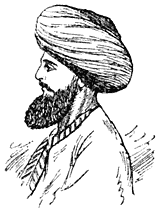
AN EGYPTIAN MAULAWI (LANE).
In winter, also, many persons wrap a muslin or other shawl (such as they use for a turban) about the head and shoulders. The head-dress consists, first, of a small close-fitting cotton cap, which is often changed; next a tarboosh, which is a red cloth cap, also fitting close to the head with a tassel of dark-blue silk at the crown; lastly, a long piece of white muslin, generally figured, or a kashmere shawl, which is wound round the tarboosh. Thus is formed the turban. The kashmere shawl is seldom worn except in cool weather. Some persons wear two or three tarbooshes one over another. A shereef (or descendant of the Prophet) wears a green turban, or is privileged to do so, but no other person; and it is not common for any but a shereef to wear a bright green dress. Stockings are not in use, but some few persons in cold weather wear woollen or cotton socks. The shoes are of thick red morocco, pointed, and turning up at the toes. Some persons also wear inner shoes of soft yellow morocco, and with soles of the same; the outer shoes are taken off on stepping upon a carpet or mat, but not the inner; for this reason the former are often worn turned down at the heel.
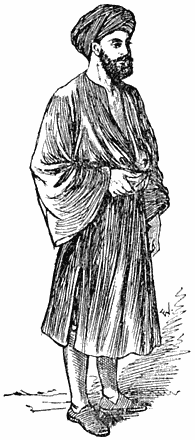
AN EGYPTIAN PEASANT (LANE).
The costume of the men of the lower orders is very simple. These, if not of the very poorest class, wear a pair of drawers, and a long and full shirt or gown of blue linen or cotton, or of brown woollen stuff, open from the neck nearly to the waist, and having wide sleeves. Over this some wear a white or red woollen girdle; for which servants often substitute a broad red belt of woollen stuff or of leather, generally containing a receptacle for money. Their turban is generally composed of a white, red, or yellow woollen shawl, or of a piece of coarse cotton or muslin wound round a tarboosh, under which is a white or brown felt cap; but many are so poor, as to have no other cap than the latter, no turban, nor even drawers, nor shoes, but only the blue or brown shirt, or merely a few rags, while many, on the other hand, wear a sudeyree under the blue shirt, and some, particularly servants in the houses of great men, wear a white shirt, a sudeyree, and a kaftān, or gibbeh, or both, and the blue shirt over all. The full sleeves of this shirt are sometimes drawn up by means of a cord, which passes round each shoulder and crosses behind, where it is tied in a knot. This custom is adopted by servants (particularly grooms), who have cords of crimson or dark blue silk for this purpose.
In cold weather, many persons of the lower classes wear an abayeh, like that before described, but coarser and sometimes (instead of being black) having broad stripes, brown and white, or blue and white, but the latter rarely. Another kind of cloak, more full than the abayeh, of black or deep blue woollen stuff, is also very commonly worn, it is called diffeeyeh. The shoes are of red or yellow morocco, or of sheep-skin. Those of the groom are of dark red morocco. Those of the door-keeper and the water-carrier of a private house, generally yellow.
The Muslims are distinguished by the colours of their turbans from the Copts and the Jews, who (as well as other subjects of the Turkish Sultān who are not Muslims) wear black, blue, gray, or light-brown turbans, and generally dull-coloured dresses.
The distinction of sects, families, dynasties, &c., among the Muslim Arabs by the colour of the turban and other articles of dress, is of very early origin. There are not many different forms of turbans now worn in Egypt; that worn by most of the servants is peculiarly formal, consisting of several spiral twists one above another like the threads of a screw. The kind common among the middle and higher classes of the tradesmen and other citizens of the metropolis and large towns is also very formal, but less so than that just before alluded to.
The Turkish turban worn in Egypt is of a more elegant fashion. The Syrian is distinguished by its width. The Ulama and men of religion and letters in general used to wear, as some do still, one particularly wide and formal called a mukleh. The turban is much respected. In the houses of the more wealthy classes, there is usually a chair on which it is placed at night. This is often sent with the furniture of a bride; as it is common for a lady to have one upon which to place her head-dress. It is never used for any other purpose.
The dress of the women of the middle and higher orders is handsome and elegant. Their shirt is very full, like that of the men, but shorter, not reaching to the knees; it is also, generally, of the same kind of material as the men’s shirt, or of coloured crape, sometimes black. A pair of very wide trousers (called shintiyān) of a coloured striped stuff, of silk and cotton, or of printed or plain white muslin, is tied round the hips under the shirt, with a dikkeh; its lower extremities are drawn up and tied just below the knee with running strings, but it is sufficiently long to hang down to the feet, or almost to the ground, when attached in this manner. Over the shirt and shintiyān is worn a long vest (called yelek), of the same material as the latter; it nearly resembles the kaftān of the men, but is more tight to the body and arms; the sleeves also are longer, and it is made to button down the front from the bosom to a little below the girdle, instead of lapping over; it is open, likewise on each side, from the height of the hip downwards.
In general, the yelek is cut in such a manner as to leave half of the bosom uncovered, except by the shirt, but many ladies have it made more ample at that part, and according to the most approved fashion it should be of sufficient length to reach to the ground, or should exceed that length by two or three inches or more. A short vest (called anteree) reaching only a little below the waist, and exactly resembling a yelek of which the lower part has been cut off, is sometimes worn instead of the latter. A square shawl, or an embroidered kerchief, doubled diagonally, is put loosely round the waist as a girdle, the two corners that are folded together hanging down behind; or sometimes the lady’s girdle is folded after the ordinary Turkish fashion, like that of the men, but more loosely.
Over the yelek is worn a gibbeh of cloth or velvet or silk, usually embroidered with gold or with coloured silk; it differs in form from the gibbeh of the men, chiefly in being not so wide, particularly in the fore part, and is of the same length as the yelek. Instead of this, a jacket (called saltah), generally of cloth or velvet, and embroidered in the same manner as the gibbeh, is often worn.
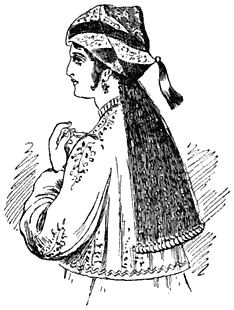
AN EGYPTIAN LADY (LANE).
The head-dress consists of a takeeyeh and tarboosh, with a square kerchief (called faroodeeyeh) of printed or painted muslin or one of crape, wound tightly round, composing what is called a rabtah. Two or more such kerchiefs were commonly used a short time since, and still are sometimes to form the ladies’ turban, but always wound in a high flat shape, very different from that of the turban of the men. A kind of crown, called kurs, and other ornaments, are attached to the ladies’ head-dress. A long piece of white muslin, embroidered at each end with coloured silks and gold, or of coloured crape ornamented with gold thread, &c., and spangles, rests upon the head, and hangs down behind, nearly or quite to the ground; this is called tarhah, it is the head-veil; the face-veil I shall presently describe. The hair, except over the forehead and temples, is divided into numerous braids or plaits, generally from eleven to twenty-five in number, but always of an uneven number; these hang down the back. To each braid of hair are usually added three black silk cords with little ornaments of gold, &c., attached to them. Over the forehead the hair is cut rather short, but two full locks hang down on each side of the face; these are often curled in ringlets and sometimes plaited.
Few of the ladies of Egypt wear stockings or socks, but many of them wear mezz (or inner shoes) of yellow or red morocco, sometimes embroidered with gold. Over these, whenever they step off the matted or carpeted part of the floor, they put on baboog (or slippers) of yellow morocco, with high-pointed toes, or use high wooden clogs or pattens, generally from four to nine inches in height, and usually ornamented with mother-of-pearl or silver, &c.
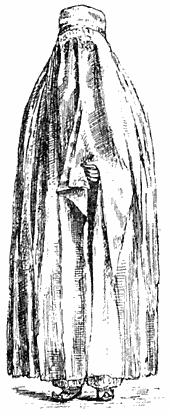
THE INDIAN BURKA. (A. F. Hole.)
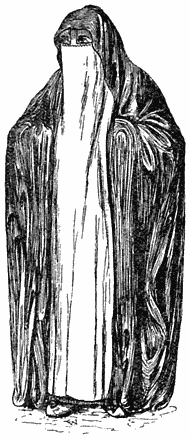
THE EGYPTIAN HABARAH.
The riding or walking attire is called tezyeereh. Whenever a lady leaves the house, she wears, in addition to what has been above described, first, a large, loose gown (called tob or sebleh), the sleeves of which are nearly equal in width to the whole length of the gown; it is of silk, generally of a pink or rose or violet colour. Next is put on the burkaʾ or face-veil, which is a long strip of white muslin, concealing the whole of the face except the eyes, and reaching nearly to the feet. It is suspended at the top by a narrow band, which passes up the forehead, and which is sewed, as are also the two upper corners of the veil, to a band that is tied round the head. The lady then covers herself with a habarah, which, for a married lady, is composed of two breadths of glossy, black silk, each ell-wide, and three yards long; these are sewed together, at or near the selvages (according to the height of the person) the seam running horizontally, with respect to the manner in which it is worn; a piece of narrow black ribbon is sewed inside the upper part, about six inches from the edge, to tie round the head. But some of them imitate the Turkish ladies of Egypt in holding the front part so as to conceal all but that portion of the veil that is above the hands. The unmarried ladies wear a habarah of white silk, or a shawl. Some females of the middle classes, who cannot afford to purchase a habarah, wear instead of it an eezār (izār), which is a piece of white calico, of the same form and size as the former, and is worn in the same manner. On the feet are worn short boots or socks (called khuff), of yellow morocco, and over these the baboog. The dress of a large proportion of those women of the lower orders who are not of the poorest class, consists of a pair of trousers or drawers (similar in form to the shintiyān of the ladies, but generally of plain white cotton or linen), a blue linen or cotton shirt (not quite so full as that of the men), reaching to the feet, a burkaʾ of a kind of coarse black crape, and a dark blue tarhah of muslin or linen. Some wear, over the long shirt, or instead of the latter, a linen tob, of the same form as that of the ladies; and within the long shirt, some wear a short white shirt; and some, a sudeyree also, or an anteree. The sleeves of the tob are often turned up over the head; either to prevent their being incommodious, or to supply the place of a tarhah. In addition to these articles of dress, many women who are not of the very poor classes wear, as a covering, a kind of plaid, similar in form to the habarah, composed of two pieces of cotton, woven in small chequers of blue and white, or cross stripes, with a mixture of red at each end. It is called milayeh; in general it is worn in the same manner as the habarah, but sometimes like the tarhah. The upper part of the black burkaʾ is often ornamented with false pearls, small gold coins, and other little flat ornaments of the same metal (called bark); sometimes with a coral bead, and a gold coin beneath; also with some coins of base silver and more commonly with a pair of chain tassels of brass or silver (called oyoon) attached to the corners. A square black silk kerchief (called asbeh), with a border of red and yellow, is bound round the head, doubled diagonally, and tied with a single knot behind; or, instead of this, the tarboosh and faroodeeyeh are worn, though by very few women of the lower classes.
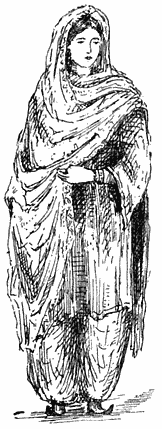
AN INDIAN ZANANA LADY. (A. F. Hole.)
The best kind of shoes worn by the females of the lower orders are of red morocco, turned up, but generally round, at the toes. The burkaʾ and shoes are most common in Cairo, and are also worn by many of the women throughout lower Egypt; but in Upper Egypt, the burkaʾ is very seldom seen, and shoes are scarcely less uncommon. To supply the place of the former, when necessary, a portion of the tarhah is drawn before the face, so as to conceal nearly all the countenance except one eye.
Many of the women of the lower orders, even in the metropolis, never conceal their faces.
Throughout the greater part of Egypt, the most common dress of the women, merely consists of the blue shirt or tob and tarhah. In the southern parts of Upper Egypt chiefly above Akhmeem, most of the women envelop themselves in a large piece of dark-brown woollen stuff (called a hulāleeyeh), wrapping it round the body and attaching the upper parts together over each shoulder, and a piece of the same they use as a tarhah. This dull dress, though picturesque, is almost as disguising as the blue tinge which women in these parts of Egypt impart to their lips. Most of the women of the lower orders wear a variety of trumpery ornaments, such as ear-rings, necklaces, bracelets, &c., and sometimes a nose-ring.
The women of Egypt deem it more incumbent upon them to cover the upper and back part of the head than the face, and more requisite to conceal the face than most other parts of the person. I have often seen women but half covered with miserable rags, and several times females in the prime of womanhood, and others in more advanced age, with nothing on the body but a narrow strip of rag bound round the hips.
Mr. Burckhardt, in his Notes on the Bedouins and Wahabys (p. 47), thus describes the dress of the Badawīs of the desert:—
In summer the men wear a coarse cotton shirt, over which the wealthy put a kombar, or “long gown,” as it is worn in Turkish towns, of silk or cotton stuff. Most of them, however, do not wear the kombar, but simply wear over their shirt a woollen mantle. There are different sorts of mantles, one very thin, light, and white woollen, manufactured at Bag͟hdād, and called mesoumy. A coarser and heavier kind, striped white and brown (worn over the mesoumy), is called abba. The Bag͟hdād abbas are most esteemed, those made at Hamah, with short wide sleeves, are called boush. (In the northern parts of Syria, every kind of woollen mantle, whether white, black, or striped white and brown, or white and blue, are called meshlakh.) I have not seen any black abbas among the Aenezes, but frequently among the sheikhs of Ahl el Shemal, sometimes interwoven with gold, and worth as much as ten pounds sterling. The Aenezes do not wear drawers; they walk and ride usually barefooted, even the richest of them, although they generally esteem yellow boots and red shoes. All the Bedouins wear on the head, instead of the red Turkish cap, a turban or square kerchief, of cotton or cotton and silk mixed; the turban is called keffie; this they fold about the head so that one corner falls backward, and two other corners hang over the fore part of the shoulders; with these two corners they cover their faces to protect them from the sun’s rays, or hot wind, or rain, or to conceal their features if they wish to be unknown. The keffie is yellow or yellow mixed with green. Over the keffie the Aenezes tie, instead of a turban, a cord round the head; this cord is of camel’s hair, and called akal. Some tie a handkerchief about the head, and it is then called shutfe. A few rich sheikhs wear shawls on their heads of Damascus or Bag͟hdād manufacture, striped red and white; they sometimes also use red caps or takie (called in Syria tarboush), and under those they wear a smaller cap of camel’s hair, called maaraka (in Syria arkye, where it is generally made of fine cotton stuff).
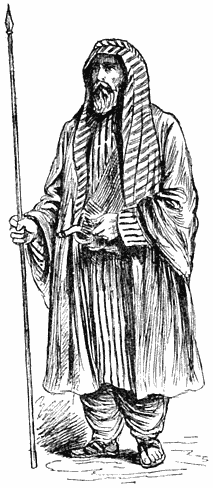
A BEDOUIN (BADAWI) OF THE DESERT.
The Aenezes are distinguished at first sight from all the Syrian Bedouins by the long tresses of their hair. They never shave their black hair, but cherish it from infancy, till they can twist it in tresses, that hang over the cheeks down to the breast: these tresses are called keroun. Some few Aenezes wear girdles of leather, others tie a cord or a piece of rag over the shirt. Men and women wear from infancy a leather girdle around the naked waist, it consists of four or five thongs twisted together into a cord as thick as one’s finger. I heard that the women tie their thongs separated from each other, round the waist. Both men and women adorn the girdles with pieces of ribands or amulets. The Aenezes called it hhakou; the Ahl el Shemal call it bereim. In summer the boys, until the age of seven or eight years, go stark naked; but I never saw any young girl in that state, although it was mentioned that in the interior of the desert the girls, at that early age, were not more encumbered by clothing than their little brothers. In winter, the Bedouins wear over the shirt a pelisse, made of several sheep-skins stitched together; many wear these skins even in summer, because experience has taught them that the more warmly a person is clothed, the less he suffers from the sun. The Arabs endure the inclemency of the rainy season in a wonderful manner. While everything around them suffers from the cold, they sleep barefooted in an open tent, where the fire is not kept up beyond midnight. Yet in the middle of summer an Arab sleeps wrapt in his mantle upon the burning sand, and exposed to the rays of an intensely hot sun. The ladies’ dress is a wide cotton gown of a dark colour, blue, brown, or black; on their heads they wear a kerchief called shauber or mekroune, the young females having it of a red colour, the old of black. All the Ranalla ladies wear black silk kerchiefs, two yards square, called shale kās; these are made at Damascus. Silver rings are much worn by the Aeneze ladies, both in the ears and noses; the ear-rings they call terkie (pl. teraky), the small nose-rings shedre, the larger (some of which are three inches and a half in diameter), khezain. All the women puncture their lips and dye them blue; this kind of tattooing they call bertoum, and apply it likewise in spotting their temples and foreheads. The Serhhān women puncture their cheeks, breasts, and arms, and the Ammour women their ankles. Several men also adorn their arms in the same manner. The Bedouin ladies half cover their faces with a dark-coloured veil, called nekye, which is so tied as to conceal the chin and mouth. The Egyptian women’s veil (berkoa) is used by the Kebly Arabs. Round their wrists the Aeneze ladies wear glass bracelets of various colours; the rich also have silver bracelets and some wear silver chains about the neck. Both in summer and winter the men and women go barefooted.
Captain Burton, in his account of Zanzibar, (vol. i. p. 382), says:—
The Arab’s head-dress is a kummeh or kofiyyāh (red fez), a Surat calotte (afiyyah), or a white skull-cap, worn under a turban (kilemba) of Oman silk and cotton religiously mixed. Usually it is of fine blue and white cotton check, embroidered and fringed with a broad red border, with the ends hanging in unequal lengths over one shoulder. The coiffure is highly picturesque. The ruling family and grandees, however, have modified its vulgar folds, wearing it peaked in front, and somewhat resembling a tiara. The essential body-clothing, and the succedaneum for trousers is an izor (nguo yaku Chini), or loin-cloth, tucked in at the waist, six to seven feet long by two to three broad. The colours are brickdust and white, or blue and white, with a silk border striped red, black, and yellow. The very poor wear a dirty bit of cotton girdled by a hakab or kundāvi, a rope of plaited thongs; the rich prefer a fine embroidered stuff from Oman, supported at the waist by a silver chain. None but the western Arabs admit the innovation of drawers (sūrūwali). The jama or upper garment is a collarless coat, of the best broad-cloth, leek-green or some tender colour being preferred. It is secured over the left breast by a silken loop, and the straight wide sleeves are gaily lined. The kizbāo is a kind of waistcoat, covering only the bust; some wear it with sleeves, others without. The dishdashes (in Kisawahili Khanzu), a narrow-sleeved shirt buttoned at the throat, and extending to midshin, is made of calico (baftah), American drill and other stuffs called doriyāh, tarabuzun, and jamdani. Sailors are known by khuzerangi, a coarse cotton, stained dingy red-yellow, with henna or pomegranate rind, and rank with wars (bastard saffron) and shark’s oil.
Respectable men guard the stomach with a hizâm, generally a Cashmere or Bombay shawl; others wear sashes of the dust-coloured raw silk, manufactured in Oman. The outer garment for chilly weather is the long tight-sleeved Persian jubbeh, jokhah, or caftān, of European broad-cloth. Most men shave their heads, and the Shafeis trim or entirely remove the moustaches.
The palms are reddened with henna, which is either brought from El Hejāz, or gathered in the plantations. The only ring is a plain cornelian seal and the sole other ornament is a talisman (hirz, in Kisawahili Hirizi). The eyes are blackened with kohl, or antimony of El Shām—here, not Syria, but the region about Meccah—and the mouth crimsoned by betel, looks as if a tooth had just been knocked out.
Dr. Eugene Schuyler, in his work on Turkestan (vol. i. p. 122), says:—
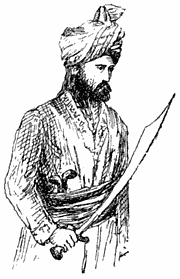
AN AFGHAN CHIEF. (A. F. Hole.)
The dress of the Central Asiatic is very simple. He wears loose baggy trousers, usually made of coarse white cotton stuff fastened tightly round the waist, with a cord and tassel; this is a necessary article of dress, and is never or rarely taken off, at all events not in the presence of another. Frequently, when men are at work, this is the only garment, and in that case it is gradually turned up under the cord, or rolled up on the legs, so that the person is almost naked. Over this is worn a long shirt, either white or of some light-coloured print, reaching almost to the feet, and with a very narrow aperture for the neck, which renders it somewhat difficult to put the head through. The sleeves are long and loose. Beyond this there is nothing more but what is called the chapan, varying in number according to the weather, or the whim of the person. The chapan is a loose gown, cut very sloping in the neck, with strings to tie it together in front; and inordinately large sleeves, made with an immense gore, and about twice as long as is necessary; exceedingly inconvenient, but useful to conceal the hands, as Asiatic politeness dictates. In summer, these are usually made of Russian prints, or of the native alatcha, a striped cotton material, or of silk, either striped or with most gorgeous eastern patterns, in bright colours, especially red, yellow, and green. I have sometimes seen men with as many as four or five of these gowns, even in summer; they say that it keeps out the heat. In winter, one gown will frequently be made of cloth, and lined with fine lamb-skin or fur. The usual girdle is a large handkerchief, or a small shawl; at times, a long scarf wound several times tightly round the waist. The Jews in places under native rule are allowed no girdle, but a bit of rope or cord, as a mark of ignominy. From the girdle hang the accessory knives and several small bags and pouches, often prettily embroidered, for combs, money, &c. On the head there is a skull-cap; these in Tashkent are always embroidered with silk; in Būkhārā they are usually worked with silk, or worsted in cross-stitch in gay patterns. The turban, called tchilpetch, or “forty turns,” is very long; and if the wearer has any pretence to elegance, it should be of fine thin material, which is chiefly imported from England. It requires considerable experience to wind one properly round the head, so that the folds will be well made and the appearance fashionable. One extremity is left to fall over the left shoulder, but is usually, except at prayer time, tucked in over the top. Should this end be on the right shoulder, it is said to be in the Afghān style. The majority of turbans are white, particularly so in Tashkent, though white is especially the colour of the mūllāhs and religious people, whose learning is judged by the size of their turbans. In general, merchants prefer blue, striped, or chequered material.
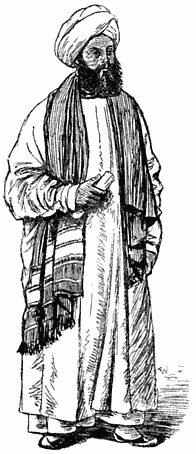
AN AFGHAN MULLAH.
At home the men usually go barefooted, but on going out wear either a sort of slippers with pointed toes and very small high heels, or long soft boots, the sole and upper being made of the same material. In the street, one must in addition put on either a slipper or golosh, or wear riding-boots made of bright green horse hide, with turned-up pointed toes and very small high heels.
The dress of the women, in shape and fashion, differs but little from that of the men, as they wear similar trousers and shirts, though, in addition, they have long gowns, usually of bright-coloured silk, which extend from the neck to the ground. They wear an innumerable quantity of necklaces, and little amulets, pendents in their hair, and ear-rings, and occasionally even a nose-ring. This is by no means so ugly as is supposed: a pretty girl with a turquoise ring in one nostril is not at all unsightly. On the contrary, there is something piquant in it. Usually, when outside of the houses, all respectable women wear a heavy black veil, reaching to their waists, made of woven horse-hair, and over that is thrown a dark blue, or green khalat, the sleeves of which, tied together at the ends, dangle behind. The theory of this dull dress is, that the women desire to escape observation, and certainly for that purpose they have devised the most ugly and unseemly costume that could be imagined. They are, however, very inquisitive, and occasionally in bye-streets one is able to get a good glance at them before they pull down their veils.
The dress of the citizens of Persia has been often described, both by ancient and modern travellers. That of the men has changed very materially within the last century. The turban, as a head-dress, is now worn by none but the Arabian inhabitants of that country. The Persians wear a long cap covered with lamb’s wool, the appearance of which is sometimes improved by being encircled with a cashmere shawl. The inhabitants of the principal towns are fond of dressing richly. Their upper garments are either made of chintz, silk, or cloth, and are often trimmed with gold or silver lace; they also wear brocade; and in winter their clothes are lined with furs, of which they import a great variety. It is not customary for any person, except the king, to wear jewels; but nothing can exceed the profusion which he displays of these ornaments; and his subjects seem peculiarly proud of this part of royal magnificence. They assert that when the monarch is dressed in his most splendid robes, and is seated in the sun, that the eye cannot gaze on the dazzling brilliancy of his attire.
DRINKABLES. Arabic ashribah (اشربة). There is a chapter in the Traditions devoted to this subject, and entitled Bābu ʾl-Ashribah. The example of Muḥammad in his habit of drinking, having influenced the Eastern world in its habits, the following traditions are noticeable. Anas says, “the Prophet has forbidden drinking water standing,” and that he used to take breath three times in drinking; and would say drinking in this way cools the stomach, quenches the thirst, and gives health and vigour to the body.
Ibn ʿAbbās says the Prophet forbade drinking water from the mouth of a leather bag.
Umm Salimah says, “the Prophet said, He who drinks out of a silver cup drinks of hell fire.” (Mishkāt, book xix. c. iii.)
DRINKING VESSELS. There are four drinking vessels which Muslims were forbidden by their Prophet to drink out of (Mishkāt, bk. i., c. i.): ḥantam, a “green vessel”; dubbāʾ, a large gourd hollowed out; naqīr, a cup made from the hollowed root of a tree; muzaffat, a vessel covered with pitch, or with a glutinous substance. These four kinds of vessels seem to have been used for drinking wine, hence the prohibition.
When a dog drinks from a vessel used by man, it should be washed seven times. (Mishkāt, book iii. c. ix. pt. i.)
DROWNING. Arabic g͟haraq (غرق). It is a strange anomaly in Muḥammadan law, according to the teaching of Abū Ḥanīfah, that if a person cause the death of another by immersing him under water until he die, the offence does not amount to murder, and retaliation (qiṣāṣ) is not incurred. The arguments of the learned divine are as follows: First, water is analogous to a small stick or rod, as is seldom or ever used in murder. Now, it is said in the Traditions that death produced by a rod is only manslaughter, and as in that a fine is merely incurred, so here likewise. Secondly, retaliation requires the observance of a perfect equality; but between drowning and wounding there is no equality, the former being short of the latter with regard to damaging the body. [MURDER.]
DRUNKENNESS. Shurb (شرب) denotes the state of a person who has taken intoxicating liquor, whilst sukr (سكر) implies a state of drunkenness. Wine of any kind being strictly forbidden by the Muslim law, no distinction is made in the punishment of a wine-drinker and a drunkard. If a Muslim drink wine, and two witnesses testify to his having done so, or if his breath smell of wine, or if he shall himself confess to having taken wine, or if he be found in a state of intoxication, he shall be beaten with eighty stripes, or, in the case of a slave, with forty stripes. (Hidāyah, vol. ii. p. 57; Mishkāt, bk. xv. c. iv.) [KHAMR.]
DRUZES. A heretical mystic sect of Muḥammadans, which arose about the beginning of the eleventh century in the mountains of Syria. They are now chiefly found in the districts of Lebanon, and in the neighbourhood of Damascus. They were founded by al-Ḥakīm, the fanatical K͟halīfah of the Fāt̤imite race, who reigned at Cairo, assisted by two Persians named Hamzah and al-Darāzī, from the latter of whom the sect derives its name.
De Sacy, in his Exposé de la Religion des Druzes, gives the following summary of their belief:—
“To acknowledge only one God, without seeking to penetrate the nature of His being and of His attributes; to confess that He can neither be comprehended by the senses nor defined by words; to believe that the Divinity has shown itself to men at different epochs, under a human form, without participating in any of the weaknesses and imperfections of humanity; that it has shown itself at last, at the commencement of the fifth age of the Hejira, under the figure of Hakim Amr Allah; that that was the last of His manifestations, after which there is none other to be expected; that Hakim disappeared in the year 411 of the Hejira, to try the faith of His servants, to give room for the apostasy of hypocrites, and of those who had only embraced the true religion from the hope of worldly rewards; that in a short time he would appear again, full of glory and of majesty, to triumph over all his enemies, to extend His empire over all the earth, and to make His faithful worshippers happy for ever; to believe that Universal Intelligence is the first of God’s creatures, the only direct production of His omnipotence; that it has appeared upon the earth at the epoch of each of the manifestations of the Divinity, and has finally appeared since the time of Hakim under the figure of Hamza, son of Ahmad; that it is by His ministry that all the other creatures have been produced; that Hamza only possesses the knowledge of all truth, that he is the prime minister of the true religion, and that he communicates, directly or indirectly, with the other ministers and with the faithful, but in different proportions, the knowledge and the grace which he receives directly from the Divinity, and of which he is the sole channel; that he only has immediate access to God, and acts as a mediator to the other worshippers of the Supreme Being; acknowledging that Hamza is he to whom Hakim will confide his sword, to make his religion triumph, to conquer all his rivals, and to distribute rewards and punishments according to the merits of each one; to know the other ministers of religion, and the rank which belongs to each of them; to give to each the obedience and submission which is their due; to confess that every soul has been created by the Universal Intelligence; that the number of men is always the same; and that souls pass successively into different bodies; that they are raised by their attachment to truth to a superior degree of excellence, or are degraded by neglecting or giving up religious meditation; to practise the seven commandments which the religion of Hamza imposes upon its followers, and which principally exacts from them the observance of truth, charity towards their brethren, the renunciation of their former religion, the most entire resignation and submission to the will of God; to confess that all preceding religions have only been types more or less perfect of true religion, that all their ceremonial observances are only allegories, and that the manifestation of true religion requires the abrogation of every other creed. Such is the abridgment of the religious system taught in the books of the Druzes, of which Hamza is the author, and whose followers are called Unitarians.”
There is a very full and correct account of the religious belief of the Druzes in the Researches into the Religions of Syria, by the Rev. J. Wortabet, M.D. In this work Dr. Wortabet gives the following Catechism of the Druzes, which expresses their belief with regard to Christianity:—
“Q. What do ye say concerning the gospel which the Christians hold?
“A. That it is true; for it is the sayings of the Lord Christ, who was Salman el Pharisy during the life of Mohammed, and who is Hamzeh the son of Ali—not the false Christ who was born of Mary, for he was the son of Joseph.
“Q. Where was the true Christ when the false Christ was with the disciples?
“A. He was among the disciples. He uttered the truths of the gospel and taught Christ, the son of Joseph, the institutes of the Christian religion; but when Jesus disobeyed the true Christ, he put hatred into the hearts of the Jews, so that they crucified him.
“Q. What became of him after the crucifixion?
“A. They put him into a grave, and the true Christ came and stole him, and gave out the report among men that Christ had risen out of the dead.
“Q. Why did he act in this manner?
“A. That he might establish the Christian religion, and confirm its followers in what he had taught them.
“Q. Why did he act in such a manner as to establish error?
“A. So that the Unitarians should be concealed in the religion of Jesus and none of them might be known.
“Q. Who was it that came from the grave and entered among the disciples when the doors were shut?
“A. The living Christ, who is immortal, even Hamzeh, the son and slave of our Lord.
“Q. Who brought the gospel to light, and preached it?
“A. Matthew, Mark, Luke, and John.”
“Q. Why did not the Christians acknowledge the unity of God?
“A. Because God had not so decreed.
“Q. Why does God permit the introduction of evil and infidelity?
“A. Because He chooses to mislead some from, and to guide others to, the truth.
“Q. If infidelity and error proceed from Him, why does he punish those who follow them?
“A. Because when He deceived them, they did not obey Him.
“Q. How can a deluded man obey, when he is ignorant of the true state of the case?
“A. We are not bound to answer this question, for God is not accountable to his creatures for his dealings with them.”
DUʿĀʾ (دعاء). “Prayer.” The word duʿāʾ is generally used for supplication, as distinguished from ṣalāt, or the liturgical form of prayer, e.g. Qurʾān, Sūrah xiv. 42: “O my Lord! make me and my posterity to be constant in prayer (ṣalāt). O our Lord! and accept my supplication (duʿāʾ). [PRAYERS.]
DUʿĀʾ-I-MAʾS̤ŪR (دعــاء مــاثــور). Lit. “Recorded prayer.” A term used for prayers which were offered up by the Prophet, and have been handed down in the Traditions.
DUʿĀʾU ʾL-QUNŪT (دعاء القنوت), called also the Qunūtu ʾl-Witr, “The prayer said standing.” A form of prayer recited after the qarāʾah in the night prayer. Recited by some sects in the early morning. It is found in the Traditions. It is as follows:—
“O God, we seek help from Thee, and forgiveness of sins.
“We believe in Thee and trust in Thee.
“We praise Thee. We thank Thee. We are not unthankful.
“We expel, and we depart from him who does not obey Thee.
“We serve Thee only, and to Thee do we pray.
“We seek Thee, we prostrate ourselves and we serve Thee.
“We hope for Thy mercy. We fear Thy punishments.
“Surely Thy judgments are upon the infidels.”
DUALISM. Professor Palmer, following the remarks of al-Baiẓāwī the commentator, says there is a protest against the dualistic doctrine that Light and Darkness were two co-eternal principles, in the Qurʾān, Sūrah vi. 1: “Praised be God who created the heavens and the earth, and brought into being the Darkness and the Light.” (Palmer’s Qurʾān, vol. i. p. 115; al-Baiẓāwī in loco.)
AD-DUK͟HĀN (الـدخان). “The Smoke.” The title of the XLIVth chapter of the Qurʾān, in which the words occur (9th verse): “Expect thou the day when the heaven shall bring a palpable smoke.”
DULDUL (دلدل). The name of the Prophet’s mule which he gave to ʿAlī.
DUMB, The. Arabic abkam (ابكم), pl. bukm.
The intelligible signs of a dumb person suffice to verify his bequests and render them valid; he may also execute a marriage contract, or give a divorce, or execute a sale or purchase, or sue or incur punishment by signs, but he cannot sue in a case of qiṣāṣ, or retaliation for murder. This rule does not apply to a person who has been deprived of speech, but merely to one who has been born dumb. (Hidāyah, vol. iv. p. 568.) A dumb person can also acknowledge and deny the faith by a sign.
AD-DURRATU ʾL-BAIẒĀʾ (الـدرة البيضاء). Lit. “The pearl of light.” A term used by Ṣūfī mystics to express the ʿāqlu ʾl-awwal, the first intelligence which God is said to have created at the beginning of the animate world. (ʿAbdu ʾr-Razzāq’s Dictionary of Ṣūfī Terms.)
DURŪD (درود); a Persian word. Arabic aṣ-Ṣalāt (الصلوة). A benediction; imploring mercy. A part of the stated prayer, recited immediately after the Tashahhud, whilst in the same posture. It is as follows: “O God, have mercy on Muḥammad and on his descendants, as Thou didst have mercy on Abraham and on his descendants! Thou art to be praised, and Thou art great! O God, bless Muḥammad and his descendants as Thou didst bless Abraham and his descendants. Thou art to be praised and Thou art great.” The merits of this form of prayer are said to be very great; for, according to Anas, the Prophet said, “He who recites it will have blessings on his head ten times, ten sins will be forgiven, and he will be exalted ten steps.” (Mishkāt, book iv. c. xvii.) [PRAYER.]
DŪZAK͟H (دوزخ). The Persian word for hell. [HELL.]
DYER. According to the Imām Abū Ḥanīfah, a dyer of cloth is at liberty to detain it until he receive his hire for dyeing it; and if the cloth perish in his hands whilst it is detained, he is not responsible. (Hidāyah, vol. iii. 320.)
DYING, The. Very special instructions are given in Muslim books as to the treatment of the dying. In the Durru ʾl-Muk͟htār (p. 88), the friends of the dying are recommended, if possible, to turn the head of the dying person towards Makkah; but if this be not convenient, his feet should be placed in that direction and his head slightly raised. The Kalimatu ʾsh-Shahādah should then be recited, and the Sūrah Yā-Sīn (xxxvi.) and Sūratu ʾr-Raʿd (xiii.) should be read from the Qurʾān. When the spirit has departed from the body, the mouth should be tied up and the eyes closed and the arms straightened, and the body should be perfumed, and no unclean person should be suffered to approach the corpse. Immediate steps should then be taken for the washing of the corpse. [DEATH.]
E.
EAR-RINGS; NOSE-RINGS. In the East it is the universal custom of Muḥammadan women to wear ear-rings, and they are not unfrequently worn by young men and children. Gold ear-rings are, however, forbidden in the Traditions; for Abū Hurairah relates that the Prophet said, “Whoever wishes to put into the ear or the nose of a friend a ring of hell fire, let him put in the ear or the nose of his friend a gold ring … let your ornament be of silver.” And Asmāʾ bint Yazīd relates the same tradition. (Mishkāt, book xx. c. 11, part 2.)
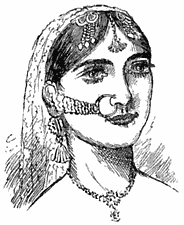
EAR AND NOSE RINGS.
EARTH, The. Arabic arẓ (ارض). Muḥammad taught his followers that just as there are seven heavens [HEAVEN] one above another, so there are seven earths one beneath another, the distance between each of these regions being five hundred years’ journey. (Mishkāt, book xxiv. c. i. part 3.)
In the Qurʾān the earth is said to be stretched out like a carpet or bed (Sūrah ii. 20; xiii. 3; lxxviii. 6), which expression the ancient commentators understood to imply that the earth was a vast plane, but circular; and (Sūrah xxxix. 67) to be but a handful in the sight of God, which in the last day shall be changed into another earth (Sūrah xiv. 49).
The earth is believed by Muḥammadan writers to be surrounded by a great sea called al-Baḥru ʾl-Muḥīt̤, or the circumambient ocean, which is bounded by the mountains of Qāf. The extent of the earth is said to be equal to a journey of five hundred years; two hundred years’ journey being allotted to the sea, two hundred to the uninhabited desert, eighty to the country of Gog and Magog (Yājūj wa Mājūj) and the rest to the civilised world. Certain terræ incognitæ in the midst of the mountains of Qāf are said to be inhabited by the jinn, or genii. According to some, Makkah (or Jerusalem according to others) is situated in the centre of the earth. On the Muḥīt̤ is the ʿArshu ʾl-Iblīs, or “Throne of Satan.” The western portion of the Muḥīt̤ is often called the Baḥru ʾz̤-Z̤ulmāt, or “Sea of Darkness,” and in the south-west corner of the earth is the Fountain of Life of which al-K͟hiẓr drank, and in virtue of which he still lives, and will live till the Day of Judgment. The mountains of Qāf which bound the great sea Muḥīt̤, form a circular barrier round the whole earth, and are said to be of green chrysolite, the colour of which the Prophet said imparts a greenish tint to the sky. The general opinion is that the mountains of Qāf bound our earth, but some say there are countries beyond, each country being a thousand years’ journey.
The seven earths, which are five hundred years’ journey from each other, are situated one beneath the other, and each of these seven regions has its special occupants. The occupants of the first are men, genii, and animals; the second is occupied by the suffocating wind which destroyed the infidel tribe of ʿĀd (Sūrah lxix. 6); the third is filled with the stones of hell, mentioned in the Qurʾān (Sūrah ii. 22; lxvi. 6) as “the fuel of which is men and stones”; the fourth by the sulphur of hell; the fifth by the serpents of hell; the sixth by the scorpions of hell, which are in size and colour like black mules, and have tails like spears; and the seventh by the devil and his angels. Our earth is said to be supported on the shoulders of an angel, who stands upon a rock of ruby, which rock is supported on a huge bull with four thousand eyes, and the same number of ears, noses, mouths, tongues, and feet; between every one of each is a distance of five hundred years’ journey. The name of this bull is Kujūta, who is supported by an enormous fish, the name of which is Bahamūt.
The above is but a brief outline of the Muḥammadan belief as regards the earth’s formation; but the statements of Muḥammadan commentators are so wild on the subject, that it seems quite useless to quote them as authorities, for they contradict each other in endless variety.
EARTHQUAKE, The. Arabic az-Zalzalah (الزلزلة). The title of the XCIXth Sūrah of the Qurʾān, in which it is stated that an earthquake will take place at the commencement of the signs of the last day:—
“When the Earth with her quaking shall quake
“And the Earth shall cast forth her burdens,
“And man shall say, What aileth her?
“On that day shall she tell out her tidings,
“Because thy Lord shall have inspired her.
“On that day shall men come forward in throngs to behold their works,
“And whosoever shall have wrought an atom’s weight of good shall behold it,
“And whosoever shall have wrought an atom’s weight of evil shall behold it.”
EATING. According to the Traditions, Muḥammadans have been enjoined by their Prophet to eat in God’s name, to return thanks, to eat with their right hand, and with their shoes off, and to lick the plate when the meal is finished. The following are some of Muḥammad’s precepts on the subject:—
“The Devil has power over that food which is eaten without remembering God.”
“Repeat the name of God. Eat with the right hand and eat from before you.”
“When a man comes into a house at meal-time, and remembers the name of God, the devil says to his followers, ‘There is no place here for you and me to-night, nor is there any supper for us.’”
“When anyone eats he must not wash his fingers until he has first licked them.”
“Whoever eats a dish and licks it afterwards, the dish intercedes with God for him.”
“When victuals are placed before you, eat them with your shoes off, because taking off your shoes will ease your feet.” (ʿAbdu ʾl-Ḥaqq adds, “and do it out of respect to the food.”)
“Whoever eats from a plate and licks it afterwards, the dish says to him, ‘May God free you from hell as you have freed me from the devils licking me.’ ”
Qatādah says that Anas said: “The Prophet did not eat off a table, as is the manner of proud men, who do it to avoid bending their backs.” (Mishkāt, Arabic ed., Bābu ʾl-At̤ʿimah.)
The following directions are given for eating, by Faqīr Muḥammad Asʿad, the author of the Ak͟hlāq-i-Jalālī (Thompson’s English Translation, p. 294):—
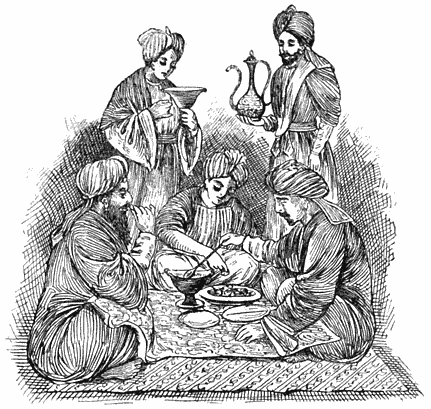
DINING
“First of all, he should wash his hands, mouth, and nose. Before beginning he should say, ‘In the name of God’ (Bismillāh); and after ending he must say, ‘Glory to God’ (Al-ḥamdu lillāh). He is not to be in a hurry to begin, unless he is the master of the feast; he must not dirty his hands, or clothes, or the table-linen; he must not eat with more than three fingers, nor open his mouth wide; not take large mouthfuls, nor swallow them hastily, nor yet keep them too long unswallowed. He must not suck his fingers in the course of eating; but after he has eaten, he may, or rather ought, as there is scripture warrant for it.
“Let him not look from dish to dish, nor smell the food, nor pick and choose it. If there should be one dish better than the rest, let him not be greedy on his own account, but let him offer it to others. He must not spill the grease upon his fingers, or so as to wet his bread and salt. He must not eye his comrades in the midst of his mouthfuls. Let him eat from what is next him, unless of fruit, which it is allowable to eat from every quarter. What he has once put into his mouth (such as bones, &c.), he must not replace upon his bread, nor upon the table-cloth; if a bone has found its way there, let him remove it unseen. Let him beware of revolting gestures, and of letting anything drop from his mouth into the cup. Let him so behave, that, if anyone should wish to eat the relics of his repast, there may be nothing to revolt him.
“Where he is a guest, he must stay his hand sooner than the master of the feast; and whenever the rest discontinue eating, he must act in concert with them, except he be in his own house, or some other where he constitutes part of the family. Where he is himself the host, he must not continue eating when the rest have stayed their hands, so that something may be left for anyone who chances to fancy it.
“If he has occasion to drink in the course of his meal, let him do it softly, that no noise in his throat or mouth may be audible to others. He must not pick his teeth in the view of the company, nor swallow what his tongue may extract from between them; and so of what may be extracted by the tooth-pick, let him throw it aside so as to disgust no one.
“When the time comes for washing his hands, let him be exceedingly careful in cleansing his nails and fingers. Similar must be his particularity in washing his lips, mouth, and nostrils. He must not void his rheum into the basin; even the water in which his mouth has been rinsed, let him cover with his hand as he throws it away.
“Neither must he take the turn from others in washing his hands, saving when he is master of the entertainment, and then he should be the first to wash.”
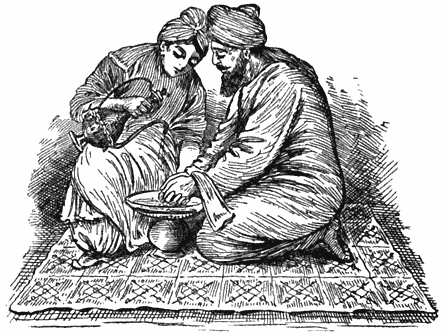
WASHING THE HANDS.
EATING WITH JEWS OR CHRISTIANS. In Muḥammadan countries, where the people have not been brought in contact with Hindus, with caste prejudices, Muslims never hesitate to eat with Jews and Christians, provided the drink and victuals are such as are lawful in Islām. Since the British occupation of India, the question has often been raised, and few Muḥammadans will eat with Englishmen. Syud Aḥmad K͟hān, C.S.I., has written a book, in which he proves that it is lawful for Muḥammadans to eat with both Christians and Jews, and his arguments would seem to be in accordance with the teaching of the Qurʾān. Sūrah v. 7: “Lawful for you to-day are the good things, and the food of the people of the Book (i.e. Jews and Christians) is lawful for you, and your food is lawful for them.”
Al-Baiẓāwī, commenting on this verse, says: “This verse includes all kinds of food, that which is slain lawfully (ẕabḥ) or not, and this verse is of common application to all the people of the Book, whether Jews or Christians. But on one occasion K͟halīfah ʿAlī did not observe its injunctions with regard to the Banū Tag͟hlib, a Christian tribe, because he said these people were not Christians, for they had not embraced anything of Christianity except wine-drinking. And he does not include amongst the people of the Book, the Majūsīs, although he included the Majūsīs with the people of the Book when he took the poll-tax from them, according to a tradition which Muḥammad gave regarding the Majūsīs, viz. ‘Treat the Majūsīs as you would treat the people of the Book, but do not marry with them, nor eat what they slay.’” (Tafsīru ʾl-Baiẓāwī, p. 216.)
The commentators, al-Kamālān, say the only question raised was that of animals slain by Jews and Christians, and the learned are all agreed that animals slain by them are lawful. (Tafsīru ʾl-Jalālain wa ʾl-Kamālain, p. 93.)
The following Ḥadīs̤ is given in the Ṣaḥīḥ Muslim on the subject: Abū S̤aʿlabah related, “I said, O Prophet of God! Verily we live in a land belonging to the people of the Book (i.e. Jews or Christians); is it lawful for us to eat out of their dishes? The Prophet replied, The order for dishes is this: if you can get other dishes, then eat of them; but if ye cannot, then wash those of the people of the Book and eat from them.”
The Imām Nawawī, the commentator on the Ṣaḥīḥ Muslim, says Abū Dāʾud has given this Ḥadīs̤. in a somewhat different form to that in the text. He says: “Abū S̤aʿlabah relates, we were passing through the country of the people of the Book (i.e. Christians), and they were cooking pigs’ flesh in their dishes, and drinking wine from their vessels.” “For” (continues Nawawī), “the learned are all agreed that it is lawful to eat with Jews and Christians unless their vessels are polluted with wine or pork, in which case they must be washed before they are used.” (Ṣaḥīḥ Muslim wa Sharḥu Nawawī, p. 146.)
ECLIPSE. The Arabic k͟husūf (خسوف) is used to denote either an eclipse of the sun or of the moon (vide Mishkāt, book iv. c. li.); but it is more specially applied to an eclipse of the moon; and kusūf (كسوف) for an eclipse of the sun (vide Richardson’s Dictionary). Special prayers, consisting of two rakʿahs, are enjoined in the Traditions (Mishkāt, book iv. c. li.) at the time of an eclipse of either the sun or moon.
ʿAbdu ʾllāh ibn ʿAbbās says: “There was an eclipse of the sun in the time of the Prophet, and he recited prayers, and the people recited after him; and he stood up for a long time, as long as anyone would be repeating the Chapter of the Cow (i.e. Sūrah ii.). Then he performed a long rukūʿ, after which he raised up his head and stood a long time, which was under the first standing; after which he did the second rukūʿ, which was the same as the first in point of time; then he raised his head up from the second rukūʿ; and performed two prostrations, as is customary. Then he stood up a long time, in the second rakʿah, and this was shorter than the first standing, in the first rakʿah; after which he did a long rukūʿ in the second rakʿah, and this was under the first rukūʿ, in the first rakʿah. After this, he raised up his head, and stood a long time; and this was shorter than the first, in the second rakʿah. Then he did a long rukūʿ; and this was not so great as the first, in the second rakʿah. Then he rose up, and performed two prostrations; and after repeating the creed, and giving the salām, he concluded his prayers. And the sun was bright. And the Prophet said, ‘Verily, the sun and moon are two signs, amongst those which prove the existence of God, and are not eclipsed on account of the life or death of any person; and when ye see this, remember God.’ The Companions said, ‘O Prophet! We saw you about to take something in the place where you stood in prayer, after which we saw you draw back a little.’ And the Prophet said, ‘I saw Paradise, and gathered a bunch of grapes from it; and if I had taken it and given it to you, verily you would have eaten of it as long as the world lasts. I also saw hell, and never saw such a horrid sight till this day; and I saw that they were mostly women there.’ And the Companions said, ‘O Prophet, why are most of the people of hell women?’ He said, ‘On account of their infidelity; not on account of their disobedience to God, but that they are ungrateful to their husbands, and hide the good things done them; and if you do good to one of them perpetually, after that, if they see the least fault in you, they will say, I never saw you perform a good work.’ ” (Mishkāt, book iv. c. ii.)
EDEN. Arabic ʿAdn (عدن), which al-Baiẓāwī says means “a fixed abode.” The Hebrew עֵדֶן is generally understood by Hebrew scholars to mean “pleasure” or “delight.”
The word ʿAdn is not used in the Qurʾān for the residence of our first parents, the term used being al-jannah, “the garden”; although the Muslim Commentators are agreed in calling it the Jannatu ʿAdn, or “Garden of Eden.” The expressions, Jannatu ʿAdn, “the Garden of Eden,” and Jannātu ʿAdn, “the Gardens of Eden,” occur ten times in the Qurʾān, but in each case they are used for the fourth heaven, or stage, of celestial bliss. [PARADISE.]
According to the Qurʾān, it seems clear that Jannatu ʿAdn is considered to be a place in heaven, and not a terrestrial paradise, and hence a difficulty arises as to the locality of that Eden from which Adam fell. Is it the same place as the fourth abode of celestial bliss? or, was it a garden situated in some part of earth? Al-Baiẓāwī says that some people have thought this Eden was situated in the country of the Philistines, or between Fāris and Kirmān. But, he adds, the Garden of Eden is the Dāru ʾs̤-S̤awāb, or “the House of Recompense,” which is a stage in the paradise of the heavens; and that when Adam and Eve were cast out of Paradise, Adam fell on the isle of Ceylon, or Sarandīb, and Eve near Jiddah in Arabia; and after a separation of 200 years, Adam was, on his repentance, conducted by the Angel Gabriel to a mountain near Makkah, where he knew his wife Eve, the mountain being thence named ʿArafah (i.e. “the place of recognition”); and that he afterwards retired with her to Ceylon, where they continued to propagate their species.
Muḥammad T̤āhir (Majmaʿu ʾl-Biḥār, p. 225), in remarking upon the fact that in the Traditions the rivers Jaihūn and Jaihān are said to be rivers in “the garden” (al-Jannah), says the terms are figurative, and mean that the faith extended to those regions and made them rivers of paradise. And in another place (idem, p. 164) the same author says the four rivers Saiḥān (Jaxartes), Jaihān (Jihon), Furāt (Euphrates), and Nil (Nile), are the rivers of Paradise, and that the rivers Saiḥān and Jaihān are not the same as Jaihūn and Jaihān, but that these four rivers already mentioned originally came from Paradise to this earth of ours.
EDUCATION. Education without religion is to the Muḥammadan mind an anomaly. In all books of Traditions there are sections specially devoted to the consideration of knowledge, but only so far as it relates to a knowledge of God, and of “God’s Book.” (See Ṣaḥīḥu ʾl-Buk͟hārī, Bābu ʾl-ʿIlm.) The people who read the “Book of God” are, according to the sayings of the Prophet, described as “assembling together in mosques, with light and comfort descending upon them, the grace of God covering them, and the angels of God encompassing them round about.” The chief aim and object of education in Islām is, therefore, to obtain a knowledge of the religion of Muḥammad, and anything beyond this is considered superfluous, and even dangerous. Amongst Muḥammadan religious leaders there have always been two classes—those who affect the ascetic and strictly religious life of mortification, such as the Ṣūfī mystics and the Faqīrs [FAQIR]; and those who, by a careful study of the Qurʾān, the Traditions, and the numerous works on divinity, have attained to a high reputation for scholarship, and are known in Turkey as the ʿUlamāʾ, or “learned,” and in India, as Maulawīs.
Amongst Muḥammadans generally, a knowledge of science and various branches of secular learning is considered dangerous to the faith, and it is discouraged by the religious, although some assert that Muḥammad has encouraged learning of all kinds in the Qurʾān, by the following verse, Sūrah ii. 272:—
“He giveth wisdom to whom He will, and He to whom wisdom is given hath had much good given him.”
Mr. Lane, in his Modern Egyptians, says: “The parents seldom devote much of their time or attention to the intellectual education of their children; generally contenting themselves with instilling into their young minds a few principles of religion, and then submitting them, if they can afford to do so, to the instruction of a school. As early as possible, the child is taught to say, ‘I testify that there is no deity but God, and I testify that Muḥammad is God’s Apostle.’ He receives also lessons of religious pride, and learns to hate the Christians, and all other sects but his own, as thoroughly as does the Muslim in advanced age.”
In connection with all mosques of importance, in all parts of Islām whether in Turkey, Egypt, Persia, or India, there are small schools, either for the education of children, or for the training of students of divinity. The child who attends these seminaries is first taught his alphabet, which he learns from a small board, on which the letters are written by the teacher. He then becomes acquainted with the numerical value of each letter. [ABJAD.] After this he learns to write down the ninety-nine names of God, and other simple words taken from the Qurʾān. [GOD.] When he has mastered the spelling of words, he proceeds to learn the first chapter of the Qurʾān, then the last chapter, and gradually reads through the whole Qurʾān in Arabic, which he usually does without understanding a word of it. Having finished the Qurʾān, which is considered an incumbent religious duty, the pupil is instructed in the elements of grammar, and perhaps a few simple rules of arithmetic. To this is added a knowledge of one Hindustanī, or Persian book. The ability to read a single Persian book like the Gulistān or Bostān, is considered in Central Asia to be the sign of a liberal education. The ordinary schoolmaster is generally a man of little learning, the learned Maulawī usually devoting himself to the study of divinity, and not to the education of the young.
Amongst students of divinity, who are called t̤alabatu (sing. t̤ālib) ʾl-ʿilm, or “seekers after knowledge,” the usual course of study is as follows: aṣ-ṣarf, grammatical inflection; an-naḥw, syntax; al-mant̤iq, logic; al-ḥisāb, arithmetic; al-jabr wa ʾl-muqābalah, algebra; al-maʿna wa ʾl-bayān, rhetoric and versification; al-fiqh, jurisprudence; al-ʿaqāʾid, scholastic theology; at-tafsīr, commentaries on the Qurʾān; ʿilmu ʾl-uṣūl, treatises on exegesis, and the principles and rules of interpretation of the laws of Islām; al-aḥādīs̤, the traditions and commentaries thereon. These are usually regarded as different branches of learning, and it is not often that a Maulawī, or ʿĀlim, attains to the knowledge of each section. For example, a scholar will be celebrated as being well educated in al-aḥādīs̤, but he may be weak in al-fiqh. The teacher, when instructing his pupils, seats himself on the ground with his hearers all seated round him in a ring. Instruction in mosques is usually given in the early morning, after the morning prayer, and continues some three or four hours. It is again renewed for a short time after the mid-day prayer.
Students in mosques are generally supported by the people of the parish, (each mosque having its section or parish), who can be called upon for food for all the inmates of a mosque every morning and evening. Not unfrequently mosques are endowed with land, or rents of shops and houses, for the payment of professors. Mr. Lane speaks of a mosque in Cairo, which had an endowment for the support of three hundred blind students. The great mosque al-Azhar, in Cairo, is the largest and most influential seat of learning in Islām. In 1875, when the present writer visited it, it had as many as 5,000 students gathered from all parts of the Muḥammadan world.
In India almost every mosque of importance has its class of students of divinity, but they are not established for the purposes of general education, but for the training of students of divinity who will in time become the Imāms of mosques. Some of the Maulawīs are men held in great reputation as Arabic scholars, but they are, as a rule, very deficient in general knowledge and information. Whether we look to India, or Persia, or Egypt, or Turkey, the attitude of Muḥammadanism is undoubtedly one in direct antagonism to the spread of secular education.
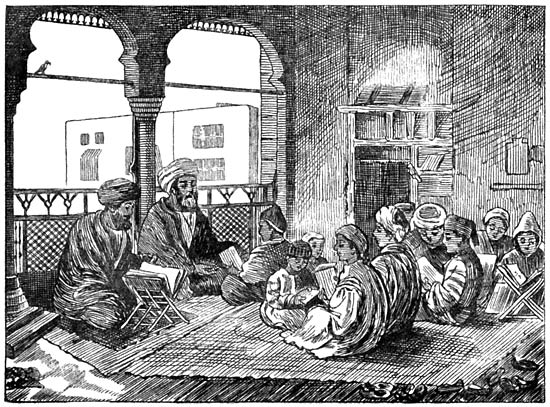
A MUSLIM SCHOOL.
Much has been made by some writers of the liberal patronage extended to literature and science by ʿAbdu ʾr-Raḥmān and his successors as K͟halīfahs of Cordova in the Middle Ages. But there was nothing original, or Islāmic, in the literature thus patronised, for, as Professor Uerberweg remarks in his History of Philosophy, “the whole philosophy of the Arabians was a form of Aristotelianism, tempered more or less with Neo-Platonic conceptions.” The philosophical works of the Greeks and their works of medical and physical science, were translated from Greek into Arabic by Syrian Christians, and not by Arabian Muslims. Muḥammadans cannot be altogether credited with these literary undertakings.
Al-Maqqarī, in his History of the Dynasties of Spain, has an interesting notice of education in that country, in which he writes:—
“Respecting the state of science among the Andalusians (Spaniards), we must own in justice that the people of that country were the most ardent lovers of knowledge, as well as those who best knew how to appreciate and distinguish a learned man and an ignorant one; indeed, science was so much esteemed by them, that whoever had not been endowed by God with the necessary qualifications to acquire it, did everything in his power to distinguish himself, and conceal from the people his want of instruction; for an ignorant man was at all times looked upon as an object of the greatest contempt, while the learned man, on the contrary, was not only respected by all, nobles and plebeians, but was trusted and consulted on every occasion; his name was in every mouth, his power and influence had no limits, and he was preferred and distinguished in all the occasions of life.
“Owing to this, rich men in Cordova, however illiterate they might be, encouraged letters, rewarded with the greatest munificence writers and poets, and spared neither trouble nor expense in forming large collections of books; so that, independently of the famous library founded by the K͟halīfah al-Ḥākim, and which is said by writers worthy of credit to have contained no less than four hundred thousand volumes, there were in the capital many other libraries in the hands of wealthy individuals, where the studious could dive into the fathomless sea of knowledge, and bring up its inestimable pearls. Cordova was indeed, in the opinion of every author, the city in Andalus where most books were to be found, and its inhabitants were renowned for their passion for forming libraries. To such an extent did this rage for collection increase, says Ibn Saʿīd, that any man in power, or holding a situation under Government, considered himself obliged to have a library of his own, and would spare no trouble or expense in collecting books, merely in order that people might say,—Such a one has a very fine library, or, he possesses a unique copy of such a book, or, he has a copy of such a work in the hand-writing of such a one.”
EGGS. According to the Imām Abū Ḥanīfah, if a person purchase eggs and after opening them discover them to be of bad quality and unfit for use, he is entitled to a complete restitution of the price from the seller. (Hidāyah, vol. ii. p. 415.)
EGYPT. Arabic Miṣr (مصر). The land of Egypt is mentioned several times in the Qurʾān in connection with the history of Joseph and Moses. In the year A.H. 7 (A.D. 628), Muḥammad sent an embassy to al-Muqauqis, the Roman Governor of Egypt, who received the embassy kindly and presented the Prophet with two female Coptic slaves.
ELEMENTS. Arabic al-ʿAnāṣiru ʾl-arbaʿah (العناصر الاربعة). “The four elements” of fire (nār), air (hawā), water (māʾ), and earth (arẓ), from which all creation mineral, animal, and vegetable is produced.
The respective properties of these elements are said to be as follows: Fire, hot and dry; air, hot and cold; water, cold and wet; earth, cold and dry. A knowledge of the properties of the four elements is required in the so-called science of Daʿwah. [DAʿWAH.]
ELEPHANT, The year of. Arabic ʿĀmu ʾl-Fīl (عام الفيل). The year in which Muḥammad was born. Being the year in which Abrahatu ʾl-Ashram, an Abyssinian Christian and Viceroy of the King of Ṣanʿāʾ in Yaman marched with a large army and a number of elephants upon Makkah, with the intention of destroying the Kaʿbah. He was defeated and his army destroyed in so sudden a manner, as to give rise to the legend embodied in the CVth Sūrah of the Qurʾān, which is known as the Chapter of the Elephant.
Professor Palmer says it is conjectured that small-pox broke out amongst the army. [ASHABU ʾL-FIL.]
ELIJAH. Arabic Ilyās (الياس), Ilyāsīn (الياسين); Heb. אֵלִיָּהוּ; New Testament, Ἠλίας. A prophet mentioned in the following verses in the Qurʾān:—
Sūrah xxxvii. 123: “Verily Ilyās (Elias) was of the Apostles; and when he said to his people, ‘Will ye not fear, Do ye call upon Baʿl and leave the best of Creators, God your Lord, and the Lord of your fathers in the old time?’ But they called him a liar; verily, they shall surely be arraigned, save God’s sincere servants. And we left him amongst posterity. Peace upon Ilyāsīn (Elias) verily, thus do we reward those who do well; verily he was of our servants who believe.”
Sūrah vi. 85: “And Zachariah and John, and Jesus, and Ilyās, all righteous ones.”
Al-Baiẓāwī says, “It has been said that this Ilyās, is the same as Idrīs, prefather of Noah, whilst others say he was the son of Yāsīn and descended from Aaron, the brother of Moses.” [IDRIS.]