DICTIONARY OF ISLĀM. (continued 11)
Reading edition
June 21 Sunset, or 12 o’clock Muslim Time. 7 4 P.M. 1 34 8 6 4 56 8 13
July 22 May 21 6 53 P.M,, . 1 30 8 30 5 7 8 43
Aug. 23 Apl. 20 6 31 P.M,, . 1 22 9 24 5 29 9 4
Sept. 23 Mar. 20 6 4 P.M,, . 1 18 10 24 5 56 9 24
Oct. 23 Feb. 18 5 37 P.M,, . 1 18 11 18 6 23 9 35
Nov. 22 Jan. 20 5 15 P.M,, . 1 22 11 59 6 45 9 41
Dec. 21 5 4 P.M,, . 1 24 12 15 6 56 9 43
N.B.—The time of noon, according to Muḥammadan reckoning, on any particular day, subtracted from twelve, gives the apparent time of sunset on that day according to European reckoning.
HOUSES. Arabic bait (بيت), pl. buyūt; dār (دار), pl. diyār, dūr; Heb. בַּיִת. In the time of Muḥammad the houses of the Arabs were made of a framework of jarīd, or palm-sticks, covered over with a cloth of camel’s hair, or a curtain of a similar stuff, forming the door. Those of the better class were made of walls of unbaked bricks, and date-leaf roofs plastered over with mud and clay. Of this description were the abodes of Muḥammad’s family. (Burton, vol. i. p. 433.)
Sir William Muir, translating from the account given by the secretary of al-Wāqidī (Life of Mahomet, new ed., p. 546), says:—
“Abdallah ibn Yazîd relates, that he saw the house in which the wives of the Prophet dwelt at the time when Omar ibn (ʿAbd) al-Azîz, then governor of Medîna (about A.H. 100) demolished them. They were built of unburnt bricks, and had separate apartments made of palm branches, daubed (or built up) with mud; he counted nine houses, each having separate apartments in the space from the house of Ayesha, and the gate of Mahomet to the house of Asma, daughter of Hosein. Observing the dwelling-place of Omm Salma, he questioned her grandson concerning it; and he told him that when the Prophet was absent on the expedition to Dûma, Omm Salma built up an addition to her house with a wall of unburnt bricks. When Mahomet returned, he went in to her, and asked what new building this was. She replied, ‘I purposed, O Prophet, to shut out the glances of men thereby!’ Mahomet answered, ‘O Omm Salma! verily the most unprofitable thing that eateth up the wealth of a believer is building.’ A citizen of Medîna present at the time, confirmed this account, and added that the curtains (Anglo-Indice, purdas) of the doors were of black hair-cloth. He was present, he said, when the despatch of the Caliph Abd al Malîk (A.H. 86–88) was read aloud, commanding that these houses should be brought within the area of the Mosque, and he never witnessed sorer weeping than there was amongst the people that day. One exclaimed, ‘I wish, by the Lord! that they would leave these houses alone thus as they are; then would those that spring up hereafter in Medîna, and strangers from the ends of the earth, come and see what kind of building sufficed for the Prophet’s own abode, and the sight thereof would deter men from extravagance and pride.
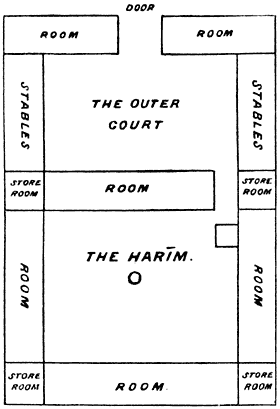
THE USUAL PLAN OF AN ORDINARY HOUSE IN CENTRAL ASIA.
“There were four houses of unburnt bricks, the apartments being of palm-branches; and five houses made of palm-branches built up with mud and without any separate apartments. Each was three Arabian yards in length. Some say that they had leather curtains for the doors. One could reach the roof with the hand. The house of Hâritha was next to that of Mahomet. Now, whenever Mahomet took to himself a new wife, he added another house to the row, and Hâritha was obliged successively to remove his house and build on the space beyond. At last this was repeated so often, that the Prophet said to those about him, ‘Verily, it shameth me to turn Hâritha over and over again out of his house.’ ”
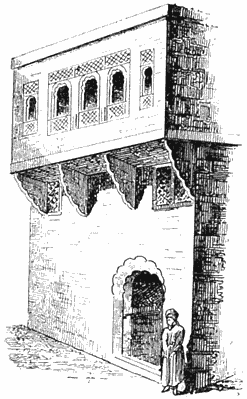
A MUḤAMMADAN HOUSE IN PESHAWUR.
The houses of the rural poor in all parts of Islām, in Turkey, Egypt, Syria, Arabia, Persia, Afg͟hānistān, and India, are usually built either of mud or of unburnt bricks. In mountainous parts of Afg͟hānistān they are built of stones (collected from the beds of rivers) and mud. They are generally one storey high, and of one apartment in which the cattle are also housed. The roofs are flat and are formed of mud and straw laid upon branches of trees and rafters. The windows are small apertures, high up in the walls, and sometimes grated with wood. There are no chimneys, but in the centre of the roof there is an opening to emit the smoke, the fire being lighted on the ground in the centre of the room. In front of the house there is an inclosure, either of thorns or a mud wall, which secures privacy to the dwelling. A separate building, called in Asia a ḥujrah, or guest chamber, is provided for male visitors or guests; this chamber being common property of the section of the village, except in the case of chiefs or wealthy land-owners, who keep ḥujrahs of their own. In towns the houses of the inferior kind do not differ much from those in the villages, except that there is sometimes an upper storey. In some parts of Afg͟hānistān and Persia, it becomes necessary for each householder to protect his dwelling, in which case a watch tower, of mud, is erected close to the house.
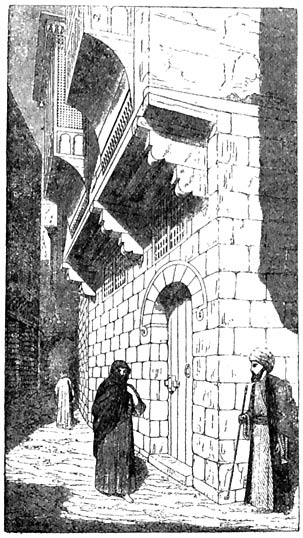
A MUḤAMMADAN HOUSE IN CAIRO.
(Lane.)
The injunctions of Muḥammad regarding the seclusion of women have very greatly influenced the plan and arrangement of Muḥammadan dwelling-houses of the better class throughout the world, all respectable houses being so constructed as to seclude the female apartments from public view. In cities such as Cairo, Damascus, Delhi, Peshawur, and Cabul, the prevailing plan of dwelling-houses is an entrance through a blank wall, whose mean appearance is usually relieved by a handsome door-way and a few latticed windows. A respectable house usually consists of two courts, the first being that used by the male visitors and guests, and the inner court is the ḥarīm or zanānah reserved for the female members of the family. Facing the outer court will be an upper chamber, or bālā k͟hānah as it is called in Persian, the ὑπερῷον or upper room of the New Testament, in which there will be a dīwān, or raised seat or sofa, upon which the inmates can sit, eat, or sleep. This is the usual reception room. In Asia, this bālā k͟hānah seems to take the place of the more elaborate qāʿah described by Mr. Lane in his Modern Egyptians, vol. i. p. 39, which is either on the ground or upper floor. Within the first enclosure will be the stables for horses and cattle, and in its centre a raised dais as seats for servants and attendants. It should be noticed that there are no special bed-rooms in Eastern houses. Male visitors and friends will sleep in the verandahs of the outer court, or on the dīwān in the upper court.
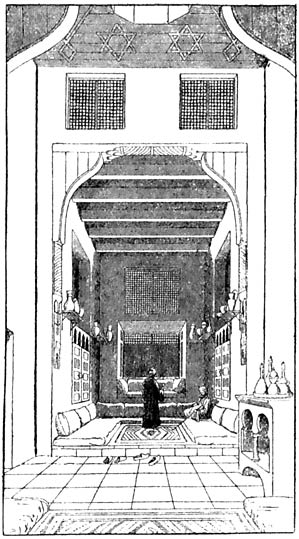
INTERIOR OF A MUḤAMMADAN HOUSE IN CAIRO. (Lane.)
The ḥarīm or women’s apartments in the inner court is entered by a small door. It is a quadrangle with verandahs on each of the four sides, formed by a row of pillars, the apertures of which are usually closed by sliding shutters. The back of the rooms being without windows, the only air being admitted from the front of the dwelling-place. The apartments are divided into long rooms, usually four, the extreme corners having small closets purposely built as store-rooms. On festive occasions these verandah rooms will be spread with handsome carpets, carpets and pillows being almost the only furniture of an Eastern dwelling, chairs being a modern invention. The roofs of these rooms are flat, and as the top is fenced in with a barrier some four feet high, the female members of the household sleep on the top of the house in the hot weather. [HARIM.]
In no point do Oriental habits differ more from European than in the use of the roof. Its flat surface, in fine weather the usual place of resort, is made useful for various household purposes, as drying corn, hanging up linen, and drying fruit.
In the centre of the inner court or ḥarīm, there is usually a well, so that the female domestics are not obliged to leave the seclusion of the ḥarīm for water-carrying. In a large court, of a wealthy person, there is usually a raised dais of either stone or wood, on which carpets are spread, and on which the ladies sit or recline. In the better class of dwellings, there are numerous courtyards, and special ones are devoted to winter and summer uses. In Peshawur, most respectable houses have an underground room, called a taḥ k͟hānah, where the inmates in the hot weather sleep at mid-day. These rooms are exceedingly cool and pleasant on hot sultry days.
Over the entrance door of a Muḥammadan dwelling it is usual to put an inscription, either of the Kalimah, or Creed, or of some verse of the Qurʾān.
We have only attempted to describe, briefly, the ordinary dwelling-houses of Muḥammadans, which are common to all parts of the Eastern world; but in large wealthy cities, such as Damascus, Cairo, Delhi, and Lucknow, there are very handsome houses, which would require a longer description than our space admits of. For Mrs. Meer Ali’s account of a Muḥammadan ḥarīm or zanānah, see HARIM.
HOUSES, Permission to enter. Arabic istiʾẕān (استئذان). To enter suddenly or abruptly into any person’s house or apartments, is reckoned a great incivility in the East, and the law on this subject is very distinctly laid down in both the Qurʾān and the Traditions.
Sūrah xxiv. 27–29:—
“O ye who believe! enter not into other houses than your own, until ye have asked leave, and have saluted its inmates. This will be best for you: haply ye will bear this in mind.
“And if ye find no one therein, then enter it not till leave be given you; and if it be said to you, ‘Go ye back,’ then go ye back. This will be more blameless in you, and God knoweth what ye do.
“There shall be no harm in your entering houses in which no one dwelleth, for the supply of your needs: and God knoweth what ye do openly and what ye hide.”
The traditionists record numerous injunctions of Muḥammad on the subject. A man asked the Prophet, “Must I ask leave to go in to see my mother?” He said, “Yes.” Then the man said, “But I stay in the same house with her!” The Prophet said: “But you must ask permission even if you stay in the same house.” Then the man said, “But I wait upon her!” The Prophet said: “What! would you like to see her naked? You must ask permission.”
The K͟halīfah ʿUmar said it was according to the teaching of the Prophet that if you salam three times and get no reply, you must then go away from the house.
Abū Hurairah says that the Prophet said: “When anyone sends to call you then you can return with the messenger and enter the house without permission.” (Mishkāt, book xxii. ch. ii. pt. 2.)
HU, HUWA (هو). The personal pronoun of the third person, singular, masculine, HE, i.e. God, or He is. It occurs in the Qurʾān in this sense, e.g. Sūrah iii. 1, الاه لا اله الا هو Allāhu lā ilāha illā Huwa, “God, there is no god but HE,” which sentence is called the nafy wa is̤bāt (or that which is rejected), “there is no god,” and that which is affirmed, “but He.” The word is often used by Ṣūfī mystics in this form: يا هو يا هو يا من لا يعلم ما هو الا هو yā hū, yā hū, yā man lā yaʿlamu mā hū illā hū, “O He (who is), O He (who is), O He whom no one knows what He Himself is but Himself.” Some commentators have supposed the word Hū to stand for the exalted name of God, the Ismu ʾl-aʿz̤am, which Muslim doctors say is only known to God. [JEHOVAH, ISMU ʾL-AʿZAM.]
HUBAL or HOBAL (هبل). The great image which stood over the well or hollow within the Kaʿbah. In the cavity beneath were preserved the offerings and other treasures of the temple. (At̤-T̤abarī, p. 6, quoted by Muir.) The idol was destroyed by Muḥammad at his final conquest of Makkah, A.H. 8, A.D. 630. “Mounted on (his camel) Al Caswa, he proceeded to the Káabah, reverently saluted with his staff the sacred stone and made the seven circuits of the temple. Then pointing with the staff one by one to the numerous idols placed around, he commanded that they should be hewn down. The great image of Hobal, reared as the tutelary deity of Mecca, in front of the Káabah, shared the common fate. ‘Truth hath come,’ exclaimed Mahomet, in words of the Corân, as it fell with a crash to the ground, ‘and falsehood hath vanished; for falsehood is evanescent.’ ” (Sūrah xvii. 83). See Muir, Life of Mahomet, new ed. p. 422. It is remarkable that there is no distinct allusion to the idol in the whole of the Qurʾān.
ḤUBS (حبس). Any bequest for pious purposes. A term used in Shīʿah law for waqf. Anything devoted to the service of God. (See Baillie’s Imāmeea Code, p. 227.)
HŪD (هود). A prophet said to have been sent to the tribe of ʿĀd. Al-Baiẓāwī says he was, according to some, the son of ʿAbdu ʾllāh, the son of Rabāḥ, the son of K͟halūd, the son of ʿĀd, the son of ʿAuṣ, the son of Iram, the son of Sām, son of Noah, or, according to others, Hūd was the son of Shālaḥ, son of Arfak͟hshad, son of Sām, son of Noah. D’Herbelot thinks he must be the Heber of the Bible (Judges iv. 1.)
The following are the accounts given of him in the Qurʾān, Sūrah vii. 63–70:—
“And to ʿĀd we sent their brother Hūd. ‘O my people, said he, worship God: ye have no other God than Him: will ye not then fear Him?’ Said the unbelieving chiefs among his people, ‘We certainly perceive that thou art unsound of mind, and verily we deem thee an impostor.’ He replied, ‘O my people! there is no unsoundness of mind in me, but I am an apostle from the Lord of the worlds. The messages of my Lord do I announce to you, and I am your faithful counsellor. Marvel ye that a warning hath come to you from your Lord through one of yourselves that He may warn you? But remember when He made you the successors of the people of Noah, and increased you in tallness of stature. Remember then the favours of God; happily it shall be well with you.’ They said, ‘Art thou come to us in order that we may worship one God only, and desert what our fathers worshipped? Then bring that upon us with which thou threatenest us, if thou be a man of truth.’ He replied, ‘Vengeance and wrath shall suddenly light on you from your Lord. Do ye dispute with me about names that you and your fathers have given those idols, and for which God hath sent you down no warranty? Wait ye then, and I too will wait with you.’ And We delivered him and those who were on his side by our mercy, and we cut off to the last man those who had treated our signs as lies and who were not believers.”
Sūrah xi. 52–63:—
“And unto ʿĀd We sent their brother Hūd. He said, ‘O my people, worship God. Ye have no God beside Him. Lo, ye are only devisers of a lie, O my people! I ask of you no recompense for this; verily my recompense is with Him only who hath made me. Will ye not then understand? And O my people! ask pardon of your Lord; then turn unto Him with penitence! He will send down the heavens upon you with copious rains. And with strength in addition to your strength will He increase you; but turn not back with deeds of evil.’ They replied, ‘O Hūd, thou hast not brought us proofs of thy mission, and we are not the persons to abandon our gods at thy word, and we believe thee not. We can only say that some of our gods have smitten thee with evil.’ He said, ‘Now take I God to witness, and do ye also witness, that I am innocent of that which ye associate (in worship with God) beside himself. Conspire then against me altogether and delay me not; Lo, I trust in God, my Lord and yours. No moving creature is there which He holdeth not by its forelock. Right, truly, is the way in which my Lord goeth. So if ye turn back, then I have already declared to you that wherewith I was sent to you, and my Lord will put another people in your place, nor shall ye at all injure Him; verily, my Lord keepeth watch over all things.’ And when our doom came to be inflicted, We rescued Hūd and those who had like faith with him, by our special mercy; and We rescued them from the rigorous chastisement. And these men of ʿĀd gainsaid the signs of their Lord, and rebelled against His messengers and followed the bidding of every proud contumacious person; followed therefore were they in this world by a curse; and in the day of the Resurrection it shall be said to them, ‘Did not, verily, the people of ʿĀd disbelieve their Lord?’ Was it not said, ‘Away with ʿĀd, the people of Hūd?’ ”
Sūrah xxvi. 123–139:
“The people of ʿĀd treated the Sent Ones as liars. When their brother Hūd said to them, ‘Will ye not fear God? I truly am your apostle, worthy of all credit; fear God then and obey me. I ask of you no reward for this, for my reward is of the Lord of the worlds alone. Build ye a landmark on every height, in pastime? And raise ye structures to be your lasting abodes? And when ye put forth your power, do ye put it forth with harshness? Fear ye God, then, and obey me; and fear ye Him who hath plenteously bestowed on you, ye well know what? Plenteously bestowed on you flocks and children, and gardens and fountains. Indeed, I fear for you the punishment of a great day.’ They said, ‘It is the same to us whether thou warn or warn us not; verily this is but a creation [tale] of the ancients, and we are not they who shall be punished.’ So they charged him with imposture and We destroyed them. Verily in this was a sign: yet most of them believed not.”
AL-ḤUDAIBIYAH (الحديبية). Al-Ḥudaibiyah, a well on an open space on the verge of the Ḥaram or sacred territory, which encircles Makkah. Celebrated as the scene of a truce between Muḥammad and the Quraish known as the truce of al-Ḥudaibiyah, when the Prophet agreed not to enter Makkah that year, but to defer his visit until the next, when they should not enter it with any weapons save those of the traveller, namely, to each a sheathed sword. (Muir, from Kātibu ʾl-Wāqidī.)
The treaty is referred to in the Qurʾān as “a victory,” in the XLVIIIth Sūrah, 1st verse: “We have given thee an obvious victory.” A chapter which is said to have been revealed on this occasion and to have foretold the final taking of Makkah, which happened two years afterwards. (See al-Baiẓāwī, in loco.)
ḤUJJAH (حجة). “An argument; a proof.” The word occurs in the Qurʾān.
Sūrah ii. 145: “Turn your faces towards it (the Kaʿbah) that men may have no argument against you, save only those of them who are unjust.”
Sūrah vi. 84: “These are our arguments which we gave to Abraham against his people.”
Sūrah vi. 150: “God’s is the perfect argument (ḥujjatu ʾl-bālig͟hah).”
ḤUJJATU ʾL-ḤAQQI ʿALA ʾL-K͟HALQ (حجة الحق على الخلق). Lit. “The demonstration of truth upon the creature.” A term used by the Ṣūfī mystics for the Insānu ʾl-kāmil, or the “perfect man,” as Adam was when he proceeded from the hand of his Maker, and when he became a demonstration of God’s wisdom and power before the angels of heaven. As is stated in the Qurʾān, Sūrah ii. 29: “Thy Lord said I am about to place a vicegerent (k͟halīfah) in the earth.” (ʿAbdu ʾr-Razzāq’s Dict. of Ṣūfī Terms.)
ḤUJRAH (حجرة). The “chamber” in which Muḥammad died and was buried, which was originally the apartment allotted to ʿĀyishah, the Prophet’s favourite wife. It is situated behind the Masjidu ʾn-Nabī, or Prophet’s mosque, at al-Madīnah, and is an irregular square of fifty-five feet, separated from the mosque by a passage of about 26 feet. Inside the Ḥujrah are supposed to be the three tombs of Muḥammad, Abū Bakr, and ʿUmar, facing the south, surrounded by stone walls, without any aperture, or, as others say, by strong planking. Whatever this material may be, it is hung outside with a curtain, somewhat like a four-post bed. The outer railing is separated by a darker passage from the inner, and is of iron filagree, painted green and gold. This fence, which connects the columns, forbids passage to all men. It has four gates, the Bābu ʾl-Muwājihah (the Front Gate), the Bābu Fāt̤imah (the Gate of Fāt̤imah), the Bābu ʾsh-Shām (the Syrian Gate), and the Bābu ʾt-Taubah (the Gate of Repentance). The Syrian Gate is the only one which is not kept closed, and is the passage which admits the officers in charge of the place. On the southern side of the fence there are three small windows about a foot square, which are said to be about three cubits from the head of the Prophet’s tomb. Above the Ḥujrah is the green dome, surmounted by a large gilt crescent, springing from a series of globes. Within the building are the tombs of Muḥammad, Abū Bakr, and ʿUmar, with a space reserved for the grave of our Lord Jesus Christ, whom Muslims say will again visit the earth, and die and be buried at al-Madīnah. The grave of Fāt̤imah, the Prophet’s daughter, is supposed to be in a separate part of the building, although some say she was buried in Baqīʿ. The Prophet’s body is said to be stretched full length on the right side, with the right palm supporting the right cheek, the face fronting Makkah. Close behind him is placed Abū Bakr, whose face fronts Muḥammad’s shoulder, and then ʿUmar, who occupies the same position with respect to his predecessor. Amongst Christian historians there was a popular story to the effect that Muḥammadans believed the coffin of their Prophet to be suspended in the air, which has no foundation whatever in Muslim literature, and Niebuhr thinks the story must have arisen from the rude pictures sold to strangers. Captain Burton gives the annexed plan of the building.
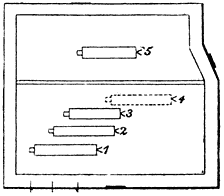
1. Muḥammad.
2. Abū Bakr.
3. ʿUmar.
4. The space for the tomb of Jesus.
5. Fāt̤imah.
It is related that Muḥammad prayed that God would not allow his followers to make his tomb an object of idolatrous adoration, and consequently the adoration paid to the tomb at al-Madīnah has been condemned by the Wahhābīs and other Muslim reformers.
In A.D. 1804, when al-Madīnah was taken by the Wahhābīs, their chief, Saʿūd, stripped the tomb of all its valuables, and proclaimed that all prayers and exclamations addressed to it were idolatrous. (See Burton’s Pilgrimage, vol. ii.; Burckhardt’s Arabia and Wahhābīs.)
The garden annexed to the tomb is called ar-Rauẓah, which is a title also given by some writers to the tomb itself.
Abū Dāʾud relates that al-Qāsim the grandson of Abū Bakr came to ʿĀyishah and said, “O Mother, lift up the curtain of the Prophet’s tomb and of his two friends, Abū Bakr and ʿUmar,” and she uncovered the graves, which were neither high nor low, but about one span in height, and were covered with red gravel. (Mishkāt, book v. ch. vi. pt. 2.)
AL-ḤUJURĀT (الـحـجـرات). “Chambers.” The title of the XLIXth Sūrah of the Qurʾān, in which the word occurs.
ḤUKM (حكم), pl. aḥkām. “Order; command; rule; sentence; judgment, of God, or of the prophets, or of a ruler or judge.” It occurs in different senses in the Qurʾān, e.g.:—
Sūrah iii. 73: “It beseemeth not a man, that God should give him the Scriptures and the Judgment and the Prophecy, and that then he should say to his followers, ‘Be ye worshippers of me, as well as of God’; but rather, ‘Be ye perfect in things pertaining to God, since ye know the Scriptures and have studied deep.’ ”
(Both Sale and Rodwell translate the word al-ḥukm, “the wisdom,” but Palmer renders it more correctly, “the judgment.”)
Sūrah xii. 40: “Judgment is God’s alone: He bids you worship only Him.”
Sūrah xxi. 79: “To each (David and Solomon) we gave judgment and knowledge.”
Al-ḥukmu ʾsh-Sharʿī, “the injunction of the law,” is a term used for a command of God, which relates to the life and conduct of an adult Muslim. (Kitābu ʾt-Taʿrīfāt, in loco.)
ḤULŪL (حلول). Lit. “descending; alighting; transmigration.” A Ṣūfī term for the indwelling light in the soul of man.
HUMAN SACRIFICES. There is no trace in the Qurʾān or Traditions of the immolation of human beings to the Deity as a religious rite. But M. C. de Perceval (vol. ii. p. 101) mentions a G͟hassānide prince who was sacrificed to Venus by Munẕir, King of Ḥirāʾ. Infanticide was common in ancient Arabia, but it seems to have been done either, as amongst the Rajputs of India, from a feeling of disappointment at the birth of female children, or to avoid the expense and trouble of rearing them. The latter seems to have been the ordinary reason; for we read in the Qurʾān, Sūrah xvii. 33: “Kill not your children for fear of poverty.” [INFANTICIDE.]
AL-HUMAZAH (الهمزة). “The slanderer.” The title of the CIVth Sūrah of the Qurʾān, so called because it commences with the words: “Woe unto every slanderer.” The passage is said to have been revealed against al-Ak͟hnas ibn Sharīq, who had been guilty of slandering the Prophet.
ḤUNAIN (حنين). The name of a valley about three miles to the north-east of Makkah, where in the eighth year of the Ḥijrah a battle took place between Muḥammad and the Banū Hawāzin, when the latter were defeated. In the Qurʾān, the victory of Ḥunain is ascribed to angelic assistance.
Sūrah ix. 25: “Verily God hath assisted you in many battle-fields and on the day of Ḥunain.”
HUNTING. Arabic ṣaid (صيد); Heb. צַיִד. There are special rules laid down in Muslim law with regard to hunting. (See Hamilton’s Hidāyah, vol. iv. p. 170.)
It is lawful to hunt with a trained dog, or a panther (Arabic fahd, Persian yūz, which is an animal of the lynx species, hooded and trained like a hawk), or a hawk, or a falcon.
The sign of a dog being trained is his catching game three times without eating it. A hawk is trained when she attends to the call of her master. If the dog or panther eat any part of the game it is unlawful, but if a hawk eat of it, it is lawful; but if the dog merely eat the blood and not the flesh, it is lawful. If a hunter take game alive which his dog has wounded, he must slay it according to the law of Ẕabḥ, namely, by cutting its throat, with the head turned Makkah-wards, and reciting, “In the name of the Great God!” The law is the same with respect to game shot by an arrow.
If a sportsman let fly an arrow (or fire a gun) at game, he must repeat the invocation, “In the name of the Great God!”
And then the flesh becomes lawful if the game is killed by the shot. But if only wounded, the animal must be slain with the invocation. Game hit by an arrow which has not a sharp point is unlawful, and so is that killed by throwing pebbles.
Game killed by a Magian, or an apostate, or a worshipper of images is not lawful, because they are not allowed to perform ẕabḥ. But that slain by a Christian or a Jew is lawful.
Hunting is not allowed on the pilgrimage nor within the limits of the sacred cities of Makkah and al-Madīnah.
ʿAdī ibn Ḥātim (Mishkāt, book xviii. ch. i.) gives the following tradition on the subject of hunting:—
“The Prophet said to me, ‘When you send your dog in pursuit of game, repeat the name of God, as at slaying an animal; then if your dog holds the game for you, and you find it alive, then slay it; but if you find your dog has killed it, and not eaten of it, then eat it; but if the dog has eaten any of it, do not you eat it, for then the dog has kept it for himself. Then if you find another dog along with yours, and the game is killed, do not eat of it; for verily you cannot know which of the dogs killed it; and if the other dog killed it, it might so be that when he was let loose after the game, the name of God might not have been repeated. And when you shoot an arrow at game, repeat the name of God, the same as in slaying an animal; then if you lose sight of the game, and on finding it perceive nothing but the impression of your own arrow, then eat it if you wish; but if you find the game drowned, do not eat of it, although the mark of your arrow should be in it.’ ”
ḤUR (حور), the plural of ḥaura. The women of Paradise described in the Qurʾān, e.g. Sūrah lv. 56–78:—
“Therein shall be the damsels with retiring glances, whom nor man nor djinn hath touched before them:
“Which then of the bounties of your Lord will ye twain deny?
“Like jacynths and pearls:
“Which, &c.
“Shall the reward of good be aught but good?
“Which, &c.
“And beside these shall be two other gardens:
“Which, &c.
“Of a dark green:
“Which, &c.
“With gushing fountains in each:
“Which, &c.
“In each fruits and the palm and the pomegranate:
“Which, &c.
“In each, the fair, the beauteous ones:
“Which, &c.
“With large dark eyeballs, kept close in their pavilions:
“Which, &c.
“Whom man hath never touched, nor any djinn:
“Which, &c.
“Their spouses on soft green cushions and on beautiful carpets shall recline:
“Which, &c.
“Blessed be the name of thy Lord, full of majesty and glory.”
AL-ḤUSAIN (الحسين). The second son of Fāt̤imah, the daughter of Muḥammad, by her husband ʿAlī, the fourth K͟halīfah. A brother to al-Ḥasan, the fifth K͟halīfah. According to the Shīʿahs, he was the third K͟halīfah. He was born A.H. 4, and died at Karbalā A.H. 61, being cruelly slain in his conflict with Yazīd, the seventh K͟halīfah, according to the Sunnīs.
The martyrdom of al-Ḥusain is celebrated by the Shīʿahs every year during the first ten days of the Muḥarram [MUHARRAM]; an account of his tragic death is therefore necessary for understanding the intensity of feeling with which the scenes and incidents of the last days of the “Imām Ḥusain” are enacted in the “Miracle Play,” a translation of which has been given in English by Sir Lewis Pelly. The following account is taken from the Preface to this work, p. xi. seqq.:—
“Shortly after the accession of Yezid (Yazīd), Ḥusain received at Mecca secret messages from the people of Cufa (al-Kūfah), entreating him to place himself at the head of the army of the faithful in Babylonia. Yezid, however, had full intimation of the intended revolt, and long before Ḥusain could reach Cufa, the too easy governor of that city had been replaced by Obaidallah (ʿUbaidu ʾllāh ibn Ziyād), the resolute ruler of Bussorah (al-Baṣrah), who by his rapid measures disconcerted the plans of the conspirators, and drove them to a premature outbreak, and the surrender of their leader Muslim. The latter foresaw the ruin which he had brought on Ḥusain, and shed bitter tears on that account when captured. His head was struck off and sent to Yezid. On Ḥusain arriving at the confines of Babylonia, he was met by Harro (al-Ḥurr), who had been sent out by Obaidallah with a body of horsemen to intercept his approach. Ḥusain, addressing them, asserted his title to the Califate, and invited them to submit to him. Harro replied, ‘We are commanded as soon as we meet you to bring you directly to Cufa into the presence of Obaidallah, the son of Ziyad.’ Ḥusain answered, ‘I would sooner die than submit to that,’ and gave the word to his men to ride on; but Harro wheeled about and intercepted them. At the same time, Harro said, ‘I have no commission to fight with you, but I am commanded not to part with you until I have conducted you into Cufa’; but he bade Ḥusain to choose any road into that city ‘that did not go directly back to Mecca,’ and ‘do you,’ said he, ‘write to Yezid or Obaidallah, and I will write to Obaidallah, and perhaps it may please God I may meet with something that may bring me off without my being forced to an extremity on your account.’ Then he retreated his force a little to allow Ḥusain to lead the way towards Cufa, and Ḥusain took the road that leads by Adib and Cadisia. This was on Thursday the 1st of Mohurrum (Muḥarram), A.H. 61 (A.D. 680). When night came on, he still continued his march all through the night. As he rode on he nodded a little, and waking again, said, ‘Men travel by night, and the destinies travel toward them; this I know to be a message of death.’
“In the morning, after prayers were over, he mended his pace, and as he rode on there came up a horseman, who took no notice of him, but saluted Harro, and delivered to him a letter, giving orders from Obaidallah to lead Ḥusain and his men into a place where was neither town nor fortifications, and there leave them till the Syrian forces should surround them.
“This was on Friday the 2nd of Mohurrum. The day after, Amer (ʿUmar ibn Saʿīd) came upon them with four thousand men, who were on their march to Dailam. They had been encamped without the walls of Cufa, and when Obaidallah heard of Ḥusain’s coming, he commanded Amer to defer his march to Dailam and go against Ḥusain. But one and all dissuaded him. ‘Beware that you go not against Ḥusain, and rebel against your Lord, and cut off mercy from you, for you had better be deprived of the dominion of the whole world than meet your Lord with the blood of Ḥusain upon you.’ Amer was fain to acquiesce, but upon Obaidallah renewing his command with threats, he marched against Ḥusain, and came up with him, as aforesaid, on Saturday the 3rd of Mohurrum.
“On Amer sending to inquire of Ḥusain what brought him thither, the latter replied, ‘The Cufans wrote to me; but since they reject me, I am willing to return to Mecca.’ Amer was glad when he heard it, and said, ‘I hope to God I may be excused from fighting against him.’ Then he wrote to this purpose to Obaidallah; but Obaidallah sternly replied, ‘Get between him and the river,’ and Amer did so; and the name of the place where he cut Ḥusain off from the Euphrates was called Kerbela (Karbalā): ‘Kerb (anguish) and belā (vexation), Trouble and affliction,’ said Ḥusain when he heard it.
“Then Ḥusain sought a conference with Amer, in which he proposed either to go to Yezid, to return to Mecca, or, as some add, but others deny, to fight against the Turks. Obaidallah was at first inclined to accede to these conditions, until Shamer stood up and swore that no terms should be made with Ḥusain, adding significantly that he had been informed of a long conference between Ḥusain and Amer.
“Then Obaidallah sent Shamer with orders to Amer, that if Ḥusain would surrender unconditionally, he would be received; if not, Amer was to fall upon him and his men, and trample them under his feet. Should he refuse to do so, Shamer was to strike off Amer’s head, and himself command the attack against Ḥusain.
“Thus passed Sunday, Monday, Tuesday, Wednesday, Thursday, and Friday, the 4th, 5th, 6th, 7th, 8th, and 9th of Mohurrum. On the evening of the 9th, Amer drew up his forces close to Ḥusain’s camp, and himself rode up to Ḥusain as he was sitting in the door of his tent just after the evening prayer, and told him of the conditions offered by Obaidallah. Ḥusain desired Amer to give him time until the next morning, when he would make his answer.
“In the night his sister came weeping to his bedside, and, awaking him, exclaimed, ‘Alas for the desolation of my family! my mother Fatima is dead and my father Ali, and my brother Ḥasan. Alas for the destruction that is past! and alas for the destruction that is to come!’ ‘Sister,’ Ḥusain replied, ‘put your trust in God, and know that man is born to die, and that the heavens shall not remain; everything shall pass away but the presence of God, who created all things by His power, and shall make them by His power to pass away, and they shall return to Him alone. My father was better than me, and my mother was better than me; and my brother was better than me; and they and we and all Muslims have an example in the Apostle of God.’ Then he told his men that Obaidallah wanted nobody but him, and that they should go away to their homes. But they said, ‘God forbid that we should ever see the day wherein we survive you!’ Then he commanded them to cord their tents close together, and make a line of them, so as to keep out the enemy’s horse. And he digged a trench behind his camp, which he filled with wood to be set on fire, so that he could only be attacked in front. The rest of the night he spent in prayer and supplication, while the enemy’s guard patrolled all night long round and round his camp.
“The next morning both sides prepared for the slaughter. Ḥusain first washed and anointed himself with musk, and several of his chief men did the like; and one asking them what it meant, Ḥusain replied pleasantly, ‘Alas! there is nothing between us and the black-eyed girls of Paradise but that these troopers come down upon us and slay us!’ Then he mounted his horse, and set the Coran before him, crying, ‘O God, Thou art my confidence in every trouble and my hope in every adversity!’ and submitted himself to the judgment of his companions before the opened pages of the sacred volume. At this his sisters and daughters began to weep, when he cried out in bitter anguish self-reproachfully, ‘God reward the son of Abbas,’ in allusion to advice which his cousin, Abdullah ibn Abbas, had given him, to leave the women behind in Mecca. At this moment a party of the enemy’s horse wheeled about and came up to Ḥusain, who expected to be attacked by them. But it was Harro, who had quitted the ranks of the Syrian army, and had now come to die with Ḥusain, and testify his repentance before men and God. As Harro rode into the doomed camp, he shouted back to Amer, ‘Alas for you!’ Whereupon Amer commanded his men to ‘bring up the colours.’ As soon as they were set in front of the troops, Shamer shot an arrow into the camp, saying, ‘Bear witness that I shot the first arrow,’ and so the fight began on both sides. It raged, chiefly in a series of single combats, until noon-day, when both sides retired to prayer, Ḥusain adding to the usual office the ‘Prayer of Fear,’ never used but in cases of extremity. When shortly afterwards the fight was renewed, Ḥusain was struck on the head by a sword. Faint with the loss of blood, he sat down by his tent and took upon his lap his little son Abdullah, who was at once killed by a flying arrow. He placed the little corpse upon the ground, crying out, ‘We come from God and we return to Him. O God, give me strength to bear these misfortunes.’ Growing thirsty, he ran toward the Euphrates, where, as he stooped to drink, an arrow struck him in the mouth. Raising his hands, all besmeared and dripping with blood, to heaven, he stood for awhile and prayed earnestly. His little nephew, a beautiful child, who went up to kiss him, had his hand cut off with a sword, on which Ḥusain again wept, saying, ‘Thy reward, dear child, is with thy forefathers in the realms of bliss.’ Hounded on by Shamer, the Syrian troops now surrounded him; but Ḥusain, nothing daunted, charged them right and left. In the midst of the fighting, his sister came between him and his slayers, crying out to Amer, how he could stand by and see Ḥusain slain. Whereupon, with tears trickling down his beard, Amer turned his face away; but Shamer, with threats and curses, set on his soldiers again, and at last one wounded Ḥusain upon the hand, and a second gashed him on the neck, and a third thrust him through the body with a spear. No sooner had he fallen to the ground than Shamer rode a troop of horsemen over his corpse, backwards and forwards, over and over again, until it was trampled into the very ground, a scarcely recognisable mass of mangled flesh and mud.
“Thus, twelve years after the death of his brother Ḥasan, Ḥusain, the second son of Ali, met his own death on the bloody plain of Kerbela on Saturday the 10th day of Mohurrum, A.H. 61 (A.D. 680).”
From al-Ḥusain and his brother al-Ḥasan are derived the descendants of the Prophet known throughout Islām as Saiyids. [SAIYID, HASAN, MUHARRAM.]
HUSBAND. Arabic zauj (زوج). A husband is not guardian over his wife any further than respects the rights of marriage, nor does the provision for her rest upon him any further than with respect to food, clothing, and lodging (Hidāyah, vol. i. p. 63), but he may be imprisoned for the maintenance of his wife (Ibidem, vol. ii. p. 628). The evidence of a husband concerning his wife is not accepted by the Sunnīs, but it is allowed in Shīʿah law (Ib., vol. ii. p. 685). The Muḥammadan law demands that a Muslim husband shall reside equally with each of his wives, unless one wife bestow her right upon another wife. (Ib., vol. i. p. 184.)
ḤUSNU ʾL-K͟HULQ (حسن الخلق). “A good disposition.” Abū Hurairah relates that one of the Companions once asked Muḥammad, “What is the best thing that has been given to man?” and Muḥammad replied, “A good disposition.” Muḥammad is also related to have said that the “heaviest thing which will be put in the scales of a Muslim in the Day of Judgment is a good disposition.” (Mishkāt, book xxii. ch. xix. pt. 2.)
AL-ḤUT̤AMAH (الحطمة). A division of Hell, mentioned in the Qurʾān, Sūrah civ.:—
“Woe to every backbiter,
“Who amasseth wealth and storeth it against the future!
“He thinketh surely that his wealth shall be with him for ever.
“Nay! for verily he shall be flung into al-ḥut̤amah.
“And who shall teach thee what al-ḥut̤amah is?
“It is God’s kindled fire,
“Which shall mount above the hearts of the damned;
“It shall verily rise over them like a vault,
“On outstretched columns.”
The Imām al-Bag͟hawī says it is the division of Hell specially reserved for the Jews.
ḤUWAIRIS̤ (حويرث). One of the citizens of Makkah, who was excluded from the general amnesty on the taking of Makkah, in consequence of his having pursued Zainab, Muḥammad’s daughter, while endeavouring to effect her escape from Makkah. He was afterwards seized and slain by ʿAlī.
ḤUẔAIFAH (حذيفة). The son of al-Yamān. He was a “sworn companion” of the Prophet, one of the most eminent of the Aṣḥāb, and it is recorded by Muslim the Traditionist, that he was specially instructed by the Prophet. His father, al-Yamān, also called Ḥisl or Ḥusail, was likewise a companion, who fell at Uḥud. Ḥuẕaifah died in the time of ʿAlī’s K͟halīfate, A.H. 36. (See Taqrību ʾt-Tahẕīb, p. 51.) Sir William Muir says he was the Companion who first suggested to ʿUs̤mān the necessity of the recension of the Qurʾān, A.H. 33. (Life of Mahomet, new ed. p. 556.)
“Hodzeifa, who had warred both in Armenia and Adzerbâijan, and had observed the different readings of the Syrians, and of the men of Irâc, was alarmed at the number and extent of the variations, and warned Othmân to interpose and ‘stop the people before they should differ regarding their scriptures, as did the Jews and Christians.’ ”
HUẔAIL (هذيل). The ancestor of the Banū Huẕail, a tribe distinguished in the annals of war and poetry, and, as we learn from Burckhardt, still occupying under the same name the environs of Makkah. (Travels in Arabia, vol. i. pp. 63, 66.)
HYPOCRISY. Arabic riyā (رياء), nifāq (نفاق), makr (مكر), mudāhanat (مداهنة). When there is an allusion to hypocrisy in the Qurʾān, it refers to that class of people known as al-Munāfiqūn, or the hypocrites of al-Madīnah, who in the days of the Prophet professed to follow him, whilst secretly they opposed him [MUNAFIQUN], vide Sūrahs ii. 7; xxxiii. 47; lvii. 13. But in the Traditions we have the following with reference to this sin, Mishkāt, book i. ch. iii. pt. 3:—
“The signs of hypocrisy are three: speaking falsely, promising and not performing, and being perfidious when trusted.”
“There are four qualities, which being possessed by anyone, constitute a complete hypocrite; and whoever has one of the four has one hypocritical quality till he discards it: perfidy when trusted, the breaking of agreements, speaking falsely, and prosecuting hostility by treachery.”
HYPOCRITES. Arabic munāfiqūn (منافقون). A term applied by Muḥammad to those residents of al-Madīnah who during his first stay in that city ostensibly joined Islām, but in secret were disaffected.
I.
IBĀḤĪYAH (اباحية). A sect of libertines who consider all things lawful.
IBĀQ (اباق). The absconding of slaves. The fugitive slave being termed ābiq, or, if he be an infant, zāll, or the strayed one. The restorer of a fugitive slave is entitled to a reward of forty dirhams, but no reward is given for the restoration of a strayed infant slave. [SLAVERY.]
IBĀẒĪYAH (اباضية). A sect of Muslims founded by ʿAbdu ʾllāh ibn Ibāẓ, who said that if a man commit a kabīrah or great sin, he is an infidel, and not a believer. (Kitābu ʾt-Taʿrīfāt, in loco.)
IBLĪS (ابليس). [DEVIL.]
IBN ʿABBĀS (ابن عباس). ʿAbdu ʾllāh, the eldest son of ʿAbbās, and a cousin of Muḥammad. One of the most celebrated of the Companions, and the relator of numerous traditions. It is said that the angel Gabriel appeared to him, when he was only ten years old, and revealed to him the meaning of the Qurʾān, which accounted for his intimate acquaintance with the letter and meaning of the book. He was called Tarjumānu ʾl-Qurʾān, or “the interpreter of the Qurʾān.” He was appointed Governor of al-Baṣrah by the K͟halīfah ʿAlī, which office he held for some time. He returned to the Ḥijāz and died at at̤-T̤āʾif A.H. 68 (A.D. 687), aged 72 years.
IBN ḤANBAL (ابن حنبل). The Imām Abū ʿAbdi ʾllāh Aḥmad ibn Ḥanbal, the founder of the fourth orthodox sect of the Sunnīs, was born at Bag͟hdād A.H. 164, A.D. 780, where he received his education under Yazīd ibn Hārūn and Yaḥyā ibn Saʿīd. On ash-Shāfiʿī coming to Bag͟hdād (A.H. 195), Ibn Ḥanbal attended the lectures delivered there by that doctor, and was instructed by him in the traditions. In process of time he acquired a high reputation from his profound knowledge of both the civil and spiritual law, and particularly for the extent of his erudition with respect to the precepts of the Prophet, of which it is said that he could repeat above a million. His fame began to spread just at the time when the disputes ran highest concerning the nature of the Qurʾān, which some held to have existed from eternity, whilst others maintained it to be created. Unfortunately for Ibn Ḥanbal, the K͟halīfah al-Muʿtaṣim was of the latter opinion, to which this doctor refusing to subscribe, he was imprisoned and severely scourged by the K͟halīfah’s order.
For this hard usage, indeed, he afterwards received some satisfaction from al-Mutawakkil, the son of al-Muʿtaṣim, who, upon succeeding to the throne, issued a decree of general toleration, leaving every person at liberty to judge for himself upon this point. This tolerant K͟halīfah set the persecuted doctor at liberty, receiving him at his Court with the most honourable marks of distinction, and offering him a compensatory present of 1,000 pieces of gold, which, however, he refused to accept. After having attained the rank of Imām, he retired from the world, and led a recluse life for several years. He died A.H. 241 (A.D. 855), aged 75. He obtained so high a reputation for sanctity, that his funeral was attended by a train of 800,000 men and 60,000 women; and it is asserted as a kind of miracle, that on the day of his decease no fewer than 20,000 Jews and Christians embraced the faith. For about a century after his death, the sect of Ibn Ḥanbal were numerous and even powerful; and uniting to their zeal a large proportion of fanaticism, became at length so turbulent and troublesome as to require the strong arm of Government to keep them in order. Like most other fanatical sects, they dwindled away in process of time, and are now to be met with only in a few parts of Arabia. Although orthodox in their other tenets, there was one point on which they differed from the rest of the Muslims; for they asserted that God had actually set Muḥammad upon his throne, and constituted him his substitute in the government of the universe; an assertion which was regarded with horror, as an impious blasphemy, and which brought them into great disrepute. This, however, did not happen until many years after Ibn Ḥanbal’s decease, and is in no degree attributed to him. He published only two works of note: one entitled the Musnad, which is said to contain above 30,000 traditions selected from 750,000; and another, a collection of apothegms, or proverbs, containing many admirable precepts upon the government of the passions. He had several eminent pupils, particularly Ismāʿīl al-Buk͟hārī and Muslim Ibn Dāʾūd. His authority is but seldom quoted by any of the modern commentators on jurisprudence.
The modern Wahhābīs are supposed to follow (to some extent) the teachings of Aḥmad ibn Ḥanbal.
IBN K͟HALLIKĀN (ابن خلكان). The well-known Muḥammadan biographer. He drew his descent from a family of Balk͟h. He was born at Arbelah, but resided at Damascus, where he filled the office of chief Qāẓī, and died A.H. 681 (A.D. 1282). His biographical dictionary has been translated into English by Baron de Slane. (Paris 1843.) The biographical notes in the present work are chiefly from Ibn K͟hallikān’s work.
IBN MĀJAH (ابن ماجة). Abū ʿAbdi ʾllāh Muḥammad Ibn Yazīd Ibn Mājah al-Qazwīnī was maulawī of the tribe of Rabīʿah, and a celebrated Ḥāfiz̤ of the Qurʾān, and is known as the compiler of the Kitābu ʾs-Sunan, or “Book of Traditions.” This work is counted one of the six Ṣaḥīḥs, or authentic collections of Ḥadīs̤. Born A.H. 209 (A.D. 824). Died A.H. 273 (A.D. 886).
IBN MASʿŪD (ابن مسعود). ʿAbdu ʾllāh ibn Masʿūd, “a companion” of considerable note. One of the illustrious “ten” (ʿAsharah Mubashsharah) to whom Muḥammad gave an assurance of Paradise. He was present at the battle of Badr and subsequent engagements. Died at al-Madīnah A.H. 32, aged 60.
IBN MULJAM (ابن ملجم). The Muslim who slew the K͟halīfah ʿAlī. The author of the Ḥayātu ʾl-Qulūb (Merrick’s Translation, p. 204) says when ʿAlī was martyred by Ibn Muljam his celestial likeness (i.e. in the ʿĀlamu ʾl-Mis̤āl) appeared wounded also; wherefore angels visit the similitude morning and evening and curse the name of Ibn Muljam.
IBN ṢAIYĀD (ابن صياد). A mysterious personage who lived in the time of Muḥammad, and who was mistaken by some people for ad-Dajjālu ʾl-Masīḥ, or the Antichrist. ʿAbdu ʾl-Ḥaqq says some say he was a Jew of al-Madīnah named ʿAbdu ʾllāh.
Ibn ʿUmar relates that the Prophet went to Ibn Ṣaiyād, accompanied by a party of his companions, and found him playing with boys; and at this time he had nearly reached puberty; and Ibn Ṣaiyād had no intimation of the coming of the Prophet and the companions, till the Prophet struck him upon the back, and said, “Do you bear witness that I am the Prophet of God?” Then Ibn Ṣaiyād looked at the Prophet and said, “I bear witness that you are the Prophet of the illiterate.” After that he said to the Prophet, “Do you bear witness that I am the Prophet of God?” Then the Prophet pressed him with both his hands and said, “I believe in God and His Prophets”; and then said to Ibn Ṣaiyād, “What do you look at?” He said, “Sometimes a person comes to me telling the truth; and sometimes another person telling lies; like as magicians, to whom devils bring truth and falsehood.” The Prophet said, “The Devil comes to you, and brings you news, false and true.” After that, the Prophet said, “Verily, I have concealed a revelation from you” (which was the one in which there is mention of the smoke); and Ibn Ṣaiyād said, “Is it the one with the smoke?” Then the Prophet said, “Begone! you cannot surpass your own degree!” Ibn ʿUmar said, “O Prophet of God! do you permit me to strike off Ibn Ṣaiyād’s head?” He said, “If Ibn Ṣaiyād be Dajjāl, you will not be able to kill him, because Jesus will be his slayer; and if he is not Dajjāl there can be no good in your killing him.” After this the Prophet and Ubaiy ibn Kaʿb al-Anṣārī went towards some date trees belonging to Ibn Ṣaiyād, and the Prophet hid himself behind the branches, to listen to what he would say, before Ibn Ṣaiyād discovered him. And at this time Ibn Ṣaiyād was lying upon his bed, with a sheet over his face, talking to himself; and his mother saw the Prophet standing behind the branches of the trees, and said to her son, “Muḥammad is standing.” At this he became silent; and the Prophet said, “Had not his mother informed him he would have said something to have discovered what he is.” Then the Prophet repeated, “Praised be God, by that which is worthy of him”; and then mentioned Dajjāl and said, “Verily, I fear for you from Dajjāl; there is no Prophet but he alarmed his people about him. Verily, Noah frightened his people about Dajjāl; but I will tell you a thing in the matter of Dajjāl, which no one Prophet ever told his people: know that he is blind, and that verily God is not blind.”
Abū Saʿīd al-K͟hudri says: “Ibn Ṣaiyād asked the Prophet about the earth of Paradise; and he said, ‘The earth of Paradise is in whiteness like flour twice sifted; and in smell like pure musk.’ And I accompanied Ibn Ṣaiyād from al-Madīnah to Makkah; and he said to me, ‘What trouble I have experienced from people’s supposing me Dajjāl! Have you not heard, O Ibn Ṣaiyād, the Prophet of God say, “Verily, Dajjāl will have no children”? and I have; and verily, the Prophet has said, “Dajjāl is an infidel,” and I am a Muslim; and the Prophet said, “Dajjāl will neither enter al-Madīnah nor Makkah”; and verily, I am going from al-Madīnah and intend going to Makkah.’ After that, Ibn Ṣaiyād said, in the latter part of his speech, ‘Beware; I swear by God, I know the place of Dajjāl’s birth, and where he stays; and I know his father and mother.’ Then this made me doubtful; and I said, ‘May the remainder of your days be lost to you.’ A person present said to Ibn Ṣaiyād, ‘Would you like to be Dajjāl?’ He said, ‘If I possessed what Dajjāl is described to have, such as the power of leading astray, I should not dislike it.’ ”
Ibn ʿUmar says: “I met Ibn Ṣaiyād when he had swollen eyes, and I said, ‘How long has this been?’ He said, ‘I do not know.’ I said, ‘Do not know, now that your eyes are in your head?’ He said, ‘If God pleased He could create eyes in your limbs, and they would not know anything about it; in this manner also, man is so employed as to be insensible to pains.’ Then Ibn Ṣaiyād made a noise from his nose, louder than the braying of an ass.” (Mishkāt, book xxiii. ch. v.)
IBN ʿUMAR (ابن عمر). Abū ʿAbdi ʾr-Raḥmān ʿAbdu ʾllāh, son of ʿUmar the celebrated K͟halīfah, was one of the most eminent of the “companions” of Muḥammad. He embraced Islām with his father when he was only eight years old. For a period of sixty years he occupied the leading position as a traditionist, and al-Buk͟hārī, the collector of traditions, says the most authentic are those given on the authority of Ibn ʿUmar. He died at Makkah A.H. 73 (A.D. 692), aged 84 years.
IBRĀHĪM (ابراهيم). The patriarch Abraham. [ABRAHAM.]
IBRĀHĪM (ابراهيم). The infant son of Muḥammad by his slave girl, Mary the Copt. Born A.H. 8, died A.H. 10 (A.D. 631).
ʿĪD (عيد). [FESTIVAL.]
ʿĪDĀN (عيدان). The Dual of ʿĪd, a festival. The two festivals, the ʿĪdu ʾl-Fit̤r, and the ʿĪdu ʾl-Aẓḥā.
ʿIDDAH (عدة). Lit. “Number.” The term of probation incumbent upon a woman in consequence of a dissolution of marriage, either by divorce or the death of her husband. After a divorce the period is three months, and after the death of her husband, four months and ten days, both periods being enjoined by the Qurʾān (Sūrah lxv. 4; ii. 234.)
ʿĪDGĀH (عيدگاه). Lit. “A place of festival.” A Persian term for the muṣallā, or praying-place, set apart for the public prayers said on the two chief festivals, viz. ʿĪdu ʾl-Fit̤r, and ʿĪdu ʾl-Aẓḥā. [ʿIDAN.]
IDIOTS. Arabic majnūn (مجنون), pl. majānīn. Mr. Lane, in his Modern Egyptians, vol. i. p. 288, says:—
“An idiot or a fool is vulgarly regarded by them as a being whose mind is in heaven, while his grosser part mingles among ordinary mortals; consequently he is considered an especial favourite of heaven. Whatever enormities a reputed saint may commit (and there are many who are constantly infringing precepts of their religion), such acts do not affect his fame for sanctity; for they are considered as the results of the abstraction of his mind from worldly things; his soul, or reasoning faculties, being wholly absorbed in devotion, so that his passions are left without control. Lunatics who are dangerous to society are kept in confinement; but those who are harmless are generally regarded as saints. Most of the reputed saints of Egypt are either lunatics, or idiots, or impostors.”
IDOLATRY. The word used in the Qurʾān for idolatry is shirk (شرك), and for an idolater, mushrik (مشرك), pl. mushrikūn. In theological works the word was̤anī (وثنى) is used for an idolater (was̤an, an idol); and ʿibādatu ʾl-aus̤ān (عبادة الاوثان), for idolatry.
In one of the earliest Sūrahs of the Qurʾān (when chronologically arranged), lii. 35–43, idolatry is condemned in the following language:—
“Were they created by nothing? or were they the creators of themselves?
“Created they the Heavens and Earth? Nay, rather, they have no faith.
“Hold they thy Lord’s treasures? Bear they the rule supreme?
“Have they a ladder for hearing the angels? Let anyone who hath heard them bring a clear proof of it.
“Hath God daughters and ye sons?
“Askest thou pay of them? They are themselves weighed down with debts.
“Have they such a knowledge of the secret things that they can write them down?
“Desire they to lay snares for thee? But the snared ones shall be they who do not believe.
“Have they any God beside God? Glory be to God above what they join with Him.”
But they are, in a later Sūrah (nearly the last), ix. 28, declared unclean, and forbidden to enter the sacred temple at Makkah. That was after Muḥammad had destroyed the idols in his last pilgrimage to the Sacred House.
“O Believers! only they who join gods with God are unclean! Let them not, therefore, after this their year, come near the sacred temple. And if ye fear want, God, if He please, will enrich you of His abundance: for God is Knowing, Wise.”
In a Sūrah given about the same time (iv. 51, 116), idolatry is declared to be the unpardonable sin:—
“Verily, God will not forgive the union of other gods with Himself! But other than this will He forgive to whom He pleaseth. And he who uniteth gods with God hath devised a great wickedness.”
“God truly will not forgive the joining other gods with Himself. Other sins He will forgive to whom He will: but he who joineth gods with God, hath erred with far-gone error.”
Nor is it lawful for Muslims to pray for the souls of idolaters, as is evident from Sūrah ix. 114:—
“It is not for the prophet or the faithful to pray for the forgiveness of those, even though they be of kin, who associate other beings with God, after it hath been made clear to them that they are to be the inmates of Hell.
“For neither did Abraham ask forgiveness for his father, but in pursuance of a promise which he had promised to him: but when it was shewn him that he was an enemy to God, he declared himself clear of him. Yet Abraham was pitiful, kind.”
Sir William Muir says (Int. p. ccxii.) that “Mahomet is related to have said that Amr son of Lohai (the first Khozaite king, A.D. 200) was the earliest who dared to change the ‘pure religion of Ishmael,’ and set up idols brought from Syria. This, however, is a mere Muslim conceit. The practice of idolatry thickly overspread the whole peninsula from a much more remote period.”
From the chapters from the Qurʾān, already quoted, it will be seen that from the very first Muḥammad denounced idolatry. But the weakness of his position compelled him to move cautiously. The expressions contained in the al-Madīnah Sūrahs, given when Muḥammad could not enter Makkah, are much more restrained than those in the Sūrahs given after the capture of Makkah and the destruction of the idols of the Kaʿbah.
At an early period (about the fifth year) of his mission, Muḥammad seems to have contemplated a compromise and reconciliation with Makkan idolatry. Sir William Muir (quoting from at̤-T̤abarī, pp. 140–142, and Kātibu ʾl-Wāqidī, p. 40), says:—
“On a certain day, the chief men of Mecca, assembled in a group beside the Káaba, discussed, as was their wont, the affairs of the city. Mahomet appeared, and, seating himself by them in a friendly manner, began to recite in their hearing Sura liii. The chapter opens with a description of the first visit of Gabriel to Mahomet, and then unfolds a second vision of that angel, in which certain heavenly mysteries were revealed. It then proceeds:—
And see ye not Lât and Ozza,
And Manât the third besides?
“When he had reached this verse, the devil suggested to Mahomet an expression of thoughts which had long possessed his soul, and put into his mouth words of reconciliation and compromise, the revelation of such as he had been yearning that God might send unto his people, namely:—
These are the exalted females,
And verily their intercession is to be hoped for.
“The Coreish were astonished and delighted with this acknowledgment of their deities; and as Mahomet wound up the Sura with the closing words,—
Wherefore bow down before God, and serve Him,
the whole assembly prostrated themselves with one accord on the ground and worshipped. Walîd alone, unable from the infirmities of age to bow down, took a handful of earth and worshipped, pressing it to his forehead.
“And all the people were pleased at that which Mahomet had spoken, and they began to say, ‘Now we know that it is the Lord alone that giveth life and taketh it away, that createth and supporteth. And as for these our goddesses, make intercession with Him for us; wherefore, as thou hast conceded unto them a portion, we are content to follow thee.’
“But their words disquieted Mahomet, and he retired to his house. In the evening Gabriel visited him, and the Prophet (as was his wont) recited the Sura unto him. And Gabriel said, ‘What is this that thou hast done? thou hast repeated before the people words that I never gave unto thee.’ So Mahomet grieved sore, and feared the Lord greatly; and he said, ‘I have spoken of God that which he hath not said.’ But the Lord comforted His Prophet, and restored his confidence, and cancelled the verse, and revealed the true reading thereof (as it now stands), namely:—
And see ye not Lât and Ozza,
And Manât the third besides?
What! shall there be male progeny unto you, and female unto him?
That were indeed an unjust partition!
They are naught but names, which ye and your fathers have invented, &c.
“Now, when the Coreish heard this, they spoke among themselves, saying, ‘Mahomet hath repented his favourable mention of the rank of our goddesses with the Lord. He hath changed the same, and brought other words instead.’ So the two Satanic verses were in the mouth of every one of the unbelievers, and they increased their malice, and stirred them up to persecute the faithful with still greater severity.” (Sir W. Muir’s Life of Mahomet, new ed. p. 86 seqq.)
The Commentators do not refer to this circumstance, and pious Muḥammadans would reject the whole story, but, as Sir W. Muir says, “the authorities are too strong to be impugned.”
These narratives of at̤-T̤abarī and the secretary of al-Wāqidī are fully borne out in the facts of Muḥammad’s subsequent compromise with the idolatrous feelings of the people; for whilst he removed the images from the Kaʿbah, he at the same time retained the black stone as an object of superstitious reverence, and although he destroyed Isāf and Nāʾilah, the deities of aṣ-Ṣafā and al-Marwah, he still retained the “runnings to and fro,” and the “stonings of the pillars,” as part of the sacred rites of what was intended to be a purely theistic and iconoclastic system. The most singular feature in the fetichism of Arabia was the adoration paid to unshapen stones, and Muḥammad found it impossible to construct his religion without some compromise with the popular form of idolatry. It is a curious circumstance that so much of the zeal and bigotry of the Wahhābī puritans is directed against the shirk, or idolatry, of the popular veneration for tombs and other objects of adoration, and yet they see no objection to the adoration of the black stone, and those other strange and peculiar customs which form part of the rites of the Makkan pilgrimage.
IDOLS. Arabic was̤an (وثن), pl. aus̤ān, also ṣanam (صنم), pl. aṣnām, both words being used in the Qurʾān. Ten of the idols of ancient Arabia are mentioned by name in the Qurʾān, viz.:—
Sūrah iv. 52: “Hast thou not observed those to whom a part of the Scriptures hath been given? They believe in al-Jibt and at̤-T̤āg͟hūt, and say of the infidels, ‘These are guided in a better path than those who hold the faith.’ ”
Sūrah liii. 19: “Have ye considered al-Lāt, al-ʿUzza, and Manāt the third?”
Sūrah lxxi. 21: “They have plotted a great plot and said, “Ye shall surely not leave your gods: ye shall surely neither leave Wadd, nor Suwāʿ, nor Yag͟hūs̤, nor Yaʿūq, nor Nasr, and they led astray many.”
Al-Jibt and at̤-T̤āg͟hūt (the latter also mentioned in Sūrah ii. 257, 259) were, according to Jalālu ʾd-dīn, two idols of the Quraish whom certain renegade Jews honoured in order to please the Quraish.
Al-Lāt was the chief idol of the Banū S̤aqīf at at̤-T̤āʾif. The name appears to be the feminine of Allāh, God.
Al-ʿUzza has been identified with Venus, but it was worshipped under the form of an acacia tree, and was the deity of the Banū G͟hat̤afān.
Manāt was a large sacrificial stone worshipped by the Banū K͟huzāʿah and Banū Huẕail.
The five idols, Wadd, Suwāʿ, Yag͟hūs̤, Yāʿūq, and Nasr, the commentators say, were originally five persons of eminence in the time of Adam, who after their deaths were worshipped in the form of idols.
Wadd was worshipped by the Banū Kalb in the form of a man, and is said to have represented heaven.
Suwāʿ was a female deity of the Banū Ḥamdān.
Yag͟hūs̤ was a deity of the Banū Maẕḥij and in the form of a lion.
Yaʿūq was an idol of the Banū Murād in the shape of a horse.
Nasr was, as its name implies, an image of an eagle, and worshipped by Ḥimyar.
It is said (according to Burkhardt, p. 164) that at the time of Muḥammad’s suppression of idol worship in the Makkan temple, there were not fewer than 360 idols in existence.
The chief of the minor deities was Hubal, an image of a man, and said to have been originally brought from Syria. Other well-known idols were Isāf, an idol on Mount aṣ-Ṣāfā, and Nāʾilah, an image on Mount al-Marwah, as part of the rites of the pilgrimage, the Prophet not being able to divert entirely the regard of the people for them.
Habhah was a large sacred stone on which camels were sacrificed, and the Ḥajaru ʾl-Aswad, or Black Stone, was an object, as it still is, of idolatrous worship. In the Kaʿbah there were also images representing Abraham and Ishmael, each with divining arrows in his hand.
The statement, made by some writers, that the image or picture of Jesus and Mary had a place in the Kaʿbah, seems to be without any authority.
Although Herodotus does not refer to the Kaʿbah, yet he mentions as one of the chief divinities of Arabia Alilat, which is strong evidence of the existence of an idol called al-Lāt at that time as an object of worship. (Herod. iii. 8.) [IDOLATRY.]
IDRĪS (ادريس). A prophet mentioned twice in the Qurʾān, about whose identity there is some discussion.
Sūrah xix. 57: “Commemorate Idrīs in the Book; verily he was a man of truth and a Prophet, and we raised him to a lofty place.”
Sūrah xxi. 85: “And Ishmael, and Idrīs, and Ẕū ʾl-kifl—all steadfast in patience.”
Al-Baiẓāwī says Idrīs was of the posterity of Shīs̤ (Seth), and a forefather of Noah, and his name was Uḥnūk͟h (Enoch, Heb. חֲנוֹךְ, Consecrated). He was called Idrīs from dars, “to instruct,” from his knowledge of divine mysteries, and thirty portions of God’s sacred scriptures were revealed to him. He was the first person who learned to write, and he was the inventor of the science of astronomy and arithmetic.
Ḥusain says, “In the Jāmiʿu ʾl-Uṣūl, it is written that Idrīs was born one hundred years after the death of Adam.”
The Jalālān say the meaning of the words in the Qurʾān, “we raised him to a lofty place,” is that he liveth either in the fourth heaven, or in the sixth or seventh heaven, or that he was raised up from the dead and taken to Paradise.
The Kāmālān say, “In the book called the Rauẓatu ʾl-Aḥbāb, Ibn Jarīr relates that Idrīs was the special friend of one of the angels of heaven, and that this angel took him up into the heavens, and when they arrived in the fourth heaven they met the Angel of Death. The angel asked the Angel of Death how many years there were remaining of the life of Idrīs; and the Angel of Death said, ‘Where is Idrīs, for I have received orders to bring death to him?’ Idrīs then remained in the fourth heaven, and he died in the wings of his angel friend who had taken him from earth.”
Some of the Commentators think Idrīs and Elijah (Ilyās) are the same persons. But the accounts given seem to identify him with Enoch.
ʿĪDU ʾL-AẒḤĀ (عيد الاضحى). Vulg. ʿĪd-i-Ẓuḥā, “The feast of sacrifice.” Called also Yaumu ʾn-Naḥr; Qurbān-ʿĪd; Baqarah-ʿĪd (i.e. the cow festival); and in Turkey and Egypt ʿĪdu Bairām. It is also called the ʿĪdu ʾl-kabīr, the great festival, as distinguished from the ʿĪdu ʾl-Fit̤r, which is called the minor festival, or al-ʿĪdu ʾṣ-ṣag͟hīr.
It is celebrated on the tenth day of Ẕū ʾl-Ḥijjah, and is part of the rites of the Makkan pilgrimage, although it is observed as well in all parts of Islām both as a day of sacrifice and as a great festival. It is founded on an injunction in the Qurʾān, Sūrah xxii. 33–38.
“This do. And they who respect the symbols of God, perform an action which proceedeth from piety of heart.
“Ye may obtain advantages from the cattle to the set time for slaying them; then, the place for sacrificing them is at the ancient House.
“And to every people have we appointed symbols, that they may commemorate the name of God over the brute beasts which He hath provided for them. And your God is the one God. To Him, therefore, surrender yourselves: and bear thou good tidings to those who humble themselves,—
“Whose hearts, when mention is made of God, thrill with awe; and to those who remain steadfast under all that befalleth them, and observe prayer, and give alms of that with which we have supplied them.
“And the camels have we appointed you for the sacrifice to God: much good have ye in them. Make mention, therefore, of the name of God over them when ye slay them, as they stand in a row; and when they are fallen over on their sides, eat of them, and feed him who is content and asketh not, and him who asketh. Thus have We subjected them to you, to the intent ye should be thankful.
“By no means can their flesh reach unto God, neither their blood; but piety on your part reacheth Him. Thus hath He subjected them to you, that ye might magnify God for His guidance: moreover, announce glad tidings to those who do good deeds.”
The institution of the sacrifice was as follows:—A few months after the Hijrah, or flight from Makkah, Muḥammad, dwelling in al-Madīnah, observed that the Jews kept, on the tenth day of the seventh month, the great fast of the Atonement. A tradition records that the Prophet asked them why they kept this fast. He was informed that it was a memorial of the deliverance of Moses and the children of Israel from the hands of Pharaoh. “We have a greater right in Moses than they,” said Muḥammad, so he fasted with the Jews and commanded his followers to fast also. This was at the period of his mission when Muḥammad was friendly with the Jews of al-Madīnah, who occasionally came to hear him preach. The Prophet also occasionally attended the synagogue. Then came the change of the Qiblah from Jerusalem to Makkah, for the Jews were not so ready to change their creed as Muḥammad had at first hoped. In the second year of the Hijrah, Muḥammad and his followers did not participate in the Jewish fast, for the Prophet now instituted the ʿĪdu ʾl-Aẓḥā. The idolatrous Arabs had been in the habit of making an annual pilgrimage to Makkah at this season of the year. The offering of animals in sacrifice formed a part of the concluding ceremony of that pilgrimage. That portion—the sacrifice of animals—Muḥammad adopted in the feast which now, at al-Madīnah, he substituted for the Jewish fast. This was well calculated to attract the attention of the Makkans and to gain the goodwill of the Arabs. Muḥammad could not then make the pilgrimage to Makkah, for as yet there was a hostile feeling between the inhabitants of the two cities; but on the tenth day of the month Ẕū ʾl-Ḥijjah, at the very time when the Arabs at Makkah were engaged in sacrificing victims, Muḥammad went forth from his house at al-Madīnah, and assembling his followers instituted the ʿĪdu ʾl-Aẓḥā. Two young kids were brought before him. One he sacrificed and said: “O Lord! I sacrifice this for my whole people, all those who bear witness to Thy unity and to my mission. O Lord! this is for Muḥammad and for the family of Muḥammad.”
There is nothing in the Qurʾān to connect this sacrifice with the history of Ishmael, but it is generally held by Muḥammadans to have been instituted in commemoration of Abraham’s willingness to offer up his son as a sacrifice. And Muḥammadan writers generally maintain that the son was Ishmael and not Isaac, and that the scene took place on Mount Mina near Makkah, and not in the land of Moriah, as is stated in Genesis.
The following is the account given by Muḥammadan writers:—“When Ibrahīm (the peace of God be upon him) founded Makkah, the Lord desired him to prepare a feast for Him. Upon Ibrahīm’s (the friend of God) requesting to know what He would have on the occasion, the Lord replied, ‘Offer up thy son Ismāʿīl.’ Agreeably to God’s command he took Ismāʿīl to the Kaʿbah to sacrifice him, and having laid him down, he made several ineffectual strokes on his throat with a knife, on which Ismāʿīl observed, ‘Your eyes being uncovered, it is through pity and compassion for me you allow the knife to miss: it would be better if you blindfolded yourself with the end of your turban and then sacrificed me.’ Ibrahīm acted upon his son’s suggestion and having repeated the words ‘Bi-smi ʾllāhi, allāhu akbar’ (i.e. ‘In the name of God! God is great!’), he drew the knife across his son’s neck. In the meanwhile, however, Gabriel had substituted a broad-tailed sheep for the youth Ismāʿīl, and Ibrahīm unfolding his eyes observed, to his surprise, the sheep slain, and his son standing behind him.” (See Qiṣaṣu ʾl-Ambiyāʾ.)
It is a notable fact that whilst Muḥammad professed to abrogate the Jewish ritual, and also ignored entirely the doctrine of the Atonement as taught in the New Testament, denying even the very fact of our Saviour’s crucifixion, he made the “day of sacrifice” the great central festival of his religion.
There is a very remarkable Ḥadīs̤, related by ʿĀyishah, who states that Muḥammad said, “Man hath not done anything on the ʿĪdu ʾl-Aẓḥā more pleasing to God than spilling blood; for verily the animal sacrificed will come, on the day of resurrection, with its horns, its hair, and its hoofs, and will make the scale of his (good) actions heavy. Verily its blood reacheth the acceptance of God, before it falleth upon the ground, therefore be joyful in it.” (Mishkāt, book iv. ch. xlii. sec. 2.)
Muḥammad has thus become a witness to the doctrine of the Christian faith that “without shedding of blood, there is no remission.” The animal sacrificed must be without blemish, and of full age; but it may be either a goat, a sheep, a cow, or a camel.
The religious part of the festival is observed as follows:—The people assemble in the morning for prayer, in the ʿĪdgāh, or place erected outside the city for these special festival prayers. The whole congregation then standing in the usual order, the Imām takes his place in front of them and leads them in two rakʿahs of prayer. After prayers the Imām ascends the mimbar or pulpit and delivers a K͟hut̤bah, or oration, on the subject of the festival.
We are indebted to Mr. Sell for the following specimen of the K͟hut̤bah:—
“In the name of God, the Compassionate, the Merciful.
“God is Great. There is no God but God. God is Great! God is Great and worthy of all praise. He is Holy. Day and night we should praise Him. He is without partner, without equal. All praise be to Him. Holy is He, Who makes the rich generous, Who provides the sacrifice for the wise. He is Great, without an equal. All praise be to Him. Listen! I testify that there is no God but God. He is alone, without partner. This testimony is as bright as the early dawn, as brilliant as the glorious feast day. Muḥammad is His servant who delivered His message. On Muḥammad, and on his family, and on his Companions may the peace of God rest. On you who are present, O congregation of Muslimīn, may the mercy of God for ever rest. O servants of God! our first duty is to fear God and to be kind. God has said, ‘I will be with those who fear Me and are kind.’
“Know, O servants of God! that to rejoice on the feast day is the sign and mark of the pure and good. Exalted will be the rank of such in Paradise, especially on the day of resurrection will they obtain dignity and honour. Do not on this day foolish acts. It is no time for amusements and negligence. This is the day on which to utter the praises of God. Read the Kalimah, the Takbīr and the Tamḥīd. This is a high festival season and the feast of sacrifice. Read now the Takbīru ʾt-Tashrīq. God is great! God is great! There is no God but God! God is great! God is great! All praise be to Him! From the morning of the ʿArafah, after every farẓ rakʿah, it is good for a person to repeat the Takbīru ʾt-Tashrīq. The woman before whom is a man as Imām, and the traveller whose Imām is a permanent resident, should also repeat this Takbīr. It should be said at each Namāz until the Ṣalātu ʾl-ʿAṣr of the Feast day (10th). Some, however, say that it should be recited every day till the afternoon of the thirteenth day, as these are the days of the Tashrīq. If the Imām forgets to recite, let not the worshipper forget. Know, O believers, that every free man who is a Ṣāḥib-i-Niṣāb should offer sacrifice on this day, provided that this sum is exclusive of his horse, his clothes, his tools, and his household goods and slaves. It is wājib for everyone to offer sacrifice for himself, but it is not a wājib order that he should do it for his children. A goat, a ram, or a cow, should be offered in sacrifice for every seven persons. The victim must not be one-eyed, blind, lame, or very thin.
“If you sacrifice a fat animal it will serve you well, and carry you across the Ṣirāt̤. O Believers, thus said the Prophet, on whom be the mercy and peace of God, ‘Sacrifice the victim with your own hands, this was the Sunnah of Ibrahīm, on whom be peace.’
“In the Kitābu Zādi ʾt-Taqwa it is said that, on the ʿĪdu ʾl-Fit̤r and the ʿĪdu ʾl-Aẓḥā, four nafl rakʿahs should be said after the farẓ Namāz of the ʿĪd. In the first rakʿah after the Sūratu ʾl-Fātiḥah recite the Sūratu ʾl-Aʿla (Sūrah lxxvii.); in the second, the Sūratu ʾsh-Shams (Sūrah xci.); in the third, the Sūratu ʾẓ-Ẓuḥa (Sūrah xciii.); in the fourth, the Sūratu ʾl-Ik͟hlāṣ (cxii.).
“O Believers, if ye do so, God will pardon the sins of fifty years which are past and of fifty years to come. The reading of these Sūrahs is equal, as an act of merit, to the reading of all the books God has sent by His prophets.
“May God include us amongst those who are accepted by Him, who act according to the Law, whose desire will be granted at the Last Day. To all such there will be no fear in the Day of Resurrection; no sorrow in the examination at the Day of Judgment. The best of all books is the Qurʾān. O believers! May God give to us and to you a blessing for ever, by the grace of the Noble Qurʾān. May its verses be our guide, and may its wise mention of God direct us aright. I desire that God may pardon all believers, male and female, the Muslimīn and the Muslimāt. O believers, also seek for pardon. Truly God is the Forgiver, the Merciful, the Eternal King, the Compassionate, the Clement. O believers, the K͟hut̤bah is over. Let all desire that on Muḥammad Muṣt̤afa the mercy and peace of God may rest.”
The K͟hut̤bah being ended, the people all return to their homes. The head of the family then takes a sheep, or a cow, or a goat, or camel, and turning its head towards Makkah says:
“In the name of the great God.
“Verily, my prayers, my sacrifice, my life, my death, belong to God, the Lord of the worlds. He has no partner: that is what I am bidden: for I am first of those who are Mūslim (i.e. resigned).”
And then he slays the animal. The flesh of the animal is then divided into three portions, one third being given to relations, one third to the poor, and the remaining third reserved for the family. Quite apart from its religious ceremonies, the festival is observed as a great time of rejoicing, and the holiday is kept for two or three days in a similar way to that of the minor festival or the ʿĪdu ʾl-Fit̤r. [HAJJ, ISHMAEL, SACRIFICE.]
ʿĪDU ʾL-FIT̤R (عـيـد الـفـطر). Lit. “The Festival of the Breaking of the Fast.” It is called also ʿĪdu Ramaẓān, the ʿĪdu ʾṣ-Ṣadaqah (Feast of Alms), and the ʿĪdu ʾṣ-ṣag͟hīr (Minor Festival). It commences as soon as the month’s fast in Ramaẓān is over, and consequently on the first day of the month of Shawwāl. It is specially a feast of alms-giving. “Bring out your alms,” said Ibn ʿAbbās, “for the Prophet has ordained this as a divine institution, one Ṣāʿ of barley or dates, or a half Ṣāʿ of wheat: this is for every person, free or bond, man or woman, old or young, to purify thy fast (i.e. the month’s fast just concluded) of any obscene language, and to give victuals to the poor.” (Mishkāt, book vi. ch. iii.)
On this festival the people, having previously distributed the alms which are called the Ṣadaqatu ʾl-Fit̤r, assemble in the vast assembly outside the city in the ʿĪdgāh, and, being led by the Imām, recite two rakʿahs of prayer. After prayers the Imām ascends the mimbar, or pulpit, and delivers the k͟hut̤bah, or oration. We are indebted to Mr. Sell for the following specimen of one of these sermons:—
“In the name of God, the Compassionate, the Merciful.
“Holy is God who has opened the door of mercy for those who fast, and in mercy and kindness has granted them the right of entrance into heaven. God is greater than all. There is no God save Him. God is great! God is great! and worthy of praise. It is of His grace and favour that He rewards those who keep the fast. He has said: ‘I will give in the future world houses and palaces, and many excellent blessings to those who fast.’ God is great! God is great! Holy is He who certainly sent the Qurʾān to our Prophet in the month of Ramaẓān, and who sends angels to grant peace to all true believers. God is great! and worthy of all praise. We praise and thank Him for the ʿĪdu ʾl-Fit̤r, that great blessing; and we testify that beside Him there is no God. He is alone. He has no partner. This witness which we give to His Unity will be a cause of our safety here, and finally gain us an entrance to Paradise. Muḥammad (on whom be the mercy and peace of God) and all famous prophets are His slaves. He is the Lord of genii and of men. From Him comes mercy and peace upon Muḥammad and his family, so long as the world shall last. God is greater than all. There is none beside Him. God is great! God is great! and worthy of all praise. O company of Believers, O congregation of Muslims, the mercy of the True One is on you. He says that this Feast day is a blessing to you, and a curse to the unbelievers. Your fasting will not be rewarded, and your prayers will be stayed in their flight to heaven until you have given the ṣadaqah. O congregation of Believers, to give alms is to you a wājib duty. Give to the poor some measures of grain or its money equivalent. Your duty in Ramaẓān was to say the Tarāwīḥ prayers, to make supplication to God, to sit and meditate (iʿtikāf) and to read the Qurʾān. The religious duties of the first ten days of Ramaẓān gain the mercy of God, those of the second ten merit His pardon; whilst those of the last ten save those who do them from the punishment of hell. God has declared that Ramaẓān is a noble month, for is not one of its nights, the Lailatu ʾl-Qadr, better than a thousand months? On that night Gabriel and the angels descended from heaven: till the morning breaks it is full of blessing. Its eloquent interpreter, and its clearest proof is the Qurʾān, the Word of God, most Gracious. Holy is God who says in the Qurʾān: ‘This is a guide for men, a distinguisher between right and wrong.’ O Believers, in such a month be present, obey the order of your God, and fast; but let the sick and the travellers substitute some other days on which to fast, so that no days be lost, and say: ‘God is great!’ and praise Him. God has made the fast easy for you. O Believers, God will bless you and us by the grace of the Holy Qurʾān. Every verse of it is a benefit to us and fills us with wisdom. God is the Bestower, the Holy King, the Munificent, the Kind, the Nourisher, the Merciful, the Clement.”
The K͟hut̤bah being ended, the whole congregation raise their hands and offer a munājāt for the remission of sins, the recovery of the sick, increase of rain, abundance of corn, preservation from misfortune, and freedom from debt. The Imām then descends to the ground, and makes further supplication for the people, the congregation saying “Amīn” at the end of each supplication. At the close of the service the members of the congregation salute and embrace each other, and offer mutual congratulations, and then return to their homes, and spend the rest of the day in feasting and merriment.
Mrs. Meer Hasan Ali, in her Observations on the Musalmans of India, says:—
“The assemblies of the ladies on this festival are marked by all the amusements and indulgences they can possibly invent or enjoy in their secluded state. Some receiving, others paying visits in covered conveyances; all doing honour to the day by wearing their best jewellery and most splendid dress. The Zanānah rings with festive songs and loud music, the cheerful meeting of friends, the distribution of presents to dependants, and remembrances to the poor; all is life and joy, cheerful bustle and amusement, on this happy day of festival, when the good lady of the mansion sits in state to receive presents from inferiors and to grant proofs of her favour to others.”
Mr. Lane, in his Modern Egyptians, vol. ii. p. 238, thus describes the ʿĪdu ʾl-Fit̤r, as kept in Egypt:—
“Soon after sunrise on the first day, the people having all dressed in new, or in their best clothes, the men assemble in the mosques, and perform the prayers of two rekʾahs, a Soonneh ordinance of the ʾeed; after which, the Khateeb delivers an exhortation. Friends, meeting in the mosque, or in the street, or in each other’s houses, congratulate and embrace and kiss each other. They generally visit each other for this purpose. Some, even of the lower classes, dress themselves entirely in a new suit of clothes, and almost everyone wears something new, if it be only a pair of shoes. The servant is presented with at least one new article of clothing by the master, and receives a few piasters from each of his master’s friends, if they visit the house; or even goes to those friends to congratulate them, and receives his present; if he have served a former master, he also visits him, and is in like manner rewarded for his trouble; and sometimes he brings a present of a dish of sweet cakes, and obtains, in return, money of twice the value, or more. On the days of this ʾeed, most of the people of Cairo eat salted fish, and thin, folded pancakes, and a kind of bun. Some families also prepare a dish consisting of stewed meat, with onions, and a quantity of treacle, vinegar, and coarse flour; and the master usually procures dried fruits, such as nuts, raisins, &c., for his family. Most of the shops in the metropolis are closed, except those at which eatables and sherbet are sold; but the streets present a gay appearance, from the crowds of passengers in their holiday clothes.
“On one or more days of this festival, some or all of the members of most families, but chiefly the women, visit the tombs of their relatives. This they also do on the occasion of the other grand festival. [ʿIDU ʾL-AZHA.] The visitors, or their servants, carry palm branches, and sometimes sweet basil, to lay upon the tomb which they go to visit. The palm-branch is broken into several pieces, and these, or the leaves only, are placed on the tomb.
“Numerous groups of women are seen on these occasions, bearing palm-branches, on their way to the cemeteries in the neighbourhood of the metropolis. They are also provided, according to their circumstances, with cakes, bread, dates, or some other kind of food, to distribute to the poor who resort to the burial-ground on these days. Sometimes tents are pitched for them; the tents surround the tomb which is the object of the visit. The visitors recite the Fatʾhhah, or, if they can afford it, employ a person to recite first the Soorat Yaʾ-Seen, or a larger portion of the Qurān. Often a khutmeh (or recital of the whole of the Qurān) is performed at the tomb, or in the house, by several fickees. Then men generally return immediately after these rites have been performed, and the fragments or leaves of the palm-branch laid on the tomb: the women usually go to the tomb early in the morning, and do not return until the afternoon; some of them (but these are not generally esteemed women of correct conduct), if they have a tent, pass the night in it, and remain until the end of the festival, or until the afternoon of the following Friday; so, too, do the women of a family possessed of a private, enclosed burial-ground, with a house within it, for there are many such enclosures, and not a few with houses for the accommodation of the females in the midst of the public cemeteries of Cairo. Intrigues are said to be not uncommon with the females who spend the night in tents among the tombs. The great cemetery of Báb en-Nusr, in the desert tract immediately on the north of the metropolis, presents a remarkable scene on the two ʾeeds. In a part next the city-gate from which the burial-ground takes its name, many swings and whirligigs are erected, and several large tents, in some of which dancers, reciters of Aboo-Zeyd, and other performers, amuse a dense crowd of spectators; and throughout the burial-ground are seen numerous tents for the reception of the visitors of the tombs. About two or three days after the ʾeed above described, the ‘Kisweh,’ or covering of the Káabeh, which is sent annually with the great caravan of pilgrims, is conveyed in procession from the citadel of the metropolis, where it is manufactured at the Sooltán’s expense, to the mosque of the Hhasaneyn, to be sewed together and lined, preparatively to the approaching pilgrimage.” [KISWAH.]