DICTIONARY OF ISLĀM. (continued 20)
Reading edition
“In this mosque Muḥammad spent the greater part of the day with his companions, conversing, instructing, and comforting the poor. Hard by were the abodes of his wives, his family, and his principal friends. Here he prayed, hearkening to the Aẕān, or devotion call, from the roof. Here he received worldly envoys and embassies, and the heavenly messages conveyed by the Archangel Gabriel. And within a few yards of the hallowed spot, he died, and found, it is supposed, a grave.
“The theatre of events so important to Islām, could not be allowed—especially as no divine decree forbade the change—to remain in its pristine lowliness. The first K͟halīfah contented himself with merely restoring some of the palm pillars, which had fallen to the ground. ʿUmar, the second successor, surrounded the Ḥujrah, or ʿĀyishah’s chamber, in which the Prophet was buried, with a mud wall, and in A.H. 17, he enlarged the mosque to 140 cubits by 120, taking in ground on all sides except the eastern, where stood the abodes of the ‘Mothers of the Moslems’ (Ummu ʾl-Muʾminīn). Outside the northern wall he erected a ṣuffah, called Batha—a raised bench of wood, earth, or stone, upon which the people might recreate themselves with conversation and quoting poetry, for the mosque was now becoming a place of peculiar reverence to men.
“The second Masjid was erected A.H. 29 by the third K͟halīfah, ʿUs̤mān, who, regardless of the clamours of the people, overthrew the old one, and extended the building greatly towards the north, and a little towards the west; but he did not remove the eastern limit on account of the private houses. He made the roof of Indian teak, and erected walls of hewn and carved stone. These innovations caused some excitement, which he allayed by quoting a tradition of the Prophet, with one of which he appears perpetually to have been prepared. The saying in question was, according to some, ‘Were this my mosque extended to Ṣafā, it verily would still be my mosque’; according to others, ‘Were the Prophet’s mosque extended to Ẕū ʾl-Ḥulafāʾ, it would still be his.’ But ʿUs̤mān’s skill in the quotation of tradition did not prevent the new building being in part a cause of his death. It was finished on the 1st Muḥarram, A.H. 30.
“At length, Islām, grown splendid and powerful, determined to surpass other nations in the magnificence of its public buildings. In A.H. 88, al-Walid the First, twelfth K͟halīfah of the Banī Umayah race, after building the noble Jāmiʿ-Masjid of the Ommiades at Damascus, determined to display his liberality at al-Madīnah. The governor of the place, ʿUmar ibn ʿAbdu ʾl-ʿAzīz, was directed to buy for 7,000 dinars all the hovels of raw brick that hedged in the eastern side of the old mosque. They were inhabited by descendants of the Prophet and of the early K͟halīfahs, and in more than one case, the ejection of the holy tenantry was effected with considerable difficulty. Some of the women (ever the most obstinate on such occasions) refused to take money, and ʿUmar was forced to the objectionable measure of turning them out of doors with exposed faces in full day. The Greek Emperor, applied to by the magnificent K͟halīfah, sent immense presents, silver lamp chains, valuable curiosities, forty loads of small cut stones for pietra-dura, and a sum of 80,000 dinars, or, as others say, 40,000 mishkals of gold. He also despatched forty Coptic and forty Greek artists to carve the marble pillars and the casings of the walls, and to superintend the gilding and the mosaic work.
“One of these Christians was beheaded for sculpturing a hog on the Qiblah wall, and another, in an attempt to defile the roof, fell to the ground, and his brains were dashed out. The remainder apostatized, but this did not prevent the older Arabs murmuring that their mosque had been turned into a kanīsah (or Church). The Ḥujrah, or chamber, where, by Muḥammad’s permission, ʿIzrāʾīl, the Angel of Death, separated his soul from his body, whilst his head was lying in the lap of ʿĀyishah, his favourite wife, was now for the first time taken into the mosque. The raw brick enceinte which surrounded the three graves was exchanged for one of carved stone, enclosed by an outer precinct with a narrow passage between. These double walls were either without a door, or had only a small blocked-up wicket on the northern side, and from that day (A.H. 90), no one has been able to approach the sepulchre. A minaret was erected at each corner of the mosque. The building was enlarged to 200 cubits by 167, and was finished in A.H. 91. When Walīd, the K͟halīfah, visited it in state, he inquired of his lieutenant why greater magnificence had not been displayed in the erection; upon which ʿUmar informed him, to his astonishment, that the walls alone had cost 45,000 dinars.
“The fourth mosque was erected in A.H. 191, by al-Mahdī, third prince of the Banū ʿAbbās or Baghdad K͟halīfahs—celebrated in history only for spending enormous sums upon a pilgrimage. He enlarged the building by adding ten handsome pillars of carved marble, with gilt capitals, on the northern side. In A.H. 202, al-Maʾmūn made further additions to this mosque.
“It was from al-Mahdī’s Masjid that Ḥakīm ibn Amri ʾllāh, the third Fāt̤imite K͟halīfah of Egypt, and the deity of the Druse sect, determined to steal the bodies of the Prophet and his two companions. About A.H. 412, he sent emissaries to al-Madīnah; the attempt, however, failed, and the would be violators of the tomb lost their lives. It is generally supposed that Ḥakīm’s object was to transfer the visitation to his own capital; but in one so manifestly insane it is difficult to discover the spring of action. Two Christians, habited like Maghrabī pilgrims, in A.H. 550, dug a mine from a neighbouring house into the temple. They were discovered, beheaded, and burned to ashes. In relating these events, the Muslim historians mix up many foolish preternaturalisms with credible matter. At last, to prevent a recurrence of such sacrilegious attempts, Māliku ʾl-ʿĀdil Nūru ʾd-dīn, of the Baharite Mamluk Sultans, or, according to others, Sultan Nūru ʾd-dīn Shāhid Maḥmūd bin Zengi, who, warned by a vision of the Prophet, had started for al-Madīnah only in time to discover the two Christians, surrounded the holy place with a deep trench, filled with molten lead. By this means Abū Bakr and ʿUmar, who had run considerable risks of their own, have ever since been enabled to occupy their last home undisturbed.
“In A.H. 654, the fifth mosque was erected in consequence of a fire, which some authors attribute to a volcano that broke out close to the town in terrible eruption; others, with more fanaticism and less probability, to the schismatic Banū Ḥusain, then the guardians of the tomb. On this occasion the Ḥujrah was saved, together with the old and venerable copies of the Qurʾān there deposited, especially the Cufic MSS., written by Us̤mān, the third K͟halīfah. The piety of three sovereigns, Mustaʿṣim (last K͟halīfah of Bag͟hdad) Muz̤affir Shems-ud-dīn-Yūsuf, chief of Yaman, and Z̤āhir Beybars, Baharite Sultan of Egypt, completed the work in A.H. 688. This building was enlarged and beautified by the princes of Egypt, and lasted upwards of 200 years.
“The sixth mosque was built, almost as it now stands, by Kaid Bey, nineteenth Sultan of the Circassian Mamluk kings of Egypt, in A.H. 888. Mustaʿṣim’s mosque had been struck by lightning during a storm; thirteen men were killed at prayers, and the destroying element spared nothing but the interior of the Ḥujrah. The railing and dome were restored; niches and a pulpit were sent from Cairo, and the gates and minarets were distributed as they are now. Not content with this, Kaid Bey established ‘waqf’ (bequests) and pensions, and introduced order among the attendants on the tomb. In the tenth century, Sultan Sulaiman the Magnificent paved with fine white marble the Rauẓah or garden, which Kaid Bey, not daring to alter, had left of earth, and erected the fine minaret that bears his name. During the dominion of the later Sultans and of Mohammad Ali, a few trifling presents of lamps, carpets, wax candles, and chandeliers, and a few immaterial alterations have been made.” (See Personal Narrative of a Pilgrimage to El Medinah and Meccah, by Richard F. Burton, 2nd edition, vol. i. p. 345.)
MASJIDU ʾT-TAQWĀ (مسجد التقوى). Lit. “The Mosque of Piety.” The mosque at Qubāʾ, a place about three miles south-east of al-Madīnah. It was here that it is said that the Prophet’s camel, al-Qaṣwā rested on its way from Makkah to al-Madīnah, on the occasion of the Flight. And when Muḥammad desired the Companions to mount the camel, Abū Bakr and ʿUmar did so, but she still remained on the ground; but when ʿAlī obeyed the order, she arose. Here the Prophet decided to erect a place for prayer. It was the first mosque erected in Islām. Muḥammad laid the first brick, and with an iron javelin marked out the direction for prayer. The Prophet, during his residence at al-Madīnah, used to visit it once a week on foot, and he always made a point of praying there the morning prayer on the 17th of Ramaẓān. A prayer in the mosque of Qubāʾ is said to be equal in merit to a Lesser Pilgrimage to Makkah, and the place itself bears rank after the mosques of Makkah and al-Madīnah and before that of Jerusalem. It was originally a square building of very small size, but the K͟halīfah ʿUs̤mān enlarged it. Sultān ʿAbdu ʾl-Ḥamīd rebuilt the place, but it has no pretensions to grandeur. (See Burton’s Pilgrimage, vol. i. p. 390.)
MASNŪN (مسنون). That which is founded upon the precept or practice of Muḥammad. [SUNNAH.]
AL-MATĪN (المتين). “The Strong” (as a fortification is strong). One of the ninety-nine names or attributes of God. It occurs in the Qurʾān, Sūrah li. 58: “God is the provider, endowed with power, the Strong.”
MATN (متن). The text of a book. The notes, or commentary upon the text are called the sharḥ. A word frequently used by Muḥammadans in theological books.
MAʾŪDAH (موءودة). From waʾad, “to bury alive.” A damsel buried alive. A custom which existed before the time of Muḥammad in ancient Arabia, but which was forbidden by him. Sūrah xvii. 33: “Kill not your children from fear of want.” See also Sūrahs xvi. 61; lxxxi. 8.
MAULĀ (مولى), pl. mawālī. A term used in Muslim law for a slave, but in the Qurʾān for “a protector or helper,” i.e. God Almighty.
Sūrah viii. 41: “Know ye that God is your protector.”
Sūrah ii. 386: “Thou (God) art our protector.”
Sūrah xlvii. 12: “God is the protector of those who believe.”
The plural form occurs in the Qurʾān, Sūrah iv. 37, where it is translated by Palmer thus: “To everyone have we appointed kinsfolk” (mawālī).
MAULAWĪ (مولوى). From maulā, “a lord or master.” A term generally used for a learned man.
MAULID (مولد). The birthday, especially of a prophet or saint. The birthday of Muḥammad, which is known as Maulidu ʾn-Nabī, is celebrated on the 12th of Rabīʿu ʾl-Awwal. It is a day observed in Turkey and Egypt and in some parts of Hindustān, but not in Central Asia, by the recital of numerous ẕikrs, and by distribution of alms.
Mr. Lane, in his Modern Egyptians, vol. ii. p. 171, gives the following specimen of a ẕikr recited in the Maulidu ʾn-Nabī: “O God bless our lord Muḥammad among the latter generations; and bless our lord Muḥammad in every time and period, and bless our lord Muḥammad among the most exalted princes, unto the Day of Judgment; and bless all the prophets and apostles among the inhabitants of the heavens, and of the earth, and may God (whose name be blessed and exalted) be well pleased with our lords and our masters, those persons of illustrious estimation, Abū Bakr, and ʿUmar, and ʿUs̤mān, and ʿAlī, and with all the other favourites of God. God is our sufficiency, excellent is the Guardian. And there is no strength nor power but in God, the High, the Great. O God, O our Lord, O Thou liberal of pardon, O Thou most bountiful of the most bountiful, O God. Amīn.”
MĀʾU ʾL-QUDS (ماء القدس). Lit. “Water of Holiness.” A term used by the Ṣūfīs for such holy influences on the soul of man as enable him to overcome the lusts of the flesh, and to become holy. (See ʿAbdu ʾr-Razzāq’s Dict. of Ṣūfī Terms.)
AL-MĀʿŪN (الماعون). Lit. “Necessaries.” The title of the CVIIth Sūrah of the Qurʾān, in the last verse of which the word occurs.
MAUT (موت). “Death.” Heb. מָוֶת. The word is always used in the Qurʾān in its literal sense, meaning the departure of the spirit from the body, e.g. Sūrah ii. 182: “Every soul must taste of death.” But amongst the Ṣūfīs it is employed in a figurative sense, e.g. al-mautu ʾl-abyaẓ, or “the white death,” is held to mean abstinence from food, or that feeling of hunger which purifies the soul. A person who frequently abstains from food is said to have entered this state of death. Al-mautu ʾl-ak͟hẓar, “the green death,” the wearing of old clothes in a state of voluntary poverty. When a person has given up wearing purple and fine linen, and has chosen the garments of poverty, he is said to have entered this state of death. Al-mautu ʾl-aswad, “the black death,” the voluntary taking up of trouble, and submitting to be evil spoken of for the truth’s sake. When a Muslim has learnt to submit to such troubles and persecutions, he is said to have entered into this state of death. (See ʿAbdu ʾr-Razzāq’s Dict. of Ṣūfī Terms.) [MAMAT.]
MAʾẔŪN (ماذون). A licensed or privileged slave. A slave who has received a remission of all the inhibitions attending his state of bondage.
MEAT. [FOOD.]
MECCA. [MAKKAH.]
MEDICINE. Arabic dawāʾ (دوا). The only medicine recommended in the Qurʾān is honey. See Sūrah xvi. 71: “From its (the bee’s) belly cometh forth a fluid of varying hues, which yieldeth medicine to man.”
MEDINA. [AL-MADINAH.]
MEDITATION. [MURAQABAH.]
MENSTRUATION. Arabic maḥīẓ (محيض). The catamenia, or menses, is termed ḥayẓ. The woman in this condition is called ḥāʾiẓ or ḥāʾiẓah. All books of Muḥammadan theology contain a chapter devoted to the treatment of women in this condition. During the period of menstruation, women are not permitted to say their prayers, or to touch or read the Qurʾān, or enter a mosque, and are forbidden to their husbands. But it is related in the traditions that Muḥammad abrogated the law of Moses which set a menstruous woman entirely apart for seven days. (Leviticus xv. 19). And Anas says that when the Jews heard this they said, “This man opposes our customs in everything.”
(See Qurʾān, Sūrah ii. 222; Mishkātu ʾl-Maṣābiḥ, Hamilton’s ed. vol. i. p. 121; Arabic ed. Bābu ʾl-Ḥaiẓ.)
When the period of menses ceases, bathing must be performed and prayer said.
MERCY. Arabic Raḥmah (رحمة). Heb. רַחַם. The attribute of mercy is specially mentioned in the Qurʾān as one which characterizes the Divine Being; each chapter of that book (with the exception of the IXth), beginning with the superscription, Bismillāhi ʾr-Raḥmāni ʾr-Raḥīm, “In the name of God the Merciful, the Compassionate.” In the Tafsīr-i-Raufī it is said that ar-Raḥmān is only applicable to God, whilst ar-Raḥīm may be applied to the creature as well as to God; but the Jalālān say the two terms are synonymous, and on this account they are used together. Al-Baiẓāwī remarks that the attribute of mercy expresses “softness of heart” (riqqatu ʾl-qalb), and “a turning with kindness and favour towards a person,” and in this way it expresses God’s sympathy with mankind, although the terms are not strictly applicable to an unchangeable Being. In the Qurʾān, Job is described as speaking of God as “the most merciful of merciful ones.” (Sūrah xxi. 83). And the angels who bear the throne, and those around it who celebrate God’s praises, cry out: “Our Lord! thou dost embrace all things in mercy and knowledge!” (Sūrah xl. 7.) The “Treasuries of the mercies of the Lord,” are often referred to in the Qurʾān (e.g. Sūrahs xvii. 102; xviii. 81). The word Raḥmah, “a mercy,” is a term used for a divine book; it is frequently applied to the Qurʾān, which is called “a mercy and a guidance” (Sūrahs x. 58; xvii. 84), and also to the books of Moses (Sūrahs xi. 20; xii. 111). In one place it is used for Paradise, “They are in God’s mercy” (Sūrah iii. 103). The bounty of God’s mercy is the constant theme both of the Qurʾān and the Traditions; e.g. Sūrah vii. 155: “My mercy embraceth everything.” To despair of God’s mercy is a cardinal sin. Sūrah xxxix. 54: “Be not in despair of the mercy of God; verily, God forgives sins, all of them.” Sūrah xv. 56: “Only those who err despair of the mercy of their Lord.”
In the Traditions, Muḥammad is related to have said: “When God created the world He wrote a book, which is with Him on the exalted throne, and therein is written, ‘Verily my mercy overcomes my anger.’ ” And, again, “Verily, God has one hundred mercies; one mercy hath he sent down to men and genii, but He hath reserved ninety-nine mercies, by which He will be gracious to His people.” (Mishkāt, book x. ch. 4.)
The LVth Sūrah of the Qurʾān is entitled the Sūratu ʾr-Raḥmān, or the “Chapter of the Merciful,” in which are set forth the “bounties of the Lord.” It is a chapter which is sadly marred by its concluding description of the sensual enjoyments of Muḥammad’s paradise.
The Christians are spoken of in the Qurʾān, Sūrah lvii. 27, as those in whose hearts God “placed mercy (raḥmah) and compassion (raʾfah).”
MICHAEL. In Muḥammadan works generally, the Archangel Michael is called Mīkāʾīl (ميكائيل), Heb. מִיכָאֵל; but in the Qurʾān, in which his name once occurs, he is called Mīkāl (ميكال). Al-Baiẓāwī says that a Jew named ʿAbdu ʾllāh ibn Ṣūrīyāʾ, objected to Muḥammad’s assertion that the Archangel Gabriel revealed the Qurʾān to him, because he was an avenging angel, and said that if it had been sent by Michael, their own guardian angel (Daniel xii. 1), they might have believed. This assertion called forth the following verses from Muḥammad in Sūrah ii. 92:—
“Whoso is the enemy of Gabriel—For he it is who by God’s leave hath caused the Qurʾān to descend on thy heart, the confirmation of previous revelations, and guidance, and good tidings to the faithful—Whoso is an enemy to God or his angels, or to Gabriel, or to Michael, shall have God as his enemy: for verily God is an enemy to the infidels. Moreover, clear signs have we sent down to thee, and none will disbelieve them but the perverse.”
MIDIAN. [MADYAN.]
MIFTĀḤU ʾL-JANNAH (مـفـتاح الجنة). “The Key of Paradise.” A term used by Muḥammad for prayer. (Mishkāt, book iii. ch. i.)
MIḤJAN (محجن). A hook-headed stick about four feet long, which, it is said, the Prophet always carried; now carried by men of religious pretensions.
MIḤRĀB (محراب). A niche in the centre of a wall of a mosque, which marks the direction of Makkah, and before which the Imām takes his position when he leads the congregation in prayer. In the Masjidu ʾn-Nabī, or Prophet’s mosque, at al-Madīnah, a large black stone, placed against the northern wall, facing Jerusalem, directed the congregation, but it was removed to the southern side when the Qiblah was changed to Makkah.
The Miḥrāb, as it now exists, dates from the days of al-Walīd (A.H. 90), and it seems probable that the K͟halīfah borrowed the idea from the Hindus, such a niche being a peculiarly Hindu feature in sacred buildings.
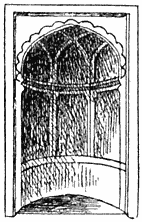
A MIHRAB.
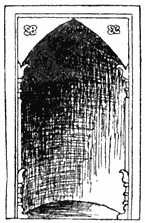
A MIHRAB. (W. S. Chadwick.)
The word occurs four times in the Qurʾān, where it is used for a chamber (Sūrahs iii. 32, 33; xix. 12; xxxviii. 20), and its plural, maḥārīb, once (Sūrah xxxiv. 12).
MĪKĀʾĪL (ميكائيل). [MICHAEL.]
MILLAH (ملة). A word which occurs in the Qurʾān fifteen times. Eight times for the religion of Abraham (Sūrahs ii. 124, 129; iii. 89; iv. 124; vi. 162; xii. 38; xvi. 124; xxii. 77); twice for the religion of former prophets (Sūrahs xiv. 16; xxxviii. 6); once for the religion of the seven children of the cave (Sūrah xviii. 19); three times for idolatrous religions (Sūrahs xii. 37; vii. 86, 87); and once for the religion of Jews and Christians (Sūrah ii. 114). The word is used in the Traditions for the religion of Abraham (Mishkāt, book x. ch. v.).
According to the Kitābu ʾt-Taʿrīfāt, it is expressive of religion as it stands in relation to the prophets, as distinguished from Dīn (دين), which signifies religion as it stands in relation to God, or from Maẕhab (مذهب), which signifies religion with reference to the learned doctors. [RELIGION.] Sprenger and Deutsch have invested the origin and meaning of this word with a certain amount of mystery, which is interesting.
Dr. Sprenger says (Das Leben und die Lehre des Mohammad, vol. ii. p. 276 n):—“When Mohammad speaks of the religion of Abraham, he generally uses the word Milla (Millah) and not Dīn. Arabian philologists have tried to trace the meaning of the word from their mother tongue, thus, Malla (Mallah) signifies fire or hot ashes in Arabic and Zaggag says (Thālaby, vol. ii. p. 114), that religion is called Milla because of the impression which it makes, and which may be compared to that which fire makes upon the bread baked in ashes. Since the Arabs are unable to give a better explanation, we must presume that milla is a foreign word, imported by the teachers of the “Milla of Abraham” in the Hijāz. Philo considered Abraham the chief promoter of the doctrine of the Unity of God, and doubtless, even before Philo, Jewish thought, in tracing the doctrine of the true religion, not only as far back as Moses, but even to the father of their nation, emancipated the indispensability of the form of the law, and so prepared the road to Essaism and Christianity.”
Mr. Emanuel Deutsch, in his article on Islām (Literary Remains, p. 130), says: “The word used in the Qurān for the religion of Abraham is generally Milla. Sprenger, after ridiculing the indeed absurd attempts made to derive it from an Arabic root, concludes that it must be a foreign word introduced by the teachers of the ‘Milla of Abraham’ into the Hijāz. He is perfectly right. Milla = Memra = Logos, are identical; being the Hebrew, Chaldee (Targum, Peshito in slightly varied spelling), and Greek terms respectively for the ‘Word,’ that surrogate for the Divine name used by the Targum, by Philo, by St. John. This Milla or ‘Word,’ which Abraham proclaimed, he, ‘who was not an astrologer but a prophet,’ teaches according to the Haggadah, first of all, the existence of one God, the Creator of the Universe, who rules this universe with mercy and loving kindness.”
MILK. Arabic laban (لبن). The sale of milk in the udder is unlawful (Hidāyah, vol. ii. p. 433). In the Qurʾān it is mentioned as one of God’s special gifts. “Verily, ye have in cattle a lesson: we give you to drink from that which is in their bellies betwixt chyme and blood—pure milk—easy to swallow for those who drink.” (Sūrah xvi. 68.)
MINĀ منى. Lit. “A wish.” A sacred valley near Makkah, in which part of the Pilgrimage ceremonies take place. According to ʿAbdu ʾl-Ḥaqq, it was so called because Adam wished for paradise in this valley.
MINARET. [MANARAH.]
MINBAR. Generally pronounced mimbar (منبر). The pulpit in a mosque from which the k͟hut̤bah (or sermon) is recited. It consists of three steps, and is sometimes a moveable wooden structure, and sometimes a fixture of brick or stone built against the wall. Muḥammad, in addressing the congregation, stood on the uppermost step, Abū Bakr on the second, and ʿUmar on the third or lowest. ʿUs̤mān fixed upon the middle step, and since then it has been the custom to preach from that step. The Shīʿahs have four steps to their mimbars.
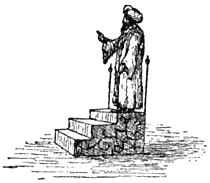
A MIMBAR IN AN INDIAN MOSQUE.
(W. S. Chadwick.)
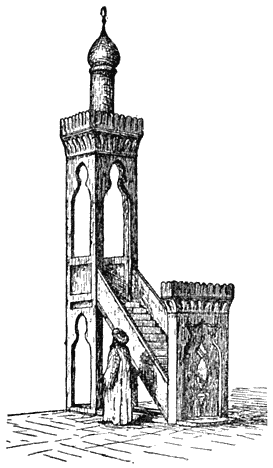
A MIMBAR IN AN EGYPTIAN MOSQUE.
(W. S. Chadwick.)
The mimbars in the mosques of Cairo are elevated structures, but in Asia they are of a more primitive character.
Burton says: “In the beginning the Prophet leaned, when fatigued, against a post, whilst preaching the k͟hut̤bah or Friday sermon. The mimbar, or pulpit, was an invention of a Madīnah man of the Banū Najjār. It was a wooden frame, two cubits long by one broad, with three steps, each one span high; on the topmost of these the Prophet sat when he required rest. The pulpit assumed its present form about A.H. 90, during the artistic reign of El Walid.”
A MIMBAR IN MOSQUES AT PESHAWAR.
MINES. Arabic maʿdin (معدن), pl. maʿādin. In Zakāt, mines are subject to a payment of one fifth. (Hidāyah, vol. i. 39.)
MINḤAH (منحة). A legal term for a portion of camel’s or sheep’s milk which another is allowed to draw, but afterwards to restore the animal to its original owner.
MINORITY. [PUBERTY.]
MĪQĀT (ميقات). Lit. “A stated time, or place.” The stations at which Makkan pilgrims assume the iḥrām or “pilgrim’s garment.” Five of these stations were established by Muḥammad (Mishkāt, book xi. ch. i. pt. 1), and the sixth has been added since to suit the convenience of travellers from the East. They are as follows: (1) Ẕū ʾl-Ḥulafāʾ, for the pilgrims from al-Madīnah; (2) Juḥfah, for Syria; (3) Qarnu ʾl-Manāzil, for Najd; (4) Yaulamlam, for Yaman; (5) Ẕāt-i-ʿIrāq, for ʿIrāq; (6) Ibrahīm Mursīa, for those who arrive by sea from India and the east.
The putting on of the iḥrām at Jerusalem is highly meritorious, according to a tradition, which says, “The Prophet said, Whoever wears the iḥrām for ḥajj or ʿumrah, from the Masjidu ʾl-Aqṣā (i.e. the Temple at Jerusalem) to the Masjidu ʾl-Ḥarām, shall be forgiven for all his past and future sins.” (Mishkāt, book xi. ch. i. pt. 2.)
MĪR (مير). A title of respect used for the descendants of celebrated Muḥammadan saints. More generally used for Saiyids, or descendants of Fāt̤imah, the Prophet’s daughter.
MIRACLES. Supernatural powers given to men are spoken of by Muslim lexicographers as k͟hāriqu ʾl-ʿādat (خارق العادة), or “things contrary to custom.” In Muslim theology, they are expressed by eight terms: (1) Āyah (اية), pl. āyāt, “a sign”; the only word used in the Qurʾān for a miracle (see Sūrahs xiii. 27; xxix. 49; liv. 2). (2) Muʿjizah (معجزة), pl. muʿjizāt, “making weak or feeble,” or that which renders the adversaries to the truth weak and feeble; a term used only for miracles performed by prophets. (3) Irhāṣ (ارهاص), pl. irhāṣāt, lit. “laying a foundation”; used for any miracle performed by a prophet before his assumption of the prophetical office. (4) ʿAlāmah (علامة), pl. ʿalāmāt, “a sign,” the same as āyah, and used for the signs of the coming Resurrection. (5) Karāmah (كرامة), pl. karāmāt, lit. “beneficence”; wonders wrought by saints for the good of the people as well as in proof of their own saintship. (6) Maʿūnah (معونة), pl. maʿwanāt, lit. “help or assistance;” used also for the wonders wrought by saints. (7) Istidrāj (استدراج), lit. “promoting by degrees”; a term employed to express the miracles wrought by the assistance of the Devil with the permission of God. (8) Ihānah (اهانة), pl. ihānāt, lit. “contempt”; miracles wrought by the assistance of the Devil, but when they turn out to the disdain and contempt of the worker.
It does not appear from the Qurʾān that Muḥammad ever claimed the power of working miracles, but, on the contrary, he asserted that it was not his mission to work signs and wonders in proof of his apostleship. This seems to be evident from the following verses in the Qurʾān:—
Sūrah xxix. 49: “They say, Why are not signs (āyāt) sent down to him from his Lord? Say: Signs are in the power of God alone, and I am only an open warner.”
Sūrah xiii. 27–30: “And they who believe not say, Why is not a sign (āyah) sent down to him from his Lord? Say: God truly misleadeth whom He will, and guideth to Himself him who turneth to Him.… If there were a Qurʾān by which the mountains would be set in motion, or the earth cleft by it, or the dead be addressed by it, they would not believe.”
Sūrah xvii. 92–97: “And they say, By no means will we believe in thee till thou cause a fountain to gush forth for us from the earth, or till thou have a garden of palm trees and grapes, and thou cause gushing rivers to gush forth in its midst, or till thou make heaven to fall upon us, as thou hast given out in pieces; or thou bring God and the angels to vouch for thee; or thou have a house of God, or thou mount up into heaven; nor will we believe in thy mounting up until thou send us down a book which we may read. Say: Praise be to my Lord! Am I more than a man, and an apostle? And what hindereth men from believing, when the guidance hath come to them, but that they say, Hath God sent a mere man as an apostle? Say: Did angels walk the earth as its familiars, we had surely sent them an angel-apostle out of heaven.”
But notwithstanding these positive assertions on the part of their Prophet against his ability to work miracles, there are at least four places in the Qurʾān where the Muḥammadans believe that miracles are referred to.
1. The clefting of the moon (Sūrah liv. 1, 2): “The hour hath approached, and the moon hath been cleft. But if the unbelievers see a sign (āyah), they turn aside and say, Magic! that shall pass away!”
Al-Baiẓāwī says, in his commentary on this verse, “Some say that the unbelievers demanded this sign of the Prophet, and the moon was cleft in two; but others say it refers to a sign of the coming Resurrection, the words ‘will be cleft’ being expressed in the prophetic preterite.”
Rodwell renders it “hath been cleft,” as he thinks Muḥammad may possibly allude to some meteor or comet which he fancied to be part of the moon.
2. The assistance given to the Muslims at the battle of Badr. Sūrah iii. 120, 121: “When thou didst say to the faithful: ‘Is it not enough for you that your Lord aideth you with three thousand angels sent down from on high?’ Nay; but if ye be steadfast, and fear God, and the foe come upon you in hot haste, your Lord will help you with five thousand angels with their distinguishing marks.”
These “distinguishing marks,” say the commentators, were when the angels rode on black and white horses, and had on their heads white and yellow turbans, the ends of which hung down between their shoulders.
3. The celebrated night journey. Sūrah xvii. 1: “We declare the glory of Him who transports his servant by night from the Masjidu ʾl-Ḥarām to the Masjidu ʾl-Aqṣā (i.e. from Makkah to Jerusalem).”
4. The Qurʾān itself, which the Muḥammadans say is the great miracle of Islām, the like of which has not been created, nor ever will be, by the power of man. In proof of this they quote Sūrah xxix. 48: “It is a clear sign (āyah) in the hearts of whom the knowledge hath reached.”
Although these very doubtful assertions in the Qurʾān fail to establish the miraculous powers of the Prophet, the Traditions record numerous occasions when he worked miracles in the presence of his people.
The following are recorded in the traditions of al-Buk͟hārī and Muslim:—
(1) On the flight from Makkah, Surāqah being cursed by the Prophet, his horse sank up to its belly in the hard ground.
(2) The Prophet marked out at Badr the exact spot on which each of the idolaters should be slain, and Anas says not one of them passed alive beyond the spot marked by the Prophet.
(3) He cured the broken leg of ʿAbdu ʾllāh ibn Atiq by a touch.
(4) He converted hard ground into a heap of sand by one stroke of an axe.
(5) He fed a thousand people upon one kid and a ṣāʿ of barley.
(6) He gave a miraculous supply of water at the battle of al-Ḥudaibiyah.
(7) Two trees miraculously moved to form a shade for the Prophet.
(8) He made Jābir a good horseman by his prayers.
(9) A wooden pillar wept to such an extent that it nearly rent in two parts, because the Prophet desisted from leaning against it.
(10) A sluggish horse became swift from being ridden by the Prophet.
(11) Seventy or eighty people miraculously fed on a few barley loaves and a little butter.
(12) Three hundred men fed from a single cake.
The following are recorded by various writers:—
(1) The Prophet was saluted by the hills and trees near Makkah, with the salutation, “Peace be to thee, O Messenger of God!”
(2) A tree moved from its place to the shade when the Prophet slept under it.
(3) The Prophet cured a maniacal boy by saying, “Come out of him.”
(4) A wolf was made to speak by the Prophet.
(For further information, see Kitābu ʾl-Muʿjizāt, Ṣaḥīḥu ʾl-Buk͟hārī, Mishkātu ʾl-Maṣābiḥ, Ṣaḥīḥu Muslim.)
MIʿRĀJ (معراج). Lit. “An ascent.” Muḥammad’s supposed journey to heaven; called also Isrā (اسرى), “the nocturnal journey.” It is said to have taken place in the twelfth year of the Prophet’s mission, in the month of Rabīʿu ʾl-Awwal.
According to ʿAbdu ʾl-Ḥaqq, there are some divines who have regarded this miraculous event as a mere vision, but, he adds, the majority hold it to be a literal journey.
The only mention of the vision in the Qurʾān is contained in Sūrah xvii. 1: “Praise be to Him who carried His servant by night from the Masjidu ʾl-Ḥarām (i.e. the Makkan temple) to the Masjidu ʾl-Aqṣā (i.e. the Temple of Jerusalem).”
The following is the description of the supposed journey given in the Mishkātu ʾl-Masābiḥ. Muḥammad is related to have said:—
“Whilst I was sleeping upon my side, he (Gabriel) came to me, and cut me open from my breast to below my navel, and took out my heart, and washed the cavity with Zamzam water, and then filled my heart with Faith and Science. After this, a white animal was brought for me to ride upon. Its size was between that of a mule and an ass, and it stretched as far as the eye could see. The name of the animal was Burāq. Then I mounted the animal, and ascended until we arrived at the lowest heaven, and Gabriel demanded that the door should be opened. And it was asked, ‘Who is it?’ and he said, ‘I am Gabriel.’ And they then said, ‘Who is with you?’ and he answered, ‘It is Muḥammad.’ They said, ‘Has Muḥammad been called to the office of a prophet?’ He said, ‘Yes.’ They said, ‘Welcome Muḥammad; his coming is well.’ Then the door was opened; and when I arrived in the first heaven, behold, I saw Adam. And Gabriel said to me, ‘This is your father Adam, salute him.’ Then I saluted Adam, and he answered it, and said, ‘You are welcome, O good son, and good Prophet!’ After that Gabriel took me above, and we reached the second heaven; and he asked the door to be opened, and it was said, ‘Who is it?’ He said, ‘I am Gabriel.’ It was said, ‘Who is with you?’ He said, ‘Muḥammad.’ It was said, ‘Was he called?’ He said, ‘Yes.’ It was said, “Welcome Muḥammad; his coming is well.’ Then the door was opened; and when I arrived in the second region, behold, I saw John and Jesus (sisters’ sons). And Gabriel said, ‘This is John, and this is Jesus; salute both of them.’ Then I saluted them, and they returned it. After that they said, ‘Welcome good brother and Prophet.’ After that we went up to the third heaven, and asked the door to be opened; and it was said, ‘Who is it?’ Gabriel said, ‘I am Gabriel.’ They said, ‘Who is with you?’ He said, ‘Muḥammad.’ They said, ‘Was he called?’ Gabriel said, ‘Yes.’ They said, ‘Welcome Muḥammad; his coming is well.’ Then the door was opened; and when I entered the third heaven, behold, I saw Joseph. And Gabriel said, ‘This is Joseph, salute him.’ Then I did so, and he answered it, and said, ‘Welcome, good brother and good Prophet.’ After that Gabriel took me to the fourth heaven, and asked the door to be opened; it was said, ‘Who is that?’ He said, ‘I am Gabriel.’ It was said, ‘Who is with you?’ He said, ‘Muḥammad.’ It was said, ‘Was he called?’ He said, ‘Yes.’ They said, ‘Welcome Muḥammad; his coming is well.’ And the door was opened; and when I entered the fourth heaven, behold, I saw Enoch. And Gabriel said, ‘This is Enoch, salute him.’ And I did so, and he answered it, and said, ‘Welcome, good brother and Prophet.’ After that Gabriel took me to the fifth heaven, and asked the door to be opened; and it was said, ‘Who is there?’ He said, ‘I am Gabriel.’ It was said, ‘Who is with you?’ He said, ‘Muḥammad.’ They said, ‘Was he called?’ He said, ‘Yes.’ They said, ‘Welcome Muḥammad; his coming is well.’ Then the door was opened; and when I arrived in the fifth region, behold, I saw Aaron. And Gabriel said, ‘This is Aaron, salute him.’ And I did so, and he returned it, and said, ‘Welcome, good brother and Prophet.’ After that Gabriel took me to the sixth heaven, and asked the door to be opened; and they said, ‘Who is there?’ He said, ‘I am Gabriel.’ They said, ‘And who is with you?’ He said, ‘Muḥammad.’ They said, ‘Is he called?’ He said, ‘Yes.’ They said, ‘Welcome Muḥammad; his coming is well.’ Then the door was opened; and when I entered the sixth heaven, behold, I saw Moses. And Gabriel said, ‘This is Moses, salute him.’ And I did so; and he returned it, and said, ‘Welcome, good brother and Prophet.’ And when I passed him, he wept. And I said to him, ‘What makes you weep?’ He said, ‘Because one is sent after me, of whose people more will enter Paradise than of mine.’ After that Gabriel took me up to the seventh heaven, and asked the door to be opened; and it was said, ‘Who is it?’ He said, ‘I am Gabriel.’ And it was said, ‘Who is with you?’ He said, ‘Muḥammad.’ They said, ‘Was he called?’ He said, ‘Yes.’ They said, ‘Welcome Muḥammad; his coming is well.’ Then I entered the seventh heaven, and behold, I saw Abraham. And Gabriel said, ‘This is Abraham, your father, salute him’; which I did, and he returned it, and said, ‘Welcome good son and good Prophet.’ After that I was taken up to the tree called Sidratu ʾl-Muntahā; and behold its fruits were like water-pots, and its leaves like elephant’s ears. And Gabriel said, ‘This is Sidratu ʾl-Muntahā.’ And I saw four rivers there; two of them hidden, and two manifest. I said to Gabriel, ‘What are these?’ He said, ‘These two concealed rivers are in Paradise; and the two manifest are the Nile and the Euphrates.’ After that, I was shown the Baitu ʾl-Maʿmūr. After that, a vessel full of wine, another full of milk, and another of honey, were brought to me; and I took the milk and drank it. And Gabriel said, ‘Milk is religion; you and your people will be of it.’ After that the divine orders for prayers were fifty every day. Then I returned, and passed by Moses; and he said, ‘What have you been ordered?’ I said, ‘Fifty prayers every day.’ Then Moses said, ‘Verily, your people will not be able to perform fifty prayers every day; and verily, I swear by God, I tried men before you; I applied a remedy to the sons of Israel, but it had not the desired effect. Then return to your Lord, and ask your people to be released from that.’ And I returned; and ten prayers were taken off. Then I went to Moses, and he said as before; and I returned to God’s court, and ten prayers more were curtailed. Then I returned to Moses, and he said as before; then I returned to God’s court, and ten more were taken off. And I went to Moses, and he said as before; then I returned to God, and ten more were lessened. Then I went to Moses, and he said as before; then I went to God’s court, and was ordered five prayers every day. Then I went to Moses, and he said, ‘How many have you been ordered?’ I said, ‘Five prayers every day.’ He said, ‘Verily, your people will not be able to perform five prayers every day; for, verily, I tried men before you, and applied the severest remedy to the sons of Israel. Then return to your Lord, and ask them to be lightened.’ I said, ‘I have asked Him till I am quite ashamed; I cannot return to Him again. But I am satisfied, and resign the work of my people to God.’ Then, when I passed from that place, a crier called out, ‘I have established My divine commandments, and have made them easy to My servants.’”
Sūratu ʾl-Miʿrāj is a title of the XVIIth chapter of the Qurʾān, in the first verse of which there is a reference to the night journey of Muḥammad. It is called also the Sūratu Banī Isrāʾīl, or the Chapter of the Children of Israel.
MĪRĀS̤ (ميراث). [INHERITANCE.]
MĪRZĀ (ميرزا). A title of respect given to persons of good family.
MIRZABAH, MIRZABBAH (مرزبة). “A clod-crusher.” The iron hammer with which the dead are beaten who cannot reply satisfactorily to the questions put to them by Munkar and Nakīr. Called also Mit̤raqah (مطرقة). [PUNISHMENTS OF THE GRAVE.]
MĪS̤ĀQ (ميثاق). “A covenant.” A word used in the Qurʾān for God’s covenant with his people. [COVENANT.]
MISHKĀTU ʾL-MAṢĀBĪḤ (مشكاة المصابيح). A well-known book of Sunnī tradition, much used by Sunnī Muslims in India, and frequently quoted in the present work. It was originally compiled by the Imām Ḥusain al-Bag͟hawī, the celebrated commentator, who died A.H. 510 or 516, and called the Maṣābīḥu ʾs-Sunnah, or the “Lamps of the Traditions.” In the year A.H. 737, Shaik͟h Walīyu ʾd-dīn revised the work of al-Bag͟hawī, adding an additional chapter to each section, and called it the Mishkātu ʾl-Maṣābīḥ, or the “Niche for lamps.” In the time of the Emperor Akbar, Shaik͟h ʿAbdu ʾl-Ḥaqq translated the work into Persian, and added a commentary. (See Kashfu ʾz̤-Z̤unūn, in loco.)
MISKĪN (مسكين). “A poor person.” Heb. Eccles. ix. 15, מִסְכֵּן. According to Muslim law, a person who has no property whatever, as distinguished from a faqīr (فقير), or a person who possesses a little property, but is poor. (Hidāyah, vol. i. p. 54.)
MIS̤QĀL (مثقال). An Arabic weight, which frequently occurs in Muḥammadan law books. Richardson gives it at a dram and three-sevenths. It is also used for a gold coin of that weight. [MONEY.]
MIṢR (مصر). [EGYPT.]
MISWĀK (مسواك). (1) A tooth-cleaner made of wood, about a span long. It is preferred when made of a wood which has a bitter flavour. The Salvadora Indica is the tree, the wood of which is used in India.
(2) The act of cleaning the teeth, which is a religious ceremony founded upon the example of Muḥammad, and forms the first part of the waẓūʾ, or “ablution before prayer.”
The Prophet was particularly careful in the observance of miswāk (see Mishkāt, book iii. ch. 4). It is amongst those things which are called fit̤rah (q.v.).
MIT̤RAQAH (مطرقة). The iron hammer or mace with which the infidels will be smitten in their graves by the angels Munkar and Nakīr. Persian gurz. [PUNISHMENTS OF THE GRAVE.]
MIYĀN (ميان). A Persian word, used as a title of respect for the descendants of celebrated Muḥammadan saints.
MĪZĀN (مـيـزان), pl. mawāzīn. Heb. pl. מֹאזְנַיִם. Lit. “A balance.” (1) The law contained in the Qurʾān, Sūrah xlii. 16: “God is He who hath sent down the Book with truth and the balance.” (2) The scales in which the actions of all men shall be weighed. Sūrah xxi. 47: “Just balances will be set up for the Day of the Resurrection, neither shall any soul be wronged in aught; though, were a work but the weight of a grain of mustard seed, we would bring it forth to be weighed: and our reckoning will suffice.”
Muḥammad is related by ʿAbdu ʾllāh ibn ʿAmr to have said: “Verily, God will bring a Muslim into the presence of all men on the Day of Judgment, and will show him ninety-nine large books, and each book as long as the eye can reach. Then God will say to him, ‘Do you deny anything in these books? Have my writers injured you?’ And the Muslim will say, ‘O my Lord, I deny nothing that is in them.’ Then God will say, ‘Have you any excuse?’ And he will say, ‘No.’ Then God will say, ‘I have good news for you, for there is no oppression in this day.’ Then God will bring forth a piece of paper, on which is written: ‘I bear witness that there is no deity but God, and I bear witness that Muḥammad is His servant and apostle.’ And God will say, ‘Go and weigh your actions.’ And the Muslim will say, ‘What is this bit of paper compared with those large books?’ And God will say, ‘This bit of paper is heavy, weigh it.’ Then the books will be put in the scale, and the bit of paper in the other, and the books containing the actions will be light, and the bit of paper, whereon is written the creed of the Muslim, will be heavy.” (See Collection of Ḥadīs̤ by at-Tirmiẕī.)
The commentators say that the scales will be held by the angel Gabriel, and that they are of so vast a size, one hangs over Paradise, and the other over Hell, and they are capacious enough to contain both heaven and earth. Though some are willing to understand what is said in the Traditions concerning this balance allegorically, and only as a figurative representation of God’s equity, yet the more ancient and orthodox opinion is that it is to be taken literally; and since words and actions, being mere accidents, are not capable of being themselves weighed, they say that the books wherein they are written will be thrown into the scales, and according as those wherein the good or the evil actions are recorded shall preponderate, sentence will be given; those whose balances laden with their good works shall be heavy, will be saved; but those whose balances are light, will be condemned. Nor will anyone have cause to complain that God suffers any good actions to pass unrewarded, because the wicked obtain rewards for the good they do in the present life, and therefore can expect no favour in the next.
The old Jewish writers make mention of the books to be produced at the Last Day, wherein men’s actions are registered, as of the balance wherein they shall be weighed, and the Bible itself seems to have given the first notion of both. But what the Persian Magi believe of the balance comes nearest to the Muḥammadan opinion. They hold that on the Day of Judgment, two angels, named Mihr and Sorush, will stand on the bridge between heaven and hell, and examine every person as he passes; that the former, who represents the divine mercy, will hold a balance in his hand, to weigh the actions of men; that, according to the report he shall make thereof to God, sentence will be pronounced, and those whose good works are found more ponderous, if they turn the scale but by the weight of a hair, will be permitted to pass forward to Paradise; but those whose good works shall be found light, will be, by the other angel, who represents God’s justice, precipitated from the bridge into hell.
MODERATION. Arabic iqtiṣād (اقتصاد). According to Muḥammad’s teaching, moderation in all religious matters is better than excessive piety, and a chapter in the Traditions is devoted to the subject. He is related to have said:—
“The best act in God’s sight is that which is constantly attended to, although in a small degree.”
“Do what you are able conveniently; because God will not be tired of rewarding as long as you are not tired of doing.”
“You must continue at your prayers as long as it is agreeable to you, and when you are tired sit down.”
“Verily, religion is easy, therefore hold it firm.” (See Mishkāt, Bābu ʾl-Iqtiṣād.)
MODESTY (Arabic ḥayāʾ حياء) is frequently commended in the traditional sayings of Muḥammad, who is related to have said:—
“Modesty is a branch of faith.”
“Verily, modesty and faith are joined together.” (Mishkāt, book xxii. ch. xix.)
MONASTICISM Arabic rahbānīyah (رهبانية) was forbidden by Muḥammad. It is related in the Traditions that ʿUs̤mān ibn Maz̤ʿūn came to the Prophet with the request that he might retire from society and become a monk (rāhib). The Prophet replied, “The retirement which becomes my people is to sit in the corner of a mosque and wait for the time of prayer.” (Mishkāt, book iv. ch. 8.)
In the Qurʾān, the Christians are charged with inventing the monastic life. Sūrah lvii. 27: “We gave them the Gospel, and we put into the hearts of those who follow him, kindness and compassion; but as to the monastic life, they invented it themselves.”
According to the Hidāyah (vol. ii. p. 215), capitation-tax is not to be imposed upon Rāhibs, whether Christian or Pagan, but this is a matter of dispute.
MONEY. There are three coins mentioned in the Qurʾān, (1) Qint̤ār (قنطار), (2) Dīnār (دينار), (3) Dirham (درهم), pl. Darāhim.
(1) Qint̤ār. Sūrah iii. 68: “Among the people of the Book are those to one of whom, if you entrust a qint̤ār, he will restore it.”
In the Qāmūs, it is said that a qint̤ār was a gold coin of the value of 200 dīnārs, but Muḥammad T̤āhir, the author of the Majmaʿu ʾl-Biḥār (p. 173), says it implies a very considerable sum of money, as much gold as will go into the hide of a cow. It is generally translated talent.
(2) Dīnār. Sūrah iii. 68: “There are those to whom, if thou entrust a dīnār, they will not restore it to thee.” It was the denarius, or a small gold coin.
(3) Dirham. Sūrah xii. 20: “And they sold him for a mean price, dirhams counted out.” A silver drachma. [QINTAR, DINAR, DIRHAM, WEIGHTS.]
Mr. Prinsep says: “The silver rupee (rupya, silver piece), now current in Muslim countries, was introduced, according to Abulfazel, by Sher Shah, who usurped the throne of Delhi from Humayoon in the year 1542. Previous to his time, the Arabic dirhim (silver drachma), the gold dinar (denarius auri), and the copper fuloos (follis), formed the currency of the Moghul dominions. Sher Shah’s rupee had on one side the Muḥammadan creed, on the other the emperor’s name and the date in Persian, both encircled in an annular Hindee inscription. Since ‘the same coin was revived and made more pure,’ in Akber’s reign, we may assume the original weight of the rupee, from Abulfazel’s statement, to have been 11¼ máshas. Akber’s square rupee, called from its inscription the jilály, was of the same weight and value. This coin was also called the chahár-yáree, from the four friends of the Prophet, Abubekr, Omar, Osman, Ali, whose names are inscribed on the margin. This rupee is supposed by the vulgar to have talismanic power.”
MONOGAMY. Although polygamy is sanctioned in the Qurʾān, the words, “and if ye fear that ye cannot be equitable, then only one” (Sūrah iv. 3), would seem to imply a leaning to monogamy, as the safest and most discreet form of matrimony. The author of the Ak͟hlāq-i-Jalālī says: “Excepting, indeed, in the case of kings, who marry to multiply offspring, and towards whom the wife has no alternative but obedience, plurality of wives is not defensible. Even in their case it were better to be cautious; for husband and wife are like heart and body, and like as one heart cannot supply life to two bodies, one man can hardly provide for the management of two homes.” (Thompson’s English Translation, p. 266.)
MONOPOLY. Arabic iḥtikār (احتكار). A monopoly of the necessaries of life (as, for example, the hoarding up of grain with the object of raising its price) is forbidden in Muḥammadan law. For the Prophet has said:—
“Whoever monopolizeth is a sinner.”
“Whosoever keepeth back grain forty days, in order to increase its price, is both a forsaker of God, and is forsaken of God.” (Mishkāt, book xii. ch. x.; Hidāyah, vol. iv. p. 114.)
MONTH. Arabic shahr (شهر), pl. shuhūr. The months of the Muḥammadan year are lunar, and the first of the month is reckoned from the sunset immediately succeeding the appearance of the new moon (hilāl). The names of the months are: (1) Muḥarram محرّم; (2) Ṣafar صفر; (3) Rabīʿu ʾl-Awwal ربيع الاول; (4) Rabīʿu ʾl-Āk͟hir ربيع الاخر; (5) Jumādā ʾl-Ūlā جمادى الاولى; (6) Jumādā ʾl-Uk͟hrā جمادى الاخرى; (7) Rajab رجب; (8) Shaʿbān شعبان; (9) Ramaẓān رمضان; (10) Shawwāl شوّال; (11) Ẕū ʾl-Qaʿdah ذو القعدة; (12) Ẕū ʾl-Ḥijjah ذو الحجة.
Four of these months are held to be sacred, namely, Muḥarram, Rajab, Ẕū ʾl-Qaʿdah, Ẕū ʾl-Ḥijjah, and according to the teaching of the Qurʾān (Sūrah ix. 36), it is not lawful for Muslims to fight during these months, except when they attack those “who join other gods with God, even as they attack you one and all.”
The names of the months seem to have been given at a time when the intercalary year was in force, although Muslim writers assume that the names were merely given to the months as they then stood at the time when they were so named. For a discussion of the formation of the Muḥammadan year, the reader is referred to that article. [YEAR.]
(1) Muḥarram is the first month in the Muḥammadan calendar, and is so called because, both in the pagan age and in the time of Muḥammad, it was held unlawful (ḥarām) to go to war in this month. It is considered a most auspicious month, and Muḥammad is related to have said, “Whosoever shall fast on Thursday, Friday, and Saturday in this month, shall be removed from hell fire a distance of seven hundred years journey; and that he who shall keep awake the first night of this month, shall be forgiven all the sins of the past year; and he who shall fast the whole of the first day, shall be kept from sin for the next two years.” (Hanīsu ʾl-Waizīn, p. 154.) The first ten days of this month are observed in commemoration of the martyrdom of al-Ḥusain, and the tenth day is the ʿĀshūrāʾ fast.
(2) Ṣafar, the second month, is supposed to derive its name from ṣafir, “empty,” either because in it the Arabians went forth to war and left their homes empty, or, according to Rubeh, because they left whom they attacked empty. According to some writers, it was so named from ṣufār, “yellowness,” because when it was first so called, it was autumn, when the leaves bore a yellowish tint. (Vide Lane’s Arabic Dict.; G͟hiyās̤u ʾl-Lug͟hah.) It is held to be the most unlucky and inauspicious month in the whole year, for in it, it is said, Adam was turned out of Eden. (See Hanīsu ʾl-Waizīn.) It was during this month that the Prophet was taken ill, but his partial recovery took place on the last Wednesday.
(3) Rabīʿu ʾl-Awwal, and (4) Rabīʿu ʾl-Āk͟hir, the first and second spring months, are said to have been so named when the calendar was first formed, and when these months occurred in the spring. Muḥammad died on the 12th day of the Rabīʿu ʾl-Awwal.
(5) Jumādā ʾl-Ūlā, and (6) Jumādā ʾl-Uk͟hrā, are the fifth and sixth months, about which there is some discussion as to the origin of the name. Mr. Lane, in his Dictionary, says the two months to which the name Jamādā (freezing) is applied, are said to be so called because, when they were so named, they fell in the season of freezing water; but this derivation seems to have been invented when the two months thus named had fallen back into, or beyond, the winter, for when they received this appellation, the former of them evidently commenced in March, and the latter ended in May. Therefore, I hold the opinion of M. Caussin de Perceval, that they were thus called because falling in a period when the earth had become dry and hard, by reason of paucity of rain, jamād being an epithet applied to land upon which rain has not fallen, which opinion is confirmed by the obvious derivation of the names of other months. (See Lane’s Arabic Dict. in loco.)
(7) Rajab, the “honoured” month, so called because of the honour in which the month was held in the Times of Ignorance, inasmuch as war was not permitted during this month. The Prophet is related to have said that the month Rajab was like a snowy white fountain flowing from heaven itself, and that he who fasts on this month will drink of the waters of life. It is called Rajab-i-Muẓar, because the Muẓar tribe held it in high esteem. It is usual for religious Muslims to spend the first Friday night (i.e. our Thursday night) of this month in prayer.
(8) Shaʿbān, the month of separation (called also the Shahru ʾn-Nabī, “the Prophet’s month”), is so called because the ancient Arabians used to separate, or disperse themselves, in this month in search of water (for when the months were regulated by the solar year, this month corresponded partly to June and partly to July), or, as some say, for predatory expeditions. On the fifteenth day of this month is the Shab-i-Barāt, or “Night of Record,” upon which it is said that God registers annually all the actions of mankind which they are to perform during the year, and upon which Muḥammad enjoined his followers to keep awake the whole night and to repeat one hundred rakʿah prayers. [SHAB-I-BARAT.]
(9) Ramaẓān, the ninth month of the Muḥammadan year, is that which is observed as a strict fast. The word is derived from ramẓ, “to burn,” because it is said that, when the month was first named, it occurred in the hot season; or because the month’s fast is supposed to burn away the sins of men. (See G͟hiyās̤u ʾl-Lug͟hah.) The excellence of this month is much extolled by Muḥammad, who said that during this month the gates of Paradise are opened, and the gates of Hell shut. (Mishkāt, book vii. chap. i. sec. 1.) [RAMAZAN.]
(10) Shawwāl, lit. “a tail,” is the tenth month of the lunar year, and, according to Arabic lexicons (see G͟hiyās̤u ʾl-Lug͟hah, Qāmūs, &c.), it is so called because, when first named, it coincided with the season when the she-camels, being seven or eight months gone with young, raised their tails; or, because it was the month for hunting. The Arabs used to say that it was an unlucky month in which to make marriage contracts, but the Prophet ignored their thus auguring, and married ʿĀyishah in this month. The ʿĪdu ʾl-Fit̤r, or “the Feast of Breaking the Fast,” occurs on the first of this month.
(11) Ẕū ʾl-Qaʿdah, or the month of truce, is the eleventh month, and so called by the ancient Arabs, because it was a month in which warfare was not conducted, and in which the people were engaged in peaceful occupations.
(12) Ẕū ʾl-Ḥijjah, the month of the Pilgrimage, is the last month of the Muḥammadan calendar. It is the month in which the pilgrimage to Makkah must be made, a visit to the sacred city at another time having in no way the merits of a pilgrimage. The Ḥajj, or “Pilgrimage,” is performed upon the seventh, eighth, ninth, and tenth of this month. The ʿĪdu ʾl-Aẓḥā, or “Feast of Sacrifice,” is held on the tenth. [HAJJ.]
MORTGAGE. [IJARAH.]
MOON. Arabic qamar (قمر). The moon is frequently mentioned in the Qurʾān. Muḥammad on three occasions swears by it (Sūrahs lxxiv. 35; lxxxiv. 18; xci. 2), and it is said to have been set in the heavens for a light (Sūrahs x. 5; lxxi. 15), to run to its appointed goal (Sūrahs xxxv. 14; xxxi. 7), and that it will be eclipsed at the Day of Judgment (Sūrah lxxv. 8). The LIVth Sūrah of the Qurʾān, which is entitled the Sūratu ʾl-Qamar, begins with a reference to the splitting of the moon, which is a matter of controversy. It reads: “The hour draws nigh and the moon is split asunder. But if they see a sign, they turn aside and say magic continues.”
Al-Baiẓāwī refers it to a miracle, and says the unbelievers having asked Muḥammad for a sign, the moon appeared to be cloven in twain. But the most natural explanation of the passage is, that the expression refers to one of the signs of the Resurrection.
At an eclipse of the moon, a devout Muslim is expected to recite a two rakʿah prayer.
MOORS. The name given to the Muḥammadan conquerors of Spain, on account of their having come from the ancient Mauri, or Mauretania, now known as the Empire of Morocco. The word Mauri is supposed to have been derived from the Alexandrian word μαυροί, “blacks.” (See Smith’s Dict. of Greek and Roman Geography: Mauretania.)
MOSES. Arabic Mūsā (موسى). Heb. מֹשֶׁח. According to Muḥammadanism, he is one of the six great prophets who founded dispensations, and to whom the Taurāt was revealed. His special title, or kalimah, is Kalīmu ʾllāh, “One who conversed with God.” A lengthy account is given of his intercourse with Pharaoh and his dealings with the Children of Israel in the Qurʾān, which we take from Mr. Lane’s Selections, together with the remarks of the Jalālān, al-Baiẓāwī, and other commentators, in italics. (Stanley Lane-Poole’s new ed. of Lane’s Selections, p. 97.)
“We will rehearse unto thee of the history of Moses and Pharaoh with truth, for the sake of people who believe. Verily Pharaoh exalted himself in the land of Egypt, and divided its inhabitants into parties to serve him. He rendered weak one class of them, namely the children of Israel, slaughtering their male children, and preserving alive their females, because one of the diviners said unto him, A child will be born among the children of Israel, who will be the means of the loss of thy kingdom;—for he was one of the corrupt doers. And We desired to be gracious unto those who had been deemed weak in the land, and to make them models of religion, and to make them the heirs of the possessions of Pharaoh, and to establish them in the land of Egypt, and in Syria, and to show Pharaoh and Hāmān and their forces what they feared from them. And We said, by revelation, unto the mother of Moses, the child above-mentioned, of whose birth none knew save his sister, Suckle him; and when thou fearest for him cast him in the river Nile, and fear not his being drowned, nor mourn for his separation; for We will restore him unto thee, and will make him one of the apostles. So she suckled him three months, during which he wept not; and then she feared for him, wherefore she put him into an ark pitched within and furnished with a bed for him, and she closed it and cast it in the river Nile by night. And the family of Pharaoh lighted upon him in the ark on the morrow of that night; so they put it before him, and it was opened, and Moses was taken forth from it, sucking milk from his thumb: that he might be unto them eventually an enemy and an affliction; for Pharaoh and Hāmān (his Wezeer) and their forces were sinners; wherefore they were punished by his hand. And the wife of Pharaoh said, when he and his servants had proposed to kill him, He is delight of the eye unto me and unto thee: do not ye kill him: peradventure he may be serviceable unto us, or we may adopt him as a son. And they complied with her desire; and they knew not the consequence.
“And the heart of the mother of Moses, when she knew of his having been lighted upon, became disquieted; and she had almost made him known to be her son, had We not fortified her heart with patience, that she might be one of the believers in Our promise. And she said unto his sister Maryam (Mary), Trace him, that thou mayest know his case. And she watched him from a distance, while they knew not that she was his sister and that she was watching him. And We forbade him the breasts, preventing him from taking the breast of any nurse except his mother, before his restoration to her; so his sister said, Shall I direct you unto the people of a house who will nurse him for you, and who will be faithful unto him? And her offer was accepted; therefore she brought his mother, and he took her breast: so she returned with him to her house, as God hath said,—And We restored him to his mother, that her eye might be cheerful and that she might not grieve, and that she might know that the promise of God to restore him unto her was true: but the greater number of them (that is, of mankind) know not this. And it appeared not that this was his sister and this his mother; and he remained with her until she had weaned him; and her hire was paid her, for every day a deenár, which she took because it was the wealth of a hostile person. She then brought him unto Pharaoh, and he was brought up in his abode, as God hath related of him in the Chapter of the Poets (Sūrah xxvi. 17), where Pharaoh said unto Moses, Have we not brought thee up among us a child, and hast thou not dwelt among us thirty years of thy life?
“And when he had attained his age of strength (thirty years or thirty and three), and had become of full age (forty years), We bestowed on him wisdom and knowledge in religion, before he was sent as a prophet; and thus do We reward the well-doers. And he entered the city of Pharaoh, which was Munf [Memphis], after he had been absent from him a while, at a time when its inhabitants were inadvertent, at the hour of the noon-sleep, and he found therein two men fighting; this being of his party (namely an Israelite), and this of his enemies, an Egyptian, who was compelling the Israelite to carry firewood to the kitchen of Pharaoh without pay: and he who was of his party begged him to aid him against him who was of his enemies. So Moses said unto the latter, Let him go. And it is said that he replied to Moses, I have a mind to put the burden on thee. And Moses struck him with his fist, and killed him. But he intended not to kill him; and he buried him in the sand. He said, This is of the work of the devil, who hath excited my anger; for he is an enemy unto the son of Adam, a manifest misleader of him. He said, in repentance, O my Lord, verily I have acted injuriously unto mine own soul, by killing him; therefore forgive me. So He forgave him: for He is the Very Forgiving, the Merciful.—He said, O my Lord, by the favours with which Thou hast favoured me, defend me, and I will by no means be an assistant to the sinners after this.—And the next morning he was afraid in the city, watching for what might happen unto him on account of the slain man; and lo, he who had begged his assistance the day before was crying out to him for aid against another Egyptian. Moses said unto him, Verily thou art a person manifestly in error, because of that which thou hast done yesterday and to-day. But when he was about to lay violent hands upon him who was an enemy unto them both (namely unto Moses and him who begged his aid), the latter said, imagining that he would lay violent hands upon him, because of that which he had said unto him, O Moses, dost thou desire to kill me, as thou killedst a soul yesterday? Thou desirest not aught but to be an oppressor in the land, and thou desirest not to be [one] of the reconcilers.—And the Egyptian heard that: so he knew that the killer was Moses; wherefore he departed unto Pharaoh and acquainted him therewith, and Pharaoh commanded the executioners to slay Moses, and they betook themselves to seek him. But a man who was a believer, of the family of Pharaoh, came from the furthest part of the city, running by a way that was nearer than the way by which they had come: he said, O Moses, verily the chiefs of the people of Pharaoh are consulting respecting thee, to slay thee; therefore go forth from the city: verily I am unto thee one of the admonishers. So he went forth from it in fear, watching in fear of pursuer, or for the aid of God. He said, O my Lord, deliver me from the unjust people of Pharaoh!
“And when he was journeying towards Medyen, which was the city of Shoʾeyb (Shuʿaib), eight days journey from Miṣr (named after Medyen [Madyan] the son of Abraham), and he knew not the way unto it, he said, Peradventure my Lord will direct me unto the right way, or the middle way. And God sent unto him an angel, having in his hand a short spear; and he went with him thither. And when he came unto the water (or well) of Medyen, he found at it a company of men watering their animals; and he found besides them two women keeping away their sheep from the water. He said unto them (namely the two women), What is the matter with you that ye water not? They answered, We shall not water until the pastors shall have driven away their animals; and our father is a very old man, who cannot water the sheep. And he watered for them from another well near unto them, from which he lifted a stone that none could lift but ten persons. Then he retired to the shade of an Egyptian thorn-tree on account of the violence of the heat of the sun: and he was hungry, and he said, O my Lord, verily I am in need of the good provision which Thou shalt send down unto me. And the two women returned unto their father in less time than they were accustomed to do: so he asked them the reason thereof; and they informed him of the person who had watered for them; whereupon he said unto one of them, Call him unto me.
“And one of them came unto him, walking bashfully, with the sleeve of her shift over her face, by reason of her abashment at him: she said, My father calleth thee, that he may recompense thee with the reward of thy having watered for us. And he assented to her call, disliking in his mind the receiving of the reward: but it seemeth that she intended the compensation if he were of such as desired it. And she walked before him; and the wind blew her garment, and her legs were discovered: so he said unto her, Walk behind me and direct me in the way. And she did so, until she came unto her father, who was Shoʾeyb, on whom be peace! and with him was prepared a supper. He said unto him, Sit and sup. But he replied, I fear lest it be a compensation for my having watered for them, and we are a family who seek not a compensation for doing good. He said, Nay, it is my custom and hath been the custom of my fathers to entertain the guest and to give food. So he ate; and acquainted him with his case. And when he had come unto him, and had related to him the story of his having killed the Egyptian and their intention to kill him and his fear of Pharaoh, he replied, Fear not: thou hast escaped from the unjust people. (For Pharaoh had no dominion over Medyen.) One of them [namely of the women] said (and she was the one who had been sent), O my father, hire him to tend our sheep in our stead; for the best whom thou canst hire is the strong, the trustworthy. So he asked her respecting him, and she acquainted him with what hath been above related, his lifting up the stone of the well, and his saying unto her, Walk behind me;—and moreover, that when she had come unto him, and he knew of her presence, he hung down his head and raised it not. He therefore said, Verily I desire to marry thee unto one of these my two daughters, on the condition that thou shalt be a hired servant to me, to tend my sheep, eight years; and if thou fulfil ten years, it shall be of thine own will; and I desire not to lay a difficulty upon thee by imposing as a condition the ten years: thou shalt find me, if God please, one of the just, who are faithful to their covenants. He replied, This be the covenant between me and thee; whichever of the two terms I fulfil, there shall be no injustice against me by demanding an addition thereto; and God is witness of what we say. And the marriage-contract was concluded according to this; and Shoʾeyb ordered his daughter to give unto Moses a rod wherewith to drive away the wild beasts from his sheep: and the rods of the prophets were in his possession; and the rod of Adam, of the myrtle of paradise, fell into her hand; and Moses took it, with the knowledge of Shoʾeyb. (Sūrah xxviii. 21–28.)
“Hath the history of Moses been related to thee? when he saw fire, during his journey from Medyen on his way to Egypt, and said unto his family, or his wife, Tarry ye here; for I have seen fire: perhaps I may bring you a brand from it, or find at the fire a guide to direct me in the way. For he had missed the way in consequence of the darkness of the night. And when he came unto it (and it was a bramble bush), he was called to by a voice saying, O Moses, verily I am thy Lord; therefore pull off thy shoes; for thou art in the holy valley of Tuwa. And I have chosen thee from among thy people; wherefore hearken attentively unto that which is revealed unto thee by Me. Verily I am God: there is no Deity except Me; therefore worship Me, and perform prayer in remembrance of Me. Verily the hour is coming: I will manifest it unto mankind, and its nearness shall appear unto them by its signs, that every soul may be recompensed therein for its good and evil work: therefore let not him who believeth not in it, and followeth his lust, hinder thee from believing in it, lest thou perish. And what is that in thy right hand, O Moses?—He answered, It is my rod, whereon I lean and wherewith I beat down leaves for my sheep that they may eat them; and I have other uses for it, as the carrying of provision and the water-skin, and the driving away of reptiles. He said, Cast it down, O Moses. So he cast it down; and lo, it was a serpent running along. God said, Take it, and fear it not: we will restore it to its former state. And he put his hand into its mouth; whereupon it became again a rod. And God said, And put thy right hand to thy left arm-pit, and take it forth: it shall come forth white, without evil, (that is without leprosy; shining like the rays of the sun, dazzling the sight,) as another sign, that We may show thee the greatest of our signs of thine apostleship. (And when he desired to restore his hand to its first state, he put it as before described, and drew it forth.) Go as an apostle unto Pharaoh and those who are with him; for he hath acted with exceeding impiety by arrogating to himself divinity.—Moses said, O my Lord, dilate my bosom, that it may bear the message, and make my affair easy unto me, and loose the knot of my tongue (this had arisen from his having been burned in his mouth by a live coal when he was a child), that they may understand my speech when I deliver the message. And appoint unto me a Wezeer of my family, namely Aaron [Haroon] my brother. Strengthen my back by him, and make him a colleague in my affair, that we may glorify Thee much, and remember Thee much; for Thou knowest us.
“God replied, Thou hast obtained thy petition, O Moses, and We have been gracious unto thee another time: forasmuch as We revealed unto thy mother what was revealed, when she gave birth to thee and feared that Pharaoh would kill thee among the others that were born, saying, Cast him into the ark, and then cast him, in the ark, into the river Nile, and the river shall throw him on the shore; then an enemy unto Me and an enemy unto him (namely Pharaoh) shall take him. And I bestowed on thee, after he had taken thee, love from Me, that thou mightest be loved by men, so that Pharaoh and all that saw thee loved thee; and that thou mightest be bred up in Mine eye. Also forasmuch as thy sister Maryam went that she might learn what became of thee, after they had brought nurses and thou hadst refused to take the breast of any one of them, and she said, Shall I direct you unto one who will nurse him? (whereupon her proposal was accepted, and she brought his mother): so We restored thee to thy mother, that her eye might become cheerful and that she might not grieve. And thou slewest a soul, namely the Copt in Egypt, and wast sorry for his slaughter, on account of Pharaoh, and We delivered thee from sorrow; and We tried thee with other trial, and delivered thee from it. And thou stayedst ten years among the people of Medyen, after thou hadst come thither from Egypt, at the abode of Shoʾeyb the prophet, and he married thee to his daughter. Then thou camest according to My decree, as to the time of thy mission, when thou hadst attained the age of forty years, O Moses; and I have chosen thee for Myself. Go thou and thy brother unto the people, with My nine signs, and cease ye not to remember Me. Go ye unto Pharaoh; for he hath acted with exceeding impiety, by arrogating to himself divinity, and speak unto him with gentle speech, exhorting him to relinquish that conduct: peradventure he will consider, or will fear God, and repent. (The [mere] hope with respect to the two [result is expressed] because of God’s knowledge that he would not repent.)—They replied, O our Lord, verily we fear that he may be precipitately violent against us, hastening to punish us, or that he may act with exceeding injustice towards us. He said, Fear ye not; for I am with you: I will hear and will see. Therefore go ye unto him, and say, Verily we are the apostles of thy Lord: therefore send with us the children of Israel unto Syria, and do not afflict them, but cease to employ them in thy difficult works, such as digging and building, and carrying the heavy burden. We have come unto thee with a sign from thy Lord, attesting our veracity in asserting ourselves apostles: and peace be on him who followeth the right direction:—that is, he shall be secure from punishment. Verily it hath been revealed unto us that punishment [shall be inflicted] upon him who chargeth with falsehood that wherewith we have come, and turneth away from it. (Sūrah xx. 8–50.)
“Then We sent after them, namely the apostles before mentioned [who were Shoʾeyb and his predecessors], Moses, with Our signs unto Pharaoh and his nobles, and they acted unjustly with respect to them, disbelieving in the signs: but see what was the end of the corrupt doers. And Moses said, O Pharaoh, verily I am an apostle from the Lord of the world unto thee. But he charged him with falsehood: so he said, I am right not to say of God aught but the truth. I have come unto you with a proof from your Lord: therefore send with me to Syria the children of Israel.—Pharaoh said unto him, If thou hast come with a sign confirmatory of thy pretension, produce it, if thou be of those who speak truth. So he cast down his rod; and lo, it was a manifest serpent. And he drew forth his hand from his bosom; and lo, it was white and radiant unto the beholders. The nobles of the people of Pharaoh said, Verily this is a knowing enchanter: he desireth to expel you from your land. What then do ye command?—They answered, Put off for a time him and his brother, and send unto the cities collectors [of the inhabitants], that they may bring unto thee every knowing enchanter. And the enchanters came unto Pharaoh. They said, Shall we surely have a reward if we be the party who overcome? He answered, Yea; and verily ye shall be of those who are admitted near unto my person. They said, O Moses, either do thou cast down thy rod, or we will cast down what we have with us. He replied, Cast ye. And when they cast down their cords and their rods, they enchanted the eyes of the men, diverting them from the true perception of them; and they terrified them; for they imagined them to be serpents running; and they performed a great enchantment. And We spake by revelation unto Moses, [saying,] Cast down thy rod. And lo, it swallowed up what they had caused to appear changed. So the truth was confirmed, and that which they had wrought became vain; and they were overcome there, and were rendered contemptible. And the enchanters cast themselves down prostrate: they said, We believe in the Lord of the worlds, the Lord of Moses and Aaron. Pharaoh said, Have ye believed in Him before I have given you permission? Verily this is a plot that ye have contrived in the city, that ye may cause its inhabitants to go forth from it. But ye shall know what shall happen unto you at my hand. I will assuredly cut off your hands and your feet on the opposite sides—the right hand of each and his left foot: then I will crucify you all.—They replied, Verily unto our Lord shall we return, after our death, of whatever kind it be; and thou dost not take vengeance on us but because we believed in the signs of our Lord when they came unto us. O our Lord, pour upon us patience, and cause us to die Muslims! (Sūrah vii. 101–123).
“And Pharaoh said, Let me alone that I may kill Moses, (for they had diverted him from killing him,) and let him call upon his Lord to defend him from me. Verily I fear lest he change your religion, and prevent your worshipping me, or that he may cause corruption to appear in the earth (that is, slaughter, and other offences).—And Moses said unto his people, having heard this, Verily, I have recourse for defence unto my Lord and your Lord from every proud person who believeth not in the day of account. And a man who was a believer, of the family of Pharaoh (it is said that he was the son of his paternal uncle,) who concealed his faith, said, Will ye kill a man because he saith, My Lord is God,—when he hath come unto you with evident proofs from your Lord? And if he be a liar, on him [will be] the evil consequence of his lie; but if he be a speaker of truth, somewhat of that punishment with which he threatened you will befall you speedily. Verily God directeth not him who is a transgressor, or polytheist, [and] a liar. O my people, ye have the dominion to-day, being overcomers in the land of Egypt; but who will defend us from the punishment of God if ye kill his favourite servants, if it come unto us?—Pharaoh said, I will not advise you to do [aught] save what I see to be advisable, which is, to kill Moses; and I will not direct you save into the right way. And he who had believed said, O my people, verily I fear for you the like of the day of the confederates, the like of the condition of the people of Noah and ʾA′d and Thamood and those who have lived after them: and God willeth not injustice unto His servants. And, O my people, verily I fear for you the day of calling (that is, the day of resurrection, when the people of Paradise and those of Hell shall often call one to another). On the day when ye shall turn back from the place of reckoning unto hell, ye shall have no protector against God. And he whom God shall cause to err shall have no director. Moreover, Joseph (who was Joseph the son of Jacob according to one opinion, and who lived unto the time of Moses; and Joseph the son of Abraham the son of Joseph the son of Jacob, according to another opinion) came unto you before Moses, with evident miraculous proofs; but ye ceased not to be in doubt respecting that wherewith he came unto you, until, when he died, ye said without proof God will by no means send an apostle after him. Thus God causeth to err him who is a transgressor, or polytheist, [and] a sceptic. They who dispute respecting the signs of God, without any convincing proof having come unto them, their disputing is very hateful with God and with those who have believed. Thus God sealeth every heart (or the whole heart) of a proud contumacious person.
“And Pharaoh said, O Hámán, build for me a tower, that I may reach the avenues, the avenues of the heavens, and ascend unto the God of Moses; but verily I think him, namely Moses, a liar in his assertion that he hath any god but myself. And thus the wickedness of his deed was made to seem comely unto Pharaoh, and he was turned away from the path of rectitude; and the artifice of Pharaoh [ended] not save in loss. And he who had believed said, O my people, follow me: I will direct you into the right way. O my people, this present life is only a temporary enjoyment; but the world to come is the mansion of firm continuance. Whosoever doeth evil, he shall not be recompensed save with the like of it; and whosoever doeth good, whether male or female, and is a believer, these shall enter Paradise; they shall be provided for therein without reckoning. And, O my people, how is it that I invite you unto salvation, and ye invite me unto the Fire? Ye invite me to deny God, and to associate with Him that of which I have no knowledge; but I invite you unto the Mighty, the Very Forgiving. [There is] no doubt but that the false gods to the worship of which ye invite me are not to be invoked in this world, nor in the world to come, and that our return [shall be] unto God, and that the transgressors shall be the companions of the Fire. And ye shall remember, when ye see the punishment, what I say unto you; and I commit my case unto God; for God seeth His servants.—This he said when they threatened him for opposing their religion. Therefore God preserved him from the evils which they had artfully devised (namely slaughter), and a most evil punishment encompassed the people of Pharaoh, with Pharaoh himself (namely the drowning); then they shall be exposed to the Fire morning and evening; and on the day when the hour [of judgment] shall come, it shall be said unto the angels, Introduce the people of Pharaoh into the most severe punishment. (Sūrah xl. 27–49.)
“And the nobles of the people of Pharaoh said unto him, Will thou let Moses and his people go that they may act corruptly in the earth, by inviting to disobey thee, and leave thee and thy gods? (For he had made for them little idols for them to worship, and he said, I am your Lord and their Lord;—and therefore he said, I am your Lord the Most High.) He answered, We will slaughter their male children and will suffer their females to live: and verily we shall prevail over them. And thus they did unto them; wherefore the children of Israel complained, and Moses said unto his people, Seek aid of God, and be patient; for the earth belongeth unto God: He causeth whomsoever He will of His servants to inherit it; and the prosperous end is for those who fear God. They replied, We have been afflicted before thou camest unto us and since thou hast come unto us. He said, Perhaps your Lord will destroy your enemy and cause you to succeed [him] in the earth, and He will see how ye will act therein.—And We had punished the family of Pharaoh with dearth and with scarcity of fruits, that they might be admonished and might believe. But when good betided them, they said, This is ours:—that is, we deserve it;—and they were not grateful for it; and if evil befell them, they ascribed it to the ill luck of Moses and those believers who were with him. Nay, their ill-luck was only with God, He brought it upon them: but the greater number of them know not this. And they said unto Moses, Whatsoever sign thou bring unto us, to enchant us therewith, we will not believe in thee. So he uttered an imprecation upon them, and We sent upon them the flood, which entered their houses and reached to the throats of the persons sitting, seven days, and the locusts, which ate their corn and their fruits, and the kummal, or grubs, or a kind of tick, which sought after what the locusts had left, and the frogs, which filled their houses and their food, and the blood in their waters; distinct signs: but they were proud, refusing to believe in them, and were a wicked people. And when the punishment fell upon them, they said, O Moses, supplicate for us thy Lord, according to that which He hath covenanted with thee, namely, that He will withdraw from us the punishment if we believe: verily, if thou remove from us the punishment, we will assuredly believe thee, and we will assuredly send with thee the children of Israel. But when We removed from them the punishment until a period at which they should arrive, lo, they brake their promise. Wherefore we took vengeance on them, and drowned them in the sea, because they charged our signs with falsehood and were heedless of them. And We caused the people who had been rendered weak, by being enslaved, to inherit the eastern parts of the earth and its western parts, which we blessed with water and trees, (namely Syria); and the gracious word of thy Lord was fulfilled on the children of Israel, because they had been patient; and We destroyed the structures which Pharaoh and his people had built and what they had erected.” (Sūrah vii. 124–133.)
“We brought the children of Israel across the sea, and Pharaoh and his troops pursued them with violence and hostility, until, when drowning overtook him, he said, I believe that there is no deity but He in whom the children of Israel believe, and I am one of the Muslims. But Gabriel thrust into his mouth some of the mire of the sea, lest mercy should be granted him, and said, Now thou believest, and thou hast been rebellious hitherto, and wast [one] of the corrupters. But to-day we will raise thee with thy lifeless body from the sea, that thou mayest be a sign unto those who shall come after thee. (It is related, on the authority of Ibn-ʾAbbás, that some of the children of Israel doubted his death; wherefore he was brought forth to them that they might see him.) But verily many men are heedless of Our signs. (Sūrah x. 90–92.)
“And We brought the children of Israel across the sea; and they came unto a people who gave themselves up to the worship of idols belonging to them; [whereupon] they said, O Moses, make for us a god (an idol for us to worship), like as they have gods. He replied, Verily ye are a people who are ignorant, since ye have requited God’s favour towards you with that which ye have said; for that [religion] in which these are [occupied shall be] destroyed, and vain is that which they do. He said, Shall I seek for you any other deity than God, when He hath preferred you above the peoples of your time. (Sūrah vii. 134–136.)
“And We caused the thin clouds to shade you from the heat of the sun in the desert, and caused the manna and the quails to descend upon you, and said, Eat of the good things which We have given you for food, and store not up.—But they were ungrateful for the benefit, and stored up; wherefore it was cut off from them. And they injured not Us thereby; but they did injure their own souls.” (Sūrah ii. 54.)
“Remember, O children of Israel, when ye said, O Moses, we will not bear patiently the having one kind of food, the manna and the quails; therefore supplicate for us thy Lord, that He may produce for us somewhat of that which the earth bringeth forth, of its herbs and its cucumbers and its wheat and its lentils and its onions:—he said unto them, Will ye take in exchange that which is worse for that which is better?—But they refused to recede; therefore he supplicated God, and He said, Get ye down into a great city; for ye shall have therein what ye have asked.—And the marks of abjection and poverty were stamped upon them: so these characteristics necessarily belong to them, even if they are rich, as necessarily as the stamped coin belongeth to its die; and they returned with indignation from God. This was because they did disbelieve in the signs of God, and slay the prophets (as Zechariah and John) unjustly: this was because they rebelled and did transgress.” (Sūrah ii. 58.)