DICTIONARY OF ISLĀM. (continued 3)
Reading edition
“This Gospel of Barnabas contains a complete history of Jesus Christ, from His birth to His ascension, and most of the circumstances of the four real gospels are to be found therein, but many of them turned, and some artfully enough, to favour the Muḥammadan system. From the design of the whole, and the frequent interpolations of stories and passages, wherein Muḥammad is spoken of and foretold by name, as the messenger of God, and the great prophet who was to perfect the dispensation of Jesus, it appears to be a most bare-faced forgery. One particular I observe therein induces me to believe it to have been dressed up by a renegade Christian, slightly instructed in his new religion, and not educated as a Muḥammadan (unless the fault be imputed to the Spanish, or, perhaps, the Italian translator, and to the original compiler). I mean the giving to Muḥammad the title of Messiah, and that not once or twice only, but in several places; whereas, the title of Messiah, or, as the Arabs write it, al-Masîḥ, i.e. Christ, is appropriated to Jesus in the Qurʾān, and is constantly applied by the Muḥammadans to him, and never to their own Prophet. The passages produced from the Italian MS. by M. de la Monnoye are to be seen in this Spanish version almost word for word.”
The Rev. Joseph White, D.D., in his Bampton Lectures of 1784, gives a translation of those chapters in this spurious Gospel of Barnabas, which relate to the supposed crucifixion of Judas in the place of our Lord, and which we insert:—
“Judas came near to the people with whom Jesus was; and when He heard the noise He entered into the house where the disciples slept. And God, seeing the fear and danger of His servant, ordered Gabriel and Michael and Rafaīl and Azraīl to carry Him out of the world.
“And they came in all haste, and bare Him out of the window which looks towards the south. And they placed Him in the third heaven, where He will remain blessing God, in the company of angels, till near the end of the world.” (Chapter 216.)
“And Judas the traitor entered before the rest into the place from which Jesus had just been taken up. And the disciples were sleeping. And the Wonderful God acted wonderfully, changing Judas into the same figure and speech with Jesus.
“We believing that it was He, said to him, Master, whom seekest thou? And he said to them, smiling, Ye have forgotten yourselves, since ye do not know Judas Iscariot.
“At this time the soldiery entered; and seeing Judas so like in every respect to Jesus, laid hands upon him,” &c. (Chapter 217.)
“In which (Chap. 218) is related the passion of Judas the traitor.
“The soldiers afterwards took Judas and bound him, notwithstanding he said with truth to them that he was not Jesus. And soldiers mocked him saying, Sir, do not be afraid; for we are come to make thee King of Israel; and we have bound thee, because we know thou hast refused the kingdom. And Judas said, Ye have lost your senses.
“I came to show you Jesus, that ye might take Him; and ye have bound me, who am your guide. The soldiers lost their patience, hearing this, and they began to go with him, striking and buffeting him, till they reached Jerusalem,” &c. &c. (Chapter 218.)
“They carried him to Mount Calvary, where they executed criminals, and crucified him, stripping him naked for the greater ignominy. Then he did nothing but cry out, O my God, why hast thou forsaken me, that I should die unjustly, when the real malefactor hath escaped? I say in truth that he was so like in person, figure, and gesture to Jesus, that as many as knew Him, believed firmly that it was He, except Peter; for which reason many left his doctrine, believing that it had been false; as He had said that He should not die till the end of the world.
“But those who stood firm were oppressed with grief, seeing him die whom they understood to be Jesus: not recollecting what He had told them. And in company with His mother, they were present at his death, weeping continually. And by means of Joseph Abarimatheas (sic), they obtained from the president the body of Judas. And they took him down from the cross, burying him with much lamentation in the new sepulchre of Joseph; having wrapped him up in linen and precious ointments.” (Chapter 219.)
“They all returned, each man to his house: and he who writeth, with James and John, went with the mother of Jesus to Nazareth. And the disciples, who did not fear God with truth, went by night and stole the body of Judas, and hid it; spreading a report that He (i.e. Jesus) had risen again, from whence sprung great confusion among the people.
“And the High Priest commanded, under pain of anathema, that no one should talk of him; and on this account raised a great persecution, banishing some, tormenting others, and even stoning some to death: because it was not in the power of anyone to be silent on this subject. And then came news to Nazareth, that Jesus had risen again. And he that writeth desired the mother of Jesus to leave off her lamentation. And Mary said, Let us go to Jerusalem, to see if it is truth. If I see Him I shall die content. (Chapter 220).
“The Virgin returned to Jerusalem with him that writeth, and James and John, the same day that the decree of the High Priest came out.
“And as she feared God, though she knew the command was unjust, she entreated those who talked with her not to speak of her Son. Who can say, how we were then affected? God, who knows the heart of man, knows that between the grief for the death of Judas, whom we understood to be Jesus, and the pleasure of seeing him risen again, we almost expired. And the angels who were the guardians of Mary went up to heaven the third day, and told Jesus what was passing. And He, moved with compassion for His mother, entreated of God that He might be seen by His disciples. And the Compassionate God ordered His four favourite angels to place Him within His own house, and to guard Him three days; that they and they only might see Him, who believed in His doctrine. Jesus descended, surrounded with light, into the house of His mother, where were the two sisters, Martha and Mary, and Lazarus, and he that writeth, and John and James, and Peter. And when they saw Him, they fell with their faces on the earth as if dead. And Jesus lifted them up, saying, Fear not, for I am your Master. Lament not henceforth, for I am alive. They were astonished at seeing Jesus, because they thought Him dead. And Mary weeping said, Tell me, my Son, why, if God gave Thee power to raise up the dead, did He consent that Thou shouldest die, with so much reproach and shame to Thy relations and friends, and so much hurt to Thy doctrine, leaving us all in desolation? Jesus replied, embracing His mother, Believe me, for I tell thee the truth, I have not been dead; for God has reserved Me for the end of the world. In saying this He desired the angels to manifest themselves, and to tell how He had passed through everything. At the instant they appeared like four suns; and all present prostrated themselves on the ground, overcome by the presence of the angels. And Jesus gave to all of them something to cover themselves with, that they might be able to hear the angels speak.
“And Jesus said to His mother, These are the Ministers of God. Gabriel knows His secrets; Michael fights with His enemies; Asrafiel will cite all to judgment; and Azrael receives the souls. And the holy angels told how they had, by the command of God, taken up Jesus, and transformed Judas, that he might suffer the punishment which he wished to bring on Jesus. And he that writeth said, Is it lawful for me to ask of Thee, in the same manner as when thou wast in the world? And Jesus answered, Speak, Barnabas, what thou wishest.
“And he said, I wish that Thou wouldest tell me how God, being so compassionate, could afflict us so much, in giving us to understand that Thou wast he that suffered, for we have been very near dying? And Thou being a prophet, why did He suffer Thee to fall under disgrace, by (apparently) placing Thee on a cross, and between two robbers? Jesus answered, Believe Me, Barnabas, let the fault be ever so small God chastiseth it with much punishment. And as my mother and faithful disciples loved me with a little earthly love, God chastised that love by this grief; that He might not chastise it in the other world. And though I was innocent, yet as they called Me God, and His Son, that the devils might not mock Me on the Day of Judgment, He has chosen that I should be mocked in this world.
“And this mocking shall last till the holy Messenger of God (i.e. Muḥammad) shall come, who shall undeceive all believers. And then He said, Just art Thou, O God! and to Thee only belongeth the honour and glory, with worship, for ever.” (Chapter 221.)
“And then He said, Barnabas, that thou by all means write my gospel, relating everything which has happened in the world concerning Me; and let it be done exactly; in order that the faithful may be undeceived, knowing the truth. He that writeth said, Master, I will do it as Thou commandest me, God willing: but I did not see all that happened with Judas. Jesus answered, Here stand Peter and John, who saw it, and will relate it to thee.
“And He told James and John to call the seven apostles who were absent, and Nicodemus, and Joseph Abarimatheas (sic), and some of the seventy-two disciples. When they were come, they did eat with Him; and on the third day He commanded them all to go to the mount of Olives with His mother: because He was to return to heaven. All the apostles and disciples went, except twenty-five of the seventy-two, who had fled to Damascus with fear. And exactly at mid-day, while they were all in prayer, Jesus came with many angels (blessing God), with so much brightness that they all bent their faces to the ground. And Jesus raised them up, saying, Fear not your Master, who comes to take leave of you; and to recommend you to God our Lord, by the mercies received from His bounty: and be He with you!
“And upon this He disappeared with the angels; all of us remaining amazed at the great brightness in which he left us.” (Chapter 222.)
AL-BARR (البر). One of the ninety-nine special names of God. In its ordinary sense it means “pious,” or “good.” As applied to God, it means “The Beneficent One.”
BARTER. [BAIʿ.]
BARZAK͟H (برزخ). (1) A thing that intervenes between any two things; a bar; an obstruction; or a thing that makes a separation between two things. In which sense it is used in the Qurʾān in two places. Sūrah xxv. 55, “He hath put an interspace between them (i.e. the two seas), and a barrier which it is forbidden them to pass.” Sūrah lv. 20, “Yet between them (the two seas) is a barrier.”
(2) The interval between the present life and that which is to come. See Qurʾān, Sūrah xxiii. 99, “And say, My Lord, I seek refuge with Thee from the incitings of the devils, and I seek refuge with Thee from their presence. Until when death comes to any one of them, he says, My Lord! send me back (to life), if haply I may do right in that which I have left. Not so! A mere word that he speaks! But behind them there is barzak͟h (a bar), until the day when they shall be raised. And when the trumpet shall be blown, there shall be no relation between them on that day, nor shall they beg of each other then.” Upon this verse the commentator Baiẓāwī says: “Barzak͟h is an intervening state (ḥāʾil, ‘a barrier’) between death and the Day of Judgment, and whoever dies enters it.” The commentator Ḥusain remarks: “Barzak͟h is a partition (māniʿ) between the living and the Day of Judgment, namely, the grave in which they will remain until the resurrection.” The commentators al-Jalālain speak of it as a ḥājiz, or intervening state between death and judgment. ʿAbdu ʾr-Razzāq in his Dictionary of Technical Terms of the Ṣūfīs (Sprenger’s Edition), gives a similar definition.
The word is employed by Muḥammadan writers in at least two senses, some using it for the place of the dead, the grave, and others for the state of departed souls between death and judgment.
The condition of believers in the grave is held to be one of undisturbed rest, but that of unbelievers one of torment; for Muḥammad is related to have said, “There are appointed for the grave of the unbeliever ninety-nine serpents to bite him until the Day of Resurrection.” (Mishkāt, i. c. 5, p. 12.) The word seems generally to be used in the sense of Hades, for every person who dies is said to enter al-Barzak͟h.
BAʿS̤ (بعث). Lit. “Raising.” (1) The Day of Resurrection. (2) The office of a messenger or prophet.
BASE MONEY. The sale of one pure dirham and two base ones in exchange for two pure dirhams and one base one is lawful. By two base ones (g͟halat̤ain), are to be understood such as pass amongst merchants but are rejected at the public treasury. (Hidāyah, vol. ii. 560.)
AL-BAṢĪR (البصير). One of the ninety-nine special names of God. It frequently occurs in the Qurʾān, and means “The All-seeing One.”
BAṢĪRAH (بصيرة). Lit. “Penetration.” The sight of the heart as distinguished from the sight of the eye (Baṣārah or Baṣar). A term used by theologians to express that enlightenment of the heart “whereby the spiritual man can understand spiritual things with as much certainty as the natural man can see objects with the sight of the eye.” The word occurs twice in the Qurʾān, Sūrah xii. 108, “This is my way; I cry unto God, resting on clear evidence;” Sūrah lxxv. 14, “A man shall be evidence against himself.”
AL-BĀSIT̤ (الباسط). One of the ninety-nine special names of God. It means “He who spreads, or stretches out,” and occurs in the Qurʾān, Sūrah xiii. 15. As applied to God, it means, “He who dispenses riches,” &c.
BASTARD (ولد الزنا, waladu ʾz-zinā). An illegitimate child has, according to Muḥammadan law, no legal father, and consequently the law does not allow the father to interfere with his illegitimate child, even for the purposes of education. He cannot inherit the property of his father, but he is acknowledged as the rightful heir of his mother (Baillie’s Digest, p. 432). The evidence of a bastard is valid, because he is innocent with respect to the immorality of his parents; but the Imām Mālik maintains that his testimony is not to be accepted with respect to a charge of whoredom. (Hidāyah, vol. ii. 692.)
BATHING. The Arabic term for ordinary bathing is (غسل) g͟hasl, and that for the religious purification of the whole body g͟husl. In all large mosques, and in most respectable dwellings in Muḥammadan countries, there are bathing-rooms erected, both for the ordinary purposes of bathing and for the religious purification. An account of the legal purification will be found in the article GHUSL. Although purifications and bathing form so essential a part of the Muslim religion, cleanliness does not distinguish Muḥammadans, who are generally in this respect a striking contrast to their Hindū fellow subjects in India. According to the saying of Muḥammad, decency should be observed in bathing, and the clothes from the waist downwards should not be taken off at such times. (Mishkāt, ii. c. iv.)
BĀT̤IL (باطل). That which is false in doctrine.
AL-BĀT̤IN (الباطن). (1) One of the ninety-nine special names of God. It means “that which is hidden or concealed,” “The Hidden One,” or “He that knows hidden things.” (2) A term used in theology for that which is hidden in its meaning, in contradistinction to that which is evident.
BATŪL (بتول). Lit. “A shoot or offset of a palm-tree cut off from its mother tree;” “a virgin” (as cut off or withheld from men). The term al-Batūl is applied to Fāt̤imah, the daughter of Muḥammad, because she was separated from the other women of her age by her excellences. Heb. בְּתוּלָה Bethūlāh.
BĀʿŪS̤ (باعوث). A Syriac word, בָּעוּתָא (i.e. “petition, prayer”), which, in the dictionary al-Qāmūs, is said to mean the Christian Easter; and also prayers for rain, or the Istisqā of the Christians. (Majmu ʾl-Biḥār, p. 101.)
BĀẔAQ or BĀẔIQ (باذق). A prohibited liquor. The juice of the grape boiled until a quantity less than two-thirds evaporates.
BEARD. Arabic لحية liḥyah or ذقن ẕaqan. The beard is regarded by Muslims as the badge of the dignity of manhood. The Prophet is related to have said, “Do the opposite of the polytheists and let your beard grow long.” (Mishkāt, xx. iv.) And the growing of a beard is said to be Fit̤rah, or one of those customs which have been observed by every Prophet. [FITRAH.]
BEAUTY, Female. “The maiden, whose loveliness inspires the most impassioned expression in Arabic poetry and prose, is celebrated for her slender figure; she is like the cane among plants, and is elegant as the twig of the oriental willow. Her face is like the full moon, presenting the strongest contrast to the colour of her hair, which (to preserve the nature of the simile just employed) is of the deepest hue of night, and descends to the middle of her back. A rosy blush overspreads the centre of each cheek; and a mole is considered an additional charm. The Arabs, indeed, are particularly extravagant in their admiration of this natural beauty-spot, which, according to its place, is compared to a globule of ambergris upon a dish of alabaster, or upon the surface of a ruby. The eyes of the Arab beauty are intensely black, large, and long, of the form of an almond; they are full of brilliancy; but this is softened by a lid slightly depressed, and by long silken lashes, giving a tender and languid expression, which is full of enchantment, and scarcely to be improved by the adventitious aid of the black border of the kuḥl; for this the lovely maiden adds rather for the sake of fashion than necessity, having what the Arabs term natural kuḥl. The eye-brows are thin and arched, the forehead is wide, and fair as ivory; the nose straight, the mouth small; the lips are of a brilliant red, and the teeth “like pearls set in coral.” The forms of the bosom are compared to two pomegranates; the waist is slender; the hips are wide and large; the feet and hands small; the fingers tapering, and their extremities dyed with the deep orange-red tint imparted by the leaves of ḥinnā.”
The following is the most complete analysis of Arabian beauty, given by an unknown author, quoted by Al-Isḥāqī:—
“Four things in a woman should be black: the hair of the head, the eye-brows, the eye-lashes, and the dark part of the eyes; four white: the complexion of the skin, the white of the eyes, the teeth, and the legs; four red: the tongue, the lips, the middle of the cheeks, and the gums; four round: the head, the neck, the fore-arms, and the ankles; four long: the back, the fingers, the arms, and the legs; four wide: the forehead, the eyes, the bosom, and the hips; four fine: the eye-brows, the nose, the lips, and the fingers; four thick: the lower part of the back, the thighs, the calves of the legs, and the knees; four small: the ears, the breasts, the hands, and the feet.” (Lane’s Arabian Nights, vol. i. p. 25.)
BEGGING. It is not lawful for any person possessing sufficient food for a day and night to beg (Durru ʾl-Muk͟htār, p. 108), and it is related that the Prophet said: “Acts of begging are scratches and wounds with which a man wounds his own face.” “It is better for a man to take a rope and bring in a bundle of sticks to sell than to beg.” “A man who continues to beg will appear in the Day of Judgment without any flesh on his face.” (Mishkāt, Book vi. chap. v.)
BEINGS. According to Muḥammadan belief, there are three different species of created intelligent beings: (1) Angels (Malāʾikah), who are said to be created of light; (2) Genii (Jinn), who are created of fire; (3) Mankind (Insān), created of earth. These intelligent beings are called Ẕawū ʾl-ʿUqūl, or “Rational beings,” whilst “unintelligent beings” are called G͟hair Ẕawū ʾl-ʿUqūl. Ḥayawāni-Nāt̤iq is also a term used for rational beings (who can speak), and Ḥayawāni-ʿAjam for all irrational creatures. [JINN.]
BELIEVERS. The terms used for believers are—Muʾmin, pl. Muʾminūn; and Muslim, pl. Muslimūn. The difference expressed in these two words is explained in the Traditions, in a Ḥadīs̤ given in the Ṣaḥīḥ of Muslim (p. 27), where it is recorded by ʿUmar, as having been taught by Muḥammad, that a Muʾmin is one who has īmān, or “faith;” Faith being a sincere belief in God, His angels, His inspired books, His prophets, the Day of Resurrection, and the predestination of good and evil; and that a Muslim is one who is resigned and obedient to the will of God, and bears witness that there is no god but God, and that Muḥammad is His Apostle, and is steadfast in prayer, and gives zakāt, or “legal alms,” and fasts in the month of Ramaẓān, and makes a pilgrimage to the Temple (Bait) at Makkah, if he have the means.
The rewards in store for the believer are as follows (see Sūratu ʾl-Baqarah, Sūrah ii. 76):—
“They who have believed and done the things that be right, they shall be the inmates of Paradise,—therein to abide for ever.”
Sūratu ʾn-Nisā, Sūrah iv. 60:—
“Those who have believed, and done the things that are right, we will bring them into gardens ’neath which the rivers flow—therein to abide eternally; therein shall they have wives of stainless purity: and we will bring them into shadowing shades.”
Sūratu ʾl-Aʿrāf, Sūrah vii. 40:—
“Those who have believed and done the things which are right, (we will lay on no one a burden beyond his power)—these shall be inmates of Paradise: for ever shall they abide therein;
“And will we remove whatever rancour was in their bosoms; rivers shall roll at their feet; and they shall say, ‘Praise be to God who hath guided us hither! We had not been guided had not God guided us! Of a surety the Apostles of our Lord came to us with truth.’ And a voice shall cry to them, ‘This is Paradise, of which, as the meed of your works, ye are made heirs.’
“And the inmates of Paradise shall cry to the inmates of the Fire, ‘Now have we found what our Lord promised us to be true. Have ye too found what your Lord promised you to be true?’ And they shall answer, ‘Yes.’
“And a Herald shall proclaim between them: ‘The curse of God be upon the evil doers, who turn men aside from the way of God, and seek to make it crooked, and who believe not in the life to come!’
“And between them shall be a partition; and on the wall al-Aʿrāf, shall be men who will know all, by their tokens, and they shall cry to the inmates of Paradise, ‘Peace be on you!’ but they shall not yet enter it, although they long to do so.
“And when their eyes are turned towards the inmates of the Fire, they shall say, ‘O our Lord! place us not with the offending people.’
“And they who are upon al-Aʿrāf shall cry to those whom they shall know by their tokens, ‘Your amassings and your pride have availed you nothing.
“ ‘Are these they on whom ye sware God would not bestow mercy? Enter ye into Paradise! where no fear shall be upon you, neither shall ye put to grief.’
“And the inmates of the Fire shall cry to the inmates of Paradise: ‘Pour upon us some water, or of the refreshments God hath given you!’ They shall say, ‘Truly God hath forbidden both to unbelievers.’”
For a further description of the Muḥammadan future state the reader is referred to the article PARADISE, which deals more directly with the sensual character of the heaven supposed to be in store for the believer in the mission of Muḥammad.
The following is a description of the believer which is given in the Qurʾān, Sūratu ʾl-Muʾminīn, the XXIIIrd Sūrah, v. 1:—
“Happy now the Believers,
Who humble themselves in their prayer,
And who keep aloof from vain words,
And who are doers of alms-deeds (zakāt),
And who restrain their appetites,
(Save with their wives, or the slaves whom their right hands possess; for in that case they shall be free from blame:
But they whose desires reach further than this are transgressors:)
And who tend well their trusts and their covenants,
And who keep them strictly to their prayers:
These shall be the heritors, who shall inherit Paradise, to abide therein for ever.”
BELLS. [NAQUS.]
BENEFICE. [WAQF.]
BENEFICENCE (Arabic سماحة samāḥah) is commended by Muḥammad as one of the evidences of faith. (Mishkāt, Book i. c. i. part 3.)
ʿAmr ibn ʿAbaratah relates: “I came to the Prophet and said, ‘O Prophet, what is Islām?’ And he said, ‘It is purity of speech and hospitality.’ I then said, ‘And what is faith?’ And he said, ‘Patience and beneficence.’”
BENJAMIN. Heb. בִּנְיָמִין, Arabic بنيامين Binyāmīn. The youngest of the children of Jacob. He is not mentioned by name in the Qurʾān, but he is referred to in Sūrah xii. 69, “And when they entered in unto Joseph, he took his brother (i.e. Benjamin) to stay with him. He said Verily I am thy brother, then take not that ill which they have been doing. And when he had equipped them with their equipment, he placed the drinking-cup in his brother’s pack,” &c. [JOSEPH.]
BEQUESTS. Arabic وصية waṣīyah, pl. waṣāyā. A bequest or will can be made verbally, although it is held to be better to execute it in writing. Two lawful witnesses are necessary to establish either a verbal bequest or a written will. A bequest in favour of a stranger to the amount of one-third of the whole property, is valid, but a bequest to any amount beyond that is invalid, unless the heirs give their consent. If a person make a bequest in favour of another from whom he has received a mortal wound, it is not valid, and if a legatee slay his testator the bequest in his favour is void. A bequest made to part of the heirs is not valid unless the other heirs give their consent. The bequest of a Muslim in favour of an unbeliever, or of an unbeliever in favour of a Muslim, is valid. If a person be involved in debt, legacies bequeathed by him are not lawful. A bequest in favour of a child yet unborn is valid, provided the fœtus happen to be less than six months old at the time of the making of the will.
If a testator deny his bequest, and the legatee produce witnesses to prove it, it is generally held not to be a retractation of it. If a person on his death-bed emancipate a slave, it takes effect after his death.
If a person will that “the pilgrimage incumbent on him be performed on his behalf after his death,” his heirs must depute a person for the purpose, and supply him with the necessary expenses. (Hamilton’s Hidāyah, vol. iv. 466.)
BESTIALITY is said by Muslim jurists to be the result of the most vitiated appetite and the utmost depravity of sentiment. But if a man commit it, he does not incur the Ḥadd, or stated punishment, as the act is not considered to have the properties of whoredom; the offender is to be punished by a discretionary correction (Taʿẕīr). According to Muslim law, the beast should be killed, and if it be of an eatable species, it should be burnt. (Hidāyah, vol. ii. 27.) Obs. According to the Mosaic code, a man guilty of this crime was surely to be put to death. (Ex. xviii. 19.)
BETROTHAL. [KHITBAH.]
BĪʿAH (بيعة). A Christian church. The word occurs in a tradition in the Mishkāt (iv. c. vii. 2), and is translated by ʿAbdu ʾl-Ḥaqq “Kalīsah.” [CHURCH.]
BIDʿAH (بدعة). A novelty or innovation in religion; heresy; schism.
BIER. Arabic جنازة jināzah and janāzah. The same word is used for the corpse, the bier, and the funeral. In most Muḥammadan countries the ordinary charpoy, or “bedstead,” is used for the bier, which, in the case of a female, is covered with a canopy. [BURIAL.]
BIHISHT (بهشت). The Persian word for the celestial regions. [PARADISE, JANNAH, FIRDAUS.]
BILĀDU ʾL-ISLĀM (بلاد الاسلام). “The countries of Islām.” A term used in Muḥammadan law for Muslim countries. It is synonymous with the term Dāru ʾl-Islām. [DARU ʾL-ISLAM.]
BILĀL (بلال). The first Muʾaẕẕin or caller to prayer appointed by Muḥammad. He was an Abyssinian slave who had been ransomed by Abū Bakr. He was tall, dark, and gaunt, with negro features and bushy hair. Muḥammad honoured and distinguished him as the “first fruits of Abyssinia.” He survived the Prophet.
BILQĪS (بلقيس). The Queen of Sabaʾ, who visited Solomon and became one of his queens. An account of her, as it is given in the Qurʾān, will be found in the story of King Solomon. [SOLOMON.]
BINT LABŪN (بنت لبون). “The daughter of a milk-giver.” A female camel two years old; so called because the mother is then suckling another foal. The proper age for a camel given in zakāt, or “legal alms,” for camels from thirty-six in number up to forty-five.
BINT MAK͟HĀẒ (بنت مخاض). “The daughter of a pregnant.” A female camel passed one year; so called because the mother is again pregnant. This is the proper age for a camel given in zakāt, or “alms,” for camels from twenty-five in number up to thirty-five.
BIOGRAPHERS OF MUḤAMMAD. Although the Qurʾān may be said to be the key-stone to the biography of Muḥammad, yet it contains but comparatively few references to the personal history of the Prophet. The Traditions, or Aḥādīs̤, form the chief material for all biographical histories. [TRADITION.] The first who attempted to compile an account of Muḥammad in the form of a history, was az-Zuhrī, who died A.H. 124, and whose work, no longer extant, is mentioned by Ibn K͟hallikān. The earliest biographical writers whose works are extant are—Ibn Isḥāq, A.H. 151; Al-Wāqidī, A.H. 207; Ibn Hishām, A.H. 218; Al-Buk͟hārī (history), A.H. 256; At̤-T̤abarī, A.H. 310. Amongst more recent biographies, the most noted are those by Ibnu ʾl-Aṣīr, A.H. 630, and Ismāʿīl Abū ʾl-Fidāʾ, A.H. 732. Abū ʾl-Fidāʾ’s work was translated into Latin by John Gagnier, Professor of Arabic at Oxford, A.D. 1723, and into English by the Rev. W. Murray, Episcopal clergyman at Duffus in Scotland, and published (without date) at Elgin. The first life of Muḥammad published in English is that by Dean Prideaux, which first appeared in 1723, and afterwards passed through several editions. Dr. Sprenger commenced a life of Muḥammad in English, and printed the first part at Allahabad, India, A.D. 1851; but it was never completed. The learned author afterwards published the whole of his work in German, at Berlin, 1869. The only complete life of Muḥammad in English which has any pretension to original research, is the well-known Life of Mahomet, by Sir William Muir, LL.D. (First Edition, four vols., London. 1858–61; Second Edition, one vol., London. 1877).
BIOGRAPHY. A Dictionary of Biography is called اسماء الرجال asmāʾu ʾr-rijāl (lit. “The Names of Men”). The most celebrated of these is, amongst Muslims, that by Ibn K͟hallikān, which has always been considered a work of the highest importance for the civil and literary history of the Muḥammadan people. Ibn K͟hallikān died A.H. 681 (A.D. 1282), but his dictionary received numerous additions from subsequent writers. It has been translated into English by MacGuckin De Slane (Paris, 1843).
BIRDS. It is commonly believed by the Muḥammadans that all kinds of birds, and many, if not all, beasts, have a language by which they communicate their thoughts to each other, and in the Qurʾān (Sūrah xxvii. 16) it is stated that King Solomon was taught the language of birds.
BIʾR ZAMZAM (بئر زمزم). The well of Zamzam. [ZAM-ZAM.]
BIʾR MAʿŪNAH (بئر معونة). The well of Maʿūnah. A celebrated spot four marches from Makkah, where a party of Muḥammad’s followers were slain by the Banū ʿĀmir and Banū Sulaim. He professed to have received a special message from heaven regarding these martyrs, which runs thus:—“Acquaint our people that we have met our Lord. He is well pleased with us, and we are well pleased with Him.” It is a remarkable verse, as having for some reason or other been cancelled, and removed from the Qurʾān. (Muir’s Life of Mahomet, vol. iii. p. 207.)
BIRTH, Evidence of. According to the Imām Abū Ḥanīfah, if a married woman should claim to be the mother of a child, her claim is not to be valid unless the birth of the child is attested by the testimony of one woman. But in the case of a father, inasmuch as the claim of parentage is a matter which relates purely to himself, his testimony alone is to be accepted.
The testimony of the midwife alone is sufficient with respect to birth, but with regard to parentage, it is established by the fact of the mother of the child being the wife of the husband.
If the woman be in her ʿiddah [ʿIDDAH] from a complete divorce, the testimony of the midwife is not sufficient with respect to birth, but the evidence of two men, or of one man and two women, is requisite. (Hamilton’s Hidāyah, vol. iii. p. 134.)
It is also ruled that it is not lawful for a person to give evidence to anything which he has not seen, except in the cases of birth, death, and marriage. (Vol. ii. 676.)
BISHĀRAH (بشارة). [BUSHRA.]
BĪ-SHARʿ (بى شرع). Lit. “Without the law.” A term applied to those mystics who totally disregard the teaching of the Qurʾān. Antinomians. [SUFI.]
BISMILLĀH (بسم الله). Lit. “In the name of God.” An ejaculation frequently used at the commencement of any undertaking. There are two forms of the Bismillah:—
1. Bi-ʾsmi ʾllāhi ʾr-raḥmāni ʾr-raḥīm, i.e. “In the name of God, the Compassionate, the Merciful.” This is used at the commencement of meals, putting on new clothes, beginning any new work, and at the commencement of books. It occurs at the head of every chapter or sūrah in the Qurʾān, with the exception of the IXth (i.e. the Sūratu ʾl-Barāʾah).
2. Bi-ʾsmi ʾllāhi ʾllāhi ʾl-akbar, i.e. “In the name of God, God the Most Great.” Used at the time of slaughtering of animals, at the commencement of a battle, &c., the attribute of mercy being omitted on such occasions.
The formula Bi-ʾsmi ʾllāhi ʾr-raḥmāni ʾr-raḥīm is of Jewish origin. It was in the first instance taught to the Quraish by Umaiyah of T̤āʾif, the poet, who was a contemporary but somewhat older than Muḥammad, and who, during his mercantile journeys into Arabia Petræa and Syria, had made himself acquainted with the sacred books and doctrines of Jews and Christians. (Kitābu ʾl-Aghānī, 16, Delhi; quoted by Rodwell.)
BIẒĀʿAH (بضاعة). A share in a mercantile adventure. Property entrusted to another to be employed in trade.
BLACK STONE. [AL-HAJARU ʾL-ASWAD.]
BLASPHEMY. Arabic كفر kufr. Lit. “to hide” (the truth). It includes a denial of any of the essential principles of Islām.
A Muslim convicted of blasphemy is sentenced to death in Muḥammadan countries. [APOSTASY.]
BLEEDING. Arabic حجامة ḥijāmah. The two great cures recommended by Muḥammad were blood-letting and drinking honey; and he taught that it was unlucky to be bled on a Friday, Saturday, or Sunday, the most lucky day being Tuesday, and the most lucky date the seventeenth of the month. (Mishkāt, xxi. c. 1.)
BLIND, The. Arabic أعمى Aʿmā, pl. ʿUmyān. It is not incumbent upon a blind man to engage in Jihād, or a religious war. And, according to the Imām Abū Ḥanīfah, the evidence of a blind person is not admissible, but the Imām Zufar maintains that such evidence is lawful when it affects a matter in which hearsay prevails. Sales and purchases made by a blind person are lawful. (Hamilton’s Hidāyah, vol. ii. pp. 141, 402, 682.)
BLOOD. The sale of blood is unlawful. (Hamilton’s Hidāyah, vol. ii. p. 428.)
BLOOD, The Avenger of. [QISAS.]
BLOOD, Issue of. [ISTIHAZAH.]
BOASTING. Arabic مفاخرة mufāk͟harah. Muḥammad is related to have said, “I swear by God, a tribe must desist from boasting of their forefathers; for they are nothing more than coals from hell-fire (i.e. they were idolaters); and if you do not leave off boasting, verily you will be more hateful in the sight of God than a black-beetle. Mankind are all the sons of Adam, and Adam was of the earth.” (Mishkāt, xxii. c. 13.)
BOOKS OF MOSES. [TAURAT.]
BOOKS, Stealing. The hand of a thief is not to be cut off for stealing a book, whatever be the subject of which it treats, because the object of the theft can only be the contents of the book, and not the book itself. But yet, it is to be observed, the hand is to be cut off for stealing “an account book,” because in this case it is evident that the object of the theft is not the contents of the book, but the paper and material of which the book is made. (Hamilton’s Hidāyah, vol. ii. 92.)
BOOTS. [SHOES.]
BREACH OF TRUST. Arabic خيانة k͟hiyānah. The punishment of amputation of the hand is not inflicted for a breach of trust. And if a guest steal the property of his host whilst he is staying in his house, the hand is not cut off. Breach of trust in Muslim law being a less offence than ordinary theft, the punishment for breach of trust is left to the discretion of the judge. (Hamilton’s Hidāyah, vol. ii. pp. 93–102.)
BRIBERY (Arabic رشوة rishwah) is not mentioned in the Qurʾān. In the Fatāwā ʿĀlamgīrī it is stated that presents to magistrates are of various kinds; for example, if a present be made in order to establish a friendship, it is lawful; but if it be given to influence the decision of the judge in the donor’s favour, it is unlawful. It is also said, if a present be made to a judge from a sense of fear, it is lawful to give it, but unlawful to accept it. (Hamilton’s Hidāyah, vol. iii. p. 332.)
BUʿĀS̤, Battle of. Arabic حرب بعاث Ḥarb Buʿās̤. A battle fought between the Banū K͟hazraj and Banū Aus, about six years before the flight of Muḥammad from Makkah.
BUHTĀN (بهتان). A false accusation; calumny.
The word occurs twice in the Qurʾān:—
Sūrah iv. 112: “Whoso commits a fault or sin, and throws it upon one who is innocent, he hath to bear calumny (buhtān) and manifest sin.”
Sūrah xxiv. 15: “And why did ye not say when ye heard it, ‘It is not for us to speak of this’? Celebrated be Thy praises, this is a mighty calumny (buhtān).” [BACKBITING.]
BUKĀʾ (بكاء). Heb. בָּכָה he wept. Weeping and lamentation for the dead. Immoderate weeping and lamentation over the graves of the dead is clearly forbidden by Muḥammad, who is related to have said, “Whatever is from the eyes (i.e. tears), and whatever is from the heart (i.e. sorrow), are from God; but what is from the hands and tongue is from the devil. Keep yourselves, O women, from wailing, which is the noise of the devil.” (Mishkāt, v. c. vii.) The custom of wailing at the tombs of the dead is, however, common in all Muḥammadan countries. (See Arabian Nights, Lane’s Modern Egyptians, Shaw’s Travels in Barbary.) [BURIAL.]
AL-BUK͟HĀRĪ (البخارى). A short title given to the well-known collection of Sunnī traditions by Abū ʿAbdu ʾllāh Muḥammad ibn Ismāʿīl ibn Ibrāhīm ibn al-Mug͟hīrah al-Juʿfī al-Buk͟hārī, who was born at Buk͟hārā, A.H. 194 (A.D. 810), and died at the village of K͟hartang near Samarqand, A.H. 256 (A.D. 870). His compilation comprises upwards of 7,000 traditions of the acts and sayings of the Prophet, selected from a mass of 600,000. His book is called the Ṣaḥīḥ of al-Buk͟hārī, and is said to have been the result of sixteen years labour. It is said that he was so anxious to record only trustworthy traditions that he performed a prostration in worship before the Almighty before he recorded each tradition.
BUK͟HTU NAṢṢAR (بخت نصر). “Nebuchadnezzar.” It is thought by Jalālu ʾd-dīn that there is a reference to his army taking Jerusalem in the Qurʾān, Sūrah xvii. 8, “And when the threat for the last (crime) came (to be inflicted, we sent an enemy) to harm your faces, and to enter the temple as they entered it the first time.” The author of the Qāmūs says that Buk͟ht is “son,” and Naṣṣar, “an idol,” i.e. “the son of Naṣṣar.”
BŪLAS (بولس). “Despair.” The name of one of the chambers of hell, where the proud will drink of the yellow water of the infernal regions. (Mishkāt, xxii. c. 20.)
BURĀQ (براق). Lit. “The bright one.” The animal upon which Muḥammad is said to have performed the nocturnal journey called Miʿrāj. He was a white animal, between the size of a mule and an ass, having two wings. (Majmaʿu ʾl-Biḥār, p. 89.) Muḥammad’s conception of this mysterious animal is not unlike the Assyrian gryphon, of which Mr. Layard gives a sketch. [MIʿRAJ.]
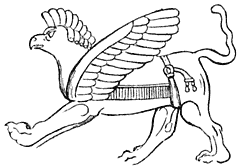
THE ASSYRIAN GRYPHON (Layard ii. 459).
BURGLARY is punished as an ordinary theft, namely by the amputation of the hand, but it is one of the niceties of Muḥammadan law, according to the Ḥanafī code, that if a thief break through the wall of the house, and enter therein, and take the property, and deliver it to an accomplice standing at the entrance of the breach, amputation of the hand is not incurred by either of the parties, because the thief who entered the house did not carry out the property. (Hidāyah, vol. ii. 103.)
BURIAL OF THE DEAD (جنازة Jināzah or Janāzah). The term Janāzah is used both for the bier and for the Muḥammadan funeral service. The burial service is founded upon the practice of Muḥammad, and varies but little in different countries, although the ceremonies connected with the funeral procession are diversified. In Egypt and Buk͟hārā, for instance, the male relations and friends of the deceased precede the corpse, whilst the female mourners follow behind. In India and Afg͟hānistān, women do not usually attend funerals, and the friends and relatives of the deceased walk behind the bier. There is a tradition amongst some Muḥammadans that no one should precede the corpse, as the angels go before. Funeral processions in Afg͟hānistān are usually very simple in their arrangements, and are said to be more in accordance with the practice of the Prophet, than those of Egypt and Turkey. It is considered a very meritorious act to carry the bier, and four from among the near relations, every now and then relieved by an equal number, carry it on their shoulders. Unlike our Christian custom of walking slowly to the grave, the Muḥammadans carry their dead quickly to the place of interment; for Muḥammad is related to have said, that it is good to carry the dead quickly to the grave, to cause the righteous person to arrive soon at happiness, and if he be a bad man, it is well to put wickedness away from one’s shoulders. Funerals should always be attended on foot; for it is said that Muḥammad on one occasion rebuked his people for following on horse-back. “Have you no shame?” said he, “since God’s angels go on foot, and you go upon the backs of quadrupeds?” It is a highly meritorious act to attend a funeral, whether it be that of a Muslim, a Jew, or a Christian. There are, however, two traditions which appear to mark a change of feeling on the part of the Prophet of Arabia towards the Jews and Christians. “A bier passed by the Prophet, and he stood up; and it was said to the Prophet, this is the bier of a Jew. ‘It is the holder of a soul,’ he replied, ‘from which we should take warning and fear.’ ” This rule is said to have been abrogated, for, “on one occasion the Prophet was sitting on the road when a bier passed, and the Prophet disliked that the bier of a Jew should be higher than his head, and he therefore stood up.” (Mishkāt, v. c. v.) Notwithstanding these contradictory traditions, we believe that in all countries Muḥammadans are wont to pay great respect to the funerals of both Jews and Christians.
The Muḥammadan funeral service is not recited in the graveyard, it being too polluted a place for so sacred an office; but either in a mosque, or in some open space near the dwelling of the deceased person or the graveyard. The owner of the corpse, i.e. the nearest relative, is the proper person to recite the service; but it is usually said by the family Imām, or the Qāẓī.
The following is the order of the service:—
Some one present calls out,—
“Here begin the prayers for the dead.”
Then those present arrange themselves in three, five, or seven rows opposite the corpse, with their faces Qiblah-wards (i.e. towards Makkah). The Imām stands in front of the ranks opposite the head (the Shīʿahs stand opposite the loins of a man) of the corpse, if it be that of a male, or the waist, if it be that of a female.
The whole company having taken up the Qiyām, or standing position, the Imām recites the Nīyah.
“I purpose to perform prayers to God for this dead person, consisting of four Takbīrs.”
Then placing his hands to the lobes of his ears, he says the first Takbīr.
“God is great!”
Then folding his hands, the right hand placed upon the left, below the navel, he recites the Subḥān:—
“Holiness to Thee, O God,
And to Thee be praise.
Great is Thy Name.
Great is Thy Greatness.
Great is Thy Praise.
There is no deity but Thee.”
Then follows the second Takbīr:—
“God is great!”
Then the Durūd:—
“O God, have mercy on Muḥammad and upon his descendants, as Thou didst bestow mercy, and peace, and blessing, and compassion, and great kindness upon Abraham and upon his descendants.
“Thou art praised, and Thou art great!
“O God, bless Muḥammad and his descendants, as Thou didst bless and didst have compassion and great kindness upon Abraham and upon his descendants.”
Then follows the third Takbīr:—
“God is great!”
After which the following prayer (Duʿā) is recited:—
“O God, forgive our living and our dead and those of us who are present, and those who are absent, and our children, and our full grown persons, our men and our women. O God, those whom Thou dost keep alive amongst us, keep alive in Islām, and those whom Thou causest to die, let them die in the Faith.”
Then follows the fourth Takbīr:—
“God is great!”
Turning the head round to the right, he says:—
“Peace and mercy be to Thee.”
Turning the head round to the left, he says:—
“Peace and mercy be to Thee.”
The Takbīr is recited by the Imām aloud, but the Subḥān, the Salām, the Durūd, and the Duʿā, are recited by the Imām and the people in a low voice.
The people then seat themselves on the ground, and raise their hands in silent prayer in behalf of the deceased’s soul, and afterwards addressing the relatives they say, “It is the decree of God.” To which the chief mourner replies, “I am pleased with the will of God.” He then gives permission to the people to retire by saying, “There is permission to depart.”
Those who wish to return to their houses do so at this time, and the rest proceed to the grave. The corpse is then placed on its back in the grave, with the head to the north and feet to the south, the face being turned towards Makkah. The persons who place the corpse in the grave repeat the following sentence: “We commit thee to earth in the name of God and in the religion of the Prophet.”
The bands of the shroud having been loosed, the recess, which is called the laḥd, is closed in with unburnt bricks and the grave filled in with earth. [GRAVE.] In some countries it is usual to recite verse 57 of the XXth Sūrah of the Qurʾān as the clods of earth are thrown into the grave; but this practice is objected to by the Wahhābīs, and by many learned divines. The verse is as follows:—
“From it (the earth) have We (God) created you, and unto it will We return you, and out of it will We bring you forth the second time.”
After the burial, the people offer a fātiḥah (i.e. the first chapter of the Qurʾān) in the name of the deceased, and again when they have proceeded about forty paces from the grave they offer another fātiḥah; for at this juncture, it is said, the two angels Munkar and Nakīr examine the deceased as to his faith. [PUNISHMENTS OF THE GRAVE.] After this, food is distributed to beggars and religious mendicants as a propitiatory offering to God, in the name of the deceased person.
If the grave be for the body of a woman, it should be to the height of a man’s chest, if for a man, to the height of the waist. At the bottom of the grave the recess is made on the side to receive the corpse, which is called the lāḥid or laḥd. The dead are seldom interred in coffins, although they are not prohibited.
To build tombs with stones or burnt bricks, or to write a verse of the Qurʾān upon them, is forbidden in the Ḥadīs̤; but large stone and brick tombs are common to all Muḥammadan countries, and very frequently they bear inscriptions.
On the third day after the burial of the dead, it is usual for the relatives to visit the grave, and to recite selections from the Qurʾān. Those who can afford to pay Maulavīs, employ these learned men to recite the whole of the Qurʾān at the graves of their deceased relatives; and the Qurʾān is divided into sections to admit of its being recited by the several Maulavīs at once. During the days of mourning the relatives abstain from wearing any article of dress of a bright colour, and their soiled garments remain unchanged.
A funeral procession in Egypt is graphically described by Mr. Lane in his Modern Egyptians. We give the account as it contrasts strikingly with the simple processions of Sunnī Muḥammadans in India.
“The first persons are about six or more poor men, called ‘Yamanīyah,’ mostly blind, who proceed two and two, or three and three, together. Walking at a moderate pace, or rather slowly, they chant incessantly, in a melancholy tone, the profession of faith (‘There is no deity but God; Muhammad is God’s Apostle; God favour and preserve him!’). They are followed by some male relations and friends of the deceased, and, in many cases, by two or more persons of some sect of darweshes, bearing the flags of their order. This is a general custom at the funeral of a darwesh. Next follow three or four or more schoolboys; one of them carries a mus̤ḥaf (or copy of the Qurʾān), or a volume consisting of one of the thirty sections of the Qurʾān, placed upon a kind of desk formed of palm-sticks, and covered over, generally with an embroidered kerchief. These boys chant, in a higher and livelier voice than the Yamanīyah, usually some words of a poem called the Ḥashrīyah, descriptive of the events of the last day, the judgment, &c. The schoolboys immediately precede the bier, which is borne head-foremost. Three or four friends of the deceased usually carry it for a short distance; then three or four other friends bear it a little further; and then these are in like manner relieved. Casual passengers, also, often take part in this service, which is esteemed highly meritorious. Behind the bier walk the female mourners; sometimes a group of more than a dozen, or twenty; with their hair dishevelled, though generally concealed by the head-veil; crying and shrieking, as before described; and often, the hired mourners accompany them, celebrating the praises of the deceased. Among the women, the relations and domestics of the deceased are distinguished by a strip of linen or cotton stuff or muslin, generally blue, bound round the head, and tied in a single knot behind: the ends hanging down a few inches. Each of these also carries a handkerchief, usually dyed blue, which she sometimes holds over her shoulders, and at other times twirls with both hands over her head, or before her face. The cries of the women, the lively chanting of the youths, and the deep tones uttered by the Yamanīyah, compose a strange discord.
“The funeral procession of a man of wealth, or of a person of the middle classes, is sometimes preceded by three or four or more camels, bearing bread and water to give to the poor at the tomb, and is composed of a more numerous and varied assemblage of persons. The foremost of these are the Yamanīyah, who chant the profession of the faith, as described above. They are generally followed by some male friends of the deceased, and some learned and devout persons who have been invited to attend the funeral. Next follows a group of four or more faqīhs, chanting the ‘Sūratu ʾl-Anʿām’ (the VIth chapter of the Qurʾān); and sometimes, another group, chanting the ‘Sūratu Yā-sīn’ (the XXXVIth chapter); another, chanting the ‘Sūratu ʾl-Kahf’ (the XVIIIth chapter); and another chanting the ‘Sūratu ʾd-Duk͟hān’ (the XLIVth chapter). These are followed by some munshids, singing the ‘Burdah;’ and these by certain persons called ‘Aṣḥābu ʾl-Aḥzāb,’ who are members of religious orders founded by celebrated shaikhs. There are generally four or more of the order of the Ḥizbu ʾs-Sādāt, a similar group of the Ḥizbu ʾsh-Shāzilī, and another of the Ḥizbu ʾsh-Shaʿrāwī; each group chants a particular form of prayer. After them are generally borne two or more half-furled flags, the banners of one or other of the principal orders of darweshes. Then follow the school-boys, the bier, and the female mourners, as in the procession before described, and, perhaps, the led horses of the bearers, if these be men of rank. A buffalo, to be sacrificed at the tomb, where its flesh is to be distributed to the poor, sometimes closes the procession.
“The funeral of a devout shaikh, or of one of the great ʿUlamā, is still more numerously attended, and the bier of such a person is not covered with a shawl. A ‘walī’ is further honoured in his funeral by a remarkable custom. Women follow his bier, but, instead of wailing, as they would after the corpse of an ordinary mortal, they rend the air with the shrill and quavering cries of joy called ‘zaghārīt̤’; and if these cries are discontinued but for a minute, the bearers of the bier protest that they cannot proceed, that a supernatural power rivets them to the spot on which they stand. Very often, it is said, a ‘walī’ impels the bearers of his corpse to a particular spot. The following anecdote, describing an ingenious mode of puzzling a dead saint in a case of this kind, was related to me by one of my friends. Some men were lately bearing the corpse of a ‘walī’ to a tomb prepared for it in the great cemetery on the north of the metropolis, but on arriving at the gate called Bābu ʾn-Naṣr, which leads to the cemetery, they found themselves unable to proceed further, from the cause above-mentioned. ‘It seems,’ said one of the bearers, ‘that the shaikh is determined not to be buried in the cemetery of Bābu ʾn-Naṣr, and what shall we do?’ They were all much perplexed, but being as obstinate as the saint himself, they did not immediately yield to his caprice. Retreating a few paces, and then advancing with a quick step, they thought by such an impetus to force the corpse through the gateway; but their efforts were unsuccessful; and the same experiment they repeated in vain several times. They then placed the bier on the ground to rest and consult; and one of them, beckoning away his comrades to a distance beyond the hearing of the dead saint, said to them, ‘Let us take up the bier again, and turn it round several times till the shaikh becomes giddy; he then will not know in what direction we are going, and we may take him easily through the gate.’ This they did; the saint was puzzled as they expected, and quietly buried in the place which he had so striven to avoid.
“In the funerals of females and boys, the bier is usually only preceded by the Yamanīyah, chanting the profession of the faith, and by some male relations of the deceased; and followed by the female mourners; unless the deceased were of a family of wealth, or of considerable station in the world; in which case, the funeral procession is distinguished by some additional display. I shall give a short description of one of the most genteel and decorous funerals of this kind that I have witnessed: it was that of a young, unmarried lady. Two men, each bearing a large, furled, green flag, headed the procession, preceding the Yamanīyah, who chanted in an unusually low and solemn manner. These faqīrs, who were in number about eight, were followed by a group of fakīhs, chanting a chapter of the Qurʾān. Next after the latter was a man bearing a large branch of ‘Nabq’ (or lote-tree), an emblem of the deceased. On each side of him walked a person bearing a tall staff or cane, to the top of which were attached several hoops ornamented with strips of various coloured paper. These were followed by two Turkish soldiers, side by side, one bearing, on a small round tray, a gilt silver ‘qumqum’ of rose-water, and the other bearing, on a similar tray, a ‘mibk͟harah’ of gilt silver, in which some odoriferous substance (as benzoin, or frankincense) was burning. These vessels diffused the odour of their contents on the way, and were afterwards used to perfume the sepulchral vault. Passengers were occasionally sprinkled with the rose-water. Next followed four men, each of whom bore, upon a small tray, several small lighted tapers of wax, stuck in lumps of paste of ‘ḥinnā.’ The bier was covered with rich shawls, and its shāhid was decorated with handsome ornaments of the head, having, besides the ṣafā, a ‘quṣṣah almās’ (a long ornament of gold and diamonds worn over the forehead), and, upon its flat top, a rich diamond qurṣ. These were the jewels of the deceased, or were, perhaps, as is often the case, borrowed for the occasion. The female mourners, in number about seven or eight, clad in the usual manner of the ladies of Egypt (with the black silk covering, &c.), followed the bier, not on foot, as is the common custom in funerals in this country, but mounted on high-saddled asses; and only the last two or three of them were wailing; these being, probably, hired mourners. In another funeral procession of a female, the daughter of a Turk of high rank, the Yamanīyah were followed by six slaves, walking two by two. The first two slaves bore each a silver qumqum of rose-water, which they sprinkled on the passengers; and one of them honoured me so profusely as to wet my dress very uncomfortably; after which, he poured a small quantity into my hands; and I wetted my face with it, according to custom. Each of the next two bore a silver mibk͟harah, with perfume; and the other two carried a silver ʾāzqi (or hanging censer), with burning charcoal of frankincense. The jewels on the shāhid of the bier were of a costly description. Eleven ladies, mounted on high-saddled asses, together with several naddābahs, followed.”
BURNING THE DEAD. There is no express injunction, in either the Qurʾān or the Traditions, regarding the burning of dead bodies, although the burning of the living is strictly forbidden. For Muḥammad said, “Punish not with God’s punishment (which is fire), for it is not fit for anyone to punish with fire but God.” (Mishkāt, xiv. c. v. part 1.)
The teaching of the Traditions is that a dead body is as fully conscious of pain as a living body, for ʿĀyishah said, that the Prophet said, “The breaking of the bones of a corpse is the same as doing it in life.” (Mishkāt, v. c. vi. part 2.)
It is, therefore, pretty clearly established that cremation of the dead is strictly forbidden by the Muḥammadan religion. There is, however, nothing to confirm the impression that the burning of a corpse in any way prevents its soul entering paradise.
BURNING TO DEATH is strictly forbidden by Muslim law. ʿIkrimah relates that some apostates from Islām were brought to the K͟halīfah ʿAlī, and he burnt them; and when Ibn ʿAbbās heard of it, he said, “Had they been brought to me, I would not have burnt them; for the Prophet said, ‘Punish not with God’s punishment. Verily it is not fit for anyone to punish with fire but God.’ ” (Mishkāt, xiv. c. v. part 1.)
BURQAʿ (برقع). The veil or covering used for the seclusion of women when walking abroad. [VEILING OF WOMEN.]
BURŪJ (بروج). Lit. “Towers,” which some interpret as real towers wherein the angels keep watch. A term used for the twelve signs of the zodiac. [SIGNS OF THE ZODIAC.] Al-Burūj is the title of the LXXXVth Sūrah of the Qurʾān.
BURYING OF THE DEAD. It is said by commentators that God taught mankind to bury their dead when “God sent a crow to scratch the earth, to show him (Cain) how he might hide his brother’s body.” (Qurʾān, Sūrah v. 34; Tafsīr-i-Ḥusainī, in loco.) The custom of burying their dead is universal in Islām. The ceremonies connected with funerals will be found in the article on Burial. [BURIAL.]
BURYING-GROUND. Arabic مقبرة maqbarat or maqbarah, “The place of graves.” Persian Qabr-gāh, or Qabristān. They are sometimes spoken of by religious Muslims as Marqad, a “cemetery” or “sleeping-place,” but the name has not obtained a general application to burial-grounds in the East as it has in the West. They are generally situated outside the city, the graves being covered with pebbles, and distinguished by headstones, those on the graves of men being with a turban-like head. The graves are dug from north to south. The grave-yards are usually much neglected. The Wahhābīs hold it to be a meritorious act, in accordance with the injunctions of the Prophet, to neglect the graves of the dead, the erection of brick tombs being forbidden. (Hidāyah, Arabic ed., vol. i. p. 90.) A grave-yard does not become public property until the proprietor formally makes a gift or bequest of it. (Hidāyah, vol ii., p. 357.)
BUSHRĀ (بشرى). “Good news;” “the gospel.” A word used in the Traditions for the publication of Islām. (Mishkāt, xxiv. c. i.) “Accept good news, O ye sons of Tamīm,” which ʿAbdu ʾl-Ḥaqq says means “embrace Islām.”
BUYING. [BAIʿ.]
BUZURG (بزرگ). Lit. “great.” A Persian word used in the East for a saintly person, an old man, or a person of rank.
C.
CÆSAR. The Arabic and Persian form of the Latin Cæsar is Qaiṣar. The word occurs in the traditions of the Ṣaḥīḥu ʾl-Muslim (vol. ii. p. 99), where it is applied to the Emperor Heraclius, who received a letter from Muḥammad inviting him to Islām, when he was at Edessa on his way to Jerusalem, August, A.D. 628. The origin of the title is uncertain. Spartianus, in his life of Aelius verus (c. ii.), mentions four different opinions respecting its origin: (1) That the word signified an elephant in the language of the Moors, and was given as a surname to one of the Julii because he had killed an elephant; or (2) That it was given to one of the Julii because he had been cut (caesus) out of his mother’s womb after her death; or (3) Because he had been born with a great quantity of hair (caesaries) on his head; or (4) Because he had azure-coloured (caesii) eyes. Of these opinions the second is the one adopted by the Arabic-Persian Dictionary the G͟hiyās̤u ʾl-Lug͟hāt.
The first of the Julian family who occurs in history as having obtained the surname of Cæsar is Sex. Julius Cæsar, prætor in B.C. 208. It was first assumed as an imperial title by Augustus as the adopted son of the dictator, and was by Augustus handed down to his adopted son Tiberius. It continued to be used by Caligula, Claudius, and Nero, as members, either by adoption or female descent, of Cæsar’s family; but though the family became extinct with Nero, succeeding emperors still retained it as part of their titles, and it was the practice to prefix it to their own name, as, for instance, Imperator Cæsar Domitianus Augustus. The title was superseded in the Greek Empire under Alexis Commenus by that of Sebastocrator. In the west, it was conferred on Charles the Great, and was borne by those who succeeded him on the imperial throne. Although this dignity came to an end with the resignation of Francis II. in 1806, the title Kaiser is still assumed by the Emperors of Austria and Germany, and more recently by the Queen of England as Qaiṣar-i-Hind, or Empress of India.
CAIN. Arabic قابل Qābil (Qābīl). The account of Cain and Abel as given in the Qurʾān, Sūrah v. 30, will be found in the article ABEL. The Commentators say that the occasion of making the offering was as follows: Each of them being born with a twin sister, Adam by God’s direction ordered Cain to marry Abel’s twin sister, and Abel to marry Cain’s, but that Cain refused. They were then ordered to submit the question by making a sacrifice, and Cain offered a sheaf of the very worst of his corn, whilst Abel offered the best fatted lamb of his flock. (Tafsīru ʾl-Baiẓāwī, in loco.)
CALEB. Arabic كالب Kālab. The son of Jephunneh (Yūfannah). He is not mentioned in the Qurʾān, but his name occurs in the Tafsīru ʾl-Baiẓāwī, in Sūrah iv. 13.
CALF, GOLDEN, The, which the Israelites worshipped, is mentioned five times in the Qurʾān. Sūrahs ii. 48, 88; iv. 152; vii. 146; xx. 90. In Sūrah xx. 90, the person who made it is said to be as-Sāmirī. [MOSES.]
CALIPH. [KHALIFAH.]
CALUMNY is expressed by the word G͟hībah, which means anything whispered to the detriment of an absent person, although it be true. Buhtān, expressing a false accusation. It is strictly forbidden in both the Qurʾān and Ḥadīs̤. [GHIBAH.]
CAMEL. Arabic Ibil. In the Qurʾān (Sūrah lxxxviii. 17), the institution of camels to ride upon is mentioned as an example of God’s wisdom and kindness: “Do they not look then at the camel how she is created.” As a proof of the great usefulness of the camel to the Arabian, and of the manner in which its very existence has influenced his language, it is remarkable that in almost every page of the Arabic Dictionary Qāmūs (as also in Richardson’s edition), there is some reference to a camel.
Camels are a lawful sacrifice on the great festivals and on other occasions. And although it is lawful to slay a camel by ẕabḥ, or by merely cutting its throat, the most eligible method, according to Muslim law, is to slay a camel by naḥr, or by spearing it in the hollow of the throat near the breast-bone, because, says Abū Ḥanīfah, it is according to the sunnah, or practice of Muḥammad, and also because in that part of the throat three blood-vessels of a camel are combined. (Hamilton’s Hidāyah, vol. iv. p. 72.) There is zakāt, or legal alms, on camels. [ZAKAT.] Muḥammadan law rules that the person who leads a string of camels is responsible for anything any one of the camels may injure or tread down. (Ibid., iv. 379.)
CANAAN. Arabic Kanʿān. According to al-Jalālain and al-Baiẓāwī, the commentators, Canaan was the unbelieving son of Noah, but, according to the Qāmūs dictionary, the grandson, who was drowned in the flood, and whose case is recorded in the Qurʾān (Sūrah xi. 44). He is said to be a son of Noah’s wife Wāʿilah, who was an infidel. “And the Ark moved on them amid waves like mountains: and Noah called to his son—for he was apart—‘Embark with us, O my child! and be not with the unbelievers.’ He said, ‘I will betake me to a mountain that shall secure me from the water.’ He said, ‘None shall be secure this day from the decree of God, save him on whom He shall have mercy.’ And a wave passed between them, and he was among the drowned.”
CAPTIVES. Asīr, pl. Usārā and Usarāʾ. With respect to captives, the Imām, or leader of the army, has it in his choice to slay them, “because the Prophet put captives to death, and also because slaying them terminates wickedness”; or, he may if he choose make them slaves. It is not lawful for the Imām to send captives back to their home and country, because that would be to strengthen the cause of infidelity against Islām. If they become Muslims after their capture, they must not be put to death, but they may be sold after their conversion. A converted captive must not be suffered to return to his country, and it is not lawful to release a captive gratuitously. The only method of dividing plunder which consists of slaves, is by selling them at the end of the expedition and then dividing the money. (Hidāyah, ii. 160.) [SLAVERY.]
CARAVAN. Persian Kārwān, Arabic Qāfilah. As the roads in the East are often unsafe and lead through dreary wastes, merchants and travellers associate together for mutual defence and comfort. These companies are called both kārwān and qāfilah. The party is always under the direction of a paid director, who is called Kārwān- or Qāfilah-Bāshī. If a caravan is attacked on the road, the Muḥammadan law allows the punishment of crucifixion for the offence. (Hidāyah, vol. ii. 131.) But it is a curious provision of the Muslim law that if some of the travellers in a caravan commit a robbery upon others of the same caravan, punishment (i.e. of amputation) is not incurred by them. (Vol. ii. 137.)
CARRION (Arabic Maitah) is forbidden in the Qurʾān, Sūrah ii. 80. “That which dieth of itself, and blood, and swine’s flesh, and that over which any other name than that of God hath been invoked, is forbidden. But he who shall partake of them by constraint, without lust or wilfulness, no sin shall be upon him.”
CASTING LOTS. Zalam, or casting lots by shooting arrows, was an ancient Arabic custom, which is forbidden by Muḥammad in his Qurʾān, Sūrah v. 4; but qurʿah, or casting lots, in its ordinary sense, is not forbidden, for ʿĀyishah relates that when the Prophet went on a journey, he used to cast lots as to which wife he should take with him. (Mishkāt Bābu ʾl-Qaṣam.)
CATS. Arabic Hirrah. According to a Ḥadīs̤ of Abū Qutādah, who was one of the Companions, Muḥammad said, “Cats are not impure, they keep watch around us.” He used water from which a cat had drunk for his purifications, and his wife ʿĀyishah ate from a vessel from which a cat had eaten. (Mishkāt, book iii., c. 10, pt. 2.)
CATTLE. Arabic Anʿām. They are said in the Qurʾān to be the gift of God, Sūrah xl. 79, “God it is who hath made for you cattle, that ye may ride on some and eat others.”
Cattle kept for the purpose of labour, such as carrying burthens, drawing ploughs, &c., are not subject to zakāt, neither is there zakāt on cattle who are left to forage for one half year or more. (Hidāyah, i. 18.)
Al-Anʿām is the title of the sixth Sūrah of the Qurʾān.
CAVE, The Companions of the (Arabic Aṣḥābu ʾl-kahf), or the Seven Sleepers of Ephesus, form the subject of one of the chapters of the Qurʾān, Sūrah xviii. 6. [ASHABU ʾL-KAHF.]
CELIBACY (Arabic ʿUzūbah), although not absolutely condemned by Muḥammad, is held to be a lower form of life to that of marriage. It is related that ʿUs̤mān ibn Maz̤ʿūn wished to lead a celibate life, and the Prophet forbade him, for, said he, “When a Muslim marries he perfects his religion.” (Mishkāt, book xii. c. xx.)
CEYLON. Arabic Sarandīb. The Commentators say that when Adam and Eve were cast out of Paradise, Adam fell on the island of Ceylon, and Eve near Jiddah in Arabia, and that after a separation of 200 years, Adam was, on his repentance, conducted by the angel Gabriel to a mountain near Makkah, where he found and knew his wife, the mountain being named ʿArafah; and that afterwards he retired with her to Ceylon, when they continued to propagate their species. (D’Herbelot, Bibl. Orient., p. 55.)
CHASTITY. “Neither their (the Muslims’) tenets nor their practice will in any respect bear to come into competition with Christian, or even with Jewish morality.… For instance, we call the Muslims chaste because they abstained from indiscriminate profligacy, and kept carefully within the bounds prescribed as licit by their Prophet. But those bounds, besides the utmost freedom of divorce and change of wives, admitted an illimitable licence of cohabitation with ‘all that the right hand of the believer might possess,’ or, in other words, with any possible number of damsels he might choose to purchase, or receive in gift, or take captive in war.” (Muir’s Life of Mahomet, vol. i. 272.) [CONCUBINAGE, SLAVES, MUTʿAH, DIVORCE, MARRIAGE.]
CHARITY, as it implies tenderness and affection, is expressed by ḥubb, or maḥabbah; as it denotes almsgiving, it is ṣadaqah. He who is liberal and charitable to the poor is called muḥibbu ʾl-fuqarāʾ.
CHERUBIM. Arabic Karūbī, pl. Karūbīn; Lit. “Those who are near.” Heb. כְּרוּבִים. The word karūbīn is used by the commentator al-Baiẓāwī, for the angels mentioned in the Qurʾān, Sūrah xl. 70: “Those around it (the throne of God) celebrate the praise of their Lord, and believe in Him, and ask pardon for those who believe.” Al-Baiẓāwī says the Karūbīn are the highest rank, and the first created angels. Ḥusain says there are 70,000 ranks of them round the throne of God. (Tafsīru ʾl-Baiẓāwī, Tafsīru Ḥusain, in loco.)
CHESS. Arabic Shat̤ranj. According to the Hidāyah, “It is an abomination to play at chess, dice, or any other game, for if anything be staked it is gambling (maisir), which is expressly forbidden in the Qurʾān; or if, on the other hand, nothing be hazarded, it is useless and vain. Besides, the Prophet has declared all the entertainments of a Muslim to be vain except three: the breaking in of his horse, the drawing of his bow, and playing and amusing himself with his wives. Several of the learned, however, deem the game at chess lawful as having a tendency to quicken the understanding. This is the opinion of ash-Shāfiʿī. If a man play at chess for a stake, it destroys the integrity of his character, but if he do not play for a stake, the integrity of his character is not affected.” (Hamilton’s Hidāyah, vol. iv. p. 122.)
CHILDREN. Arabic Aulād. There are no special injunctions in the Qurʾān regarding the customs to be observed at the birth of an infant (circumcision not being even once mentioned in that book), nor with reference to the training and instruction of the young; but the subject is frequently referred to in the Traditions and in Muḥammadan books on Ethics. Muḥammadans have so largely incorporated the customs of the Hindus in India with their own, especially those observed at the births of children, that it is sometimes difficult to distinguish those which are special characteristics of Islām; many of the customs recorded in Herklots’ Musalmans, for example, being merely those common to Hindus as well as Muḥammadans. We shall, however, endeavour to describe those which are generally admitted to have some authority in the precepts of the Muslim religion.
(1.) At the birth of a child, after he has been properly washed with water and bound in swaddling clothes, he is carried by the midwife to the assembly of male relatives and friends, who have met on the occasion, when the chief Maulawī, or some person present, recites the Aẕān, or summons to prayer [AZAN], in the infant’s right ear, and the Iqāmah, which is the Aẕān with the addition of the words, “We are standing up for prayers” [IQAMAH], in the left ear; a custom which is founded on the example of the Prophet, who is related to have done so at the birth of his grandson Ḥasan (Mishkāt, book xviii. c. iv. 2). The Maulawī then chews a little date fruit and inserts it into the infant’s mouth, a custom also founded upon the example of Muḥammad. (Mishkāt, book xviii. c. iv. 1.) This ceremony being over, alms are distributed, and fātiḥahs are recited for the health and prosperity of the child. According to the traditions, the amount of silver given in alms should be of the same weight as the hair on the infant’s head—the child’s head being shaved for this purpose. (Mishkāt, ibid., part 2.) The friends and neighbours then visit the home, and bring presents, and pay congratulatory compliments on the joyful occasion.
(2.) The naming of the child should, according to the Traditions (Mishkāt, ibid.), be given on the seventh day; the child being either named after some member of the family, or after some saint venerated by the family, or some name suggested by the auspicious hour, the planet, or the sign of the zodiac. [EXORCISM.]
(3.) On this, the seventh day, is observed also the ceremony of ʿAqīqah, established by Muḥammad himself (Bābu ʾl-ʿAqīqah in Arabic Ed. Ṣaḥīḥ of Abū Dāūd, vol. ii. p. 36). It consists of a sacrifice to God, in the name of the child, of two he-goats for a boy, and one he-goat for a girl. The goats must be not above a year old, and without spot or blemish. The animal is dressed and cooked, and whilst the friends eat of it they offer the following prayer:—“O God! I offer to thee instead of my own offspring, life for life, blood for blood, head for head, bone for bone, hair for hair, skin for skin. In the name of the great God, I do sacrifice this goat!”
(4.) The mother is purified on the fortieth day, when she is at liberty to go about as usual, and it is on this day that the infant is generally placed in the swinging cradle peculiar to eastern households. It is a day of some rejoicing amongst the members of the Ḥaram.
(5.) As soon as the child is able to talk, or when he has attained the age of four years, four months, and four days, he is taught the Bismillah; that is, to recite the inscription which occurs at the commencement of the Qurʾān: “Bi-ʾsmi ʾllāhi ʾr-raḥmāni ʾr-raḥīm.” In the name of God the Merciful, the Gracious. After this ceremony, the child is sent to school and taught the alphabet, and to recite certain chapters of the Qurʾān by rote.
(6.) According to the opinion of Sunnī doctors, the circumcision of the child should take place in his seventh year; the operation being generally performed by the barber. [CIRCUMCISION.] The child is not required to observe all the customs of the Muslim law until he has arrived at puberty [PUBERTY]; but it is held incumbent on parents and guardians to teach him the prayers as soon as he has been circumcised.
(7.) The time when the child has finished reciting the whole of the Qurʾān, once through, is also regarded as an important epoch in the life of a child. On this occasion the scholar makes his obeisance to his tutor and presents him with trays of sweetmeats, a suit of clothes, and money.
As we have already remarked, the instruction of youth is a frequent subject of discussion in books of Muslim Ethics. The following, which is taken from the Ak͟hlāq-i-Jalālī, is an interesting specimen of Muḥammadan ideas on the subject:—The first requisite is to employ a proper nurse of a well-balanced temperament, for the qualities, both temperamental and spiritual, of the nurse are communicated to the infant. Next, since we are recommended by the Traditions to give the name on the seventh day (after birth), the precept had better be conformed to. In delaying it, however, there is this advantage, that time is given for a deliberate selection of an appropriate name. For, if we give the child an ill-assorted one, his whole life is embittered in consequence. Hence caution in determining the name is one of the parent’s obligations towards his offspring.
If we would prevent the child’s acquiring culpable habits, we must apply ourselves to educate him as soon as weaned. For though men have a capacity for perfection, the tendency to vice is naturally implanted in the soul. The first requisite is to restrain him absolutely from all acquaintance with those excesses which are characterised as vice. For the mind of children is like a clear tablet, equally open to any inscription. Next to that, he should be taught the institutes of religion and rules of propriety, and, according as his power and capacity may admit, confined to their practice, and reprehended and restrained from their neglect. Thus, at the age of seven, we are told by the Traditions to enjoin him merely to say his prayers; at the age of ten, if he omits them, to admonish him by blows. By praising the good and censuring the bad, we should render him emulous of right and apprehensive of wrong. We should commend him when he performs a creditable action, and intimidate him when he commits a reprehensible one; and yet we should avoid, if possible, subjecting him to positive censure, imputing it rather to oversight, lest he grow audacious. If he keep his fault a secret, we are not to rend away the disguise; but if he do so repeatedly, we must rebuke him severely in private, aggravating the heinousness of such a practice, and intimidating him from its repetition. We must beware, however, of too much frequency of detection and reproof, for fear of his growing used to censure, and contracting a habit of recklessness; and thus, according to the proverb, “Men grow eager for that which is withheld,” feeling a tendency to repeat the offence. For these reasons we should prefer to work by enhancing the attraction of virtue.
On meat, drink, and fine clothing, he must be taught to look with contempt, and deeply impressed with the conviction that it is the practice of women only to prize the colouring and figuring of dress; that men ought to hold themselves above it. The proprieties of meal-taking are those in which he should be earliest instructed, as far as he can acquire them. He should be made to understand that the proper end of eating is health and not gratification; that food and drink are a sort of medicine for the cure of hunger and thirst; and just as medicines are only to be taken in the measure of need, according as sickness may require their influence, food and drink are only to be used in quantity sufficient to satisfy hunger and remove thirst. He should be forbidden to vary his diet, and taught to prefer limiting himself to a single dish. His appetite should also be checked, that he may be satisfied with meals at the stated hours. Let him not be a lover of delicacies. He should now and then be kept on dry bread only, in order that in time of need he may be able to subsist on that. Habits like these are better than riches. Let his principal meal be made in the evening rather than the morning, or he will be overpowered by drowsiness and lassitude during the day. Flesh let him have sparingly, or he will grow heavy and dull. Sweetmeats and other such aperient food should be forbidden him, as likewise all liquid at the time of meals. Incumbent as it is on all men to eschew strong drinks, there are obvious reasons why it is superlatively so on boys, impairing them both in mind and body, and leading to anger, rashness, audacity, and levity, qualities which such a practice is sure to confirm. Parties of this nature he should not be allowed unnecessarily to frequent, nor to listen to reprehensible conversation. His food should not be given to him till he has despatched his tasks, unless suffering from positive exhaustion. He must be forbidden to conceal any of his actions, lest he grow bold in impropriety; for, manifestly, the motive to concealment can be no other than an idea that they are culpable. Sleeping in the day and sleeping overmuch at night should be prohibited. Soft clothing and all the uses of luxury, such as cool retreats in the hot season, and fires and fur in the cold, he should be taught to abstain from; he should be inured to exercise, foot-walking, horse-riding, and all other appropriate accomplishments.
Next, let him learn the proprieties of conversation and behaviour. Let him not be tricked out with trimmings of the hair and womanly attention to dress, nor be presented with rings till the proper time for wearing them. Let him be forbidden to boast to his companions of his ancestry or worldly advantages. Let him be restrained from speaking untruths or from swearing in any case, whether true or false; for an oath is wrongful in anyone, and repugnant to the letter of the Traditions, saving when required by the interest of the public. And even though oaths may be requisite to men, to boys they never can be so. Let him be trained to silence, to speaking only when addressed, to listening in the presence of his elders, and expressing himself correctly.
For an instructor he should have a man of principle and intelligence, well acquainted with the discipline of morals, fond of cleanliness, noted for stateliness, dignity, and humanity, well acquainted with the dispositions of kings, with the etiquette of dining in their company, and with the terms of intercourse with all classes of mankind. It is desirable that others of his kind, and especially sons of noblemen, whose manners have always a distinguished elegance, should be at school with him, so that in their society he may escape lassitude, learn demeanour, and exert himself with emulation in his studies. If the instructor correct him with blows, he must be forbidden to cry, for that is the practice of slaves and imbeciles. On the other hand, the instructor must be careful not to resort to blows, except he is witness of an offence openly committed. When compelled to inflict them, it is desirable in the outset to make them small in number and great in pain; otherwise the warning is not so efficacious, and he may grow audacious enough to repeat the offence.
Let him be encouraged to liberality, and taught to look with contempt on the perishable things of this world; for more ill comes from the love of money than from the simoom of the desert or the serpent of the field. The Imām al-G͟hazzālī, in commenting on the text, “Preserve me and them from idolatry,” says that by idols is here meant gold and silver; and Abraham’s prayer is that he and his descendants may be kept far removed from the worship of gold and silver, and from fixing their affections on them; because the love of these was the root of all evil. In his leisure hours he may be allowed to play, provided it does not lead to excess of fatigue or the commission of anything wrong.
When the discerning power begins to preponderate, it should be explained to him that the original object of worldly possessions is the maintenance of health; so that the body may be made to last the period requisite to the spirit’s qualifying itself for the life eternal. Then, if he is to belong to the scientific classes, let him be instructed in the sciences. Let him be employed (as soon as disengaged from studying the essentials of the religion) in acquiring the sciences. The best course is to ascertain, by examination of the youth’s character, for what science or art he is best qualified, and to employ him accordingly; for, agreeably to the proverb, “All facilities are not created to the same person”; everyone is not qualified for every profession, but each for a particular one.
This, indeed, is the expression of a principle by which the fortunes of man and of the world are regulated. With the old philosophers it was a practice to inspect the horoscope of nativity, and to devote the child to that profession which appeared from the planetary positions to be suitable to his nature. When a person is adapted to a profession, he can acquire it with little pains; and when unadapted, the utmost he can do is but to waste his time and defer his establishment in life. When a profession bears an incongruity with his nature, and means and appliances are unpropitious, we should not urge him to pursue it, but exchange it for some other, provided that there is no hope at all of succeeding with the first; otherwise it may lead to his perplexity. In the prosecution of every profession, let him adopt a system which will call into play the ardour of his nature, assist him in preserving health, and prevent obtusity and lassitude.
As soon as he is perfect in a profession, let him be required to gain his livelihood thereby; in order that, from an experience of its advantages, he may strive to master it completely, and make full progress in the minutiæ of its principles. And for this livelihood he must be trained to look to that honourable emolument which characterises the well-connected. He must not depend on the provision afforded by his father. For it generally happens, when the sons of the wealthy, by the pride of their parents’ opulence, are debarred from acquiring a profession, that they sink by the vicissitudes of fortune into utter insignificance. Therefore, when he has so far mastered his profession as to earn a livelihood, it is expedient to provide him with a consort, and let him depend on his separate earning. The Kings of Fārs, forbearing to bring their sons up surrounded by domestics and retinue, sent them off to a distance, in order to habituate them to a life of hardship. The Dilemite chiefs had the same practice. A person bred upon the opposite principle can hardly be brought to good, especially if at all advanced in years; like hard wood which is with difficulty straightened. And this was the answer Socrates gave, when asked why his intimacies lay chiefly among the young.
In training daughters to that which befits them, domestic ministration, rigid seclusion, chastity, modesty, and the other qualities already appropriated to women—no care can be too great. They should be made emulous of acquiring the virtues of their sex, but must be altogether forbidden to read and write. When they reach the marriageable age, no time should be lost in marrying them to proper mates. (See Ak͟hlāq-i-Jalālī, Thompson’s ed.)
CHILD STEALING. The hand of a thief is not to be cut off for stealing a free-born child, although there be ornaments upon it, because a free person is not property, and the ornaments are only appendages; and also because the thief may plead that he took the child up when it was crying, with a view to appease it, and to deliver it to the nurse. But Abū Yūsuf does not agree with Ḥanīfah; for he says where the value of the ornaments amounts to ten dirms, amputation is incurred. Amputation is also inflicted for stealing an infant slave, because a slave is property, although Abū Yūsuf says it is not. (Hidāyah, ii. 91.)
CHOSROES. Arabic K͟husraw. The King of Persia to whom Muḥammad sent a letter inviting him to Islām. He is said to be Nausherwān. (See G͟hiyās̤u ʾl-Lug͟hāt, in loco; refer also to Muir’s Life of Mahomet, vol. ii. 54 n.)
CHRIST. [JESUS CHRIST.]
CHRISTIANITY and CHRISTIANS. Arabic, Naṣrānīyah, “Christianity”; the terms used for Christians being Naṣrān, pl. Naṣāra, or ʿĪsawī.
Christianity seems to have been widely diffused in Arabia at the time of Muḥammad. According to Caussin de Perceval, who quotes from Arabic writers, Christianity existed amongst the Banū Tag͟hlib of Mesopotamia, the Banū ʿAbdu ʾl-Qais, the Banū Hāris̤ of Najrān, the Banū G͟hassān of Syria, and other tribes between al-Madīnah and al-Kūfah.
The historian Philostorges (Hist. Eccles. lib. 1, c. 3) tells us that a monk named Theophilus, who was an Indian bishop, was sent by the Emperor Constance, A.D. 342, to the Ḥimyarite King of Yaman, and obtained permission to build three Christian churches for those who professed Christianity; one at Zafār, another at ʿAdan, and a third at Hurmuz on the Persian Gulf. According to the same author, the Christian religion was introduced into Najrān in the fifth century. A bishop sent by the Patriarch of Alexandria was established in the city of Zafār, and we are told by Muslim authors, quoted by Caussin de Perceval, that a Christian church was built at Ṣanʿāʾ which was the wonder of the age, the Roman Emperor and the Viceroy of Abyssinia furnishing the materials and workmen for the building. The Arabs of Yaman were ordered by the ruler of Abyssinia to perform a pilgrimage to this new church instead of to the Kaʿbah; an edict which is said to have been resisted and to have given rise to the “War of the Elephant,” when Abrahah, the Viceroy of Egypt, took an oath that he would destroy the Meccan temple, and marched at the head of an army of Abyssinians, mounted on an elephant. This “War of the Elephant” marks the period of Muḥammad’s birth. [MUHAMMAD.]