DICTIONARY OF ISLĀM. (continued 25)
Reading edition
Sir William Muir gives the following account of the persecution:—
“Dzu Nowâs was a votary of Judaism, which he is said to have embraced on a visit to Medîna. This creed he supported with an intolerant and proselytizing adherence, which at last proved fatal to his kingdom. His bigotry was aroused by the prevalence and success of Christianity in the neighbouring province of Najrân; and he invaded it with a large army. The Christians offered a strenuous resistance, but yielded at length to the treacherous promise that no ill would be done to them. They were offered the choice of Judaism or death, and those who remained constant to the faith of Jesus were cruelly massacred. Deep trenches were dug and filled with combustible materials; the pile was lighted, and the Christian martyrs cast headlong into the flame. The number thus miserably burned, or slain by the sword, is stated at no less than twenty thousand.
“However much the account of this melancholy carnage may have been exaggerated, there can be no doubt of the cruel and bloody character of the tyrant’s administration in Najrân.
“News of the proceedings reached the Emperor Justin I., through his ambassador at Hîra, to which court Dzu Nowâs had exultingly communicated tidings of his triumph. One of the intended victims, Dous dzu Tholabân, also escaped to Constantinople, and holding up a half-burnt gospel, invoked, in the name of outraged Christendom, retribution upon the oppressor. The Emperor was moved, and indited a despatch to the Najâshi, or Prince of the Abyssinians, desiring him to take vengeance upon the barbarous Nimyarite. Immediately an armament was set on foot, and in a short time seventy thousand warriors embarked in thirteen hundred merchant ships or transports, crossed the narrow gulph which separates Yemen from Adulis. Dzu Nowâs was defeated. In despair, he urged his horse into the sea, and expiated in the waves the inhumanities of his career. The Abyssinian victory occurred in 525 A.D.” (Life of Mahomet, 1st ed., Intro., p. clxii.)
NAJSH (نجش). “Exciting; stirring up.” The practice of enhancing the price of goods, by making a tender for them without any intention of buying, but merely to incite others to offer a higher price. It is forbidden by Muḥammadan law. (Hamilton’s Hidāyah, vol. ii. p. 46.)
NAK͟Hʿ (نخع). The Banū ʾn-Nak͟hʿ, an Arabian tribe, the descendants of Qahlān, subdued by ʿAlī during the lifetime of Muḥammad, A.H. 10. Two hundred of this tribe came to tender their allegiance to the Prophet, it being the last deputation received by him. (Muir’s Life of Mahomet, new ed., p. 477.)
NAK͟HLAH (نخلة). A valley about midway between Makkah and at̤-T̤āʾif, famous as the scene of the first expedition planned by Muḥammad against Makkah in which blood was shed. (See Muir’s Life of Mahomet, new ed., p. 216 et seq.)
NĀKIḤ (ناكح). A legal term for a married man; a married woman is termed mankūḥah (منكوحة). The legal term for an unmarried person is ʾazab (عزب).
NAKĪR (نكير). One of the angels who interrogate the dead. [MUNKAR AND NAKIR.]
NAMĀZ (نماز). The Persian and Hindūstānī term for ṣalāt, the Muḥammadan liturgical prayer. [PRAYER.]
NAMES, SURNAMES. Arabic Ism (اسم), Laqab (لقب), Kunyah (كنية). The teaching of Muḥammad very greatly influenced the nomenclature of his followers, as is evident from the chapter devoted to the Traditions on the subject in the Mishkātu ʾl-Masābiḥ, entitled “Bābu ʾl-Asāmī,” book xxii. ch. viii., from which are extracted the following traditional sayings of Muḥammad:—
“The best names in the sight of God are ʿAbdu ʾllāh (the servant of God), ʿAbdu ʾr-Raḥmān (the servant of the Merciful One).”
“You must not name your slaves Yasār (abundance), Rabāḥ (gain), Najīḥ (prosperous), Aflaḥ (felicitous), because if you ask after one of these your domestic servants, and he be not present, the negative reply will express that abundance, or gain, or prosperity, or felicity, are not in your dwelling.”
“The vilest name you can give a human being is Maliku ʾl-Amlāk, or ‘King of Kings,’ because no one can be such but God Himself.”
“You must not say to your slaves, ‘My slave,’ or ‘My slave girl,’ for all your slaves are God’s, but say, ‘My boy,’ or ‘My girl,’ or ‘My youth,’ or ‘My lass.’ And a slave must not say to his master, Yā Rabbī! (i.e. My Lord!), but he may say to him Yā Saiyidī! (My Chief!).”
“Call your children after your Prophet (i.e. Muḥammad), but the names God likes best are ʿAbdu ʾllāh (servant of God), ʿAbdu ʾr-Raḥmān, and the next best names are Ḥāris̤ (husbandman), and Humām (high-minded). The worst of names is Ḥarb (enmity), or Murrah (bitterness).” [Heb. מָרָה, see Ruth i. 20.]
Shuraiḥ ibn Hāniʾ relates that his father came to the Prophet with his tribe, and the Prophet heard them calling him Abū ʾl-Ḥakam. When the Prophet said, “Why do you call him so? Ḥakam, ‘Ruler,’ is an attribute of God.” And the Prophet ordered him to call himself Abū Shuraiḥ, i.e. the father of Shuraiḥ, his eldest son.
Modified, somewhat, by these injunctions of the Prophet, Muḥammadan names have still continued to be ordered amongst learned Muslims according to the ancient custom of Arabia. Persons are often named—
(1) By a single name, as Muḥammad, Mūsā (Moses), Dāʾūd (David), Ibrāhīm (Abraham), Ḥasan, Aḥmad.
(2) As the father or mother of certain persons, e.g. Abū Dāʾūd, the father of David; or Ummu Salimah, the mother of Salimah.
(3) As the son of a certain one, e.g. Ibn ʿUmar, the son of ʿUmar; Ibn ʿAbbās, the son of ʿAbbās, &c.
(4) By a combination of words, e.g. Nūru ʾd-dīn, “Light of Religion”; ʿAbdu ʾllāh, “Servant of God.”
(5) By a nickname of harmless signification, e.g. Abū Hurairah, “the kitten’s father.”
(6) By the trade or profession, e.g. al-Manṣūr al-Ḥallāj, Manṣūr the dresser of cotton.
(7) By the name of his birth-place, e.g. al-Buk͟hārī, the native of Buk͟hārah.
These rules, guiding the nomenclature of the Arabians, give a strange sound to western ears in the names of celebrated authors. For instance, the celebrated compiler of the chief book of authentic traditions is known as “Abū ʿAbdi ʾllāh, Muḥammad, ibn Ismāʿīl ibn Ibrāhīm ibn Mug͟hīrah al-Juʿfī, al-Buk͟hārī,” which means that his name is Muḥammad and that he is the father of a son named ʿAbdu ʾllāh, and that his own father’s name was Ismāʿīl, the son of Ibrāhīm, the son of Mug͟hīrah, of the tribe of Juʿfī, and that he himself was born in Buk͟hārā.
Arabic names have undergone strange modifications when brought in contact with western languages, e.g. Averroës, the philosopher, is a corruption of Ibn Rashīd; Avicenna, of Ibn Sīnā; Achmet, the Sultan, of Aḥmad; Amurath, of al-Murād; Saladin, the celebrated warrior of the twelfth century, of the Arabic Ṣalāḥu ʾd-dīn, “the peace of religion.”
AN-NAML (النمل). “The Ants.” The title of the XXVIIth Sūrah of the Qurʾān, in the 18th verse of which the word occurs: “They came upon the valley of the ants.”
NĀMŪS (ناموس). The angel, spirit, or being, which Waraqah is related to have said appeared to Moses. See Ṣaḥīḥu ʾl-Buk͟hārī, p. 3, where it is said, when Muḥammad told Waraqah, the Jew, what he had seen on Mount Ḥirāʾ, Waraqah exclaimed, “It is the Nāmūs who appeared from God to Moses.”
ʿAbdu ʾl-Ḥaqq says Nāmūs means one who can take knowledge of the secret thoughts of a man, and is used in contradistinction to the word Jāsūs, “a spy,” who seeks to know the evil deeds of another.
According to the Kitābu ʾt-Taʿrifāt, it is the law of God.
Mr. Emanuel Deutsch says: “The nāmūs is a hermaphrodite in words. It is Arabic and also Greek. It is Talmudic. It is, in the first instance, νόμος, ‘law,’ that which by ‘custom and common consent’ has become so. In Talmudic phraseology it stands for the Thorah or Revealed Law. In Arabic it further means one who communicates a secret message. And all these different significations were conveyed by Waraqah to Muhammad.” (Literary Remains, p. 78.)
The word nāmūs occurs in the ethical work known as the Ak͟hlāq-i-Jalālī, in the following passage:—
“The maintenance of equity, then, is realised by three things: (1) The holy institute of God, (2) The equitable Prince, (3) Money, or, as the old philosophers laid it down, the foremost νόμος is the institute, the second νόμος is the Prince who conforms to the institute (for religion and government are twins); and the third νόμος is money (νόμος in their language meaning discipline and correction). Thus the institute or greatest arbitrator is obeyed of all; to this even the Prince or secondary arbitrator is bound to conform. While the third arbitrator, which is money, should be invariably under the authority of the second, which is the Prince. An intimation of this principle we have in the Qurʾān, Sūrah lvii. 25: “We have sent down the book, and the balance along with it, that man might stand by the right, and we have sent down steel (ḥadīd), wherein is mighty power and advantages to man.” The book in this passage alludes to the institute; the balance to that which tests the quantities of things, in fact any instrument for ascertaining the value of heterogeneous objects (money being such an one), and steel to the sword, which is grasped by the might of the wrath-exerting doom-pronouncing Prince.” (Ak͟hlāq-i-Jalālī, Thompson’s ed., p. 127.)
NAQL ṢAḤĪḤ (نقل صحيح). “Correct relation.” A term used for a Ḥadīs̤, or tradition, related by a person of authority. [TRADITIONS.]
AN-NAQSHBANDĪYAH (النقشبندية). An ascetic order of Faqīrs, the followers of K͟hwājah Pīr Muḥammad Naqshband. They are a very numerous sect, and perform the Ẕikr-i-K͟hafī, or silent religious devotion described in the article on ZIKR.
NĀQŪS (ناقوس). A thin oblong piece of wood, which is beaten with a flexible rod called wabīl (وبيل), used by the Christians of Muḥammad’s time to summon the people to worship. At first “the Companions” suggested either a lighted fire or the nāqūs as the call to prayer, but Muḥammad decided upon the aẕān. (Mishkāt, book iv. ch. v. pt. i.) This method of calling Christian people to prayer still exists in some Greek monasteries, and was seen and illustrated by the Hon. R. Curzon in 1833 (Visits to the Monasteries of the Levant). It is called the simandro (σιμανδρο) and is generally beaten by one of the monks. [AZAN.]
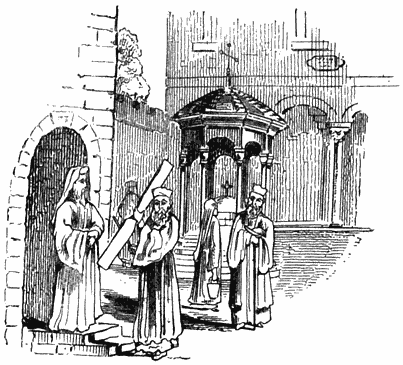
THE NAQUS AS USED IN A MONASTERY
AN-NĀR (النار), “the fire,” occurs in the Qurʾān very frequently for hell, e.g. Sūrah ii. 22: “Fear the fire whose fuel is men and stones.”
All Sunnī commentators understand the fire of hell in its literal sense. (See al-Baiẓāwī on the above verse.) But Ṣūfī writers understand it to be merely figurative.
NĀRAWĀ (ناروا). “Unlawful.” A Persian word for those things which are expressly forbidden by the Qurʾān and Ḥadīs̤. It corresponds with the Arabic Ḥarām. [LAW.]
AN-NĀS (الناس). “Mankind.” The title of the last Sūrah of the Qurʾān. The word occurs in this Sūrah, and is the last word in the Qurʾān, “from genii and men.”
NASAʾ (نساء). “To omit.” A term used in the Qurʾān for the system of intercalation of the year practised by the ancient Arabs, and which was abolished in the Qurʾān. (Sūrah ix. 37.) [INTERCALATION OF THE YEAR.]
NASAB (نسب). Family, race, lineage. The term, in its legal sense, is generally restricted to the descent of a child from his father, but it is sometimes applied to descent from the mother, and is generally employed in a larger sense to embrace other relationships. (Baillie’s Dig. Muh. Law, p. 389.)
AN-NASĀʾĪ (النسائى). “Sunanu ʾn-Nasāʾī,” or al-Mujtaba (the selected), a name given to the collection of traditions by Abū ʿAbdi ʾr-Raḥmān Aḥmad an-Nasāʾī. Born A.H. 215, died A.H. 303. He first compiled a large collection of traditions called the Sunanu ʾl-Kubrā, but he afterwards revised the whole and admitted only those traditions which were of authority. This collection (Sunanu ʾṣ-Ṣug͟hrā) is one of the Kutubu ʾs-Sittah, or “six (correct) books.” [TRADITIONS.]
NAṢĀRĀ (نصارى), pl. of Naṣrān, Nazarenes. The name given to professors of the Christian faith, both in the Qurʾān and the Traditions, and also in the theological works of the Muḥammadans. Christians are never called either ʿIsawī or Masīḥī, in Muḥammadan books written before the existence of modern missions; these titles having been applied to Christians by our own missionaries. [CHRISTIANITY.]
NĀSIK͟H (ناسخ). “One who cancels.” A term used for a verse or sentence of the Qurʾān or Ḥadīs̤, which abrogates a previous one. The one abrogated being called mansūk͟h. [QURʾAN.]
NASR (نسر). One of the idols of ancient Arabia, mentioned in the Qurʾān, Sūrah lxxi. 23. It was an idol which, as its name implies, was worshipped under the form of an eagle.
AN-NAṢR (النصر). “Help.” The title of the CXth Sūrah of the Qurʾān, in the first verse of which the word occurs: “When there comes God’s help and victory.”
NAṢṢ (نص). “A demonstration.” A legal term used for the express law of the Qurʾān or Ḥadīs̤.
NAṢṢ-I-KARĪM (نص كريم). “Gracious revelation.” A title given to the Qurʾān.
NAṢŪḤ (نصوح). “Sincere in friendship or repentance.” In the latter sense the word occurs once in the Qurʾān, Sūrah lxvi. 8: “O Believers! turn to God with the turning of true repentance.”
NĀSŪT (ناسوت). “Human nature.” A term used by the Ṣūfīs to express the natural state of every man before he enters upon the mystic journey. They say the law has been specially revealed for the guidance of people in this condition, but that the law is not necessary for the higher states. [SUFI.]
NAUḤAH (نوحة). “Lamentations for the dead.” The employment of paid mourners is forbidden by the Sunnī law, for Abū Saʿīdu ʾl-K͟hudrī says, “The Prophet cursed both the paid mourner and him that listened to her lamentations.” (Mishkāt, book v. ch. viii. pt. 2.)
NAU ROZ (نو روز). “New Year’s Day.” Chiefly observed amongst the Persians. In Persia it is a day of great festivity. It is observed the first day after the sun has crossed the vernal equinox, and the festivities last for a week or more.
NAWAʾIB (نوائب), pl. of nāʾibah. “Adversities.” A legal term used for any special tax levied by the sovereign of a country. The ruling of the Sunnī law regarding it is as follows:—
“If it extend only to what is just (such as exactions for digging a canal, for the wages of safe guards, for the equipment of an army to fight against the infidels, for the release of Muslim captives, or for the digging of a ditch, the mending of a fort, or the construction of a bridge), the tax is lawful in the opinion of the whole of our doctors. But if it extend to exactions wrongfully imposed, that is, to such as tyrants extort from their subjects, in that case, concerning the validity of security for it, there is a difference of opinion amongst our modern doctors.” (Hamilton’s Hidāyah, vol. ii. p. 594.)
NAZARENES. [NASARA.]
AN-NĀZIʿĀT (النازعات). “Those who tear out.” The title of the LXXIXth Sūrah of the Qurʾān, which opens with the verse, “By those who tear out violently,” referring to the Angel of Death and his assistants, who tear away the souls of the wicked violently, and gently release the souls of the good.
AN-NAẒĪR (النضير). A Jewish tribe residing in the vicinity of al-Madīnah, and known as the Banū ʾn-Naẓīr, or Nadhīr. They are celebrated in Muḥammadan history, as having accepted the Prophet’s mission after the battle of Badr, but when he met with reverses at Uḥud they forsook him, but they were afterwards defeated by the Prophet and exiled, some to K͟haibar, and some to Ḥirāʾ. They were the occasion of the LIXth Sūrah of the Qurʾān, known as the Sūratu ʾl-Ḥashr, or “Chapter of Emigration.” (See al-Baiẓāwī in loco.)
NAẔR WA NIYĀZ (نذر و نياز). “Vows and oblations.” These are given in the name of God, or in the name of the Prophet, or in the name of some Muslim saint. [VOWS.]
NEBUCHADNEZZAR. [BUKHT NASSAR.]
NECKLACE. Arabic qilādah (قلادة). The wearing of necklaces (among men) is forbidden in the Ḥadīs̤ (Mishkāt, Arabic edition, vol. ii. 5), although it is a custom very common amongst the Musalmāns of India.
NEGUS. [NAJASHI.]
NEHEMIAH. Not mentioned in the Qurʾān or in Muslim commentaries. But the following legend given in the Qurʾān Sūrah ii. 261, seems to have its origin in the circuit made by Nehemiah (Neh. ii. 13):—
“Hast thou considered him who passed by a city which had been laid in ruins. ‘How,’ said he, ‘shall God give life to this city, after she hath been dead?’ And God caused him to die for an hundred years, and then raised him to life. And God said, ‘How long hast thou waited?’ He said, ‘I have waited a day or part of a day.’ He said, ‘Nay, thou hast waited an hundred years. Look on thy food and thy drink; they are not corrupted; and look on thine ass; we would make thee a sign unto men: And look on the bones of thine ass, how we will raise them, then clothe them with flesh.’ And when this was shown to him, he said, ‘I acknowledge that God hath power to do all things.’ ”
The commentators, al-Kamālān, say it was either Jeremiah, or K͟hiẓr, or Ezekiel.
NEIGHBOURS. Arabic jār (جار), pl. jīrān. The Sunnīs hold that neighbours are those who worship in the same mosque, but some Shīʿah doctors say that a neighbour is anyone whose house is within forty cubits, whilst others maintain that the term extends to all the occupants of forty houses on either side. (Baillie’s Digest, Sunni Code, p. 579; Im. Code, p. 216.)
A neighbour has the next right of preemption to a partner in the sale and purchase of houses and lands. (Hidāyah, vol. iii. p. 562.)
The rights of a neighbour in case of the sale of property, are established by the Muḥammadan law, for the Prophet has said that the neighbour of a house has a superior right to the purchase of that house (i.e. next to immediate relatives), and the neighbour of lands has a prior claim to the purchase of those lands, and if he be absent, the seller must wait his return. (Hidāyah, vol. iv. p. 562.)
Muslims are enjoined in the Qurʾān (Sūrah iv. 40) to be kind to their neighbours. In the Traditions, it is said that Muḥammad was so frequently advised by the angel Gabriel to order his people to be kind to their neighbours, that he almost imagined that he (the angel) wished to make neighbours heirs to each other. It is also related that the Prophet said, “He is not a perfect Muslim who eats to his full and leaves his neighbour hungry.”
Abū Hurairah says that a man once said to the Prophet, “There is a woman who worships God a great deal, but she is very abusive to her neighbours.” And the Prophet said, “She will be in the fire.” The man then said, “But there is another woman who worships little and gives but little in alms, but she does not annoy her neighbours with her tongue?” The Prophet said, “She will be in Paradise.” (Mishkāt, book xxii. ch. xv.)
NESTOR. Arabic Naṣt̤ūr (نصطور). A Christian monk who resided in Syria, who is said to have borne witness to Muḥammad. The legend is not accepted by Sunnī writers, and Sir William Muir (Life of Mahomet, new ed., p. 21), says it is to be rejected as a puerile fabrication. It is, however, believed by the Shīʿahs, and the following is the story as given in the Shīʿah work entitled the Ḥayātu ʾl-Qulūb, on the supposed authority of Abū T̤ālib, Muḥammad’s uncle:—
“As we approached Shâm (Syria),” continued Abutâlib, “I saw the houses of that country in motion, and light above the brightness of the sun beaming from them. The crowd that collected to see Mohammed, that Yusoof of Misree perfection, made the Bâzârs impassable wherever we went, and so loud were exclamations at his beauty and excellence altogether, that the sound reached the frontiers of Shâm. Every monk and learned man came to see him. The wisest of the wise among the people of the Book, who was called Nestoor, visited him, and for three days was in his company without speaking a word. At the close of the third day, apparently overwhelmed with emotion, he came near and walked around the Prophet, upon which I said unto him, ‘O monk what do you want of the child?’ He said, ‘I wish to know his name.’ I told him it was Mohammed-bin-Abdullah. At the mention of the name the monk’s colour changed, and he requested to be allowed to see the shoulders of the Prophet. No sooner did he behold the seal of prophecy [SEAL OF PROPHECY], than he cast himself down, kissed it, and wept, saying, ‘Carry back this sun of prophecy quickly to the place of his nativity. Verily, if you had known what enemies he has here, you would not have brought him with you.’ The learned man continued his visit to the Prophet, treated him with the greatest reverence, and when we left the country gave him a shirt as a memento of his friendship. I carried Mohammed home with the utmost expedition, and when the news of our happy return reached Mekkah, great and small came out to welcome the Prophet, except Abujahl, who was intoxicated and ignorant of the event.”
Other traditions respecting this journey into Syria inform us that many more miracles attended it. Savage animals and birds of the air rendered the most obsequious homage to the Prophet. And when the party reached the bâzârs of Buṣrā they met a company of monks, who immediately changed colour, as if their faces had been rubbed over with saffron, while their bodies shook as in an ague. “They besought us to visit their chief in their great church. We replied, What have you to do with us? On which they said, What harm is there in your coming to our place of worship? Accordingly we went with them, they supposing that Mohammed was in our company, and entered a very large and lofty church, where we saw their great wise man sitting among his disciples with a book in his hand. After looking at the book and scrutinizing us, he said to his people, ‘You have accomplished nothing, the object of our inquiry is not here.’ He then asked who we were, to which we replied that we were Koraysh. ‘Of what family of that tribe?’ he further demanded. We answered that we were of the Benee Abdulshems. He then demanded if there was no other person belonging to our party besides those present. We told him there was a youth of the Benee Hâshim belonging to our company, who was called the orphan grandson of Abdulmutalib. On hearing this he shrieked, nearly swooned away, sprang up and cried, ‘Alas! alas! the Nasarânee religion is ruined!’ He then leaned on his crosier and fell into profound thought for a long time, with eight of his patriarchs and disciples standing around him. At last he said, ‘Can you show me that youth?’ We answered in the affirmative.
“He then accompanied us to the bâzâr, where we found the Prophet, with light beaming from the radiant moon of his face, and a great crowd of people around him, who had been attracted by his extraordinary beauty, and were buying his goods at the highest prices, while they sold their own to him at the cheapest rate. With the view of proving the knowledge of the wise man, we pointed out another individual as the object of his inquiry, but presently he recognised the Prophet himself, and shouted, ‘By the truth of the Lord Meseeh, I have found him!’ and overpowered with emotion, came and kissed his blessed head, saying, ‘Thou art holy!’ He then asked Mohammed many things concerning himself, all of which he satisfactorily answered. The wise man affirmed that if he were to live in the time of Mohammed’s prophecy, he would fight for him in the cause of truth, declaring that whoever obeyed him would gain everlasting life, and whoever rejected him would die eternal death.” (Merrick’s translation of Ḥayātu ʾl-Qulūb, p. 64.)
NEW MOON. Arabic Hilāl (هلال). The term is used for the first three days of the new moon.
NEW TESTAMENT. Arabic al-ʿAhdu ʾl-Jadīd (العهد الجديد). There is no evidence in the Qurʾān, or in the Traditions, that Muḥammad had ever seen, or was acquainted with, the New Testament. The Christian scriptures are spoken of in the Qurʾān as the Injīl, εὐαγγέλιον, “which was given to Jesus”; by which Muḥammadans understand a complete book somewhat similar to the Qurʾān. See Sūrah lvii. 27: “We caused our Apostles to follow in their footsteps (i.e. of Noah and Abraham), and We caused Jesus the son of Mary to follow them, and We gave him the Injīl, and We put into the hearts of those who followed him kindness and compassion; but as to the monastic life, they invented it themselves.” The only New Testament characters mentioned by name in the Qurʾān are Jesus, Mary, Zacharias, John, and Gabriel, and there is no direct reference to the Sacraments of Baptism and the Lord’s Supper, nor to the miracles or parables of Jesus. This is all the more remarkable, because the Old Testament history and its leading characters, are frequently mentioned in the Qurʾān. [INJIL, CHRISTIANITY.]
NEW YEAR. [NAUROZ.]
NICKNAME. Arabic nabaz (نبز), pl. anbāz. The calling of nicknames is forbidden in the Qurʾān, Sūrah xlix. 11: “O Believers, let not men laugh men to scorn who haply may be better than themselves. Neither let women laugh women to scorn, who haply may be better than themselves. Neither defame one another, nor call one another by nicknames.”
This verse is said to have been given when Ṣafīyah, one of the Prophet’s wives, complained that she had been taunted by the other women with her Jewish origin. Muḥammad answered her, “Canst thou not say, ‘Aaron is my father, Moses is my uncle, and Muḥammad is my husband.’ ” (See al-Baiẓāwī, in loco.)
NIFĀQ (نفاق). Hypocrisy, or professing with the lips to believe and hiding infidelity in one’s heart. (Kitābu ʾt-Taʿrīfāt, in loco.)
NIFĀS (نفاس). The condition of a woman after the birth of a child, during which period she is unclean and is not permitted to perform the usual prayers. According to the Sunnīs, it is a period of forty days, but according to the Shīʿahs, only ten.
NIGHT JOURNEY OF MUḤAMMAD. [MIʿRAJ.]
NIGHT PRAYERS. Arabic ṣalātu ʾl-layl (صلوة الليل), or ṣalātu ʾt-tahajjud (صلوة التهجد). From eight to twelve rakʿah prayers recited during the night, in addition to the witr prayers, which consist of an odd number of rakʿahs. These prayers are Sunnah, i.e. established according to the custom of the Prophet, but they are voluntary acts of devotion. (Mishkāt, book iv. ch. xxxii.)
NIKĀḤ (نكاح). A word which, in its literal sense signifies conjunction, but which in the language of the law implies the marriage contract. [MARRIAGE.]
NIMROD. Arabic Numrūd (نمرود). Heb. נִמְרוֹד. All Muḥammadan commentators say he was the son of Canaan (Kanʿān), and not, as stated in Genesis x. 8, the son of Cush.
He is referred to in the Qurʾān in the following passage:—
Sūrah ii. 260: “Hast thou not thought on him who disputed with Abraham about his Lord, because God had given him the kingdom? When Abraham said, ‘My Lord is He who maketh alive and causeth to die:’ He said, ‘It is I who make alive and cause to die!’ Abraham said, ‘Since God bringeth the sun from the East, do thou, then bring it from the West.’ The infidel was confounded; for God guideth not the evil doers.”
Sūrah xxi. 68, 69: “They said: ‘Burn him, and come to the succour of your gods: if ye will do anything at all.’ We said, ‘O fire! be thou cold, and to Abraham a safety!’”
The Rabbins make Nimrod to have been the persecutor of Abraham (comp. Targ. Jon. on Gen. xv. 7; Tr. Bava Bathra, fol. 91a.; Maimon. More Nevochim, iii. 29; Weil, Legenden, p. 74), and the Muḥammadan commentators say, that by Nimrod’s order a large space was inclosed at Kūs̤ā, and filled with a vast quantity of wood, which being set on fire, burned so fiercely that none dared to venture near it; then they bound Abraham, and putting him into an engine (which some suppose to have been of the Devil’s invention), shot him into the midst of the fire, from which he was preserved by the angel Gabriel, who was sent to his assistance, the fire burning only the cords with which he was bound. They add that the fire, having miraculously lost its heat in respect to Abraham, became an odoriferous air, and that the pile changed to a pleasant meadow, though it raged so furiously otherwise, that, according to some writers, about two thousand of the idolaters were consumed by it.
This story seems to have had no other foundation than that passage of Moses, where God is said to have brought Abraham out of Ur of the Chaldees, misunderstood; which word the Jews, the most trifling interpreters of scripture, and some moderns who have followed them, have translated out of the fire of the Chaldees; taking the word Ur, not for the proper name of a city, as it really is, but for an appellative signifying “fire.” However, it is a fable of some antiquity, and credited not only by the Jews, but by several of the eastern Christians; the twenty-fifth of the second Kānūn, or January, being set apart in the Syrian calendar for the commemoration of Abraham’s being cast into the fire.
The Jews also mention some other persecutions which Abraham underwent on account of his religion, particularly a ten years’ imprisonment, some saying he was imprisoned by Nimrod, and others by his father Terah. Some tell us that Nimrod, on seeing this miraculous deliverance from his palace, cried out that he would make an offering to the God of Abraham; and that he accordingly sacrificed four thousand kine. But if he ever relented, he soon relapsed into his former infidelity, for he built a tower that he might ascend to heaven to see Abraham’s God, which being overthrown, still persisting in his design, he would be carried to heaven in a chest borne by four monstrous birds; but after wandering for some time through the air, he fell down on a mountain with such force that he made it shake, whereto (as some fancy) a passage in the Qurʾān alludes (Sūrah xiv. 47), which may be translated, “Although their contrivances be such as to make the mountains tremble.” Nimrod, disappointed in his design of making war with God, turns his arms against Abraham, who being a great prince, raised forces to defend himself; but God, dividing Nimrod’s subjects, and confounding their language, deprived him of the greater part of his people, and plagued those who adhered to him by swarms of gnats, which destroyed almost all of them; and one of those gnats having entered into the nostril, or ear, of Nimrod, penetrated to one of the membranes of his brain, where growing bigger every day, it gave him such intolerable pain that he was obliged to cause his head to be beaten with a mallet, in order to procure some ease, which torture he suffered four hundred years; God being willing to punish by one of the smallest of his creatures him who insolently boasted himself to be lord of all. A Syrian calendar places the death of Nimrod, as if the time were well known, on the 8th of Tamūz, or July. (See Sale’s Koran; D’Herbelot’s Bibl. Orient.; al-Baiẓāwī’s Com.)
NĪNAWĀ (نينوى). [NINEVEH.]
NINEVEH. Arabic Nīnawā (نينوى). Heb. נִינְוֵה. Not mentioned by name in the Qurʾān, but according to al-Baiẓāwī it is the city of “a hundred thousand persons, or even more,” to whom Jonah was sent. See Qurʾān, Sūrah xxxvii. 147.
AN-NISĀ (النساء). “Women.” The title of the IVth Sūrah of the Qurʾān, in the first verse of which the word occurs, and which treats to a great extent the subject of women.
NIṢĀB (نصاب). An estate or property for which zakāt, or legal alms, must be paid. [ZAKAT.]
NĪYAH (نية). A vow; intention; purpose. A term used for the vow or declaration of the intention to perform prayers. ‘I have purposed to offer up to God only with a sincere heart this morning (or, as the case may be), with my face Qiblah-wards two (or, as the case may be) rakʿah prayers farẓ (sunnah, nafl, or witr).’ It is also used by a Muslim about to perform the pilgrimage or the month’s fast. The formula is necessary to render an act of devotion acceptable. [PRAYER.]
NIYĀZ-I-ALLĀH (نياز الله). A Persian term for offerings in the name of God.
NIYĀZ-I-RASŪL (نياز رسول). A Persian term for offerings in the name of the Prophet.
NOAH. Arabic Nūḥ (نوح). Heb. נוֹחַ. A prophet to whom Muḥammadans give the Kalimah, or title, of Nabīyu ʾllāh, “the Prophet of God.” He is not supposed to have been the inspired author of “a Book.”
The following is the account given of him and of the flood in the Qurʾān (with Mr. Lane’s annotations in italics: see second edition, by Mr. Stanley Lane-Poole):—
“We formerly sent Noah unto his people, saying, Verily I am unto you a plain admonisher that ye worship not [any] but God. Verily I fear for you, if ye worship any other, the punishment of an afflictive day in this world and the world to come.—But the chiefs who disbelieved among his people replied, We see thee not to be other than a man, like unto us; and we see not any to have followed thee except the meanest of us, as the weavers and the cobblers, at first thought (or rashly), nor do we see you to have any excellence above us: nay, we imagine you to be liars in your claim to the apostolic commission. He said, O my people, tell me, if I have an evident proof from my Lord and He hath bestowed on me mercy (the gift of prophecy) from Himself which is hidden from you, shall we compel you to receive it when ye are averse thereto? We cannot do so. And, O my people, I ask not of you any riches for it; namely, for delivering my message. My reward is not due from any but God; and I will not drive away those who have believed as ye have commanded me [because they are poor people]. Verily they shall meet their Lord at the resurrection, and He will recompense them, and will exact for them [reparation] from those who have treated them with injustice, and driven them away. But I see you [to be] a people who are ignorant of the end of your case. And, O my people, who will defend me against God if I drive them away? Will ye not then consider? And I do not say unto you, I have the treasures of God; nor [do I say], I know the things unseen; nor do I say, Verily I am an angel; nor do I say, of those whom your eyes contemn, God will by no means bestow on them good: (God best knoweth what is in their minds:) verily I should in that case be [one] of the offenders.—They replied, O Noah, thou hast disputed with us and multiplied disputes with us: now bring upon us that punishment wherewith thou threatenest us, if thou be of those that speak truth. He said, Only God will bring it upon you, if He please to hasten it unto you; for it is His affair, not mine; and ye shall not escape God: nor will my counsel profit you, if I desire to counsel you, if God desire to lead you into error. He is your Lord; and unto Him shall ye be brought back.” (Sūrah xi. 27–36.)
“And it was said by revelation unto Noah, Verily there shall not believe of thy people [any] but they who have already believed; therefore be not grieved for that which they have done.” (Sūrah xi. 38.)
“And he uttered an imprecation upon them, saying, O my Lord, leave not upon the earth any one of the unbelievers; for if Thou leave them, they will lead Thy servants into error, and will not beget [any] but a wicked, ungrateful [offspring]. O my Lord, forgive me and my parents (for they were believers), and whomsoever entereth my house (my abode, or my place of worship), being a believer, and the believing men, and the believing women, (to the day of resurrection,) and add not to the offenders [aught] save destruction.” (Sūrah lxxi. 27–29.)
“And God answered his prayer, and said, Construct the ark in our sight and according to our revelation, and speak not unto Me concerning those who have offended, to beg Me not to destroy them; for they [shall be] drowned. And he constructed the ark; and whenever a company of his people passed by him, they derided him. He said, If ye deride us, we will deride you, like as ye deride, when we are saved and ye are drowned, and ye shall know on whom shall come a punishment which shall render him vile, and whom shall befall a lasting punishment. [Thus he was employed] until when Our decree for their destruction came to pass, and the baker’s oven overflowed with water (for this was a signal unto Noah), We said, Carry into it (that is, into the ark) of every pair, male and female, of each of these descriptions, two (and it is related that God assembled for Noah the wild beasts and the birds and other creatures, and he proceeded to put his hands upon each kind, and his right hand fell always upon the male, and his left upon the female, and he carried them into the ark), and thy family (excepting him upon whom the sentence of destruction hath already been pronounced, namely, Noah’s wife, and his son Canaan: but Shem and Ham and Japheth and their three wives he took), and those who have believed; but there believed not with him save a few: they were six men and their wives: and it is said that all who were in the ark were eighty, half of whom were men and half women. And Noah said, Embark ye therein. In the name of God [be] its course and its mooring. Verily my Lord is very forgiving [and] merciful.—And it moved along with them amid waves like mountains; and Noah called unto his son, Canaan, who was apart from the ark, O my child, embark with us, and be not with the unbelievers! He replied, I will betake me to a mountain which will secure me from the water. [Noah] said, There is nought that will secure to-day from the decree of God [any] but him on whom He hath mercy. And the waves intervened between them; so he became [one] of the drowned. And it was said, O earth, swallow up thy water (whereupon it drank it up, except what had descended from heaven, which became rivers and seas), and, O heaven, cease from raining;—and the water abated, and the decree was fulfilled, and it (namely, the ark), rested on El-Joodee (a mountain of El-Jezeereh, near El-Mósil); and it was said, Perdition to the offending people!” (Sūrah xi. 39–46.)
“And Noah called upon his Lord, and said, O my Lord, verily my son is of my family, and Thou hast promised me to save them, and verily Thy promise is true, and Thou art the most just of those who exercise judgment. God replied, O Noah, verily he is not of thy family who should be saved, or of the people of thy religion. Verily it (namely, thine asking Me to save him) is not a righteous act; for he was an unbeliever, and there is no safety for the unbelievers; therefore ask not of Me that wherein thou hast no knowledge. I admonish thee, lest thou become [one] of the ignorant.—Noah said, O my Lord, I beg Thee to preserve me from asking Thee that wherein I have no knowledge; and if Thou do not forgive me and have mercy upon me, I shall be of those who suffer loss.—It was said, O Noah, descend from the ark, with peace from Us, and blessings, upon thee and upon peoples [that shall proceed] from those who are with thee in the ark (that is, their believing posterity); but peoples [that shall proceed] from those who are with thee We will permit to enjoy the provisions of this world; then a painful punishment shall befall them from Us, in the world to come; they being unbelievers.” (Sūrah xi. 47–50.)
The commentator, al-Baiẓāwī, says that Noah went into the ark on the tenth of Rajab, and came out of it on the tenth of Muḥarram; which therefore became a fast; so that the whole time of Noah’s being in the ark, according to him, was six months; and that Noah was two years in building the ark, which was framed of Indian plane-tree; that it was divided into three stories, of which the lower was designed for the beasts, the middle one for the men and women, and the upper for the birds; and the men were separated from the women by the body of Adam, which Noah had taken into the ark.
NOMOS. Greek νόμος. [NAMUS.]
NOSE, Cutting off. There is retaliation for cutting off a nose: a nose for a nose. (Hidāyah, vol. iv. p. 294.)
NUBŪWAH (نبوة). “Prophecy.” The office or work of a nabī or prophet. [PROPHETS.]
NŪḤ (نوح). [NOAH.]
AN-NUJABĀʾ (النجباء), the pl. of Najīb. “The Excellent ones.” According to the Ṣūfīs, forty saintly characters who always exist on earth for the benefit of its people. (See Kashshāfu ʾl-Iṣt̤ilaḥāt in loco.) [ABDAL.]
NUʿMĀN (نعمان). The name of several of the Kings of Ḥirāʾ. Nuʿmān V. is celebrated in the annals of the history of Arabia, because his reign approached close upon the rise of Islām, and he was the patron of several poets of renown, who have celebrated his name. (See Muir’s Life of Mahomet, 1st ed., Intro. p. clxxxi.)
Nuʿmān is also the popular title of the Imām Abū Ḥanīfah. [HANIFAH.]
NUMRŪD (نمرود). [NIMROD.]
NŪN (نون). The letter N ن, which occurs at the commencement of the LXVIIIth Sūrah of the Qurʾān. The meaning of which is acknowledged by all commentators to be a mystery.
Al-Baiẓāwī says it is supposed that nūn either means an inkstand, referring to the pen of the first verse, or a fish, referring to that which swallowed Jonah mentioned in the 48th verse of this Sūrah, but he thinks it is merely an initial letter, the meaning of which is unknown to mortal man.
NUPTIAL FEAST. [WALIMAH, MARRIAGE.]
AN-NUQABĀʾ (النقباء), the pl. of Naqīb. “The Watchmen.” According to the Ṣūfīs, they are three hundred persons who are ever to be found in the world, and who are engaged in its enlightenment. (See Kitābu ʾt-Taʿrīfāt, in loco.) [ABDAL.]
NUQŪʿU ʾZ-ZABĪB (نقوع الزبيب). “Infusion of raisins.” Water in which raisins are steeped until it becomes sweet and is affected in its substance. It is a prohibited liquor. (Hamilton’s Hidāyah, vol. iv. p. 159.)
AN-NŪR (النور). “The Light.” One of the ninety-nine names or attributes of God. It occurs in the Qurʾān, Sūrah xxiv. 35:—
“God is the Light of the Heavens and of the Earth. His Light is like a niche in which is a lamp—the lamp encased in glass—the glass, as it were, a glistening star. From a blessed tree is it lighted, the olive neither of the East nor the West, whose oil would well nigh shine out, even though fire touched it not! It is light upon light. God guideth whom He will to His light, and God setteth forth parables to men, for God Knoweth all things.”
NŪR-I-MUḤAMMADĪ (نور محمدى). Persian for “The Light of Muḥammad.” The original essence of Muḥammad, known in Arabic as the Haqīqatu ʾl-Muḥammadīyah, under which title the subject is discussed in this dictionary. [HAQIQATU ʾL-MUHAMMADIYAH.]
NŪRU ʾL-ANWĀR (نور الانوار). “The Light of Lights.” A title given to the Divine Being. (See ʿAbdu ʾr-Razzāq’s Dict. of Ṣūfī Terms.)
NUZŪL (نزول). “Descent.” (1) The portions of the Qurʾān as they were declared by Muḥammad to have descended from heaven by the hand of Gabriel.
(2) Property which falls to the state from default of heir, or which has been confiscated.
O.
OATH. Arabic yamīn (يمين), pl. yamināt, aimān. The teaching of the Qurʾān with reference to an oath, is expressed in the following verses:—
Sūrah ii. 225: “God will not punish you for an inconsiderate word in your oath, but he will punish you for that which your hearts have assented to.”
Sūrah v. 91: “God will not punish you for an inconsiderate word in your oaths, but he will punish you in regard to an oath taken seriously. Its expiation shall be to feed ten poor persons with such moderate food as ye feed your own families with, or to clothe them; or to set free a captive. But he who cannot find means shall fast three days.”
Sūrah xvi. 96: “Take not your oaths between you deceitfully.”
The following is the teaching of Muḥammad, as given in the Traditions:—
“Whoever swears to a thing and says, ‘If it please God,’ and acts contrary to his oath, it is no sin.”
“Swear not by idols or by your own fathers.”
“Swear not by God except it be to the truth.”
“Whoever swears by the prayers or by the fast, or by the pilgrimage, is not a Muslim.”
The Prophet used generally to swear in these words: “No, by the Turner of Hearts.”
According to the Hidāyah (Hamilton’s ed., vol. vi., pp. 1, 2), yamīn is constituted by the use of the name of Almighty God, or by any of those appellations by which the Deity is generally known or understood.
False oaths are of three kinds:—
(1) Al-Yamīnu ʾl-G͟hamūs (اليمين الغموس). An oath taken concerning a thing already past, in which is conveyed an intentional falsehood on the part of the swearer: such an oath is highly sinful, the Prophet having declared—“Whosoever sweareth falsely, the same shall be condemned to hell.”
(2) Al-Yamīnu ʾl-munʿaqid (اليمين المنعقد). An oath taken concerning a matter which is to come. Thus, a man swears that he will do such a thing, or he will not do such a thing, and where he fails in this, expiation is incumbent upon him, which expiation is established on the authority of the sacred writings.
(3) Yamīnu ʾl-Lag͟hw (يمين اللغو). An oath taken concerning an incident or transaction already past, where the swearer believes that the matter to which he thus bears testimony accords with what he swears, though it should happen to be actually otherwise; in which case it may be hoped from the divine mercy that the swearer will not be condemned for such an oath.
The expiation, or kaffārah, is of no avail for the Yamīnu ʾl-G͟hamūs, but it is necessary for the Yamīnu ʾl-munʿaqid. It consists of either feeding or clothing ten poor persons, or releasing a Muslim captive.
The Muslim law with regard to oaths is a modification of the Talmudic law, for from the Divine law the Jewish doctors deduced many special cases of perjury, which are thus classified:—
(1) Jus jurandum promissorium, a rash or inconsiderate oath for the future, or a false assertion respecting the past (Lev. v. 4).
(2) Vanum, an absurd contradictory assertion.
(3) Depositi, breach of contract denied (Lev. xix. 11).
(4) Testimonii, judicial perjury (Lev. v. 1). (H. W. P. in Smith’s Dict. of the Bible.)
The Mosaic law admitted expiation in the case of rash or forgotten oaths, vide Lev. v. 4, but the Yamīnu ʾl-munʿaqid of Muḥammadan law allows a much greater latitude, for it applies to all vows or oaths excepting those intentionally false made with regard to future events.
The teaching of Muḥammadan jurists on the subject of oaths and vows, exhibits that reservatio mentalis of Muḥammadan morality which is so similar to that of the Jewish Rabbis, and which was condemned by Jesus Christ in St. Matt. xxiii. 16.
Sunnī writers on jurisprudence say that an oath should be expressed by such attributes of the Deity as are commonly used in swearing, such as the power, or the glory, or the might of God, because an oath is usually expressed under one or other of those qualities; and the sense of yamīn, viz. “strength,” is by this means obtained, since as the swearer believes in the power, glory, and might, and other attributes of the Deity, it follows that the mention of these attributes only is sufficient to strengthen the resolution in the performance of the act vowed, or the avoidance thereof.
If a man swear “by the knowledge of God,” it does not constitute an oath, because an oath expressed by the knowledge of God is not in use; moreover, by “knowledge” is frequently implied merely that which is known; and in this sense the word knowledge is not expressive either of the name of God, of any of His attributes. In the same manner, should a person swear “by the wrath of God,” or “by the mercy of God,” it does not constitute an oath, because an oath is not commonly expressed by any of these attributes; moreover, by the word raḥmah is sometimes understood “rain,” and “heaven” is also occasionally expressed by that term; and by the word G͟haiz̤ is understood “punishment”; and none of these are either appellations or attributes of the Deity.
If a person swear by another name than that of God,—such as “the Prophet,” or “the Holy Temple,” this does not constitute an oath, as the Prophet has said, “if any man among you take an oath, he must swear by the name of God, or else his oath is void.” If a person swear by the Qurʾān, it does not constitute an oath, although the Qurʾān be the word of God, because men do not swear by the Qurʾān. The compiler of the Hidāyah observes that this is where the swearer only says, “by the Prophet,” or “by the Temple,” or “by the Qurʾān,” but if the swearer say, “If I act contrary to what I now say, may I be deprived ‘of the Prophet,’ ” or “of the temple,” or “of the Qurʾān,” this constitutes an oath, because such privation would reduce the swearer to the state of an infidel, and the suspension of infidelity upon a condition amounts to yamīn.
Abū Ḥanīfah alleges that if a man should swear “by the truth of God,” this does not constitute an oath, and in this Imām Muḥammad coincides. There are two opinions of Abū Yūsuf recorded on this point. According to one, it is not an oath; but according to the other it is an oath, because truth is one of the attributes of the Deity, signifying the certainty of the divine existence, and hence it is the same as if the swearer were to say, “by God, the truth!” and as oaths are common under this mode of expression, so an oath is hereby constituted. The argument of Imām Muḥammad and Abū Ḥanīfah is that the term “the truth,” as here expressed, relates merely to the identity of the godhead as the object of obedience, and hence an oath thus expressed appears to be taken by that which is neither an appellation nor an attribute of God. The learned jurists, however, say that if a person express himself thus, “by the truth I will do so and so,” this constitutes an oath, because the truth is one of the appellatives or proper names of God. But if a person were to say, “I will do this truly,” it does not amount to an oath, because the word truly can only be taken, in this case, as a corroboration or confirmation of the promise contained in the speech, being the same as if he were to say, “I shall do this indeed.” If a man say, “I swear,” or “I vow,” or “I testify,” whether the words “by God” be superadded or not, it constitutes an oath, because such words are commonly used in swearing; the use of them in the present tense is undisputed; and they are also sometimes used in the future tense, where the context admits of a construction in the present; and attestation amounts to an oath, as in that sense it occurs in the sacred writings. Now swearing “by the name of God” is both customary and conformable to the divine ordinances, but without the name of God it is forbidden. When it so occurs, therefore, it must be construed into a lawful oath; hence some say that intention is not requisite in it; others, however, allege that the intention is essential, because the words here recited bear the construction of a promise, that is, they admit of being received as applying to the future, and also of being taken as a vow without the name of God.
If a person, speaking in the Persian language, were to say, “I swear by God,” it amounts to an oath, because here the idiom confines the expression solely to the present; but if he were to say simply, “I swear,” some allege that this does not constitute an oath. If he were to say, “I swear by the divorce of my wife,” this is not an oath, as an oath is not so expressed in practice.
If a man in swearing say “by the age” or “the existence of God,” it constitutes an oath, because the age or existence of God signifies his eternity, which is one of his attributes.
If a person should say, “If I do this may I be a Jew, or a Christian, or an infidel,” it constitutes an oath; because, as the swearer has made the condition a sign of infidelity, it follows that he is conscious of his obligation to avoid the condition; and this obligation is possible, by making it an oath, in such a way as to render unlawful to himself that which is lawful. And if the oath relate to anything which he has done in the time past, as if he were to say, “If I have done so may I be a Jew or an infidel,” and so forth, this is yamīnu ʾl-G͟hamūs, or “perjury.” The swearer is not, however, in this case made a Jew or an infidel, because the words “may I be an infidel,” and so forth, relate to some future indefinite period. Some, on the contrary, have alleged that he becomes actually as an infidel, because the penalty which the swearer imprecates upon himself relates to the present instant of his testimony, being the same as if he were to say, “I am a Jew,” &c. But the majority of doctors say, the swearer does not become a Jew or infidel in either of the cases, either in that of a vow with respect to the future, or an oath regarding the past, provided he consider this merely as a form of swearing. But if he believe that by thus swearing he fully subjects himself to the penalty expressed, he suffers accordingly, in either instance, because he appears consenting to infidelity, on account of having ventured upon a thing by the commission of which he conceives that he may be rendered an infidel.
If a person say, “If I do this, may the anger of God fall upon me,” this does not constitute a vow, as not being a customary mode of expression for that purpose. And so also, if a person were to say, “May I be an adulterer or a drunkard or an usurer,” because these are not generally understood or received as forms of swearing.
The following are considered the most solemn and binding methods of taking an oath:—
1. Saying three times “by the Great God.”
2. Taking the Qurʾān and saying, “by what this contains of the word of God.”
3. By placing a sword on the Qurʾān.
4. By saying, “I impose upon myself divorcement.”
Muḥammad himself was rather given to swearing, and the Qurʾān is full of wild oaths, one of the most terrible of which, according to the Prophet’s own words, is to “swear by the setting stars.” (Sūrah lvi. 74.)
Burckhardt, in his notes on the Bedouin Arabs, says that these children of the desert often take hold of the middle of a tent pole and swear by the life of the tent and its owners.
As might be expected, from the example set them by their Prophet, Muḥammadans are commonly guilty of taking God’s name in vain by swearing upon every petty occasion. Like the μα Δία of the Greeks, the word is hardly ever out of their mouths.
[For further information on the subject of Oaths, see Hamilton’s Hidāyah, book vi.; the Durru ʾl-Muk͟htār, the Raddu ʾl-Muḥtār, and the Fatāwā-i-ʿĀlamgīrī, in loco, in which there are chapters devoted to the consideration of oaths and vows made under all circumstances of life, e.g. with respect to entering places of residence; with regard to actions; with respect to eating and drinking, speaking and conversing; of vows in manumission and divorce; with respect to buying and selling, marriage, clothing, wearing ornaments, striking, killing, the payment of money, &c. &c.]
OATH, The administration of an. An oath in a court of justice is not worthy of credit unless it be taken in the name of God, because Muḥammad said, “Whosoever takes an oath otherwise than in the name of God, is most certainly a polytheist.” It is incumbent upon the Qāẓī, or judge, to request the swearer to corroborate his oath by reciting some of the attributes of God. For example, “I swear by God, the Righteous, the Knower of Secrets,” &c. A defendant must not be required to swear by divorce or emancipation, as if he should say: “If it be true my wife is divorced, or my slave is free.”
If an oath be administered to a Jew, he should say, “I swear by God who revealed the Taurāt to Moses.”
If to a Christian, he should say, “I swear by God who revealed the Injīl to Jesus.”
If to a Majūsī or fire-worshipper, he should say, “I swear by God who created fire.”
An oath cannot be administered to an idolater otherwise than in the name of God, in accordance with this verse in the Qurʾān, “If ye ask of them who hath created you, verily they will say God Almighty.” (Sūrah xxxix. 39.)
An oath cannot be administered to infidels in their places of worship, because the Qāẓī is not allowed to enter such a place. This applies to the places of worship of the Jews and Christians as well as of idolaters. (Hidāyah, vol. ii. p. 77.)
Women are not in Muslim law (as in Jewish, Mishna Sheb. iv. 1), forbidden to bear witness on oath.
OBSEQUIES OF THE DEAD. [JANAZAH.]
OFFENCE AGAINST THE PERSON. [JINAYAH.]
OFFERINGS. The Arabic word naẕr (نذر) is often used for an offering, but in its strict theological meaning it expresses a vow. K͟hairāt (خيرات), pl. of K͟hair, is used for ordinary acts of charity. Ṣadaqah (صدقة) also expresses the same meaning. Niyāz (نياز) is an offering to a saint. Zakāt (زكوة), the legal alms.
[For an account of these offerings refer to the words.]
OHUD. [UHUD.]
OLD TESTAMENT. Al-ʿAhdu ʾl-ʿAtīq (العهد العتيق). Muḥammad, in his Qurʾān, professes to receive all the inspired books of the Old Testament. (See Sūrah ii. 130): “We believe in God, and what has been revealed to us, and what has been revealed to Abraham, and Ishmael, and Isaac, and Jacob, and the Tribes, and what was brought unto the Prophets from their Lord: and we will not distinguish between any of them, and unto Him are we resigned” (i.e. Muslims). But there is no evidence that Muḥammad had ever seen the Jewish Scriptures, as now received by both Jews and Christians. In the Qurʾān, he mentions the Taurāt of Moses, the Zabūr (Psalms) of David, and makes several references to the historical portions of the Old Testament; but Jonah is the only name amongst the writers of the prophetical books (either greater or minor), of the Old Testament scriptures, mentioned in the Qurʾān.
Muḥammadan writers say there have been 124,000 prophets, but only eight of these have been apostles to whom the Almighty has revealed books, and that only one hundred portions, or ṣuhuf, and four books, or kutub, have been given to mankind. Ten portions to Adam, the first of the prophets, fifty to Seth (not once mentioned in the Qurʾān), thirty to Idrīs or Enoch, and ten to Abraham. One book to Moses, another to David, another to Jesus, and the fourth to Muḥammad.
Six of the prophets are said to have brought in new laws which successively abrogated the preceding, namely Adam, Noah, Abraham, Moses, Jesus, and Muḥammad.
It is impossible to read the Qurʾān carefully without arriving at the conclusion that Muḥammad derived his knowledge of the events of Old Testament scriptures rather from the Rabbins and their Talmudic teaching, than from the inspired text itself. Mr. Emanuel Deutsch truly says: “Judaism forms the kernel of Muḥammadanism, both general and special. It seems as if he (Muḥammad) had breathed from his childhood almost the air of contemporary Judaism, such Judaism as is found by us crystallised in the Talmud, the Targum, and the Midras.” (Literary Remains, p. 89.)
The following Old Testament characters are mentioned by name in the Qurʾān:—
Aaron, Hārūn; Abel, Hābīl; Cain, Qābīl; Abraham, Ibrāhīm; Adam, Ādam; Terah, Āzar; David, Dāʾūd; Goliath, Jālūt; Enoch, Idrīs; Elias, Ilyās; Elijah, Alyasaʿ (al-Yasaʿ); Ezra, ʿUzair; Gabriel, Jibrīl; Gog, Yājūj; Magog, Mājūj; Isaac, Isḥāq; Ishmael, Ismāʿīl; Jacob, Yaʿqūb; Joseph, Yūsuf; Job, Aiyūb; Jonah, Yūnus; Joshua, Yūshaʿ; Korah, Qārūn; Lot, Lūt̤; Michael, Mikāʾīl; Moses, Mūsā; Noah, Nūḥ; Pharaoh, Firaun; Solomon, Sulaimān; Saul, T̤ālūt.
The following incidents of Old Testament history are related in the Qurʾān, with a strange want of accuracy and a large admixture of Talmudic fable:—
Aaron makes a calf. Sūrah xx. 90.
Cain and Abel. Sūrah v. 30.
Abraham visited by Angels. Sūrah xi. 72, xv. 51.
Abraham ready to sacrifice his son. Sūrah xxxvii. 101.
Adam, his fall. Sūrah vii. 18, ii. 34.
Korah and his company. Sūrah xxviii. 76, xxix. 38, xl. 25.
Creation of the world. Sūrah xvi. 3, xiii. 3, xxxv. 1, 12.
David’s praise of God. Sūrah xxxiv. 10.
Deluge. Sūrah liv. 9, lxix. 11, xi. 42.
Jacob goes to Egypt. Sūrah xii. 100.
Jonah and the fish. Sūrah vi. 86, x. 98, xxxvii. 139, lxviii. 48.
Joseph’s history. Sūrah vi. 84, xii. 1, xl. 36.
Manna and quails given. Sūrah vii. 160, xx. 82.
Moses strikes the rock. Sūrah vii. 160.
Noah’s ark. Sūrah xi. 40.
Pharaoh. Sūrah ii. 46, x. 76, xliii. 45, xl. 38.
Solomon’s judgment. Sūrah xxi. 78.
Queen of Sheba. Sūrah xxvii. 22.
The compiler of the Kashfu ʾz̤-Z̤unūn (ed. Flügel, vol. ii. p. 458, article, Taurāt) attempts an account of the Old Testament scriptures.
He divides the whole into four sections, and gives the names of the books as follows:—
(1) The Taurāt, or the Five Books of Moses.
(2) Yūshaʿ (Joshua).
Sifru ʾl-Ḥukkām (Judges).
Shamūʾīl (Samuel).
Sifru ʾl-Mulūk (Kings).
(3) Shaʿyāʾ (Isaiah).
Irmiyā (Jeremiah).
Ḥizqīl (Ezekiel).
Yūnus (Jonah).
(4) Taʾrīk͟h. A history from Adam to the building of the Temple.
Mazāmīr (Psalms).
Aiyūb (Job).
Ams̤āl (Proverbs).
Aḥbāru ʾl-Ḥukkām qabla ʾl-Mulūk (Ecclesiastes).
Nashāʾid li-Sulaimān (Song of Solomon).
Ḥikmah (Wisdom).
An-Nawāḥ (Lamentations).
Urdshair (Esther).
Dānyāl (Daniel).
ʿUzair (Esdras).
[PROPHETS, TAURAT, ZABUR.]
OLD AND NEW TESTAMENTS, The testimony of the Qurʾān to the. The references in the Qurʾān to the sacred scriptures of the Jews and Christians are very many, and in all cases Muḥammad refers to these sacred writings with the highest respect and veneration. He acknowledges their inspiration, admits the existence of such documents in his own day, and appeals to them in support of his own mission.
The following verses of the Qurʾān, in which there are references to the Old and New Testament, have been placed in chronological order, and the translations given are for the most part from Sir William Muir’s Manual on “The Coran,” published by the Society for Promoting Christian Knowledge:—
Sūrah lxxxvii. 18: “Verily this is in the books of yore; the books of Abraham and Moses.”
Sūrah liii. 37–40: “Hath he not been told of that which is in the pages of Moses, and of Abraham who acted faithfully? That a burdened soul shall not bear another’s burden, and that there shall be nothing (imputed) to a man, but that which he himself hath wrought,” &c.
Sūrah xxxii. 23–25: “And verily We gave Moses the book: wherefore be not in doubt as to the reception thereof, and We made it a direction to the Israelites. And We made from among them leaders who should direct according to Our command, when they were steadfast, and believed in Our signs. Verily thy Lord, he will judge between them on the Day of Resurrection as to that concerning which they disagree.”
Sūrah liv. 43: “Are your unbelievers (Ye Makkans) better than those (i.e. of the days of Noah, Lot, Moses, &c., just referred to;) or is there an immunity for you in the Scriptures?”
Sūrah xxxiv. 30: “And the unbelievers say:—We will not believe in this Qurʾān, nor in that (which was revealed) before it.”
Sūrah xli. 45: “And verily We gave Moses the book, and they fell to variance concerning it.”
Sūrah xlv. 15, 16: “And verily We gave the children of Israel the book, and wisdom, and prophecy, and We nourished them with pleasant food, and We exalted them above the rest of the world; and We gave them plain directions in the matter (of religion;) and they fell not to variance until after divine knowledge (or the Revelation,) had come unto them, out of jealousy among themselves. Verily, thy Lord will decide between them on the Day of Judgment, concerning that about which they disagree.”
Sūrah xxxvii. 34: “Verily when it is said unto them:—There is no God but the Lord; they arrogantly reply,—What! shall we give up our gods for a phrenzied poet? Nay, he cometh with the truth, and attesteth (the Revelations,) of the (former) apostles.”
Sūrah xxxvii. 114: “And verily we were gracious to Moses and Aaron, and saved them and their people from great tribulation; and We brought them assistance, and they were the conquerors; and We gave them the perspicuous book, and directed them into the right way.”
Sūrah xxvi. 194: “Verily it (the Qurʾān) is a revelation from the Lord of creation; the faithful Spirit hath caused it to descend on thy heart, that thou mightest be one of the warners, in the plain Arabic tongue. And verily it is in the former Scriptures. What! is it not a sign unto them that the wise men of the Children of Israel recognize it?”
Sūrah xlvi. 12: “And when they refuse to be guided thereby, they say:—this is an antiquated lie. Yet preceding it there is the Book of Moses, a guide and a mercy; and this Qurʾān is a book attesting (previous Revelation), in the Arabic tongue, to warn the transgressors, and glad tidings to the righteous.”
Sūrah xlvi. 30: “And (call to mind) when We caused a company of the Genii to turn aside unto thee that they might hear the Qurʾān; And, when they were present thereat, they said,—Give ear. And when it was ended, they returned to their people as warners; they said,—Oh our people! verily we have heard a book revealed after Moses, attesting the revelation that precedeth it; it leadeth to the truth, and unto the straight path.”
Sūrah xxxv. 25: “And if they reject thee, verily they who preceded them rejected (their prophets), who brought them clear signs, and writings, and the enlightening book.”
Sūrah xxxv. 31: “And that which We have revealed unto thee is the truth, attesting that which precedeth it.”
Sūrah xix. 11: “Oh John! take the book (the Taurāt) with power;—and We gave him wisdom while a child.”
Sūrah xix. 28, 29: “And she (Mary) pointed to him (the infant Jesus:) they said,—How shall we speak with a child in the cradle? (The infant Jesus) said,—verily I am the servant of God; he hath given me the book (i.e. the Gospel), and made me a prophet.”
Sūrah xlii. 1: “Thus doth God, the glorious and the wise, communicate inspiration unto thee, as he did unto those that preceded thee.”
Sūrah xlii. 12: “He hath ordained unto you the religion which he commanded unto Noah, and which We have revealed unto thee, and which We commanded unto Abraham, Moses, and Jesus;—saying, Maintain the (true) religion, and be not at variance therein.”
Sūrah xlii. 14, 15: “And they did not differ until after the knowledge (of Divine Revelation) came unto them, rebelliously among themselves: and unless the word had gone forth from thy Lord (respiting them) until a fixed time, verily the matter had been decided between them. And verily they that have inherited the book after them are in a perplexing doubt respecting the same. Wherefore invite (men unto the true faith), and stand fast as thou hast been commanded, and follow not their desires. And say, I believe in whatever books God hath revealed, and I am commanded to decide between you: God is our Lord, and your Lord. To us will (be reckoned) our works—to you, yours. There is no ground of dispute between us and you. God will gather us together, and to Him shall be the return.”
Sūrah xl. 55, 56: “And verily We gave unto Moses guidance, and We caused the Children of Israel to inherit the book,—a guide and an admonition unto people of understanding hearts. Wherefore be patient, for the promise of God is true, and ask pardon for thy sin,” &c.
Sūrah xl. 72: “They who reject the book and that which We have sent our messengers with (the Old and New Testament),—they shall know; when the collars shall be on their necks, and the chains by which they shall be dragged into hell;—then shall they be burned in the fire.”
Sūrah xxv. 36: “And verily We gave Moses the book, and We appointed his brother Aaron his helper.”
Sūrah xx. 132: “And they (the Quraish) say,—‘If he doth not bring us a sign from his Lord (we will not believe).’ What! hath not an evident demonstration come unto them in the former pages?”
Sūrah xliii. 43: “And ask those of Our Apostles whom We have sent before thee, whether We have appointed any besides the Merciful, as a God whom they should worship.”
Sūrah xii. 111: “It is not a story fabricated, but an attestation of (the revelation) which is before it, and an explanation of every matter, a guide and a mercy to the people that believe.”
Sūrah xi. 17, 18: “These are they for whom there is no portion in the next life but fire: and that which they have done shall perish therein; vain will that be which they have wrought. What! (shall such a one be equal unto him) who proceedeth upon a plain direction from his Lord; and a witness from him (i.e. from the Lord) attendeth him, and before him (or it) is the Book of Moses a guide and a mercy.”
Sūrah xi. 3: “And verily We gave Moses the book, and they fell to variance regarding it. And had not the word gone forth from thy Lord, surely the matter had been decided between them; and verily they are in perplexing doubt concerning the same.”
Sūrah x. 37: “And this Qurʾān is not such that it could have been fabricated by other than God; but it is an attestation of that (i.e. of those Scriptures) which precede it, and an explanation of the book,—there is no doubt therein,—from the Lord of creation. What! will they say, he (Muḥammad) hath forged it? Say,—then bring a Sūrah like unto it.”
Sūrah x. 93: “If thou art in doubt regarding that which We have sent down unto thee, then ask those who read the book (revealed) before thee. Verily the truth hath come unto thee from thy Lord; be not therefore amongst those that doubt.”
Sūrah vi. 20: “Those to whom We have given the book recognize him as they recognise their own sons. They that have destroyed their own souls, these believe not.”
Sūrah vi. 90: “These are they to whom We have given the book, and wisdom, and prophecy, and if these (the Quraish) disbelieve the same, verily We have given it in trust unto a people who are not disbelievers therein. These are they whom God hath guided; wherefore persevere in the guidance of them.”
Sūrah vi. 92: “And they do not estimate God with a just estimation, when they say,—God hath not sent down—(i.e. revealed), anything to Man. Say, who sent down the book, which Moses brought, a light and a direction to mankind? Ye (var. read. they) make (or transcribe) it upon sheets of paper which ye (or they) show, and ye (or they) conceal much: and ye are taught that which ye knew not, neither did your fathers. Say,—God: then leave them to sport in their follies.”
Sūrah vi. 93: “And this book We have revealed,—blessed,—certifying the truth of that (revelation) which precedeth it, and that thou mightest admonish the people of the city (Makkah) and those around it.”
Sūrah vi. 114: “He it is that hath sent down to you the book, explaining (all things;) and those to whom We have given the book know that it (the Qurʾān) hath been sent down from thy Lord in truth. Wherefore, be not thou (O Muḥammad) among those that doubt.”
Sūrah vi. 124: “And when a verse cometh unto them, they say,—We will not believe until there is brought unto us (a revelation) like unto that which the apostles of God brought.”
Sūrah vi. 154: “Then We gave Moses the book complete as to whatever is excellent, and an explanation of every matter, and a direction and a mercy, if haply they might believe in the meeting of their Lord.”
Sūrah vi. 155: “And this book (the Qurʾān) We have sent down,—blessed; wherefore follow it, and fear God, if haply ye may find mercy; lest ye should say,—Verily the Scripture hath been revealed to two people (the Jews and Christians) before us, and we are ignorant of their reading;—or lest ye should say,—If the Scripture had been revealed to us, we surely would have followed its direction better than they; and now verily a clear exposition hath come unto you from your Lord, a direction and mercy,” &c.
Sūrah xxviii. 44: “And verily We gave Moses the book, after that We had destroyed the former generations,—an enlightenment unto mankind, and a direction, and a mercy, if haply they might be admonished.”
Sūrah xxviii. 47: “And thou wert not on the side of Mount Sinai, when We called out (to Moses;) but (thou art) a mercy from thy Lord, that thou mayest admonish a people unto whom no warner hath come before thee, if perchance they may receive admonition;—and lest, if there befall them a calamity for the evil works they have committed, they should say,—Oh Lord! if thou hadst sent unto us a prophet, we had followed thy revelations, and been of the number of the believers. And now that the truth hath come unto them from us, they say,—if there were to come (a revelation) like unto that which came unto Moses (we should believe). What! do they not disbelieve in that which was given unto Moses heretofore; they say,—two impostures that mutually assist one another; and they say,—verily we reject them both. Say,—bring a book from God that guideth more aright than these two, if ye be true; and if they answer not,” &c.
Sūrah xxviii. 53: “Those to whom We have given the Scripture before it (i.e. before the Qurʾān,) believe therein; and when it (the Qurʾān) is read unto them, they say,—We believe in it; verily it is the truth from our Lord, surely we were Muslims from before.”
Sūrah xxiii. 25: “And verily We gave Moses the book, if haply they might be directed; and We made the son of Mary and his mother a sign,” &c.
Sūrah xxi. 7: “And We sent not before thee (as Apostles) other than men whom We inspired: ask, therefore, the people of the Scripture, if ye know it not.”
Sūrah xxi. 49: “And verily We gave Moses and Aaron the distinction (al-Furqān), and a light, and an admonition to the pious,—those who fear their Lord in secret, and who tremble for the hour (of Judgment). This blessed admonition also We have sent down; will ye therefore deny it?”
Sūrah xxi. 105: “And verily We have written in the Psalms, after the Law, that ‘my servants, the righteous, shall inherit the earth.’”
Sūrah xvii. 2: “And We gave Moses the book, and made it a direction to the Children of Israel, (saying)—Take ye not other than Me for a patron.”
Sūrah xvii. 4, 5, and 7: “And We declared in the book, in respect of the Children of Israel,—saying, Ye shall surely work corruptly on the earth twice, and ye shall be elated with great arrogance. And when the threat of the first of these two (visitations) came to pass, We sent against you our servants of terrible strength, &c., and when the threat of the second (visitation) came to pass,” &c.
Sūrah xvii. 55: “And verily We have bestowed favour upon some of the prophets more than upon others, and We gave David the Psalms,” &c.
Sūrah xvii. 108: “Say,—Believe in it (the Qurʾān), or believe not;—verily they unto whom the knowledge (of Divine Revelation) hath been given anterior to it, when they hear it recited unto them, fall down upon their faces worshipping: and they say,—Praised be our Lord; verily the promise of our Lord is fulfilled. And they fall down on their faces weeping, and it increaseth their humility.”
Sūrah xvi. 43: “And We have not sent before thee other than men whom We have inspired;—wherefore ask the people of the Scripture if ye know not. (We sent them) with evident signs and books, and We have sent down unto thee the revelation, that thou mightest make known to mankind that which hath been revealed to them, that haply they might reflect.”
Sūrah xiii. 45: “And those who disbelieve say,—Thou art not sent;—say,—God sufficeth for a witness between me and between you, and also he with whom is the knowledge of the book.”
Sūrah xxix. 27: “And We gave to him (i.e. to Abraham) Isaac and Jacob, and We placed among his descendants prophecy and the book.”
Sūrah xxix. 46: “And contend not with the people of the book (Jews and Christians) but in a generous manner, excepting those of them who act wickedly; and say,—We believe in that which hath been revealed to us, and in that which hath been revealed to you: and your God and our God is one, and we are to Him resigned.”
Sūrah xxix. 47: “And thus have We sent down to thee the book (the Qurʾān,) and those to whom We have given the Scripture believe in it.”
Sūrah vii. 158: “And I will shortly write down it (i.e. my mercy,) for those who fear the Lord and give alms, and those who believe in our signs: those who shall follow the apostle,—the illiterate prophet,—whom they shall find written (i.e. described) in the Pentateuch and in the Gospel among them; he shall command them to do that which is excellent,” &c.
Sūrah vii. 168: “And (call to mind) when thy Lord commanded that there should certainly be sent against them (i.e. the Jews) until the day of resurrection those that would afflict them with grievous distress;—verily thy Lord is swift in vengeance, and he is surely forgiving and merciful. And We dispersed them in the earth amongst the nations; there are of them that are virtuous, and there are of them that are not so. And We proved them with blessings, and with adversities, if perchance they might return. And there succeeded after them a generation that inherited the book, who receive the temporal advantage of this world, and say,—It will be forgiven unto us. And if there come unto them an advantage the like thereof, they accept it. What! hath there not been taken from them the covenant of the book, that they should not say of God other than the truth, and they diligently study that which is therein.”
Sūrah lxxiv. 30: “Over it (Hell) are nineteen angels; and We have not made the guardians of the fire other than angels; and We have not expressed their number, except as a trial to those who disbelieve, and in order that those to whom We have given the book may firmly believe, and that they who believe may increase in faith; and that those to whom We have given the book may not doubt, nor the believers.”
Sūrah ii. 1–5: “This is the book in which there is no doubt,—a guide to the pious;—they who believe in the Unseen, and observe prayer, and spend out of that which we have provided them with;—and they who believe in that which hath been revealed unto thee, and that which hath been revealed before thee, and have faith in the life to come. These walk according to the direction of their Lord, and these are the blessed.”
Sūrah ii. 36: “Oh Children of Israel! remember My favour wherewith I have favoured you, and fulfil My covenant,—I likewise will fulfil your covenant; and fear Me, and believe in that which I have revealed, attesting the truth of the (Scripture) which is with you: and be not the first to reject the same; and sell not my revelation for a small price; and clothe not the truth with error, and do not conceal the truth while ye know it.”
Sūrah ii. 50: “And when We gave Moses the book and the distinction (between good and evil,—Furqān,)—if haply ye might be directed.”
Sūrah ii. 71: “And when they (the Jews of al-Madīnah,) meet the believers, they say,—We believe; but when they retire privately one with the other, they say,—Why do ye acquaint them with what God hath revealed to you, that they may therewith dispute with you before your Lord? What do ye not understand? Do they not know that God knoweth what they conceal as well as that which they make public.”
Sūrah ii. 79: “What do ye (the Jews) believe in part of the book, and reject part thereof? But whosoever amongst you doeth this, his reward shall be none other than disgrace in the present life, and in the Day of Judgment they shall be cast into a more awful torment.”
Sūrah ii. 81: “And verily We gave Moses the Book, and caused prophets to arise after him, and We gave to Jesus, the Son of Mary, evident signs, and strengthened him with the Holy Spirit.”
Sūrah ii. 89: “And when a Book (i.e. the Qurʾān) came unto them from God, attesting the truth of that (Scripture) which is with them, (although they had from before been praying for victory over those who disbelieve); yet when that came unto them which they recognised, they rejected the same.”
Sūrah ii. 83: “And when it is said unto them;—Believe in that which God hath revealed; they say;—We believe in that which hath been revealed unto us; and they reject that which (hath been revealed) after it, although it be the truth attesting that which is with them.”
Sūrah ii. 85: “And verily Moses came unto you with evident signs (or revelations); then ye took the calf,” &c.
Sūrah ii. 86: “For he (Gabriel) hath caused it (the Qurʾān) to descend upon thy heart, by the command of God, attesting that (Scripture) which is before it, and a direction and good tidings to the believers.”
Sūrah ii. 95: “And when a prophet came unto them from God, attesting that (Scripture) which is with them, a party of those who have received the Scripture cast the Book of God behind their backs, as if they knew it not.”
Sūrah ii. 107: “The Jews say, the Christians are not (founded) upon anything; and the Christians say the Jews are not (founded) upon anything; and yet they read the Scripture.”
Sūrah ii. 130 (see also Sūrah iii. 79): “Say,—We believe in God and in what hath been revealed unto us, and in what hath been revealed unto Abraham, and Ishmael, and Isaac, and Jacob, and the Tribes; and in what hath been given unto Moses and unto Jesus, and in what hath been given unto the prophets from their Lord: we make no distinction between any of them; and unto Him we are resigned.”
Sūrah ii. 139: “Verily We saw thee turn about thy face into the Heavens; wherefore We will cause thee to turn towards a qiblah that will please thee—turn therefore thy face towards the holy temple: wheresoever thou art, turn thy face towards it. And verily those to whom the Scripture hath been given, they know that this is the truth from their Lord, and God is not unmindful of that which they do. And if thou broughtest unto those to whom the Scripture hath been given, every kind of sign, they would not follow thy qiblah, nor wilt thou follow their qiblah,” &c.
Sūrah ii. 142: “Those to whom We have given the Scripture recognise him as they recognise their own sons; but verily a section of them hide the truth, although they know it.”
Sūrah ii. 169: “Verily they that conceal the Scripture which God hath revealed, and sell it for a small price;—these shall eat nought but the fire in their bellies, and God shall not speak unto them on the Day of Judgment, neither shall He purify them; they shall have bitter torment. These are they that have bought error at the price of direction, and punishment at the price of pardon:—how shall they endure the fire!—this because God hath sent down the Book in truth; and they that dispute regarding the Book are in a grievous error.”
Sūrah ii. 209: “Mankind was one people, and God sent prophets as preachers of good tidings, and warners: and He sent down the Scripture with them in truth, that it might decide between men in that in which they differed:—and they differed not therein, excepting those to whom it was given, after there came to them clear demonstrations, wickedly amongst themselves; and God guided those that believed to the truth concerning which they disputed, by His will,” &c.
Sūrah ii. 254: “Of these prophets We have preferred some above others. Some of them hath God spoken unto, and He hath raised some of them to high dignity. And We gave unto Jesus, the Son of Mary, evident signs, and We strengthened Him by the Holy Spirit. And if God had pleased, those that came after them would not have contended with one another, after the evident signs (or plain revelations) had come unto them. Yet they fell to variance. And amongst them were those that believed: and amongst them were those that disbelieved. And if God had wished, they had not contended with one another; but God doeth that which pleaseth Him.”
Sūrah ii. 286: “The apostle believeth in that which hath been revealed unto him from his Lord: and the faithful, everyone of them, believeth in God, and in His angels, and in His books, and in His apostles; we make no distinction between any one of his apostles.”
Sūrah lvii. 18: “And those that believe in God, and in His apostles, these are the righteous, and the witnesses with their Lord; they have their reward and their light; but they that disbelieve, and accuse Our revelations of falsehood, these are the companions of hell-fire.”
Sūrah lvii. 25: “We have verily sent Our apostles with evident demonstrations; and We revealed unto them the Scripture, and the Balance, that men might observe justice; and We revealed (the use of) Iron wherein is great strength, and advantages to mankind, and in order that God might know who assisteth him and his apostles in secret,—for God is mighty and glorious. And verily We sent Noah and Abraham; and We placed amongst their posterity, prophecy and the Scripture: and amongst them were those that were rightly directed, but many of them were evil-doers. Afterwards We caused Our apostles to follow in their footsteps; and We caused Jesus, the Son of Mary, to succeed them, and We gave him the Gospel: and We put into the hearts of his followers compassion and mercy; and as to Monasticism they invented the same,—[We did not prescribe it unto them,]—simply out of a desire to please God, but they have not observed it with a right observance. And We have given those of them that believe, their reward, but many of them are evil-doers. Oh ye that believe! fear God, and believe in His prophet. He will give you a double portion of His mercy, and will create for you a Light wherein ye shall walk, and forgive you, for the Lord is forgiving and merciful.”
Sūrah xcviii. 1: “The unbelievers from amongst the people of the Book, and the idolaters, did not waver until there came unto them a clear—a prophet from God reading pure pages, containing right Scriptures. And those to whom the Scriptures have been given did not fall to variance, until after a clear (Revelation) had come unto them: and they are not commanded (in their own Scriptures) otherwise than that they should worship God, rendering unto Him the orthodox worship, and that they should observe prayer, and give alms; and this is the right faith.”
Sūrah lxii. 5: “The likeness of those who are charged with the Law (the Tourât), and do not discharge (the obligations of) it, is as the likeness of the Ass laden with books. Evil is the likeness of the people which rejecteth the signs of God: and God doth not guide the unjust people.”
Sūrah xlviii. 29: “Muḥammad is the prophet of God; and those who follow him are fierce against the unbelievers, but compassionate among themselves. Thou mayest see them bowing down, prostrating themselves, seeking the favour of God and his pleasure. Their signs are in their faces from the marks of their prostration. This is the likeness of them in the Pentateuch and the likeness of them in the Gospel,—as a seed which putteth forth its stalk and strengtheneth it, and swelleth and riseth on its stem, and delighteth the sower thereof,—that the unbelievers may be indignant thereat.”
Sūrah lxi. 6: “And when Jesus, the Son of Mary, said:—O children of Israel, verily I am an Apostle of God unto you, attesting that which is before me of the Tourât, and giving glad tidings of an apostle that shall come after me, whose name is Aḥmad (the Praised).”
Sūrah iv. 43: “Hast thou not seen those to whom We have given a portion of the Scripture?—they buy error, and desire that ye may err from the way: and God best knoweth your enemies. God sufficeth for a patron, and God sufficeth for a helper. Of those who profess Judaism there are that dislocate words from their places, and say—‘we have heard,—and, have disobeyed’; and, ‘do thou hearken without hearing;’ and, ‘look upon us’; twisting with their tongues, and reviling the faith. And if they had said, ‘we have heard and obeyed’; and, ‘hearken’; and, ‘look upon us’; it had been better for them and more upright: but God hath cursed them for their unbelief, and they shall not believe, excepting a few. O ye unto whom the Scriptures have been given! believe in what We have revealed attesting that (Scripture) which is with you, before We deface your countenances, and turn them front backwards, or curse them as We cursed those who (broke) the Sabbath; and the command of the Lord was fulfilled.”
Sūrah iv. 49: “Hast thou not seen those to whom a portion of the Scripture hath been given? they believe in false gods and idols, and they say to the unbelievers, These are better directed in the way than those who believe.”
Sūrah iv. 52: “Do they envy mankind that which God hath given them of His bounty? And verily We gave to the children of Abraham the book and wisdom, and We gave them a mighty kingdom. Amongst them are those that believe in Him and those also that turn away from Him.”
Sūrah iv. 58: “Hast thou not seen those who fancy that they believe in that which hath been revealed unto thee, and in that which hath been revealed before thee? They desire to go for a mutual decision unto the idol Jaghût: yet verily they have been commanded to disbelieve therein, and Satan desireth to deceive them into a wide deception.”
Sūrah iv. 130: “To God belongs whatever is in the heavens and in the earth, and verily We commanded those to whom the Scripture was given before you, and you likewise,—Fear God, and, if ye disbelieve, verily to God belongeth whatsoever is in the heavens and in the earth.”
Sūrah iv. 135: “O ye that believe! believe in God and in His prophet, and in the book which He hath revealed to His prophet, and in the book which He revealed from before; and whoever disbelieves in God, and in His angels, and in His books, and in His prophets, and in the last day, verily he hath wandered into a wide error.”
Sūrah iv. 149: “Verily they that reject God and His apostles, and seek to make a distinction between God and His apostles; and say,—We believe in a part, and we reject a part; and seek to take a path between the same; these are infidels in reality, and We have prepared for the infidels an ignominious punishment. But they that believe in God and in His apostles, and make no distinction between any of them, to these We shall surely give their reward, and God is forgiving and merciful. The people of the book will ask thee that thou cause a book to descend upon them from the heavens, and verily they asked Moses for a greater thing than that,” &c.
Sūrah iv. 161: “But those of them that are grounded in knowledge, and the faithful, believe in that which hath been revealed unto thee, and in that which hath been revealed before thee. And those that observe prayer, and give alms, and the believers in God and in the last day, unto these shall We give a great reward. Verily We have revealed our will unto thee, as We revealed our will unto Abraham, and Ishmael, and Isaac, and Jacob, and the Tribes, and Jesus, and Job, and Jonas, and Aaron, and Solomon, and We gave unto David the Psalms; and Apostles, whom We have already made mention of unto thee; and Apostles, of whom We have not made mention unto thee; and God spake with Moses in open discourse,” &c.