DICTIONARY OF ISLĀM. (continued 16)
Reading edition
K͟HAZRAJ (خـزرج). An Arabic tribe who, at an early period of Muḥammad’s mission, submitted to his authority. They are supposed to have settled in al-Madīnah early in the fourth century.
K͟HIBRAH (خبرة). A proof; an experiment. Practical knowledge. Ahlu ʾl-K͟hibrah, persons practically acquainted with any subject.
K͟HILĀFAH (خلافة). The office of K͟halīfah. [KHALIFAH.]
K͟HILʿAH or K͟HILʿAT (خـلـعـة). A dress of honour presented by a ruler to an inferior, as a mark of distinction. A complete k͟hilʿah may include arms, or a horse, or an elephant.
K͟HILWAH (خلوة). “Privacy; retirement.” A term used by the Ṣūfīs for retirement from the world for the purposes of worship and meditation.
K͟HIRQAH (خرقة). The robe of the faqīr or ascetic. A religious habit made of shreds and patches, worn by darveshes.
K͟HIT̤BAH (خطبة). “Betrothal.” Called in Hindūstānī mangnī. No religious ceremony is enjoined by Muḥammadan law, but it is usual for the Maulawī or Qāẓī to be invited to be present to offer up a prayer for a blessing on the proceeding.
The ceremony is usually accompanied with great rejoicings. The following is Mrs. Meer Hassan Ali’s account of a betrothal in the neighbourhood of Lucknow:—
“A very intimate friend of mine was seeking for a suitable match for her son, and, being much in her confidence, I was initiated in all the mysteries and arrangements (according to Musalman rule) of the affair, pending the marriage of her son.
“The young lady to be sought (wooed we have it), had been described as amiable and pretty—advantages as much esteemed as her rank; fortune she had none worth mentioning, but it was what is termed in Indian society a good and equal match. The overture was, therefore, to be made from the youth’s family in the following manner:—
“On a silver tray covered with gold brocade, and fringed with silver, was laid the youth’s pedigree, traced by a neat writer in the Persian character, on richly embossed paper, ornamented and emblazoned with gold figures. The youth being a Saiyid, his pedigree was traced up to Muhammad, in both paternal and maternal lines, and many a hero and begum of their noble blood filled up the space from the Prophet down to the youthful Mir Muhammad, my friend’s son.
“On the tray, with the pedigree, was laid a nazr, or offering of five gold mohurs, and twenty-one (the lucky number) rupees; a brocaded cover, fringed with silver, was spread over the whole, and this was conveyed by the male agent to the young begum’s father. The tray and its contents are retained for ever, if the proposal is accepted; if rejected, the parties return the whole without delay, which is received as a tacit proof that the suitor is rejected: no further explanation is ever given or required.
“In the present instance the tray was detained, and in a few days after a female from their family was sent to my friend’s house, to make a general scrutiny of the zanánah and its inmates. This female was pressed to stay a day or two, and in that time many important subjects underwent discussion. The youth was introduced, and, everything according with the views entertained by both parties, the fathers met, and the marriage, it was decided, should take place within a twelve-month, when the young lady would have accomplished her thirteenth year.
“ ‘Do you decide on having mangnī performed?’ is the question proposed by the father of the youth to the father of the young maiden. In the present case it was chosen, and great were the preparations of my friend to do all possible honour to the future bride of her son.
“Mangnī is the first contract, by which the parties are bound to fulfil their engagement at an appointed time.
“The dress for a bride differs in one material point from the general style of Hindustani costume: a sort of gown is worn, made of silver tissue, or some equally expensive article, about the walking length of an English dress; the skirt is open in front, and contains about twenty breadths of the material, a tight body, and long sleeves. The whole dress is trimmed very richly with embroidered trimming and silver riband; the deputtah (drapery) is made to correspond. This style of dress is the original Hindoo fashion, and was worn at the Court of Delhi for many centuries; but of late years it has been used only on marriage festivals amongst the better sort of people in Hindustán, except kings or náwábs sending khillauts to females, when this dress, called a jhammah, is invariably one of the articles.
“The costly dresses for the present mangnī my friend prepared at great expense, and with much good taste; to which were added a ruby ring of great value, large gold ear-rings, offerings of money, the flower-garlands for the head, neck, wrists, and ankles, formed of the sweet-scented jessamine; choice confectionery set out in trays with the pawns and fruits; the whole conveyed under an escort of soldiers and servants, with a band of music, from the residence of Mir Muhammad to that of his bride elect, accompanied by many friends of the family. These offerings from the youth bind the contract with the young lady, who wears his ring from that day to the end of her life.
“The poorer sort of people perform mangnī by the youth simply sending a rupee in a silk band, to be tied on the girl’s arm.
“Being curious to know the whole business of a wedding ceremony amongst the Musalmán people, I was allowed to perform the part of ‘officiating friend’ on this occasion of celebrating the mangnī. The parents of the young lady having been consulted, my visit was a source of solicitude to the whole family, who made every possible preparation to receive me with becoming respect. I went just in time to reach the gate at the moment the parade arrived. I was handed to the door of the zanánah by the girl’s father, and was soon surrounded by the young members of the family, together with many lady-visitors, slaves, and women-servants of the establishment. They had never before seen an English woman, and the novelty, I fancy, surprised the whole group; they examined my dress, my complexion, hair, hands, &c., and looked the wonder they could not express in words. The young begum was not amongst the gazing throng; some preliminary customs detained her behind the purdah, where it may be supposed she endured all the agony of suspense and curiosity by her compliance with the prescribed forms.
“The lady of the mansion waited my approach to the great hall, with all due etiquette, standing to receive and embrace me on my advancing towards her. This ceremony performed, I was invited to take a seat on the carpet with her on the ground; a chair had been provided for me, but I chose to respect the lady’s preference, and the seat on the floor suited me for the time without much inconvenience.
“After some time had been passed in conversation on such subjects as suited the tastes of the lady of the house, I was surprised at the servants entering with trays, which they placed immediately before me, containing a full-dress suit in the costume of Hindustán. The hostess told me she had prepared this dress for me, and I must condescend to wear it. I would have declined the gaudy array, but one of her friends whispered me, ‘The custom is of long standing; when the face of a stranger is first seen, a dress is always presented; I should displease Sumdun Begum by my refusal; besides, it would be deemed an ill omen at the mangnī of the young Bohur Begum if I did not put on the native dress before I saw the face of the bride elect.’ These I found to be weighty arguments, and felt constrained to quiet their apprehensions of ill-luck by compliance; I therefore forced the gold dress and the glittering drapery over my other clothes, at the expense of some suffering from the heat, for it was at the very hottest season of the year, and the hall was crowded with visitors.
“This important point conceded to them, I was led to a side hall, where the little girl was seated on her carpet of rich embroidery, her face resting on her knees in apparent bashfulness. I could not directly ascertain whether she was plain, or pretty, as the female agent had represented. I was allowed the privilege of decorating the young lady with the sweet jessamine guinahs, and placing the ring on the fore-finger of the right hand; after which, the ear-rings, the gold-tissue dress, the deputtah, were all in their turn put on, the offering of money presented, and then I had the first embrace before her mother. She looked very pretty, just turned twelve. If I could have prevailed on her to be cheerful, I should have been much gratified to have extended my visit in her apartment, but the poor child seemed ready to sink with timidity; and out of compassion to the dear girl, I hurried away from the hall, to relieve her from the burden my presence seemed to inflict, the moment I had accomplished my last duty, which was to feed her with my own hands, giving her seven pieces of sugar-candy; seven, on this occasion, is the lucky number, I presume, as I was particularly cautioned to feed her with exactly that number of pieces.
“Returning to the assembly in the dalhána; I would have gladly taken leave, but there was yet one other custom to be observed to secure a happy omen to the young people’s union. Once again seated on the musnud with Sumdun Begum, the female slaves entered with sherbert in silver basins. Each person taking sherbert is expected to deposit gold or silver coins in the tray; the sherbert-money at this house is collected for the bride; and when, during the three days’ performance of the marriage ceremony at the bridegroom’s house, sherbert is presented to the guests, the money collected there is reserved for him. The produce of the two houses is afterwards compared, and conclusions drawn as to the greatest portion of respect paid by the friends on either side. The poor people find the sherbert-money a useful fund to help them to keep house; but with the rich it is a mere matter to boast of, that so much money was collected in consequence of the number of visitors who attended the nuptials.” (Mrs. Meer Hasan Ali’s Indian Musalmáns, vol. i. p. 362.)
K͟HIYĀNAH (خيانة). Breach of trust. Amputation is not incurred by a breach of trust, as in the case of ordinary theft, according to a saying of the Prophet recorded in the Hidāyah (vol. ii. p. 93).
K͟HIYĀR (خيار). “Option.” A term used to express a certain period after the conclusion of a bargain, during which either of the parties may cancel it. According to ʿAbdu ʾl-Ḥaqq, it is of five kinds: (1) K͟hiyāru ʾsh-Shart̤, optional condition; where one of the parties stipulates for a period of three days or less. (2) K͟hiyāruʾl-ʿAib, option from defect; the option of dissolving the contract on discovery of defect. (3) K͟hiyāru ʾr-Ruʾyah, option of inspection; the option of rejecting the thing purchased after sight. (4) K͟hiyāru ʾt-Taʿyīn, option of determination; where a person, having purchased two or three things of the same kind, stipulates a period to make his selection. (5) K͟hiyāru ʾl-Majlis, the option of withdrawing from the contract as long as the meeting of the parties continues. The Ḥanafīyah doctors do not accept the last, but it is allowed by the other sects.
K͟HIẔLĀN (خذلان). “Abandonment.” The abandonment of a Muslim by God. The word occurs once in the Qurʾān, Sūrah iii. 154: “If then God help you, none shall overcome you, but if He abandon you, who is he that shall help you.”
Used by a Christian, it would imply the state of a person fallen from grace.
AL-K͟HIẒR (الخضر). Lit. “The green one.” The Maulawī Muḥammad T̤āhir says the learned are not agreed as to whether he is a prophet or not. His real name is, according to al-Baiẓāwī, Balyā ibn Malkān. Some say he lived in the time of Abraham, and that he is still alive in the flesh, and most of the religious and Ṣūfī mystics are agreed upon this point, and some have declared that they have seen him; and they say he is still to be seen in sacred places, such as Makkah or Jerusalem. Some few traditionists deny his existence. Others say he is of the family of Noah, and the son of a king. (Majmaʿu ʾl-Biḥār, p. 250.)
His name does not occur in the Qurʾān, but Ḥusain, Jalālu ʾd-dīn, al-Baiẓāwī, and nearly all the commentators, believe that al-K͟hiẓr is the mysterious individual referred to in the following narrative in the Qurʾān:—
Sūrah xviii. 59–81: “Remember when Moses said to his servant, ‘I will not stop till I reach the confluence of the two seas (i.e. the sea of Greece and the sea of Persia), or for years will I journey on.’ But when they reached their confluence, they forgot their fish, and it took its way in the sea at will. And when they had passed on, said Moses to his servant, ‘Bring us our morning meal; for now have we incurred weariness from this journey.’ He said, ‘What thinkest thou? When we repaired to the rock for rest I forgot the fish; and none but Satan made me forget it, so as not to mention it; and it hath taken its way in the sea in a wondrous sort.’ He said, ‘It is this we were in quest of.’ And they both went back retracing their footsteps. Then found they one of our servants to whom we had vouchsafed our mercy, and whom we had instructed with our knowledge. And Moses said to him, ‘Shall I follow thee that thou teach me, for guidance, of that which thou too hast been taught?’ He said, ‘Verily, thou canst not have patience with me; how canst thou be patient in matters whose meaning thou comprehendest not?’ He said, ‘Thou shalt find me patient if God please, nor will I disobey thy bidding.’ He said, ‘Then, if thou follow me, ask me not of aught until I have given thee an account thereof.’ So they both went on till they embarked in a ship, and he (the unknown) staved it in. ‘What!’ said Moses, ‘hast thou staved it in that thou mayest drown its crew? a strange thing now hast thou done!’ He said, ‘Did I not tell thee that thou couldst not have patience with me?’ He said, ‘Chide me not that I forgat, nor lay on me a hard command.’ Then went they on till they met a youth, and he slew him. Said Moses, ‘Hast thou slain him who is free from guilt of blood? Now hast thou wrought a grievous thing!’ He said, ‘Did I not tell thee that thou couldst not have patience with me?’ Moses said, ‘If after this I ask thee aught, then let me be thy comrade no longer; but now hast thou my excuse.’ They went on till they came to the people of a city. Of this people they asked food, but they refused them for guests. And they found in it a wall that was about to fall, and he set it upright. Said Moses, ‘If thou hadst wished, for this thou mightest have obtained pay.’ He said, ‘This is the parting point between me and thee. But I will first tell thee the meaning of that which thou couldst not await with patience. As to the vessel, it belonged to poor men who toiled upon the sea, and I was minded to damage it, for in their rear was a king who seized every ship by force. As to the youth, his parents were believers, and we feared lest he should trouble them by error and infidelity. And we desired that their Lord might give them in his place a child, better than he in virtue, and nearer to filial piety. And as to the wall, it belonged to two orphan youths in the city, and beneath it was their treasure: and their father was a righteous man: and thy Lord desired that they should reach the age of strength, and take forth their treasure through the mercy of thy Lord. And not of mine own will have I done this. This is the interpretation of that which thou couldst not bear with patience.”
In some Muslim books he seems to be confounded with Elias, and in others with St. George, the patron saint of England. In the above quotation he is represented as the companion of Moses, and the commentator Ḥusain says he was a general in the army of Ẕū ʾl-Qarnain (Alexander the Great). But as al-K͟hiẓr is supposed to have discovered and drunk of the fountain of life, he may be contemporary with any age!
K͟HUBĀB or K͟HABBĀB (خباب). The son of al-Aras̤s̤, the blacksmith. A slave converted in the early history of Islām, and one who suffered much persecution from the Quraish on account of his religious opinions.
When ʿUmar was K͟halīfah, K͟hubāb ibn al-Aras̤s̤ showed him the scars of the stripes he had received from the unbelieving Makkans twenty or thirty years before, ʿUmar seated him upon his masnad, saying that there was but one man who was more worthy of this favour than K͟hubāb, namely, Bilāl, who had also been sorely persecuted by the unbelievers. But K͟hubāb replied: “Why is he more worthy than I am? He had his friends among the idolators, whom the Lord raised up to help him. But I had none to help me. And I well remember one day they took me and kindled a fire for me, and threw me therein upon my back, and a man stamped with his foot upon my chest, my back being towards the ground. And when they uncovered my back, lo! it was blistered and white.” (Kātibu ʾl-Wāqidī, quoted by Sir W. Muir.)
K͟HUBAIB (خبيب). Son of ʿAda. One of the early martyrs of Islām. Being perfidiously sold to the Quraish, he was by them put to death in a most cruel manner, being mutilated and impaled. When at the stake and in the midst of his tortures, he was asked whether he did not wish Muḥammad was in his place, and he answered, “I would not wish to be with my family, my substance, and my children, on condition that Muḥammad was only pricked with a thorn.” When bound to the stake, his enemies said, “Now abjure Islām, and we will let you go.” He replied, “Not for the whole world.”
Sir William Muir says: “I see no reason to doubt the main facts of the story.” (Life of Mahomet, new ed. p. 286.)
K͟HUDĀI (خداى), also K͟HUDĀ (خدا). From the Persian خود k͟hūd, “self,” and آى āi, “coming.” The Supreme Being; the Self-Existing God. [GOD.] K͟hudā-parast, “a God worshipper”; K͟hudā-tars, “a God fearer”; K͟hudā-shinās, “a God knower”; K͟hudā-faroshān, “God sellers,” i.e. hypocrites.
K͟HUDĀWAND (خداوند). A Persian word, signifying, “lord,” “prince,” “master.” A possessor: a man of authority. It is used as a title of the Deity, and by Christian missionaries in India it is generally employed as a translation of the Greek Κύριος, “Lord.” In the G͟hiyās̤u ʾl-Lug͟hah, it is derived from K͟hudā, “God”; and wand, “like”; i.e. one like unto God.
K͟HULʿ (خلع). An agreement entered into for the purpose of dissolving marriage. The release from the marriage tie obtained by a wife upon payment of a compensation or consideration. In the Hidāyah it is said: “Whenever enmity takes place between husband and wife, and they both see reason to apprehend the ends of marriage are not likely to be answered by a continuance of their union, the woman need not scruple to release herself from the power of her husband, by offering such a compensation as may induce him to liberate her.” In the event of a woman desiring this form of divorce, she is not entitled to the repayment of her dower. This law is laid down in the Qurʾān: “If ye fear that they cannot observe the ordinances of God, then no blame shall attach to either of you for what the wife shall herself give for her redemption.” (Sūrah ii. 229.)
AL-K͟HULAFĀʾU ʾR-RĀSHIDŪN (الخلفاء الراشدون). “The well-directed K͟halīfahs.” A title given to the first four successors of Muḥammad—Abū Bakr, ʿUmar (Omar), ʿUs̤mān, and ʿAlī. It is generally held by the Sunnīs that after these four reigns, Islām became corrupted, and the succession in the office of K͟halīfah uncertain. [KHALIFAH.]
K͟HULQ (خلق). “Disposition; temper; nature.” Qurʾān, Sūrah lxviii. 4: “Verily thou art of a noble nature.”
K͟HULT̤ĪN (خلطين). An infusion of dates and raisins, boiled together until they ferment and become spirituous, but of which a Muslim can drink without impropriety or sin. This is grounded on a circumstance relative to Ibn Ziyād, which is thus related by himself: “ʿAbdu ʾllāh, the son of ʿUmar, having given me some sherbet to drink, I became intoxicated to such a degree that I knew not my own house. I went to him next morning, and, having informed him of the circumstance, he acquainted me that he had given me nothing but a drink composed of dates and raisins. Now this was certainly k͟hult̤īn, which had undergone the operation of boiling; because it is elsewhere related by ʿUmar that it is unlawful in its crude state.” (Hidāyah, vol. iv. p. 161.)
K͟HULŪD (خلود). “Eternity.” [ETERNAL PUNISHMENT.]
K͟HUMS (خمس). “A fifth.” The fifth of property which is given to the Baitu ʾl-Māl, or public treasury.
K͟HUNS̤Ā (خنثى). [HERMAPHRODITE.]
K͟HUSŪF (خسوف). [ECLIPSE OF THE MOON.]
K͟HUT̤BAH (خطبة). The sermon or oration delivered on Fridays at the time of z̤uhr, or meridian prayer. It is also recited on the two great festivals in the morning after sunrise. [ʿIDU ʾL-FITR, ʿIDU ʾL-AZHA.] The Friday prayer and sermon are established by an injunction in the Qurʾān, Sūrah lxii. 9: “O ye who believe! when the call to prayer is made upon the congregation day (yaumu ʾl-jumʿah), then hasten to the remembrance of God, and leave off traffic.” By the words “remembrance of God,” most commentators understand the k͟hut̤bah or sermon.
From the Traditions, it appears that Muḥammad used frequently to deliver a k͟hut̤bah, and that it was not the studied and formal oration which it has become in more recent times.
Jābir says: “When the Prophet delivered the k͟hut̤bah, his eyes used to be red, and his voice high, and his anger raged so that you would say he was warning a tribe of the approach of a hostile army, and frightening them with apprehensions of its arrival thus: It is at hand! In the evening or morning it will come down upon you and plunder you! And the Prophet would say, I have been sent, and the Resurrection is like these two fingers, and he used to join his fore-finger with the next to it, as an explanation of the semblance that the Resurrection was not farther off than the difference of length in the two fingers.” (Mishkāt, book iv. ch. xlvi.)
On Fridays, after the usual ablutions, the four Sunnah prayers are recited, and the preacher, or k͟hat̤īb, then seats himself on the pulpit, or mimbar, whilst the Muʾaẕẕin proclaims aẕān; after which he stands up on the second step and delivers the k͟hut̤bah. It must be in Arabic, and must include prayers for Muḥammad, the Companions, and the king, but its composition and general structure is left to the discretion of the preacher. In some countries, Egypt for example (Lane’s Egyptians, vol. i. p. 107), the k͟hat̤īb holds a wooden sword in his hand, whilst he delivers the exhortation. The k͟hut̤bah is divided into two sections, the k͟hut̤batu ʾl-waʿz̤, and the k͟hut̤batu ʾn-naʿt, supplications being made between the two sections. The following is a translation of a k͟hut̤bah, as delivered in India in the present day, from which the name and titles of the reigning monarch are omitted. It is the third of a series of sermons published at Lucknow in a volume entitled Majmaʿu K͟hut̤ab:—
“In the name of God, the Compassionate, the Merciful.
“Praised be God. Praised be that God who hath shown us the way in this religion. If He had not guided us into the path we should not have found it.
“I bear witness that there is no deity but God. He is one. He has no associate. I bear witness that Muḥammad is, of a truth, His servant and His Apostle. May God have mercy upon him, and upon his descendants, and upon his companions, and give them peace.
“Fear God, O ye people, and fear that day, the Day of Judgment, when a father will not be able to answer for his son, nor the son for the father. Of a truth God’s promises are true. Let not this present life make you proud. Let not the deceiver (Satan) lead you astray.
(The preacher then descends from the pulpit, and sitting on the floor of the mosque, offers up a silent prayer. He then again ascends the mimbar, as before, and proceeds.)
“In the name of God, the Compassionate, the Merciful.
“Praised be God. We praise Him. We seek help from Him. We ask forgiveness of sins. We trust in Him. We seek refuge in Him from evil desires and from former sinful actions. He who has God for His guide is never lost; and whomsoever He leadeth aside none can guide into the right path.
“We bear witness that there is no deity but God. He is one. He hath no partner.
“Verily we bear witness that Muḥammad is the servant and apostle of God, and may God have mercy upon him, who is more exalted than any being. May God have mercy upon his descendants, and upon his companions! May God give them peace! Especially upon Amīru ʾl-Muʾminīn Abū Bakr aṣ-Ṣiddīq (may God be pleased with him). And upon him who was the most temperate of the ‘friends,’ Amīru ʾl-Muʾminīn ʿUmar Ibn al-K͟hat̤t̤āb (may God be pleased with him). And upon him whose modesty and faith were perfect, Amīru ʾl-Muʾminīn ʿUs̤mān (may God be pleased with him). And upon the Lion of the powerful God, Amīru ʾl-Muʾminīn ʿAlī ibn Abī-T̤ālib (may God be pleased with him). And upon the two Imāms, the holy ones, the two martyrs, Amīru ʾl-Muʾminīn Abū Muḥammad al-Ḥasan and Abū ʿAbdi ʾllāh al-Ḥusain (may God be pleased with both of them). And upon the mother of these two persons, the chief of women, Fāt̤imatu ʾz-Zuhrāʾ (may God be pleased with her). And upon his (Muḥammad’s) two uncles, Ḥamzah and al-ʿAbbās (may God be pleased with them). And upon the rest of the ‘companions,’ and upon the ‘followers’ (may God be pleased with all of them). Of Thy mercy, O most merciful of all merciful ones, O God, forgive all Muslim men and Muslim women, all male believers and all female believers. Of a truth Thou art He who wilt receive our prayers.
“O God, help those who help the religion of Muḥammad. May we also exert ourselves to help those who help Islām. Make those weak, who weaken the religion of Muḥammad.
“O God, bless the ruler of the age, and make him kind and favourable to the people.
“O servants of God, may God have mercy upon you. Verily, God enjoineth justice and the doing of good, and gifts to kindred; and He forbiddeth wickedness, and wrong, and oppression. He warneth you that haply ye may be mindful. (Sūrah cxvi. 92.)
“O ye people, remember the great and exalted God. He will also remember you. He will answer your prayers. The remembrance of God is great, and good, and honourable, and noble, and meritorious, and worthy, and sublime.”
A more eloquent and strikingly characteristic k͟hut̤bah has been translated by Mr. Lane in his Modern Egyptians (vol. i. p. 107). It is a New Year’s Day sermon, delivered in the great mosque at Cairo, on the first Friday in the year, on the occasion of Mr. Lane’s first visit, and is as follows:—
“In the name of God, the Compassionate, the Merciful.
“Praise be to God, the Renewer of Years, and the Multiplier of favours, and the Creator of months and days, according to the most perfect wisdom and most admirable regulation; who hath dignified the months of the Arabs above all other months, and hath pronounced that among the more excellent of them is al-Muḥarram the Sacred, and hath commenced with it the year, as He hath closed it with Ẕū ʾl-Ḥijjah. How propitious is the beginning, and how good is the end! I extol His perfection, exempting Him from the association of any other deity with Him. He hath well considered what He hath formed and established what He hath contrived, and He alone hath the power to create and to annihilate. I praise Him, extolling His perfection, and exalting His name, for the knowledge and inspiration which He hath graciously vouchsafed; and I testify that there is no deity but God alone; He hath no companion; He is the Most Holy King; the God of Peace; and I testify that our lord and our Prophet and our friend Muḥammad is His servant and His Apostle, and His elect, and His friend, the Guide of the Way, and the lamp of the dark. O God, bless and save and beautify this noble Prophet, and chief and excellent apostle, the merciful-hearted, our Lord Muḥammad, and his family and his companions, and his wives, and his posterity, and the people of his house, the noble persons, and grant them ample salvation.
“O servants of God, your lives have been gradually curtailed, and year after year hath passed away, and ye are sleeping on the bed of indolence, and on the pillow of iniquity. Ye pass by the tombs of your predecessors, and fear not the assault of destiny and destruction, as if others departed from the world and ye must of necessity remain in it. Ye rejoice at the arrival of new years, as if they brought an increase to the term of life, and swim in the seas of desires, and enlarge your hopes, and in every way exceed other people in presumption; and ye are sluggish in doing good. O how great a calamity is this! God teacheth by an allegory. Know ye not that in the curtailment of time by indolence and sleep there is very great trouble? Know ye not that in the cutting short of lives by the termination of years is a very great warning? Know ye not that the night and day divide the lives of numerous souls? Know ye not that health and capacity are two blessings coveted by many men? But the truth hath become manifest to him who hath eyes. Ye are now between two years: one year hath passed away, and come to an end, with its evils; and ye have entered upon another year, in which, if it please God, mankind shall be relieved. Is any of you determining upon diligence in doing good in the year to come? or repenting of his failings in the times that are passed? The happy one is he who maketh amends for the time past in the time to come; and the miserable one is he whose days pass away and he is careless of his time. This new year hath arrived, and the sacred month of God hath come with blessings to you, the first of the months of the year, and of the four sacred months, as hath been said, and the most worthy of preference and honour and reverence. Its fast is the most excellent of fasts after that which is obligatory, and the doing of good in it is among the most excellent of the objects of desire. Whosoever desireth to reap advantage from it, let him fast the ninth and tenth days, looking for aid. Abstain not from the fast through indolence, and esteeming it a hardship; but comply with it, in the best manner, and honour it with the best of honours, and improve your time by the worship of God morning and evening. Turn unto God with repentance, before the assault of death: He is the God who accepteth repentance of His servants, and pardoneth sins. The Apostle of God (God bless and save him) hath said, ‘The most excellent prayer, after the prescribed, is the prayer that is said in the last third of the night; and the most excellent fast, after Ramaẓān, is that of the month of God, al-Muḥarram.’
(The k͟hat̤īb, having concluded his exhortation, says to the congregation, “Supplicate God.” He then sits down and prays privately; and each member of the congregation at the same time offers up some private petition, as after the ordinary prayers, holding his hands before him (looking at the palms), and then drawing them down his face. The k͟hat̤īb then rises again, and recites the following):—
“Praise be to God, abundant praise, as He hath commanded. I testify that there is no deity but God alone: He hath no companion: affirming His supremacy, and condemning him who denieth and disbelieveth: and I testify that our Lord and our Prophet Muḥammad is His servant and His apostle, the lord of mankind, the intercessor, the accepted intercessor, on the Day of Assembling: God bless him and his family as long as the eye seeth and the ear heareth. O people, reverence God by doing what He hath commanded, and abstain from that which He hath forbidden and prohibited. The happy one is he who obeyeth, and the miserable one is he who opposeth and sinneth. Know that the present world is a transitory abode, and that the world to come is a lasting abode. Make provision, therefore, in your transitory state for your lasting state, and prepare for your reckoning and standing before your Lord: for know that ye shall to-morrow be placed before God, and reckoned with according to your deeds; and before the Lord of Might ye shall be present, ‘and those who acted unjustly shall know with what an overthrowal they shall be overthrown.’ Know that God, whose perfection I extol, and whose name be exalted, hath said and ceaseth not to say wisely, and to command judiciously, warning you, and teaching, and honouring the dignity of your Prophet, extolling and magnifying him. Verily, God and His angels bless the Prophet: ‘O ye who believe, bless him, and greet him with a salutation.’ O God bless Muḥammad and the family of Muḥammad, as Thou blessedst Ibrahīm and the family of Ibrahīm among all creatures, for Thou art praiseworthy and glorious. O God, do Thou also be well pleased with the four K͟halīfahs, the orthodox lords, of high dignity and illustrious honour, Abū Bakr, aṣ-Ṣiddīq, and ʿUmar, and ʿUs̤mān, and ʿAlī; and be Thou well pleased, O God, with the six who remained of the ten noble and just persons who swore allegiance to Thy Prophet Muḥammad (God bless him and save him) under the tree (for Thou art the Lord of piety and the Lord of pardon); those persons of excellence and clemency, and rectitude and prosperity, T̤alḥah, and Zubair, and Ṣaʿd, and Saʿīd, and ʿAbdu ʾr-Raḥmān ibn ʿAuf, and Abū ʿUbaidah Āmir ibn al-Jarrāh; and with all the Companions of the Apostle of God (God bless and save him); and be Thou well pleased, O God, with the two martyred descendants, the two bright moons, the ‘two lords of the youths of the people of Paradise in Paradise,’ the two sweet-smelling flowers of the Prophet of this nation, Abū Muḥammad al-Ḥasan and Abū ʿAbdi ʾllāh al-Ḥusain; and be Thou well pleased, O God, with their mother, the daughter of the Apostle of God (God bless and save him), Fāt̤imatu ʾz-Zahrāʾ, and with their grandmother K͟hadījah al-Kubra, and with ʿĀyishah, the mother of the faithful, and with the rest of the pure wives, and with the generation which succeeded the Companions, and with the generation which succeeded that, with beneficence to the Day of Judgment. O God, pardon the believing men and the believing women, and the Muslim men and the Muslim women, those who are living, and the dead; for Thou art a hearer near, an answerer of prayers, O Lord, of the beings of the whole world. O God, aid Islām, and strengthen its pillars, and make infidelity to tremble, and destroy its might, by the preservation of Thy servant, and the son of Thy servant, the submissive to the Might of Thy Majesty and Glory, whom God hath aided, by the care of the Adored King, our master the Sult̤ān, son of the Sult̤ān, the Sult̤ān Maḥmūd K͟hān; may God assist him, and prolong [his reign]. O God, assist him, and assist his armies, O Thou Lord of the religion, and the world present, and the world to come, O Lord of the beings of the whole world.
“O God, assist the forces of the Muslims, and the armies of the Unitarians. O God, frustrate the infidels and polytheists, thine enemies, the enemies of the religion. O God, invert their banners, and ruin their habitations, and give them and their wealth as booty to the Muslims. O God, unloose the captivity of the captives, and annul the debts of the debtors; and make this town to be safe and secure, and blessed with wealth and plenty, and all the towns of the Muslims, O Lord of the beings of the whole world. And decree safety and health to us and to all travellers, and pilgrims, and warriors, and wanderers, upon Thy earth, and upon Thy sea, such as are Muslims, O Lord of the beings of the whole world.
“ ‘O Lord, we have acted unjustly towards our own souls, and if Thou do not forgive us and be merciful unto us, we shall surely be of those who perish.’ I beg of God, the Great, that He may forgive me and you, and all the people of Muḥammad, the servants of God. ‘Verily God commandeth justice, and the doing of good, and giving what is due to kindred; and forbiddeth wickedness, and iniquity, and oppression: He admonisheth you that ye may reflect. Remember God; He will remember you: and thank Him; He will increase to you your blessings. Praise be to God, the Lord of the beings of the whole world!’”
The k͟hut̤bah being ended, the k͟hat̤īb then descends from the pulpit, and, if he officiate as Imām, takes his position and leads the people in a two-rakʿah prayer. The k͟hat̤īb, however, does not always officiate as Imām. The Prophet is related to have said that the length of a man’s prayers and the shortness of his sermon, are signs of a man’s common sense.
According to the best authorities, the name of the reigning K͟halīfah ought to be recited in the k͟hut̤bah, and the fact that it is not so recited in independent Muḥammadan kingdoms, but the name of the Sult̤ān or Amīr is substituted for the K͟halīfah, has its significance, for it is a question whether the Sult̤ān of Turkey, has any real claim to the spiritual headship of Islām. [KHALIFAH.] In India the name of the king is omitted and the expression “Ruler of the Age” is used.
In India, the recital of the k͟hut̤bah serves to remind every Muḥammadan priest, at least once a week, that he is in a Dāru ʾl-Ḥarb, “a land of enmity.” Still the fact that he can recite his k͟hut̤bah at all in a country not under Muslim rule, must also assure him that he is in a Dāru ʾl-Amān, or “land of protection.”
K͟HUT̤BATU ʾL-WAQFAH (خطبة الوقفة). The “sermon of standing.” The sermon or oration recited on Mount ʿArafāt at the mid-day prayer on the ninth day of the pilgrimage. (Burton’s Pilgrimage, vol. ii. p. 219.) [KHUTBAH.]
K͟HUZĀʿAH (خزاعة). Lit. “A remnant.” A part of the Banū ʾl-Azd who were left behind when the tribe migrated, and who settled down permanently near Makkah. They were from the first friendly to Muḥammad, and made a treaty with him soon after that of al-Ḥudaibiyah. They were an important portion of the army which marched to Makkah with the Prophet.
K͟HUZAIMAH (خزيمة). An Arabian tribe were expelled by the Yaman tribes and afterwards settled in the Ḥijāz, where they bore a prominent part in opposing the army of Muḥammad.
K͟HUZAIMAH IBN S̤ĀBIT (خزيمة بن ثابت). A Companion of some renown. He was present at the battle of Badr. He was killed at the same time as the K͟halīfah ʿAlī, A.H. 37.
K͟HWĀJAH (خواجه). Persian. A rich or respectable man; a gentleman. An opulent merchant.
KIBR (كبر). “Pride; haughtiness.” With regard to mortal man, it is considered a vice, but with regard to the Infinite God, it is held to be one of His attributes. Al-Kabīr, “the Great One.”
AL-KĪMIYĀʾ (الكيمياء). “Alchemy.” The word is supposed to be derived from the Greek χυμὸς, which signifies “juice,” and to be properly confined to the study of extracts and essences of plants. It is now, however, applied more especially to a pretended science, which had for its object the transmutation of the baser materials into gold or silver, or the discovery of a panacea or universal remedy for diseases. Although this so-called science has now fallen into deserved contempt, it was held in high repute, and much cultivated from the 13th to the 17th century, especially amongst the Saracens. The first Muslim of reputation who is said to have given his attention to the subject, was K͟hālid, a son of the K͟halīfah Yazīd (A.D. 683), and the first who wrote on the subject was Jābir ibn Abbān aṣ-Ṣūfī, who was a disciple of K͟hālid.
Ḥājī K͟halfah, the celebrated author of the Kashfu ʾz̤-Z̤unūn, says “the word Kīmiyah comes from the Hebrew, kīm and yah and means ‘from God.’ There is some discussion regarding this science. Many people do not believe in its existence, amongst others the celebrated philosopher Shaik͟h ʿAlī ibn Sīnāʾ, who wrote against it in his book, the Kitābu ʾsh-Shafāʾ: also Yaʿqūb al-Kindī, and many others. But, on the other hand, many learned men have believed in its existence; for example, Imām Fak͟hru ʾd-dīn ar-Rāzi, and Shaik͟h Najmu ʾd-dīn al-Bag͟hdādī.” (Kashfu ʾz̤-Z̤unūn, in loco.)
Ahlu Kīmiyāʾ, is a term used not only for an alchymist, but for a deceiver, and also a lover.
Al-Kīmiyāʾu ʾl-Akbar, the philosopher’s stone, or some celebrated tincture.
Kīmiyāʾu ʾl-Maʿānī, the chemistry of meanings, that is, the study of truth.
II.—Amongst the Ṣūfī mystics, the term al-Kīmiyāʾ is used for being satisfied with the things in possession, and not yearning after things which we do not possess. Kīmiyāʾu ʾl-ʿAwām, the alchymistry of the ordinary people, is the exchange of spiritual things for the things which perish. Kīmiyāʾu ʾl-K͟hawāṣṣ, the alchymistry of special people, is the emptying of the heart of everything except God. Kīmiyāʾu ʾs-Saʿādah, the alchymistry of felicity, is the purification of one’s heart from all things that are evil by the attainment of special graces. (ʿAbdu ʾr-Razzāq’s Dict. of Ṣūfī Terms.)
KINĀNAH (كنانة). (1) The name of the ancestor and founder of the Arabian tribe, the Banū Kinānah, the father of an-Naẓr, the grandfather of Fihr, who was surnamed Quraish. [QURAISH.]
(2) The name of the Jewish chief of K͟haibar who defended the fortress of Qamuṣ against Muḥammad. He was slain by order of the Prophet, who afterwards took Kinānah’s bride, Ṣafīyah, to his home and married her. [SAFIYAH.]
KINĀYAH (كناية). “A metaphor.” A word used in the science of exegesis, e.g. “Thou art separated,” by which may be meant, “Thou art divorced,” which is called T̤alāqu ʾl-Kināyah, or a divorce in metaphor.
KINDAH (كندة). A tribe of al-Yaman, and the descendants of Ḥimyar. They are admitted to be one of the noblest of the Arab tribes. One of the remarkable descendants of this tribe was al-Kindī the philosopher. [KINDI.]
AL-KINDĪ (الكندى), the philosopher. Abū Yūsuf Yaʿqūb ibn Isḥāq ibn aṣ-Ṣabbāḥ al-Kindī, who flourished at the court of the K͟halīfah Maʾmūn, A.D. 833, and who translated numerous classical and philosophical works for the Abbaside Government. De Slane says his father Isḥāq was Amīr of al-Kūfah, and his great grandfather was one of the Prophet’s Companions. It was at one time supposed he was a Jew or a convert to the Jewish religion, while others tried to identify him with the author of an Apology for Christianity, entitled Risālatu ʿAbdi ʾl-Masīḥ ibn Isḥāq al-Kindī, in which the writer explains to a Muslim friend his reasons for holding the Christian faith, in preference to Islām, whose acceptance the latter had pressed upon him. But it has been proved that al-Kindī, the philosopher, and al-Kindī, the author of the said treatise, are two distinct persons, although both living at the court of al-Maʾmūn and belonging to the same tribe.
Dr. J. M. Arnold, in his Islām and Christianity, p. 372, says the Risālah, or treatise of al-Kindī, is quoted as a genuine production by the celebrated historian, Muḥammad ibn Aḥmad al-Bīrūnī (died A.H. 430), in one of his works in confirmation of his statement that there were human sacrifices offered up in Arabia prior to the time of Muḥammad.
The Apology of al-Kindī has been rendered into English by Sir William Muir, from an edition in Arabic published by the Turkish Missions Aid Society.
KINDRED. [INHERITANCE, MARRIAGE.]
KING. The term used in the Qurʾān for a king is generally malik (ملك), Heb. מֶלֶךְ, e.g. when the Israelites “said to a prophet of theirs, ‘Raise up for us a king.’ ” (Sūrah ii. 246.)
(1) The word malik is now merely used in Arabia and in Central Asia for a petty chief.
(2) Sult̤ān occurs in the Qurʾān for “authority,” or “power,” and not for a king. Sūrah lxix. 29, “My authority has perished from me.” But it is now the title assumed by the Emperor of Turkey.
(3) Pādshāh and Shāh are Persian words, the ruler of Persia having assumed the title of Shāh or King. The word Pādshāh is derived from pād, “a throne,” and shāh, “a lord or possessor,” i.e. “the lord of the throne.” In Hindustani it is Bādshāh.
(4) Wālī, is a title assumed by Muḥammadan rulers, the title being held by the Barakzai rulers of Afg͟hānistān in all legal documents. The word simply means a possessor, or one in authority.
(5) Amīr has a similar meaning to Wālī, and is a title which is assumed by Muslim rulers, as the Amīrs of Buk͟harah and of Kabūl. It is derived from ʿamr, “to rule.”
(6) Saiyid, “a lord,” is a title given to the descendants of Muḥammad, and is a regal title assumed by the ruler of Zanzibār.
(7) Imām, “a leader,” is the legal title of the head of the Muslims, and it is that given to the successors of Muḥammad, who are so called in the Traditions and in Muḥammadan works of law. [IMAM.]
(8) K͟halīfah, “a vicegerent.” K͟halīfah, or Caliph, is used for the same regal personage as Imām. [KHALIFAH, RULERS.]
KIRĀMAH (كرامة). The miracles of any saint other than a Prophet, as distinguished from muʿjizah, which is always used for the miracles of an apostle or prophet. [MIRACLES.]
KIRĀMĪYAH (كرامية). A sect of Muslims founded by Muḥammad ibn Karīm, and called also the Mujassīyah, or Corporealists, because they admitted not only a resemblance between God and created beings, but declared him to be corporeal in substance.
“The more sober among them, indeed, when they applied the word body to God, would be understood to mean that He is a self-subsisting being, which with them is the definition of body; but yet some of them affirmed him to be finite, and circumscribed either on all sides, or on some only (as beneath, for example), according to different opinions; and others allowed that He might be felt by the hand, and seen by the eye. Nay, one David al-Jawâri went so far as to say that His deity was a body composed of flesh and blood, and that He had members, as hands, feet, a head, a tongue, eyes, and ears; but that he was a body, however, not like other bodies, neither was he like to any created being. He is also said, further, to have affirmed that from the crown of the head to the breast he was hollow, and from the breast downward solid, and that He had black curled hair. These most blasphemous and monstrous notions were the consequence of the literal acceptation of those passages in the Koran (Sūrahs xl. 10; xx. 4; ii. 109), which figuratively attribute corporeal actions to God, and of the words of Muḥammad, when he said that God created man in His own image, and that he himself had felt the fingers of God, which He laid on his back, to be cold; besides which, this sect are charged with fathering on their Prophet a great number of spurious and forged traditions to support their opinion, the greater part whereof they borrowed from the Jews, who are accused as naturally prone to assimilate God to men, so that they describe Him as weeping for Noah’s flood till His eyes were sore.” (Sale.)
KIRĀMUN KĀTIBŪN (كـرام كاتبون). Lit. “Illustrious writers.” The two recording angels who are said to be with every man, one on the right hand to record his good deeds, and one on his left to record the evil deeds. They are mentioned in the Qurʾān, Sūratu ʾl-Infit̤ār (lxxxii.): “Yet truly there are guardians over you, illustrious recorders (kirāman kātibīn) cognizant of your actions.”
It is related that the Prophet enjoined his people not to spit in front, or on the right, but on the left, as on that side stands the recording angel of evil. (Mishkāt, book iv. ch. viii. pt. 1.)
As these angels are supposed to be changed every day, they are called the muʿaqqibāt, or those who succeed each other.
KISRĀ (كسرى), pl. Akāsirah. The Chosroes, or Cyrus, a name given to almost every king of Persia of the Sassānian dynasty (like Cæsar among the Romans and Pharaoh among the Egyptians). The kings of Persia, prior to Islām, according to Arab historians, composed four dynasties, namely, the Peshdādians, the chronology of which is unknown; the Kayānians, which ended B.C. 331, when Persia was conquered by Alexander the Great; the Ashkānians, which terminated A.D. 202; and the Sassānians, the last of whom was overcome by the Arabs, A.D. 636.
From the Qurʾān, Sūrah xxx. 1, it appears that after the taking of Jerusalem by Chosroes, the sympathies of Muḥammad were all enlisted on the side of the Cæsar, and he foretells his ultimate victory over the king of Persia:—
“The Greeks have been conquered in the neighbouring coast, but in a few years after their defeat they shall again be victorious.”
In the sixth year of the Hijrah, Muḥammad sent a despatch to Chosroes, inviting him to Islām. Sir William Muir says (Life of Mahomet, new ed. p. 384):—
“The despatch for the King of Persia reached the Court probably some months after the accession of Siroes. It was delivered to the Monarch, who, on hearing the contents, tore it in pieces. When this was reported to Mahomet, he prayed and said: ‘Even thus, O Lord! rend Thou his kingdom from him.’ Connected with the court of Persia, but of date somewhat earlier than the despatch sent to it, is a remarkable incident, which was followed by results of considerable importance.
“A few months before his overthrow, the Chosroes, receiving strange reports of the prophetical claims of Mahomet, and of the depredations committed on the Syrian border by his marauding bands, sent order to Bâdzân, the Persian Governor of Yemen, to despatch two trusty men to Medîna, and procure for him certain information regarding the Pretender. Bâdzân obeyed, and with the messengers sent a courteous despatch to Mahomet. By the time they arrived at Medîna, tidings had reached the Prophet of the deposition and death of Chosroes. When the despatch, therefore, was read before him, he smiled at its contents, and summoned the ambassadors to embrace Islâm. He then apprised them of the murder of the Chosroes and the accession of his son. ‘Go,’ said he, ‘inform your master of this, and require him to tender his submission to the Prophet of the Lord.’ The glory of Persia had now departed. She had long ago relaxed her grasp upon Arabia; and the Governor of Yemen was free to choose a protectorate more congenial to his people. Bâdzân, therefore, gladly recognised the rising fortunes of Islâm, and signified his adhesion to the Prophet. From the distance of this province, its allegiance was at the first little more than nominal; but the accession served as a point for further action, and meanwhile added new prestige to the Prophet’s name.”
KISWAH (كسوة). Lit. “A robe.” The covering of the Kaʿbah, or cube-like building, at Makkah. [KAʿBAH.]
When Captain Burton visited Makkah in 1853, he found it to be a coarse tissue of mixed silk and cotton, and of eight pieces, two for each face of the building, the seams being concealed by the broad gilt band called the ḥizām. It is lined with white calico, and has cotton ropes to secure the covering to metal rings at the basement. But on the occasion of Captain Burton’s visit, the kiswah was tucked up by ropes from the roof. The whole is of a brilliant black, with the gold band running round it.
The burqaʿ, or veil, is a curtain hung before the door of the Kaʿbah, also of black brocade, embroidered with inscriptions, in letters of gold, of verses from the Qurʾān, and lined with green silk.
According to Burton, the inscription on the gold band of the kiswah is the ninetieth verse of the third Sūrah of the Qurʾān: “Verily, the first House founded for mankind was surely that at Bakkah, for a blessing and a guidance to the worlds.” The whole of the kiswah is covered with seven Sūrahs of the Qurʾān, namely, XVIIIth, XIXth, IIIrd, IXth, XXth, XXXIXth, and LXVIIth (i.e. al-Kahf, Maryam, Ālu ʿImrān, at-Taubah, T̤ā Ḥā, Yā Sīn, and al-Mulk). The character is the ancient Kufic, and legible from a considerable distance.
Mr. Lane says that the kiswah is made of a mixture of silk and cotton, because the Prophet expressly forbade silk as an article of dress.
The kiswah and burqaʿ are now manufactured at Cairo, at a manufactory called the K͟hurunfīsh, and is made by a family who possess the hereditary right, and who are called the Baitu ʾs-Saʿd. When they are completed, they are taken to the mosque known as the Sult̤ān Ḥasan, and there kept until they are sent off with a caravan of pilgrims to Makkah. This usually takes place a few days after the ʿĪdu ʾl-Fit̤r, generally about the 6th day of the month of Shawwāl, and two or three weeks before the departure of the regal canopy or Maḥmal. [MAHMAL.] The procession of the kiswah is similar to that of the Maḥmal, and therefore requires no separate description.
According to Muslim historians, the Kaʿbah was first dressed with a kiswah or robe by a Ḥimyarite chief, named Tubbaʿu ʾl-Arqān. From the time of Quṣaiy it was veiled by subscriptions collected from Pagan Arabs, until Abū Rabiyah ibn al-Mug͟hīrah ibn ʿAbdi ʾllāh provided the covering, whereby he obtained the title of al-ʿAdl, “the Just.” When Muḥammad obtained possession, he ordered it to be covered with fine Yamānī cloth, and ordered the expense to be defrayed from the public treasury. The K͟halīfah ʿUmar chose Egyptian linen, and ordered the robe to be renewed every year. K͟halīfah ʿUs̤mān, being a man of eminent piety ordered it to be clothed twice a year. For the winter it had a robe of brocade silk, and in the summer a suit of fine linen. Muʿāwiyah, the Umaiyah K͟halīfah, was the first to establish the present kiswah of silk and linen tissue, but being reminded of the Prophet’s well-known dislike to silken robes he changed it again to the more orthodox covering of Yamānī cloth. The K͟halīfah Maʾmūn (A.D. 813) ordered the dress to be changed three times a year, the fine Yamānī cloth on the 1st of Rajab, white brocade on the 1st of Shawwāl, for the pilgrimage two months later, and rich red brocade on the 10th of Muḥarram. The K͟halīfah al-Mutawakkil (A.D. 847) sent a new robe every two months. During the Abbaside dynasty, the investing of the Kaʿbah with the kiswah was regarded as a sign of sovereignty over the holy places. The later K͟halīfahs of Bag͟hdād are said to have sent a kiswah of green and gold. The Fāt̤imide K͟halīfahs made the kiswah at Cairo of black brocade of mixed silk and cotton; and when Sult̤ān Salīm assumed the power of the K͟halīfate (A.D. 1512), the kiswah still continued to be supplied from Cairo, as is now the case under the Ottoman rule.
(Burckhardt’s Arabia, Lane’s Egyptians, Ali Bey’s Pilgrimage, Burton’s Mecca and Medina.) [KAʿBAH, MASJIDU ʾL-HARAM.]
AL-KITĀB (الكتاب). “The Book.” A term used for the Qurʾān, and extended to all inspired books of the Jews and Christians, who are called Ahlu ʾl-Kitāb, or believers in the book.
KITĀBĪ (كتابى). A term used for one of the Ahlu ʾl-Kitāb, “the people of the Book,” or those in possession of the inspired word of God, as Jews or Christians.
KITĀBĪYAH (كتابية). Fem. of Kitābī. A female of the Ahlu ʾl-Kitāb, or those who possess an inspired book, Jews or Christians.
KITĀBU ʾL-AʿMĀL (كتاب الاعمال). [SAHIFATU ʾL-AʿMAL.]
AL-KITĀBU ʾL-ḤUKMĪ (الكتاب الحكمى). A letter transmissible from one Qāẓī to another when the defendant in a suit resides at a distance. Such letter must be a transcript of real evidence.
AL-KITĀBU ʾL-MUBĪN (الكتاب المبين). Lit. “The Manifest or clear book.” The term is used in the Qurʾān both for the Tablet of Decrees (Lauḥu ʾl-Maḥfūz̤), and for the Qurʾān itself.
Sūrah vi. 59: “No leaf falleth but He knoweth it; neither is there a grain in the darkness of the earth, nor a green thing or sere, but it is noted in the clear book.”
Sūrah iv. 18: “Now hath a light and a clear book come to you from God.”
KITMĀN (كتمان). “Concealing; keeping secret.” The injunction of the Qurʾān is: “Hide not the truth while ye know it”; and yet the art of concealing profane religious beliefs has been a special characteristic of the Eastern mystics.
KNEELING. The attitude of kneeling amongst Muḥammadans consists of placing the two knees on the ground and sitting on the feet behind. Kneeling as practised by Christians in the present day, does not exist amongst Muslims as an attitude of worship.
The word jās̤ī, which occurs in the Qurʾān, Sūrah xlv. 27: “And thou shalt see each nation kneeling (jās̤iyatan), each nation summoned to the book,” expresses an attitude of fear and not of worship.
KNOWLEDGE. [ʿILM.]
KORAH. Arabic Qārūn (قارون). Heb. קֹרַח. The son of Yaṣhar (Izhar), son of Qāhis̤ (Kohath), son of Lāwī (Levi). The leader of the rebellion against Moses. Num. xvi. 1; Jude 11 (where he is coupled with Cain and Balaam). He is mentioned three times in the Qurʾān.
Sūrah xl. 24, 25: “Moreover we had sent Moses of old, with our signs and with clear authority, to Pharaoh, and Haman, and Korah; and they said, ‘Sorcerer, impostor.’ ”
Sūrah xxix. 38: “And Korah and Pharaoh and Haman. With proofs of his mission did Moses come to them, and they behaved proudly on the earth; but us they could not outstrip; for every one of them did we seize in his sin. Against some of them did we send a stone-charged wind; some of them did the terrible cry of Gabriel surprise; for some of them we cleaved the earth; and some of them we drowned.”
Sūrah xxviii. 76–82: “Now Korah was of the people of Moses: but he behaved haughtily toward them; for we had given him such treasure that its keys would have burdened a company of men of strength. When his people said to him, ‘Exult not, for God loveth not those who exult; but seek by means of what God hath given thee, to attain the future Mansion; and neglect not thy part in this world, but be bounteous to others as God hath been bounteous to thee, and seek not to commit excesses on the earth; for God loveth not those who commit excesses:’ he said, ‘It hath been given me only on account of the knowledge that is in me.’ Did he not know that God had destroyed before him generations that were mightier than he in strength and had amassed more abundant wealth? But the wicked shall not be asked of their crimes. And Korah went forth to his people in his pomp. Those who were greedy for this present life said, ‘Oh that we had the like of that which hath been bestowed on Korah! Truly he is possessed of great good fortune.’ But they to whom knowledge had been given said, ‘Woe to you! the reward of God is better for him who believeth and worketh righteousness, and none shall win it but those who have patiently endured.’ And we clave the earth for him and for his palace, and he had no forces, in the place of God, to help him, nor was he among those who are succoured. And in the morning those who the day before had coveted his lot said, ‘Aha! God enlargeth supplies to whom He pleaseth of His servants, or is sparing. Had not God been gracious to us, He had caused it to cleave for us. Aha! the ungrateful can never prosper.’”
Al-Baiẓāwī says Korah brought a false accusation of immorality against Moses, and Moses complained to God, and God directed him to command the earth what he pleased, and it should obey him; whereupon he said, “O earth, swallow them up”; and immediately the earth opened under Korah and his confederates, and swallowed them up, with his palace and all his riches.—There is a tradition that as Korah sank gradually into the ground, first to his knees, then to his waist, then to his neck, he cried out four several times, “O Moses, have mercy on me!” but that Moses continued to say, “O earth, swallow them up!” till at last he wholly disappeared: upon which God said to Moses, “Thou hadst no mercy on Korah, though he asked pardon of thee four times; but I would have had compassion on him if he had asked pardon of Me but once.”
He is represented by Jalālu ʾd-dīn as the most beautiful of the Israelites of his time. His opulence and avarice have become a proverb for those who amass wealth without giving away in alms and charity.
In the Talmud it is said that “Joseph concealed three treasures in Egypt, one of which became known to Korah … the keys of Korah’s treasure chambers were a burden for 300 white mules.” Midr. Jalkut on Eccl. v. 12: “Riches kept for the owners thereof to their hurt,”—which may have furnished Muḥammad with the nucleus of this story. Compare also Tract. Psachim, fol. 119a.
AL-KŪFAH (الكوفة). A city on the west bank of the river Euphrates, about four days march from Bag͟hdād, but which has now entirely disappeared.
The city of al-Kūfah was founded soon after the Arabs conquered Persia, A.D. 636, and in the reign of the K͟halīfah ʿUmar. It was built opposite the ancient town of Madain, on the other side of the river. The first Abbaside K͟halīfah, Abū ʾl-ʿAbbās, A.D. 750, made it his capital, and it was then a flourishing city, but when the K͟halīfah al-Manṣūr built Bag͟hdād, al-Kūfah decreased in importance, and gradually fell into decay. It was much famed for its learned men, and especially for its grammarians. Two sects of rival grammarians were named respectively from al-Baṣrah and al-Kūfah, and the more ancient characters of Arabic writing are called Kūfī or Kufic, after this seat of learning. The Kufic-Arabic letters resemble the Syriac, being square and heavy. The ancient copies of the Qurʾān are written in Kufic.
KUFR (كفر). Lit. “That which covers the truth.” Infidelity; blasphemy. Disbelieving in the Qurʾān or in any of the tenets of the Muslim religion. [KAFIR.]
KULĀH (كلاه). The Persian for a cap, or cowl, especially worn by Muḥammadan faqīrs or darweshes. The faqīrs generally call it their tāj or crown, and it is one of the distinguishing marks of their order.

KULAHS. (E. Campbell.)
KULS̤ŪM (كلثوم). Kuls̤ūm ibn Hadam, the name of a hospitable but blind chief, with whom Muḥammad stayed at Qubāʾ upon his arrival in that place after his flight from Makkah. It was whilst he was staying with Kuls̤ūm that Muḥammad built his first mosque at Qubāʾ. Kuls̤ūm died soon afterwards.
KURZ IBN JĀBIR (كرز بن جابر). A Quraish chieftain who committed a raid near al-Madīnah, and carried off some of the flocks and herds of the Muslims. He was afterwards converted to Islām, and fell under K͟hālid at the taking of Makkah.
KUSŪF (كسوف). [ECLIPSE OF THE SUN.]
L.
LĀĀDRĪYAH (لاادرية). A sect of heretics who say it is impossible for mortal man to be certain of any fact, even of man’s own identity.
LABBAIKA (لبيك). [TALBIYAH.]
LABĪD (لبيد). The son of Rabīʿah ibn Jaʿfar al-ʿĀmirī, a celebrated poet in the time of Muḥammad who embraced Islām, and who is said to have died at al-Kūfah at the advanced age of 157 years. The Prophet is related to have said, “The truest words ever uttered by a poet are those of Labīd,—‘Know that everything is vanity but God.’ ” (Mishkāt, book xxxii. ch. x. pt. 1.) [POETRY.]
LAḤD (لحد). The hollow made in a grave on the Qiblah side, in which the corpse is placed. It is made the same length as the grave, and is as high as would allow a person to sit up in it.
LĀHŪT (لاهوت). Lit. “Extinction” or “absorption.” (1) The last stage of the mystic journey. (2) Divinity. (3) Life penetrating all things. [SUFIISM.]
LAḤYĀN (لحيان). A branch of the Huẕail tribe, which inhabited, in the days of Muḥammad, as they still do, the vicinity of Makkah. Muḥammad formed an expedition against them, A.H. 6, on account of their treacherous attack on a small party of Muslims at Rajī.
LAILATU ʾL-BARĀʾAH (ليلة البراءة). [SHAB-I-BARAʾAH.]
AL-LAILATU ʾL-MUBĀRAKAH (الليلة المباركة). Lit. “The Blessed Night.” [LAILATU ʾL-QADR.]
LAILATU ʾL-QADR (ليلة القدر). “The night of power.” A mysterious night, in the month of Ramaẓān, the precise date of which is said to have been known only to the Prophet and a few of the Companions. The following is the allusion to it in the Qurʾān. Sūratu ʾl-Qadr (xcvii.):—
“Verily we have caused it (the Qurʾān) to descend on the Lailatu ʾl-Qadr.
“Who shall teach thee what the Lailatu ʾl-Qadr is?
“The Lailatu ʾl-Qadr excelleth a thousand months:
“Therein descend the angels, and the spirit by permission
“Of their Lord in every matter;
“And all is peace until the breaking of the dawn.”
This night must not be confounded, as it often is, with the Shab-i-Barāʾah, which is generally called Shab-i-Qadr, or the night of power, but which occurs on the 15th of Shaʿbān. [SHAB-I-BARAʾAH.]
The excellences of the Lailatu ʾl-Qadr are said to be innumerable, and it is believed that during its solemn hours the whole animal and vegetable creation bow down in humble adoration to the Almighty.
LAILATU ʾR-RAG͟HĀʾIB (ليلة الرغائب). The “night of supererogatory devotions.” A festival observed on the first Friday in the month Rajab, by certain mystic leaders who affirm that it was established by the Prophet; but it is generally rejected by orthodox Sunnīs. (See Raddu ʾl-Muḥtār, vol. i. p. 717.)
LAIS̤ (ليث). An Arabic tribe descended from Kinānah. Al-Baiẓāwī says they thought it unlawful for a man to eat alone, and were the cause of the verse in the Qurʾān, Sūrah xxiv. 60: “There is no crime in you, whether ye eat together or separately.”
LAMENTATION. [BUKAʾ.]
LAʿNAH (لعنة). “Imprecation; curse; anathema.” A word used thirteen times in the Qurʾān, e.g. Sūrah ii. 83: “The curse of God is on the infidels.”
LAND. Arabic arẓ (ارض), balad (بلد), mulk (ملك).
The following are some of the principal rules of Muslim law relating to land:—
(1) Tithes or Zakāt on lands.—Upon every thing produced from the ground there is due a tenth, or ʿāshir, ʿushr (Heb. מַעֲשֵׂר), whether the soil be watered by the annual overflow of great rivers, or by periodical rains; excepting upon articles of wood, bamboos, and grass, which are not subject to tithe. Land watered by means of buckets or machinery, such as Persian wheels, or by watering camels, are subject to only half tithes. (Hidāyah, vol. i. p. 44.)
(2) Conquered lands become the property of the state. Those of idolaters remain so. Those belonging to Jews, Christians, or Fire worshippers, are secured to the owners on payment of tribute. Those who afterwards embrace Islām recover their property, according to ash-Shāfiʿī, but not according to the Ḥanīfah school. Upon the Muslim army evacuating an enemy’s country, it becomes unlawful for the troops to feed their cattle on the land without due payment. (Hidāyah, vol. ii. p. 170.)
(3) Appropriation for religious uses.—Land may be so appropriated; but if a person appropriate land for such a purpose and it should afterwards be discovered that an indefinite portion of it was the property of another person, the appropriation is void with respect to the remainder also. The appropriation must also be of a perpetual and not of a temporary nature. (Hidāyah, vol. ii. p. 340.)
(4) The sale of land is lawful. In such sales the trees upon the land are included in the sale, whether specified or not; but neither the grain growing on the ground, nor the fruit growing on the trees, are included, unless specified. But in the case of the fruit or corn being purchased with the land, it must be gathered or cleared away at once. In the sale of ground, the seed sown in the ground is not included. Land may be resold previous to seizing or possession, by the first purchaser, according to Abū Ḥanīfah, but the Imām Muḥammad says it is unlawful. Wells and watercourses are not included in the sale of lands unless specified. (Hidāyah, vol. ii. pp. 372, 481, 503.)
(5) Claims against land must be made by the plaintiff, defining the four boundaries and specifying the names of each possessor, and the demand for the land must be made in explicit terms. And if the land has been resold, a decree must be given either for or against the last possessor, according to some doctors. (Hidāyah, vol. iii. p. 65.)
(6) Land can be lent, and the borrower can build upon it, but when the lender receives back his land, he can compel the borrower to remove his houses and trees. Land lent for tillage cannot be resumed by the lender until the crops sown have been reaped. Abū Ḥanīfah maintains that when land is lent to another, the contract should be in these words, “You have given me to eat of this land.” (Hidāyah, vol. iii. p. 284, 288.)
(7) A gift of land which is uncultivated cannot be retracted after houses have been built on it or trees planted. If the donee sell half of the granted land, the donor in that case may, if he wishes, resume the other half. If a person make a gift of land to his relative within the prohibited degrees it is not lawful for him to resume it. (Hidāyah, vol. iii. p. 302.)
(8) The Ijārah, or rental of land, is lawful, but the period must be specified, otherwise the rent may be demanded from day to day. But a lease of land is not lawful unless mention is made of the article to be raised upon it, and at the expiration of the lease the land must be restored in its original state. A hirer of land is not responsible for accidents; for example, if in burning off the stubble he happen to burn other property, he is not responsible for loss incurred. (Hidāyah, vol. iii. p. 314, &c.)
(9) The cultivation of waste and unclaimed lands is lawful, when it is done with the permission of the ruler of the country, and the act of cultivation invests the cultivator with a right of property in them. But if the land be not cultivated for three years after it has been allotted, it may again be claimed by the state. (Hidāyah, vol. iv. p. 128.)
(10) If a person be slain on lands belonging to anyone, and situated near a village, and the proprietor of the land be not an inhabitant of the village, he is responsible for the murder, as the regulation and protection of those lands rest upon him. (Hidāyah, vol. iv. p. 447.)
LAPIDATION. [STONING.]
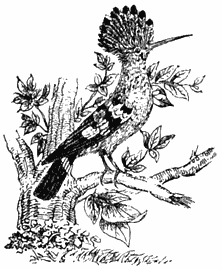
LAPWING. Arabic hudhud (هدهد). The name in the Qurʾān, Sūrah xxvii. 20, for the bird which carried the letter from King Solomon to the Queen of Sheba. [SOLOMON.] It is the דּוּכִיפַת of the Old Testament, Lev. xi. 19, Deut. xiv. 18. Greek ἔποψ. The modern Hoopoe.
The commentators al-Jalālān and al-Baiẓāwī say that Solomon, having finished the temple of Jerusalem, went in pilgrimage to Makkah, whence, having stayed as long as he pleased, he proceeded towards al-Yaman; leaving Makkah in the morning, he arrived by noon at Ṣanʿāʾ, and being extremely delighted with the country, rested there. But wanting water to make the ablution, he looked among the birds for the lapwing, whose business it was to find it; for it is pretended she was sagacious or sharp-sighted to discover water underground, which the devils used to draw, after she had marked the place by digging with her bill. They add that this bird was then taking a tour in the air, whence, seeing one of her companions alighting, she descended also, and having had a description given her by the other of the city of Sabaʾ, whence she was just arrived, they both went together to take a view of the place, and returned soon after Solomon had made the inquiry given in the Qurʾān: “He reviewed the birds and said, ‘How is it I do not see al-Hudhud? Is he, then, amongst the absent?’ ”
LAQAB (لقب). A surname. Either a title of honour or a nickname; e.g. Al-Ḥusain ibn Masʿūd al-Farrā, “the tanner”; Abū Saʿīd Tāju ʾl-Mulūk, “the crown of kings”; Ibn Muḥammad at-Tag͟hlabī, “of the tribe of Tag͟hlab.” [NAMES.]
LAQĪT̤ (لقيط), in its primitive sense, signifies anything lifted from the ground, but in the language of the law it signifies a child abandoned by those to whom it properly belongs. The person who finds the child is termed the multaqit̤, or the taker up. [FOUNDLING.]
LARCENY. Arabic sariqah (سرقة). In the language of the law, sariqah signifies the taking away the property of another in a secret manner, at a time when such property is in custody. Custody is of two kinds: 1st, by place, for example, a house or a shop; and, 2nd, by personal guard, which is by means of a personal watch over the property. If an adult of sound understanding steal out of undoubted custody ten dirhams, or property to the value of ten dirhams, the Muḥammadan law awards the amputation of a hand, for it is said in the Qurʾān, Sūrah v. 42: “If a man or woman steal, cut off their hands.”
With regard to the amount of the value which constitutes a theft, there is some difference of opinion. According to Abū Ḥanīfah, it is ten dirhams; according to ash-Shāfiʿī, it is the fourth of a dīnār, or twelve dirhams; whilst Mālik holds that the sum is three dirhams.
The freeman and the slave are on equal footing with respect to punishment for theft, and the hand of the slave is to be struck off in the same manner as the hand of a free Muslim.
The theft must be established upon the testimony of two witnesses, but the magistrate must examine the witnesses as to the manner, time, and place of the theft. The thief must also be held in confinement, or suspicion, until the witnesses be fully examined.
If a party commit a theft, and each of the party receive ten dirhams, the hand of each is to be cut off; but if they receive less than ten dirhams each, they are not liable to amputation.
Amputation is not incurred by the theft of anything of a trifling nature, such as wood, bamboos, grass, fish, fowls, and garden stuff.
Amputation is not incurred by the theft of such things as quickly decay and spoil, such as milk or fruit, nor for stealing fruit whilst upon the tree, or grain which has not been reaped, these not being considered as in custody.
The hand of a thief is not struck off for stealing any fermented liquor, because he may explain his intention in taking it, by saying, “I took it with a view to spill it”; and also because some fermented liquors are not lawful property.
The hand is not to be cut off for stealing a guitar or tabor, these being of use merely as idle amusements.
Amputation is not incurred by stealing a Qurʾān, although ash-Shāfiʿī maintains that it is.
There is no amputation for stealing the door of a mosque. Nor is the hand struck off for stealing a crucifix or a chess board, as it is in the thief’s power to excuse himself by saying, “I took them with a view to break and destroy them, as things prohibited.” It is otherwise with a coin bearing the impression of an idol, by the theft of which amputation is incurred; because the money is not an object of worship.
The hand is not to be struck off for stealing a free-born infant, although there be ornaments upon it, because a free person is not property; but amputation is incurred by stealing an infant slave, although the stealing of an adult slave does not incur amputation, as such an act does not come under the description of theft, being an usurpation or a fraud.
Amputation is not incurred for stealing a book, because the object of the thief can only be its contents and not the property.
The hand is not cut off for stealing a cur-dog, because such an animal is common property; nor for stealing utensils made of wood.
There is no amputation for stealing from the public treasury, because everything there is the common property of all Muslims, and in which the thief, as a member of the community has a share. And if a person steal from property of which he is in part owner, amputation is not inflicted. Nor if a creditor steal from his debt is the hand cut off.
The right hand of the thief is to be cut off at the joint of the wrist and the stump afterwards cauterised, and for the second theft the left foot, and for any theft beyond that he must suffer imprisonment.
AL-LĀT (اللات). The name of an idol worshipped by the ancient Arabians, probably the Alilat of Herodotus. The idol Lāt is mentioned in the Qurʾān in conjunction with the two other idols, al-ʿUzzā and Manāt. See Sūrah liii. 19: “What think ye, then, of al-Lāt and al-ʿUzzā, and Manāt, the third idol besides?”
In connection with this verse there is an interesting discussion. (See Muir, new ed. p. 86.) Al-Wāqidī and at̤-T̤abarī both relate that, on a certain day, the chief men of Makkah assembled in a group beside the Kaʿbah, discussed, as was their wont, the affairs of the city, when the Prophet appeared, and seating himself by them in a friendly manner, began to recite the 53rd chapter of the Qurʾān; and when he had reached the verse “What think ye then of al-Lāt, and al-ʿUzzā, and Manāt, the third idol besides?” the Devil suggested words of reconciliation and compromise with idolatry, namely, “These are exalted females, and verily their intercession is to be hoped for.” These words, however, which were received by the idolaters with great delight, were afterwards disavowed by the Prophet, for Gabriel revealed to him the true reading, namely, “What think ye then of al-Lāt, and al-ʿUzzā, and Manāt, the third idol besides? Shall ye have male progeny and God female? This, then, were an unjust partition! Verily, these are mere names which ye and your fathers have given them.”
The narrative thus related by al-Wāqidī and at̤-T̤abarī is given as an explanation of Sūrah xxii. 51: “Nor have we sent any apostle or prophet before thee into whose readings Satan hath not injected some wrong desire.”
AL-LAT̤ĪF (اللطيف). “The Mysterious or the Subtle One.” One of the ninety-nine attributes of God. Sūrah vi. 103: “For He is the Subtle (al-Lat̤īf), the All-informed (al-K͟habīr).
LAT̤ĪFAH (لطيفة). A term used by Ṣūfī mystics for any sign or influence in the soul, derived from God, which has such a mysterious effect on the heart that mortal man cannot express it in language, just as a delicious taste in the mouth cannot be exactly expressed by the tongue. (Kitābu ʾt-Taʿrīfāt, in loco.)
LAUGHING. Arabic ẓaḥk, ẓiḥk (ضحك). Heb. צָחַק. (Gen. xviii. 13.) Immoderate laughing is generally condemned by Muḥammadan teachers, for ʿĀyishah relates that Muḥammad “never laughed a full laugh so that the inside of his mouth could be seen; he only smiled.” (Mishkāt, book xxii. ch. vii.)
AL-LAUḤU ʾL-MAḤFŪZ̤ (اللوح المحفوظ). “The preserved tablet.”
In the Ḥadīs̤ and in theological works it is used to denote the tablet on which the decrees of God were recorded with reference to mankind. In the Qurʾān it only occurs once, when it refers to the Qurʾān itself. Sūrah lxxxv. 21, 22: “It is a glorious Qurʾān written on the preserved table.” The plural alwāḥ occurs in Sūrah vii. 142, for the tables of the law given to Moses.
LAW, The. The words used by Muslims to express “the law,” are ash-Sharīʿah (الشريعة) and ash-Sharʿ (الشرع), the meaning of which is “the way.” The compiler of the G͟hiyās̤u ʾl-Lug͟hah defines it as “the way or road in the religion of Muḥammad, which God has established for the guidance of His people, both for the worship of God and for the duties of life.” The term ash-Sharīʿah occurs once in the Qurʾān, Sūrah xlv. 17: “We (God) put thee (Muḥammad) in the right way concerning the affair.” The term ash-Shirʿah is almost obsolete in books on Muslim theology, but it occurs once in the Qurʾān, Sūrah v. 52: “To every one have we given a right way.”
In the Traditions and theological works, the word ash-Sharʿ is generally used to express the law of Muḥammad. The Hebrew תּוֹרָה occurs in the Qurʾān as Taurāt, and is always used for the law of Moses. [TAURAT.]
According to Muslim doctors, ash-Sharʿ, or “the Law,” may be divided into five sections: Iʿtiqādāt, “belief”; Ādāb, “moralities”; ʿIbādāt, “devotions”; Muʿāmalāt, “transactions”; and ʿUqūbāt, “punishments.”
(1) Iʿtiqādāt, embraces all that is contained in the six articles of the Muslim faith, namely, Belief in (a) God; (b) His angels; (c) His Books; (d) His Prophets; (e) The Day of Judgment; (f) The Decrees of God. This section of Muslim law is termed ʿIlmu ʾl-ʿAqāʾid, or, “The Science of the Articles of Belief,” and includes all branches of scholastic theology. The books chiefly consulted on this subject in the present work are the Sharḥu ʾl-Muwāqif, by Saiyid Sharīf-al-Jurjānī, and the Sharḥu ʾl-ʿAqāʾid, by Masʿūd Saʿdu ʾd-dīn at-Taftāzānī.
(2) Ādāb embraces the consideration of all those moral excellences which are enjoined in the Qurʾān and Traditions, as Ik͟hlāṣ, “sincerity”; Tawwakkul, “confidence in God”; Tawāz̤uʿ, “humility”; Tafwīẓ, “resignation”; Qaṣru ʾl-ʿAmal, “keeping down one’s expectation”; Zuhd fī ʾd-dunyā, “renunciation of the world”; Naṣīḥah, “giving good counsel and advice”; Qanāʿah, “contentment”; Sak͟hāwah, “liberality”; Ḥubb, “love to God and man”; Ṣabr, “patience”; &c. (See Majmaʿu ʾl-Biḥār, vol. ii. p. 422.)
(3) ʿIbādāt, includes all acts of devotion to God, such as are included in the five pillars of practice: (a) Recital of the Creed; (b) Prayer; (c) Zakāt, or “legal alms”; (d) Ṣaum, or “fasting”; (e) The pilgrimage to Makkah. It will also embrace such religious acts as Jihād, or warfare for the propagation of the religion of Islām.
(4) Muʿāmalāt, includes such duties as are required between man and man, and is divided into Muk͟hāṣamāt, “altercations”; Munākaḥāt, “nuptials”; Amānāt, “securities.” Under these three heads are embraced all the various sections of civil jurisprudence such as barter, sale, agency, larceny, marriage, divorce, dower, partnership, claims, &c.
(5) ʿUqūbāt, denotes the punishments instituted in the Qurʾān and Traditions, namely, (a) Qiṣāṣ, “retaliation”; (b) Ḥaddu ʾs-sariqah, punishment for theft by the loss of a hand; (c) Ḥaddu ʾz-zināʾ, punishment for fornication and adultery, stoning for a married person and one hundred lashes for an unmarried person; (e) Ḥaddu ʾl-qazf, or punishment of eighty lashes for slander; Ḥaddu ʾr-riddah, or punishment by death for apostasy; Ḥaddu ʾsh-shurb, or punishment with eighty lashes for wine-drinking.
The two common divisions of Muḥammadan law are ʿIlmu ʾl-Kalām, or ʿAqāʾid, embracing all matters of faith; and ʿIlmu ʾl-Fiqh, which includes all matters of practice as distinguished from articles of faith.
Muslim law is also divided into two great distinctions of Mashrūʿ, “lawful,” and G͟hairu ʾl-mashrūʿ, “unlawful,” or, as it is expressed in Persian, Rawā and Nārawā.
That which is lawful is graded into five classes. (1) Farẓ, that which is proved beyond all doubt to have been enjoined either in the Qurʾān or in a tradition of undoubted authority, and the denial or disobedience of which is positive infidelity. (2) Wājib, that which is obligatory, but of which there is some doubt whether or not it was enjoined in the Qurʾān or in a tradition of undoubted authority. (3) Sunnah, that which was practised by Muḥammad; (4) Mustāḥabb, that which Muḥammad and his Companions sometimes did and sometimes omitted; (5) Mubāḥ, that which is desirable, but which may be omitted without fear of sin.
Things which are unlawful are graded into three classes: (1) Mufsid, that which is most vicious and corrupting, a mortal sin; (2) Ḥarām, that which is distinctly forbidden; (3) Makrūh, that which is generally held to be unclean.
These distinctions of lawful and unlawful, with their various subdivisions, apply to all branches of Muslim law, whether it relate to ordinary duties of life, or of devotion to God.
It will be seen how important a place the example, practices, and sayings of Muḥammad occupy in the moral law of Islām. This branch of Muslim law is called as-Sunnah, or the custom of Muḥammad, and is distinguished as—
(1) Sunnatu ʾl-ʿfilī, that which Muḥammad himself did.
(2) Sunnatu ʾl-qaulī, that which Muḥammad said should be practised.
(3) Sunnatu ʾt-taqrīrī, that which was done in the presence of Muḥammad, and which he appears to have sanctioned.
It is therefore a serious mistake to suppose that the Qurʾān contains all that is esteemed necessary for faith and practice in Islām; the example of Muḥammad is as binding upon the Muslim as any injunction contained in the Qurʾān itself, for neither that which is Farẓ nor that which is Sunnah can be omitted without sin.
The true origin and fountain of all law is the Qurʾān and the Traditions, and no Muslim school of theology has ever rejected the Traditions. They are binding upon Sunnī, and Shīʿah, and Wahhābī; the only difference between the Sunnī and Shīʿah being that they receive different collections of Traditions. The Wahhābīs receive those of the Sunnīs, and call themselves Muḥaddis̤in, or traditionists.
In addition to the Qurʾān and Ḥadīs̤ (or Traditions), both Sunnī and Shīʿah Muslims acknowledge the concurrence of the learned, called Ijmāʿ, the Shīʿahs believing that they still possess Mujtahids capable of giving an infallible interpretation of the law; the Sunnīs, on the other hand, confessing that, since the days of the four great doctors (Abū Ḥanīfah, Mālik, ash-Shāfiʿī, and Ibn Ḥanbal), Ijmāʿ has not been possible; whilst the Wahhābīs accept only the Ijmāʿ of those who conversed with the Prophet himself. The fourth foundation of orthodoxy in both Sunnī and Shīʿah schools is the system of interpretation called Qiyās, or ratiocination.
I. The Sunnīs all receive the same collections of traditions, especially those which are known as the “six correct books,” the Ṣaḥīḥu ʾl-Buk͟hārī, the Ṣaḥīḥu Muslim, the Sunanu ʾt-Tirmiẓī, Sunanu Abī Dāʾūd, Sunanu an-Nasafī, and Sunanu Ibn Mājah. The compilation by the Imām Mālik, which is first in order of date, is also a collection of traditions of very great authority. [TRADITIONS.]
These different sects of Sunnīs do not differ in uṣūl, or fundamentals of religious belief, but in minor rules of practice, and in certain legal interpretations; but being of different opinions and broaching in some respects separate doctrines, four schools of jurisprudence have been established, known as Ḥanafī, Shāfiʿī, Ḥanbalī, and Mālikī.
The differences amongst these four Sunnī schools are based either upon different traditions or upon different interpretations of the same traditions, also upon the various ways in which the liberty of qiyās, or ratiocination, has been exercised. Consequently the number of works which have appeared on the subjects of scholastic science and jurisprudence, has been very great indeed.
We are indebted to Mr. Shama Churun Sircar, the learned and able Tagore Professor of Law in Calcutta, for the following résumé of the principal Sunnī writings on ash-Sharʿ.
“The chief works that treat generally of the doctrines of the four principal sects of the Sunnís, are mentioned by Hájí Khalífah to be the Jámi-ul-Mazáhib (Jāmiʿu ʾl-Maẕāhib), the Majmaa-ul-Khiláfíyat, the Yanábiya-ul-Ahkám (Yanābīʿu ʾl-Aḥkām), the Uyúm, and the Zubdat-ul-Ahkám. The Kanz-ud-Dakáïk (Kanzu ʾd-Daqāʾiq), by An-Nasafí, is a book of great reputation, principally derived from the Wáfí; and containing questions and decisions according to the doctrines of Abú-Hanífah, Abú-Yusuf, Imám Muhammad, Zufar, Sháfií, Málik, and others. Many commentaries have been written on the last mentioned work; the most famous of them is the Bahr-ur-Ráïk (al-Baḥru ʾr-Rāʾiq), which may, indeed, almost be said to have superseded its original, at least in India. The Bahr-ur-Ráïk is by Zainu-ul-Aábidín Bin Nujaim-ul Misrí (Ibn Najīm), A.H. 970. The Multaka-al-Abhár (Multaqa ʾl-Abḥār), by Shaikh Ibráhím Bin Muhammad al-Halabí, who died A.H. 956, is a universal code of Muhammadan law. It gives the different opinions or doctrines of Abú Hanífah, Málik, Sháfií, and Hanbal, the chief Mujtahid Imáms and the founders of the four great sects of Sunnís, and illustrates them by those of the principal jurisconsults of the school of Abú Hanífah. It is more frequently referred to as an authority throughout Turkey, than any other treatise on jurisprudence.
“The digests inculcating exclusively the doctrines of each of the said four great sects are, indeed, numerous, though a very few of them which maintain the doctrines of the Málikí, or Sháfií, or Hanbalí sects are used in India. Digests written by Málik or any of his followers are scarcely found in India.
“Of the digests maintaining the Málikí doctrines, two have lately appeared in France (by M. Vincent, 1842; M. Perron, 1843). The first work of Sháfií, entitled the Usúl (Uṣūl), or fundamentals, which contains the principles of the Muhammadan civil and canon law, may be classed as a digest. The Muk͟htasar, the Mansúr, the Rasáïl-ul-Muatabirah (ar-Rasāʾilu ʾl-Muʿtabarah), and the Kitáb-ul-Wasáïk, are amongst the other works written by Abú Ibráhím Bin Yahiyá-al-Muzani, a distinguished disciple of Sháfií, and a native of Egypt (A.H. 264), and are according to the doctrines of Sháfií. The works by Ibnu Hambal and his followers are few in number, and rare.
“The followers of the Hanífí sect, which obtains most commonly amongst the Muhammadans of India, have, like others, divided their law into two general branches or parts, respectively called the Fikah (law, religious and secular), and Faráïz (the succession to, and division of, inheritance).
“The works which are on Fikah (Fiqh), and which are considered as the chief authorities of the Hanífí sect, are the following:—Abú Hanífah’s own digest of law, entitled the Fikah-ul-Akbar (al-Fiqhu ʾl-Akbar). This is the first in rank, and has been commented upon by various writers, many of whom are mentioned by Hájí Khalífah. The doctrines of that great lawyer, however, are sometimes qualified or dissented from by his two famous pupils, Abú Yusuf and Imám Muhammad. The work entitled Adab-ul-Kází, which treats of the duties of a magistrate, is known to have been written by Abú Yusuf. Save and except this, no other work appears to have been composed by him. He, however, is said to have supplied his notes to his pupil Imám Muhammad, who made use of them in the composition of his own works. The works of Imám Muhammad are six in number, five of which are, in common, entitled the Záhir-ur-Rawáyát (Z̤āhiru ʾr-Rawāyāt, conspicuous traditions or reports). They are: 1. The Jámi-ul-Kabír (al-Jāmiʿu ʾl-Kabīr); 2. Jámi-us-Saghír (al-Jāmiʿu ʾṣ-Ṣag͟hīr); 3. Mabsút fí Farú-ul-Hanífiyát; 4. Ziyádát fí Farú-ul-Hanífiyát; and 5. Siyar al-Kabír wa Saghír. The Nawádir, the sixth and last of the known compositions of Imám Muhammad, though not so highly esteemed as the others, is still greatly respected as an authority.
“The next authorities among the Hanafís, after the founder of their sect and his two disciples, are the Imám Zufar Bin al-Hazíl who was chief judge at Basrah, where he died (A.H. 158), and Hasan Bin Ziyád. These lawyers are said to have been contemporaries, friends, and scholars of Abú-Hanífah, and their works are quoted here as authorities for Abú Hanífah’s doctrines, more especially when the two disciples are silent. The most celebrated of the several treatises known by the name of Adáb-ul Kází was written by Abú Bakr Ahmad Bin ʿUmar ul-Khassáf (A.H. 261). An abridgement of the Hanafí doctrines, called the Mukhtasar ut-Tahaví, was written by Abú Jaafar Ahmad Bin Muhammad at-Tahaví (A.H. 331), who wrote also a commentary on the Jámi us-Saghír of Imám Muhammad.
“The Mukhtasar lil-Kudúrí, by Abú ul-Husain Ahmad Bin Muhammad al-Kudúrí (A.H. 228) is among the most esteemed of the works which follow the doctrines of Abú Hanífah. There is a well-known commentary on the Mukhtasar lil-Kudúrí, entitled Al-Jauharat un-Nayyirah, which is sometimes called Al-Jauharat ul-Munírah. The digest, entitled the Mabsút (al-Mabsūt̤), was composed by Shams-ul-Aïmmah Abú Bakr Muhammad as-Sarakhsi whilst in prison at Uʾzjand. This is a work of great extent and authority. He was also the author of the most celebrated work entitled Al-Muhít (al-Muḥīt̤), which is derived in a great measure from the Mabsút, the Ziyádát, and the Nawádir of Imám Muhammad. The work entitled the Muhít, by Burhán-ud-dín Mahmúd Bin Ahmad, already spoken of, is not so greatly esteemed as the Muhít as-Sarakhsi (Muḥīt̤u ʾṣ-Ṣarak͟hsī). A compendium of Al-Kudúrí’s Mukhtasar, which he entitled the Tuhfat-ul-Fukahá (Tuḥfatu ʾl-Fuqahāʾ), was composed by Shaikh Alá-ud-dín Muhammad as-Samarkandí. The work of Alá-ud-dín was commented upon by his pupil Abú Bakr Bin Masuúd.
“There are several Arabic works on philosophical and theological subjects which bear the name of Al-Hidáyah (the guide). The work entitled Al-Hidáyah fí-al-Farú, or the guide in particular points, is a digest of law according to the doctrines of Abú Hanífah and his disciples Abú Yusuf and Imám Muhammad. The author of this work is Shaikh Burhán-ud-dín Alí (A.H. 593), whose reputation as a lawyer was beyond that of all his contemporaries. This Hidáyah is a commentary on the Badáya-ul-Mubtadá, an introduction to the study of law, written by the same author in a style exceedingly concise and close. In praise of the Hidáyah, Hájí Khalífah says, ‘It has been declared, like the Kurán, to have superseded all previous books on the law; that all persons should remember the rules prescribed in it, and that it should be followed as a guide through life.’ The Hidáyah has, besides the Kifáyah, many other commentaries, as a work of so great celebrity and authority is expected to have. The principal ones are the Ináyah (ʿInāyah), the Niháyah, and the Fath-ul-Kabír.