DICTIONARY OF ISLĀM. (continued 18)
Reading edition
(See The Thousand and One Nights, a new translation, with copious notes, by Edward W. Lane; new ed. by E. S. Poole, vol. i. p. 60.)
MAGISTRATES. [QAZI.]
MAGPIE. Arabic ʿaqʿaq (عقعق). According to Abū Ḥanīfah, the flesh of the magpie is mubāḥ, or indifferent; but the Imām Yūsuf held it to be makrūh, or reprobated, because it frequently feeds on dead bodies. (Hidāyah, vol. iv. p. 74.)
AL-MAHDĪ (المهدى). Lit. “The Directed One,” hence, “who is fit to direct others, Guide, Leader.” A ruler who shall in the last days appear upon the earth. According to the Shīʿahs, he has already appeared in the person of Muḥammad Abū ʾl-Qāsim, the twelfth Imām, who is believed to be concealed in some secret place until the day of his manifestation before the end of the world. But the Sunnīs say he has not yet appeared. In the history of Muḥammadanism, there are numerous instances of impostors having assumed the character of this mysterious personage, amongst others, Saiyid Aḥmad, who fought against the Sikhs on the North-West frontier of the Panjāb, A.D. 1826, and still more recently, the Muḥammadan who has claimed to be al-Mahdī in the Sudān in Egypt.
The sayings of the Prophet on the subject, according to al-Buk͟hārī and other traditionists, are as follows:—
“The world will not come to an end until a man of my tribe and of my name shall be master of Arabia.”
“When you see black ensigns coming from the direction of K͟horasān, then join them, for the Imām of God will be with the standards, whose name is al-Mahdī.”
“The Mahdī will be descended from me, he will be a man with an open countenance and with a high nose. He will fill the earth with equity and justice, even as it has been filled with tyranny and oppression, and he will reign over the earth seven years.”
“Quarrelling and disputation shall exist amongst men, and then shall a man of the people of al-Madīnah come forth, and shall go from al-Madīnah to Makkah, and the people of Makkah shall make him Imām. Then shall the ruler of Syria send an army against the Mahdī, but the Syrian army shall perish by an earthquake near Badāʾ, between al-Madīnah and Makkah. And when the people shall see this, the Abdāl [ABDAL] will come from Syria, and also a multitude from al-ʿIrāq. After this an enemy to the Mahdī shall arise from the Quraish tribe, whose uncles shall be of the tribe of Kalb, and this man shall send an army against the Mahdī. The Mahdī shall rule according to the example of your Prophet, and shall give strength and stability to Islām. He shall reign for seven years, and then die.”
“There shall be much rain in the days of the Mahdī and the inhabitants both of heaven and earth shall be pleased with him. Men’s lives shall pass so pleasantly, that they will wish even the dead were alive again.” (Mishkātu ʾl-Maṣābiḥ, book xxiii. ch. 3.)
According to Shīʿah traditions, Muḥammad is related to have said: “O ye people! I am the Prophet and ʿAlī is my heir, and from us will descend al-Mahdī, the seal (i.e. the last) of the Imāms, who will conquer all religions and take vengeance on the wicked. He will take fortresses and will destroy them, and slay every tribe of idolaters, and he will avenge the deaths of the martyrs of God. He will be the champion of the Faith, and a drawer of water at the fountain of divine knowledge. He will reward merit and requite every fool according to his folly. He will be the approved and chosen of God, and the heir of all knowledge. He will be the valiant in doing right, and one to whom the Most High has entrusted Islām.… O ye people, I have explained to you, and ʿAlī also will make you understand it.” (Ḥayātu ʾl-Qulūb, Merrick’s ed., p. 342.)
It is probable that it is from these traditions that the opinion became current amongst the Christians that the Muḥammadans expected their Prophet would rise again.
MAḤJŪR (محجور). A slave inhibited by the ruler from exercising any office or agency. (Hidāyah, vol. iii. 5.)
MAḤMAL, MAḤMIL (محمل). A covered litter borne on a camel, both from Cairo and from Damascus, to Makkah, as an emblem of royalty at the time of the pilgrimage.
It is said that Sult̤ān Az̤-Z̤āhir Beybars, King of Egypt, was the first who sent a maḥmal with the caravan of pilgrims to Makkah in A.D. 1272, but that it had its origin a few years before his accession to the throne, under the following circumstances:—
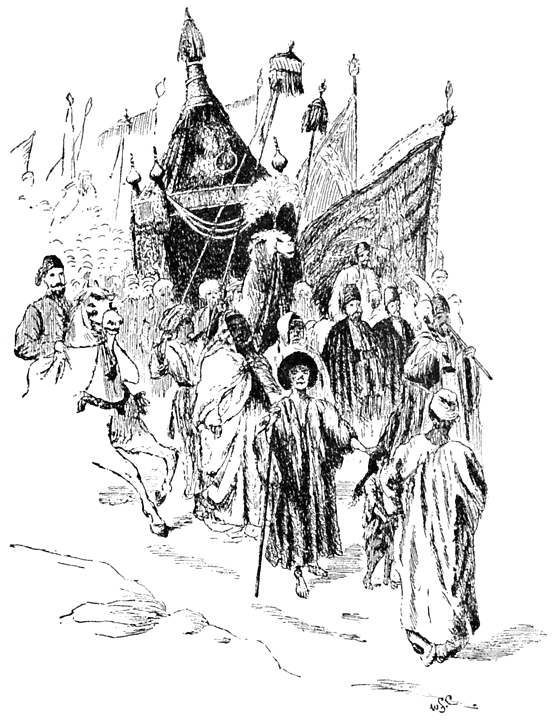
THE MAHMAL. (From an Original Picture.)
Shag͟hru ʾd-Durr, a beautiful Turkish female slave, who became the favourite wife of Sult̤ān aṣ-Ṣālih Najmu ʾd-dīn, and who on the death of his son (with whom terminated the dynasty of Aiyūb) caused herself to be acknowledged Queen of Egypt, performed the ḥajj in a magnificent litter borne by a camel. And for successive years her empty litter was sent yearly to Makkah, as an emblem of state. After her death, a similar litter was sent each year with the caravan of pilgrims from Cairo and Damascus, and is called maḥmal or maḥmil, a word signifying that by which anything is supported.
Mr. Lane, in his Modern Egyptians, vol. ii. p. 162, thus describes the maḥmal:—
“It is a square skeleton frame of wood with a pyramidal top, and has a covering of black brocade richly worked with inscriptions and ornamental embroidery in gold, in some parts upon a ground of green or red silk, and bordered with a fringe of silk, with tassels, surmounted by silver balls. Its covering is not always made after the same pattern with regard to the decorations; but in every cover that I have seen, I have remarked on the upper part of the front a view of the Temple of Makkah, worked in gold, and over it the Sultan’s cipher. It contains nothing; but has two copies of the Kurán, one on a small scroll, and the other in the usual form of a book, also small, each inclosed in a case of gilt silver, attached externally at the top. The five balls with crescents, which ornament the maḥmal, are of gilt silver. The maḥmal is borne by a fine tall camel, which is generally indulged with exemption from every kind of labour during the remainder of its life.”
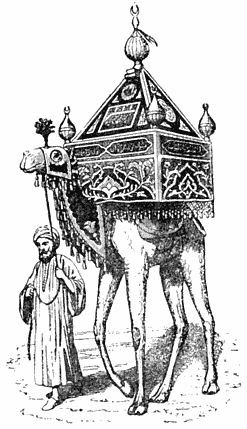
THE MAHMAL. (Lane.)
Eastern travellers often confuse the maḥmal with the kiswah, or covering for the Kaʿbah, which is a totally distinct thing, although it is made in Cairo and sent at the same time as the maḥmal. [KISWAH.]
The Wahhābīs prohibited the maḥmal as an object of vain pomp, and on one occasion intercepted the caravan which escorted it.
Captain Burton saw both the Egyptian and the Damascus maḥmals on the plain below ʿArafah at the time of the pilgrimage.
MAḤMŪDĪYAH (محمودية). A Shīʿah sect founded by Mīr Sharīf, who in the reign of Akbar held a military appointment in Bengal. He was a disciple of Maḥmūd of Busak͟hwān, the founder of the Nuqtawīyah sect. Maḥmūd lived in the reign of Timur, and professed to be al-Mahdī. He also called himself the Shak͟hs-i-Waḥīd—the Individual one. He used to quote the verse, “It may be that thy Lord will raise thee up to a glorious (maḥmūd) station” (Sūrah xvii. 81). From this he argued that the body of man had been advancing in purity since the creation, and that on its reaching to a certain degree, one Maḥmūd (glorious) would arise, and that then the dispensation of Muḥammad would come to an end. He claimed to be the Maḥmūd. He also taught the doctrine of transmigration, and that the beginning of everything was the earth atom (nuqt̤ah). It is on this account that they are called in Persian the Nuqtawīyah sect. They are also known by the names Maḥmūdīyah and Waḥīdīyah. Shah ʿAbbās, King of Persia, expelled them from his dominions, but Akbar received the fugitives kindly, and promoted some amongst them to high offices of State.
MAHR (مهر). Heb. מֹהַר. The dower or settlement of money or property on the wife, without which a marriage is not legal, for an explanation of which see the article on DOWER.
The Hebrew word occurs three times in the old Testament, viz. Gen. xxxiv. 12; Ex. xxii. 17; 1 Sam. xviii. 25. [DOWER and MARRIAGE.]
MAḤRAM (محرم). Lit. “Unlawful.” A near relative with whom it is unlawful to marry. Muḥammad enjoined that every woman performing pilgrimage should have a maḥram with her night and day, to prevent scandal. (Mishkāt, book xi. ch. i.)
AL-MĀʾIDAH (المائدة). Lit. “The table.” The title of the Vth Sūrah of the Qurʾān, in the 114th verse of which the word occurs: “O Jesus, son of Mary! is thy Lord able to send down to us a table?”
“This miracle is thus related by the commentators. Jesus having at the request of his followers asked it of God, a red table immediately descended, in their sight, between two clouds, and was set before them; whereupon he rose up, and, having made the ablution, prayed, and then took off the cloth which covered the table, saying, ‘In the name of God, the best provider of food!’ What the provisions were with which this table was furnished, is a matter wherein the expositors are not agreed. One will have them to be nine cakes of bread and nine fishes; another, bread and flesh; another, all sorts of food except flesh; another, all sorts of food except bread and flesh; another, all except bread and fish; another, one fish which had the taste of all manner of food; and another, fruits of paradise; but the most received tradition is that when the table was uncovered, there appeared a fish ready dressed, without scales or prickly fins, dropping with fat, having salt placed at its head and vinegar at its tail, and round it all sorts of herbs except leeks, and fine loaves of bread, on one of which there were olives, on the second honey, on the third butter, on the fourth cheese, and on the fifth dried flesh. They add that Jesus, at the request of the Apostles, showed them another miracle, by restoring the fish to life, and causing its scales and fins to return to it, at which the standers-by being affrighted, he caused it to become as it was before; that one thousand three hundred men and women, all afflicted with bodily infirmities or poverty, ate of these provisions, and were satisfied, the fish remaining whole as it was at first; that then the table flew up to heaven in the sight of all; and every one who had partaken of this food were delivered from their infirmities and misfortunes; and that it continued to descend for forty days together, at dinner-time, and stood on the ground till the sun declined, and was then taken up into the clouds. Some of the Muḥammadan writers are of opinion that this table did not really descend, but that it was only a parable; but most think the words of the Qurʾān are plain to the contrary. A further tradition is that several men were changed into swine for disbelieving this miracle, and attributing it to magic art; or, as others pretend, for stealing some of the victuals from off it. Several other fabulous circumstances are also told, which are scarce worth transcribing. Some say the table descended on a Sunday, which was the reason of the Christians observing that day as sacred. Others pretend that this day is still kept among them as a very great festival, and it seems as if the story had its rise from an imperfect notion of Christ’s last supper and the institution of the Eucharist.” (Sale’s Qurʾān.)
MAIMŪNAH (ميمونة). The last of Muḥammad’s wives. A sister to Ummu ʾl-Faẓl, the wife of al-ʿAbbās, and consequently related to the Prophet. She was a widow, 51 years of age, when Muḥammad married her. She survived him, and died at the age of 81, being buried on the very spot on which she had celebrated her marriage. (Muir’s Life of Mahomet, new ed. p. 403.)
MAINTENANCE. Arabic nafaqah (نفقة), which, in the language of the law, signifies all those things which are necessary to the support of life, such as food, clothes, and lodging, although many confine it solely to food. (Durru ʾl-Muk͟htār, p. 283.)
There are three causes of maintenance established by law. (1) Marriage; (2) Relationship; (3) Property (i.e. in case of a slave).
A husband is bound to give proper maintenance to his wife or wives, provided she or they have not become refractory or rebellious, but have surrendered herself or themselves to the custody of their husband.
Maintenance may be decreed out of the property of an absent husband, whether it be held in trust, or deposit, or muẓārabah for him.
If the husband become poor to such a degree as to be unable to provide his wife her maintenance, still they are not to be separated on this account, but the Qāẓī shall direct the woman to procure necessaries for herself upon her husband’s credit, the amount remaining a debt upon him.
A divorced wife is entitled to food, clothing, and lodging during the period of her ʿiddah, and until her delivery, if she be pregnant. No maintenance is, however, due to a woman, whether pregnant or not, for the ʿiddah observed upon the death of her husband. No maintenance is due to a woman upon separation caused by her own fault.
A father is bound to support his infant children; and no one shares the obligation with him.
A mother, who is a married wife, cannot be compelled to suckle her infant, except where a nurse cannot be procured, or the child refuses to take the milk of any other than of the mother, who in that case is bound to suckle it, unless incapacitated for want of health, or other sufficient cause.
If neither the father nor the child has any property, the mother may be compelled to suckle it.
The maintenance of an infant child is incumbent upon the father, although he be of a different religion; and, in the same manner, the maintenance of a wife is incumbent upon her husband, notwithstanding this circumstance.
Maintenance of children becomes, however, incumbent upon the father only where they possess no independent property.
When the father is poor and the child’s paternal grandfather is rich, and the child’s own property is unavailable, the grandfather may be directed to maintain him, and the amount will be a debt due to him from the father, for which the grandfather may have recourse against him; after which the father may reimburse himself by having recourse against the child’s property, if there is any.
When the father is infirm and the child has no property of his own, the paternal grandfather may be ordered to maintain him, without right of recourse against anyone; and, in like manner, if the child’s mother be rich, or the grandmother rich, while its father is poor, she may be ordered to maintain the child, and the maintenance will be a debt against the child if he be not infirm, but if he be so, he is not liable.
If the father is poor and the mother is rich, and the young child has also a rich grandfather, the mother should be ordered to maintain the child out of her own property, with a right of recourse against the father and the grandfather is not to be called upon to do so. When the father is poor, and has a rich brother, he may be ordered to maintain the child, with right of recourse against the father.
When male children have strength enough to work for their livelihood, though not actually adult, the father may set them to work for their own maintenance, or hire them out, and maintain them out of their wages; but he has no power to hire females out for work or service.
A father must maintain his female children absolutely until they are married, when they have no property of their own. But he is not obliged to maintain his adult male children unless they are disabled by infirmity or disease.
It is also incumbent on a father to maintain his son’s wife, when the son is young, poor, or infirm.
The maintenance to an adult daughter, or to an adult son who is disabled, rests upon the parents in three equal parts, two-thirds being furnished by the father, and one-third by the mother.
A child in easy circumstances may be compelled to maintain his poor parents, whether they be Muslim or not, or whether by their own industry they be able to earn anything for subsistence or not.
Where there are male and female children, or children only of the male sex, or only of the female sex, the maintenance of both parents is alike incumbent upon them.
Where there is a mixture of male and female children, the maintenance of both parents is incumbent on them alike.
When a mother is poor, her son is bound to maintain her, though he be in straitened circumstances himself, and she not infirm. When a son is able to maintain only one of his parents, the mother has the better right; and if he have both parents and a minor son, and is able to maintain only one of them, the son has the preferable right. When he has both parents, and cannot afford maintenance to either of them, he should take them to live with him, that they may participate in what food he has for himself. When the son, though poor, is earning something, and his father is infirm, the son should allow the father to share his food with him.
As of a father and mother, so the maintenance of grandfathers and grandmothers, if they be indigent, is incumbent upon their grandchildren, though the former be of different religion.
It is a man’s duty to provide maintenance for all his infant male relations within prohibited degrees who are in poverty; and also to all female relations within the same degrees, whether infants or adults, where they are in necessity; and also to all adult male relations within the same degrees who are poor, disabled, or blind; but the obligation does not extend beyond those relations.
No adult male, if in health, is entitled to maintenance, though he is poor; but a person is obliged to maintain his adult female relatives, though in health of body, if they require it. The maintenance of a mere relative is not incumbent on any poor person; contrary to the maintenance of a wife and child, for whom poor and rich are equally liable.
When a poor person has a father and a son’s son, both in easy circumstances, the father is liable for his maintenance; and when there is a daughter and a son’s son, the daughter only is liable, though they both divide the inheritance between them. So also, when there is a daughter’s daughter, or daughter’s son, and a full brother, the child of the daughter, whether male or female, is liable, though the brother is entitled to the inheritance. When a person has a parent and a child, both in easy circumstances, the latter is liable, though both are equally near to him. But if he have a grandfather and a son’s son, they are liable for his maintenance in proportion to their shares in the inheritance, that is, the grandfather for a sixth, and the son’s son for the remainder. If a poor person has a Christian son and a Muslim brother, both in easy circumstances, the son is liable for the maintenance, though the brother would take the inheritance. If he has a mother and grandfather, they are both liable in proportion to their shares as heirs, that is, the mother in one-third, and the grandfather in two-thirds. So, also, when with the mother there is a full brother, or the son of a full brother, or a full paternal uncle, or any other of the ʿaṣabah or residuaries, the maintenance is on them, by thirds according to the rules of inheritance. When there is a maternal uncle, and the son of a full paternal uncle, the liability for maintenance is on the former, though the latter would have the inheritance; because the condition of liability is wanting on the latter, who is not within the forbidden degrees.
If a man have a paternal uncle and aunt, and a maternal aunt, his maintenance is on the uncle; and if the uncle be in straitened circumstances, it is on both the others. The principle in this case is, that when a person who takes the whole of the inheritance is in straitened circumstances, his inability is the same as death, and being as it were dead, the maintenance is cast on the remaining relatives in the same proportions as they would be entitled to in the inheritance of the person to be maintained, if the other were not in existence; and that when one who takes only a part of the inheritance is in straitened circumstances, he is to be treated as if he were dead, and the maintenance is cast on the others, according to the shares of the inheritance to which they would be entitled if they should succeed together with him. (See Durru ʾl-Muk͟htār, Bābu ʾn-Nafaqah.)
AL-MAISIR (الميسر). A game of chance forbidden in the Qurʾān. Sūrahs ii. 216; v. 92, 93. It signifies a game performed with arrows, and much in use with pagan Arabs. But the term al-maisir is now understood to include all games of chance or hazard.
MAJBŪB (مجبوب). A complete eunuch, as distinguished from k͟haṣī, or one who is simply castrated. (Hidāyah, vol. i. p. 356.)
AL-MAJĪD (المجيد). “The Glorious One.” One of the ninety-nine names or attributes of God. It occurs in the Qurʾān, Sūrah xi. 76: “Verily He is to be praised and glorified.”
MAJORITY. [PUBERTY.]
MĀJŪJ (ماجوج). [YAJUJ.]
AL-MAJŪS (المجوس), pl. of Majūsī. The Magians. Mentioned in the Qurʾān only once, Sūrah xxii. 17: “As to those who believe, and the Jews, and the Sabeites, and the Christians, and the Magians, and those who join other gods with God, of a truth, God shall decide between them on the Day of Resurrection: for God is witness of all things.”
Most Muḥammadan writers (especially amongst the Shīʿahs) believe them to have formerly possessed a revelation from God which they have since lost.
The Magians were a sect of ancient philosophers which arose in the East at a very early period, devoting much of their time to the study of the heavenly bodies. They were the learned men of their time, and we find Daniel the Prophet promoted to the head of this sect in Chaldea. (Dan. v. 11.) They are supposed to have worshipped the Deity under the emblem of fire; whilst the Sabians, to whom they were opposed, worshipped the heavenly bodies. They held in the greatest abhorrence the worship of images, and considered fire the purest symbol of the Divine Being. This religious sect was reformed by Zoroaster in the sixth century before Christ, and it was the national religion of Persia until it was supplanted by Muḥammadanism. The Magians are now known in Persia as Gabrs, and in India as Pārsīs. Their sacred book is the Zend Avesta, an English translation of which has been published by Mr. A. H. Bleeck (Hertford, 1864), from Professor Spiegel’s German translation. There is an able refutation of the Pārsī religion by the late Rev. John Wilson, D.D. (Bombay, 1843).
MAJẔŪB (مجذوب). Lit. “Attracted.” A term used by the Ṣūfīs for a person whom God has chosen for Himself, for a manifestation of His love, and who is thus enabled to attain to all the stages of Ṣūfīism without any effort or trouble. (See ʿAbdu ʾr-Razzāq’s Dict. of Ṣūfī Terms.)
MAKKAH (مكة). The capital of Arabia, and the most sacred city of the Muslims. It is celebrated as the birth-place of Muḥammad, and as the site of the Kaʿbah, or Sacred Cube, building. Muḥammad is related to have said of Makkah, “What a splendid city thou art! If I had not been driven out of thee by my tribe, I would dwell in no other place but in thee.” “It is not man but God who has made Makkah sacred.” “My people will be always safe in this world and the next as long as they respect Makkah.” (Mishkāt, book xl. ch. xv.)
Makkah (the ancient name of which was Bakkah) is situated in about 21° 30′ N. lat., 40° 20′ E. long., and 70 miles from the Red Sea, in a sandy valley running north and south, and from 100 to 70 paces broad. The chief part of the city is placed where the valley is widest. In the narrower part there are single rows of houses only, or detached shops. The town itself covers a space of about 1,500 paces in length, but the whole extent of ground comprehended under the denomination of Makkah, amounts to 3,500 paces in length. The surrounding rocky hills are from 200 to 500 feet in height, barren, and destitute of trees. Most of the town is situated in the valley itself, but there are some parts built on the sides of the hills. The streets are in general broader than those of Eastern cities, for the purpose of accommodating the vast number of pilgrims who resort to it. The houses are lofty and of stone, and the numerous windows that face the streets give to these quite a European aspect. Many of the houses are three stories high.
The only public place in the body of the town is the large square of the great mosque, which is enlivened during the Ḥajj (Pilgrimage) by a great number of well-stored shops. The streets are all unpaved, and in summer the sand and dust are as great a nuisance as the mud is in the rainy season, during which they are scarcely passable after a storm.
Makkah is badly provided with water. There are a few cisterns for receiving rain, and the well-water is brackish. The famous well of Zamzam, in the great mosque, is indeed copious enough to supply the whole town, but the water is not well tasted. The best water is brought by an aqueduct from the vicinity of ʿArafah, six or seven miles distant. There are two places in the interior of the city, where the aqueduct runs above ground, and in these parts it is let off into small channels or fountains, at which some slaves of the Sharīf (the ruler of the city) are stationed to exact a toll from persons who fill their water-skins.
All the houses in Makkah except those of the principal and richest inhabitants, are constructed for the accommodation of lodgers, and divided into numerous separate apartments, each consisting of a sitting-room and a small kitchen. Except four or five houses belonging to the Sharīf, two colleges, and the sacred mosque, Makkah has no public edifices of any importance.
The inhabitants of Makkah, with few exceptions, are Arabians. They have two kinds of employment, trade and the service of the temple. During the Ḥajj, Makkah becomes one of the largest fairs in the East, and certainly the most interesting, from the variety of nations which frequent it. The merchants of the place make large profits during this time by their merchandise. They have also a considerable trade with the Beduins and with other parts of Arabia. The greatest profit, however, is derived from supplying food for 60,000 pilgrims and 20,000 camels. The only articles of manufacture are some pottery and beads; there are a few dyeing-houses in the city.
Makkah is governed by a Sharīf, who is chosen from the Saiyids (or descendants of the Prophet) settled in the Ḥijāz, who were once numerous, but are now reduced to a few families in Makkah. Although he obtains his office by the choice of his people, or by force, he holds his authority from the Turkish Sult̤ān.
Makkah was the seat of government during the reigns of the first five K͟halīfahs.
(For an account of the sacred temple, see the article on MASJIDU ʾL-HARAM.)
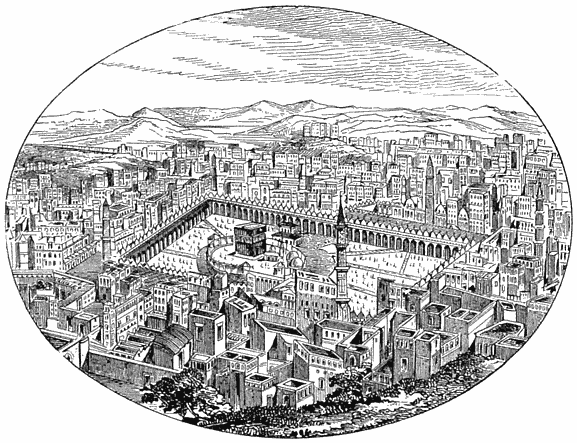
MAKKAH. (From Stanley Lane-Poole’s edition of Lane’s “Selections.”)
MAKRŪH (مكروه). Lit. “That which is hateful and unbecoming.” A term used in the religious, civil, and ceremonial law of Islām, for an act the unlawfulness of which is not absolutely certain, but which is considered improper and unbecoming.
The author of the Hidāyah remarks that the doctors of the Ḥanafī sect have disagreed as to the extent to which the term can be received.
The Imām Muḥammad is of opinion that makrūh is unlawful, but as he could not draw any convincing argument in favour of his opinion from either the Qurʾān or Traditions, he renounced the general application of “unlawfulness” with respect to such things or acts, and classed them under those which are merely improper.
The Imāms Abū Ḥanīfah and Abū Yūsuf hold that the term applies to that which in its qualities nearly approaches to unlawful, without it being actually so. (Hidāyah, vol. iv. p. 86.)
In the Kitābu ʾt-Taʿrifāt, that which is makrūh is divided into makrūh taḥrīmī, “that which is nearly unlawful”; and makrūh tanzīhī, “that which approaches the lawful.”
In all works on Muḥammadan law, a section is devoted to the consideration of things which are held to be makrūh.
AL-MALĀʾIKAH (الملائكه). Lit. “The Angels.” The title of the XXXVth Chapter of the Qurʾān in the first verse of which the word occurs:—“Who employeth the angels as envoys.” It is also called Sūratu ʾl-Fāt̤ir, the “Chapter of the Originator.”
MALAK (ملك). [ANGEL.]
MALAKU ʾL-MAUT (ملك الموت). “The Angel of Death.” See Qurʾān, Sūrah xxxii. 11: “The angel of death who is charged with you shall cause you to die: then ye shall be returned to your Lord.” He is also called ʿIzrāʾīl.
MALANG (مـلـنـگ). An order of Muḥammadan faqīrs or darveshes, who are the descendants and followers of Jaman Juti, a follower of Zindu Shah Madār. They usually wear the hair of the head very full and matted and formed into a knot behind. The order is a very common one in India. (Herklots’ Musalmans, p. 290.)
AL-MĀLIK (المالك). “The Possessor, lord, ruler.” One of the ninety-nine names or attributes of God. It frequently occurs in the Qurʾān, e.g. in the first Sūrah, “Ruler of the Day of Judgment.”
MĀLIK (مالك). Lit. “One in authority, a possessor.” The angel who is said to preside over hell, and superintend the torments of the damned. He is mentioned in the Qurʾān, Sūrah xliii. 77: “And they shall cry out, O Mālik! let thy Lord make an end of us; he shall say, Verily, tarry here.” Perhaps the same as מֹלֶך Molech, the fire-god and tutelary deity of the children of Ammon.
MĀLIK (مالك). The founder of a sect of Sunnī Muslims.
The Imām Abū ʿAbdi ʾllāh Mālik ibn Anas, the founder of one of the four orthodox sects of Sunnīs, was born at al-Madīnah, A.H. 94 (A.D. 716). He lived in the same place and received his earliest impressions of Islām from Sahl ibn Saʿd, the almost sole survivor of the Companions of the Prophet. He was considered to be the most learned man of his time, and his self-denial and abstinence were such that he usually fasted four days in the week. He enjoyed the advantages of a personal acquaintance and familiar intercourse with the Imām Abū Ḥanīfah, although differing from him on many important questions regarding the authority of the Traditions. His pride, however, was at least equal to his literary endowments. In proof of this, it is related of him that when the great K͟halīfah Hārūnu ʾr-Rashīd came to al-Madīnah to visit the tomb of the Prophet, Mālik having gone forth to meet him, the K͟halīfah addressed him, “O Mālik! I entreat as a favour that you will come every day to me and my two sons, Amīn and Maʾmūn, and instruct us in traditional knowledge.” To which the sage haughtily replied, “O K͟halīfah, science is of a dignified nature, and instead of going to any person, requires that all should come to it.” The story further says that the sovereign, with much humility, asked his pardon, acknowledged the truth of his remark, and sent both his sons to Mālik, who seated them among his other scholars without any distinction.
With regard to the Traditions, his authority is generally quoted as decisive; in fact, he considered them as altogether superseding the judgment of a man, and on his death-bed severely condemned himself for the many decisions he had presumed to give on the mere suggestion of his own reason. The Qurʾān and the Sunnah excepted, the only study to which he applied himself in his latter days, was the contemplation of the Deity; and his mind was at length so much absorbed in the immensity of the Divine attributes and perfections, as to lose sight of all more insignificant objects! Hence he gradually withdrew himself from the world, became indifferent to its concerns, and after some years of complete retirement, died at al-Madīnah, A.H. 179 (A.D. 795). His authority is at present chiefly received in Barbary and the other northern states of Africa. Of his works, the only one upon record is one of tradition, known as the Muwat̤t̤aʾ. His principal pupil was ash-Shāfiʿī, who afterwards himself gave the name to a sect.
MĀLIKU ʾL-MULK (مالك الملك). “The Lord of the Kingdom.” One of the ninety-nine names or attributes of God. It occurs once in the Qurʾān, Sūrah iii. 25: “Say, O God, Lord of the Kingdom, Thou givest the kingdom to whomsoever Thou pleasest, and strippest the kingdom from whomsoever Thou pleasest.”
MĀL ẒĀMINĪ (مال ضامنى). Bail for property. A legal term. (Hidāyah, vol. ii. p. 568). Bail for the person is ḥāẓir ẓāminī.
MAMĀT (ممات). “Death”; e.g. Sūrah vi. 163: “My prayers, my sacrifice, my life, and my death, belong to God.” [MAUT.]
MAMLŪK (مملوك), pl. mamālīk. “A slave.” A term used in Muslim law for a bond-slave, the word ʿabd signifying both “a slave” and “a servant of God.” It occurs only once in the Qurʾān, Sūrah xvi. 77: “God propounds a comparison between a slave (mamlūk) and the property of his master.”
This word has become historic in the Mamlukes, or that military body of slaves who for a long time ruled Egypt. These military slaves were first organized by Mālik aṣ-Ṣālih, who purchased many thousands of slaves in the markets of Asia, and brought them to Egypt in the 13th century. They were by him embodied into a corps of 12,000 men, but in A.D. 1254, they revolted, and killed Turan Shah, the last prince of the Aiyūb dynasty. They then raised to the throne of Egypt al-Muʿizz, who was himself a Turkoman slave. The Mamlukes continued the ruling power in Egypt till A.D. 1517, when Salīm I. defeated them and put to death Tumaun Bey, the last of the Mamluke dynasty. They were, however, maintained in Egypt as a military aristocracy, and were a powerful body at the time of the French invasion. Muḥammad ʿAlī Pasha of Egypt destroyed their power and influence by murdering many of them in A.D. 1811.
MAʿMŪDĪYAH (معمودية). A word used by the commentator al-Baiẓāwī for Christian Baptism. In remarking on Sūrah ii. 132, “the baptism of God” (Ṣibg͟hatu ʾllāh), he says, “The Nazarenes used to dip their children in yellow water, and they called it Maʿmūdīyah; and they said, whoever was dipped in Maʿmūdīyah was purified, and that it was a sign of his becoming a Nazarene.” (See Tafsīru ʾl-Baiẓāwī, in loco.)
MANĀRAH (منارة). Anglice minaret. From manār, “a place were a fire is lit, lighthouse, pillar.” The lofty turret of a mosque, from which the Muʾaẕẕin, or “caller to prayer,” invites the people to prayer. In the early days of Islām there were no minarets to the mosques, those at Qūbāʾ and al-Madīnah being erected by ʿUmar ibn ʿAbdi ʾl-ʿAzīz, A.H. 86. [MOSQUE.]
MANĀSIK (مناسك). From mansik, “a place of sacrifice.” The sacred rites and ceremonies attending the pilgrimage. [HAJJ.]
MANĀT (منات). An idol mentioned in the Qurʾān, Sūrah liii. 19, 20: “What think ye, then, of al-Lāt and al-ʿUzzā, and Manāt, the third idol besides.”
According to Ḥusain, it was an idol of the tribes of Huẕail and K͟hazāʿah. For a discussion of the subject, see the article on LAT.
AL-MĀNIʿ (المانع). “The Withholder.” One of the ninety-nine names or attributes of God. It does not occur in the Qurʾān, but is given in the Ḥadīs̤.
MANĪḤAH (منيحة). A legal term for a camel lent, with permission to use its milk, its hair, and its young, but on condition of returning the camel itself. Such an animal cannot be sacrificed. (Mishkāt, book iv. ch. 50.)
MANLĀ (منلا). A learned man. A Muḥammadan priest. The Egyptian form of Maulavī or Mulla.
MAN-LĀ-YASTAḤẒIRAHU ʾL-FAQĪH (من لا يستحضره الفقيه). A book of Shīʿah traditions compiled by Saiyid Rāzī, A.H. 406.
MANNA. Arabic mann (من); Heb. מָן mān; Greek μάννα. The giving of manna to the children of Israel is mentioned three times in the Qurʾān.
Sūrah ii. 54: “And we overshadowed them with the cloud, and sent down manna and the quails.”
Sūrah xx. 82: “We caused the manna and the quails to descend upon you.”
Sūrah vii. 160: “We caused clouds to overshadow them, and sent down upon them the manna and the quails.”
ʿAbdu ʾl-ʿAzīz, in his commentary, says it was like white sugar.
MANSLAUGHTER. [MURDER.]
MANUMISSION. Arabic ʿItq (عتق). [SLAVERY.]
MAQĀM MAḤMŪD (مـقـام محمود). “A glorious station,” or place in heaven, said to be reserved for Muḥammad. It is mentioned in the XVIIth chapter of the Qurʾān, verse 81: “It may be that thy Lord will raise thee to a glorious station.”
Religious Muslims always pray that God will grant the Maḥmūd to their Prophet, when they hear the Aẕān recited. [AZAN.]
MAQĀMU IBRAHĪM (مقام ابرهيم). “The place or station of Abraham.” Mentioned twice in the Qurʾān.
Sūrah iii. 91: “In it (Makkah) are evident signs, even the place of Abraham.”
Sūrah ii. 119: “Take ye the station of Abraham for a place of prayer.”
It is a place at Makkah within the Masjid boundary, supposed to have the impression of the foot-marks of Abraham. Burckhardt says this is a small building, supported by six pillars about eight feet high, four of which are surrounded from the top to bottom by a fine iron railing, while they leave the space behind the two hind pillars open. Within the railing is a frame about five feet square, terminating in a pyramidal top, and said to contain the sacred stone upon which Abraham stood when he built the Kaʿbah.
MAQSŪRAH (مقصورة). A closet or place of retirement. A place set apart in mosques, enclosed with curtains, where devout men recite their supererogatory prayers, and perform ẕikr. [ZIKR.]
MĀRIYATU ʾL-QIBT̤ĪYAH (مارية القبطية). [MARY THE COPT.]
MARRIAGE. The celebration of the marriage contract is called nikāḥ (نكاح). The festive rejoicings ʿurs (عرس); Persian shādī. Marriage is enjoined upon every Muslim, and celibacy is frequently condemned by Muḥammad. It is related in the Traditions that Muḥammad said: “When the servant of God marries, he perfects half of his religion;” and that “on one occasion Muḥammad asked a man if he was married, and being answered in the negative, he said, ‘Art thou sound and healthy?’ Upon the man replying that he was, Muḥammad said, ‘Then thou art one of the brothers of the devil.’ ” (Mishkāt, book xiii. ch. i.) Consequently in Islām, even the ascetic orders are rather married than single.
It is related that one of the Companions, named ʿUs̤mān ibn Maz̤ʿūn, wished to lead a life of celibacy, but Muḥammad forbade him.
The following are some of the sayings of Muḥammad on the subject of marriage (see Mishkātu ʾl-Masābīḥ, book xiii.):—
“The best wedding is that upon which the least trouble and expense is bestowed.”
“The worst of feasts are marriage feasts, to which the rich are invited and the poor left out, and he who abandons the acceptation of an invitation, then verily disobeys God and His Prophet.”
“Matrimonial alliances (between two families or tribes) increase friendship more than anything else.”
“Marry women who will love their husbands and be very prolific, for I wish you to be more numerous than any other people.”
“When anyone demands your daughter in marriage, and you are pleased with his disposition and his faith, then give her to him; for if you do not so, then there will be strife and contention in the world.”
“A woman may be married either for her money, her reputation, her beauty, or her religion; then look out for a religious woman, for if you do marry other than a religious woman, may your hands be rubbed with dirt.”
“All young men who have arrived at the age of puberty should marry, for marriage prevents sins. He who cannot marry should fast.”
“When a Muslim marries he perfects half his religion, and he should practise abstinence for the remaining half.”
“Beware! make not large settlements upon women; because, if great settlements were a cause of greatness in the world and of righteousness before God, surely it would be most proper for the Prophet of God to make them.”
“When any of you wishes to demand a woman in marriage, if he can arrange it, let him see her first.”
“A woman ripe in years shall have her consent asked in marriage, and if she remain silent her silence is her consent, and if she refuse she shall not be married by force.”
“A widow shall not be married until she be consulted, nor shall a virgin be married until her consent be asked.” The Companions said, “In what manner is the permission of a virgin?” He replied, “Her consent is by her silence.”
“If a woman marries without the consent of her guardian, her marriage is null and void, is null and void, is null and void; then, if her marriage hath been consummated, the woman shall take her dower; if her guardians dispute about her marriage, then the king is her guardian.”
The subject of Muslim marriages will now be treated in the present article under the headings—I. The Validity of Marriage; II. The Legal Disabilities to Marriage; III. The Religious Ceremony; IV. The Marriage Festivities.
I.—The Validity of Marriage.
Muslims are permitted to marry four free women, and to have as many slaves for concubines as they may have acquired. See Qurʾān, Sūrah iv. 3: “Of women who seem good in your eyes, marry two, or three, or four; and if ye still fear that ye shall not act equitably, then one only; or the slaves whom ye have acquired.” [WIVES.]
Usufructory or temporary marriages were sanctioned by the Prophet, but this law is said by the Sunnīs to have been abrogated, although it is allowed by the Shīʿahs, and is practised in Persia in the present day. [MUTʿAH.] These temporary marriages are undoubtedly the greatest blot in Muḥammad’s moral legislation, and admit of no satisfactory apology.
Marriage, according to Muḥammadan law, is simply a civil contract, and its validity does not depend upon any religious ceremony. Though the civil contract is not positively prescribed to be reduced to writing, its validity depends upon the consent of the parties, which is called ījāb and qabūl, “declaration” and “acceptance”; the presence of two male witnesses (or one male and two female witnesses); and a dower of not less than ten dirhams, to be settled upon the woman. The omission of the settlement does not, however, invalidate the contract, for under any circumstances, the woman becomes entitled to her dower of ten dirhams or more. (A dower suitable to the position of the woman is called Mahru ʾl-mis̤l.)
Liberty is allowed a woman who has reached the age of puberty, to marry or refuse to marry a particular man, independent of her guardian, who has no power to dispose of her in marriage without her consent or against her will; while the objection is reserved for the girl, married by her guardian during her infancy, to ratify or dissolve the contract immediately on reaching her majority. When a woman, adult and sane, elects to be married through an agent (wakīl), she empowers him, in the presence of competent witnesses, to convey her consent to the bridegroom. The agent, if a stranger, need not see her, and it is sufficient that the witnesses, who see her, satisfy him that she, expressly or impliedly, consents to the proposition of which he is the bearer. The law respects the modesty of the sex, and allows the expression of consent on the part of the lady by indirect ways, even without words. With a virgin, silence is taken as consent, and so is a smile or laugh.
Mr. Syed Ameer Ali says:—
“The validity of a marriage under the Muhammadan law depends on two conditions: first, on the capacity of the parties to marry each other; secondly, on the celebration of the marriage according to the forms prescribed in the place where the marriage is celebrated, or which are recognised as legal by the customary law of the Mussulmans. It is a recognised principle that the capacity of each of the parties to a marriage is to be judged of by their respective lex domicilii. ‘If they are each, whether belonging to the same country or to different countries, capable according to their lex domicilii of marriage with the other, they have the capacity required by the rule under consideration. In short, as in other contracts, so in that of marriage, personal capacity must depend on the law of domicil.’
“The capacity of a Mussalman domiciled in England will be regulated by the English law, but the capacity of one who is domiciled in the Belâd-ul-Islâm (i.e. a Muhammadan country), by the provisions of the Mussalman law. It is, therefore, important to consider what the requisite conditions are to vest in an individual the capacity to enter into a valid contract of marriage. As a general rule, it may be remarked, that under the Islâmic law, the capacity to contract a valid marriage rests on the same basis as the capacity to enter into any other contract. ‘Among the conditions which are requisite for the validity of a contract of marriage (says the Fatâwa-i-Alamgîrî, p. 377), are understanding, puberty, and freedom, in the contracting parties, with this difference, that whilst the first requisite is essentially necessary for the validity of the marriage, as a marriage cannot be contracted by a majnûn (non compos mentis), or a boy without understanding, the other two conditions are required only to give operation to the contract, as the marriage contracted by a (minor) boy (possessed) of understanding is dependent for its operation on the consent of his guardian.’ Puberty and discretion constitute, accordingly, the essential conditions of the capacity to enter into a valid contract of marriage. A person who is an infant in the eye of the law is disqualified from entering into any legal transactions (tassarufât-i-shariyeh—taṣarrufāt-i-sharīʿah), and is consequently incompetent to contract a marriage. Like the English common law, however, the Muhammadan law makes a distinction between a contract made by a minor possessed of discretion or understanding and one made by a child who does not possess understanding. A marriage contracted by a minor who has not arrived at the age of discretion, or who does not possess understanding, or who cannot comprehend the consequences of the act, is a mere nullity.
“The Muhammadan law fixes no particular age when discretion should be presumed. Under the English law, however, the age of seven marks the difference between want of understanding in children and capacity to comprehend the legal effects of particular acts. The Indian Penal Code also has fixed the age of seven as the period when the liability for offences should commence. It may be assumed, perhaps not without some reason, that the same principle ought to govern cases under the Muhammadan law, that is, when a contract of marriage is entered into by a child under the age of seven, it will be regarded as a nullity. It is otherwise, however, in the case of a marriage contracted by a person of understanding. ‘It is valid,’ says the Fatâwa, ‘though dependent for its operation on the consent of the guardian.’
“A contract entered into by a person who is insane is null and void, unless it is made during a lucid interval. A slave cannot enter into a contract of marriage without the consent of his master. The Mussalman lawyers, therefore, add freedom (hurriyet) as one of the conditions to the capacity for marriage.
“Majority is presumed, among the Hanafis and the Shiahs, on the completion of the fifteenth year, in the case of both males and females, unless there is any evidence to show that puberty was attained earlier.
“Besides puberty and discretion, the capacity to marry requires that there should be no legal disability or bar to the union of the parties; that in fact they should not be within the prohibited degrees, or so related to or connected with each other as to make their union unlawful.” (See Syed Ameer Ali’s Personal Law of the Muhammadans, p. 216.)
With regard to the consent of the woman, Mr. Syed Ameer Ali remarks:—
“No contract can be said to be complete unless the contracting parties understand its nature and mutually consent to it. A contract of marriage also implies mutual consent, and when the parties see one another, and of their own accord agree to bind themselves, both having the capacity to do so, there is no doubt as to the validity of the marriage. Owing, however, to the privacy in which Eastern women generally live, and the difficulties under which they labour in the exercise of their own choice in matrimonial matters, the Mohammadan law, with somewhat wearying particularity, lays down the principle by which they may not only protect themselves from the cupidity of their natural guardians, but may also have a certain scope in the selection of their husbands.
“For example, when a marriage is contracted on behalf of an adult person of either sex, it is an essential condition to its validity that such person should consent thereto, or, in other words, marriage contracted without his or her authority or consent is null, by whomsoever it may have been entered into.
“Among the Hanafis and the Shiahs, the capacity of a woman, who is adult and sane, to contract herself in marriage is absolute. The Shiah law is most explicit on this point. It expressly declares that, in the marriage of a discreet female (rashîdah) who is adult, no guardian is required. The Hidâya holds the same opinion. A woman (it says) who is adult and of sound mind, may be married by virtue of her own consent, although the contract may not have been made or acceded to by her guardians, and this whether she be a virgin or saibbah. Among the Shafais and the Malikis, although the consent of the adult virgin is an essential to the validity of a contract of marriage entered into on her behalf, as among the Hanafis and the Shiahs, she cannot contract herself in marriage without the intervention of a walî. (Hamilton’s Hidāyah, vol. i. p. 95.)
“Among the Shafais, a woman cannot personally consent to the marriage. The presence of the walî, or guardian, is essentially necessary to give validity to the contract. The walî’s intervention is required by the Shafais and the Malikis to supplement the presumed incapacity of the woman to understand the nature of the contract, to settle the terms and other matters of a similar import, and to guard the girl from being victimised by an unscrupulous adventurer, or from marrying a person morally or socially unfitted for her. It is owing to the importance and multifariousness of the duties with which a walî is charged, that the Sunni law is particular in ascertaining the order in which the right of guardianship is possessed by the different individuals who may be entitled to it. The schools are not in accord with reference to the order. The Hanafis entrust the office first to the agnates in the order of succession; then to the mother, the sister, the relatives on the mother’s side, and lastly to the Kazi. The Shafais adopt the following order: The father, the father’s father, the son (by a previous marriage), the full brother, the consanguineous brother, the nephew, the uncle, the cousin, the tutor, and lastly the Kazi; thus entirely excluding the female relations from the wilayet. The Malikis agree with the Shafais in confiding the office of guardian only to men, but they adopt an order slightly different. They assign the first rank to the sons of the woman (by a former marriage), the second to the father; and then successively to the full brother, nephew, paternal grandfather, paternal uncle, cousin, manumittor, and lastly to the Kazi. Among the Malikis and the Shafais, where the presence of the guardian at a marriage is always necessary, the question has given birth to two different systems. The first of these considers the guardian to derive his powers entirely from the law. It consequently insists not only on his presence at the marriage, but on his actual participation in giving the consent. According to this view, not only is a marriage contracted through a more distant guardian invalid, whilst one more nearly connected is present, but the latter cannot validate a marriage contracted at the time without his consent, by according his consent subsequently. This harsh doctrine, however, does not appear to be forced in any community following the Maliki or Shafai tenets. The second system is diametrically opposed to the first, and seems to have been enunciated by Shaikh Ziâd as the doctrine taught by Malik. According to this system the right of the guardian, though no doubt a creation of the law, is exercised only in virtue of the power or special authorisation granted by the woman; for the woman once emancipated from the patria potestas is mistress of her own actions. She is not only entitled to consult her own interests in matrimony, but can appoint whomsoever she chooses to represent her and protect her legitimate interests. If she think the nearer guardian inimically inclined towards her, she may appoint one more remote to act for her during her marriage. Under this view of the law, the guardian acts as an attorney on behalf of the woman, deriving all his powers from her and acting solely for her benefit. This doctrine has been adopted by Al-Karkhi, Ibn al-Kâsim, and Ibn-i-Salamun, and has been formally enunciated by the Algerian Kazis in several consecutive judgments. When the walî preferentially entitled to act is absent, and his whereabouts unknown, when he is a prisoner or has been reduced to slavery, or is absent more than ten days’ journey from the place where the woman is residing, or is insane or an infant, then the wilayet passes to the person next in order to him. The Hanafis hold that the woman is always entitled to give her consent without the intervention of a guardian. When a guardian is employed and found acting on her behalf, he is presumed to derive his power solely from her, so that he cannot act in any circumstances in contravention of his authority or instructions. When the woman has authorised her guardian to marry her to a particular individual, or has consented to a marriage proposed to her by a specific person, the guardian has no power to marry her to another. Under the Shiah law, a woman who is ‘adult and discreet,’ is herself competent to enter into a contract of marriage. She requires no representative or intermediary, through whom to give her consent. ‘If her guardians,’ says the Sharâya, ‘refuse to marry her to an equal when desired by her to do so, there is no doubt that she is entitled to contract herself, even against their wish.’ The Shiahs agree with the Hanafis in giving to females the power of representing others in matrimonial contracts. In a contract of marriage, full regard is to be paid to the words of a female who is adult and sane, that is, possessed of sound understanding; she is, accordingly, not only qualified to contract herself, but also to act as the agent of another in giving expression either to the declaration or to the consent. The Mafâtih and the Jama-ush-Shattât, also declare ‘that it is not requisite that the parties through whom a contract is entered into should both be males, since with us (the Shiahs) a contract made through (the agency or intermediation of) a female is valid.’ To recapitulate. Under the Maliki and Shafai law, the marriage of an adult girl is not valid unless her consent is obtained to it, but such consent must be given through a legally authorised walî, who would act as her representative. Under the Hanafi and Shiah law, the woman can consent to her own marriage, either with or without a guardian or agent.” (Personal Law of the Muhammadans, p. 233.)
II.—The Legal Disabilities to Marriage.
There are nine prohibitions to marriage, namely:—
1. Consanguinity, which includes mother, grandmother, sister, niece, aunt, &c.
2. Affinity, which includes mother-in-law, step-grandmother, daughter-in-law, step-granddaughter, &c.
3. Fosterage. A man cannot marry his foster mother, nor foster sister, unless the foster brother and sister were nursed by the same mother at intervals widely separated. But a man may marry the mother of his foster sister, or the foster mother of his sister.
4. A man may not marry his wife’s sister during his wife’s lifetime, unless she be divorced.
5. A man married to a free woman cannot marry a slave.
6. It is not lawful for a man to marry the wife or muʿtaddah of another, whether the ʿiddah be on account of repudiation or death. That is, he cannot marry until the expiration of the woman’s ʿiddah, or period of probation.
7. A Muslim cannot marry a polytheist, or Majūsīyah. But he may marry a Jewess, or a Christian, or a Sabean.
8. A woman is prohibited by reason of property. For example, it is not lawful for a man to marry his own slave, or a woman her bondsman.
9. A woman is prohibited by repudiation or divorce. If a man pronounces three divorces upon a wife who is free, or two upon a slave, she is not lawful to him until she shall have been regularly espoused by another man, who having duly consummated the marriage, afterwards divorces her, or dies, and her ʿiddah from him be accomplished.
Mr. Syed Ameer Ali says:—
“The prohibitions may be divided into four heads, viz. relative or absolute, prohibitive or directory. They arise in the first place from legitimate and illegitimate relationship of blood (consanguinity); secondly, from alliance or affinity (al-muṣāḥarat); thirdly, from fosterage (ar-riẓāʿ); and, fourthly, from completion of number (i.e. four). The ancient Arabs permitted the union of step-mothers and mothers-in-law on one side, and step-sons and sons-in-law on the other. The Kurân expressly forbids this custom: ‘Marry not women whom your fathers have had to wife (except what is already past), for this is an uncleanliness and abomination, and an evil way.’ (Sūrah iv. 26.) Then come the more definite prohibitions in the next verse: ‘Ye are forbidden to marry your mothers, your daughters, your sisters, and your aunts, both on the father’s and on the mother’s side; your brothers’ daughters and your sister’s daughters; your mothers who have given you suck and your foster-sisters; your wives’ mothers, your daughters-in-law, born of your wives with whom ye have cohabited. Ye are also prohibited to take to wife two sisters (except what is already past), nor to marry women who are already married.’ (Sūrah iv. 27.)
“The prohibitions founded on consanguinity (taḥrīmu ʾn-nasab) are the same among the Sunnis as among the Shiahs. No marriage can be contracted with the ascendants, with the descendants, with relations of the second rank, such as brothers and sisters or their descendants, with paternal and maternal uncles and aunts. Nor can a marriage be contracted with a natural offspring or his or her descendants. Among the Shiahs, marriage is forbidden for fosterage in the same order as in the case of nasab. The Sunnis, however, permit marriage in spite of fosterage in the following cases: The marriage of the father of the child with the mother of his child’s foster-mother, or with her daughter; the marriage of the foster-mother with the brother of the child whom she has fostered; the marriage with the foster-mother of an uncle or aunt. The relationship by fosterage arises among the Shiahs when the child has been really nourished at the breast of the foster-mother. Among the Sunnis, it is required that the child should have been suckled at least fifteen times, or at least a day and night. Among the Hanafis, it is enough if it have been suckled only once. Among the Shafais it is necessary that it should have been suckled four times. There is no difference among the Sunnis and the Shiahs regarding the prohibitions arising from alliance. Under the Shiah law, a woman against whom a proceeding by laân (liʿān) has taken place on the ground of her adultery, and who is thereby divorced from her husband, cannot under any circumstance re-marry him. The Shafais and Malikis agree in this opinion with the Shiahs. The Hanafis, however, allow a remarriage with a woman divorced by laân. The Shiahs as well as the Shafais, Malikis, and Hanbalis, hold that a marriage with a woman who is already pregnant (by another) is absolutely illegal. According to the Hidâya, however, it would appear that Abu Hanifah and his disciple Muhammad were of opinion that such a marriage was allowable. The practice among the Indian Hanifis is variable. But generally speaking, such marriages are regarded with extreme disapprobation. Among the Shafais, Malikis and Hanbalis, marriages are prohibited during the state of ihrâm (pilgrimage to Makkah), so that when a marriage is contracted by two persons, either of whom is a follower of the doctrines of the above-mentioned schools whilst on the pilgrimage, it is illegal. The Hanafis regard such marriages to be legal. With the Shiahs, though a marriage in a state of ihrâm is, in any case, illegal, the woman is not prohibited to the man always, unless he was aware of the illegality of the union. All the schools prohibit contemporaneous marriages with two women so related to each other that, supposing either of them to be a male a marriage between them would be illegal. Illicit intercourse between a man and a woman, according to the Hanafis and Shiahs, prohibits the man from marrying the woman’s mother as well as her daughter. The observant student of the law of the two principal sects which divide the world of Islâm, cannot fail to notice the distinctive peculiarity existing between them in respect to their attitude to outside people. The nations who adopted the Shiah doctrines never seem to have come into contact with the Christian races of the West to any marked extent; whilst their relations with the Mago-Zoroastrians of the East were both intimate and lasting. The Sunnis, on the other hand, seem always to have been more or less influenced by the Western nations. In consequence of the different positions which the followers of the sects occupied towards non-Muslims, a wide divergence exists between the Shiah and Sunni schools of law regarding intermarriages between Muslims and non-Muslims. It has already been pointed out that the Kurân, for political reasons, forbade all unions between Mussalmans and idolaters. It said in explicit terms, ‘Marry not a woman of the Polytheists (Mushrikin) until she embraces Islâm.’ But it also declared that ‘such women as are muhsinas (of chaste reputation) belonging to the scriptural sects,’ or believing in a revealed or moral religion, ‘are lawful to Muslims.’
“From these and similar directions, two somewhat divergent conclusions have been drawn by the lawyers of the two schools. The Sunnis recognise as legal and valid a marriage contracted between a Muslim on one side, and a Hebrew or a Christian woman on the other. They hold, however, that a marriage between a Mussalman and a Magian or a Hindu woman is invalid. The Akhbari Shiahs and the Mutazalas agree with the Sunni doctors. The Usuli Shiahs do not recognise as legal a permanent contract of marriage between Muslims and the followers of any other creed. They allow, however, temporary contracts extending over a term of years, or a certain specified period, with a Christian, Jew, or a Magian female. Abu Hanifah permits a Mussalman to marry a Sabean woman, but Abu Yusuf and Muhammad and the other Sunni Imâms, hold such unions illegal.
“A female Muslim cannot under any circumstances marry a non-Muslim. Both schools prohibit a Muhammadan from marrying an idolatrous female, or one who worships the stars or any kind of fetish whatsoever.
“These prohibitions are relative in their nature and in their effect. They do not imply the absolute nullity of the marriage. For example, when a Muhammadan marries a Hindu woman in a place where the laws of Islâm are in force, the marriage only is invalid, and does not affect the status of legitimacy of the offspring.” (See Personal Law of the Muhammadans, p. 220.)
III.—The Religious Ceremony.
The Muḥammadan law appoints no specific religious ceremony, nor are any religious rites necessary for the contraction of a valid marriage. Legally, a marriage contracted between two persons possessing the capacity to enter into the contract, is valid and binding, if entered into by mutual consent in the presence of witnesses. And the Shīʿah law even dispenses with witnesses.
In India there is little difference between the rites that are practised at the marriage ceremonies of the Shīʿahs and Sunnīs.
In all cases the religious ceremony is left entirely to the discretion of the Qāẓī or person who performs the ceremony, and consequently there is no uniformity of ritual. Some Qāẓīs merely recite the Fātiḥah (the first chapter of the Qurʾān), and the durūd, or blessing. The following is the more common order of performing the service. The Qāẓī, the bridegroom, and the bride’s attorney, with the witnesses, having assembled in some convenient place (but not in a mosque), arrangements are made as to the amount of dower or mahr. The bridegroom then repeats after the Qāẓī the following:—
1. The Istig͟hfār. “I desire forgiveness from God.”
2. The four Quls. The four chapters of the Qurʾān commencing with the word “Qul” (cix., cxii., cxiii., cxiv.). These chapters have nothing in them connected with the subject of marriage, and appear to be selected on account of their brevity.
3. The Kalimah, or Creed. “There is no Deity but God, and Muḥammad is the Prophet of God.”
4. The Ṣifwatu ʾl-Īmān. A profession of belief in God, the Angels, the Scriptures, the Prophets, the Resurrection, and the Absolute Decree of good and evil.
The Qāẓī then requests the bride’s attorney to take the hand of the bridegroom, and to say, “Such an one’s daughter, by the agency of her attorney and by the testimony of two witnesses, has, in your marriage with her, had such a dower settled upon her; do you consent to it?” To which the bridegroom replies, “With my whole heart and soul, to my marriage with this woman, as well as to the dower already settled upon her, I consent, I consent, I consent.”
After this the Qāẓī raises his hands and offers the following prayer: “O great God! grant that mutual love may reign between this couple, as it existed between Adam and Eve, Abraham and Sarah, Joseph and Zalīk͟hā, Moses and Zipporah, his highness Muḥammad and ʿĀyishah, and his highness ʿAlī al-Murtaẓā and Fāt̤imatu ʾz-Zahrā.”
The ceremony being over, the bridegroom embraces his friends and receives their congratulations.
According to the Durru ʾl-Muk͟htār, p. 196, and all schools of Muslim law, the bridegroom is entitled to see his wife before the marriage, but Eastern customs very rarely allow the exercise of this right, and the husband, generally speaking, sees his wife for the first time when leading her to the nuptial chamber.
IV.—The Marriage Festivities.
Nikāḥ is preceded and followed by festive rejoicings which have been variously described by Oriental travellers, but they are not parts of either the civil or religious ceremonies.
The following account of a shādī or wedding in Hindustan is abridged (with some correction) from Mrs. Meer Hasan Alī’s Musalmāns of India.
The marriage ceremony usually occupies three days and three nights. The day being fixed, the mother of the bride actively employs the intervening time in finishing her preparations for the young lady’s departure from the paternal roof with suitable articles, which might prove the bride was not sent forth to her new family without proper provision: A silver-gilt bedstead with the necessary furniture; a silver pawn-dān, shaped very like an English spice-box; a chillumchi or wash-hand basin; a lota or water-jug, resembling an old-fashioned coffee-pot; a silver luggun, or spittoon; a surai, or water-bottle; silver basins for water; several dozens of copper pots, plates, and spoons for cooking; dishes, plates and platters in endless variety; and numerous other articles needful for housekeeping, including a looking-glass for the bride’s toilette, masnads, cushions, and carpets.
On the first day the ladies’ apartments of both houses are completely filled with visitors of all grades, from the wives and mothers of noblemen, down to the humblest acquaintance of the family, and to do honour to the hostess, the guests appear in their best attire and most valuable ornaments. The poor bride is kept in strict confinement in a dark closet or room during the whole three days’ merriment, whilst the happy bridegroom is the most prominent person in the assembly of the males, where amusements are contrived to please and divert him, the whole party vying in personal attentions to him. The ladies are occupied in conversations and merriment, and amused with native songs and music of the domnis, smoking the ḥuqqah, eating pawn, dinner, &c. Company is their delight and time passes pleasantly with them in such an assembly.
The second day is one of bustle and preparation in the bride’s home; it is spent in arranging the various articles that are to accompany the bride’s mayndī or ḥinnāʾ (the Lawsonia inermis), which is forwarded in the evening to the bridegroom’s house with great parade. The herb mayndī or ḥinnāʾ is in general request amongst the natives of India, for the purpose of dyeing the hands and feet; and is considered by them an indispensable article to their comfort, keeping those members cool, and a great ornament to the person. Long established custom obliges the bride to send mayndī on the second night of the nuptials to the bridegroom; and to make the event more conspicuous, presents proportioned to the means of the party accompany the trays of prepared mayndī.
The female friends of the bride’s family attend the procession in covered conveyances, and the male guests on horses, elephants, and in palkies; trains of servants and bands of music swell the procession (amongst persons of distinction) to a magnitude inconceivable to those who have not visited the large native cities of India.
Amongst the bride’s presents with mayndī may be noticed everything requisite for a full-dress suit for the bridegroom, and the etceteras of his toilette; confectionery, dried fruits, preserves, the prepared pawns, and a multitude of trifles too tedious to enumerate, but which are nevertheless esteemed luxuries with the native young people, and are considered essential to the occasion. One thing I must not omit, the sugar-candy, which forms the source of amusement when the bridegroom is under the dominion of the females in his mother’s zanānah. The fireworks sent with the presents are concealed in flowers formed of the transparent uberuck; these flowers are set out in frames, and represent beds of flowers in their varied forms and colours; these in their number and gay appearance have a pretty effect in the procession, interspersed with the trays containing the dresses, &c. All the trays are first covered with basketwork raised in domes, and over these are thrown draperies of broad-cloth, gold cloth, and brocade, neatly fringed in bright colours.
The mayndī procession having reached the bridegroom’s house, bustle and excitement pervade through every department of the mansion. The gentlemen are introduced to the father’s hall; the ladies to the youth’s mother, who in all possible state is prepared to receive the bride’s friends.
The ladies crowd into the centre hall to witness, through the blinds of bamboo, the important process of dressing the bridegroom in his bride’s presents. The centre purdah is let down, in which are openings to admit the hands and feet; and close to this purdah a low stool is placed. When all these preliminary preparations are made, and the ladies securely under cover, notice is sent to the male assembly that “the bridegroom is wanted”; and he then enters the zanānah courtyard, amidst the deafening sounds of trumpets and drums from without, and a serenade from the female singers within. He seats himself on the stool placed for him close to the purdah, and obeys the several commands he receives from the hidden females, with childlike docility. The moist mayndī is then tied on with bandages by hands he cannot see, and, if time admits, one hour is requisite to fix the dye bright and permanent on the hands and feet. During this delay, the hour is passed in lively dialogues with the several purdahed dames, who have all the advantages of seeing though themselves unseen; the singers occasionally lauding his praise in extempore strains, after describing the loveliness of his bride (whom they know nothing about), and foretelling the happiness which awaits him in his marriage, but which, in the lottery, may perhaps prove a blank. The sugar-candy, broken into small lumps, is presented by the ladies whilst his hands and feet are fast bound in the bandages of mayndī; but as he cannot help himself, and it is an omen of good to eat the bride’s sweets at this ceremony, they are sure he will try to catch the morsels which they present to his mouth and then draw back, teasing the youth with their banterings, until at last he may successfully snap at the candy, and seize the fingers also with the dainty, to the general amusement of the whole party and the youth’s entire satisfaction.
The mayndī supposed to have done its duty the bandages are removed, the old nurse of his infancy (always retained for life), assists him with water to wash off the leaves, dries his feet and hands, rubs him with perfumes, and robes him in his bride’s presents. Thus attired, he takes leave of his tormentors, sends respectful messages to his bride’s family, and bows his way from their guardianship to the male apartment, where he is greeted by a flourish of trumpets and the congratulations of the guests, many of whom make him presents and embrace him cordially.
The dinner is introduced at twelve, amongst the bridegroom’s guests, and the night passed in good-humoured conviviality, although the strongest beverage at the feast consists of sugar and water sherbet. The dancing-women’s performances, the displays of fireworks, the dinner, pawn, and ḥuqqah, form the chief amusements of the night, and they break up only when the dawn of morning approaches.
The bride’s female friends take sherbet and pawn after the bridegroom’s departure from the zanānah, after which they hasten away to the bride’s assembly, to detail the whole business of their mission.
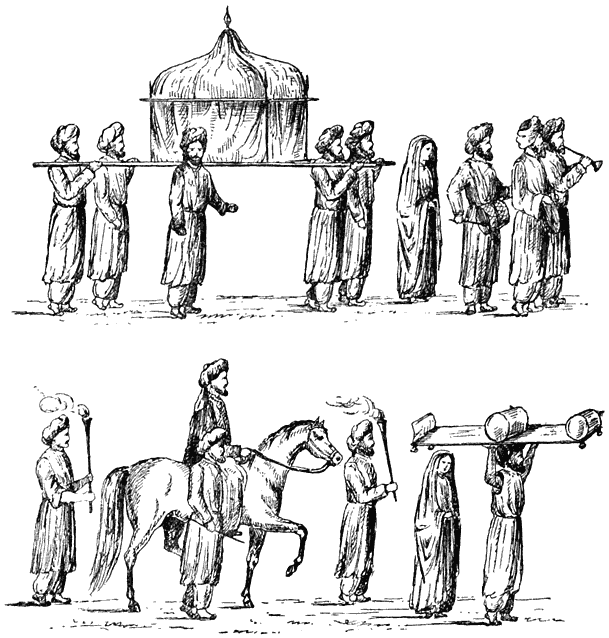
BRINGING HOME THE BRIDE IN AFGHANISTAN. (A. F. Hole.)
The third day, the eventful barāt, arrives to awaken in the heart of a tender mother all the good feelings of fond affection; she is, perhaps, about to part with the great solace of her life under many domestic trials; at any rate, she transfers her beloved child to another protection. All marriages are not equally happy in their termination; it is a lottery, a fate, in the good mother’s calculation. Her darling child may be the favoured of Heaven, for which she prays; she may be however, the miserable first wife of a licentious pluralist; nothing is certain, but she will strive to trust in God’s mercy, that the event prove a happy one to her dearly-loved girl.
The young bride is in close confinement during the days of celebrating her nuptials; on the third, she is tormented with the preparations for her departure. The mayndī must be applied to her hands and feet, the formidable operations of bathing, drying her hair, oiling and dressing her head, dyeing her lips, gums, and teeth with antimony, fixing on her the wedding ornaments, the nose-ring presented by her husband’s family; the many rings to be placed on her fingers and toes, the rings fixed in her ears, are all so many new trials to her, which though a complication of inconvenience, she cannot venture to murmur at, and therefore submits to with the passive weakness of a lamb.
Towards the close of the evening, all these preparations being fulfilled, the marriage portion is set in order to accompany the bride. The guests make their own amusements for the day; the mother is too much occupied with her daughter’s affairs to give much of her time or attention to them; nor do they expect it, for they all know by experience the nature of a mother’s duties at such an interesting period.
The bridegroom’s house is nearly in the same state of bustle as the bride’s, though of a very different description, as the preparing for the reception of a bride is an event of vast importance in the opinion of a Musalman. The gentlemen assemble in the evening, and are regaled with sherbet and the ḥuqqah, and entertained with the nauch-singing and fireworks, until the appointed hour for setting out in the procession to fetch the bride to her new home.
The procession is on a grand scale; every friend or acquaintance, together with their elephants, are pressed into the service of the bridegroom on this night of Barāt. The young man himself is mounted on a handsome charger, the legs, tail, and mane of which are dyed with mayndī, whilst the ornamental furniture of the horse is splendid with spangles and embroidery. The dress of the bridegroom is of gold cloth, richly trimmed, with a turban to correspond, to the top of which is fastened an immense bunch of silver trimming, that falls over his face to his waist, and answers the purpose of a veil (this is in strict keeping with the Hindu custom at their marriage processions). A select few of the females from the bridegroom’s house attend in his train to bring home the bride, accompanied by innumerable torches, with bands of music, soldiers, and servants, to give effect to the procession. On their arrival at the gate of the bride’s residence, the gentlemen are introduced to the father’s apartments, where fire-works, music, and singing, occupy their time and attention until the hour for departure arrives.
The marriage ceremony is performed in the presence of witnesses, although the bride is not seen by any of the males at the time, not even by her husband, until they have been lawfully united according to the common form.
The Maulawī commences by calling on the young maiden by name, to answer to his demand, “Is it by your own consent this marriage takes place with ——?” naming the person who is the bridegroom; the bride answers, “It is by my consent.” The Maulawī then explains the law of Muḥammad, and reads a certain chapter from that portion of the Qurʾān which binds the parties in holy wedlock. He then turns to the young man, and asks him to name the sum he proposes as his wife’s dowry. The bridegroom thus called upon, names ten, twenty, or, perhaps, a hundred lacs of rupees; the Maulawī repeats to all present the amount proposed, and then prays that the young couple thus united may be blessed in this world and in eternity. All the gentleman then retire except the bridegroom, who is delayed entering the hall until the bride’s guests have retreated into the side rooms; as soon as this is accomplished he is introduced into the presence of his mother-in-law and her daughter by the women servants. He studiously avoids looking up as he enters the hall, because, according to the custom of this people, he must first see his wife’s face in a looking-glass, which is placed before the young couple, when he is seated on the masnad by his bride. Happy for him if he then beholds a face that bespeaks the gentle being he hopes Fate has destined to make him happy. If otherwise, he must submit; there is no untying the sacred contract.
Many absurd customs follow this first introduction of the bride and bridegroom. When the procession is all formed, the goods and chattels of the bride are loaded on the heads of the carriers; the bridegroom conveys his young wife in his arms to the covered palankeen, which is in readiness within the court, and the procession moves off in grand style, with a perpetual din of noisy music, until they arrive at the bridegroom’s mansion.
The poor mother has, perhaps, had many struggles with her own heart to save her daughter’s feelings during the preparation for departure; but when the separation takes place, the scene is affecting beyond description. I never witnessed anything equal to it in other societies; indeed, so powerfully are the feelings of the mother excited, that she rarely acquires her usual composure until her daughter is allowed to revisit her, which is generally within a week after her marriage. (See Mrs. Meer Hasan Alī’s Indian Musalmāns, vol. i. p. 46.)
The above description of a wedding in India has been selected as representative of such ceremonies; but there is no uniform custom of celebrating Muslim nuptials, the nuptial ceremonies in Afghanistan being much more simple in their character, as will be seen by the illustration given on the preceding page.
Mr. Lane, in his Modern Egyptians, gives the following interesting account of a wedding in Egypt:—
“Marriages in Cairo are generally conducted, in the case of a virgin, in the following manner; but in that of a widow, or a divorced woman, with little ceremony. Most commonly, the mother, or some other near female relation, of the youth or man who is desirous of obtaining a wife, describes to him the personal and other qualifications of the young women with whom she is acquainted, and directs his choice; or he employs a ‘khatʾbeh,’ or ‘khatibeh’ (k͟hāt̤ibah), a woman whose regular business it is to assist men in such cases. Sometimes two or more women of this profession are employed. A khatʾbeh gives her report confidentially, describing one girl as being like a gazelle, pretty and elegant and young; and another as not pretty, but rich, and so forth. If the man have a mother and other near female relations, two or three of these usually go with a khatʾbeh to pay visits to several hareems, to which she has access in her professional character of a match-maker; for she is employed as much by the women as the men. She sometimes, also, exercises the trade of a ‘dellaleh’ (or broker), for the sale of ornaments, clothing, &c., which procures her admission into almost every hareem. The women who accompany her in search of a wife for their relation, are introduced to the different hareems merely as ordinary visitors; and as such, if disappointed, they soon take their leave, though the object of their visit is, of course, well understood by the other party; but if they find among the females of a family (and they are sure to see all who are marriageable) a girl or young woman having the necessary personal qualifications, they state the motives of their visit, and ask, if the proposed match be not at once disapproved of, what property, ornaments, &c., the objects of their wishes may possess. If the father of the intended bride be dead, she may perhaps possess one or more houses, shops, &c.; and in almost every case, a marriageable girl of the middle or higher ranks has a set of ornaments of gold and jewels. The women visitors, having asked these and other questions, bring their report to the expectant youth or man. If satisfied with their report, he gives a present to the khatʾbeh, and sends her again to the family of his intended wife, to make known to them his wishes. She generally gives an exaggerated description of his personal attractions, wealth, &c. For instance, she will say of a very ordinary young man, of scarcely any property, and of whose disposition she knows nothing, ‘My daughter, the youth who wishes to marry you is young, graceful, elegant, beardless, has plenty of money, dresses handsomely, is fond of delicacies, but cannot enjoy his luxuries alone; he wants you as his companion; he will give you everything that money can procure; he is a stayer at home, and will spend his whole time with you, caressing and fondling you.’
“The parents may betroth their daughter to whom they please, and marry her to him without her consent, if she be not arrived at the age of puberty; but after she has attained that age, she may choose a husband for herself, and appoint any man to arrange and effect her marriage. In the former case, however, the khatʾbeh and the relations of a girl sought in marriage usually endeavour to obtain her consent to the proposed union. Very often a father objects to giving a daughter in marriage to a man who is not of the same profession or trade as himself; and to marrying a younger daughter before an elder! The bridegroom can scarcely ever obtain even a surreptitious glance at the features of his bride, until he finds her in his absolute possession, unless she belong to the lower classes of society; in which case it is easy enough for him to see her face.
“When a female is about to marry, she should have a ‘wekeel’ (wakīl, or deputy), to settle the compact and conclude the contract, for her, with her proposed husband. If she be under the age of puberty, this is absolutely necessary; and in this case, her father, if living, or (if he be dead) her nearest adult male relation, or a guardian appointed by will, or by the Kadee, performs the office of wekeel; but if she be of age, she appoints her own wekeel, or may even make the contract herself; though this is seldom done.
“After a youth or man has made choice of a female to demand in marriage, on the report of his female relations, or that of the khatʾbeh, and, by proxy, made the preliminary arrangements before described with her and her relations in the hareem, he repairs with two or three of his friends to her wekeel. Having obtained the wekeel’s consent to the union, if the intended bride be under age, he asks what is the amount of the required mahr (or dowry).
“The giving of a dowry is indispensable. The usual amount of the dowry, if the parties be in possession of a moderately good income, is about a thousand riyals (or twenty-two pounds ten shillings); or, sometimes, not more than half that sum. The wealthy calculate the dowry in purses, of five hundred piasters (about five pounds sterling) each; and fix its amount at ten purses or more.
“It must be borne in mind that we are considering the case of a virgin bride; the dowry of a widow or divorced woman is much less. In settling the amount of the dowry, as in other pecuniary transactions, a little haggling frequently takes place; if a thousand riyals be demanded through the wekeel, the party of the intended bridegroom will probably make an offer of six hundred; the former party then gradually lowering the demand, and the other increasing the offer, they at length agree to fix it at eight hundred. It is generally stipulated that two-thirds of the dowry shall be paid immediately before the marriage-contract is made; and the remaining third held in reserve, to be paid to the wife in case of divorcing her against her own consent, or in case of the husband’s death.
“This affair being settled, and confirmed by all persons present reciting the opening chapter of the Kuran (the Fatʾhah), an early day (perhaps the day next following) is appointed for paying the money, and performing the ceremony of the marriage-contract, which is properly called ‘akd en-nikah’ (ʿaqdu ʾn-nikāḥ). The making this contract is commonly called ‘ketb el-kitáb’ (katbu ʾl-kitāb, or the writing of the writ); but it is very seldom the case that any document is written to confirm the marriage, unless the bridegroom is about to travel to another place, and fears that he may have occasion to prove his marriage where witnesses of the contract cannot be procured. Sometimes the marriage-contract is concluded immediately after the arrangement respecting the dowry, but more generally a day or two after.
“On the day appointed for this ceremony, the bridegroom, again accompanied by two or three of his friends, goes to the house of his bride, usually about noon, taking with him that portion of the dowry which he has promised to pay on this occasion. He and his companions are received by the bride’s wekeel, and two or more friends of the latter are usually present. It is necessary that there be two witnesses (and those must be Muslims) to the marriage-contract, unless in a situation where witnesses cannot be procured. All persons present recite the Fatʾhah; and the bridegroom then pays the money. After this, the marriage-contract is performed. It is very simple. The bridegroom and the bride’s wekeel sit upon the ground, face to face, with one knee upon the ground, and grasp each other’s right hand, raising the thumbs, and pressing them against each other. A ‘fekeeh’ (faqīh) is generally employed to instruct them what they are to say. Having placed a handkerchief over their joined hands, he usually prefaces the words of the contract with a khutbeh (k͟hut̤bah), consisting of a few words of exhortation and prayer, with quotations from the Kuran and Traditions, on the excellence and advantages of marriage. He then desires the bride’s wekeel to say, ‘I betroth (or marry) to thee my daughter (or the female who has appointed me her wekeel), such a one (naming the bride), the virgin [or the adult], for a dowry of such an amount.’ (The words ‘for a dowry,’ &c., are sometimes omitted.) The bride’s wekeel having said this, the bridegroom says, ‘I accept from thee her betrothal [or marriage] to myself, and take her under my care, and myself to afford her my protection; and ye who are present bear witness of this.’ The wekeel addresses the bridegroom in the same manner a second and a third time; and each time, the latter replies as before. Both then generally add, ‘And blessing be on the Apostles: and praise be to God, the Lord of the beings of the whole world. Amen.’ After which all present again repeat the Fatʾhah. It is not always the same form of khutbeh that is recited on these occasions; any form may be used, and it may be repeated by any person; it is not even necessary, and is often altogether omitted.
“The contract concluded, the bridegroom sometimes (but seldom, unless he be a person of the lower orders) kisses the hands of his friends and others there present; and they are presented with sharbat, and generally remain to dinner. Each of them receives an embroidered handkerchief, provided by the family of the bride; except the fekeeh, who receives a similar handkerchief, with a small gold coin tied up in it, from the bridegroom. Before the persons assembled on this occasion disperse, they settle when the ‘leylet ed-dakhleh’ is to be. This is the night when the bride is brought to the house of the bridegroom, and the latter, for the first time, visits her.
“The bridegroom should receive his bride on the eve of Friday, or that of Monday; but the former is generally esteemed the more fortunate period. Let us say, for instance, that the bride is to be conducted to him on the eve of Friday.
“During two or three or more preceding nights, the street or quarter in which the bridegroom lives is illuminated with chandeliers and lanterns, or with lanterns and small lamps, some suspended from cords drawn across from the bridegroom’s and several other houses on each side to the houses opposite; and several small silk flags, each of two colours, generally red and green, are attached to these or other cords.
“An entertainment is also given on each of these nights, particularly on the last night before that on which the wedding is concluded, at the bridegroom’s house. On these occasions, it is customary for the persons invited, and for all intimate friends, to send presents to his house, a day or two before the feast which they purpose or expect to attend. They generally send sugar, coffee, rice, wax candles, or a lamb. The former articles are usually placed upon a tray of copper or wood, and covered with a silk or embroidered kerchief. The guests are entertained on these occasions by musicians and male or female singers, by dancing girls, or by the performance of a ‘khatmeh’ (k͟hatmah), or a ‘zikr’ (ẕikr).
“The customs which I am now about to describe are observed by those classes that compose the main bulk of the population of Cairo.
“On the preceding Wednesday (or on the Saturday if the wedding be to conclude on the eve of Monday), at about the hour of noon, or a little later, the bride goes in state to the bath. The procession to the bath is called ‘Zeffet el-Hammām.’ It is headed by a party of musicians, with a hautboy or two, and drums of different kinds. Sometimes at the head of the bride’s party, are two men, who carry the utensils and linen used in the bath, upon two round trays, each of which is covered with an embroidered or a plain silk kerchief; also a sakka (saqqā) who gives water to any of the passengers, if asked; and two other persons, one of whom bears a ‘kamkam,’ or bottle, of plain or gilt silver, or of china, containing rose-water, or orange-flower water, which he occasionally sprinkles on the passengers; and the other, a ‘mibkharah’ (or perfuming vessel) of silver, with aloes-wood, or some other odoriferous substance, burning in it; but it is seldom that the procession is thus attended. In general, the first persons among the bride’s party are several of her married female relations and friends, walking in pairs; and next, a number of young virgins. The former are dressed in the usual manner, covered with the black silk ḥabarah; the latter have white silk ḥabarahs, or shawls. Then follows the bride, walking under a canopy of silk, of some gay colour, as pink, rose-colour, or yellow; or of two colours, composing wide stripes, often rose-colour and yellow. It is carried by four men, by means of a pole at each corner, and is open only in front; and at the top of each of the four poles is attached an embroidered handkerchief.