DICTIONARY OF ISLĀM. (continued 28)
Reading edition
QUBĀʾ (قباء). A place three miles from al-Madīnah, where the Prophet’s she-camel, al-Qaṣwāʾ knelt down as she brought her master on his flight from Makkah, and where Muḥammad laid the foundations of a mosque. This was the first place of public prayer in Islām. Muḥammad laid the first brick with his javelin, and marked out the direction of prayer. It is this mosque which is mentioned in the Qurʾān, Sūrah ix. 109:—“There is a mosque founded from its first day in piety. More worthy is it that thou enter therein: therein are men who aspire to purity, and God loveth the purified.”
It is esteemed the fourth mosque in rank, being next to that of Makkah, al-Madīnah, and Jerusalem, and tradition relates that the Prophet said one prayer in it was equal to a lesser pilgrimage to Makkah. [UMRAH.] Captain Burton says:—
“It was originally a square building of very small size; Osman enlarged it in the direction of the minaret, making it sixty-six cubits each way. It is no longer ‘mean and decayed’ as in Burckhardt’s time. The Sultan Abdel Hamid, father of Mahmud, created a neat structure of cut stone, whose crenelles make it look more like a place of defence than of prayer. It has, however, no pretensions to grandeur. The minaret is of Turkish shape. To the south, a small and narrow Riwak (riwāq), or raised hypo-style, with unpretending columns, looks out northwards upon a little open area simply sanded over; and this is the whole building.”
AL-QUDDŪS (القدوس). “The Holy.” One of the ninety-nine names of God. It occurs in the Qurʾān, Sūrah lix. 23: “He is God beside whom there is no deity, the King, the Holy.”
QUDRAH (قدرة). Power. Omnipotence. One of the attributes of God. Al-Qudratu ʾl-ḥalwāʾ, The sweet cake of God, i.e. The manna of Israel. The word Qudrah does not occur in the Qurʾān.
QUNŪTU ʾL-WITR (قنوت الوتر). A special supplication said after the Witr prayers, or, according to some, after the morning prayers. It was at such times that the Prophet would pray for the liberation of his friends and for the destruction of his enemies.
For the different forms of supplication, see Mishkāt, book iv. chapters xxxvi. and xxxvii.
The following is the one usually recited: “O God! direct me amongst those to whom Thou hast shown the right road, and keep me in safety from the calamities of this world and the next, and love me amongst those Thou hast befriended. Increase Thy favours on me, and preserve me from ill; for verily Thou canst order at Thy will, and canst not be ordered. Verily none are ruined that Thou befriendest, nor are any made great with whom Thou art at enmity.”
QURAISH (قريش). The Arabian tribe from which Muḥammad was descended, and of which his grandfather, ʿAbdu ʾl-Mut̤t̤alib was chief or prince. This tribe occupies a very prominent place in the Qurʾān and in Muḥammadan history. In the Traditions, a special section is set apart for a record of the sayings of the Prophet regarding the good qualities of this tribe.
Muḥammad is related to have said: “Whosoever wishes for the destruction of the Quraish, him may God destroy.”
Ibn ʿUmar relates that the Prophet said, “The office of K͟halīfah should be in the Quraish as long as there are two persons left in the tribe, one to be ruler and the other to be ruled.” (Mishkāt, book xxiv. c. xii.)
The Sharīf, or Sheriff of Makkah, is always of the Quraish tribe, but ever since the extinction of the Abbaside K͟halīfahs, the Sultāns of Turkey have held the office of K͟halīfah, who are not of this tribe. [KHALIFAH.]
For an account of the Quraish, refer to Sir William Muir’s Life of Mahomet, vol. i. Intro. cxcv. See also article ARABIA.
Muḥammad T̤āhir, in his Majmaʿu ʾl-Biḥār, vol. ii., p. 133, says Quraish is the name of a great marine monster which preys on fish, and was given to this tribe on account of its strength and importance amongst the tribes of Arabia. Quraish is the title of the CVIth Sūrah of the Qurʾān.
QURAIZ̤AH (قريظة). A tribe of Jews located near al-Madīnah in the time of Muḥammad. They at first professed to support his mission, but afterwards became disaffected. The Prophet asserted that he had been commanded by God to destroy them, and a complete massacre of the men took place, and the women and children were taken captive. The event is referred to at length in the XXXIIIrd Sūrah of the Qurʾān.
Sir William Muir thus records the event:—
“The men and women were penned up for the night in separate yards; they were supplied with dates, and spent the night in prayer, repeating passages from their Scriptures, and exhorting one another in constancy. During the night graves or trenches sufficient to contain the dead bodies of the men were dug in the chief market-place of the city. When these were ready in the morning, Mahomet, himself a spectator of the tragedy, gave command that the captives should be brought forth in companies of five or six at a time. Each company was made to sit down by the brink of the trench destined for its grave, and there beheaded. Party after party they were thus led out, and butchered in cold blood, till the whole were slain. One woman alone was put to death. It was she who threw the millstone from the battlements. For Zoheir, an aged Jew, who had saved some of his allies of the Bani Aus in the battle of Boâth, Thâbit interceded and procured a pardon, including the freedom of his family and restoration of his property. ‘But what hath become of all our chiefs,—of Kâb, of Huwey, of Ozzâl, the son of Samuel?’ asked the old man. As one after another he named the leading chiefs of his tribe, he received to each inquiry the same reply,—they had all been slain already. ‘Then of what use is life to me any longer? Leave me not to that bloodthirsty man who has killed all that are dear to me in cold blood. But slay me also, I entreat thee. Here, take my sword, it is sharp; strike high and hard.’ Thâbit refused, and gave him over to another, who, under Ali’s orders, beheaded the aged man, but attended to his last request in obtaining freedom for his family. When Mahomet was told of his saying, ‘Slay me also, that I may go to my home and join those that have preceded me,’ he answered, ‘Yea, he shall join them in the fire of hell!’
“Having sated his revenge, and drenched the market-place with the blood of eight hundred victims, and having given command for the earth to be smoothed over their remains, Mahomet returned from the horrid spectacle to solace himself with the charms of Rîhâna, whose husband and all whose male relatives had just perished in the massacre. He invited her to be his wife, but she declined, and chose to remain (as, indeed, having refused marriage, she had no alternative) his slave or concubine. She also declined the summons to conversion, and continued in the Jewish faith, at which the Prophet was much concerned. It is said, however, that she afterwards embraced Islâm. She lived with Mahomet till his death.
“The booty was divided into four classes—lands, chattels, cattle, and slaves; and Mahomet took a fifth of each. There were (besides little children who counted with their mothers) a thousand captives; from his share of these, Mahomet made certain presents to his friends of slave girls and female servants. The rest of the women and children he sent to be sold among the Bedouin tribes of Najd, in exchange for horses and arms; for he kept steadily in view the advantage of raising around him a body of efficient horse.” (Life of Mahomet, vol. iii. p. 276.)
QURʾĀN (قران). The sacred book of the Muḥammadans, and believed by them to be the inspired word of God. It is written in the Arabic language.
The word Qurʾān is derived from the Arabic Qaraʾ, which occurs at the commencement of Sūrah xcv., which is said to have been the first chapter revealed to Muḥammad, and has the same meaning as the Heb. קָרָא kārā, “to read,” or “to recite,” which is frequently used in Jeremiah xxxvi., as well as in other places in the Old Testament. It is, therefore, equivalent to the Heb. מִקְרָא mikrā, rendered in Nehemiah viii. 8, “the reading.” It is the title given to the Muḥammadan Scriptures which are usually appealed to and quoted from as al-Qurʾān al-Majīd, the “Glorious Qurʾān”; al-Qurʾān ash-Sharīf, the “Noble Qurʾān”; and is also called the Furqān, “Distinguisher”; Kalāmu ʾllāh, the “Word of God”; and al-Kitāb, “the Book.”
According to Jalālu ʾd-dīn as-Suyūt̤ī, in his Itqān, p. 117, the Qurʾān is distinguished in the text of the book by the following fifty-five special titles:—
1. Al-Kitāb The Book.
2. Al-Mubīn The Enlightener.
3. Al-Qurʾān The Reading.
4. Al-Karīm The Good.
5. Al-Kalām The Word.
6. Al-Burhān The Proof.
7. An-Nūr The Light.
8. Al-Hudā The Guidance.
9. Ar-Raḥmah The Mercy.
10. Al-Furqān The Distinguisher.
11. Ash-Shifāʾ The Health.
12. Al-Muʿiz̤ah The Sermon.
13. Aẕ-Ẕikr The Reminder.
14. Al-Mubārak The Blessed.
15. Al-ʿAlī The Lofty.
16. Al-Ḥikmah The Wisdom.
17. Al-Ḥakīm The Philosopher.
18. Al-Muhaimin The Preserver.
19. Al-Muṣaddiq The Establisher of Truth.
20. Al-Ḥabl The Rope.
21. Aṣ-Ṣirāt̤u ʾl-Mustaqīm The Straight Path.
22. Al-Qaiyim The Strong.
23. Al-Qaulu ʾl-Faṣl The Distinguishing Speech.
24. An-Nabaʾu ʾl-ʿAz̤īm The Exalted News.
25. Al-Ḥasanu ʾl-Ḥadīs̤ The Good Saying.
26. Al-Mas̤ānī The Repetition.
27. Al-Mutashābih The Uniform.
28. At-Tanzīl The Revelation.
29. Ar-Rūḥ The Spirit.
30. Al-Waḥy The Inspiration.
31. Al-ʿArabī The Arabic.
32. Al-Baṣāʾir The Enlightenment.
33. Al-Bayān The Explanation.
34. Al-ʿIlm The Knowledge.
35. Al-Ḥaqq The Truth.
36. Al-Hādī The Guide.
37. Al-ʿAjab The Wonderful.
38. At-Taẕkirah The Exhortation.
39. Al-ʿUrwatu ʾl-Wus̤qā The Firm Handle.
40. Aṣ-Ṣidq The Righteous.
41. Al-ʿAdl The Justice.
42. Al-Amr The Order.
43. Al-Munādī The Preacher.
44. Al-Bushrā The Glad Tidings.
45. Al-Majīd The Exalted.
46. Az-Zabūr The Psalm.
47. Al-Bashīr The Herald of Glad Tidings.
48. An-Naẕīr The Warner.
49. Al-ʿAzīz The Mighty.
50. Al-Balāg͟h The Message.
51. Al-Qaṣaṣ The Narrative.
52. As-Sūḥuf The Pamphlets.
53. Al-Mukarramah The Excellent.
54. Al-Marfūʿah The Exalted.
55. Al-Mut̤āharah The Purified.
I.—The Inspiration of the Qurʾān.
According to Abū Ḥanīfah, the great Sunnī Imām, the Qurʾān is eternal in its original essence. He says, “The Qurʾān is the Word of God, and is His inspired Word and Revelation. It is a necessary attribute (ṣifah) of God. It is not God, but still it is inseparable from God. It is written in a volume, it is read in a language, it is remembered in the heart, and its letters and its vowel points, and its writing are all created, for these are the works of man, but God’s word is uncreated (g͟hairu ʾl-mak͟hlūq). Its words, its writing, its letters, and its verses, are for the necessities of man, for its meaning is arrived at by their use, but the Word of God is fixed in the essence (ẕāt) of God, and he who says that the word of God is created is an infidel.” (See Kitābu ʾl-Waṣīyah, p. 77.)
Muḥammadans believe the Qurʾān to have been written by “the hands of noble, righteous scribes,” mentioned in the Sūratu ʿAbasa (lxxx.) 15, and to have been sent down to the lowest heaven complete, from whence it was revealed from time to time to the Prophet by the angel Gabriel. [GABRIEL.]
There is, however, only one distinct assertion in the Qurʾān of Gabriel having been the medium of inspiration, namely, Sūratu ʾl-Baqarah (ii.), 91; and this occurs in a Medinah Sūrah revealed about seven years after the Prophet’s rule had been established. In the Sūratu ʾsh-Shuʿarāʾ (xxvi.), 193, the Qurʾān is said to have been given by the Rūhu ʾl-Amīn, or “Faithful Spirit”; and in the Sūratu ʾn-Najm (liii.), 5, Muḥammad claims to have been taught by the Shadīdu ʾl-Quwā, or “One terrible in power”; and in the Traditions the agent of inspiration is generally spoken of as “an angel” (malak). It is, therefore, not quite certain through what agency Muḥammad believed himself to be inspired of God, the Holy Spirit or the angel Gabriel.
According to the traditions, the revelation was first communicated in dreams. ʿĀyishah, one of the Prophet’s wives, relates (Mishkāt, xxiv. 5):—
“The first revelations which the Prophet received were in true dreams; and he never dreamt but it came to pass as regularly as the dawn of day. After this the Prophet was fond of retirement, and used to seclude himself in a cave in Mount Ḥirāʾ and worship there day and night. He would, whenever he wished, return to his family at Makkah, and then go back again, taking with him the necessaries of life. Thus he continued to return to K͟hadījah from time to time, until one day the revelation came down to him, and the angel (Arabic malak, Heb. malak͟h, “an angel; a prophet”; a name of office, not of nature [See Wilson’s Hebrew Lexicon, p. 13]) came to him and said, ‘Read’ (iqraʾ); but the Prophet said, ‘I am not a reader.’ And the Prophet related that he (i.e. the angel) took hold of me and squeezed me as much as I could bear, and he then let me go and said again, ‘Read!’ And I said, ‘I am not a reader.’ Then he took hold of me a second time, and squeezed me as much as I could bear, and then let me go, and said, ‘Read!’ And I said, ‘I am not a reader.’ Then he took hold of me a third time and squeezed me as much as I could bear, and said:—
“ ‘Read! in the name of Thy Lord who created;
Created man from a clot of blood in the womb.
Read! for thy Lord is the most beneficent,
He hath taught men the use of the pen;
He hath taught man that which he knoweth not.’
(These are the first five verses of the XCVIth Sūrah of the Qurʾān. The other verses of the Sūrah being of a later date.)
“Then the Prophet repeated the words himself, and with his heart trembling he returned (i.e. from Ḥirāʾ to Makkah) to K͟hadījah, and said, ‘Wrap me up, wrap me up.’ And they wrapped him up in a garment till his fear was dispelled, and he told K͟hadījah what had passed, and he said: ‘Verily, I was afraid I should have died.’ Then K͟hadījah said, ‘No, it will not be so. I swear by God, He will never make you melancholy or sad. For verily you are kind to your relatives, you speak the truth, you are faithful in trust, you bear the afflictions of the people, you spend in good works what you gain in trade, you are hospitable, and you assist your fellow men.’ After this K͟hadījah took the Prophet to Waraqah, who was the son of her uncle, and she said to him, ‘O son of my uncle! hear what your brother’s son says.’ Then Waraqah said to the Prophet, ‘O son of my brother! what do you see?’ Then the Prophet told Waraqah what he saw, and Waraqah said, ‘That is the Nāmūs [NAMUS] which God sent to Moses.’ ʿĀyishah also relates that Ḥāris̤ ibn Hishām asked the Prophet, ‘How did the revelation come to you?’ and the Prophet said, ‘Sometimes like the noise of a bell, and sometimes the angel would come and converse with me in the shape of a man.’ ”
According to ʿĀyishah’s statement, the Sūratu ʾl-ʿAlaq (xcvi.) was the first portion of the Qurʾān revealed; but it is more probable that the poetical Sūrahs, in which there is no express declaration of the prophetic office, or of a divine commission, were composed at an earlier period. Internal evidence would assign the earliest date to the Sūrahs az-Zalzalah (xcix.), al-ʿAṣr (ciii.), al-ʿĀdiyāt (c.), and al-Fātiḥah (i.), which are rather the utterances of a searcher after truth than of an Apostle of God.
Although the Qurʾān now appears as one book, the Muslim admits that it was not all made known to the Prophet in one and the same manner.
Mr. Sell, in his Faith of Islām, quoting from the Mudāriju ʾn-Nubūwah, p. 509, gives the following as some of the modes of inspiration:—
“1. It is recorded on the authority of ʾA′yesha, one of Muhammad’s wives, that a brightness like the brightness of the morning came upon the Prophet. According to some commentators, this brightness remained six months. In some mysterious way Gabriel, through this brightness or vision, made known the will of God.
“2. Gabriel appeared in the form of Dahiah (Daḥyah), one of the Companions of the Prophet, renowned for his beauty and gracefulness. A learned dispute has arisen with regard to the abode of the soul of Gabriel when he assumed the bodily form of Dahiah. At times, the angelic nature of Gabriel overcame Muhammad, who was then translated to the world of angels. This always happened when the revelation was one of bad news, such as denunciations or predictions of woe. At other times, when the message brought by Gabriel was one of consolation and comfort, the human nature of the Prophet overcame the angelic nature of the angel, who, in such case, having assumed a human form, proceeded to deliver the message.
“3. The Prophet heard at times the noise of the tinkling of a bell. To him alone was known the meaning of the sound. He alone could distinguish in, and through it, the words which Gabriel wished him to understand. The effect of this mode of Wahí (Waḥy) was more marvellous than that of any of the other ways. When his ear caught the sound his whole frame became agitated. On the coldest day, the perspiration, like beads of silver, would roll down his face. The glorious brightness of his countenance gave place to a ghastly hue, whilst the way in which he bent down his head showed the intensity of the emotion through which he was passing. If riding, the camel on which he sat would fall to the ground. The Prophet one day, when reclining with his head on the lap of Zeid, heard the well-known sound: Zeid, too, knew that something unusual was happening, for so heavy became the head of Muhammad that it was with the greatest difficulty he could support the weight.
“4. At the time of the Miʾráj, or night ascent into heaven, God spoke to the Prophet without the intervention of an angel. It is a disputed point whether the face of the Lord was veiled or not.
“5. God sometimes appeared in a dream, and placing his hands on the Prophet’s shoulders made known his will.
“6. Twice, angels having each six hundred wings, appeared and brought the message from God.
“7. Gabriel, though not appearing in bodily form, so inspired the heart of the Prophet, that the words he uttered under its influence were the words of God. This is technically called Ilka (Ilqāʾ), and is by some supposed to be the degree of inspiration to which the Traditions belong. (See as-Suyūt̤ī’s Itqān, p. 103.)
“Above all, the Prophet was not allowed to remain in any error; if, by any chance, he had made a wrong deduction from any previous revelation, another was always sent to rectify it. This idea has been worked up to a science of abrogation, according to which some verses of the Qurán abrogate others. Muhammad found it necessary to shift his stand-point more than once, and thus it became necessary to annul earlier portions of his revelation. [MANSUKH.]
“Thus in various ways was the revelation made known to Muhammad. At first there seems to have been a season of doubt, the dread lest after all it might be a mockery. But as years rolled on, confidence in himself and in his mission came. At times, too, there is a joyousness in his utterances as he swears by heaven and earth, by God and man; but more often the visions were weird and terrible. Tradition says:—“He roared like a camel, the sound as of bells well-nigh rent his heart in pieces.” Some strange power moved him, his fear was uncontrollable. For twenty years or more the revelations came, a direction on things of heaven and of earth, to the Prophet as the spiritual guide of all men, to the Warrior-Chief, as the founder of political unity among the Arab tribes.”
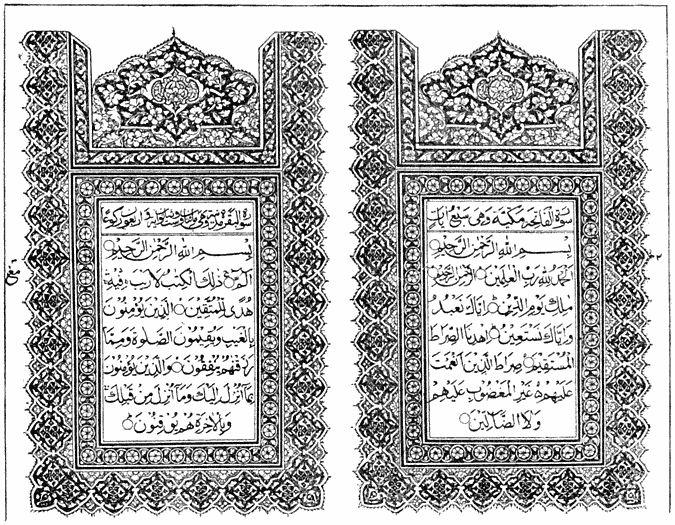
A SPECIMEN OF THE FIRST TWO PAGES OF A QURʾAN.
II.—The Collation of the Qurʾān.
The whole book was not arranged until after Muḥammad’s death, but it is believed that the Prophet himself divided the Sūrahs [SURAH] and gave most of them their present titles, which are chosen from some word which occurs in the chapter. The following is the account of the collection and arrangement of the Qurʾān, as it stands at present, as given in traditions recorded by al-Buk͟hārī (see Ṣaḥīḥu ʾl-Buk͟hārī, Arabic ed., p. 745.)
“Zaid ibn S̤ābit relates:—‘Abu Bakr sent a person to me, and called me to him, at the time of the battle with the people of Yamāmah; and I went to him, and ʿUmar was with him; and Abu Bakr said to me, “ʿUmar came to me and said, ‘Verily a great many of the readers of the Qurʾān were slain on the day of the battle with the people of Yamāmah; and really I am afraid that if the slaughter should be great, much will be lost from the Qurʾān, because every person remembers something of it; and, verily, I see it advisable for you to order the Qurʾān to be collected into one book.’ I said to ʿUmar, ‘How can I do a thing which the Prophet has not done?’ He said, ‘I swear by God, this collecting of the Qurʾān is a good thing.’ And ʿUmar used to be constantly returning to me and saying: ‘You must collect the Qurʾān,’ till at length God opened my breast so to do, and I saw what ʿUmar had been advising.” And Zaid ibn S̤ābit says that, ‘Abū Bakr said to me, “You are a young and sensible man, and I do not suspect you of forgetfulness, negligence, or perfidy; and, verily, you used to write for the Prophet his instructions from above; then look for the Qurʾān in every place and collect it.” I said, “I swear by God, that if people had ordered me to carry a mountain about from one place to another, it would not be heavier upon me than the order which Abū Bakr has given for collecting the Qurʾān.” I said to Abū Bakr, “How do you do a thing which the Prophet of God did not?” He said, “By God, this collecting of the Qurʾān is a good act.” And he used perpetually to return to me, until God put it into my heart to do the thing which the heart of Abū Bakr had been set upon. Then I sought for the Qurʾān, and collected it from the leaves of the date, and white stones, and the breasts of people that remembered it, till I found the last part of the chapter entitled Tauba (Repentance), with Abū K͟huzaimah al-Anṣārī, and with no other person. These leaves were in the possession of Abū Bakr, until God caused him to die; after which ʿUmar had them in his life-time; after that, they remained with his daughter, Ḥafṣah; after that, ʿUs̤mān compiled them into one book.’
“Anas ibn Mālik relates: ‘Huzaifah came to ʿUs̤mān, and he had fought with the people of Syria in the conquest of Armenia; and had fought in Aẕurbaijān, with the people of al-ʿIrāq, and he was shocked at the different ways of people reading the Qurʾān. And Huzaifah said to ʿUs̤mān, “O ʿUs̤mān, assist this people, before they differ in the Book of God, just as the Jews and Christians differ in their books.” Then ʿUs̤mān sent a person to Ḥafṣah, ordering her to send those portions which she had, and saying, “I shall have a number of copies of them taken, and will then return them to you.” And Ḥafṣah sent the portions to ʿUs̤mān, and ʿUs̤mān ordered Zaid ibn S̤ābit, Anṣārī, and ʿAbdu ʾllāh ibn az-Zubair, and Saʿīd ibn Alʿās, and ʿAbdu ʾr-Raḥmān ibn al-Ḥāris̤ ibn Hishām; and these were all of the Quraish tribe, except Zaid ibn S̤ābit and ʿUs̤mān. And he said to the three Quraishites, “When you and Zaid ibn-S̤ābit differ about any part of the dialect of the Qurʾān, then do ye write it in the Quraish dialect, because it came not down in the language of any tribe but theirs.” Then they did as ʿUs̤mān had ordered; and when a number of copies had been taken, ʿUs̤mān returned the leaves to Ḥafṣah. And ʿUs̤mān sent a copy to every quarter of the countries of Islām, and ordered all other leaves to be burnt, and Ibn Shahāb said, “K͟hārījah, son of Zaid ibn S̤ābit, informed me, saying, ‘I could not find one verse when I was writing the Qurʾān, which, verily, I heard from the Prophet; then I looked for it, and found it with K͟huzaimah, and entered it into the Sūratu ʾl-Aḥzāb.’ ”
This recension of the Qurʾān produced by the K͟halīfah ʿUs̤mān has been handed down to us unaltered; and there is probably no other book in the world which has remained twelve centuries with so pure a text.
Sir William Muir remarks in his Life of Mahomet:—
“The original copy of the first edition was obtained from Haphsa’s (Ḥafṣah) depository, and a careful recension of the whole set on foot. In case of difference between Zaid and his coadjutors, the voice of the latter, as demonstrative of the Coreishite idiom, was to preponderate; and the new collation was thus assimilated to the Meccan dialect, in which the Prophet had given utterance to his inspiration. Transcripts were multiplied and forwarded to the chief cities in the empire, and the previously existing copies were all, by the Caliph’s command, committed to the flames. The old original was returned to Haphsa’s custody.
“The recension of Othmân (ʿUs̤mān) has been handed down to us unaltered. So carefully, indeed, has it been preserved, that there are no variations of importance,—we might almost say no variations at all, amongst the innumerable copies of the Coran scattered throughout the vast bounds of the empire of Islâm.
“Contending and embittered factions, taking their rise in the murder of Othmân himself within a quarter of a century from the death of Mahomet, have ever since rent the Mahometan world. Yet but one Corân has been current amongst them; and the consentaneous use by them all in every age up to the present day of the same Scripture, is an irrefragable proof that we have now before us the very text prepared by command of the unfortunate Caliph. There is probably in the world no other work which has remained twelve centuries with so pure a text. The various readings are wonderfully few in number, and are chiefly confined to differences in the vowel points and diacritical signs. But these marks were invented at a later date.
“In support of this position, the following arguments may be adduced. First: When Othmân’s edition was prepared, no open breach had yet taken place between the Omeyads and the Alyites. The unity of Islâm was still complete and unthreatened. Ali’s pretensions were as yet undeveloped. No sufficient object can, therefore, be assigned for the perpetration by Othmân of an offence which Moslems regard as one of the blackest dye. Second: On the other hand, Ali, from the very commencement of Othmân’s reign, had an influential party of adherents, strong enough in the end to depose the Caliph, to storm his palace in the heart of Medîna, and to put an end to his life. Can we conceive that these men would have remained quiet, when the very evidence of their leader’s superior claims was being openly expunged from the book of God. Third: At the time of the recension, there were still multitudes alive who had the Corân, as originally delivered, by heart; and of the supposed passages favouring Ali—had any ever existed—there would have been numerous transcripts in the hands of his family and followers. Both of these sources must have proved an effectual check upon any attempt at suppression. Fourth: The party of Ali shortly after assumed an independent attitude, and he himself succeeded to the Caliphate. Is it possible that either Ali, or his party, when thus arrived at power, would have tolerated a mutilated Corân—mutilated expressly to destroy his claims. Yet we find that they used the same Corân as their opponents, and raised no shadow of an objection against it.
“The insurgents are indeed said to have made it one of their complaints against Othmân that he had caused a new edition to be made of the Corân, and had committed all the old copies to the flames; but these proceedings were objected to simply as unauthorised and sacrilegious. No hint was dropped of any alteration or omission. Such a supposition, palpably absurd at the time, is altogether an after-thought of the modern Sheeas.
“We may, then, safely conclude that Othmân’s recension was, what it professed to be, a reproduction of Abu Bakr’s edition, with a more perfect conformity to the dialect of Mecca, and possibly a more uniform arrangement of its parts,—but still a faithful reproduction.
“The most important question yet remains, viz. Whether Abu Bakr’s edition was itself an authentic and complete collection of Mahomet’s Revelations. The following considerations warrant the belief that it was authentic and, in the main, as complete as at the time was possible.
“First.—We have no reason to doubt that Abu Bakr was a sincere follower of Mahomet, and an earnest believer in the divine origin of the Corân. His faithful attachment to the Prophet’s person, conspicuous for the last twenty years of his life, and his simple, consistent, and unambitious deportment as Caliph, admit no other supposition. Firmly believing the revelations of his friend to be the revelations of God himself, his first object would be to secure a pure and complete transcript of them. A similar argument applies with almost equal force to Omar, and the other agents in the revision. The great mass of Mussulmans were undoubtedly sincere in their belief. From the scribes themselves, employed in the compilation, down to the humblest believer who brought his little store of writing on stones or palm-leaves, all would be influenced by the same earnest desire to reproduce the very words which their Prophet had declared as his message from the Lord. And a similar guarantee existed in the feelings of the people at large, in whose soul no principle was more deeply rooted than an awful reverence for the supposed word of God. The Corân itself contains frequent denunciations against those who should presume to ‘fabricate anything in the name of the Lord,’ or conceal any part of that which He had revealed. Such an action, represented as the very worst description of crime, we cannot believe that the first Moslems, in the early ardour of their faith and love, would have dared to contemplate.
“Second.—The compilation was made within two years of Mahomet’s death. We have seen that several of his followers had the entire revelation (excepting, perhaps, some obsolete fragments) by heart; that every Moslem treasured up more or less some portions in his memory; and that there were official Reciters of it, for public worship and tuition, in all countries to which Islâm extended. These formed an unbroken link between the Revelation fresh from Mahomet’s lips, and the edition of it by Zeid. Thus the people were not only sincere and fervent in wishing for a faithful copy of the Corân; they were also in possession of ample means for realising their desire, and for testing the accuracy and completeness of the volume placed in their hands by Abu Bakr.
“Third.—A still greater security would be obtained from the fragmentary transcripts which existed in Mahomet’s life-time, and which must have greatly multiplied before the Corân was compiled. These were in the possession, probably, of all who could read. And as we know that the compilation of Abu Bakr came into immediate and unquestioned use, it is reasonable to conclude that it embraced and corresponded with every extant fragment, and therefore by common consent, superseded them. We hear of no fragments, sentences, or words, intentionally omitted by the compilers, nor of any that differed from the received edition. Had any such been discoverable, they would undoubtedly have been preserved and noticed in those traditional repositories which treasured up the minutest and most trivial acts and sayings of the Prophet.
“Fourth.—The contents and the arrangement of the Corân speak forcibly for its authenticity. All the fragments that could possibly be obtained have with artless simplicity been joined together. The patchwork bears no marks of a designing genius or a moulding hand. It testifies to the faith and reverence of the compilers, and proves that they dared no more than simply collect the sacred fragments and place them in juxtaposition. Hence the interminable repetitions; the palling reiteration of the same ideas, truths, and doctrines; hence, scriptural stories and Arab legends, told over and over again with little verbal variation; hence the pervading want of connection, and the startling chasms between adjacent passages. Again, the frailties of Mahomet, supposed to have been noticed by the Deity, are all with evident faithfulness entered in the Corân. Not less undisguised are the frequent verses which are contradicted or abrogated by later revelations. The editor plainly contented himself with compiling and copying out in a continuous form, but with scrupulous accuracy, the fragmentary materials within his reach. He neither ventured to select from repeated versions of the same incident, nor to reconcile differences, nor by the alteration of a single letter to connect abrupt transitions of context, nor by tampering with the text to soften discreditable appearances. Thus we possess every internal guarantee of confidence.
“But it may be objected,—if the text of Abu Bakr’s Corân was pure and universally received, how came it to be so soon corrupted, and to require, in consequence of its variations, an extensive recension? Tradition does not afford sufficient light to determine the cause of these discrepancies. They may have been owing to various readings in the older fragmentary transcripts which remained in the possession of the people; they may have originated in the diverse dialects of Arabia, and the different modes of pronunciation and orthography; or they may have sprung up naturally in the already vast domains of Islâm, before strict uniformity was officially enforced. It is sufficient for us to know that in Othmân’s revision recourse was had to the original exemplar of the first compilation, and that there is otherwise every security, internal and external, that we possess a text the same as that which Mahomet himself gave forth and used.” (Life of Mahomet, new ed., p. 557 et seqq.)
The various readings (qirāʾah) in the Qurʾān are not such as are usually understood by the term in English authors, but different dialects of the Arabic language. Ibn ʿAbbās says the Prophet said, “Gabriel taught me to read the Qurʾān in one dialect, and when I recited it he taught me to recite it in another dialect, and so on until the number of dialects increased to seven.” (Mishkāt, book ii. ch. ii.)
Muḥammad seems to have adopted this expedient to satisfy the desire of the leading tribes to have a Qurʾān in their own dialect; for ʿAbdu ʾl-Ḥaqq says, “The Qurʾān was first revealed in the dialect of the Quraish, which was the Prophet’s native tongue; but when the Prophet saw that the people of other tribes recited it with difficulty, then he obtained permission from God to extend its currency by allowing it to be recited in all the chief dialects of Arabia, which were seven:—Quraish, Taiy, Hawāzin, Yaman, S̤aqīf, Huẕail, and Banū Tamīm. Every one of these tribes accordingly read the Qurʾān in its own dialect, till the time of ʿUs̤mān, when these differences of reading were prohibited.”
These seven dialects are called in Arabic Sabaʿtu Aḥruf, and in Persian Haft Qirāʾāt.
III.—The Divisions of the Qurʾān.
The Qurʾān, which is written in the Arabic language, is divided into: Ḥarf, Kalimah, Āyah, Sūrah, Rukūʾ, Rubʿ, Niṣf, S̤uls̤, Juzʾ, Manzal.
1. Ḥarf (pl. Ḥurūf), Letters; of which there are said to be 323,671, or according to some authorities, 338,606.
2. Kalimah (pl. Kalimāt), Words; of which there are 77,934, or, according to some writers, 79,934.
3. Āyah (pl. Āyāt), Verses. Āyah (Heb. אוֹת) is a word which signifies “sign.” It was used by Muḥammad for short sections or verses of his supposed revelation. The division of verses differs in different editions of the Arabic Qurʾān. The number of verses in the Arabic Qurʾāns are recorded after the title of the Sūrah, and the verses distinguished in the text by a small cypher or circle. The early readers of the Qurʾān did not agree as to the original position of these circles, and so it happens that there are five different systems of numbering the verses.
(a) Kūfah verses. The Readers in the city of al-Kūfah say that they followed the custom of ʿAlī. Their way of reckoning is generally adopted in India. They reckon 6,239 verses.
(b) Baṣrah verses. The Readers of al-Baṣrah follow ʿĀṣim ibn Ḥajjāj, a Companion. They reckon 6,204 verses.
(c) Shāmī verses. The Readers in Syria (Shām) followed ʿAbdu ʾllāh ibn ʿUmar, a Companion. They reckon 6,225 verses.
(d) Makkah verses. According to this arrangement, there are 6,219 verses.
(e) Madīnah verses. This way of reading contains 6,211 verses.
4. Sūrah (pl. Suwar), Chapters. A word which signifies a row or series, but which is now used exclusively for the chapters of the Qurʾān, which are one hundred and fourteen in number. These chapters are called after some word which occurs in the text, and, if the Traditions are to be trusted, they were so named by Muḥammad himself, although the verses of their respective Sūrahs were undoubtedly arranged after his death, and sometimes with little regard to their sequence. Muslim doctors admit that the K͟halīfah ʿUs̤mān arranged the chapters in the order in which they now stand in the Qurʾān.
The Sūrahs of the Muḥammadan Qurʾān are similar to the forty-three divisions of the Law amongst the Jews known as סְדָרִים Sidārīm, or “orders.” These were likewise named after a word in the section, e.g. The first is Bereshith, the second Noah, &c. (See Buxtorf’s Tiberias, p. 181.)
Each Sūrah of the Qurʾān, with the exception of the IXth, begins with the words—
بسم الله الرحمن الرحيم
“In the name of the Merciful, the Compassionate.”
The Sūrahs, as they stand in Arabic editions of the Qurʾān, are as follows:—
No. Title of Sūrah. Meaning in English. The Chronological Order.
According to Jalālu ʾd-dīn. According to Rev. J. M. Rodwell. According to Sir W. Muir.
1 Fātiḥah Preface uncertain 8 6
2 Baqarah Cow 86 91 uncertain
3 Ālu ʿImrān Family of ʿImrān 88 97 A.H. 2 to 10
4 Nisāʾ Women 91 100 uncertain
5 Māʾidah Table 112 114 A.H. 6 to 10
6 Anʿām Cattle 54 89 81
7 Aʿrāf Aʿrāf 38 87 91
8 Anfāl Spoils 87 95 A.H. 2
9 Taubah Repentance 113 113 The last.
10 Yūnus Jonah 50 84 79
11 Hūd Hūd 51 75 78
12 Yūsuf Joseph 52 77 77
13 Raʿd Thunder 95 90 89
14 Ibrāhīm Abraham 71 76 80
15 Ḥijr Ḥijr 53 57 62
16 Naḥl Bee 69 73 88
17 Banū Isrāʾīl Children of Israel 49 67 87
18 Kahf Cave 68 69 69
19 Maryam Mary 43 58 68
20 T̤ā Ḥā T̤ā Ḥā 44 55 75
21 Ambiyāʾ Prophets 72 65 86
22 Ḥajj Pilgrimage 103 107 85
23 Muʾminūn Believers 73 64 84
24 Nūr Light 102 105 A.H. 5
25 Furqān Qurʾān 41 66 74
26 Shuʿarāʾ Poets 46 56 61
27 Naml Ant 47 68 70
28 Qaṣaṣ Story 48 79 83
29 ʿAnkabūt Spider 84 81 90
30 Rūm Greeks 83 74 60
31 Luqmān Luqmān 56 82 50
32 Sajdah Prostration 74 70 44
33 Aḥzāb Confederates 89 103 uncertain
34 Sabaʾ Sabaʾ 57 85 79
35 Malāʾikah Angels 42 86 66
36 Yā Sīn Yā Sīn 40 60 67
37 Sāffāt Ranks 55 50 59
38 Ṣād Ṣād 37 59 73
39 Zumar Troops 58 80 45
40 Muʾmin Believer 59 78 72
41 Fuṣṣilat Explanation 60 71 53
42 Shūrā Council 61 83 71
43 Zuk͟hrūf Ornaments 62 61 76
44 Duk͟hān Smoke 63 53 58
45 Jās̤iyah Kneeling 64 72 57
46 Aḥqāf Aḥqāf 65 88 64
47 Muḥammad Muḥammad 94 96 uncertain
48 Fatḥ Victory 111 108 A.H. 6
49 Ḥujurāt Chambers 106 112 uncertain
50 Qāf Qāf 33 54 56
51 Ẕāriyāt Scattering Winds 66 43 63
52 T̤ūr Mountain 75 44 55
53 Najm Star 22 46 43
54 Qamar Moon 36 49 48
55 Raḥmān Merciful 96 48 40
56 Wāqiʿah Inevitable 45 45 41
57 Ḥadīd Iron 93 99 uncertain
58 Mujādilah Disputer 105 106 uncertain
59 Ḥashr Assembly 101 102 A.H. 4
60 Mumtaḥinah Proved 90 110 A.H. 7
61 Ṣaff Array 110 98 uncertain
62 Jamuʿah Assembly 108 94 uncertain
63 Munāfiqīn Hypocrites 104 104 A.H. 65
64 Tag͟hābun Mutual Deceit 109 93 82
65 T̤alāq Divorce 108 101 uncertain
66 Taḥrīm Prohibition 107 109 A.H. 7 to 8
67 Mulk Kingdom 76 63 42
68 Qalam Pen 2 17 52
69 Ḥāqqah Inevitable Day 77 42 51
70 Maʿārij Steps 78 47 37
71 Nūḥ Noah 70 51 54
72 Jinn Genii 39 62 65
73 Muzzammil Wrapped up 3 3 46
74 Muddas̤s̤ir Enfolded 4 2 21
75 Qiyāmah Resurrection 30 40 36
76 Dahr Time 97 52 35
77 Mursalāt Messengers 32 36 34
78 Nabaʾ News 79 37 33
79 Nāziʿāt Those who drag 80 35 47
80 ʿAbasa He frowned 23 24 26
81 Takwīr Folding up 6 32 27
82 Infit̤ār Cleaving asunder 81 31 11
83 Tat̤fīf Short Measure 85 41 32
84 Inshiqāq Rending in sunder 82 33 28
85 Burūj Celestial Signs 26 28 31
86 T̤āriq Night Star 35 22 29
87 Aʿla Most High 7 25 23
88 G͟hāshiyah Overwhelming 67 38 25
89 Fajr Day-break 9 39 14
90 Balad City 34 18 15
91 Shams Sun 25 23 4
92 Lail Night 8 16 12
93 Ẓuḥā Sun in his meridian 10 4 16
94 Inshirāḥ Expanding 11 5 17
95 Tīn Fig 27 26 8
96 ʿAlaq Congealed blood 1 1 19
97 Qadr (Night of) Power 24 92 24
98 Baiyinah Evidence 99 21 uncertain
99 Zalzalah Earthquake 92 30 3
100 ʿĀdiyāt Swift horses 13 34 2
101 Qāriʿah Striking 29 29 7
102 Takās̤ur Multiplying 15 14 9
103 ʿAṣr Afternoon 12 27 1
104 Humazah Slanderer 31 13 10
105 Fīl Elephant 18 19 13
106 Quraish Quraish 28 20 5
107 Māʿūn Necessaries 16 15 39
108 Kaus̤ar Kaus̤ar 14 9 18
109 Kāfirūn Infidels 17 12 38
110 Naṣr Assistance 101 111 30
111 Abū Lahab Abū Lahab 5 11 22
112 Ik͟hlāṣ Unity 21 10 20
113 Falaq Day-break 19 6 uncertain
114 Nās Men 20 7 uncertain
5. Rukūʾ (pl. Rukūʾāt), an inclination of the head or bow. These are sections of about ten verses or less, at which the devout Muslim makes a bow of reverence; they are marked on the margin of the Qurʾān with the letter ʿain ع, with the number of the rukūʾ over it. Muḥammadans generally quote their Qurʾān by the Juzʾ or Sīpārah and the Rukūʾ.
6. Rubʿ. The quarter of a Juzʾ, or Sīpārah.
7. Niṣf. The half of a Sīpārah.
8. S̤uls̤. The three-quarters of a Sīpārah. These three divisions are denoted by the words being written on the margin.
9. Juzʾ (pl. Ajzāʾ). Persian Sīpārah. Thirty divisions of the Qurʾān, which have been made to enable the devout Muslim to recite the whole of the Qurʾān in the thirty days of Ramaẓān. Muḥammadans usually quote their Qurʾān by the Sīpārah or Juzʾ and not by the Sūrah.
10. Manzil (pl. Manāzil, Stages). These are seven in number, and are marked by the letters ف م ى ب ش و ق, which are said to spell Famī bi Shauq, “My mouth with desire.” This arrangement is to enable the Muslim to recite the whole in the course of a week.
IV.—The Contents of the Qurʾān and the Chronological Arrangement of its Chapters.
In the Arabic Qurʾān, the Sūrahs are placed as they were arranged by Zaid ibn S̤ābit, who seems to have put them together regardless of any chronological sequence. The initial, or opening prayer, stands first, and then the longest chapters. But the Muḥammadan commentators admit that the Qurʾān is not chronologically arranged; and Jalālu ʾd-dīn, in his Itqān, has given a list of them as they are supposed to have been revealed. This list will be found under the Divisions of the Qurʾān in the present article. And, what is still more confusing, all Muḥammadan doctors allow that in some of the Sūrahs there are verses which belong to a different date from that of other portions of the chapter; for example, in the Sūratu ʾl-ʿAlaq, the first five verses belong to a much earlier date than the others; and in Sūratu ʾl-Baqarah, verse 234 is acknowledged by all commentators to have been revealed after verse 240, which it abrogates.
If we arrange the Sūrahs or Chapters according to the order given in Suyūt̤ī’s Itqān, or by Sir William Muir, or by Mr Rodwell, we cannot fail to mark the gradual development of Muḥammad’s mind from that of a mere moral teacher and reformer to that of a prophet and warrior-chief. The contrast between the earlier, middle, and later Sūrahs is very instructive and interesting.
In the earlier Sūrahs we observe a predominance of a poetical element, a deep appreciation of the beauty of natural objects, fragmentary and impassioned utterances; denunciation of woe and punishment being expressed in these earlier Sūrahs with extreme brevity.
“With a change, however, in the position of Muḥammad when he openly assumes the office of ‘public warner,’ the Sūrahs begin to wear a more prosaic and didactic tone, though the poetical ornament of rhyme is preserved throughout. We lose the poet in the missionary aiming to convert, and in the warm asserter of dogmatic truths; the descriptions of natural objects, of the Judgment, of Heaven and Hell, make way for gradually increasing historical statements, first from Jewish, and subsequently from Christian histories; while in the twenty-nine (thirty?) Sūrahs revealed at Medina we no longer listen to vague words, often, as it would seem, without definite aim, but to the earnest disputant with the opponents of the new faith, the Apostle pleading the cause of what he believes to be the truth of God. He who at Mecca is the admonisher and persuader, at Medina is the legislator and the warrior dictating obedience, and who uses other weapons than the pen of the poet and the scribe; while we are startled by finding obedience to God and the Apostle, God’s gifts and the Apostle’s, God’s pleasure and the Apostle’s, spoken of in the same breath, and epithets and attributes elsewhere applied to Allah openly applied to himself. ‘Whoso obeyeth the Apostle obeyeth Allah.’
“The Suras, viewed as a whole, will thus appear to be the work of one who began his career as a thoughtful inquirer after truth, and as an earnest asserter of it in such rhetorical and poetical forms as he deemed most likely to win and attract his countrymen, but who gradually proceeded from the dogmatic teacher to the political founder of a system for which laws and regulations had to be provided as occasions arose. And of all the Suras, it must be remarked that they were intended not only for readers but for hearers—that they were all promulgated by public recital—and that much was left, as the imperfect sentences show, to the manner and suggestive action of the reciter.” (Rodwell’s Preface to the Qurʾān.)
The absence of the historical element from the Qurʾān, as regards the details of Muḥammad’s daily life, may be judged of by the fact that only two of his contemporaries (Abū Lahab and Zaid) are mentioned in the entire volume, and that Muḥammad’s name occurs but five times, although he is all the way through addressed by the angel Gabriel as the recipient of the divine revelations, with the word “Say.” Perhaps also such passages as Sūrah ii., verses 5, 246, and 274, and the constant mention of guidance, direction, wandering, may have been suggested by reminiscences of his mercantile journeys in his earlier years.
Sir William Muir has very skilfully arranged the Sūrahs into six periods. (See Corân, S.P.C.K. ed.), and although they are not precisely in the chronological order given by Jalālu ʾd-Dīn in his Itqān, the arrangement seems to be fully borne out by internal evidence. With the assistance of Prof. Palmer’s “Table of Contents” slightly altered (The Qurʾān, Oxford ed. 1880), we shall arrange the contents of the Qurʾān according to these periods.
THE FIRST PERIOD.
Eighteen Sūrahs, consisting of short rhapsodies, may have been composed by Muḥammad before he conceived the idea of a divine mission, none of which are in the form of a message from the Deity.
Chapter CIII.
Sūratu ʾl-ʿAṣr.
The Chapter of the Afternoon.
A short chapter of one verse as follows:—
“By the afternoon! Verily, man is in loss! Save those who believe and do right and bid each other be true, and bid each other be patient.”
Chapter C.
Sūratu ʾl-ʿĀdiyāt.
The Chapter of the Chargers.
Oath by the charging of war-horses.
Man is ungrateful.
Certainty of the Judgment.
Chapter XCIX.
Sūratu ʾz-Zalzalah.
The Chapter of the Earthquake.
The earthquake preceding the Judgment Day.
Chapter XCI.
Sūratu ʾsh-Shams.
The Chapter of the Sun.
Purity of the soul brings happiness.
Example of S̤amūd.
(The latter verses are clearly of a later date than the first ten.)
Chapter CVI.
Sūratu ʾl-Quraish.
The Chapter of the Quraish.
The Quraish are bidden to give thanks to God for the trade of their two yearly caravans.
Chapter I.
Sūratu ʾl-Fātiḥah.
The Opening Chapter.
A prayer for guidance.
(This short chapter, which is the opening chapter of the Qurʾān, is recited in the liturgy.)
“Praise be to God, Lord of all the worlds!
The compassionate, the merciful!
King of the day of reckoning!
Thee only do we worship, and to Thee only do we cry for help.
Guide Thou us in the straight path,
The path of those to whom Thou hast been gracious;
With whom Thou art not angry,
And who go not astray.”
Chapter CI.
Sūratu ʾl-Qāriʿah.
The Chapter of the Smiting.
The terrors of the last day and of hell-fire (al-Hāwiyah).
Chapter XCV.
Sūratu ʾt-Tīn.
The Chapter of the Fig.
The degradation of man.
Future reward and punishment.
Chapter CII.
Sūratu ʾt-Takās̤ur.
The Chapter of the Contention about Numbers.
Two families of the Arabs rebuked for contending which was the more numerous.
Warning of the punishment of hell.
Chapter CIV.
Sūratu ʾl-Humazah.
The Chapter of the Backbiter.
Backbiters shall be cast into hell.
Chapter LXXXII.
Sūratu ʾl-Infit̤ār.
The Chapter of the Cleaving Asunder.
Signs of the Judgment Day.
Guardian angels.
Chapter XCII.
Sūratu ʾl-Lail.
The Chapter of the Night.
Promise of reward to those who give alms and fear God and “believe in the best.”
Chapter CV.
Sūratu ʾl-Fīl.
The Chapter of the Elephant.
The miraculous destruction of the Abyssinian army under Abrahatu ʾl-Ashram by birds when invading Makkah with elephants, in the year that Muḥammad was born.
Chapter LXXXIX.
Sūratu ʾl-Fajr.
The Chapter of the Dawn.
Fate of previous nations who rejected their teachers.
Admonition to those who rely too much on their prosperity.
Chapter XC.
Sūratu ʾl-Balad.
The Chapter of the City.
Exhortation to practise charity.
Chapter XCIII.
Sūratu ʾẓ-Ẓuḥā.
The Chapter of the Forenoon.
Muḥammad encouraged and bidden to remember how God has cared for him hitherto; he is to be charitable in return, and to publish God’s goodness.
Chapter XCIV.
Sūratu ʾl-Inshirāḥ.
The Chapter of “Have we not Expanded?”
God has made Muḥammad’s mission easier to him.
Chapter CVIII.
Sūratu ʾl-Kaus̤ar.
The Chapter of al-Kaus̤ar.
Muḥammad is commanded to offer the sacrifices out of his abundance.
Threat that his enemies shall be childless.
THE SECOND PERIOD.
Four Sūrahs. The opening of Muḥammad’s Ministry. Sūrah xcvi. contains the command to recite, and, according to the Traditions, it was the first revelation.
Chapter XCVI.
Sūratu ʾl-ʿAlaq.
The Chapter of Congealed Blood.
Muḥammad’s first call to read the Qurʾān.
Denunciation of Abū Lahab for his opposition.
(The latter verses of this Sūrah are admitted to be of a later date than the former.)
Chapter CXII.
Sūratu ʾl-Ik͟hlāṣ.
The Chapter of the Unity.
Declaration of God’s unity.
(This short Sūrah is highly esteemed, and is recited in the daily liturgy.)
“Say: He is God alone:
God the Eternal!
He begetteth not,
And is not begotten;
And there is none like unto Him.”
Chapter LXXIV.
Sūratu ʾl-Muddas̤s̤ir.
The Chapter of the Covered.
Muḥammad while covered up is bidden to arise and preach.
Denunciation of a rich infidel who mocks at the revelation.
Hell and its nineteen angels.
The infidels rebuked for demanding material scriptures as a proof of Muḥammad’s mission.
Chapter CXI.
Sūratu Tabbat.
The Chapter of “Let Perish.”
Denunciation of Abū Lahab and his wife, who are threatened with hell fire.
THE THIRD PERIOD.
Nineteen Sūrahs, chiefly descriptions of the Resurrection, Paradise, and Hell, with reference to the growing opposition of the Quraish, given from the commencement of Muḥammad’s public ministry to the Abyssinian emigration.
Chapter LXXXVII.
Sūratu ʾl-Aʿlā.
The Chapter of the Most High.
Muḥammad shall not forget any of the revelation save what God pleases.
The revelation is the same as that given to Abraham and Moses.
Chapter XCVII.
Sūratu ʾl-Qadr.
The Chapter of Power.
The Qurʾān revealed on the night of power.
Its excellence.
Angels descend thereon.
Chapter LXXXVIII.
Sūratu ʾl-G͟hāshiyah.
The Chapter of the Overwhelming.
Description of the Last Day, Heaven and Hell.
Chapter LXXX.
Sūratu ʿAbasa.
The Chapter “he Frowned.”
The Prophet rebuked for frowning on a poor blind believer.
The Creation and Resurrection.
Chapter LXXXIV.
Sūratu ʾl-Inshiqāq.
The Chapter of the Rending Asunder.
Signs of the Judgment Day.
The books of men’s actions.
The Resurrection.
Denunciation of misbelievers.
Chapter LXXXI.
Sūratu ʾl-Takwīr.
The Chapter of the Folding-up.
Terrors of the Judgment Day.
The female child who has been buried alive will demand vengeance.
Allusion to the Prophet’s vision of Gabriel on Mount Ḥirāʾ.
He is vindicated from the charge of madness.
Chapter LXXXVI.
Sūratu ʾt̤-T̤āriq.
The Chapter of the Night Star.
By the night-star, every soul has a guardian angel.
Creation and resurrection of man.
The plot of the infidels shall be frustrated.
Chapter CX.
Sūratu ʾn-Naṣr.
The Chapter of Help.
Prophecy that men shall join Islām by troops.
Chapter LXXXV.
Sūratu ʾl-Burūj.
The Chapter of the Zodiacal Signs.
Denunciation of those who persecute believers.
Example of the fate of Pharaoh and S̤amūd.
Chapter LXXXIII.
Sūratu ʾt-Tat̤fīf.
The Chapter of those who give Short Weight.
Fraudulent traders are warned.
Sijjīn, the register of the acts of the wicked.
Hell and heaven.
Chapter LXXVIII.
Sūratu ʾn-Nabaʾ.
The Chapter of the Information.
Description of the Day of Judgment, hell, and heaven.
Chapter LXXVII.
Sūratu ʾl-Mursalāt.
The Chapter of Messengers.
Oath by the angels who execute God’s behests.
Terrors of the Last Day.
Hell and Heaven.
Chapter LXXVI.
Sūratu ʾd-Dahr.
The Chapter of Time.
Man’s conception and birth.
Unbelievers warned and believers promised a reward.
Exhortation to charity.
Bliss of the charitable in Paradise.
The Qurʾān revealed by degrees.
Only those believe whom God wills.
Chapter LXXV.
Sūratu ʾl-Qiyāmah.
The Chapter of Resurrection.
The Resurrection.
Muḥammad is bidden not to be hurried in repeating the Qurʾān so as to commit it to memory.
Dying agony of an infidel.
Chapter LXX.
Sūratu ʾl-Maʿārij.
The Chapter of the Ascents.
An unbeliever mockingly calls for a judgment on himself and his companions.
The terrors of the Judgment Day.
Man’s ingratitude.
Adultery denounced.
Certainty of the Judgment Day.
Chapter CIX.
Sūratu ʾl-Kāfirūn.
The Chapter of the Misbelievers.
The Prophet will not follow the religion of the misbelievers.
Chapter CVII.
Sūratu ʾl-Māʿūn.
The Chapter of Necessaries.
Denunciation of the unbelieving and uncharitable.
Chapter LV.
Sūratu ʾr-Raḥmān.
The Chapter of the Merciful.
An enumeration of the works of the Lord ending with a description of Paradise and Hell.
A refrain runs throughout this chapter:—
“Which then of your Lord’s bounties do ye twain deny?”
Chapter LVI.
Sūratu ʾl-Wāqiʿah.
The Chapter of the Inevitable.
Terrors of the inevitable Day of Judgment.
Description of Paradise and Hell.
Proofs in Nature.
None but the clean may touch the Qurʾān.
The condition of a dying man.
THE FOURTH PERIOD.
Twenty-two Sūrahs, given from the sixth to the tenth year of Muḥammad’s ministry. With this period begin the narratives of the Jewish Scriptures, and Rabbinical and Arab legends. The temporary compromise with idolatry is connected with Sūrah liii.
Chapter LXVII.
Sūratu ʾl-Mulk.
The Chapter of the Kingdom.
God the Lord of heavens.
The marvels thereof.
The discomfiture of the misbelievers in Hell.
The power of God exhibited in Nature.
Warnings and threats of punishment.
Chapter LIII.
Sūratu ʾn-Najm.
The Chapter of the Star.
Oath by the star that Muḥammad’s vision of his ascent to heaven was not a delusion.
Description of the same.
The amended passage relating to idolatry.
Wickedness of asserting the angels to be females.
God’s Omniscience.
Rebuke of an apostle who paid another to take upon him his burden at the Judgment Day.
Definition of true religion.
God’s attributes.
Chapter XXXII.
Sūratu ʾs-Sajdah.
The Chapter of Adoration.
The Qurʾān is truth from the Lord.
God the Creator and Governor.
The Resurrection.
Conduct of true believers when they hear the word.
Their reward.
The punishment of misbelievers.
Description of Hell.
The people are exhorted to believe and are admonished by the fate of the ruined cities they see around them.
They are warned of the Judgment Day.
Chapter XXXIX.
Sūratu ʾz-Zumar.
The Chapter of the Troops.
Rebuke to the idolaters who say they serve false gods as a means of access to God himself.
The unity of God, the Creator and Controller of the universe.
His independence and omnipotence.
Ingratitude of man for God’s help.
Difference between the believers and unbelievers.
Muḥammad is called to sincerity of religion and to Islām.
He is to fear the torment at the Judgment Day if he disobeys the call.
Hell-fire is prepared for the infidels.
Paradise promised to those who avoid idolatry.
The irrigation of the soil and the growth of corn are signs.
The Qurʾān makes the skin of those who fear God creep.
Threat of the Judgment Day.
The Makkans are warned by the fate of their predecessors not to reject the Qurʾān.
Parable showing the uncertain position of the idolaters.
Muḥammad not immortal.
Warning to those who lie against God, and promise of reward to those who assert the truth.
Muḥammad is not to be frightened with the idols of the Makkans.
Their helplessness demonstrated.
The Qurʾān is a guide, but the Prophet cannot compel men to follow it.
Human souls are taken to God during sleep, and those who are destined to live on are sent back.
No intercession allowed with God.
The doctrine of the unity of God terrifies the idolaters.
Prayer to God to decide between them.
The infidels will regret on the Resurrection Day.
Ingratitude of man for God’s help in trouble.
The Makkans are warned by the fate of their predecessors.
Exhortation to repentance before it is too late.
Salvation of the God-fearing.
God the creator and controller of everything.
Description of the Last Judgment.
All souls driven in troops to heaven or to hell.
Chapter LXXIII.
Sūratu ʾl-Muzzammil.
The Chapter of the Enwrapped.
Muḥammad, when wrapped up in his mantle, is bidden to arise and pray.
Is bidden to repeat the Qurʾān and to practice devotion by night.
He is to bear with the unbelievers for a while.
Pharaoh rejected the apostle sent to him.
Stated times for prayer prescribed.
Almsgiving prescribed.
Chapter LXXIX.
Sūratu ʾn-Nāziʿāt.
The Chapter of those who Tear Out.
The coming of the Day of Judgment.
The call of Moses.
His interview with Pharaoh.
Chastisement of the latter.
The Creation and Resurrection.
Chapter LIV.
Sūratu ʾl-Qamar.
The Chapter of the Moon.
The splitting asunder of the moon.
Muḥammad accused of imposture.
The Makkans warned by the stories of Noah and the Deluge, of S̤amūd, the people of Sodom, and Pharaoh.
The sure coming of the Judgment.
Chapter XXXIV.
Sūratu Sabaʾ.
The Chapter of Sabaʾ.
The omniscience of God.
Those who have received knowledge recognise the revelation.
The unbelievers mock at Muḥammad for preaching the Resurrection.
The birds and mountains sing praises with David.
Iron softened for him.
He makes coats of mail.
The wind subjected to Solomon.
A fountain of brass made to flow for him.
The jinns compelled to work for him.
His death only discovered by means of the worm that gnawed.
The staff that supported his corpse.
The prosperity of Sabaʾ.
Bursting of the dyke (al-ʿArim) and ruin of the town.
Helplessness of the false gods.
They cannot intercede for their worshippers when assembled at the Last Day.
Fate of the misbelievers on that day.
The proud and the weak shall dispute as to which misled the others.
The affluence of the Makkans will only increase their ruin.
The angels shall disown the worshippers of false gods.
The Makkans accuse Muḥammad of imposture.
So did other nations deal with their Prophets and were punished for it.
Muḥammad is cleared of the suspicion of insanity.
The wretched plight of the misbelievers on the Last Day.
Chapter XXXI.
Sūratu Luqmān.
The Chapter of Luqmān.
The Qurʾān a guidance to believers.
Denunciation of one who purchased Persian legends and preferred them to the Qurʾān.
God in Nature.
Other gods can create nothing.
Wisdom granted to Luqmān.
His advice to his son.
The obstinacy of the infidels rebuked.
If the sea were ink and the trees pens, they would not suffice to write the words of the Lord.
God manifest in the night and day, in the sun and moon, and in rescuing men from dangers by sea.
God only knows the future.
Chapter LXIX.
Sūratu ʾl-Ḥāqqah.
The Chapter of the Inevitable.
The inevitable judgment.
Fate of those who denied it, of ʿĀd, S̤amūd, and Pharaoh.
The Deluge and the Last Judgment.
Vindication of Muḥammad from the charge of having forged the Qurʾān.
Chapter LXVIII.
Sūratu ʾl-Qalam.
The Chapter of the Pen.
Muḥammad is neither mad nor an impostor.
Denounced by an insolent opponent.
Example from the fate of the owner of the gardens.
Unbelievers threatened.
Muḥammad exhorted to be patient and not to follow the example of Jonah.
Chapter XLI.
Sūratu Fuṣṣilat.
The Chapter “Are Detailed.”
The Makkans are called on to believe the Qurʾān.
The creation of the heavens and the earth.
Warning from the fate of ʿĀd and S̤amūd.
The very skins of the unbelievers shall bear witness against them on the Day of Judgement.
Punishment of those who reject the Qurʾān.
The angels descend and encourage those who believe.
Precept to return good for evil.
Refuge to be sought with God against temptation from the devil.
Against sun and moon worship.
The angels praise God, though the idolators are too proud to do so.
The quickening of the earth with rain is a sign.
The Qurʾān a confirmation of previous scriptures.
If it had been revealed in a foreign tongue the people would have objected that they could not understand it, and that the Prophet, being an Arab, should have had a revelation in his own language.
Moses’ scripture was also the subject of dispute.
God is omniscient.
The false gods will desert their worshippers at the Resurrection.
Man’s ingratitude for God’s help in trouble.
God is sufficient witness of the truth.
Chapter LXXI.
Sūratu Nūḥ.
The Chapter of Noah.
Noah’s preaching to the Antediluvians.
Their five idols also worshipped by the Arabs.
Their fate.
Chapter LII.
Sūratu ʾt̤-T̤ūr.
The Chapter of the Mount.
Oath by Mount Sinai and other things.
Terrors of the Last Day.
Bliss of Paradise.
Muḥammad is neither a madman, soothsayer, poet, nor impostor.
Reproof of the Makkans for their superstitions, and for proudly rejecting the Prophet.
Chapter L.
Sūratu Qāf.
The Chapter of Qāf.
Proofs in nature of a future life.
Example of the fate of the nations of old who rejected the apostles.
Creation of man.
God’s proximity to him.
The two recording angels.
Death and Resurrection.
The Last Judgment and exhortation to believe.
Chapter XLV.
Sūratu ʾl-Jās̤iyah.
The Chapter of the Kneeling.
God revealed in nature.
Denunciation of the infidels.
Trading by sea a sign of God’s providence.
The law first given to Israel, then to Muḥammad in the Qurʾān.
Answer to the infidels who deny the Resurrection, and warning of their fate on that day.
Chapter XLIV.
Sūratu ʾd-Duk͟hān.
The Chapter of the Smoke.
Night of the revelation of the Qurʾān.
Unity of God.
Threat of the Last Day, when a smoke shall cover the heavens, and the unbelievers shall be punished for rejecting the Prophet, and saying he is taught by others or distracted.
Fate of Pharaoh for rejecting Moses.
Fate of the people of Jubbaʿ.
The Judgment Day.
The tree Zaqqūm and the punishment of hell.
Paradise and the virgins thereof.
The Qurʾān revealed in Arabic for an admonition.
Chapter XXXVII.
Sūratu ʾṣ-Ṣāffāt.
The Chapter of the Ranged.
Oath by the angels ranged in rank, by those who drive the clouds, and by those who rehearse the Qurʾān, that God is one alone!
They guard the gates of heaven, and pelt the devils, who would listen there, with shooting-stars.
Do the Makkans imagine themselves stronger than the angels, that they mock of God’s signs and deny the Resurrection?
The false gods and the Makkans shall recriminate each other at the Judgment Day.
They say now, “Shall we leave our gods for a mad poet?”
They shall taste hell-fire for their unbelief, while the believers are in Paradise.
Description of the delights thereof.
The maidens there.
The blessed shall see their unbelieving former comrades in hell.
Immortality of the blessed.
Az-Zaqqūm the accursed tree in hell.
Horrors of that place.
The posterity of Noah were blessed.
Abraham mocks at and breaks the idols.
He is condemned to be burnt alive, but is delivered.
Is commanded to offer up his son as a sacrifice; obeys, but his son is spared.
His posterity is blessed.
Moses and Aaron, too, left a good report behind them; so, too, did Elias, who protested against the worship of Baal.
Lot was saved.
Jonah was delivered after having been thrown overboard and swallowed by a fish.
The gourd.
Jonah is sent to preach to the people of the city (of Nineveh).
The Makkans rebuked for saying that God has daughters, and for saying that He is akin to the jinns.
The angels declare that they are but the humble servants of God.
The success of the Prophet and the confusion of the infidels foretold.
Chapter XXX.
Sūratu ʾr-Rūm.
The Chapter of the Greeks.
Victory of the Persians over the Greeks.
Prophecy of the coming triumph of the latter.
The Makkans warned by the fate of former cities.
The idols shall forsake them at the Resurrection.
The believers shall enter Paradise.
God is to be praised in the morning and evening and at noon and sunset.
His creation of man and of the universe and His providence are signs.
He is the incomparable Lord of all.
Warning against idolatry and schism.
Honesty inculcated and usury reproved.
God only creates and kills.
Corruption in the earth through sin.
The fate of former idolaters.
Exhortation to believe before the sudden coming of the Judgment Day.
God’s sending rain to quicken the earth is a sign of His power.
Muḥammad cannot make the deaf hear his message.
Warning of the Last Day.
Chapter XXVI.
Sūratu ʾsh-Shuʿarāʾ.
The Chapter of the Poets.
Muḥammad is not to be vexed by the people’s unbelief.
Though called a liar now, his cause shall triumph in the end.
Moses and Pharaoh.
He fears lest he may be killed for slaying the Egyptian.
Pharaoh charges him with ingratitude.
Their dispute about God.
Pharaoh claims to be God himself.
The miracles of the rod and the white hand.
Moses’ contest with the magicians.
The magicians are conquered and believe.
Pharaoh threatens them with condign punishment.
The Israelites leave Egypt and are pursued.
The passing of the Red Sea and destruction of Pharaoh and his hosts.
The history of Abraham.
He preaches against idolatry.
Noah is called a liar and vindicated.
Hūd preaches to the people of ʿĀd and Ṣāliḥ to S̤amūd.
The latter hamstring the she-camel and perish.
The crime and punishment of the people of Sodom.
The people of the Grove and the prophet Shuʿaib.
The Qurʾān revealed through the instrumentality of the Faithful Spirit (Gabriel) in plain Arabic.
The learned Jews recognise its truth from the prophecies in their own scriptures.
The devils could not have brought it.
Muḥammad is to be meek towards believers and to warn his clansmen.
Those upon whom the devils descend, namely, the poets who wander distraught in every vale.
Chapter XV.
Sūratu ʾl-Ḥijr.
The Chapter of al-Ḥijr.
Misbelievers will one day regret their misbelief.
No city was ever destroyed without warning.
The infidels mockingly ask Muḥammad to bring down angels to punish them.
So did the sinners of old act towards their apostles.
There are signs enough in the zodiac, guarded as they are from the devils who are pelted with shooting-stars if they attempt to listen.
All nature is under God’s control.
Man created from clay, and jinn from smokeless fire.
The angels bidden to adore Adam.
The devil refuses, is cursed and expelled, but respited until the Day of Judgment.
Is allowed to seduce mankind.
Hell, with its seven doors, promised to misbelievers, and Paradise to believers.
Story of Abraham’s angelic guests.
They announce to him the birth of a son.
They proceed to Lot’s family.
The crime and punishment of the people of Sodom.
The ruined cities still remain to tell the tale.
Similar fate of the people of the Grove and of al-Ḥijr.
The hour draws nigh.
The Lord Omniscient Creator has sent the Qurʾān and the seven verses of repetition.
Muḥammad is not to grieve at the worldly success of unbelievers.
Those who dismember the Qurʾān are threatened with punishment.
Muḥammad is encouraged against the misbelievers.
Chapter LI.
Sūratu ʾẕ-Ẕāriyāt.
The Chapter of the Scatterers.
Oaths by different natural phenomena that the Judgment Day will come.
Story of Abraham’s entertaining the angels.
The destruction of Sodom.
Fate of Pharaoh, of ʿĀd, of S̤amūd, and of the people of Noah.
Vindication of Muḥammad against the charges of imposture or madness.
THE FIFTH PERIOD.
Thirty-one Sūrahs. From the tenth year of Muḥammad’s ministry to the flight from Makkah.
The Sūrahs of this period contain some narratives from the gospel. The rites of pilgrimage are enjoined. The cavillings of the Quraish are refuted; and we have vivid picturings of the Resurrection and Judgment, of Heaven and Hell, with proofs of God’s unity, power and providence.
From stage to stage the Sūrahs become, on the average, longer, and some of them now fill many pages. In the latter Sūrahs of this period, we meet not unfrequently with Madīnah passages, which have been interpolated as bearing on some connected subject. As examples may be taken, verse 40 of Sūrah xxii., in which permission is given to bear arms against the Makkans; verse 33, Sūrah xvii., containing rules for the administration of justice; verse 111, Sūrah xvi., referring to such believers as had fled their country and fought for the faith; being all passages which could have been promulgated only after the Flight to al-Madīnah.
Chapter XLVI.
Sūratu ʾl-Aḥqāf.
The Chapter of al-Aḥqāf.
God the only God and Creator.
The unbelievers call Muḥammad a sorcerer or a forger.
The book of Moses was revealed before, and the Qurʾān is a confirmation of it in Arabic.
Conception, birth, and life of man.
Kindness to parents and acceptance of Islām enjoined.
The misbelievers are warned by the example of ʿĀd, who dwell in Aḥqāf, and by that of the cities whose ruins lie around Makkah.
Allusion to the jinns who listened to Muḥammad’s preaching at Makkah on his return from at̤-T̤āʾif.
Warning to unbelievers of the punishment of the Last Day.
Chapter LXXII.
Sūratu ʾl-Jinn.
The Chapter of the Jinn.
A crowd of jinns listen to Muḥammad’s teaching at Nak͟hlah.
Their account of themselves.
Muḥammad exhorted to persevere in preaching.
Chapter XXXV.
Sūratu ʾl-Malāʾikah.
The Chapter of the Angels.
Praise of God, who makes the Angels his messengers.
God’s unity.
Apostles before Muḥammad were accused of imposture.
Punishment in store for the unbelievers.
Muḥammad is not to be vexed on their account.
God sends rain to quicken the dead earth.
This is a sign of the Resurrection.
The power of God shown in all nature.
The helplessness of the idols.
They will disclaim their worshippers at the Resurrection.
No soul shall bear the burden of another.
Muḥammad cannot compel people to believe.
He is only a warner.
Other nations have accused their prophets of imposture and perished.
Reward of the God-fearing of believers, and of those who read and follow the Qurʾān.
Punishment of hell for the infidels.
The idolaters shall be confounded on the Judgment Day.
The Quraish, in spite of their promises and of the examples around them, are more arrogant and unbelieving than other people.
If God were to punish men as they deserve, he would not leave so much as a beast on the earth; but He respites them for a time.
Chapter XXXVI.
Sūratu Yā Sīn.
The Chapter of Yā Sīn.
Muḥammad is God’s messenger, and the Qurʾān is a revelation from God to warn a heedless people.
The infidels are predestined not to believe.
All men’s work shall be recorded.
The apostles of Jesus rejected at Antioch.
Ḥabību ʾn-Najjār exhorts the people to follow their advice.
He is stoned to death by the populace.
Gabriel cries out and the sinful people are destroyed.
Men will laugh at the apostles who come to them, but they have an example in the nations who have perished before them.
The quickening of the dead earth is a sign of the Resurrection.
God’s power shown in the procreation of species.
The alternation of night and day, the phases of the moon, the sun and moon in their orbits, are signs of God’s power.
So, too, the preservation of men in ships at sea.
Almsgiving enjoined.
The unbelievers jeer at the command.
The sudden coming of the Judgment Day.
Blessed state of the believers in Paradise, and misery of the unbelievers in hell.
Muḥammad is no mere poet.
The Qurʾān an admonition.
God’s providence.
The false gods will not be able to help their worshippers.
Proofs of the Resurrection.
Chapter XIX.
Sūratu Maryam.
The Chapter of Mary.
Zachariah prays for an heir.
He is promised a son, who is to be called John.
Is struck dumb for three days as a sign.
John is born and given the Book, Judgment, grace, and purity.
Story of Mary.
The annunciation.
Her delivery beneath a palm-tree.
The infant Jesus in the cradle testifies to her innocence and to his own mission.
Warning of the Day of Judgment.
Story of Abraham.
He reproves his father, who threatens to stone him.
Abraham prays for him.
Isaac and Jacob are born to him.
Moses communes with God and has Aaron for a help.
Ishmael and Idrīs mentioned as Prophets.
Their seed, when the signs of the Merciful are read, fall down adoring.
The Makkans, their successors, are promised reward in Paradise, if they repent and believe.
The angels only descend at the bidding of the Lord.
Certainty of the Resurrection.
Punishment of those who have rebelled against the Merciful.
Reproof of one who said he should have wealth and children on the Judgment Day.
The false gods shall deny their worshippers then.
The devils sent to tempt unbelievers.
The gathering of the Judgment Day.
All nature is convulsed at the imputation that the Merciful has begotten a son.
This revelation is only to warn mankind by the example of the generations who have passed away.
Chapter XVIII.
Sūratu ʾl-Kahf.
The Chapter of the Cave.
The Qurʾān is a warning especially to those who say God has begotten a son.
Muḥammad is not to grieve if they refuse to believe.
Story of the Fellows of the Cave.
Their number known only to God.
Muḥammad rebuked for promising a revelation on the subject.
He is enjoined to obey God in all things, and not to be induced to give up his poorer followers.
Hell-fire threatened for the unbelievers and Paradise promised to the good.
Parable of the proud man’s garden which was destroyed, while that of the humble man flourished.
This life is like the herb that springs up and perishes.
Good works are more lasting than wealth and children.
The Last Day.
The devil refuses to adore Adam.
The men are not to take him for a patron.
They shall be forsaken by their patrons at the Last Day.
Men would believe, but that the example of those of yore must be repeated.
Misbelievers are unjust, and shall not be allowed to understand, or be guided.
But God is merciful.
Story of Moses and his servant in search of al-K͟hiẓr.
They lose their fish at the confluence of the two seas.
They meet a strange prophet, who bids Moses not question anything he may do.
He scuttles a ship, kills a boy, and builds up a tottering wall.
Moses desires an explanation, which the stranger gives, and leaves him.
Story of Ẕū ʾl-Qarnain.
He travels to the ocean of the setting sun.
Builds a rampart to keep in Gog and Magog.
These are to be let loose again before the Judgment Day.
Reward and punishment on that day.
Were the sea ink, it would not suffice for the words of the Lord.
The Prophet is only a mortal.
Chapter XXVII.
Sūratu ʾn-Naml.
The Chapter of the Ant.
The Qurʾān a guidance to believers.
God appears to Moses in the fire.
Moses is sent to Pharaoh with signs, but is called a sorcerer.
David and Solomon endowed with knowledge.
Solomon taught the speech of birds.
His army of men, jinns, and birds, marches through the valley of the ant.
One ant bids the rest retire to their holes lest Solomon and his hosts crush them.
Solomon smiles and answers her.
He reviews the birds and misses the hoopoe, who, returning, brings news of the magnificence of the Queen of Sheba.
Solomon sends him back with a letter to the Queen.
A demon brings him her throne.
She comes to Solomon, recognises her throne; marvels at the palace with the glass floor, which she mistakes for water.
Becomes a Muslim.
S̤amūd rejects Ṣāliḥ and perish.
Lot is saved, while the people of Sodom are destroyed.
The Lord, the God of nature; the only God and Creator.
Certainty of the Resurrection.
The ruins of ancient cities an example.
The Qurʾān decides disputed points for the Jews.
Muḥammad bidden to trust in God, for he cannot make the deaf to hear his message.
The beast that shall appear at the Resurrection.
Terrors of the Last Day.
The Prophet bidden to worship the Lord of this land, to recite the Qurʾān, and to become a Muslim.
Chapter XLII.
Sūratu ʾsh-Shūrā.
The Chapter of Counsel.
The Qurʾān inspired by God to warn the Mother of cities of the judgment to come.
God is one, the Creator of all things, who provides for all.
He calls men to the same religion as that of the prophets of old, which men have broken up into sects.
Muḥammad has only to proclaim his message.
Those who argue about God shall be confuted.
None knows when the hour shall come but God.
The idolaters shall only have their portion in this life.
God will vindicate the truth of His revelation.
His creation and providence signs of His power.
Men’s misfortunes by land and sea are due to their own sins.
The provision of the next world is best for the righteous.
It is not sinful to retaliate if wronged, though forgiveness is a duty.
The sinners shall have none to help them on the Day of Judgement.
They are exhorted to repent before it comes.
Ingratitude of man.
God controls all.
No mortal has ever seen God face to face.
He speaks to men only through inspiration of His apostles.
This Qurʾān was revealed by a spirit to guide into the right way.
Chapter XL.
Sūratu ʾl-Muʾmin.
The Chapter of the Believer.
Attributes of God.
Muḥammad encouraged by the fate of other nations who rejected their apostles.
The angels’ prayer for the believers.
Despair in hell of the idolaters.
The terrors of the Judgment Day.
God alone the Omniscient Judge.
The vestiges of former nations are still visible in the land to warn the people.
The story of Moses and Pharaoh.
The latter wishes to kill Moses, but a secret believer makes a long appeal.
Pharaoh bids Hāmān construct a tower to mount up to the God of Moses.
God saves the believer, and Pharaoh is ruined by his own devices.
Mutual recrimination of the damned.
Exhortation to patience and praise.
Those who wrangle about God rebuked.
The certain coming of the Hour.
The unity of God asserted and His attributes enumerated.
Idolatry forbidden.
The conception, birth, life, and death of man.
Idolaters shall find out their error in hell.
Muḥammad encouraged to wait for the issue.
Cattle to ride on and to eat are signs of God’s providence.
The example of the nations who perished of old for rejecting the apostles.
Chapter XXXVIII.
Sūratu ʾṣ-Ṣād.
The Chapter of Ṣād.
Oath by the Qurʾān.
Example of former generations who perished for unbelief, and for saying that their prophets were sorcerers and the Scriptures forgeries.
The Makkans are warned thereby.
Any hosts of the confederates shall be routed.
Fate of the people of Noah, ʿĀd, Pharaoh, S̤amūd, and Lot.
The Makkans must expect the same.
Muḥammad exhorted to be patient of what they say.
He is reminded of the powers bestowed on David.
The parable of the ewe lambs proposed to David by the two antagonists.
David exhorted not to follow lust.
The heaven and earth were not created in vain, as the misbelievers think.
The Qurʾān a reminder.
Solomon, lost in admiration of his horses, neglects his devotions, but, repenting, slays them.
A jinn in Solomon’s likeness is set on his throne to punish him.
He repents and prays God for a kingdom such as no one should ever possess again.
The wind and the devils made subject to him.
The patience of Job.
Abraham, Isaac, and Jacob.
Elisha and Ẕū ʾl-Kifl.
Happiness of the righteous in Paradise.
Misery and mutual recrimination of the wicked in hell.
Muḥammad only sent to warn people and proclaim God’s unity.
The creation of man and disobedience of Iblīs, who is expelled.
He is respited till the Judgment Day, that he may seduce people to misbelief.
But he and those who follow him shall fill hell.
Chapter XXV.
Sūratu ʾl-Furqān.
The Chapter of the Discrimination.
The Discrimination sent down as a warning that God is one, the Creator and Governor of all; yet the Makkans call it old folks’ tales.
They object that the Prophet acts and lives as a mere mortal or is crazy.
Hell-fire shall be the punishment of those who disbelieve in the Resurrection.
Description of the Judgment Day.
The Quraish object that the Qurʾān was revealed piecemeal.
Moses and Aaron and Noah were treated like Muḥammad, but those who called them liars were punished.
ʿĀd and S̤amūd perished for the same sin.
The ruins of the cities of the plain are existing examples.
Yet they will not accept the Prophet.
God controls the shadow, gives night for a repose, quickens the dead earth with rain.
He lets loose the two seas, but places a barrier between them.
He has created man.
He is the loving and merciful God.
The Quraish object to the Merciful as a new God.
The lowly and moderate are His servants.
They abstain from idolatry, murder, false witness, and frivolous discourse.
These shall be rewarded.
God cares nothing for the rejection of his message by the infidels.
Their punishment shall be lasting.
Chapter XX.
Sūratu T̤ā Hā.
The Chapter of T̤ā Hā.
The Qurʾān a reminder from the Merciful, who owns all things and knows all things.
There is no god but He.
His are the excellent names.
Story of Moses.
He perceives the fire and is addressed from it by God in the holy valley T̤uvan.
God shows him the miracle of the staff turned to a snake and of the white hand.
Sends him to Pharaoh.
Moses excuses himself because of the impediment in his speech.
Aaron is given him as a minister.
Moses’ mother throws him into the sea.
His sister watches him.
He is restored to his mother.
Slays an Egyptian and flees to Midian.
Moses and Aaron go to Pharaoh and call on him to believe.
Pharaoh charges them with being magicians.
Their contest with the Egyptian magicians, who believe, and are threatened with punishment by Pharaoh.
Moses leads the children of Israel across the sea, by a dry road.
Pharaoh and his people are overwhelmed.
The covenant on Mount Sinai.
The miracle of the manna and quails.
As-Sāmirī makes the calf in Moses absence.
Moses seizes his brother angrily by the beard and destroys the calf.
Misbelievers threatened with the terrors of the Resurrection Day.
Fate of the mountains on that day.
All men shall be summoned to judgment.
No intercession shall avail except from such as the Merciful permits.
The Qurʾān is in Arabic that people may fear and remember.
Muḥammad is not to hasten on its revelation.
Adam broke his covenant with God.
Angels bidden to adore Adam.
Iblīs refuses.
Tempts Adam.
Adam, Eve, and the Devil expelled from Paradise.
Misbelievers shall be gathered together blind on the Resurrection Day.
The Makkans pass by the ruined dwellings of the generations who have been aforetime destroyed for unbelief.
But for the Lord’s word being passed, they would have perished too.
Muḥammad is exhorted to bear their insults patiently and to praise God through the day.
Prayer enjoined.
The fate of those of yore a sufficient sign.
Let them wait and see the issue.
Chapter XLIII.
Sūratu ʾz-Zuk͟hruf.
The Chapter of Gilding.
The original of the Qurʾān is with God.
The example of the nations of old who mocked at the prophets.
God the Creator.
Men are bidden to praise Him who provides man with ships and cattle whereon to ride.
The Arabs are rebuked for attributing female offspring to God, when they themselves repine when a female child is born to any one of them.
They are also blamed for asserting that the angels are female.
The excuse that this was the religion of their fathers, will not avail.
It is the same as older nations made.
Their fate.
Abraham disclaimed idolatry.
The Makkans were permitted to enjoy prosperity only until the Apostle came, and now that he has come they reject him.
They are reproved for saying that had the Prophet been a man of consideration at Makkah and at̤-T̤āʾif, they would have owned him.
Misbelievers would have had still more wealth and enjoyment, but that men would have then all become infidels.
Those who turn from the admonition shall be chained to devils, who shall mislead them.
God will take vengeance on them, whether Muḥammad live to see it or not.
He is encouraged to persevere.
Moses was mocked by Pharaoh, whom he was sent to warn.
But Pharaoh and his people were drowned.
Answer to the Arabs, who objected that Jesus, too, must come under the ban against false gods.
But Jesus did not assume to be a god.
Threat of the coming of the Hour.
The joys of Paradise and the terrors of Hell.
The damned shall beg Mālik to make an end of them.
The recording angels note down the secret plots of the infidels.
God has no son.
He is the Lord of all.
Chapter XII.
Sūratu Yūsuf.
The Chapter of Joseph.
The Qurʾān revealed in Arabic that the Makkans may understand.
It contains the best of stories.
Story of Joseph.
He tells his father his dream.
Jacob advises him to keep it to himself.
Jealousy of Joseph’s brethren.
They conspire to throw him in a pit.
Induce his father to let him go with them.
They cast him in the pit, and bring home his shirt covered with lying blood.
Travellers discover him and sell him into Egypt.
He is adopted by his master.
His mistress endeavours to seduce him.
His innocence proved.
His mistress shows him to the women of the city to excuse her conduct.
Their amazement at his beauty.
He is imprisoned.
Interprets the dreams of the baker and the cupbearer.
Pharaoh’s dream.
Joseph is sent for to expound it.
He is appointed to a situation of trust in the land.
His brethren arrive and do not recognise him.
They ask for corn and he requires them to bring their youngest brother as the condition of his giving it to them.
The goods they had brought to barter are returned to their sacks.
Benjamin is sent back.
Joseph discovers himself to him.
Joseph places the king’s drinking-cup in his brother’s pack.
Accuses them all of the theft.
Takes Benjamin as a bondsman for the theft.
They return to Jacob, who, in great grief, sends them back again, to bring him news.
Joseph discovers himself to them and sends back his shirt.
Jacob recognises it by the smell.
Jacob goes back with them to Egypt.
This story appealed to as a proof of the truth of the Revelation.
Chapter XI.
Sūratu Hūd.
The Chapter of Hūd.
The Qurʾān a book calling men to believe in the unity of God.
Nothing is hidden from Him.
He is the Creator of all.
Men will not believe, and deem themselves secure, because their punishment is deferred.
They demand a sign, or say the Qurʾān is invented by the Prophet; but they and their false gods together cannot bring ten such Sūrahs.
Misbelievers threatened with future punishment, while believers are promised Paradise.
Noah was likewise sent, but his people objected that he was a mere mortal like themselves, and only followed by the meaner sort of men.
He also is accused of having invented his revelation.
He is saved in the ark and the unbelievers drowned.
He endeavours to save his son.
The ark settles on Mount al-Jūdī.
Hūd was sent to ʿĀd.
His people plotted against him and were destroyed, while he was saved.
Ṣālih was sent to S̤amūd.
The she-camel given for a sign.
The people hamstring her and perish.
Abraham entertains the angels who are sent to the people of Lot.
He pleads for them.
Lot offers his daughters to the people of Sodom, to spare the angels.
He escapes by night, and Sodom is destroyed.
Shuʿaib is sent to Midian, and his people, rejecting his mission, perish too.
Moses sent to Pharaoh, who shall be punished at the Resurrection.
The Makkans, too, shall be punished.
They are threatened with the Judgment Day, when they shall be sent to hell, while the believers are in Paradise.
The Makkans are bidden to take warning by the fate of the cities whose stories are related above.
These stories are intended to strengthen the Prophet’s heart.
He is bidden to wait and leave the issue to God.
Chapter X.
Sūratu Yūnus.
The Chapter of Jonah.
No wonder that the Qurʾān was revealed to a mere man.
Misbelievers deem him a sorcerer.
God the Creator and Ruler.
No one can intercede with Him except by His permission.
Creation is a sign of His power.
Reward hereafter for the believers.
Man calls on God in distress, but forgets Him when deliverance comes.
Warning from the fall of former generations.
The infidels are not satisfied with the Qurʾān.
Muḥammad dare not invent a false revelation.
False gods can neither harm nor profit them.
People require a sign.
God saves people in dangers by land and sea.
This life is like grass.
Promise of Paradise and threat of Hell.
Fate of the idolaters and false gods at the Last Day.
God the Lord of all.
Other religions are mere conjecture.
The Qurʾān could only have been devised by God.
The Makkans are challenged to produce a single Sūrah like it.
Unbelievers warned of the Last Day by the fate of previous nations.
Reproval of those who prohibit lawful things.
God is ever watchful over the Prophet’s actions.
Happiness of the believers.
The infidels cannot harm the Prophet.
Refutation of those who ascribe offspring to God.
Muḥammad encouraged by the story of Noah and the other prophets of old.
Fate of Pharaoh and vindication of Moses and Aaron.
The people of the Book (Jews and Christians) appealed to in confirmation of the truth of the Qurʾān.
The story of Jonah.
The people of Nineveh saved by repenting and believing in time.
The people are exhorted to embrace Islām, the faith of the Ḥanīf.
God alone is powerful.
Belief or unbelief affect only the individual himself.
Resignation and patience inculcated.
Chapter XIV.
Sūratu Ibrāhīm.
The Chapter of Abraham.
The Qurʾān revealed to bring men from darkness into light.
God is Lord of all.
No apostle sent except with the language of his own people.
Moses sent to Pharaoh.
The people of Noah.
ʿĀd and S̤amūd objected that their prophets were mortals like themselves.
The prophets relied on God, who vindicated them.
Frightful description of hell.
Misbelievers are like ashes blown away by the stormy wind.
Helplessness of the damned.
But believers are in Paradise.
A good word is like a good tree whose root is in the earth and whose branches are in the sky, and which gives fruit in all seasons.
A bad word is as a tree that is felled.
God’s word is sure.
Idolaters are threatened with hell-fire.
God is the Creator of all.
He subjects all things to man’s use.
Abraham prayed that the territory of Makkah might be a sanctuary.
The unjust are only respited till the Judgment Day.
The ruins of the dwellings of those who have perished for the denying the mission of their apostles, are a proof of the truth of Muḥammad’s mission.
The Lord will take vengeance on the Last Day, when sinners shall burn in hell with shirts of pitch to cover them.
The Qurʾān is a warning and an admonition.
Chapter VI.
Sūratu ʾl-Anʿām.
The Chapter of Cattle.
Light and darkness are both created by God.
Rebuke to idolaters.
They are exhorted to take warning by the fate of those of old who rejected the prophets.
Had the revelation been a material book, they would have disbelieved it.