DICTIONARY OF ISLĀM. (continued 13)
Reading edition
INTERCALATION of the Year. Arabic nasīʾ. The privilege of commuting the last of the three continuous sacred months for the one succeeding it, the month Ṣafar, in which case Muḥarram became secular, and Ṣafar sacred. M. Caussin de Perceval supposes that this innovation was introduced by Quṣaiy, an ancestor sixth in ascent from Muḥammad, who lived in the middle of the fifth century. Dr. Sprenger thinks that intercalation in the ordinary sense of the word was not practised at Makkah, and that the Arab year was a purely lunar one, performing its cycle regularly, and losing one year in every thirty-three.
The custom of nasīʾ was abolished by Muḥammad, at the farewell pilgrimage, A.H. 10, as is stated in the Qurʾān, Sūrah ix. 36, 37:—
“Twelve months is the number of months with God, according to God’s book, since the day when He created the heavens and the earth: of these four are sacred; this is the right usage. But wrong not yourselves therein; attack those who join gods with God in all, as they attack you in all: and know that God is with those who fear Him.
“To carry over a sacred month to another, is only a growth of infidelity. The Infidels are led into error by it. They allow it one year, and forbid it another, that they may make good the number of months which God hath hallowed, and they allow that which God hath prohibited.”
INTERCESSION. Arabic Shafāʿah (شفاعة). There is a general belief amongst Muḥammadans that their Prophet is a living intercessor for them at the throne of God; but the Wahhābīs state that the intercession of their Prophet will only be by the permission (Iẕn) of God at the last day, and that there is no intercession for sins until the Day of Judgment. The teaching of the Qurʾān and the Traditions seems to be in favour of this view.
Sūrah ii. 256: “Who is he that can intercede with Him but by His own permission?”
Sūrah xix. 90: “None shall meet (in the Day of Judgment) with intercession save he who hath entered into covenant with the God of mercy.”
Sūrah xx. 108: “No intercession shall avail on that day, save his whom the Merciful shall allow, and whose words He shall approve.”
Sūrah xxxiv. 22: “No intercession shall avail with him but that which He Himself alloweth.”
Sūrah xxxix. 45: “Intercession is wholly with God.”
Sūrah lxxviii. 38: “On the day whereon the spirit (Rūḥ) and the angels shall stand ranged in order they shall not utter a word, save he whom the God of mercy permits, and who shall say what is right.”
The statements of Muḥammad, as contained in the Traditions, are as follows:—
“He is most fortunate in my intercession in the Day of Judgment, who shall have said from his heart, without any mixture of hypocrisy, ‘There is no deity but God.’ ”
“I will intercede for those who shall have committed great sins.”
“Three classes will intercede on the Day of Judgment, the Prophets, the Learned, the Martyrs.” (Mishkāt, book xxxiii. ch. xii.)
The author of the Sharḥ-i-Muwāqif says (p. 588): According to the Sunnīs, the intercession of Muḥammad is specially for those who have committed great sins (ahlu ʾl-kabāʾir), for the purpose of removing punishment; for Muḥammad has said, “My intercession is for those who have committed great sins.” But the Muʿtazilahs say the intercession of Muḥammad is for the increase of merit, and not for the prevention of punishment; for it is said in the Qurʾān, Sūrah ii. 45: “Fear the day wherein no soul shall pay recompense for another soul. Nor shall intercession be accepted for it, nor shall compensation be taken from it, nor shall they be helped.”
INTERMEDIATE STATE. The state of the soul between the time of death and the resurrection is generally expressed by the term ʿĀlam-i-Barzak͟h, for an explanation of which refer to the article BARZAKH. Ṣūfī writers use the term ʿĀlam-i-Arwāḥ, “The world of spirits.”
From the Traditions it would appear that Muḥammad taught that the intermediate state is not one of unconsciousness. To the wicked it is certainly not; but inasmuch as the Muslim is encouraged to “sleep like the bridegroom,” it may be inferred that the intermediate state of the Muslim is held to be one of absolute repose. [PUNISHMENTS OF THE GRAVE.]
INZ̤ĀR (انظار). Listening or lending an ear to the bankrupt’s statement or petition.
INZIʿĀJ (انزعاج). Lit. “Being disturbed and moved from its place.” A term used by the Ṣūfī mystics for the movement and excitement of the heart in the direction of God, through the effect either of a sermon, or of music and singing. (ʿAbdu ʾr-Razzāq’s Dict. of Ṣūfī Terms.)
IQĀLAH (اقالة). “Cancelling.” In law, the cancelling or dissolution of sale, or any other contract.
IQĀMAH (اقامة). Lit. “Causing to stand.” A recitation at the commencement of the stated prayers when said in a congregation, after the worshippers have taken up their position. It is the same as the Iʾẕān, with the addition of the sentence, “Verily prayers are now ready” (Qad qāmati ʾṣ-ṣalāt). The sentences are, however, recited singly by all the sects except the Ḥanafīs who give it exactly as the Iʾẕān. It is not recited by the Imām, but by the person who stands behind him, who is called the Muqtadī, or “follower.” In large mosques it is usual for the Muʾaẕẕin, or caller to prayer, to take this office. But in his absence the person who happens to be behind the Imām recites the Iqāmah. [IMAM.]
IQRĀR (اقرار). Acknowledgment; confession.
(1) A legal term used for the avowal of the right of another upon one’s self in sales, contracts, and divorce. (2) A theological term used for a confession of the Muslim faith, or a confession of sin. (3) Iqrār-nāmah, a legal deed of acknowledgment. (4) Iqrār-nāmah s̤alās̤ī, a deed of arbitration by a third party. (5) Iqrāru ʾl-as̤ām, a confession of guilt by a prisoner. (6) Iqrār ʿāmm, a public acknowledgment.
IQTIẒĀʾ (اقتضاء). Lit. “Demanding.” A term used in the exegesis of the Qurʾān for sentences which demand certain conditions, e.g. Sūrah iv. 94: “Whoso killeth a Muʾmin (a believer) by mischance shall be bound to free a slave.” Here the condition demanded is that the slave shall be the property of the person who frees him, and if he have not a slave to free, then some other expiation is required.
IRĀDAH (ارادة). Purpose, will, intention. (1) A word used for the intention, or will of man. (2) Irādatu ʾllāh, the will of God. (3) According to the Ṣūfī mystics, it is “a flame of love in the heart which desires God and longs to be united with Him.” (ʿAbdu ʾr-Razzāq’s Dict. of Ṣūfī Terms.)
IRAM (ارم). A place mentioned in the Qurʾān, Sūrah lxxxix. 6: “Iram of the columns, the like of which has not been created in these lands.”
It is related that ash-Shaddād, the son of ʿĀd, ordered the construction of a terrestrial paradise in the desert of ʿAdan, ostensibly to rival the celestial one, and to be called Iram after his great grandfather. On going to take possession of it, he and all his people were struck dead by a noise from heaven, and the paradise disappeared.
AL-ʿIRĀQ (العراق). Lit. “A side, or shore.” A country frequently mentioned in the Traditions, which extends from ʿAbbadān to al-Mauṣil in length, and from al-Qādisīyah to Ḥalwān in breadth. Said to be so named because it was on the “shore” of the rivers Tigris and Euphrates. Its principal cities were al-Baṣrah and al-Kūfah, and were called al-ʿIrāqān, or the Two ʿIrāqs.
ʿIRBĀN (عربان). Earnest-money paid in any legal transaction.
IRHAṢ (ارهاص). Lit. “Laying the Foundation.” A term used for any wonder wrought in behalf of a Prophet before he assumes the prophetic office; for example, the existence of a light on the forehead of Muḥammad’s ancestors is an Irhāṣ. (Kitābu ʾt-Taʿrīfāt.)
IRON. Arabic al-Ḥadīd (الحديد). The title of Sūrah lvii. in the Qurʾān, in the 25th verse of which it is said: “We (God) sent down iron, in which are both keen violence and advantages to men.” Zamak͟hsharī says that Adam brought down with him from Paradise five things made of iron, viz. an anvil, a pair of tongs, two hammers, a greater and lesser, and a needle.
IRTIDĀD (ارتداد). [APOSTASY.]
ʿĪSĀ (عيسى). The name given to Jesus in the Qurʾān and all Muḥammadan writings. [JESUS CHRIST.]
ISAAC. Arabic Isḥāq (اسحاق). The son of Abraham. He is mentioned in the Qurʾān as specially the child of promise, and a gift from God to Abraham; and also as an inspired prophet.
Sūrah xxi. 72: “And We (God) gave him (Abraham) Isaac and Jacob as a farther gift; and we made them all righteous.”
Sūrah xix. 50:
“And when he had separated himself from them and that which they worshipped beside God, we bestowed on him Isaac and Jacob; and each of them we made a prophet.
“And we bestowed gifts on them in our mercy, and gave them the lofty tongue of truth.”
The birth of Isaac as a child of promise to Abraham is related in Sūrah xi. 72–77:—
“And our messengers came formerly to Abraham with glad tidings. ‘Peace,’ said they. He said, ‘Peace,’ and he tarried not, but brought a roasted calf.
“And when he saw that their hands touched it not, he misliked them, and grew fearful of them. They said, ‘Fear not, for we are sent to the people of Lot.’
“His wife was standing by and laughed; and we announced Isaac to her; and after Isaac, Jacob.
“She said, ‘Ah, woe is me! shall I bear a son when I am old, and when this my husband is an old man? This truly would be a marvellous thing.’
“They said, ‘Marvellest thou at the command of God? God’s mercy and blessing be upon you, O people of this house; praise and glory are His due!’
“And when Abraham’s fear had passed away, and these glad tidings had reached him, he pleaded with us for the people of Lot. Verily, Abraham was right kind, pitiful, relenting.”
Abraham’s willingness to offer up his son is told in the Qurʾān, and from the text there would seem little doubt but Isaac was intended, although al-Baiẓāwī and many commentators declare it was Ishmael. The account runs thus (Sūrah xxxvii. 97–113):—
“And he said, ‘Verily, I repair to my Lord who will guide me.
“ ‘O Lord give me a son, of the righteous.’
“We announced to him a youth of meekness.
“And when he became a full-grown youth,
“His father said to him, ‘My son, I have seen in a dream that I should sacrifice thee; therefore, consider what thou seest right.’
“He said, ‘My father, do what thou art bidden; of the patient, if God please, shalt thou find me.’
“And when they had surrendered them to the will of God, he laid him down upon his forehead.
“We cried unto him, ‘O Abraham!
“ ‘Now hast thou satisfied the vision. See how we recompense the righteous.’
“This was indeed a decisive test.
“And we ransomed his son with a costly victim.
“And we left this for him among posterity,
“ ‘Peace be on Abraham!’
“Thus do we reward the well-doers,
“For he was of our believing servants.
“And we announced Isaac to him—a righteous prophet—
“And on him and on Isaac we bestowed our blessing. And among their offspring were well-doers, and others, to their own hurt undoubted sinners.”
The feast of sacrifice, the ʿĪdu ʾl-Aẓḥā, is said to have been instituted in commemoration of this event. [ʿIDU ʾL-AZHA.]
Syud Ahmad Khan Bahadur, in his Essays on Arabia, remarks that learned Muḥammadan theologians distinctly say it was Isaac and not Ishmael who was to have been offered up; but our researches scarcely confirm the learned Syud’s statement. Ismāʿīl al-Buk͟hārī, no mean authority, says it was Ishmael, and so does al-Baiẓāwī.
The weight of traditional authority seems to be in favour of Isaac, and so does the text of the Qurʾān, which we have explained in the account of Ishmael; and yet amongst both the Sunnīs and the Shīʿahs the opinion is now almost universal that it was Ishmael. [ISHMAEL.]
ISAIAH. Arabic Shaʿyāʾ (شعياء). The name is not mentioned in the Qurʾān, but al-Baiẓāwī, the commentator, in remarking on Sūratu ʾl-Miʿrāj, xvii. 4:—“We decreed to the children of Isrāʾīl in the Book, ‘Ye shall verily do evil in the earth twice,’ ”—says the two sins committed by the Israelites were first the murder of Shaʿyāʾ ibn Amsiyā (i.e. Isaiah, son of Amoz) or Armiyā (i.e. Jeremiah); and the second, the murder of Zakarīā and John the Baptist, and the intention of killing Jesus.
IʾS̤ĀR (ايثار). Honouring another above oneself. Thinking of another’s gain rather than one’s own. The highest form of human friendship.
ʿISHĀʾ (عشاء). The Night Prayer. The liturgical prayer recited after the night has well set in. [PRAYER.]
ISḤĀQ (اسحاق). [ISAAC.]
ISḤĀQĪYAH (اسحاقية). A Shīʿah sect founded by a person named Isḥāq, who held that the Spirit of God existed in the K͟halīfah ʿAlī.
ISHĀRATU ʾL-MALAK (اشارة الملك). [INSPIRATION.]
ISHMAEL. Arabic Ismāʿīl (اسماعيل). The eldest son of Abraham, by his “wife” Hagar. [HAJAR.]
(1) The progenitor of the Arabian race, and, according to the Qurʾān, an inspired prophet. Sūrah xix. 55:—
“And commemorate Ishmael in ‘the Book;’ for he was true to his promise, and was an Apostle, a prophet;
“And he enjoined prayer and almsgiving on his people, and was well-pleasing to his Lord.”
(2) Said to have assisted his father in the construction of the Kaʿbah. Sūrah ii. 119, 121:—
“And remember when we appointed the Holy House as man’s resort and safe retreat, and said, ‘Take ye the station of Abraham for a place of prayer.’ And we commanded Abraham and Ishmael, ‘Purify my house for those who shall go in procession round it, and those who shall abide there for devotion, and those who shall bow down and prostrate themselves.’
“And when Abraham, with Ishmael, raised the foundations of the House, they said, ‘O our Lord! accept it from us; for Thou art the Hearer, the Knower.’ ”
(3) Also mentioned in six other places.
Sūrah ii. 134: “Do ye say that Abraham and Ishmael, and Isaac and Jacob, and the Tribes were Jews, or Christians?”
Sūrah iii. 78: “And what was revealed to Abraham and Ishmael and Isaac and Jacob and the Tribes.”
Sūrah iv. 161: “And we inspired Abraham and Ishmael, and Jacob and the Tribes.”
Sūrah vi. 86: “And Ishmael and Elisha, and Jonah, and Lot.”
Sūrah xxi. 85: “And Ishmael, and Idrīs, and Ẕū ʾl-Kifl, all these were of the patient.”
Sūrah xxxviii. 48: “And remember Ishmael, and Elisha, and Ẕū ʾl-Kifl, for each was righteous.”
(4) According to the Old Testament, Ishmael had twelve sons, and Muḥammadan tradition also agrees with this:—
Genesis xxv. 12: “Now these are the generations of Ishmael, Abraham’s son, whom Hagar the Egyptian, Sarah’s handmaid, bare unto Abraham. And these are the names of the sons of Ishmael, according to their generations: the first-born of Ishmael, Nebajoth; and Kedar, and Adbeel, and Mibsam, and Mishma, and Dumah, and Massa, and Hadar, and Tema, and Jetur, and Naphish, and Kedemah. These are the sons of Ishmael, and these are their names by their castles, twelve princes according to their nations.”
The names of these sons of Ishmael can still be distinguished amongst the tribes, the names of which occur in Muḥammadan history: Nebajoth (Nabayus̤), the founder of the Nabathean nation, who succeeded the Idumeans in Arabia, and were an important people in Northern Arabia. Kedar (Qaidar) was also a famous tribe, so famous that the Badawīs of the desert applied the name to all Jews. Dumah is still preserved in the name Dūmatu ʾl-Jandal. Tema corresponds with Taimah, and Jetur with the Jadūr of modern Arabia. Muḥammad is said to have been descended from Ishmael’s second son Kedar (Qaidar), through one named ʿAdnān. The period between ʿAdnān and Ishmael is doubtful. Some reckon forty generations, others only four. Umm Salmah, one of the Prophet’s wives, said ʿAdnān was the son of ʿAdad, the son of Humaisa, son of Nabat, son of Ishmael. (See Abū ʾl-Fidāʾ, p. 62.) Muslim historians, however, admit that the pedigree of Muḥammad beyond ʿAdnān is uncertain; but they are unanimous in tracing his descent to ʿAdnān in the following line: (1) Muḥammad, (2) ʿAbdu ʾllāh, (3) Abū Mut̤t̤talib, (4) Hāshim, (5) ʿAbdu Manāf, (6) Quṣaiy, (7) Kilāb, (8) Murrah, (9) Kaʿb, (10) Luwaiy, (11) G͟hālib, (12) Fihr, (13) Mālik, (14) An-Naẓr, (15) Kinānah, (16) K͟huzaimah, (17) Mudrikah, (18) Al-Yaʾs, (19) Muẓar, (20) Nizār, (21) Maʿadd, (22) ʿAdnān.
Syud Ahmad Khan Bahadur, traces the descent of Muḥammad to Kedar, the son of Ishmael, and the view is one in accordance with that of most Muslim writers. In the time of Isaiah the two chief Arabian tribes seem to have been the descendants of Nebajoth and Kedar. (See Isaiah lx. 7.) “All the flocks of Kedar shall be gathered unto thee, the rams of Nebajoth shall minister unto thee.”
(5) The account of Hagar leaving Abraham’s home is given in numerous traditions. But there are two traditions given by Ibn ʿAbbās, and recorded in the Ṣaḥīḥ of al-Buk͟hārī, which are the foundation of Muḥammadan history on the subject. We give them as they have been translated by Syud Ahmad Khan, and afterwards append the Scripture narrative, which can be compared with the traditions of Islām:—
Tradition I.
For reasons known only to Abraham and his wife, Sarah, the former took Ishmael, his son, and the boy’s mother (Hagar), and left his country.
And they had with them a skin full of water.
Ishmael’s mother drank from out the skin, suckling her child.
Upon her arriving at the place where Mecca now stands, she placed the child under a bush.
Then Abraham returned to come back to his wife, and the mother of Ishmael followed him,
Until she reached Keda.
And she called out, “O Abraham, with whom leavest thou me?”
He answered, “With God.”
She replied, “I am satisfied with my God.”
Then she returned, and commenced drinking out of the skin, and suckled her infant until the water was consumed.
And she thought that if she went and looked around, she might, perhaps, see someone; and she went.
She ascended Mount Safā, and looked around to see whether or not there was anyone in sight; then hastily returning through the wilderness, she ascended the mountain of Marvā.
Then she said, “I must now go and see how my child is.” And she went, and saw that he was at the point of death; but not being able to compose her mind, she said, “If I go and look around, peradventure I may see someone.” And accordingly she ascended the mountain of Safā, but could descry no one.
And this she repeated seven times.
She then said, “It will be better for me to go and see my child.” But she suddenly heard a voice.
And she replied, “Kindly assist me, if you have any compassion.”
The angel was Gabriel.
The narrator of the tradition, stamping the earth with his foot, said, this was exactly what the angel did, and that water issued from the spot; and she began to widen the hole.
It is related by Ibn ʿAbbās, that the Prophet said that had she (Hagar) allowed the water to remain in its former state, the water would then have continued issuing forth for ever.
She used to drink that water and suckle her child.
Tradition II.
Abraham brought with him his wife (Hagar) and his son (Ishmael),
Whom she (Hagar) suckled.
And they both placed the child close by the spot where the Kaaba now stands under a bush.
Near the well of Zamzem, near the lofty side of the temple—and in those days Mecca was uninhabited and without water—and they deposited the child in the above place.
And Abraham placed beside them a bag full of dates,
And a skin full of water.
Then returned Abraham, and Ishmael’s mother ran after him,
And said, “Abraham, whither goest thou, and wherefore leavest thou me here?
“In this wilderness, where there is no one to pity me, neither is there anything to eat?” This she repeated several times, but Abraham hearkened not unto her. Then she asked him, “Has God commanded thee to do this?”
He answered, “Yes.”
“Then,” said she, “God will cause no harm to come unto me.”
Thereupon she returned back.
And Abraham went away, and when he reached Saneoa, he could not see those he had left behind him.
Then he turned towards Mecca, and prayed thus: “O Lord, I have caused some of my offspring to settle in an unfruitful valley, near thy holy house, O Lord, that they may be constant in prayer. Grant, therefore, that the hearts of some men may be affected with kindness towards them; and do thou bestow on them all sorts of fruits, that they may give thanks.”
And the mother of Ishmael began to suckle her child, and to drink water out of the skin until it was emptied.
And she and her son felt thirsty. And when she saw that her child was suffering from thirst, she could not bear to see it in such a plight, and retired, and reached the mountain of Safā, that was near, and ascending it, looked at the plain, in the hope of seeing someone; but, not perceiving anyone, she came down from the mountain.
When she reached the desert, she girded up her loins and ran as one mad, until she crossed the desert, and ascended Mount Marvā; but she could not see anyone.
She repeated the same seven times.
It is related by Ibn ʿAbbās, that the Prophet said that this was the origin of the custom of true believers running between these mountains during the Haj.
And when she ascended the Marvā mountain, she heard a voice.
She was startled thereat; and upon hearing it again, she said, “Wherefore callest thou on me? Assist me if thou canst.”
She then saw an angel near the Zamzem.
He (the angel) made a hollow place, either by his foot or with his wing, and the water issued forth; and the mother of Ishmael commenced widening it.
She filled the skin with water, which came out of it as from a fountain.
It is related by Ibn ʿAbbās that the Prophet said, “May God bless the mother of Ishmael. Had she left the Zamzem as it was, or had she not filled her skin with water, then the Zamzem would always have remained an overflowing fountain.”
Then she drank the water, and suckled her child.
The account as given in the Bible, Genesis xxii. 9, is as follows:—
“And Sarah saw the son of Hagar the Egyptian, which she had borne unto Abraham, mocking. Wherefore she said unto Abraham, Cast out this bondwoman and her son; for the son of this bondwoman shall not be heir with my son, even with Isaac. And this thing was very grievous in Abraham’s sight, because of his son. And God said unto Abraham, Let it not be grievous in thy sight because of the lad, and because of thy bondwoman; in all that Sarah hath said unto thee, hearken unto her voice; for in Isaac shall thy seed be called. And also of the son of the bondwoman will I make a nation, because he is thy seed. And Abraham rose up early in the morning, and took bread, and a bottle of water, and gave it unto Hagar, putting it on her shoulder, and the child, and sent her away; and she departed, and wandered in the wilderness of Beersheba. And the water was spent in the bottle, and she cast the child under one of the shrubs. And she went, and set her down over against him a good way off, as it were a bow shot; for she said, Let me not see the death of the child. And she sat over against him, and lifted up her voice, and wept. And God heard the voice of the lad, and the angel of God called to Hagar out of heaven, and said unto her, What aileth thee, Hagar? Fear not; for God hath heard the voice of the lad where he is. Arise, lift up the lad, and hold him in thine hand, for I will make him a great nation. And God opened her eyes, and she saw a well of water; and she went, and filled the bottle with water, and gave the lad drink. And God was with the lad; and he grew, and dwelt in the wilderness, and became an archer. And he dwelt in the wilderness of Paran; and his mother took him a wife out of the land of Egypt.”
With reference to the above account, as given in Holy Scripture, Syud Ahmad K͟hān remarks:—
“Notwithstanding the perfect coincidence of the facts taken from the Scriptures with those from the Koran, as above shown, there are, nevertheless, three very important questions which suggest themselves respecting Ishmael’s settlement.
“First. Where did Abraham leave Ishmael and his mother after expelling them from his home?
“Secondly. Where did Ishmael and Hagar settle after their wanderings in the desert?
“Thirdly. Was it in the very spot where they had rested for the first time, or in some other place?
“The Koran mentions nothing on the subject; but there are some local traditions, and also a few Hadeeses, which treat of it, the latter, however, by reason of their not possessing sufficient authority, and from their not being traced up to the Prophet, are as little to be relied on as the former. The local traditions being deemed unworthy of credit, from their mixing up together occurrences that had happened on various and different occasions, we do not think it necessary to dwell on the first question more than has been done by the Scriptures themselves, which say that ‘He (Abraham) sent her (Hagar) away; and she departed, and wandered in the wilderness of Beersheba.’
“As for the two remaining questions, although the language of Scripture is not very clear—since, in one place it says, ‘And he (Ishmael) grew, and dwelt in the wilderness, and became an archer’ (Gen. xxi. 20), and in another, ‘He (Ishmael) dwelt in the wilderness of Paran’ (Gen. xxi. 21), passages which would certainly lead us to infer that Ishmael had changed the place of his abode; yet, as no Christian commentator represents him as having removed from one place to another, and as, moreover, neither the religious nor the local traditions of the Mohammedans in any way confirm the above, it may be safely asserted that Ishmael and his mother did not change the place where they dwelt, and that by the word ‘wilderness’ alone the sacred writer meant the wilderness of Paran. The solving of the whole question depends, therefore, upon ascertaining and fixing the position of the said wilderness of Paran, where Ishmael is said to have settled.
“Oriental geographers mention three places as known by the appellation of Paran. First, that wilderness wherein the city of Mecca now stands, and the mountains in its vicinity; secondly, those mountains and a village which are situated in Eastern Egypt, or Arabia Petræa; and thirdly, a district in the province of Samarcand.”
(6) Al-Baiẓāwī says it was Ishmael, and not Isaac, whom Abraham was willing to offer up as a sacrifice; but this view is neither supported by the text of the Qurʾān nor by the preponderance of traditional testimony. If we compare Sūrah xi. 74: “And We announced Isaac (as the child of promise) to her,” with Sūrah xxxvii. 99: “We announced (as a child of promise) to him a youth of meekness; and when he became a full-grown youth, his father said to him, ‘My son, I have seen in a dream that I should sacrifice thee’ ”—there can be no doubt in any candid mind that, as far as the Qurʾān is concerned, Isaac and not Ishmael is intended. [ISAAC.]
The two commentators al-Kamālān quote a number of traditions on the subject. They say Ibn ʿUmar, Ibn ʿAbbās, Ḥasan, and ʿAbdu ʾllāh ibn Aḥmad, relate that it was Isaac; whilst Ibn Masʿūd, Mujāhid, ʿIkrimah, Qatādah, and Ibn Isḥāq say it was Ishmael. But whatever may be the real facts of the case, it is certain that popular tradition amongst both Sunnīs and Shīʿahs assigns the honour to Ishmael, and believe the great Festival of Sacrifice, the ʿĪdu ʾl-Aẓḥā, to have been established to commemorate the event. [ʿIDU ʾL-AZHA.]
The author of the Shīʿah work, the Ḥayātu ʾl-Qulūb (Merrick’s ed. p. 28) says: “On a certain occasion when this illustrious father (Abraham) was performing the rites of the pilgrimage at Mecca, Abraham said to his beloved child, ‘I dreamed that I must sacrifice you; now consider what is to be done with reference to such an admonition.’ Ishmael replied, ‘Do as you shall be commanded of God. Verify your dream. You will find me endure patiently.’ But when Abraham was about to sacrifice Ishmael, the Most High God made a black and white sheep his substitute, a sheep which had been pasturing forty years in Paradise, and was created by the direct power of God for this event. Now every sheep offered on Mount Minā, until the Day of Judgment is a substitute, or a commemoration of the substitute for Ishmael.”
The idea is universal amongst Muḥammadans that the incident took place on Mount Minā near Makkah, and not in the “land of Moriah,” as stated in Genesis xxii. 3. (For a discussion on the site of Mount Moriah, see Mr. George Grove’s article in Smith’s Dict. of the Bible.)
Sir William Muir says (Life of Mahomet, new ed. p. xvii.): “By a summary adjustment, the story of Palestine became the story of the Hejâz. The precincts of the Káaba were hallowed as the scene of Hagar’s distress, and the sacred well Zamzem as the source of her relief. The pilgrims hasted to and fro between Safa and Marwa in memory of her hurried steps in search of water. It was Abraham and Ishmael who built the (Meccan) temple, placed in it the black stone, and established for all mankind the pilgrimage to Arafât. In imitation of him it was that stones were flung by pilgrims at Satan; and sacrifices were offered at Minâ in remembrance of the vicarious sacrifice by Abraham instead of his son. And thus, although the indigenous rites may have been little if at all altered, by the adoption of the Abrahamic legends, they came to be viewed in a totally different light, and to be connected in the Arab imagination with something of the sanctity of Abraham, the Friend of God. The gulf between the gross idolatry of Arabia and the pure theism of the Jews was bridged over. Upon this common ground Mahomet took his stand, and proclaimed to his people a new and a spiritual system, in accents to which all Arabia could respond. The rites of the Káaba were retained, but stripped by him of every idolatrous tendency; and they still hang, a strange unmeaning shroud, around the living theism of Islâm.”
ʿISHQ (عشق). “Love.” A word used by mystic writers to express a divine love. The word, however, preferred by orthodox Muslim writers for the love of God, or love to God, is ḥubb (حب).
ISLĀM (اسلام). Resignation to the will of God. The word generally used by Muḥammadans themselves for their religion. ʿAbdu ʾl-Ḥaqq says it implies submission to the divine will; and Muḥammad explained it to mean the observance of the five duties: (1) Bearing witness that there is but one God; (2) Reciting the daily prayers; (3) Giving the legal alms; (4) Observing the Ramaẓān or month’s fast; (5) Making the pilgrimage to Makkah once in a lifetime.
In the Qurʾān the word is used for doing homage to God. Islām is said to be the religion of all the prophets from the time of Abraham, as will appear from the following verses (Sūrah iii. 78, 79):—“Say: We believe in God and in what hath been sent down to Abraham, and Ishmael, and Isaac, and Jacob, and the Tribes, and in what was given to Moses, and Jesus and the Prophets from their Lord. We make no difference between them, and to Him are we resigned (i.e. Muslims). Whoso desireth any other religion than Islām, that religion shall never be accepted of Him, and in the next world he shall be lost.”
There are three words used by Muḥammadan writers for religion, namely Dīn, Millah, and Maẕhab; and in the Kitābu ʾt-Taʿrīfāt, the difference implied in these words is said to be as follows:—Dīn, as it stands in its relation to God, e.g. Dīnu ʾllāh, the religion of God; Millah, as it stands in relation to a prophet or lawgiver, e.g. Millatu Ibrāhīm, the religion of Abraham; and Maẕhab, as it stands in relation to the divines of Islām, e.g. Maẕhab Ḥanafī, the religion or religious teaching of Abū Ḥanīfah. The expression Dīn, however, is of general application. [RELIGION.]
Those who profess the religion of Islām are called Musalmāns, Muslims, or Muʾmins.
Ahlu ʾl-Kitāb, “the people of the Book,” is used for Muḥammadans, Jews, and Christians.
IS̤M (اثم). A sin; anything forbidden by the law.
ʿIṢMAH (عصمة). Lit. “Keeping back from sin.” The continence and freedom from sin which Muḥammadans say was the state of each Prophet, and which is that of infant children.
ISMĀʿĪL (اسماعيل). [ISHMAEL.]
ISMĀʾĪL (اسمائيل). The name of the angel who is said to have accompanied the angel Gabriel in his last visit to the Prophet on his death-bed. He is said to command one hundred thousand angels. (Mishkāt, book xxiv. ch. x. pt. 3.)
ISMĀʿĪLĪYAH (اسماعيلية). A Shīʿah sect who said that Ismāʿīl ibn Jaʿfar aṣ-Ṣādiq was the true Imām and not Mūsā al-Kāz̤im, and who held that God was neither existent nor non-existent, nor intelligent nor unintelligent, nor powerful nor helpless, &c.; for, they said, it is not possible for any thing or attribute to be associated with God, for He is the maker of all things, even of names and attributes. (Kitābu ʾt-Taʿrīfāt, in loco.)
ISM-I-JALĀLĪ (اسم جلالى). Any of the attributes of God which express His power and greatness, e.g. al-Ḥākim, the Judge; al-Ādil, the Just; al-Kabīr, the Great. [GOD.]
ISM-I-JAMĀLĪ (اسم جمالى). Any of the attributes of God which express His mercy or condescension, e.g. ar-Raḥīm, the Compassionate; as-Samīʿ, the Hearer; al-Ḥāfiz̤, the Guardian.
ISM-I-ṢIFAH (اسم صفة). Name of a divine attribute.
AL-ISMU ʾL-AʿZ̤AM (الاسم الاعظم). The exalted name of God, which is generally believed to be known only to the Prophets. Muḥammad is related to have said that it occurs in either the Sūratu ʾl-Baqarah, ii. 256: “God (Allāh) there is no God but He (Hū), the Living (al-Ḥaiy), the Self-subsistent (al-Qaiyūm)”; or in the Sūratu ʿĀli ʿImrān, iii. 1, which contains the same words; or in the Sūratu T̤ā Hā, xx. 110: “Faces shall be humbled before the Living (al-Ḥaiy) and the Self-subsistent (al-Qaiyūm).”
It is therefore generally held to be either Allāh, or Hū, or al-Ḥaiy, or al-Qaiyūm.
It is very probable that the mysterious title of the Divine Being refers to the great name of Jehovah, the superstitious reverence for which on the part of the Jews must have been well known to Muḥammad.
ISMU ʾẔ-ẔĀT (اسم الذات). Name of the Divine Essence; the essential name of God, i.e. Allāh, or Hū, as distinguished from His attributes. [ALLAH.]
IS̤NĀ-ʿASHARĪYAH (اثناعشرية). Lit. “The twelveans.” Those Shīʿahs who acknowledge the twelve Imāms. [SHIʿAH.]
ISQĀT̤ (اسقاط). [ABORTION.]
ISRĀ(اسراى). [MIʿRAJ.]
ISRAEL. Arabic Isrāʾīl (اسرائيل). The surname of Yaʿqūb (Jacob). Al Baiẓāwī says the meaning of Isrāʾīl in Hebrew is Ṣufwatu ʾllāh, i.e. “the sincere friend of God”; or, as some say, ʿAbdu ʾllāh, “the servant of God.” Banū Isrāʾīl, “the children of Israel,” is a term that frequently occurs in the Qurʾān. The XVIIth chapter of the Qurʾān, known as the Sūratu ʾl-Miʿrāj, is also called the Sūratu Banī Isrāʾīl.
ISRĀF (اسراف). Lit. “Wasting.” Extravagance in religious duties, i.e. doing more than is required by the law.
ISRĀFĪL (اسرافيل). The Archangel who will sound the trumpet at the Day of Resurrection. His name, however, does not occur in either the Qurʾān, or the Traditions.
IṢRĀR (اصرار). A word used by the Arabs for a horse pricking up his ears, and not obeying the rein. A term in Muḥammadan theology for persisting in any sin, and being determined to commit the sin in future.
ISSUE OF BLOOD. Arabic Istiḥāẓah (استحاضة). [MUSTAHAZAH.]
ISTIʿĀNAH (استعانة). Lit. “Seeking aid.” Imploring help from God. The word occurs in the Sūratu ʾl-Fātiḥah, or the first chapter of the Qurʾān, which is part of the liturgical prayer: واياك نستعين waīyāka nastaʿīn, “Of Thee only do we seek help.”
ISTIBRAʾ (استبراء). The purification of the womb. The period of probation, of one menses, to be observed after the purchase of a female slave (or in the case of a virgin under age), the period of one month before she is taken to her master’s bed.
ISTIBṢĀR (استبصار). A Book of Muḥammadan traditions, received by the Shīʿahs, compiled by Shaik͟h Naṣīru ʾd-Dīn Abū Jaʿfar Muḥammad at̤-T̤ūsī, A.H. 672.
ISTIDLĀL (استدلال). A term used in the science of exegesis for those sentences which require certain proofs. [QURʾAN.]
ISTIDRĀJ (استدراج). Lit. “Promoting by degrees, step by step.” The word occurs in the Qurʾān for an unbeliever being brought by degrees to hell and destruction.
Sūrah vii. 181: “They who say our signs are lies, We (God) will bring them down step by step from whence they know not.”
Sūrah lxviii. 44: “We (God) will surely bring them down step by step from whence they do not know, and I (God) will let them have their way; for My device is sure.”
(In this verse the sudden transition from the first person plural to the first person singular, for the Almighty, is peculiar; it is, however, of frequent occurrence in the Qurʾān.)
ISTIG͟HFĀR (استغفار). Seeking forgiveness of God. It is related of Muḥammad that he said:—
“I swear by God that I ask pardon of God, and repent before Him more then seventy times daily.
“O men, repent and turn to God, for verily I repent before Him one hundred times a day.” (Mishkāt, book x. ch. iii.)
ISTIḤĀẒAH (استحاضة). The issue of blood of women; during which time they are ceremonially unclean. (Vide Mishkāt, book iii. ch. xvi.)
ISTIḤSĀN (استحسان). Lit. “Approving.” A term used in the exegesis of the Qurʾān and of the Ḥadīs̤. It implies the rejection of Qiyās [QIYAS], and the admission of the law of expediency.
For example, it is a law of Islām that everything that is washed must be squeezed like a cloth; but, as it is impossible to squeeze a vessel, it is evident that it must be cleansed without squeezing. (Nūru ʾl-Anwār, p. 208.)
ISTIK͟HĀRAH (استخارة). Lit. “Asking favours.” A prayer for special favours and blessings, consisting of the recital of two rakʿah prayers. (Mishkāt, book iv. ch. xl.)
Jābir says: “The Prophet taught the Istik͟hārah, as he also did a chapter of the Qurʾān; and he said, ‘When anyone of you intends doing a thing, he must perform two rakʿah prayers expressly for Istik͟hārah, and afterwards recite the following supplication: O God, I supplicate Thy help, in Thy great wisdom; and I pray for ability through Thy power. I ask a thing of Thy bounty. Thou knowest all, but I do not. Thou art powerful, and I am not. Thou knowest the secrets of men. O God! if the matter I am about to undertake is good for my faith, my life, and my futurity, then make it easy for me, and give me success in it. But if it is bad for my faith, my life, and my futurity, then put it away from me, and show me what is good, and satisfy me. And the person praying shall mention in his prayer the business which he has in hand.’ ”
This very simple and commendable injunction has, however, been perverted to superstitious uses.
Mr. Lane, in his Modern Egyptians, says:—
“Some persons have recourse to the Qurʾān for an answer to their doubts. This they call making an “istikhárah,” or application for the favour of Heaven, or for direction in the right course. Repeating three times the opening chapter, the 112th chapter, and the fifty-eighth verse of the sixth chapter, they let the book fall open, or open it at random, and, from the seventh line of the right-hand page, draw their answer.
“The words often will not convey a direct answer, but are taken as affirmative or negative according as their general tenour is good or bad, promising a blessing, or denouncing a threat, &c. Instead of reading the seventh line of this page, some count the number of letters kha and sheen which occur in the whole page; and if the kha’s predominate, the inference is favourable. Kha represents kheyr, or good; sheen, shur, or evil. There is another mode of istikhárah; which is, to take hold of any two points of a sebhhah (or rosary), after reciting the Fatʾhhah three times, and then to count the beads between these two points, saying, in passing the first bead through the fingers, ‘[I assert] the absolute glory of God;’ in passing the second, ‘Praise be to God;’ in passing the third, ‘There is no deity but God;’ and repeating these expressions in the same order, to the last bead. If the first expression fall to the last bead, the answer is affirmative and favourable; if the second, indifferent; if the last, negative. This is practised by many persons.
“Some, again, in similar cases, on lying down to sleep at night, beg of God to direct them by a dream; by causing them to see something white or green, or water, if the action which they contemplate be approved, or if they are to expect approaching good fortune; and if not, by causing them to see something black or red, or fire; they then recite the Fatʾhhah ten times, and continue to repeat these words: ‘O God, favour our lord Mohammad!’—until they fall asleep.” (Modern Egyptians, vol. i. 338.)
Amongst pious Muslims in Asia it is usual to recite the two rakʿah prayers before retiring to rest, in the hope that God will reveal His will in a dream during the night.
ISTĪLĀD (استيلاد). Claim of offspring. A legal term signifying the act of a Muslim, having a child born to him of a female slave, which he acknowledges as his own, whereby the slave becomes free. (Hidāyah, vol. i. p. 478.)
IṢT̤ILĀḤ (اصطلاح), pl. Iṣt̤ilāḥāt. A phrase; a term; idiom. A theological term.
The author of the Kitābu ʾt-Taʿrīfāt says it is the agreement of a tribe, or sect, or party, to give a special meaning to a word, over and above that which it has in its literal sense, but which is in accordance with it.
ISTINJĀʾ (استنجاء). Abstersion; concerning which there are most minute instructions in the Traditions and in other books of Muslim divinity. Such acts of cleansing must be performed with the left hand, with not less than three handfuls of water, or with three of dry earth. (Mishkāt, book ii. 1.)
ISTINSHĀQ (استنشاق). The act of throwing water up into the nostrils, which is part of the religious ablution or waẓū. [ABLUTION.]
ISTIQĀMAH (استقـامـة). Lit. “Standing erect.” A term (1) used by the Ṣūfī mystics for rectitude of life, purity of life; (2) being constant in religion according to the rules of the Qurʾān.
ISTIQBĀL (استقبال). Lit. “Going forth to meet.” (1) A custom amongst Orientals of going out to meet a friend or guest on his arrival; (2) turning the face towards Makkah for prayer; (3) a coming era or period; the future.
ISTIRJĀʿ (استرجاع). Lit. “Returning.” A term used for the act of appealing to God for help in the time of affliction by repeating the following ejaculation from the Qurʾān, Sūrah ii. 150: Innā liʾllāhi wa innā ilaihi rajiʿūn, “Verily, we belong to God, and verily we shall return to God.” This formula is used by Muḥammadans in any danger or sudden calamity, especially in the presence of death.
ISTIṢḤĀB (استصحاب). A law or injunction contained in a previous revelation (e.g. the Law of Moses) and not abrogated by the succeeding law-giver.
ISTIS̤NĀʾ (استثناء). Lit. “Excepting or excluding.” A term used for the custom of exclaiming, “If God will.” It is in accordance with the injunctions of the Qurʾān, Sūrah xviii. 23: “And never say of anything, ‘Verily, I am going to do that to-morrow,’ without, ‘If God will.’ ” (Compare James iv. 15: “For ye ought to say, If the Lord will.”)
ISTISQĀʾ (استسقاء). Prayers for rain, consisting of two rakʿah prayers. (Mishkāt, book iv. ch. liii.)
IʿTĀQ (اعتاق). Lit. “Setting free.” The manumission of slaves. [SLAVERY.]
IT̤FĪR (اطفير). [POTIPHAR.]
IʿTIKĀF (اعتكاف). Seeking retirement in a mosque during the last ten days of the Fast of Ramaẓān; during which time the worshipper does not leave the place, except for necessary purposes. The time is spent in reciting the Qurʾān and in performing the ceremony of Ẕikr, or the recital of the names and praises of the Deity.
ʿITQ (عتق). “Being free.” In the language of the law it signifies the power given to a person by the extinction of bondage. Hence the emancipation of slaves. (Hidāyah, vol. i. p. 413.)
ITTIḤAD (اتحاد). Union; concord; intimate friendship. A term used by the Ṣūfī mystics for “seeing the existence of all things visible as only existing in God.” (ʿAbdu ʾr-Razzāq’s Dict. of Ṣūfī Terms.)
IẔN (اذن). Permission. [INTERCESSION.]
ʿIZRĀʾĪL (عزرائيل). The Angel of Death, or the Malaku ʾl-Maut, who comes to a man at the hour of death to carry his soul away from the body. See Qurʾān, Sūrah xxxii. 11: “The Angel of Death shall take you away, he who is given charge of you. Then unto your Lord shall ye return.”
Muḥammad is related to have said that when the Angel of Death approaches a believer he sits at his head and says, “O pure soul, come forth to God’s pardon and pleasure!” And then the soul comes out as gently as water from a bag. But, in the case of an infidel, the Angel of Death sits at his head and says, “O impure soul, come forth to the wrath of God!” And then the Angel of Death draws it out as a hot spit is drawn out of wet wool. (Mishkāt, book v. ch. iii.)
J.
JABALU MŪSĀ (جبل موسى). The Mount of Moses; Mount Sinai. It is called in the Qurʾān, Sūrah ii. 60, at̤-T̤ūr, “The Mountain.”
AL-JABARĪYAH (الجبرية). Lit. “The Necessitarians.” A sect of Muḥammadans who deny free agency in man.
They take their denomination from Jabr, which signifies “necessity or compulsion;” because they hold man to be necessarily and inevitably constrained to act as he does by force of God’s eternal and immutable decree. This sect is distinguished into two species, some being more rigid and extreme in their opinion, who are thence called pure Jabarīyahs; and others, more moderate, who are therefore called middle Jabarīyahs. The former will not allow men to be said either to act, or to have any power at all, either operative or acquiring, asserting that man can do nothing, but produces all his actions by necessity, having neither power, nor will, nor choice, any more than an inanimate agent. They also declare that rewarding and punishing are also the effects of necessity; and the same they say of the imposing of commands. This was the doctrine of the Jahmīyahs, the followers of Jahm ibn Sufwān, who likewise held that Paradise and Hell will vanish, or be annihilated, after those who are destined thereto respectively shall have entered them, so that at last there will remain no existing being besides God, supposing those words of the Qurʾān which declare that the inhabitants of Paradise and of Hell shall remain therein for ever, to be hyperbolical only, and intended for corroboration, and not to denote an eternal duration in reality. The moderate Jabarīyahs are they who ascribe some power to man, but such a power as hath no influence on the action; for as to those who grant the power of man to have a certain influence on the action, which influence is called Acquisition, some will not admit them to be called Jabarīyahs, though others reckon those also to be called middle Jabarīyahs, and to contend for the middle opinion between absolute necessity and absolute liberty, who attribute to man acquisition, or concurrence, in producing the action, whereby he gaineth commendation or blame (yet without admitting it to have any influence on the action), and, therefore, make the Ashārians a branch of this sect. (Sale’s Koran, Introd.)
JABARŪT (جبروت). The possession of power, of omnipotence. One of the mystic stages of the Ṣūfī. [SUFIISM.]
JABBĀR (جبار). Omnipotent; an absolute sovereign. Al-Jabbār, “The Absolute.” One of the ninety-nine names or attributes of God.
Sūrah lix. 23: “The King, the Holy, the Peaceful, the Faithful, the Protector, the Mighty, the Absolute, the Great.”
JABĪL (جبيل). The Angel of the Mountains; mentioned in the Shīʿah work, Ḥayātu ʾl-Qulūb. (Merrick’s ed. p. 128.)
JĀBIR (جابر). The son of a poor citizen of al-Madīnah, slain at Uḥud. He embraced Islām and accompanied Muḥammad in numerous battles. He lived to a great age, for he died at al-Madīnah A.H. 78, aged 94 years.
JABR (جبر). A Christian servant of a family from Ḥaẓramaut—a convert to Islām—accused by the Quraish with having instructed the Prophet.
Sūrah xvi. 105: “We knew that they said, ‘It is only some mortal that teaches him.’ The tongue of him they incline towards is barbarous, this is plain Arabic.”
Ḥusain says Jabr was one of the Ahlu ʾl-Kitāb, and was well read in the Taurāt and Injīl, and Muḥammad used to hear him read these books as he passed by his house.
JACOB. Arabic Yaʿqūb (يعقوب). The son of Isaac; an inspired prophet. There are frequent but brief allusions to the Patriarch Jacob in the Qurʾān in connection with Abraham and Isaac. The story of his journey to Egypt will be found in the account of Joseph as given in the XIIth Sūrah of the Qurʾān. [JOSEPH.]
A brief reference to his death is made in Sūrah ii. ch. 127:—
“Were ye present when Jacob was at the point of death? when he said to his sons, ‘Whom will ye worship when I am gone?’ They said, ‘We will worship thy God and the God of thy fathers Abraham and Ismael and Isaac, one God, and to Him are we surrendered (Muslims).’ That people have now passed away; they have the reward of their deeds and ye shall have the meed of yours: but of their doings ye shall not be questioned. They say, moreover, ‘Become Jews or Christians that ye may have the true guidance.’ Say: Nay! the religion of Abraham, the sound in faith, and not one of those who join gods with God!”
JADD (جد). A term used in Muḥammadan law for either a paternal or a maternal grandfather. The word has also the meaning greatness, majesty, as in Sūrah lxxii. 3: “May the Majesty of our Lord be exalted.” [GRANDFATHER.]
JAʿFAR (جعفر). A son of Abū T̤ālib and a cousin to Muḥammad. He was a great friend to the poor, and was called by Muḥammad Abū ʾl-Masākīn, “the father of the poor.” He fell bravely at the battle of Muʾtah, A.H. 8.
JAʿFARU ʾṢ-ṢĀDIQ (جعفر الصادق). Abū ʿAbdi ʾllāh Jaʿfar ibn Muḥammad ibn ʿAlī ibn al-Ḥusain ibn ʿAlī ibn Abī T̤ālib, was one of the twelve persons who, according to the Shīʿahs, are considered the rightful Imāms [SHIʿAH]. He was surnamed aṣ-Ṣādiq, “The Veracious,” on account of his uprightness of character. He was a learned man, and his pupil, Abū Mūsā, is said to have composed a work of two thousand pages containing the problems of his master Jaʿfaru ʾṣ-Ṣādiq. Jaʿfar was born A.H. 80, and died A.H. 148, and was buried in the cemetery al-Bakīʿ at al-Madīnah.
JĀGĪR (جاگير). Persian Jā, “A place;” Gīr, “Occupying.” A tenure common under the Muḥammadan Government, in which the public revenues of a given tract of land were made over to a servant of the State, together with the powers requisite to enable him to collect and appropriate such revenue, and administer the general government of the district. The assignment was either conditional or unconditional; in the former case, some public service, as the levy and maintenance of troops, or other specified duty, was engaged for; the latter was left to the entire disposal of the grantee. The assignment was either for a stated term, or, more usually, for the lifetime of the holder, lapsing, on his death, to the State, although not unusually renewed to his heir, on payment of a nazarāna or fine, and sometimes specified to be a hereditary assignment, without which specification it was held to be a life-tenure only. (Ben. Reg. xxxvii. 1723, cl. 15.) A Jāgīr was also liable to forfeiture on failure of performance of the conditions on which it was granted, or on the holder’s incurring the displeasure of the Emperor. On the other hand, in the inability of the State to vindicate its rights, a Jāgīr was sometimes converted into a perpetual and transferable estate; and the same consequence has resulted from the recognition of sundry Jāgīr as hereditary by the British Government after the extinction of the Native Governments by which they were originally granted; so that they have now come to be considered as family properties, of which the holders could not be rightfully dispossessed, and to which their legal heirs succeed, as a matter of course, without fine or nazarāna, such having been silently dispensed with. (Wilson’s Glossary of Indian Terms.)
JAHANNAM (جهنم). [HELL.]
JAHL (جهل). “Ignorance.” A term used by theologians for an ignorance of religious truths, which they say is of two kinds: Jahl-i-Basīt̤, simple ignorance; and Jahl-i-Murakkab, or complicated ignorance, or confirmed error.
JAIFAR (جيفر). A king of ʿUmān to whom Muḥammad sent a despatch inviting him to Islām, which event led eventually to the conversion of that province.
“On his return from the siege of Tâyif, towards the close of the eighth year of the Hegira, Mahomet sent Amru with a despatch to Jeyfar, King of Omân, summoning him and his brother to make profession of the true faith. At first they gave answer ‘that they would be the weakest among the Arabs, if they made another man possessor of their property.’ But as Amru was about to depart, they repented, and, calling him back, embraced Islâm. The people followed their example, and without demur paid their tithes to Amru, who continued till the Prophet’s death to be his representative in Omân.” (Muir’s Life of Mahomet, new ed. p. 471.)
JAIḤŪN (جيحون). The river Jihon, or Bactrus, said to be one of the rivers of Eden. [EDEN.]
JĀʾ-I-NAMĀZ (جاى نماز). Persian. “The place of prayer.” A term used in Asia for the small mat or carpet on which a Muslim prays. It is called in Arabic Sujjādah and Muṣallā.
The carpet is about five feet in length, and has a point or Qiblah worked in the pattern to mark the place for prostration.
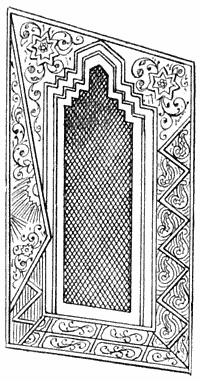
A JA-I-NAMAZ, OR PRAYER CARPET, AS USED IN PESHAWAR.
JAIYID (جيد). Pure money; current coin. A term used in Muslim law. (Hidāyah, vol. iii. p. 152.)
JALĀL (جلال). Being glorious or mighty. Ẕū ʾl-Jalāl, “The Glorious One,” is an attribute of God. See Qurʾān, Sūrah lv. 78: “Blessed be the name of thy Lord who is possessed of glory and honour.”
Al-Jalāl is a term used by Ṣūfī mystics to express that state of the Almighty which places Him beyond the understanding of His creatures. (ʿAbdu ʾr-Razzāq’s Dictionary of Ṣūfī Terms.)
AL-JALĀLĀN (الجلالان). “The two Jalāls.” A term given to two commentators of the name of Jalālu ʾd-dīn, whose joint work is called the Tafsīru ʾl-Jalālain; the first half of which was compiled by the Shaik͟h Jalālu ʾd-dīn al-Maḥallī, died A.H. 864, and the rest by Jalālu ʾd-dīn as-Suyūt̤ī, died A.H. 911.
Jalālu ʾd-dīn as-Suyūt̤ī was a prolific author. Grammar, rhetoric, dogmatical and practical theology, history, criticism, medicine, and anatomy, comprise some of the subjects on which he wrote. His Itqān, which is an explanatory work on the Qurʾān, has been published by the Asiatic Society of Bengal, and edited by Dr. Sprenger (A.D. 1857), and his History of the Temple of Jerusalem has been translated by the Rev. James Reynolds for the Oriental Translation Society (A.D. 1836). [JERUSALEM.]
JAʿLU ʾL-JAUF (جعل الجوف). Another name for Dūmatu ʾl-Jandal, a place near Tabūk. [DUMAH.]
JĀLŪT (جالوت). [GOLIATH.]
JAMRAH (جمرة). Lit. “Gravel, or small pebbles.” (1) The three pillars at Minā, at which the Makkan pilgrims throw seven pebbles. They are known as al-Ūlā, the first; al-Wust̤ā, the middle; and al-ʿĀqibah, the last. According to Muslim writers these pillars mark the successive spots where the Devil, in the shape of an old Shaik͟h, appeared to Adam, Abraham, and Ishmael, and was driven away by the simple process which Gabriel taught them of throwing seven small pebbles. The Jamratu ʾl-ʿĀqibah, is known as the Shait̤ānu ʾl-Kabīr, or the “Great Devil.”
Captain Burton, in his El Medinah and Mecca, vol. ii. 227, says:—
“The ‘Shait̤ānu ʾl-Kabīr’ is a dwarf buttress of rude masonry, about eight feet high by two and a half broad, placed against a rough wall of stones, at the Meccan entrance to Muna. As the ceremony of ‘Ramy,’ or Lapidation, must be performed on the first day by all pilgrims between sunrise and sunset, and as the fiend was malicious enough to appear in a rugged pass, the crowd makes the place dangerous. On one side of the road, which is not forty feet broad, stood a row of shops, belonging principally to barbers. On the other side is the rugged wall of the pillar, with a chevaux de frise of Bedouins and naked boys. The narrow space was crowded with pilgrims, all struggling like drowning men to approach as near as possible to the Devil.”
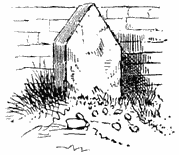
THE SHAITANU ʾL-KABIR. (Burton.)
(2) Jamrah also means a “live coal,” and is an astronomical or meteorological term used to signify the infusion of vital heat into the elements in spring, or rather, at the end of winter. According to this theory there are three Jamarāt: one, the infusion of heat into the air, occurs thirty days before the vernal equinox; the second, affecting the waters, seven days later; and the third, vivifying the earth, sixteen days before the equinox. (Catafago’s Dictionary, in loco.)
JAMʿU ʾL-JAMʿ (جمع الجمع). Lit. “The plural of a plural.” A term used by the Ṣūfī mystics for the high position of the Perfect Man or al-Insānu ʾl-Kāmil.
JANĀB (جناب). “Majesty.” A term of respect used in India in addressing a person of rank or office, whether Native or European. Janāb-i-ʿalī, “Your high eminence.”
JANĀBAH (جنابة). A state of uncleanness. The Niddoh, or separation, of Leviticus xii. 5. The menses, coitus, childbirth, pollutio nocturna, contact with the dead, or having performed the offices of nature, place the person in a state of Janābah or separation. [PURIFICATION.]
JANĀZAH, JINĀZAH (جنازة). A term used both for the bier, and for the funeral service of a Muslim, also for the corpse itself. [BURIAL.]
JĀNN (جان). The father of the Jinn. [JINN.]
JANNAH (جنة), pl. Jannāt. Lit. “A garden.” (1) A term used for the regions of celestial bliss. [PARADISE.] (2) A term used by Ṣūfī mystics to express different stages of the spiritual life: Jannatu ʾl-Afʿāl, the paradise of works, or that enjoyment which is derived from sensual pleasures, such as eating, drinking, &c.; Jannatu ʾl-Wirās̤ah, the paradise of inheritance, which is a disposition like that of the saints and prophets; Jannatu ʾṣ-Ṣifāt, the paradise of attributes, becoming like God; Jannatu ʾẕ-Ẕāt, the paradise of essence, being united with God (i.e. absorption into the divine essence). (ʿAbdu ʾr-Razzāq’s Dictionary of Ṣūfī Terms.)
JANNĀTU ʿADN (جنات عدن). The Gardens of Eden. (Sūrah ix. 73, et alias.) [PARADISE.]
JANNĀTU ʾL-FIRDAUS (جنات الفردوس). The Gardens of Paradise. (Sūrah xviii. 107.) [PARADISE.]
JANNATU ʾL-K͟HULD (جنة الخلد). The Garden of Eternity. (Sūrah xxv. 16.) [PARADISE.]
JANNĀTU ʾL-MAʾWĀ (جنات الماوى). The Gardens of Refuge. (Sūrah xxxii. 19.) [PARADISE.]
JANNĀTU ʾN-NAʿĪM (جنات النعيم). The Gardens of Delight. (Sūrah v. 70.) [PARADISE.]
JĀR MULĀṢIQ (جار ملاصق). “A next-door neighbour.” A term used in Muḥammadan law for a joint proprietor in a house, or room or wall of the house. (Hidāyah, vol. iii. p. 565.)
JARR (جر). “Dragging.” A degree of chastisement practised according to Muḥammadan law, namely, by dragging the offender to the door and exposing him to scorn. (Hamilton’s Hidāyah, vol. ii. p. 76.)
AL-JĀS̤IYAH (الجاثية). Lit. “The Kneeling.” A title given to the XLVth Sūrah of the Qurʾān, in which the expression occurs (verse 26):—
“And God’s is the kingdom of the Heavens and of the Earth; and on the day when the Hour shall arrive, on that day shall the despisers perish. And thou shalt see every nation kneeling; to its own book shall every nation be summoned:—‘This day shall ye be repaid as ye have wrought.’ ”
JĀS̤ULĪQ (جاثليق). An Arabicized word from the Greek Καθολικὸς. The Catholicos, or Primate of the Christians. In the G͟hiyās̤u ʾl-Lug͟hah he is said to be the chief of the Christians, and under him is the Mit̤rān (Metropolitan), and then the Usquf (Bishop), and then Qasīs (Presbyter), and then Shammās (Deacon).
Mr. Lane, in his Dictionary, gives the Order of Bit̤rāq (Patriarch) as under the Jās̤ulīq, which term we understand to mean, in Muḥammadan works, none other than the Patriarch, e.g. of Jerusalem, or Antioch, &c.
JAWĀMIʿU ʾL-KALIM (جوامع الكلم). Lit. “Comprehending many significations.” A title given to the Qurʾān and to certain traditions, because it is related that the Prophet said, “that has been revealed to me which comprehends many significations.” (Kashfu ʾl-Iṣt̤ilāḥāt, in loco.)
JAẔʿAH (جذعة). A female camel in her fifth year. The proper age for a camel given in zakāt or legal alms for camels from sixty-one to seventy-five in number. [ZAKAT.]
JAẔBAH (جذبة). “Attraction.” A term used by the Ṣūfī mystics to express a yearning after the Divine Being. The nearer approach of man to his Maker through God’s grace. (ʿAbdu ʾr-Razzāq’s Dictionary of Ṣūfī Terms.)
JEDDAH. Arabic Jiddah (جدة). The principal seaport of Arabia, and one of the Mīqāt or stages where the Makkan pilgrims put on the Iḥrām or pilgrim’s robe. It is also celebrated as the place of Eve’s sepulchre. She is said to measure 120 paces from head to waist, and 80 paces from waist to heel. (Burton.)
JEHOVAH. Heb. יְהֹוָה. In the Old Testament it is usually with the vowel points of אֲדֹנָי; but when the two occur together, the former is pointed יֱהֹוִה, that is, with the vowels of אֱלֹהִים, as in Obad. i. 1; Heb. iii. 19. The LXX. generally render it by Κύριος, the vulgate by Dominus; and in this respect they have been followed by the A.V. where it is translated “The Lord.” The true pronunciation of this name, by which God was known to the Hebrews, has been entirely lost, the Jews themselves scrupulously avoiding every mention of it, and substituting in its stead one or other of the words with whose proper vowel-points it may happen to be written. This custom, which had its origin in reverence, and has almost degenerated into a superstition, was founded upon an erroneous rendering of Lev. xxiv. 16, “He that blasphemeth the name of God shall surely be put to death”; from which it was inferred that the mere utterance of the name constituted a capital offence. In the Rabbinical writings it is distinguished by various euphemistic expressions; as simply “the name,” or “the name of four letters” (the Greek tetragrammaton); “the great and terrible name”; “the peculiar name,” i.e. appropriated to God alone; “the separate name,” i.e. either the name which is separated or removed from human knowledge, or, as some render, “the name which has been interpreted or revealed.” (Professor W. A. Wright, M.A., Smith’s Dictionary of the Bible, in loco.)
This superstitious reverence for the word Jehovah must have been the origin of the Ismu ʾl-Aʿz̤am, or “exalted name,” which Muḥammad is related to have said was known only to God and His prophets; but which, he said, occurs in one of three verses in the Qurʾān, namely: Sūratu ʾl-Baqarah ii. 256: “God! (Allāh) there is no God but He (Hū) the Living One (al-Ḥaiy), the Self-Subsisting One (al-Qaiyūm)”; or, in the Sūratu Āli ʿImrān iii. 1, which contains the same words; or, in the Sūratu T̤ā Ḥā xx. 110: “Faces shall be humbled before the Living One (al-Ḥaiy), the Self-Subsistent One (al-Qaiyūm).”
Some European scholars (see Catafago’s Arabic Dictionary) have fancied the Yahūh יהוה, or Yahovah of the Hebrews, is identical with the ejaculation of the Muslim devotee, Yā Hū, “O He!” (i.e. God). Al-Baiẓāwī says the word Hū (better Huwa), i.e. HE (God), may be the Ismu ʾl-Aʿz̤am, or Exalted Name of the Almighty, especially as it occurs in two of the verses of the Qurʾān indicated by Muḥammad, namely, Sūrahs ii. 256, iii. 1. [HUWA, GOD.]
JEREMIAH. Arabic Armiyā (ارميا). The prophet is not mentioned in the Qurʾān, but Muslim historians say he was contemporary with Maʿadd, the son of ʿAdnān, the renowned ancestor of Muḥammad. The Kātibu ʾl-Wāqidī says: “God watched over ʿAdnān’s son Maʿadd, who was by the command of the Lord taken by Armiyā and Abrak͟hā (Jeremiah and Baruch) into the land of Harram and nurtured safely.” According to the G͟hiyās̤u ʾl-Lug͟hah, he is the same as al-K͟hiẓr. [AL-KHIZR.]
JERUSALEM. Arabic al-Baitu ʾl-Muqaddas (البيت المقدس), “the Holy House,” or Baitu ʾl-Maqdis (بيت المقدس), “the House of the Sanctuary”; Aurashalīm (اورشليم); Iliyāʾ (ايلياء), i.e. Aelia Capitolina.
In the Qurʾān Jerusalem is never mentioned by name, and in the Traditions and other Muslim works, it is always called al-Baitu ʾl-Muqaddas, “the Holy House,” as referring to the Temple of Jerusalem, or Iliyāʾ. The allusions to it in the Qurʾān, are as follows:—
Sūrah ii. 55 (where God, after giving the manna and quails, is represented as saying to the children of Israel): “Enter the city and eat therefrom as plentifully as ye wish.” Al-Baiẓāwī the commentator says this city was the the Baitu ʾl-Maqdis (Jerusalem), or Arīḥā (Jericho).
Sūrah ii. 261: “Like him who passed by a city when it was desolate, and as he walked over its roofs said, ‘How will God revive this after its destruction?’” Commentators say Elias or al-K͟hiẓr visited the city of Jerusalem after its destruction by Nebuchadnezzar.
Sūrah xxx. opens with a reference to the Persians conquering Syria and taking Jerusalem.
In Sūrah xvii. 1, Muḥammad is represented as having taken his flight from Makkah to Jerusalem. “Celebrated be the praises of Him who by night took his servant from the Masjidu ʾl-Ḥarām (the Sacred Mosque) to the Masjidu ʾl-Aqṣā (the Remote Mosque), the precinct of which we have blessed.”
And in Sūrah l. 40, one of the signs of the approach of the last day will be: “The crier (to prayer) shall cry from a near place” (i.e. a place from which all men shall hear). Ḥusain says this “near place” is the Temple at Jerusalem.
A curious account of Jerusalem and its temple, the Masjidu ʾl-Aqṣā, or Distant Mosque (so called because it is a distant object of pilgrimage), has been written by Jalālu ʾd-dīn as-Suyūt̤ī, one of the commentators on the Qurʾān, known as the Jalālān. It was written in the year A.H. 848, A.D. 1444, and the special object of the book appears to be to exalt the merits of Jerusalem as a place of prayer and pilgrimage. [For an account of the Temple, see MASJIDU ʾL-AQSA.] He says Jerusalem is specially honoured as being the scene of the repentance of David and Solomon. The place where God sent His angel to Solomon, announced glad tidings to Zacharias and John, showed David a plan of the Temple, and put all the beasts of the earth and fowls of the air in subjection to him. It was at Jerusalem that the prophets sacrificed; that Jesus was born and spoke in his cradle; and it was at Jerusalem that Jesus ascended to heaven; and it will be there that He will again descend. Gog and Magog shall subdue every place on the earth but Jerusalem, and it will be there that God Almighty will destroy them. It is in the holy land of Jerusalem that Adam and Abraham, and Isaac and Mary, are buried. And in the last days there will be a general flight to Jerusalem, and the Ark and the Shechinah will be again restored to the Temple. There will all mankind be gathered at the Resurrection for judgment, and God will enter, surrounded by His angels, into the Holy Temple, when He comes to judge the earth. (See Reynolds’ Translation, p. 16.)
The peculiar reference paid to the Sacred Rock (aṣ-Ṣak͟hrah) seems to be one of the many instances of afterthought and addition to Islām since the time of Muḥammad. Muʿāwiyah seems to have encouraged it in order to direct the affections and fanaticism of his subjects into a new channel, and to withdraw their exclusive attention from Makkah and al-Madīnah, where the rival family of ʿAlī resided.
In the same book there is a desultory account of the taking of Jerusalem by the K͟halīfah ʿUmar.
After the conclusion of the battle of Yarmūk (Hieromax), the whole army of the Muslims marched into the territory of Palestine and Jordan. Then they closely besieged the city. The conquest was attended with difficulty until the arrival of the K͟halīfah ʿUmar with four thousand horse. He came upon the holy place on the eastern side, and then encircled the city. They fought for a long time, until at last the inhabitants sent a party to the walls with a flag of truce, asking for a parley. The Patriarch (Sophronius) then demanded the safe conduct of a messenger to ʿUmar. The envoy came without hindrance and requested ʿUmar to make peace and to accept tribute.
Jalālu ʾd-dīn gives a copy of the treaty which the Muslims compelled the people of Jerusalem to sign. It reads as follows:—
“In the name of God, the Merciful and Compassionate! This is the writing from the Christians of the Holy City to ʿUmar ibn al-K͟hat̤t̤āb, the Commander of the Faithful. When you came down upon us, we asked of you a capitulation for ourselves and our possessions, and our children, and the people of our religion; and we have stipulated with you, that we shall not be polluted by interruption in our places of worship, or whatever chapels, or churches, or cells, or monasteries of monks, may be therein; and that no one shall live therein who may have the impress of Muslims (by long residence), and that we will not prohibit the Muslims from entering them, by night or by day; and that we will open the gates wide to passengers and to travellers; and if any Muslim passing by shall take up his lodging with us three nights, we shall give him food, and not entertain in our churches a spy, nor conceal him unknown to the Muslims; and not teach our children the Qurʾān; and not publicly exhibit the Associating or Christian religion, and not beg any one to embrace it; and not hinder anyone of our relations from entering the Muslim religion, if he will, and that we should honour the Muslims and make much of them, and place them in our assemblies, if anyone of them will, and give them the chief seats, and not imitate them in our dress, neither in girdles, nor in the turban, nor the slipper, nor the parting of the hair, and never write in their language, nor call ourselves by their surnames; and that we should never ride upon great saddles, nor suspend our swords by belts, and never accept arms (the bow, sword, and club), nor carry them with us; and that we should never engrave upon our signet-rings in the Arabic language; and that we should not sell wine, and that we should shave the front of our heads, and tie up our dress, wherever we may be, and not wear wide girdles at our waist; and that we should never publicly exhibit the cross upon our churches, nor expose our crosses, nor ever inscribe them in the path of the Muslims, nor in their market places, and never strike our bells the (quick) stroke, nor raise our voices over the dead, nor publicly expose the lights, or anything else, in the roads and markets of the Muslims, and never come near them with our dead, and never receive any slave who has drawn upon himself familiarity with Muslims, and never look upon them in their houses.”
We learn moreover, from the same authority, as follows:—
“When ʿUmar ratified the treaty, he added thereto,—‘And that we will not strike anyone of the Muslims. We stipulate this with you for ourselves and the people of our religion; and we accept these terms of capitulation: and if we subsequently violate a point of that which we have stipulated, upon our lives be it, and let there be no faith with us and may it be allowed you to do to us whatever is lawful against rebellious and revolting subjects.’ ” (Hist. of Jerusalem, by Jalālu ʾd-dīn, Reynolds’ Translation.)
There were within the city 12,000 Greeks and 50,000 natives, and the K͟halīfah ʿUmar insisted that all the Greeks depart within three days, and that the natives should pay tribute. Five dīnārs were imposed upon the rich, four upon the middle classes, and three upon the lower classes; very old and very young persons paid nothing.
When ʿUmar entered the Holy City, his first object was to find the Sacred Rock (aṣ-Ṣak͟hrah), the site of the Masjidu ʾl-Aqṣā, to which Muḥammad said he was carried on Burāq on the night of the Miʿrāj [MIʿRAJ], and he therefore requested the Patriarch to direct him to the spot. They first went to the Church of the Resurrection, and the Patriarch said, “This is the Mosque of David.” But ʿUmar said, “Thou hast spoken falsely, for the Apostle of God (Muḥammad) described the place to me, and it was not like this.” They then went to the church on Zion, and the Patriarch said, “This is the Mosque of David.” But ʿUmar said, “Thou hast spoken falsely.” And in this manner the Patriarch took ʿUmar to every church in the city. At last they came to a gate, which is now called Bābu ʾl-Muḥammad, or the Gate of Muḥammad, and clearing away the filth on the steps, they came to a narrow passage, and the K͟halīfah, creeping on his knees, came to the central sewer. Here, standing up, ʿUmar looked at the rock (aṣ-Ṣak͟hrah), and then exclaimed, “By Him in whose hand is my life, this is the place which the Apostle of God (upon whom be peace and blessing) described to us.” ʿUmar then ordered a mosque to be built thereon. And ʿAbdu ʾl-Malik ibn Marwān built the mosque of the Baitu ʾl-Muqaddas (now known as the Mosque of ʿUmar). He spent upon it the produce of seven years’ tax upon Egypt. He began it in A.H. 69 and finished it in A.H. 72.
Some authority quoted by Jalālu ʾd-dīn says the Holy City did not cease to be in the hands of the Muslims from its surrender to ʿUmar until the year A.H. 491, when it was taken by the Franks, who killed therein a vast number of Muslims in the space of seven days. In the Masjidu ʾl-Aqṣā alone, they killed 70,000, and they took from aṣ-Ṣak͟hrah the vessels of gold and silver and the wealth which was preserved in strong boxes. “But,” he adds, “Ṣalāḥu ʾd-dīn (Saladin) was raised up for the complete deliverance of the Holy City; for he was the most renowned of Lions, and the very brightness of Fire.”
(For a further account of the taking of the city by Saladin, see Reynolds’ translation of Jalālu ʾd-dīn’s History of the Temple of Jerusalem, p. 199.)
A brief outline of the History of Jerusalem from the Time of Christ.
A.D.
33. The crucifixion, death, resurrection, and ascension of Jesus Christ at Jerusalem.
43. St. Paul’s first visit to Jerusalem after his conversion to Christianity.
69. Taken by Titus.
136. The Emperor Hadrian bestows on the city the name of Aelia Capitolina. (This name is used by Jalālu ʾd-dīn is his book, A.D. 1444.)
336. Jerusalem under Christian rule, the Martyrion and the Church of the Resurrection built.
614. The city invested and taken by the Persians under Chosroes II. (See Qurʾān, Sūrah xxx.)
621. The era of the flight of Muḥammad.
628. The Emperor Heraclius enters Jerusalem in triumph.
637. The patriarch Sophronius surrenders the Holy City to the K͟halīfah ʿUmar. Liberty of worship secured to the Christians in churches which already existed, but they are prohibited the erection of new churches. A mosque built on the reputed site of Jacob’s vision, now known as the mosque of ʿUmar. Said to be on the site of the temple called by Muslims Masjidu ʾl-Aqṣā, the Remote Mosque, or aṣ-Ṣak͟hrah, the Rock.
800. Ambassadors sent by the Emperor Charlemagne to distribute alms in the Holy City. The K͟halīfah Harūn ar-Rashīd sends back as a present to the Emperor the keys of Calvary and the Holy Sepulchre.
820. Held for a time by the rebel chief Tamum Abū Ḥarab.
969. Falls into the hands of the Fāt̤imate K͟halīfah Muʿizz. The Church of the Holy Sepulchre burnt.
1035. The pilgrimage of Robert of Normandy.
1054. The pilgrimage of Lietbert of Cambray.
1065. The pilgrimage of the German bishops.
1077. Jerusalem pillaged by the army of Malik Shah.
1084. The Turkoman chief Urtok becomes ruler the Holy City. The Christians suffer.
1098. The city retaken by the Fāt̤imate K͟halīfah.
1099. 40,000 Crusaders appear before its walls. The city taken by the Crusaders. 10,000 Muslims slain. Godfrey of Bouillon made King. (For eighty years the city remained in the hands of the Christians.)
1187. Retaken by Saladin (Ṣalāḥu ʾd-dīn), the Muslim general.
1219. Ceded to the Christians by virtue of a treaty with the Emperor Frederick II.
1239. Taken by the Muslims.
1243. Again ceded to the Christians.
1244. The Christians defeated at Gaza, and Jerusalem occupied by the Muslims.
1277. Nominally annexed to the kingdom of Sicily.
1517. Becomes part of the Empire of the Ottoman Sultān Selim I.
1542. Sultān Sulaiman I. builds the present walls.
1832. Muḥammad ʿAlī Pasha of Egypt takes the city.
1840. Restored to the Sultān of Turkey.
[AS-SAKHRAH, MASJIDU ʾL-AQSA.]
JESUS CHRIST. Arabic ʿĪsā ʾl-Masīḥ (عيسى المسيح). In the Qurʾān, the Lord Jesus Christ is spoken of under the following names and titles:—
(1) ʿĪsā (عيسى), “Jesus.” Al-Baiẓāwī says it is the same as the Hebrew Īshūʿ, (ايشوع), and derived from al-ʿayas, “white mingled with red,” without, however, explaining this derivation.
(2) ʿĪsā ibn Maryam (عيسى بن مريم), “Jesus the son of Mary,” from whom He was born by the power of God.
(3) Al-Masīḥ (المسيح), “the Messiah.” Sūrah iii. 40: “His name shall be Messiah Jesus.” Al-Kamālān, the commentators, say he is called al-Masīḥ either because he was both blessed and anointed by the angel Gabriel, or because whomsoever Jesus touched was healed.
(4) Kalimatu ʾllāh (كلمة الله), “the Word of God.” Sūrah iv. 169: “His word.” Ḥusain says by this expression is meant he who was born at the express fiat of God. (Sūrah xix. 36: “He says only to it BE and it is.”)
(5) Qaulu ʾl-Ḥaqq (قول الحق). “The Word of Truth.” Sūrah xix. 35. Some commentators take the expression qaulu ʾl-ḥaqq as referring to the statement made being “the word of truth,” whilst others take it as referring to Christ Himself, “The Word of Truth.”
(6) Rūḥun min Allāh (روح من الله), “A Spirit from God.” Sūrah iv. 169: “A Spirit from Him.” Al-Baiẓāwī says it is a spirit which proceedeth from God. The title Rūḥu ʾllāh is the special Kalimah for Jesus Christ. [PROPHETS.]
(7) Rasūlu ʾllāh (رسول الله), “The Messenger of God.” Sūrah iv. 169. It is the same title as Muḥammad assumed for himself, i.e. the Prophet, or Apostle, or Messenger of God.
(8) ʿAbdu ʾllāh (عبد الله), “The Servant of God.” Sūrah xix. 31: “Verily, I am the servant of God.”
(9) Nabīyu ʾllāh (نبى الله), “The Prophet of God.” Sūrah xix. 31: “He hath made me a Prophet.”
(10) Wajīhun fī ʾd-dunyā wa ʾl-āk͟hirah (وجيه فى الدنيا والاخرة), “Illustrious in this world and in the next,” namely, as al-Baiẓāwī explains it, “in this world as a Prophet, in the next as an Intercessor.” Sūrah iii. 40.
In order to present the somewhat incoherent narrative of the Qurʾān in a systematic form, we shall arrange its history of the Lord Jesus into (1) The Annunciation of the Virgin, (2) The Birth of Jesus, (3) His Miracles, (4) His Mission, (5) His Crucifixion, (6) His Divinity and Sinlessness, (7) The Trinity, (8) His Second Coming (as taught in the Traditions), (9) His Exaltation in Heaven. From a perusal of these selections it will be seen that Muḥammad taught that Jesus was miraculously born of the Virgin Mary, who was sister of Aaron and the daughter of ʿImrān, near the trunk of a palm tree. That the Jews charged the Virgin with being unchaste; but the babe, speaking in his cradle, vindicated his mother’s honour. That Jesus performed miracles, giving life to a clay figure of a bird, healing the blind, curing the leper, quickening the dead, and bringing down a table from heaven “as a festival and a sign.” That he (Jesus) was specially commissioned as the Apostle or Prophet of God to confirm the Law and to reveal the Gospel. That he proclaimed his mission with many manifest signs, being strengthened by the Holy Spirit. That he foretold the advent of another Prophet, whose name should be Aḥmad. That the Jews intended to crucify him, but God deceived them, for they did not crucify Jesus, but only his likeness. That he is now in one of the stages of celestial bliss. That after he left this earth his disciples disputed amongst themselves, some calling him a God, and making him one of a Trinity of the “Father, the Mother, and the Son.” That he will come again at the last day, and will slay Antichrist, kill all the swine, break the Cross, remove the poll-tax from the infidels. That he will reign as a just king for forty-five years, marry, and have children, and die and be buried near Muḥammad at al-Madīnah, between the graves of Abū Bakr and ʿUmar.
I.—The Annunciation of the Virgin.
Sūrah iii. 37–43: “And remember when the angels said, ‘O Mary! verily hath God chosen thee, and purified thee, and chosen thee above the women of the worlds! O Mary! be devout towards thy Lord, and prostrate thyself, and bow down with those who bow.’ This is one of the announcements of things unseen by thee: To thee, O Muḥammad! do we reveal it; for thou wast not with them when they cast lots with reeds which of them should rear Mary; nor wast thou with them when they disputed about it. Remember when the angel said, ‘O Mary! Verily God announceth to thee the Word from Him: His name shall be, Messiah Jesus the son of Mary, illustrious in this world, and in the next, and one of those who have near access to God; and he shall speak to men alike when in the cradle and when grown up; and he shall be one of the just.’ She said, ‘How, O my Lord! shall I have a son, when man hath not touched me?’ He said, ‘Thus: God will create what He will; when He decreeth a thing, He only saith, “Be,” and it is.’ And He will teach him the Book, and the Wisdom, and the Law, and the Evangel; and he shall be an apostle to the children of Israel.”
Sūrah xix. 16–21: “And make mention in the Book, of Mary, when she went apart from her family, eastward, and took a veil to shroud herself from them: and We sent Our spirit to her, and he took before her the form of a perfect man. She said: ‘I fly for refuge from thee to the God of Mercy! If thou fearest Him, begone from me.’ He said: ‘I am only a messenger of thy Lord, that I may bestow on thee a holy son.’ She said: ‘How shall I have a son, when man hath never touched me? and I am not unchaste.’ He said: ‘So shall it be. Thy Lord hath said: “Easy is this with me; and we will make him a sign to mankind, and a mercy from us. For it is a thing decreed.” ’ ”
[In the earlier part of Sūrah iii. the Virgin Mary is spoken of as the daughter of ʿImrān. Commentators say that ʿImrān died before Mary was born. In the traditions it is stated “that the only two persons born into the world who have not been touched of the Devil are Mary and her son Jesus.” Thus teaching not only the Immaculate Conception of Mary, but also of her mother. “When she went eastward,” Ḥusain says, she went out of her house in an eastward direction, in order to perform her ablutions, when Gabriel appeared to her.]
II.—The Birth of Jesus.
Sūrah xix. 22–34: “And she conceived him, and retired with him to a far-off place. And the throes came upon her by the trunk of a palm. She said: ‘Oh, would that I had died ere this, and been a thing forgotten, forgotten quite!’ And one cried to her from below her: ‘Grieve not thou, thy Lord hath provided a streamlet at thy feet:—And shake the trunk of the palm-tree toward thee: it will drop fresh ripe dates upon thee. Eat then and drink, and be of cheerful eye: and shouldst thou see a man, say,—Verily, I have vowed abstinence to the God of mercy.—To no one will I speak this day.’ Then came she with the babe to her people, bearing him. They said, ‘O Mary! now hast thou done a strange thing! O sister of Aaron! Thy father was not a man of wickedness, nor unchaste thy mother.’ And she made a sign to them, pointing towards the babe. They said, ‘How shall we speak with him who is in the cradle, an infant?’ It said, ‘Verily, I am the servant of God; He hath given me the Book, and He hath made me a prophet; and He hath made me blessed wherever I may be, and hath enjoined me prayer and almsgiving so long as I shall live; and to be dutiful to her that bare me: and he hath not made me proud, depraved. And the peace of God was on me the day I was born, and will be the day I shall die, and the day I shall be raised to life.’”
Sūrah xxiii. 52: “And we appointed the Son and his Mother for a sign; and we prepared an abode in a lofty spot, quiet and watered with springs.”
[Professor Wahl understands this last verse to refer to Paradise, but the Muslim commentators all refer it to the place of abode; and al-Baiẓāwī and Ḥusain say it was either in Jerusalem, or Damascus, or Ramleh! Ḥusain says Jesus was born in Bethlehem. The expression, “O sister of Aaron,” as applied to the Virgin Mary, suggests an anachronism of some consequence, but the commentators get over the difficulty. The Kamālān say it is a figurative expression implying that she was pure and righteous like a sister of Aaron. But al-Baiẓāwī says it means that she was of the tribe of Aaron. European authors suggest that there was a confusion between Miriam the Virgin and Miriam the sister of Moses. Al-Baiẓāwī says: “The palm to which she fled, that she might lean on it in her travail, was a withered trunk, without any head or verdure; and this happened in the winter season, notwithstanding which, it miraculously supplied her with fruits for her refreshment, as is mentioned immediately.” Mr. Sale says: “It has been observed, that the Mohammedan account of the delivery of the Virgin Mary very much resembles that of Latona, as described by the poets, not only in this circumstance of their laying hold on a palm-tree (though some say Latona embraced an olive-tree, or an olive and a palm, or else two laurels), but also in that of their infants speaking; which Apollo is fabled to have done in the womb.” (See Homer, Hymn. in Apoll.; Callimach, Hymn. in Delum.)]
III.—The Miracles of Jesus.
Sūrah iii. 43–46: “And He will teach him the Book, and the Wisdom, and the Law, and the Evangel; and he shall be an apostle to the children of Israel. ‘Now have I come,’ he will say, ‘to you with a sign from your Lord: Out of clay will I make for you, as it were, the figure of a bird: and I will breathe into it, and it shall become, by God’s leave, a bird. And I will heal the blind, and the leper; and by God’s leave will I quicken the dead; and I will tell you what ye eat, and what ye store up in your houses! Truly in this will be a sign for you, if ye are believers.’ And when Jesus perceived unbelief on their part, He said, ‘Who my helpers with God?’ The apostles said, ‘We will be God’s helpers! We believe in God, and bear thou witness that we are Muslims. O our Lord! we believe in what thou hast sent down, and we follow the apostle; write us up, then, with those who bear witness to him.’ ”
[The commentators al-Jalālān say Jesus made for his disciples a bat, for it is the most perfect of birds in make, and it flew while they looked at it; but when it had gone out of their sight, it fell down dead. That he cured in one day fifty thousand persons, and that he raised Lazarus (ʿĀzar) from the dead; also Shem, the son of Noah, who had been dead 4,000 years, but he died immediately; also the son of an old woman, and the daughter of a tax-collector.]
Sūrah v. 112–115: “Remember when the Apostles said: ‘O Jesus, Son of Mary! is thy Lord able to send down a furnished table to us out of Heaven?’ He said: ‘Fear God if ye be believers.’ They said: ‘We desire to eat therefrom, and to have our hearts assured; and to know that thou hast indeed spoken truth to us, and to be witnesses thereof.’ Jesus, Son of Mary, said: ‘O God, our Lord! send down a table to us out of Heaven, that it may become a recurring festival to us, to the first of us and to the last of us, and a sign from thee; and do thou nourish us, for thou art the best of nourishers.’ And God said: ‘Verily, I will cause it to descend unto you; but whoever among you after that shall disbelieve, I will surely chastise him with a chastisement wherewith I will not chastise any other creature.’ ”
[Mr. Sale, in his commentary on this miracle, says (quoting from al-Baiẓāwī):—“This miracle is thus related by the commentators. Jesus having, at the request of his followers, asked it of God, a red table immediately descended in their sight, between two clouds, and was set before them. Whereupon he rose up, and having made the ablution, prayed, and then took off the cloth which covered the table, saying, ‘In the name of God, the best provider of food!’ What the provisions were, with which this table was furnished, is a matter wherein the expositors are not agreed. One will have them to be nine cakes of bread and nine fishes; another, bread and flesh; another, all sorts of food, except flesh; another, all sorts of food, except bread and flesh; another, all except bread and fish; another, one fish, which had the taste of all manner of food; and another, fruits of paradise; but the most received tradition is, that when the table was uncovered, there appeared a fish ready dressed, without scales or prickly fins, dropping with fat, having salt placed at its head, and vinegar at its tail, and round it all sorts of herbs, except leeks, and five loaves of bread, on one of which there were olives; on the second, honey; on the third, butter; on the fourth, cheese; and on the fifth, dried flesh. They add, that Jesus, at the request of the apostles, showed them another miracle, by restoring the fish to life, and causing its scales and fins to return to it; at which the standers-by, being affrighted, he caused it to become as it was before: that one thousand three hundred men and women, all afflicted with bodily infirmities or poverty, ate of these provisions, and were satisfied, the fish remaining whole as it was at first; that then the table flew up to heaven in the sight of all; and everyone who had partaken of this food were delivered from their infirmities and misfortunes; and that it continued to descend for forty days together, at dinner-time, and stood on the ground till the sun declined, and was then taken up into the clouds. Some of the Mohammedan writers are of opinion that this table did not really descend, but that it was only a parable; but most think the words of the Koran are plain to the contrary. A further tradition is, that several men were changed into swine for disbelieving this miracle, and attributing it to magic art; or, as others pretend, for stealing some of the victuals from off it.”]
IV.—The Mission of Jesus.
Sūrah lvii. 26, 27: “And of old sent we Noah and Abraham, and on their seed conferred the gift of prophecy, and the Book; and some of them we guided aright; but many were evil doers. Then we caused our apostles to follow in their footsteps; and we caused Jesus the son of Mary to follow them; and we gave him the Evangel and we put into the hearts of those who followed him kindness and compassion: but as to the monastic life, they invented it themselves. The desire only of pleasing God did we prescribe to them, and this they observed not as it ought to have been observed: but to such of them as believed gave we their reward, though many of them were perverse.”
Sūrah v. 50, 51: “And in the footsteps of the prophets caused we Jesus, the son of Mary, to follow, confirming the law which was before him: and we gave him the Evangel with its guidance and light, confirmatory of the preceding Law; a guidance and warning to those who fear God;—And that the people of the Evangel may judge according to what God hath sent down therein. And whoso will not judge by what God hath sent down—such are the perverse.”