DICTIONARY OF ISLĀM. (continued 7)
Reading edition
ELISHA. Arabic al-Yasaʿ (اليسع). Heb. אֱלִישָׁע. Elisha is mentioned twice in the Qurʾān, under the name al-Yasaʿ.
Sūrah xxxviii. 48: “And remember Ishmael and Elisha, and Ẕū ʾl-kifl, for each was righteous.”
Sūrah vi. 85, 86: “And Zachariah, and John, and Jesus, and Elias, all righteousness; and Ishmael and Elisha and Jonah and Lot, each have We preferred above the worlds.”
The Commentators give no account of him except that he was the son of Uk͟htūb, although the Bible says he was the son of Shaphat. Ḥusain says he was Ibnu ʾl-ʿajūz (the son of the old woman).
ELOQUENCE. The Arabic word al-Bayān (البيان), which is defined in the G͟hiyās̤u ʾl-Lug͟hah as speaking fluently and eloquently, occurs once in the Qurʾān, Sūrah lv. 3: “He created man: he hath taught him distinct speech.” The word also occurs in the Traditions, and it is remarkable that although the Qurʾān is written in rhythm, and in a grandiloquent style, that in the Traditions the Prophet seems to affect to despise eloquence, as will be seen from the following Aḥādīs̤:—Ibn ʿUmar says the Prophet said, “May they go to hell who amplify their words.” Abū Umāmah relates that the Prophet said, “Eloquence (al-bayān) is a kind of magic.” Ibn Masʿūd relates that the Prophet said, “Vain talking and embellishing (bayān) are two branches of hypocrisy.” ʿAmr ibn al-ʿĀṣī relates that the Prophet said, “I have been ordered to speak little, and verily it is best to speak little.” (Mishkāt, book xxii. c. ix.)
EMANCIPATION OF SLAVES. Arabic Iʿtāq (اعتاق). The emancipation of slaves is recommended by the Prophet, but the recommendation applies exclusively to slaves who are of the Muslim faith. He is related to have said: “Whoever frees a Muslim slave God will redeem that person from hell-fire member for member.” (Mishkāt, book xiii. c. xix.) It is therefore laudable in a man to release his slave or for a woman to free her bond-woman, in order that they may secure freedom in the next world. (Hidāyah, vol. i. p. 420.)
ENFRANCHISEMENT. In an orthodox Muḥammadan state, only those persons who have embraced the Muslim faith are enfranchised; all others are called upon to pay a poll tax (jizyah), for which they obtain security (amān). Those residents in a Muslim country who are not Muḥammadans are expected to wear a distinctive dress and to reside in a special part of the village or town in which they live. Slaves who may embrace the Muslim faith do not become ipso facto enfranchised, unless their master be an unbeliever, in which case their becoming Muslims secures their emancipation. Ẕimmīs, or persons not Muslims in a Muslim state, cannot give evidence against a Muslim. (See Durru ʾl-Muk͟htār, in loco.)
ENOCH. [IDRIS.]
ENTERING INTO HOUSES. To enter suddenly or abruptly into any person’s home or apartment, is reckoned a great incivility in all eastern countries. With Muḥammadans it is a religious duty to give notice before you enter a house. The custom is founded upon an express injunction in the Qurʾān, Sūrah xxiv. 57–61:—
“O ye who believe! let your slaves and those of you who have not come of age, ask leave of you, three times a day, ere they come into your presence;—before the morning prayer, and when ye lay aside your garments at mid-day, and after the evening prayer. These are your three times of privacy. No blame shall attach to you or to them, if after these times, when ye go your rounds of attendance on one another, they come in without permission. Thus doth God make clear to you His signs: and God is Knowing, Wise!
“And when your children come of age, let them ask leave to come into your presence, as they who were before them asked it. Thus doth God make clear to you his signs: and God is Knowing, Wise.
“As to women who are past childbearing, and have no hope of marriage, no blame shall attach to them if they lay aside their outer garments, but so as not to shew their ornaments. Yet if they abstain from this, it will be better for them: and God Heareth, Knoweth.
“No crime shall it be in the blind, or in the lame, or in the sick, to eat at your tables: or in yourselves, if ye eat in your own houses, or in the houses of your fathers, or of your mothers, or of your brothers, or of your sisters, or of your uncles on the father’s side, or of your aunts on the father’s side, or of your uncles on the mother’s side, or of your aunts on the mother’s side, or in those of which ye possess the keys, or in the house of your friend. No blame shall attach to you whether ye eat together or apart.
“And when ye enter houses, salute one another with a good and blessed greeting as from God. Thus doth God make clear to you His signs, that haply ye may comprehend them.”
The following are the traditions given in the Mishkāt on the subject (book xxii. c. ii.): Muḥammad is related to have said, “Do not permit anyone to enter your home unless he gives a salam first.” ʿAbdu ʾllāh ibn Masʿūd says the Prophet said, “The signal for your permission to enter is that you lift up the curtain and enter until I prevent you.” ʿAbdu ʾllāh ibn Busr says, “Whenever the Prophet came to the door of a house, he would not stand in front of it, but on the side of the door, and say, ‘The peace of God be with you.’ ” ʿAt̤āʾ ibn Yasār says the Prophet told him to ask leave to enter even the room of his mother.
ENVY. Arabic Ḥasad (حسد). The word occurs twice in the Qurʾān.
Sūrah ii. 103: “Many of those who have the Book would fain turn you again into unbelievers, even after ye have once believed, and that through envy.”
Sūrah cxiii.: “I seek refuge … from the evil of the envious when he envies.”
EPHESUS, The Seven Sleepers of. [ASHABU ʾL-KAHF.]
ESOP. The Luqmān of the Qurʾān is generally supposed by European writers to be Esop. Sale is of opinion that Maximus Planudes borrowed the greater part of his life of Esop from the traditions he met with in the East concerning Luqmān. [LUQMAN.]
ETERNITY OF PUNISHMENT. The Muḥammadan religion teaches that all Muslims (i.e. those who have embraced the religion of their Prophet) will be ultimately saved, although they will suffer for their actual sins in a purgatorial hell. But those who have not embraced Islām will suffer a never-ending torment in “the fire” (an-nār).
Sūrah ii. 37: “Those who misbelieve and call our signs lies, they are the fellows of hell, they shall dwell therein for ever” (k͟hālidūn).
Sūrah xi. 108, 109: “And as for those who are wretched—why in the fire shall they groan and sob! to dwell therein for ever (k͟hālidūn) as long as the heavens and the earth endure.”
Al-Baiẓāwī says the expression “as long as the heavens and the earth endure,” is an Arabic idiom expressing that which is eternal.
Ibn ʿArabī (died A.D. 638), in his book Fuṣūṣu ʾl-Ḥikam, says the word k͟hālid in the verses quoted above does not imply eternal duration, but a period, or age, of long duration. Al-Baiẓāwī, the commentator, also admits that the literal meaning of the word only expresses a period of extended duration; but the Jalālān and Ḥusain both contend that its meaning is that of abadī, or “never ending,” in which no being will be annihilated, and which no one can ever escape.
It is also to be observed that this word k͟hālid is that used for the eternity of bliss of those in Paradise:—
Sūrah xi. 110: “As for those who are glad—why in Paradise! to dwell therein for ever” (k͟hālidūn).
EUCHARIST, or LORD’S SUPPER. It is a singular omission in the Qurʾān, that there is no direct allusion to this Christian institution.
Both Sale and Rodwell think that there is a reference to it in the following passages in the Qurʾān, Sūrah v. 112–114:—
“Remember when the Apostles said:—O Jesus, Son of Mary, is thy Lord able to send down a table (māʾidah, ‘a table,’ especially one covered with victuals) to us out of heaven? He said, Fear God if ye be believers. They said:—We desire to eat therefrom, and to have our hearts assured; and to know that thou hast indeed spoken truth to us, and we be witnesses thereof. Jesus, Son of Mary, said:—‘O God, our Lord! send down a table to us out of heaven, that it may become a recurring festival to us, to the first of us, and to the last of us, and a sign from Thee; and do Thou nourish us, for Thou art the best of nourishers.’ ”
Muslim commentators are not agreed as to the meaning of these verses, but none of them suggest the institution of the Lord’s Supper as an explanation. The interpretations are as confused as the revelation.
According to the Imām al-Bag͟hawī, ʿAmmār ibn Yāsir said that the Prophet said it was flesh and bread which was sent down from heaven; but because the Christians to whom it was sent were unfaithful, it was taken away, and they became pigs and monkeys!
Ibn ʿAbbās says that after a thirty days’ fast, a table was sent down with seven loaves and seven fishes, and the whole company of disciples ate and were filled (St. Matt. xv. 34). The commentators al-Jalālān also give these two explanations, and the Sacrament of the Lord’s Supper is never once suggested by any Muslim doctor in explanation of the above verses.
EUNUCH. Arabic k͟haṣī (خصى). Although in all parts of the East it is usual for wealthy Muḥammadans to keep an establishment of eunuchs to guard the female members of the household, it has been strictly forbidden by Muḥammad for any of his followers to make themselves such, or to make others. ʿUs̤mān ibn Maz̤ʿūn came to him and said, “O Prophet! permit me to become a eunuch.” But Muḥammad said, “He is not of my people who makes another a eunuch or becomes so himself. The manner in which my people become eunuchs is to exercise fasting.” (Mishkāt, book iv. c. viii.)
EVE. Arabic Ḥawwāʾ (حـــواء). [ADAM.]
EVIDENCE. Arabic Shahādah (شهادة). The law of evidence is very clearly laid down in all Muḥammadan books of law, especially in the Hidāyah, and the Durru ʾl-Muk͟htār, and it is interesting to observe the difference between the law of evidence as provided for in the law of Moses, and that laid down in Muḥammadan books. In the Pentateuch two witnesses at least were required to establish any charge (Num. xxxv. 30), and the witness who withheld the truth was censured (Lev. v. 1), whilst slanderous reports and officious witnesses were discouraged (Ex. xxiii. 1; Lev. xix. 16), and false witnesses were punished with the punishment due to the offence they sought to establish (Deut. xix. 16). According to Josephus, women and slaves were not admitted to give evidence. (Ant. iv. c. 8, s. 15.)
The Sunnī law, as explained by the author of the Hidāyah (vol. iii. p. 664), is in many respects the same as the Jewish and is as follows:—
It is the duty of witnesses to bear testimony, and it is not lawful for them to conceal it, when the party concerned demands it from them. Because it is written in the Qurʾān, Sūrah ii. 282, “Let not witnesses withhold their evidence when it is demanded of them.” And again, “Conceal not your testimony, for whoever conceals his testimony is an offender.”
The requisition of the party is a condition, because the delivery of evidence is the right of the party requiring it, and therefore rests upon his requisition of it, as is the case with respect to all other rights.
In cases inducing corporal punishment, witnesses are at liberty either to give or withhold their testimony as they please; because in such case they are distracted between two laudable actions; namely, the establishment of the punishment, and the preservation of the criminal’s character. The concealment of vice is, moreover, preferable; because the prophet said to a person that had borne testimony, “Verily, it would have been better for you, if you had concealed it”; and also because he elsewhere said, “Whoever conceals the vices of his brother Muslim, shall have a veil drawn over his own crimes in both worlds by God.” Besides, it has been inculcated both by the Prophet and his Companions as commendable to assist in the prevention of corporal punishment; and this is an evident argument for the concealment of such evidence as tends to establish it. It is incumbent, however, in the case of theft, to bear evidence to the property, by testifying that “a certain person took such property,” in order to preserve the right of the proprietor; but the word taken must be used instead of stolen, to the end that the crime may be kept concealed; besides, if the word stolen were used, the thief would be rendered liable to amputation; and as, where amputation is incurred, there is no responsibility for the property, the proprietor’s right would be destroyed.
The evidence required in a case of whoredom is that of four men, as has been ruled in the Qurʾān (Sūrah xxiv. 3); and the testimony of a woman in such a case is not admitted; because, az-Zuhrī says, “in the time of the Prophet and his two immediate successors, it was an invariable rule to exclude the evidence of women in all cases inducing punishment or retaliation,” and also because the testimony of women involves a degree of doubt, as it is merely a substitute for evidence, being accepted only where the testimony of men cannot be had; and therefore it is not admitted in any matter liable to drop from the existence of a doubt.
The evidence required in other criminal cases is that of two men, according to the text of the Qurʾān; and the testimony of women is not admitted, on the strength of the tradition of az-Zuhrī above quoted. In all other cases the evidence required is that of two men, or of one man and two women, whether the case relate to property or to other rights, such as marriage, divorce, agency, executorship, or the like. Ash-Shāfiʿī has said that the evidence of one man and two women cannot be admitted, excepting in cases that relate to property, or its dependencies, such as hire, bail, and so forth; because the evidence of women is originally inadmissible on account of their defect of understanding, their want of memory and incapacity of governing, whence it is that their evidence is not admitted in criminal cases.
The evidence of one woman is admitted in cases of birth (as where one woman, for instance, declares that a certain woman brought forth a certain child). In the same manner also, the evidence of one woman is sufficient with respect to virginity, or with respect to the defects of that part of a woman which is concealed from man. The principle of the law in these cases is derived from a traditional saying of the Prophet: “The evidence of women is valid with respect to such things as it is not fitting for man to behold.” Ash-Shāfiʿī holds the evidence of four women to be a necessary condition in such cases.
The evidence of a woman with respect to istihlāl (the noise made by a child at its birth), is not admissible, in the opinion of Abū Ḥanīfah, so far as relates to the establishment of the right of heritage in the child; because this noise is of a nature to be known or discovered by men; but is admissible so far as relates to the necessity of reading funeral prayers over the child; because these prayers are merely a matter of religion: in consequence of her evidence, therefore, the funeral prayers are to be repeated over it. The two disciples, Muḥammad and Abū Yūsuf, maintain that the evidence of a woman is sufficient to establish the right of heritage also; because the noise in question being made at the birth, none but women can be supposed to be present when it is made. The evidence of a woman, therefore, to this noise, is the same as her evidence to a living birth; and as the evidence of women in the one case is admissible, so also is it in the other.
In all rights, whether of property or otherwise, the probity of the witness, and the use of the word ashhadu, “I bear witness,” is absolutely requisite, even in the case of the evidence of women with respect to birth and the like. If, therefore, a witness should say, “I know,” or “I know with certainty,” without making use of the word ashhadu, in that case his evidence cannot be admitted. With respect to the probity of the witness, it is indispensable, because it is written in the Qurʾān, Sūrah lxv. 2, “Take the evidence of two just men”; and also because the probity of the witnesses induces a probability of the truth.
If the defendant throw a reproach on the witnesses, it is in that case incumbent on the Qāẓī to institute an enquiry into their character; because, in the same manner as it is probable that a Muslim abstains from falsehood as being a thing prohibited in the religion he professes, so also is it probable that one Muslim will not unjustly reproach another.
It is not lawful for a person to give evidence to such things as he has not actually seen, excepting in the cases of birth, death, marriage, and cohabitation.
But if a person, in any of the above cases, gives evidence from creditable hearsay, it is requisite that he give it in an absolute manner, by saying, for instance, “I bear testimony that A. is the son of B.,” and not, “I bear testimony so and so, because I have heard it,” for in that case the Qāẓī cannot accept it.
The testimony of any person who is property—that is to say, a slave, male or female—is not admissible; because testimony is of an authoritative nature; and as a slave has no authority over his own person, it follows that he can have no authority over others, a fortiori.
The testimony of a person that has been punished for slander is inadmissible, because it is said in the Qurʾān, Sūrah xxiv. 4, “But as to those who accuse married persons of whoredom, and produce not four witnesses of the fact, scourge them with four-score stripes, and receive not their testimony for ever; for such are infamous prevaricators,—excepting those who shall afterwards repent.”
If an infidel who has suffered punishment for slander should afterwards become a Muslim, his evidence is then admissible; for although, on account of the said punishment, he had lost the degree in which he was before qualified to give evidence (that is, in all matters that related to his own sect), yet by his conversion to the Muslim faith he acquires a new competency in regard to evidence (namely, competency to give evidence relative to Muslims), which he did not possess before, and which is not affected by any matter that happened prior to the circumstance which gave birth to it.
Testimony in favour of a son or grandson, or in favour of a father or grandfather, is not admissible, because the Prophet has so ordained. Besides, as there is a kind of communion of benefits between these degrees of kindred, it follows that their testimony in matters relative to each other is in some degree a testimony in favour of themselves, and is therefore liable to suspicion.
So also the Prophet has said, “We are not to credit the evidence of a wife concerning her husband, or of a husband concerning his wife; or of a slave concerning his master; or of a master concerning his slave; or, lastly, of a hirer concerning his hireling.”
The testimony of one partner in favour of another, in a matter relative to their joint property, is not admissible; because it is in some degree in favour of himself. The testimony, however, of partners, in favour of each other, in matters not relating to their joint property, is admissible, because in it there is no room for suspicion. The testimony of a person who has committed a great crime, such as induces punishment, is not admissible, because in consequence of such crime he is unjust. The testimony of a person who goes naked into the public bath is inadmissible, because of his committing a prohibited action in the exposure of his nakedness.
The testimony of a person who receives usury is inadmissible; and so, also, of one who plays for a stake at dice or chess. The evidence of a person guilty of base and low actions, such as making water or eating his victuals on the high road, is not admissible; because where a man is not refrained, by a sense of shame, from such actions as these, he exposes himself to a suspicion that he will not refrain from falsehood.
The evidence of a person who openly inveighs against the Companions of the Prophet and their disciples is not admissible, because of his apparent want of integrity. It is otherwise, however, where a person conceals his sentiments in regard to them, because in such case the want of integrity is not apparent.
The testimony of ẕimmīs with respect to each other is admissible, notwithstanding they be of different religions.
The Imām Abū Ḥanīfah is of opinion that a false witness must be stigmatised, but not chastised with blows. The two disciples are of opinion that he must be scourged and confined; and this also is the opinion of ash-Shāfiʿī.
The mode of stigmatising a false witness is this:—If the witness be a sojourner in any public street or market-place, let him be sent to that street or market place; or, if otherwise, let him be sent to his own tribe or kindred, after the evening prayers (as they are generally assembled in greater numbers at that time than any other); and let the stigmatiser inform the people that the Qāẓī salutes them, and informs them that he has detected this person in giving false evidence; that they must, therefore, beware of him themselves, and likewise desire others to beware of him.
If witnesses retract their testimony prior to the Qāẓī passing any decree, it becomes void; if, on the contrary, the Qāẓī pass a decree, and the witnesses afterwards retract their testimony, the decree is not thereby rendered void.
The retraction of evidence is not valid, unless it be made in the presence of the Qāẓī.
EVIL EYE. Iṣābatu ʾl-ʿAin (اصابة العين). Muḥammad was a believer in the baneful influence of an evil eye. Asmāʾ bint ʿUmais relates that she said, “O Prophet, the family of Jaʿfar are affected by the baneful influences of an evil eye; may I use spells for them or not?” The Prophet said, “Yes, for if there were anything in the world which would overcome fate, it would be an evil eye.” (Mishkāt, book xxi. c. i. part 2.)
EXECUTION. The Muḥammadan mode of execution is as follows:—The executioner (jallād) seizes the condemned culprit by the right hand, while with a sharp sword or axe he aims a blow at the back of the neck, and the head is detached at the first stroke. This mode of execution is still, or was till lately, practised in Muḥammadan states in India.
If a Qāẓī say, I have sentenced such a person to be stoned, or to have his hand cut off, or to be killed, do you therefore do it; it is lawful for that person to whom the Qāẓī has given the order to carry it out.
And according to Abū Ḥanīfah, if the Qāẓī order the executioner to cut off the right hand, and the executioner wilfully cut off the left, he is not liable to punishment. But other doctors do not agree with him.
EXECUTOR. Arabic Waṣī (وصى), a term also used for the testator; wakīl ʿalā ʾl-waṣīyah (وكيل على الوصية). An executor having accepted his appointment in the presence of the testator, is not afterwards at liberty to withdraw, and any act indicative of his having accepted the position of executor binds him to fulfil his duties.
A Muslim may not appoint a slave, or a reprobate (fāsiq) or an infidel as his executor, and in the event of his doing so, the Qāẓī must nominate a proper substitute. But if none of the testator’s heirs have attained their majority, a slave may be appointed as executor until they are of age.
If joint executors have been appointed and one of them die, the Qāẓī must appoint a substitute in office.
In the cases of infants or absent heirs, the executor is entitled to possess himself pro tem. of their property, but he cannot trade with his ward’s portion.
If a person die without appointing an executor, the next of kin administers the estate, and it is an arrangement of Muslim law that his father is his executor and not his eldest son. (Hidāyah, vol. iv. p. 554.)
EXILES, The. [MUHAJIRUN.]
EXISTENCES. The Arabic word wujūd (وجود), expresses a substance, or essence, or existence. According to Muḥammadan writers (see G͟hiyās̤u ʾl-Lug͟hah), existences are of three kinds: Wājibu ʾl-wujūd, “a necessary existence,” e.g. Almighty God; mumkinu ʾl-wujūd, “a possible existence,” e.g. the human kind; mumtaniʿu ʾl-wujūd, “an impossible existence,” e.g. a partner with the Divine Being.
These terms are used by Muḥammadan scholars when discussing the doctrine of the Eternal Trinity with Christian Evangelists.
EXORCISM. [DAʿWAH.]
EXPIATION. The doctrine of expiation or atonement for neglected duties, sins of omission and commission, is distinguished in the Muslim religion from the doctrine of sacrifice; sacrifices being strictly confined to the ʿIdu ʾl-Aẓḥā, or Feast of Sacrifice in the month of pilgrimage.
There are two words employed in the Qurʾān to express the doctrine of expiation: kaffārah (كفارة), from kafr, “to hide”; and fidyah (فدية), from fidāʾ, “to exchange, or ransom.”
(1) Kaffārah occurs in the following verses:—
Sūrah v. 49:—
“And therein (Ex. xxi. 23) have we enacted for them, ‘Life for life, an eye for eye, and nose for nose, and ear for ear, and tooth for tooth, and for wounds retaliation:’—Whoso shall compromise it as alms shall have therein the expiation of his sin; and whoso will not judge by what God hath sent down—such are the transgressors.”
Sūrah v. 91:—
“God will not punish you for a mistaken word in your oaths: but he will punish you in regard to an oath taken seriously. Its expiation shall be to feed ten poor persons with such middling food as ye feed your own families with, or to clothe them; or to set free a captive. But he who cannot find means, shall fast three days. This is the expiation of your oaths when ye shall have sworn.”
Sūrah v. 96:—
“O believers! kill no game while ye are on pilgrimage. Whosoever among you shall purposely kill it, shall compensate for it in domestic animals of equal value (according to the judgment of two just persons among you), to be brought as an offering to the Kaʿbah; or in expiation thereof shall feed the poor; or as the equivalent of this shall fast, that he may taste the ill consequence of his deed. God forgiveth what is past; but whoever doeth it again, God will take vengeance on him; for God is mighty and vengeance is His.”
(2) Fidyah occurs in the following verses:—
Sūrah ii. 180:—
“But he amongst you who is ill, or on a journey, then let him fast another number of days; and those who are fit to fast and do not, the expiation of this shall be the maintenance of a poor man. And he who of his own accord performeth a good work, shall derive good from it: and good shall it be for you to fast—if ye knew it.”
Sūrah ii. 192:—
“Accomplish the Pilgrimage and Visitation of the holy places in honour of God: and if ye be hemmed in by foes, send whatever offering shall be the easiest: and shave not your heads until the offering reach the place of sacrifice. But whoever among you is sick, or hath an ailment of the head, must expiate by fasting, or alms, or an offering.”
Sūrah lvii. 13:—
“On that day the hypocrites, both men and women, shall say to those who believe, ‘Tarry for us, that we may kindle our light at yours.’ It shall be said, ‘Return ye back, and seek light for yourselves.’ But between them shall be set a wall with a gateway, within which shall be the Mercy, and in front, without it, the Torment. They shall cry to them, ‘Were we not with you?’ They shall say, ‘Yes! but ye led yourselves into temptation, and ye delayed, and ye doubted, and the good things ye craved deceived you, till the doom of God arrived:—and the deceiver deceived you in regard to God.’
“On that day, therefore, no expiation shall be taken from you or from those who believe not:—your abode the fire!—This shall be your master! and wretched the journey thither!”
(3) In theological books the term kaffāratu ʾẕ-ẕunūb, “the atonement for sins,” is used for the duties of prayer, fasting, almsgiving, and pilgrimage. There is also a popular saying that ziyāratu ʾl-qubūr is kaffāratu ʾẕ-ẕunūb, i.e. the visiting of shrines of the saints is an atonement for sins.
Theologians define the terms kaffārah and fidyah as expressing that expiation which is due to God, whilst diyah and qiṣāṣ are that which is due to man. [FINES, SACRIFICES.]
For that expiation which is made by freeing a slave, the word taḥrīr is used, a word which implies setting a slave free for God’s sake, although the word does not in any sense mean a ransom or atonement for sin. It occurs in the Qurʾān, Sūrah iv. 94, “Whosoever kills a believer by mistake let him FREE a believing neck” (i.e. a Muslim slave).
EXTRAVAGANCE. Arabic Isrāf (اسراف). An extravagant person or prodigal is musrif, or mubaẕẕir, and is condemned in the Qurʾān:—
Sūrah xvii. 28, 29: “Waste not wastefully, for the wasteful were ever the brothers of the devil; and the devil is ever ungrateful to his Lord.”
Sūrah vii. 29: “O sons of men, take your ornaments to every mosque; and eat and drink, but be not extravagant, for He loves not the extravagant.”
EYES. Arabic ʿAyn (عين); pl. ʿUyūn, Aʿyun, Aʿyān. “If a person strike another in the eye, so as to force the member with its vessels out of the socket, there is no retaliation in this case, it being impossible to preserve a perfect equality in extracting an eye. But if the eye remain in its place, and the sight be destroyed, retaliation is to be inflicted, as in this case equality may be effected by extinguishing the sight of the offender’s corresponding eye with a hot iron.” (Hidāyah, iv. 294.)
There is a tradition by Mālik that the diyah or “fine” for blinding one eye is fifteen camels. (Mishkāt, book xiv. 167.) [EVIL EYE.]
EZEKIEL. Arabic Ḥizqīl. Not mentioned by name, but there is generally supposed to be an allusion to Ezekiel’s vision of the dry bones (Ezek. xxxvii. 1) in the Qurʾān, Sūrah ii. 244:—
“Dost thou not look at those who left their homes by thousands, for fear of death; and God said to them ‘Die,’ and He then quickened them again?”
Al-Baiẓāwī says that a number of Israelites fled from their villages either to join in a religious war, or for fear of the plague, and were struck dead, but Ezekiel raised them to life again.
The Kamālān say he is perhaps the same as Ẕū ʾl-Kifl. [ZU ʾL-KIFL.]
EZRA. Arabic ʿUzair. The son of Sharaḥyāʾ, the scribe. Mentioned only once by name in the Qurʾān, Sūrah ix. 30:—
“The Jews say ʿUzair (Ezra) is a son of God.”
Al-Baiẓāwī says that during the Babylonish captivity the taurāt (the law) was lost, and that as there was no one who remembered the law when the Jews returned from captivity, God raised up Ezra from the dead, although he had been buried a hundred years. And that when the Jews saw him thus raised from the dead, they said he must be the son of God.
This story is supposed to have been revealed in the Qurʾān, Sūrah ii. 261:—
“[Hast thou not considered] him who passed by a city (which was Jerusalem), riding upon an ass, and having with him a basket of figs and a vessel of the juice of grapes and he was ʿUzair, and it was falling down upon its roofs, Nebuchadnezzar having ruined it? He said, wondering at the power of God, How will God quicken this after its death?—And God caused him to die for a hundred years. Then He raised him to life: and He said unto him, How long hast thou tarried here?—He answered I have tarried a day, or part of a day.—For he slept in the first part of the day, and was deprived of his life, and was reanimated at sunset. He said Nay, thou hast tarried a hundred years: but look at thy food and thy drink: they have not become changed by time: and look at thine ass.—And he beheld it dead, and its bones white and shining.—We have done this that thou mayest know, and that We may make thee a sign of the resurrection unto men. And look at the bones of thine ass, how We will raise them; then We will clothe them with flesh. So he looked at them, and they had become put together, and were clothed with flesh, and life was breathed into it, and it brayed. Therefore when it had been made manifest to him he said, I know that God is able to accomplish everything.”
F.
FAIʾ (فى). Booty obtained from infidels. According to Muḥammad ibn T̤āhir, faiʾ is booty taken from a country which submits to Islām without resistance, as distinguished from g͟hanīmah, or plunder. The K͟halīfah ʿUmar said it was the special privilege of the Prophet to take booty as well as plunder, a privilege not permitted to any other prophet.
ʿAuf ibn Mālik says the Prophet used to divide booty on the same day he took it, and would give two shares to a man with a wife, and only one share to a man without one. (Mishkāt, book xvii. c. xii.)
FAITH. [IMAN.]
FAIẒ-I-AQDAS (فيض اقدس, Persian). Communications of divine grace made to angels and prophets and other superior intelligences.
AL-FAJR (الفجر), “The Daybreak.” The title of the LXXXIXth Sūrah of the Qurʾān, in the first verse of which the word occurs.
FAʾL (فال). A good omen, as distinguished from t̤iyārah, “a bad omen.”
Muḥammad is related to have said, “Do not put faith in a bad omen, but rather take a good one.” The people asked, “What is a good omen?” And he replied, “Any good word which any of you may hear.”
Ibn ʿAbbās says, “The Prophet used to take good omens by men’s names, but he would not take bad omens.”
Qat̤ʿān ibn Qabīṣah says, “The Prophet forbade taking omens from the running of animals, the flight of birds, and from throwing pebbles, which were done by the idolators of Arabia.” (Mishkāt, book xxi. c. ii.)
It is, however, very commonly practised amongst the Muḥammadans of India. For example, if a person start out on an important journey, and he meet a woman first, he will take it as a bad omen, and if he meet a man he will regard it as a good one.
AL-FALAQ (الفلق), “The Daybreak.” The title of the CXIIIth Sūrah of the Qurʾān. The word signifies cleaving, and denotes the breaking forth of the light from the darkness.
FALL, The (of Adam). Is known amongst Muslim writers as zallatu Ādam, “the fall,” or slip of Adam. The term zallah, “a slip” or “error,” being applied to prophets, but not ẕamb, “a sin,” which they say Prophets do not commit.
The following is the account of Adam’s “slip,” as given in the Qurʾān, Sūrah ii. 33:—
“And we said, ‘O Adam! dwell thou and thy wife in the Garden, and eat ye plentifully therefrom wherever ye list; but to this tree come not nigh, lest ye become of the transgressors.’
“But Satan made them slip (azallahumā) from it, and caused their banishment from the place in which they were. And we said, ‘Get ye down, the one of you an enemy to the other: and there shall be for you in the earth a dwelling-place, and a provision for a time.’ ”
Sūrah vii. 18–24:—
“ ‘And, O Adam! dwell thou and thy wife in Paradise, and eat ye whence ye will, but to this tree approach not, lest ye become of the unjust doers.’
“Then Satan whispered them to show them their nakedness, which had been hidden from them both. And he said, ‘This tree hath your Lord forbidden you, only lest ye should become angels, or lest ye should become immortals.’
“And he sware to them both, ‘Verily I am unto you one who counselleth aright.’
“So he beguiled them by deceits: and when they had tasted of the tree, their nakedness appeared to them, and they began to sew together upon themselves the leaves of the garden. And their Lord called to them, ‘Did I not forbid you this tree, and did I not say to you, “Verily, Satan is your declared enemy”?’
“They said, ‘O our Lord! With ourselves have we dealt unjustly: if thou forgive us not and have pity on us, we shall surely be of those who perish.’
“He said, ‘Get ye down, the one of you an enemy to the other; and on earth shall be your dwelling, and your provision for a season.’
“He said, ‘On it shall ye live, and on it shall ye die, and from it shall ye be taken forth.’ ”
Sūrah xx. 114–120:—
“And of old We made a covenant with Adam; but he forgat it; and we found no firmness of purpose in him.
“And when We said to the angels, ‘Fall down and worship Adam,’ they worshipped all, save Eblis, who refused: and We said, ‘O Adam! this truly is a foe to thee and to thy wife. Let him not therefore drive you out of the garden, and ye become wretched;
“ ‘For to thee is it granted that thou shalt not hunger therein, neither shalt thou be naked;
“ ‘And that thou shalt not thirst therein, neither shalt thou parch with heat’;
“But Satan whispered him: said he, ‘O Adam! shall I shew thee the tree of Eternity, and the Kingdom that faileth not?’
“And they both ate thereof, and their nakedness appeared to them, and they began to sew of the leaves of the Garden to cover them, and Adam disobeyed his Lord and went astray.
“Afterwards his Lord chose him for himself, and was turned towards him, and guided him.”
The Muslim Commentators are much perplexed as to the scene of the fall of Adam. From the text of the Qurʾān it would appear that the Paradise spoken of was in heaven and not on earth; and the tradition, that when Adam was cast forth he fell on the island of Ceylon, would support this view. But al-Baiẓāwī says some say the Garden of Eden was situated either in the country of the Philistines or in Fāris, and that Adam was cast out of it and sent in the direction of Hindustān. But this view he rejects, and maintains that the Garden of Eden was in the heavens, and that the fall occurred before Adam and Eve inhabited this earth of ours. [EDEN.]
The Muḥammadan commentators are silent as to the effects of Adam’s fall upon the human race.
FALSE WITNESS. The Imām Abū Ḥanīfah is of opinion that a false witness must be publicly stigmatised, but not chastised with blows; but the Imāms ash-Shāfiʿī, Yūsuf, and Muḥammad are of opinion that he should be scourged and imprisoned.
In the Law of Moses, a false witness was punished with the punishment of the offence it sought to establish. Deut. xx. 19: “Thou shalt do unto him as he had thought to do unto his brother.” [EVIDENCE.]
FANĀʾ (فناء). Extinction. The last stage in the Ṣūfīistic journey. [SUFIISM.]
FAQĪH (فقيه). A Muḥammadan lawyer or theologian. The term is still retained in Spanish as alfaqui. [FIQH.]
FAQĪR (فقير). Persian darwesh. The Arabic word faqīr signifies “poor”; but it is used in the sense of being in need of mercy, and poor in the sight of God, rather than in need of worldly assistance. Darwesh is a Persian word, derived from dar, “a door,” i.e. those who beg from door to door. The terms are generally used for those who lead a religious life. Religious faqīrs are divided into two great classes, the ba sharʿ (with the law), or those who govern their conduct according to the principles of Islām; and the be sharʿ (without the law), or those who do not rule their lives according to the principles of any religious creed, although they call themselves Musulmāns. The former are called sālik, or travellers on the pathway (t̤arīqah) to heaven; and the latter are either āzād (free), or majẕūb (abstracted). The sālik embrace the various religious orders who perform the ẕikrs, described in the article ZIKR.
The Majẕūb faqīrs are totally absorbed in religious reverie. The Āzād shave their beards, whiskers, moustachios, eye-brows, and eye-lashes, and lead lives of celibacy.
The Āzād and Majẕūb faqīrs can scarcely be said to be Muḥammadans, as they do not say the regular prayers or observe the ordinances of Islām, so that a description of their various sects does not fall within the limits of this work. The Sālik faqīrs are divided into very numerous orders; but their chief difference consists in their silsilah, or chain of succession, from their great teachers, the K͟halīfahs Abū Bakr and ʿAlī, who are said to have been the founders of the religious order of faqīrs.
It is impossible to become acquainted with all the rules and ceremonies of the numerous orders of faqīrs; for, like those of the Freemasons and other secret societies, they are not divulged to the uninitiated.
The doctrines of the darwesh orders are those of the Ṣūfī mystics, and their religious ceremonies consist of exercises called ẕikrs, or “recitals.” [ZIKR, SUFIISM.]
M. D’Ohsson, in his celebrated work on the Ottoman Empire, traces the origin of the order of faqīrs to the time of Muḥammad himself:—
“In the first year of the Hijrah, forty-five citizens of Makkah joined themselves to as many others of al-Madīnah. They took an oath of fidelity to the doctrines of their Prophet, and formed a sect or fraternity, the object of which was to establish among themselves a community of property, and to perform every day certain religious practices in a spirit of penitence and mortification. To distinguish themselves from other Muḥammadans, they took the name of Sūfīs. [SUFIISM.] This name, which later was attributed to the most zealous partizans of Islām, is the same still in use to indicate any Musulmān who retires from the world to study, to lead a life of pious contemplation, and to follow the most painful exercises of an exaggerated devotion. To the name of Sūfī they added also that of faqīr, because their maxim was to renounce the goods of the earth, and to live in an entire abnegation of all worldly enjoyments, following thereby the words of the Prophet, al-faqru fak͟hrī, or ‘Poverty is my pride.’ Following their example, Abū Bakr and ʿAlī established, even during the life-time of the Prophet and under his own eyes, religious orders, over which each presided, with Ẕikrs or peculiar religious exercises, established by them separately, and a vow taken by each of the voluntary disciples forming them. On his decease, Abū Bakr made over his office of president to one Salmānu ʾl-Fārisī, and ʿAlī to al-Ḥasanu ʾl-Baṣrī, and each of these charges were consecrated under the title K͟halīfah, or successor. The two first successors followed the example of the K͟halīfahs of Islām, and transmitted it to their successors, and these in turn to others, the most aged and venerable of their fraternity. Some among them, led by the delirium of the imagination, wandered away from the primitive rules of their society, and converted, from time to time, these fraternities into a multitude of religious orders.
“They were doubtlessly emboldened in this enterprise by that of a recluse who, in the thirty-seventh year of the Hijrah (A.D. 657) formed the first order of anchorets of the greatest austerity, named Uwais al-Karānī, a native of Kārū, in Yaman, who one day announced that the archangel Gabriel had appeared to him in a dream, and in the name of the Eternal God commanded him to withdraw from the world, and to give himself up to a life of contemplation and penitence. This visionary pretended also to have received from that heavenly visitor the plan of his future conduct, and the rules of his institution. These consisted in a continual abstinence, in retirement from society, in an abandonment of the pleasures of innocent nature, and in the recital of an infinity of prayers day and night (Ẕikrs). Uwais even added to these practices. He went so far as to draw out his teeth, in honour, it is said, of the Prophet, who had lost two of his own in the celebrated battle of Uḥud. He required his disciples to make the same sacrifice. He pretended that all those who would be especially favoured by heaven, and really called to the exercises of his Order, should lose their teeth in a supernatural manner; that an angel should draw out their teeth whilst in the midst of a deep sleep; and that on awakening they should find them by their bedside. The experiences of such a vocation were doubtless too severe to attract many proselytes to the order; it only enjoyed a certain degree of attraction for fanatics and credulously ignorant people during the first days of Islām. Since then it has remained in Yaman, where it originated, and where its partisans were always but few in number.”
It was about A.H. 49 (A.D. 766), that the Shaik͟h Alwān, a mystic renowned for his religious fervour, founded the first regular order of faqīrs, now known as the Alwanīyah, with its special rules and religious exercises, although similar associations of men without strict rules had existed from the days of Abū Bakr, the first K͟halīfah. And although there is the formal declaration of Muḥammad, “Let there be no monasticism in Islām,” still the inclinations of Eastern races to a solitary and a contemplative life, carried it even against the positive opposition of orthodox Islām, and now there is scarcely a maulawī or learned man of reputation in Islām who is not a member of some religious order.
Each century gave birth to new orders, named after their respective founders, but in the present day there is no means of ascertaining the actual number of these associations of mystic Muslims. M. D’Ohsson, in the work already quoted, gives a list of thirty-two orders, but it is by no means comprehensive.
No. Name of the Order. Founder. Place of the Founder’s Shrine. Date. Date.
A.H. A.D.
1 Alwaniyah Shaik͟h Alwan Jeddah 149 766
2 Adhamiyah Ibrahim ibn Adham Damascus 161 777
3 Bastamiyah Bayazid Bastami Jabal Bastam 261 874
4 Saqatiyah Sirri Saqati Bag͟hdād 295 907
5 Qadiriyah Abdu ʾl-Qadir Jilani Bag͟hdād 561 1165
6 Rufaiyah Saiyid Ahmad Rufai Bag͟hdād 576 1182
7 Suhrwardiyah Shihabu ʾd-Din Bag͟hdād 602 1205
8 Kabrawiyah Najmu ʾd-Din Khawazim 617 1220
9 Shaziliyah Abu ʾl-Hasan Makkah 656 1258
10 Maulawiyah Jalalu ʾd-Din Rumi Conyah 672 1273
11 Badawiyah Abu ʾl-Fitan Ahmad Tanta, Egypt 675 1276
12 Naqshbandiyah Pir Muhammad Qasri Arifan 719 1319
13 Sadiyah Sadu ʾd-Din Damascus 736 1335
14 Bakhtashiyah Haji Bakhtash Kīr Sher 736 1357
15 Khalwatiyah Umar Khalwati Cæsarea 800 1397
16 Zainiyah Zainu ʾd-Din Kufah 838 1438
17 Babaiyah Abdu ʾl-Ghani Adrianople 870 1465
18 Bahramiyah Haji Bahrami Angora 876 1471
19 Ashrafiyah Ashraf Rumi Chīn Iznic 899 1493
20 Bakriyah Abu Bakr Wafai Aleppo 902 1496
21 Sunbuliyah Sunbul Yusuf Bulawi Constantinople 936 1529
22 Gulshaniyah Ibrahim Gulshani Cairo 940 1533
23 Ighit Bashiyah Shamsu ʾd-Din Magnesia 951 1544
24 Umm Sunaniyah Shaik͟h Umm Sunan Constantinople 959 1552
25 Jalwatiyah Pir Uftadi Broosa 988 1580
26 Ashaqiyah Hasanu ʾd-Din Constantinople 1001 1592
27 Shamsiyah Shamsu ʾd-Din Madīnah 1010 1601
28 Sunan Ummiyah Alim Sunan Ummi Alwali 1079 1668
29 Niyaziyah Muhammad Niyaz Lemnos 1100 1694
30 Muradiyah Murad Shami Constantinople 1132 1719
31 Nuruddiniyah Nuru ʾd-Din Constantinople 1146 1733
32 Jamaliyah Jamalu ʾd-Din Constantinople 1164 1750
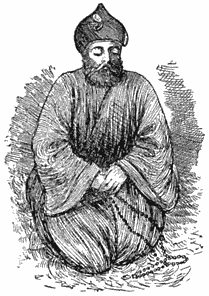
A BASTAMI SHAIKH. (Brown.)
Three of these orders, the Bast̤āmīyah, the Naqshbandīyah, and the Bak͟htāshīyah, descend from the original order established by the first K͟halīfah, Abū Bakr. The fourth K͟halīfah, ʿAlī, gave birth to all the others. Each order has its silsilah, or chain of succession, from one of these two great founders.
The Naqshbandīyah, who are the followers of K͟hwajah Pīr Muḥammad Naqshband, are a very numerous order. They usually perform the Ẕikr-i-K͟hafī, or silent devotions, described in the account of ZIKR.
The first duty of the members of this Order is to recite, daily, particular prayers, called the k͟hātim k͟hāwjagān; once, at least, the Istīg͟hfār (Prayer for Forgiveness); seven times the salāmāt; seven times the Fātiḥah (first chapter of the Qurʾān); nine times the chapter of the Qurʾān called Inshirāh (Chapter xciv.); lastly, the Ik͟hlāṣ (Chapter cxii.). To these are added the ceremonies called Ẕikr. [ZIKR.]
For these recitals they meet together once a week. Ordinarily, this is on Thursday, and after the fifth prayer of the day, so that it occurs after night-fall. In each city, suburb, or quarter, the members of this association, divided into different bodies, assemble at the house of their respective pīr or shaik͟h, where, seated, they perform their pious exercises with the most perfect gravity. The shaik͟h, or any other brother in his stead, chants the prayers which constitute the association, and the assembly respond in chorus, “Hū (He),” or “Allāh!” In some cities, the Naqshbandīyah have especial halls, consecrated wholly to this purpose, and then the shaik͟h only is distinguished from the other brethren by a special turban.
The Bak͟htāshīyah was founded by a native of Buk͟hārā, and is celebrated as being the order which eventually gave birth to the fanatical order of Janissaries. The symbol of their order is the mystic girdle, which they put off and on seven times, saying:—
1. “I tie up greediness, and unbind generosity.”
2. “I tie up anger, and unbind meekness.”
3. “I tie up avarice, and unbind piety.”
4. “I tie up ignorance, and unbind the fear of God.”
5. “I tie up passion, and unbind the love of God.”
6. “I tie up hunger, and unbind (spiritual) contentment.”
7. “I tie up Satanism and unbind Divineness.”
The Maulawīyah are the most popular religious order of faqīrs in the Turkish empire. They are called by Europeans, who witness their ẕikrs and various religious performances at Constantinople and Cairo, the “dancing,” or “whirling” darweshes. They were founded by the Maulawī Jalālu ʾd-dīn ar-Rūmī, the renowned author of the Mas̤nawī, a book much read in Persia, and, indeed, in all parts of Islām.

THE MAULAWI OR DANCING DARWESH.
They have service at their takyah, or “convent,” every Wednesday and Sunday at two o’clock. There are about twenty performers, with high round felt caps and brown mantles. At a given signal they all fall flat on their faces, and rise and walk slowly round and round with their arms folded, bowing and turning slowly several times. They then cast off their mantles and appear in long bell-shaped petticoats and jackets, and then begin to spin, revolving, dancing and turning with extraordinary velocity. [ZIKR.]
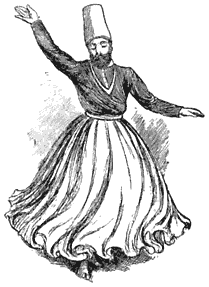
THE MAULAWI OR DANCING DARWESH.

THE MAULAWI OR DANCING DARWESH.
The Qādirīyah sprang from the celebrated Saiyid ʿAbdu ʾl-Qādir, surnamed Pīr-i-Dastagīr, whose shrine is at Bagdad. They practise both the Ẕikr-i-Jalī and the Ẕikr-i-K͟hafī. Most of the Sunnī Maulawīs on the north-west frontier of India are members of this order. In Egypt it is most popular among fishermen.
The Chishtīyah are followers of Muʿīnu ʾd-dīn Banda Nawāz, surnamed the Gīsū darāz, or the “long-ringletted.” His shrine is at Calburgah.
The Shīʿahs generally become faqīrs of this order. They are partial to vocal music, for the founder of the order remarked that singing was the food and support of the soul. They perform the Ẕikr-i-Jalī, described in the article on ZIKR.
The Jalālīyah were founded by Saiyid Jalālu ʾd-dīn, of Buk͟hārā. They are met with in Central Asia. Religious mendicants are often of this order.
The Suhrwardīyah are a popular order in Afg͟hānistān, and comprise a number of learned men. They are the followers of Shihābu ʾd-dīn of Suhrward of al-ʿIrāq. These are the most noted orders of ba sharʿ faqīrs.
The be sharʿ faqīrs are very numerous.
The most popular order in India is that of the Murdārīyah, founded by Zinda Shāh Murdār, of Syria, whose shrine is at Makanpur, in Oudh. From these have sprung the Malang faqīrs, who crowd the bazaars of India. They wear their hair matted and tied in a knot. The Rufāʿīyah order is also a numerous one in some parts of India. They practise the most severe discipline, and mortify themselves by beating their bodies. They are known in Turkey and Egypt as the “Howling Darweshes.”
Another well-known order of darweshes is the Qalandarīyah, or “Wandering Darweshes,” founded by Qalandar Yūsuf al-Andalusī, a native of Spain. He was for a time a member of the Bak͟htāshīs; but having been dismissed from the order, he established one of his own, with the obligation of perpetual travelling. The Qalandar faqīr is a prominent character in Eastern romance.

A QALANDAR. (Brown.)

A RUFAʿI IN ECSTATICS. (Brown.)
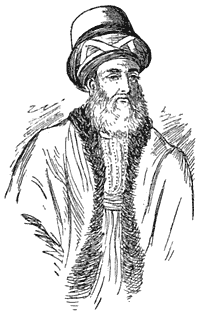
THE SHAIKH OF THE DANCING DARWESHES AT CAIRO. (From a Photograph.)
Each order is established on different principles, and has its rules and statutes and peculiar devotions. These characteristics extend even to the garments worn by their followers. Each order has, in fact, a particular dress, and amongst the greater part of them this is chosen so as to mark a difference in that of the shaik͟h from that of the ordinary members. It is perceived principally in the turbans, the shape of the coat, the colours, and the nature of the stuff of which the dresses are made. The shaik͟hs wear robes of green or white cloth; and any of those who in winter line them with fur, use that kind called petit gris and zibaline martin. Few darweshes use cloth for their dress. Black or white felt dresses called ʿabāʾ, such as are made in some of the cities of Anatolia, are the most usual. Those who wear black felt are the Jalwatīs and the Qādirīs. The latter have adopted it for their boots, and muslin for their turbans. Some, such as the Maulawīs and the Bakrīs, wear tall caps called kulāhs, made also of felt; and others, such as the Rufāʿīs, use short caps called T̤āqīyah, to which is added a coarse cloth. The head-dress of almost all the darweshes is called tāj, which signifies a “crown.” These turbans are of different forms, either from the manner in which the muslin is folded, or by the cut of the cloth which covers the top of the head. The cloth is in several gores. Some have four, as the Adhamīs; some six, as the Qādirīs and the Saʿdīs; the Gulshanīs have eight; the Bak͟htāshīs twelve; and the Jalwatīs eighteen.
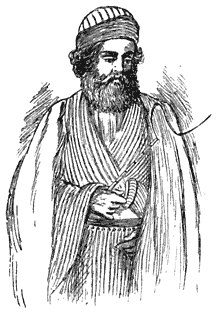
AN EGYPTIAN FAKIR. (From a Photograph.)
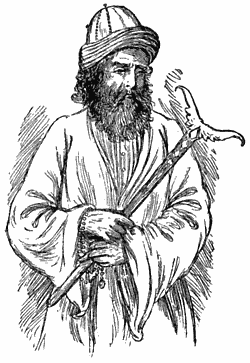
AN EGYPTIAN FAKIR. (From a Photograph.)
The darweshes carry about with them one or other of the following articles: a small crooked stick or iron, which the devotee places under his arm-pit or forehead, to lean upon when he meditates, or an iron or brass bar on which there is a little artificial hand wherewith to scratch his unwashed body, a bag made of lamb-skin, a kashkūl or beggar’s wallet.
Generally, all the darweshes allow their beards and mustachios to grow. Some of the orders—the Qādirīs, Rufāʿīs, K͟halwatīs, Gulshanīs, Jalwatīs, and the Nūru ʾd-dīnīs—still wear long hair, in memory of the usage of the Prophet and several of his disciples. Some allow their hair to fall over their shoulders; others tie it up and put it under their turban.
Whilst private Musulmāns are in the habit of holding rosaries of beads as a pastime, the darweshes do the same, only in a spirit of religion and piety. These rosaries have thirty-three, sixty-six, or ninety-nine beads, which is the number of the attributes of the Divinity [GOD]. Some have them always in their hands, others in their girdles; and all are required to recite, several times during the day, the particular prayers of their order. [TASBIH.]
The individual who desires to enter an order is received in an assembly of the fraternity, presided over by the shaik͟h, who touches his hand and breathes in his ear three times the words, “Lā ilāha illa ʾllāh” (“There is no god but God”), commanding him to repeat them 101, 151, or 301 times each day. This ceremony is called the Talqīn. The recipient, faithful to the orders of his chief, obligates himself to spend his time in perfect retirement, and to report to the shaik͟h the visions or dreams which he may have during the course of his novitiate. These dreams, besides characterising the sanctity of his vocation, and his spiritual advancement in the order, serve likewise as so many supernatural means to direct the shaik͟h regarding the periods when he may again breathe in the ear of the neophyte the second words of the initiation, “Yā Allāh!” (“O God!”), and successively all the others to the last, “Yā Qahhār!” (“O avengeful God!”). The full complement of this exercise is called Chilleh, or “forty days,” a period sometimes even longer, according to the dispositions, more or less favourable, of the candidate. Arrived at the last grade of his novitiate, he is then supposed to have fully ended his career, called Takmīlu ʾs-Sulūk, and acquired the degree of perfection for his solemn admission into the corps to which he has devoted himself. During all his novitiate, the recipient bears the name of Murīd, or “Disciple,” and the shaik͟h who directs him in this pretended celestial career takes the title of Murshid, or “Spiritual Guide.”
The founder of the Alwānīs laid out the first rules of this novitiate; they were subsequently perfected by the institution of the Qādirīs, and more so by the K͟halwatīs. The darweshes of these two last societies are distinguished in some countries by the decoration of their turban, on the top of which are embroidered the words “Lā ilāha illā ʾllāh” (There is no god but God).
The tests of the novice among the Maulawīs seem to be still more severe, and the reception of these dervishes is attended with ceremonies peculiar to their order. The aspirant is required to labour in the convent or takyah 1,001 successive days in the lowest grade, on which account he is called the kārrā kolak (jackal). If he fails in this service only one day, or is absent one night, he is obliged to recommence his novitiate. The chief of the kitchen, or ashjibāshī, one of the most notable of the darweshes, presents him to the shaik͟h, who, seated in an angle of the sofā, receives him amid a general assembly of all the darweshes of the convent. The candidate kisses the hand of the shaik͟h, and takes a seat before him on a mat, which covers the floor of the hall. The chief of the kitchen places his right hand on the neck, and his left hand on the forehead of the novice, whilst the shaik͟h takes off his cap and holds it over his head, reciting the following Persian distich, the composition of the founder of the order:—
“It is true greatness and felicity to close the heart to all human passions; the abandonment of the vanities of this world is the happy effect of the victorious strength given by the grace of our Holy Prophet.”
These verses are followed by the exordium of the Takbīr, “Allāhu akbar—God is great,” after which the shaik͟h covers the head of the new darwesh, who now rises and places himself with the Ashjibāshī in the middle of the hall, where they assume the most humble posture, their hands crossed upon the breast, the left foot over the right foot, and the head inclined towards the left shoulder. The shaik͟h addresses these words to the head of the kitchen:—
“May the services of this darwesh, thy brother, be agreeable to the throne of the Eternal, and in the eyes of our Pīr (the founder of the order); may his satisfaction, his felicity, and his glory grow in this nest of the humble, in the cell of the poor; let us exclaim ‘Hū!’ in honour of our Maulawī.”
They answer “Hū!” and the accepted novice, arising from his place, kisses the hand of the shaik͟h, who at this moment addresses to him some paternal exhortations on the subject of the duties of his new condition, and closes by ordering all the darweshes of the meeting to recognise and embrace their new brother.
The following is said to be the usual method of admitting a Muḥammadan to the order of a ba sharʿ faqīr in India. Having first performed the legal ablutions, the murīd (disciple) seats himself before the murshid (spiritual guide). The murshid then takes the murīd’s right hand, and requires of him a confession of sin according to the following form:—
“I ask forgiveness of the great God than Whom there is no other deity, the Eternal, the Everlasting, the Living One: I turn to Him for repentance, and beg His grace and forgiveness.”
This, or a similar form of repentance, is repeated several times. The murīd then repeats after the murshid:—
“I beg for the favour of God and of the Prophet, and I take for my guide to God such a one (here naming the murshid) not to change or to separate from him. God is our witness. By the great God. There is no deity but God. Amen.”
The murshid and the murīd then recite the first chapter of the Qurʾān, and the murīd concludes the ceremony by kissing the murshid’s hand.
After the initiatory rite, the murīd undergoes a series of instructions, including the ẕikrs, which he is required to repeat daily. The murīd frequently visits his murshid, and sometimes the murshids proceed on a circuit of visitation to their disciples. The place where these “holy men” sit down to instruct the people is ever afterwards held sacred, a small flag is hoisted on a tree, and it is fenced in. Such places are called “takyah,” and are protected and kept free from pollution by some faqīr engaged for the purpose.
Another account of the admission of a murīd, or “disciple,” into the order of Qādirīyah faqīrs, is given by Tawakkul Beg in the Journal Asiatique:—
“Having been introduced by Ak͟hūnd Mullā Muḥammad to Shaik͟h Mulla Shāh, my heart, through frequent intercourse with him, was filled with such a burning desire to arrive at a true knowledge of the mystical science, that I found no sleep by night, nor rest by day. When the initiation commenced, I passed the whole night without sleep, and repeated innumerable times the Sūratu ʾl-Ik͟hlāṣ:—
‘Say: He is God alone;
God the eternal:
He begetteth not, and He is not begotten:
And there is none like unto Him.’
(Sūrah cxii.)
“Whosoever repeats this Sūrah one hundred times can accomplish all his vows. I desired that the shaik͟h should bestow on me his love. No sooner had I finished my task, than the heart of the shaik͟h became full of sympathy for me. On the following night I was conducted to his presence. During the whole of that night he concentrated his thoughts on me, whilst I gave myself up to inward meditation. Three nights passed in this way. On the fourth night the shaik͟h said:—‘Let Mullā Sang͟him and Ṣāliḥ Beg, who are very susceptible to ecstatic emotions, apply their spiritual energies to Tawakkul Beg.’
“They did so, whilst I passed the whole night in meditation, with my face turned toward Makkah. As the morning drew near, a little light came into my mind, but I could not distinguish form or colour. After the morning prayers, I was taken to the shaik͟h who bade me inform him of my mental state. I replied that I had seen a light with my inward eye. On hearing this, the shaik͟h became animated and said: ‘Thy heart is dark, but the time is come when I will show myself clearly to thee.’ He then ordered me to sit down in front of him, and to impress his features on my mind. Then having blindfolded me, he ordered me to concentrate all my thoughts upon him. I did so, and in an instant, by the spiritual help of the shaik͟h, my heart opened. He asked me what I saw. I said that I saw another Tawakkul Beg and another Mullā Shāh. The bandage was then removed, and I saw the shaik͟h in front of me. Again they covered my face, and again I saw him with my inward eye. Astonished, I cried: ‘O master! whether I look with my bodily eye, or with my spiritual sight, it is always you I see.’ I then saw a dazzling figure approach me. The shaik͟h told me to say to the apparition, ‘What is your name?’ In my spirit I put the question, and the figure answered to my heart: ‘I am ʿAbdu ʾl-Qādir al-Jilānī, I have already aided thee, thy heart is opened.’ Much affected, I vowed that in honour of the saint, I would repeat the whole Qurʾān every Friday night.
“Mullā Shāh then said: ‘The spiritual world has been shown to thee in all its beauty.’ I then rendered perfect obedience to the shaik͟h. The following day I saw the Prophet, the chief Companions, and legions of saints and angels. After three months I entered the cheerless region in which the figures appeared no more. During the whole of this time the shaik͟h continued to explain to me the mystery of the doctrine of the Unity and of the knowledge of God; but as yet he did not show me the absolute reality. It was not until a year had passed that I arrived at the true conception of unity. Then in words such as these I told the shaik͟h of my inspiration. ‘I look upon the body as only dust and water, I regard neither my heart nor my soul, alas! that in separation from Thee (God) so much of my life has passed. Thou wert I and I knew it not.’ The shaik͟h was delighted, and said that the truth of the union with God was now clearly revealed to me. Then addressing those who were present, he said:—
“ ‘Tawakkul Beg learnt from me the doctrine of the Unity, his inward eye has been opened, the spheres of colours and of images have been shown to him. At length, he entered the colourless region. He has now attained to the Unity; doubt and scepticism henceforth have no power over him. No one sees the Unity with the outward eye, till the inward eye gains strength and power.’ ”
Each institution imposes on its darweshes the obligation to recite certain passages at different times of the day in private, as well as in common with others. Several have also practices which are peculiar to themselves, and which consist in dances, or rather religious circular movements. In each convent there is a room consecrated to these exercises. Nothing is simpler than its construction; it contains no ornaments of any nature; the middle of the room, turned towards Makkah, contains a niche or miḥrāb, in front of which is a small carpet, mostly made of the skin of a sheep, on which the shaik͟h of the community reclines; over the niche the name of the founder of the order is written. In some halls this inscription is surmounted by two others—one containing the Confession of Faith, and the other the words “Bismillāh,” &c. (“In the name of God, the most Clement and Merciful.”) In others are seen on the wall to the right and the left of the niche tablets, on which are written in large letters the name of God (Allāh), that of Muḥammad, and those of the four first K͟halīfahs. At others are seen the names of al-Ḥasan and al-Ḥusain, grandsons of the Prophet, and some verses of the Qurʾān, or others of a moral character.
The exercises which are followed in these halls are of various kinds, a description of which is given in the account of ZIKR.
The more zealous faqīrs devote themselves to the most austere acts, and shut themselves up in their cells, so as to give themselves up for whole hours to prayer and meditation; the others pass very often a whole night in pronouncing the words Hū and Allāh, or rather the phrase, Lā ilāha illā ʾllāh. So as to drive away sleep from their eyes, some of them stand for whole nights in very uncomfortable positions. They sit with their feet on the ground, the two hands resting upon their knees: they fasten themselves in this attitude by a band of leather passed over their neck and legs. Others tie their hair with a cord to the ceiling, and call this usage Chilleh. There are some, also, who devote themselves to an absolute retirement from the world, and to the most rigid abstinence, living only on bread and water for twelve days successively, in honour of the twelve Imāms of the race of ʿAlī. This retirement is called K͟halwah. They pretend that the shaik͟h ʿAmr K͟halwatī was the first to follow it, and that he often practised it. They add that one day, having left his retirement, he heard a celestial voice saying, “O ʿAmr K͟halwatī, why dost thou abandon us?” and that, faithful to this oracle, he felt himself obliged to consecrate the rest of his days to works of penitence, and even to institute an order under the name of K͟halwatīs, a name signifying “living in retirement.” For this reason, darweshes of this order consider it their duty, more than any others, to live in solitude and abstinence. The more devoted among them observe sometimes a painful fast of forty days consecutively, called by them al-arbaʿūn (forty). Amongst them all their object is the expiation of their sins, the sanctification of their lives, and the glorification of Islām; the prosperity of the state, and the general salvation of the Muḥammadan people. The most ancient and the greatest of the orders, such as the Alwānīs, the Adhamīs, the Qādirīs, the Rufaʿīs, the Naqshbandīs, the K͟halwatīs, &c., are considered as the cardinal orders; for which reason they call themselves the Uṣūls, or “Originals.” They give to the others the names of the Furūʿ, or “Branches,” signifying thereby secondary ones, to designate their filiation or emanation from the first. The order of the Naqshbandīs and K͟halwatīs hold, however, the first rank in the temporal line; the one on account of the conformity of its statutes to the principles of the ten first confraternities, and to the lustre which causes the grandees and principal citizens of the empire to incorporate themselves in it; and the other, because of its being the source of the mother society which gave birth to many others. In the spiritual line, the order of the Qādirīs, Maulawīs, Bak͟htāshīs, Rufaʿīs, and the Sāʿdīs, are the most distinguished, especially the three first, on account of the eminent sanctity of their founders, of the multitude of the miracles attributed to them, and of the superabundance of the merit which is deemed especially attached to them.
Although all of them are considered as mendicant orders, no darwesh is allowed to beg, especially in public. The only exception is among the Bak͟htāshīs, who deem it meritorious to live by alms; and many of these visit not only private houses, but even the streets, public squares, bureaux, and public houses, for the purpose of recommending themselves to the charity of their brethren.
They only express their requests by the words “Shayid Ullāh,” a corruption from “Shayun li-ʾllāh,” which means, “Something for the love of God.” Many of these make it a rule to live only by the labour of their hands, in imitation of Ḥājī Bak͟htāsh, their founder; and, like him, they make spoons, ladles, graters, and other utensils, of wood or marble. It is these, also, who fashion the pieces of marble, white or veined, which are used as collars or buckles for the belts of all the darweshes of their order, and the kashkūls, or shell cups, in which they are obliged to ask alms.
Although in no wise bound by any oaths, all being free to change their community, and even to return to the world, and there to adopt any occupation which may please their fancy, it is rarely that anyone makes use of this liberty. Each one regards it as a sacred duty to end his days in the dress of his order. To this spirit of poverty and perseverance, in which they are so exemplary, must be added that of perfect submission to their superior. This latter is elevated by the deep humility which accompanies all their conduct, not only in the interior of the cloisters, but even in private life. One never meets them anywhere but with head bent and the most respectful countenance. They never salute anyone, particularly the Maulawīs, and the Bak͟htāshīs, except by the exclamation, “Yā Hū!” The words Ai bi-ʾllāh, “thanks to God,” frequently are used in their conversation; and the more devout or enthusiastic speak only of dreams, visions, celestial spirits, supernatural objects, &c.
They are seldom exposed to the trouble and vexations of ambition, because the most ancient darweshes are those who may aspire to the grade of shaik͟h, or superior of the convent. The shaik͟hs are named by their respective generals, called the Raisu ʾl-Mashāʾik͟h (chief of shaik͟hs). Those of the Maulawīs have the distinctive title of Cheleby Efendi. All reside in the same cities which contain the ashes of the founders of their orders, called by the name of Āstāneh signifying “the court.” They are subordinate to the Muftī of the capital, who exercises absolute jurisdiction over them. In the Turkish Empire the Shaik͟hu ʾl-Islām has the right of removing all the generals of the various orders, even those of the Qādirīs, the Maulawīs, and of the Bak͟htāshīs, although the dignity be hereditary in their family, on account of their all three being sprung from the blood of the same founders of their orders. The Muftī has likewise the right to confirm the shaik͟hs who may be nominated by any of the generals of the orders.
(See The Dervishes or Oriental Spiritualism, by John P. Brown; Malcolm’s Persia; Lane’s Modern Egyptians; D’Ohsson’s Ottoman Empire; Ubicini’s Letters on Turkey; Herklots’ Musalmans; Taẕkiratu ʾl-Auliyā, by Shaik͟h Farīdu ʾd-Dīn al-ʿAt̤t̤ār.)
FAQR (فقر). The life of a Faqīr or an ascetic.
FARAʿ (فرع). The first-born of either camels, sheep, or goats, which the Arab pagans used to offer to idols. This was allowed by the Prophet at the commencement of his mission, but afterwards abolished. (Mishkāt, book iv. c. 50.)
FARĀʾIẒ (فرائض), pl. of Farīẓah. “Inheritances.” A term used for the law of inheritance, or ʿIlmu ʾl-Farāʾiẓ. Farīẓah means literally an ordinance of God, and this branch of Muslim law is so called because it is established fully in the Qurʾān, Sūrah iv. [INHERITANCE.]
FARAQ (فرق). Lit. “Separation.” Faraq-i-Awwal is a term used by Ṣūfī mystics to express that state of mind in which the soul is drawn away from a contemplation of God by a contemplation of his creation; and faraq-i-s̤ānī (the second separation) is when the soul is constantly contemplating the stability of the creation with the eternity of the Creator. (ʿAbdu ʾr-Razzāq’s Dictionary of Ṣūfī Terms.)
FĀRAQLĪT̤ (فارقليط). The Arabic rendering of the Greek παράκλητος, “Paraclete.” Muḥammadan writers assert that it is the original of the word translated Aḥmad in the following verse in the Qurʾān, Sūrah lxi. v. 6:—
“And call to mind when Jesus, son of Mary, said:—‘O children of Israel! Verily I am an Apostle of God unto you, attesting the Taurāt revealed before me, and giving good tidings of a Prophet that shall come after whose name is Aḥmad.’”
Aḥmad is another derivative of the root to which Muḥammad belongs, signifying, like it, “the Praised.” It is not improbable that in some imperfect copies of St. John xvi. 7, παράκλητος may have been rendered περικλυτος, which in some early Arabic translation of the Gospel may have been translated Aḥmad. In the Majmaʿu ʾl-Biḥār, a work written three hundred years ago, the word fāraqlīt̤ is said to mean a distinguisher between truth and error. The word also occurs several times in the well-known Shīʿah work, the Ḥayātu ʾl-Qulūb (vide Merrick’s translation, page 86). The author says, “It is well known that his (the Prophet’s) name in the Taurāt is Mūādmūād, in the gospels (Injīl) Tābtāb, and in the Psalms (Zabūr) Farakleet.” And again (p. 308), “God said to Jesus, O Son of my handmaid … verily I will send the chosen of prophets, Aḥmad, whom I have selected of all my creatures, even Farakleet, my friend and servant.” [JESUS.]
FARSAK͟H (فرسخ). Persian Farsang. A land measure which occurs in Muḥammadan books of law. It is a league of 18,000 feet, or three and a half miles in length.
FARWAH (فروة). An Arab of the Banū Juẕām and Governor of ʿAmmān, who is represented by tradition (upon imperfect evidence) as one of the early martyrs of Islām. Having been converted to Islām, the Roman authorities crucified him. (Muir’s Life of Mahomet, vol. ii. p. 103.)
FARẒ (فرض). That which is obligatory. A term used for those rules and ordinances of religion which are said to have been established and enjoined by God Himself, as distinguished from those which are established upon the precept or practice of the Prophet, and which are called sunnah.
FARẒ KIFĀʾĪ (فرض كفائى). A command which is imperative (farẓ) upon all Muslims, but which if one person in eight or ten performs it, it is sufficient (kifāʾī), or equivalent to all having performed it.
They are generally held to be five in number: (1) To return a salutation; (2) To visit the sick and inquire after their welfare; (3) To follow a bier on foot to the grave; (4) To accept an invitation to dinner; (5) Replying to a sneeze. [SNEEZING.]
They are also said to be six or seven in number, when there are added one or two of the following: (1) To give advice when asked for it; (2) To help a Muslim to verify his oath; (3) To assist a person in distress. ʿAbdu ʾl-Ḥaqq says this last injunction applies to all cases, whether that of a Muslim or an infidel. (Mishkāt, book v. c. i. part 1.)
FARẒU ʾL-ʿAIN (فرض العين). An injunction or ordinance the obligation of which extends to every Muslim, as prayer, fasting, &c.
FĀSID (فاسد). A seditious or rebellious person.
FĀSIQ (فاسق). A term used in Muḥammadan law for a reprobate person who neglects decorum in his dress and behaviour. The acceptance of such a person’s evidence is not admissible. He is not regarded as a Muslim citizen, although he may profess Islām.
FASTING. Arabic Ṣaum (صوم); Persian Rozah (روزه). Fasting was highly commended by Muḥammad as an atonement for sin. The following are the fasts founded upon the example of the Prophet and observed by devout Muslims:—
(1) The thirty-days of the month of Ramaẓān. This month’s fast is regarded as a divine institution, being enjoined in the Qurʾān (Sūrah ii. 180) and is therefore compulsory. [RAMAZAN.]
(2) The day ʿĀshūrāʾ. The tenth day of the month Muḥarram. This is a voluntary fast, but it is pretty generally observed by all Muslims, for Abū Qatādah relates that the Prophet said he hoped that the fast of ʿĀshūrāʾ would cover the sins of the coming year. (Mishkāt, book vii. ch. vii. pt. 1.) [ʿASHURAʾ.]
(3) The six days following the ʿĪdu ʾl-Fit̤r. Abū Aiyūb relates that the Prophet said, “The person who fasts the month of Ramaẓān, and follows it up with six days of the month of Shawwāl, will obtain the rewards of a continued fast.” (Mishkāt, book vii. ch. vii. pt. 1.)
(4) The Monday and Thursday of every week are recommended as fast days, as distinguished from the Christian fast of Wednesday. Abū Hurairah relates that the Prophet said, “The actions of God’s servants are represented at the throne of God on Mondays and Thursdays.” (Mishkāt, book vii. ch. vii. pt. 2.) These days are only observed by strictly religious Muslims.
(5) The month of Shaʿbān. ʿĀyishah relates that “the Prophet used sometimes to fast part of this month and sometimes the whole.” (Mishkāt, book vii. ch. vii. pt. 1.) It is seldom observed in the present day.
(6) The 13th, 14th, and 15th of each month. These days are termed al-ayyāmu ʾl-bīẓ, i.e. the bright days, and were observed by Muḥammad himself as fasts. (Mishkāt, book vii. ch. vii. pt. 2.) These are generally observed by devout Muslims.
(7) Fasting alternate days, which Muḥammad said was the fast observed by David, King of Israel. (Mishkāt, book vii. ch. vii. pt. 1.)
In the Traditions, fasting is commended by Muḥammad in the following words:—
“Every good act that a man does shall receive from ten to seven hundred rewards, but the rewards of fasting are beyond bounds, for fasting is for God alone, and He will give its rewards.”
“He who fasts abandons the cravings of his appetites for God’s sake.”
“There are two pleasures in fasting, one when the person who fasts breaks it, and the other in the next world when he meets his Lord. The very smell of the mouth of a keeper of a fast is more agreeable to God than the smell of musk.”
“Fasting is a shield.”
“When any of you fast utter no bad words, nor raise your voice in strife. If anyone abuse one who is fasting, let him refrain from replying; let him say that he is keeping a fast.” (Mishkāt, book vii. ch. i. pt. 1.)
FATE. [PREDESTINATION.]
AL-FATḤ (الفتح), “The victory.” The title of the XLVIIIth Sūrah of the Qurʾān, in the first verse of which the word occurs. “Verily We (God) have given thee an obvious victory, that God may pardon thee thy former and later sin.”
Professor Palmer says “Some of the commentators take this to mean sins committed by Muḥammad before his call and after it. Others refer the word to the liaison with the Coptic handmaiden Mary, and to his marriage with Zainab, the wife of his adopted son Zaid.” None of the commentators we have consulted, including al-Baiẓāwī, al-Jalālān, al-Kamālān, and Ḥusain, give the last interpretation. They all say it refers to his sins before and after his call to the Apostleship.
FATHER. In the Sunnī law of inheritance, a father is a sharer in the property of his son or son’s son, taking one-sixth, but if his son die unmarried and without issue, the father is the residuary and takes the whole.
According to the law of qiṣāṣ or retaliation, if a father take the life of his son, he is not to be slain, for the Prophet has said, “Retaliation must not be executed upon the parent for his offspring”; and Abū Ḥanīfah adds, “because as the parent is the efficient cause of his child’s existence, it is not proper that the child should require or be the occasion of his father’s death”; whence it is that a son is forbidden to shoot his father, when in the army of the enemy, or to throw a stone at him, if suffering lapidation for adultery.
In the law of evidence, the testimony of a father for or against his child is not admitted in a court of law.
AL-FĀTIḤAH (الفاتحة). Lit. “The opening one.” The first chapter of the Qurʾān, called also the Sūratu ʾl-Ḥamd, or the “Chapter of Praise.” It is held in great veneration by Muḥammadans, and is used by them very much as the Paternoster is recited by Roman Catholics. It is repeated over sick persons as a means of healing and also recited as an intercession for the souls of the departed, and occurs in each rakʿah of the daily prayer. Muḥammad is related to have said it was the greatest Sūrah in the Qurʾān, and to have called it the Qurʾānu ʾl-ʿAz̤īm, or the “exalted reading.” It is also entitled the Sabʿu ʾl-Mas̤ānī, or the “seven recitals,” as it contains seven verses; also Ummu ʾl-Qurʾān, the “Mother of the Qurʾān.” According to a saying of the Prophet, the fātiḥah was revealed twice; once at Makkah and once at al-Madīnah. The Amīn is always said at the conclusion of this prayer.
The following transliteration of the Arabic of the Fātiḥah into English characters may give some idea of the rhythm in which the Qurʾān is written:—
“Al-ḥamdu li-ʾllāhi Rabbi ʾl-ʿālamīn.
Ar-raḥmāni ʾr-raḥīm.
Māliki yaumi ʾd-dīn.
Iyyāka naʿbudu, wa-iyyāka nastaʿīn.
Ihdinā ʾṣ-ṣirāt̤a ʾl-mustaqīm.
Ṣirāt̤a ʾllaẕīna anʿamta ʿalaihim.
G͟hairi ʾl-mag͟hẓūbi ʿalaihim, walā ʾẓ-ẓāllīn.”
Which is translated by Rodwell in his English Qurʾān as follows:—
“Praise be to God, Lord of all the worlds!
The Compassionate, the Merciful!
King on the Day of Judgment!
Thee do we worship, and to Thee do we cry for help!
Guide Thou us on the right path!
The path of those to whom Thou art gracious!
Not of those with whom Thou art angered, nor of those who go astray.”
FĀT̤IMAH (فاطمة). A daughter of Muḥammad, by his first wife K͟hadījah. She married ʿAlī the cousin of Muḥammad, by whom she had three sons, al-Ḥasan, al-Ḥusain, and al-Muḥsin; the latter died in infancy. From the two former are descended the posterity of the Prophet, known as Saiyids. Fāt̤imah died six months after her father. She is spoken of by the Prophet as one of the four perfect women, and is called al-Batūl, or “the Virgin,” by which is meant one who had renounced the World, also Fāt̤imatu ʾz-zuhrāʾ, or “the beautiful Fāt̤imah.”
There are three women of the name of Fāt̤imah mentioned in the Traditions: (1) Fāt̤imah, the daughter of Muḥammad; (2) The mother of ʿAlī; (3) The daughter of Ḥamzah, the uncle of Muḥammad.
AL-FĀT̤IMĪYAH (الفاطمية). “The Fatimides.” A dynasty of K͟halīfahs who reigned over Egypt and North Africa from A.D. 908 to A.D. 1171. They obtained the name from the pretensions of the founder of their dynasty Abū Muḥammad ʿUbaidu ʾllāh, who asserted that he was a Saiyid, and descended from Fāt̤imah, the daughter of the Prophet and ʿAlī. His opponents declared he was the grandson of a Jew of the Magian religion.
There were in all fourteen K͟halīfahs of this dynasty:—
(1) ʿUbaidu ʾllāh, the first Fatimide K͟halīfah, was born A.D. 882. Having incurred the displeasure of al-Muktafī, the reigning Abasside K͟halīfah, he was obliged to wander through various parts of Africa, till through fortunate circumstances he was raised in A.D. 910 from a dungeon in Segelmessa to sovereign power. He assumed the title of al-Mahdī, or “the Director of the Faithful.” [MAHDI.] He subdued the Amīrs in the north of Africa, who had become independent of the Abbasides, and established his authority from the Atlantic to the borders of Egypt. He founded Mahadi on the site of the ancient Aphrodisium, a town on the coast of Africa, about a hundred miles south of Tunis, and made it his capital. He became the author of a great schism among the Muḥammadans by disowning the authority of the Abassides, and assuming the titles of K͟halīfah and Amīru ʾl-Muʾminīn, “Prince of the Faithful.” His fleets ravaged the coasts of Italy and Sicily, and his armies frequently invaded Egypt, but without any permanent success.
(2) Al-Qāʾim succeeded his father in A.D. 933. During his reign, an impostor, Abū Yazīd, originally an Ethiopian slave, advanced certain peculiar doctrines in religion, which he was enabled to propagate over the whole of the north of Africa, and was so successful in his military expeditions as to deprive al-Qāʾim of all his dominions, and confine him to his capital, Mahadi, which he was besieging when al-Qāʾim died.
(3) Al-Manṣūr succeeded his father in A.D. 946, when the kingdom was in a state of the greatest confusion. By his valour and prudence he regained the greater part of the dominions of his grandfather ʿUbaidu ʾllāh, defeated the usurper Abū Yazīd, and laid the foundation of that power which enabled his son al-Muʿizz to conquer Egypt.
(4) Al-Muʿizz (A.D. 955) was the most powerful of the Fatimide K͟halīfahs. He was successful in a naval war with Spain, and took the island of Sicily; but his most celebrated conquest was that of Egypt, which was subdued in A.D. 972. Two years afterwards he removed his court to Egypt, and founded Cairo. The name of the Abasside K͟halīfah was omitted in the Friday prayers, and his own substituted in its place; from which time the great schism of the Fatimide and Abasside K͟halīfahs is more frequently dated than from the assumption of the title by ʿUbaidu ʾllāh. The armies of al-Muʿizz conquered the whole of Palestine and Syria as far as Damascus.
(5) Al-ʿAzīz (A.D. 978). The dominions recently acquired by al-Muʿizz were secured to the Fatimide K͟halīfahs by the wise government of his son, al-ʿAzīz, who took several towns in Syria. He married a Christian woman, whose brothers he made patriarchs of Alexandria and Jerusalem.
(6) Al-Ḥākim was only eleven years of age when he succeeded his father in A.D. 996. He is distinguished even among Oriental despots by his cruelty and folly. His tyranny caused frequent insurrections in Cairo. He persecuted the Jews and Christians, and burnt their places of worship. By his order the Church of the Resurrection at Jerusalem was destroyed (A.D. 1009). His persecutions of the Christians induced them to appeal to their brethren in the West, and was one of the causes that led to the crusades. He carried his folly so far as to seek to become the founder of a new religion, and to assert that he was the express image of God. He was assassinated in A.D. 1021, and was succeeded by his son.
(7) Az̤-Z̤āhir (A.D. 1021) was not so cruel as his father, but was addicted to pleasure, and resigned all the cares of government to his Vizirs. In his reign the power of the Fatimide K͟halīfahs began to decline. They possessed nothing but the external show of royalty; secluded in the harem, they were the slaves of their vizirs whom they could not remove, and dared not disobey. In addition to the evils of misgovernment, Egypt was afflicted in the reign of az̤-Z̤āhir with one of the most dreadful famines that ever visited the country.
(8) Al-Mustanṣir (A.D. 1037) was only nine years old when he succeeded his father. The Turks invaded Syria and Palestine in his reign, took Damascus and Jerusalem (1076), where the princes of the house of Ortok, a Turkish family, established an independent kingdom. They advanced to the Nile with the intention of conquering Egypt, but were repulsed.
(9) Al-Mustaʿlī (A.D. 1094), the second son of al-Mustanṣir, was seated on the throne by the all-powerful Vizir Afẓal, in whose hands the entire power rested during the whole of al-Mustaʿlī’s reign. The invasion of Asia Minor by the Crusaders in 1097 appeared to Afẓal a favourable opportunity for the recovery of Jerusalem. Refusing to assist the Turks against the Crusaders, he marched against Jerusalem, took it (1098), and deprived the Ortok princes of the sovereignty which they had exercised for twenty years. His possession of Jerusalem was, however, of very short duration, for it was taken in the following year (1099) by the Crusaders. Anxious to recover his loss, he led an immense army in the same year against Jerusalem, but was entirely defeated by the Crusaders near Ascalon.
(10) Al-Āmir (A.D. 1101).
(11) Al-Ḥāfiẕ (A.D. 1129).
(12) Az̤-Z̤āfir (A.D. 1149).
(13) Al-Fāʾiz (A.D. 1154).
During these reigns the power of the Fatimides rapidly decayed.
(14) Al-ʿĀẓid (A.D. 1160) was the last K͟halīfah of the Fatimide dynasty. At the commencement of his reign Egypt was divided into two factions, the respective chiefs of which, Dargham and Shāwir, disputed for the dignity of Vizir. Shāwir implored the assistance of Nūru ʾd-dīn, who sent an army into Egypt under the command of Shīrkūh, by means of which his rival was crushed. But becoming jealous of Nūru ʾd-dīn’s power in Egypt, he solicited the aid of Amauri, King of Jerusalem, who marched into Egypt and expelled Shīrkūh from the country. Nūru ʾd-dīn soon sent another army into Egypt under the same commander, who was accompanied by his nephew, the celebrated Ṣalāḥu ʾd-dīn (Saladin). Shīrkūh was again unsuccessful, and was obliged to retreat. The ambition of Amauri afforded shortly afterwards a more favourable opportunity for the reduction of Egypt. Amauri, after driving Shīrkūh out of the country, meditated the design of reducing it to his own authority. Shāwir, alarmed at the success of Amauri, entreated the assistance of Nūru ʾd-dīn, who sent Shīrkūh for the third time at the head of a numerous army. He repulsed the Christians, and afterwards put the treacherous Vizir to death. Shīrkūh succeeded to his dignity, but dying shortly after, Saladin obtained the post of Vizir. As Nūru ʾd-dīn was attached to the interests of the Abassides, he gave orders for the proclamation of al-Mustahdī, the Abasside K͟halīfah, and for depriving the Fatimides of the K͟halīfate. ʿĀẓid, who was then on a sick-bed, died a few days afterwards. [KHALIFAH.]
FATQ (فتق). Lit. “Opening.” A term used by Ṣūfī mystics to explain the eternity of matter, together with its development in creation. (ʿAbdu ʾr-Razzāq’s Dict. of Ṣūfī Terms.)
FATRAH (فترة). Lit. “Languor,” or “Intermission.” (1) The interval between the supposed revelation of the XCVIth Sūrah of the Qurʾān and the LXXIVth and XCIIIrd Sūrahs. It is during this period that the powers of inspiration of the Prophet are said to have been suspended, and it was then that he contemplated suicide by intending to cast himself from Mount Ḥirāʾ. The accounts of this interval are confused and contradictory, and various are the periods assigned to it, viz. from seven months to seven years.
(2) The term is also used for the time which elapses between the disappearance of a prophet and the appearance of another. (G͟hiyās̤u ʾl-Lug͟hah in loco.)