DICTIONARY OF ISLĀM. (continued 35)
Reading edition
IV. Renunciation.
“This leads us to the subject of Renunciation, which is of two kinds, external and internal. The former is the renunciation of worldly wealth; the latter, the renunciation of worldly desires. Everything that hinders or veils the Traveller’s path must be renounced, whether it relate to this world or the next. Wealth and dignity are great hindrances; but too much praying and fasting are often hindrances too. The one is a shroud of darkness, the other a veil of light. The Traveller must renounce idolatry, if he desire to reach the Goal, and everything that bars his progress is an idol. All men have some idol, which they worship; with one it is wealth and dignity, with another overmuch prayer and fasting. If a man sit always upon his prayer-carpet, his prayer-carpet becomes his idol. And so on with a great number of instances.
“Renunciation must not be performed without the advice and permission of an elder. It should be the renunciation of trifles, not of necessaries, such as food, clothing, and dwelling-place, which are indispensable to man; for without them he would be obliged to rely on the aid of others, and this would beget avarice, which is ‘the mother of vice.’ The renunciation of necessaries produces as corrupting an influence upon the mind as the possession of too much wealth. The greatest of blessings is to have a sufficiency, but to over-step this limit is to gain nought but additional trouble.
“Renunciation is the practice of those who know God, and the characteristic mark of the wise. Every individual fancies that he alone possesses this knowledge, but knowledge is an attribute of the mind, and there is no approach from unaided sense to the attributes of the mind, by which we can discover who is, or who is not, possessed of this knowledge. Qualities however are the sources of action; therefore a man’s practice is an infallible indication of the qualities he possesses; if, for instance, a man asserts that he is a baker, a carpenter, or a blacksmith, we can judge at once if he possesses skill in these crafts by the perfection of his handiwork. In a word, theory is internal, and practice external, the presence of the practice, therefore, is a proof that the theory too is there.
“Renunciation is necessary to the real confession of faith; for the formula ‘There is no God but God,’ involves two things, negation and proof. Negation is the renunciation of other Gods, and proof is the knowledge of God. Wealth and dignity have led many from the right path, they are the gods the people worship; if then you see that one has renounced these, you may be sure that he has expelled the love of this world from his heart, and completed the negation; and whosoever has attained to the knowledge of God has completed the proofs. This is really confessing that ‘there is no God but God’; and he who has not attained to the knowledge of God, has never really repeated the confession of faith. Early prejudices are a great stumbling-block to many people; for the first principles of Monotheism are contained in the words of the Hadís: ‘Every one is born with a disposition [for the true faith], but his parents make him a Jew, a Christian, or a Magian.’ The Unitarians also say, that the real confession of faith consists in negation and proof; but they explain negation by renunciation of self, and proof by acknowledgment of God.
“Thus, according to the Sufis, confession of faith, prayer and fasting contain two distinct features, namely, form and truth; the former being entirely inefficacious without the latter. Renunciation and the knowledge of God are like a tree; the knowledge of God is the root, renunciation the branches, and all good principles and qualities are the fruit. To sum up, the lesson to be learnt is that in repeating the formula the Traveller must acknowledge in his heart that God only always was, God only always will be. This world and the next, nay, the very existence of the Traveller, may vanish, but God alone remains. This is the true confession of faith; and although the Traveller before was blind, the moment he is assured of this his eyes are opened, and he seeth.
V. Helps to Devotion.
“The Sufis hold that there are three aids necessary to conduct the Traveller on his path.
“1. Attraction (injiẕāb انجذاب); 2. Devotion (ʿibādah عبادة); 3. Elevation (ʿurūj عروج).
“Attraction is the act of God, who draws man towards Himself. Man sets his face towards this world, and is entangled in the love of wealth and dignity, until the grace of God steps in and turns his heart towards God. The tendency proceeding from God is called Attraction; that which proceeds from man is called Inclination, Desire and Love. As the inclination increases, its name changes, and it causes the Traveller to renounce everything else becoming a Kiblah, to set his face towards God; when it has become his Kiblah, and made him forget everything but God, it is developed into Love. [QIBLAH.]
“Most men when they have attained this stage are content to pass their lives therein, and leave the world without making further progress. Such a person the Sufis call Attracted (مجذوب majẕūb).
“Others, however, proceed from this to self-examination, and pass the rest of their lives in devotion. They are then called Devoutly Attracted (مجذوب سالك majẕūb-i-Sālik). If devotion be first practised, and the attraction of God then step in, such a person is called an Attracted Devotee (سالك مجذوب Sālik-i-majẕūb). If he practise and complete devotion, but is not influenced by the attraction of God, he is called a Devotee (سالك Sālik).
“Sheikh Sheháb-uddín, in his work entitled ʾAwárif al Maʾárif, says that an elder or teacher should be selected from the second class alone: for although many may be estimable and righteous, it is but few who are fit for such offices, or for the education of disciples.
“Devotion is the prosecution of the journey, and that in two ways, to God and in God. The first, the Sufis say, has a limit; the second is boundless; the journey to God is completed when the Traveller has attained to the knowledge of God; and then commences the journey in God, which has for its object the knowledge of the Nature and Attributes of God, a task which they confess is not to be accomplished in so short a space as the lifetime of man.
The knowledge wisest men have shared
Of Thy great power and Thee
Is less, when with Thyself compared,
Than one drop in a sea.
“The Unitarians maintain that the journey to God is completed when the Traveller has acknowledged that there is no existence save that of God; the journey in God they explain to be a subsequent inquiry into the mysteries of nature.
“The term Elevation or ascent (عروج ʿurūj) is almost synonymous with Progress.
VI. The Intellectual and Spiritual Development of Man.
“Every animal possesses a vegetative spirit, a living spirit, and an instinctive spirit; but man has an additional inheritance, namely the Spirit of Humanity. Now this was breathed by God into man directly from Himself, and is therefore of the same character as the Primal Element: ‘And when I have fashioned him and breathed My spirit into him.’ (Cor. cap. 15. v. 29.) The Sufis do not interpret this of the Life, but of the Spirit of Humanity, and say that it is frequently not attained until a late period of life, thirty or even eighty years. Before man can receive this Spirit of Humanity, he must be furnished with capacity, which is only to be acquired by purifying oneself from all evil and immoral qualities and dispositions, and adorning oneself with the opposite ones. Sheikh Muhíy-uddín ibn ul ʾArabí, in his ‘Investigations’ (فصوص), says that the words ‘and when I have fashioned him,’ refer to this preparation, and the rest of the sentence, ‘and breathed My spirit into him,’ refers to the accession of the Spirit of Humanity.
“Two conditions are therefore imposed upon the Traveller, first, to attain Humanity, second, to acquire capacity.
“There are three developments of character that must be suppressed before man can attain to Humanity; the animal, the brutal, and the fiendish. He who only eats and sleeps, and gives way to lust, is mere animal; if besides these he gives way to anger and cruelty, he is brutal; and if in addition to all these he is crafty, lying, and deceitful, he is fiendish.
“If the Traveller is moderate in his food, rest, and desires, and strives to attain a knowledge of himself and of God, then is the time for acquiring capacity by freeing himself from all that is evil and base, and adorning himself with the opposite qualities; after that by prayer he may obtain the Spirit of Humanity. Some one has truly said that there is none of the perfection, essence, or immortality of man, save only among such as are ‘created with a godly disposition.’ When the Traveller has once been revivified by the Spirit of Humanity he becomes immortal, and inherits everlasting life. This is why it has been said that ‘man has a beginning but no end.’
“If when he has attained this Spirit of Humanity, he is earnest, and does not waste his life in trifling, he soon arrives at the Divine Light itself. For ‘God guideth whom He pleaseth unto His Light.’ The attainment of this light is the completion of Man’s upward progress, but no one can attain to it but those who are pure in spirit and in their lives. Mohammed asserted that he himself had attained it, ‘To the light have I reached, and in the light I live;’ now this light is the Nature of God; wherefore he said, ‘who seeth me seeth God.’ [NUR-I-MUHAMMAD.]
“The germ that contains the Primal Element of Man is the lowest of the low, and the Divine Light is the highest of the high; it is between these extremes that the stages of man’s upward or downward progress lie. ‘We have created man in the fairest of proportions, and then have thrown him back to be the lowest of the low, save only such as believe and act with righteousness; and verily these shall have their reward.’ (Cor. cap. 95, v. 4). This reward is said by the Sufis to be defined by the word ajrat, ‘reward,’ itself. This word contains three radical letters ا ج and ر; ا stands for اعادة ‘return,’ ج for جنة ‘paradise,’ and ر for روئة, that is ‘those who have handed down the faith.’ Their acting righteously is their return to the Nature of God, for when they have finished their upward progress and reached this they are in Paradise, and in the presence of their God. He therefore is a man, in the true sense of the word, who being sent down upon earth strives upward towards Heaven. These aspirations are indispensable to man; he might by the Almighty Power of God exist without all beside, even had the Heavens and the elements themselves never been; but these things are the aim and want of all.
“It has been said that the Primal Element or constructive spirit as well as the Spirit of Humanity proceed direct from God. They are therefore identical, and are both included by the Sufis in the one term Concomitant Spirit. Now this Spirit, although distinct and individual, comprehends and governs the entire Universe. The Simple Natures are its administrators and exponents; of these the Seven Sires beget, and the Four Mothers conceive from the incarnation of this spirit in them, and their offspring is the triple kingdom, Mineral, Vegetable, and Animal. And so it is with the Lesser World of Man.
“Now this Spirit hath two functions, external and internal; the external is revealed in the material generation just alluded to, the internal abides in the heart of man. Whosoever purifies his heart from worldly impressions and desires, reveals this internal function of the Spirit within him, and illumines and revivifies his soul.
“Thus the Spirit at once comprehends the Universe and dwells in the heart of man.
VII. Of the Upward Progress or Ascent of Man.
“When Man has become assured of the truth of Revelation, he has reached the stage of Belief, and has the name of Múmin, ‘Believer.’ When he further acts in obedience to the will of God, and apportions the night and day for earnest prayer, he has reached the stage of worship, and is called an ʾA′bid, or ‘Worshipper.’ When he has expelled the love of this world from his heart, and occupies himself with a contemplation of the mighty Whole, he reaches the next stage, and becomes a Záhid, or ‘Recluse.’ When in addition to all this he knows God, and subsequently learns the mysteries of nature, he reaches the stage of Acquaintance, and is called ʾA′rif, ‘One who knows.’ The next stage is that in which he attains to the love of God, and is called a Welí, or ‘Saint.’ When he is moreover gifted with inspiration and the power of working miracles, he becomes a Nebí, ‘Prophet’; and when entrusted next with the delivery of God’s own message, he is called an ‘Apostle,’ Rusúl. When he is appointed to abrogate a previous dispensation and preach a new one, he is called Ulu ʾlʾAzm, ‘One who has a mission.’ When this mission is final, he has arrived at the stage called Khatm, or ‘the Seal.’ This is the Upward Progress of Man. The first stage is the ‘Believer,’ the last the ‘Seal.’
“After separation from the body, the soul of Man returns to that Heaven which corresponds to the stage which he has attained; thus the Believer at last dwells in the first or lowest Heaven, and the Seal in the Heaven of Heavens; for it will be noticed that the stages of upward progress correspond to the number of degrees in the Heavenly Spheres, namely, seven inferior and two superior.
“The metaphysicians say that these stages and degrees do not in reality exist, but that the Heavenly Intelligence which corresponds to the degree of intelligence attained by Man, attracts and absorbs his soul into itself after separation from the body. Thus every one who has attained intelligence corresponding to that of the highest sphere, his soul returns thereto; and he who has attained intelligence corresponding to the lowest sphere, his soul in like manner returns to that; those who have not attained intelligence corresponding to any of these will be placed in Hell, which is situate below the lowest sphere.
“As each of the Heavenly Spheres is furnished with knowledge and purity in proportion to its position, the rank of Man’s soul in the future state will, according to this last account, be in proportion to his degree of knowledge and purity of life while upon the earth.
“The Unitarians say that man’s Upward Progress has no end, for if he strive for a thousand years, each day will teach him something that he knew not before, inasmuch as the knowledge of God has no limit. So Mohammed says, ‘He who progresses daily is yet of feeble mind.’
“The religious account says that the soul of every man returns to an individual place after separation from the body. This the metaphysicians deny; for how, say they, can the soul of a man return to a certain place when it has not originally come from a certain place? The soul of man is the Primal Spirit, and if a thousand persons live, it is the same spirit that animates them all; and in like manner if a thousand die, the same spirit returns to itself, and is not lessened or diminished. If a myriad persons build houses and make windows therein, the same sun illumines them all, and though every one of them should be destroyed, the sun would not be lessened or diminished. The sun is the lord of the sensible world, and the exponent of the attributes of the Primal Spirit. The Primal Spirit is the lord of the invisible world and the exponent of the Nature of God.
“When the heart of man has been revivified and illumined by the Primal Spirit, he has arrived at Intelligence; for Intelligence is a light in the heart, distinguishing between truth and vanity. Until he has been so revivified and illumined, it is impossible for him to attain to intelligence at all. But having attained to intelligence, then, and not till then, is the time for the attainment of knowledge, for becoming Wise. Intelligence is a Primal Element, and knowledge the attribute thereof. When from knowledge he has successively proceeded to the attainment of the Divine Light, and acquaintance with the mysteries of nature, his last step will be Perfection, with which his Upward Progress concludes.
“But dive he ever so deeply into the treasury of mysteries and knowledge, unless he examine himself and confess that after all he knows naught, all that he has acquired will slip through his hands, and leave him far poorer than before. His treasure of to-day should as much exceed the treasure of yesterday as an ocean exceeds a drop; but this can never be, unless he, leaving all else for contemplation and self-examination, have freedom and leisure to learn how poor he really is, and how much he needs the saving help of God.
“One class of Unitarians explain the Upward Progress of Man thus. They say that every atom of existent beings is filled with light;
Arise and look around, for every atom that has birth
Shines forth a lustrous beacon to illumine all the earth:
but that man walks abroad in darkness, blinded by the lusts of life, and laments the want of light that would, were he but aware of it, involve him in the glorious sheen of brightest day:
’Twere well to catch the odours that about our senses play,
For all the world is full of blasts to bear the sweets away.
What they mean is this, that all existent beings are compounded of two things, darkness and light, which are indistinguishably blended together. The light belongs to the Invisible, and the darkness to the Sensible world; but the two are intimately connected, and the former exercises a paramount influence upon the latter. The object of man, according to them, is to separate the light from the darkness, that its nature and attributes may be understood, and in this consists his Upward Progress.
“Although the light and the darkness can never be entirely separated, for the one is as it were the veil of the other, the light can be made to prevail, so that its attributes may become manifest.
“Now it is possible to separate thus far the light from the darkness in certain cases; in the bodies of men and animals, for instance, there are certain organs always at work, whose sole object is this separation. Thus, when food is introduced into the stomach, the liver receives the cream and essence of it and transmits it to the heart; the heart, in like manner, extracts the essence of this, which is the life, and transmits it to the brain; lastly, the brain extracts the essence of this, and transforms it into the elixir of life, the real light of all.
“The elixir evolved by the brain is the instinctive spirit, and is, as it were, a lamp in a lantern; but it gives forth after all but a flickering and cloudy light, and man’s object should therefore be to strengthen and purify it by Renunciation and Contemplation, until it give forth the true light which is the Spirit of Humanity. When man has attained to this he necessarily becomes free from all that is evil, and is adorned instead with every good and noble quality.
“The body of man is like a lantern, the Vegetative Spirit is the lamp, the Animal Spirit is the wick, the Instinctive Spirit the oil, and the Spirit of Humanity the fire that kindles all. ‘Verily its oil would almost shine even though no fire kindled it.’ (Cor. cap. 24, v. 35.) In other words, the Instinctive Spirit should feed and supply the Spirit of Humanity, as the oil feeds and supplies the flame in a lamp. The Traveller must aim at completing this lamp, so that his heart may be illumined, and he may see things as they really are. When the Spirit of Humanity a ‘light upon light’ (Cor. cap. 24, v. 35) has thus kindled the Instinctive Spirit, God ‘guideth whom He pleaseth to His own light’ (idem), that is, to the divine light of His own nature, reaching which the Traveller’s Upward Progress is complete; for ‘from Him they spring, and unto Him return.’ ”
VIII. Ṣūfīism adapted to Muḥammadanism.
A clear and intelligible exposition of the principles of Ṣūfīism, or Oriental Spiritualism, is given by Muḥammad al-Miṣrī, a Ṣūfī of the Ilhāmīyah school of thought, in the following categorical form (translated by Mr. J. P. Brown, in the Journal of the American Oriental Society). It represents more particularly the way in which this form of mysticism is adapted to the stern and dogmatic teaching of Islām.
Question.—What is the beginning of at-Taṣawwuf?
Answer.—Īmān, or faith, of which there are six pillars, namely, (1) Belief in God, (2) in His Angels, (3) in His Books, (4) and in His Prophets, (5) in the Last Day, and (6) in His decree of good and evil.
Q.—What is the result of at-Taṣawwuf?
A.—It is not only the reciting with the tongue these pillars of faith, but also establishing them in the heart. This was the reply made by the Murshid Junaidu ʾl-Bag͟hdādī, in answer to the same question.
Q.—What is the distinction between a Ṣūfī and an ordinary person?
A.—The knowledge of an ordinary person is but Īmānu-i-Taqlīdī, or “a counterfeit faith,” whereas that of the Ṣūfī is Īmān-i-Taḥqīqī, or “true faith.”
Q.—What do you mean by counterfeit faith?
A.—It is that which an ordinary person has derived from his forefathers, or from the teachers and preachers of his own day, without knowing why it is essential that a man should believe in these six articles for his soul’s salvation. For example, a person may be walking in the public streets and find a precious jewel which, perhaps, kings had sought for in vain, and rulers who had conquered the whole world had sought for and yet had not found. But in this precious jewel he has found that which is more effulgent than the sun, when it is so bright that it obscures the lesser light of the moon; or even he has found an alchemy which can convert copper into gold. And yet, perhaps, the finder knows not the value of the precious jewel, but thinks it a counterfeit jewel, and one which he would give away even for a drink of water if he were thirsty.
Q.—What is the establishment of faith?
A.—The establishment of faith consists in a search being made for the true origin of each of these six pillars of faith, until the enquirer arrives at al-Ḥaqīqah, “the Truth.” Many persons pursue the journey for ten, or twenty, or thirty, or even forty years, and, wandering away from the true path, enter upon the path of error, and hence there are known to be seventy-three ways, only one of which is the way of Salvation. [SECTS.] At last, by a perfect subjection to the teaching of the Murshid, or guide, they find out the value of the lost jewel which they have found, and their faith becomes manifest, and you might say that, with the light of a lamp, they have reached the sun. They then find out that the T̤arīqah, or journey of the Ṣūfī, is consistent with the Sharīʿah, or law of Islām.
Q.—In matters of faith and worship, to what sect are the Ṣūfīs attached?
A.—(To this reply the author says, speaking, of course, of his own people, that they are chiefly of the Sunnī sect. But he does not notice that mystic doctrines are more prevalent amongst the Shīʿahs.)
Q.—When Bāyazīd al-Bist̤āmī was asked of what sect he was, he replied, “I am of the sect of Allāh.” What did he mean?
A.—The sects of Allāh are the four orthodox sects of Islām. [Here our author departs from true Ṣūfī teaching.]
Q.—Most of the Ṣūfīs, in their poems, use certain words which we hear and understand as showing that they were of the Metempsychosians. They say, “I am sometimes Lot, sometimes a vegetable, sometimes an animal, at other times a man.” What does this mean?
A.—Brother! the prophet has said: “My people, in the future life, will rise up in companies”—that is, some as monkeys, others as hogs, or in other forms—as is written in a verse of the Qurʾān, Sūrah lxxviii. 18: “Ye shall come in troops,” which has been commented on by al-Baiẓāwī, who cites a tradition to the effect that, at the resurrection, men will rise up in the form of those animals whose chief characteristics resemble their own ruling passions in life: the greedy, avaricious man as a hog; the angry, passionate man as a camel; the tale-bearer or mischief-maker as a monkey. For though these men, while in this life, bore the human form externally, they were internally nothing different from the animals whose characters are in common with their own. The resemblance is not manifest during the life, but becomes so in the other existence, after the resurrection. Let us avoid such traits; repentance before death will free us from these evils. The Prophet said with regard to this: “Sleep is the brother of death. The dying man sees himself in his true character, and so knows whether or not he is, by repentance, freed from his ruling passion of life. In like manner, he will see himself during his slumbers, still following in the path of his passions.” For instance, the money-calculator, in sleep, sees himself engaged in his all-absorbing occupation; and this fact is a warning from God not to allow himself to be absorbed in any animal passion or degrading occupation. It is only by prayerful repentance that anyone can hope to see himself, in his sleep, delivered from his ruling carnal passion, and restored to his proper human, intellectual form. If in your slumbers you see a monkey, consider it as a warning to abandon or abstain from the passion of mischief; if a hog, cease to seize upon the goods of others; and so on. Go and give yourself up to an upright Murshid, or spiritual guide, who will, through his prayers, show you in your slumbers the evil parts of your character, until one by one they have passed away, and have been replaced by good ones—all through the power of the name of God, whom he will instruct you to invoke [ZIKR]: at length you will only see in your slumbers the forms of holy and pious men, in testimony of that degree of piety to which you will have attained. This is what is meant by that expression of certain poets, referring to one’s condition previous to the act of repentance, when the writer says, “I am sometimes an animal, sometimes a vegetable, sometimes a man”; and the same may be said by the Ṣūfīs, in application to themselves, as of any other part of creation, for man is called the āk͟hiru ʾl-maujūdāt, or “the climax of beings”: for in him are comprised all the characteristics of creation. Many mystical books have been written on this subject, all showing that man is the larger part, and the world the smaller part, of God’s creation. The human frame is said to comprise all the other parts of creation; and the heart of man is supposed to be even more comprehensive than the rainbow, because, when the eyes are closed, the mental capacity can take in the whole of a vast city; though not seen by the eyes, it is seen by the capacious nature of the mind. Among such books is the Ḥauẓu ʾl-Ḥayāt, or the “Well of Life,” which says that, if a man closes his eyes, ears, and nostrils, he cannot take cold; that the right nostril is called the sun, and the left the moon; that from the former he breathes heat, and from the latter cold air.
Q.—Explain the distinctive opinions of the Ṣūfīs in at-Tanāsuk͟h, or the Transmigration of Souls.
A.—O Brother! our teaching regarding al-Barzak͟h (Qurʾān xxiii. 102) has nothing whatever to do with at-Tanāsuk͟h. Of all the erring sects in the world, those who believe in Metempsychosis, or Transmigration of Souls, is the very worst.
Q.—The Ṣūfīs regard certain things as lawful which are forbidden. For instance, they enjoin the use of wine, wine-shops, the wine-cup, sweethearts; they speak of the curls of their mistresses, and the moles on their faces, cheeks, &c., and compare the furrows on their brows to verses of the Qurʾān. What does this mean?
A.—The Ṣūfīs often exchange the external features of all things for the internal, the corporeal for the spiritual, and thus give an imaginary signification to outward forms. They behold objects of a precious nature in their natural character and for this reason the greater part of their words have a spiritual and figurative meaning. For instance, when, like Ḥāfiz̤, they mention wine, they mean a knowledge of God, which, figuratively considered, is the love of God. Wine, viewed figuratively, is also love: love and affection are here the same thing. The wine-shop, with them, means the murshidu ʾl-kāmil, or spiritual director, for his heart is said to be the depository of the love of God; the wine-cup is the Talqīn, or the pronunciation of the name of God in a declaration of faith, as: “There is no God but Allāh!” or it signifies the words which flow from the Murshid’s mouth respecting divine knowledge, and which, when heard by the Sālik, or “one who pursues the true path,” intoxicates his soul, and divests his heart of passions, giving him pure spiritual delights. The sweetheart means the excellent preceptor, because, when anyone sees his beloved, he admires her perfect proportions, with a heart full of love; the Sālik beholds the secret knowledge of God which fills the heart of his spiritual preceptor, or Murshid, and through it receives a similar inspiration, and acquires a full perception of all that he possesses, just as the pupil learns from his master. As the lover delights in the presence of his sweetheart, so the Sālik rejoices in the company of his beloved Murshid, or preceptor. The sweetheart is the object of a worldly affection, but the preceptor of a spiritual attachment. The curls or ringlets of the beloved are the grateful praises of the preceptor, tending to bind the affections of the disciple; the moles on her face signify that when the pupil, at times, beholds the total absence of all worldly wants on the part of the preceptor, he also abandons all the desires of both worlds—he perhaps even goes so far as to desire nothing else in life than his preceptor; the furrows on the brow of the beloved one, which they compare to verses of the Qurʾān, mean the light of the heart of the Murshid; they are compared to verses of the Qurʾān, because the attributes of God, in accordance with the injunction of the Prophet: “Be ye endued with divine qualities,” are possessed by the Murshid.
Q.—The Murshids and their disciples often say: “We see God.” Is it possible for anyone to see God?
A.—It is not possible. What they mean by this assertion is that they know God, that they see His power; for it is forbidden to mortal eyes to behold Him, as is declared in the Qurʾān, Sūrah vi. 103: “No sight reaches Him; He reaches the sight—the subtle, the knowing.” The Prophet commanded us to “adore God, as thou wouldst didst thou see Him; for, if thou dost not see Him, He sees thee.” This permission to adore Him is a divine favour, and they say that they are God’s servants by divine favour. ʿAlī said: “Should the veil fall from my eyes, how would God visit me in truth?” This saying proves that no one really sees God, and that even the sainted ʿAlī never saw Him.
Q.—Can it possibly be erroneous to say that, by seeing the traces of anyone he may be beheld?
A.—One may certainly be thus seen. When any person sees the brightness of the sun, he may safely say that he has seen the sun, though, indeed, he has not really seen it. There is another example, namely: Should you hold a mirror in your hand, you see a figure in it, and you may, therefore, say that you see your own face, which is really an impossibility, for no one has ever seen his own face, and you have asserted what is not strictly correct.
Q.—Since everyone sees the traces of God, as everyone is able to do, how is it that the Ṣūfīs declare that they only see Him?
A.—Those who make this statement do not know what they see, for they have never really seen Him. A person who has eaten of a sweet and savoury dish given to him, but of which he knows not the name, seeks for it again with a longing desire after it, and thus wanders about in search of what has given him so much delight, even though he be ignorant of what it really was. So are those who seek after God, without knowing Him, or what He is.
Q.—Some Ṣūfīs declare: “We are neither afraid of Hell, nor do we desire Heaven”—a saying which must be blasphemous. How is this?
A.—They do not really mean that they do not fear Hell, and that they do not wish for Heaven. If they really meant this, it would be blasphemous. Their meaning is not as they express themselves; probably they wish to say: “O Lord, Thou who createdst us, and madest us what we are, Thou hast not made us because we assist Thy workings. We are in duty bound to serve Thee all the more devotedly, wholly in obedience to Thy holy will. We have no bargaining with Thee, and we do not adore Thee with the view of gaining thereby either Heaven or Hell!” As it is written in the Qurʾān, Sūrah ix. 112: “Verily, God hath bought of the believers their persons and their wealth, for the Paradise they are to have,” which means that His bounty has no bounds, His mercy no end; and thus it is that He benefits His faithful servants. They would say: “Thou hast no bargaining with anyone; our devotion is from the sincerity of our hearts, and is for love of Thee only. Were there no Heaven, nor any Hell, it would still be our duty to adore Thee. To Thee belongs the perfect right to put us either in Heaven or in Hell, and may Thy commands be executed agreeably to Thy blessed will! If Thou puttest us in Heaven, it is through Thine excellence, not on account of our devotion; if Thou puttest us in Hell, it is from out of Thy great justice, and not from any arbitrary decision on Thy part; so be it for ever and for ever!” This is the true meaning of the Ṣūfīs when they say they do not desire Heaven or fear Hell.
Q.—Thou saidst that there is no conflict between the Sharīʿah, “law,” and the Ḥaqīqah, “truth,” and nothing in the latter inconsistent with the former; and yet these two are distinguished from one another by “a something” which the Ahlu ʾl-Ḥaqīqah, “believers in the truth,” conceal. Were there nothing conflicting, why should it be thus hidden?
A.—If it be concealed, it is not because there is a contrariety to the law, but only because the thing hidden is contrary to the human mind; its definition is subtle, and not understood by everyone, for which reason the Prophet said: “Speak to men according to their mental capacities, for if you speak all things to all men, some cannot understand you, and so fall into error.” The Ṣūfīs, therefore, hide some things conformably with this precept.
Q.—Should anyone not know the science which is known to the Ṣūfīs, and still do what the law plainly commands, and be satisfied therewith, would his faith and Islām be less than that of the Ṣūfīs?
A.—No. He would not be inferior to the Ṣūfīs; his faith and Islām would be equal even to that of the prophets, because Īmān and Islām are a jewel which admits of no division or separation into parts, and can neither be increased nor diminished, just as the portion of the sun enjoyed by a king and by a faqīr is the same, or as the limbs of the poor and the rich are equal in number: just as the members of the body of the king and the subject are precisely alike, so is the faith of the Muslim the same in all and common to all, neither greater nor less in any case.
Q.—Some men are prophets, saints, pure ones, and others Fāsiqs (who know God, but perform none of His commands); what difference is there among them?
A.—The difference lies in their maʿrifah, or “knowledge of spiritual things”; but in the matter of faith they are all equal; just as, in the case of the ruler and the subject, their limbs are all equal, while they differ in their dress, power, and office.
IX. Ṣūfī Poetry.
The very essence of Ṣūfīism is poetry, and the Eastern Mystics are never tired of expatiating on the ʿIshq, or “love to God,” which is the one distinguishing feature of Ṣūfī mysticism. The Mas̤nawī, which teaches in the sweetest strains that all nature abounds with love divine, that causes even the lowest plant to seek the sublime object of its desire; the works of the celebrated Jāmī, so full of ecstatic rapture; the moral lessons of the eloquent Saʿdī; and the lyric odes of Ḥāfiz̤, may be termed the Scriptures of the Ṣūfī sect; and yet each of these authors contains passages which are unfit for publication in an English dress, and advocate morals at variance with what Christianity teaches us to be the true reflection of God’s Holy Will. Whilst propriety demands the suppression of verses of the character alluded to, we give a few odes as specimens of the higher order of Ṣūfī poetry.
Jalālu ʾd-dīn ar-Rūmī, the author of the Mas̤nawī (A.H. 670), thus writes:—
“I am the Gospel, the Psalter, the Qurʾān;
I am ʿUzzā and Lāt—(Arabic deities)—Bell and the Dragon.
Into three and seventy sects is the world divided,
Yet only one God; the faithful who believe in Him am I.
Thou knowest what are fire, water, air and earth;
Fire, water, air, and earth, all am I.
Lies and truth, good, bad, hard and soft,
Knowledge, solitude, virtue, faith,
The deepest ground of hell, the highest torment of the flames,
The highest paradise,
The earth and what is therein,
The angels and the devils, Spirit and man, am I.
What is the goal of speech, O tell it Shams Tabrīzī?
The goal of sense? This:—The world Soul am I.”
* * *
And again:—
“Are we fools? We are God’s captivity.
Are we wise? We are His promenade.
Are we sleeping? We are drunk with God.
Are we waking? Then we are His heralds.
Are we weeping? Then His clouds of wrath.
Are we laughing? Flashes of His love.”
* * *
“Every night God frees the host of spirits;
Frees them every night from fleshly prison.
Then the soul is neither slave nor master;
Nothing knows the bondsman of his bondage;
Nothing knows the lord of all his lordship.
Gone from such a night, is eating sorrow;
Gone, the thoughts that question good or evil.
Then without distraction, or division,
In this One the spirit sinks and slumbers.”
The following is from the mystic poet Maḥmūd:—
“All sects but multiply the I and Thou;
This I and Thou belong to partial being.
When I and Thou, and several being vanish,
Then mosque and church shall find Thee nevermore.
Our individual life is but a phantom;
Make clear thine eye, and see reality.”
The following verses are by Farīdu ʾd-dīn Shakrgunj (A.H. 662):—
“Man, what thou art is hidden from thyself;
Know’st not that morning, mid-day, and the eve
Are all within Thee? The ninth heaven art Thou;
And from the spheres into the roar of time
Didst fall ere-while, Thou art the brush that painted
The hues of all the world—the light of life
That ranged its glory in the nothingness.”
“Joy! joy! I triumph now; no more I know
Myself as simply me. I burn with love.
The centre is within me, and its wonder
Lies as a circle everywhere about me.
Joy! joy! No mortal thought can fathom me.
I am the merchant and the pearl at once.
Lo! time and space lie crouching at my feet.
Joy! joy! When I would revel in a rapture,
I plunge into myself, and all things know.”
Mr. Lane, in his Modern Egyptians, gives a translation of a Ṣūfī poem recited by an Egyptian Darwesh:—
“With my love my heart is troubled;
And mine eye-lid hind’reth sleep:
My vitals are dissever’d;
While with streaming tears I weep.
My union seems far distant:
Will my love e’er meet mine eye?
Alas! Did not estrangement
Draw my tears, I would not sigh.
By dreary nights I’m wasted:
Absence makes my hope expire:
My tears, like pearls, are dropping;
And my heart is wrapt in fire.
Whose is like my condition?
Scarcely know I remedy.
Alas! Did not estrangement
Draw my tears, I would not sigh.
O turtle-dove! acquaint me
Wherefore thus dost thou lament?
Art thou so stung by absence?
Of thy wings depriv’d and pent?
He saith, ‘Our griefs are equal:
Worn away with love, I lie.’
Alas! Did not estrangement
Draw my tears, I would not sigh.
O First, and sole Eternal!
Show thy favour yet to me.
Thy slave, Aḥmad El-Bekree,
Hath no Lord excepting Thee.
By Ṭá-há, the Great Prophet!
Do thou not his wish deny.
Alas! Did not estrangement
Draw my tears, I would not sigh.”
Dr. Tholuck quotes this verse from a Darwesh Breviary:—
“Yesterday I beat the kettle-drum of dominion,
I pitched my tent on the highest throne;
I drank, crowned by the Beloved,
The wine of unity from the cup of the Almighty.”
One of the most characteristic Ṣūfī poems is the Persian poem by the poet Jāmī, entitled Salāmān and Absāl. The whole narrative is supposed to represent the joys of Love Divine as compared with the delusive fascinations of a Life of Sense. The story is that of a certain King of Ionia, who had a son named Salāmān, who in his infancy was nursed by a young maiden named Absāl, who, as he grew up, fell desperately in love with the youth, and in time ensnared him. Salāmān and Absāl rejoiced together in a life of sense for a full year, and thought their pleasures would never end. A certain sage is then sent by the king to reason with the erring couple. Salāmān confesses that the sage is right, but pleads the weakness of his own will. Salāmān leaves his native land in company with Absāl, and they find themselves on an island of wonderful beauty. Salāmān, unsatisfied with himself and his love, returns once more to his native country, where he and Absāl resolve to destroy themselves. They go to a desert and kindle a pile, and both walk into the fire. Absāl is consumed, but Salāmān is preserved in the fire, and lives to lament the fate of his beloved one. In course of time he is introduced by the sage to a celestial beauty called Zuhrah, with whom he becomes completely enamoured, and Absāl is forgotten.
“… Celestial beauty seen,
He left the earthly; and once come to know
Eternal love, he let the mortal go.”
In the epilogue to the poem, the author explains the mystic meaning of the whole story in the following language:—
“Under the outward form of any story
An inner meaning lies—this story now
Completed, do thou of its mystery
(Whereto the wise hath found himself a way)
Have thy desire—no tale of I and Thou,
Though I and Thou be its interpreters.
What signifies the King? and what the Sage?
And what Salāmān not of woman born?
And what Absāl who drew him to desire?
And what the Kingdom that awaited him
When he had drawn his garment from her hand?
What means that Fiery Pile? and what the Sea?
And what that heavenly Zuhrah who at last
Clear’d Absāl from the mirror of his soul?
Learn part by part the mystery from me;
All ear from head to foot and understanding be.
The incomparable Creator, when this world
He did create, created first of all
The first intelligence—first of a chain
Of ten intelligences, of which the last
Sole Agent is this our Universe,
Active intelligence so call’d, the one
Distributor of evil and of good,
Of joy and sorrow. Himself apart from matter,
In essence and in energy—His treasure
Subject to no such talisman—He yet
Hath fashion’d all that is—material form,
And spiritual sprung from Him—by Him
Directed all, and in His bounty drown’d.
Therefore is He that Firman-issuing King
To whom the world was subject. But because
What he distributes to the Universe
Himself from still higher power receives,
The wise, and all who comprehend aright,
Will recognise that higher in the Sage.
His the Prime Spirit that, spontaneously
Projected by the tenth intelligence,
Was from no womb of matter reproduced
A special essence called the Soul—a Child
Fresh sprung from heaven in raiment undefiled
Of sensual taint, and therefore call’d Salāmān.
And who Absāl?—The lust-adoring body,
Slave to the blood and sense—through whom the Soul,
Although the body’s very life it be,
Does yet imbibe the knowledge and desire
Of things of sense; and these united thus
By such a tie God only can unloose,
Body and soul are lovers each of other.
What is the Sea on which they sail’d?—the Sea
Of animal desire—the sensual abyss,
Under whose waters lies a world of being
Swept far from God in that submersion.
And wherefore was Absāl in that Isle
Deceived in her delight, and that Salāmān
Fell short of his desire?—that was to show
How passion tires, and how with time begins
The folding of the carpet of desire.
And what the turning of Salāmān’s heart
Back to the King, and looking to the throne
Of pomp and glory? What but the return
Of the lost soul to its true parentage,
And back from carnal error looking up
Repentant to its intellectual throne.
What is the Fire?—Ascetic discipline,
That burns away the animal alloy,
Till all the dross of matter be consumed,
And the essential Soul, its raiment clean
Of mortal taint, be left. But forasmuch
As, any life-long habit so consumed,
May well recur a pang for what is lost,
Therefore the Sage set in Salāmān’s eyes.
A soothing fantom of the past, but still
Told of a better Venus, till his soul
She fill’d, and blotted out his mortal love.
For what is Zuhrah?—That divine perfection,
Wherewith the soul inspir’d and all array’d
Its intellectual light is royal blest,
And mounts the throne, and wears the crown, and reigns
Lord of the empire of humanity.
This is the meaning of this mystery,
Which to know wholly ponder in thy heart,
Till all its ancient secret be enlarged.
Enough—the written summary I close,
And set my seal:
The truth God only Knows.”
X. The True Character of Ṣūfīism.
It will be seen that the great object of the Ṣūfī Mystic is to lose his own identity. Having effected this, perfection is attained. This ideal conception of the Ṣūfī is thus expressed by Jalālu ʾd-dīnu ʾr-Rūmī in his book, the Mas̤nawī (p. 78). It represents Human Love seeking admission into the Sanctuary of Divinity:—
“One knocked at the door of the Beloved, and a voice from within inquired, ‘Who is there?’ Then he answered, ‘It is I.’ And the voice said, ‘This house will not hold me and thee.’ So the door remained shut. Then the Lover sped away into the wilderness, and fasted and prayed in solitude. And after a year he returned, and knocked again at the door, and the voice again demanded, ‘Who is there?’ And the Lover said, ‘It is Thou.’ Then the door was opened.”
The Ṣūfī doctrines are undoubtedly pantheistic, and are almost identical with those of the Brahmans and Buddhists, the Neo-Platonists, the Beghards and Beguins. There is the same union of man with God, the same emanation of all things from God, and the same final absorption of all things into the Divine Essence. And these doctrines are held in harmony with a Muḥammadan view of predestination, which makes all a necessary evolution of the Divine Essence. The creation of the creature, the fall of those who have departed from God, and their final return, are all events pre-ordained by an absolute necessity.
Bāyazīdu ʾl-Bist̤āmī, a mystic of the ninth century, said he was a sea without a bottom, without beginning and without end. Being asked, “What is the throne of God?” he answered, “I am the throne of God.” “What is the table on which the divine decrees are written?” “I am that table.” “What is the pen of God—the word by which God created all things?” “I am the pen.” “What is Abraham, Moses, and Jesus?” “I am Abraham, Moses, and Jesus.” “What are the angels Gabriel, Michael, Isrāfīl?” “I am Gabriel, Michael, Isrāfīl, for whatever comes to true being is absorbed into God, and this is God.” Again, in another place, al-Bist̤āmī cries, “Praise to me, I am truth. I am the true God. Praise to me, I must be celebrated by divine praise.”
The chief school of Arabian philosophy, that of al-G͟hazzālī (A.H. 505), passed over to Ṣūfīism by the same reasoning which led Plotinus to his mystical theology. After long inquiries for some ground on which to base the certainty of our knowledge, al-G͟hazzālī was led to reject entirely all belief in the senses. He then found it equally difficult to be certified of the accuracy of the conclusions of reason, for there may be, he thought, some faculty higher than reason, which, if we possessed, would show the uncertainty of reason, as reason now shows the uncertainty of the senses. He was left in scepticism, and saw no escape but in the Ṣūfī union with Deity. There alone can man know what is true by becoming the truth itself. “I was forced,” he said, “to return to the admission of intellectual notions as the bases of all certitude. This, however, was not by systematic reasoning and accumulation of proofs, but by a flash of light which God sent into my soul! For whoever imagines that truth can only be rendered evident by proofs, places narrow limits to the wide compassion of the Creator.”
Ṣūfīism (says Mr. Cowell) has arisen from the bosom of Muḥammadanism as a vague protest of the human soul, in its intense longing after a purer creed. On certain tenets of the Qurʾān the Ṣūfīs have erected their own system, professing, indeed, to reverence its authority as a divine revelation, but in reality substituting for it the oral voice of the teacher, or the secret dreams of the Mystic. Dissatisfied with the barren letter of the Qurʾān, Ṣūfīism appeals to human consciousness, and from our nature’s felt wants, seeks to set before us nobler hopes than a gross Muḥammadan Paradise can fulfil.
Whilst there are doubtless many amongst the Ṣūfīs who are earnest seekers after truth, it is well known that some of them make their mystical creed a cloak for gross sensual gratification. A sect of Ṣūfīs called the Muhābīyah, or “Revered,” maintain the doctrine of community of property and women, and the sect known as the Malāmatīyah, or “reproached,” maintain the doctrine of necessity, and compound all virtue with vice. Many such do not hold themselves in the least responsible for sins committed by the body, which they regard only as the miserable robe of humanity which encircles the pure spirit.
Some of the Ṣūfī poetry is most objectionable. MacGuckin de Slane, in his Introduction to Ibn K͟hallikān’s Biographical Dictionary, says:—“It often happens that a poet describes his mistress under the attributes of the other sex, lest he should offend that excessive prudery of Oriental feelings which, since the fourth century of Islāmism, scarcely allows an allusion to women, and more particularly in poetry; and this rigidness is still carried so far, that Cairo public singers dare not amuse their auditors with a song in which the beloved is indicated as a female. It cannot, however, be denied that the feelings which inspired poetry of this kind were not always pure, and that polygamy and jealousy have invested the morals of some Eastern nations with the foulest corruption.”
The story of the Rev. Dr. ʿImādu ʾd-dīn (the eminent native clergyman, a convert from Islām, now residing at Amritsar) is a remarkable testimony to the unsatisfying nature of Ṣūfīistic exercises to meet the spiritual need of anxious soul. The following extract from the printed autobiography of his life will show this:—
“I sought for union with God from travellers and faqīrs, and even from the insane people of the city, according to the tenets of the Ṣūfī mystics. The thought of utterly renouncing the world then came into my mind with so much power, that I left everybody, and went out into the desert, and became a faqīr, putting on clothes covered with red ochre, and wandered here and there, from city to city and from village to village, step by step, alone, for about 2,000, or (2,500 miles) without plan or baggage. Faith in the Muḥammadan religion will never, indeed, allow true sincerity to be produced in the nature of man; yet I was then, although with many worldly motives, in search only of God. In this state I entered the city of Karuli, where a stream called Cholida flows beneath a mountain, and there I stayed to perform the Ḥisbu ʾl-bahār. I had a book with me on the doctrines of mysticism and the practice of devotion, which I had received from my religious guide, and held more dear even than the Qurʾān. In my journeys I slept with it at my side at nights, and took comfort in clasping it to my heart whenever my mind was perplexed. My religious guide had forbidden me to show this book, or to speak of its secrets to anyone, for it contained the sum of everlasting happiness; and so this priceless book is even now lying useless on a shelf in my house. I took up the book, and sat down on the bank of the stream, to perform the ceremonies as they were enjoined, according to the following rules:—The celebrant must first perform his ablutions on the bank of the flowing stream, and, wearing an unsewn dress, must sit in a particular manner on one knee for twelve days, and repeat the prayer called Jugopar thirty times every day with a loud voice. He must not eat any food with salt, or anything at all, except some barley bread of flour lawfully earned, which he has made with his own hands, and baked with wood that he has brought himself from the jungles. During the day he must fast entirely, after performing his ablutions in the river before daylight; and he must remain barefooted, wearing no shoes; nor must he touch any man, nor, except at an appointed time, even speak to anyone. The object of all this is, that he may meet with God, and from the longing desire to obtain this, I underwent all this pain. In addition to the above, I wrote the name of God on paper 125,000 times, performing a certain portion every day; and I cut out each word separately with scissors, and wrapped them up each in a ball of flour, and fed the fishes of the river with them, in the way the book prescribed. My days were spent in this manner; and during half the night I slept, and the remaining half I sat up, and wrote the name of God mentally on my heart, and saw Him with the eye of thought. When all this toil was over, and I went thence, I had no strength left in my body; my face was wan and pale, and I could not even hold myself up against the wind.”
Major Durie Osborn, in his Islam under the Khalifs of Baghdad (p. 112), says: “The spread of this Pantheistic spirit has been and is the source of incalculable evil throughout the Muḥammadan world. The true function of religion is to vivify and illuminate all the ordinary relations of life with light from a higher world. The weakness to which religious minds are peculiarly prone is to suppose that this world of working life is an atmosphere too gross and impure for them to live in. They crave for better bread than can be made from wheat. They attempt to fashion a world for themselves, where nothing shall soil the purity of the soul or disturb the serenity of their thoughts. The divorce thus effected between the religious life and the worldly life, is disastrous to both. The ordinary relations of men become emptied of all divine significance. They are considered as the symbols of bondage to the world or to an evil deity. The religious spirit dwindles down to a selfish desire to acquire a felicity from which the children of this world are hopelessly excluded. Pre-eminently has this been the result of Muḥammadan mysticism. It has dug a deep gulf between those who can know God and those who must wander in darkness, feeding upon the husks of rites and ceremonies. It has affirmed with emphasis, that only by a complete renunciation of the world is it possible to attain the true end of man’s existence. Thus all the best and purest natures—the men who might have put a soul in the decaying Church of Islam—have been drawn off from their proper task to wander about in deserts and solitary places, or expend their lives in idle and profitless passivity disguised under the title of ‘spiritual contemplation.’ [ZIKR.] But this has only been part of the evil. The logical result of Pantheism is the destruction of a moral law. If God be all in all, and man’s apparent individuality a delusion of the perceptive faculty, there exists no will which can act, no conscience which can reprove or applaud. The individual is but a momentary seeming; he comes and goes like ‘the snow-flake on the river; a moment seen, then gone for ever.’ To reproach such an ephemeral creature for being the slave of its passions, is to chide the thistledown for yielding to the violence of the wind. Muḥammadans have not been slow to discover these consequences. Thousands of reckless and profligate spirits have entered the orders of the derweshes to enjoy the licence thereby obtained. Their affectation of piety is simply a cloak for the practice of sensuality; their emancipation from the ritual of Islam involves a liberation also from its moral restraints. And thus a movement, animated at its outset by a high and lofty purpose, has degenerated into a fruitful source of ill. The stream which ought to have expanded into a fertilising river, has become a vast swamp, exhaling vapours charged with disease and death.” [FAQIR.]
(For further information on the subject of Eastern Mysticism the English reader is referred to the following works: Hunt’s Pantheism; Tholuck’s Sufismus; Malcolm’s History of Persia; Brown’s Darweshes; Oxford Essays for 1855, by E. B. Cowell; Palmer’s Oriental Mysticism; De Slane’s Introduction to Ibn K͟hallikān; Bicknell’s Translation of Ḥāfiz̤ of Shīrāz; Ouseley’s Persian Poets; Vaughan’s Hours with the Mystics. Persian and Arabic books on the subject are too numerous to mention. ʿAbdu ʾr-Razzāq’s Dictionary of the Technical Terms of the Ṣūfīs was published in Arabic by Dr. Sprenger in Calcutta in 1845.) [FAQIR; ZIKR.]
SUFTAJAH (سفتجة). The delivery of property by way of loan, and not by way of trust. It is forbidden by the Sunnī law. (Hamilton’s Hidāyah, vol. iii. p. 244.)
SUHAIL IBN ʿAMR (سهيل بن عمرو). One of the most noble of the Quraish, and one of their leaders on the day of the action of Badr. He was taken prisoner on that occasion. He embraced Islām after the taking of Makkah. He is said to have died A.H. 18.
SUICIDE. Arabic Qatlu nafsi-hi (قتل نفسه). Suicide is not once referred to in the Qurʾān, but it is forbidden in the Traditions, where Muḥammad is related to have said: “Whosoever shall kill himself shall suffer in the fire of hell” (al-Buk͟hārī, Arabic ed., p. 984); and “shall be excluded from heaven for ever” (ibid. p. 182). It is also related that the Prophet refused the funeral rites to a suicide (Abū Dāʾūd, Arabic ed., vol. ii. p. 98), but it is usual in Muḥammadan countries to perform the funeral service, although forbidden by the custom of the Prophet himself.
SUKR (سكر). [DRUNKENNESS.]
SULAIM (سليم). Banū Sulaim. One of the powerful tribes of ancient Arabia, descended from the Banū ʿAdwān.
SULAIMĀN (سليمان). [SOLOMON.]
ṢULḤ (صلح). “Concord; reconciliation; peace.” It occurs in the Qurʾān, as follows:—
Sūrah iv. 127: “And if a woman fears from her husband perverseness or aversion, it is no crime in them both that they should be reconciled to each other, for reconciliation is best.”
S̤ULS̤ (ثلث). “Three-quarters” of a Sīpārah of the Qurʾān, or of the Qurʾān itself. [QURʾAN.]
SULT̤ĀN (سلطان). A word in modern times used for a ruler or king, as the Sult̤ān of Turkey. Its literal meaning is “strength” or “might,” and in this sense it occurs in the Qurʾān:—
Sūrah xvii. 35: “We have given his next of kin authority.”
Sūrah lxix. 29: “My authority has perished from me.”
Sūrah li. 38: “We sent him (Moses) to Pharaoh with a manifest power (miracle, or authority).”
SUNNAH (سنة). Lit. “A path or way; a manner of life.” A term used in the religion of the Muslim to express the custom or manner of life. Hence the tradition which records either the sayings or doings of Muḥammad. Consequently all traditional law is divided into (1) Sunnatu ʾl-Fiʿl, or what Muḥammad did; (2) Sunnatu ʾl-Qaul, or what Muḥammad enjoined; (3) Sunnatu ʾt-Taqrīr, or that which was done or said in the presence of Muḥammad, and which was not forbidden by him.
Those things which the Prophet emphatically enjoined on his followers are called Sunnatu ʾl-Hudā, “Sunna of Guidance,” or as-Sunnatu ʾl-Muʾakkadah: as, for example, the sounding of the aẕān before prayers. Those things which have not been emphatically enjoined, are called as-Sunnatu ʾl-Zāʾidah, or “Supererogatory Sunnah.”
The Honourable Syed Ahmed Khan, C.S.I., says in his Essay on the Traditions, that “upon examining the sayings (or the Aḥādīs̤), and the deeds (or the Sunnah) of the Prophet, we find (1) some of them relating to religion, (2) others connected with the peculiar circumstances of his life, (3) some bearing upon society in general, and (4) others concerning the art of Government.” When Muḥammad spoke on the subject of religion, he is held to have been inspired, and also when he performed a religious act he is believed to have been guided by inspiration; but with regard to other matters, the degree to which he was inspired is held to be a subject for investigation as well as for discrimination. In support of this view, the following tradition is related by Rāfiʿ ibn K͟hadīj: “The Prophet came to al-Madīnah when the people were grafting the male bud of a date tree into the female in order to produce greater abundance of fruit, and he said, ‘Why do you do this?’ They replied, ‘It is an ancient custom.’ The Prophet said, ‘Perhaps it would be better if you did not do it.’ And then they left off the custom, and the trees yielded but little fruit. The people complained to the Prophet, and he said, ‘I am no more than a man. When I order anything respecting religion, receive it; but when I order you about the affairs of the world, then I speak only as a man.’ ” (Mishkāt, book i. ch. vi. pt. 1.)
ʿAbdu ʾllāh ibn Masʿūd says: “The Prophet drew a straight line for us, and said, ‘This is the path of God.’ Then he drew several other lines on the right and left of it, and said, ‘There are the paths of those who follow the devil. Verily my path (sunnah) is straight and you must follow it.’ ”
It is upon the sayings and customs of Muḥammad that that traditional law is founded which is handed down in the Ḥadīs̤, and which is treated of under the article TRADITION.
SUNNĪ (سنى). Lit. “One of the path.” A Traditionist. A term generally applied to the large sect of Muslims who acknowledge the first four K͟halīfahs to have been the rightful successors of Muḥammad, and who receive the Kutubu ʿs-Sittah, or “six authentic” books of tradition, and who belong to one of the four schools of jurisprudence founded by Imām Abū Ḥanīfah, Imām ash-Shāfiʿī, Imām Mālik, or Imām Aḥmad ibn Ḥambal.
The word Sunnī is really a Persian form, with its plural Sunnīyān, and stands for that which is expressed by the Arabic Ahlu ʾs-Sunnah, “the People of the Path.” The word sunnah meaning a “path,” but being applied to the example of Muḥammad.
A Sunnī is held to be a traditionist, not that any section of Islām rejects the traditions, but merely that the Sunnīs have arrogated to themselves this title, and the rest of the Muslim world has acquiesced in the assumption; hence it comes to pass that although the Shīʿahs, even to a greater degree than the Sunnīs, rest their claims upon traditional evidence, they have allowed their opponents to claim the title of traditionists, and consequently Mr. Sale and many European writers have stated that the Shīʿahs reject the traditions.
The Sunnīs embrace by far the greater portion of the Muḥammadan world. According to Mr. Wilfrid Blunt’s census, they are 145 millions, whilst the Shīʿahs are but some 15 millions.
The principal differences between the Sunnīs and the Shīʿahs are treated of in the article SHIʿAH.
SUPEREROGATION, ACTS OF. [NAFL.]
SŪRAH (سورة). Lit. “A row or series.” A term used exclusively for the chapters of the Qurʾān, of which there are one hundred and fourteen in number. These chapters are called after some word which occurs in the text, e.g. Sūratu ʾl-Ḥadīd, the “Chapter of Iron.” The ancient Jews divided the whole law of Moses into fifty-four siderīm, or “sections,” which were named after the same manner as the Sūrahs of the Qurʾān. [QURʾAN.]
SUTRAH (سترة). Lit. “That wherewith anything is concealed or covered.” Something put up before one engaged in prayer facing Makkah, to prevent others from intruding upon his devotions. It may be a stick, or anything a cubit in height and an inch in thickness. (Mishkāt, book iv. ch. x.) [PRAYER.]
SUWĀʿ (سواع). An idol mentioned in Sūrah lxxi. 22. Professor Palmer says it was an idol in the form of a woman, and believed to be a relic of antediluvian times. (Introduction to the Qurʾān, p. xii.)
SWEARING. [OATH.]
SWINE. Arabic k͟hinzīr (خنزير), pl. k͟hanāzīr. Heb. חֲזִיר k͟hazīr. Swine’s flesh is strictly forbidden to Muslims in four different places in the Qurʾān, namely, Sūrahs ii. 168, v. 4, vi. 146, xvi. 116; in which places its use is prohibited with that which dieth of itself and blood.
In the Traditions, it is related that Muḥammad said that “when Jesus the Son of Mary shall descend from the heavens upon your people as a just king, and he will break the cross and will kill all the swine.” (Mishkāt, book xxiii. ch. vi.)
SYNAGOGUES. [CHURCHES.]
SYRIA. [SHAM.]
T.
T̤ĀʿAH (طاعة). Lit. “Obedience.” A word which occurs once in the Qurʾān, Sūrah iv. 83: “They say ‘Obedience!’ ” It is an old Arabic word used for the worship and service of God.
TAʿALLUQ (تعلق). Lit. “That which is suspended.” A division or district. A term applied in India to a district including a number of villages, for which a fixed amount of revenue is paid, and the possession of which is hereditary as long as the revenue is paid. These taʿalluqs, or, as they are commonly called, tāluks, are of two kinds: (1) Huẓūrī (from حضور, “the State”), of which the revenue is paid direct to Government; and (2) Maẕkurī (from مذكور, “specified”), of which the revenue is paid through a chief, who thus farms the revenue. The term was introduced to India by the Muslim conquerors.
T̤AʿĀM (طعام). [FOOD.]
TAʿAWWUẔ (تعوذ). The ejaculation: “I seek refuge from God from the cursed Satan,” which forms part of the Muḥammadan daily prayer. It is called also ʿauẕun bi-ʾllāh. [PRAYER.]
TABARRUK (تبرك). The commutation for an offering incumbent upon a religious mendicant holding some endowment (waqf).
TABAʿU ʾT-TĀBIʿĪN (تبع التابعين). Lit. “The followers of the followers.” Those who conversed with the Tābiʿūn (which term is used for those who conversed with Companions of Muḥammad). Traditions related by them are received, but are of less authority than those related by persons who had seen the Prophet. [TRADITIONS.]
T̤ABĪB (طبيب). A doctor of medicine. One who practises at̤-t̤ibb, the “science of medicine.” Ḥakīm (lit. “a philosopher”) is also used to express a medical practitioner.
TĀBIʿŪN (تابعون), pl. of Tābiʿ. Those who conversed with the Associates or companions of Muḥammad. The traditions which they related are of high authority and form part of the Sunnah or traditional law. [TRADITIONS.]
TABLES OF THE LAW. Arabic Alwāḥ (الواح), pl. of Lauḥ. The giving of the Law to Moses on tables is mentioned in the Qurʾān, Sūrah vii. 142: “We wrote for him (Moses) upon tables (alwāḥ) a monition concerning every matter.” But Muslim doctors are not agreed as to the number of the tables. The commentators al-Jalālān say that there were either seven or ten. [TEN COMMANDMENTS.]
TABŪK (تبوك). A valley in Arabia, celebrated as the scene of one of Muḥammad’s military expeditions, and as the place where he made a treaty with John the Christian prince of Ailah. [TREATY.]
TĀBŪT (تابوت). (1) The Ark of the Covenant, mentioned in the Qurʾān, Sūrah ii. 249: “Verily the sign of his (Saul’s) kingship shall be that the Ark (Tābūt) shall come to you: and in it Sakīnah from your Lord, and the relics left by Moses and Aaron; the angels shall bear it.”
Tābūt is the Hebrew תֵּבָה Tēbāh used for Noah’s Ark, and the Ark of bulrushes, Ex. ii. 3, and not אָרוֹן Ārōn, the word in the Bible for the Ark of the Covenant.
The commentator, al-Baiẓāwī, says the Sakīnah was either the Taurāt, or Books of Moses, or an idol of emeralds or rubies, the head and tail of which was like that of a goat, and the wings of feathers, and which uttered a feeble cry; and when the ark was sent after an enemy, then this was sent. But some say it was a representation of the prophets.
Al-Jalālān say the relics left in the Ark were the fragments of the two tables of the Law, and the rod and robes and shoes of Moses, the mitre of Aaron, and the vase of manna. [ARK OF THE COVENANT, SAKINAH.]
(2) A coffin or bier for the burial of the dead.
(3) The representation of the funeral of al-Ḥusain. [MUHARRAM.]
(4) The box or ark in which the body of the child Moses was placed by his mother for fear of Pharaoh. See Qurʾān, Sūrah xx. 39: “When we spake unto thy mother what was spoken: ‘Cast him into the ark: then cast him on the sea [the river], and the sea shall throw him on the shore: and an enemy to me and an enemy to him shall take him up.’ And I myself have made thee an object of love, That thou mightest be reared in mine eye.”
TADBĪR (تدبير). Post obit manumission of slaves. In its primitive sense it means looking forward to the event of a business. In the language of the law, it means a declaration of a freedom to be established after the master’s death. As when the master says to his slave, “Thou art free after my death.” The slave so freed is called a mudabbir. (Hamilton’s Hidāyah, vol. i. p. 475.) [SLAVERY.]
TAFAKKUR (تفكر). Lit. “Contemplation or thought.” According to the Kitābu ʾt-Taʿrifāt, it is the lamp of the heart whereby a man sees his own evils or virtues.
TAFSĪR (تفسير). Lit. “Explaining.” A term used for a commentary on any book, but especially for a commentary on the Qurʾān. [COMMENTARIES.]
AT-TAG͟HĀBUN (التغابن). “Mutual deceit.” The title of the 64th Sūrah of the Qurʾān, the IXth verse of which begins thus:
“The day when He shall gather you together for the day of the assembly will be the day of Mutual Deceit.”
That is, when the blessed will deceive or disappoint the damned by taking the places which they would have had in Paradise had they been true believers, and vice versâ.
TAG͟HLIB (تغلب). An Arabian tribe who, on the first spread of Islām, were occupying a province in Mesopotamia and professing the Christian faith. The Banū Tag͟hlib sent an embassy to Muḥammad, formed of sixteen men, some Muslims and some Christians. The latter wore crosses of gold. The Prophet made terms with the Christians, stipulating that they should themselves continue in the profession of their religion, but should not baptize their children into Christian faith. (Sir W. Muir, from Kātibu ʾl-Wāqidī, p. 61.)
AT-TAG͟HT̤ĪS (التغطيس). A term which occurs in the Kashfu ʾz̤-Z̤unūn for “baptism.” [INJIL, SIGHBAH.]
T̤ĀG͟HŪT (طاغوت). An idol mentioned in the Qurʾān:—
Sūrah iv. 54: “They believe in Jibt and T̤āg͟hūt.”
Sūrah ii. 257: “Whoso disbelieves in T̤āg͟hūt and believes in God, he has got a firm handle, in which is no breaking off.”
Sūrah ii. 259: “But those who misbelieve their patrons are T̤āg͟hūt, these bring them forth to darkness.”
Jalālu ʾd-dīn says T̤āg͟hūt was an idol of the Quraish, whom certain renegade Jews honoured in order to please the tribe.
Mr. Lane observes that in the Arabian Nights the name is used to express the devil as well as an idol.
T̤Ā HĀ (طه). The title of the XXth Sūrah of the Qurʾān, which begins with these Arabic letters. Their meaning is uncertain. Some fancy the first letter stands for t̤ūbā, “beatitude,” and the second for Hāwiyah, the name of the lowest pit of hell. T̤ah is also, like ṣah, and the English “hush,” an interjection commanding silence, and might be here employed to enjoin a silent and reverential listening to the revelation to follow.
TAḤĀLUF (تحالف). The swearing of both plaintiff and defendant. In a civil suit of both seller and purchaser. In a disagreement, if both should take an oath, the Qāẓī must dissolve the sale, or contract. (Hamilton’s Hidāyah, vol. iii. p. 85.)
TAḤANNUS̤ (تحنث). Avoiding and abstaining from sin. Worshipping God for a certain period in seclusion. The word is used in the latter sense for the seclusion of Muḥammad on Mount Ḥirāʾ, when he is supposed to have received his first revelation. (Mishkāt, book xxiv. c. v.) [INSPIRATION, QURʾAN].
T̤AHĀRAH (طهارة). “Purification,” including waẓūʾ, tayammum, masaḥ, g͟husl, and miswāk, accounts of which are given under their respective articles. [PURIFICATION.]
T̤ĀHIR (طاهر). A woman in a state of purity. [PURIFICATION.]
TAHLĪL (تهليل). The ejaculation, “Lā ilāha illā ʾllāh!” (لا اله الا الله), “There is no deity but God!” (Mishkāt, book x. ch. ii.)
Abū Hurairah relates that the Prophet said, “That person who recites ‘There is no deity but God,’ one hundred times, shall receive rewards equal to the emancipating of ten slaves, and shall have one hundred good deeds recorded to his account, and one hundred of his sins shall be blotted out, and the words shall be a protection from the devil.” [ZIKR.]
TAḤMĪD (تحميد). The ejaculation, “al-Ḥamdu li-ʾllāh!” (الحمد لله), “God be praised!” (Mishkāt, book x. ch. ii.)
ʿUmar ibn Shuʿaib relates from his forefathers that the Prophet said, “He who recites ‘God be praised,’ a hundred times in the morning and again a hundred times in the evening, shall be like a person who has provided one hundred horsemen for a jihād, or ‘religious war.’ ”
TAḤRĪF (تحريف). The word used by Muḥammadan writers for the supposed corruption of the Jewish and Christian scriptures. [CORRUPTION OF THE SCRIPTURES.]
AT-TAḤRĪM (التحريم). “The Prohibition.” The title of the 66th Sūrah of the Qurʾān, which begins with the words: “Why O Prophet! dost thou forbid that which God hath made lawful to thee, from a desire to please thy wives.” The object of this chapter was to free Muḥammad from his obligation to his wife Ḥafṣah, to whom he had recently sworn to separate entirely from the Coptic slave-girl Māriyah.
TAHẔĪB (تهذيب). A book of traditions received by the Shīʿahs, compiled by Shaik͟h Abū Jaʿfar Muḥammad, A.H. 466.
AT-T̤ĀʾIF (الطائف). The name of a town, the capital of a district of the same name in Arabia, which Muḥammad besieged A.H. 8, but the city was surrounded by strong battlements and was provisioned for some months. The siege was, therefore, raised by Muḥammad, after he had cut down and burned its celebrated vineyards. (Muir’s Life of Mahomet, new ed. p. 432.)
T̤AIRAH (طيرة). “Lightness; levity of mind.” Condemned in the Ḥadīs̤.
T̤AIY (طى). An Arabian tribe who emigrated from al-Yaman to the Najd about the third century. Some of them embraced Judaism and some Christianity, while a portion remained pagans and erected a temple to the idol Fuls. The whole tribe eventually embraced Islām, A.D. 632, when ʿAlī was sent to destroy the temple of Fuls.
Ḥātim at̤-T̤āʾīy, a Christian Bedouin Arab, celebrated for his hospitality, is the subject of Eastern poetry. He lived in the “time of ignorance,” viz. before Muḥammad, but his son ʿAdī became a Muslim, and is numbered among the “Companions.” Ḥātim at̤-T̤āʾīy’s most famous act of liberality was that which he showed to an ambassador of the Greek Emperor, sent to demand of him as a present for his master, a horse of very great price. The generous Arab, before he knew the object of this person’s mission, slaughtered his horse to regale him, having nothing at the time in his house to serve in its stead. It is also said that he often caused as many as forty camels to be slaughtered for the entertainment of his guests and the poor Arabs of the desert.
TĀJ (تاج). “A crown; a diadem.” The Muslim K͟halīfahs never wore a crown, the word is therefore not used in Muslim theology, but it is used by the Ṣūfī faqīrs for the cap worn by a leader of a religious order, which is generally of a conical shape. [KULAH.]
AT-TAKĀS̤UR (التكاثر). “Multiplying.” The title of the CIInd Sūrah of the Qurʾān, the opening verses of which are:
“The desire of increasing riches occupieth you
Till you come to the grave.”
TAKBĪR (تكبير). The expression, “Allāhu akbar!” (الله اكبر), “God is very great!” (Mishkāt, book x. ch. ii.)
The ejaculation frequently occurs in the daily liturgy and in the funeral office. [PRAYER.]
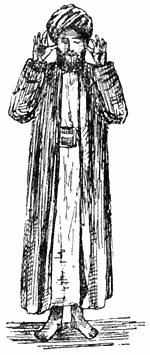
TAKBĪRU ʾT-TAḤRĪMAH (تكبير التحريمة). The first takbīr in the liturgical prayer, said standing, after the recital of which the worshipper must give himself up entirely to worship. [PRAYER, TAKBIR.]
TAK͟HĀRUJ (تخارج). An arrangement entered into by some heirs-at-law with others for their share of the inheritance, in consideration of some specific thing which excludes them from inheritance. (Hamilton’s Hidāyah, vol. iii. p. 201.)
AT-TAKWĪR (التكوير). “The Folding-up.” The title of the LXXXIst Sūrah of the Qurʾān, which opens a solemn announcement of the Judgment Day by the words: “When the sun shall be folded up.”
TAKYAH (تكية). Lit. “A pillow; a place of repose.” Used in all Muḥammadan countries for—
(1) A place in which some celebrated saint has stayed. In Central Asia, these places are often merely marked by a few stones and a flag, but they are held sacred.
(2) A monastery, or religious house, in which faqīrs and ascetics reside, as the Takyahs at Constantinople and Cairo.
(3) A hostel or rest-house, as the Takyah at Damascus, which is a hostel for pilgrims. Dr. Robinson describes it as a large quadrangular enclosure, divided into two courts, in the southern court of which there is a large mosque. Around the wall of the court runs a row of cells, with a portico or gallery of columns in front. This takyah was founded by Sultan Salīm, A.D. 1516. (Researches, vol. iii. p. 459.)
T̤ALĀQ (طلاق). (1) The sentence of divorce. [DIVORCE.] (2) The title of the LXVth Sūrah of the Qurʾān which treats of the subject of divorce.
TALBĪYAH (تلبية). Lit. “Waiting or standing for orders.” The recitation of the following words during the pilgrimage to Makkah: “Labbaika! Allāhummah! Labbaika! Labbaika! Lā Sharīka laka! Labbaika! Inna ʾl-ḥamda wa-niʿamata laka! Wa ʾl-mulka! Lā Sharīka-laka!” “I stand up for Thy service, O God! I stand up! I stand up! There is no partner with Thee! I stand up for Thy service! Verily Thine is the praise, the beneficence, and the kingdom! There is no partner with Thee!”
From the Mishkāt (book xi. ch. ii. pt. 1), it appears that this hymn was in use amongst the idolaters of Arabia before Muḥammad’s time. [HAJJ.]
T̤ALḤAH (طلحة), son of ʿUbaidu ʾllāh, the Quraish, was a grand-nephew of Abū Bakr. He was a distinguished Companion, and was honoured with the position of one of the ʿAsharah Mubashsharah, or “ten patriarchs of the Muslim faith.” He saved the life of Muḥammad at the battle of Uḥud. He was slain in the fight of the Camel, A.H. 36, aged 64, and was buried at al-Baṣrah.
T̤ĀLIB (طالب). Lit. “One who seeks.” An inquirer. A term generally used for a student of divinity, is T̤ālibu ʾl-ʿilm.
TALISMAN. Arabic (طلسم) t̤ilsam; pl. t̤alāsim. The English word is a corruption of the Arabic. A term applied to mystical characters, and also to seals and stones upon which such characters are engraved or inscribed. The characters are astrological, or of some other magical kind. Talismans are used as charms against evil, for the preserving from enchantment or from accident; they are also sometimes buried with a hidden treasure to protect it. [AMULET, EXORCISM.]
TALKING. [CONVERSATION.]
TALMUD. The traditional law of the Jews. From Heb. לָמַד lāmad, “to learn.” The learning of the Rabbis. Mr. Emanuel Deutsch says:—
“It seems as if Muḥammad had breathed from his childhood almost the air of contemporary Judaism, as is found by us crystallized in the Talmud, the Targum and the Midrash.
* * *
“It is not merely parallelisms, reminiscences, allusions, technical terms, and the like of Judaism, its law and dogma and ceremony, its Halacha and its Haggadah (its law and legend), which we find in the Koran; but we think Islām neither more nor less than Judaism as adapted to Arabia—plus the Apostleship of Jesus and Muḥammad.” (Literary Remains, p. 64.)
How much Muḥammad was indebted to the Jewish Talmud for his doctrines, ethics, and ceremonial, is shown in an essay by the Jewish Rabbi, Abraham Geiger, in answer to the question put by the University at Bonn: “Inquiratur in fontes Alcorani seu legis Mohammedicæ eos, qui ex Judæismo derivandi sunt,” of which a German translation has appeared, Was hat Mohammed aus dem Judenthume aufgenommen? (Bonn, 1833), and is treated of in the present work in the article on JUDAISM.
The Talmud consists of two parts: The Mishna, or the text (what is called in Arabic the Matn), and the Gemara, or Commentary (Arabic Sharḥ). These two form the Talmud.
The Mishna (from Shanah, to “repeat”) or the oral law of the Jews, was not committed to writing until about the year A.D. 190, by Rabbi Judah, although it is said it was first commenced by Rabbi Akibah, A.D. 130.
The Gemara (lit. “that which is perfect”) are two commentaries on the Mishna. The one compiled by Rabbi Jochonam at Jerusalem about the middle of the third century, and the other by Rabbi Ashe at Babylon, about the middle of the sixth.
Canon Farrar (Life of Christ, vol. ii. p. 348), says: “Anything more utterly unhistorical than the Talmud, cannot be conceived. It is probable that no human writings ever confounded names, dates, and facts, with more absolute indifference.”
And doubtless it is this unsatisfactory feature in the Talmud of the Jews which, to a great extent, accounts for the equally unhistorical character of the Qurʾān.
For information on the Talmud, the English reader can consult the following works: The Talmud, by Joseph Barklay, LL.D., Bishop of Jerusalem, 1878; A Talmudic Miscellany, by Paul Isaac Hershon, 1880; Selections from the Talmud, by H. Polono; The Talmud, an article in the Quarterly Review, October, 1867, by Emanuel Deutsch; The Talmud, a chapter in The Home and Synagogue of the Modern Jew (Religious Tract Society). A complete translation of the Talmud is being undertaken by Mr. P. I. Hershon. See Dr. Farrar’s Preface to the Talmudic Miscellany.
TALQĪN (تلقين). Lit. “Instructing.” An exhortation or instruction imparted by a religious teacher. It is specially used for the instruction given at the grave of a departed Muslim, at the close of the burial service, when one of the mourners draws near the middle of the grave, addresses the deceased, and says:—
“O servant of God, and child of a female servant of God.
“O son of such an one, remember the faith you professed on earth to the very last; this is your witness that there is no deity but God, and that certainly Muḥammad is His Apostle, and that Paradise and Hell and the Resurrection from the dead are real; that there will be a Day of Judgment; and say: ‘I confess that God is my Lord, Islām my religion, Muḥammad (on whom be the mercy and peace of God) my Prophet, the Qurʾān my guide, the Kaʿbah my Qiblah, and that Muslims are my brethren.’ O God, keep him (the deceased) firm in his faith, and widen his grave, and make his examination (by Munkar and Nakīr) easy, and exalt him and have mercy on him, O Thou most Merciful!” [BURIAL.]
T̤ĀLŪT (طالوت). [SAUL.]
TAMATTUʿ (تمتع). Lit. “Reaping advantage.” The act of performing the ʿUmrah until its completion, and then performing the Ḥajj as a separate ceremony, thus reaping the advantages of both. [HAJJ, UMRAH.]
TAMĪM (تميم). An independent Arab tribe of Makkan origin who occupied the north-eastern desert of Najd. They fought by the side of Muḥammad at Makkah and Ḥunain.
TAMJĪD (تمجيد). The expression, “Lā ḥaula wa lā quwwata illā bi-ʾllāhi ʾl ʿalīyi ʾl-ʿaz̤īm” (لا حول ولا قوة الا بالله العلى العظيم), “There is no power and strength but in God, the High one, the Great.” (Mishkāt, book x. ch. ii.)
Abū Hurairah relates that the Prophet said, “Recite very frequently, ‘There is no power and strength but in God,’ for these words are one of the treasures of Paradise. For there is no escape from God but with God. And God will open for the reciter thereof seventy doors of escape from evil, the least of which is poverty.”
TANĀSUK͟H (تناسخ). (1) In Muḥammadan law, the death of one heir after another before the partition of an inheritance.
(2) At-Tanāsuk͟h. The metempsychosis or Pythagorean system of the transmigration of souls, a doctrine held by the Hindus and Buddhists, but forming no part of the Muḥammadan system.
TANFĪL (تنفيل). “Plundering in religious warfare.” Commended in the Qurʾān, Sūrah viii. 1: “They will question thee about the spoils. Say: The spoils are God’s and the Apostle’s.”
TAQARRUB (تقرب). Lit. “Seeking admittance or striving to draw near.” A term used to express the desire of propitiating the Deity by prayer, almsgiving, or sacrifice.
TAQDĪR (تقدير). Lit. “To measure.” The doctrine of Fate or Predestination, al-Qadr. [PREDESTINATION.]
TAQĪYAH (تقية). Lit. “Guarding oneself.” A Shīʿah doctrine. A pious fraud whereby the Shīʿah Muslim believes he is justified in either smoothing down or in denying the peculiarities of his religious belief, in order to save himself from religious persecution. A Shīʿah can, therefore, pass himself off as a Sunnī to escape persecution.
The Shīʿah traditionists relate that certain persons inquired of the Imām Ṣādiq if the Prophet had ever practised taqīyah, or “religious dissimulation,” and the Imām replied, “Not after this verse was sent down to the Prophet, namely, Sūrah v. 71: ‘O thou Apostle! publish the whole of what has been revealed to thee from thy Lord; if thou do it not, thou hast not preached His message, and God will not defend thee from wicked men; for God guides not the unbelieving people.’ When the Most High became surety for the Prophet against harm, then he no longer dissimulated, although before this revelation appeared he had occasionally done so.” (The Ḥayātu ʾl-Qulūb, Merrick’s ed., p. 96.) [SHIʿAH.]
TAQLĪD (تقليد). Lit. “Winding round.” (1) Putting a wreath round a victim destined to be slain at Makkah. (2) Girding with a sword, as a sign of investiture of a high dignitary. (3) A term used in Muḥammadan law for the following of a religious leader without due inquiry.
TAQWĀ (تقوى). [ABSTINENCE.]
TARĀWĪH (تراويح). The plural of tarwīḥ, “Rest.” The prayers, of usually twenty rakʿahs, recited at night during the month of Ramaẓān; so called because the congregation sit down and rest after every fourth rakʿah and every second “Salām.” [RAMAZAN.]
TARIKAH (تركة). A legacy, a bequest, an inheritance.
AT-T̤ĀRIQ (الطارق). “The night-comer.” The title of the LXXXVIth Sūrah of the Qurʾān, beginning thus:
“By the heaven, and by the night-comer!
But what shall teach thee
What the night-comer is?
’Tis the star of piercing radiance.”
According to al-Wāḥidī, these words were revealed when Abū T̤ālib, at the time of the evening meal, was startled by a shooting star. Nöldeke, however, observes that the three verses seem rather to apply to a planet or a fixed star of particular brightness.
T̤ARĪQAH (طريقة). “A path.” A term used by the Sūfīs for the religious life. [SUFI.]
TARWIYAH (تروية). Lit. “Satisfying thirst,” or, according to some, “giving attention.” The eighth day of the pilgrimage; so called either because the pilgrims give their camels water on this day, or because Abraham gave attention (rawwa) to the vision wherein he was instructed to sacrifice his son Ishmael (?) on this day.
TAṢAWWUF (تصوف). A word used to express the doctrines of the Ṣūfīs or Muḥammadan mystics. Ṣūfīism. The word does not occur in the celebrated Arabic Dictionary, the Qāmūs, which was compiled A.H. 817, nor in the Ṣiḥāḥ, A.H. 393. [SUFI.]
TASBĪḤ (تسبيح). (1) The ejaculation, “Subḥāna ʾllāh!” (سبحان الله), “I extol the holiness of God!” or “Holy God!” A most meritorious ejaculation, which, if recited one hundred times, night and morning, is said by the Prophet to atone for man’s sins, however many or great. (Mishkāt, book x. ch. ii.)
(2) A Rosary. [ROSARY, ZIKR.]
TASHAHHUD (تشهد). Lit. “Testimony.” A declaration of the Muslim faith recited during the stated prayers, immediately after the Taḥīyah, in the same attitude, but with the first finger of the right hand extended, as a witness to the Unity of God. It is as follows: “I testify that there is no deity but God, and I testify that Muḥammad is the Messenger of God.” It is also used as an expression of faith upon a person becoming a Muḥammadan. (Mishkāt, book iv. ch. xvi.) [PRAYERS.]
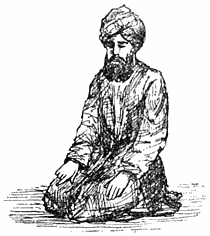
TASHRĪQ (تشريق). Lit. “Drying flesh in the sun.” A name given to three days after the sacrifice at Makkah during the Pilgrimage, either because the flesh of the victim is then dried, or because they are not slain until sunrise. [HAJJ.]
TASLĪM (تسليم). The benediction at the close of the usual form of prayer, “As-salāmu ʿalaikum wa raḥmatu ʿllāh!” (السلام عليكم ورحمة الله), “The peace and mercy of God be with you.” [PRAYERS.]
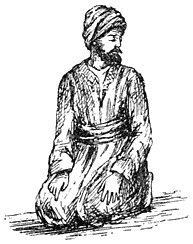
TASMĪʿ (تسميع). The following ejaculation which is recited by the Imām in the daily prayers: “God hears him who praises Him.” [PRAYERS.]
TASMIYAH (تسمية). Lit. “Giving a name.” (1) A title given to the Bismillāh, or the initial sentence, “In the name of God, the Compassionate, the Merciful.” This occurs at the commencement of each chapter or Sūrah of the Qurʾān, with the exception of the IXth Sūrah. [QURʾAN.] (2) Also used at the commencement of any religious act (except sacrifice), such as prayer, ablutions, &c. (3) The usual “grace before meat,” amongst Muslims. [BISMILLAH.]
TASNĪM (تسنيم). Lit. “Anything convex and shelving at both sides.” The name of a fountain in Paradise mentioned in the Qurʾān, Sūrah lxxxiii. 28: “Mingled therewith shall be the waters of Tasnīm.”
TAS̤WĪB (تثويب). Repeating the phrase, “Aṣ-ṣalātu k͟hairun mina ʾn-nāum” (i.e. “Prayer is better than sleep”), in the Aẕān for the early morning prayer. [AZAN, PRAYER.]
TAT̤AWWUʿ (تطوع). An act of supererogation. A term which includes both the sunnah and nafl actions of the Muslim (q.v.).
AT-TAT̤FĪF (التطفيف). “Giving Short Measure.” The title of the LXXXIIIrd Sūrah of the Qurʾān, beginning with the words:
“Woe to those who stint the measure:
Who when they take by measure from others, exact the full;
But when they mete to them or weigh to them, minish—
Have they no thought that they shall be raised again
For a great day.”
We learn from the Itqān that some commentators see in this passage allusions to Madīnah circumstances, and consequently think that the Sūrah, or at least part of it, was revealed in that town. But in connection with such obviously Makkan verses, as 30 and following, where it is said:
“The sinners, indeed, laugh the faithful to scorn,
And when they pass by them, they wink at one another,
And when they return to their own people, they return jesting,
And when they see them, they say, ‘Verily these are the erring ones’ ”—
it appears evident, that the pride and arrogance of the Makkans, founded on their ill-gotten wealth, is contrasted with the humble and precarious condition of the followers of Muḥammad, to convey at the same time a solemn warning, that the positions will be reversed on the Great Day of Reckoning.
TAT̤HĪR (تطهير). A purifying or cleansing of anything which is ceremonially unclean. For example, if a dog drinks from a vessel, it becomes najis, or “impure,” but it can be purified (tat̤hīr) by washing it seven times. A mosque which has been defiled can be cleansed with dry earth or water, and by recitals from the Qurʾān. If the boots on the feet have been defiled, they can be purified by rubbing them on dry earth.
Barāʾ ibn ʿĀzib says that Muḥammad taught that the micturation of an animal lawful for food does not render clothes ceremonially unclean. (Mishkāt, book iii. ch. ix.) [PURIFICATION.]
TATTOOING. Muḥammad forbade the custom of the idolaters of Arabia to prick the hands of their women and to rub the punctures over with wood, indigo, and other colours. (Mishkāt, book xii. ch. i. pt. 1.)