DICTIONARY OF ISLĀM. (continued 12)
Reading edition
The visiting of tombs on the occasion of the two festivals is not a custom in India. It is generally done in the Muḥarram, both by the Sunnīs and the Shīʿahs.
ʿIFFAH (عفة). “Chastity, continence, purity.” Ahlu ʿiffah, “those who are chaste.”
ʿIFRĪT (عفريت). A demon, or class of demons, mentioned in the Qurʾān (Sūrah xxvii. 39). They are said to be giants, and very malicious. The ghosts of the wicked dead are sometimes called by this name. [GENII.]
IFT̤ĀR (افطار). Lit. “Breaking.” Breaking the month’s fast on the evening of the ʿĪdu ʾl-Fit̤r, that is, at the first sight of the new moon, after sunset. It is also used for breaking the fast every evening after sunset during the month of Ramaẓān. It is, according to the example of the Prophet, to break the fast by eating either dates or salt.
IḤDĀD (احداد). The period of mourning observed by a widow for her husband, namely, four months and ten days. [MOURNING.]
IHLĀL (اهلال). Lit. “Raising the voice.” A term used for the Talbiyah. [TALBIYAH.]
IḤRĀM (احرام). Lit. “Prohibiting.” The pilgrim’s dress, and also the state in which the pilgrim is held to be from the time he assumes this distinctive garb until he lays it aside. It consists of two new white cotton cloths, each six feet long by three and a half broad. One of these sheets, termed ridāʾ is thrown over the back, and, exposing the arm and shoulder, is knotted at the right side in the style called wīshaḥ. The other, called izār, is wrapped round the loins from the waist to the knee, and knotted or tucked in at the middle.
In the state of iḥrām, the pilgrim is forbidden the following actions: connection with or kissing women, covering the face, perfumes, hunting or slaying animals, anointing the head with oil, cutting the beard or shaving the head, colouring the clothes, washing the head or beard with marsh mallows, cutting the nails, plucking a blade of grass, cutting a green tree. But although the pilgrim is not allowed to hunt or slay animals, he may kill the following noxious creatures: a lion, a biting dog, a snake or scorpion, a crow, a kite, and a rat. For each offence against the rules of iḥrām, special sacrifices are ordained, according to the offence. [HAJJ.]
IḤSĀN (احسان). Lit. “To confer favours, or to perform an action in a perfect manner.” A term used in the Traditions for the sincere worship of God. Muḥammad said Iḥsān was “both to worship God as if thou sawest Him, and to remember that God seest thee.” (Mishkāt, book i. ch. i. pt. 1.) The word is used in this sense by the Ṣūfī mystics. (ʿAbdu ʾr-Razzāq’s Dict. of Ṣūfī Terms.)
IḤṢĀN (احصان). Lit. “Keeping a wife secluded.” A legal term for a married man. (Hidāyah, vol. ii. p. 49.)
IḤṢĀRU ʾL-ḤAJJ (احصار الحج). The hindering of the Pilgrimage. For example: If a pilgrim be stopped on his way by any unforeseen circumstance, such as sickness or accident, he is required to send an animal to be sacrificed at the Sacred City. (Hidāyah, Arabic ed., vol. i. p. 184.) This injunction is founded upon the teaching of the Qurʾān, Sūrah ii. 192: “And if he be prevented, then send whatever offering shall be easiest: and shave not your heads until the offering reach the place of sacrifice. But whoever among you is sick, or hath an ailment of the head, must expiate by fasting, or alms, or a victim for sacrifice. And when ye are secure (from hindrances) then he who delights in the visitation (ʿUmrah) of the holy place until the Pilgrimage, shall bring whatever offering shall be the easiest. But he who hath nothing to offer shall fast three days in the Pilgrimage and seven days when ye return: they shall be ten days in all.”
IḤTIKĀR (احتكار). Hoarding up grain with the object of raising the price. Used for monopoly of all kinds. Abū Ḥanīfah restricts its use to a monopoly of the necessaries of life. It is strictly forbidden by Muḥammad, who is related to have said: “Whoever monopoliseth is a sinner”; “Those who bring grain to a city to sell at a cheap rate are blessed, and they who keep it back in order to sell at a high rate are cursed.” (Mishkāt, book xii. ch. viii.)
IḤTILAM (احتلام). Pollutio nocturna; after which g͟husl, or legal bathing, is absolutely necessary. [PURIFICATION.]
IHTIMĀM (اهتمام). “Superintendence; care.” The trust or jurisdiction of a landowner over certain portions of land.
IḤYĀʾU ʾL-MAWĀT (احياء الموات). Lit. “The revival of dead lands.” A legal term for the cultivation of wastes.
IḤẒĀR (احضار). A summons citing to appear before a Qāẓī or Judge.
ĪJĀB (ايجاب). The first proposal made by one of the parties in negociating or concluding a bargain. [MARRIAGE.]
IJĀRAH (اجارة). Price, hire, wages, rent, profit, emolument, according to the subject to which it applies. [HIRE.]
IJMĀʿ (اجماع). The third foundation of Islām. It literally means “collecting,” or “assembling,” and in Muslim divinity it expresses the unanimous consent of the Mujtahidūn (learned doctors); or, as we should call it, “the unanimous consent of the Fathers.” A Mujtahid is a Muslim divine of the highest degree of learning, a title usually conferred by Muslim rulers. [MUJTAHID.] There are three foundations of Ijmāʿ: (1) Ittifāq-i-Qaulī, unanimous consent expressed in declaration of opinion; (2) Ittifāq-i-Fiʿlī expressed in unanimity of practice; (3) Ittifāq-i-Sakūtī, when the majority of the Mujtahidūn signified their tacit assent to the opinions of the minority by “silence” or non-interference.
The Mujtahidūn capable of making Ijmāʿ must be “men of learning and piety, not heretics, nor fools, but men of judgment.”
There is great diversity of opinion as to up to what period in the history of Islām Ijmāʿ can be accepted. Some doctors assert that only the Ijmāʿ of the Mujtahidūn who were Aṣḥāb (companions); others, that of those who were not only “companions” but “descendants” of the “Prophet,” can be accepted; whilst others accept the Ijmāʿ of the Anṣārs (helpers), and of the Muhājirūn (fugitives), who were dwellers in al-Madīnah with Muḥammad. The majority of learned Muslim divines, however, appear to think that Ijmāʿ may be collected in every age, although they admit that, owing to the numerous divisions which have arisen amongst Muḥammadans, it has not been possible since the days of the Tabaʿu ʾt-Tābiʿīn (i.e. the followers of the followers of the Companions).
The following is considered to be the relative value of Ijmāʿ:—
That of the Aṣḥāb (companions) is equal to Ḥadīs̤ Mutawātir. That which was decided afterwards, but in accordance with the unanimous opinion of the Aṣḥāb, is equal to Ḥadīs̤-i-K͟habar-i-Mashhūr, and that upon which there was diversity of opinion amongst the Aṣḥāb, but has since been decided by the later Mujtahidūn is equal to Ḥadīs̤-i-K͟habar-i-Wāḥid. (See Syud Ahmad Khan’s Essay.)
Some European writers confuse the term Ijmāʿ with Ijtihād. But Ijtihād is the deduction made by a single Mujtahid, whilst Ijmāʿ is the collective opinion of a council of Mujtahidūn, or enlightened doctors.
Amongst the Shīʿahs there are still Mujtahidūn whose Ijmāʿ is accepted, but the Sunnīs have four orthodox schools of interpretation, named after their respective founders—Ḥanafī, Shāfaʿī, Malakī, and Ḥanbalī. The Wahhābīs for the most part reject Ijmāʿ collected after the death of “the Companions.”
It will be easily understood what a fruitful source of religious dissension and sectarian strife this third foundation of the rule of faith is. Divided as the Christian Church is by its numerous sects, it will compare favourably with Muḥammadanism even in this respect. Muḥammad, it is related, prophesied that, as the Jewish Church had been divided into seventy-one sects! and the Christians into seventy-two! so his followers would be divided into seventy-three sects! But every Muslim historian is obliged to admit that they have far exceeded the limits of Muḥammad’s prophecy; for, according to ʿAbdu ʾl-Qādir al-Jīlānī, there are at least 150.
IJTIHĀD (اجتهاد). Lit. “Exertion.” The logical deduction on a legal or theological question by a Mujtahid or learned and enlightened doctor, as distinguished from Ijmāʿ, which is the collective opinion of a council of divines.
This method of attaining to a certain degree of authority in searching into the principles of jurisprudence is sanctioned by the Traditions:—
“The Prophet wished to send a man named Muʿāẕ to al-Yaman to receive some money collected for alms, which he was then to distribute to the poor. On appointing him he said: ‘O Muʿāẕ, by what rule will you act?’ He replied, ‘By the Law of the Qurʾān.’ ‘But if you find no direction therein?’ ‘Then I will act according to the Sunnah of the Prophet.’ ‘But what if that fails?’ ‘Then I will make an Ijtihād, and act on that.’ The Prophet raised his hands and said, ‘Praise be to God who guides the messenger of His Prophet in what He pleases.’ ”
The growth of this system of divinity is traced by a Sunnī writer, Mirza Qāṣim Beg, Professor in the University of St. Petersburg (extracts from which are given in Sell’s Faith of Islām), as follows:—
1. God, the only legislator, has shown the way of felicity to the people whom He has chosen, and in order to enable them to walk in that way He has shown to them the precepts which are found partly in the eternal Qurʾān, and partly in the sayings of the Prophet transmitted to posterity by the Companions and preserved in the Sunnah. That way is called the Sharīʿah (law). The rules thereof are called Aḥkām (commandments).
2. The Qurʾān and the Sunnah, which since their manifestation are the primitive sources of the orders of the Law, form two branches of study, viz. ʿIlm-i-Tafsīr, or the interpretation of the Qurʾān, and ʿIlm-i-Ḥadīs̤, or the study of Tradition.
3. All the orders of the Law have regard either to the actions (Dīn), or to the belief (Īmān) of the faithful (Mukallif).
4. As the Qurʾān and the Sunnah are the principal sources from whence the precepts of the Sharīʿah have been drawn, so the rules recognised as the principal elements of actual jurisprudence are the subject of ʿIlm-i-Fiqh, or the science of Law.
Fiqh in its root signifies “conception, comprehension.” Thus Muḥammad prayed for Ibn Masʿūd: “May God make him comprehend (Faqqaha-hu), and make him know the interpretation of the Qurʾān.” Muḥammad in his quality of Judge and chief of the Believers decided, without appeal or contradiction, all the affairs of the people. His sayings served as a guide to the Companions. After the death of the Prophet the first K͟halīfahs acted on the authority of the Traditions. Meanwhile the Qurʾān and the Sunnah, the principal elements of religion and legislation, became little by little the subject of controversy. It was then that men applied themselves vigorously to the task of learning by heart the Qurʾān and the Traditions, and then that jurisprudence became a separate science. No science had as yet been systematically taught, and the early Musalmāns did not possess books which would serve for such teaching. A change soon, however, took place. In the year in which the great jurisconsult of Syria died (A.H. 80), Nuʿmān ibn S̤ābit, surnamed Abū Ḥanīfah, was born. He is the most celebrated of the founders of the schools of jurisprudence, a science which ranks first in all Muslim seats of learning. Until that time and for thirty years later the learned doctors had all their knowledge by heart, and those who possessed good memories were highly esteemed. Many of them knew by heart the whole Qurʾān with the comments made on it by the Prophet and by the Companions; they also knew the Traditions and their explanations, and all the commands which proceed from the Qurʾān and the Sunnah. Such men enjoyed the right of Mujtahidūn. They transmitted their knowledge to their scholars orally. It was not till towards the middle of the second century of the Hijrah that treatises on the different branches of the Law were written, after which six schools (Maẕhabs) of jurisprudence were formed. The founders (all Imāms of the first class) were Abū Ḥanīfah, the Imāmu ʾl-Aʿz̤am or greatest Imām (A.H. 150), Sufyān as̤-S̤aurī (A.H. 161), Mālik (A.H. 179), ash-Shāfiʿī (A.H. 204), Ibn Ḥanbal (A.H. 241), and the Imām Dāwūd az̤-Z̤āhirī (A.H. 270). The two sects founded by as̤-S̤aurī and az̤-Z̤āhirī became extinct in the eighth century of the Hijrah. The other four still remain. These men venerated one another. The younger ones speak with great respect of the elder. Thus ash-Shāfiʿī says: “No one in the world was so well versed in jurisprudence as Abū Ḥanīfah was, and he who has read neither his works nor those of his disciples knows nothing of jurisprudence.” Ibn Ḥanbal, when sick, wore a shirt which had belonged to ash-Shāfiʿī, in order that he might be cured of his malady; but all this did not prevent them starting schools of their own, for the right of Ijtihād is granted to those who are real Mujtahidūn.
There are three degrees of Ijtihād:
1. Ijtihād fī ʾsh-Sharʿ, absolute independence in legislation.
2. Ijtihād fī ʾl-Maẕhab, authority in the judicial systems founded by the Mujtahidūn of the first class.
3. Ijtihād fī ʾl-Masāʾil, authority in cases which have not been decided by the authors of the four systems of jurisprudence.
The first is called a complete and absolute authority, the second relative, the third special.
(1) Ijtihād fī ʾsh-Sharʿ.
Absolute independence in legislation is the gift of God. He to whom it is given when seeking to discover the meaning of the Divine Law is not bound to follow any other teacher. He can use his own judgment. This gift was bestowed on the jurisconsults of the first, and to some of the second and third centuries. The Companions, however, who were closely connected with the Prophet, having transmitted immediately to their posterity the treasures of legislation, are looked upon as Mujtahidūn of much higher authority than those of the second and third centuries. Thus Abū Ḥanīfah says: “That which comes to us from the Companions is on our head and eyes (i.e. to be received with respect): as to that which comes from the Tābiʿūn, they are men and we are men.”
Since the time of the Tābiʿūn this degree of Mujtahid has only been conferred on the six great Imāms before mentioned. Theoretically any Muslim can attain to this degree, but it is one of the principles of jurisprudence that the confirmation of this rank is dependent on many conditions, and so no one now gains the honour. These conditions are:—
1. The knowledge of the Qurʾān and all that is related to it; that is to say, a complete knowledge of Arabic literature, a profound acquaintance with the orders of the Qurʾān and all their sub-divisions, their relationship to each other and their connection with the orders of the Sunnah. The candidate should know when and why each verse of the Qurʾān was written, he should have a perfect acquaintance with the literal meaning of the words, the speciality or generality of each clause, the abrogating and abrogated sentences. He should be able to make clear the meaning of the “obscure” passages (Mutashābih), to discriminate between the literal and the allegorical, the universal and the particular.
2. He must know the Qurʾān by heart with all the Traditions and explanations.
3. He must have a perfect knowledge of the Traditions, or at least of three thousand of them.
He must know their source, history, object, and their connection with the laws of the Qurʾān. He should know by heart the most important Traditions.
4. A pious and austere life.
5. A profound knowledge of all the sciences of the Law.
Should anyone now aspire to such a degree another condition would be added, viz.:—
6. A complete knowledge of the four schools of jurisprudence.
The obstacles, then, are almost insurmountable. On the one hand, there is the severity of the ʿUlamāʾ, which requires from the candidate things almost impossible; on the other, there is the attachment of the ʿUlamāʾ to their own Imāms, for should such a man arise no one is bound now to listen to him. The Imām Ibn Ḥanbal said: “Draw your knowledge from whence the Imāms drew theirs, and do not content yourself with following others, for that is certainly blindness of sight.” Thus the schools of the four Imāms remain intact after a thousand years have passed, and so the ʿUlamāʾ recognise since the time of these Imāms no Mujtahid of the first degree. Ibn Ḥanbal was the last.
The rights of the man who attained to this degree were very important. He was not bound to be a disciple of another, he was a mediator between the Law and his followers, for whom he established a system of legislation, without anyone having the right to make any objection. He had the right to explain the Qurʾān, the Sunnah, and the Ijmāʿ, according as he understood them. He used the Prophet’s words, whilst his disciples only used his. Should a disciple find some discrepancy between a decision of his own Imām and the Qurʾān or Traditions, he must abide by the decision of the Imām. The Law does not permit him to interpret after his own fashion. When once the disciple has entered the sect of one Imām he cannot leave it and join another. He loses the right of private judgment, for only a Mujtahid of the first class can dispute the decision of one of the Imāms. Theoretically, such Mujtahidūn may still arise; but, as we have already shown, practically they do not.
(2.) Ijtihād fī ʾl-Maẕhab.
This degree has been granted to the immediate disciples of the great Imāms who have elaborated the systems of their masters. They enjoyed the special consideration of the contemporary ʿUlamāʾ, and of their respective Imāms who in some cases have allowed them to retain their own opinion. The most famous of these men are the two disciples of Abū Ḥanīfah, Abū Yūsuf, and Muḥammad ibn al-Ḥasan. In a secondary matter their opinion carries great weight. It is laid down as a rule that a Muftī may follow the unanimous opinion of these two even when it goes against that of Abū Ḥanīfah.
(3.) Ijtihād fī ʾl-Masāʾil.
This is the degree of special independence. The candidates for it should have a perfect knowledge of all the branches of jurisprudence according to the four schools of the Arabic language and literature. They can solve cases which come before them, giving reasons for their judgment, or decide on cases which have not been settled by previous Mujtahidūn; but in either case their decisions must always be in absolute accordance with the opinions of the Mujtahidūn of the first and second classes, and with the principles which guided them. Many of these men attained great celebrity during their lifetime, but to most of them this rank is not accorded till after their death. Since their Imām Qāẓī K͟hān died (A.H. 592), no one has been recognised by the Sunnīs as a Mujtahid even of the third class.
There are three other inferior classes of jurists, called Muqallidūn, or followers of the Mujtahidūn; but all that the highest in rank amongst them can do is to explain obscure passages in the writings of the older jurisconsults. By some of the ʿUlamāʾ they are considered to be equal to the Mujtahidūn of the third class. If there are several conflicting legal opinions on any point, they can select one opinion on which to base their decision. This a mere Qāẓī cannot do. In such a case he would have to refer to these men or to their writings for guidance. They seem to have written commentaries on the legal systems without originating anything new. The author of the Hidāyah, who lived at the end of the sixth century, was a Muqallid.
IK͟HLĀṢ (اخلاص). Lit. “Sincerity.” (1) A theological term, implying that a Muslim performs his religious acts in the sight of God alone, and not to be seen of men. (2) Al-Ik͟hlāṣ, the title of the CXIIth Sūrah of the Qurʾān. A chapter which occurs in the daily prayer, and reads thus:—
“Say, ‘He is God alone!
“Say, God the Eternal!
“Say, He begets not, and is not begotten!
“Say, Nor is there anyone like unto him!’ ”
Professor Palmer says this chapter is generally known as al-Ik͟hlāṣ, “clearing oneself,” i.e. of belief in any but one God.
IKRĀH (اكراه). [COMPULSION.]
ʿIKRIMAH (عكرمة). Lit. “A hen pigeon.” The son of Abū Jahl ibn Hishām. A “companion” of the Prophet. He embraced Islām after the final taking of Makkah. For some years he and his father, Abū Jahl, were determined opponents of Islām. He was one of the heroes of the Quraish at the battle of Badr, and commanded the left wing of the Quraish army at Uḥud. He opposed the Prophet’s advance on Makkah, and on defeat fled to Jiddah, intending to escape to Africa, but he was brought back by his wife to Makkah, and received pardon from Muḥammad, and embraced Islām. He became one of Abū Bakr’s generals, and died in his reign.
ʿIKRIMAH (عكرمة). Abū ʿAbdi ʾllāh ʿIkrimah ibn ʿAbdi ʾllāh, was a slave belonging to Ibn ʿAbbās. His master took great pains to teach him the Qurʾān and the Traditions, and consequently he is known as a traditionist of some note. His master, Ibn ʿAbbās, died without giving him his liberty, and ʿAlī the son of Ibn ʿAbbās sold him to K͟hālid ibn Yazīd for four thousand dīnārs. But ʿIkrimah went to ʿAlī and said, “You have sold your father’s learning for four thousand dīnārs!” Upon this, ʿAlī, being ashamed, obtained K͟hālid’s consent to annul the bargain, and he granted ʿIkrimah his liberty. He died A.H. 107 (A.D. 725), aged 84.
ĪLĀʾ (ايلاء). A form of divorce in which a man makes a vow that he will not have connection with his wife for not less than four months and observes it inviolate. The divorce is thereby effected ipso facto, without a decree of separation from the judge. See Qurʾān, Sūratu ʾl-Baqarah, ii. 226: “Those who swear off from their women, they must wait four months; but if they break their vow, God is forgiving and merciful.”
Sulaiman ibn Yasār says: “I was in company with about ten of the Prophet’s Companions, and every one said, ‘A man who swears that he will not go near his wife for four months shall be imprisoned until he return to her, or he shall divorce her.’ ” (Mishkāt, book xiii. ch. xiii.)
ILĀH (اله). An object of worship or adoration; i.e. a god, or deity. The term Allāh, “God,” being Ilāh with the definite article ال al, i.e. al-ilāh, “the God.”
ILĀHĪ (الهى). From Ilāh, “God.” (1) That which is divine, e.g. ad-dīnu ʾl-Ilāhī, the divine religion. (2) Ilāhī is also used for the era instituted by the Emperor Akbar, commencing with the first year of his reign, A.H. 963, A.D. 1556. Although found on the coins of Akbar and his immediate successors, it never obtained currency, and is now obsolete.
IʿLĀN (اعلان). Publishing the notice of marriage by sending messengers to the houses of friends. A custom which is founded upon the express injunction of the Prophet, as reported by ʿĀyishah: “Give notice of marriages, perform them in mosques, and beat drums for them.” (Mishkāt, book xiii. ch. iv. pt. 2.)
ILHĀM (الهام). [INSPIRATION.]
AL-ILHĀMU ʾR-RABBĀNĪ (الالهام الربانى). [INSPIRATION.]
ILLEGITIMATE CHILDREN. An illegitimate child, Arabic waladu ʾz-zināʾ (ولد الزناء), has legally no father, and a putative father is, therefore, excluded from the custody of such a child. The child only inherits from its mother and the mother’s relations, who in return inherit from him. (Tagore Law Lectures, 1873, pp. 123, 488.)
ʿILLĪYŪN (عليون). The seventh stage of celestial bliss. Also the register in which the good deeds of Muslims are said to be written. See Sūratu ʾt-Tat̤fīf, lxxxiii. 18: “The register of the righteous is in ʿIllīyūn.” See also Mishkāt, book v. ch. iii. pt. 3: “The angels follow it (the soul) through each heaven, and the angels of one region pass it on to the next until it reaches the seventh heaven, when God says, ‘Write the name of my servant in ʿIllīyūn, and return him to the earth, that is, to his body which is buried in the earth.’”
ʿILM (علم). Lit. “To know; knowledge.” In Muslim theology, the word ʿIlm is always used for religious knowledge. ʿAbdu ʾl-Ḥaqq says it is the knowledge of religion as expressed in “the Book” (Qurʾān) and the “Sunnah” (Traditions), and is of two kinds, ʿIlmu ʾl-Mabādī, elementary knowledge, or that relating to the words and sentences of the Qurʾān and Ḥadīs̤; and ʿIlmu ʾl-Maqāṣīd, perfected knowledge, or that relating to faith and works, as taught in the Qurʾān and Ḥadīs̤. There is also ʿIlmu ʾl-Mukāshafah, revealed knowledge, or that secret knowledge, or light, which shines into the heart of the pious Muslim, whereby he becomes enlightened as to the truths of religion. This spiritual knowledge is also called ʿIlmu ʾl-Ḥaqīqah, or the knowledge of the truth. It is related (Mishkāt, book ii. ch. i. Arabic ed.) that the Prophet said ʿIlm is of three kinds, viz. Āyātu ʾl-Muḥkam, Sunnatu ʾl-Qāʾim, and Farīẓatu ʾl-ʿAdil, and that whatever is beyond these three is not necessary. The learned doctors explain these terms as follows: Āyātu ʾl-Muḥkam, the established text or verses of the Qurʾān; Sunnatu ʾl-Qāʾim, the correct Aḥādīs̤ or Traditions; and Farīẓatu ʾl-ʿAdil, the lawful interpretation of the Qurʾān and the Traditions.
The acquisition and the imparting of religious knowledge is very highly commended by Muḥammad (see Mishkātu ʾl-Maṣābiḥ, in loco):—
“The desire of knowledge is a divine commandment for every Muslim, and to instruct in knowledge those who are unworthy of it, is like putting pearls, jewels, and gold on the necks of swine.”
“Whoever is asked about the knowledge which he hath, and concealeth it, will be reined with a bridle of fire on the Day of Resurrection.”
“There are two avaricious persons that are never satisfied: one of them in knowledge, the more he attains the more he desires; the other of the world, with the things of which he is never satisfied.”
“That person who will pursue the road of knowledge, God will direct him to the road of Paradise; and verily the angels spread their arms to receive him that seeketh after knowledge; and everything in heaven and earth will ask grace for him. Verily the superiority of a learned man over a worshipper is like that of the full moon over all the stars.”
ʿILMU ʾL-ADAB (علم الادب). The science of Philology. In Ḥājjī K͟halfah, Lexicon, vol. i. p. 215, quoted by Lane, it is “the science by which one guards against error in the language of the Arabs, with respect to words and with respect to writing.”
The science of polite writing is classed under twelve heads: 1, lug͟hah, lexicology; 2, ṣarf, accidence; 3, ishtiqāq, derivation; 4, naḥw, syntax; 5, maʿānī, sense or meaning; 6, bayān, eloquence; 7, ʿarūẓ, prosody; 8, qāfīyah, rhyme; 9, rasmu ʾl-k͟hat̤t̤, calligraphy; 10, qarẓ-ush-shiʿr, versification; 11, inshāʾu ʾn-nas̤r, prose composition; 12, muḥāẓarah, dictation. These sections are regarded as distinct sciences.
ʿILMU ʾL-AK͟HLĀQ (علم الاخلاق). Ethics; morals. The best-known works on the subject are the Persian works—the Ak͟hlāq-i-Jalālī, by Faqīr Jānī Muḥammad, A.H. 908, which has been translated into English, with references and notes, by W. F. Thompson, Esq. (London, 1839); the Ak͟hlāq-i-Naṣīrī, by Naṣīru ʾd-dīn at̤-T̤ūsī, A.H. 672; and the Ak͟hlāq-i-Muḥsinī by the Maulawī Ḥusain al-Kāshifī (Ḥusain the commentator), A.H. 910.
ʿILMU ʾL-AKTĀF (علم الاكتاف). The science of divining by the shoulder-blades of sheep. It was the custom of the ancient Arabs to place the shoulder-bone of a sheep in the sun, and to examine it, and so divine by its marks future events, in the same way as by the science of palmistry. (Kashfu ʾz̤-Z̤unūn, in loco.)
ʿILMU ʾL-ʿAQĀʾID (عـلـم العقائد). [ʿILMU ʾL-KALAM.]
ʿILMU ʾL-ASMĀʾ (علم الاسماء). The knowledge of the names, titles, or attributes of God. [GOD, ZIKR, SUFIISM.]
ʿILMU ʾL-BĀT̤IN (علم الباطن). The mystic science; the same as Taṣawwuf. [SUFIISM.]
ʿILMU ʾL-FALAK (علم الفلك). The science of Astronomy. According to the Muḥammadans the earth is the centre of the astronomical system. The seven planets, which are called the nujūmu ʾs-saiyārāt or wandering stars, as distinguished from fixed stars, are 1, Qamar, Moon; 2, ʿUt̤ārid, Mercury; 3, Zuhrah, Venus; 4, Shams, Sun; 5, Mirrīk͟h, Mars; 6, Mushtarī, Jupiter; 7, Zuḥal, Saturn.
The Arabian arrangement of the planets is that of Ptolemy, who placed the earth in the centre of the universe, and nearest to it the moon, whose synodic revolution is the shortest of all, being performed in 29½ days. Next to the moon he placed Mercury, who returns to his conjunctions in 116 days. After Mercury followed Venus, whose periodic time is 584 days. Beyond Venus he placed the sun, then Mars, next Jupiter, and lastly Saturn, beyond which are the fixed stars.
The signs of the zodiac (mint̤aqatu ʾl-burūj) are called: 1, Ḥamal, Ram; 2, S̤aur, Bull; 3, Jauzāʾ, Twins; 4, Sarat̤ān, Crab; 5, Asad, Lion; 6, Sunbalah (lit. an ear of corn), Virgin; 7, Mīzān, Scales; 8, ʿAqrab, Scorpion; 9, Qaus (bow), Archer; 10, Jady (he-goat), Capricorn; 11, Dalw (watering-pot), Aquarius; 12, Ḥūt, Fish.
ʿILMU ʾL-FARĀʾIẒ (علم الفرائض). The law of inheritance. [INHERITANCE.]
ʿILMU ʾL-FIQH (علم الفقه). Jurisprudence; and the knowledge of all subjects connected with practical religion. In the first place, Fiqh deals with the five pillars of practical religion: 1, the recital of the creed; 2, prayer; 3, fasting; 4, zakāt or almsgiving; 5, ḥajj or pilgrimage; and in the second place with all questions of jurisprudence such as marriage, divorce, inheritance, sale, evidence, slavery, partnership, warfare, &c. &c.
The chief Sunnī works on the subject are: Of the Ḥanafī sect, the Hidāyah, the Fatāwā-i-ʿĀlamgīrī, the Durru ʾl-Muk͟htār, and Raddu ʾl-Muḥtār; of the Shāfiʿī and Malakī sects, the Kitābu ʾl-Anwār, the Muḥarrar, and the Ik͟htilāfu ʾl-Aʾimmah. The best-known Shīʿah works on jurisprudence are the Sharāʾiʿu ʾl-Islām, the Mafātīḥ, and the Jāmiʿu ʾsh-Shatāt.
ʿILMU ʾL-ḤADĪS̤ (عـلـم الحديث). The science of the Traditions; i.e. the various canons which have been established for ascertaining the authenticity and genuineness of the Ḥadīs̤ or Traditions. The Nuk͟hbatu ʾl-Fikar, with its commentary the Nuzhatu ʾn-Naz̤ar by Shahābu ʾd-dīn Aḥmad al-ʿAsqalānī (Lee’s ed. Calcutta, 1862), is a well-known work on the subject.
ʿILMU ʾL-HANDASAH (علم الهندسة). The science of Geometry.
ʿILMU ʾL-ḤIKMAH (علم الحكمه). Also ʿIlmu ʾl-Falsafah (علم الفلسفه). [PHILOSOPHY.]
ʿILMU ʾL-ḤISĀB (عـلـم الحساب). Arithmetic.
ʿILMU ʾL-ILĀHĪYĀT (علم الالهيات). A knowledge of divinity. [THEOLOGY.]
ʿILMU ʾL-INSHĀʾ (علم الانشاء). The art of literary composition. [INSHAʾ.]
ʿILMU ʾL-JABR (عـلـم الجـبـر). Algebra.
ʿILMU ʾL-KAFF (علم الكف). The science of palmistry said to have been practised by Daniel.
ʿILMU ʾL-KALĀM (عـلـم الكلام). Scholastic theology. It is also known as ʿIlmu ʾl-ʿAqāʾid, the science of the articles of belief. The author of the Kashfu ʾz̤-Z̤unūn defines it as “the science whereby we are able to bring forward proofs of our religious belief,” and it includes the discussion of the nature of the existence and the attributes of God.
ʿIlmu ʾl-Kalām is the discussion of all subjects connected with the six articles of the Muslim Creed: 1, the Unity of God; 2, the Angels; 3, the Books; 4, the Prophets; 5, the Day of Judgment; 6, the Decrees of God, as distinguished from al-Fiqh, which is an exposition of the five foundations of practical religion—1, recital of the Creed; 2, prayer; 3, fasting; 4, zakāt; 5, ḥajj.
The most celebrated works on the subject of ʿAqāʾid or ʿIlmu ʾl-Kalām are: Sharḥu ʾl-ʿAqāʾid, by the Maulawī Masʿūd Saʿdu ʾd-dīn at-Taftāzānī, A.H. 792; the Sharḥu ʾl-Muwāqif, by Saiyid Sharīf Jurjāni.
ʿILMU ʾL-LUG͟HAH (عـلـم اللغة). Lexicography. [ARABIC LEXICONS.]
ʿILMU ʾL-MANT̤IQ (عـلـم المنطق). Logical science. [LOGIC.]
ʿILMU ʾL-MASĀḤAH (علم المساحة). Mensuration.
ʿILMU ʾL-MILĀḤAH (عـلـم الـمـلاحة). The nautical art. The science of making and navigating ships.
ʿILMU ʾL-MŪSĪQĪ (علم الموسيقى). The science of Music. [MUSIC.]
ʿILMU ʾL-UṢŪL (علم الاصول). The science of the “roots,” or fundamentals of the religion of Muḥammad, namely, of the Qurʾān, Aḥādīs̤, Ijmāʿ, and Qiyās. The science of exegesis, or the rules of interpretation of these four roots of Islām. An explanation of the methods of this science will be found in the article on QURʾAN, Sect. viii., the same principles applying to the other three fundamentals.
The best known works on the ʿIlmu ʾl-Uṣūl are the Manār, by ʿAbdu ʾllāh ibn Aḥmad an-Nasafī, A.H. 710, and its commentary, the Nūru ʾl-Anwār; also at-Tanqīḥ, by ʿUbaidu ʾllāh ibn Masʿūd, A.H. 747, with its commentary, at-Tauẓiḥ, by the same author, and a super-commentary, the Talwīḥu ʾt-Tauẓīḥ, by Saʿdu ʾd-dīn Masʿūd ibn ʿUmar at-Taftāzānī, A.H. 792.
AL-ʿILMU ʾL-YAQĪN (العلم اليقين). Certain knowledge; demonstration; a religious life; a knowledge of the truth.
ʿILMU ʾN-NABĀTĀT (علم النباتات). Botany. The knowledge of the use of herbs.
ʿILMU ʾN-NUJŪM (عـلـم النجوم). Astrology. “The science by which are discovered the events both of the present and of the future by means of the position of the stars.” (Kashfu ʾz̤-Z̤unūn, in loco.) [ASTROLOGY.]
ʿILMU ʾR-RAML (عـلـم الـرمـل). Geomancy. A pretended divination by means of lines on the sand (raml). It is said to have been practised as a miracle by six prophets, viz. Adam, Idrīs, Luqmān, Armiyā (Jeremiah), Shaʿyāʾ (Isaiah), Daniel. (See Kashfu ʾz̤-Z̤unūn, in loco.)
ʿILMU ʾR-RIYĀẒAH (علم الرياضة). Mathematics. The author of the Kashfu ʾz̤-Z̤unūn says the science of Riyāẓah is divided into four sections: 1, handasah, geometry; 2, ḥiʾah, astronomy; 3, ḥisāb, arithmetic; 4, mūsīqā, music.
ʿILMU ʾSH-SHIʿR (علم الشعر). [POETRY.]
ʿILMU ʾS-SIḤR (علم السحر). The science of magic. [MAGIC.]
ʿILMU ʾS-SĪMIYĀʾ (علم السيمياء). Natural magic, chiromancy, palmistry.
AL-ʿILMU ʾT̤-T̤ABĪʿĪ (العلم الطبيعى). Natural philosophy.
ʿILMU ʾT-TAJWĪD (علم التجويد), called also ʿIlmu ʾl-Qirāʾah. The science of reading the Qurʾān correctly. The most popular work on the subject is al-Muqaddamatu ʾl-Jazarīyah, by the Shaik͟h Muḥammad ibn Muḥammad al-Jazarī (A.H. 833).
ʿILMU ʾT-TAṢAWWUF (عـلـم التصوف). The mystic or contemplative science. [SUFIISM.]
ʿILMU ʾT-TASHRĪḤ (علم التشريح). The science of anatomy.
ʿILMU ʾT-TAWĀRĪK͟H (عـلـم التواريخ), or ʿIlmu ʾt-Taʾrīk͟h. Chronology, history. For a complete list of Muḥammadan histories of an early date, see Kashfu ʾz̤-Z̤unūn in loco.
ʿILMU ʾT̤-T̤IBB (علم الطب). The science of Medicine. For a list of medical books of an early date, see Kashfu ʾz̤-Z̤unūn, in loco.
ILQĀʾ (القاء). Lit. “Injecting; infusing.” A theological term used for the teaching of the heart by the power of God. Inspiration of soul in that which is good.
IMAGES. It is unlawful for a Muḥammadan to have an image of any kind in his house. (Mishkāt, book xx. ch. v.) [PICTURES, IDOLS.]
IMĀM (امام). One whose leadership or example is to be followed. A pattern; a model; an example of evil. The term is used in the Qurʾān in these senses.
Sūrah ii. 118: “Verily I have set thee (Abraham) as an Imām (or a leader) for mankind.”
Sūrah xvii. 73: “The day when we will call all men by their Imām (or leader).”
Sūrah xxxvi. 11: “Everything we have set down in a clear model.”
Sūrah xv. 79: “They (Sodom and Midian) are an obvious example.”
Sūrah xxv. 74: “Make us a model to the pious.”
Muḥammadans use the term in the following senses:—
(1) The Imām, or K͟halīfah, of the Muslim people. The author of the Hidāyah says, by the rightful Imām is understood a person in whom all the qualities essential to magistracy are united, such as Islāmism, freedom, sanity of intellect, and maturity of age, and who has been elected into his office by any tribe of Muslims, with their general consent; whose view and intention is the advancement of the true religion, and the strengthening of the Muslims, and under whom the Muslims enjoy security in person and property; one who levies title and tribute according to law; who, out of the public treasury, pays what is due to learned men, preachers, qāẓīs, muftīs, philosophers, public teachers, and so forth; and who is just in all his dealings with Muslims; for whoever does not answer this description is not the right Imām, whence it is not incumbent to support such a one, but rather it is incumbent to oppose him, and make war upon him until such time as he either adopt a proper mode of conduct, or be slain; as is written in the Maʿdinu ʾl-Ḥaqāʾiq, copied from the Fawāʾid. (Hidāyah, vol. ii. p. 248.)
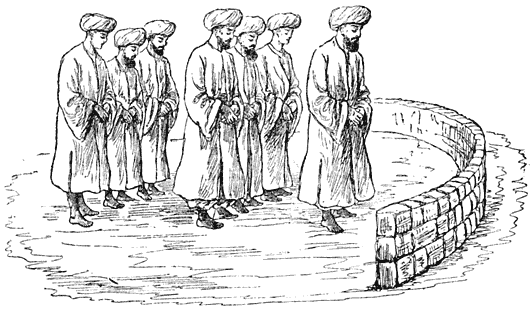
THE IMAM LEADING PRAYERS AND RECITING THE FATIHAH OR FIRST SURAH OF THE QURʾAN.
(E. Campbell.)
For a discussion of this meaning of the title, refer to the article on KHALIFAH, which is the term used for the Imām of the Sunnī Muslims.
(2) The Shīʿahs apply the term Imām to the twelve leaders of their sect whom they call the true Imāms [SHIʿAH], and not using the term K͟halīfah for this office as the Sunnīs do. The Shīʿah traditions are very wild on the subject of the Imāmate, and contrast unfavourably with those of the Sunnīs.
In the Ḥayātu ʾl-Qulūb (Merrick’s edition, p. 203), Muḥammad is said to have related: “On the night of the ascension, the Most High commanded me to inquire of the past prophets for what reason they were exalted to that rank, and they all testified, We were raised up on account of your prophetical office, and the Imāmate of ʿAlī ibn Abī T̤ālib, and of the Imāms of your posterity. A divine voice then commanded, ‘Look on the right side of the empyrean.’ I looked and saw the similitude of ʿAlī and al-Ḥasan, and al-Ḥusain, and ʿAlī ibn al-Ḥusain (alias Zainu ʾl-ʿAbidīn), and Muḥammad al-Bāqir, and Jaʿfar aṣ-Ṣādiq, and Mūsā al-Kāz̤im, and ʿAlī ibn Mūsā ar-Riẓā, and Muḥammad at-Taqī, and ʿAlī an-Naqī, and al-Ḥasan al-ʿAskarī, and al-Mahdī, all performing prayers in a sea of light. These, said the Most High, are my proofs, vicegerents, and friends, and the last of them will take vengeance on my enemies.”
(3) The Imām, or leader, of any system of theology or law. Abū Ḥanīfah and the other three doctors of the Sunnīs are called Imāms, and so are other leading doctors of divinity. The term is still used for a religious leader. For example, the head of the Wahhābīs on the North-West frontier of India is called the Imām, and so is the chief of Najd.
(4) The Imām or leader of prayers in any Masjid. Mr. Sale says it answers to the Latin Antistes. Each mosque, however small, has its Imām, or priest, who is supported by endowments. The office is not in any sense a sacerdotal one, the Imām not being set apart with any ceremony, as in the case of a Christian presbyter, nor the office being hereditary, as in the case of the Hindu Brahmins. The position of Imām in this sense is not unlike the sheliach, or legatus, of the Jewish synagogue, who acted as the delegate of the congregation, and was the chief reader of prayers in their name. But quite independent of the duly appointed minister of a mosque, who is responsible for its services, and receives its revenues, no congregation of Muslim worshippers can assemble without one of the party taking the lead in the prayers by standing in front, and who is said “to act as Imām” for the assembly.
The rules laid down on this subject, as given in the Traditions, are as follows (Mishkāt, book iv. ch. xxvii., xxviii.):—
Abū Saʿīd al-K͟hudrī says the Prophet said: “When there are three persons, one of them must act as Imām and the other two follow him, and the most worthy of them to act as such is he who repeats the Qurʾān best.”
Abū Masʿūd al-Anṣārī says the Prophet said: “Let him act as Imām to a congregation who knows the Qurʾān thoroughly; and if all present should be equal in that respect, then let him perform who is best informed in the rules of prayer; and if they are equal in this respect also, let him act as Imām who has fled for the sake of Islām; and if equal in this likewise, let that person act who is oldest; but the governed must not act as Imām to the governor.”
Abū Hurairah relates that the Prophet said: “When any of you acts as Imām to others, he must be concise in his prayers, because there are decrepit, aged, and sick persons amongst them, and when any one of you says his prayers alone, he may be as prolix as he pleases. [MASJID.]
IMĀM-BĀRAH (امام باره). A building in which the festival of the Muḥarram is celebrated, and service held in commemoration of the deaths of ʿAlī and his sons, al-Ḥasan and al-Ḥusain. At other times, the tāzias, or shrines, are preserved in it; sometimes it is used as the mausoleum of the founder of the family. [MUHARRAM.]
IMĀMĪYAH (امامية). Lit. “The followers of the Imām.” The chief sect of the Shīʿahs, namely, those who acknowledge the twelve Imāms. [SHIʿAH.]
IMĀM MUBĪN (امام مبين). “The clear prototype or model.” The expression occurs twice in the Qurʾān, Sūrah xxxvi. 11, “Everything we do set down in a clear prototype” (fī Imāmin Mubīnin). Here it appears to be used for the Qurʾān as an inspired record. Sūrah xv. 79, “Verily they became both, Sodom and Midian, a clear example” (labi-Imāmin Mubīnin). Muḥammadan teachers use the word for the Laḥwu ʾl-Maḥfūz̤, or the Tablet of Decrees.
AL-IMĀMU ʾL-MAHDĪ (الامـام الـمـهـدى). Lit. “The well-guided Leader.” Umm Salmah relates that the Prophet said, “Strife and disputations will be created among men when a K͟halīfah shall die: and this shall be in the last days. And a man of the people of al-Madīnah will come forth and will flee from al-Madīnah to Makkah, and the men of Makkah will come and try to make him Imām by flattery, but he will not be pleased. Then men shall acknowledge him as Imām. Then an army from Syria shall advance against him, and this army shall be engulphed in an earthquake at Badāʾah, between Makkah and al-Madīnah. Then when the people shall see this the Abdāl, i.e. the Substitutes or good people [ABDAL], will come from Syria, and a multitude from al-ʿIrāq. And after that a man shall be born of the Quraish, of the tribe of Kalb, who will also send an army against him i.e. al-Mahdī; but he shall be victorious. Then he will rule people according to the laws of Muḥammad, and will give strength to Islām upon the earth, and he will remain on the earth seven years. Then will he die, and Muslims will say prayers in his behalf.”
The Shīʿahs believe that al-Mahdī has already come and is still concealed in some part of the earth. For they suppose him to be the last of the twelve Imāms, named Muḥammad ʿAbdu ʾl-Qāṣim [SHIʿAHS], who will again appear in the last days. The Shīʿahs say that Muḥammad said, “O ye people, I am the Prophet and ʿAlī is my heir, and from us will descend al-Mahdī, the seal of the Imāms, who will conquer all religions and will take vengeance on the wicked.” (Ḥarjātu ʾl-Qulūb, p. 342.)
IʾMĀN, ĪMĀN (ايمان). “Faith,” which, according to the Muḥammadan doctors, is the belief of the heart and the confession of the lips to the truth of the Muslim religion. Faith is of two kinds: Iʾmān Mujmal, or the simple expression of faith in the teaching of the Qurʾān and the Aḥādīs̤, or Traditions; and Iʾmān Mufaṣṣal, or a formal declaration of belief in the six articles of the Muslim Creed: 1, in God; 2, the Angels of God; 3, the Books of God; 4, the Prophets of God; 5, the Day of Judgment; 6, Predestination to good and evil. In the Traditions, Iʾmān includes practice (ʿAmal), and all that belongs to the religious life of the Muslim. It is related (Mishkāt, book i. ch. i.) that Muḥammad said, “That person has tasted the sweets of faith who is pleased with God as his Lord, with Islām as his religion, and with Muḥammad as the Prophet of God.” And again (ib.), “The most excellent faith is to love him who loves God, and to hate him who hates God, to keep the tongue employed in repeating the name of God [ZIKR], and to do unto men as you would wish them to do unto you, and to reject for others what you would reject for yourself.”
Salvation by faith without works is clearly taught (Mishkāt, book i. ch. i.) by Muḥammad, e.g. “When anyone of you shall have believed truly and sincerely, then whatever good action that person may do will be rewarded from ten to seven hundred fold, and every sin he may commit will be expiated one by one before he dies.” Good works, however, are the test of faith. A man asked the Prophet what was the sign whereby he might know the reality of his faith. He said, “If thou dost derive pleasure from the good that thou hast done, and art grieved for the evil which thou hast committed, then thou art a true believer” (Mishkāt, book i. ch. i.). Some of the Prophet’s friends came to him and said, “Verily, we find in our minds such wicked propensities, that we think it even a sin to speak of them.” The Prophet said, “Do you find them really bad?” They said, “Yes.” He said, “This is an evidence of faith.” By which he meant, if the man had not faith he would not have felt the wickedness of his heart.
ʿIMLĪQ (عمليق). The grandson of Shem, the son of Noah. The progenitor of the ʿAmāliqah, the Amalekites of Scripture. They are said to be some of the earliest inhabitants of Makkah and al-Madīnah.
IMMACULATE CONCEPTION of the Virgin Mary. This doctrine was asserted by Muḥammad (Mishkāt, book i. ch. iii. pt. 1). The Prophet said, “There is not of the sons of Adam, except Mary and her Son, one born but is touched by the Devil at the time of his birth, and the child makes a loud noise from the touch.”
When or where the doctrine of the Immaculate Conception was first taught is quite unknown. Perrone says that some writers have ascribed its origin to France, and he himself is of opinion that it came from the East, and was recognized in Naples in the ninth century. (Blunt’s Dictionary of Doctrinal and Historical Theology, in loco.)
The doctrine of the Immaculate Conception was finally imposed as an Article of Faith in the Romish Church, by Pius IX., Dec. 8th, 1854.
IMMODESTY. [MODESTY.]
IMPOSTURE. The Quraish charged Muḥammad, at the early period of his preaching, with imposture. The following Sūrahs were given in answer to these charges:—
Sūrah xxv. 5–7: “Those who misbelieve say, ‘This is nothing but a lie which he has forged, and another people hath helped him at it’; but they have wrought an injustice and a falsehood. And they say, ‘They are old folk’s tales which he has got written down while they are dictated to him morning and evening.’ Say He sent it down who knows the secrets of heaven and earth.”
Sūrah lxix. 40–43: “Verily it is the speech of a noble Apostle, and it is not the speech of a poet:—little is it ye believe!
“And it is not the speech of a soothsayer,—little is it that ye mind! It is a revelation from the Lord, the Lord of all the worlds.”
IMPOTENCY. Arabic ʿAnānah (عنانة), ʿInnīnah (عنينة). Both according to Sunnī and Shīʿah law it cancels the marriage contract, but the decree of the Qāẓī is necessary before it can take effect. [DIVORCE.]
IMPRISONMENT. Arabic Sijn (سجن), Ḥabs (حـبـس). According to the Ḥanīfī school of jurisprudence, the person upon whom punishment or retaliation is claimed, must not be imprisoned until evidence be given, either by two people of unknown character (that is, of whom it is not known whether they be just or unjust), or by one just man who is known to the Qāẓī; because the imprisonment, in this case, is founded on suspicion, and suspicion cannot be confirmed but by the evidence of two men of unknown character, or of one just man. It is otherwise in imprisonment on account of property; because the defendant, in that instance, cannot be imprisoned but upon the evidence of two just men; for imprisonment on such an account is a grievous oppression, and, therefore, requires to be grounded on complete proof. In the Mabsūt̤, under the head of duties of the Qāẓī, it is mentioned that, according to the two disciples, the defendant, in a case of punishment for slander, or of retaliation, is not to be imprisoned on the evidence of one just man, because, as the exaction of bail is in such case (in their opinion) lawful, bail is, therefore to be taken from him. When a claimant establishes his right before the Qāẓī, and demands of him the imprisonment of his debtor, the Qāẓī must not precipitately comply, but must first order the debtor to render the right; after which, if he should attempt to delay, the Qāẓī may imprison him. If a defendant, after the decree of the Qāẓī against him, delay the payment in a case where the debt due was contracted for some equivalent (as in the case of goods purchased for a price, or of money, or of goods borrowed on promise of a return), the Qāẓī must immediately imprison him, because the property he received is a proof of his being possessed of wealth. In the same manner, the Qāẓī must imprison a refractory defendant who has undertaken an obligation in virtue of some contract, such as marriage or bail, because his voluntary engagement in an obligation is an argument of his possession of wealth, since no one is supposed to undertake what he is not competent to fulfil.
A husband may be imprisoned for the maintenance of his wife, because in withholding it he is guilty of oppression; but a father cannot be imprisoned for a debt due to his son, because imprisonment is a species of severity which a son has no right to be the cause of inflicting on his father; in the same manner as in cases of retaliation or punishment. If, however, a father withhold maintenance from an infant son, who has no property of his own, he must be imprisoned; because this tends to preserve the life of the child. (Hidāyah, vol. ii.)
ʿIMRĀN (عمران). According to Muḥammadan writers the name of two different persons. The one the father of Moses and Aaron, and the other the father of the Virgin Mary. Christian writers imagine that the Qurʾān confounds Mary, the mother of Jesus, with Mary or Maryam, the sister of Moses and Aaron. The verses are as follows:—
Sūrah iii. 30: “Verily, above all human beings did God choose Adam and Noah, and the family of ʿImrān, the one the posterity of the other; and God heareth and knoweth. Remember when the wife of ʿImrān said, ‘O my Lord, I vow to Thee what is in my womb, for Thy special service.… And I have named her Mary, and I commend her and her offspring to Thy special protection.’ ”
Sūrah lxvi. 12: “And Mary the daughter of ʿImrān, ever virgin, and into whose womb We breathed Our spirit.”
Sūrah xix. 29: “ ‘O sister of Aaron! thy father was not a wicked man, nor unchaste thy mother.’ And she made a sign unto them pointing towards the babe.”
Al-Baiẓāwī the commentator, says the ʿImrān first mentioned in Sūrah iii. is the father of Moses, and the second the father of Mary the Virgin. He attempts to explain the anachronism in Sūrah xix. by stating that (1) Mary is called the sister of Aaron by way of comparison; (2) or because she was of the Levitical race; (3) or, as some have said, there was a man of the name of Aaron, renowned either for piety or wickedness, who lived at the time, and she is said, by way of derision, to be like him!
IMSĀK (امساك). Lit. “Keeping back.” The word occurs only once in the Qurʾān, Sūrah ii. 228: “Divorce (may happen) twice; then, keep them in reason or let them go in kindness.”
The word is used in theological works for being miserly in charity, and in giving in God’s service, in opposition to Infāq.
INʿĀM (انعام). A gift; a benefaction in general. A gift by a superior to an inferior. In India, the term is especially applied to grants of land held rent-free, and in hereditary and perpetual occupation; the tenure came in time to be qualified by the reservation of a portion of the assessable revenue, or by the exaction of all proceeds exceeding the intended value of the original assignment; the term is also vaguely applied to grants of rent-free land without reference to perpetuity or any specified conditions. The grants are also distinguishable by their origin from the ruling authorities, or from the village communities, and are again distinguishable by peculiar reservations, or by their being applicable to different objects.
Sanad-i-Inʿām is a grant emanating from the ruling power of the time of the grant, free from all Government exactions, in perpetuity, and validified by a Sanad, or official deed of grant; it usually comprises land included in the village area, but which is uncultivated, or has been abandoned; and it is subject to the village functionaries.
Nisbat-i-Inʿām (from nisbah, “a portion”), are lands granted rent-free by the village out of its own lands; the loss or deduction thence accruing to the Government, assessment being made good by the village community. (Wilson’s Glossary of Indian Terms.)
INCANTATION. [DAʿWAH, MAGIC.]
INCENSE. Arabic Bak͟hūr (بخور), Lubān (لبان). Heb. לְבוֹנָה, in Isaiah xliii. 23, &c. The use of incense forms no part of the religious customs of the Muslim, although its use as a perfume for a corpse is permitted by the Traditions. It is, however, much used as an offering at the shrines of the Muḥammadan saints, and forms an important item in the so-called science of Daʿwah. [DAʿWAH.]
INFANTS, The Religion of. The general rule is that the religion of an infant is the same as that of its parents. But where one of the parents is a Muḥammadan, and the other of a different persuasion (as a Jew or a Christian), the infant must be accounted a Muḥammadan, on the principle that where the reasons are equally balanced, the preference is to be given to that religion. (Hidāyah, vol. i. p. 177. Sharīfīyah, Appendix No. 71. Baillie’s Inheritance, p. 28.)
INFANT SALVATION. The author of Durru ʾl-Muk͟htār, vol. i. p. 891, says: Abū Ḥanīfah gave no answer to the question whether the infants of mushrikūn (those who associate another with God) will have to answer for themselves in the Day of Judgment or not; or whether they will inherit the Fire (i.e. Hell), or go to Paradise (Jannah) or not. But Ibn al-Humām has said, the learned are not agreed upon these questions, and it is evident that Abū Ḥanīfah and others are at a loss to answer them; and, moreover, there are contradictory traditions recorded regarding them. So it is evident that in the matter of salvation, they (the infants) will be committed to God, and we are not able to say anything regarding this matter. Muḥammad ibn al-Ḥasan (the disciple of Abū Ḥanīfah), has said, “I am certain God will not commit anyone to the punishment (of hell) until he has committed sin.” And Ibn Abī Sharīf (a disciple of Ibn al-Ḥasan), says the Companions were silent regarding the question of the future of infants; but it is related by the Imām Nawawī (commentator on the Ṣaḥīḥ Muslim) that there are three views regarding the salvation of infants. Some say they will go to hell, some do not venture an opinion on the subject, and some say they will enter Paradise; and the last view he considers the correct one, in accordance with the tradition which says, “Every child is born according to the law of God.”
INFĀQ (انفاق). Lit. “Giving forth; expending.” The word occurs once in the Qurʾān, Sūrah xvii. 102: “Did ye control the treasuries of the mercy of my Lord, then ye would hold them through fear of expending (infāq), for man is ever niggardly.”
The word is used for giving in charity and in God’s service, in opposition to imsāk.
INFIDEL. There are several words used for those in a state of infidelity: 1, kāfir (كافر), one who hides or denies the truth; 2, mushrik (مشرك), one who gives companions to God; 3, mulḥid (ملحد), one who has deviated from the truth; 4, zandīq (زنديق), an infidel or a zend-worshipper; 5, munāfiq (منافق), one who secretly disbelieves in the mission of Muḥammad; 6, murtadd (مرتد), an apostate from Islām; 7, dahrī (دهرى), an atheist; 8, was̤anīy (وثنى), a pagan or idolater.
AL-INFIT̤ĀR (الانـفـطـار). “The cleaving asunder.” The title of the LXXXIInd Sūrah of the Qurʾān, in which the word occurs. Zamak͟hsharī, according to Savary, says that “the Muslims who shall recite this chapter shall receive a divine favour for every drop of water that drops from the clouds, and another for each grave on the face of the earth.”
INHERITANCE. Arabic Farāʾiẓ (فرائض), Mīrās̤ (ميراث). The law of inheritance is called ʿilmu ʾl-farāʾiẓ, or ʿilm-i-mīrās̤. The verses in the Qurʾān upon which the law of inheritance is founded are called Ayātu ʾl-Mawārīs̤, the Verses of Inheritance; they begin at the 12th verse of Sūratu ʾn-Nisāʾ, or the IVth chapter of the Qurʾān, and are as follows:—
“With regard to your children, God commandeth you to give the male the portion of two females; and if they be females more than two, then they shall have two-thirds of that which their father hath left: but if she be an only daughter, she shall have the half; and the father and mother of the deceased shall each of them have a sixth part of what he hath left, if he have a child; but if he have no child, and his parents be his heirs, then his mother shall have the third; and if he have brethren, his mother shall have the sixth, after paying the bequests he shall have bequeathed, and his debts. As to your fathers, or your children, ye know not which of them is the most advantageous to you. This is the law of God. Verily, God is Knowing, Wise!
“Half of what your wives leave shall be yours, if they have no issue; but if they have issue, then a fourth of what they leave shall be yours, after paying the bequests they shall bequeath, and debts.
“And your wives shall have a fourth part of what ye leave, if ye have no issue; but if ye have issue, then they shall have an eighth part of what ye leave, after paying the bequests ye shall bequeath, and debts.
“If a man or woman make a distant relation their heir, and he or she have a brother or a sister, each of these two shall have a sixth; but if there are more than this, then shall they be sharers in a third, after payment of the bequests he shall have bequeathed, and debts,
“Without loss to any one. This is the ordinance of God, and God is Knowing, Gracious!”
The earliest authority in the Traditions on the subject of inheritance is Zaid ibn S̤ābit, and the present law is chiefly collected from his sayings, as recorded in the Ḥadīs̤. There are no very important differences between the Sunnī and Shīʿah law with reference to this question. The highest authority amongst the former is the book as-Sirājīyah, by Sirāju ʾd-dīn Muḥammad, A.H. 600, which has been published with a commentary entitled Mamzūj, by Sir W. Jones, Calcutta, 1792.
The Shīʿah law of inheritance will be found in the Mafātīḥ and the Jāmiʿu ʾsh-Shatāt.
The property of a deceased Muslim is applicable, in the first place, to the payment of his funeral expenses; secondly, to the discharge of his debts; and, thirdly, to the payment of legacies as far as one-third of the residue. The remaining two-thirds, with so much of the third as is not absorbed by legacies are the patrimony of the heirs. A Muḥammadan is therefore disabled from disposing of more than a third of his property by will. (See As-Sirājīyah.)
The clear residue of the estate after the payment of funeral expenses, debts, and legacies, descends to the heirs; and among these the first are persons for whom the law has provided certain specific shares or portions, and who are thence denominated Sharers, or ẕawū ʾl-furūẓ.
In most cases there must be a residue after the shares have been satisfied; and this passes to another class of persons who from that circumstance may be termed Residuaries, or ʿaṣabah.
It can seldom happen that the deceased should have no individual connected with him who would fall under these two classes; but to guard against this possible contingency, the law has provided another class of persons, who, though many of them may be nearly related to the deceased, by reason of their remote position with respect to the inheritance, have been denominated Distant kindred, or ẕawū ʾl-arḥām.
“As a general rule,” says Mr. Ameer Ali, “the law of succession, both among the Shiahs (Shīʿahs) and the Sunnis, proceeds on the assumption of intestacy. During his lifetime a Mussulman has absolute power over his property, whether it is ancestral or self-acquired, or whether it is real or personal. He may dispose of it in whatever way he likes. But such dispositions in order to be valid and effective, are required to have operation given to them during the lifetime of the owner. If a gift be made, the subject matter of the gift must be made over to the donee during the lifetime of the donor; he must, in fact, divest himself of all proprietary rights in it, and place the donee in possession. To make the operation of the gift dependent upon the donor’s death, would invalidate the donation. So also in the case of endowments for charitable or religious purposes. A disposition in favour of a charity, in order to be valid, should be accompanied by the complete divestment of all proprietary rights. As regards testamentary dispositions, the power is limited to one-third of the property, provided it is not in favour of one who is entitled to share in the inheritance. For example, the proprietor may devise by will one-third of his property to a stranger; should the devise, however, relate to more than one-third, or should it be in favour of an heir, it would be invalid.
“This restriction on the testamentary powers of a Mussulman, which is not without analogy in some of the Western systems, leads to the consequence that, as far as the major portion of the estate and effects of a deceased propositus is concerned, the distribution takes place as if he had died intestate.
“Intestacy is accordingly the general rule among the Mussulmans; and as almost in every case there are more heirs than one entitled to share in the inheritance of the deceased, it is important to bear in mind the points of contact as well as of divergence between the Shiah and the Sunni schools.
“As regards the points of contact, it may be stated generally that both the Sunnis and the Shiahs are agreed on the principle by which the individuals who are entitled to an inheritance in the estate of the deceased can be distinguished from those who have no right. For example, a Mussulman upon his death, may leave behind him a numerous body of relations. In the absence of certain determinate rules, it would be extremely difficult to distinguish between the inheriting and the non-inheriting relations. In order to obviate this difficulty and to render it easy to distinguish between the two classes of heirs, it is recognized by both the schools as a general rule, and one capable of universal application, that when a deceased Mussulman leaves behind him two relations, one of whom is connected with him through the other, the former shall not succeed whilst the intermediate person is alive. For example, if a person on his death leave behind him a son and that son’s son, this latter will not succeed to his grandfather’s estate while his father is alive. The other rule, which is also framed with the object of discovering the heirs of a deceased individual, is adopted with some modification by the two schools. For example, on the succession of male agnates, the Sunnis prefer the nearer in degree to the more remote, whilst the Shiahs apply the rule of nearness or propinquity to all cases, without distinction of class or sex. If a person die leaving behind him a brother’s son, and a brother’s grandson, and his own daughter’s son, among the Sunnis, the brother’s son being a male agnate and nearer to the deceased than the brother’s grandson, takes the inheritance in preference to the others; whilst among the Shiahs, the daughter’s son, being nearer in blood, would exclude the others.” (Personal Law, by Ameer Ali, p. 41.)
The law of inheritance, even according to Muslim doctors of law, is acknowledged to be an exceedingly difficult object of study; it will, therefore, be impossible to follow it out in all its intricacies, but we give a carefully-drawn table by Mr. A. Ramsey, on the Sunnī law, and a more simple one on Shīʿah inheritance by Mr. Ameer Ali.
I.—SHARERS.
* Are always entitled to some shares.
† Are liable to exclusion by others who are nearer.
R Denotes those who benefit by the return.
* 1o Father. (α).—As mere sharer, when a son or a son’s son, how low soever, he takes ⅙. (β).—As mere residuary, when no successor but himself, he takes the whole: or with a sharer, not a child or son’s child, how low soever, he takes what is left by such sharer. (γ).—As sharer and residuary, as when there are daughters and son’s daughter, but no son or son’s son, he, as sharer, takes ⅙; daughter takes ½, or two or more daughters, ⅔; son’s daughter ⅙; and father the remainder as residuary.
† 2o True Grandfather, i.e. father’s father, his father and so forth, into whose line of relationship to deceased no mother enters, is excluded by father, and excludes brothers and sisters; comes into father’s place when no father, but does not, like father, reduce mother’s share to ⅓ of residue, nor entirely exclude paternal grandmother.
† 3o Half Brothers by same Mother, take, in the absence of children, or son’s descendants, and father and true grandfather, one ⅙, two or more between them ⅓. R
* 4o Daughters; when no sons, take, one ½; two or more, ⅔ between them: with sons become residuaries and take each half a son’s share. R
† 5o Son’s Daughters; take as daughters, when there is no child; take nothing when there is a son or more daughters than one; take ⅙ when only one daughter; are made residuaries by brother or male cousin how low soever. R
* 6o Mother: takes ⅙, when there is a child or son’s child, how low soever, or two or more brothers or sisters of whole or half blood; takes ⅓, when none of these: when husband or wife and both parents, takes ⅓ of remainder after deducting their shares, the residue going to father: if no father, but grandfather, takes ⅓ of the whole. R
† 7o True Grandmother, i.e. father’s or mother’s mother, how high soever; when no mother, takes ⅙: if more than one, ⅙ between them. Paternal grandmother is excluded by both father and mother; maternal grandmother by mother only. R
† 8o Full Sisters, take as daughters when no children, son’s children, how low soever, father, true grandfather or full brother: with full brother, take half share of male: when daughters or son’s daughters, how low soever, but neither sons, nor sons’ sons, nor father, nor true grandfather, nor brothers, the full sisters take as residuaries what remains after daughter or son’s daughter have had their share. R
† 9o Half Sisters by same Father: as full sisters, when there are none: with one full sister, take ⅙; when two full sisters, take nothing, unless they have a brother who makes them residuaries, and then they take half a male’s share. R
† 10o Half Sisters by Mother only: when no children or son’s children how low soever, or father or true grandfather, take one ⅙; two or more ⅓ between them. R
* 11o Husband: if no child or son’s child, how low soever, takes ½; otherwise ¼.
* 12o Wife: if no child or son’s child, how low soever, takes ¼; if otherwise, ⅛. Several widows share equally.
Corollary.—All brothers and sisters are excluded by son, son’s son, how low soever, father or true grandfather. Half brothers and sisters, on father’s side, are excluded by these and also by full brother. Half brothers and sisters on mother’s side are excluded by any child or son’s child, by father and true grandfather.
II.—RESIDUARIES.
A.—Residuaries in their own right, being males into whose line of relationship to the deceased no female enters.
(a.) Descendants.
1. Son.
2. Son’s son.
3. Son’s son’s son.
4. Son of No. 3. 4A. Son of No. 4. 4B. And so on, how low soever.
(b.) Ascendants.
5. Father.
6. Father’s father.
7. Father of No. 6.
8. Father of No. 7. 8A. Father of No. 8. 8B. And so on, how high soever.
(c.) Collaterals.
9. Full brother.
10. Half brother by father.
11. Son of No. 9.
12. Son of No. 10. 11A. Son of No. 11. 12A. Son of No. 12. 11B. Son of No. 11A. 12B. Son of No. 12A. And so on, how low soever.
13. Full paternal uncle by father.
14. Half paternal uncle by father.
15. Son of No. 13.
16. Son of No. 14. 15A. Son of No. 15. 16A. Son of No. 16. And so on, how low soever.
17. Father’s full paternal uncle by father’s side.
18. Father’s half paternal uncle by father’s side.
19. Son of No. 17.
20. Son of No. 18. 19A. Son of No. 19. 20A. Son of No. 20. And so on, how low soever.
21. Grandfather’s full paternal uncle by father’s side.
22. Grandfather’s half paternal uncle by father’s side.
23. Son of No. 21.
24. Son of No. 22. 23A. Son of No. 23. 24A. Son of No. 24. And so on, how low soever.
N.B.—α. A nearer Residuary in the above Table is preferred to and excludes a more remote.
β. Where several Residuaries are in the same degree, they take per capita, not per stirpes, i.e. they share equally.
γ. The whole blood is preferred to and excludes the half blood at each stage.
B.—Residuaries in another’s right, being certain females, who are made residuaries by males parallel to them; but who, in the absence of such males, are only entitled to legal shares. These female Residuaries take each half as much as the parallel male who makes them Residuaries.
1. Daughter made Residuary by son.
2. Son’s daughter made Residuary by son’s son.
3. Full sister made Residuary by full brother.
4. Half sister by father made Residuary by her brother.
C. Residuaries with another, being certain females who become residuaries with other females.
1. Full sisters with daughters or daughters’ sons.
2. Half sisters by father.
N.B.—When there are several Residuaries of different kinds or classes, e.g. residuaries in their own right and residuaries with another, propinquity to deceased gives a preference: so that the residuary with another, when nearer to the deceased than the residuary is himself, is the first.
If there be Residuaries and no Sharers, the Residuaries take all the property.
If there be Sharers, and no Residuaries, the Sharers take all the property by the doctrine of the “Return.” Seven persons are entitled to the Return. 1st, mother; 2nd, grandmother; 3rd, daughter; 4th, son’s daughter; 5th, full sister; 6th, half sister by father; 7th, half brother or sister by mother.
A posthumous child inherits. There is no presumption as to commorients, who are supposed to die at the same time unless there be proof otherwise.
If there be neither Sharers nor Residuaries, the property will go to the following class (Distant Kindred).
III.—DISTANT KINDRED.
Comprising all relatives, who are neither Shares nor Residuaries.
Class 1.
Descendants: Children of daughters and son’s daughters.
1. Daughter’s son.
2. Daughter’s daughter.
3. Son of No. 1.
4. Daughter of No. 1.
5. Son of No. 2.
6. Daughter of No. 2, and so on, how low soever, and whether male or female.
7. Son’s daughter’s son.
8. Son’s daughter’s daughter.
9. Son of No. 7.
10. Daughter of No. 7.
11. Son of No. 8.
12. Daughter of No. 8, and so on, how low soever, and whether male or female.
N.B.—(α)—Distant kindred of the first class take according to proximity of degree; but, when equal in this respect, those who claim through an heir, i.e. sharer or residuary, have a preference over those who claim through one not an heir.
(β)—When the sexes of their ancestors differ, distribution is made having regard to such difference of sex, e.g. daughter of daughter’s son gets a portion double that of son of daughter’s daughter, and when the claimants are equal in degree, but different in sex, males take twice as much as females.
Class 2.
Ascendants: False grandfathers and false grandmothers.
13. Maternal grandfather.
14. Father of No. 13, father of No. 14, and so on, how high soever (i.e. all false grandfathers).
15. Maternal grandfather’s mother.
16. Mother of No. 15, and so on, how high soever (i.e. all false grandmothers).
N.B.—Rules (α) and (β), applicable to class 1, apply also to class 2. Further (γ) when the sides of relation differ, the claimant by the paternal side gets twice as much as the claimant by the maternal side.
Class 3.
Parents’ Descendants.
17. Full brother’s daughter and her descendants.
18. Full sister’s son.
19. Full sister’s daughters and their descendants, how low soever.
20. Daughter of half brother by father, and her descendants.
21. Son of half sister by father.
22. Daughter of half sister by father, and their descendants, how low soever.
23. Son of half brother by mother.
24. Daughter of half brother by mother and their descendants, how low soever.
25. Son of half sister by mother.
26. Daughter of half sister by mother, and their descendants, how low soever.
N.B.—Rules (α) and (β) applicable to class 1, apply also to class 3. Further (δ) when two claimants are equal in respect of proximity, one who claims through a residuary is preferred to one who cannot so claim.
Class 4.
Descendants of the two grandfathers and the two grandmothers.
27. Full paternal aunt and her descendants.*
28. Half paternal aunt and her descendants.*
29. Father’s half brother by mother and his descendants.*
30. Father’s half sister by mother and her descendants.*
31. Maternal uncle and his descendants.*
32. Maternal aunt and her descendants.*
* Male or Female, and how low soever.
N.B. (ε)—The sides of relation being equal, uncles and aunts of the whole blood are preferred to those of the half, and those connected by same father only, whether males or females, are preferred to those connected by the same mother only. (η) Where sides of relation differ, the claimant by paternal relation gets twice as much as the claimant by maternal relation. (θ) Where sides and strength of relation are equal, the male gets twice as much as the female.
General Rule.—Each of these classes excludes the next following class.
IV.—Successor by Contract or Mutual Friendship.
V.—Successor of acknowledged Kindred.
VI.—Universal Legatee.
VII.—Public Treasury.
A Synoptical Table of Shiʿah Inheritance.
I.—Consanguinity, or Nasab
First Class. Second Class. Third Class.
(1) Immediate ascendants, viz. father and mother. (2) Lineal descendants, sons and daughters and grandchildren. (1) Paternal uncles and aunts and their children. (2) Maternal uncles and aunts and their children.
(1) Ascendants of second and third degrees viz. grand-parents and their parents. (2) Brothers and sisters and their children.
II.—Special Cause, or Sabab.
Matrimony. Walāʾ.
Husband or Wife. (1) Emancipation. (2) Suretyship. (3) Spiritual Headship.
[For the Muḥammadan law of inheritance in English, refer to Sir William Jones’ translation of the Sirājīyah (Calcutta, A.D. 1792), reprinted by Mr. Almaric Ramsey, A.D. 1869. The Muḥammadan Law of Inheritance, by Mr. N. B. E. Baillie, A.D. 1832; by Mr. S. G. Grady, A.D. 1869; also Personal Law of the Muḥammadans, by Mr. Ameer Ali, 1880. The Arabic works on the subject are: For Sunnī law, as-Sirājīyah, ash-Sharīfīyah, Hidāyah, Durru ʾl-Muk͟htār; for Shīʿah law, Jāmiʿu ʾsh-Shatāt, Mafātīḥ, Sharāʾiʿu ʾl-Islām, Irshād-i-Allāmah.]
INHIBITION. Arabic ḥijr (حجر), which, in its primitive sense, means “interdiction or prevention.” In the language of the law it signifies an interdiction of action with respect to a particular person; the causes of inhibition being three: infancy, insanity, and servitude.
The acts of an infant, i.e. one under puberty, are unlawful, unless sanctioned by his guardian. The acts of a lunatic who has no lucid intervals are not at all lawful; and so are those of a male or female slave. (Hidāyah, iii. p. 468.)
INITIAL LETTERS of the Qurʾān. [QURʾAN.]
INJĪL (انجيل). Gr. Εὐαγγέλιον. Evangel. Injīl is used in the Qurʾān, and in the Traditions, and in all Muḥammadan theological works of an early date, for the revelations made by God to Jesus. But in recent works it is applied by Muḥammadans to the New Testament. The word occurs twelve times in the Qurʾān, as in the following Sūrahs, which we have arranged chronologically, and not as they occur in the Qurʾān. (It will be seen that the expression Injīl is not mentioned in the earlier Sūrahs. See chronological table of Sūrahs in article QURʾAN.)
Sūrah vii. 156: “Who follow the Apostle—the illiterate Prophet, whom they find written down with them in the Law (Taurāt) and the Gospel (Injīl).”
Sūrah iii. 2: “He has sent thee a book (i.e. the Qurʾān) confirming what was before it, and has revealed the Law, and the Gospel before, for the guidance of men.”
Sūrah iii. 43: “He will teach him the Book and Wisdom, and the Law and the Gospel.”
Sūrah iii. 58: “Why do ye dispute about Abraham, when the Law and the Gospel were not revealed until after him.”
Sūrah lvii. 27: “We gave him (Jesus) the Gospel, and we placed in the hearts of those who followed him kindness and compassion.”
Sūrah xlviii. 29: “Their marks are in their faces from the effects of adoration: that is their similitude in the Law, and their similitude in the Gospel.”
Sūrah ix. 112: “Promised in truth in the Law, in the Gospel, and in the Qurʾān.”
Sūrah v. 50: “We brought him (Jesus) the Gospel.”
Sūrah v. 51: “Then let the people of the Gospel judge by what is revealed therein.”
Sūrah v. 70: “And were they steadfast in the Law and in the Gospel?”
Sūrah v. 72: “Ye rest on nought until ye stand fast by the Law and the Gospel and what is revealed to you from your Lord.”
Sūrah v. 110: “When I taught thee the Book, and Wisdom, and the Law, and the Gospel.”
There are also allusions to the Christian Scriptures in the following verses:—
Sūrah xix. 31. (The infant Jesus said,) “Verily, I am the servant of God: He hath given me the book, and He hath made me a prophet.”
Muḥammad was much more indebted to Judaism than Christianity for the teaching he received, which enabled him to overthrow Arabian idolatry and to establish the worship of the One True God [CHRISTIANITY, JUDAISM], and consequently we find more frequent allusions to the Law of Moses than to the Gospel of Christ; and, as it has been already stated, the references to the Gospel as a revelation are in the later Sūrahs. But in all references to the Injīl as an inspired record, there is not one single statement to the effect that the Christians of Muḥammad’s day did not possess the genuine Scriptures. In Sūrah iv. 169, (which is an al-Madīnah Sūrah), the Christians are charged with extravagance, or error in doctrine, but not with not possessing the true Gospels:—
“Ye people of the Book! commit not extravagance in your religion; and say not of God other than the truth. For verily the Messiah, Jesus, the son of Mary, is an apostle of God, and His word which He placed in Mary, and a spirit from Him. Wherefore, believe in God, and in His apostle; and say not,—‘the Trinity’;—refrain; it will be better for you. For verily God is one God; far exalted is He above the possibility that there should be unto Him progeny! to Him belongeth whatever is in the heavens and in the earth, and He sufficeth as a guardian.”
In Sūrah lxi. 6, there is an appeal to the Gospel in support of Muḥammad’s mission, and the appeal is made without any doubt that he was referring to a genuine saying of Christ, well known to the Christians of that day. The verse is as follows:—
“When Jesus, the son of Mary, said: ‘O children of Israel! verily, I am the apostle of God to you, verifying the law that was before me, and giving you glad tidings of an apostle who shall come after me, whose name shall be Aḥmad!’ But when he did come to them with manifest signs, they said, ‘This is manifest sorcery!’ ”
The allusion is to the promise of the Paraclete in John xvi. 7, the Muslims declaring that the word παράκλητος has been substituted for the Greek περικλυτός, the word Aḥmad, which is equivalent to Muḥammad, meaning “Praised.” The charge which modern Muslims bring against the Christians of having either lost, or changed the original Scriptures, is treated of under the head of CORRUPTION OF THE SCRIPTURES; but some curious statements on the subject will be found in an article in the Kashfu ʾz̤-Z̤unūn. It is a Bibliographical Dictionary, compiled by Ḥājjī K͟halīfah about 200 years ago. The statements in its article on INJIL are such a strange mixture of fact and fiction that we translate the article from the Arabic in extenso:—
“The Injīl is a book which God revealed to ʿĪsā ibn Maryam. In the work entitled al-Muwāhib (by Shihābu ʾd-Dīn Aḥmad al-Qast̤alānī, died A.H. 923), it is recorded that the Injīl was first revealed in the Syriac tongue, and has since been translated into seventeen languages. But in the Ṣaḥīḥu ʾl-Buk͟hārī (A.H. 256), in the story of Waraqah ibn Naufal, it is related that the Injīl was revealed in Hebrew. According to Wahb ibn Munabbih, as quoted by Zamak͟hsharī (A.H. 538) in the Kashshāf, the Injīl was revealed to Jesus on the 13th day of the month Ramaẓān, although some say it was on the 18th day of that month, 1200 years after the revelation of the Zabūr (Psalms) to Moses.
“It is a disputed question whether or not the Injīl abrogates the Law of Moses (Taurāt). Some say that Jesus was not a Sāḥibu ʾsh-Sharīʿah (a law-giver); for it is said in the Injīl:—
قال عيسى انى ما جئت لتبديل شرع موسى عليه السلام بل لتكميله
‘I am not come to abrogate (tabdīl) the Law of Moses, peace be upon him, but to fulfil it (takmīl).’
“But al-Baiẓāwī (A.H. 685), in his commentary the Anwāru ʾt-Tanzīl, seems to prove that the Law of Jesus does abrogate the Law of Moses (Sharʿu Mūsā), for there are certain things revealed to Jesus which were not revealed to Moses.
“At the commencement of the Injīl is Inscribed باسم الاب و الابن الخم, ‘In the name of the Father and of the Son,’ &c. And the Injīl, which is now in the hands of the Christians, is merely a history of the Christ (Sīratu ʾl-Masīḥ), collected by his four companions Matta, Lūqā, Marqūṣ and Yūḥannā.
“In the book entitled the Tuḥfatu ʾl-Adīb fi Raddi ʿalā Ahli ʾṣ-Ṣalīb, or ‘A refutation of the servants of the Cross’ (written by ʿAbdu ʾllāh, a pervert from Christianity to Islām, A.H. 823), it is said that these four Companions are they who corrupted the religion of Jesus, and have added to it. And that they were not of the Ḥawārīyūn, or Apostles, mentioned in the Qurʾān. Matta did not see Jesus until the year he was taken up to heaven; and after the Ascension of Jesus he wrote in the city of Alexandria, with his own hand, his Injīl, in which he gives an account of the birth and life of Jesus, mentioning several circumstances which are not mentioned by others. Lūqā also did not see Jesus, but he was converted to Christianity by one Būlis (Paul), who was an Israelite, who himself had not seen Jesus, but was converted by Anānīyā (Ananias). Marqūṣ also did not see Jesus at all, but was converted to Christianity, after the Ascension of Jesus, by the Apostle Bītrū, and received the Injīl (Gospel) from that Apostle in the city of Rome. And his Gospel in many respects contradicts the statements of the other three. Yūḥannā was the son of the sister of Maryam, the mother of Jesus, and the Christians assert that Jesus was present at the marriage of Yūḥannā, when Jesus changed the water into wine. It was the first miracle performed by Jesus.
“When Yūḥannā saw the miracle, he was converted to Christianity, and left his wife and followed Jesus. He was the writer of the fourth Injīl (Gospel). It was written in Greek, in the city of Ephesus. These are the four persons who altered and changed the true Injīl, for there was only one Injīl revealed to Jesus, in which there was no contradiction or discrepancy. These people have invented lies concerning God and His Prophet Jesus, upon whom be peace, as it is a well known fact, although the Christians (Naṣāra) deny it. For example, Marqūṣ has written in the first chapter of his Gospel that in the book of the Prophet Isaiah it is said by God, ‘I have sent an angel before thy face, namely, before the face of Jesus,’ whereas the words are not in the book of Isaiah but in that of Malachi. [See Mark i. 2. In the Received Version the words are “in the Prophets”; but in the Revised Version we have “in Isaiah the prophet.”]
“Again, it is related by Matta, in the first or rather thirteenth chapter of his Gospel [sic; see, however, Matt. xii. 40], that Jesus said, ‘My body will remain in the belly of the earth three days and three nights after my death, just as Jonas was in the whale’s belly;’ and it is evident it was not true, for Matta agrees with the three other writers of the Gospels that Jesus died in the sixth hour on Friday, and was buried in the first hour of the night on Saturday, and rose from the dead early on Sunday morning, so that he remained in the belly of the earth one day and two nights. So there remains no doubt that the writers of the Gospels told the untruth. For neither Jesus said of himself, nor did God in his Injīl say of him, that Jesus will be killed or buried in the earth, for God has said (i.e. in the Qurʾān, Sūrah iv. 156), ‘They slew him not, for certain! Nay, God raised him up unto Himself.’ For this cause there were various divisions amongst the Christians. Other circumstances similar to these are mentioned in the Tuḥfatu ʾl-Adīb. Then there are the fundamental rules and doctrines (al-Qawāʾid), upon which the Christians are, with very few exceptions, universally agreed, namely: (1) At-Tag͟ht̤īs (Baptism); (2) Faith in the Tas̤līs̤, or Trinity; (3) the Incarnation of the Uqnūm (i.e. the essence) of the Son in the womb of Mary; (4) a belief in the Fit̤rah (i.e. the Holy Communion); (5) the Confession of all sins to the Priest (Qissīs). These five foundations also are full of falsehood, corruption, and ignorance.”
“In the work entitled al-Insānu ʾl-Kāmil (written by the Shaik͟h ʿAbdu ʾl-Karīm ibn Ibrahīm al-Jīlī, lived A.H. 767–811) it is said that when the Christians found that there was at the commencement of the Injīl the superscription باسم الاب و الابن, i.e. ‘in the name of the Father and Son,’ they took the words in their natural meaning, and [thinking it ought to be Ab, father, Umm, mother, and Ibn, son] understood by Ab, the Spirit, by Umm, Mary, and by Ibn, Jesus; and on this account they said, S̤ālis̤u S̤alās̤atin, i.e. ‘(God is) the third of three.’ (Sūrah v. 77.) But they did not understand that by Ab is meant God Most High, by Umm, the Mahīyatu ʾl-Ḥaqāʾiq, or ‘Essence of Truth’ (Quidditas veritatum), and by Ibn, the Book of God, which is called the Wujūdu ʾl-Mut̤laq, or ‘Absolute Existence,’ being an emanation of the Essence of Truth, as it is implied in the words of the Qurʾān, Sūrah xiii. 9: ‘And with him is the Ummu ʾl-Kitāb, or the Mother of the Book.’ ”
AL-INSĀN (الانسان). “Man.” The title of the LXXVIth Sūrah of the Qurʾān, called also Sūratu ʾd-Dahr, both words occurring in the first verse: “Did there not pass over man (insān) a long space of time (dahr), during which he was a thing not worthy of remembrance.”
Some take these words to be spoken of Adam, whose body, according to tradition, was first a figure of clay, and was left for forty years to dry, before God breathed into it; but others understand them of man in general and of the time he lies in the womb. (See al-Baiẓāwī, in loco.)
AL-INSĀNU ʾL-KĀMIL (الانسان الكامل). “The perfect man.” A term used by the Ṣūfī mystics for one in whom are combined all the attributes of divinity and of humanity. (Kitābu ʾt-Taʿrīfāt, in loco). Also title of a mystic work by ʿAbdu ʾl-Karīm ibn Ibrahīm al-Jīlī (lived A.H. 767–811).
INSHĀʾ (انشاء). Lit. “Constructing; raising-up.” The term is particularly applied to literary compositions and forms of letter-writing.
Mr. Lane, in his Modern Egyptians, vol. i. p. 272, mentions the Shaik͟h of the great Mosque, the Azhar, as the author of a collection of Arabic letters on various subjects, which are intended as models of epistolary style, such a collection being called an Inshāʾ.
INSHĀʾA ʾLLĀHU TAʿĀLĀ (ان شاء الله تعالى). “If it should please God Almighty.” A very frequent ejaculation amongst Muslims. [ISTISNAʾ.]
AL-INSHIRĀḤ (الانشراح). “Expanding.” The title of the xcivth Sūrah of the Qurʾān, which opens with the words “Have we not expanded thy breast.” It is supposed to allude to the opening of Muḥammad’s heart in his infancy, when it is said to have been taken out and cleansed of original sin. (See al-Baiẓāwī, in loco.)
INSOLVENCY of a debtor is established by a judicial decree; and after such a declaration a bequest by such a person is void. If, however, the creditors relinquish their claim, the bequest is then valid. (Hidāyah, iv. p. 475.)
INSPIRATION. Arabic waḥy (وحى). According to the Nūru ʾl-Anwār, by Shaik͟h Jīwan Aḥmad (A.H. 1130), inspiration is of two kinds. Waḥy z̤āhir, external inspiration, or Waḥy bāt̤in, internal inspiration.
I.—External Inspiration is of three kinds:—
(1) Waḥyu Qurʾān, or that which was received from the mouth of the angel Gabriel, and reached the ear of the Prophet, after he knew beyond doubt that it was the angel who spoke to him. This is the only kind of inspiration admitted to be in the Qurʾān. It is sometimes called the Waḥy matlū.
(2) Ishāratu ʾl-Malak, or that which was received from the angel but not by word of mouth, as when the Prophet said, “the Holy Ghost has breathed into my heart.”
(3) Ilhām or Waḥyu qalb, or that which was made known to the Prophet by the “light of prophecy.” This kind of inspiration is said to be possessed by Walīs or saints, in which case it may be either true or false.
II.—Internal Inspiration is that which the Prophet obtained by thought and analogical reasoning, just as the Mujtahidūn, or enlightened doctors of the law obtain it. It is the belief of all orthodox Muslims that their Prophet always spoke on matters of religion by the lower forms of inspiration (i.e. Ishāratu ʾl-Malak, Ilhām, or Waḥyu qalb); and, consequently a Ḥadīs̤ is held to be inspired in as great a degree, although not in the same manner as the Qurʾān itself. The inspiration of the Ḥadīs̤ is called the Waḥy g͟hair matlū. (See Nūru ʾl-Anwār, p. 181; Mishkāt, book i. ch. vi. pt. 2.)
Sūratu ʾn-Najm, liii. 2: “Your lord (ṣāḥib) erreth not, nor is he led astray, neither speaketh he from impulse.”
According to the strict Muḥammadan doctrine, every syllable of the Qurʾān is of a directly divine origin, although wild rhapsodical Sūrahs first composed by Muḥammad (as xci., c., cii., ciii.) do not at all bear marks of such an assumption, and were not probably intended to be clothed in the dress of a message from the Most High, which characterizes the rest of the Qurʾān. But when Muḥammad’s die was cast (the turning point in his career) of assuming that Great Name as the speaker of His revelations, then these earlier Sūrahs also came to be regarded as emanating directly from the Deity. Hence it arises that Muḥammadans rigidly include every word of the Qurʾān, at whatever stage delivered, in the category of Qāla ʾllāhu, or “Thus saith the Lord,” and it is one of their arguments against our Christian scriptures that they are not entirely cast in the same mould—not exclusively oracles from the mouth, and spoken in the person of God. (Muir’s Life of Mahomet.)
The following is a description of inspiration as given by Ibn K͟haldūn, “The sign that a man is inspired,” he says, “is, that he is at times completely absent, though in the society of others. His respiration is stentorious and he seems to be in a cataleptic fit, or in a swoon. This, however, is merely apparent; for in reality such an ecstasis is an absorption into the invisible world; and he has within his grasp what he alone is able to conceive, which is above the conception of others. Subsequently these spiritual visions descend and become perceptible to the faculties of man. They are either whispered to him in a low tone, or an angel appears to him in human shape and tells him what he brings from God. Then the ecstasis ceases, and the prophet remembers what he has heard.”
INTELLECT. Arabic ʿaql (عقل), fahm (فهم), idrāk (ادراك).
The Faqīr Jānī Muḥammad ibn Asʿad, in his work the Ak͟hlāq-i-Jalālī, says: “The reasonable mind has two powers, (1) the power of perceiving, and (2) the power of impelling; and each of these powers has two divisions: in the percipient power, 1st, an observative intellect, which is the source of impression from the celestial sources, by the reception of those ideas which are the materials of knowledge; 2nd, an active intellect, which, through thought and reflection, is the remote source of motion to the body in its separate actions. Combined with the appetent and vindictive powers, this division originates the occurrence of many states productive of action or impact, as shame, laughing, crying; in its operation on imagination and supposition, it leads to the accession of ideas and arts in the partial state; and in its relation with the observative sense and the connection maintained between them, it is the means of originating general ideas relating to actions, as the beauty of truth, the odiousness of falsehood, and the like. The impelling power has likewise two divisions: 1st, the vindictive power, which is the source of forcibly repelling what is disagreeable; 2nd, the appetent power, which is the source of acquiring what is agreeable.” (Thompson’s ed. p. 52.)