DICTIONARY OF ISLĀM. (continued 34)
Reading edition
There are five leading sects of Sikhs, the names of which need only be mentioned. They are:—
1. The Udāsīs, or those who are “indifferent” to the world.
2. The Suthre, or the “pure.”
3. The Diwāne, or “mad” saints.
4. The Nirmale Sādhu, or “spotless saints.”
5. The Akālīs, or worshippers of the “Eternal One.”
[The foregoing able review of the connection between Sikhism and the teachings of Islām has been contributed, specially for the present work, by Mr. Frederic Pincott, M.R.A.S.]
The authorities upon which this article is based are:—Dr. Trumpp’s Translation of the Ādi Granth; the text of the Ādi Granth, India Office MS. No. 2484; the Janam-Sākhī of Guru Nānak in old Panjābī, I. O. MS. No. 1728; the Janam-Patrī of Guru Nānak, I. O. MS. No. 2885; Sikhān de Rāj dī Vithiˏā (an Account of the Rule of the Sikhs, in Panjābī); The Travels of Guru Tegh-Bahādur and Guru Gobind Singh, translated from the original Gur-mukhī by Sirdār Atar Singh, Chief of Bhadaur; Jap-Jī Sāhib, the Panjābī text with commentary in Urdū, by Sirdār Atar Singh; Srī Guru Charitra Prabhākar, by Pandit Gyānī Sant Singh; Srī Nānak Prakās, by Bhāˏī Santokh Singh; Srī Granth Gur-Pratāp Sūraj Rāsā, by Bhāˏī Santokh Singh. [FAQIR, MUHAMMADANISM, SUFI.]
SILSILAH (سلسلة). Lit. “A chain.” (1) The line of succession in any religious order, traced either to some religious leader of reputation, or to the four rightly directed K͟halīfahs, or to the Prophet himself. (2) An unbroken tradition.
SIMON PETER. Arabic Shamʿūn (شمعون). Not mentioned by name in the Qurʾān, but al-Baiẓāwī says he is the Apostle who was sent to Antioch to succour the two disciples in prison (said to be John and Jude), and who is referred to in Sūrah xxxvi. 13: “And we strengthened them with a third.”
SIMSĀR (سمسار), pl. samāsirah. A term used in Muḥammadan law for agents or brokers.
SIN. Arabic zamb (زنب), k͟hat̤iʾah (خطئة), is̤m (اثم). Heb. אָשָׁם āshām, חֵטְא k͟hētʾ. Muḥammadan doctors divide sin into two classes. Kabīrah, “great,” and ṣag͟hīrah, “little” sins. Kabīrah sins are those great sins of which, if a Musalmān do not repent, he will be sent to the purgatorial hell reserved for sinful Muslims, whilst ṣag͟hīrah are those venial sins which are inherent in our fallen nature.
Muḥammadan writers are not agreed as to the exact number of kabīrah sins, but they are generally held to be the following seventeen:—
1. Kufr, or infidelity.
2. Constantly committing little sins.
3. Despairing of God’s mercy.
4. Considering oneself safe from the wrath of God.
5. False witness.
6. Qaẕf, or falsely charging a Muslim with adultery.
7. Taking a false oath.
8. Magic.
9. Drinking wine.
10. Appropriation of the property of orphans.
11. Usury.
12. Adultery.
13. Unnatural crime.
14. Theft.
15. Murder.
16. Fleeing in battle before the face of an infidel enemy.
17. Disobedience to parents.
The following are sayings of Muḥammad, as given in the Traditions, on the subject of sin (Mishkāt, book i. ch. ii.):—
“He is not a believer who commits adultery, or steals, or drinks liquor, or plunders, or embezzles, when entrusted with the plunder of the infidel. Beware! beware!”
“The greatest sin is to associate another with God, or to vex your father and mother, or to murder your own species, or to commit suicide, or to swear, or to lie.”
“The greatest of sins before God is that you call any other like unto the God who created you, or that you murder your child from an idea that it will eat your victuals, or that you commit adultery with your neighbour’s wife.”
“Abstain ye from seven ruinous destructive things, namely, (1) associating anything with God; (2) magic; (3) killing anyone without reason; (4) taking interest on money; (5) taking the property of the orphan; (6) running away on the day of battle; (7) and taxing an innocent woman with adultery.”
“Do not associate anything with God, although they kill or burn you. Do not affront your parents, although they should order you to leave your wives, your children, and your property. Do not abandon the divine prayers, for he who does so will not remain in the asylum of God. Never drink wine; for it is the root of all evil. Abstain from vice, for from it descends the anger of God. Refrain from running away in battle, although ye be killed. When a pestilence shall visit mankind, and you are in the midst of it, remain there. Cherish your children, and chastise them in order to teach them good behaviour, and instruct them in the fear of God.”
It is related that a Jew once said to his friend, “Take me to this Prophet.” He said, “Do not call him a prophet, for if he hears it he will be pleased.” And they came to the Prophet and asked him about the nine (sic) wonders (i.e. Ten Commandments), which appeared (from the hands of Moses). He said, “Do not associate anything with God, nor steal, nor commit adultery, nor murder, nor take an inoffensive person before the king to be killed, nor practise magic, nor take interest, nor accuse an innocent woman of adultery, nor turn your backs on the field of battle; and it is proper, particularly for the Jews, not to work on Saturday.” The Jews kissed the hands and feet of the Prophet, and said, “We bear witness that you are a Prophet.” He said, “What prevented you from being my disciples?” They replied, “David called on God to perpetuate the gift of prophecy in his family, and we fear the Jews will kill us if we become your followers.”
SINAI. Arabic Saināʾ (سيناء), Heb. סִינַי Sinai. In the Qurʾān T̤ūru Saināʾ (طور سيناء), also T̤ūru Sīnīn (طور سينين), “Mount Sinai”; and at̤-T̤ūr (الطور), “the Mount”; Chaldee טוּר T̤ūr. In Muslim commentaries, Jabalu Mūsā (جبل موسى), “the Mount of Moses.”
It is referred to in the Qurʾān as the mountain on which God gave the tables of the Law (Sūrah vii. 139), and as the place where God assembled the prophets and took a compact from them (Sūrah iii. 75). In Sūrah xcv. 2, Muḥammad makes the Almighty swear “by Mount Sinai”; and in Sūrah xxiii. 20, we are told that, “a tree growing out of Mount Sinai produces oil and a condiment for those who eat.”
Al-Baiẓāwī (Fleischer’s ed., vol. i. p. 343), and the author of the Majmaʿu ʾl-Biḥār (p. 57), both say that Moses received the tables of the Law on the mountain called Jabalu Zubair (جبل زبير).
SINGING. Arabic g͟hināʾ (غناء). Among Muslim theologians, singing is generally held to be unlawful, and the objection is founded on a tradition recorded by Jābir, who relates that Muḥammad said, “Singing and hearing songs causeth hypocrisy to grow in the heart, even as rain causeth the corn to grow in the field.” (Mishkāt, book xxii. ch. ix. pt. 3.)
Shaik͟h ʿAbdu ʾl-Ḥaqq, in his commentary, remarking on this tradition, says, it is not a tradition of any authority, and adds, “The traditionists all agree that there is no Ḥadīs̤ of any authority forbidding the practice of singing.” (vol. iv. p. 63.)
The Ṣūfīs, who engage in the service of song as an act of worship, say Muḥammad only forbade songs of an objectionable character. Still most divines of reputation regard the practice with disfavour.
SĪPĀRAH (سيپاره). The Persian term for the thirty juzʾ, or divisions of the Qurʾān. From sī, “thirty,” and pārah, “a portion.”
The Qurʾān is said to have been thus divided to enable the pious Muslim to recite the whole of the Qurʾān in the month of Ramaẓān. Muḥammadans generally quote the Qurʾān by the Sīpārah and not by the Sūrah. [QURʾAN.]
S̤IQAH (ثقة). “Worthy of confidence.” A term used in the study of the Ḥadīs̤ for a traditionist worthy of confidence.
ṢIRĀT̤ (صراط). Lit. “A road.” The word occurs in the Qurʾān thirty-eight times, in nearly all of which it is used for the Ṣirāt̤u ʾl-Mustaqīm, or the “right way” of religion. In Muslim traditions and other writings it is more commonly used for the bridge across the infernal fire, which is described as finer than a hair and sharper than a sword, and is beset on each side with briars and hooked thorns. The righteous will pass over it with the swiftness of the lightning, but the wicked will soon miss their footing and will fall into the fire of hell. (Mulla ʿAlī Qārī, p. 110.)
Muḥammad appears to have borrowed his idea of the bridge from the Zoroastrian system, according to which the spirits of the departed, both good and bad, proceed along an appointed path to the “bridge of the gatherer” (chinvat peretu). This was a narrow road conducting to Heaven or Paradise, over which the souls of the pious alone could pass, whilst the wicked fell into the gulf below. (Rawlinson’s Seventh Oriental Monarchy, p. 636.)
The Jews, also, believed in the bridge of hell, which is no broader than a thread, over which idolaters must pass. (Midrash, Yalkut, Reubeni, sect. Gehinnom.)
AṢ-ṢIRĀT̤U ʾL-MUSTAQĪM (الصراط المستقيم). “The right way,” i.e. the Muḥammadan religion; e.g. Qurʾān, Sūrah iii. 44: “Fear God and obey me; of a truth God is my Lord and your Lord: Therefore worship Him. This is the right way.” It occurs in about thirty other places.
SIRIUS. Arabic ash-Shiʿrā (الشعرى). “The dog-star.” The Almighty is called in the Qurʾān, Sūrah liii. 50, Rabbu ʾsh-Shiʿrā, the “Lord of the Dog-star.”
The Kamālān say that before the time of Muḥammad this star was worshipped by the Banū K͟huzāʿah, hence the reference to it in the Qurʾān.
SITTING. Arabic julūs (جلوس). The traditionists are very particular in describing the precise position in which Muḥammad used to sit.
Ibn ʿUmar says: “I saw him sit with his knees up and the bottom of his feet on the ground, and his arms round his legs.”
Jābir says: “I saw him sitting reclining upon a pillow which was put under his arm.”
Kailah says: “I saw him sitting in the mosque upon his buttocks, in the greatest humility and lowliness.”
Jābir says, again: “The Prophet used, after he had said morning prayer, to sit with his feet drawn under him, until sun-rise.” (Mishkāt, book xxii. ch. v.)
Muḥammadans always sit on the ground in their places of public worship. In social gatherings, people of inferior position always sit lower than their superiors.
SIX FOUNDATIONS OF FAITH. Al-Īmān (الايمان), or “the Faith,” is defined as consisting of the six articles of belief:—
1. Allāh, God.
2. Al-Malāʾikah, the Angels.
3. Al-Kutub, the Books (of the Prophets).
4. Ar-Rusul, the Prophets.
5. Al-Yaumu ʾl-Āk͟hir, the Last Day.
6. Al-Qadar, the Decrees of God.
These Six Articles of Faith are entitled Ṣifātu ʾl-Īmān, “the Attributes of Faith,” or Arkānu ʾl-Īmān, “the Pillars of Faith.” [MUHAMMADANISM.]
SIYAR (سير), pl. of sīrah. Lit. “Going in any manner or pace.” The record of a man’s actions and exploits. Stories of the ancients.
Kitābu ʾs-Siyar is the title given to a history of the establishment of Islām, hence as-Siyar means an historical work on the life of Muḥammad, or any of his Companions, or of his successors, &c. The earliest book of the kind written in Islām is that by Imām Muḥammad ibn Isḥāq, who died A.H. 51. (Kashfu ʾz̤-Z̤unūn, Flügel’s edition, vol. iii. p. 634.)
SLANDER. [QAZF.]
SLAUGHTER OF ANIMALS. [FOOD, ZABH.]
SLAVERY. Arabic ʿUbūdīyah (عبودية), Heb. עֲבוֹדָה ʿabōdāh. A slave, ʿAbd (عبد) (Sūrah ii. 220), Heb. עֶבֶד ʿebed; Mamlūk (مملوك) (Sūrah xvi. 77); A female slave, amah (امه) (Sūrah ii. 220). The term generally used in the Qurʾān for slaves is ما ملكت ايمانكم mā malakat aimānukum, “that which your right hands possess.”
Muḥammad found slavery an existing institution, both amongst the Jews and the idolaters of Arabia, and therefore it is recognised although not established in the Qurʾān.
I.—The Teaching of the Qurʾān on the subject of slavery is as follows:
(1) Muslims are allowed to cohabit with any of their female slaves. Sūrah iv. 3: “Then marry what seems good to you of women, by twos, or threes, or fours; and if ye fear that ye cannot be equitable, then only one, or what your right hands possess.” Sūrah iv. 29: “Take of what your right hands possess of young women.” Sūrah xxxiii. 49: “O prophet! verily We make lawful for thee wives to whom thou hast given their hire (dowry), and what thy right hand possesses out of the booty God hath granted thee.”
(2) They are allowed to take possession of married women if they are slaves. Sūrah iv. 28: “Unlawful for you are … married women, save such as your right hands possess.” (On this verse al-Jalālān the commentators say: “that is, it is lawful for them to cohabit with those women whom you have made captive, even though their husbands be alive in the Dāru ʾl-Ḥarb.”)
(3) Muslims are excused from strict rules of decorum in the presence of their female slaves, even as in the presence of their wives. Sūrah xxiii. 5: “Those who are strict in the rules of decorum, except for their wives, or what their right hands possess.” See also Sūrah lxx. 29.
(4) The helpless position of the slave as regards his master illustrates the helpless position of the false gods of Arabia in the presence of their Creator. Sūrah xvi. 77: “God has struck out a parable, an owned slave, able to do nothing, and one provided with a good provision, and one who expends therefrom in alms secretly and openly, shall they be held equal? Praise be to God, most of them do not know!” See also Sūrah xxx. 27.
(5) Muslims shall exercise kindness towards their slaves. Sūrah iv. 40: “Serve God and do not associate aught with Him, and show kindness to your parents and to kindred … and to that which your right hands possess.”
(6) When slaves can redeem themselves it is the duty of Muslims to grant the emancipation. Sūrah xxiv. 33: “And such of those whom your right hands possess as crave a writing (i.e. a document of freedom), write it out for them if ye know any good in them, and give them of the wealth of God which He has given you. And do not compel your slave-girls to prostitution if they desire to keep continent.”
From the teaching of the Qurʾān above quoted it will be seen that all male and female slaves taken as plunder in war are the lawful property of their master; that the master has power to take to himself any female slave, either married or single; that the position of a slave is as helpless as that of the stone idols of Arabia; but they should be treated with kindness, and be granted their freedom when they are able to ask for and pay for it.
II.—From the Teaching of the Traditions, it appears that it was the custom of Muḥammad either to put to death or take captive those of the enemy who fell into his hands. If a captive embraced Islām on the field of battle he was a free man; but if he were made captive, and afterwards embraced Islām, the change of creed did not emancipate him. ʿAt̤īyatu ʾl-Quraz̤ī relates that, after his battle with the Banū Quraiz̤ah, the Prophet ordered all those who were able to fight to be killed, and the women and children to be enslaved.
Very special blessings are attached to the emancipation of a slave. Abū Hurairah relates that Muḥammad said, “Whosoever frees a slave who is a Muslim, God will redeem every member of his body, limb for limb, from hell fire.” Abū Ẕarr asked which slave was the best to emancipate, and the Prophet replied, “That which is of the highest price and most liked by his master.” An Arab once asked the Prophet what act would take him to Paradise, and the Prophet said, “Free a slave, or assist one in redeeming a bond of slavery.” The following are some of the sayings of Muḥammad regarding the treatment of slaves:
“It is well for a slave who regularly worships God and discharges his master’s work properly.”
“Whoever buys a slave and does not agree about his property, then no part of it is for the purchaser of the slave.”
“When a slave of yours has money to redeem his bond, then you must not allow him to come into your presence afterwards.”
“Behaving well to slaves is a means of prosperity, and behaving ill to them is a cause of loss.”
“When any one of you is about to beat his slave, and the slave asks pardon in the name of God, then withhold yourself from beating him.”
“It is incumbent upon the master of slaves to find them in victuals and clothes, and not order them to do what they are not able to do.”
“When a slave-girl has a child by her master she is free at his death.”
“Whoever frees a slave, and the slave has property, it is for the master, unless the master shall have agreed that it was the slave’s at the time of freeing him.” (See Mishkātu ʾl-Maṣābīḥ, Ṣaḥīḥu ʾl-Buk͟hārī, Ṣaḥīḥu Muslim.)
III.—With regard to the Enslaving of Captives, the author of the Hidāyah says:
“The Imām, with respect to captives, has it in his choice to slay them, because the Prophet put captives to death, and also because slaying them terminates wickedness; or, if he choose, he may make them slaves, because by enslaving them the wickedness of them is remedied, and at the same time the Muslims reap an advantage; or, if he please, he may release them so as to make them freemen and Ẕimmīs, according to what is recorded of ʿUmar; but it is not lawful so to release the idolaters of Arabia, or apostates. It is not lawful for the Imām to return the captives to their own country, as this would be strengthening the infidels against the Muslims. If captives become Muslims, let not the Imām put them to death, because the wickedness of them is hereby remedied without slaying them; but yet he may lawfully make them slaves, after their conversion, because the reason for making them slaves (namely, their being secured within the Muslim territory) had existence previous to their embracing the faith. It is otherwise where infidels become Muslims before their capture, because then the reason for making them slaves did not exist previous to their conversion. It is not lawful to release infidel captives in exchange for the release of Muslim captives from the infidels. According to the two disciples, this is lawful (and such also is the opinion of ash-Shāfiʿī), because this produces the emancipation of Muslims, which is preferable to slaying the infidels or making them slaves. The argument of Imām Abū Ḥanīfah is that such an exchange is an assistance to the infidels, because those captives will again return to fight the Muslims, which is a wickedness, and the prevention of this wickedness is preferable to effecting the release of the Muslims, since, as they remain in the hands of the infidels, the injury only affects them, and does not extend to the other Muslims, whereas the injury attending the release of infidel captives extends to the whole body of Muslims. An exchange for property (that is, releasing infidel prisoners in return for property) is also unlawful, as this is assisting the infidels, as was before observed, and the same is mentioned in the Maẕhabu ʾl-Mashhūr. In the Sairu ʾl-Kabīr it is asserted that an exchange of prisoners for property may be made where the Muslims are necessitous, because the Prophet released the captives taken at Badr for a ransom. If a captive become a Muslim in the hands of the Muslims, it is not lawful to release and send him back to the infidels in return for their releasing a Muslim who is a captive in their hands, because no advantage can result from the transaction. If, however, the converted captive consent to it, and there be no apprehension of his apostatizing, in this case the releasing of him in exchange for a Muslim captive is a matter of discretion. It is not lawful to confer a favour upon captives by releasing them gratuitously, that is, without receiving anything in return, or their becoming Ẕimmīs, or being made slaves. Ash-Shāfiʿī says that showing favour to captives in this way is lawful, because the Prophet showed favour in this way to some of the captives taken at the battle of Badr. The arguments of the Ḥanafī doctors upon this point are two-fold: First, it is said in the Qurʾān, ‘Slay idolaters wherever ye find them’; secondly, the right of enslaving them is established by their being conquered and captured, and hence it is not lawful to annul that right without receiving some advantage in return, in the same manner as holds with respect to all plunder; and with respect to what ash-Shāfiʿī relates that the Prophet showed favour in this way to some of the captives taken at the battle of Badr, it is abrogated by the text of the Qurʾān already quoted. (Hamilton’s Hidāyah, vol. ii. p. 160.)
IV.—Slave Traffic is not only allowed but legislated for by Muḥammadan law, and is clearly sanctioned by the example of the Prophet as given in the Traditions (see Ṣaḥīḥu Muslim, Kitābu ʾl-Buyūʿ, vol. i. p. 2). In the Law of Sale (see Raddu ʾl-Muḥtār. Hidāyah, Hamilton’s ed., vol. ii. p. 458), slaves, male and female, are treated merely as articles of merchandize. In chapters on sale, and option, and wills, the illustrations are generally given as regards slaves, and the same, or very similar, rules apply both to the sale of animals and bondsmen.
The following traditions (Mishkāt, book xiii. chap. xx.) with reference to the action of the Prophet in this matter are notable:—
“ʿImrān ibn al-Ḥusain said a man freed six slaves at his death, and he had no other property besides; and the Prophet called them, and divided them into three sections, and then cast lots; he then ordered that two of them should be freed, and he retained four in slavery, and spoke severely of the man who had set them free.”
“Jābir said we used to sell the mothers of children in the time of the Prophet, and of Abū Bakr; but ʿUmar forbade it in his time.”
V.—The Manumission or Slaves is permitted by Muḥammadan law under the following forms: (1) ʿAtāq (ʿAtq, Iʿtāq); (2) Kitābah; (3) Tadbīr; and (4) Istīlād.
(1) ʿAtāq, in its literal sense, means power, and in law expresses the act of the owner of a slave (either male or female) giving immediate and unconditional freedom to his slave. This act is lawful when it proceeds from a person who is free, sane, adult, and the actual owner of the slave in question. If such a person say to his slave, “Thou art free,” or “Thou art muʿtaq” or “Thou art consecrated to God,” or make use of any similar expression to his slave, the slave becomes ipso facto free, whether the owner really mean emancipation or not.
(2) Kitābah, literally “a writing,” signifies a bond of freedom granted to a slave (male or female), in return for money paid. It is founded on the teaching of the Qurʾān, Sūrah xxiv. 33: “And such of those as your right hands possess as crave a writing, write it out for them if ye know any good in them,” which precept is held to be recommendatory, although not injunctive. The slave thus ransomed is called mukātab, until the ransom is fully paid. During the interval between the promise of freedom and the payment of the money the mukātab enjoys a certain degree of freedom, but is nevertheless placed under certain restrictions. For example, although he is free to move from place to place, he cannot marry, or bestow alms, or become bail, or grant a loan, or make a pilgrimage, &c., without the permission of his master.
(3) Tadbīr signifies literally, “arrangement, disposition, plan,” but in the language of the law it means a declaration of freedom made to a slave (male or female), to take effect after the master’s death. If the owner of a slave say, “Thou art free at my death,” or “Thou art a mudabbir,” or words to that effect, the slave can claim his freedom upon the decease of his master, and any children born to him in the interval are placed in the position.
(4) Istīlād, Lit. “the offspring’s claim,” signifies a man having a child born to him of a female slave, which he claims and acknowledges as his own, which acknowledgment becomes ipso facto the cause of the freedom of the female slave. The woman is then called ummu ʾl-walad, “the mother of offspring,” and stands in relation to her master as his wife, the child being also free.
(5) In addition to the above forms of emancipation, it is also established that the manumission of slaves is the legal penalty or expiation (kaffārah) for certain sins, e.g. for breaking the fast of Ramaẓān the expiation is either the release of a slave or feeding seven poor persons; this expiation is also made for a rash oath [OATH], as also for the rash form of divorce known as z̤ihār [ZIHAR]. (See Raddu ʾl-Muḥtār, vol. ii. p. 175; iii. p. 92; ii. p. 952.)
VI.—Modern Muslim Slavery. The slaves of the Arabs are mostly from Abyssinia and negro countries; a few, chiefly in the homes of wealthy individuals, are from Georgia and Circassia.
Mr. Lane says, in Egypt “Abyssinian and white female slaves are kept by many men of the middle and higher classes, and often instead of wives, as requiring less expense, and being more subservient, but they are generally indulged with the same luxuries as free ladies; their vanity is gratified by costly dresses and ornaments, and they rank high above free servants, as do also the male slaves. Those called Abyssinians appear to be a mixed race between negroes and whites, and from the territories of the Gallas. They are mostly kidnapped and sold by their own countrymen. The negro female slaves, as few of them have considerable personal attractions (which is not the case with the Abyssinians, many of whom are very beautiful), are usually employed only in cooking and other menial offices.
“The female slaves of the higher classes are often instructed in plain needlework and embroidery, and sometimes in music and dancing. Formerly many of them possessed sufficient literary accomplishments to quote largely from esteemed poems, or even to compose extemporary verses, which they would often accompany with the lute. The condition of many concubine slaves is happy, and that of many quite the contrary. These, and all other slaves of either sex, are generally treated with kindness, but at first they are usually importuned, and not unfrequently used with much harshness, to induce them to embrace the Muḥammadan faith, which almost all of them do. Their services are commonly light; the usual office of the male white slave, who is called (memlook) mamlūk, is that of a page, or a military guard.
“Eunuchs are employed as guardians of the women, but only in the houses of men of high rank or of great wealth; on account of the important office which they fill, they are generally treated in public with special consideration. I used to remark, in Cairo, that few persons saluted me with a more dignified and consequential air than these pitiable but self-conceited beings. Most of them are Abyssinians or negroes. Indeed, the slaves in general take too much advantage of the countenance of their masters, especially when they belong to men in power.” (Arabian Nights, vol. i. p 55.)
In Central Asia the great slave-trade is carried on with Kāfiristān. The Kāfirs, inasmuch as they enslave each other in war, sell their own countrymen and countrywomen into slavery, and, when the slave market is dull, the Muḥammadans residing on their borders make inroads upon the Kāfirs and carry them (especially the women who are very fair and pretty) into slavery. Some Kāfir slaves have risen to eminence in Cabul, the late Sher Ali K͟hān’s commander-in-chief, Feramoz K͟hān, being a Kāfir slave.
In Hindūstān British rule has abolished slavery, but it nevertheless exists in noble families, where the slaves seem willingly to assent to their condition of bondage.
VII.—The Treatment of Slaves.—It has been already shown that, both according to the teaching of the Qurʾān and also according to the injunctions of Muḥammad, as given in the Traditions, kindness to slaves is strictly enjoined; and it must be admitted that the treatment of slaves in Muḥammadan countries contrasts favourably with that in America, when slavery existed as an institution under a Christian people.
Mr. Lane (Arabian Nights, vol. i. p. 55), writing from his personal observations of slavery in Egypt, remarks:—
“The master is bound to afford his slaves proper food and clothing, or to let them work for their own support, or to sell, give away, or liberate them. It is, however, considered disgraceful for him to sell a slave who has been long in his possession; and it seldom happens that a master emancipates a female slave without marrying her to some man able to support her, or otherwise providing for her.
“The Prophet strongly enjoined the duty of kindness to slaves. ‘Feed your slaves,’ said he, ‘with food of that which ye eat, and clothe them with such clothing as ye wear; and command them not to do that which they are unable.’ These precepts are generally attended to, either entirely or in a degree.”
“Some other sayings of the Prophet on this subject well deserve to be mentioned; as the following:—
“ ‘He who beats his slave without fault, or slaps him on the face, his atonement for this is freeing him.’
“ ‘A man who behaves ill to his slave will not enter into Paradise.’
“ ‘Whoever is the cause of separation between mother and child by selling or giving, God will separate him from his friends on the day of resurrection.’
“ ‘When a slave wishes well to his master, and worships God well, for him are double rewards.’
“It is related of Othman (ʿUs̤mān), that he twisted the ear of a memlook belonging to him, on account of disobedience, and afterwards, repenting of it, ordered him to twist his ear in like manner; but he would not. Othman urged him, and the slave advanced and began to wring it by little and little. He said to him, ‘Wring it hard, for I cannot endure the punishment of the Day of Judgment [on account of this act].’ The memlook answered, ‘O my master, the day that thou fearest I also fear.’
“It is related also of Zainu ʾl-Abidīn, that he had a memlook who seized a sheep and broke its leg; and he said to him, ‘Why didst thou this?’ He answered, ‘To provoke thee to anger.’ ‘And I,’ said he, ‘will provoke to anger him who taught thee; and he is Iblīs (i.e. the Devil): go, and be free, for the sake of God.’
“Many similar anecdotes might be added; but the general assertions of travellers in the East are far more satisfactory evidence in favour of the humane conduct of most Muslims to their slaves.”
But although this testimony of Mr. Lane’s will be borne out with regard to the treatment of slaves in Islām in all parts of the Muḥammadan world, the power which a Muslim possesses over the persons of his bondsman or bondsmaid is unlimited. For example, according to the Hidāyah (vol. iv. p. 282), “A master is not slain for the murder of his slave,” nor “if one of two partners in a slave kill the slave is retaliation incurred.” In this the law of Muḥammad departs from that of Moses. See Exodus xxi. 20: “And if a man smite his servant, or his maid, with a rod, and he die under his hand, he shall be surely punished. (Heb. avenged.) Notwithstanding, if he continue a day or two, he shall not be punished: for he is his money.”
Slaves have no civil liberty, but are entirely under the authority of their owners, whatever may be the religion, sex, or age, of the latter; and can possess no property, unless by the owner’s permission. The owner is entire master, while he pleases, of the person and goods of his slave; and of the offspring of his female slave, which, if begotten by him or presumed to be so, he may recognise as his own legitimate child, or not: the child, if recognised by him, enjoys the same privileges as the offspring of a free wife, and if not recognised by him is his slave.
He may give away or sell his slaves, excepting in some cases which have been mentioned, and may marry them to whom he will, but not separate them when married. A slave, however, according to most of the doctors, cannot have more than two wives at the same time. Unemancipated slaves, at the death of their master, become the property of his heirs; and when an emancipated slave dies, leaving no male descendants or collateral relations, the former master is the heir; or, if he be dead, his heirs inherit the slave’s property. As a slave enjoys less advantages than a free person, the law, in some cases, ordains that his punishment for an offence shall be half of that to which the free is liable for the same offence, or even less than half: if it be a fine, or pecuniary compensation, it must be paid by the owner, to the amount, if necessary, of the value of the slave, or the slave must be given in compensation.
The owner, but not the part owner, may cohabit with any of his female slaves who is a Muḥammadan, a Christian, or a Jewess, if he has not married her to another man; but not with two or more who are sisters, or who are related to each other in any of the degrees which would prevent their both being his wives at the same time if they were free: after having so lived with one, he must entirely relinquish such intercourse with her before he can do the same with another who is so related to her. He cannot have intercourse with a pagan slave. A Christian or Jew may have slaves, but not enjoy the privilege above mentioned with one who is a Muḥammadan. The master must wait a certain period (generally from a month to three months) after the acquisition of a female slave before he can have such intercourse with her. If he find any fault in her within three days, he is usually allowed to return her.
When a man, from being the husband, becomes the master of a slave, the marriage is dissolved, and he cannot continue to live with her but as her master, enjoying, however, all a master’s privileges; unless he emancipates her, in which case he may again take her as his wife, with her consent. In like manner, when a woman, from being the wife, becomes the possessor of a slave, the marriage is dissolved, and cannot be renewed unless she emancipates him, and he consents to the reunion.
There is absolutely no limit to the number of slave-girls with whom a Muḥammadan may cohabit, and it is the consecration of this illimitable indulgence which so popularizes the Muḥammadan religion amongst uncivilized nations, and so popularizes slavery in the Muslim religion.
In the Ak͟hlāq-i-Jalālī, which is the popular work upon practical philosophy amongst the Muḥammadans, it is said that “for service a slave is preferable to a freeman, inasmuch as he must be more disposed to submit, obey and adopt his patron’s habits and pursuits.”
Some Muslim writers of the present day (Syed Ameer Ali’s Life of Mohammed, p. 257) contend that Muḥammad looked upon the custom as temporary in its nature, and held that its extinction was sure to be achieved by the progress of ideas and change of circumstances; but the slavery of Islām is interwoven with the Law of marriage, the Law of sale, and the Law of inheritance, of the system, and its abolition would strike at the very foundations of the code of Muḥammadanism.
Slavery is in complete harmony with the spirit of Islām, while it is abhorrent to that of Christianity. That Muḥammad ameliorated the condition of the slave, as it existed under the heathen laws of Arabia, we cannot doubt; but it is equally certain that the Arabian legislator intended it to be a perpetual institution.
Although slavery has existed side by side with Christianity, it is undoubtedly contrary to the spirit of the teaching of our divine Lord, who has given to the world the grand doctrine of universal brotherhood.
Mr. Lecky believes (European Morals, vol. ii. p. 70) that it was the spirit of Christianity which brought about the abolition of slavery in Europe. He says, “The services of Christianity were of three kinds. It supplied a new order of relations, in which the distinction of classes was unknown. It imparted a moral dignity to the servile classes. It gave an unexampled impetus to the movement of enfranchisement.”
SLEEPING. Arabic naum (نوم). Heb. נוּם nūm. It is usual for Muslims to sleep with the head in the direction of Makkah.
Abū Ẕarr relates that on one occasion he was sleeping on his belly, and the Prophet saw him, and, kicking him, said, “O Jundub! this way of sleeping is the way the devils sleep!”
Abbab says he saw the Prophet sleeping on his back, with one leg lying over the other, but Jābir says the Prophet forbade that way of sleeping. (Mishkāt, book xxii. ch. v. pt. 1.)
SNEEZING. Arabic ʿut̤ās (عطاس). According to the Muḥammadan religion, it is a sacred duty to reply to a sneeze. For example, if a person sneeze and say immediately afterwards, “God be praised” (al-ḥamdu li-ʾllāh, الحمد لله), it is incumbent upon at least one of the party to exclaim, “God have mercy on you” (Yarḥamu-ka ʾllāh, يرحمك الله). This custom of replying to a sneeze existed amongst the Jews, whose sneezing formula was “Tobim khayim!” i.e. “Good life.”
There are interesting chapters on saluting after sneezing in Tylor’s Primitive Culture, and Isaac D’Israeli’s Curiosities of Literature.
Replying to a sneeze is amongst the duties called Farẓ Kafāʾi. (Mishkāt, book v. ch. i. pt. 1.)
Abū Hurairah relates that Muḥammad said, “Verily God loves sneezing and hates yawning.” (Mishkāt, book xxii. ch. vi.)
SODOM. Arabic Sadūm (سدوم). Heb. סְדוֹם Sedōm. “The City of Lot.” The Qāmūs says it is more correctly Ẕaẕūm. The city is not mentioned by name in the Qurʾān, but it is admitted to be one of the “overturned cities” referred to in Sūrahs ix. 71; lxix. 9. Amongst Muḥammadans, this city is associated with sodomy, or unnatural crime, called in Arabic liwāt̤ah. Pæderastia, is held to be forbidden by Muslim law, and the reader will find a discussion on the subject in Hamilton’s Hidāyah, vol. ii. p. 26. The prevalence of this vice amongst Muḥammadans is but too well known. (See Vambéry’s Sketches of Central Asia, p. 192.)
SOLOMON. Arabic Sulaimān (سليمان). Heb. שְׁלֹמֹה Shelōmōh. Both according to the Qurʾān and the Muḥammadan commentators, Solomon was celebrated for his skill and wisdom. The following is the account given of him in the Qurʾān, with the commentators’ remarks in italics, as given in Mr. Lane’s Selections from the Ḳurʾán (2nd ed. by Mr. Stanley Lane-Poole):—
“And We subjected unto Solomon the wind, blowing strongly, and being light at his desire, which ran at his command to the land that We blessed (namely Syria); and We knew all things (knowing that what We gave him would stimulate him to be submissive to his Lord). And We subjected, of the devils, those who should dive for him in the sea and bring forth from it jewels for him, and do other work besides that; that is, building, and performing other services; and We watched over them, that they might not spoil what they executed; for they used, when they had finished a work before night, to spoil it, if they were not employed in something else.” (Sūrah xxi. 81, 82.)
“We gave unto David Solomon his son. How excellent a servant was he! For he was one who earnestly turned himself unto God, glorifying and praising Him at all times. Remember when, in the latter part of the day, after the commencement of the declining of the sun, the mares standing on three feet and touching the ground with the edge of the fourth foot, swift in the course, were displayed before him. They were a thousand mares, which were displayed before him after he had performed the noon-prayers, on the occasion of his desiring to make use of them in a holy war; and when nine hundred of them had been displayed, the sun set, and he had not performed the afternoon prayers. So he was grieved, and he said, Verily I have preferred the love of earthly goods above the remembrance of my Lord, (that is, the performance of the afternoon prayers,) so that the sun is concealed by the veil. Bring them (namely the horses) back unto me. Therefore they brought them back. And he began to sever with his sword the legs and the necks, slaughtering them, and cutting off their legs, as a sacrifice unto God, and gave their flesh in alms; and God gave him in compensation what was better than they were and swifter, namely the wind, which travelled by his command whithersoever he desired. And We tried Solomon by depriving him of his kingdom. This was because he married a woman of whom he became enamoured, and she used to worship an idol in his palace without his knowledge. His dominion was in his signet; and he pulled it off once and deposited it with his wife, who was named El-Emeeneh (Amīnah); and a jinnee came unto her in the form of Solomon, and took it from her. And We placed upon his throne a counterfeit body: namely that jinnee, who was Ṣakhr (Ṣak͟hr), or another. He sat upon the throne of Solomon, and the birds and other creatures surrounded him; and Solomon went forth, with a changed appearance, and saw him upon his throne, and said unto the people, I am Solomon:—but they denied him. Then he returned unto his kingdom, after some days, having obtained the signet and put it on, and seated himself upon his throne. He said, O my Lord, forgive me, and give me a dominion that may not be to anyone after me (or beside me); for Thou art the Liberal Giver. So We subjected unto him the wind, which ran gently at his command whithersoever he desired; and the devils also, every builder of wonderful structures, and diver that brought up pearls from the sea, and others bound in chains which connected their hands to their necks. And We said unto him, This is Our gift, and bestow thou thereof upon whomsoever thou wilt, or refrain from bestowing, without rendering an account. And verily for him was ordained a high rank with Us, and an excellent retreat.” (Sūrah xxxviii. 29–39.)
“We bestowed on David and Solomon knowledge in judging men and in the language of the birds and other matters; and they said, Praise be to God who hath made us to excel many of His believing servants, by the gift of prophecy and by the subjection of the jinn and mankind and the devils. And Solomon inherited from David the gift of prophecy and knowledge; and he said, O men, we have been taught the language of the birds, and have had bestowed on us of everything wherewith prophets and kings are gifted. Verily this is manifest excellence. And his armies of jinn and men and birds were gathered together unto Solomon, and they were led on in order, until, when they came unto the valley of ants, (which was at Et-Táïf [at̤-T̤āʾif], or in Syria, the ants whereof were small or great), an ant (the queen of the ants), having seen the troops of Solomon, said, O ants, enter your habitations, lest Solomon and his troops crush you violently, while they perceive not. And Solomon smiled, afterwards laughing at her saying, which he heard from the distance of three miles, the wind conveying it to him: so he withheld his forces when he came in sight of their valley, until the ants had entered their dwellings: and his troops were on horses and on foot in this expedition. And he said, O my Lord, inspire me to be thankful for Thy favour which Thou hast bestowed upon me and upon my parents, and to do righteousness which Thou shalt approve, and admit me, in Thy mercy, among Thy servants, the righteous, the prophets and the saints.
“And he examined the birds, that he might see the lap-wing, that saw the water beneath the earth, and directed to it by pecking the earth, whereupon the devils used to draw it forth when Solomon wanted it to perform the ablution for prayer; but he saw it not: and he said, Wherefore do I not see the lapwing? Is it one of the absent? And when he was certain of the case he said, I will assuredly punish it with a severe punishment, by plucking out its feathers and its tail and casting it in the sun so that it shall not be able to guard against excessive thirst; or I will slaughter it; or it shall bring me a manifest convincing proof showing its excuse. And it tarried not long before it presented itself unto Solomon submissively, and raised its head and relaxed its tail and its wings: so he forgave it; and he asked it what it had met with during its absence; and it said, I have become acquainted with that wherewith thou hast not become acquainted, and I have come unto thee from Seba (a tribe of El-Yemen) with a sure piece of news. I found a woman reigning over them, named Bilḳees (Bilqīs), and she hath been gifted with everything that princes require, and hath a magnificent throne. (Its length was eighty cubits, and its breadth, forty cubits; and its height, thirty cubits: it was composed of gold and silver set with fine pearls and with rubies and chrysolites, and its legs were of rubies and chrysolites and emeralds: upon it were closed seven doors: to each chamber through which one passed to it was a closed door.) I found her and her people worshipping the sun instead of God, and the devil hath made their works to seem comely unto them, so that he hath hindered them from the right way, wherefore they are not rightly directed to the worship of God, who produceth what is hidden (namely, the rain and vegetables) in the heavens and the earth, and knoweth what they [that is, mankind and others] conceal in their hearts, and what they reveal with their tongues. God: there is no deity but He, the Lord of the magnificent throne, between which and the throne of Bilḳees is a vast difference.
“Solomon said to the lapwing, We will see whether thou hast spoken truth or whether thou art of the liars. Then the lapwing guided them to the water, and it was drawn forth by the devils; and they quenched their thirst and performed the ablution and prayed. Then Solomon wrote a letter, the form whereof was this:—From the servant of God, Solomon the son of David, to Bilḳees the queen of Seba. In the name of God, the Compassionate, the Merciful, Peace be on whomsoever followeth the right direction. After this salutation, I say, Act ye not proudly towards me; but come unto me submitting. He then sealed it with musk, and stamped it with his signet, and said unto the lapwing, Go with this my letter and throw it down unto them (namely Bilḳees and her people): then turn away from them, but stay near them, and see what reply they will return. So the lapwing took it, and came unto her, and around her were her forces; and he threw it down into her lap; and when she saw it, she trembled with fear. Then she considered what was in it, and she said unto the nobles of her people, O nobles, an honourable (sealed) letter hath been thrown down unto me. It is from Solomon; and it is this:—In the name of God, the Compassionate, the Merciful. Act ye not proudly towards me: but come unto me submitting.—She said, O nobles, advise me in mine affair. I will not decide upon a thing unless ye bear me witness.—They replied, We are endowed with strength and endowed with great valour; but the command belongeth to thee; therefore see what thou wilt command us to do, and we will obey thee. She said, Verily kings, when they enter a city, waste it, and render the mighty of its inhabitants abject; and thus will they do who have sent the letter. But I will send unto them with a gift, and I will see with what the messengers will return, whether the gift will be accepted, or whether it will be rejected. If he be merely a king, he will accept it; and if he be a prophet, he will not accept it. And she sent male and female servants, a thousand in equal numbers, five hundred of each sex, and five hundred bricks of gold, and a crown set with jewels, and musk and ambergris and other things, by a messenger with a letter. And the lapwing hastened unto Solomon, to tell him the news; on hearing which, he commanded that bricks of gold and silver should be cast, and that a horse-course should be extended to the length of nine leagues from the place where he was, and that they should build around it a wall with battlements, of gold and silver, and that the handsomest of the beasts of the land and of the sea should be brought with the sons of the jinn on the right side of the horse-course and on its left.
“And when the messenger came with the gift, and with him his attendants, unto Solomon, he (Solomon) said, Do ye aid me with wealth? But what God hath given me (namely, the gift of prophecy and the kingdom) is better than what He hath given you, of worldly goods; yet ye rejoice in your gift, because ye glory in the showy things of this world. Return unto them with the gift that thou hast brought; for we will surely come unto them with forces with which they have not power to contend, and we will surely drive them out from it, (that is, from their country, Seba, which was named after the father of their tribe,) abject and contemptible, if they come not unto us submitting. And when the messenger returned unto her with the gift, she placed her throne within seven doors, within her palace, and her palace was within seven palaces; and she closed the doors, and set guards to them, and prepared to go unto Solomon, that she might see what he would command her to do. She departed with twelve thousand kings, each king having with him many thousands, and proceeded until she came as near to him as a league’s distance; when he knew of her approach, he said, O nobles, which of you will bring unto me her throne before they come unto me submitting? An ʾefreet (ʿIfrīt) of the jinn, answered, I will bring it unto thee before thou shalt arise from thy place wherein thou sittest to judge from morning until mid-day; for I am able to do it, and trustworthy with respect to the jewels that it compriseth and other matters. Solomon said, I desire it more speedily. And thereupon he with whom was knowledge of the revealed scripture (namely his Wezeer, Aṣaf the son of Barkhiya, who was a just person, acquainted with the most great name of God, which ensured an answer to him who invoked thereby) said, I will bring it unto thee before thy glance can be withdrawn from any object. And he said unto him, Look at the sky. So he looked at it; then he withdrew his glance, and found it placed before him: for during his look towards the sky, Aṣaf prayed, by the most great name, that God would bring it; and it so happened, the throne passing under the ground until it came up before the throne of Solomon. And when he saw it firmly placed before him, he said, This is the favour of my Lord, that He may try me, whether I shall be thankful or whether I shall be unthankful. And he who is thankful is thankful for the sake of his own soul, which will have the reward of his thankfulness; and as to him who is ungrateful, my Lord is independent and bountiful.
“Then Solomon said, Alter ye her throne so that it may not be known by her, that we may see whether she be rightly directed to the knowledge thereof, or whether she be of those who are not rightly directed to the knowledge of that which is altered. He desired thereby to try her intelligence. So they altered it, by adding to it, or taking from it, or in some other manner. And when she came, it was said unto her, Is thy throne like this? She answered, As though it were the same. (She answered them ambiguously like as they had questioned her ambiguously, not saying, Is this thy throne?—and had they so said, she had answered, Yes.) And when Solomon saw her knowledge, he said, And we have had knowledge bestowed on us before her, and have been Muslims. But what she worshipped instead of God hindered her from worshipping Him; for she was of an unbelieving people. It was said unto her also, Enter the palace. It had a floor of white, transparent glass, beneath which was running water, wherein were fish. Solomon had made it on its being said unto him that her legs and feet were hairy, like the legs of an ass. And when she saw it, she imagined it to be a great water, and she uncovered her legs, that she might wade through it; and Solomon was on his throne at the upper end of the palace, and he saw that her legs and her feet were handsome. He said unto her, Verily it is a palace evenly spread with glass. And he invited her to embrace El-Islám, whereupon she said, O my Lord, verily I have acted unjustly towards mine own soul, by worshipping another than Thee, and I resign myself, with Solomon, unto God, the Lord of the worlds. And he desired to marry her; but he disliked the hair upon her legs; so the devils made for him the depilatory of quick-lime, wherewith she removed the hair, and he married her; and he loved her, and confirmed her in her kingdom. He used to visit her every month once, and to remain with her three days; and her reign expired on the expiration of the reign of Solomon. It is related that he began to reign when he was thirteen years of age, and died at the age of three and fifty years. Extolled be the perfection of Him to the duration of whose dominion there is no end!” (Sūrah xxvii. 15–45.)
“We subjected unto Solomon the wind, which travelled in the morning (unto the period when the sun began to decline) the distance of a month’s journey, and in the evening (from the commencement of the declining of the sun into its setting) a month’s journey. And We made the fountain of molten brass to flow for him three days with their nights in every month, as water floweth; and the people worked until the day of its flowing, with that which had been given unto Solomon. And of the jinn were those who worked in his presence, by the will of his Lord; and such of them as swerved from obedience to Our command We will cause to taste of the punishment of hell in the world to come (or, as it is said by some, We cause to taste of its punishment in the present world, an angel beating them with a scourge from hell, the stripe of which burneth them). They made for him whatever he pleased, of lofty halls (with steps whereby to ascend to them), and images (for they were not forbidden by his law), and large dishes, like great tanks for watering camels, around each of which assembled a thousand men, eating from it, and cooking-pots standing firmly on their legs, cut out from the mountains in El-Yemen, and to which they ascended by ladders. And We said, Work, O family of David, in the service of God, with thanksgiving unto Him for what He hath given you:—but few of My servants are the thankful. And when We decreed that he (namely Solomon) should die, and he died, and remained standing, and leaning upon his staff for a year, dead, the jinn meanwhile performing those difficult works as they were accustomed to do, not knowing of his death, until the worm ate his staff, whereupon he fell down, nothing showed them his death but the eating reptile (the worm) that ate his staff. And when he fell down, the jinn plainly perceived that if they had known things unseen (of which things was the death of Solomon), they had not continued in the ignominious affliction (that is, in their difficult works), imagining that he was alive, inconsistently with their opinion that they knew things unseen. And that the period was a year was known by calculating what the worm had eaten of his staff since his death in each day and night or other space of time.” (Sūrah xxxiv. 11–13.)
Mr. Sale, quoting from the commentators al-Jalālān and al-Baiẓāwī, has the following remarks on the foregoing account of Solomon:—
“Some say the spirits made him (Solomon) two lions, which were placed at the foot of his throne; and two eagles, which were set above it; and that when he mounted it, the lions stretched out their paws; and when he sat down, the eagles shaded him with their wings; and that he had a carpet of green silk, on which his throne was placed, being of a prodigious length and breadth, and sufficient for all his forces to stand on, the men placing themselves on his right hand, and the spirits [or jinn] on his left; and that when all were in order, the wind at his command took up the carpet and transported it with all that were upon it wherever he pleased; the army of birds at the same time flying over their heads and forming a kind of canopy to shade them from the sun. The commentators tell us that David, having laid the foundations of the Temple of Jerusalem, which was to be in lieu of the tabernacle of Moses, when he died, left it to be finished by his son Solomon, who employed the genii in the work; that Solomon, before the edifice was quite completed, perceiving his end drew nigh, begged of God that his death might be concealed from the genii till they had entirely finished it; that God therefore so ordered it that Solomon died as he stood at his prayers, leaning on his staff, which supported the body in that posture a full year; and the genii, supposing him to be alive, continued their work during that term, at the expiration whereof, the temple being perfectly completed, a worm, which had gotten into the staff, ate it through, and the corpse fell to the ground and discovered the king’s death. That after the space of forty days, which was the time the image had been worshipped in his house, the devil flew away, and threw the signet into the sea: the signet was immediately swallowed by a fish, which being taken and given to Solomon, he found the ring in its belly, and, having by this means recovered the kingdom, took Ṣakhr, and, tying a great stone to his neck, threw him into the Lake of Tiberias. The Arab historians tell us that Solomon, having finished the Temple of Jerusalem, went in pilgrimage to Makkah, where having stayed as long as he pleased, he proceeded towards al-Yaman; and leaving Makkah in the morning he arrived by noon at Ṣanʿāʾ, and being extremely delighted with the country rested there; but wanting water to make the ablution, he looked among the birds for the lapwing which found it for him. Some say that Bilqīs, to try whether Solomon was a prophet or not, drest the boys like girls and the girls like boys, and sent him in a casket a pearl not drilled and an onyx drilled with a crooked hole; and that Solomon distinguished the boys from the girls by the different manner of their taking water, and ordered one worm to bore the pearl, and another to pass a thread through the onyx.”
SON. Arabic ibn (ابن), pl. banū; Heb. בֵּן bēn; walad (ولد), pl. aulād; Heb. וָלָד wālād. The evidence of a son in favour of his parents in a court of law is not admissible. A son cannot be the slave of his father. A father can slay his son without punishment being inflicted upon him for the murder.
According to the law of inheritance of both Sunnī and Shīʿah, when there are several sons they divide the property of their deceased father equally, the eldest son being according to Shīʿah law, entitled to take possession of his father’s sabre, Qurʾān, signet-ring, and robes of honour. (Personal Law, by Syed Ameer Ali, p. 74.)
For the Muslim doctrine regarding the son-ship of Christ, refer to article JESUS CHRIST.
SORCERY. [MAGIC.]
SOUL. There are two words used in the Qurʾān for the soul of man, rūḥ (روح), Heb. רוּחַ rūak͟h, and nafs (نفس), נֶפֶשׁ nephesh; e.g.:—
Sūrah xvii. 87: “They will ask thee of the spirit (rūḥ). Say, the spirit proceedeth at my Lord’s command, but of knowledge only a little to you is given.”
Sūrah iii. 24: “Each soul (nafs) shall be paid what it has earned.”
Muslim theologians do not distinguish between the rūḥ and nafs, but the philosophers do. Nafs seems to answer the Greek ψυχή, “soul or life,” human beings being distinguished as an-nafsu ʾn-nāt̤iqah, “the soul which speaks”; animals as an-nafsu ʾl-ḥaiwānīyah, “the animal life”; and vegetables as an-nafsu ʾn-nabātīyah; whilst rūḥ expresses the Greek πνεῦμα, “spirit.” Man thus forming a tripartite nature of جسم jism, “body”; نفس nafs, “soul”; and روح rūḥ, “spirit”; an idea which does not find expression in the Qurʾān, but which is expressed in the New Testament, 1 Thess. v. 23: “And I pray God your whole spirit and soul, and body be preserved blameless until the coming of our Lord Jesus Christ.” This tripartite nature of man is used by Dr. Pfander, and other controversialists, as an illustration of the Trinity in Unity. [SPIRIT.]
SPEAKING. [CONVERSATION.]
SPIDER, The. Arabic al-ʿAnkabūt (العنكبوت). The title of the XXIXth Sūrah of the Qurʾān, in the 40th verse of which is given the parable of the spider: “The likeness for those who take to themselves guardians instead of God is the likeness of the spider who buildeth her a house: But verily, frailest of all houses surely is the house of the spider. Did they but know this!”
SPIRIT. Arabic (روح). The word rūḥ (pl. arwāḥ), translated “spirit,” is the Arabic form corresponding to the Hebrew רוּחַ rūak͟h. It occurs nineteen times in the Qurʾān:—
1. Sūratu ʾl-Baqarah (ii.), 81: “We strengthened him (Jesus) by the Holy Spirit (Rūḥu ʾl-Qudus).”
2. Sūratu ʾl-Baqarah (ii.), 254: “We strengthened him (Jesus) by the Holy Spirit (Rūḥu ʾl-Qudus).”
3. Sūratu ʾn-Nisāʾ (iv.), 169: “The Masīḥ, Jesus, son of Mary, is only an apostle of God, and His Word which He conveyed into Mary and a Spirit (proceeding) from Himself (Rūḥun min-hu).”
4. Sūratu ʾl-Māiʾdah (v.), 109: “When I strengthened thee (Jesus) with the Holy Spirit (Rūḥu ʾl-Qudus).”
5. Sūratu ʾn-Naḥl (xvi.), 2: “He will cause the angels to descend with the spirit (Rūḥ) on whom He pleaseth among his servants, bidding them warn that there be no God but me.”
6. Sūratu ʾn-Naḥl (xvi.), 104: “The Holy Spirit (Rūḥu ʾl-Qudus) hath brought it (the Qurʾān) down with truth from thy Lord.”
7. Sūratu ʾl-Miʿrāj (xvii.), 87: “They will ask thee of the spirit. Say: The spirit (ar-Rūḥ) proceedeth at my Lord’s command, but of knowledge only a little to you is given.”
8. Sūratu ʾsh-Shuʿarāʾ (xxvi.), 193: “The faithful Spirit (ar-Rūḥu ʾl-Amīn) hath come down with it (the Qurʾān).”
9. Sūratu ʾl-Muʾmin (xl.), 15: “He sendeth forth the Spirit (ar-Rūḥ) at His own behest on whomsoever of His servants He pleaseth.”
10. Sūratu ʾl-Mujādilah (lviii.), 23: “On the hearts of these (the faithful) hath God graven the Faith, and with a spirit proceeding from Himself (Rūḥun min-hu) hath He strengthened them.”
11. Sūratu ʾl-Maʿārij (lxx.), 4: “The angels and the Spirit (ar-Rūḥ) ascend to Him in a day, whose length is fifty thousand years.”
12. Sūratu ʾl-Qadr (xcvii.), 4: “Therein descend the angels and the Spirit (ar-Rūḥ) by permission of their Lord for every matter.”
13. Sūratu ʾsh-Shūrā (xlii.), 52: “Thus have we sent the Spirit (ar-Rūḥ) to thee with a revelation, by our command.”
14. Sūratu Maryam (xix.), 17: “And we sent our spirit (Rūḥa-nā) to her, Mary, and he took before her the form of a perfect man.”
15. Sūratu ʾl-Ambiyāʾ (xxi.), 91: “Into whom (Mary) we breathed of our Spirit (min Rūḥi-nā).”
16. Sūratu ʾt-Taḥrīm (lxvi.), 12: “Into whose womb (i.e. Mary’s) we breathed of our Spirit (min Rūḥi-nā).”
17. Sūratu ʾs-Sajdah (xxxii.), 8: “And breathed of His Spirit (min Rūḥi-hi) into him (Adam).”
18. Sūratu ʾl-Ḥijr (xv.), 29: “And when I shall have finished him (Adam) and breathed of my Spirit (min Rūḥī) into him.”
19. Sūratu Ṣād (xxxviii.), 72: “And when I have formed him (Adam) and breathed of my Spirit (min Rūḥī) into him.”
Of the above quotations, all Muslim commentators are agreed in applying Nos. 1, 2, 4, 5, 6, 8, 11, 12, 14, to the angel Gabriel; Nos. 3, 15, 16, are said to be Jesus, the Rūḥu ʾllāh, or “Spirit of God”; Nos. 17, 18, 19, the Rūḥ, or “Life,” given to Adam; Nos. 9, 13, “the Spirit of Prophecy”; No. 10 is held to mean God’s grace and strength. With reference to No. 7, there is some discussion. The K͟halīfah ʿAlī is related to have said that it was an angel with 7,000 mouths, in each mouth there being 7,000 tongues, which unceasingly praised God. Ibn ʿAbbās held that it meant the angel Gabriel. Mujāhid, that it meant beings of another world.
The Commentators al-Kamālān say the Jews came and asked Muḥammad regarding the spirit of man, and the Prophet replied, “The Spirit proceedeth at my Lord’s command, but of knowledge only a little to you is given,” from which it is evident that it is impossible for the finite mind to understand the nature of a spirit.
The philosophical bearings of the question are fully discussed, from an Oriental standpoint in the Kashshāfu Iṣt̤ilāḥāti ʾl-Funūn, A Dictionary of Technical Terms used in the Sciences of the Mussalmāns, edited by W. Nassau Lees, LL.D., 1862, vol. i. p. 541; also in the Sharḥu ʾl-Mawāqif, p. 582.
Muḥammadan writers hold very conflicting views regarding the state of the soul or spirit after death. All agree that the Angel of Death (Malaku ʾl-Maut), separates the human soul from the body at the time of death, and that he performs his office with ease and gentleness towards the good, and with force and violence towards the wicked, a view which they establish on the testimony of the Qurʾān, Sūrah lxxix. 1, where the Prophet swears by “those who tear out violently and those who gently release.” After death the spirits enter a state called al-Barzak͟h, or the interval between death and the Resurrection, the ᾍδης of the New Testament. The souls of the faithful are said to be divided into three classes: (1) those of the Prophets who are admitted into Paradise immediately after death; (2) those of the martyrs who, according to a tradition of Muḥammad, rest in the crops of green birds, which eat the fruits and drink of the waters of Paradise; (3) those of all other believers, concerning the state of whose souls before the Resurrection there is great diversity of opinion. Some say they stay near the graves, either for a period of only seven days, or, according to others, until the Day of Resurrection. In proof of this, they quote the example of Muḥammad, who always saluted the spirits of the departed when passing a grave-yard. Others say, all the departed spirits of the faithful are in the lowest heaven with Adam, because the Prophet declared he saw them there in his pretended ascent to heaven. [MIʿRAJ.] Whilst others say the departed spirits dwell in the forms of white birds under the throne of God (which is a Jewish tradition).
Al-Baiẓāwī says the souls of the wicked are carried down to a pit in hell called Sijjīn [SIJJIN]; and there is a tradition to the effect that Muḥammad said the spirits of the wicked are tormented until the Day of Resurrection, when they are produced with their bodies for judgment.
The author of the Sharḥu ʾl-Mawāqif (p. 583), says that some Muslim philosophers state that after death the spirit of man will either be in a state of enlightenment or of ignorance. Those who are in a state of ignorance will go on from worse to worse, and those who are in a state of enlightenment will only suffer so far as they have contracted qualities of an undesirable character when in the body, but they will gradually improve until they arrive at a state of perfect enjoyment. This view, however, is not one which is tenable with the views propounded by the Qurʾān, in which there are very decided notions regarding the future state of heaven and hell. [SOUL.]
SPITTING. According to the Traditions, Muslims must spit on the left side, and cover it over with earth. Spitting in mosques is forbidden. (See ʿAbdu ʾl-Ḥaqq’s Commentary on the Mishkāt, vol. i. p. 295.)
Muḥammad said: “Spit not in front, for you are in God’s presence. Spit not on the right hand, for there standeth the angel who recordeth your good actions.”
SPOILS, The. Arabic al-Anfāl (الانفال). The title of the VIIIth Sūrah of the Qurʾān, in which are given instructions regarding the division of the spoils taken at the battle of Badr, a dispute having arisen between the young men who had fought and the old men who had stayed under the ensigns; the former insisting they ought to have the whole, and the latter that they deserved a share. [PLUNDER.]
STANDARDS. Arabic ʿalam (علم), pl. aʿlām. Regarding the standards used by Muḥammad, there are the following traditions:—
Jābir says: “The Prophet came into Makkah with a white standard.”
Ibn ʿAbbās says: “The Prophet had two standards, a large black one and a small white one.”
Al-Barāʾ ibn ʿĀzib says: “The standard, I remember, was a square one, and black spotted with divers colours.”
In the struggle between the Shīʿahs and the Sunnīs, the Fatimides adopted green as the colour of their standard, whilst the Banī Umaiyah assumed white for theirs.
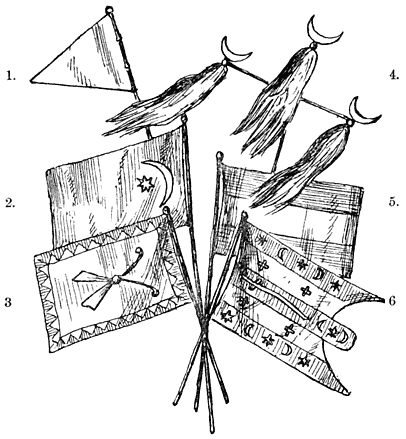
MUHAMMADAN STANDARDS. (A. F. Hole.)
1. Muslim Standard of Central Asian Tribes. 4. Horse-tail Standard of Modern Turks.
2. Standard of the Turkish Empire. 5. Standard of Egypt.
3. Standard of the Empire of Morocco. 6. Standard of Persia.
In Central Asia, the ordinary Muslim standards are either black or green, and are triangular. The sign of the crescent, as it appears on Turkish standards, was adopted after the taking of Byzantium; for, long before the conquest of Constantinople, the crescent had been used in the city for an emblem of sovereignty, as may be seen from the medals struck in honour of Augustus and Trajan. [CRESCENT.]
There is a standard still preserved at Constantinople amongst the ancient relics, and called as-Sinjaqu ʾsh-sharīf, which is held to be a most sacred emblem, and is only produced on very special occasions. It is said to be the ancient standard of the Prophet.
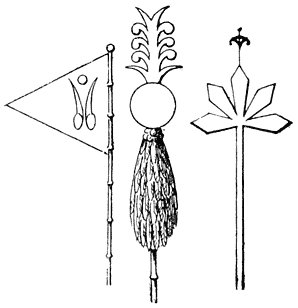
MUHARRAM STANDARDS.
A modern writer, describing this flag, says: “It is made of four layers of silk, the topmost of which is green, those below being composed of cloth, embroidered with gold. Its entire length is twelve feet, and from it is suspended the figure of a human hand, which clasps a copy of the Qurʾān, transcribed by the K͟halīfah ʿUs̤mān. In times of peace, the banner of the Prophet is kept in a chamber appropriated to the purpose, along with the clothes, teeth, the venerable locks, the stirrups, and the bow of the Prophet.”
In the Muḥarram, when the martyrdom of al-Ḥasan and al-Ḥusain is celebrated, numerous standards are carried about in the procession.
The origin of the horse-tail standard borne by modern Turks, appears to have been from the people bearing the horse-tail as a distinction of rank, the two ranks of pashas being distinguished respectively by two and three tails, and a further distinction of rank being marked by the elevation of one of the tails above the others.
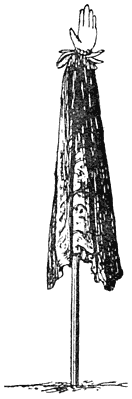
MUHARRAM STANDARD.
According to the Traditions, the Mahdī, in the Last Days, will appear from the direction of K͟horasān with black ensigns, and there seems to be every reason to regard the black standard as the primitive ensign of Islām, although the Wahhābīs have generally carried green standards.
STATUES. [SCULPTURE.]
STONING TO DEATH. Arabic rajm (رجم). In Muslim law, the punishment of lapidation is only inflicted for adultery. (Under the Jewish law idolaters and bearers of false witness were also stoned.) It is founded, not upon the Qurʾān, where the only punishment awarded is one hundred stripes (Sūrah xxiv. 2), but upon the Traditions (Mishkāt, book xv. ch. 1), where Muḥammad is related to have said, “Verily God hath ordained for a man or woman not married one hundred lashes and expulsion from their town one year, and for a man or woman having been married one hundred lashes and stoning.” ʿAbdu ʾl-Ḥaqq says the hundred lashes, in addition to the stoning, is abrogated by the express example of the Prophet, who ordered stoning only; for ʿAbdu ʾllāh ibn ʿUmar relates the following tradition:—
“A Jew came to the Prophet and said, ‘A man and woman of ours have committed adultery.’ And the Prophet said, ‘What do you meet with in the Book of Moses in the matter of stoning?’ The Jew said, ‘We do not find stoning in the Bible, but we disgrace adulterers and whip them.’ Then ʿAbdu ʾllāh ibn Salām, who was a learned man of the Jews, and had embraced Islām, said, ‘You lie, O Jewish tribe! verily the order for stoning is in the Book of Moses.’ Then the book was brought, and opened; and a Jew put his hand upon the revelation for stoning, and read the one above and below it; and ʿAbdu ʾllāh said, ‘Lift up your hand.’ And he did so, and behold the revelation for stoning was produced in the book, and the Jews said, ‘ʿAbdu ʾllāh spoke true, O Muḥammad! the stoning revelation is in the Book of Moses.’ Then the Prophet ordered both the man and woman to be stoned.” (Mishkāt, book xv. ch. i.)
The author of the Hidāyah (vol. ii. p. 9) gives the following instructions as to the correct way of carrying out the sentence:—
“It is necessary, when a whoremonger is to be stoned to death, that he should be carried to some barren place void of houses or cultivation, and it is requisite that the stoning be executed—first by the witnesses, and after them by the Imām or Qāẓī, and after those by the rest of the bystanders, because it is so recorded from ʿAlī, and also because in the circumstance of the execution being begun by the witnesses there is a precaution, since a person may be very bold in delivering his evidence against a criminal, but afterwards, when directed himself to commence the infliction of that punishment which is a consequence of it, may from compunction retract his testimony; thus, causing the witnesses to begin the punishment may be a means of entirely preventing it. Ash-Shāfiʿī has said that the witnesses beginning the punishment is not a requisite, in a case of lapidation, any more than in a case of scourging. To this our doctors reply that reasoning upon a case of lapidation from a case of scourging is supposing an analogy between things which are essentially different, because all persons are not acquainted with the proper method of inflicting flagellation, and hence, if a witness thus ignorant were to attempt, it might prove fatal to the sufferer, and he would die where death is not his due, contrary to a case of lapidation, as that is of a destructive nature, and what every person is equally capable of executing, wherefore if the witnesses shrink back from the commencement of lapidation the punishment drops, because their reluctance argues their retraction.
“In the same manner punishment is remitted when the witnesses happen to die, or to disappear, as in this case the condition, namely, the commencement of it by the witnesses, is defeated. This is when the whoredom is established upon the testimony of witnesses: but when it is established upon the confession of the offender, it is then requisite that the lapidation be executed, first by the Imām or the Qāẓī, and after them by the rest of the multitude, because it is so recorded from ʿAlī. Moreover, the Prophet threw a small stone like a bean at G͟hamdīyah who had confessed whoredom. When a woman is to be stoned, a hole or excavation should be dug to receive her, as deep as her waist, because the Prophet ordered such a hole to be dug for G͟hamdīyah before mentioned, and ʿAlī also ordered a hole to be dug for Shuraha Hamdiānī. It is, however, immaterial whether a hole be dug or not, because the Prophet did not issue any particular ordinance respecting this, and the nakedness of a woman is sufficiently covered by her garments; but yet it is laudable to dig a hole for her, as decency is thus most effectually preserved. There is no manner of necessity to dig a hole for a man, because the prophet did not do so in the case of Māʿiz. And observe, it is not lawful to bind a person in order to execute punishment upon him in this case, unless it appears that it cannot otherwise be inflicted.
“The corpse of a person executed by lapidation for whoredom is entitled to the usual ablutions, and to all other funeral ceremonies, because of the declaration of the Prophet with respect to Māʿiz. ‘Do by the body as ye do by those of other believers’; and also, because the offender thus put to death is slain in vindication of the laws of God, wherefore ablution is not refused, as in the case of one put to death by a sentence of retaliation; moreover the Prophet allowed the prayers for the dead to G͟hamdīyah, after lapidation.” (Hidāyah, book ii. p. 9.)
This punishment of lapidation for adultery has become almost obsolete in modern times; even in Buk͟hārah, where the institutes of Muḥammad are supposed to be most strictly observed, it is not inflicted.
SUBḤAH (سبحة). The rosary of ninety-nine beads. [ROSARY.]
SUBḤAN (سبحان). [TASBIH.]
SUBḤĀNA ʾLLĀHI (سبحان الله). “Holiness be to God!” An ejaculation which is called the Tasbīḥ. It occurs in the liturgical prayer, and is used as an ejaculation of surprise or fear. [TASBIH.]
ṢŪFAH (صوفة). Banū Ṣūfah. An ancient tribe of Arabia. The descendants of Tābik͟ha and Elyās. (Muir, vol. i. p. cxcix.)
ṢŪFĪ (صوفى), more correctly صوفىّ Ṣūfīy. (The Persian form of the plural being صوفيان Ṣūfīyān.) A man of the people called صوفيه Ṣūfīyah, who profess the mystic principles of تصوف Taṣawwuf. There is considerable discussion as to the origin of this word. It is said to be derived (1) from the Arabic Ṣūf, “wool,” on account of the woollen dress worn by Eastern ascetics; (2) or from the Arabic Ṣafū, “purity,” with reference to the effort to attain to metaphysical purity (which is scarcely probable); (3) or from the Greek σοφία, “wisdom”; (4) or, according to the G͟hiyās̤u ʾl-Lug͟hāt, it is derived from the Ṣūfah, the name of a tribe of Arabs who in the “time of ignorance,” separated themselves from the world, and engaged themselves exclusively in the service of the Makkah Temple.
It might at first sight appear almost an impossibility for mysticism to engraft itself upon the legal system of the Qurʾān, and the Aḥādīs̤, with the detailed ritual and cold formality which are so strikingly exemplified in Islām; but it would appear that from the very days of Muḥammad, there have been always those who, whilst they called themselves Muslims, set aside the literal meaning of the words of Muḥammad for a supposed mystic or spiritual interpretation, and it is generally admitted by Ṣūfīs that one of the great founders of their system, as found in Islām, was the adopted son and son-in-law of the Prophet, ʿAlī ibn Abī T̤ālib. The Ṣūfīs themselves admit that their religious system has always existed in the world, prior to the mission of Muḥammad, and the unprejudiced student of their system will observe that Taṣawwuf, or Ṣūfīism, is but a Muslim adaptation of the Vedānta school of Hindū philosophers, and which also we find in the writings of the old academics of Greece, and Sir William Jones thought Plato learned from the sages of the East.
The Ṣūfīs are divided into innumerable sects, which find expression in the numerous religious orders of Darweshes or Faqīrs [FAQIR]; but although they differ in name and in some of their customs, as dress, meditations and recitations, they are all agreed in their principal tenets, particularly those which inculcate the absolute necessity of blind submission to a murshid, or inspired guide. It is generally admitted that, quite irrespective of minor sects, the Ṣūfīs are divided into those who claim to be only the Ilhāmīyah, or inspired of God, and those who assert that they are Ittiḥādīyah, or unionist with God.
I. The Doctrine of the Ṣūfīs.
The following is a succinct account of the doctrines of the Ṣūfīs:—
1. God only exists. He is in all things, and all things are in Him.
2. All visible and invisible beings are an emanation from Him, and are not really distinct from Him.
3. Religions are matters of indifference: they however serve as leading to realities. Some for this purpose are more advantageous than others, among which is al-Islām, of which Ṣūfīism is the true philosophy.
4. There does not really exist any difference between good and evil, for all is reduced to Unity, and God is the real Author of the acts of mankind.
5. It is God who fixes the will of man: man therefore is not free in his actions.
6. The soul existed before the body, and is confined within the latter as in a cage. Death, therefore, should be the object of the wishes of the Ṣūfī, for it is then that he returns to the bosom of Divinity.
7. It is by this metempsychosis that souls which have not fulfilled their destination here below are purified and become worthy of reunion with God.
8. Without the grace of God, which the Ṣūfīs call Fayaẓānu ʾllāh, or Faẓlu ʾllāh, no one can attain to this spiritual union, but this, they assert, can be obtained by fervently asking for it.
9. The principal occupation of the Ṣūfī, whilst in the body, is meditation on the waḥdānīyah, or Unity of God, the remembrance of God’s names [ZIKR], and the progressive advancement in the T̤arīqah, or journey of life, so as to attain unification with God.
II. The Sūfī Journey.
Human life is likened to a journey (safar), and the seeker after God to a traveller (sālik).
The great business of the traveller is to exert himself and strive to attain that perfect knowledge (maʿrifah) of God which is diffused through all things, for the Soul of man is an exile from its Creator, and human existence is its period of banishment. The sole object of Ṣūfīism is to lead the wandering soul onward, stage by stage, until it reaches the desired goal—perfect union with the Divine Being.
The natural state of every human being is humanity (nāsūt), in which state the disciple must observe the Law (sharīʿah); but as this is the lowest form of spiritual existence, the performance of the journey is enjoined upon every searcher after true knowledge.
The various stages (manāzil) are differently described by Ṣūfī writers, but amongst those of India (and, according to Malcolm, of Persia also,) the following is the usual journey:—
The first stage, as we have already remarked, is humanity (nāsūt), in which the disciple must live according to the Law (sharīʿah), and observe all the rites, customs, and precepts of his religion. The second is the nature of angels (malakūt), for which there is the pathway of purity (t̤arīqah). The third is the possession of power (jabrūt), for which there is knowledge (maʿrifah); and the fourth is extinction (fanāʾ) (i.e. absorption into the Deity), for which there is Truth (ḥaqīqah).
The following more extended journey is marked out for the traveller by a Ṣūfī writer, ʿAzīz ibn Muḥammad Nafasī, in a book called al-Maqṣadu ʾl-Aqṣā, or the “Remotest Aim,” which has been rendered into English by the lamented Professor Palmer (Oriental Mysticism, Cambridge, 1867):—
When a man possessing the necessary requirements of fully-developed reasoning powers turns to them for a resolution of his doubts and uncertainties concerning the real nature of the Godhead, he is called a t̤ālib, “a searcher after God.”
If he manifest a further inclination to prosecute his inquiry according to their system, he is called a murīd, or “one who inclines.”
Placing himself then under the spiritual instruction of some eminent leader of the sect, he is fairly started upon his journey and becomes a sālik, or “traveller,” whose whole business in life is devotion, to the end that he may ultimately arrive at the knowledge of God.
1. Here he is exhorted to serve God, as the first step towards a knowledge of Him. This is the first stage of his journey, and is called ʿubūdīyah (عبودية), or “service.”
2. When in answer to his prayers the Divine influence or attraction has developed his inclination into the love of God, he is said to have reached the stage called ʿIshq (عشق) or “love.”
3. This Divine Love, expelling all worldly desires from his heart, leads him to the next stage, which is zuhd (زهد), or “seclusion.”
4. Occupying himself henceforward with contemplations and investigations of metaphysical theories concerning the nature, attributes, and works of God, he reaches maʿrifah (معرفة), or “knowledge.”
5. This assiduous contemplation of startling metaphysical theories is exceedingly attractive to an oriental mind, and not unfrequently produces a state of mental excitement. Such ecstatic state is considered a sure prognostication of direct illumination of the heart by God, and constitutes the next stage, called wajd (وجد), or “ecstasy.”
6. During this stage he is supposed to receive a revelation of the true nature of the Godhead, and to have reached the stage called ḥaqīqah (حقيقة), or “truth.”
7. He then proceeds to the stage of waṣl (وصل), or “union with God.”
8. Further than this he cannot go, but pursues his habit of self-denial and contemplation until his death, which is looked upon as fanāʾ (فناء), “total absorption into the Deity, extinction.”
To develop this quasi “spiritual life” the Ṣūfī leaders have invented various forms of devotion called ẕikr (ذكر), or “recitations.” These eccentric exercises have generally attracted the notice of travellers in the East, and have been described by Lane, Vambéry, Burton, and other Orientalists. For an account of these ceremonies of Ẕikr the reader is referred to the article under that head. [ZIKR.]
III. The Perfect Man in Sūfī Spiritualism.
The late Professor E. H. Palmer of Cambridge has in his Oriental Mysticism, compiled from native sources, given a very correct idea of what may be considered the spiritual side of Muḥammadanism, as expressed in the teaching of Muslim Ṣūfīs.
“The perfect man is he who has fully comprehended the Law, the Doctrine, and the Truth; or, in other words, he who is endued with four things in perfection, viz. 1. Good words; 2. Good deeds; 3. Good principles; 4. The sciences. It is the business of the Traveller to provide himself with these things in perfection, and by so doing he will provide himself with perfection.
“The Perfect Man has had various other names assigned to him, all equally applicable, viz. Elder, Leader, Guide, Inspired Teacher, Wise, Virtuous, Perfect, Perfecter, Beacon and Mirror of the world, Powerful Antidote, Mighty Elixir, ʿIsà (Jesus) the Raiser of the Dead, Khizar the Discoverer of the Water of Life, and Solomon who knew the language of Birds.
“The Universe has been likened to a single person, of whom the Perfect Man is the Soul; and again, to a tree, of which mankind is the fruit, and the Perfect Man the pith and essence. Nothing is hidden from the Perfect Man; for after arriving at the knowledge of God, he has attained to that of the nature and properties of material objects, and can henceforth find no better employment than acting mercifully towards mankind. Now there is no mercy better than to devote oneself to the perfection and improvement of others, both by precept and example. Thus the Prophet is called in the Coran ‘a mercy to the Universe.’ (Cor. cap. 21, v. 107.) But with all his perfection the Perfect Man cannot compass his desires, but passes his life in consistent and unavoidable self-denial: he is perfect in knowledge and principle, but imperfect in faculty and power.
“There have indeed been Perfect Men possessed of power; such power as that which resides in kings and rulers; yet a careful consideration of the poor extent of man’s capacities will shew that his weakness is preferable to his power, his want of faculty preferable to his possession of it. Prophets and saints, kings and sultans, have desired many things, and failed to obtain them; they have wished to avoid many things, and have had them forced upon them. Mankind is made up of the Perfect and the Imperfect, of the Wise and the Foolish, of Kings and Subjects, but all are alike weak and helpless, all pass their lives in a manner contrary to their desires; this the Perfect Man recognises and acts upon, and, knowing that nothing is better for man than renunciation, forsakes all and becomes free and at leisure. As before he renounced wealth and dignity, so now he foregoes eldership and teachership, esteeming freedom and rest above everything: the fact is, that though the motive alleged for education and care of others is a feeling of compassion and a regard for discipline, yet the real instigation is the love of dignity: as the Prophet says, ‘The last thing that is removed from the chiefs of the righteous is love of dignity.’ I have said that the Perfect Man should be endued with four things in perfection: now the Perfectly Free Man should have four additional characteristics, viz. renunciation, retirement, contentment, and leisure. He who has the first four is virtuous, but not free: he who has the whole eight is perfect, liberal, virtuous, and free. Furthermore, there are two grades of the Perfectly Free—those who have renounced wealth and dignity only, and those who have further renounced eldership and teachership, thus becoming free and at leisure. These again are subdivided into two classes; those who, after renunciation, retirement and contentment, make choice of obscurity, and those who, after renunciation, make choice of submission, contemplation, and resignation; but the object of both is the same. Some writers assert that freedom and leisure consists in the former course, while others maintain that it is only to be found in the latter.
“Those who make choice of obscurity are actuated by the knowledge that annoyance and distraction of thought are the invariable concomitants of society; they therefore avoid receiving visits and presents, and fear them as they would venomous beasts. The other class, who adopt submission, resignation and contemplation, do so because they perceive that mankind for the most part are ignorant of what is good for them, being dissatisfied with what is beneficial, and delighted with circumstances that are harmful to them; as the Coran says, ‘Perchance ye may dislike what is good for you, and like what is hurtful to you.’ (Cor. cap. 2, v. 213.) For this reason they retire from society equally with the other class, caring little what the world may think of them.
“Fellowship has many qualities and effects both of good and evil. The fellowship of the wise is the only thing that can conduct the Traveller safely to the Goal; therefore all the submission, earnestness, and discipline that have been hitherto inculcated are merely in order to render him worthy of such fellowship. Provided he have the capacity, a single day, nay, a single hour, in the society of the wise, tends more to his improvement than years of self-discipline without it. ‘Verily one day with thy Lord is better than a thousand years.’ (Cor. cap. 22, v. 46.)
“It is, however, possible to frequent the society of the wise without receiving any benefit therefrom, but this must proceed either from want of capacity or want of will. In order then to avoid such a result, the Sufis have laid down the following rules for the conduct of the disciple when in the presence of his teachers.
“Hear, attend, but speak little.
“Never answer a question not addressed to you; but if asked, answer promptly and concisely, never feeling ashamed to say, ‘I know not.’
“Do not dispute for disputation’s sake.
“Never boast before your elders.
“Never seek the highest place, nor even accept it if it be offered to you.
“Do not be over-ceremonious, for this will compel your elders to act in the same manner towards you, and give them needless annoyance.
“Observe in all cases the etiquette appropriate to the time, place, and persons present.
“In indifferent matters, that is, matters involving no breach of duty by their omission or commission, conform to the practice and wishes of those with whom you are associating.
“Do not make a practice of anything which is not either a duty or calculated to increase the comfort of your associates; otherwise it will become an idol to you; and it is incumbent on every one to break his idols and renounce his habits.”