DICTIONARY OF ISLĀM. (continued 15)
Reading edition
“And when they entered as their father had commanded them, separately, it did not avert from them anything decreed to befall them from God, but only satisfied a desire in the soul of Jacob, which he accomplished; that is, the desire of averting the evil eye, arising from a feeling of compassion: and he was endowed with knowledge, because We had taught him: but the greater number of men, namely the unbelievers, know not God’s inspiration of his saints. And when they went in unto Joseph, he received unto him (or pressed unto him) his brother. He said, Verily, I am thy brother: therefore be not sorrowful for that which they did from envy to us. And he commanded him that he should not inform them, and agree with him that he should employ a stratagem to retain him with him. And when he had furnished them with their provision, he put the cup, which was a measure made of gold set with jewels, in the sack of his brother Benjamin. Then a crier cried, after they had gone forth from the chamber of Joseph, O company of travellers, ye are surely thieves. They said (and turned unto them), What is it that ye miss? They answered, We miss the king’s measure; and to him who shall bring it shall be given a camel-load of corn, and I am surety for it, namely the load. They replied, By God! ye well know that we have not come to act corruptly in the land, and we have not been thieves. The crier and his companions said, Then what shall be the recompense of him who hath stolen it, if ye be liars in your saying, We have not been thieves,—and it be found among you? They answered, His recompense shall be that he in whose sack it shall be found shall be made a slave: he, the thief, shall be compensation for it; namely, for the thing stolen. Such was the usage of the family of Jacob. Thus do We recompense the offenders who are guilty of theft.—So they turned towards Joseph, that he might search their sacks. And he began with their sacks, and searched them before the sack of his brother Benjamin, lest he should be suspected. Then he took it forth (namely the measure) from the sack of his brother. Thus, saith God, did We contrive a stratagem for Joseph. It was not lawful for him to take his brother as a slave for theft by the law of the king of Egypt (for his recompense by his law was beating, and a fine of twice the value of the thing stolen; not the being made a slave), unless God had pleased, by inspiring him to inquire of his brethren and inspiring them to reply according to their usage. We exalt unto degrees of knowledge and honour whom We please, as Joseph; and there is who is knowing about everyone else endowed with knowledge.—They said, If he steal, a brother of his hath stolen before; namely, Joseph; for he stole an idol of gold belonging to the father of his mother, and broke it, that he might not worship it. And Joseph concealed it in his mind, and did not discover it to them. He said within himself, Ye are in a worse condition than Joseph and his brother, by reason of your having stolen your brother from your father and your having treated him unjustly; and God well knoweth what ye state concerning him.—They said, O prince, verily he hath a father, a very old man, who loveth him more than us, and consoleth himself by him for the loss of his son who hath perished, and the separation of him grieveth him; therefore take one of us as a slave in his stead; for we see thee [to be one] of the beneficent. He replied, God preserve us from taking [any] save him in whose possession we found our property; for then (if we took another), we [should be] unjust.
And when they despaired of obtaining him, they retired to confer privately together. The chief of them in age (namely, Reuben, or in judgment, namely, Judah), said, Do ye not know that your father hath obtained of you a solemn promise in the name of God, with respect of your brother, and how ye formerly failed of your duty with respect to Joseph? Therefore I will by no means depart from the land of Egypt until my father give me permission to return to him, or God decide for me by the delivery of my brother; and He is the best, the most just, of those who decide. Return ye to your father, and say, O our father, verily thy son hath committed theft, and we bore not testimony against him save according to that which we knew of a certainty, by our seeing the cup in his sack; and we were not acquainted with what was unseen by us when we gave the solemn promise: had we known that he would commit theft, we had not taken him. And send thou, and ask the people of the city in which we have been (namely, Miṣr) and the company of travellers with whom we have arrived (who were a people of Canaan): and we are surely speakers of truth.—So they returned to him, and said unto him those words. He replied, Nay, your minds have made a thing seem pleasant unto you, and ye have done it (he suspected them, on account of their former conduct in the case of Joseph); but patience is seemly: peradventure God will bring them back (namely, Joseph and his brother) unto me, together; for He is the Knowing with respect to my case, the Wise in His acts. And he turned from them, and said, O! my sorrow for Joseph! And his eyes became white in consequence of mourning, and he was oppressed with silent grief. They said, By God, thou wilt not cease to think upon Joseph until thou be at the point of death, or be of the number of the dead. He replied, I only complain of my great and unconcealable grief and my sorrow unto God; not unto any beside Him; for He it is unto whom complaint is made with advantage; and I know by revelation from God what ye know not; namely, that the dream of Joseph was true, and that he is living. Then he said, O my sons, go and seek news of Joseph and his brother; and despair not of the mercy of God; for none despaireth of the mercy of God except the unbelieving people.
“So they departed towards Egypt, unto Joseph; and when they went in unto him, they said, O Prince, distress (that is, hunger) hath affected us and our family, and we have come with paltry money (it was base money, or some other sort): yet give us full measure, and be charitable to us, by excusing the badness of our money; for God recompenseth those who act charitably. And he had pity upon them, and compassion affected him, and he lifted up the curtain that was between him and them: then he said unto them in reproach, Do ye know what ye did unto Joseph, in beating and selling and other actions, and his brother, by your injurious conduct to him after the separation of his brother, when ye were ignorant of what would be the result of the case of Joseph? They replied, after they had recognised him (desiring confirmation), Art thou indeed Joseph? He answered, I am Joseph, and this is my brother. God hath been gracious unto us, by bringing us together; for whosoever feareth God and is patient [will be rewarded]: God will not suffer the reward of the well-doers to perish. They replied, By God, verily God hath preferred thee above us, and we have been indeed sinners. He said, There shall be no reproach cast on you this day: God forgive you; for He is the most merciful of those that show mercy. And he asked them respecting his father: so they answered, His eyes are gone. And he said, Go ye with this my shirt (it was the shirt of Abraham, which he wore when he was cast into the fire: it was on his, that is, Joseph’s neck, appended as an amulet, in the well; and it was from paradise: Gabriel commanded him to send it, and said, In it is its odour, that is, the odour of paradise, and it shall not be cast upon any one afflicted with a disease but he shall be restored to health), and cast it, said Joseph, upon the face of my father: he shall recover his sight; and bring unto me all your family.—And when the company of travellers had gone forth from El-ʾAreesh of Egypt, their father said, unto those who were present of his offspring, Verily I perceive the smell of Joseph (for the zephyr had conveyed it to him, by permission of Him whose name be exalted, from the distance of three days’ journey, or eight, or more): were it not that ye think I dote, ye would believe me. They replied, By God, thou art surely in thine old error. And when the messenger of good tidings (namely, Judah) came with the shirt (and he had borne the bloody shirt; wherefore he desired to rejoice him, as he had grieved him), he cast it upon his face, and he recovered his sight. Thereupon Jacob said, Did I not say unto you, I know, from God, what ye know not? They said, O our father, ask pardon of our crimes for us; for we have been sinners. He replied, I will ask pardon for you of my Lord; for He is the Very forgiving, the Merciful.—He delayed doing so until the first appearance of the dawn, that the prayer might be more likely to be answered; or, as some say, until the night of [that is, preceding] Friday.
“They then repaired to Egypt, and Joseph and the great men came forth to meet them; and when they went in unto Joseph, in his pavilion or tent, he received unto him (or pressed unto him) his parents (his father and his mother and his maternal aunt), and said unto them, Enter ye Miṣr, if God please, in safety. So they entered; and Joseph seated himself upon his couch, and he caused his parents to ascend upon the seat of state, and they (that is, his parents and his brethren) fell down, bowing themselves unto him (bending, but not putting the forehead) upon the ground: such being their mode of obeisance in that time. And he said, O my father, this is the interpretation of my dream of former times: my Lord hath made it true; and He hath shown favour unto me, since He took me forth from the prison (he said not, from the well,—from a motive of generosity, that his brethren might not be abashed), and hath brought you from the desert, after that the devil had excited discord between me and my brethren; for my Lord is gracious unto whom He pleaseth; for He is the Knowing, the Wise.—And his father resided with him four and twenty years, or seventeen; and the period of his separation was eighteen, or forty, or eighty years. And death came unto him; and thereupon he charged Joseph that he should carry him and bury him by his fathers. So he went himself and buried him. Then he returned to Egypt and remained after him three and twenty years; and when his case was ended, and he knew that he should not last upon earth, and his soul desired the lasting possession, he said, O my Lord, Thou hast given me dominion, and taught me the interpretation of events (or dreams): Creator of the heavens and the earth, Thou art my guardian in this world and in the world to come. Make me to die a Muslim, and join me with the righteous among my forefathers. And he lived after that a week, or more, and died a hundred and twenty years old. And the Egyptians disputed concerning his burial: so they put him in a chest of marble, and buried him in the upper part of the Nile, that the blessing resulting from him might be general to the tracts on each side of it. Extolled be the perfection of Him to whose dominion there is no end!” (Sūrah xii. 54 to the end.)
For the Talmudic origin of this account, see JUDAISM.
JOSHUA. Arabic Yūshaʿ (يوشع). Son of Nūn. Not mentioned by name in the Qurʾān, but is most probably “the servant” mentioned in Sūrah xviii. 59: “When Moses said to his servant, ‘I will not stop until I reach the confluence of the two seas, or for years I will journey on.’ ” (Vide al-Baiẓāwī in loco.) Some say he is the Ẕū ʾl-Kifl of Sūrah xxi. 85. [ZU ʾL-KIFL.]
JUBAIR (جبير). Jubair ibn Mut̤ʿim an-Naufalī. One of the Companions, and acknowledged as a traditionist by al-Buk͟hārī and Muslim. He was one of the most learned of the Quraish chiefs. Died at Makkah A.H. 54. Ibn Jubair, his son, was an Imām of great renown, he died A.H. 99.
JUBBU ʾL-ḤUZN (جب الحزن). “The pit of sorrow,” which Muḥammad said was a desert in hell, from which hell itself calls for protection, and which is reserved for readers of the Qurʾān who are haughty in their behaviour. (Mishkāt, book ii. ch. iii.)
JUDGE. Arabic Qāẓī (قاضى). A magistrate or judge appointed by the ruler of a Muḥammadan country. He should be an adult, a free man, a Muslim, sane, and unconvicted of slander (qaẕf). It becomes a Muslim not to covet the appointment of Qāẓī, for the Prophet has said: “Whoever seeks the appointment of Qāẓī shall be left alone, but to him who accepts the office on compulsion, an angel shall descend and guide him.” (Mishkāt, book xvi. ch. iii.)
The Qāẓī must exercise his office in some public place, the chief mosque being recommended, or, if in his own house, he should see that the public have free access. He must not accept any presents except from relatives and old friends, nor should he attend feasts and entertainments given by others than his relatives and friends. In addition to his duties as magistrate, it is his duty to attend funerals and weddings, and when present it is his right and office to perform the ceremonies. A woman may exercise the office of a Qāẓī, except in the administration of punishment (ḥadd) or retaliation (qiṣāṣ). (Hidāyah, vol. ii. p. 613.)
JUDGMENT-DAY. Arabic Qiyāmah (قيامة). [RESURRECTION.]
AL-JŪDĪ (الجودى). Mount Ararat, upon which the ark of Noah rested. Mentioned in the Qurʾān, Sūrah xi. 46: “And it (the ark) settled on al-Jūdī.”
Jūdī is a corruption apparently for Mount Giordi, the Gordyœi of the Greeks, situated between Armenia and Mesopotamia.
Ainsworth, in his Travels in the Track of the Ten Thousand, says tradition still points to Jabal Jūdī as the scene of the event, and maintains the belief that fragments of the ark exist on its summit.
Whiston, in his History of Armenia, p. 361, says Araratia is the name of a province and not of a mountain in Armenia.
JUʿL (جعل). The hire or reward of labour. An extraordinary pay or donation. In the language of the law, a reward for bringing back a fugitive slave.
JUMĀDĀ ʾL-UK͟HRĀ (جمادى الاخرى). The sixth month of the Muḥammadan year. [MONTHS.]
JUMĀDĀ ʾL-ŪLĀ (جمادى الاولى). The fifth month of the Muḥammadan year. [MONTHS.]
JUMʿAH (جمعة). [FRIDAY.]
JUNUB (جنب). Lit. “One who is separated.” The unclean. A person who is in a state of uncleanness [JANABAH] whereby he or she cannot perform any religious act or join in religious assemblies. [PURIFICATION.]
JURF (جرف). Lit. “A wasted river-bank.” A place three miles from al-Madīnah, celebrated in Muḥammadan history.
JUSTIFIABLE HOMICIDE. The Muḥammadan law on the subject is as follows:—
“If any person draw a sword upon a Muslim he (the Muslim) is at liberty to kill him in self-defence, because the Prophet has said, ‘He who draws a sword upon a Muslim renders his blood liable to be shed with impunity’; and also, because a person who thus draws a sword is a rebel, and guilty of sedition; and it is lawful to slay such, God having said, in the Qurʾān, ‘Slay those who are guilty of sedition, to the end that it may be prevented.’ Besides, it is indispensably requisite that a man repel murder from himself and as, in the present instance, there is no method of effecting this but by slaying the person, it is consequently lawful so to do. If however, it be possible to effect the self-defence without slaying the person, it is not lawful to slay him. It is written in the Jama Sagheer (al-Jāmiʿu ʾṣ-Ṣag͟hīr), that if a person strike at another with a sword, during either night or day, or lift a club against another in the night in a city, or in the day-time in the highway out of the city; and the person so threatened kill him who thus strikes with the sword, or lifts the club, nothing is incurred; because, as striking with a sword affords no room for delay or deliberation, it is in this case necessary to kill the person in order to repel him; and although, in the case of a club, there be more room for deliberation, yet in the night-time assistance cannot be obtained, and hence the person threatened is in a manner forced, in repelling the other’s attack, to kill him. (And so likewise where the attack is made during the day-time in the highway, as there assistance cannot readily be obtained). Where, therefore, a person thus slays another, the blood of the slain is of no account. If a lunatic draw a sword upon a person, and the person slay him, the fine of blood is due from his property, and does not fall upon his Akilas (ʿĀqilah). Ash-Shāfiʿī maintains that nothing whatever is incurred in this instance. In the same manner, also, if an infant draw a sword and make an attack upon a person, or if an animal attack anyone, and the person so attacked slay the infant, or the animal, a fine is due on account of the infant, or the value on account of the animal, according to Abū Ḥanīfah, but not according to ash-Shāfiʿī.
“If a person draw a sword upon another, and strike him, and then go away, and the person struck, or any other, afterwards kill this person, he is liable to retaliation. This is where the striker retires in such a way as indicates that he will not strike again, for as, upon his so retiring, he no longer continues an assailant, and the protection of his blood (which had been forfeited by the assault) reverts, retaliation is consequently incurred by killing him.
“If a person come in the night to a stranger, and carry off his goods by theft, and the owner of the goods follow and slay him, nothing whatever is incurred, the Prophet having said, ‘Ye may kill in preservation of your property.’ It is to be observed, however, that this is only where the owner cannot recover his property but by killing the thief; for if he know that upon his calling out the thief would relinquish the goods, and he notwithstanding neglect calling out, and slay him, retaliation is incurred upon him, since he in this case slays the person unrighteously.” (Hidāyah, vol. iv. p. 291.)
JUWAIRĪYAH (جويرية). One of Muḥammad’s wives. She was the daughter of the chief of the Banī ʾl-Muṣt̤aliq. She survived the Prophet some years.
Sir William Muir writes (Life of Mahomet, new ed. p. 309): “The captives of the Bani Mustalick having been carried to Medîna with the rest of the booty, men from their tribe soon arrived to make terms for their release. One of them was Juweiria, a damsel about twenty years of age, full of grace and beauty, the daughter of a chief, and married to one of her own tribe. She fell to the lot of a citizen, who, taking advantage of her rank and comeliness, fixed her ransom at nine ounces of gold. Despairing to raise so large a sum, she ventured into the presence of the Prophet, while seated in the apartment of Ayesha, and pleaded for some remission of the heavy price demanded for her freedom. Ayesha no sooner saw that she was fair to look upon, and of a sprightly winning carriage, than her jealousy prognosticated what was about to come to pass. Mahomet listened to her supplications. ‘Wilt thou hearken,’ he said, ‘to something better than that thou askest of me?’ Surprised by his gentle accents, she inquired what that might be: ‘Even that I should pay thy ransom, and marry thee myself!’ The damsel forthwith expressed her consent, the ransom was paid, and Mahomet, taking her at once to wife, built a seventh house for her reception. As soon as the marriage was noised abroad, the people said that the Bani Mustalick having now become their relatives, they would let the rest of the prisoners go free as Juweiria’s dower; ‘and thus no woman,’ said Ayesha, telling the story in after days, ‘was ever a greater blessing to her people than this Juweiria.’ ”
JUZʾ (جزء). One of the thirty portions into which the Qurʾān is divided. [SIPARAH.]
K.
KAʿBAH (كعبة). Lit. “A cube.” The cube-like building in the centre of the mosque at Makkah, which contains the Ḥajaru ʾl-Aswad, or black stone.
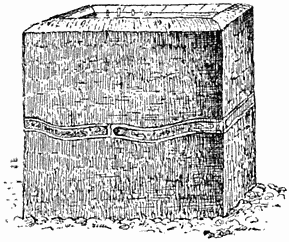
THE KAʿBAH. (From a Photograph.)
I. A Description of the Kaʿbah.—It is, according to Burckhardt and Burton, an oblong massive structure, 18 paces in length, 14 in breadth, and about 35 feet in height. It is constructed of grey Makkan stone, in large blocks of different sizes, joined together in a very rough manner, with cement. (Burton says it is excellent mortar, like Roman cement.) The Kaʿbah stands upon a base two feet in height, which presents a sharp inclined plane; its roof being flat, it has, at a distance, the appearance of a perfect cube. The only door which affords entrance, and which is opened but two or three times in the year (Burton says it can be entered by pilgrims, by paying the guardian a liberal fee), is on the east side, and about seven feet above the ground. At the south-east corner of the Kaʿbah, near the door, is the famous black stone [HAJARU ʾL-ASWAD], which forms a part of the sharp angle of the building, at four or five feet above the ground. The black stone is an irregular oval, about seven inches in diameter, with an undulating surface, composed of about a dozen smaller stones of different shapes and sizes. It is surrounded on all sides by a border of reddish brown cement, both the stone and the border being encircled by a band of a massive arch of gold or silver gilt, the aperture of the stone being one span and three fingers broad. In the corner facing the south, there is another stone about five feet from the ground. It is one foot and a half in length, and two inches in breadth, placed upright, and of common Makkan stone. According to the rites of the pilgrimage, this stone, which is called ar-Ruknu ʾl-Yamānī, or Yaman pillar, should only be touched with the right hand as the pilgrim passes it, but Captain Burton says he frequently saw it kissed by the pilgrims. Just by the door of the Kaʿbah, and close to the wall, is a slight hollow in the ground, lined with marble and sufficiently large to admit of three persons sitting, which is called al-Miʿjan, and supposed to be the place where Abraham and his son Ishmael kneaded the chalk and mud which they used to build the Kaʿbah. Here it is thought meritorious to pray. On the basis of the Kaʿbah, just above the Miʿjan, is an ancient Kufic inscription, which neither Burckhardt nor Burton were able to decipher or to copy. On the north-west side of the Kaʿbah, about two feet below its summit, is the water-spout, which is called the Miʾzābu ʾr-Raḥmah, or the water-spout of mercy. This spout is of gold, and was sent hither from Constantinople in A.H. 981. It carries rain from the roof, and discharges it upon Ishmael’s grave. There are two large green marble slabs, which are said to have been presents from Cairo, A.H. 241, which are supposed to mark the graves of Hagar and Ishmael. The pavement round the Kaʿbah consists of a very handsome mosaic of various coloured stones, and is said to have been laid down A.H. 826. On one side of the Kaʿbah is a semicircular wall, the extremities of which are in a line with the sides of the Kaʿbah, and distant about six feet, leaving an opening which leads to the grave of Ishmael. The wall is called al-Ḥat̤īm, “the broken,” and the enclosed area al-Ḥijr, “the enclosure.” The Kaʿbah is covered with a coarse tissue of mixed silk and cotton, being of a brilliant black colour, and with a gold band round it, upon which is inscribed the ninetieth verse of the third chapter of the Qurʾān: “Verily the first home founded for mankind was surely that at Bakkah, for a blessing and a guidance to mankind.” The inscription being in large Kufic characters. For a further account of this cover, see KISWAH.
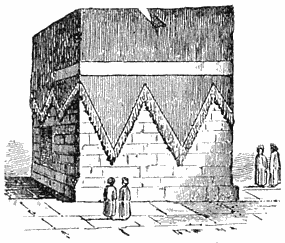
THE KAʿBAH. (Burton.)
II. The History of the Kaʿbah, is embraced in the history of the Baitu ʾllāh or MASJIDU ʾL-HARAM.
According to the Traditions and the inventive genius of Muslim writers, the Kaʿbah was first constructed in heaven (where a model of it still remains, called the Baitu ʾl-Maʿmūr) two thousand years before the creation of the world. Adam erected the Kaʿbah on earth exactly below the spot its perfect model occupies in heaven, and selected the stones from the five sacred mountains, Sinai, al-Jūdī, Ḥirāʾ, Olivet, and Lebanon. Ten thousand angels were appointed to guard the structure, but, as Burckhardt remarks, they appear to have been often most remiss in their duty! At the Deluge the Sacred House was destroyed. But the Almighty is said to have instructed Abraham to rebuild it. In its reconstruction Abraham was assisted by his son Ishmael, who with his mother Hagar were at the time residents of Makkah, Abraham having journeyed from Syria in order to obey the commands of God.
Upon digging they found the original foundations of the building. But wanting a stone to mark the corner of the building, Ishmael started in search of one, and as he was going in the direction of Jabal Qubais, the angel Gabriel met him, and gave him the famous black stone. Ibn ʿAbbās relates that the Prophet said, the black stone when it came down from Paradise was whiter than milk, but that it has become black from the sins of those who have touched it. (Mishkāt, book xi. ch. iv. pt. 2.)
Upon the death of Ishmael, the Kaʿbah fell into the possession of the Banū Jurhum, and remained in their hands for a thousand years. It then became the property of the Banū K͟huzāʿah, who held it for three hundred years. But being constantly exposed to torrents, it was destroyed, and was rebuilt by Quṣaiy ibn Kilāb, who put a top to it. Up to this time it is said to have been open at the roof.
It is said, by Muḥammadan historians, that ʿAmr ibn Luḥaiy was the first who introduced idolatry into Arabia, and that he brought the great idol Hubal from Hait in Mesopotamia and placed it in the sacred house. It then became a Pantheon common to all the tribes. [IDOLS.] The tribe of Quṣaiy were the first who built dwelling-houses round the Kaʿbah. The successors of the Banū Quṣaiy were the Quraish. Soon after they came into possession, the Kaʿbah was destroyed by fire, and they rebuilt it of wood and of a smaller size, than it had been in the time of the Banū Quṣaiy. The roof was supported within by six pillars, and the statue of Hubal was placed over a wall then existing within the Kaʿbah. This took place during the youth of Muḥammad. Al-Azraqī, quoted by Burckhardt, says that the figure of the Virgin Mary and the infant Jesus was sculptured as a deity upon one of the six pillars nearest the gate.
The grandfather of Muḥammad, ʿAbdu ʾl-Mut̤t̤alib, the son of Hāshim, became the custodian of the Sacred House; and during his time, the Kaʿbah being considered too low in its structure, the Quraish wished to raise it; so they demolished it and then they rebuilt till the work reached the place of the black stone. Each tribe wishing to have the honour of raising the black stone into its place, they quarrelled amongst themselves. But they at last agreed that the first man who should enter the gate of the enclosure should be umpire. Muḥammad was the first to enter, and he was appointed umpire. He thereupon ordered them to place the stone upon a cloth and each tribe by its representative to take hold of the cloth and lift it into its place. The dispute was thus ended, and when the stone had reached its proper place, Muḥammad fixed it in its situation with his own hand.
At the commencement of Muḥammad’s mission, it is remarkable that there is scarcely an allusion to the Kaʿbah, and this fact, taken with the circumstance that the earliest Qiblah or direction for prayer, was Jerusalem, and not the Kaʿbah, seems to imply that Muḥammad’s strong iconoclastic tendencies did not incline his sympathies to this ancient idol temple with its superstitious ceremonies. Had the Jews favourably received the new prophet as one who taught the religion of Abraham, to the abrogation of that of Moses and Jesus, Jerusalem and not Makkah would have been the sacred city, and the ancient Rock [SAKHRAH] and not the Kaʿbah would have been the object of superstitious reverence.
Taking the Sūrahs chronologically, the earliest reference in the Qurʾān to the Kaʿbah occurs in Sūrah lii. 4, where the Prophet swears by the frequented house (al-Baitu ʾl-Maʿmūr), but commentators are not agreed whether it refers to the Kaʿbah in Makkah, or its heavenly model above, which is said to be frequented by the angels. We then come to Sūrah xvii. 1, where Muḥammad refers to his celebrated night dream of his journey from the Sacred Mosque (al-Masjidu ʾl-Ḥarām) at Makkah to the Remote Mosque (al-Masjidu ʾl-Aqṣā) at Jerusalem. And in this verse we find the Rock at Jerusalem spoken of as “the precinct of which We (God) have blessed, to show him (Muḥammad) of our signs,” proving that even then the Prophet of Arabia had his heart fixed on Mount Zion, and not on the Kaʿbah.
When Muḥammad found himself established in al-Madīnah, with a very good prospect of his obtaining possession of Makkah, and its historic associations, he seems to have withdrawn his thoughts from Jerusalem, and its Sacred Rock and to fix them on the house at Bakkah as the home founded for mankind,—Blessed, and a guidance to all creatures. (Sūrah iii. 90). The Jews proving obdurate, and there being little chance of his succeeding in establishing his claim as their prophet spoken of by Moses, he changes the Qiblah, or direction for prayer, from Jerusalem to Makkah. The house at Makkah is made “a place of resort unto men and a sanctuary” (Sūrah ii. 119).
The Qiblah is changed by an express command of the Almighty, and the whole passage is remarkable as exhibiting a decided concession on the part of Muḥammad to the claims of the Kaʿbah as a central object of adoration. (Sūrah iii. 138–145.)
“We appointed the Qiblah which thou formerly hadst, only that we might know him who followeth the apostle, from him who turneth on his heels: The change is a difficulty, but not to those whom God hath guided. But God will not let your faith be fruitless; for unto man is God Merciful, Gracious. We have seen thee turning thy face towards every part of Heaven; but we will have thee turn to a Qiblah which shall please thee. Turn then thy face towards the sacred Mosque, and wherever ye be, turn your faces towards that part. They, verily, to whom ‘the Book’ hath been given, know this to be the truth from their Lord: and God is not regardless of what ye do. Even though thou shouldest bring every kind of sign to those who have received the Scriptures, yet thy Qiblah they will not adopt; nor shalt thou adopt their Qiblah; nor will one part of them adopt the Qiblah of the other. And if, after the knowledge which hath come to thee, thou follow their wishes, verily then wilt thou become of the unrighteous. They to whom we have given the Scriptures know him—the apostle—even as they know their own children: but truly a part of them do conceal the truth, though acquainted with it. The truth is from thy Lord. Be not then of those who doubt. All have a quarter of the Heavens to which they turn them; but wherever ye be, hasten emulously after good: God will one day bring you all together; verily, God is all-powerful. And from whatever place thou comest forth, turn thy face toward the sacred Mosque; for this is the truth from thy Lord; and God is not inattentive to your doings. And from whatever place thou comest forth, turn thy face toward the sacred Mosque; and wherever ye be, to that part turn your faces, lest men have cause of dispute against you: but as for the impious among them, fear them not; but fear me, that I may perfect my favours on you, and that ye may be guided aright.”
The verses of the second Sūrah of the Qurʾān are, according to Jalālu ʾd-dīn and other commentators, not in their chronological order. It is therefore difficult to fix the precise date of the following verse:—
Sūrah ii. 108: “Who is more unjust than he who prohibits God’s mosques, that His name should not be worshipped there, and who strives to ruin them.”
According to al-Baiẓāwī, the verse either refers to the sacking of Jerusalem by Titus, or to the Quraish who, at al-Ḥudaibiyah, had prevented the Prophet from entering Makkah until the following year.
In the seventh year of the Hijrah, Muḥammad was, according to the treaty with the Quraish at al-Ḥudaibiyah in the previous year, allowed to enter Makkah, and perform the circuit of the Kaʿbah. Hubal and the other idols of the Arabian pantheon were still within the sacred building, but, as Muḥammad’s visit was limited to three days, he confined himself to the ordinary rites of the ʿUmrah, or visitation, without interfering with the idolatrous arrangement of the Kaʿbah itself. Before he left, at the hour of midday prayer, Bilāl ascended the holy house, and from its summit gave the first call to Muslim prayers, which were afterwards led by the Prophet in the usual form.
The following year Muḥammad occupied Makkah by force of arms. The idols in the Kaʿbah were destroyed, and the rites of the pilgrimage were established as by divine enactment. From this time the history of the Kaʿbah becomes part of the history of Islām.
The K͟halīfah ʿUmar first built a mosque round the Kaʿbah, A.H. 17.
For a history of the sacred mosque at Makkah, see MASJIDU ʾL-HARAM.
KAʿB IBN MĀLIK (كعب بن مالك). A companion of the Prophet and one of the Anṣārs of the tribe of K͟hazraj. He was celebrated as a poet, and embraced Islām after the second pledge of ʿAkabah. He was one of the three companions who refused to accompany Muḥammad on the expedition to Tabūk (Hilāl and Marārah being the other two), and who are referred to in the Qurʾān, Sūrah ix. 118, 119: “Verily He is kind to them, unto the three who were left behind.” For a time Muḥammad was displeased with them, but he afterwards became reconciled. Kaʿb became a companion of some note, and died during the reign of ʿAlī.
AL-KABĪR (الكبير). “The Great One.” One of the ninety-nine attributes of God, Sūrah xxxiv. 22: “He is the High (al-ʿAlī) and the Great (al-Kabīr).”
KABĪRAH (كبيرة). The fem. of kabīr, “great.” A term used in theological books for Gunāh-i-Kabīrah, “a great sin”; namely, that sin which is clearly forbidden in the law, and for which punishment has been ordained of God. [SIN.]
KAʿBĪYAH (كعبية). A sect of Muslims founded by Abū Qāsim Muḥammad ibn al-Kaʿbī, who was a Muʿtazilī of Bag͟hdād, who said the acts of God were without purpose, will, or desire.
KACHKŪL (كچكول). Persian (vulg. kachkol). The begging bowl of a religious mendicant. [FAQIR.]
KAFĀLAH (كفالة). [BAIL.]
KAFAN (كفن). The shroud for the dead. It usually consists of three pieces of cloth for a man and five for a woman. Those for a man: 1, An izār, or piece of cloth, reaching from the navel to the knees or ankle joints; 2, A qamīṣ, or shirt, from the neck to the knees; 3, A sheet to cover the whole corpse. For a woman there are also a breast band and head band. The whole being of white. [BURIAL.]
KAFFĀRAH (كفارة), from kafr, “to hide.” Heb. כִּפֻּרִים. Lit. “Coverings; atonements; expiation.”
The word occurs four times in the Qurʾān:—
Sūrah v. 49: “Whoso remitteth it as alms shall have expiation for his sins.”
Sūrah v. 91: “Its expiation shall be to feed ten persons.” “This is the expiation for your oaths.”
Sūrah v. 96: “In expiation thereof shall ye feed the poor.”
The other word used is fidyah [FIDYAH]. The expression kaffāratu ʾẕ-ẕunūb, “atonement for sins,” is used for expiation by prayer, alms, fasting, and pilgrimage. [EXPIATION.]
AL-KĀFĪ (الكافى). “The Sufficient One.” An attribute of God mentioned in the Qurʾān, Sūrah xxxix. 37: “Is not God sufficient for His servant.”
AL-KĀFĪ (الكافى). The title of a collection of traditions by Abū Jaʿfar Muḥammad ibn Yaʿqūb al-Kulīnī (A.H. 328) received by the Shīʿahs.
KĀFIR (كافر), pl. kāfirūn. Lit. “The coverer.” One who hides or covers up the truth.
The word is generally used by Muḥammadans to define one who is an unbeliever in the ministry of Muḥammad and his Qurʾān, and in this sense it seems to have been used by Muḥammad himself. Sūrah ii. 37: “Those who misbelieve (waʾllaẕīna kafarū), and call our signs lies, they are fellows of the Fire, they shall dwell within for ever.”
It is also used for those who believe in the Divinity of the Lord Jesus, and the Holy Trinity. Sūrah v. 76: “They indeed are infidels (la-qad kafara ʾllaẕīna), who say God is al-Masīḥu ibn Maryam.… Verily him who associates anything with God, hath God forbidden Paradise, and his resort is the Fire.”
Sūrah v. 77: “They are infidels who say Verily God is the third of three.”
[On this passage the Kamālān say it refers to the Nestorians and to the Malakāʾīyah, who believe that God is one of three, the other two being the mother and son.]
According to the Raddu ʾl-Muḥtār (vol. iii. p. 442), there are five classes of kāfirs or infidels: (1) Those who do not believe in the Great First Cause; (2) Those who do not believe in the Unity of God, as the S̤anawīyah who believe in the two eternal principles of light and darkness; (3) Those who believe in the Unity of God, but do not believe in a revelation; (4) Those who are idolaters; (5) Those who believe in God and in a revelation, but do not believe in the general mission of Muḥammad to the whole of mankind, as the Christians, a sect of the Jews (sic).
Saiyid Sharīf Jurjānī says: “Mankind are divided into two parties, namely, those who acknowledge the mission of Muḥammad, or those who do not believe in it. Those who do not believe in his mission are either those who reject it and yet believe in the inspiration and divine mission of other prophets, as the Jews or Christians, and also the Majūsī (Fire Worshippers); or those who do not believe in any revelation of God’s will. Those who do not believe in any revelation from God, are either those who acknowledge the existence of God, as the Brāhmā (Buddhists?), or those who deny the existence of a Supreme Ruler, as the Dahrī, or Atheists.”
“Those who do not acknowledge Muḥammad as an inspired prophet are either those who do it wilfully and from mere enmity, or those who do not acknowledge it from reflection and due study of the subject. For the former is eternal punishment, and for the latter that punishment which is not eternal. There are also those who, whilst they are Muslims, are not orthodox in their belief; these are heretics, but they are not kāfirs. Those who are orthodox are an-Nājī or the salvationists.” (Sharḥu ʾl-Muwāqif, p. 597.)
KAFŪR (كفور). The unthankful, or ungrateful. Condemned in the Qurʾān, Sūrah xxii. 39: “God loveth not the false, the unthankful.”
KĀFŪR (كافور). Lit. “Camphor.” A fountain in Paradise mentioned in the Qurʾān (Sūrah lxxvi. 5) as the fountain whereof the servants of the Lord shall drink. But al-Baiẓāwī, the commentator, takes it for an appellative, and believes that the wine of Paradise will be mixed with camphor because of its agreeable coolness and smell.
AL-KAHF (الكهف). “The Cave.” The title of the XVIIIth chapter of the Qurʾān, in which is related the story of the Seven Sleepers of Ephesus, known as the Aṣḥābu ʾl-Kahf.
KĀHIN (كاهن), pl. kahanah and kuhhān. A soothsayer, or augur. The word occurs only twice in the Qurʾān; and in both instances it is used for “a soothsayer.”
Sūrah lii. 29: “For thou (Muḥammad), by the favour of thy Lord, art neither a soothsayer (kāhin), nor one possessed (majnūn).”
Sūrah lxix. 42: “Neither is it (the Qurʾān) the word of a soothsayer (kāhin).”
The word is used in the Traditions in the same sense only:—
Mishkāt, book iv. chap. i.: “The Prophet said, believe in Islām, and put not your trust in soothsayers (kahanah).”
Mishkāt, book xxi. ch. ii.: “ʿĀyishah relates that the Prophet was asked about kahanah, fortune-tellers, and he said, ‘You must not believe anything they say.’ It was then said, ‘O Prophet, why do they then sometimes tell lies?’ And the Prophet said: ‘Because one of the jinn steals away the truth and carries it to the magician’s ear, and the magicians (kuhhān) mix a hundred lies with it.’ ”
The Hebrew כֹחֵן Kohain, ἱερεὺς, is applied in the Old Testament not only to the Jewish priests, but also to Melchizedek (Gen. xiv. 18), Potipher (Gen. xli. 45; see marginal reading in our English version), and to Jethro (Ex. ii. 16).
KAHRUBĀ (كهربا). Lit. “Attracting Straws.” Electricity, or the power of attraction. A Ṣūfī term.
KAIFĪYAH (كيفية). “Detailed circumstances.” A term used in Muḥammadan books for a statement or account of anything, e.g. kaifīyat-i-task͟hīr, “the manner of attack”; kaifīyat-i-rāsik͟hah, “a fixed or permanent quality”; kaifīyat-i-ʿāriẓah, “a moveable or accidental quality.”
KAʾLAH (كالة). A kind of sale which is prohibited. Mishkāt, book xii. ch. v. pt. 2: “The Prophet has forbidden selling on credit for credit.”
ʿAbdu ʾl-Ḥaqq explains it thus: “If ʿAmr owe Zaid a piece of cloth, and Bakr ten dirhams, and Zaid say to Bakr, I have sold you the piece of cloth, which is with ʿAmr for ten dirhams”—this sale is forbidden.
KALĀM (كلام). “A word; speech.” ʿIlmu ʾl-kalām, “scholastic theology”; fasīḥu ʾl-kalām, “eloquent”; muḥaṣṣalu ʾl-kalām, “the substance of a discourse.”
KALĀMU ʾLLĀH (كلام الله). “The Word of God.” A title given to the Qurʾān. Sūrah ii. 70: “Already a sect of them have heard the Word of God.”
KALIMAH (كلمة). Lit. “The Word.” The Creed of the Muslim.
لا اله الا الاه محمد رسول الله
Lā Īlāha illā ʾllāhu: Muḥammadun Rasūlu ʾllāh.
“There is no deity but God: Muḥammad is the Apostle of God.”
The whole sentence as it stands does not occur in the Qurʾān; but the first part of the creed, “There is no deity but God,” is in the Sūratu Muḥammad, or XLVIIth chapter of the Qurʾān, verse 21; and the second part, “Muḥammad is the Apostle of God,” is in the Sūratu ʾl-Fatḥ, or XLVIIIth chapter, verse 29. The first sentence is known as the Nafy and the Iṣbāt, or the rejection (there is no deity) and the affirmation (but God), and is recited often as a religious office by the Ṣūfī faqīrs.
The whole creed frequently occurs in the Traditions, and is an oft-recurring clause in the daily prayer.
This Kalimah occupies a similar place in the Muslim religion to the “Shemaʿ Israīl” of the Hebrew Bible in the Jews’ religion. The Shemaʿ (“Hear”) is the fourth verse of Deut. vi.: “Hear, O Israīl, Jehovah our Elohīm is one Jehovah”; which is frequently used in daily morning and evening service of the Jews. From the Traditions (Mishkāt, book xi. ch. 2, pt. 1) it appears that a something similar to this well known symbol of the Muslim creed, was in use amongst the ancient Arabians, and is still recited by Muslims, amongst whom it is known as the Talbiyah: “I stand up for Thy service, O God! There is no partner with Thee.” [TALBIYAH.]
The recital of the kalimah is the first of the five foundations or pillars of practice, and, according to the Fawāʾidu ʾsh-Sharīʿah, every Muslim should recite it aloud at least once in his lifetime, and he should understand its meaning. [RECITAL OF THE CREED.]
KALIMATU ʾL-ḤAẒRAH (كلمة الحضرة). The fiat of God when He said “Be,” and it was created. The word كن, kun, is therefore called the Kalimatu ʾl-Ḥaẓrah. It occurs in the Qurʾān, Sūrah xxxvi. 82: “His bidding is only when He desires anything to say to it ‘BE,’ and it is.” And in about eleven other places.
KALIMATU ʾSH-SHAHĀDAT (كلمة الشهادة). “The word of testimony.” The following expression of belief: “I bear witness that there is no deity but God, and that Muḥammad is His Apostle.” [PRAYER.]
KALĪMU ʾLLĀH (كليم الله). “The Converser with God.” A title given to the Prophet Moses (vide Mishkāt, book xxii. ch. xii.). It is also referred to in the Qurʾān, Sūrah iv. 162: “Moses did God speak to—conversing.”
KALĪSAH, KILĪSAH (كليسة). A Christian Church. Ἐκκλησία. The word is used in books of Muḥammadan law for both Christian and Jewish places of worship. The word kanīsah is also used. [KANISAH.]
KĀMIL (كامل). “Perfect; complete.” Al-Insānu ʾl-Kāmil, “the perfect man.” A mystic term. [INSANU ʾL-KAMIL.]
KĀMILĪYAH (كاملية). A sect of Shīʿah Muslims founded by Abū ʾl-Kāmil, who said the Aṣāḥīb, or Companions of the Prophet, were infidels, because they rejected the house of ʿAlī in forming the K͟halīfate, and he even called the K͟halīfah ʿAlī an infidel because he did not claim his rights when Muḥammad died. (Kitābu ʾt-Taʿrīfāt, in loco.)
KANʿĀN (كنعان). “Canaan.” Not mentioned by name in the Qurʾān. The Commentators al-Baiẓāwī and Jalālu ʾd-dīn, say he was the son of Noah; but the author of the Qāmūs dictionary says he was the son of Shem. (According to the Old Testament, he was the son of Ham, Gen. x. 6; 1 Chron. i. 8.)
He is said to be that son of Noah who was drowned, through unbelief, in the deluge. See Qurʾān, Sūrah xi. 44. [NOAH.]
KANĪSAH (كنيسة). A Christian church, a Jewish synagogue, or a pagan temple. It is used in the Hidāyah (vol. ii. p. 219) for a synagogue. [CHURCHES.]
AL-KANZU ʾL-MAK͟HFĪ (الكنز المخفى). Lit. “The Secret Treasure.” A term used by the Ṣūfīs for the essence and personality of God.
KĀRAWĀN (كاروان). Persian. “A caravan.” The Arabic term is Qāfilah. A party of merchants proceeding on a journey under the direction of a leader who is called a Qāfilah Bāshī.
KARBALĀʾ (كربلاء), or MASHHADU ʾL-ḤUSAIN. A city in al-ʿIrāq, celebrated as the scene of the martyrdom of al-Ḥusain [AL-HUSAIN] and the place of his sepulchre. It is fifty miles south-west of Bag͟hdād, and about six miles west of the Euphrates.
AL-KARĪM (الكريم). “The Generous One.” One of the ninety-nine attributes of God.
KARŪBĪN (كروبين). [CHERUBIM.]
KASHF (كشف). The uncovering of anything covered; manifestation. A mystic term used for a revelation of any secret truth to the mind of man, by the grace and power of God.
KĀTIB (كاتب). An Amanuensis; a clerk; a secretary. In the latter sense it is used for Muḥammad ibn Saʿd ibn Manīʿ az-Zuhrī, the secretary to al-Wāqidī. [KATIBU ʾL-WAQIDI.]
KĀTIBU ʾL-WĀQIDĪ (كاتب الواقدى). The secretary of al-Wāqidī. A Muslim historian, largely quoted by Sir William Muir in his Life of Mahomet, and also by Sprenger, and often given as an authority in the present work.
Mr. Ameer Ali in his Life of Muḥammad (London, 1873), couples the name of Kātibu ʾl-Wāqidī with that of al-Wāqidī himself, as regarded by “the Muḥammadan as the least trustworthy and most careless biographers of Muḥammad,” and quotes Ibn K͟hallikān in support of his opinion. It is quite true that Ibn K͟hallikān does speak of the traditions received by al-Wāqidī as “of feeble authority,” but he bears testimony to the trustworthiness of al-Wāqidī’s secretary in the strongest terms, as will be seen in the following quotation, and it is manifestly unfair of Mr. Ameer Ali to couple the two names together in his preface:—
“Abû Abd Allah Muhammad Ibn Saad Ibn Manî az-Zuhri, was a man of the highest talents, merit, and eminence. He lived for some time with al-Wakidi [WAQIDI] in the character of a secretary, and for this reason he became known by the appellation of Katibu-l-Wakidi. Amongst the masters under whom he studied was Sofyân Ibn Oyaina. Traditional information was delivered on his own authority by Abû Bakr Ibn Abid-Dunyâ and Abû Muhammad al-Hârith Ibn Abi Osâma at-Tamimi. He composed an excellent work, in fifteen volumes, on the different classes (tabakât) of Muhammad’s companions and of the Tâbîs. It contains also a history of the khalifs brought down to his own time. He left also a smaller Tabakât. His character as a veracious and trustworthy historian is universally admitted. It is said that the complete collection of al-Wakidi’s works remained in the possession of four persons, the first of whom was his secretary, Muhammad ibn Saad. This distinguished writer displayed great acquirements in the sciences, the traditions, and traditional literature; most of his books treat of the traditions and law. The Khatîb Abû Bakr, author of the history of Baghdad, speaks of him in these terms: ‘We consider Muhammad ibn Saad as a man of unimpeached integrity, and the Traditions which he delivered are a proof of his veracity, for in the greater part of the information handed down by him, we find him discussing it, passage by passage.’ He was a mawla (slave) to al-Husain Ibn Abd Allah Ibn Obaid Allah Ibn al-Abbâs Ibn Abd al-Muttalib. He died at Baghdad on Sunday the 4th of the latter Jumâda, A.H. 203 (December, A.D. 818), at the age of sixty-two years, and was interred in the cemetery outside the Damascus gate (Bâb as-Shâm.)”—(Ibn K͟hallikān, Biog. Dict., in loco.)
AL-KAUS̤AR (الكوثر). Lit. “Abundance.” A pond in Muḥammad’s paradise known as the Ḥauẓu ʾl-Kaus̤ar, or “The Pond of Abundance.”
The word occurs once in the Qurʾān, Sūrah cviii. 1–3:—
“Truly we have given thee an abundance (i.e. al-Kaus̤ar);
“Pray therefore to the Lord, and slay the victims.
“Verily whoso hateth thee shall be childless.”
But it is not clear whether the pond is intended in this verse. Al-Baiẓāwī thinks it refers to abundance of blessings and not to the pond.
Anas relates that the Prophet said the prophet saw the pond al-Kaus̤ar in the night of his Miʿrāj or heavenly journey [MIʿRAJ] and that it “was a river of water on each side of which there were domes, each formed of a hollow pearl.”
ʿAbdu ʾllāh ibn ʿAmr relates that the Prophet said “the circumference of al-Kaus̤ar is a month’s journey, and it is a square, its water whiter than milk, its smell sweeter than musk, and its cups for drinking sparkle like the stars of heaven. He who drinks of its waters shall never thirst.” (Mishkāt, book xxiii. ch. xii.)
K͟HABAR-I-WĀḤID (خبر واحد). A term used in the Traditions for a tradition related by one person and handed down by one chain of narrators. [TRADITION.]
K͟HABAR MUTAWĀTIR (خبر متواتر). A term used for a tradition which is handed down by very many distinct chains of narrators, and which has been always accepted as authentic and genuine, no doubt ever having been raised against it.
Syud Ahmad Khan says all learned Muslims of every period have declared the Qurʾān is the only Ḥadīs̤ Mutawātir, but some have declared certain Aḥādīs̤ also to be Mutawātir, the number of such not exceeding five. (Essay on the Traditions, p. 15.) [TRADITIONS.]
K͟HABĪS̤ (خبيث). “Impure; base; wicked.”
Qurʾān viii. 38: “That God may distinguish the vile from the good, and may put the vile one on the top of the other, and heap all up together, and put them into hell.”
K͟HADĪJAH (خديجة). Known as K͟hadījatu ʾl-Kubrā, “K͟hadījah the Great.” The first wife of Muḥammad, and the first convert to a belief in his mission.
She was a Quraish lady of good fortune, the daughter of K͟huwailid, who was the great grandson of Quṣaiy. Before she married Muḥammad, she was a widow who had been twice married, and had borne two sons and a daughter. Upon her marriage with Muḥammad, she had attained her fortieth year, whilst he was only twenty-five years of age. She continued to be his only wife until the day of her death. She died December, A.D. 619, aged 65; having been his counsellor and support for five-and-twenty years. She had borne Muḥammad two sons and four daughters: al-Qāṣim, and ʿAbdu ʾllāh, also called at̤-T̤aiyib and at̤-T̤āhir, Zainab, Ruqaiyah, Fāt̤imah, and Umm Kuls̤ūm. Of those, only Fāt̤imah survived the Prophet, and from her and her husband ʿAlī are descended that posterity of Saiyids who are the subjects of such frequent petitions in the k͟hut̤bahs and the liturgical prayers in all parts of the Muḥammadan world.
Muḥammad ever retained his affection for K͟hadījah. ʿĀyishah said: “I was never so jealous of any one of the Prophet’s wives as I was of K͟hadījah, although I never saw her. The Prophet was always talking of her, and he would very often slay goats and cut them up, and send pieces of them as presents to K͟hadījah’s female friends. I often said to him, ‘One might suppose there had not been such another woman as K͟hadījah in the world!’ And the Prophet would then praise her and say she was so and so, and I had children by her.” (Mishkāt, book xxix. ch. xxii.)
According to a traditional saying of Muḥammad, K͟hadījah, Fāt̤imah, the Virgin Mary, and Āsiyah the wife of Pharaoh, were the four perfect women. (Mishkāt, book xxiv. ch. xxix. pt. 2.) [MUHAMMAD.]
K͟HAFĪ (خفى). “Hidden.” A term used in works on exegesis for that which is hidden in its meaning, as compared with that which is obvious. [QURʾAN.]
K͟HAIBAR (خيبر). A rich and populous valley, eight stages from al-Madīnah, inhabited by Jews. It is celebrated in the history of Islām as the scene of one of Muḥammad’s expeditions, A.H. 7, when the chief Kinānah was slain and the whole valley conquered. (See Muir’s Life of Mahomet, new ed., p. 388 seqq.)
Here the Prophet instituted mutʿah, or temporary marriage [MUTʿAH.] Here were the special orders regarding clean and unclean animals promulgated. Here Muḥammad married Ṣafīyah, the widow of the chief of K͟haibar. Here Zainab, the sister of the warrior Marhab, who had lost her husband, her father, and her brother in battle, tried to poison the Prophet with a poisoned kid. The campaign of K͟haibar, therefore, marks an epoch in the Prophet’s history. [MUHAMMAD.]
K͟HAIRĀT (خيرات). The Plural of K͟hair. “Charity; good deeds.” The word occurs in the Qurʾān in its singular form (k͟hair), but in modern theological works it is more frequently used in its plural form.
K͟HAIRU ʾL-QURŪN (خير القرون). The best generations. A term used for the first three generations of Muslims from the time of the Prophet. Muḥammad is related to have said there would be three virtuous generations, the one in which he lived and the two following it.
K͟HALFĪYAH (خلفية). A sect of Muslims founded by K͟halfu ʾl-K͟hārijī, who maintained, contrary to the general belief, that the children of idolators will be eternally damned.
K͟HĀLID (خالد). Son of al-Walīd. The famous Muḥammadan general. He fought against Muḥammad at Uḥud and defeated the Muslim army. The Prophet married Maimūnah, who was an aunt to K͟hālid, a lady fifty-one years of age, and soon afterwards K͟hālid himself embraced Islām and became one of its most powerful champions. He led the Bedouin converts in the advance on Makkah, and was present as one of the chief leaders of the Muslim army at the battle of Ḥunain, and subsequent expeditions. In the reign of Abū Bakr, he murdered Mālik Ibn Nuwairah, an eminent Arab chief, and married his widow. The murder greatly displeased the K͟halīfah Abū Bakr, and he would have ordered K͟hālid to be put to death, but ʿUmar interceded for him. He afterwards took the lead in various expeditions. He invaded al-ʿIrāq and Syria, took Bustrah, defeated the Christians at Ajnadin, commanded the Muslim army at Yarmūk, and subdued the country as far as the Euphrates. After the taking of Damascus, he was recalled by ʿUmar, and sent to Ḥimṣ and Baʿlabakk. He died at Ḥimṣ A.H. 18, A.D. 639.
K͟HĀLIDŪN (خالدون), pl. of k͟hālid, “Everlasting.” A term used to express the everlasting character of the joys of heaven and the torments of hell. It is used fifty times in the Qurʾān in this sense. [ETERNAL PUNISHMENT.]
K͟HALĪFAH (خليفة), pl. K͟hulafāʾ, from k͟half, “to leave behind.” Anglice, “Caliph.” A successor; a lieutenant; a vicegerent, or deputy. The word is used in the Qurʾān for Adam, as the vicegerent of the Almighty on earth.
Sūrah ii. 28: “And when thy Lord said to the angels, ‘I am about to place a vicegerent (k͟halīfah) on the earth,’ they said, ‘Wilt Thou place therein one who will do evil therein and shed blood?’ ”
And also for David:—
Sūrah xxxviii. 25: “O David! verily We have made thee a vicegerent (k͟halīfah); judge then between men with truth.”
In Muḥammadanism it is the title given to the successor of Muḥammad, who is vested with absolute authority in all matters of state, both civil and religious, as long as he rules in conformity with the law of the Qurʾān and Ḥadīs̤. The word more frequently used for the office in Muḥammadan works of jurisprudence, is Imām (leader), or al-Imāmu ʾl-Aʿz̤am (the great leader). It is held to be an essential principle in the establishment of the office, that there shall be only one K͟halīfah at the same time; for the Prophet said: “When two K͟halīfahs have been set up, put the last to death and preserve the other, for the last is a rebel.” (Mishkāt, book xvi. ch. i.)
According to all Sunnī Muḥammadan books, it is absolutely necessary that the K͟halīfah be “a man, an adult, a sane person, a free man, a learned divine, a powerful ruler, a just person, and one of the Quraish (i.e. of the tribe to which the Prophet himself belonged).
The Shīʿahs hold that he should be one of the descendants of the Prophet’s own family; but this is rejected by the Sunnīs and Wahhābīs.
The condition that the K͟halīfah should be of the Quraish is very important, for thereby the present Ottoman Sultāns fail to establish their claims to the K͟halīfate (Arabic K͟hilāfah). The four immediate successors of Muḥammad are entitled the K͟hulafāʾu ʾr-Rāshidūn, or “the well-directed K͟halīfahs.” According to the Bag͟hyatu ʾr-Raid, only the first five K͟halīfahs, Abū Bakr, ʿUmar, ʿUs̤mān, ʿAlī, and al-Ḥasan, are entitled to the distinction of K͟halīfah, the others being merely Amīrs, or Governors. After the deaths of the first five K͟halīfahs, the K͟halīfate, which is allowed by all parties to be elective and not hereditary, passed successively to the Umayades (Banū Umayah). The first K͟halīfah of this dynasty was Muʿāwiyah, the grandson of Umaiyah of the Quraish tribe, who received the K͟halīfate from al-Ḥasan. Of the Umayades, there were fourteen K͟halīfahs who reigned at Damascus, extending over a period from A.H. 41 to A.H. 132 (A.D. 661 to A.D. 750). The title then passed to Abū ʾl-ʿAbbās, the fourth in descent from al-ʿAbbās, the uncle of Muḥammad, and the Abbaside K͟halīfahs, thirty-seven in number, who reigned at Bag͟hdād from A.H. 132 to A.H. 656 (A.D. 750 to A.D. 1258).
The temporal power of the Abbaside K͟halīfahs was overthrown by Halāk K͟hān, grandson of the celebrated Chenjiz K͟hān, A.D. 1258; but for three centuries, certain descendants of the Abbaside, or Bag͟hdād K͟halīfahs, resided in Egypt, and asserted their claim to the spiritual power. The founder of the present dynasty of Turkish Sult̤āns was ʿUs̤mān (Othmān), a chieftain descended from the Orghuz Turks (born at Sakut, A.D. 1259), who was at first the ruler of a small territory in Bithynia, but who in 1299 invaded the whole country of Makkah, and subsequently extended his conquests to the Black Sea, and whose successor, Salīm (ninth in descent), obtained the title of K͟halīfah from one of the Abbaside K͟halīfahs in Egypt. About the year A.D. 1515 (A.H. 921), Salīm I., ruler of the Ottoman Turks and Emperor of Constantinople, finding himself the most powerful prince of his day in Islām, and wishing still further to consolidate his rule, conceived the idea of reviving in his own person the extinct glories of the K͟halīfate. He had more than one claim to be considered their champion by orthodox Muḥammadans, for he was the grandson of that Muḥammad II. who had finally extinguished the Roman Empire of the East; and he had himself just ended a successful campaign against the heretical Shah of Persia. His only rivals among Sunnī princes were the Muslim Emperors in India, the Emperor of Morocco, and the Mameluke ruler of Egypt, then known to the world as par excellence, “the Sultan.” With the two former, as rulers of what were remote lands of Islām, Salīm seems to have troubled himself little, but he made war on Egypt. In A.D. 1516 he invaded Syria, its outlying province, and in A.D. 1517 he entered Cairo. There he made prisoner the reigning Mameluke, Qansau ʾl-G͟haurī, and had him publicly beheaded.
He then, in virtue of a very doubtful cession made to him of his rights by one Mutawakkil Ibn ʿAmri ʾl-Ḥākim, a descendant of the house of al-ʿAbbās, whom he found living as titular K͟halīfah in Cairo, took to himself the following style and title: Sult̤ānu ʾs-Salāt̤īn wa Ḥākimu ʾl-Ḥākimīn, Māliku ʾl-Baḥrain wa Ḥāmīyu ʾl-Barrain, K͟halīfatu ʾr-Rasūli ʾllāh, Amīru ʾl-Muʾminīn, wa Sult̤ān, wa K͟hān; that is: “King of kings and Ruler of rulers, Monarch of the two seas (the Mediterranean and the Red Sea) and Protector of the two lands (al-Ḥijāz and Syria, the holy lands of Islām), Successor (K͟halīfah) of the Apostle of God, Ruler of the Faithful, King and Chief.” It is said that he first had the satisfaction of hearing his name mentioned in the public prayers as K͟halīfah when he visited the Great Mosque of Zacharias at Aleppo, on his return northwards in 1519.
Such are the titles still claimed by the Ottoman Sult̤āns, who arrogate to themselves the position of K͟halīfahs and Successors to the Prophet. It is, however, a mere assertion; for the title and office being elective and not hereditary, it was not in the power of any K͟halīfah to transfer it to another. Force of circumstances alone has compelled the ruler of the Ottoman Empire to assume the position, and has induced his subjects to acquiesce in the usurpation. We have not seen a single work of authority, nor met with a single man of learning, attempting to prove that the Sult̤āns of Turkey are rightful K͟halīfahs; for the assumption of the title by anyone who is not of the Quraish tribe is undoubtedly illegal and heretical, as will be seen from the following authorities:—
Mishkātu ʾl-Maṣābīḥ, book xxiv. ch. xii.: “Ibn ʿAmr relates that the Prophet of God said: ‘The K͟halīfah shall be in the Quraish tribe as long as there are two persons in it, one to rule and another to serve.’ ”
Sharḥu ʾl-Muwāqif, p. 606, Arabic edition, Egypt: “It is a condition that the K͟halīfah (Imām) be of the Quraish tribe. All admit this except the K͟hawārij and certain Muʿtazilahs. We all say with the Prophet: ‘Let the K͟halīfah be of the Quraish’; and it is certain that the Companions acted upon this injunction, for Abū Bakr urged it as an authority upon the Anṣārs, on the day of Sakhifah, when the Companions were present and agreed. It is, therefore, for a certainty established that the K͟halīfah must be of the Quraish.”
The Ḥujjatu ʾllāhi ʾl-Balāg͟hah, p. 335, Arabic edition, Delhi: “It is a necessary condition that the K͟halīfah (Imām) be of the Quraish tribe.”
The Kashʾhāfu ʾl-Iṣt̤ilāḥāt; A Dictionary of Technical Terms. Edited by Colonel N. Lees, in loco: “The K͟halīfah (Imām) must be a Quraish.”
It is a matter of history that the Wahhābīs regarded the Turkish Sult̤ān as a usurper, when Saʿūd took Makkah and al-Madīnah in 1804; and to the present day, in countries not under Turkish rule, the k͟hut̤bah is recited in behalf of the Amīr, or ruler of the Muslim state, instead of the Ottoman Sult̤ān, which would not be the case if he were acknowledged as a lawful K͟halīfah. In a collection of k͟hut̤bahs, entitled the Majmaʿu K͟hut̤ab, the name of the Sult̤ān of Turkey does not once occur, although this collection is much used in Muḥammadan states. We have seen it stated that the Sult̤ān is prayed for in Hyderabad and Bengal; but we believe it will be found, upon careful inquiry, that he was not mentioned by name, until very recently, in any of the mosques of India. K͟hut̤bahs, in which there are prayers for the Ottoman Sult̤ān by name, have been imported from Constantinople.
According to Mr. W. S. Blunt, the chief arguments of the Hanifite ʿUlamāʾ in support of the claims of the present Ottoman dynasty are:—
(1) The right of the Sword.—The K͟halīfate being a necessity (and this all Muslims admit), it was also a necessity that the de facto holder of the title should be recognised until a claimant with a better title should appear. Now, the first qualification of a claimant was, that he should make the claim, and the second, that he should be supported by a party; and Salīm had both claimed the K͟halīfate and supported his pretensions at the head of an army. He challenged the world to produce a rival, and no rival had been found.
(2) Election, that is, the sanction of a legal body of elders. It was argued that, as the ahlu ʿaqd (or council), had been removed from al-Madīnah to Damascus, and from Damascus to Bag͟hdād, and from Bag͟hdād to Cairo, so it had been once more legally removed from Cairo to Constantinople. Salīm had brought with him to St. Sophia’s some of the ʿUlamāʾ (learned men) of the Azhar mosque in Cairo, and these in conjunction with the Turkish ʿUlamāʾ had elected him or ratified his election. A form of election is to the present day observed at Constantinople in token of this right, and each new Sult̤ān of the house of ʿUs̤mān, as he succeeds to the temporal sovereignty of Turkey, must wait before being recognised as K͟halīfah till he has received the sword of office at the hands of the ʿUlamāʾ. This ceremony it is customary to perform in the mosque of Aiyūb.
(3) Nomination.—Sult̤ān Salīm, as has been already said, obtained from Mutawakkil, a descendant of the Abbasides, and himself titularly K͟halīfah, a full cession of all the K͟halīfah rights of that family. The fact, as far as it goes, is historical, and the only flaw in the argument would seem to be that Mutawakkil had no right thus to dispose of a title to an alien, which was his own only in virtue of his birth. As a precedent for nomination, they cite the act of Abū Bakr, who on his death-bed recommended ʿUmar as his successor in the K͟halīfate.
(4) The Guardianship of the Two Shrines (Ḥaramān), that is to say, of Makkah and Jerusalem, but especially of Makkah. It has been asserted by some of the ʿUlamāʾ, and it is certainly a common opinion at the present day, that the sovereignty of al-Ḥijāz is in itself sufficient title to the K͟halīfate. It seems certainly to have been so considered in the first age of Islām, and many a bloody war was then fought for the right of protecting the Baitu ʾllāh, but the connection of al-Ḥijāz with the empire of the K͟halīfahs has been too often broken to make this a very tenable argument. In the tenth century, Makkah was held by the Karmathian heretics, in the thirteenth by the Imāms of Ṣanʿāʾ, and for seven years in the present century by the Wahhābīs. Still the de facto sovereignty of the Ḥaramān, or two shrines, was one of Salīm’s pleas; and it is one which has reappeared in modern arguments respecting the K͟halīfal rights of his descendants.
(5) Possession of the Amānāt, or sacred relics. This last is a plea addressed to the vulgar rather than to the learned; but it is one which cannot be passed by unnoticed here, for it exercises a powerful influence at the present day over the ignorant mass of Muslims. It was asserted, and is still a pious belief, that from the sack of Bag͟hdād in A.D. 1258, certain relicts of the Prophet and his Companions were saved and brought to Cairo, and thence transferred by Salīm to Constantinople. These were represented as constituting the imperial insignia of office, and their possession as giving a title to the succession. They consisted of the cloak of the Prophet, borne by his soldiers as a standard, of some hairs of the Prophet’s beard, and of the sword of ʿUmar. The vulgar still believe them to be preserved in the mosque of Aiyūb at Constantinople. (See The Future of Islām, by Wilfrid Scawen Blunt, London, 1882, p. 66.)
On the general question as to whether or not an Imām, or K͟halīfah, is necessary for Islām, the author of the Sharḥu ʾl-Muwāqif says, “The appointment of an Imām (i.e. K͟halīfah) is incumbent upon the united body of Muslims, according to the orthodox law of the Sunnīs, although the Muʿtazilahs and Zaidīyahs say it is merely expedient, but not ordered by the law, whilst the Ishmailīyahs and the Imāmīyahs say God will Himself appoint an Imām for the establishment of sound doctrine. Some say the appointment of an Imām is only necessary when Muslims are at peace amongst themselves and united, and not when they are in a state of rebellion.
The arguments in favour of the absolute necessity of an Imām, or K͟halīfah, being appointed, are that in the time of Abū Bakr, the first K͟halīfah, it was established by general consent; and Abū Bakr, in his first k͟hut̤bah after the death of Muḥammad, said: “Beware! Muḥammad is certainly dead, and it is necessary for this religion that some one should be appointed for its protection.” And all the Muslims at that time consented to this saying of Abū Bakr, and consequently in all ages Muslims have had an Imām. And it is well known that without such an officer Islām cannot be protected from evil, for without him it is impossible to maintain the orders of the Muslim law, such as marriage, Jihād, punishment, and the various ordinances of Islām. (Sharḥu ʾl-Muwāqif, p. 603.)
The following are some of the injunctions of Muḥammad regarding the Imām or K͟halīfah:—
“When two K͟halīfahs have been set up, put the last of them to death and preserve the other, for the second is a rebel.”
“He who acknowledges an Imām must obey him as far as he can, and if a pretender comes, kill him.”
“Whomever God appoints as Imām, and he does not protect his people, shall never smell the smells of paradise.”
“It is indispensable for every Muslim to listen to, and approve the orders of the Imām, whether he likes or dislikes, so long as he is not ordered to sin and act contrary to law; then when he is ordered to sin, he must neither attend to it nor obey it.”
“Whoever quits obedience to the Imām and divides a body of Muslims, dies like the people in ignorance; and whoever takes a part in an affray, without knowing the true from the false, does not fight to show his religion, but to aid oppression; and if he is slain, then he dies as the people of ignorance; and that person who shall draw his sword upon my people, and kill the virtuous and the vicious, and not fear the killing of Muslims or those protected by them, is not of me nor am I of him.”
“The Companions said, ‘O Prophet! when they are our enemies and we theirs, may we not fight with them?’ He said, ‘No, so long as they keep on foot the prayers amongst you’; this he repeated, ‘Beware! he who shall be constituted your prince, see if he does anything in disobedience to God; and if he does, hold it in displeasure, but do not withdraw yourselves from his obedience.’”
“He who forsakes obedience to the Imām, will come before God on the Day of Resurrection without a proof of his faith; and he who dies without having professed to the Imām, dies as the people of ignorance.”
“Prophets were the governors of the children of Israel; when one died, another supplied his place; and verily there is no prophet after me, and the time is near when there will be after me a great many K͟halīfahs. The Companions said, ‘Then what do you order us?’ The Prophet said, ‘Obey the K͟halīfah, and give him his due; for verily God will ask about the duty of the subject.’ ”
“Beware! you are all guardians, and you will all be asked about your subjects; then the Imām is the guardian of the subject, and he will be asked respecting the subject; and a man is as a shepherd to his own family, and will be asked how they behaved, and his conduct to them; and a wife is a guardian to her husband’s house and children, and will be interrogated about them; and a slave is a shepherd to his master’s property, and will be asked about it whether he took good care of it or not.”
“God never sent any prophet, nor ever made any K͟halīfah, but had two counsellors with him; one of them directing lawful deeds, and that is an angel, and the other, in sin, and that is the devil; and he is guarded from sin whom God has guarded.” (Mishkāt, book xvi. ch. i.)
I.—The K͟halīfahs of the Sunnīs, from the death of Muḥammad to the present time.
(1) The four rightly directed K͟halīfahs, and al-Ḥasan (at Makkah):—
1. Abū Bakr, A.H. 11 (A.D. 632).
(Collected the Qurʾān into one volume.)
2. ʿUmar, A.H. 13 (A.D. 634).
(Conquered Egypt, Syria, and Persia.)
3. ʿUs̤man, A.H. 23 (A.D. 643).
(Invades Cyprus; revolt at al-Kūfah.)
4. ʿAlī, A.H. 35 (A.D. 655).
(Revolt of Muʿāwiyah: ʿAlī assassinated.)
5. Al-Ḥasan, A.H. 40 (A.D. 660).
(Resigns; poisoned.)
(2) Umaiyade dynasty. The Banū Umaiyah (at Damascus):—
1. Muʿāwiyah I., A.H. 41 (A.D. 661).
(Siege of Constantinople; makes Damascus the capital.)
2. Yazīd I., A.H. 60 (A.D. 679).
(Destruction of al-Ḥusain’s party and his death.)
3. Muʿāwiyah II., A.H. 64. (A.D. 683).
(Deposed.)
4. Marwān I., A.H. 64 (A.D. 683).
(Poisoned.)
5. ʿAbdu ʾl-Malik, A.H. 65 (A.D. 684).
(Arabian money first coined.)
6. Al-Walīd I., A.H. 86 (A.D. 705).
(Conquest of Africa, Spain, Buk͟hārah.)
7. Sulaimān, A.H. 96 (A.D. 715).
(Defeated before Constantinople; dies of grief.)
8. ʿUmar (Omer), A.H. 99 (A.D. 717).
(Poisoned.)
9. Yazīd II., A.H. 101 (A.D. 720).
(His generals successful in war.)
10. Hishām, A.H. 105 (A.D. 724).
(Charles Martel checks the conquest of the Arabs in the West; rise of the Abbasides.)
11. Al-Walīd II., A.H. 125 (A.D. 743).
(Slain by conspirators.)
12. Yazīd III., A.H. 126 (A.D. 744).
(Died of the plague.)
13. Ibrahīm, A.H. 126 (A.D. 744).
(Deposed.)
14. Marwān, A.H. 127 (A.D. 744).
(Defeated by the Abbasides, pursued to Egypt, and slain on the banks of the Nile.)
The end of the Umayah dynasty, A.H. 132 (A.D. 749).
(3) The Abbaside dynasty. Ad-Daulatu ʾl-ʿAbbāsīyah (at Bag͟hdād and Saumara).
1. Abū ʾl-ʿAbbās as-Saffāḥ, A.H. 132 (A.D. 750).
(Resides at al-Kūfah.)
2. Al-Manṣūr, A.H. 136 (A.D. 754).
(ʿAbdu ʾr-Raḥmān, the Umaiyah K͟halīfah seizes Spain; Bag͟hdād founded).
3. Al-Mahdī, A.H. 158 (A.D. 775).
(Conquers Nicomedia on Sea of Marmora, making the Empress Irene pay tribute.)
4. Al-Hādī, A.H. 169 (A.D. 785).
5. Harūnu ʾr-Rashīd, A.H. 170 (A.D. 786).
(The hero of Arabian Nights; a flourishing period of Arabian literature.)
6. Al-Amīn, A.H. 193 (A.D. 809).
7. Al-Maʾmūn, A.H. 198 (A.D. 813).
(The Augustan period of Arabian letters.)
8. Al-Muʿtaṣim, A.H. 218 (A.D. 833).
(Makes the city of Saumara his capital; decline of the K͟halīfate.)
9. Al-Wās̤iq, A.H. 227 (A.D. 841).
10. Al-Mutawakkil, A.H. 232 (A.D. 847).
(A persecutor of the Jews and Christians; murdered.)
11. Al-Muntaṣir, A.H. 247 (A.D. 861).
12. Al-Mustaʿīn, A.H. 248 (A.D. 862).
13. Al-Muʿtazz, A.H. 252 (A.D. 866).
14. Al-Muhtadī, A.H. 255 (A.D. 869).
15. Al-Muʿtamid, A.H. 256 (A.D. 870).
(Re-establishes the capital at Bag͟hdād.)
16. Muʿtaẓid, A.H. 279 (A.D. 892).
(Conquers Persia; Ismail Samain seizes Turkistan from the K͟halīfah.)
17. Al-Muktafī I., A.H. 289 (A.D. 902).
(Ismail Samain seizes Persia from the K͟halīfah.)
18. Al-Muqtadir, A.H. 295 (A.D. 908).
(The Fāt̤imites in Egypt.)
19. Al-Qāhir, A.H. 320 (A.D. 932).
(Blinded and deposed.)
20. Ar-Rāẓi, A.H. 322 (A.D. 934).
(The last of the K͟halīfahs who ever recited the k͟hut̤bah.)
21. Al-Mūttaqī, A.H. 329 (A.D. 940).
(Decline of the Abbasides.)
22. Al-Mustakfī, A.H. 333 (A.D. 944).
23. Al-Mut̤īʿ, A.H. 334 (A.D. 945).
(The Fāt̤imate K͟halīfahs seize all North Africa and Egypt.)
24. At̤-T̤āiʿ, A.H. 363 (A.D. 974).
(Deposed.)
25. Al-Qādir, A.H. 381 (A.D. 991).
(Maḥmūd of G͟hazni conquers India.)
26. Al-Qāʾim, A.H. 422 (A.D. 1031).
(Rise of the Seljukian Turks.)
27. Al-Muqtadī, A.H. 467 (A.D. 1075).
(The first crusade; rise of Ḥasan Jubah, and his followers the Assassins.)
28. Al-Mustaʿẕir, A.H. 487 (A.D. 1094).
(Jerusalem taken by the Fāt̤imites.)
29. Al-Mustarshid, A.H. 512 (A.D. 1118).
(Murdered by the Assassins.)
30. Ar-Rāshid, A.H. 529 (A.D. 1135).
(Murdered by the Assassins.)
31. Al-Muktafī II., A.H. 530 (A.D. 1136).
(Defeated by the Turks; second crusade, A.D. 1146.)
32. Al-Mustanjid, A.H. 555 (A.D. 1160).
(Disorders in Persia.)
33. Al-Mustahdī, A.H. 566 (A.D. 1170).
(Saladin, the Sult̤ān of Egypt, conquers Syria.)
34. An-Nāṣir, A.H. 575 (A.D. 1180).
(Conquests of Jengiz K͟hān; third crusade, A.D. 1189.)
35. Az̤-Z̤āhir, A.H. 622 (A.D. 1225).
36. Al-Mustanṣir, A.H. 623 (A.D. 1226).
(Persia subject to the Moghuls.)
37. Al-Mustaʿṣim, A.H.. 640 (A.D. 1240).
(Halaku, the Turk, a grandson of Jengiz K͟hān, takes Bag͟hdād and puts the K͟halīfah to death, A.H. 656 (A.D. 1258). The uncle of the last K͟halīfah goes to Egypt, while the K͟halīfate continues only as a spiritual power.)
(4) The ʿUs̤mān, or Turk Dynasty (at Constantinople).
1. ʿUs̤mān I. (Othmān), A.D. 1299.
2. Ūrk͟hān, A.D. 1326.
3. Murād (Amurath), A.D. 1360.
4. Bayāzīd I., A.D. 1389.
5. Sulaimān I., A.D. 1402.
6. Mūsā, A.D. 1410.
7. Muḥammad I., A.D. 1413.
8. Murād II., A.D. 1421.
9. Muḥammad II., A.D. 1451.
10. Bayāzīd II., A.D. 1481.
11. Salīm I. (Selim), A.D. 1512.
(Assumes the title of K͟halīfah.)
12. Sulaimān II., A.D. 1520.
13. Salīm II., A.D. 1566.
14. Murād III., A.D. 1574.
15. Muḥammad III., A.D. 1595.
16. Aḥmad I., A.D. 1603.
17. Muṣt̤afa I., A.D. 1617.
(Deposed in favour of his nephew.)
18. ʿUs̤mān II., A.D. 1618.
19. Muṣt̤afa I., A.D. 1622.
(Restored and again deposed.)
20. Murād IV., A.D. 1623.
21. Ibrahīm, A.D. 1640.
22. Muḥammad IV., A.D. 1649.
23. Sulaimān III., A.D. 1687.
24. Aḥmad II., A.D. 1691.
25. Muṣt̤afa II., A.D. 1695.
26. Aḥmad III., A.D. 1703.
27. Maḥmūd I., A.D. 1730.
28. ʿUs̤mān III., A.D. 1754.
29. Muṣt̤afa III., A.D. 1757.
30. ʿAbdu ʾl-Ḥamīd I., A.D. 1774.
31. Salīm III., A.D. 1788.
32. Muṣt̤afa IV., A.D. 1807.
33. Maḥmūd II., A.D. 1808.
34. ʿAbdu ʾl-Majīd, A.D. 1839.
35. ʿAbdu ʾl-ʿAzīz, A.D. 1861.
36. Murād V., A.D. 1876.
37. ʿAbdu ʾl-Ḥamīd, A.D. 1876.
II.—The Shīʿahs only regard those as rightful Imāms (they do not use the word K͟halīfah) who are descended from ʿAlī (the son-in-law of the Prophet) and his wife Fāt̤imah, the Prophet’s daughter. According to their traditions, Muḥammad distinctly nominated ʿAlī as his successor when he was returning from his farewell pilgrimage. They say, that on his way to al-Madīnah, the Prophet, with ʿAlī and certain other of the Companions stayed at a place called G͟hadiri-i-K͟hūm. And that it was here revealed by Gabriel that he should nominate ʿAlī as his successor. He is related to have said, “O ye people, I am your Prophet and ʿAlī is my successor. From us (i.e. ʿAlī and my daughter) shall descend al-Mahdī, the seal of the Imāms.” (See Ḥayātu ʾl-Qulūb, p. 334.)
According to the Shīʿahs, there have only been twelve lawful Imāms:—
1. ʿAlī, son-in-law of Muḥammad.
2. Al-Ḥasan, eldest son of ʿAlī and Fāt̤imah.
3. Al-Ḥusain, the second son of ʿAlī and Fāt̤imah.
4. Zainu ʾl-ʿĀbidīn, son of al-Ḥusain.
5. Muḥammad al-Bāqir, son of Zainu ʾl-ʿĀbidīn.
6. Jaʿfaru ʾṣ-Ṣādiq, son of Muḥammad al-Bāqir.
7. Mūsā ʾl-Kāz̤im, son of Jaʿfar.
8. ʿAlī ar-Raẓā, son of Mūsā.
9. Muḥammad at-Taqī, son of ʿAlī ar-Raẓā.
10. ʿAlī an-Naqī, son of at-Taqī.
11. Al-Ḥasan al-ʿAskarī, son of ʿAlī.
12. Muḥammad, son of al-ʿAskarī, or the Imām Mahdī, who is supposed to be still alive, although he has withdrawn himself from the world, and that he will appear again as al-Mahdī, the Director, in the last days. [AL-MAHDI.]
The Kings of Persia have never claimed to be in any sense the successors of the Prophet.
Sult̤ān Maḥmūd ʿAbdu ʾllāh (A.H. 706, A.D. 1306), was the first monarch of Persia who proclaimed himself a Shīʿah.
III.—The Fāt̤imide K͟halīfahs were a dynasty who claimed the K͟halīfate in the reign of the Abbaside K͟halīfah Muqtadir, their founder, ʿUbaidu ʾllāh, pretending to be al-Mahdī, “The Director,” and a descendant of Fāt̤imah, the daughter of the Prophet. They reigned over Egypt and North Africa from A.D. 910 to A.D. 1171, and were in all fourteen K͟halīfahs.
1. ʿUbaidu ʾllāh, A.D. 910.
(Ravaged the coasts of Italy and invaded Egypt several times.)
2. Al-Qāʾim, A.D. 933.
3. Al-Manṣūr, A.D. 946.
4. Al-Muʿizz, A.D. 955.
(Established the K͟halīfate of the Fāt̤imides in Egypt; defeated in Spain; took Sicily; founded Cairo; conquered Syria and Palestine.)
5. Al-ʿAzīz, A.D. 978.
(Married a Christian woman, whose brothers he made Patriarchs of Alexandria and Jerusalem.)
6. Al-Ḥākim, A.D. 996.
(Persecuted Jews and Christians.)
7. Az̤-Z̤āhir, A.D. 1021.
(The power of the Fāt̤imides declines.)
8. Al-Mustanṣir, A.D. 1037.
(The rise of the Turks.)
9. Al-Mustaʿlī, A.D. 1094.
(Defeated by the Crusaders.)
10. Al-Amīr, A.D. 1101.
11. Al-Ḥāfiz̤, A.D. 1129.
12. Az̤-Z̤afīr, A.D. 1149.
13. Al-Fāʾiz, A.D. 1154.
14. Al-ʿĀẓid, A.D. 1160.
(The last of the Fāt̤imide K͟halīfahs. His Wazīr, Nūru ʾd-dīn, on the death of his master, submits to the Abbaside K͟halīfah Mustahdī, A.D. 1171.)
[FATIMIYAH.]
IV.—The K͟halīfate of Cordova in Spain was founded by a descendant of the deposed Umaiyah dynasty, ʿAbdu ʾr-Raḥmān ibn Muʿāwiyah. Muslim Amīrs had ruled at Cordova from A.D. 711, when T̤ārik and Mūsā came over from Africa and invaded Spain. But ʿAbdu ʾr-Raḥmān was the first to assume the title of K͟halīfah.
The following is a list of the K͟halīfahs of Cordova and Granada from A.D. 755 to the fall of Granada, A.D. 1492:—
1. ʿAbdu ʾr-Raḥmān I., A.D. 755.
(Cordova embellished and the Mazquita erected.)
2. Hishām I., A.D. 786.
3. ʿAbdu ʾr-Raḥmān II., A.D. 786.
4. Al-Ḥakam I., A.D. 796.
(Surnamed “The Cruel.”)
5. ʿAbdu ʾr-Raḥmān III., A.D. 821.
(Christians persecuted.)
6. Muḥammad I., A.D. 852.
(Alfonso the Great obtains victories.)
7. Al-Munayyir, A.D. 886.
8. ʿAbdu ʾllāh, A.D. 888.
(Flourishing period of literature and science at Cordova.)
9. ʿAbdu ʾr-Raḥmān IV., A.D. 912.
(The heroic age of Spain.)
10. Al-Ḥakam II., A.D. 961.
11. Hishām II., A.D. 976.
12. Sulaimān, A.D. 1012.
(Defeated and executed by ʿAlī.)
13. ʿAlī, A.D. 1015.
14. ʿAbdu ʾr-Raḥmān V., A.D. 1017.
15. Al-Qāsim, A.D. 1018.
16. ʿAbdu ʾr-Raḥmān VI., A.D. 1023.
17. Muḥammad II., A.D. 1023.
18. Hishām III., A.D. 1026.
(Esteemed for his equitable and humane government.)
19. Jawāhir, A.D. 1031.
20. Muḥammad III., A.D. 1044.
21. Muḥammad IV., A.D. 1060.
22. Muḥammad V., A.D. 1069.
(Siege of Toledo, A.D. 1082.)
23. Yūsuf I., A.D. 1094.
24. ʿAlī, A.D. 1107.
25. Tāshifīn, A.D. 1144.
26. ʿAbdu ʾl-Munʿim, A.D. 1147.
27. Yūsuf II., A.D. 1163.
28. Yaʿqūb I., A.D. 1178.
29. Muḥammad VI., A.D. 1199.
30. Yaʿqūb II., A.D. 1213.
31. Abū Yaʿqūb, A.D. 1213.
32. Abū Mālik, A.D. 1223.
33. Al-Maʾnūn, A.D. 1225.
(Died in Morocco.)
34. Abū ʿAlī, A.D. 1225.
(Cordova surprised by Ferdinand of Leon and Castile, and taken. The fall of the K͟halīfate of Cordova, A.D. 1236. A K͟halīfate established by the Moors at Granada.)
The K͟halīfahs or Sult̤āns of Granada.
35. Muḥammad I., A.D. 1238.
(Encourages literature.)
36. Muḥammad II., A.D. 1273.
37. Muḥammad III., A.D. 1302.
38. An-Nāṣir, A.D. 1309.
39. Ismāʿīl I., A.D. 1313.
40. Muḥammad IV., A.D. 1325.
41. Yūsuf I., A.D. 1333.
42. Muḥammad V., A.D. 1354.
43. Ismāʿīl II., A.D. 1359.
44. Abū Saʿīd, A.D. 1360.
45. Yūsuf II., A.D. 1391.
46. Muḥammad VI., A.D. 1396.
47. Yūsuf III., A.D. 1408.
48. Muḥammad VII., A.D. 1423.
49. Muḥammad VIII., A.D. 1427.
50. Muḥammad VII. (restored), A.D. 1429.
51. Yūsuf IV., A.D. 1432.
52. Muḥammad VII. (again restored), A.D. 1432.
53. Muḥammad IX., A.D. 1445.
54. Muḥammad X., A.D. 1454.
55. ʿAlī, A.D. 1463.
56. Abū ʿAbdi ʾllāh, A.D. 1483.
57. ʿAbdu ʾllāh Zaggāl, A.D. 1484.
(The fall of Granada, and the consolidation of the Spanish Monarchy, A.D. 1492.)
Thus, amidst the acclamations of Christendom, Ferdinand and Isabella planted the symbol of Christian faith on the walls of Granada, and proclaimed the destruction of Muḥammadan rule in Spain.
K͟HALĪLU ʾLLĀH (خليل الله). “The friend of God.” A title given to Abraham in the Qurʾān, Sūrah iv. 124: “For God took Abraham as his friend.”
With regard to this verse, al-Baiẓāwī says: “Abraham in a time of dearth sent to a friend of his in Egypt for a supply of corn: but the friend denied him, saying, in his excuse, that though there was a famine in their country also, yet, had it been for Abraham’s own family, he would have sent what he desired, but he knew he wanted it only to entertain his guests, and give away to the poor, according to his usual hospitality. The servants whom Abraham had sent on this message, being ashamed to return empty, to conceal the matter from their neighbours, filled their sacks with fine white sand, which in the East pretty much resembles meal. Abraham being informed by his servants on their return of their ill success, the concern he was under threw him into a sleep, and in the meantime Sarah, knowing nothing of what had happened, opening one of the sacks, found good flour in it, and immediately set to making bread. Abraham awaking, and smelling the new bread, asked her whence she had the flour. ‘Why,’ says she, ‘from your friend in Egypt.’ ‘Nay,’ replied the patriarch, ‘it must have come from no other than my friend, God Almighty.’ ” [ABRAHAM.]
K͟HAMR (خمر). The word used in the Qurʾān for wine or anything that intoxicates.
Sūrah ii. 216: “They will ask thee about wine (k͟hamr), and games of chance: say in both is sin and profit to men, but the sin of both is greater than the profit of the same.”
By the orthodox, the term k͟hamr is generally held to include not only alcoholic drinks, but opium and other narcotics. Some understand it to include tobacco; hence the destruction of tobacco pipes in the streets of Makkah by the Wahhābīs. [WAHHABI.]
K͟HĀN (خان). Persian. “A ruler; a chief.” A term used for the supreme ruler of small countries or provinces. The K͟hān of the Tartars. It is also one of the titles of the Sult̤ān of Turkey. It is also used for a caravansary or inn, being a corruption of the Persian k͟hanah, “a home.”
AL-K͟HANNĀS (الخناس). A demon mentioned in the Qurʾān, Sūrah cxiv. (the last chapter):—
“Say: I betake me for refuge to the Lord of men,
“The King of men,
“The God of men,
“Against the mischief of the stealthily withdrawing whisperer (al-k͟hannās),
“Who whispereth in man’s breast—
“Against genii and men.”
K͟HANZAB (خنزب). A demon who casts doubt at the time of prayer. ʿUs̤mān ibn Abī ʾl-ʿĀṣī relates that he came to the Prophet and complained that he was disturbed by the devil during prayers. The Prophet said, “This is a demon called K͟hanzab who disturbs prayer. When you are aware of any such disturbance, seek protection of God and spit over your left shoulder three times.” ʿUs̤mān did so, and all doubt and perplexity was dispelled.
K͟HARĀBĀT (خرابات). “A wine-shop or tavern.” A mystic term for the society of the Murshid, or inspired teacher. See Dīwān-i-Ḥāfiz̤ (Bicknell’s edition, p. 212):—
“Within the Magian’s house of wine our Maker’s light I see.”
“Behold this marvel, what a light and where that sight I see.”
K͟HARĀJ (خراج). A tax, or tribute on land. This was originally applied to a land tribute from non-Muslim tribes (Hidāyah, vol. ii. p. 204), but it is now used for a tax, or land-rent due to the State. Lā-k͟harāj is a term used for lands exempt from any such payment.
K͟HARQU ʾL-ʿĀDAH (خرق العادة). Lit. “The splitting of Nature.” That which is contrary to the usual course of nature. A term used for miracles. Either (1) Muʿjizah, miracles worked by Prophets; or (2) Karāmah, wonders performed by walīs or saints; or (3) Istidrāj, wonders worked by the power of Satan. [MIRACLES.]
K͟HASHYAH (خـشـيـة). “Fear.” K͟hashyatu ʾllāh, “The fear of God,” is an expression which occurs in the Qurʾān.
Sūrah ii. 69: “There are some that fall down for fear of God.”
Sūrah iv. 79: “A portion of them fear men as with the fear of God, or with a yet greater fear.”
K͟HAṢR (خصر). Lit. “The middle or waist.” An act forbidden in prayer, as related by Abū Hurairah, who said: “The Prophet forbade K͟haṣr in prayer.” (Mishkāt, book iv. ch. xx.) It is generally held to be the act of holding the waist with the hands to relieve the sensation of fatigue experienced in the position of standing. Some divines believe it to be a prohibition to lean on a mik͟hṣarah, or staff, in prayer, whilst others give to it the sense of cutting short the verbal forms of prayer, or remaining too short a time in the prescribed attitude. (Shaik͟h ʿAbdu ʾl-Ḥaqq.)
K͟HĀṢṢ (خاص). “Special” as distinguished from ʿĀmm, “general.” A term frequently used by Muḥammadan writers and in treatises on exegesis.
K͟HĀTIMU ʾN-NABĪYĪN (خـاتـم النبيين). “The seal of the Prophets.” A title assumed by Muḥammad in the Qurʾān. Sūrah xxxiii. 40: “He is the Apostle of God and the seal of the Prophets.” By which is meant, that he is the last of the Prophets.
K͟HĀTIMU ʾN-NABŪWAH (خاتم النبوة). “The seal of prophecy.” A term used for the large mole or fleshy protuberance on Muḥammad’s back, which is said to have been a divine sign of his prophetic office.
ʿAbdu ʾllāh ibn Sarjis describes it as being as large as his closed fist, with moles round about it. Abū Rams̤ah wanted to remove it, but Muḥammad refused saying, “The Physician thereof is He who placed it there.”
K͟HĀT̤IR (خـاطـر). “Mind; conscience.” A term used by mystic teachers. K͟hāt̤ir is said to be of four kinds: Al-K͟hāt̤iru ʾr-Rabbānī, “conscience inspired of God”; al-K͟hāt̤iru ʾl-Malakī, “conscience inspired by angels”; al-K͟hāt̤iru ʾn-Nafsānī, “a conscience inspired by the flesh”; al-K͟hāt̤iru ʾsh-Shait̤ānī, “a conscience inspired by the devil.” (Kitābu ʾt-Taʿrīfāt, in loco.)
K͟HATMAH (ختمة). An epilogue, but more generally a recitation of the whole of the Qurʾān. (K͟hatm, “concluding.”)
Mr. Lane in his Arabian Nights (vol. i. p. 382), says the most approved and common mode of entertaining guests at modern private festivities, is by a k͟hatmah, which is the recitation of the whole of the Qurʾān. Their mode of recitation is a peculiar chanting.
K͟HATN (ختن). A legal term for the husbands of female relations within the prohibited degrees. It likewise includes all the relations of these husbands. (Hidāyah, vol. iv. p. 518.)
K͟HATNAH (ختنة). [CIRCUMCISION.]
K͟HAT̤T̤ (خط). A line; a letter of the alphabet; an epistle. (1) A figure drawn by exorcists making an incantation. (2) K͟hat̤t̤-i-Sharīf, “royal letters; a diploma.” (3) ʿAbdu ʾllāh ibn ʿAbbās says a k͟hat̤t̤, or “letter,” is the language of the hand, and its divine origin is stated in the Qurʾān, Sūrah xcvi. 4: “Who hath taught us the use of the pen.” It is said Adam first wrote with his finger in the dust, but others say it was Idrīs. The same traditionist says the first who invented the Arabic character, were three persons of the tribe of Bulān of the race of Banū T̤aiy.
Ibn Isḥāq says there are four classes of Arabic writing: the Makkī, the Madanī, the Baṣrī, and the Kūfī; and the first who wrote the Qurʾān in a clear and elegant writing, was K͟hālid ibn Abī ʾl-Haiyāj, and that he was set to the work by Saʿd, who employed him as a calligraphist for the K͟halīfah Walīd ibn ʿAbdi ʾl-Malik, A.H. 86, and that K͟hālid wrote it in what is now called the Kufic character. (K͟hashfu ʾz̤-Z̤unūn, Flügel’s ed., vol. iii. p. 149.)
K͟HAUF (خوف). “Fear.” Generally used for the fear of God. ʿAbdu ʾllāh ibn Masʿūd relates that Muḥammad said: “There is no Muslim whose eyes shed tears, although they be as small as the head of a fly, from fear of God, but shall escape hell fire.” (Mishkāt, book xxii. ch. xxix. pt. 3.)
K͟HAWĀRIJ (خوارج). Lit. “The Revolters.” A sect of Muslims who affirm that any man may be promoted to the dignity of K͟halīfah, even though he be not of the Quraish tribe, provided he be elected by the Muḥammadan nation. The first who were so-called were the 12,000 men who revolted from ʿAlī after they had fought under him at the battle of Ṣiffīn, and took offence at his submitting the decision of his right to the K͟halīfate to the arbitration of men when, in their opinion, it ought to have been submitted to the judgment of God. They affirmed that a man might be appointed K͟halīfah, no matter of what tribe or nation, provided he were a just and pious person, and that if the K͟halīfah turned away from the truth, he might be put to death or deposed. They also held that there was no absolute necessity for a K͟halīfah at all. In A.H. 38, large numbers of this sect were killed, but a few escaped, and propagated their schism in different parts of the world. [KHALIFAH.]