DICTIONARY OF ISLĀM. (continued 23)
Reading edition
“This is the second phase in the progress of the Prophet’s mind. His belief in the scriptures does not imply that he ever belonged to the Christian or Jewish Church. He never could reconcile his notions of God with the doctrine of the Trinity, and with the Divinity of Christ, and he was disgusted with the monkish institutions and sectarian disputes of the Christians. His creed was: ‘He is God alone, the Eternal God; He has not begotten, and is not begotten; and none is His equal.’ (See Sūrah cxii.) Nothing, however, can be more erroneous than to suppose that Mohammad was, at any period of his early career, a deist. Faith, when once extinct, cannot be revived; and it was his enthusiastic faith in inspiration that made him a prophet. Disappointed with the Jewish and Christian religions, he began to form a system of faith of his own; and this is the third phase of the transition period. For some time, it seems, he had no intention to preach it publicly, but circumstances, as well as the warm conviction of the truth of his creed, at length prevailed upon him to spread it beyond the circle of his family and friends.
“The mental excitement of the Prophet was much increased during the fatrah, and like the ardent scholar in one of Schiller’s poems, who dared to lift the veil of truth, he was nearly annihilated by the light which broke in upon him. He usually wandered about in the hills near Makkah, and was so long absent, that on one occasion, his wife being afraid that he was lost, sent men in search of him. He suffered from hallucinations of his senses, and, to finish his sufferings, he several times contemplated suicide by throwing himself down from a precipice. His friends were alarmed at his state of mind. Some considered it as the eccentricities of a poetical genius; others thought that he was a kahin, or soothsayer; but the majority took a less charitable view (see Sūrahs lxix. 40, xx. 5), and declared that he was insane; and, as madness and melancholy are ascribed to supernatural influence in the East, they said that he was in the power of Satan and his agents, the jinn. They called in exorcists; and he himself doubted the soundness of his mind. ‘I hear a sound,’ he said to his wife, ‘and see a light. I am afraid there are jinn in me.’ And on other occasions he said, ‘I am afraid I am a kahin.’ ‘God will never allow that such should befall thee,’ said Khadyjah; ‘for thou keepest thy engagements, and assistest thy relations.’ According to some accounts, she added, ‘Thou wilt be the prophet of thy nation.’ And, in order to remove every doubt, she took him to her cousin Waraqah; and he said to her, ‘I see thou (i.e. thy explanation) art correct; the cause of the excitement of thy husband is the coming to him of the great nomos, law, which is like the nomos of Moses. If I should be alive when he receives his mission, I would assist him; for I believe in him.’ After this Khadyjah went to the monk, ʾAddas, and he confirmed what Waraqah had said. Waraqah died soon after, before Mohammad entered on his mission.
“The words of Mohammad, ‘I am afraid I am a kahin,’ require some explanation. The Arabs, previous to the promulgation of Islam, believed in kahins, soothsayers; and even in our days they have greater faith in saints and inspired persons than other equally uncivilized nations. Such a belief is so necessary a limitation of the personal freedom of the Bedouins, which knows no other bounds, that I consider it as the offspring of liberty. Even the most refractory spirit sees no humiliation in confessing his wrong-doings to a helpless seer, and in submitting to his decisions; and by doing so, if he has embroiled himself, he can return to peace with himself and with society. We find, therefore, in the ancient history of Arabia, that litigations were frequently referred to celebrated kahins. These, it would appear, were eccentric persons, of great cunning, and not without genius. The specimens which we have of their oracles are obscure, and usually in rhymed prose and incoherent sentences; and they are frequently preceded by a heavy oath to the truth of what they say, like some of the Surahs of the Quran. It was believed that they knew what was concealed from the eyes of the common mortals; but they were looked upon with awe; for the Arabs conceived that they were possessed by, or allied with, Satan and the jinn. The evil spirits used to approach the gates of heaven by stealth, to pry into the secrets which were being transacted between God and the angels, and to convey them to the kahins. Existing prejudices left no alternative to Mohammad but to proclaim himself a prophet who was inspired by God and His angels, or to be considered a kahin possessed by Satan and his agents the jinn.
“Khadyjah and her friends advised him to adopt the former course; and, after some hesitation, he followed their advice, as it would appear, with his own conviction. His purer notions of the Deity, his moral conduct, his predilection for religious speculations, and his piety, were proofs sufficiently strong to convince an affectionate wife that the supernatural influence, under which he was, came from heaven. But, as the pagan Arabs had very imperfect notions of divine inspiration, it was necessary for him to prove to them, by the history of the prophets, that some seers were inspired by God; and to this end, he devoted more than two-thirds of the Quran to Biblical legends, most of which he has so well adapted to his own case, that if we substitute the name of Mohammad for Moses and Abraham, we have his own views, fate, and tendency. And, in order to remove every doubt as to the cause of his excitement, Mohammad subsequently maintained, that since he had assumed his office, heaven was surrounded by a strong guard of angels; and if the jinn venture to ascend to its precincts, a flaming dart, that is to say, a shooting star, is thrown at them, and they are precipitated to the lower regions; and, therefore, the kahins ceased with the commencement of his mission.
“The declaration of Waraqah, and of the monk ʾAddas, that the great nomos would descend upon him, and the faith of his wife, neither conveyed full conviction nor gave they sufficient courage to Mohammad to declare himself publicly the messenger of God; on the contrary, they increased the morbid state of his mind. A fatalist, as he was, it was a hallucination and a fit which decided him to follow their advice. One day, whilst he was wandering about in the hills near Makkah, with the intention to destroy himself, he heard a voice; and, on raising his head, he beheld Gabriel, between heaven and earth; and the angel assured him that he was the prophet of God. This hallucination is one of the few clearly stated miracles to which he appeals in the Quran. Not even an allusion is made, in that book, to his fits, during which his followers believe that he received the revelations. This bears out the account of Wáqidy, which I have followed, and proves that it was rather the exalted state of his mind, than his fits, which caused his friends to believe in his mission. Frightened by this apparition, he returned home; and, feeling unwell, he called for covering. He had a fit, and they poured cold water upon him; and when he was recovering from it, he received the revelation, ‘O thou covered, arise and preach, and magnify thy Lord, and cleanse thy garment, and fly every abomination’; and henceforth, we are told, he received revelations without intermission; that is to say, the fatrah was at an end, and he assumed his office.
“This crisis of Mohammad’s struggles bears a strange resemblance to the opening scene of Goethe’s Faust. He paints, in that admirable drama, the struggles of mind which attend the transition, in men of genius, from the ideal to the real—from youth to manhood. Both in Mohammad and in Faust the anguish of the mind, distracted by doubts, is dispelled by the song of angels, which rises from their own bosoms, and is the voice of the consciousness of their sincerity and warmth in seeking for truth; and in both, after this crisis, the enthusiasm ebbs gradually down to calm design, and they now blasphemously sacrifice their faith in God to self-aggrandisement. In this respect the resemblance of the second part of Faust to Mohammad’s career at Madinah is complete. As the period of transition in the life of the Prophet has hitherto been completely unknown in Europe, Goethe’s general picture of this period, in the life of enthusiasts, is like a prediction in reference to the individual case of Mohammad.
“Some authors consider the fits of the Prophet as the principal evidence of his mission, and it is therefore necessary to say a few words on them. They were preceded by a great depression of spirits; he was despondent, and his face was clouded; and they were ushered in by coldness of the extremities and shivering. He shook, as if he were suffering of ague, and called out for covering. His mind was in a most painfully excited state. He heard a tinkling in his ears, as if bells were ringing; or a humming, as if bees were swarming round his head; and his lips quivered; but this motion was under the control of volition. If the attack proceeded beyond this stage, his eyes became fixed and staring, and the motions of his head became convulsive and automatic. At length, perspiration broke out, which covered his face in large drops; and with this ended the attack. Sometimes, however, if he had a violent fit, he fell comatose to the ground, like a person who is intoxicated; and (at least at a latter period of his life) his face was flushed, and his respiration stertorous, and he remained in that state for some time. The bystanders sprinkled water in his face; but he himself fancied that he would derive a great benefit from being cupped on the head. This is all the information which I have been able to collect concerning the fits of Mohammad. It will be observed that we have no distinct account of a paroxysm between the one which he had in his infancy, and the one after which he assumed his office. It is likely that up to his forty-fourth year they were not habitual. The alarm of the nurse, under whose care he had been two years before he had the former of these two fits, shews that it was the first, and the age and circumstances under which he had it, render it likely that it was solitary, and caused by the heat of the sun and gastric irritation. The fit after which he assumed his office was undoubtedly brought on by long-continued and increasing mental excitement, and by his ascetic exercises. We know that he used frequently to fast, and that he sometimes devoted the greater part of the night to prayer. The bias of the Musalmans is to gloss over the aberration of mind, and the intention to commit suicide, of their prophet. Most of his biographers pass over the transition period in silence. We may, therefore, be justified in stretching the scanty information which we can glean from them to the utmost extent, and in supposing that he was for some time a complete maniac; and that the fit after which he assumed his office was a paroxysm of cataleptic insanity. This disease is sometimes accompanied by such interesting psychical phenomena, that even in modern times it has given rise to many superstitious opinions. After this paroxysm the fits became habitual, though the moral excitement cooled down, and they assumed more and more an epileptic character.” (The Life of Mohammad from Original Sources, by A. Sprenger, M.D., part i., Allahabad, 1851, p. 949.)
(3) Dr. Marcus Dodds, in his Mohammed, Buddha, and Christ, says:—
“But is Mohammed in no sense a prophet? Certainly he had two of the most important characteristics of the prophetic order. He saw truth about God which his fellow-men did not see, and he had an irresistible inward impulse to publish this truth. In respect of this latter qualification, Mohammed may stand comparison with the most courageous of the heroic prophets of Israel. For the truth’s sake he risked his life, he suffered daily persecution for years, and eventually banishment, the loss of property, of the goodwill of his fellow-citizens, and of the confidence of his friends; he suffered, in short, as much as any man can suffer short of death, which he only escaped by flight, and yet he unflinchingly proclaimed his message. No bribe, threat, or inducement, could silence him. ‘Though they array against me the sun on the right hand and the moon on the left, I cannot renounce my purpose.’ And it was this persistency, this belief in his call, to proclaim the unity of God, which was the making of Islam.
“Other men have been monotheists in the midst of idolaters, but no other man has founded a strong and enduring monotheistic religion. The distinction in his case was his resolution that other men should believe. If we ask what it was that made Mohammed aggressive and proselytizing, where other men had been content to cherish a solitary faith, we must answer that it was nothing else than the depth and force of his own conviction of the truth. To himself the difference between one God and many, between the unseen Creator and these ugly lumps of stone or wood, was simply infinite. The one creed was death and darkness to him, the other life and light. It is useless seeking for motives in such a case—for ends to serve and selfish reasons for his speaking; the impossibility with Mohammed was to keep silence. His acceptance of the office of teacher of his people was anything but the ill-advised and sudden impulse of a light-minded vanity or ambition. His own convictions had been reached only after long years of lonely mental agony, and of a doubt and distraction bordering on madness. Who can doubt the earnestness of that search after truth and the living God, that drove the affluent merchant from his comfortable home and his fond wife, to make his abode for months at a time in the dismal cave on Mount Hira? If we respect the shrinking of Isaiah or Jeremiah from the heavy task of proclaiming unwelcome truth, we must also respect the keen sensitiveness of Mohammed, who was so burdened by this same responsibility, and so persuaded of his incompetency for the task, that at times he thought his new feelings and thoughts were a snare of the Devil, and at times he would fain have rid himself of all further struggle by casting himself from a friendly precipice. His rolling his head in his mantle, the sound of the ringing of bells in his ears, his sobbing like a young camel, the sudden grey hairs which he himself ascribed to the terrific Suras—what were all these but so many physical signs of nervous organization overstrained by anxiety and thought?
“His giving himself out as a prophet of God was, in the first instance, not only sincere, but probably correct in the sense in which he himself understood it. He felt that he had thoughts of God which it deeply concerned all around him to receive, and he knew that these thoughts were given him by God, although not, as we shall see, a revelation strictly so called. His mistake by no means lay in his supposing himself to be called upon by God to speak for Him and introduce a better religion, but it lay in his gradually coming to insist quite as much on men’s accepting him as a prophet as on their accepting the great truth he preached. He was a prophet to his countrymen in so far as he proclaimed the unity of God, but this was no sufficient ground for his claiming to be their guide in all matters of religion, still less for his assuming the lordship over them in all matters civil as well. The modesty and humility apparent in him, so long as his mind was possessed with objective truth, gradually gives way to the presumptuousness and arrogance of a mind turned more to a sense of its own importance. To put the second article of the Mohammedan creed on the same level as the first, to make it as essential that men should believe in the mission of Mohammed as in the unity of God, was an ignorant, incongruous, and false combination. Had Mohammed known his own ignorance as well as his knowledge, the world would have had one religion the less, and Christianity would have had one more reformer.” (Mohammed, Buddha, and Christ, p. 17.)
(4) Thomas Carlyle, in his lecture, “The Hero as Prophet,” says:—
“Mahomet himself, after all that can be said about him, was not a sensual man. We shall err widely if we consider this man as a common voluptuary, intent mainly on base enjoyments—nay, on enjoyments of any kind. His household was of the frugalest, his common diet barley-bread and water; sometimes for months there was not a fire once lighted on his hearth. They record with just pride that he would mend his own shoes, patch his own cloak. A poor hard-toiling, ill-provided man; careless of what vulgar men toil for. Not a bad man, I should say; something better in him than hunger of any sort—or these wild Arab men fighting and jostling three and twenty years at his hand, in close contact with him always, would not have reverenced him so! These were wild men, bursting ever and anon into quarrel, into all kinds of fierce sincerity; without right, worth, and manhood, no man could have commanded them. They called him Prophet, you say? Why, he stood there face to face with them; bare, not enshrined in any mystery, visibly clouting his own cloak, cobbling his own shoes, fighting, counselling, ordering in the midst of them, they must have seen what kind of a man he was, let him be called what you like! No emperor with his tiaras was obeyed as this man in a cloak of his own clouting. During three and twenty years of rough actual trial, I find something of a veritable Hero necessary for that of itself.
“His last words are a prayer, broken ejaculations of a heart struggling-up in trembling hope towards its Maker. We cannot say his religion made him worse; it made him better; good, not bad. Generous things are recorded of him; when he lost his daughter, the thing he answers is, in his own dialect, everyway sincere, and yet equivalent to that of Christians: ‘The Lord giveth and the Lord taketh away; blessed be the name of the Lord.’ He answered in like manner of Said, his emancipated well-beloved slave, the second of the believers. Said had fallen in the war of Tâbûc, the first of Mahomet’s fightings with the Greeks. Mahomet said it was well, Said had done his Master’s work, Said had now gone to his Master; it was all well with Said. Yet Said’s daughter found him weeping over the body; the old gray-haired man melting in tears! What do I see? said she. You see a friend weeping over his friend. He went out for the last time into the mosque two days before his death; asked, If he had injured any man? Let his own back bear the stripes. If he owed any man? A voice answered, ‘Yes, me; three drachms, borrowed on such an occasion.’ Mahomet ordered them to be paid. ‘Better be in shame now,’ said he, ‘than at the Day of Judgment.’ You remember Kadîjah, and the ‘No by Allah!’ Traits of this kind show us the genuine man, the brother of us all, brought visible through twelve centuries, the veritable son of our common Mother.” (Lectures on Heroes, p. 66.)
(5) The Rev. Dr. Badger remarks:—
“With respect to the private as distinct from the public character of Muhammad, from the time of his settlement at al-Madīnah, it does not appear to have deteriorated, except in one particular, from what it had been prior to the flight from Mecca. He was still frugal in his habits, generous and liberal, faithful to his associates, treasured up the loving memory of absent and departed friends, and awaited his last summons with fortitude and submission. That he entertained an excessive passion for women, was lustful, if you will, cannot be denied; but the fourteen wives whom from first to last he married, and his eleven (? two: see MUHAMMAD’S WIVES) concubines, figure favourably by the side of David’s six wives and numerous concubines (2 Sam. v. 13; 1 Chron. iii. 1–9; xiv. 3), Solomon’s 700 wives and 300 concubines (1 Kings xi. 3), and Rehoboam’s eighteen wives and sixty concubines (2 Chron. xi. 21), a plurality expressly forbidden to the sovereign of Israel, who was commanded not to multiply wives to himself. (Deut. xvii. 17.)
“It is not so much his polygamy, considering all the circumstances of the case, which justly lays Muhammad open to reproach, but his having deliberately infringed one of his own alleged divine revelations, which restricted the number of wives to ‘four and no more’ (Sura iv. 3); also, for having in the first instance dallied with Zainab, the wife of his freedman and adopted son Zaid-ibn-Harithah, who complacently divorced her in order that she might espouse the Prophet. In this case, moreover, as has already been related, he adduced the authority of God as sanctioning on his behoof first, and thenceforth in the behoof of all Muslims, the marriage of a man with the divorced wife of his adopted son, which up to that time had been considered incestuous. Whatever apology may be adduced for Muhammad in this matter of polygamy, there is no valid plea to justify his improbity and impiety in the case of Zainab.”
(6) Sir William Muir says:—
“I would warn the reader against seeking to portray in his mind a character in all its parts consistent with itself as the character of Mahomet. The truth is, that the strangest inconsistencies blended together (according to the wont of human nature) throughout the life of the Prophet. The student of the history will trace for himself how the pure and lofty aspirations of Mahomet were first tinged, and then gradually debased by a half-unconscious self-deception, and how in this process truth merged into falsehood, sincerity into guile, these opposite principles often co-existing even as active agencies in his conduct. The reader will observe that simultaneously with the anxious desire to extinguish idolatry, and to promote religion and virtue in the world, there was nurtured by the Prophet in his own heart, a licentious self-indulgence, till in the end, assuming to be the favourite of Heaven, he justified himself by ‘revelations’ from God in the most flagrant breaches of morality. He will remark that while Mahomet cherished a kind and tender disposition, ‘weeping with them that wept,’ and binding to his person the hearts of his followers by the ready and self-denying offices of love and friendship, he could yet take pleasure in cruel and perfidious assassination, could gloat over the massacre of an entire tribe, and savagely consign the innocent babe to the fires of hell. Inconsistencies such as these continually present themselves from the period of Mahomet’s arrival at Medîna, and it is by the study of these inconsistencies that his character must be rightly comprehended. The key to many difficulties of this description may be found, I believe, in the chapter ‘on the belief of Mahomet in his own inspiration.’ When once he had dared to forge the name of the Most High God as the seal and authority of his own words and actions, the germ was laid from which the errors of his after life freely and fatally developed themselves.” (Life of Mahomet, new ed. p. 535.)
(7) Mr. Bosworth Smith, in his Mohammed and Mohammedanism, says:—
“Mohammed did not, indeed, himself conquer a world like Alexander, or Cæsar, or Napoleon. He did not himself weld together into a homogeneous whole a vast system of states like Charles the Great. He was not a philosophic king, like Marcus Aurelius, nor philosopher like Aristotle or like Bacon, ruling by pure reason the world of thought for centuries with a more than kingly power; he was not a legislator for all mankind, nor even the highest part of it, like Justinian; nor did he cheaply earn the title of the Great by being the first among rulers to turn, like Constantine, from the setting to the rising sun. He was not a universal philanthropist, like the greatest of the Stoics.
“Nor was he the apostle of the highest form of religion and civilisation combined, like Gregory or Boniface, like Leo or Alfred the Great. He was less, indeed, than most of these in one or two of the elements that go to make up human greatness, but he was also greater. Half Christian and half Pagan, half civilised and half barbarian, it was given to him in a marvellous degree to unite the peculiar excellences of the one with the peculiar excellences of the other. ‘I have seen,’ said the ambassador sent by the triumphant Quraish to the despised exile at Medina—‘I have seen the Persian Chosroes and the Greek Heraclius sitting upon their thrones; but never did I see a man ruling his equals as does Mohammed.’
“Head of the State as well as of the Church, he was Cæsar and Pope in one; but he was Pope without the Pope’s pretensions, Cæsar without the legions of Cæsar. Without a standing army, without a body-guard, without a palace, without a fixed revenue; if ever any man had the right to say that he ruled by a right divine, it was Mohammed, for he had all the power without its instruments, and without its supports.
* * *
“By a fortune absolutely unique in history, Mohammed is a three-fold founder—of a nation, of an empire, and of a religion. Illiterate himself, scarcely able to read or write, he was yet the author of a book which is a poem, a code of laws, a Book of Common Prayer, and a Bible in one, and is reverenced to this day by a sixth of the whole human race, as a miracle of purity of style, of wisdom, and of truth. It was the one miracle claimed by Mohammed—his standing miracle he called it; and a miracle indeed it is. But looking at the circumstances of the time, at the unbounded reverence of his followers, and comparing him with the Fathers of the Church or with mediæval saints, to my mind the most miraculous thing about Mohammed is, that he never claimed the power of working miracles. Whatever he had said he could do, his disciples would straightway have seen him do. They could not help attributing to him miraculous acts which he never did, and which he always denied he could do. What more crowning proof of his sincerity is needed? Mohammed to the end of his life claimed for himself that title only with which he had begun, and which the highest philosophy and the truest Christianity will one day, I venture to believe, agree in yielding to him, that of a Prophet, a very Prophet of God.” (Mohammed and Mohammedanism, p. 340.)
(8) Major Robert Durie Osborn, in his Islām under the Arabs, says:—
“He (Muḥammad) was brought face to face with the question which every spiritual reformer has to meet and consider, against which so many noble spirits have gone to ruin. Will not the end justify the means? ‘Here am I a faithful servant of God, eager only to enthrone Him in the hearts of men, and at the very goal and termination of my labours I am thwarted by this incapacity to work a miracle. It is true, as these infidels allege, that the older prophets did possess this power, and I, unless the very reason and purpose of my existence is to be made a blank, must also do something wonderful. But what kind of miracle?’ In his despair, Muḥammad declared that the Qurʾān itself was that constantly-recurring miracle they were seeking after. Had they ever heard these stories of Noah, Lot, Abraham, Joseph, Zacharias, Jesus, and others? No; neither had he. They were transcripts made from the ‘preserved Table,’ that stood before the throne of God. The archangel Gabriel had revealed them to Muḥammad, written in pure Arabic, for the spiritual edification of the Quraish. Thus in the twelfth Sūrah, where he details at great length an exceedingly ridiculous history of Joseph, he commences the narrative with these words, as spoken by God:—
‘These are signs of the clear Book.
An Arabic Qurʾān have we sent it down, that ye might understand it.’
And at the close of the Sūrah, we are told:—
‘This is one of the secret histories which we reveal unto thee. Thou wast not present with Joseph’s brethren when they conceived their design and laid their plot: but the greater part of men, though thou long for it, will not believe. Thou shalt not ask of them any recompense for this message. It is simply an instruction for all mankind.’
And, again, in the LXVIIth Sūrah, he declares respecting the Qurʾān:—
‘It is a missive from the Lord of the worlds.
But if Muḥammad had fabricated concerning us any sayings,
We had surely seized him by the right hand,
And had cut through the vein of his neck.’
“It would be easy to multiply extracts of similar purport; but the above will suffice by way of illustration. There are modern biographers of the Prophet who would have us believe that he was not conscious of falsehood when making these assertions. He was under a hallucination, of course, but he believed what he said. This to me is incredible. The legends in the Qurʾān are derived chiefly from Talmudic sources. Muḥammad must have learned them from some Jew resident in or near Mekka. To work them up into the form of rhymed Sūrahs, to put his own peculiar doctrines in the mouth of Jewish patriarchs, the Virgin Mary, and the infant Jesus (who talks like a good Moslem the moment after his birth), must have required time, thought, and labour. It is not possible that the man who had done this could have forgotten all about it, and believed that these legends had been brought to him ready prepared by an angelic visitor. Muḥammad was guilty of falsehood under circumstances where he deemed the end justified the means.” (Islām under the Arabs, p. 21.)
(9) The character of Muḥammad is a historic problem, and many have been the conjectures as to his motives and designs. Was he an impostor, a fanatic, or an honest man—“a very prophet of God”? And the problem might have for ever remained unsolved, had not the Prophet himself appealed to the Old and New Testaments in proof of his mission. This is the crucial test, established by the Prophet himself. He claims to be weighed in the balance with the divine Jesus.
Objection has often been made to the manner in which Christian divines have attacked the private character of Muḥammad. Why reject the prophetic mission of Muḥammad on account of his private vices, when you receive as inspired the sayings of a Balaam, a David, or a Solomon? Missionaries should not, as a rule, attack the character of Muḥammad in dealing with Islām; it rouses opposition, and is an offensive line of argument. Still, in forming an estimate of his prophetic claims, we maintain that the character of Muḥammad in an important consideration. We readily admit that bad men have sometimes been, like Balaam and others, the divinely appointed organs of inspiration; but in the case of Muḥammad, his professed inspiration sanctioned and encouraged his own vices. That which ought to have been the fountain of purity was, in fact, the cover of the Prophet’s depravity. But how different it is in the case of the true prophet David, where, in the words of inspiration, he lays bare to public gaze the enormity of his own crimes. The deep contrition of his inmost soul is manifest in every line—“I acknowledge my transgression, and my sin is ever before me: against Thee, Thee only, have I sinned, and done this evil in Thy sight.”
The best defenders of the Arabian Prophet are obliged to admit that the matter of Zainab, the wife of Zaid, and again, of Mary, the Coptic slave, are “an indelible stain” upon his memory; that “he is once or twice untrue to the kind and forgiving disposition of his best nature; that he is once or twice unrelenting in the punishment of his personal enemies; and that he is guilty even more than once of conniving at the assassination of inveterate opponents”; but they give no satisfactory explanation or apology for all this being done under the supposed sanction of God in the Qurʾān.
In forming an estimate of Muḥammad’s prophetical pretensions, it must be remembered that he did not claim to be the founder of a new religion, but merely of a new covenant. He is the last and greatest of all God’s prophets. He is sent to convert the world to the one true religion which God had before revealed to the five great law-givers—Adam, Noah, Abraham, Moses, and Jesus! The creed of Muḥammad, therefore, claims to supersede that of the Lord Jesus. And it is here that we take our stand. We give Muḥammad credit as a warrior, as a legislator, as a poet, as a man of uncommon genius raising himself amidst great opposition to the pinnacle of renown; we admit that he is, without doubt, one of the greatest heroes the world has ever seen; but when we consider his claims to supersede the mission of the divine Jesus, we strip him of his borrowed plumes, and reduce him to the condition of an impostor! For whilst he has adopted and avowed his belief in the sacred books of the Jew and the Christian, and has given them all the stamp and currency which his authority and influence could impart, he has attempted to rob Christianity of every distinctive truth which it possesses—its divine Saviour, its Heavenly Comforter, its two Sacraments, its pure code of social morals, its spirit of love and truth—and has written his own refutation and condemnation with his own hand, by professing to confirm the divine oracles which sap the very foundations of his religious system. We follow the Prophet in his self-asserted mission from the cave of Ḥirāʾ to the closing scene, when he dies in the midst of the lamentations of his ḥarīm, and the contentions of his friends—the visions of Gabriel, the period of mental depression, the contemplated suicide, the assumption of the prophetic office, his struggles with Makkan unbelief, his flight to al-Madīnah, his triumphant entry into Makkah—and whilst we wonder at the genius of the hero, we pause at every stage and inquire, “Is this the Apostle of God, whose mission is to claim universal dominion, to the suppression not merely of idolatry, but of Christianity itself?” Then it is that the divine and holy character of Jesus rises to our view, and the inquiring mind sickens at the thought of the beloved, the pure, the lowly Jesus giving place to that of the ambitious, the sensual, the time-serving hero of Arabia. In the study of Islām, the character of Muḥammad needs an apology or a defence at every stage; but in the contemplation of the Christian system, whilst we everywhere read of Jesus, and see the reflection of His image in everything we read, the heart revels in the contemplation, the inner pulsations of our spiritual life bound within us at the study of a character so divine, so pure.
We are not insensible to the beauties of the Qurʾān as a literary production (although they have, without doubt, been overrated); but as we admire its conceptions of the Divine nature, its deep and fervent trust in the power of God, its frequent deep moral earnestness, and its sententious wisdom, we would gladly rid ourselves of our recollections of the Prophet, his licentious ḥarīm, his sanguinary battle-fields, his ambitious schemes; whilst as we peruse the Christian Scriptures, we find the grand central charm in the divine character of its Founder. It is the divine character of Jesus which gives fragrance to His words; it is the divine form of Jesus which shines through all He says or does; it is the divine life of Jesus which is the great central point in Gospel history. How, then, we ask, can the creed of Muḥammad, the son of ʿAbdu ʾllāh, supersede and abrogate that of Jesus, the Son of God? And it is a remarkable coincidence that, whilst the founder of Islām died feeling that he had but imperfectly fulfilled his mission, the Founder of Christianity died in the full consciousness that His work was done—“It is finished.” It was in professing to produce a revelation which should supersede that of Jesus, that Muḥammad set the seal of his own refutation. (Hughes, Notes on Muhammadanism, p. 2.)
MUḤAMMAD (محمد). The title of the XLVIIth Sūrah of the Qurʾān, in the second verse of which the word occurs: “Believe in what hath been revealed to Muḥammad.”
The name Muḥammad occurs only in three more places in the Qurʾān:—
Sūrah iii. 138: “Muḥammad is but an apostle of God.”
Sūrah xxxiii. 40: “Muḥammad is not the father of any of your men, but the Apostle of God, and the Seal of the Prophets.”
Sūrah xlviii. 29: “Muḥammad is the Apostle of God.”
MUḤAMMAD, The Wives of. Arabic al-azwāju ʾl-mut̤ahharāt (الازواج المطهرات), i.e. “The pure wives.” According to the Traditions, Muḥammad took to himself eleven lawful wives, and two concubines. (See Majmaʿu ʾl-Biḥār, p. 528.)
(1) K͟hadījah (خديجة), a Quraish lady, the daughter of K͟huwailid ibn Asad. She was a rich widow lady, who had been twice married. She was married to Muḥammad when he was 25 years old, and she was 40 years, and remained his only wife for twenty-five years, until she died (A.D. 619), aged 65, Muḥammad being 50 years old. She bore Muḥammad two sons, al-Qāṣim and ʿAbdu ʾllāh, surnamed at̤-T̤āhir and at̤-T̤aiyib, and four daughters, Zainab, Ruqaiyah, Fāt̤imah, and Ummu Kuls̤ūm. Of these children, only Fāt̤imah (the wife of ʿAlī) survived Muḥammad.
(2) Saudah (سودة), daughter of Zamaʿah, the widow of as-Sakrān (a Quraish and one of the Companions). Married about two months after the death of K͟hadījah.
(3) ʿĀyishah (عائشة), the daughter of Abū Bakr. She was betrothed when she was only 7 years old, and was married at 10, about the ninth month after the flight to al-Madīnah.
(4) Juwairīyah (جويرية), a widow, the daughter of al-Ḥāris̤ ibn Abī Ẓirār, the chief of the Banū Muṣt̤aliq. Muḥammad ransomed her from a citizen who had fixed her ransom at nine ounces of gold. It is related that ʿĀyishah said, “No woman was ever a greater blessing to her people than this Juwairīyah.”
(5) Ḥafṣah (حفصة), the daughter of ʿUmar. She was the widow of K͟hunais, an early convert to Islām. Muḥammad married her about six months after her former husband’s death.
(6) Zainab, the daughter of K͟huzaimah (زينب بنت خزيمة), the widow of Muḥammad’s cousin ʿUbaidah, who was killed at the battle of Badr. She was called the “Mother of the Poor,” Ummu ʾl-Masākīn, on account of her care of destitute converts. She died before Muḥammad.
(7) Ummu Salimah (ام سلمة), the widow of Abū Salimah, one of the Refugees, who was wounded at the battle of Uḥud, and afterwards died of his wounds.
(8) Zainab the daughter of Jaḥsh (زينب بنت جحش), the wife of Muḥammad’s adopted son Zaid. Zaid divorced her to please the Prophet. She was (being the wife of an adopted son) unlawful to him, but Sūrah xxxiii. 36 was produced to settle the difficulty.
(9) Ṣafīyah (صفية), daughter of Ḥayī ibn Ak͟ht̤ab, the widow of Kinānah, the K͟haibar chief, who was cruelly put to death. It was said that Muḥammad wished to divorce her, but she begged that her turn might be given to ʿĀyishah.
(10) Ummu Ḥabībah (ام حبيبة), the daughter of Abū Sufyān and the widow of ʿUbaidu ʾllāh, one of the “Four Enquirers,” who, after emigrating as a Muslim to Abyssinia, had embraced Christianity there, and died in the profession of that faith.
(11) Maimūnah (ميمونة), the daughter of al-Ḥāris̤ and widowed kinswoman of Muḥammad, and the sister-in-law of al-ʿAbbās. She is said to have been 51 years of age when she married Muḥammad.
Muḥammad’s concubines were:—
(1) Mary the Copt (مارية القبطية). A Christian slave-girl sent to Muḥammad by al-Muqauqis, the Roman Governor in Egypt. She became the mother of a son by Muḥammad, named Ibrāhīm, who died young.
(2) Rīḥānah (ريحانة), a Jewess, whose husband had perished in the massacre of the Banū Quraiz̤ah. She declined the summons to conversion, and continued a Jew; but it is said she embraced Islām before her death.
At the time of Muḥammad’s death, he had nine wives and two concubines living, (Ṣaḥīḥu ʾl-Buk͟hārī, p. 798), K͟hadījah and Zainab bint K͟huzaimah having died before him.
According to the Shīʿahs, Muḥammad had, in all, twenty-two wives. Eight of these never consummated the marriage. Their names are ʿAlīyah bint Zabyān, Fatīlah bint Qais, Fāt̤imah bint Ẓaḥḥāf, Asmāʾ bint Kanaʿān, Mulaikah bint Suwaid, Lailah bint K͟hāt̤ib, and Shabah bint Ṣīlah. Twelve were duly married. Their names are K͟hadījah, Saudah, Hind (or Ummu Salimah), ʿĀyishah, Ḥafṣah, Zainab bint Jaḥsh, Ramalah bint Abī Sufyān (or Ummu Ḥabībah), Maimūnah, Zainab bint ʿUmais, Juwairīyah bint al-Ḥāris̤ of the Banū Muṣt̤aliq, Ṣafīyah, K͟haulah bint Ḥakīm, and Ummiāni, a sister to ʿAlī. Two were bondwomen: Māriyatu ʾl-Qibt̤īyah and Rīḥānah. (See Jannātu ʾl-K͟hulūd, p. 14.)
MUḤAMMAD, The Children of. According to the Majmaʿu ʾl-Biḥār, p. 538, Muḥammad had seven children. Two sons and four daughters by K͟hadījah, and one son by Mary, his Coptic slave.
The two sons by K͟hadījah were al-Qāsim and ʿAbdu ʾllāh (called also at̤-T̤āhir and at̤-T̤aiyib); and the four daughters were Zainab, Ruqaiyah, Fāt̤imah, and Ummu Kuls̤ūm. The son by his bondwoman Mary was Ibrāhīm. All these children died before Muḥammad, with the exception of Fāt̤imah, who married ʿAlī, the fourth K͟halīfah, and from whom are descended the Saiyids. [SAIYID.]
Zainab married Abū ʾl-ʿĀṣ bnu ʾr-Rabīʿ. Ruqaiyah married ʿUtbah ibn Abū Lahab, by whom she was divorced. She afterwards married ʿUs̤mān, the third K͟halīfah.
MUḤAMMAD’S GRAVE. [HUJRAH.]
MUḤAMMADAN. Arabic Muḥammadī (محمدى). A name seldom used in Muḥammadan works for the followers of Muḥammad, who call themselves either Muʾmins, Muslims, or Musalmāns. It is, however, sometimes used in Indian papers and other popular publications, and it is not, as many European scholars suppose, an offensive term to Muslims.
MUḤAMMADANISM. The religion of Muḥammad is called by its followers al-Islām (الاسلام), a word which implies the entire surrender of the will of man to God. [ISLAM.] Its adherents speak of themselves as Muslims, pl. Muslimūn, or Muʾmin, pl. Muʾminūn; a Muʾmin being a “believer.” In Persian these terms are rendered by the word Musalmān, pl. Musalmānān.
The principles of Islām were first enunciated in portions of the Qurʾān, as they were revealed piecemeal by Muḥammad, together with such verbal explanations as were given by him to his followers; but when the final recension of the Qurʾān was produced by the K͟halīfah ʿUs̤mān, about twenty-two years after Muḥammad’s death, the Muslims possessed a complete book, which they regarded as the inspired and infallible word of God. [QURʾAN.] But as an interpretation of its precepts, and as a supplement to its teachings, there also existed, side by side with the Qurʾān, the sayings, and practice of Muḥammad, called the Aḥādīs̤ and Sunnah. These traditions of what the Prophet “did and said,” gradually laid the foundations of what is now called Islām. For whilst it is a canon in Islām that nothing can be received or taught which is contrary to the literal injunctions of the Qurʾān, it is to the Traditions rather than to the Qurʾān that we must refer for Muḥammadan law on the subject of faith, knowledge, purification, prayer, almsgiving, fasting, marriage, barter, inheritance, punishments, fate, duties of magistrates, religious warfare, lawful food, death, Day of Judgment, &c., and each collection of traditions has sections devoted to these subjects; so that it is upon these traditional sayings, quite as much as upon the Qurʾān itself, that the religious and civil law of the Muslims is based, both Shīʿah and Sunnī appealing alike to Tradition in support of their views.
When the Prophet was alive, men could go direct to him with their doubts and difficulties; and an infallible authority was always present to give “inspired” directions. But after the deaths of all those who knew Muḥammad personally, it became absolutely necessary to systematise the great mass of traditional sayings then afloat amongst Muslims, and thus various schools of jurisprudence were formed; the concurrent opinion of those learned regarding matters of dispute in Muslim law being called Ijmāʿ [IJMAʿ]. Upon this naturally followed the system of analogical reasoning called Qiyās [QIYAS]; thus constituting the four “pillars” or foundations of Islām, known as the Qurʾān, Ḥadīs̤, Ijmāʿ, and Qiyās.
Islām, whether it be Shīʿah, Sunnī, or Wahhābī, is founded upon these four authorities, and it is not true, as is so frequently asserted, that the Shīʿahs reject the Traditions. They merely accept different collections of Aḥādīs̤ to those received by the Sunnīs and Wahhābīs. Nor do the Wahhābīs reject Ijmāʿ and Qiyās, but they assert that Ijmāʿ was only possible in the earliest stages of Islām.
A study of the present work will show what an elaborate system of dogma Muḥammadanism is. This system of dogma, together with the liturgical form of worship, has been formulated from the traditional sayings of Muḥammad rather than from the Qurʾān itself. For example, the daily ritual, with its purifications, which are such a prominent feature in Islām, is entirely founded on the Traditions. [PRAYER.] Circumcision is not once mentioned in the Qurʾān.
The Dīn, or religion of the Muslim, is divided into Imān, or “Faith,” and ʿAmal, or “Practice.”
Faith consists in the acceptance of six articles of belief:—
1. The Unity of God.
2. The Angels.
3. The Inspired Books.
4. The Inspired Prophets.
5. The Day of Judgment.
6. The Decrees of God.
Practical Religion consists in the observance of—
1. The recital of the Creed—“There is no deity but God, and Muḥammad is the Prophet of God.”
2. The five stated periods of prayer.
3. The thirty days fast in the month Ramaẓān.
4. The payment of Zakāt, or the legal alms.
5. The Ḥajj, or Pilgrimage to Makkah.
A belief in these six articles of faith, and the observance of these five practical duties, constitute Islām. He who thus believes and acts is called a Muʾmin, or “believer”; but he who rejects any article of faith or practice is a Kāfir, or “infidel.”
Muḥammadan theology, which is very extensive, is divided into—
1. The Qurʾān and its commentaries.
2. The Traditions and their commentaries.
3. Uṣūl, or expositions on the principles of exegesis.
4. ʿAqāʾid, or expositions of scholastic theology founded on the six articles of faith.
5. Fiqh, or works on both civil and religious law. [THEOLOGY.]
Muḥammadanism is, therefore, a system which affords a large field for patient study and research, and much of its present energy and vitality is to be attributed to the fact that, in all parts of Islām, there are in the various mosques students who devote their whole lives to the study of Muslim divinity.
The two leading principles of Islām are those expressed in its well-known creed, or kalimah, namely, a belief in the absolute unity of the Divine Being, and in the mission of Muḥammad as the Messenger of the Almighty. [KALIMAH.]
“The faith,” says Gibbon, “which he (Muḥammad) preached to his family and nation, is compounded of an eternal truth and a necessary fiction: That there is only one God, and that Muḥammad is the Apostle of God.” (Roman Empire, vol. vi. p. 222.)
“Moḥammad’s conception of God,” says Mr. Stanley Lane-Poole, “has, I think, been misunderstood, and its effect upon the people consequently under-estimated. The God of Islám is commonly represented as a pitiless tyrant, who plays with humanity as on a chessboard, and works out his game without regard to the sacrifice of the pieces; and there is a certain truth in the figure. There is more in Islám of the potter who shapes the clay than of the father pitying his children. Moḥammad conceived of God as the Semitic mind has always preferred to think of Him: his God is the All-Mighty, the All-Knowing, the All-Just. Irresistible Power is the first attribute he thinks of: the Lord of the Worlds, the Author of the Heavens and the Earth, who hath created Life and Death, in whose hand is Dominion, who maketh the Dawn to appear and causeth the Night to cover the Day, the Great, All-Powerful Lord of the Glorious Throne; the thunder proclaimeth His perfection, the whole earth is His handful, and the heavens shall be folded together in His right hand. And with the Power He conceives the Knowledge that directs it to right ends. God is the Wise, the Just, the True, the Swift in reckoning, who knoweth every ant’s weight of good and of ill that each man hath done, and who suffereth not the reward of the faithful to perish.
“ ‘God! There is no God but He, the Ever-Living, the Ever-Subsisting. Slumber seizeth Him not nor sleep. To Him belongeth whatsoever is in the Heavens and whatsoever is in the Earth. Who is he that shall intercede with Him, save by his permission? He knoweth the things that have gone before and the things that follow after, and men shall not compass aught of His knowledge, save what He willeth. His throne comprehendeth the Heavens and the Earth, and the care of them burdeneth Him not. And He is the High, the Great.’—Ḳur-án, ii. 256.
“But with this Power there is also the gentleness that belongs only to great strength. God is the Guardian over His servants, the Shelterer of the orphan, the Guider of the erring, the Deliverer from every affliction; in His hand is Good, and He is the Generous Lord, the Gracious, the Hearer, the Near-at-Hand. Every soorah of the Ḳur-án begins with the words, ‘In the Name of God, the Compassionate, the Merciful,’ and Moḥammad was never tired of telling the people how God was Very-Forgiving, that His love for man was more tender than the mother-bird for her young.
“It is too often forgotten how much there is in the Ḳur-án of the loving-kindness of God, but it must be allowed that these are not the main thoughts in Moḥammad’s teaching. It is the doctrine of the Might of God that most held his imagination, and that has impressed itself most strongly upon Muslims of all ages. The fear rather than the love of God is the spur of Islám. There can be no question which is the higher incentive to good; but it is nearly certain that the love of God is an idea absolutely foreign to most of the races that have accepted Islám, and to preach such a doctrine would have been to mistake the leaning of the Semitic mind.
“The leading doctrine of Moḥammad, then, is the belief in One All-Powerful God. Islám is the self-surrender of every man to the will of God. Its danger lies in the stress laid on the power of God, which has brought about the stifling effects of fatalism. Moḥammad taught the foreknowledge of God, but he did not lay down precisely the doctrine of Predestination. He found it, as all have found it, a stumbling-block in the way of man’s progress. It perplexed him, and he spoke of it, but often contradicted himself; and he would become angry if the subject were mooted in his presence: ‘Sit not with a disputer about fate,’ he said, ‘nor begin a conversation with him.’ Moḥammad vaguely recognised that little margin of Free Will which makes life not wholly mechanical.
“This doctrine of one Supreme God, to whose will it is the duty of every man to surrender himself, is the kernel of Islám, the truth for which Moḥammad lived and suffered and triumphed. But it was no new teaching, as he himself was constantly saying. His was only the last of revelations. Many prophets—Abraham, Moses, and Christ—had taught the same faith before; but people had hearkened little to their words. So Moḥammad was sent, not different from them, only a messenger, yet the last and greatest of them, the ‘seal of prophecy,’ the ‘most excellent of the creation of God.’ This is the second dogma of Islám: Moḥammad is the Apostle of God. It is well worthy of notice that it is not said, ‘Moḥammad is the only apostle of God.’ Islám is more tolerant in this matter than other religions. Its prophet is not the sole commissioner of the Most High, nor is his teaching the only true teaching the world has ever received. Many other messengers had been sent by God to guide men to the right, and these taught the same religion that was in the mouth of the preacher of Islám. Hence Muslims reverence Moses and Christ only next to Moḥammad. All they claim for their founder is that he was the last and best of the messengers of the one God.” (Introduction to Lane’s Selections, 2nd ed., p. lxxix. et seqq.)
Islām does not profess to be a new religion, formulated by Muḥammad (nor indeed is it), but a continuation of the religious principles established by Adam, by Noah, by Abraham, by Moses, and by Jesus, as well as by other inspired teachers, for it is said that God sent not fewer than 313 apostles into the world to reclaim it from superstition and infidelity. The revelations of these great prophets are generally supposed to have been lost, but God, it is asserted, had retained all that is necessary for man’s guidance in the Qurʾān, although, as a matter of fact, a very large proportion of the ethical, devotional, and dogmatic teaching in Islām, comes from the traditional sayings of Muḥammad and not from the Qurʾān itself. [TRADITIONS.]
In reading the different articles in the present work, the reader cannot fail to be struck with the great indebtedness of Muḥammad to the Jewish religion for the chief elements of his system. Mr. Emanuel Deutsch has truly remarked “that Muḥammadanism owes more to Judaism than either to Heathenism or to Christianity. It is not merely parallelisms, reminiscences, allusions, technical terms, and the like of Judaism, its lore and dogma and ceremony, its Halacha, and its Haggadah, its Law and Legend, which we find in the Qurʾān; but we think Islām neither more nor less than Judaism—as adapted to Arabia—plus the Apostleship of Jesus and Muḥammad. Nay, we verily believe that a great deal of such Christianity as has found its way into the Qurʾān, has found it through Jewish channels.” (Literary Remains, p. 64.)
Its conception of God, its prophets, its seven heavens and seven hells, its law of marriage and divorce, its law of oaths, its purifications and ritual, its festivals, are all of marked Jewish origin, and prove that Talmudic Judaism forms the kernel of Muḥammadanism, which even according to the words of the founder, professed to be the “religion of Abraham.” See Sūrah iii. 60: “Abraham was neither a Jew nor Christian, but he was a Ḥanīf, a Muslim.” Nevertheless, Muḥammad, although he professed to take his legislation from Abraham, incorporated into his system a vast amount of the law of Moses.
The sects of Islām have become numerous; indeed, the Prophet is related to have predicted that his followers would be divided into seventy-three. They have far exceeded the limits of that prophecy, for, according to ʿAbdu ʾl-Qādir al-Jīlānī, there are at least 150. The chief sect is the Sunnī, which is divided into four schools of interpretation, known after their respective founders, Ḥanafī, Shāfiʿī, Malakī, Ḥanbalī. The Shīʿahs, who separated from the so-called orthodox Sunnīs on the question of the K͟halīfate, maintaining that ʿAlī and not Abū Bakr was the rightful successor to Muḥammad, are divided also into numerous sects. [SHIʿAH.] The Wahhābīs are a comparatively modern sect, who are the Puritans of Islām, maintaining that Islām has very far departed from the original teaching of Muḥammad, as expressed in the Traditions. They consequently reject very many of the so-called Ijtihād of the Sunnīs, and take the literal meaning of the Traditional sayings of the Prophet as the best exposition of the Qurʾān.
The Shīʿah sect is almost entirely confined to Persia, although there are a few thousand in Lucknow and other parts of India. Of the Sunnīs, the Ḥanafīs are found chiefly in Turkey, Arabia, India, and Central Asia, the Shāfiʿīs in Egypt, and the Malakīs in Morocco and Tunis. The Ḥanbalī are a small sect found in Arabia. Wahhābīism, as will be seen upon reference to the article on the subject, is a principle of reform which has extended itself to all parts of Islām. It is scarcely to be called a sect, but a school of thought in Sunnī Islām.
One hundred and seventy millions of the human race are said to profess the religion of Muḥammad; and, according to the late Mr. Keith Johnstone’s computations, they are distributed as follows:—In Europe, 5,974,000; in Africa, 50,416,000; in Asia, 112,739,000.
Mr. W. S. Blunt divides 175 millions as follows:—Turkey, Syria, and ʿIrāq, 22 millions; Egypt, 5 millions; North Africa, 18 millions; Arabia, 11½ millions; Central Africa, 11½ millions; Persia, 8 millions; India, 40 millions; Malays (Java), 30 millions; China, 15 millions; Central Asia, 11 millions; Afghanistan, 3 millions. No census having been taken of any of these countries, except India, the numbers are merely an approximation. Out of this supposed population of Islām, 93,250 pilgrims were present at Makkah in the year 1880. (Blunt’s Future of Islam, p. 10.)
In some parts of the world—in Africa for example—Muḥammadanism is spreading; and even in Borneo, and in other islands of the Indian Archipelago, we are told that it has supplanted Hinduism. In Central Asia, within the last twenty years, numerous villages of Shiaposh Kafirs have been forcibly converted to Islām, and in Santalia and other parts of India, the converts to Islām from the aboriginal tribes are not inconsiderable.
But, although Muḥammadanism has, perhaps, gained in numerical strength within the last few years, no candid Muslim will deny that it has lost, and is still losing, its vital power. Indeed, “this want of faith and decline in vitality” are regarded as the signs of the last days by many a devout Muslim.
In no Muḥammadan state is Muslim law administered in its strict integrity, and even in the Sultan’s own dominion, some of the most sacred principles of the Prophet’s religion are set at naught by the civil power; and, as far as we can ascertain (and we speak after a good deal of personal research), the prevalence of downright infidelity amongst educated Muslims is unmistakable. “No intelligent man believes in the teaching of the Muslim divines,” said a highly educated Muḥammadan Egyptian not long ago; “for our religion is not in keeping with the progress of thought.” The truth is, the Arabian Prophet over-legislated, and, as we now see in Turkey, it is impossible for civilised Muḥammadans to be tied hand and foot by laws and social customs which were intended for Arabian society as it existed 1,200 years ago; whilst, on the contrary, Christianity legislates in spirit, and can therefore be adapted to the spiritual and social necessities of mankind in the various stages of human thought and civilisation.
Mr. Palgrave, in his Central and Eastern Arabia, remarks:—
“Islam is in its essence stationary, and was framed thus to remain. Sterile like its God, lifeless like its first principle and supreme original in all that constitutes true life—for life is love, participation, and progress, and of these, the Coranic Deity has none—it justly repudiates all change, all advance, all development. To borrow the forcible words of Lord Houghton, the ‘written book’ is there, the ‘dead man’s hand,’ stiff and motionless; whatever savours of vitality is by that alone convicted of heresy and defection.
“But Christianity with its living and loving God, Begetter and Begotten, Spirit and Movement, nay more, a Creator made creature, the Maker and the made existing in One, a Divinity communicating itself by uninterrupted gradation and degree, from the most intimate union far off to the faintest irradiation, through all that it has made for love and governs in love; One who calls His creatures not slaves, not servants, but friends, nay sons, nay gods—to sum up, a religion in whose seal and secret ‘God in man is one with man in God,’ must also be necessarily a religion of vitality, of progress, of advancement. The contrast between it and Islam is that of movement with fixedness, of participation with sterility, of development with barrenness, of life with petrifaction. The first vital principle and the animating spirit of its birth must indeed abide ever the same, but the outer form must change with the changing days, and new offshoots of fresh sap and greenness be continually thrown out as witnesses to the vitality within, else were the vine withered and the branches dead.
“I have no intention here—it would be extremely out of place—of entering on the maze of controversy, or discussing whether any dogmatic attempt to reproduce the religious phase of a former age is likely to succeed. I only say that life supposes movement and growth, and both imply change; that to censure a living thing for growing and changing is absurd; and that to attempt to hinder it from so doing, by pinning it down on a written label, or nailing it to a Procrustean framework, is tantamount to killing it altogether.
“Now Christianity is living, and because living must grow, must advance, must change, and was meant to do so; onwards and forwards is a condition of its very existence; and I cannot but think that those who do not recognize this, show themselves so far ignorant of its true nature and essence. On the other hand, Islam is lifeless, and because lifeless cannot grow, cannot advance, cannot change, and was never intended so to do; ‘Stand still’ is its motto and its most essential condition.” (Central and Eastern Arabia, vol. i. p. 372.)
Mr. Stanley Lane Poole, in his Introduction to Lane’s Selections, says:—
“Islám is unfortunately a social system as well as a religion; and herein lies the great difficulty of fairly estimating its good and its bad influence on the world. It is but in the nature of things that the teacher who lays down the law of the relation of man to God should also endeavour to appoint the proper relation between man and his neighbour.
* * *
“Moḥammad not only promulgated a religion; he laid down a complete social system, containing minute regulations for a man’s conduct in all circumstances of life, with due rewards or penalties according to his fulfilment of these rules. As a religion, Islám is great: it has taught men to worship one God with a pure worship who formerly worshipped many gods impurely. As a social system, Islám is a complete failure: it has misunderstood the relations of the sexes, upon which the whole character of a nation’s life hangs, and, by degrading women, has degraded each successive generation of their children down an increasing scale of infamy and corruption, until it seems almost impossible to reach a lower level of vice.”
Mr. W. E. H. Lecky remarks:—
“In the first place, then, it must be observed that the enthusiasm by which Mahometanism conquered the world, was mainly a military enthusiasm. Men were drawn to it at once, and without conditions, by the splendour of the achievements of its disciples, and it declared an absolute war against all the religions it encountered. Its history, therefore, exhibits nothing of the process of gradual absorption, persuasion, compromise, and assimilation, that are exhibited in the dealings of Christianity with the barbarians. In the next place, one of the great characteristics of the Koran is the extreme care and skill with which it labours to assist men in realising the unseen. Descriptions, the most minutely detailed, and at the same time the most vivid, are mingled with powerful appeals to those sensual passions by which the imagination in all countries, but especially in those in which Mahometanism has taken root, is most forcibly influenced. In no other religion that prohibits idols is the strain upon the imagination so slight.” (History of the Rise and Influence of Rationalism, vol. i. p. 223.)
“This great religion, which so long rivalled the influence of Christianity, had indeed spread the deepest and most justifiable panic through Christendom. Without any of those aids to the imagination which pictures and images can furnish, without any elaborate sacerdotal organization, preaching the purest Monotheism among ignorant and barbarous men, and inculcating, on the whole, an extremely high and noble system of morals, it spread with a rapidity, and it acquired a hold over the minds of its votaries, which it is probable that no other religion has altogether equalled. It borrowed from Christianity that doctrine of salvation by belief, which is perhaps the most powerful impulse that can be applied to the characters of masses of men, and it elaborated so minutely the charms of its sensual heavens and the terrors of its material hell, as to cause the alternative to appeal with unrivalled force to the gross imaginations of the people. It possessed a book which, however inferior to that of the opposing religion, has nevertheless been the consolation and the support of millions in many ages. It taught a fatalism which, in its first age, nerved its adherents with a matchless military courage, and which, though in later days it has often paralysed their active energies, has also rarely failed to support them under the pressure of inevitable calamity. But, above all, it discovered the great though fatal secret, of uniting indissolubly the passion of the soldier with the passion of the devotee. Making the conquest of the infidel the first of duties, and proposing heaven as the certain reward of the valiant soldier, it created a blended enthusiasm that soon overpowered the divided counsels and the voluptuous governments of the East, and within a century of the death of Muḥammad, his followers had almost extirpated Christianity from its original home, founded great monarchies in Asia and Africa, planted a noble, though transient and exotic, civilisation in Spain, menaced the capital of the Eastern empire, and but for the issue of a single battle, they would probably have extended their sceptre over the energetic and progressive races of Central Europe. The wave was broken by Charles Martel, at the battle of Poictiers, and it is now useless to speculate what might have been the consequences, had Muḥammadanism unfurled its triumphant banner among those Teutonic tribes, who have so often changed their creed, and on whom the course of civilisation has so largely depended.” (Hist. of European Morals, vol. ii. p. 266.)
“The influence of Catholicism was seconded by Muḥammadanism, which on this (suicide), as on many other points, borrowed its teaching from the Christian Church, and even intensified it; for suicide, which is never expressly condemned in the Bible, is more than once forbidden in the Qurʾān, and the Christian duty of resignation was exaggerated by the Moslem into a complete fatalism. Under the empire of Catholicism and Muḥammadanism, suicide, during many centuries, almost absolutely ceased in all the civilised, active and progressive part of mankind. When we recollect how warmly it was applauded, or how faintly it was condemned in the civilisations of Greece and Rome, when we remember, too, that there was scarcely a barbarous tribe from Denmark to Spain who did not habitually practise it, we may realise the complete revolution which was effected in this sphere by the influence of Christianity.” (Hist. of European Morals, vol. ii. p. 56.)
Major Durie Osborn says:—
“When Islam penetrates to countries lower in the scale of humanity than were the Arabs of Muhammad’s day, it suffices to elevate them to that level. But it does so at a tremendous cost. It reproduces in its new converts the characteristics of its first—their impenetrable self-esteem, their unintelligent scorn, and blind hatred of all other creeds. And thus the capacity for all further advance is destroyed; the mind is obdurately shut to the entrance of any purer light. But it is a grievous error to confound that transient gleam of culture which illuminated Baghdad under the first Abbaside khalifs with the legitimate fruits of Islam. When the Arabs conquered Syria and Persia, they brought with them no new knowledge to take the place of that which had preceded them. Mere Bedouins of the desert, they found themselves all at once the masters of vast countries, with everything to learn. They were compelled to put themselves to school under the very people they had vanquished. Thus the Persians and Syrians, conquered though they were and tributary, from the ignorance of their masters, retained in their hands the control of the administrative machinery. The Abbaside khalifs were borne into power by means of a Persian revolution, headed by a Persian slave. Then began the endeavour to root the old Greek philosophy, and the deep and beautiful thoughts of Zoroaster, on the hard and barren soil of Muhammadanism. It was an impossible attempt to make a frail exotic flourish on uncongenial soil. It has imparted, indeed, a deceptive lustre to this period of Muhammadan history; but the orthodox Muhammadans knew that their faith and the wisdom of the Greeks could not amalgamate, and they fought fiercely against the innovators. Successive storms of barbarians sweeping down from the north of Asia, tore up the fragile plant by the roots, and scattered its blossoms to the winds. The new comers embraced the creed of the Koran in its primitive simplicity; they hated and repudiated the refinements which the Persians would fain have engrafted on it. And they won the day. The present condition of Central Asia is the legitimate fruit of Islam; not the glories of Baghdad, which were but the afterglow of the thought and culture which sank with the fall of the Sassanides, and the expulsion of the Byzantine emperors. So also in Moorish Spain. The blossom and the fruitage which Muhammadanism seemed to put forth there were, in fact, due to influences alien to Islam—to the intimate contact, namely, with Jewish and Christian thought; for when the Moors were driven back into northern Africa, all that blossom and fruitage withered away, and Northern Africa sank into the intellectual darkness and political anarchy in which it lies at the present time. There are to be found in Muhammadan history all the elements of greatness—faith, courage, endurance, self-sacrifice; but, closed within the narrow walls of a rude theology and barbarous polity, from which the capacity to grow and the liberty to modify have been sternly cut off, they work no deliverance upon the earth. They are strong only for destruction. When that work is over, they either prey upon each other, or beat themselves to death against the bars of their prison-house. No permanent dwelling-place can be erected on a foundation of sand; and no durable or humanising polity upon a foundation of fatalism, despotism, polygamy and slavery. When Muhammadan states cease to be racked by revolutions, they succumb to the poison diffused by a corrupt moral atmosphere. A Darwesh, ejaculating ‘Allah!’ and revolving in a series of rapid gyrations until he drops senseless, is an exact image of the course of their history.” (Islam under the Arabs, p. 93.)
Lieutenant-Colonel W. F. Butler, C.B., remarks:—
“The Goth might ravage Italy, but the Goth came forth purified from the flames which he himself had kindled. The Saxon swept Britain, but the music of the Celtic heart softened his rough nature, and wooed him into less churlish habits. Visigoth and Frank, Heruli and Vandal, blotted out their voracity in the very light of the civilisation they had striven to extinguish. Even the Hun, wildest Tartar from the Scythian waste, was touched and softened in his wicker encampment amid Pannonian plains; but the Turk—wherever his scymitar reached—degraded, defiled, and defamed; blasting into eternal decay Greek, Roman and Latin civilisation, until, when all had gone, he sat down, satiated with savagery, to doze for two hundred years into hopeless decrepitude.” (Good Words for September 1880.)
Literature on the subject of Muḥammadanism:—
Muhamedis Imposturæ. W. Bedwell. London 1615
A Lytell Treatyse of the Turkes Law called Alcoran. W. De Worde. London. No date.
Mahomet Unmasked. W. Bedwell. London 1642
The Alcoran of Mahomet. Alex. Ross. London 1642
Religion and Manners of Mahometans. Joseph Pitts. Exon 1704
History of the Saracens. S. Ockley. London 1708
Four Treatises by Reland and others. London 1712
The True Nature of the Imposture. Dean Prideaux. London 1718
Abulfeda. Translated into Latin. J. Gagnier. London 1723
Muhammadanism Explained. Joseph Morgan. London 1723
Life of Mahomet. Count Boulainvilliers. Translated. London 1731
Translation of Koran and Preliminary Discourse. G. Sale. London 1734
Reflections on Mohammedism (sic) Anon. London 1735
The Morality of the East, extracted from the Koran. Anon. London 1766
Roman Empire. E. Gibbon. London 1776
The Koran. Translated. Savary 1782
Bampton Lectures. Rev. J. White. Oxford 1784
The Hidayah. Translated by C. Hamilton. London 1791
The Rise of Mahomet accounted for. N. Alcock. London 1796
Life of Mahomet. Anon. London 1799
The Mishkāt. Translated by Matthews. Calcutta 1809
History of Muhammedanism. C. Mills. London 1817
Christianity compared with Hinduism and Muhamadanism. London 1823
The Muhammedan System. Rev. W. H. Mills 1828
Mahometanism Unveiled. Rev. C. Forster. London 1829
An Apology for the Life of Mohammed. G. Higgins. London 1829
A Reply to Higgins. R. M. Beverley. Beverley 1829
Travels in Arabia. J. L. Burckhardt. London 1829
Controversial Tracts. Rev. H. Martyn. Edited by S. Lee. No date or place.
Animadversions on Higgins. Rev. P. Inchbald. Doncaster 1830
Notes on Bedouins and Wahhabis. J. L. Burckhardt. London 1830
Observations on the Musulmans. Mrs. Meer Hasan Ali. London 1832
Qanoon-e-Islam. Dr. Herklots. London 1832
History of Muhammadanism. W. C. Taylor. London 1834
History of the Wahhabies. Sir H. J. Brydges. London 1834
Muhammedan Dynasties in Spain. Al Makkari. Translated. London 1840
The Hero as Prophet. Thomas Carlyle. London 1840
Manners and Customs of the Modern Egyptians. E. W. Lane. London 1842
Ibn Khallikan’s Biographical Dictionary. M. G. De Slane. Translated. London 1843
Selections from the Kur-án. E. W. Lane. London 1843
Life of Mohammed. Rev. George Bush. New York 1844
The Relation of Islam to the Gospel. Dr. J. A. Moehler. Translated by J. P. Menge. Calcutta 1847
Life of Mahomet. Washington Irving. London 1850
Life of Mohammed. By Abulfeda. Translated by Rev. W. Murray. Elgin. No date.
Muhammadan Law of Sale. N. B. E. Baillie. London 1850
Life of Mohammad. A. Sprenger. Calcutta 1851
Islamism, its Rise and Progress. F. A. Neale. London 1854
Pilgrimage to El Medinah and Mecca. R. F. Burton. London 1855
Life of Mahomet. W. Muir. London 1858
Mohammedan Religion Explained. Rev. J. D. Macbride. London 1859
Ishmael. Rev. J. M. Arnold. London 1859
Arabian Nights with Notes. E. W. Lane. London 1859
Imposture instanced in the Life of Mahomet. Rev. G. Akehurst. London 1859
Testimony borne by the Koran. W. Muir. Allahabad 1860
Religions of Syria. Rev. John Wortabet. London 1860
Muhammedan Commentary on the Bible. Syed Ahmad. Ghazeepur 1862
Digest of Muhammadan Law. Hanifi Code. N. B. E. Baillie. London 1865
Food for Reflection. Rev. Dr. Koelle. London 1865
Central and Eastern Arabia. W. G. Palgrave. London 1865
The Mizān ul Haqq. Dr. Pfander. Translated. London 1867
Aīn i Akbari of Abul Fazl. Translated. H. Blochmann. Calcutta 1868
Notes on Islam. Rev. A. Brinckman. London 1868
Digest of Muhammadan Law. Imameea Code. N. B. E. Baillie. London 1869
Law of Inheritance. S. G. Grady. London 1869
Al Sirajiyyah. Translated. A. Rumsey. London 1869
Apology for Muhammad. John Davenport. London 1869
Pilgrimage to Mecca. Begum of Bhopal. London 1870
Our Indian Musulmans. W. W. Hunter. London 1871
On Dr. Hunter’s “Indian Musulmans.” Syed Ahmed Khan 1871
The Koran Translated. Rev. J. M. Rodwell. London 1871
Essays on the Life of Muhammad. Syed Ahmed Khan. London 1871
Essays on Eastern Questions. W. G. Palgrave. London 1872
Manual of Laws. J. B. S. Boyle. Lahore 1873
Life of Muhammad. Syed Ameer Ali. London 1873
Tagore Lectures. Shama Churun Sircar. Calcutta 1873
Tagore Lectures. Shama Churun Sircar. Calcutta 1874
Islām and Christianity. Rev. J. M. Arnold. London 1874
Mohammed and Mohammedanism. R. Bosworth Smith. London 1874
Essay on Islam. Emanuel Deutsch. London 1874
Islam under the Arabs. R. D. Osborn. London 1876
Notes on Muhammadanism. Rev. T. P. Hughes. London. 2nd ed. 1877
Christianity and Islam. Rev. W. R. W. Stephens. London 1877
Islam and its Founder. J. W. H. Stobart. London 1878
Mohammed, Buddha, and Christ. Marcus Dods. London 1878
Islam, its Origin, Genius, and Mission. J. J. Lake. London 1878
Islam under the Khalifs of Baghdad. R. D. Osborn. London 1878
Lane’s Selections from the Kurān. New ed. S. L. Poole. London 1879
The Miracle Play of Hasan and Husain. Sir Lewis Pelly. London 1879
The Personal Law of Muhammedans. Syed Ameer Ali. London 1880
The Faith of Islam. Rev. E. Sell. Madras 1880
The Future of Islam. W. S. Blunt. London 1880
The Quran. Translated. 2 vols. Prof. E. H. Palmer. Oxford 1880
Commentary on the Qurān. Rev. E. M. Wherry. London 1882
Reforms in Mohammadan States. Moulvie Cheragh Ali. Bombay 1883
Annals of the Early Caliphate. Sir W. Muir. London 1883
Religio Turcia Mahometis vita. J. Wallich. Stadae Suecorum 1659
Refutatio Al Corani. L. Marracio. Patavii 1698
Specimen Historiæ Arabum. E. Pocock. Oxon 1750
Recueil des Rites et Cérémonies du Pélerinage de la Mecque. Galland. Amsterdam 1754
Bibliothèque Orientale. D’Herbelot. Maestricht 1776
Lettres sur l’Histoire des Arabes avant l’Islamisme. 1836
Essai sur l’Histoire des Arabes avant l’Islamisme. A. P. Caussin de Perceval 1848
Die Geisterlehre der Moslimen. Von Hammer Purgstall. Wien 1852
Geschichte des Qorâns. T. Nöldeke 1860
Das Leben Mohammeds nach Ibn Ishak. Bearbeitet von Ibn Hischam, by Weil 1864
Mahomet et le Coran. T. B. de St. Hilaire. Paris 1865
Geschichte der herrschenden Ideen des Islams. A. von Kremer 1868
Das Leben und die Lehre des Mohammad. A. Sprenger. Berlin 1869
L’Islamisme d’après le Coran. Garcin de Tassy. Paris 1874
Essai sur l’Histoire de l’Islamisme. R. Dozy 1879
MUḤARRAM (محرم). Lit. “That which is forbidden.” Anything sacred. (1) The first month of the Muḥammadan year [MONTHS.] (2) The first ten days of the month, observed in commemoration of the martyrdom of al-Ḥusain, the second son of Fāt̤imah, the Prophet’s daughter, by ʿAlī. [AL-HUSAIN.] These days of lamentation are only observed by the Shīʿah Muslims, but the tenth day of Muḥarram is observed by the Sunnīs in commemoration of its having been the day on which Adam and Eve, heaven and hell, the pen, fate, life and death, were created. [ʿASHURAʾ.]
The ceremonies of the Muḥarram differ much in different places and countries. The following is a graphic description of the observance of the Muḥarram at Ispahan in the year 1811, which has been taken, with some slight alterations from Morier’s Second Journey through Persia:—
The tragical termination of al-Ḥusain’s life, commencing with his flight from al-Madīnah and terminating with his death on the plain of Karbalāʾ, has been drawn up in the form of a drama, consisting of several parts, of which one is performed by actors on each successive day of the mourning. The last part, which is appointed for the Roz-i-Qatl, comprises the events of the day on which he met his death, and is acted with great pomp before the King, in the largest square of the city. The subject, which is full of affecting incidents, would of itself excite great interest in the breasts of a Christian audience; but allied as it is with all the religious and national feelings of the Persians, it awakens their strongest passions. Al-Ḥusain would be a hero in our eyes; in theirs he is a martyr. The vicissitudes of his life, his dangers in the desert, his fortitude, his invincible courage, and his devotedness at the hour of his death, are all circumstances upon which the Persians dwell with rapture, and which excite in them an enthusiasm not to be diminished by lapse of time. The celebration of this mourning keeps up in their minds the remembrance of those who destroyed him, and consequently their hatred for all Musalmāns who do not partake of their feelings. They execrate Yazīd and curse ʿUmar with such rancour, that it is necessary to have witnessed the scenes that are exhibited in their cities to judge of the degree of fanaticism which possesses them at this time. I have seen some of the most violent of them, as they vociferated, “O Ḥusain!” walk about the streets almost naked, with only their loins covered, and their bodies streaming with blood, by the voluntary cuts which they have given to themselves, either as acts of love, anguish, or mortification. Such must have been the cuttings of which we read in Holy Writ, which were forbidden to the Israelites by Moses (Lev. xix. 28, Deut. xiv. 1), and these extravagances, I conjecture, must resemble the practices of the priests of Baal, who cried aloud and cut themselves after this manner with knives and lancets, till the blood gushed out upon them. 1 Kings xviii. 28; see also Jeremiah xvi. 5, 6, and 7.
The preparations which were made throughout the city consisted in erecting large tents, that are there called takiyah, in the streets and open places, in fitting them up with black linen, and furnishing them with objects emblematical of the mourning. These tents are erected either at the joint expense of the district, or by men of consequence, as an act of devotion; and all ranks of people have a free access to them. The expense of a takiyah consists in the hire of a mulla, or priest, of actors and their clothes, and in the purchase of lights. Many there are who seize this opportunity of atoning for past sins, or of rendering thanks to heaven for some blessing, by adding charity to the good act of erecting a takiyah, and distribute gratuitous food to those who attend it.
Our neighbour Muḥammad K͟hān had a takiyah in his house, to which all the people of the district flocked in great numbers. During the time of this assemblage we heard a constant noise of drums, cymbals, and trumpets. We remarked that besides the takiyah in different open places and streets of the town, a wooden pulpit, without any appendage, was erected, upon which a mulla, or priest, was mounted, preaching to the people who were collected around him. A European ambassador, who is said to have intrigued with Yazīd in favour of al-Ḥusain, was brought forward to be an actor in one of the parts of the tragedy, and the populace were in consequence inclined to look favourably upon us. Notwithstanding the excitation of the public mind, we did not cease to take our usual rides, and we generally passed unmolested through the middle of congregations, during the time of their devotions. Such little scruples have they at our seeing their religious ceremonies, that on the eighth night of the Muḥarram the Grand Vizier invited the whole of the embassy to attend his takiyah. On entering the room we found a large assembly of Persians clad in dark-coloured clothes, which, accompanied with their black caps, their black beards, and their dismal faces, really looked as if they were afflicting their souls. They neither wore their daggers, nor any parts of their dress which they look upon as ornamental. A mulla of high consideration sat next to the Grand Vizier, and kept him in serious conversation, whilst the remaining part of the society communicated with each other in whispers. After we had sat some time, the windows of the room in which we were seated were thrown open, and we then discovered a priest placed on a high chair, under the covering of a tent, surrounded by a crowd of the populace; the whole of the scene being lighted up with candles. He commenced by an exordium, in which he reminded them of the great value of each tear shed for the sake of the Imām al-Ḥusain, which would be an atonement for a past life of wickedness; and also informed them with much solemnity, that whatsoever soul it be that shall not be afflicted in the same day, shall be cut off from among the people. He then began to read from a book, with a sort of nasal chaunt, that part of the tragic history of al-Ḥusain appointed for the day, which soon produced its effect upon his audience, for he scarcely had turned over three leaves, before the Grand Vizier commenced to shake his head to and fro, to utter in a most piteous voice the usual Persian exclamation of grief, “Wahi! Wahi! Wahi!” both of which acts were followed in a more or less violent manner by the rest of the audience. The chaunting of the mulla lasted nearly an hour, and some parts of his story were indeed pathetic, and well calculated to rouse the feelings of a superstitious and lively people. In one part of it, all the company stood up, and I observed that the Grand Vizier turned himself towards the wall, with his hand extended before him, and prayed. After the mulla had finished, a company of actors appeared, some dressed as women, who chaunted forth their parts from slips of paper, in a sort of recitative, that was not unpleasing even to our ears. In the very tragical parts, most of them appeared to cry very unaffectedly; and as I sat near the Grand Vizier, and to his neighbour the priest, I was witness to many real tears that fell from them. In some of these mournful assemblies, it is the custom for a mulla to go about to each person at the height of his grief, with a piece of cotton in his hand, with which he carefully collects the falling tears, and which he then squeezes into a bottle, preserving them with the greatest caution. This practically illustrates that passage in the 56th Psalm, verse 8, “Put thou my tears into thy bottle.” Some Persians believe that in the agony of death, when all medicines have failed, a drop of tears so collected, put into the mouth of a dying man, has been known to revive him; and it is for such use, that they are collected.
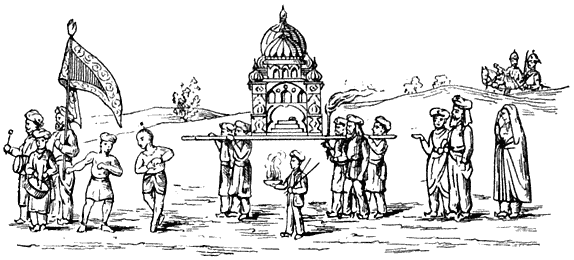
A MUHARRAM PROCESSION IN INDIA. (By a Native Artist.)
On the Roz-i-Qatl, or day of martyrdom, the tenth day, the Ambassador was invited by the King to be present at the termination of the ceremonies, in which the death of al-Ḥusain was to be represented. We set off after breakfast, and placed ourselves in a small tent, that was pitched for our accommodation over an arched gateway, which was situated close to the room in which His Majesty was to be seated.
We looked upon the great square which is in front of the palace, at the entrance of which we perceived a circle of Cajars, or people of the King’s own tribe, who were standing barefooted, and beating their breasts in cadence to the chaunting of one who stood in the centre, and with whom they now and then joined their voices in chorus. Smiting the breast is a universal act throughout the mourning; and the breast is made bare for that purpose, by unbuttoning the top of the shirt. The King, in order to show his humility, ordered the Cajars, among whom were many of his own relations, to walk about without either shoes or stockings, to superintend the order of the different ceremonies about to be performed, and they were to be seen stepping tenderly over the stones, with sticks in their hands, doing the duties of menials, now keeping back a crowd, then dealing out blows with their sticks, and settling the order of the processions.
Part of the square was partitioned off by an enclosure, which was to represent the town of Karbalāʾ, near which al-Ḥusain was put to death; and close to this were two small tents, which were to represent his encampment in the desert with his family. A wooden platform covered with carpets, upon which the actors were to perform, completed all the scenery used on the occasion.
A short time after we had reached our tent, the King appeared, and although we could not see him, yet we were soon apprised of his presence by all the people standing up, and by the bowing of his officers. The procession then commenced as follows:—First come a stout man, naked from the waist upwards, balancing in his girdle a long thick pole, surmounted by an ornament made of tin, curiously wrought with devices from the Qurʾān, in height altogether about thirty feet. Then another, naked like the former, balanced an ornamental pole in his girdle still more ponderous, though not so high, upon which a young darvesh resting his feet upon the bearer’s girdle had placed himself, chaunting verses with all his might in praise of the King. After him a person of more strength and more nakedness, a water carrier, walked forwards, bearing an immense leather sack filled with water slung over his back. This personage, we were told, was emblematical of the great thirst which al-Ḥusain suffered in the desert.
A litter in the shape of a sarcophagus, which was called Qabr-i-Ḥusain, or the tomb of al-Ḥusain (a Tāʿziyah) succeeded, borne on the shoulders of eight men. On its front was a large oval ornament entirely covered with precious stones, and just above it, a great diamond star. On a small projection were two tapers placed on candlesticks enriched with jewels. The top and sides were covered with Cashmere shawls, and on the summit rested a turban, intended to represent the head-dress of the K͟halīfah. On each side walked two men bearing poles, from which a variety of beautiful shawls were suspended. At the top of which were representations of al-Ḥusain’s hand studded with jewellery.
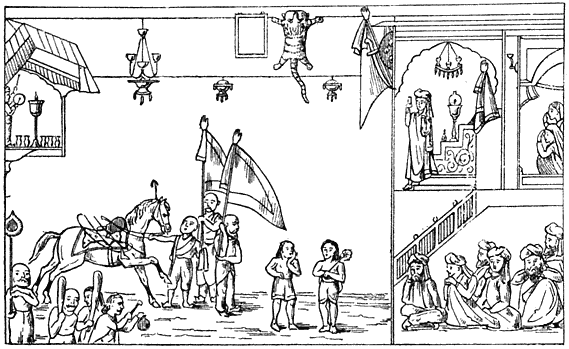
THE MUHARRAM CEREMONIES IN THE IMAMBARAH OR TAKIAH IN INDIA.
(By a Native Artist.)
After this came four led horses, caparisoned in the richest manner. The fronts of their heads were ornamented with plates, entirely covered with diamonds, that emitted a thousand beautiful rays. Their bodies were dressed with shawls and gold stuffs; and on their saddles were placed some objects emblematical of the death of al-Ḥusain. When all these had passed, they arranged themselves in a row to the right of the King’s apartment.
After a short pause, a body of fierce-looking men, with only a loose white sheet thrown over their naked bodies, marched forwards. They were all begrimed with blood; and each brandishing a sword, they sang a sort of a hymn, the tones of which were very wild. These represented the sixty-two relations, or the Martyrs, as the Persians call them, who accompanied al-Ḥusain, and were slain in defending him. Close after them was led a white horse, covered with artificial wounds, with arrows stuck all about him, and caparisoned in black, representing the horse upon which al-Ḥusain was mounted when he was killed. A band of about fifty men, striking two pieces of wood together in their hands, completed the procession. They arranged themselves in rows before the King, and marshalled by a maître de ballet, who stood in the middle to regulate their movements, they performed a dance, clapping their hands in the best possible time. The maître de ballet all this time sang in recitative, to which the dancers joined at different intervals with loud shouts and reiterated clapping of their pieces of wood.
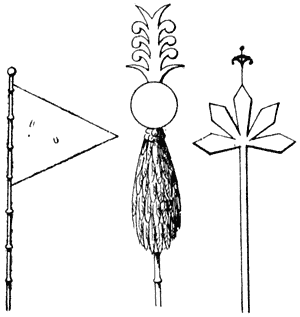
MUHARRAM STANDARDS.

HUSAIN’S HAND AND STANDARD.
The two processions were succeeded by the tragedians. Al-Ḥusain came forward, followed by his wives, sisters, and first relatives. They performed many long and tedious acts; but as our distance from the stage was too great to hear the many affecting things which they no doubt said to each other, we will proceed at once to where the unfortunate al-Ḥusain lay extended on the ground, ready to receive the death-stroke from a ruffian dressed in armour, who acted the part of executioner. At this moment a burst of lamentation issued from the multitude, and heavy sobs and real tears came from almost every one of those who were near enough to come under our inspection. The indignation of the populace wanted some object upon which to vent itself, and it fell upon those of the actors who had performed the part of Yazīd’s soldiers. No sooner was al-Ḥusain killed, than they were driven off the ground by a volley of stones, followed by shouts of abuse. We were informed that it is so difficult to procure performers to fill these characters, that on the present occasion a party of Russian prisoners were pressed into the army of Yazīd, and they made as speedy an exit after the catastrophe as it was in their power.
The scene terminated by the burning of Karbalāʾ. Several reed huts had been constructed behind the enclosure before mentioned, which of a sudden were set on fire. The tomb of al-Ḥusain was seen covered with black cloth, and upon it sat a figure disguised in a tiger’s skin, which was intended to represent the miraculous lion, recorded to have kept watch over his remains after he had been buried. The most extraordinary part of the whole exhibition was the representation of the dead bodies of the martyrs; who having been decapitated, were all placed in a row, each body with a head close to it. To effect this, several Persians buried themselves alive, leaving the head out just above ground; whilst others put their heads under ground, leaving out the body. The heads and bodies were placed in such relative positions to each other, as to make it appear that they had been severed. This is done by way of penance; but in hot weather, the violence of the exertion has been known to produce death. The whole ceremony was terminated by a k͟hut̤bah, or oration, in praise of al-Ḥusain. (Morier’s Second Journey through Persia.)