Volume 4 — Nai
Reading edition
List of Paragraphs
1. Structure of the caste
2. Marriage and other customs
3. Occupation
4. Other services
5. Duties at weddings
6. The barber-surgeon
7. A barber at the court of Oudh
8. Character and position of the barber
9. Beliefs about hair
10. Hair of kings and priests
11. The beard
12. Significance of removal of the hair and shaving the head
13. Shaving the head by mourners
14. Hair offerings
15. Keeping hair unshorn during a vow
16. Disposal of cut hair and nails
17. Superstitions about shaving the hair
18. Reasons why the hair was considered the source of strength
1. Structure of the caste
2. Marriage and other customs
The exogamous groups are known as khero or kul, and marriage between members of the same group is prohibited. Girls are usually wedded between the ages of eight and twelve and boys between fifteen and twenty. A girl who goes wrong before marriage is finally expelled from the caste. The wedding ceremony follows the ritual prevalent in the locality as described in the articles on Kurmi and Kunbi. At an ordinary wedding the expenses on the girl’s side amount to about Rs. 150, and on the boy’s to Rs. 200. The remarriage of widows is permitted. In the northern Districts the widow may wed the younger brother of her deceased husband, but in the Marātha country she may not be married to any of his relatives. Divorce may be effected at the instance of the husband before the caste committee, and a divorced woman is at liberty to marry again. The Nais worship all the ordinary Hindu deities. On the Dasahra and Diwāli festivals they wash and revere their implements, the razor, scissors and nail-pruners. They pay regard to omens. It is unpropitious to sneeze or hear the report of a gun when about to commence any business; and when a man is starting on a journey, if a cat, a squirrel, a hare or a snake should cross the road in front of him he will give it up and return home. The bodies of the dead are usually burnt. In Chhattīsgarh the poor throw the corpses of their dead into the Mahānadi, and the bodies of children dying under one year of age were until recently buried in the courtyard of the house. The period of mourning for adults is ten days and for children three days. The chief mourner must take only one meal a day, which he cooks himself until the ceremony of the tenth day is performed.
3. Occupation
4. Other services
After he has shaved a client the barber pinches and rubs his arms, presses his fingers together and cracks the joints of each finger, this last action being perhaps meant to avert evil spirits. He also does massage, a very favourite method of treatment in India, and also inexpensive as compared with Europe. For one rupee a month in towns the barber will come and rub a man’s legs five or ten minutes every day. Cultivators have their legs rubbed in the sowing season, when the labour is intensely hard owing to the necessity of sowing all the land in a short period. If a man is well-to-do he may have his whole head and body rubbed with scented oil. Landowners have often a barber as a family servant, the office descending from father to son. Such a man will light his master’s chilam (pipe-bowl) or huqqa (water-pipe), clean and light lamps, prepare his bed, tell his master stories to send him to sleep, act as escort for the women of the family when they go on a journey and arrange matches for the children. The barber’s wife attends on women in child-birth after the days of pollution are over, and rubs oil on the bodies of her clients, pares their nails and paints their feet with red dye at marriages and on other festival occasions.
5. Duties at weddings
6. The barber-surgeon
7. A barber at the court of Oudh
“‘Ha, Khan!’ said the king, observing him; ‘the monthly bill, is it?’
“‘It is, your majesty,’ was the smiling reply.
“‘Come, out with it; let us see the extent. Unroll it, Khan.’
“The king was in a playful humour; and the barber was always in the same mood as the king. He held the end of the roll in his hand, and threw the rest along the floor, allowing it to unroll itself as it retreated. It reached to the other side of the long apartment—a goodly array of items and figures, closely written too. The king wanted it measured. A measure was brought and the bill was found to be four yards and a half long. I glanced at the amount; it was upwards of Rs. 90,000, or £9000!”
8. Character and position of the barber
Nai hai chhattīsa Khai an ka pīsa,
9. Beliefs about hair
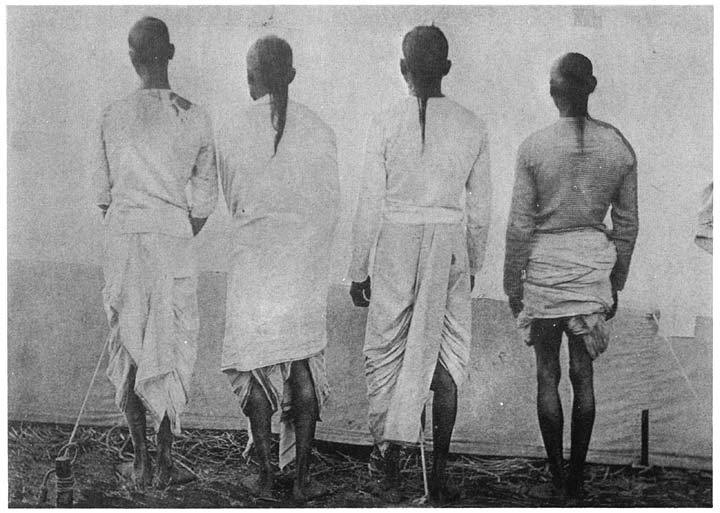
Hindu men showing the choti or scalp-lock
10. Hair of kings and priests
11. The beard
12. Significance of removal of the hair and shaving the head
13. Shaving the head by mourners
14. Hair offerings
Another case of the hair offering is that made in fulfilment of a vow or at a temple. In this case the hair appears to be a gift-offering which is made to the god as representing the life and strength of the donor; owing to the importance attached to the hair as the source of life and strength, it was a very precious sacrifice. Sir James Frazer also suggests that the hair so given would impart life and strength to the god, of which he stood in need, just as he needed food to nourish him. Among the Hindus it is a common practice to take a child to some well-known temple to have its hair cut for the first time, and to offer the clippings of hair to the deity. If they cannot go to the temple to have the hair cut they have it cut at home, and either preserve the whole hair or a lock of it, until an opportunity occurs to offer it at the temple. In some castes a Brāhman is invited at the first cutting of a child’s hair, and he repeats texts and blesses the child; the first lock of hair is then cut by the child’s maternal uncle, and its head is shaved by the barber. A child’s hair is cut in the first, third or fifth year after birth, but not in the second or fourth year. Among the Muhammadans when a child’s hair is cut for the first time, or at least on one occasion in its life, the hair should be weighed against silver or gold and the amount distributed in charity. In these cases also it would appear that the hair as a valuable part of the child is offered to the god to obtain his protection for the life of the child. If a woman has no child and desires one, or if she has had children and lost them, she will vow her next child’s hair to some god or temple. A small patch known as chench is then left unshorn on the child’s head until it can be taken to the temple.
15. Keeping hair unshorn during a vow
16. Disposal of cut hair and nails
Cut no horn On the Sabbath morn.
Among some Hindus it is said that the toe-nails should not be cut at all until a child is married, when they are cut ceremoniously by the barber.