Volume 4 — Thug
Reading edition
[This article is based almost entirely on Colonel (Sir William) Sleeman’s Rāmaseeāna or Vocabulary of the Thugs (1835). A small work, Hutton’s Thugs and Dacoits, has been quoted for convenience, but it is compiled entirely from Colonel Sleeman’s Reports. Another book by Colonel Sleeman, Reports on the Depredations of the Thug Gangs, is mainly a series of accounts of the journeys of different gangs and contains only a very brief general notice.]
List of Paragraphs
1. Historical notice
2. Thuggees depicted in the caves of Ellora
3. Origin of the Thugs
4. Methods of assassination
5. Account of certain murders
6. Special incidents (continued)
7. Disguises of the Thugs
8. Secrecy of their operations
9. Support of landholders and villagers
10. Murder of sepoys
11. Callous nature of the Thugs
12. Belief in divine support
13. Theory of Thuggee as a religious sect
14. Worship of Kāli
15. The sacred pickaxe
16. The sacred gur (sugar)
17. Worship of ancestors
18. Fasting
19. Initiation of a novice
20. Prohibition of murder of women
21. Other classes of persons not killed
22. Belief in omens
23. Omens and taboos
24. Nature of the belief in omens
25. Suppression of Thuggee
1. Historical notice
Thug, Phānsigar.—The famous community of murderers who were accustomed to infest the high-roads and strangle travellers for their property. The Thugs are, of course, now extinct, having been finally suppressed by measures taken under the direction of Colonel Sleeman between 1825 and 1850. The only existing traces of them are a small number of persons known as Goranda or Goyanda in Jubbulpore, the descendants of Thugs employed in the school of industry which was established at that town. These work honestly for their living and are believed to have no marked criminal tendencies. In the course of his inquiries, however, Colonel Sleeman collected a considerable mass of information about the Thugs, some of which is of ethnological interest, and as the works in which this is contained are out of print and not easily accessible, it seems desirable to record a portion of it here. The word Thug signifies generically a cheat or robber, while Phānsigar, which was the name used in southern India, is derived from phānsi, a noose, and means a strangler. The form of robbery and murder practised by these people was probably of considerable antiquity, and is referred to as follows by a French traveller, Thevenot, in the sixteenth century:
This passage seems to demonstrate an antiquity of three centuries for the Thugs down to 1850. But during the period over which Sir William Sleeman’s inquiries extended women never accompanied them on their expeditions, and were frequently even, as a measure of precaution, left in ignorance of the profession of their husbands.
2. Thuggees depicted in the caves of Ellora
The Thugs themselves believed that the operations of their trade were depicted in the carvings of the Ellora caves, and a noted leader, Feringia, and other Thugs spoke of these carvings as follows: “Every one of the operations is to be seen there: in one place you see men strangling; in another burying the bodies; in another carrying them off to the graves. Whenever we passed near we used to go and see these caves. Every man will there find his trade described and they were all made in one night.
“Everybody there can see the secret operations of his trade; but he does not tell others of them; and no other person can understand what they mean. They are the works of God. No human hands were employed on them. That everybody admits.”
Another Thug: “I have seen there the Sotha (inveigler) sitting upon the same carpet as the traveller, and in close conversation with him, just as we are when we worm out their secrets. In another place the strangler has got his rūmāl (handkerchief) over his neck and is strangling him; while another, the Chamochi, is holding him by the legs.” I do not think there is any reason to suppose that these carvings really have anything to do with the Thugs.
3. Origin of the Thugs
4. Methods of assassination
5. Account of certain murders
6. Special incidents (continued)
7. Disguises of the Thugs
8. Secrecy of their operations
9. Support of landholders and villagers
10. Murder of sepoys
11. Callous nature of the Thugs
And again: “The most extraordinary trait in the characters of these people is not this that they can look back upon all the murders they have perpetrated without any feelings of remorse, but that they can look forward indifferently to their children, whom they love as tenderly as any man in the world, following the same trade of murder or being united in marriage to men who follow the trade. When I have asked them how they could cherish these children through infancy and childhood under the determination to make them murderers or marry them to murderers, the only observation they have ever made was that formerly there was no danger of their ever being hung or transported, but that now they would rather that their children should learn some less dangerous trade.”
12. Belief in divine support
13. Theory of Thuggee as a religious sect
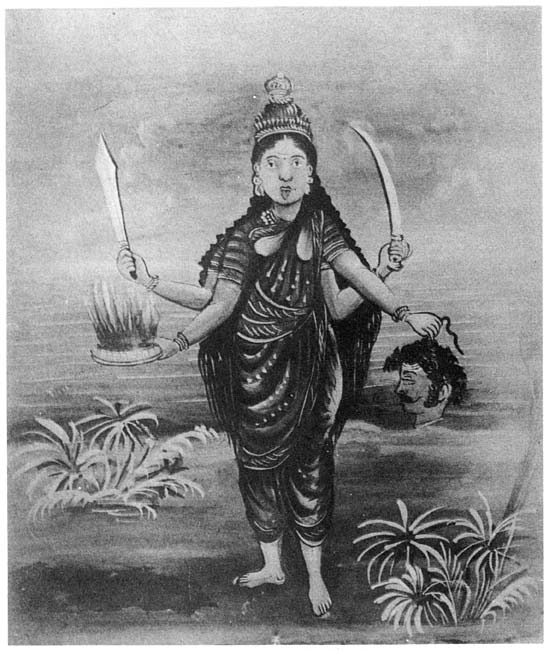
The Goddess Kāli
The veneration paid to the pickaxe, which will shortly be described, merely arises from the common animistic belief that tools and implements generally achieve the results obtained from them by their inherent virtue and of their own volition, and not from the human hand which guides them and the human brain which fashioned them to serve their ends. Members of practically all castes worship the implements of their profession and thus afford evidence of the same belief, the most familiar instance of which is perhaps, ‘The pestilence that walketh in the darkness and the arrow that flieth by noonday’; where the writer intended no metaphor but actually thought that the pestilence walked and the arrow flew of their own volition.
14. Worship of Kāli
Kāli or Bhawāni was the principal deity of the Thugs, as of most of the criminal and lower castes; and those who were Muhammadans got over the difficulty of her being a Hindu goddess by pretending that Fātima, the daughter of the Prophet, was an incarnation of her. In former times they held that the goddess was accustomed to relieve them of the trouble of destroying the dead bodies by devouring them herself; but in order that they might not see her doing this she had strictly enjoined on them never to look back on leaving the site of a murder. On one occasion a novice of the fraternity disobeyed this rule and, unguardedly looking behind him, saw the goddess in the act of feasting upon a body with the half of it hanging out of her mouth. Upon this she declared that she would no longer devour those whom the Thugs slaughtered; but she agreed to present them with one of her teeth for a pickaxe, a rib for a knife and the hem of her lower garment for a noose, and ordered them for the future to cut about and bury the bodies of those whom they destroyed. As there seems reason to suppose that the goddess Kāli represents the deified tiger, on which she rides, she was eminently appropriate as the patroness of the Thugs and in the capacity of the devourer of corpses.
15. The sacred pickaxe
16. The sacred gur (sugar)
The eating of this gur was clearly the sacrificial meal of the Thugs. On the analogy of other races they should have partaken of the body of an animal god at their sacrificial meal, and if the goddess Kāli is the deified tiger, they should have eaten tiger’s flesh. This custom, if it ever existed, had been abandoned, and the gur would in that case be a substitute; and as has been seen the eating of the gur was held to confer on them the same cruelty, callousness and desire to kill which might be expected to follow from eating tiger’s flesh and thus assimilating the qualities of the animal. Since they went unarmed as a rule, in order to avoid exciting the suspicions of their victims, it would be quite impossible for them to obtain tiger’s flesh, except by the rarest accident; and the gur might be considered a suitable substitute, since its yellow colour would be held to make it resemble the tiger.
17. Worship of ancestors
The Thugs also worshipped the spirits of their ancestors. One of these was Dādu Dhira, an ancient Thug of the Barsote class, who was invoked at certain religious ceremonies, when liquor was drunk. Vows were made to offer libations of ardent spirits to him, and if the prayer was answered the worshipper drank the liquor, or if his caste precluded him from doing this, threw it on the ground with an expression of thanks. Another deity was the spirit of Jhora Nāik, who was a Muhammadan. He and his servant killed a man who had jewels and other articles laden on a mule to the value of more than a lakh and a half. They brought home the booty, assembled all the members of their fraternity within reach, and honestly divided the whole as if all had been present The Thugs also said that Nizām-ud-dīn Aulia, a well-known Muhammadan saint, famed for his generosity, whose shrine is near Delhi, had been a Thug, at any rate in his younger days. He distributed so much money in charity that he was supposed to be endowed with a Dustul Ghīb or supernatural purse; and they supposed that he obtained it by the practice of Thuggee. Orthodox Muhammadans would, however, no doubt indignantly repudiate this.
18. Fasting
Whenever they set out on a fresh expedition the first week was known as Satha (seven). During this period the families of those who were engaged in it would admit no visitors from the relatives of other Thugs, lest the travellers destined for their own gang should go over to these others; neither could they eat any food belonging to the families of other Thugs. During the Satha period the Thugs engaged in the expedition ate no animal food except fish and nothing cooked with ghī (melted butter). They did not shave or bathe or have their clothes washed or indulge in sexual intercourse, or give away anything in charity or throw any part of their food to dogs or jackals. At one time they ate no salt or turmeric, but this rule was afterwards abandoned. But if the Sourka or first murder took place within the seven days they considered themselves relieved by it from all these restraints.
19. Initiation of a novice
20. Prohibition of murder of women
21. Other classes of persons not killed
Another rule was that a man having a cow with him should not be murdered, no doubt on account of the sanctity attaching to the animal. But in one case of a murder of fourteen persons including women and a man with a cow at Kotri in the Damoh District, the Thugs, having made acquaintance with the party, pretended that they had made a vow to offer a cow at a temple in Shāhpur lying on their road and persuaded the cow’s owner to sell her to them for this sacred purpose, and having duly made the offering and deprived him of the protection afforded by the cow, they had no compunction in strangling him with all the travellers. Travellers who had lost a limb were also exempted from death, but this rule too was broken, as in the case of the native officer with his two daughters who was murdered by the Thugs he had befriended; for it is recorded that this man had lost a leg. Pilgrims carrying Ganges water could not be killed if they actually had the Ganges water with them; and others who should not be murdered were washermen, sweepers, oil-vendors, dancers and musicians, carpenters and blacksmiths, if found travelling together, and religious mendicants. The reason for the exemption of carpenters and blacksmiths only when travelling together may probably have been that the sacred pickaxe was their joint handiwork, having a wooden handle and an iron head; and this seems a more likely explanation than any other in view of the deep veneration shown for the pickaxe. Maimed persons would probably not be acceptable victims to the goddess, according to the rule that the sacrifice must be without spot or blemish. The other classes have already been discussed under the exemption of first victims. Among the Deccan Thugs if a man strangled any victim of a class whom it was forbidden to kill, he was expelled from the community and never readmitted to it. This was considered a most dreadful crime.
22. Belief in omens
23. Omens and taboos
24. Nature of the belief in omens
25. Suppression of Thuggee
When the suppression of the Thugs was seriously taken in hand by the Thuggee and Dacoity Department under the direction of Sir William Sleeman, this abominable confraternity, which had for centuries infested the main roads of India and made away with tens of thousands of helpless travellers, never to be heard of again by their families and friends, was destroyed with comparatively little difficulty. The Thugs when arrested readily furnished the fullest information of their murders and the names of their confederates in return for the promise of their lives, and Colonel Sleeman started a separate file or dossier for every Thug whose name became known to him, in which all information obtained about him from different informers was collected. In this manner, as soon as a man was arrested and identified, a mass of evidence was usually at once forthcoming to secure his conviction. Between 1826 and 1835 about 2000 Thugs were arrested and hanged, transported or kept under restraint; subsequently to this a larger number of British officers were deputed to the work of hunting down the Thugs, and by 1848 it was considered that this form of crime had been practically stamped out. For the support of the approver Thugs and the families of these and others a labour colony was instituted at Jubbulpore, which subsequently developed into the school of industry and was the parent of the existing Reformatory School. Here these criminals were taught tent and carpet-making and other trades, and in time grew to be ashamed of the murderous calling in which they had once taken a pride.