Volume 4 — Murha
Reading edition
1. Origin of the caste
2. Marriage customs
In Narsinghpur the Murhas appear to have no regular exogamous divisions. Some of them remember the names of their kheros or ancestral villages and do not marry with families belonging to the same khero, but this is not a regular rule of the caste. Generally speaking, persons descended through males from a common ancestor do not intermarry so long as they remember the relationship. In Mandla they have five divisions, of which the highest is Pūrbia. The name Pūrbia (Eastern) is commonly applied in the Central Provinces to persons coming from Oudh, and in this case the Pūrbia Murhas are probably the latest immigrants from home and have a superior status on this account. Up till recently they practised hypergamy with the other groups, taking daughters from them in marriage, but not giving their daughters to them. This rule is now, however, breaking down on account of the difficulty they find in getting their daughters married. The children of brothers and sisters may marry in some places, but in others neither they nor their children may marry with each other. Anta Sānta or the exchange of girls between two families is permitted. The bridegroom’s father has to pay from five to twenty rupees as a chari or bride-price to the girl’s father, which sum is regarded as the remuneration of the latter for having brought up his daughter. In the case of the daughter of a headman the bride-price is sometimes as high as Rs. 150. In Damoh a curious survival of marriage by capture remains. The bridegroom’s party give a ram or he-goat to the bride’s party and these take it to their shed, cut its head off and hang it by the side of the khām or marriage-pole. The brother-in-law of the bridegroom or of his father then sallies forth to bring back the head of the animal, but is opposed by the women of the bride’s party, who belabour him and his friends with sticks, brooms and rolling-pins. But in the end the head is always taken away. The binding portion of the marriage is the bhānwar or walking round the sacred post. When the bride is leaving for her husband’s house the women of her party take seven balls of flour with burning wicks thrust into them, and place them in a winnowing-fan. They wave this round the bride’s head and then throw the balls and after them the fan over the litter in which the bride is seated. The bridegroom’s party must catch the fan, and if they let it fall to the ground they are much laughed at for their clumsiness. When the pair arrive at the bridegroom’s house, the fan is again waved over their heads; and a cloth is spread before the house, on which seven burning wicks are placed like the previous ones. The bride walks quickly over the cloth to the house and the bridegroom must keep pace with her, picking up the burning flour balls as he goes. When the pair arrive at the house the bridegroom’s sister shuts the door and will not open it until she is given a present. Divorce and the remarriage of widows are permitted.
3. Funeral rites
The caste worship the ordinary Hindu deities. Well-to-do members burn their dead and the poorer ones bury them. The corpse is usually placed with the head to the south as is the custom among the primitive tribes, but in some localities the Hindu fashion of laying the head to the north has been adopted. Two pice are thrown down by the grave or burning-ghāt to buy the site, and these are taken by the sweeper. The ashes are collected on the third day and thrown into a river. The usual period of mourning is only three days, but it is sometimes extended to nine days when the chief mourner is unable to feed the caste-fellows on the third day, and the feast may in case of necessity be postponed to any time within six months of the death. The chief mourner puts on a new white cloth and eats nothing but rice and pulse without salt.
4. Occupation
The caste are employed on all kinds of earthwork, such as building walls, excavating trenches, and making embankments in fields. Their trade implements consist of a pickaxe, a basket, and a thin wooden hod to fill the earth into the basket. The Murha invokes these as follows: “Oh! my lord the basket, my lord the pickaxe shaped like a snake, and my lady the hod, come and eat up those who do not pay me for my work!” The Murhas are strict in their rules about food and will not accept cooked food even from a Brāhman, but notwithstanding this, their social position is so low that not even a sweeper would take food from them. The caste eat flesh and drink liquor, but abstain from fowls, pork and beef. They engage Brāhmans on the occasion of births and marriages, but not usually for funerals. The women tattoo their bodies after marriage, and the charge for this should always be paid by the maternal uncle’s wife, the paternal aunt, or some other similar relation of the girl. The fact that among most Hindus a girl must be tattooed before leaving for her husband’s house, and that the cost of the operation must always be paid for by her own family, seems to indicate that tattooing was formerly a rite of puberty for the female sex. A wife must not mention the name of her husband or of any person who stands in the relation of father, mother, uncle or aunt to him. Parents do not call their eldest son by his proper name, but by some pet name. Women are impure for five days during menstruation and are not allowed to cook for that period. The Murhas have a caste panchāyat or committee, the head of which is known as Patel or Mukhia, the office being hereditary. He receives a part of all fines levied for the commission of social offences. In appearance the caste are dark and short of stature, and have some resemblance to the Kols.
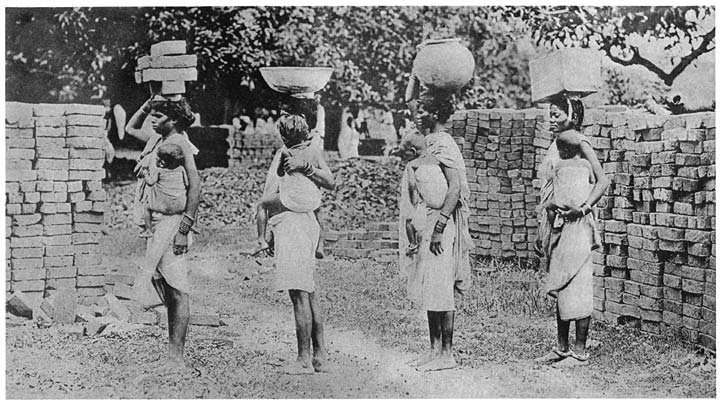
Coolie women with babies slung at the side
5. Women’s song
In conclusion, I reproduce one of the songs which the women sing as they are carrying the basketfuls of earth or stones at their work; in the original each line consists of two parts, the last words of which sometimes rhyme with each other:
Our mother Nerbudda is very kind; blow, wind, we are hot with labour.
He said to the Maina: Go, carry my message to my love.
The red ants climb up the mango-tree; and the daughter follows her mother’s way.
I have no money to give her even lime and tobacco; I am poor, so how can I tell her of my love.
The boat has gone down on the flood of the Nerbudda; the fisherwoman is weeping for her husband.
She has no bangles on her arm nor necklace on her neck; she has no beauty, but seeks her lovers throughout the village.
Bread from the girdle, curry from the lota; let us go, beloved, the moon is shining.
The leaves of gram have been plucked from the plants; I think much on Dadaria, but she does not come.
The love of a stranger is as a dream; think not of him, beloved, he cannot be yours.
Twelve has struck and it is thirteen time (past the time of labour); oh, overseer, let your poor labourers go.
The betel-leaf is pressed in the mouth (and gives pleasure); attractive eyes delight the heart.
Catechu, areca and black cloves; my heart’s secret troubles me in my dreams.
The Nerbudda came and swept away the rubbish (from the works); fly away, bees, do not perch on my cloth.
The colour does not come on the wheat; her youth is passing, but she cannot yet drape her cloth on her body.
Like the sight of rain-drops splashing on the ground; so beautiful is she to look upon.
It rains and the hidden streams in the woodland are filled (and come to view); hide as long as you may, some day you must be seen.
The mahua flowers are falling from the trees on the hill; leave me your cloth so that I may know you will return.
He went to the bazār and brought back a cocoanut; it is green without, but insects are eating the core.
He went to the hill and cut strings of bamboo; you cannot drape your cloth, you have wound it round your body.
The coral necklace hangs on the peg; if you become the second wife of my husband I shall give you clothes.
She put on her clothes and went to the forest; she met her lover and said you are welcome to me.
He went to the bazār and bought potatoes; but if he had loved me he would have brought me liquor.
The fish in the river are on the look-out; the Brāhman’s daughter is bathing with her hair down.
The arhar-stumps stand in the field; I loved one of another caste, but must give him up.
He ate betel and coloured his teeth; his beloved came from without and knew him.
The ploughmen are gone to the field; my clever writer is gone to the court-house.
The broken areca-nuts lie in the forest; when a man comes to misfortune no one will help him.
The broken areca-nuts cannot be mended; and two hearts which are sundered cannot be joined.
Ask me for five rupees and I will give you twenty-five; but I will not give my lover for the whole world.
I will put bangles on my arm; when the other wife sees me she will die of jealousy.
Break the bangles which your husband gave you; and put others on your wrists in my name.
O my lover, give me bangles; make me armlets, for I am content with you.
I had gone to the bazār and bought fish; she is so ugly that the flies would not settle on her.