Volume 4 — Māli
Reading edition
List of Paragraphs
1. General notice of the caste, and its social position
2. Caste legend
3. Flowers offered to the gods
4. Custom of wearing garlands
5. Sub-castes
6. Marriage
7. Widow-marriage, divorce and polygamy
8. Disposal of the dead
9. Religion
10. Occupation
11. Traits and character
12. Other functions of the Māli
13. Physical appearance
1. General notice of the caste, and its social position
2. Caste legend
His services in providing flowers for the gods would be remunerated by contributions of grain from the cultivators, the acceptance of which would place the Māli below them in the rank of a village menial, though higher than most of the class owing to the purity of his occupation. His status was probably much the same as that of the Guraos or village priests of Mahādeo in the Marātha country. And though he has now become a cultivator, his position has not improved to the level of other cultivating castes for the reasons already given. It was probably the necessity of regularly watering his plants in order to obtain a longer and more constant supply of blooms which first taught the Māli the uses of irrigation.
3. Flowers offered to the gods
Flowers are par excellence suited for the offerings and adornment of the gods, and many Hindus have rose or other plants in their houses whose flowers are destined to the household god. There is little reason to doubt that this was the purpose for which cultivated flowers were first grown. The marigold, lotus and champak are favourite religious flowers, while the tulsi or basil is itself worshipped as the consort of Vishnu; in this case, however, the scent is perhaps the more valued feature. In many Hindu households all flowers brought into the house are offered to the household god before being put to any other use. A Brāhman school-boy to whom I had given some flowers to copy in drawing said that his mother had offered them to the god Krishna before he used them. When faded or done with they should be consigned to the sacred element, water, in any stream or river. The statues of the gods are adorned with sculptured garlands or hold them in their hands. A similar state of things prevailed in classical antiquity:
Who are these coming to the sacrifice? To what green altar, O mysterious priest, Lead’st thou that heifer lowing at the skies, And all her silken flanks with garlands drest?
And,
Fairer than these, though temple thou hast none, Nor altar decked with flowers, Nor virgin choir to make delicious moan Upon the midnight hours.
4. Custom of wearing garlands
5. Sub-castes
The caste has numerous endogamous groups, varying in different localities. The Phūlmālis, who derive their name from their occupation of growing and selling flowers (phūl), usually rank as the highest. The Ghāse Mālis are the only subcaste which will grow and prepare turmeric in Wardha; but they will not sell milk or curds, an occupation to which the Phūlmālis, though the highest subcaste, have no objection. In Chānda the Kosaria Mālis, who take their name from Kosala, the classical designation of the Chhattīsgarh country, are the sole growers of turmeric, while in Berār the Halde subcaste, named after the plant, occupy the same position. The Kosaria or Kosre subcaste abstain from liquor, and their women wear glass bangles only on one hand and silver ones on the other. The objection entertained to the cultivation of turmeric by Hindus generally is said to be based on the fact that when the roots are boiled numbers of small insects are necessarily destroyed; but the other Mālis relate that one of the ancestors of the caste had a calf called Hardulia, and one day he said to his daughter, Haldi pakā, or ‘Cook turmeric.’ But the daughter thought that he said ‘cook Hardulia,’ so she killed and roasted the calf, and in consequence of this her father was expelled from the caste, and his descendants are the Ghāse or Halde subcaste. Ever since this happened the shape of a calf may be seen in the flower of turmeric. This legend has, however, no real value and the meaning of the superstition attaching to the plant is obscure. Though the growing of turmeric is tabooed yet it is a sacred plant, and no Hindu girl, at least in the Central Provinces, can be married without having turmeric powder rubbed on her body. Mr. Gordon remarks in Indian Folk-Tales: “I was once speaking to a Hindu gardener of the possibility of turmeric and garlic being stolen from his garden. ‘These two vegetables are never stolen,’ he replied, ‘for we Hindus believe that he who steals turmeric and garlic will appear with six fingers in the next birth, and this deformity is always considered the birth-mark of a thief.’” The Jīre Mālis are so named because they were formerly the only subcaste who would grow cumin (jira), but this distinction no longer exists as other Mālis, except perhaps the Phūlmālis, now grow it. Other subcastes have territorial names, as Baone from Berār, Jaipuria, Kanaujia, and so on. The caste have also exogamous septs or bargas, with designations taken from villages, titles or nicknames or inanimate objects.
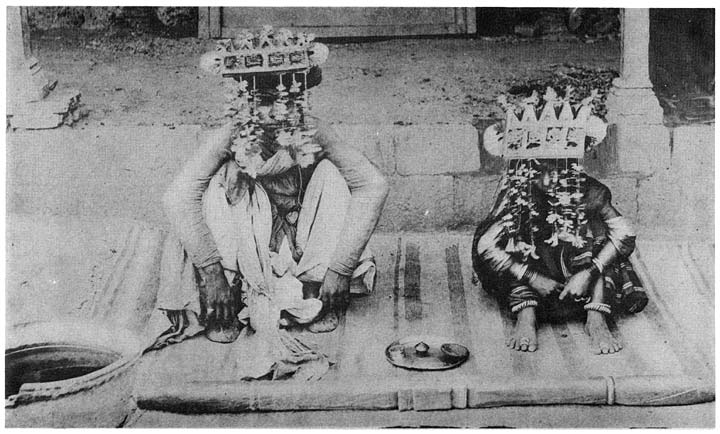
Bride and bridegroom with marriage crowns
6. Marriage
7. Widow-marriage, divorce and polygamy
8. Disposal of the dead
The dead may be either buried or burnt; in the former case the corpse is laid with the feet to the north. Mourning is observed only for three days and propitiatory offerings are made to the spirits of the dead. If a man is killed by a tiger his family make a wooden image of a tiger and worship it.
9. Religion
10. Occupation
Marār, Māli jote tāli Tāli margayi, dhare kudāli
or, ‘The Marār yokes cows; if the cow dies he takes to the pickaxe’; implying that he is not usually rich enough to keep bullocks.” The saying has also a derogatory sense, as no good Hindu would yoke a cow to the plough. Another form of lift used by the Kāchhis is the Persian wheel. In this two wheels are fixed above the well or tank and long looped ropes pass over them and down into the well, between which a line of earthen pots is secured. As the ropes move on the wheels the pots descend into the well, are filled with water, brought up, and just after they reach the apex of the wheel and turn to descend again, the water pours out to a hollow open tree-trunk, from which a channel conveys it to the field. The wheel which turns the rope is worked by a man pedalling, but he cannot do more than about three hours a day. The common lift for gardens is the mot or bag made of the hide of a bullock or buffalo. This is usually worked by a pair of bullocks moving forwards down a slope to raise the mot from the well and backwards up the slope to let it down when empty.
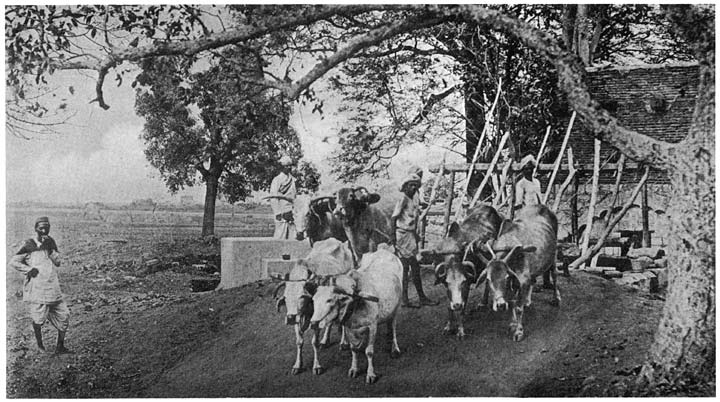
Bullocks drawing water with mot
11. Traits and character
“It is necessary,” the account continues, “for the Marār’s business for one member at least of his family to go to market with his vegetables; and the Marārin is a noteworthy feature in all bazārs, sitting with her basket or garment spread on the ground, full of white onions and garlic, purple brinjals and scarlet chillies, with a few handfuls of strongly flavoured green stuff. Whether from the publicity which it entails on their women or from whatever cause, the Marārin does not bear the best of reputations for chastity; and is usually considered rather a bold, coarse creature. The distinctive feature of her attire is the way in which she ties up her body-cloth so as to leave a tail sticking up behind; whence the proverb shouted after her by rude little boys: ‘Jump from roof to roof, Monkey. Pull the tail of the Marārin, Monkey,’ She also rejoices in a very large tikli or spangle on her forehead and in a peculiar kind of angia (waistcoat). The caste are usually considered rather clannish and morose. They live in communities by themselves, and nearly always inhabit a separate hamlet of the village. The Marārs of a certain place are said to have boycotted a village carpenter who lost an axe belonging to one of their number, so that he had to leave the neighbourhood for lack of custom.”
12. Other functions of the Māli
Many Mālis live in the towns and keep vegetable- or flower-gardens just outside. They sell flowers, and the Māli girls are very good flower-sellers, Major Sutherland says, being famous for their coquetry. A saying about them is: “The crow among birds, the jackal among beasts, the barber among men and the Mālin among women; all these are much too clever.” The Māli also prepares the maur or marriage-crown, made from the leaves of the date-palm, both for the bride and bridegroom at marriages. In return he gets a present of a rupee, a piece of cloth and a day’s food. He also makes the garlands which are used for presentation at entertainments, and supplies the daily bunches of flowers which are required as offerings for Mahādeo. The Māli keeps garlands for sale in the bazār, and when a well-to-do person passes he goes up and puts a garland round his neck and expects a present of a pice or two.
13. Physical appearance
“Physically,” Mr. Low states, “the Marār is rather a poor-looking creature, dark and undersized; but the women are often not bad looking, and dressed up in their best at a wedding, rattling their castanets and waving light-coloured silk handkerchiefs, give a very graceful dance. The caste are not as a rule celebrated for their cleanliness. A polite way of addressing a Marār is to call him Patel.”