Volume 4 — Pardhān
Reading edition
List of Paragraphs
1. General notice
2. Tribal Subdivisions
3. Marriage
4. Religion
5. Social Customs
6. Methods of cheating among Pathāris
7. Musicians and priests
1. General notice
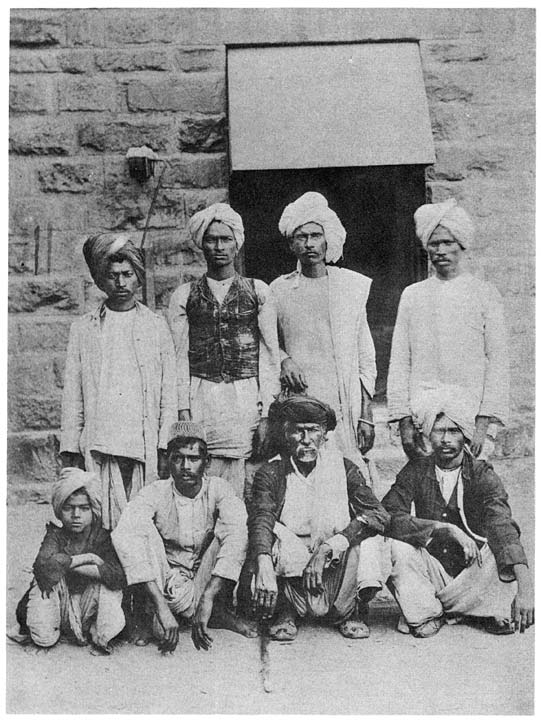
Group of Pardhāns
2. Tribal Subdivisions
The tribe have several endogamous divisions, of which the principal are the Rāj Pardhāns, the Gānda Pardhāns and the Thothia Pardhāns. The Rāj Pardhāns appear to be the descendants of alliances between Raj Gonds and Pardhān women. They say that formerly the priests of Bura Deo lived a celibate life, and both men and women attended to worship the god; but on one occasion the priests ran away with some women and after this the Gonds did not know who should be appointed to serve the deity. While they were thus perplexed, a kingri (or rude wooden lyre) fell from heaven on to the lap of one of them, and, in accordance with this plain indication of the divine will, he became the priest, and was the ancestor of the Rāj Pardhāns; and since this contretemps the priests are permitted to marry, while women are no longer allowed to attend the worship of Bura Deo. The Thothia subtribe are said to be the descendants of illicit unions, the word Thothia meaning ‘maimed’; while the Gāndas are the offspring of intermarriages between the Pardhāns and members of that degraded caste. Other groups are the Mādes or those of the Mād country in Chānda and Bastar, the Khalotias or those of the Chhattīsgarh plain, and the Deogarhias of Deogarh in Chhindwāra; and there are also some occupational divisions, as the Kandres or bamboo-workers, the Gaitas who act as priests in Chhattīsgarh, and the Arakhs who engage in service and sell old clothes. A curious grouping is found in Chānda, where the tribe are divided into the Gond Pathāris and Chor or ‘Thief’ Pathāris. The latter have obtained their name from their criminal propensities, but they are said to be proud of it and to refuse to intermarry with any families not having the designation of Chor Pathāri. In Raipur the Pathāris are said to be the offspring of Gonds by women of other castes, and the descendants of such unions. The exogamous divisions of the Pardhāns are the same as those of the Gonds, and like them they are split up into groups worshipping different numbers of gods whose members may not marry with one another.
3. Marriage
A Pardhān wedding is usually held in the bridegroom’s village in some public place, such as the market or cross-roads. The boy wears a blanket and carries a dagger in his hand. The couple walk five times round in a circle, after which the boy catches hold of the girl’s hand. He tries to open her fist which she keeps closed, and when he succeeds in this he places an iron ring on her little finger and puts his right toe over that of the girl’s. The officiating priest then ties the ends of their clothes together and five chickens are killed. The customary bride-price is Rs. 12, but it varies in different localities. A widower taking a girl bride has, as a rule, to pay a double price. A widow is usually taken in marriage by her deceased husband’s younger brother.
4. Religion
As the priests of the Gonds, the Pardhāns are employed to conduct the ceremonial worship of their great god Bura Deo, which takes place on the third day of the bright fortnight of Baisākh (April). Many goats or pigs are then offered to him with liquor, cocoanuts, betel-leaves, flowers, lemons and rice. Bura Deo is always enshrined under a tree outside the village, either of the mahua or sāj (Terminalia tomentosa) varieties. In Chhattīsgarh the Gonds say that the origin of Bura Deo was from a child born of an illicit union between a Gond and a Rāwat woman. The father murdered the child by strangling it, and its spirit then began to haunt and annoy the man and all his relations, and gradually extended its attentions to all the Gonds of the surrounding country. It finally consented to be appeased by a promise of adoration from the whole tribe, and since then has been installed as the principal deity of the Gonds. The story is interesting as showing how completely devoid of any supernatural majesty or power is the Gond conception of their principal deity.