Volume 4 — Sunār
Reading edition
List of Paragraphs
1. General notice of the caste
2. Internal structure
3. Marriage and other customs
4. Religion
5. Social position
6. Manufacture of ornaments
7. The sanctity of gold
8. Ornaments. The marriage ornaments
9. Beads and other ornaments
10. Ear-piercing
11. Origin of ear-piercing
12. Ornaments worn as amulets
13. Audhia Sunārs
14. The Sunār as money-changer
15. Malpractices of lower-class Sumārs
1. General notice of the caste
2. Internal structure
The caste have a number of subdivisions, nearly all of which are of the territorial class and indicate the various localities from which it has been recruited in these Provinces. The most important subcastes are the Audhia from Ajodhia or Oudh; the Purānia or old settlers; the Bundelkhandi from Bundelkhand; the Mālwi from Mālwa; the Lād from Lāt, the old name for the southern portion of Gujarāt; and the Mair, who appear to have been the first immigrants from Upper India and are named after Mair, the original ancestor, who melted down the golden demon. Other small groups are the Pātkars, so called because they allow pāt or widow-marriage, though, as a matter of fact, it is permitted by the great majority of the caste; the Pāndhare or ‘White Sunārs’; and the Ahīr Sunārs, whose ancestors must presumably have belonged to the caste whose name they bear. The caste have also numerous bainks or exogamous septs, which differ entirely from the long lists given for Bengal and the United Provinces, and show, as Mr. Crooke remarks, the extreme fertility with which sections of this kind spring up. In the Central Provinces the names are of a titular or territorial nature. Examples of the former kind, that is, a title or nickname supposed to have been borne by the sept’s founder, are: Dantele, one who has projecting teeth; Kāle, black; Munde, bald; Kolhīmāre, a killer of jackals; and Ladaiya, a jackal or a quarrelsome person. Among the territorial names are Narwaria from Narwar; Bhilsainyān from Bhilsa; Kanaujia from Kanauj; Dillīwāl from Delhi; Kālpiwāl from Kālpi. Besides the bainks or septs by which marriage is regulated, they have adopted the Brāhmanical eponymous gotra-names as Kashyap, Garg, Sāndilya, and so on. These are employed on ceremonial occasions as when a gift is made for the purpose of obtaining religious merit, and the gotra- name of the owner is recorded, but they do not influence marriage. The use of them is a harmless vanity analogous to the assumption of distinguished surnames by people who were not born to them.
3. Marriage and other customs
4. Religion
The caste venerate the ordinary Hindu deities, and many of them have sects and return themselves as Vaishnavas, Saivas or Sāktas. In some places they are said to make a daily offering to their melting-furnace so that it may bring them in a profit. When a child has been born they make a sacrifice of a goat to Dūlha Deo, the marriage-god, on the following Dasahra festival, and the body of this must be eaten by the family only, no outsider being allowed to participate. In Hoshangābād it is stated that on the night before the Dasahra festival all the Sunārs assemble beside a river and hold a feast. Each of them is then believed to take an oath that he will not during the coming year disclose the amount of the alloy which a fellow-craftsman may mix with the precious metals. Any Sunār who violates this agreement is put out of caste. On the 15th day of Jeth (May) the village Sunār stops work for five days and worships his implements after washing them. He draws pictures of the goddess Devi on a piece of paper and goes round the village to affix them to the doors of his clients, receiving in return a small present.
The caste usually burn their dead and take the ashes to the Nerbudda or Ganges; those living to the south of the Nerbudda always stop at this river, because they think that if they crossed it to go to the Ganges, the Nerbudda would be offended at their not considering it good enough. If a man meets with a violent death and his body is lost, they construct a small image of him and burn this with all the proper ceremonies. Mourning is observed for ten or thirteen days, and the shrāddh ceremony is performed on the anniversary of a death, while the usual oblations are offered to the ancestors during the fortnight of Pitr Paksh in Kunwār (September).
5. Social position
The more ambitious members of the caste abjure all flesh and liquor, and wear the sacred thread. These will not take cooked food even from a Brāhman. Others do not observe these restrictions. Brāhmans will usually take water from Sunārs, especially from those who wear the sacred thread. Owing to their association with the sacred metal gold, and the fact that they generally live in towns or large villages, and many of their members are well-to-do, the Sunārs occupy a fairly high position, ranking equal with, or above the cultivating castes. But, as already stated, the goldsmith was a village menial in the Marātha villages, and Sir D. Ibbetson thinks that the Jat really considers the Sunār to be distinctly inferior to himself.
6. Manufacture of ornaments
From early dawn he works; And all day long, and when night comes the lamp Lights up his studious forehead and thin hands.
7. The sanctity of gold
Therefore, thou best of gold art worst of gold:
Other, less fine in carat, is more precious,
The metals which are used for currency, gold, silver and copper, are all held sacred by the Hindus, and this is easily explained on the grounds of their intrinsic value and their potency when employed as coin. It may be noted that when the nickel anna coinage was introduced, it was held in some localities that the coins could not be presented at temples as this metal was not sacred.
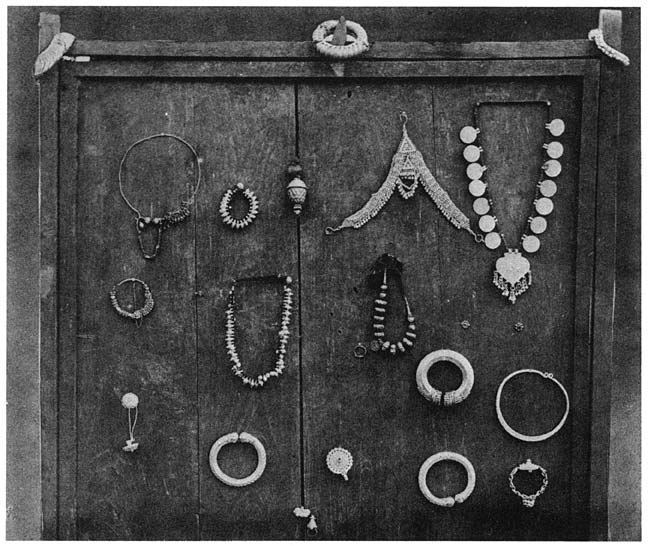
Ornaments
List of Ornaments, from Left to Right.
Three bracelets on top of board, from left to right:—
1.—Anklet, with links like coils of a snake.
2.—Tora, or solid anklet.
3.—Naugrihi, or wristlet of nine planets.
Second row, from left to right:—
4.—Large nathni, or nose-ring.
5.—Another naugrihi.
6.—Bīja, or custard apple worn on head above bindia.
7.—Bindia, or ornament worn on head.
8.—Haniel, or necklace of rupees with betel-leaf pendant.
Third row, from left to right:—
9.—Small nathni, or nose-ring.
10.—Bora, or waistband with beads like smallpox postules.
11.—Kantha, or gold necklace.
12.—Bohta, or circlet for upper arm.
13.—Hasli, or necklet like collar-bone.
Fourth row, from left to right:—
14.—Karanphūl or earring like marigold.
15.—Paijan, or hollow tinkling anklet.
16.—Dhara, or earring like shield.
17.—Another anklet.
18.—Another armlet, called “koparbela.”
8. Ornaments. The marriage ornaments
9. Beads and other ornaments
In the Marātha Districts an essential feature of a wedding is the hanging of the mangal-sūtram or necklace of black beads round the bride’s neck. All beads which shine and reflect the light are considered to be efficacious in averting the evil eye, and a peculiar virtue, Sir J. Campbell states, attaches to black beads. A woman wears the mangalsūtram or marriage string of beads all her life, and considers that her husband’s life is to some extent bound up in it. If she breaks the thread she will not say ‘my thread is broken,’ but ‘my thread has increased’; and she will not let her husband see her until she has got a new thread, as she thinks that to do so would cause his death. The many necklaces of beads worn by the primitive tribes and the strings of blue beads tied round the necks of oxen and ponies have the same end in view. A similar belief was probably partly responsible for the value set on precious stones as ornaments, and especially on diamonds, which sparkle most of all. The pearl is very sacred among the Hindus, and Madrāsis put a pearl into the mouth at the time of death instead of gold. Partly at least for this purpose pearls are worn set in a ring of gold in the ear, so that they may be available at need. Coral is also highly esteemed as an amulet, largely because it is supposed to change colour. The coral given to babies to suck may have been intended to render the soft and swollen gums at teething hard like the hard red stone. Another favourite shape for beads of gold is that of grains of rice, rice being a sacred grain. The gold ornament called kantha worn on the neck has carvings of the flowers of the singāra or water-nut This is a holy plant, the eating of which on fast-days gives purity. Hence women think that water thrown over the carved flowers of the ornament when bathing will have greater virtue to purify their bodies. Another favourite ornament is the hamel or necklace of rupees. The sanctity of coined metal would probably be increased by the royal image and superscription and also by its virtue as currency. Mr. Nunn states that gold mohur coins are still made solely for the purpose of ornament, being commonly engraved with the formula of belief of Islām and worn by Muhammadans as a charm. Suspended to the hamel or necklace of rupees in front is a silver pendant in the shape of a betel-leaf, this leaf being very efficacious in magic; and on this is carved either the image of Hanumān, the god of strength, or a peacock’s feather as a symbol of Kārtikeya, the god of war. The silver bar necklet known as hasli is intended to resemble the collar-bone. Children carried in their mother’s cloth are liable to be jarred and shaken against her body, so that the collar-bone is bruised and becomes painful. It is thought that the wearing of a silver collar-bone will prevent this, just as silver eyes are offered in smallpox to protect the sufferer’s eyes and a silver wire to save his throat from being choked. Little children sometimes have round the waist a band of silver beads which is called bora; these beads are meant to resemble the smallpox pustules and the bora protects the wearer from smallpox. There are usually 84 beads, this number being lucky among the Hindus. At her wedding a Hindu bride must wear a wristlet of nine little cones of silver like the kalas or pinnacle of a temple. This is called nau-graha or nau-giri and represents the nine planets which are worshipped at weddings—that is, the sun, moon and the five planets, Mars, Mercury, Jupiter, Venus and Saturn, which were known to the ancients and gave their names to the days of the week in many of the Aryan languages; while the remaining two are said to have been Rahu and Ketu, the nodes of the moon and the demons which cause eclipses. The bonhta or bānkra, the rigid circular bangle on the upper arm, is supposed to make a woman’s arm stronger by the pressure exercised on the veins and muscles. Circular ornaments worn on the legs similarly strengthen them and prevent a woman from getting stiffness or pins and needles in her legs after long squatting on the ground. The chutka, a large silver ring worn by men on the big toe, is believed to attract to itself the ends of all the veins and ligaments from the navel downwards, and hold them all braced in their proper position, thus preventing rupture.
10. Ear-piercing
11. Origin of ear-piercing
12. Ornaments worn as amulets
The above account of the ornaments of a Hindu woman is sufficient to show that her profuse display of them is not to be attributed, as is often supposed, to the mere desire for adornment. Each ornament originally played its part in protecting some limb or feature from various dangers of the seen or unseen world. And though the reasons which led to their adoption have now been to a large extent forgotten and the ornaments are valued for themselves, the shape and character remain to show their real significance. Women as being weaker and less accustomed to mix in society are naturally more superstitious and fearful of the machinations of spirits. And the same argument applies in greater degree to children. The Hindus have probably recognised that children are very delicate and succumb easily to disease, and they could scarcely fail to have done so when statistics show that about a quarter of all the babies born in India die in the first year of age. But they do not attribute the mortality to its real causes of congenital weakness arising from the immaturity of the parents, insanitary treatment at and after birth, unsuitable food, and the general frailty of the undeveloped organism. They ascribe the loss of their offspring solely to the machinations of jealous deities and evil spirits, and the envy and admiration of other people, especially childless women and witches, who cast the evil eye upon them. And in order to guard against these dangers their bodies are decorated with amulets and ornaments as a means of protection. But the result is quite other than that intended, and the ornaments which are meant to protect the children from the imaginary terrors of the evil eye, in reality merely serve as a whet to illicit cupidity, and expose them a rich, defenceless prey to the violence of the murderer and the thief.
13. Audhia Sunārs
14. The Sunār as money-changer
15. Malpractices of lower-class Sumārs
The goldsmith’s industry has hitherto not been affected to any serious extent by the competition of imported goods, and except during periods of agricultural depression the Sunār continues to prosper.
A Persian couplet said by a lover to his mistress is, ‘Gold has no scent and in the scent of flowers there is no gold; but thou both art gold and hast scent.’