Volume 4 — Marātha
Reading edition
List of Paragraphs
1. Numerical statistics
2. Double meaning of the term Marātha
3. Origin and position of the caste
4. Exogamous clans
5. Other subdivisions
6. Social customs
7. Religion
8. Present position of the caste
9. Nature of the Marātha insurrection
10. Marātha women in past times
11. The Marātha horseman
12. Cavalry in the field
13. Military administration
14. Sitting Dharna
15. The infantry
16. Character of the Marātha armies
1. Numerical statistics
Marātha, Mahrātta.—The military caste of southern India which manned the armies of Sivaji, and of the Peshwa and other princes of the Marātha confederacy. In the Central Provinces the Marāthas numbered 34,000 persons in 1911, of whom Nāgpur contained 9000 and Wardha 8000, while the remainder were distributed over Raipur, Hoshangābād and Nimār. In Berār their strength was 60,000 persons, the total for the combined province being thus 94,000. The caste is found in large numbers in Bombay and Hyderābād, and in 1901 the India Census tables show a total of not less than five million persons belonging to it.
2. Double meaning of the term Marātha
3. Origin and position of the caste
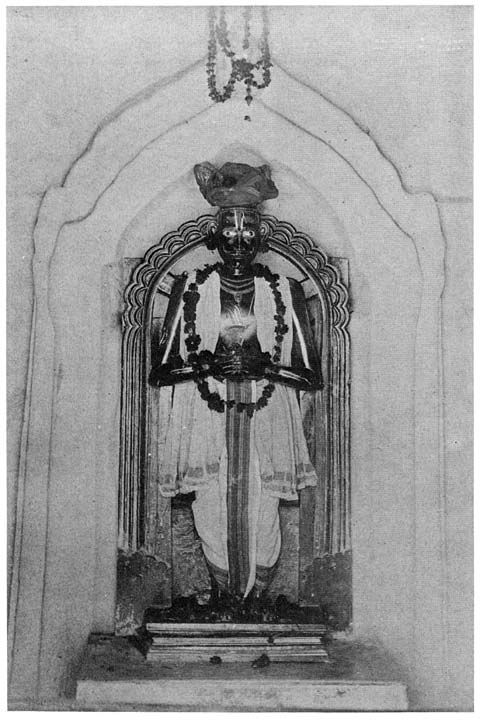
Statue of Marātha leader, Bīmbāji Bhonsla, in armour
It seems then most probable that, as already stated, the Marātha caste was of purely military origin, constituted from the various castes of Mahārāshtra who adopted military service, though some of the leading families may have had Rājpūts for their ancestors. Sir D. Ibbetson thought that a similar relation existed in past times between the Rājpūts and Jāts, the landed aristocracy of the Jāt caste being gradually admitted to Rājpūt rank. The Khandaits or swordsmen of Orissa are a caste formed in the same manner from military service. In the Imperial Gazetteer Sir H. Risley suggests that the Marātha people were of Scythian origin:
“The physical type of the people of this region accords fairly well with this theory, while the arguments derived from language and religion do not seem to conflict with it.... On this view the wide-ranging forays of the Marāthas, their guerilla methods of warfare, their unscrupulous dealings with friend and foe, their genius for intrigue and their consequent failure to build up an enduring dominion, might well be regarded as inherited from their Scythian ancestors.”
4. Exogamous clans
5. Other subdivisions
Besides the 96 clans there are now in the Central Provinces some local subcastes who occupy a lower position and do not intermarry with the Marāthas proper. Among these are the Deshkar or ‘Residents of the country’; the Waindesha or those of Berār and Khāndesh; the Gangthade or those dwelling on the banks of the Godāvari and Wainganga; and the Ghātmāthe or residents of the Mahādeo plateau in Berār. It is also stated that the Marāthas are divided into the Khāsi or ‘pure’ and the Kharchi or the descendants of handmaids. In Bombay the latter are known as the Akarmāshes or 11 māshas, meaning that as twelve māshas make a tola, a twelfth part of them is alloy.
6. Social customs
A man must not marry in his own clan or that of his mother. A sister’s son may be married to a brother’s daughter, but not vice versa. Girls are commonly married between five and twelve years of age, and the ceremony resembles that of the Kunbis. The bridegroom goes to the bride’s house riding on horseback and covered with a black blanket When a girl first becomes mature, usually after marriage, the Marathas perform the Shāntik ceremony. The girl is secluded for four days, after which she is bathed and puts on new clothes and dresses her hair and a feast is given to the caste-fellows. Sometimes the bridegroom comes and is asked whether he has visited his wife before she became mature, and if he confesses that he has done so a small fine is imposed on him. Such cases are, however, believed to be rare. The Marāthas proper forbid widow-marriage, but the lower groups allow it. If a maiden is seduced by one of the caste she may be married to him as if she were a widow, a fine being imposed on her family; but if she goes wrong with an outsider she is finally expelled. Divorce is not ostensibly allowed but may be concluded by agreement between the parties. A wife who commits adultery is cast off and expelled from the caste. The caste burn their dead when they can afford it and perform the shrāddh ceremony in the month of Kunwār (September), when oblations are offered to the dead and a feast is given to the caste-fellows. Sometimes a tomb is erected as a memorial to the dead, but without his name, and is surmounted usually by an image of Mahādeo. The caste eat the flesh of clean animals and of fowls and wild pig, and drink liquor. Their rules about food are liberal like those of the Rājpūts, a too great stringency being no doubt in both cases incompatible with the exigencies of military service. They make no difference between food cooked with or without water, and will accept either from a Brāhman, Rājpūt, Tirole Kunbi, Lingāyat Bania or Phūlmāli.
The Marāthas proper observe the parda system with regard to their women, and will go to the well and draw water themselves rather than permit their wives to do so. The women wear ornaments only of gold or glass and not of silver or any baser metal. They are not permitted to spin cotton as being an occupation of the lower classes. The women are tattooed in the centre of the forehead with a device resembling a trident. The men commonly wear a turban made of many folds of cloth twisted into a narrow rope and large gold rings with pearls in the upper part of the ear. Like the Rājpūts they often have their hair long and wear beards and whiskers. They assume the sacred thread and invest a boy with it when he is seven or eight years old or on his marriage. Till then they let the hair grow on the front of his head, and when the thread ceremony is performed they cut this off and let the choti or scalp-lock grow at the back. In appearance the men are often tall and well-built and of a light wheat-coloured complexion.
7. Religion
8. Present position of the caste
The Marāthas present the somewhat melancholy spectacle of an impoverished aristocratic class attempting to maintain some semblance of their former position, though they no longer have the means to do so. They flourished during two or three centuries of almost continuous war, and became a wealthy and powerful caste, but they find a difficulty in turning their hands to the arts of peace. Sir R. Craddock writes of them in Nāgpur:
“Among the Marāthas a large number represent connections of the Bhonsla family, related by marriage or by illegitimate descent to that house. A considerable proportion of the Government political pensioners are Marāthas. Many of them own villages or hold tenant land, but as a rule they are extravagant in their living; and several of the old Marātha nobility have fallen very much in the world. Pensions diminish with each generation, but the expenditure shows no corresponding decrease. The sons are brought up to no employment and the daughters are married with lavish pomp and show. The native army does not much attract them, and but few are educated well enough for the dignified posts in the civil employ of Government. It is a question whether their pride of race will give way before the necessity of earning their livelihood soon enough for them to maintain or regain some of their former position. Otherwise those with the largest landed estates may be saved by the intervention of Government, but the rest must gradually deteriorate till the dignities of their class have become a mere memory. The humbler members of the caste find their employment as petty contractors or traders, private servants, Government peons, sowārs and hangers-on in the retinue of the more important families.
9. Nature of the Marātha insurrection
Sir D. Ibbetson drew attention to the fact that the rising of the Marāthas against the Muhammadans was almost the only instance in Indian history of what might correctly be called a really national movement. In other cases, as that of the Sikhs, though the essential motive was perhaps of the same nature, it was obscured by the fact that its ostensible tendency was religious. The gurus of the Sikhs did not call on their followers to fight for their country but for a new religion. This was only in accordance with the Hindu intellect, to which the idea of nationality has hitherto been foreign, while its protests against both alien and domestic tyrannies tend to take the shape of a religious revolt. A similar tendency is observable even in the case of the Marāthas, for the rising was from its inception largely engineered by the Marātha Brāhmans, who on its success hastened to annex for themselves a leading position in the new Poona state. And it has been recorded that in calling his countrymen to arms, Sivaji did not ask them to defend their hearths and homes or wives and children, but to rally for the protection of the sacred persons of Brāhmans and cows.
10. Marātha women in past times
Although the Marāthas have now in imitation of the Rājpūts and Muhammadans adopted the parda system, this is not a native custom, and women have played quite an important part in their history. The women of the household have also exercised a considerable influence and their opinions are treated with respect by the men. Several instances occur in which women of high rank have successfully acted as governors and administrators. In the Bhonsla family the Princess Bāka Bāi, widow of Raghūji II., is a conspicuous instance, while the famous or notorious Rāni of Jhānsi is another case of a Marātha lady who led her troops in person, and was called the best man on the native side in the Mutiny.
11. The Marātha horseman
This article may conclude with one or two extracts to give an idea of the way in which the Marātha soldiery took the field. Grant Duff describes the troopers as follows:
“The Marātha horsemen are commonly dressed in a pair of light breeches covering the knee, a turban which many of them fasten by passing a fold of it under the chin, a frock of quilted cotton, and a cloth round the waist, with which they generally gird on their swords in preference to securing them with their belts. The horseman is armed with a sword and shield; a proportion in each body carry matchlocks, but the great national weapon is the spear, in the use of which and the management of their horse they evince both grace and dexterity. The spearmen have generally a sword, and sometimes a shield; but the latter is unwieldy and only carried in case the spear should be broken. The trained spearmen may always be known by their riding very long, the ball of the toe touching the stirrup; some of the matchlockmen and most of the Brāhmans ride very short and ungracefully. The bridle consists of a single headstall of cotton-rope, with a small but very severe flexible bit”
12. Cavalry in the field
The following account of the Marātha cavalry is given in General Hislop’s Summary of the Marātha and Pindāri Campaigns of 1817–1819:
“The Marāthas possess extraordinary skill in horsemanship, and so intimate an acquaintance with their horses, that they can make their animals do anything, even in full speed, in halting, wheeling, etc.; they likewise use the spear with remarkable dexterity, sometimes in full gallop, grasping their spears short and quickly sticking the point in the ground; still holding the handles, they turn their horse suddenly round it, thus performing on the point of a spear as on a pivot the same circle round and round again. Their horses likewise never leave the particular class or body to which they belong; so that if the rider should be knocked off, away gallops the animal after its fellows, never separating itself from the main body. Every Marātha brings his own horse and his own arms with him to the field, and possibly in the interest they possess in this private equipment we shall find their usual shyness to expose themselves or even to make a bold vigorous attack. But if armies or troops could be frightened by appearances these horses of the Marāthas would dishearten the bravest, actually darkening the plains with their numbers and clouding the horizon with dust for miles and miles around. A little fighting, however, goes a great way with them, as with most others of the native powers in India.”
13. Military administration
An interesting description of the internal administration of the Marātha cavalry is contained in the letter on the Marāthas by Colonel Tone already quoted. But his account must refer to a period of declining efficiency and cannot represent the military system at its best:
“In the great scale of rank and eminence which is one peculiar feature of Hindu institutions the Marātha holds a very inferior situation, being just removed one degree above those castes which are considered absolutely unclean. He is happily free from the rigorous observances as regards food which fetter the actions of the higher castes. He can eat of all kinds of food with the exception of beef; can dress his meal at all times and seasons; can partake of all victuals dressed by any caste superior to his own; washing and praying are not indispensable in his order and may be practised or omitted at pleasure. The three great tribes which compose the Marātha caste are the Kunbi or farmer, the Dhangar or shepherd and the Goāla or cowherd; to this original cause may perhaps be ascribed that great simplicity of manner which distinguishes the Marātha people. Homer mentions princesses going in person to the fountain to wash their household linen. I can affirm having seen the daughters of a prince who was able to bring an army into the field much larger than the whole Greek confederacy, making bread with their own hands and otherwise employed in the ordinary business of domestic housewifery. I have seen one of the most powerful chiefs of the Empire, after a day of action, assisting in kindling a fire to keep himself warm during the night, and sitting on the ground on a spread saddle-cloth dictating to his secretaries.
“The troops collected in this manner are under no discipline whatever and engage for no specific period, but quit the army whenever they please; with the exception of furnishing a picquet while in camp, they do no duty but in the day of battle.
“The Marātha cavalry is always irregularly and badly paid; the household troops scarcely ever receive money, but are furnished with a daily allowance of coarse flour and some other ingredients from the bazār which just enable them to exist. The Sillādār is very nearly as badly situated. In his arrangements with the State he has allotted to him a certain proportion of jungle where he pastures his cattle; here he and his family reside, and his sole occupation when not on actual service is increasing his Pagah or troop by breeding out of his mares, of which the Marātha cavalry almost entirely consist. There are no people in the world who understand the method of rearing and multiplying the breed of cattle equal to the Marāthas. It is by no means uncommon for a Sillādār to enter a service with one mare and in a few years be able to muster a very respectable Pagah. They have many methods of rendering the animal prolific; they back their colts much earlier than we do and they are consequently more valuable as they come sooner on the effective strength.
“When called upon for actual service the Sillādār is obliged to give muster. Upon this occasion it is always necessary that the Brāhman who takes it should have a bribe; and indeed the Hāzri, as the muster is termed, is of such a nature that it could not pass by any fair or honourable means. Not only any despicable tattus are substituted in the place of horses but animals are borrowed to fill up the complement. Heel-ropes and grain-bags are produced as belonging to cattle supposed to be at grass; in short every mode is practised to impose on the Sirkār, which in turn reimburses itself by irregular and bad payments; for it is always considered if the Sillādārs receive six months’ arrears out of the year that they are exceedingly well paid. The Volunteers who join the camp are still worse situated, as they have no collective force, and money is very seldom given in a Marātha State without being extorted. In one word, the native cavalry are the worst-paid body of troops in the world. But there is another grand error in this mode of raising troops which is productive of the worst effects. Every man in a Marātha camp is totally independent; he is the proprietor of the horse he rides, which he is never inclined to risk, since without it he can get no service. This single circumstance destroys all enterprise and spirit in the soldier, whose sole business, instead of being desirous of distinguishing himself, is to keep out of the way of danger; for notwithstanding every horseman on entering a service has a certain value put upon his horse, yet should he lose it even in action he never receives any compensation or at least none proportioned to his loss. If at any time a Sillādār is disgusted with the service he can go away without meeting any molestation even though in the face of an enemy. In fact the pay is in general so shamefully irregular that a man is justified in resorting to any measure, however apparently unbecoming, to attain it. It is also another very curious circumstance attending this service that many great Sillādārs have troops in the pay of two or three chiefs at the same time, who are frequently at open war with each other.
14. Sitting Dharna
15. The infantry
“In the various Marātha services there are very little more than a bare majority who are Marāthas by caste, and very few instances occur of their ever entering into the infantry at all. The sepoys in the pay of the different princes are recruited in Hindustān, and principally of the Rājpūt and Pūrbia caste; these are perhaps the finest race of men in the world for figure and appearance; of lofty stature, strong, graceful and athletic; of acute feelings, high military pride, quick, apprehensive, brave, prudent and economic; at the same time it must be confessed they are impatient of discipline, and naturally inclined to mutiny. They are mere soldiers of fortune and serve only for their pay. There are also a great number of Musalmāns who serve in the different Marātha armies, some of whom have very great commands.
16. Character of the Marātha armies
“The Marātha cavalry at times make very long and rapid marches, in which they do not suffer themselves to be interrupted by the monsoon or any violence of weather. In very pressing exigencies it is incredible the fatigue a Marātha horseman will endure; frequently many days pass without his enjoying one regular meal, but he depends entirely for subsistence on the different corn-fields through which the army passes: a few heads of juāri, which he chafes in his hands while on horseback, will serve him for the day; his horse subsists on the same fare, and with the addition of opium, which the Marāthas frequently administer to their cattle, is enabled to perform incredible marches.”