Volume 4 — Mochi1
Reading edition
Mochi1
List of Paragraphs
1. General notice
2. Legends of origin
3. Art among the Hindus
4. Antagonism of Mochis and Chamārs
5. Exogamous groups
6. Social customs
7. Shoes
1. General notice
2. Legends of origin
3. Art among the Hindus
In the Central Provinces the term Mochi is often used for the whole caste in the northern Districts, and Jīngar in the Marātha country; while the Chitrakārs or painters form a separate group. Though the trades of cobbler and book-binder are now widely separated in civilised countries, the connection between them is apparent since both work in leather. It is not at first sight clear why the painter should be of the same caste, but the reason is perhaps that his brushes are made of the hair of animals, and this is also regarded as impure, as being a part of the hide. If such be the case a senseless caste rule of ceremonial impurity has prevented the art of painting from being cultivated by the Hindus; and the comparatively poor development of their music may perhaps be ascribed to the same cause, since the use of the sinews of animals for stringed instruments would also prevent the educated classes from learning to play them. Thus no stringed instruments are permitted to be used in temples, but only the gong, cymbal, horn and conch-shell. And this rule would greatly discourage the cultivation of music, which art, like all the others, has usually served in its early period as an appanage to religious services. It has been held that instruments were originally employed at temples and shrines in order to scare away evil spirits by their noise while the god was being fed or worshipped, and not for the purpose of calling the worshippers together; since noise is a recognised means of driving away spirits, probably in consequence of its effect in frightening wild animals. It is for the same end that music is essential at weddings, especially during the night when the spirits are more potent; and this is the primary object of the continuous discordant din which the Hindus consider a necessary accompaniment to a wedding.
Except for this ceremonial strictness Hinduism should have been favourable to the development of both painting and sculpture, as being a polytheistic religion. In the early stages of society religion and art are intimately connected, as is shown by the fact that images and paintings are at first nearly always of deities or sacred persons or animals, and it is only after a considerable period of development that secular subjects are treated. Similarly architecture is in its commencement found to be applied solely to sacred buildings, as temples and churches, and is only gradually diverted to secular buildings. The figures sculptured by the Mochis are usually images for temples, and those who practise this art are called Murtikar, from murti, an image or idol; and the pictures of the Chitrakārs were until recently all of deities or divine animals, though secular paintings may now occasionally be met with. And the uneducated believers in a polytheistic religion regularly take the image for the deity himself, at first scarcely conceiving of the one apart from the other. Thus some Bharewas or brass-workers say that they dare not make metal images of the gods, because they are afraid that the badness of their handiwork might arouse the wrath of the gods and move them to take revenge. The surmise might in fact be almost justifiable that the end to which figures of men and animals were first drawn or painted, or modelled in clay or metal was that they might be worshipped as images of the deities, the savage mind not distinguishing at all between an image of the god and the god himself. For this reason monotheistic religions would be severely antagonistic to the arts, and such is in fact the case. Thus the Muhammadan commentary, the Hadith, has a verse: “Woe to him who has painted a living creature! At the day of the last judgment the persons represented by him will come out of the tomb and join themselves to him to demand of him a soul. Then that man, unable to give life to his work, will burn in eternal flames.” And in Judaism the familiar prohibition of the Second Commandment appears to be directed to the same end.
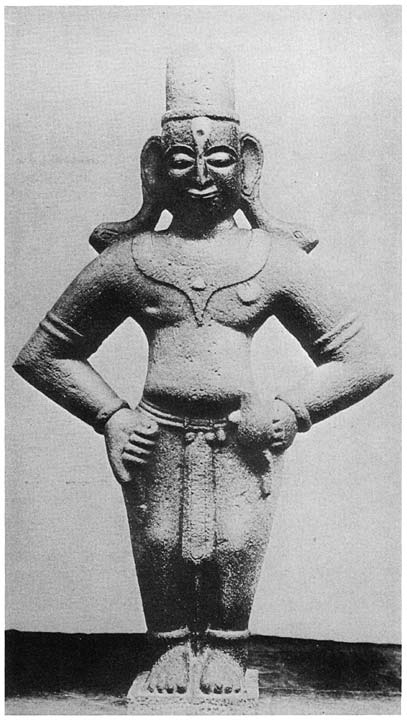
Image of the god Vishnu as Vithoba
Hindu sculpture has indeed been fairly prolific, but is not generally considered to have attained to any degree of artistic merit. Since sculpture is mainly concerned with the human form it seems clear that an appreciation of the beauty of muscular strength and the symmetrical development of the limbs is an essential preliminary to success in this art; and such a feeling can only arise among a people who set much store on feats of bodily strength and agility. This has never been the character of the Hindus, whose religion encourages asceticism and mortification of the body, and points to mental self-absorption and detachment from worldly cares and exercises as the highest type of virtue.
4. Antagonism of Mochis and Chamārs
As a natural result of the pretensions to nobility made by the Mochis, there is no love lost between them and the Chamārs; and the latter allege that the Mochis have stolen their rāmpi, the knife with which they cut leather. On this account the Chamārs will neither take water to drink from the Mochis nor mend their shoes, and will not even permit them to try on a new pair of shoes until they have paid the price set on them; for they say that the Mochis are half-bred Chamārs and therefore cannot be permitted to defile the shoes of a true Chamār by trying them on; but when they have been paid for, the maker has severed connection with them, and the use to which they may be put no longer affects him.
5. Exogamous groups
In the Central Provinces the Mochis are said to have forty exogamous sections or gotras, of which the bulk are named after all the well-known Rājpūt clans, while two agree with those of the Chamārs. And they have also an equal number of kheras or groups named after villages. The limits of the two groups seem to be identical; thus members of the sept named after the Kachhwāha Rājpūts say that their khera or village name is Mungāvali in Gwālior; those of the Ghangere sept give Chanderi as their khera, the Sitāwat sept Dhāmoni in Saugor, the Didoria Chhatarpur, the Narele Narwar, and so on. The names of the village groups have now been generally forgotten and they are said to have no influence on marriage, which is regulated by the Rājpūt sept names; but it seems probable that the kheras were the original divisions and the Rājpūt gotras have been more recently adopted in support of the claims already noticed.
6. Social customs
The Mochis have adopted the customs of the higher Hindu castes. A man may not take a wife from his own gotra, his mother’s gotra or from a family into which a girl from his own family has married. They usually marry their daughters in childhood and employ Brāhmans in their ceremonies, and no degradation attaches to these latter for serving as their priests. In minor domestic ceremonies for which the Brāhman is not engaged his place is taken by a relative, who is called sawāsa, and is either the sister’s husband, daughter’s husband, or father’s sister’s husband, of the head of the family. They permit widow-remarriage and divorce, and in the southern Districts effect a divorce by laying a pestle between the wife and husband. They burn their dead and observe mourning for the usual period. After a death they will not again put on a coloured head-cloth until some relative sets it on their heads for the first time on the expiry of the period of mourning. They revere the ordinary Hindu deities, and like the Chamārs they have a family god, known as Mair, whose representation in the shape of a lump of clay is enshrined within the house and worshipped at marriages and deaths. In Saugor he is said to be the collective representative of the spirits of their ancestors. In some localities they eat flesh and drink liquor, but in others abstain from both. Among the Hindus the Mochis rank considerably higher than the Chamārs; their touch does not defile and they are permitted to enter temples and take part in religious ceremonies. The name of a Saugor Mochi is remembered who became a good drawer and painter and was held in much esteem at the Peshwa’s court. In northern India about half the Mochis are Muhammadans, but in the Central Provinces they are all Hindus.