Volume 4 — Nat
Reading edition
List of Paragraphs
1. The Nats not a proper caste
2. Muhammadan Nats
3. Social customs of the Nats. Their low status
4. Acrobatic performances
5. Sliding or walking on ropes as a charm for the crops
6. Snake-charmers
1. The Nats not a proper caste
2. Muhammadan Nats
One division of the Nats are Muhammadans and seem to be to some extent a distinctive group. They have seven gotras—Chicharia, Damaria, Dhalbalki, Pūrbia, Dhondabalki, Karimki and Kalasia. They worship two Birs or spirits, Halaila Bir and Sheikh Saddu, to whom they sacrifice fowls in the months of Bhādon (August) and Baisākh (April). Hindus of any caste are freely admitted into their community, and they can marry Hindu girls.
3. Social customs of the Nats. Their low status
4. Acrobatic performances
5. Sliding or walking on ropes as a charm for the crops
“Drought, want of fertility in the soil, murrain in cattle, and other calamities incident to husbandry are here invariably ascribed to the wrath of particular gods, to appease which recourse is had to various ceremonies. In the Kumaon District offerings and singing and dancing are resorted to on such occasions. In Garhwāl the measures pursued with the same view are of a peculiar nature, deserving of more particular notice. In villages dedicated to the protection of Mahādeva propitiatory festivals are held in his honour. At these Bādis or rope-dancers are engaged to perform on the tight-rope, and slide down an inclined rope stretched from the summit of a cliff to the valley beneath and made fast to posts driven into the ground. The Bādi sits astride on a wooden saddle, to which he is tied by thongs; the saddle is similarly secured to the bast or sliding cable, along which it runs, by means of a deep groove; sandbags are tied to the Bādi’s feet sufficient to secure his balance, and he is then, after various ceremonies and the sacrifice of a kid, started off; the velocity of his descent is very great, and the saddle, however well greased, emits a volume of smoke throughout the greater part of his progress. The length and inclination of the bast necessarily vary with the nature of the cliff, but as the Bādi is remunerated at the rate of a rupee for every hundred cubits, hence termed a tola, a correct measurement always takes place; the longest bast which has fallen within my observation has been twenty-one tolas, or 2100 cubits in length. From the precautions taken as above mentioned the only danger to be apprehended by the Bādi is from breaking of the rope, to provide against which the latter, commonly from one and a half to two inches in diameter, is made wholly by his own hand; the material used is the bhābar grass. Formerly, if a Bādi fell to the ground in his course, he was immediately despatched with a sword by the surrounding spectators, but this practice is now, of course, prohibited. No fatal accident has occurred from the performance of this ceremony since 1815, though it is probably celebrated at not less than fifty villages in each year. After the completion of the sliding, the bast or rope is cut up and distributed among the inhabitants of the village, who hang the pieces as charms on the eaves of their houses. The hair of the Bādi is also taken and preserved as possessing similar virtues. He being thus made the organ to obtain fertility for the lands of others, the Bādi is supposed to entail sterility on his own; and it is firmly believed that no grain sown with his hand can ever vegetate. Each District has its hereditary Bādi, who is supported by annual contributions of grain from the inhabitants.” It is not improbable that the performance of the Nat is a reminiscence of a period when human victims were sacrificed for the crops, this being a common practice among primitive peoples, as shown by Sir J.G. Frazer in Attis, Adonis, Osiris. Similarly the spirits of Nats which are revered in the Central Provinces may really be those of victims killed during the performance of some charm for the good of the crops, akin to that still prevalent in the Himalayas. The custom of making the Nat slide down a rope is of the same character as that of swinging a man in the air by a hook secured in his flesh, which was formerly common in these Provinces. But in both cases the meaning of the rite is obscure.
6. Snake-charmers
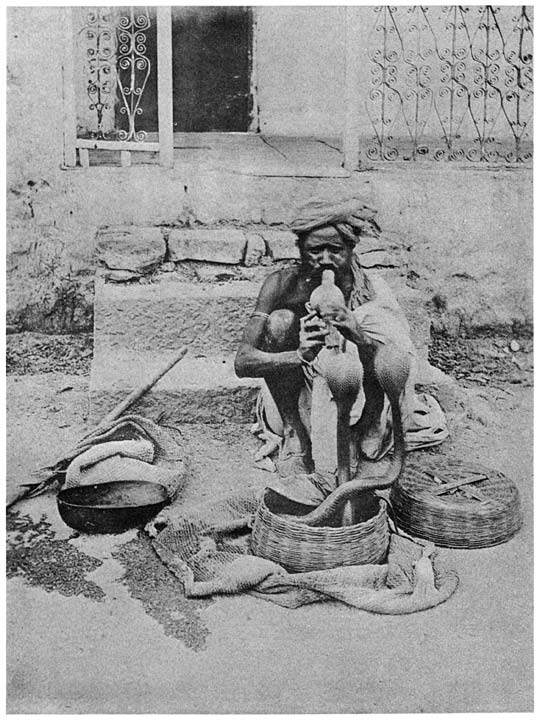
Snake-charmer with cobras
“Hence, on many occasions throughout the year, the dread Manasa Devi, the queen of snakes, is propitiated by presents, vows and religious rites. In the month of Shrābana the worship of the snake goddess is celebrated with great éclat. An image of the goddess, seated on a water-lily, encircled with serpents, or a branch of the snake-tree (a species of Euphorbia), or a pot of water, with images of serpents made of clay, forms the object of worship. Men, women and children, all offer presents to avert from themselves the wrath of the terrific deity. The Māls or snake-catchers signalise themselves on this occasion. Temporary scaffolds of bamboo work are set up in the presence of the goddess. Vessels filled with all sorts of snakes are brought in. The Māls, often reeling with intoxication, mount the scaffolds, take out serpents from the vessels, and allow them to bite their arms. Bite after bite succeeds; the arms run with blood; and the Māls go on with their pranks, amid the deafening plaudits of the spectators. Now and then they fall off from the scaffold and pretend to feel the effects of poison, and cure themselves by their incantations. But all is mere pretence. The serpents displayed on the occasion and challenged to do their worst, have passed through a preparatory state. Their fangs have been carefully extracted from their jaws. But most of the vulgar spectators easily persuade themselves to believe that the Māls are the chosen servants of Siva and the favourites of Manasa. Although their supernatural pretensions are ridiculous, yet it must be confessed that the Māls have made snakes the subject of their peculiar study. They are thoroughly acquainted with their qualities, their dispositions, and their habits. They will run down a snake into its hole, and bring it out thence by main force. Even the terrible cobra is cowed down by the controlling influence of a Māl. When in the act of bringing out snakes from their subterranean holes, the Māls are in the habit of muttering charms, in which the names of Manasa and Mahādeva frequently occur; superstition alone can clothe these unmeaning words with supernatural potency. But it is not inconsistent with the soundest philosophy to suppose that there may be some plants whose roots are disagreeable to serpents, and from which they instinctively turn away. All snake-catchers of Bengal are provided with a bundle of the roots of some plant which they carefully carry along with them, when they set out on their serpent-hunting expeditions. When a serpent, disturbed in its hole, comes out furiously hissing with rage, with its body coiled, and its head lifted up, the Māl has only to present before it the bundle of roots above alluded to, at the sight of which it becomes spiritless as an eel. This we have ourselves witnessed more than once.”
These Māls appear to have been members of the aboriginal Māle or Māle Pahāria tribe of Bengal.