Volume 4 — Kurmi
Reading edition
List of Paragraphs
1. Numbers and derivation of name
2. Functional character of the caste
3. Subcastes
4. Exogamous groups
5. Marriage rules. Betrothal
6. The marriage-shed or pavilion
7. The marriage-cakes
8. Customs at the wedding
9. Walking round the sacred post
10. Other ceremonies
11. Polygamy widow-marriage and divorce
12. Impurity of women
13. Pregnancy rites
14. Earth-eating
15. Customs at birth
16. Treatment of mother and child
17. Ceremonies after birth
18. Suckling children
19. Beliefs about twins
20. Disposal of the dead
21. Funeral rites
22. Burning the dead
23. Burial
24. Return of the soul
25. Mourning
26. Shaving, and presents to Brahmans
27. End of mourning
28. Anniversaries of the dead
29. Beliefs in the hereafter
30. Religion. Village gods
31. Sowing the Jawaras or Gardens of Adonis
32. Rites connected with the crops. Customs of cultivation
33. Agricultural superstitions
34. Houses
35. Superstitions about houses
36. Furniture
37. Clothes
38. Women’s clothes
39. Bathing
40. Food
41. Caste-feasts
42. Hospitality
43. Social customs. Tattooing
44. Caste penalties
45. The cultivating status
46. Occupation
Appendix: List of Exogamous Clans
1. Numbers and derivation of name
2. Functional character of the caste
3. Subcastes
The caste has a large number of subdivisions. The Usrete belonged to Bundelkhand, where this name is found in several castes; they are also known as Havelia, because they live in the rich level tract of the Jubbulpore Haveli, covered like a chessboard with large embanked wheat-fields. The name Haveli seems to have signified a palace or headquarters of a ruler, and hence was applied to the tract surrounding it, which was usually of special fertility, and provided for the maintenance of the chief’s establishment and household troops. Thus in Jubbulpore, Mandia and Betūl we find the forts of the old Gond rulers dominating an expanse of rich plain-country. The Usrete Kurmis abstain from meat and liquor, and may be considered as one of the highest subcastes. Their name may be derived from a-sreshtha, or not the best, and its significance would be that formerly they were considered to be of mixed origin, like most castes in Bundelkhand. The group of Sreshtha or best-born Kurmis has now, however, died out if it ever existed, and the Usretes have succeeded in establishing themselves in its place. The Chandnāhes of Jubbulpore or Chandnāhus of Chhattīsgarh are another large subdivision. The name may be derived from the village Chandnoha in Bundelkhand, but the Chandnāhus of Chhattīsgarh say that three or four centuries ago a Rājpūt general of the Rāja of Ratanpur had been so successful in war that the king allowed him to appear in Durbār in his uniform with his forehead marked with sandalwood, as a special honour. When he died his son continued to do the same, and on the king’s attention being drawn to it he forbade him. But the son did not obey, and hence the king ordered the sandalwood to be rubbed from his forehead in open Durbār. But when this was done the mark miraculously reappeared through the agency of the goddess Devi, whose favourite he was. Three times the king had the mark rubbed out and three times it came again. So he was allowed to wear it thereafter, and was called Chandan Singh from chandan, sandalwood; and his descendants are the Chandnāhu Kurmis. Another derivation is from Chandra, the moon. In Jubbulpore these Chandnāhes sometimes kill a pig under the palanquin of a newly married bride. In Bilāspur they are prosperous and capable cultivators, but are generally reputed to be stingy, and therefore are not very popular. Here they are divided into the Ekbahinyas and Dobahinyas, or those who wear glass bangles on one or both arms respectively. The Chandrāha Kurmis of Raipur are probably a branch of the Chandnāhus. They sprinkle with water the wood with which they are about to cook their food in order to purify it, and will eat food only in the chauka or sanctified place in the house. At harvest when they must take meals in the fields, one of them prepares a patch of ground, cleaning and watering it, and there cooks food for them all.
4. Exogamous groups
Each subcaste has a number of exogamous divisions and these present a large variety of all types. Some groups have the names of Brāhman saints as Sāndil, Bhāradwaj, Kausil and Kashyap; others are called after Rājpūt septs, as Chauhān, Rāthor, Panwār and Solanki; other names are of villages, as Khairagarhi from Khairagarh, Pandariha from Pandaria, Bhadaria, and Harkotia from Harkoti; others are titular, as Sondeha, gold-bodied, Sonkharchi, spender of gold, Bimba Lohir, stick-carrier, Banhpagar, one wearing a thread on the arm, Bhandāri, a store-keeper, Kumaria, a potter, and Shikaria, a hunter; and a large number are totemistic, named after plants, animals or natural objects, as Sadāphal, a fruit; Kathail from kath or catechu; Dhorha, from dhor, cattle; Kānsia, the kāns grass; Karaiya, a frying-pan; Sarang, a peacock; Samundha, the ocean; Sindia, the date-palm tree; Dudhua from dudh, milk, and so on. Some sections are subdivided; thus the Tidha section, supposed to be named after a village, is divided into three subsections named Ghurepake, a mound of cowdung, Dwarparke, door-jamb, and Jangi, a warrior, which are themselves exogamous. Similarly the Chaudhri section, named after the title of the caste headman, is divided into four subsections, two, Majhgawān Bamuria, named after villages, and two, Purwa Thok and Pascham Thok, signifying the eastern and western groups. Presumably when sections get so large as to bar the marriage of persons not really related to each other at all, relief is obtained by subdividing them in this manner. A list of the sections of certain subcastes so far as they have been obtained is given at the end of the article.
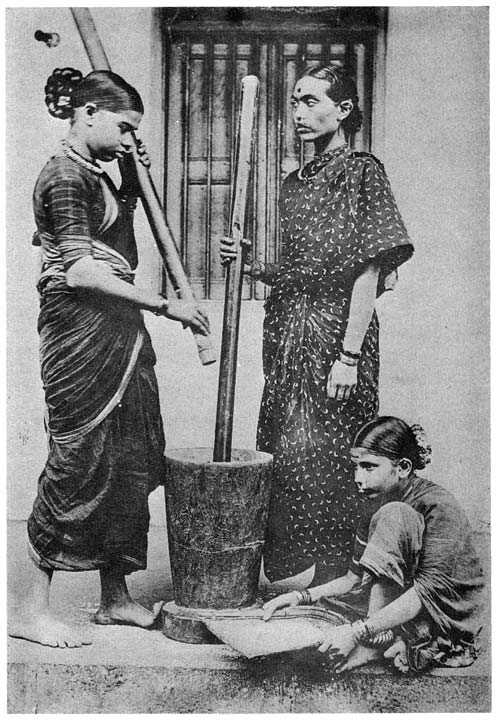
Pounding rice
5. Marriage rules. Betrothal
Marriage is prohibited between members of the same section and between first and second cousins on the mother’s side. But the Chandnāhe Kurmis permit the wedding of a brother’s daughter to a sister’s son. Most Kurmis forbid a man to marry his wife’s sister during her lifetime. The Chhattīsgarh Kurmis have the practice of exchanging girls between two families. There is usually no objection to marriage on account of religious differences within the pale of Hinduism, but the difficulty of a union between a member of a Vaishnava sect who abstains from flesh and liquor, and a partner who does not, is felt and expressed in the following saying:
Vaishnava purush avaishnava nāri Unt beil ki jot bichāri,
or ‘A Vaishnava husband with a non-Vaishnava wife is like a camel yoked with a bullock.’ Muhammadans and Christians are not retained in the caste. Girls are usually wedded between nine and eleven, but well-to-do Kurmis like other agriculturists, sometimes marry their daughters when only a few months old. The people say that when a Kurmi gets rich he will do three things: marry his daughters very young and with great display, build a fine house, and buy the best bullocks he can afford. The second and third methods of spending his money are very sensible, whatever may be thought of the first. No penalty is imposed for allowing a girl to exceed the age of puberty before marriage. Boys are married between nine and fifteen years, but the tendency is towards the postponement of the ceremony. The boy’s father goes and asks for a bride and says to the girl’s father, ‘I have placed my son with you,’ that is, given him in adoption; if the match be acceptable the girl’s father replies, ‘Yes, I will give my daughter to collect cowdung for you’; to which the boy’s father responds, ‘I will hold her as the apple of my eye.’ Then the girl’s father sends the barber and the Brāhman to the boy’s house, carrying a rupee and a cocoanut. The boy’s relatives return the visit and perform the ‘God bharna,’ or ‘Filling the lap of the girl.’ They take some sweetmeats, a rupee and a cocoanut, and place them in the girl’s lap, this being meant to induce fertility. The ceremony of betrothal succeeds, when the couple are seated together on a wooden plank and touch the feet of the guests and are blessed by them. The auspicious date of the wedding is fixed by the Brāhman and intimation is given to the boy’s family through the lagan or formal invitation, which is sent on a paper coloured yellow with powdered rice and turmeric. A bride-price is paid, which in the case of well-to-do families may amount to as much as Rs. 100 to Rs. 400.
6. The marriage-shed or pavilion
7. The marriage-cakes
8. Customs at the wedding
Before the wedding the women of each party go and anoint the village gods with oil and turmeric, worshipping them, and then similarly anoint the bride and bridegroom at their respective houses for three days. The bridegroom’s head is shaved except for his scalp-lock; he wears a silver necklet on his neck, puts lamp-black on his eyes, and is dressed in new yellow and white clothes. Thus attired he goes round and worships all the village gods and visits the houses of his relatives and friends, who mark his forehead with rice and turmeric and give him a silver piece. A list of the money thus received is made and similar presents are returned to the donors when they have weddings. The bridegroom goes to the wedding either in a litter or on a horse, and must not look behind him. After being received at the bride’s village and conducted to his lodging, he proceeds to the bride’s house and strikes a grass mat hung before the house seven times with a reed-stick. On entering the bride’s house the bridegroom is taken to worship her family gods, the men of the party usually remaining outside. Then, as he goes through the room, one of the women who has tied a long thread round her toe gets behind him and measures his height with the thread without his seeing. She breaks off the thread at his height and doubling it once or twice sews it round the top of the bride’s skirt, and they think that as long as the bride wears this thread she will be able to make her husband do as she likes. If the girls wish to have a joke they take one of the bridegroom’s shoes which he has left outside the house, wrap it up in a piece of cloth, and place it on a shelf or in a cupboard, where the family god would be kept, with two lamps burning before it. Then they say to the bridegroom, ‘Come and worship our household god’; and if he goes and does reverence to it they unwrap the cloth and show him his own shoe and laugh at him. But if he has been to one or two weddings and knows the joke he just gives it a kick. The bride’s younger brother steals the bridegroom’s other shoe and hides it, and will not give it back without a present of a rupee or two. The bride and bridegroom are seated on wooden seats, and while the Brāhman recites texts, they make the following promises. The bridegroom covenants to live with his wife and her children, to support them and tell her all his concerns, consult her, make her a partner of his religious worship and almsgiving, and be with her on the night following the termination of her monthly impurity. The bride promises to remain faithful to her husband, to obey his wishes and orders, to perform her household duties as well as she can, and not to go anywhere without his permission. The last promise of the bridegroom has reference to the general rule among Hindus that a man should always sleep with his wife on the night following the termination of her menses because at this time she is most likely to conceive and the prospect of a child being born must not be lost. The Shāstras lay it down that a man should not visit his wife before going into battle, this being no doubt an instance of the common custom of abstinence from conjugal intercourse prior to some important business or undertaking; but it is stated that if on such an occasion she should have just completed a period of impurity and have bathed and should desire him to come in to her, he should do so, even with his armour on, because by refusing, in the event of his being killed in battle, the chance of a child being born would be finally lost. To Hindu ideas the neglect to produce life is a sin of the same character, though in a minor degree, as that of destroying life; and it is to be feared that it will be some time before this ingrained superstition gives way to any considerations of prudential restraint Some people say that for a man not to visit his wife at this time is as great a sin as murder.
9. Walking round the sacred post
The binding ceremony of the marriage is the walking seven times round the marriage-post in the direction of the sun. The post probably represents the sun and the walk of the bridal couple round it may be an imitation of the movement of the planets round the sun. The reverence paid to the marriage-post has already been noticed. During the procession the bride leads and the bridegroom puts his left hand on her left shoulder. The household pounding-slab is near the post and on it are placed seven little heaps of rice, turmeric, areca-nut, and a small winnowing-fan. Each time the bride passes the slab the bridegroom catches her right foot and with it makes her brush one of the little heaps off the slab. These seven heaps represent the seven Rishis or saints who are the seven large stars of the constellation of the Great Bear.
10. Other ceremonies
After the wedding the bride and bridegroom resume their seats and the parents of the bride wash their feet in a brass tray, marking their foreheads with rice and turmeric. They put some silver in the tray, and other relations and friends do the same. The presents thus collected go to the bridegroom. The Chandnāhu Kurmis then have a ceremony known as palkachār. The bride’s father provides a bed on which a mattress and quilt are laid and the bride and bridegroom are seated on it, while their brother and sister sprinkle parched rice round them. This is supposed to typify the consummation of the marriage, but the ceremony is purely formal as the bridal couple are children. The bridegroom is given two lamps and he has to mix their flames, probably to symbolise the mixing of the spirits of his wife and himself. He requires a present of a rupee or two before he consents to do so. During the wedding the bride is bathed in the same water as the bridegroom, the joint use of the sacred element being perhaps another symbolic mark of their union. At the feasts the bride eats rice and milk with her husband from one dish, once at her own house and once after she goes to her husband’s house. Subsequently she never eats with her husband but always after him. She also sits and eats at the wedding-feasts with her husband’s relations. This is perhaps meant to mark her admission into her husband’s clan. After the wedding the Brāhmans on either side recite Sanskrit verses, praising their respective families and displaying their own learning. The competition often becomes bitter and would end in a quarrel, but that the elders of the party interfere and stop it.
The expenses of an ordinary wedding on the bridegroom’s side may be Rs. 100 in addition to the bride-price, and on the bride’s Rs. 200. The bride goes home for a day or two with the bridegroom’s party in Chhattīsgarh but not in the northern Districts, as women accompany the wedding procession in the former but not in the latter locality. If she is too small to go, her shoes and marriage-crown are sent to represent her. When she attains maturity the chauk or gauna ceremony is performed, her husband going to fetch her with a few friends. At this time her parents give her clothes, food and ornaments in a basket called jhanpi or tipara specially prepared for the occasion.
11. Polygamy widow-marriage and divorce
A girl who becomes pregnant by a man of the caste before marriage is wedded to him by the rite used for widows. If the man is an outsider she is expelled from the community. Women are much valued for the sake of their labour in the fields, and the transgressions of a wife are viewed with a lenient eye. In Damoh it is said that a man readily condones his wife’s adultery with another Kurmi, and if it becomes known and she is put out of caste, he will give the penalty feasts himself for her admission. If she is detected in a liaison with an outsider she is usually discarded, but the offence may be condoned should the man be a Brāhman. And one instance is mentioned of a mālguzār’s wife who had gone wrong with a Gond, and was forgiven and taken back by her husband and the caste. But the leniency was misplaced as she subsequently eloped with an Ahīr. Polygamy is usual with those who can afford to pay for several wives, as a wife’s labour is more efficient and she is a more profitable investment than a hired servant. An instance is on record of a blind Kurmi in Jubbulpore, who had nine wives. A man who is faithful to one wife, and does not visit her on fast-days, is called a Brahmachari or saint and it is thought that he will go to heaven. The remarriage of widows is permitted and is usual. The widow goes to a well on some night in the dark fortnight, and leaving her old clothes there puts on new ones which are given to her by the barber’s wife. She then fills a pitcher with water and takes it to her new husband’s house. He meets her on the threshold and lifts it from her head, and she goes into the house and puts bangles on her wrists. The following saying shows that the second marriage of widows is looked upon as quite natural and normal by the cultivating castes:
A bachelor marrying a widow must first go through the ceremony with a ring which he thereafter wears on his finger, and if it is lost he must perform a funeral ceremony as if a wife had died. If a widower marries a girl she must wear round her neck an image of his first wife. A girl who is twice married by going round the sacred post is called Chandelia and is most unlucky. She is considered as bad or worse than a widow, and the people sometimes make her live outside the village and forbid her to show them her face. Divorce is open to either party, to a wife on account of the impotency or ill-treatment of her husband, and to a husband for the bad character, ill-health or quarrelsome disposition of his wife. A deed of divorce is executed and delivered before the caste committee.
12. Impurity of women
If a woman desires to procure a miscarriage she eats a raw papāya fruit, and drinks a mixture of ginger, sugar, bamboo leaves and milk boiled together. She then has her abdomen well rubbed by a professional masseuse, who comes at a time when she can escape observation. After a prolonged course of this treatment it is said that a miscarriage is obtained. It would seem that the rubbing is the only treatment which is directly effective. The papāya, which is a very digestible fruit, can hardly be of assistance, but may be eaten from some magical idea of its resemblance to a foetus. The mixture drunk is perhaps designed to be a tonic to the stomach against the painful effects of the massage.
13. Pregnancy rites
“During the fifth month of pregnancy the family gods are worshipped to avoid generally any difficulties in her labour. Towards the end of that month and sometimes in the seventh month she rubs her body with a preparation of gram-flour, castor-oil and turmeric, bathes herself, and is clothed with new garments and seated on a wooden stool in a space freshly cleaned and spread with cowdung. Her lap is then filled with sweets called pakwān made of cocoanut. A similar ceremony called Boha Jewan is sometimes performed in the seventh or eighth month, when a new sāri is given to her and grain is thrown into her lap. Another special rite is the Pansavan ceremony, performed to remove all defects in the child, give it a male form, increase its size and beauty, give it wisdom and avert the influence of evil spirits.”
14. Earth-eating
Pregnant women sometimes have a craving for eating earth. They eat the earth which has been mixed with wheat on the threshing-floor, or the ashes of cowdung cakes which have been used for cooking. They consider it as a sort of medicine which will prevent them from vomiting. Children also sometimes get the taste for eating earth, licking it up from the floor, or taking pieces of lime-plaster from the walls. Possibly they may be attracted by the saltish taste, but the result is that they get ill and their stomachs are distended. The Panwar women of Bālāghāt eat red and white clay in order that their children may be born with red and white complexions.
15. Customs at birth
The menstrual blood of the mother during child-birth is efficacious as a charm for fertility. The Nāin or Basorin will sometimes try and dip her big toe into it and go to her house. There she will wash her toe and give the water to a barren woman, who by drinking it will transfer to herself the fertility of the woman whose blood it is. The women of the family are in the lying-in room and they watch her carefully, while some of the men stand about outside. If they see the midwife coming out they examine her, and if they find any blood exclaim, ‘You have eaten of our salt and will you play us this trick’; and they force her back into the room where the blood is washed off. All the stained clothes are washed in the birth-room, and the water as well as that in which the mother and child are bathed is poured into a hole dug inside the room, so that none of it may be used as a charm.
16. Treatment of mother and child
The great object of the treatment after birth is to prevent the mother and child from catching cold. They appear to confuse the symptoms of pneumonia and infantile lockjaw in a disease called sanpāt, to the prevention of which their efforts are directed. A sigri or stove is kept alight under the bed, and in this the seeds of ajwāin or coriander are burnt. The mother eats the seeds, and the child is waved over the stove in the smoke of the burning ajwāin. Raw asafoetida is put in the woman’s ears wrapped in cotton-wool, and she eats a little half-cooked. A freshly-dried piece of cowdung is also picked up from the ground and half-burnt and put in water, and some of this water is given to her to drink, the process being repeated every day for a month. Other details of the treatment of the mother and child after birth are given in the articles on Mehtar and Kunbi. For the first five days after birth the child is given a little honey and calf’s urine mixed. If the child coughs it is given bans-lochan, which is said to be some kind of silicate found in bamboos. The mother does not suckle the child for three days, and for that period she is not washed and nobody goes near her, at least in Mandla. On the third day after the birth of a girl, or the fourth after that of a boy, the mother is washed and the child is then suckled by her for the first time, at an auspicious moment pointed out by the astrologer. Generally speaking the whole treatment of child-birth is directed towards the avoidance of various imaginary magical dangers, while the real sanitary precautions and other assistance which should be given to the mother are not only totally neglected, but the treatment employed greatly aggravates the ordinary risks which a woman has to take, especially in the middle and higher castes.
17. Ceremonies after birth
When a boy is born the father’s younger brother or one of his friends lets off a gun and beats a brass plate to proclaim the event The women often announce the birth of a boy by saying that it is a one-eyed girl. This is in case any enemy should hear the mention of the boy’s birth, and the envy felt by him should injure the child. On the sixth day after the birth the Chhathi ceremony is performed and the mother is given ordinary food to eat, as described in the article on Kunbi. The twelfth day is known as Barhon or Chauk. On this day the father is shaved for the first time after the child’s birth. The mother bathes and cuts the nails of her hands and feet; if she is living by a river she throws them into it, otherwise on to the roof of the house. The father and mother sit in the chauk or space marked out for worship with cowdung and flour; the woman is on the man’s left side, a woman being known as Bāmangi or the left limb, either because the left limb is weak or because woman is supposed to have been made from man’s left side, as in Genesis. The household god is brought into the chauk and they worship it. The Bua or husband’s sister brings presents to the mother known as bharti, for filling her lap: silver or gold bangles if she can afford them, a coat and cap for the boy; dates, rice and a breast-cloth for the mother; for the father a rupee and a cocoanut. These things are placed in the mother’s lap as a charm to sustain her fertility. The father gives his sister back double the value of the presents if he can afford it. He gives her husband a head-cloth and shoulder-cloth; he waves two or three pice round his wife’s head and gives them to the barber’s wife. The latter and the midwife take the clothes worn by the mother at child-birth, and the father gives them each a new cloth if he can afford it. The part of the navel-string which falls off the child’s body is believed to have the power of rendering a barren woman fertile, and is also intimately connected with the child’s destiny. It is therefore carefully preserved and buried in some auspicious place, as by the bank of a river.
In the sixth month the Pasni ceremony is performed, when the child is given grain for the first time, consisting of rice and milk. Brāhmans or religious mendicants are invited and fed. The child’s hair and nails are cut for the first time on the Shivrātri or Akti festival following the birth, and are wrapped up in a ball of dough and thrown into a sacred river. If a child is born during an eclipse they think that it will suffer from lung disease; so a silver model of the moon is made immediately during the eclipse, and hung round the child’s neck, and this is supposed to preserve it from harm.
18. Suckling children
A Hindu woman will normally suckle her child for two to three years after its birth, and even beyond this up to six years if it sleeps with her. But they think that the child becomes short of breath if suckled for so long, and advise the mother to wean it. And if she becomes pregnant again, when she has been three or four months in this condition, she will wean the child by putting nīm leaves or some other bitter thing on her breasts. A Hindu should not visit his wife for the last six months of her pregnancy nor until the child has been fed with grain for the first time six months after its birth. During the former period such action is thought to be a sin, while during the latter it may have the effect of rendering the mother pregnant again too quickly, and hence may not allow her a sufficiently long period to suckle the first child.
19. Beliefs about twins
20. Disposal of the dead
21. Funeral rites
As soon as death occurs the corpse is bathed, clothed and smeared with a mixture of powdered sandalwood, camphor and spices. A bier is constructed of planks, or if this cannot be afforded the man’s cot is turned upside down and the body is carried out for burial on it in this fashion, with the legs of the cot pointing upwards. Straw is laid on the bier, and the corpse, covered with fine white cloth, is tied securely on to it, the hands being crossed on the breast, with the thumbs and great toes tied together. When a married woman dies she is covered with a red cloth which reaches only to the neck, and her face is left open to the view of everybody, whether she went abroad unveiled in her life or not. It is considered a highly auspicious thing for a woman to die in the lifetime of her husband and children, and the corpse is sometimes dressed like a bride and ornaments put on it. The corpse of a widow or girl is wrapped in a white cloth with the head covered. At the head of the funeral procession walks the son of the deceased, or other chief mourner, and in his hand he takes smouldering cowdung cakes in an earthen pot, from which the pyre will be kindled. This fire is brought from the hearth of the house by the barber, and he sometimes also carries it to the pyre. On the way the mourners change places so that each may assist in bearing the bier, and once they set the bier on the ground and leave two pice and some grain where it lay, before taking it up again. After the funeral each person who has helped to carry it takes up a clod of earth and with it touches successively the place on his shoulder where the bier rested, his waist and his knee, afterwards dropping the clod on the ground. It is believed that by so doing he removes from his shoulder the weight of the corpse, which would otherwise press on it for some time.
22. Burning the dead
At the cremation-ground the corpse is taken from the bier and placed on the pyre. The cloth which covered it and that on which it lay are given to a sweeper, who is always present to receive this perquisite. To the corpse’s mouth, eyes, ears, nostrils and throat is applied a mixture of barley-flour, butter, sesamum seeds and powdered sandalwood. Logs of wood and cowdung cakes are then piled on the body and the pyre is fired by the son, who first holds a burning stick to the mouth of the corpse as if to inform it that he is about to apply the fire. The pyre of a man is fired at the head and of a woman at the foot. Rich people burn the corpse with sandalwood, and others have a little of this, and incense and sweet-smelling gum. Nowadays if the rain comes on and the pyre will not burn they use kerosine oil. When the body is half-consumed the son takes up a piece of wood and with it strikes the skull seven times, to break it and give exit to the soul. This, however, is not always done. The son then takes up on his right shoulder an earthen pot full of water, at the bottom of which is a small hole. He walks round the pyre three times in the direction of the sun’s course and stands facing to the south, and dashes the pot on the ground, crying out in his grief, ‘Oh, my father.’ While this is going on mantras or sacred verses are recited by the officiating Brāhman. When the corpse is partly consumed each member of the assembly throws the Pānch lakariya (five pieces of wood or sprigs of basil) on to the pyre, making obeisance to the deceased and saying, ‘Swarg ko jao,’ or ‘Ascend to heaven.’ Or they may say, ‘Go, become incarnate in some human being.’ They stay by the corpse for 1¼ pahars or watches or some four hours, until either the skull is broken by the chief mourner or breaks of itself with a crack. Then they bathe and come home and after some hours again return to the corpse, to see that it is properly burnt. If the pyre should go out and a dog or other animal should get hold of the corpse when it is half-burnt, all the relatives are put out of caste, and have to give a feast to all the caste, costing for a rich family about Rs. 50 and for a poor one Rs. 10 to Rs. 15. Then they return home and chew nīm leaves, which are bitter and purifying, and spit them out of their mouth, thus severing their connection with the corpse. When the mourners have left the deceased’s house the women of the family bathe, the bangles of the widow are broken, the vermilion on the parting of her hair and the glass ornament (tikli) on her forehead are removed, and she is clad in white clothing of coarse texture to show that henceforth she is only a widow.
On the third day the mourners go again and collect the ashes and throw them into the nearest river. The bones are placed in a silken bag or an earthen pot or a leaf basket, and taken to the Ganges or Nerbudda within ten days if possible, or otherwise after a longer interval, being buried meantime. Some milk, salt and calfs urine are sprinkled over the place where the corpse was burnt. These will cool the place, and the soul of the dead will similarly be cooled, and a cow will probably come and lick up the salt, and this will sanctify the place and also the soul. When the bones are to be taken to a sacred river they are tied up in a little piece of cloth and carried at the end of a stick by the chief mourner, who is usually accompanied by several caste-fellows. At night during the journey this stick is planted in the ground, so that the bones may not touch the earth.
23. Burial
Graves are always dug from north to south. Some people say that heaven is to the north, being situated in the Himalayas, and others that In the Satyug or Golden Age the sun rose to the north. The digging of the grave only commences on the arrival of the funeral party, so there is of necessity a delay of several hours at the site, and all who attend a funeral are supposed to help in digging. It is considered to be meritorious to assist at a burial, and there is a saying that a man who has himself conducted a hundred funerals will become a Rāja in his next birth. When the grave has been filled in and a mound raised to mark the spot, each person present makes five small balls of earth and places them in a heap at the head of the grave. This custom is also known as Pānch lakariya, and must therefore be an imitation of the placing of the five sticks on the pyre; its original meaning in the latter case may have been that the mourners should assist the family by bringing a contribution of wood to the pyre. As adopted in burial it seems to have no special significance, but somewhat resembles the European custom of the mourners throwing a little dust into the grave.
24. Return of the soul
25. Mourning
During the days of mourning the chief mourner sits apart and does no work. The others do their work but do not touch any one else, as they are impure. They leave their hair unkempt, do not worship the gods nor sleep on cots, and abjure betel, milk, butter, curds, meat, the wearing of shoes, new clothes and other luxuries. In these days the friends of the family come and comfort the mourners with conversation on the shortness and uncertainty of human life and kindred topics. During the period of mourning when the family go to bathe they march one behind the other in Indian file. And on the last day all the people of the village accompany them, the men first and after they have returned the women, all marching one behind the other. They also come back in this manner from the actual funeral, and the idea is perhaps to prevent the dead man’s spirit from following them. He would probably feel impelled to adopt the same formation and fall in behind the last of the line, and then some means is devised, such as spreading thorns in the path, for leaving him behind.
26. Shaving, and presents to Brahmans
27. End of mourning
When the mourning is complete on the Gauri-Ganesh day all the relatives take their food at the chief mourner’s house, and afterwards the panchāyat invest him with a new turban provided by a relative. On the next bazār day the members of the panchāyat take him to the bazār and tell him to take up his regular occupation and earn his livelihood. Thereafter all his relatives and friends invite him to take food at their houses, probably to mark his accession to the position of head of the family.
28. Anniversaries of the dead
Three months, six months and twelve months after the death presents are made to a Brāhman, consisting of Sīdha, or butter, wheat and rice for a day’s food. The anniversaries of the dead are celebrated during Pitripaksh or the dark fortnight of Kunwār (September-October). If a man died on the third day of any fortnight in the year, his anniversary is celebrated on the third day of this fortnight and so on. On that day it is supposed that his spirit will visit his earthly house where his relatives reside. But the souls of women all return to their homes on the ninth day of the fortnight, and on the thirteenth day come the souls of all those who have met with a violent death, as by a fall, or have been killed by wild animals or snakes. The spirits of such persons are supposed, on account of their untimely end, to entertain a special grudge against the living.
29. Beliefs in the hereafter
30. Religion. Village gods
The caste worship the principal Hindu deities. Either Bhagwān or Parmeshwar is usually referred to as the supreme deity, as we speak of God. Bhagwān appears to be Vishnu or the Sun, and Parmeshwar is Siva or Mahādeo. There are few temples to Vishnu in villages, but none are required as the sun is daily visible. Sunday or Raviwār is the day sacred to him, and some people fast in his honour on Sundays, eating only one meal without salt. A man salutes the sun after he gets up by joining his hands and looking towards it, again when he has washed his face, and a third time when he has bathed, by throwing a little water in the sun’s direction. He must not spit in front of the sun nor perform the lower functions of the body in its sight. Others say that the sun and moon are the eyes of God, and the light of the sun is the effulgence of God, because by its light and heat all moving and immobile creatures sustain their life and all corn and other products of the earth grow. In his incarnations of Rāma and Krishna there are temples to Vishnu in large villages and towns. Khermāta, the mother of the village, is the local form of Devi or the earth-goddess. She has a small hut and an image of Devi, either black or red. She is worshipped by a priest called Panda, who may be of any caste except the impure castes. The earth is worshipped in various ways. A man taking medicine for the first time in an illness sprinkles a few drops on the earth in its honour. Similarly for the first three or four times that a cow is milked after the birth of a calf the stream is allowed to fall on the ground. A man who is travelling offers a little food to the earth before eating himself. Devi is sometimes considered to be one of seven sisters, but of the others only two are known, Marhai Devi, the goddess of cholera, and Sitala Devi, the goddess of smallpox. When an epidemic of cholera breaks out the Panda performs the following ceremony to avert it. He takes a kid and a small pig or chicken, and some cloth, cakes, glass bangles, vermilion, an earthen lamp, and some country liquor, which is sprinkled all along the way from where he starts to where he stops. He proceeds in this manner to the boundary of the village at a place where there are cross-roads, and leaves all the things there. Sometimes the animals are sacrificed and eaten. While the Panda is doing this every one collects the sweepings of his house in a winnowing-fan and throws them outside the village boundary, at the same time ringing a bell continuously. The Panda must perform his ceremony at night and, if possible, on the day of the new moon. He is accompanied by a few other low-caste persons called Gunias. A Gunia is one who can be possessed by a spirit in the temple of Khermāta. When possessed he shakes his head up and down violently and foams at the mouth, and sometimes strikes his head on the ground. Another favourite godling is Hardaul, who was the brother of Jujhār Singh, Rāja of Orchha, and was suspected by Jujhār Singh of loving the latter’s wife, and poisoned in consequence by his orders. Hardaul has a platform and sometimes a hut with an image of a man on horseback carrying a spear in his hand. His shrine is outside the village, and two days before a marriage the women of the family visit his shrine and cook and eat their food there and invite him to the wedding. Clay horses are offered to him, and he is supposed to be able to keep off rain and storms during the ceremony. Hardaul is perhaps the deified Rājpūt horseman. Hanumān or Mahābīr is represented by an image of a monkey coloured with vermilion, with a club in his hand and a slain man beneath his feet. He is principally worshipped on Saturdays so that he may counteract the evil influences exercised by the planet Saturn on that day. His image is painted with oil mixed with vermilion and has a wreath of flowers of the cotton tree; and gugal or incense made of resin, sandalwood and other ingredients is burnt before him. He is the deified ape, and is the god of strength and swiftness, owing to the exploits performed by him during Rāma’s invasion of Ceylon. Dūlha Deo is another godling whose shrine is in every village. He was a young bridegroom who was carried off by a tiger on his way to his wedding, or, according to another account, was turned into a stone pillar by a flash of lightning. Before the starting of a wedding procession the members go to Dūlha Deo and offer a pair of shoes and a miniature post and marriage-crown. On their return they offer a cocoanut. Dūlha Deo has a stone and platform to the east of the village, or occasionally an image of a man on horseback like Hardaul. Mirohia is the god of the field boundary. There is no sign of him, but every tenant, when he begins sowing and cutting the crops, offers a little curds and rice and a cocoanut and lays them on the boundary of the field, saying the name of Mirohia Deo. It is believed among agriculturists that if this godling is neglected he will flatten the corn by a wind, or cause the cart to break on its way to the threshing-floor.
31. Sowing the Jawaras or Gardens of Adonis
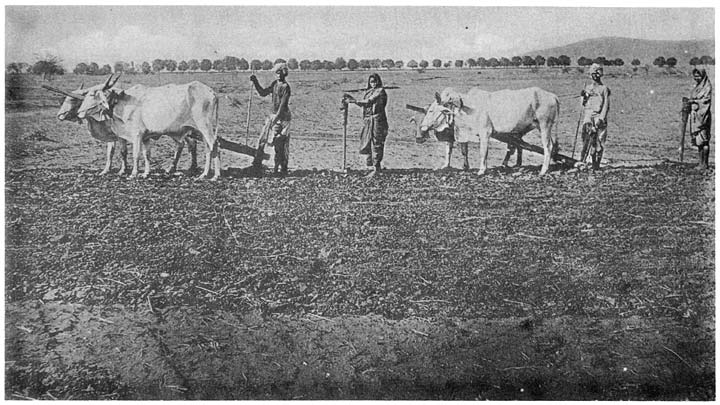
Sowing
The following observances in connection with the crops are practised by the agricultural castes in Chhattīsgarh:
32. Rites connected with the crops. Customs of cultivation
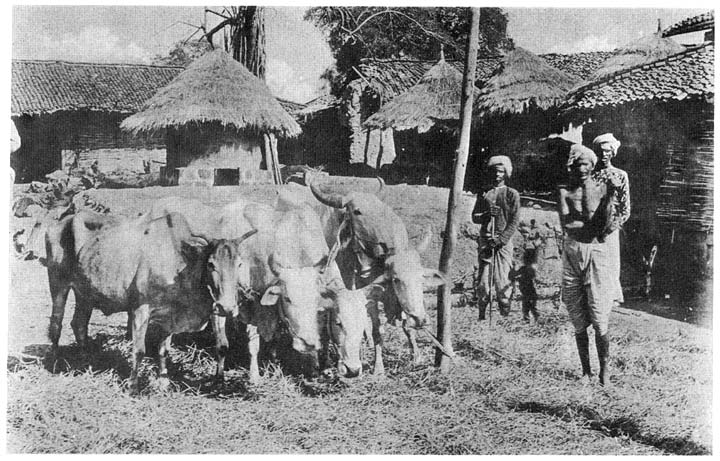
Threshing
33. Agricultural superstitions
The cultivators think that each grain should bear a hundredfold, but they do not get this as Kuvera, the treasurer of the gods, or Bhainsāsur, the buffalo demon who lives in the fields, takes it. Bhainsāsur is worshipped when the rice is coming into ear, and if they think he is likely to be mischievous they give him a pig, but otherwise a smaller offering. When the standing corn in the fields is beaten down at night they think that Bhainsāsur has been passing over it. He also steals the crop while it is being cut and is lying on the ground. Once Bhainsāsur was absent while the particular field in the village from which he stole his supply of grain was cut and the crop removed, and afterwards he was heard crying that all his provision for the year had been lost. Sometimes the oldest man in the house cuts the first five bundles of the crop, and they are afterwards left in the field for the birds to eat. And at the end of harvest the last one or two sheaves are left standing in the field, and any one who likes can cut and carry them away. In some localities the last stalks are left standing in the field and are known as barhona or the giver of increase. Then all the labourers rush together at this last patch of corn and tear it up by the roots; everybody seizes as much as he can and keeps it, the master having no share in this patch. After the barhona has been torn up all the labourers fall on their faces to the ground and worship the field. In other places the barhona is left standing for the birds to eat. This custom, arises from the belief demonstrated by Sir J. G. Frazer in The Golden Bough that the corn-spirit takes refuge in the last patch of grain, and that when it is cut he flies away or his life is extinguished. And the idea is supported by the fact that the rats and other vermin, who have been living in the field, seek shelter in the last patch of corn, and when this is cut have to dart out in front of the reapers. In some countries it is thought, as shown by Sir J. G. Frazer, that the corn-spirit takes refuge in the body of one of these animals.
34. Houses
The house of a mālguzār or good tenant stands in a courtyard or angan 45 to 60 feet square and surrounded by a brick or mud wall. The plan of a typical house is shown below:—
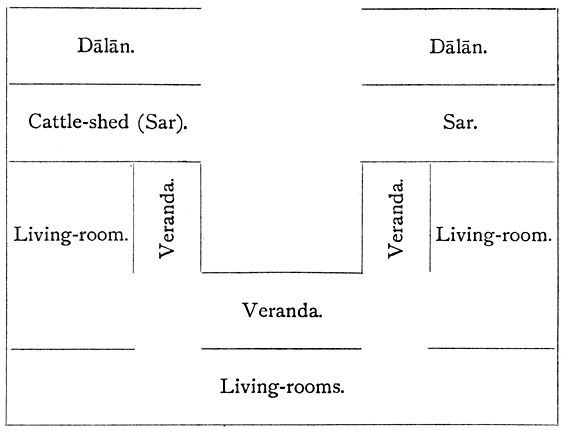
The dālān or hall is for the reception of visitors. One of the living-rooms is set apart for storing grain. Those who keep their women secluded have a door at the back of the courtyard for their use. Cooking is done in one of the rooms, and there are no chimneys, the smoke escaping through the tiles. They bathe either in the chauk or central courtyard, or go out and bathe in a tank or river or at a well. The family usually sleep inside the house in the winter and outside in the hot weather. A poor mālguzār or tenant has only two rooms with a veranda in front, one of which is used by the family, while cattle are kept in the other; while the small tenants and labourers have only one room in which both men and cattle reside. The walls are of bamboo matting plastered on both sides with mud, and the roof usually consists of single small tiles roughly baked in an improvised kiln. The house is surrounded by a mud wall or hedge, and sometimes has a garden behind in which tobacco, maize or vegetables are grown. The interior is dark, for light is admitted only by the low door, and the smoke-stained ceiling contributes to the gloom. The floor is of beaten earth well plastered with cowdung, the plastering being repeated weekly.
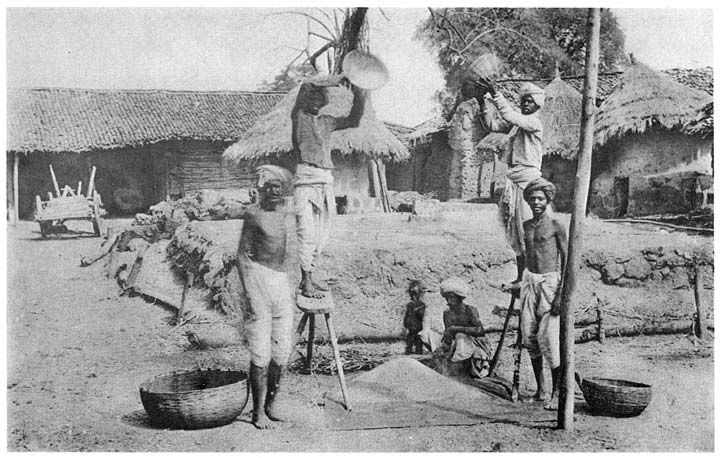
Winnowing
35. Superstitions about houses
No one should ever sit on the threshold of a house; this is the seat of Lakshmi, the goddess of wealth, and to sit on it is disrespectful to her. A house should never be swept at twilight, because it is then that Lakshmi makes her rounds, and she would curse it and pass by. At this time a lamp should be lighted, no one should be allowed to sleep, and even if a man is sick he should sit up on his bed. At this time the grinding-mill should not be turned nor grain be husked, but reverence should be paid to ancestors and to the household deities. No one must sit on the grinding-mill; it is regarded as a mother because it gives out the flour by which the family is fed. No one must sit on cowdung cakes because they are the seat of Saturn, the Evil One, and their smell is called Sanīchar ke bās. No one must step on the chūlka or cooking-hearth nor jar it with his foot. At the midday meal, when food is freshly cooked, each man will take a little fire from the hearth and place it in front of him, and will throw a little of everything he eats on to the fire, and some ghī as an offering to Agni, the god of fire. And he will also walk round the hearth, taking water in his hand and then throwing it on the ground as an offering to Agni. A man should not sleep with his feet to the south, because a corpse is always laid in that direction. He should not sleep with his feet to the east, nor spit out water from his mouth in the direction of the east.
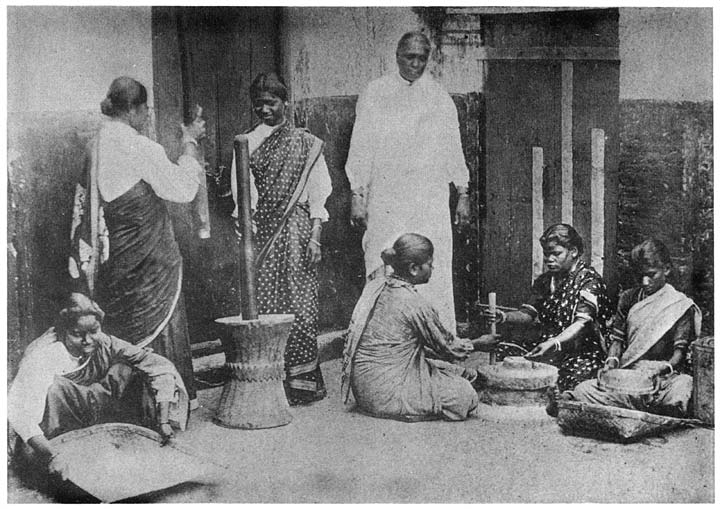
Women grinding wheat and husking rice
36. Furniture
Of furniture there is very little. Carefully arranged in their places are the brass cooking-pots, water-pots and plates, well polished with mud and water applied with plenty of elbow-grease by the careful housewife. Poor tenants frequently only have one or two brass plates and cups and an iron girdle, while all the rest of their vessels are of earthenware. Each house has several chūlhas or small horseshoe erections of earth for cooking. Each person in the house has a sleeping-cot if the family is comfortably off, and a spare one is also kept. These must be put out and exposed to the sun at least once a week to clear them of fleas and bugs. It is said that the Jains cannot adopt this method of disinfecting their beds owing to the sacrifice of insect life thereby involved; and that there are persons in Calcutta who make it their profession to go round and offer to lie on these cots for a time; they lie on them for some hours, and the little denizens being surfeited with their blood subsequently allow the owner of the cot to have a quiet night. A cot should always be shorter than a man’s length, so that his legs project over the end; if it is so long as to contain his whole length it is like a bier, and it is feared that lying on a cot of this kind will cause him shortly to lie on a bier. Poor tenants do not usually have cots, but sleep on the ground, spreading kodon-straw on it for warmth. They have no bedding except a gudri or mattress made of old rags and clothes sewn together. In winter they put it over them, and sleep on it in summer. They will have a wooden log to rest their heads on when sleeping, and this will also serve as a seat for a guest. Mālguzārs have a razai or quilt, and a doria or thick cloth like those used for covering carts. Clothes and other things are kept in jhāmpis or round bamboo baskets. For sitting on there are machnīs or four-legged stools about a foot high with seats of grass rope or pīrhis, little wooden stools only an inch or two from the ground. For lighting, wicks are set afloat in little earthen saucers filled with oil.
37. Clothes
Landowners usually have a long coat known as angarkha reaching to the knees, with flaps folding over the breasts and tied with strings. The bandi is a short coat like this but coming only to the hips, and is more popular with cultivators. In the cold weather it is frequently stuffed with cotton and dyed dark green or dark blue so as not to show the dirt. For visits of ceremony a pair of paijāmas are kept, but otherwise the dhoti or loin-cloth is commonly worn. Wearing the dhoti pulled half-way up to the thighs is called ‘cultivator’s fashion.’ A shirt may be worn under the coat; but cultivators usually have only one garment, nowadays often a sleeveless coat with buttons in front. The proper head-dress is the pagri, a piece of coloured cloth perhaps 30 feet long and a foot wide, twisted tightly into folds, which is lifted on and off the head and is only rarely undone. Twisting the pagri is an art, and a man is usually hired to do it and paid four annas. The pagris have different shapes in different parts of the country, and a Hindu can tell by the shape of a man’s pagri where he comes from. But nowadays cultivators usually wear a dupatta or short piece of cloth tied, loosely round the head. The tenant arranges his head-cloth with a large projection on one side, and in it he carries his chilam or pipe-bowl, and also small quantities of vegetables, salt or condiments purchased at the bazār. In case of necessity he can transform it into a loin-cloth, or tie up a bundle of grass with it, or tie his lota to it to draw water from a well. ‘What can the washerman do in a village where the people live naked?’ is a Chhattīsgarhi proverb which aptly indicates that scantiness is the most prominent feature of the local apparel. Here a cloth round the loins, and this usually of meagre dimensions, constituted, until recently, the full dress of a cultivator. Those who have progressed a stage farther throw a cloth loosely over one shoulder, covering the chest, and assume an apology for a turban by wrapping another small rag carelessly round the head, leaving the crown generally bare, as if this part of the person required special sunning and ventilation. Hindus will not be seen out-of-doors with the head bare, though the Gonds and other tribes only begin to wear head-cloths when they are adopting Hinduism. The Gondi fashion was formerly prevalent in Chhattīsgarh. Some sanctity attaches to the turban, probably because it is the covering of the head. To knock off a man’s turban is a great insult, and if it drops off or he lets it fall, it is a very bad omen.
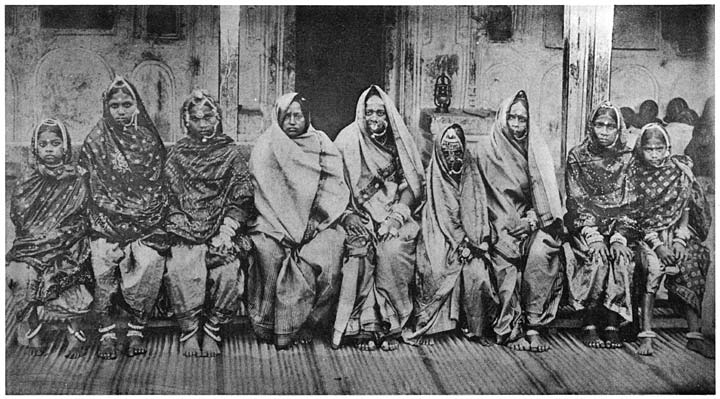
Group of women in Hindustāni dress
38. Women’s clothes
Women, in the northern Districts wear a skirt made of coarse cloth, usually red or blue, and a shoulder-cloth of the same material. Hand-woven cloth is still commonly used in the interior. The skirt is sometimes drawn up through the legs behind so as to give it a divided appearance; this is called kachhota. On the upper part of the body they wear an angia or breast-cloth, that is a short, tight, sleeveless jacket reaching only to below the breasts. The angia is tied behind, while the Marātha choli, which is the same thing, is buttoned or tied in front. High-caste women draw their shoulder-cloth right over the head so that the face cannot be seen. When a woman goes before a person of position she covers her head, as it is considered immodest to leave it bare. Women of respectable families wear a sheet of fine white, yellow, or red cloth drawn over the head and reaching to the ankles when they go on a journey, this being known as pichhora. In Chhattīsgarh all the requirements of fashion among women are satisfied by one cloth from 8 to 12 yards long and about a yard wide, which envelops the person in one fold from the waist to below the knee, hanging somewhat loosely. It is tied at the waist, and the remaining half is spread over the breast and drawn across the right shoulder, the end covering the head like a sheet and falling over the left shoulder. The simplicity of this solitary garment displays a graceful figure to advantage, especially on festival days, when those who can afford it are arrayed in tasar silk. When a girl is married the bridegroom’s family give her expensive clothes to wear at festivals and her own people give her ordinary clothes, but usually not more than will last a year. Whenever she goes back to her father’s house after her marriage, he gives her one or two cloths if he can afford it. Women of the middle and lower classes wear ornaments of bell-metal, a mixture of copper and zinc, which are very popular. Some women wear brass and zinc ornaments, and well-to-do persons have them of silver or gold.
39. Bathing
40. Food
Amarbel aur kamalgata, Gaon ka thākur, gai ka matha, Nagar sowāsan, unmen milai, Khāj, dād, sehua mīt jāwe.
Amarbel is an endless creeper, with long yellow strings like stalks, which infests and destroys trees; it is called amarbel or the immortal, because it has no visible root. Kamalgata is the seed of the lotus; gai ka matha is buttermilk; nagar sowāsan, ‘the happiness of the town,’ is turmeric, because married women whose husbands are alive put turmeric on their foreheads every day; khāj, dād and sehua are itch, ringworm and some kind of rash, perhaps measles; and the verse therefore means:
“Eat amarbel, lotus seeds, chirota, buttermilk and turmeric mixed together, and you will keep off itch, ringworm and measles.” Chirota is good for the itch.
41. Caste-feasts
At the commencement of a marriage or other ceremonial feast the host must wash the feet of all the guests himself. If he does not do this they will be dissatisfied, and, though they will eat at his house, will consider they have not been properly welcomed. He takes a large brass plate and placing the feet of his guest on it, pours water over them and then rubs and dries them; the water is thrown away and fresh water poured out for the next guest unless they should be brothers. Little flat stools about three inches high are provided for the guests, and if there are not enough of them a carpet is spread; or baithkis or sitting-mats plaited from five or six large leaves are set out. These serve as a mark of attention, as it would be discourteous to make a man sit on the ground, and they also prevent the body-cloth from getting wet. The guests sit in the chauk or yard of the house inside, or in the angan or outside yard, either in lines or in a circle; members of the same caste sit with their crossed knees actually touching those of the man on either side of them to emphasise their brotherhood; if a man sat even a few inches apart from his fellows people would say he was out of caste—and this is how a man who is put out of caste actually does sit. Before each guest may be set two plates of leaves and eight donas or leaf-cups. On the plates are heaped rice, cakes of wheat fried in butter, and of husked urad pulse cooked with tilli or sesamum oil, and the pulse of gram and lentils. In the cups will be sugar, ghī, dahi or curded milk, various vegetables, pumpkins, and besin or ground gram cooked with buttermilk. All the male members of the host’s family serve the food and they take it round, heaping and pouring it into each man’s plates or cups until he says enough; and they continue to give further helpings as required. All the food is served at once in the different plates and cups, but owing to the number of guests a considerable time elapses before all are fully served, and the dinner lasts about two hours. The guests eat all the different dishes together with their fingers, taking a little of each according to their fancy. Each man has his lota or vessel of water by him and drinks as he eats. When the meal is finished large brass plates are brought in, one being given to about ten guests, and they wash their hands over these, pouring water on them from their vessels. A fresh carpet is then spread in the yard and the guests sit on it, and betel-leaf and tobacco are distributed. The huqqa is passed round, and chilams and chongis (clay pipe-bowls and leaf-pipes) are provided for those who want them. The women do not appear at the feast but stay inside, sitting in the angan or inner court, which is behind the purda.
42. Hospitality
The people still show great hospitality, and it is the custom of many mālguzārs, at least in Chhattīsgarh, to afford food and a night’s rest to all travellers who may require it. When a Brāhman comes to the village such mālguzārs will give him one or two annas, and to a Pandit or learned man as much as a rupee. Formerly it is said that when any stranger came through the village he was at once offered a cup of milk and told to drink it or throw it away. But this custom has died out in Chhattīsgarh, though one has met with it once or twice in Sambalpur. When District Officers go on tour, well-to-do landowners ask to be allowed to supply free provisions for the whole camp at least for a day, and it is difficult to refuse them gracefully. In Mandla, Banias and mālguzārs in villages near the Nerbudda sometimes undertake to give a pound of grain to every parikramawāsi or pilgrim perambulating the Nerbudda. And as the number of these steadily increases in consequence, they often become impoverished as a result of such indiscriminate charity.
43. Social customs. Tattooing
The Kurmis employ Brāhmans for their ceremonies. They have gurus or spiritual preceptors who may be Brāhmans or Bairāgis; the guru is given from 8 annas to Rs. 5 when he initiates a neophyte, as well as his food and a new white cloth. The guru is occasionally consulted on some religious question, but otherwise he does nothing for his disciple except to pay him an occasional visit, when he is hospitably entertained. The Kurmis of the northern Districts do not as a rule eat meat and also abstain from alcohol, but in Chhattīsgarh they eat the flesh of clean animals and fish, and also of fowls, and drink country liquor. Old men often give up flesh and wine as a mark of piety, when they are known as Bhagat or holy. They will take food cooked with water only from Brāhmans, and that cooked without water from Rājpūts, Banias and Kāyasths as well. Brāhmans and Rājpūts will take water from Kurmis in the northern Districts though not in Chhattīsgarh. Here the Kurmis do not object to eating cooked food which has been carried from the house to the fields. This is called rengai roti, and castes which will eat it are considered inferior to those who always take their food in the chauka or purified place in the house. They say ‘Rām, Rām’ to each other in greeting, and the Raipur Kurmis swear by a dog or a pig. Generally they do not plough on the new or full moon days. Their women are tattooed after marriage with dots on the cheeks, marks of flies on the fingers, scorpions on the arms, and other devices on the legs.
44. Caste penalties
Permanent expulsion from caste is inflicted for a change of religion, taking food or having sexual intercourse with a member of an impure caste, and for eating beef. For killing a man, a cow, a buffalo, an ass, a horse, a squirrel, a cat or a monkey a man must purify himself by bathing in the Ganges at Allahābād or Benāres and giving a feast to the caste. It will be seen that all these are domestic animals except the monkey, who is the god Hanumān. The squirrel is counted as a domestic animal because it is always about the house, and the souls of children are believed to go into squirrels. One household animal, the dog, is omitted, and he appears to be less sacred than the others. For getting maggots in a wound the offender must bathe in a sacred river, such as the Nerbudda or Mahānadi, and give a feast to the caste. For eating or having intercourse with a member of any caste other than the impure ones, or for a liaison within the caste, or for divorcing a wife or marrying a widow, or in the case of a woman for breaking her bangles in a quarrel with her husband, a penalty feast must be given. If a man omits to feast the caste after a death in his family a second feast is imposed, and if he insults the panchāyat he is fined.
45. The cultivating status
Uttam kheti, madhyam bān, Kanisht chākri, bhīk nidān,
or ‘Cultivation is the best calling, trade is respectable, service is menial, and begging is degraded.’
46. Occupation
The Kurmi is the typical cultivator. He loves his land, and to lose it is to break the mainspring of his life. His land gives him a freedom and independence of character which is not found among the English farm-labourers. He is industrious and plodding, and inured to hardship. In some Districts the excellent tilth of the Kurmi’s fields well portrays the result of his persevering labour, which he does not grudge to the land because it is his own. His wife is in no way behind him; the proverb says, “Good is the caste of the Kurmin; with a hoe in her hand she goes to the fields and works with her husband.” The Chandnāhu Kurmi women are said to be more enterprising than the men, keeping them up to their work, and managing the business of the farm as well as the household.
Appendix
List of Exogamous Clans
Sections of the Chandnāhu subcaste:
Chānwar bambar Fly fan.
Sandil Name of a Rishi.
Gaind Ball.
Sadāphal A fruit.
Sondeha Gold-bodied.
Sonkharchi Spender of gold.
Kathail Kath, wood, or kaththa, catechu.
Kāshi Benares. The Desha Kurmis are all of this gotra. It may also be a corruption of Kachhap, tortoise.
Dhorha Dhor, cattle.
Sumer A mountain.
Chatur Midalia Chatur, clever.
Bhāradwāj After the Rishi of that name; also a bird.
Kousil Name of a Rishi.
Ishwar God.
Samund Karkari A particle in an ocean.
Akālchuwa Akāl, famine.
Padel Fallow.
Bāghmār Tiger-slayer.
Hardūba Green grass.
Kānsia Kāns, a kind of grass.
Ghiu Sāgar Ocean of ghī
Dharam Dhurandar Most charitable.
Singnāha Singh, a lion.
Chimangarhia Belonging to Chimangarh.
Khairagarhia Belonging to Khairagarh.
Gotam A Rishi.
Kāskyap A Rishi.
Pandariha From Pandaria, a village.
Paipakhār One who washes feet.
Bānhpakhār One who washes arms.
Chauria Chaurai, a vegetable.
Sānd Sathi Sānd, bullock.
Singhi Singh, lion or horn.
Agra—Chandan Sandalwood.
Tek Sanichar Saturday.
Karaiya Frying-pan.
Pukharia Pond.
Dhubinha Dhobi, a caste.
Pāwanbare Pāwan, air.
Modganga Ganges.
Sections of the Gabel subcaste:
Gangajal Ganges water.
Bimba Lohir Bearer of a lāthi (stick).
Sarang Peacock.
Rāja Rāwat Royal prince.
Singūr Beauty.
Bānk pagar With a thread on the arm.
Samundha Ocean.
Parasrām, Rishi
Katārmal Katār, dagger.
Chaultān Sept of Rājpūts.
Pātan Village.
Gajmani Elephant.
Deori Sumer Village.
Lahura Samudra Small sea.
Hansbimbraon Hans, goose.
Sunwāni Purifier.
Sections of the Santora subcaste:
Narvaria Narwar, a town in Gwalior State.
Mundharia Mundhra, a village.
Naigaiyan Naogaon, a town in Bundelkhand.
Pipraiya Piparia, a village.
Dindoria Dindori, a village in Mandla District.
Baheria A village.
Bāndha Bāndh, embankment.
Ktmūsar Wooden pestle.
Sections of the Tirole subcaste:
Baghele Bāgh, tiger, or a sept of Rājpūts.
Rāthor Clan of Rājpūts.
Panwār Clan of Rājpūts.
Solanki Clan of Rājpūts.
Aulia Aonla, a fruit-bearing tree.
Sindia Sindi, date-palm tree.
Khusia Khusi, happiness.
Sanoria San, hemp.
Gora Fair-coloured.
Bhākrya Bhākar, a thick bread.
Sections of the Gaur subcaste:
Bhandāri Storekeeper.
Dudhua Dūdh, milk.
Patele A headman.
Lonia Salt-maker.
Kumaria A potter.
Sionia Seoni town.
Chhaparia Chhapāra, a town.
Bijoria A tree.
Simra A village.
Ketharia Keth, a fruit.
Usarguiyan Perhaps a village.
Bhadoria Village.
Rurgaiyan Village.
Musrele Mūsar, a pestle.
Sections of the Usrete subcaste:
Shikāre Hunter.
Nāhar Tiger.
Gursaraiyan Gursarai, a town.
Bardia A village.
Sandia Sānd, a bull.
Sirwaiyan Sirwai, a village.
Itguhān A village.
Sengaiyan or Singaiyan Sengai, a village.
Harkotia Harkoti, a village.
Noria Norai, a village.
Larent Lareti, a village.
Rabia Rabai, a village.
Lakhauria (Lakori village. It is said that whoever utters the name of this section early in the morning is sure to remain hungry the whole day, or at least will get into some trouble that day.)
Dhandkonya Dhandakna, to roll.
Badgaiyan Badagaon, a large village.
Kotia Kot, a fort
Bilwār Billi, cat
Thutha Stump of a tree.
Sections of the Kanaujia subcaste:
Tidha.—From Tidha, a village. This section is subdivided into (a) Ghureparke (of the cow-dung hill); (b) Dwārparke (of the door); and (c) Jangi (warrior).
Chamania—From Chamyani (village). This is also subdivided into: (a) Gomarkya (b) Mathuria (Muttra town).
Chaudhri (caste headman). This is divided as follows: (a) Majhgawān A village. (b) Purva thok Eastern group. (c) Pashchim thok Western group. (d) Bamurya A village.
Rāwat Title.
Malha Perhaps sailor or wrestler.
Chiloliān Chiloli, a village.
Dhanuiyan Dhanu Kheda, a village.