Volume 4 — Mahār
Reading edition
List of Paragraphs
1. General Notice.
2. Length of residence in the Central Provinces
3. Legend of origin
4. Sub-castes
5. Exogamous groups and marriage customs
6. Funeral rites
7. Childbirth
8. Names
9. Religion
10. Adoption of foreign religions
11. Superstitions
12. Social rules
13. Social subjection
14. Their position improving
15. Occupation
1. General Notice.
2. Length of residence in the Central Provinces
3. Legend of origin
4. Sub-castes
5. Exogamous groups and marriage customs
The caste have also a large number of exogamous groups, the names of which are usually derived from plants, animals, and natural objects. A few may be given as examples out of fifty-seven recorded in the Central Provinces, though this is far from representing the real total; all the common animals have septs named after them, as the tiger, cobra, tortoise, peacock, jackal, lizard, elephant, lark, scorpion, calf, and so on; while more curious names are—Darpan, a mirror; Khānda Phari, sword and shield; Undrimāria, a rat-killer; Aglāvi, an incendiary; Andhāre, a blind man; Kutramāria, a dog-killer; Kodu Dūdh, sour milk; Khobragāde, cocoanut-kernel; Bhājikhai, a vegetable eater, and so on.
6. Funeral rites
7. Childbirth
In Mandla the mother is secluded at childbirth in a separate house if one is available, and if not they fence in a part of the veranda for her use with bamboo screens. After the birth the mother must remain impure until the barber comes and colours her toe-nails and draws a line round her feet with red mahur powder. This is indispensable, and if the barber is not immediately available she must wait until his services can be obtained. When the navel-string drops it is buried in the place on which the mother sat while giving birth, and when this has been done the purification may be effected. The Dhobi is then called to wash the clothes of the household, and their earthen pots are thrown away. The head of the newborn child is shaved clean, as the birth-hair is considered to be impure, and the hair is wrapped up in dough and thrown into a river.
8. Names
A child is named on the seventh or twelfth day after its birth, the name being chosen by the Mohtūria or caste headman. The ordinary Hindu names of deities for men and sacred rivers or pious and faithful wives for women are employed; instances of the latter being Ganga, Godāvari, Jamuna, Sīta, Laxmi and Rādha. Opprobrious names are sometimes given to avert ill-luck, as Damdya (purchased for eight cowries), Kauria (a cowrie), Bhikāria (a beggar), Ghusia (from ghus, a mallet for stamping earth), Harchatt (refuse), Akāli (born in famine-time), Langra (lame), Lula (having an arm useless); or the name of another low caste is given, as Bhangi (sweeper), Domari (Dom sweeper), Chamra (tanner), Basori (basket-maker). Not infrequently children are named after the month or day when they were born, as Pusau, born in Pus (December), Chaitu, born in Chait (March), Manglu (born on Tuesday), Buddhi (born on Wednesday), Sukka (born on Friday), Sanīchra (born on Saturday). One boy was called Mulua or ‘Sold’ (mol-dena). His mother had no other children, so sold him for one pice (farthing) to a Gond woman. After five or six months, as he did not get fat, his name was changed to Jhuma or ‘lean,’ probably as an additional means of averting ill-luck. Another boy was named Ghurka, from the noise he made when being suckled. A child born in the absence of its father is called Sonwa, or one born in an empty house.
9. Religion
The great body of the caste worship the ordinary deities Devi, Hanumān, Dūlha Deo, and others, though of course they are not allowed to enter Hindu temples. They principally observe the Holi and Dasahra festivals and the days of the new and full moon. On the festival of Nāg-Panchmi they make an image of a snake with flour and sugar and eat it. At the sacred Ambāla tank at Rāmtek the Mahārs have a special bathing-ghāt set apart for them, and they may enter the citadel and go as far as the lowest step leading up to the temples; here they worship the god and think that he accepts their offerings. They are thus permitted to traverse the outer enclosures of the citadel, which are also sacred. In Wardha the Mahārs may not touch the shrines of Mahādeo, but must stand before them with their hands joined. They may sometimes deposit offerings with their own hands on those of Bhīmsen, originally a Gond god, and Māta Devi, the goddess of smallpox.
10. Adoption of foreign religions
11. Superstitions
12. Social rules
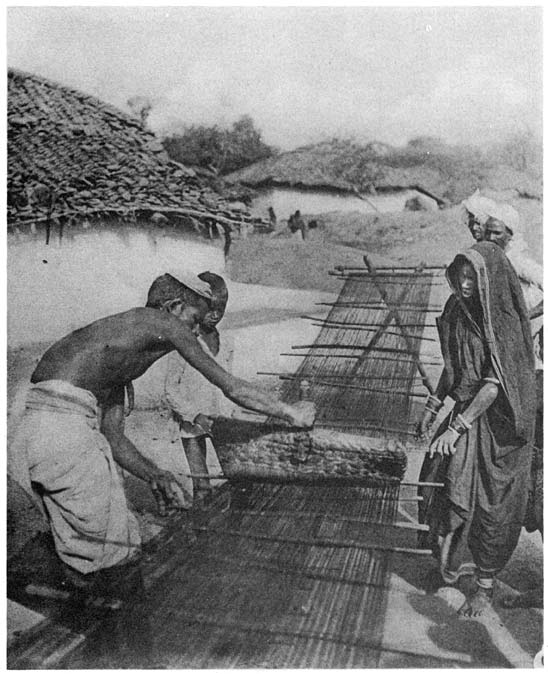
Weaving: sizing the warp
13. Social subjection
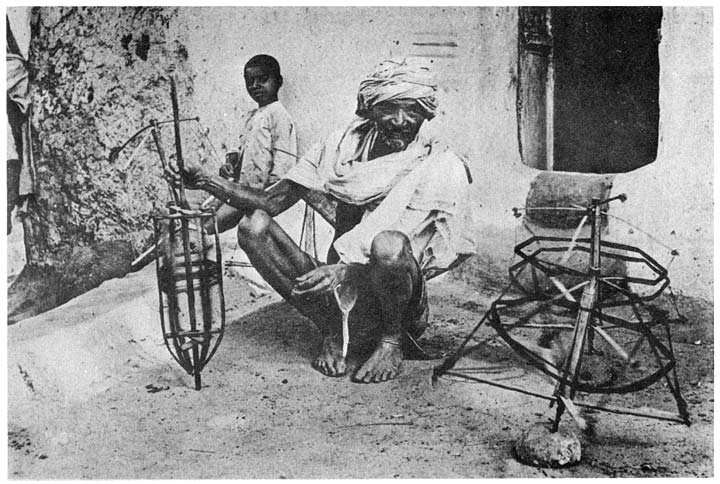
Winding thread
14. Their position improving
From the painful state of degradation described above the Mahārs are gradually being rescued by the levelling and liberalising tendency of British rule, which must be to these depressed classes an untold blessing. With the right of acquiring property they have begun to assert themselves, and the extension of railways more especially has a great effect in abolishing caste distinctions. The Brāhman who cannot afford a second-class fare must either not travel or take the risk of rubbing shoulders with a Mahār in a third-class carriage, and if he chooses to consider himself defiled will have to go hungry and thirsty until he gets the opportunity of bathing at his journey’s end. The observance of the rules of impurity thus becomes so irksome that they are gradually falling into abeyance.