Volume 4 — Kunbi
Reading edition
[This article is based on the information collected for the District Gazetteers of the Central Provinces, manuscript notes furnished by Mr. A.K. Smith, C.S., and from papers by Pandit Pyāre Lāl Misra and Munshi Kanhya Lāl. The Kunbis are treated in the Poona and Khāndesh volumes of the Bombay Gazetteer. The caste has been taken as typical of the Marāthi-speaking Districts, and a fairly full description of the marriage and other ceremonies has therefore been given, some information on houses, dress and food being also reproduced from the Wardha and Yeotmal District Gazetteers.]
List of Paragraphs
1. Distribution of the caste and origin of name
2. Settlement in the Central Provinces
3. Subcastes
4. The cultivating status
5. Exogamus septs
6. Restrictions on marriage of relatives
7. Betrothal and marriage
8. Polygamy and divorce
9. Widow-marriage
10. Customs at birth
11. Sixth and twelfth day ceremonies
12. Devices for procuring children
13. Love charms
14. Disposal of the dead
15. Mourning
16. Religion
17. The Pola festival
18. Muhammadan tendencies of Berār Kunbis
19. Villages and houses
20. Furniture
21. Food
22. Clothes and ornaments
23. The Kunbi as cultivator
24. Social and moral characteristics
1. Distribution of the caste and origin of name
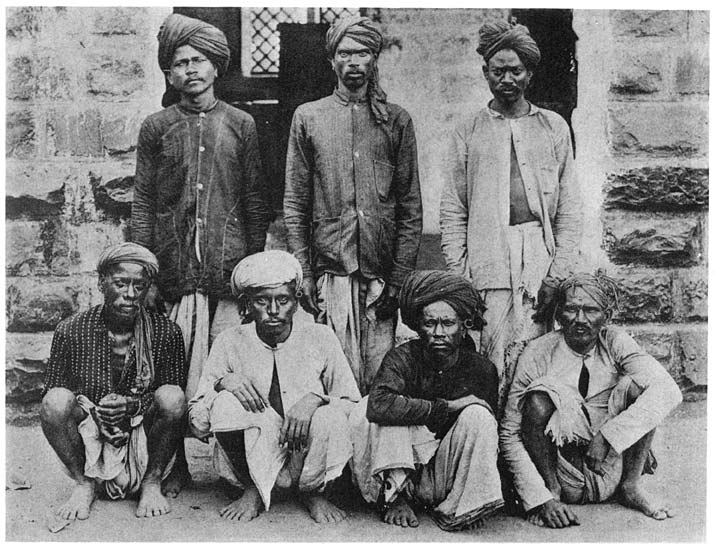
Group of Kunbis
2. Settlement in the Central Provinces
3. Subcastes
4. The cultivating status
5. Exogamus septs
6. Restrictions on marriage of relatives
A man is forbidden to marry within his own sept or kul, or in that of his mother or either of his grandmothers. He may marry his wife’s younger sister but not her elder sister. Alliances between first and second cousins are also prohibited except that a sister’s son may be married to a brother’s daughter. Such marriages are also favoured by the Marātha Brāhmans and other castes, and the suitability of the match is expressed in the saying Ato ghari bhāsi sūn, or ‘At a sister’s house her brother’s daughter is a daughter-in-law.’ The sister claims it as a right and not unfrequently there are quarrels if the brother decides to give his daughter to somebody else, while the general feeling is so strongly in favour of these marriages that the caste committee sometimes imposes a fine on fathers who wish to break through the rule. The fact that in this single case the marriage of near relatives is not only permitted but considered almost as an obligation, while in all other instances it is strictly prohibited, probably points to the conclusion that the custom is a survival of the matriarchate, when a brother’s property would pass to his sister’s son. Under such a law of inheritance he would naturally desire that his heir should be united to his own daughter, and this union might gradually become customary and at length almost obligatory. The custom in this case may survive when the reasons which justified it have entirely vanished. And while formerly it was the brother who would have had reason to desire the match for his daughter, it is now the sister who insists on it for her son, the explanation being that among the Kunbis as with other agricultural castes, to whom a wife’s labour is a valuable asset, girls are expensive and a considerable price has to be paid for a bride.
7. Betrothal and marriage
Girls are usually married between the ages of five and eleven and boys between ten and twenty. The Kunbis still think it a mark of social distinction to have their daughters married as young as possible. The recognised bride-price is about twenty rupees, but much larger sums are often paid. The boy’s father goes in search of a girl to be married to his son, and when the bride-price has been settled and the match arranged the ceremony of Māngni or betrothal takes place. In the first place the boy’s father proceeds to his future daughter-in-law’s house, where he washes her feet, smears her forehead with red powder and gives her a present of a rupee and some sweetmeats. All the party then eat together. This is followed by a visit of the girl’s father to the boy’s house where a similar ceremony is enacted and the boy is presented with a cocoanut, a pagri and cloth, and a silver or gold ring. Again the boy’s relatives go to the girl’s house and give her more valuable presents of jewellery and clothing. A Brāhman is afterwards consulted to fix the date of the marriage, but the poorer Kunbis dispense with his services as he charges two or three rupees. Prior to the ceremony the bodies of the bride and bridegroom are well massaged with vegetable oil and turmeric in their respective houses, partly with a view to enhance their beauty and also perhaps to protect them during the trying period of the ceremony when maleficent spirits are particularly on the alert. The marriage-shed is made of eleven poles festooned with leaves, and inside it are placed two posts of the sāleh (Boswellia serrata) or umar (Ficus glomerata) tree, one longer than the other, to represent the bride and bridegroom. Two jars filled with water are set near the posts, and a small earthen platform called baola is made. The bridegroom wears a yellow or white dress, and has a triangular frame of bamboo covered with tinsel over his forehead, which is known as bāsing and is a substitute for the maur or marriage-crown of the Hindustāni castes. Over his shoulder he carries a pickaxe as the representative implement of husbandry with one or two wheaten cakes tied to it. This is placed on the top of the marriage-shed and at the end of the five days’ ceremonies the members of the families eat the dried cakes with milk, no outsider being allowed to participate. The barāt or wedding procession sets out for the bride’s village, the women of the bridegroom’s family accompanying it except among the Tirole Kunbis, who forbid the practice in order to demonstrate their higher social position. It is received on the border of the girl’s village by her father and his friends and relatives, and conducted to the janwāsa or temporary lodging prepared for it, with the exception of the bridegroom, who is left alone before the shrine of Māroti or Hanumān. The bridegroom’s father goes to the marriage-shed where he washes the bride’s feet and gives her another present of clothes, and her relatives then proceed to Māroti’s temple where they worship and make offerings, and return bringing the bridegroom with them. As he arrives at the marriage pavilion he touches it with a stick, on which the bride’s brother who is seated above the shed pours down some water and is given a present of money by the bridegroom. The bridegroom’s feet are then washed by his father-in-law and he is given a yellow cloth which he wears. The couple are made to stand on two wooden planks opposite each other with a curtain between them, the bridegroom facing east and the bride west, holding some Akshata or rice covered with saffron in their hands. As the sun sets the officiating Brāhman gets on to the roof of the house and repeats the marriage texts from there. At his signal the couple throw the rice over each other, the curtain between them is withdrawn, and they change their seats. The assembled party applaud and the marriage proper is over. The Brāhman marks their foreheads with rice and turmeric and presses them together. He then seats them on the earthen platform or baola, and ties their clothes together, this being known as the Brahma Gānthi or Brāhman’s knot. The wedding usually takes place on the day after the arrival of the marriage procession and another two days are consumed in feasting and worshipping the deities. When the bride and bridegroom return home after the wedding one of the party waves a pot of water round their heads and throws it away at a little distance on the ground, and after this some grain in the same manner. This is a provision of food and drink to any evil spirits who may be hovering round the couple, so that they may stop to consume it and refrain from entering the house. The expenses of the bride’s family may vary from Rs. 60 to Rs. 100 and those of the bridegroom’s from Rs. 160 to Rs. 600. A wedding carried out on a lavish scale by a well-to-do man is known as Lāl Biāh or a red marriage, but when the parties are poor the expenses are curtailed and it is then called Safed Biāh or a white marriage. In this case the bridegroom’s mother does not accompany the wedding procession and the proceedings last only two days. The bride goes back with the wedding procession for a few days to her husband’s house and then returns home. When she arrives at maturity her parents give a feast to the caste and send her to her husband’s house, this occasion being known as Bolvan (the calling). The Karwa Kunbis of Nimār have a peculiar rule for the celebration of marriages. They have a guru or priest in Gujarāt who sends them a notice once in every ten or twelve years, and in this year only marriages can be performed. It is called Singhast ki sāl and is the year in which the planet Guru (Jupiter) comes into conjunction with the constellation Sinh (Leo). But the Karwas themselves think that there is a large temple in Gujarāt with a locked door to which there is no key. But once in ten or twelve years the door unlocks of itself, and in that year their marriages are celebrated. A certain day is fixed and all the weddings are held on it together. On this occasion children from infants in arms to ten or twelve years are married, and if a match cannot be arranged for them they will have to wait another ten or twelve years. A girl child who is born on the day fixed for weddings may, however, be married twelve days afterwards, the twelfth night being called Māndo Rāt, and on this occasion any other weddings which may have been unavoidably postponed owing to a death or illness in the families may also be completed. The rule affords a loophole of escape for the victims of any such contretemps and also insures that every girl shall be married before she is fully twelve years old. Rather than not marry their daughter in the Singhast ki sāl before she is twelve the parents will accept any bridegroom, even though he be very poor or younger than the bride. This is the same year in which the celebration of marriages is forbidden among the Hindus generally. The other Kunbis have the general Hindu rule that weddings are forbidden during the four months from the 11th Asārh Sudi (June) to the 11th Kārtik Sudi (October). This is the period of the rains, when the crops are growing and the gods are said to go to sleep, and it is observed more or less as a time of abstinence and fasting. The Hindus should properly abstain from eating sugarcane, brinjals, onions, garlic and other vegetables for the whole four months. On the 12th of Kārtik the marriage of Tulsi or the basil plant with the Sāligrām or ammonite representing Vishnu is performed and all these vegetables are offered to her and afterwards generally consumed. Two days afterwards, beginning from the 14th of Kārtik, comes the Diwāli festival. In Betūl the bridal couple are seated in the centre of a square made of four plough yokes, while a leaf of the pīpal tree and a piece of turmeric are tied by a string round both their wrists. The untying of the string by the local Brāhman constitutes the essential and binding portion of the marriage. Among the Lonhāre subcaste a curious ceremony is performed after the wedding. A swing is made, and a round pestle, which is supposed to represent a child, is placed on it and swung to and fro. It is then taken off and placed in the lap of the bride, and the effect of performing this symbolical ceremony is supposed to be that she will soon become a mother.
8. Polygamy and divorce
9. Widow-marriage
The Kunbis permit the remarriage of widows, with the exception of the Deshmukh families of the Tirole subcaste who have forbidden it. If a woman’s husband dies she returns to her father’s house and he arranges her second marriage, which is called choli-pātal, or giving her new clothes. He takes a price for her which may vary from twenty-five to five hundred rupees according to the age and attractions of the woman. A widow may marry any one outside the family of her deceased husband, but she may not marry his younger brother. This union, which among the Hindustāni castes is looked upon as most suitable if not obligatory, is strictly forbidden among the Marātha castes, the reason assigned being that a wife stands in the position of a mother to her husband’s younger brothers. The contrast is curious. The ceremony of widow-marriage is largely governed by the idea of escaping or placating the wrath of the first husband’s ghost, and also of its being something to be ashamed of and contrary to orthodox Hinduism. It always takes place in the dark fortnight of the month and always at night. Sometimes no women are present, and if any do attend they must be widows, as it would be the worst of omens for a married woman or unmarried girl to witness the ceremony. This, it is thought, would lead to her shortly becoming a widow herself. The bridegroom goes to the widow’s house with his male friends and two wooden seats are set side by side. On one of these a betel-nut is placed which represents the deceased husband of the widow. The new bridegroom advances with a small wooden sword, touches the nut with its tip, and then kicks it off the seat with his right toe. The barber picks up the nut and burns it. This is supposed to lay the deceased husband’s spirit and prevent his interference with the new union. The bridegroom then takes the seat from which the nut has been displaced and the woman sits on the other side to his left. He puts a necklace of beads round her neck and the couple leave the house in a stealthy fashion and go to the husband’s village. It is considered unlucky to see them as they go away because the second husband is regarded in the light of a robber. Sometimes they stop by a stream on the way home, and, taking off the woman’s clothes and bangles, bury them by the side of the stream. An exorcist may also be called in, who will confine the late husband’s spirit in a horn by putting in some grains of wheat, and after sealing up the horn deposit it with the clothes. When a widower or widow marries a second time and is afterwards attacked by illness, it is ascribed to the illwill of their former partner’s spirit. The metal image of the first husband or wife is then made and worn as an amulet on the arm or round the neck. A bachelor who wishes to marry a widow must first go through a mock ceremony with an ākra or swallow-wort plant, as the widow-marriage is not considered a real one, and it is inauspicious for any one to die without having been properly married once. A similar ceremony must be gone through when a man is married for the third time, as it is held that if he marries a woman for the third time he will quickly die. The ākra or swallow-wort (Calotropis gigantea) is a very common plant growing on waste land with mauve or purple flowers. When cut or broken a copious milky juice exudes from the stem, and in some places parents are said to poison children whom they do not desire to keep alive by rubbing this on their lips.
10. Customs at birth
11. Sixth and twelfth day ceremonies
On the sixth day after birth they believe that Chhathi or Satwai Devi, the Sixth-day Goddess, comes at midnight and writes on the child’s forehead its fate in life, which writing, it is said, may be seen on a man’s skull when the flesh has come off it after death. On this night the women of the family stay awake all night singing songs and eating sweetmeats. A picture of the goddess is drawn with turmeric and vermilion over the mother’s bed. The door of the birth-room is left open, and at midnight she comes. Sometimes a Sunār is employed to make a small image of Chhathi Devi, for which he is paid Rs. 1–4, and it is hung round the child’s neck. On this day the mother is given to eat all kinds of grain, and among flesh-eating castes the soup of fish and meat, because it is thought that every kind of food which the mother eats this day will be easily digested by the child throughout its life. On this day the mother is given a second bath, the first being on the day of the birth, and she must not bathe in between. Sometimes after childbirth a woman buys several bottles of liquor and has a bath in it; the stimulating effect of the spirit is supposed to remedy the distension of the body caused by the birth. If the child is a boy it is named on the twelfth and if a girl on the thirteenth day. On the twelfth day the mother’s bangles are thrown away and new ones put on. The Kunbis are very kind to their children, and never harsh or quick-tempered, but this may perhaps be partly due to their constitutional lethargy. They seldom refuse a child anything, but taking advantage of its innocence will by dissimulation make it forget what it wanted. The time arrives when this course of conduct is useless, and then the child learns to mistrust the word of its parents. Minute quantities of opium are generally administered to children as a narcotic.
12. Devices for procuring children
13. Love charms
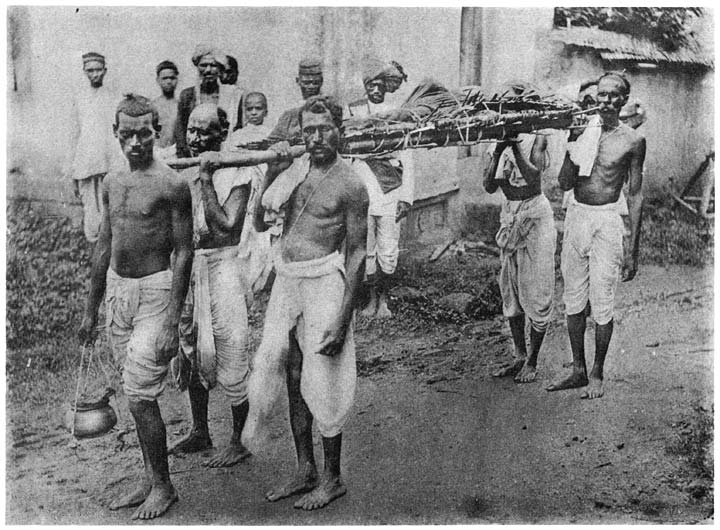
14. Disposal of the dead
15. Mourning
The period of mourning for adults of the family is ten days, and for children three, while in the case of distant relatives it is sufficient to take a bath as a mark of respect for them. The male mourners shave their heads, the walls of the house are whitewashed and the floor spread with cowdung. The chief mourner avoids social intercourse and abstains from ordinary work and from all kinds of amusements. He debars himself from such luxuries as betel-leaf and from visiting his wife. Oblations are offered to the dead on the third day of the light fortnight of Baisākh (June) and on the last day of Bhādrapad (September). The Kunbi is a firm believer in the action of ghosts and spirits, and never omits the attentions due to his ancestors. On the appointed day he diligently calls on the crows, who represent the spirits of ancestors, to come and eat the food which he places ready for them; and if no crow turns up, he is disturbed at having incurred the displeasure of the dead. He changes the food and goes on calling until a crow comes, and then concludes that their previous failure to appear was due to the fact that his ancestors were not pleased with the kind of food he first offered. In future years, therefore, he changes it, and puts out that which was eaten, until a similar contretemps of the non-appearance of crows again occurs. The belief that the spirits of the dead pass into crows is no doubt connected with that of the crow’s longevity. Many Hindus think that a crow lives a thousand years, and others that it never dies of disease, but only when killed by violence. Tennyson’s ‘many-wintered crow’ may indicate some similar idea in Europe. Similarly if the Gonds find a crow’s nest they give the nestlings to young children to eat, and think that this will make them long-lived. If a crow perches in the house when a woman’s husband or other relative is away, she says, ‘Fly away, crow; fly away and I will feed you’; and if the crow then flies away she thinks that the absent one will return. Here the idea is no doubt that if he had been killed his spirit might have come home in the shape of the crow perching on the house. If a married woman sees two crows breeding it is considered a very bad omen, the effect being that her husband will soon die. It is probably supposed that his spirit will pass into the young crow which is born as a result of the meeting which she has seen.
Mr. A. K. Smith states that the omen applies to men also, and relates a story of a young advocate who saw two crows thus engaged on alighting from the train at some station. In order to avert the consequences he ran to the telegraph office and sent messages to all his relatives and friends announcing his own death, the idea being that this fictitious death would fulfil the omen, and the real death would thus become unnecessary. In this case the belief would be that the man’s own spirit would pass into the young crow.
16. Religion
17. The Pola festival
The principal festival of the Kunbis is the Pola, falling at about the middle of the rainy season, when they have a procession of plough-bullocks. An old bullock goes first, and on his horns is tied the makhar, a wooden frame with pegs to which torches are affixed. They make a rope of mango-leaves stretched between two posts, and the makhar bullock is made to break this and stampede back to the village, followed by all the other cattle. It is said that the makhar bullock will die within three years. Behind him come the bullocks of the proprietors and then those of the tenants in the order, not so much of their wealth, but of their standing in the village and of the traditional position held by their families. A Kunbi feels it very bitterly if he is not given what he considers to be his proper rank in this procession. It has often been remarked that the feudal feeling of reverence for hereditary rights and position is as strong among the Marātha people as anywhere in the world.
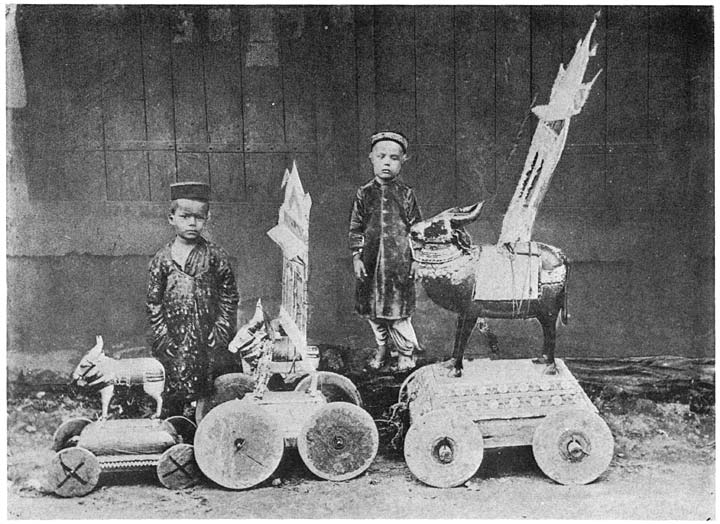
Figures of animals made for Pola festival
18. Muhammadan tendencies of Berār Kunbis
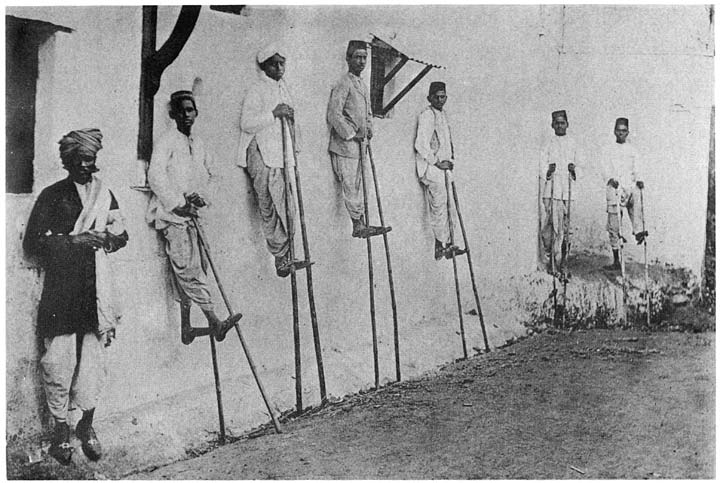
Hindu boys on stilts
19. Villages and houses
20. Furniture
Ordinary cultivators have earthen pots for cooking purposes and brass ones for eating from, while the well-to-do have all their vessels of brass. The furniture consists of a few stools and cots. No Kunbi will lie on the ground, probably because a dying man is always laid on the ground to breathe his last; and so every one has a cot consisting of a wooden frame with a bed made of hempen string or of the root-fibres of the palās tree (Butea frondosa). These cots are always too short for a man to lie on them at full length, and are in consequence supremely uncomfortable. The reason may perhaps be found in the belief that a man should always lie on a bed a little shorter than himself so that his feet project over the end. Because if the bed is longer than he is, it resembles a bier, and if he lies on a bier once he may soon die and lie on it a second time. For bathing they make a little enclosure in the compound with mats, and place two or three flat stones in it. Hot water is generally used and they rub the perspiration off their bodies with a flat stone called Jhāwar. Most Kunbis bathe daily. On days when they are shaved they plaster the head with soft black earth, and then wash it off and rub their bodies with a little linseed or sesamum oil, or, if they can afford it, with cocoanut oil.
21. Food
The Kunbis eat three times a day, at about eight in the morning, at midday and after dark. The morning meal is commonly eaten in the field and the two others at home. At midday the cultivator comes home from work, bathes and takes his meal, having a rest for about two hours in all. After finishing work he again comes home and has his evening meal, and then, after a rest, at about ten o’clock he goes again to the fields, if the crops are on the ground, and sleeps on the mara or small elevated platform erected in the field to protect the grain from birds and wild animals; occasionally waking and emitting long-drawn howls or pulling the strings which connect with clappers in various parts of the field. Thus for nearly eight months of the year the Kunbi sleeps in his fields, and only during the remaining period at home. Juāri is the staple food of the caste, and is eaten both raw and cooked. The raw pods of juāri were the provision carried with them on their saddles by the marauding Marātha horsemen, and the description of Sivaji getting his sustenance from gnawing at one of these as he rode along is said to have struck fear into the heart of the Nizām. It is a common custom among well-to-do tenants and proprietors to invite their friends to a picnic in the fields when the crop is ripe to eat hurda or the pods of juāri roasted in hot ashes. For cooking purposes juāri is ground in an ordinary handmill and then passed through a sieve, which separates the finer from the coarser particles. The finer flour is made into dough with hot water and baked into thick flat chapātis or cakes, weighing more than half a pound each; while the coarse flour is boiled in water like rice. The boiled pulse of arhar (Cajanus indicus) is commonly eaten with juāri, and the chapātis are either dipped into cold linseed oil or consumed dry. The sameness of this diet is varied by a number of green vegetables, generally with very little savour to a European palate. These are usually boiled and then mixed into a salad with linseed or sesamum oil and flavoured with salt or powdered chillies, these last being the Kunbi’s indispensable condiment. He is also very fond of onions and garlic, which are either chopped and boiled, or eaten raw. Butter-milk when available is mixed with the boiled juāri after it is cooked, while wheat and rice, butter and sugar are delicacies reserved for festivals. As a rule only water is drunk, but the caste indulge in country liquor on festive occasions. Tobacco is commonly chewed after each meal or smoked in leaf cigarettes, or in chilams or clay pipe-bowls without a stem. Men also take snuff, and a few women chew tobacco and take snuff, though they do not smoke. It is noticeable that different subdivisions of the caste will commonly take food from each other in Berār, whereas in the Central Provinces they refuse to do so. The more liberal usage in Berār is possibly another case of Muhammadan influence. Small children eat with their father and brothers, but the women always wait on the men, and take their own food afterwards. Among the Dālia Kunbis of Nimār, however, women eat before men at caste feasts in opposition to the usual practice. It is stated in explanation that on one occasion when the men had finished their meal first and gone home, the women on returning were waylaid in the dark and robbed of their ornaments. And hence it was decided that they should always eat first and go home before nightfall. The Kunbi is fairly liberal in the matter of food. He will eat the flesh of goats, sheep and deer, all kinds of fish and fowls, and will drink liquor. In Hoshangābād and Nimār the higher subcastes abstain from flesh and wine. The caste will take food cooked without water from Brāhmans, Banias and Sunārs, and that mixed with water only from Marātha Brāhmans. All castes except Marātha Brāhmans will take water from the hands of a Kunbi.
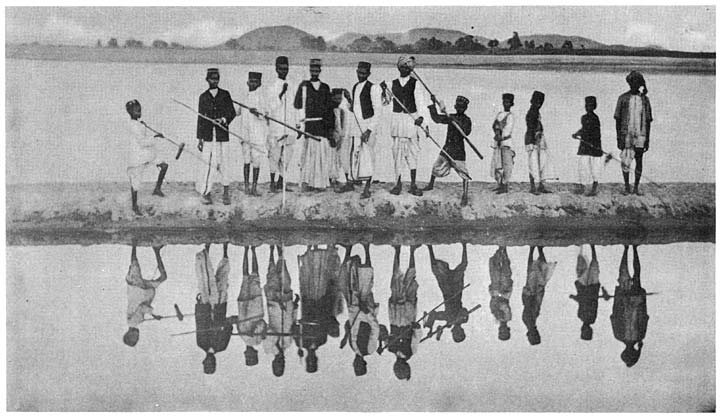
Throwing stilts into the water at the Pola festival
22. Clothes and ornaments
The dress of the ordinary cultivator is most common-place and consists only of a loin-cloth, another cloth thrown over the shoulders and upper part of the body, which except for this is often bare, and a third rough cloth wound loosely round the head. All these, originally white, soon assume a very dingy hue. There is thus no colour in a man’s everyday attire, but the gala dress for holidays consists of a red pagri or turban, a black, coloured or white coat, and a white loin-cloth with red silk borders if he can afford it. The Kunbi is seldom or never seen with his head bare; this being considered a bad omen because every one bares his head when a death occurs. Women wear lugras, or a single long cloth of red, blue or black cotton, and under this the choli, or small breast-cloth. They have one silk-bordered cloth for special occasions. A woman having a husband alive must not wear a white cloth with no colour in it, as this is the dress of widows. A white cloth with a coloured border may be worn. The men generally wear shoes which are open at the back of the heel, and clatter as they move along. Women do not, as a rule, wear shoes unless these are necessary for field work, or if they go out just after their confinement. But they have now begun to do so in towns. Women have the usual collection of ornaments on all parts of the person. The head ornaments should be of gold when this metal can be afforded. On the finger they have a miniature mirror set in a ring; as a rule not more than one ring is worn, so that the hands may be free for work. For a similar reason glass bangles, being fragile, are worn only on the left wrist and metal ones on the right. But the Dhanoje Kunbis, as already stated, have cocoanut shell bangles on both wrists. They smear a mark of red powder on the forehead or have a spangle there. Girls are generally tattooed in childhood when the skin is tender, and the operation is consequently less painful. They usually have a small crescent and circle between the brows, small circles or dots on each temple and on the nose, cheeks and chin, and five small marks on the back of the hands to represent flies. Some of the Deshmukh families have now adopted the sacred thread; they also put caste marks on the forehead, and wear the shape of pagri or turban formerly distinctive of Marātha Brāhmans.
23. The Kunbi as cultivator
Carrying out the dead