Volume 4 — Teli
Reading edition
List of Paragraphs
1. Strength and distribution of the caste
2. Origin and traditions
3. Endogamous subcastes
4. Exogamous divisions
5. Marriage customs
6. Widow-remarriage
7. Religion: Caste deities
8. Driving out evil
9. Customs at birth and death
10. Social status
11. Social customs and caste penalties
12. The Rāthor Telis
13. Gujarāti Telis of Nimār
14. The Teli an unlucky caste
15. Occupation. Oil-pressing
16. Trade and agriculture
17. Teli beneficence
1. Strength and distribution of the caste
2. Origin and traditions
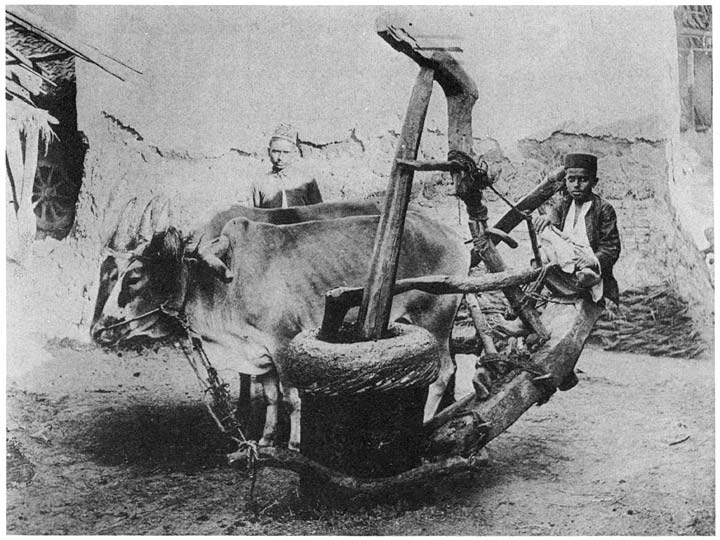
Teli’s oil-press
3. Endogamous subcastes
The caste has a large number of subdivisions. The principal groups in Chhattīsgarh are the Halia, Jharia and Ekbahia Telis. The Halias, who perhaps take their name from hal, a plough, are considered to be the best cultivators, and are said to have immigrated from Mandla some generations ago. Probably the bulk of the Hindu population of Chhattīsgarh came from this direction. The name Jharia means jungly or savage, and is commonly applied to the oldest residents, but the Jharia Telis are the highest local subcaste. They require the presence of a Brāhman at their weddings, and abstain generally from liquor, fowls and pork, to which the Halias are not averse. They also bathe the corpse before it is burnt or buried, an observance omitted by the Halias. The Jharias yoke only one bullock to the oil-press, and the Halias two, a distinction which is elsewhere sufficient of itself to produce separate subcastes. The Ekbahia (one-armed) Telis are so called because their women wear glass bangles only on the right hand and metal ones on the left. This is a custom of several castes whose women do manual labour, and the reason appears to be one of convenience, as glass bangles on the working arm would be continually getting broken. Among the Ekbahia Telis it is said that a woman considers it a point of honour to have these metal bangles as numerous and heavy as her arm can bear; and at a wedding a present of three bracelets from the bridegroom to the bride is held to be indispensable. The Madpotwa are a small subcaste living near the hills, who in former times distilled liquor; they keep pigs and poultry, and rank below the others. Other groups are the Kosarias, who are called after Kosala, the old name of Chhattīsgarh, and the Chhote or Little Telis, who are of illegitimate descent. Children born out of wedlock are relegated to this group.
4. Exogamous divisions
Each subcaste is divided into a number of exogamous groups for the regulation of marriages. The names of the groups appear to be taken either from villages or titles or nicknames. Most of them cannot be recognised, but the following are a few: Bāghmāre, a tiger-killer; Deshmukh, a village officer; Vaidya, a physician; Bāwankule, the fifty-two septs; Badwāik, the great ones; Satpute, seven sons; Bhājikhāya, an eater of vegetables; Satapaise, seven pice; Ghoremādia, a horse-killer; Chaudhri, a caste headman; Ardona, a kind of gram; Malghāti, a valley; Chandan-malāgar, one who presented sandalwood; and Sanichara, born on Saturday. Three septs, Dhurwa, Besrām, a hawk, and Sonwāni, gold-water, belong to the Gonds or other tribes. The clans of the Rāthor Telis of Mandla are said to be named after villages in Jubbulpore and Maihar State.
5. Marriage customs
The marriage of persons of the same sept and of first cousins is usually forbidden. A man may marry his wife’s younger sister while she herself is alive, but never her elder sister. An unmarried girl becoming pregnant by a man of the caste is married to him by the ceremony used for a widow, and she may be readmitted even after a liaison with an outsider among most Telis. In Chānda the parents of a girl who is not married before puberty are fined. The proposal comes from the boy’s side and a bride-price is usually paid, though not of large amount. The Halia Telis of Chhattīsgarh, like other agricultural castes, sometimes betroth their children when they are five or six months old, but as a rule no penalty attaches to the breaking of the betrothal. The betrothal is celebrated by the distribution of one or two rupees’ worth of liquor to the neighbours of the caste. As among other low castes, on the day before the wedding procession starts, the bridegroom goes round to all the houses in the village and his sister dances round him with her head bent, and all the people give him presents. This is known as the Binaiki or Farewell, and the bride does the same in her village. Among the Jharia Telis the women go and worship the marriage-post at the carpenter’s house while it is being made. In this subcaste the bridegroom goes to the wedding in a cart and not on horseback or in a litter as among some castes. The rule may perhaps be a recognition of their humble station. The Halia subcaste can dispense with the presence of a Brāhman at the wedding, but not the Jharias. In Wardha the bridegroom’s head is covered with a blanket, over which is placed the marriage-crown. On the arrival of the bridegroom’s party they are regaled with sherbet or sugar and water by the bride’s relatives, and sometimes red pepper is mixed with this by way of a joke. At a wedding of the Gujarāti Tells in Nimār the caste-priest carries the tutelary goddess Kāli in procession, and in front of her a pot filled with burning cotton-seeds and oil. A cloth is held over the pot, and it is believed that the power of the goddess prevents the cloth from taking fire. If this should happen some great calamity would be portended. Rāthor Teli girls, whether married or unmarried, go with their heads bare, and a woman draws her cloth over her head for the first time when she begins to live in her husband’s house.
6. Widow-remarriage
Divorce and widow-marriage are permitted. In Chhattīsgarh a widow is always kept in the family if possible, and if her late husband’s brother be only a boy she is sometimes induced to put on the bangles and wait for him. If a barandi widow, that is one who has been married but has not lived with her husband, desires to marry again out of his family, the second husband must repay to them the amount spent on her first marriage. In Chānda, on the other hand, some Telis do not permit a widow to marry her late husband’s younger brother at all, and others only when he is a bachelor or a widower. Here the minimum period for which a widow must remain single after her husband’s death is one month. The engagement with a widow is arranged by the suitor’s female relatives, and they pay her a rupee as earnest money. On the day fixed she goes with one or two other widows to the bridegroom’s house, and from there to the bazār, where she buys two pairs of bell-metal rings, to be worn on the second toe of each foot, and some glass bangles. She remains sitting in the bazār till well after dark, when some widow goes to fetch her on behalf of her suitor. They bring her to his house, where the couple sit together, and red powder is applied to their foreheads. They then bathe and present their clothes to the washerman, putting on new clothes. The idea in all this is clearly to sever the widow as completely as possible from her old home and prevent her from being accompanied to the new one by the first husband’s spirit. In some localities when a Teli widow remarries it is considered most unlucky for any one to see the face of the bride or bridegroom for twenty-four hours, or as some say for three days after the wedding. The ceremony is therefore held at night, and for this period the couple either remain shut up in the house or retire to the jungle.
7. Religion: Caste deities
The caste especially revere Mahādeo or Siva, who gave them the oil-mill. In the Nāgpur country they do not work the mill on Monday, because it is Mahādeo’s day, he having the moon on his forehead. They revere the oil-mill, and when the trunk is brought to be set up in the house, if there is difficulty in moving it they make offerings to it of a goat or wheat-cakes or cocoanuts, after which it moves easily. When a Teli first sets the trunk-socket of the oil-press in the ground he buries beneath it five pieces of turmeric, some cowries and an areca-nut In the northern Districts the Telis worship Masān Bāba, who is supposed to be the ghost of a Teli boy. He is a boy about three feet in height, black-coloured, with a long black scalp-lock. Some Telis have Masān Bāba in their possession, and when they are turning the oil-press they set him on top of it, and he makes the bullocks keep on working, so that the master can go away and leave the press. But in order to prevent him from getting into mischief a cake of flour mixed with human hair must be placed in front of the press; he will eat this, but will first pick out all the hairs one by one, and this will occupy him the whole night; but if no cake is put for him he will eat all the food in the house. A Teli who has not got Māsan must go to one who has and hire him for Rs. 1–4 a night. They then both go to the owner’s oil-press, and the hirer says, ‘I have hired you to-night,’ and the owner says, ‘Yes, I have let you for to-night’; and then the hirer goes away, and Masān Bāba follows him and will turn the oil-mill all night. A Teli who has not got Masān Bāba puts a stone on the oil-mill, and then the bullock thinks that his master Masān is sitting on it, and will go on turning the press; but this is not so good as having Masān Bāba. Some say that he will repay his hirer the sum of Rs. 1–4 by stealing something during the year and giving it to him. Masān may perhaps be considered as a divine personification of the oil-press, and as being the Teli’s explanation of the fact that the bullock goes on turning the press without being driven, which he does not attribute simply to the animal’s docility. In Chhattīsgarh Dūlha Deo is the household god of the caste, and he is said not to have any visible image or symbol, but is considered to reside in a cupboard in the house. When any member of the family falls ill it is thought that Dūlha Deo is angry, and a goat is offered to appease him. Like the other low castes the Telis of the Nāgpur country make the sacrifice of a pig to Nārāyan Deo or the Sun at intervals.
8. Driving out evil
Here on the third day after the Pola festival in the rains the women of the caste bring the branches of a thorny creeper, with very small leaves, and call it Mārbod, and sweep out the whole house with it, saying:
‘Ira, pīra, khātka, khatkīra, Khānsi, kokhala, rai, rog, Murkuto gheunja ga Mārbod,’
or, ‘Oh Mārbod! sweep away all diseases, pains, coughs, bugs, flies and mosquitoes.’ And then they take the pot of sweepings and throw it outside the village. Mārbod is the deity represented by the branch of the creeper. This rite takes place in the middle of the rainy season, when all kinds of insects infest the house, and colds and fever are prevalent Mr. H.R. Crosthwaite sends the following explanation given by a Teli cultivator of an eclipse of the sun: “The Sun is indebted to a sweeper. The sweeper has gone to collect the debt and the Sun has refused to pay. The sweeper is in need of the money and is sitting dharna at the Sun’s door; you can see his shadow across the Sun’s threshold. Presently the debt will be paid and the sweeper will go away.” The Telis of Nimār observe various Muhammadan practices. They fast during the month of Ramazān, taking their food in the morning before sunrise; and at Id they eat the vermicelli and dates which the Muhammadans eat in memory of the time when their forefathers lived on this food in the Arabian desert. Such customs are a relic of the long period of Muhammadan dominance in Nimār, when the Hindus conformed partly to the religion of their masters. Many Telis are also members of the Swāmi-Nārāyan reforming sect, which may have attracted them by its disregard of the distinctions of caste and of the low status which attaches to them under Hinduism.
9. Customs at birth and death
In Patna State a pregnant woman must not cross a river nor eat any fruit or vegetables of red colour, nor wear any black cloth. These taboos preserve her health and that of her unborn child. After the birth of a child a woman is impure for seven or nine days in Chhattīsgarh, and is then permitted to cook. The dead are either buried or burnt, cremation being an honour reserved for the old. The body is placed in both cases with the head to the north and face downwards or upwards for a male or female respectively.
10. Social status
The social status of the Telis is low, in the group of castes from which Brāhmans will not take water, and below such menials as the blacksmith and carpenter. Manu classes them with butchers and liquor-vendors: “From a king not born in the military class let a Brāhman accept no gift nor from such as keep a slaughter-house, or an oil-press, or put out a vintner’s flag or subsist by the gains of prostitutes.” This is much about the position which the Telis have occupied till recently. Brāhmans will not usually enter their houses, though they have begun to do so in the case of the landholding subcastes. It is noticeable that the Teli has a much better position in Bengal than elsewhere. Sir H. Risley says: “Their original profession was probably oil-pressing, and the caste may be regarded as a functional group recruited from the respectable middle class of Hindu society. Oil is used by all Hindus for domestic and ceremonial purposes, and its manufacture could only be carried on by men whose social purity was beyond dispute.” This is, however, quite exceptional, and Mr. Crooke, Mr. Nesfield and Sir D. Ibbetson are agreed as to his inferior, if not partly impure, status. This is only one of several instances, such as those of the barber, the potter and the weaver, of menial castes which in Bengal have now obtained a position above the agricultural castes. It may be suggested in explanation that the old fabric of Hindu society, that is the village community, has long decayed in Bengal owing to Muhammadan dominance, the concentration of estates in the hands of large proprietors and the weakening or lapse of the customary rights of tenants. Coupled with this has been the growth of an important urban population, in which the castes mentioned have raised themselves from their menial position in the villages and attained wealth and influence, just as the Gujarāti Telis are now doing in Burhānpur, while the agricultural castes of Bengal have been comparatively depressed. Hence the urban industrial castes have obtained a great rise in status. Sir H. Risley’s emphasis of the importance of oil in Hindu domestic ceremonial is no doubt quite true, though it is perhaps little used in sacrifices, butter being generally preferred as a product of the sacred cow. But the inference does not seem necessarily to follow that the producer of any article shares exactly in the estimation attaching to the thing itself. Turmeric, for instance, is a sacred plant and indispensable at every wedding; but those who grow turmeric always incur a certain stigma and loss in social position. The reason for the impurity of the Teli’s calling seems somewhat doubtful. That generally given is his sinful conduct in harnessing the sacred ox and blindfolding the animal’s eyes to make it work continuously on the tread-mill. The labour is said to be very severe, and the bullocks often die after two or three years. As already seen, the Teli fears that after death his soul may pass into one of his own bullocks in retribution for his treatment of them during life. Another reason which may be suggested is that the crushing of oil-seeds must involve a large destruction of insect life, many of the seeds being at times infested with insects. The Teli’s occupation would naturally rank with the other village industries, that is below agriculture; and prior to the introduction of cash coinage he must have received contributions of grain from the tenants for supplying them with oil like the other village menials. He still takes his oil to the fields at harvest-time and gets his sheaf of grain from each holding.
11. Social customs and caste penalties
12. The Rāthor Telis
The Rāthor Telis of Mandla hold a number of villages. They now call themselves Rāthor, and entirely disown the name of Teli. They say that they came from the Maihar State near Panna, and that the title of Mahto, from mahat, great, which is borne by the leading men of the caste, was conferred on them by the Rāja of Maihar. Another story is that, as already related, they are debased Rāthor Rājpūts. Recently they have given up eating fowls and drinking liquor. They are good cultivators, borrowing among themselves at low interest and avoiding debt, and their villages are generally prosperous.
13. Gujarāti Telis of Nimār
Again, as has been seen, the Gujarāti Telis of Burhānpur have taken to trade, and some of them have become wealthy merchants and capitalists from their dealings in cotton. The position of Telis in Burhānpur was apparently one of peculiar degradation under Muhammadan rule. According to local tradition they had to remove the corpses of dead elephants, which no other caste would consent to do, and also to dig the graves of Muhammadans. It is also said that even now a Hindu becomes impure by passing under the eaves of a Teli’s house, and that no dancing-girl may dance before a Teli, and if she does so will incur a penalty of Rs. 50 to her caste. The Telis, on the other hand, vigorously repudiate these allegations, which no doubt are due partly to jealousy of their present prosperity and consequent attempts to better their status. The Telis allege that they were Modh Banias in Gujarāt and when they came to Burhānpur adopted the occupation of oil-pressing, which is also countenanced by the Shāstras for a Vaishya. They say that formerly they did not permit widow-marriage, but when living under Muhammadan rule they were constrained to get their widows married in the caste, or the Muhammadans would have taken them. The Muhammadan practices already noticed as prevalent among them are being severely repressed, and they are believed to have made a caste rule that any Teli who goes to the house of a Muhammadan will have his hair and beard shaved and be fined Rs. 50. They are also supposed to have made offers to Brāhmans of sums of Rs. 500 to Rs. 1000 to come and take their food in the verandas of the Telis’ houses, but hitherto these have not been accepted.