Volume 4 — Kumhār
Reading edition
List of Paragraphs
1. Traditions of origin
2. Caste sub-divisions
3. Social Customs
4. The Kumhār as a village menial
5. Occupation
6. Breeding pigs for sacrifices
7. The goddess Demeter
8. Estimation of the pig in India
9. The buffalo as a corn-god
10. The Dasahra festival
11. The goddess Devi
1. Traditions of origin
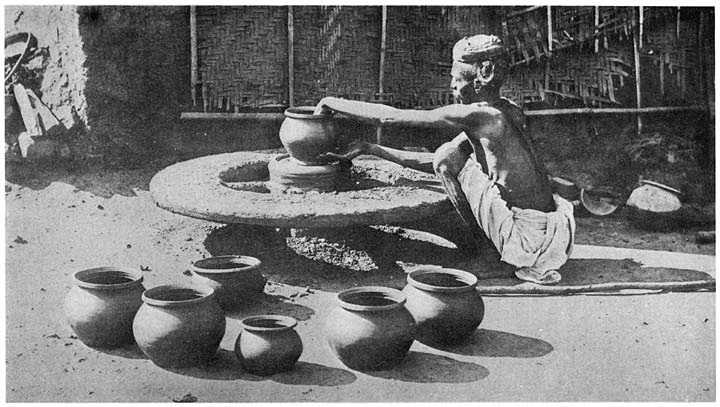
Potter and his wheel
2. Caste sub-divisions
3. Social Customs
Girls are married at an early age when their parents can afford it, the matches being usually arranged at caste feasts. In Chānda parents who allow a daughter to become adolescent while still unwed are put out of caste, but elsewhere the rule is by no means so strict. The ceremony is of the normal type and a Brāhman usually officiates, but in Betūl it is performed by the Sawāsa or husband of the bride’s paternal aunt. After the wedding the couple are given kneaded flour to hold in their hands and snatch from each other as an emblem of their trade. In Mandla a bride price of Rs. 50 is paid.
The Kumhārs recognise divorce and the remarriage of widows. If an unmarried girl is detected in criminal intimacy with a member of the caste, she has to give a feast to the caste-fellows and pay a fine of Rs. 1–4 and five locks of her hair are also cut off by way of purification. The caste usually burn the dead, but the Lingāyat Kumhārs always bury them in accordance with the practice of their sect. They worship the ordinary Hindu deities and make an offering to the implements of their trade on the festival of Deothān Igāras. The village Brāhman serves as their priest. In Bālāghāt a Kumhār is put out of caste if a dead cat is found in his house. At the census of 1901 the Kumhār was ranked with the impure castes, but his status is not really so low. Sir D. Ibbetson said of him: “He is a true village menial; his social standing is very low, far below that of the Lohār and not much above the Chamār. His association with that impure beast, the donkey, the animal sacred to Sitala, the smallpox goddess, pollutes him and also his readiness to carry manure and sweepings.” As already seen there are in the Central Provinces Sungaria and Gadheria subcastes which keep donkeys and pigs, and these are regarded as impure. But in most Districts the Kumhār ranks not much below the Barhai and Lohār, that is in what I have designated the grade of village menials above the impure and below the cultivating castes. In Bengal the Kumhārs have a much higher status and Brāhmans will take water from their hands. But the gradation of caste in Bengal differs very greatly from that of other parts of India.
4. The Kumhār as a village menial
5. Occupation
It is a local belief that, if an earthen pot is filled with salt and plastered over, the rains will stop until it is opened. This device is adopted when the fall is excessive, but, on the other hand, if there is drought, the people sometimes think that the potter has used it to keep off the rain, because he cannot pursue his calling when the clay is very wet. And on occasions of a long break in the rains, they have been known to attack his shop and break all his vessels under the influence of this belief. The potter is sometimes known as Prājapati or the ‘The Creator,’ in accordance with the favourite comparison made by ancient writers of the moulding of his pots with the creation of human beings, the justice of which will be recognised by any one who watches the masses of mud on a whirling wheel growing into shapely vessels in the potter’s creating hands.
6. Breeding pigs for sacrifices
Certain Kumhārs as well as the Dhīmars make the breeding of pigs a means of subsistence, and they sell these pigs for sacrifices at prices varying from eight annas (8d.) to a rupee. The pigs are sacrificed by the Gonds to their god Bura Deo and by Hindus to the deity Bhainsāsur, or the buffalo demon, for the protection of the crops. Bhainsāsur is represented by a stone in the fields, and when crops are beaten down at night by the wind it is supposed that Bhainsāsur has passed over them and trampled them down. Hindus, usually of the lower castes, offer pigs to Bhainsāsur to propitiate him and preserve their crops from his ravages, but they cannot touch the impure pig themselves. What they have to do, therefore, is to pay the Kumhār the price of the pig and get him to offer it to Bhainsāsur on their behalf. The Kumhār goes to the god and sacrifices the pig and then takes the body home and eats it, so that his trade is a profitable one, while conversely to sacrifice a pig without partaking of its flesh must necessarily be bitter to the frugal Hindu mind, and this indicates the importance of the deity who is to be propitiated by the offering. The first question which arises in connection with this curious custom is why pigs should be sacrificed for the preservation of the crops; and the reason appears to be that the wild pig is the animal which, at present, mainly damages the crops.
7. The goddess Demeter
“In these caverns or vaults there were said to be serpents, which guarded the caverns and consumed most of the flesh of the pigs and dough-cakes which were thrown in. Afterwards—apparently at the next annual festival—the decayed remains of the pigs, the cakes, and the pine-branches were fetched by women called ‘drawers,’ who, after observing, rules of ceremonial purity for three days, descended into the caverns, and, frightening away the serpents by clapping their hands, brought up the remains and placed them on the altar. Whoever got a piece of the decayed flesh and cakes, and sowed it with the seed-corn in his field, was believed to be sure of a good crop.
“To explain this rude and ancient rite the following legend was told. At the moment when Pluto carried off Proserpine, a swineherd called Eubuleus chanced to be herding his swine on the spot, and his herd was engulfed in the chasm down which Pluto vanished with Proserpine. Accordingly, at the Thesmophoria pigs were annually thrown into caverns to commemorate the disappearance of the swine of Eubuleus. It follows from this that the casting of the pigs into the vaults at the Thesmophoria formed part of the dramatic representation of Proserpine’s descent into the lower world; and as no image of Proserpine appears to have been thrown in, we may infer that the descent of the pigs was not so much an accompaniment of her descent as the descent itself, in short, that the pigs were Proserpine. Afterwards, when Proserpine or Demeter (for the two are equivalent) became anthropomorphic, a reason had to be found for the custom of throwing pigs into caverns at her festival; and this was done by saying that when Pluto carried off Proserpine, there happened to be some swine browsing near, which were swallowed up along with her. The story is obviously a forced and awkward attempt to bridge over the gulf between the old conception of the corn-spirit as a pig and the new conception of her as an anthropomorphic goddess. A trace of the older conception survived in the legend that when the sad mother was searching for traces of the vanished Proserpine, the footprints of the lost one were obliterated by the footprints of a pig; originally, we may conjecture, the footprints of the pig were the footprints of Proserpine and of Demeter herself. A consciousness of the intimate connection of the pig with the corn lurks in the legend that the swineherd Eubuleus was a brother of Triptolemus, to whom Demeter first imparted the secret of the corn. Indeed, according to one version of the story, Eubuleus himself received, jointly with his brother Triptolemus, the gift of the corn from Demeter as a reward for revealing to her the fate of Proserpine. Further, it is to be noted that at the Thesmophoria the women appear to have eaten swine’s flesh. The meal, if I am right, must have been a solemn sacrament or communion, the worshippers partaking of the body of the god.”