Volume 4 — Lakhera
Reading edition
List of Paragraphs
1. General notice
2. Social customs
3. The lac industry
4. Lac bangles
5. Red, a lucky colour
6. Vermilion and spangles
7. Red dye on the feet
8. Red threads
9. Lac toys
1. General notice
Lakhera, Laheri.—The small caste whose members make bangles and other articles of lac. About 3000 persons were shown as belonging to the caste in the Central Provinces in 1911, being most numerous in the Jubbulpore, Chhīndwāra and Betūl Districts. From Berār 150 persons were returned, chiefly from Amraoti. The name is derived from the Sanskrit laksha-kara, a worker in lac. The caste are a mixed functional group closely connected with the Kacheras and Patwas; no distinction being recognised between the Patwas and Lakheras in some localities of the Central Provinces. Mr. Baillie gives the following notice of them in the Census Report of the North-Western Provinces (1891): “The accounts given by members of the caste of their origin are very various and sometimes ingenious. One story is that like the Patwas, with whom they are connected, they were originally Kāyasths. According to another account they were made from the dirt washed from Pārvati before her marriage with Siva, being created by the god to make bangles for his wife, and hence called Deobansi. Again, it is stated, they were created by Krishna to make bangles for the Gopis or milkmaids. The most elaborate account is that they were originally Yāduvansi Rājpūts, who assisted the Kurus to make a fort of lac, in which the Pāndavas were to be treacherously burned. For this traitorous conduct they were degraded and compelled eternally to work in lac or glass.”
2. Social customs
The bulk of these artisan and manufacturing castes tell stories showing that their ancestors were Kāyasths and Rājpūts, but no importance can be attached to such legends, which are obviously manufactured by the family priests to minister to the harmless vanity of their clients. To support their claim the Lakheras have divided themselves like the Rājpūts into the Sūrajvansi and Somvansi subcastes or those who belong to the Solar and Lunar races. Other subdivisions are the Mārwāri or those coming from Mārwār in Rājpūtana, and the Tarkhera or makers of the large earrings which low-caste women wear. These consist of a circular piece of wood or fibre, nearly an inch across, which is worked through a large hole in the lobe of the ear. It is often the stalk of the ambāri fibre, and on the outer end is fixed a slab decorated with little pieces of glass. The exogamous sections of the Lakheras are generally named after animals, plants and natural objects, and indicate that the caste is recruited from the lower classes of the population. Their social customs resemble those of the middle and lower Hindustāni castes. Girls are married at an early age when the parents can afford the expense of the ceremony, but no penalty is incurred if the wedding is postponed for want of means. The remarriage of widows and divorce are permitted. They eat flesh, but not fowls or pork, and some of them drink liquor, while others abstain. Rājpūts and Banias will take water from them, but not Brāhmans. In Bombay, however, they are considered to rank above Kunbis.
3. The lac industry
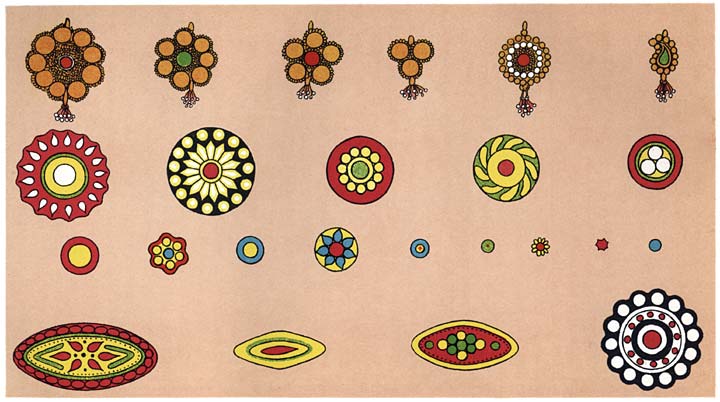
Examples of spangles worn by women on the forehead
4. Lac bangles
The trade in lac bangles has now greatly declined, as they have been supplanted by the more ornamental glass bangles. They are thick and clumsy and five of them will cover a large part of the space between the elbow and the wrist. They may be observed on Banjāra women. Lac bangles are also still used by the Hindus, generally on ceremonial occasions, as at a marriage, when they are presented to and worn by the bride, and during the month of Shrāwan (July), when the Hindus observe a fast on behalf of the growing crops and the women wear bangles of lac. For these customs Mr. Hīra Lāl suggests the explanation that lac bangles were at one time generally worn by the Hindus, while glass ones are a comparatively recent fashion introduced by the Muhammadans. In support of this it may be urged that glass bangles are largely made by the Muhammadan Turkāri or Sīsgar, and also that lac bangles must have been worn prior to glass ones, because if the latter had been known the clumsy and unornamental bracelet made of lac and clay could never have come into existence. The wearing of lac bangles on the above occasions would therefore be explained according to the common usage of adhering on religious and ceremonial occasions to the more ancient methods and accessories, which are sanctified by association and custom. Similarly the Holi pyre is often kindled with fire produced by the friction of wood, and temples are lighted with vegetable instead of mineral oil.
5. Red, a lucky colour
6. Vermilion and spangles
7. Red dye on the feet
The Lakheras also sell balls of red cotton-wool known as māhur ki guleli or mahāwar. The cotton-wool is dipped in the melted lac-gum and is rubbed on to the feet of women to colour them red or pink at marriages and festivals. This is done by the barber’s wife, who will colour the feet of the whole party, at the same time drawing lines round the outside of the foot and inward from the toes. The mahāwar is also an essential part of the Sohāg of marriage. Instead of lac the Muhammadans use mehndi or henna, the henna-leaves being pounded with catechu and the mixture rubbed on to the feet and hands. After a little time it is washed off and a red dye remains on the skin. It is supposed that the similar custom which prevailed among the ancient Greeks is alluded to in the epithet of ‘rosy-fingered Aurora.’ The Hindus use henna dye only in the month Shrāwan (July), which is a period of fasting; the auspicious kunku and mahāwar are therefore perhaps not considered suitable at such a time, but as special protection is needed against evil spirits, the necessary red colouring is obtained from henna. When a married woman rubs henna on her hands, if the dye comes out a deep red tinge, the other women say that her husband is not in love with her; but if of a pale yellowish tinge, that he is very much in love.
8. Red threads
The Lakheras and Patwas also make the kardora or waist-band of red thread. This is worn by Hindu men and women, except Marātha Brāhmans. After he is married, if a man breaks this thread he must not take food until he has put on a fresh one, and the same rule applies to a woman all her life. Other threads are the rākhis tied round the wrists for protection against evil spirits on the day of Rakshābandhan, and the necklets of silk or cotton thread wound round with thin silver wire, which the Hindus put on at Anant Chaudas and frequently retain for the whole year. The colour of all these threads is generally red in the first place, but they soon get blackened by contact with the skin.
9. Lac toys
Toys of lac are especially made during the fast of Shrāwan (July). At this time for five years after her marriage a Hindu bride receives annually from her husband a present called Shrāoni, or that which is given in Shrāwan. It consists of a chakri or reel, to which a string is attached, and the reel is thrown up into the air and wound and unwound on the string; a bhora or wooden top spun by a string; a bansuli or wooden flute; a stick and ball, lac bangles and a spangle, and cloth, usually of red chintz. All these toys are made by the carpenter and coloured red with lac by the Lakhera, with the exception of the bangles which may be yellow or green. For five years the bride plays with the toys, and then they are sent to her no longer as her childhood has passed. It is probable that some, if not all of them, are in a manner connected with the crops, and supposed to have a magical influence, because during the same period it is the custom for boys to walk on stilts and play at swinging themselves; and in these cases the original idea is to make the crops grow as high as the stilts or swing. As in the other cases, the red colour appears to have a protective influence against evil spirits, who are more than usually active at a time of fasting.