Volume 4 — Panwār Rājpūt
Reading edition
List of Paragraphs
1. Historical notice. The Agnikula clans and the slaughter of the Kshatriyas by Parasurāma
2. The legend of Parasurāma
3. The Panwār dynasty of Dhār and Ujjain
4. Diffusion of the Panwārs over India
5. The Nāgpur Panwārs
6. Subdivisions
7. Marriage customs
8. Widow-marriage
9. Religion
10. Worship of the spirits of those dying a violent death
11. Funeral rites
12. Caste discipline
13. Social customs
1. Historical notice. The Agnikula clans and the slaughter of the Kshatriyas by Parasurāma
2. The legend of Parasurāma
3. The Panwār dynasty of Dhār and Ujjain
A saying about it quoted by Colonel Tod was:
Jahān Puār tahān Dhār hai; Aur Dhār jahān Puār; Dhār bina Puār nahin; Aur nahin Puār bina Dhār:
4. Diffusion of the Panwārs over India
5. The Nāgpur Panwārs
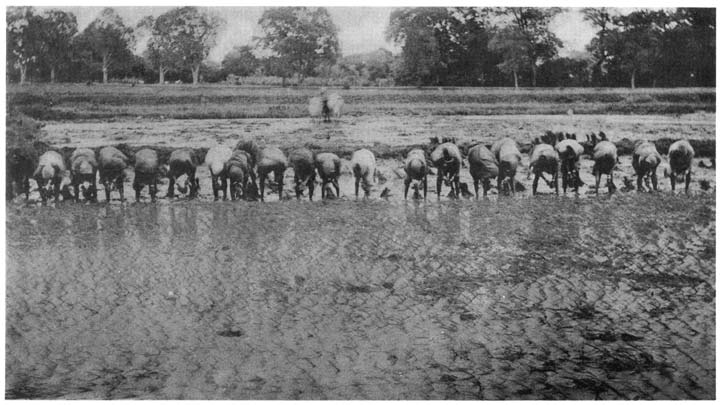
Transplanting rice
6. Subdivisions
They number about 150,000 persons, and include many village proprietors and substantial cultivators. The quotations already given have shown how this virile clan of Rājpūts travelled to the north, south and east from their own country in search of a livelihood. Everywhere they made their mark so that they live in history, but they paid no regard to the purity of their Rājpūt blood and took to themselves wives from the women of the country as they could get them. The Panwārs of the Wainganga Valley have developed into a caste marrying among themselves. They have no subcastes but thirty-six exogamous sections. Some of these have the names of Rājpūt clans, while others are derived from villages, titles or names of offices, or from other castes. Among the titular names are Chaudhri (headman), Patlia (patel or chief officer of a village) and Sonwānia (one who purifies offenders among the Gonds and other tribes). Among the names of other castes are Bopcha or Korku, Bhoyar (a caste of cultivators), Pārdhi (hunter), Kohli (a local cultivating caste) and Sahria (from the Saonr tribe). These names indicate how freely they have intermarried. It is noticeable that the Bhoyars and Korkus of Betūl both say that their ancestors were Panwārs of Dhār, and the occurrence of both names among the Panwārs of Bālāghāt may indicate that these castes also have some Panwār blood. Three names, Rahmat (kind), Turukh or Turk, and Farīd (a well-known saint), are of Muhammadan origin, and indicate intermarriage in that quarter.
7. Marriage customs
Girls are usually, but not necessarily, wedded before adolescence. Occasionally a Panwār boy who cannot afford a regular marriage will enter his prospective father-in-law’s house and serve him for a year or more, when he will obtain a daughter in marriage. And sometimes a girl will contract a liking for some man or boy of the caste and will go to his house, leaving her home. In such cases the parents accept the accomplished fact, and the couple are married. If the boy’s parents refuse their consent they are temporarily put out of caste, and subsequently the neighbours will not pay them the customary visits on the occasions of family joys and griefs. Even if a girl has lived with a man of another caste, as long as she has not borne a child, she may be re-admitted to the community on payment of such penalty as the elders may determine. If her own parents will not take her back, a man of the same gotra or section is appointed as her guardian and she can be married from his house.
The ceremonies of a Panwār marriage are elaborate. Marriage-sheds are erected at the houses both of the bride and bridegroom in accordance with the usual practice, and just before the marriage, parties are given at both houses; the village watchman brings the toran or string of mango-leaves, which is hung round the marriage-shed in the manner of a triumphal arch, and in the evening the party assembles, the men sitting at one side of the shed and the women at the other. Presents of clothes are made to the child who is to be married, and the following song is sung:
The mother of the bride grew angry and went away to the mango grove. Come soon, come quickly, Mother, it is the time for giving clothes. The father of the bridegroom has sent the bride a fold of cloth from his house, The fold of it is like the curve of the winnowing-fan, and there is a bodice decked with coral and pearls.
Before the actual wedding the father of the bridegroom goes to the bride’s house and gives her clothes and other presents, and the following is a specimen given by Mr. Muhammad Yūsuf of the songs sung on this occasion:
Five years old to-day is Bāja Bai the bride; Send word to the mother of the bridegroom; Her dress is too short, send for the Koshta, Husband; The Koshta came and wove a border to the dress.
Afterwards the girl’s father goes and makes similar presents to the bridegroom. After many preliminary ceremonies the marriage procession proper sets forth, consisting of men only. Before the boy starts his mother places her breast in his mouth; the maid-servants stand before him with vessels of water, and he puts a pice in each. During the journey songs are sung, of which the following is a specimen:
O! the boy bridegroom is going to another country;
O Mother! how may he go to another country?
Make payment before he enters another country;
O Mother! how may he cross the border of another country?
Make payment before he crosses the border of another country;
O Mother! how may he touch another’s bower?
Make payment before he touches another’s bower;
O Mother! how shall he bathe with strange water?
Make payment before he bathes with strange water;
Make payment before he eats another’s banwat;
O Mother! how shall he marry another woman?
He shall wed her holding the little finger of her left hand.
The bridegroom’s party are always driven to the wedding in bullock-carts, and when they approach the bride’s village her people also come to meet them in carts. All the party then turn and race to the village, and the winner obtains much distinction. The cartmen afterwards go to the bridegroom’s father and he has to make them a present of from one to forty rupees. On arriving at the village the bridegroom is carried to Devi’s shrine in a man’s arms, while four other men hold a canopy over him, and from there to the marriage-shed. He touches a bamboo of this, and a man seated on the top pours turmeric and water over his head. Five men of the groom’s party go to the bride’s house carrying salt, and here their feet are washed and the tīka or mark of anointing is made on their foreheads. Afterwards they carry rice in the same manner and with this is the wedding-rice, coloured yellow with turmeric and known as the Lagun-gāth. Before sunset the bridegroom goes to the bride’s house for the wedding. Two baskets are hung before Dulha Deo’s shrine inside the house, and the couple are seated in these with a cloth between them. The ends of their clothes are knotted, each places the right foot on the left foot of the other and holds the other’s ear with the hand. Meanwhile a Brāhman has climbed on to the roof of the house, and after saying the names of the bride and bridegroom shouts loudly, ‘Rām nawara, Sīta nawari, Saodhān,’ or ‘Rām, the Bridegroom, and Sīta, the Bride, pay heed,’ The people inside the house repeat these words and someone beats on a brass plate; the wedding-rice is poured over the heads of the couple, and a quid of betel is placed first in the mouth of one and then of the other. The bridegroom’s party dance in the marriage-shed and their feet are washed. Two plough-yokes are brought in and a cloth spread over them, and the couple are seated on them face to face. A string of twisted grass is drawn round their necks and a thread is tied round their marriage-crowns. The bride’s dowry is given and her relatives make presents to her. This property is known as khamora, and is retained by a wife for her own use, her husband having no control over it. It is customary also in the caste for the parents to supply clothes to a married daughter as long as they live, and during this period a wife will not accept any clothes from her husband. On the following day the maid-servants bring a present of gulāl or red powder to the fathers of the bride and bridegroom, who sprinkle it over each other. The bridegroom’s father makes them a present of from one to twenty rupees according to his means, and also gives suitable fees to the barber, the washerman, the Barai or betel-leaf seller and the Bhāt or bard. The maid-servants then bring vessels of water and throw it over each other in sport. After the evening meal, the party go back, the bride and bridegroom riding in the same cart. As they start the women sing:
Let us go to the basket-maker And buy a costly pair of fans; Fans worth a lot of money; Let us praise the mother of the bride.
8. Widow-marriage
9. Religion
The caste worship the ordinary Hindu divinities, and their household god is Dūlha Deo, the deified bridegroom. He is represented by a nut and a date, which are wrapped in a cloth and hung on a peg in the wall of the house above the platform erected to him. Every year, or at the time of a marriage or the birth of a first child, a goat is offered to Dūlha Deo. The animal is brought to the platform and given some rice to eat. A dedicatory mark of red ochre is made on its forehead and water is poured over the body, and as soon as it shivers it is killed. The shivering is considered to be an indication from the deity that the sacrifice is acceptable. The flesh is cooked and eaten by the family inside the house, and the skin and bones are buried below the floor. Nārāyan Deo or Vishnu or the Sun is represented by a bunch of peacock’s feathers. He is generally kept in the house of a Mahār, and when his worship is to be celebrated he is brought thence in a gourd to the Panwār’s house, and a black goat, rice and cakes are offered to him by the head of the household. While the offering is being made the Mahār sings and dances, and when the flesh of the goat is eaten he is permitted to sit inside the Panwār’s house and begin the feast, the Panwārs eating after him. On ordinary occasions a Mahār is not allowed to come inside the house, and any Panwār who took food with him would be put out of caste; and this rite is no doubt a recognition of the position of the Mahārs as the earlier residents of the country before the Panwārs came to it. The Turukh or Turk sept of Panwārs pay a similar worship to Bāba Farīd, the Muhammadan saint of Girar. He is also represented by a bundle of peacock’s feathers, and when a goat is sacrificed to him a Muhammadan kills it and is the first to partake of its flesh.
10. Worship of the spirits of those dying a violent death
That the same superstition is generally prevalent in the Central Provinces appears to be shown by the fact that among castes who practise cremation, the bodies of men who come to a violent end or die of smallpox or leprosy are buried, though whether burial is considered as more likely to prevent the ghost from walking than cremation, is not clear. Possibly, however, it may be considered that the bodies are too impure to be committed to the sacred fire.
11. Funeral rites
Cremation of the dead is the rule, but the bodies of those who have not died a natural death are buried, as also of persons who are believed to have been possessed of the goddess Devi in their lifetime. The bodies of small children are buried when the Khīr Chatai ceremony has not been performed. This takes place when a child is about two years old: he is invited to the house of some member of the same section on the Diwāli day and given to eat some Khīr or a mess of new rice with milk and sugar, and thus apparently is held to become a proper member of the caste, as boys do in other castes on having their ears pierced. When a corpse is to be burnt a heap of cowdung cakes is made, on which it is laid, while others are spread over it, together with butter, sugar and linseed. The fire with which the pyre is kindled is carried by the son or other chief mourner in an earthen pot at the head of the corpse. After the cremation the ashes of the body are thrown into water, but the bones are kept by the chief mourner; his head and face are then shaved by the barber, and the hair is thrown into the water with most of the bones; he may retain a few to carry them to the Nerbudda at a convenient season, burying them meanwhile under a mango or pīpal tree. A present of a rupee or a cow may be made to the barber. After the removal of a dead body the house is swept, and the rubbish with the broom and dustpan are thrown away outside the village. Before the body is taken away the widow of the dead man places her hands on his breast and forehead, and her bangles are broken by another widow. The shrāddh ceremony is performed every year in the month of Kunwār (September) on the same day of the fortnight as that on which the death took place. On the day before the ceremony the head of the household goes to the houses of those whom he wishes to invite, and sticks some grains of rice on their foreheads. The guests must then fast up to the ceremony. On the following day, when they arrive at noon, the host, wearing a sacred thread of twisted grass, washes their feet with water in which the sacred kusa grass has been mixed, and marks their foreheads with sandal-paste and rice. The leaf-plates of the guests are set out inside the house, and a very small quantity of cooked rice is placed in each. The host then gathers up all this rice and throws it on to the roof of the house while his wife throws up some water, calling aloud the name of the dead man whose shrāddh ceremony is being performed, and after this the whole party take their dinner.
12. Caste discipline
As has been shown, the Panwārs have abandoned most of the distinctive Rājpūt customs. They do not wear the sacred thread and they permit the remarriage of widows. They eat the flesh of goats, fowls, wild pig, game-birds and fish, but abstain from liquor except on such ceremonial occasions as the worship of Nārāyan Deo, when every one must partake of it. Mr. Low states that the injurious habit of smoking madak (a preparation of opium) is growing in the caste. They will take water to drink from a Gond’s hand and in some localities even cooked food. This is the outcome of their close association in agriculture, the Gonds having been commonly employed as farmservants by Panwār cultivators. A Brāhman usually officiates at their ceremonies, but his presence is not essential and his duties may be performed by a member of the caste. Every Panwār male or female has a guru or spiritual preceptor, who is either a Brāhman, a Gosain or a Bairāgi. From time to time the guru comes to visit his chela or disciple, and on such occasions the chauk or sacred place is prepared with lines of wheat-flour. Two wooden stools are set within it and the guru and his chela take their seats on these. Their heads are covered with a new piece of cloth and the guru whispers some text into the ear of the disciple. Sweetmeats and other delicacies are then offered to the guru, and the disciple makes him a present of one to five rupees. When a Panwār is put out of caste two feasts have to be given on reinstatement, known as the Maili and Chokhi Roti (impure and pure food). The former is held in the morning on the bank of a tank or river and is attended by men only. A goat is killed and served with rice to the caste-fellows, and in serious cases the offender’s head and face are shaved, and he prays, ‘God forgive me the sin, it will never be repeated.’ The Chokhi Roti is held in the evening at the offender’s house, the elders and women as well as men of the caste being present. The Sendia or leader of the caste eats first, and he will not begin his meal unless he finds a douceur of from one to five rupees deposited beneath his leaf-plate. The whole cost of the ceremony of readmission is from fifteen to fifty rupees.
13. Social customs
The Panwār women wear their clothes tied in the Hindustāni and not in the Marātha fashion. They are tattooed on the legs, hands and face, the face being usually decorated with single dots which are supposed to enhance its beauty, much after the same fashion as patches in England. Padmākar, the Saugor poet, Mr. Hīra Lāl remarks, compared the dot on a woman’s chin to a black bee buried in a half-ripe mango. The women, Mr. Low says, are addicted to dances, plays and charades, the first being especially graceful performances. They are skilful with their fingers and make pretty grass mats and screens for the house, and are also very good cooks and appreciate variety in food. The Panwārs do not eat off the ground, but place their dishes on little iron stands, sitting themselves on low wooden stools. The housewife is a very important person, and the husband will not give anything to eat or drink out of the house without her concurrence. Mr. Low writes on the character and abilities of the Panwārs as follows: “The Panwār is to Bālāghāt what the Kunbi is to Berār or the Gūjar to Hoshangābād, but at the same time he is less entirely attached to the soil and its cultivation, and much more intelligent and cosmopolitan than either. One of the most intelligent officials in the Agricultural Department is a Panwār, and several members of the caste have made large sums as forest and railway contractors in this District; Panwār shikāris are also not uncommon. They are generally averse to sedentary occupations, and though quite ready to avail themselves of the advantages of primary education, they do not, as a rule, care to carry their studies to a point that would ensure their admission to the higher ranks of Government service. Very few of them are to be found as patwāris, constables or peons. They are a handsome race, with intelligent faces, unusually fair, with high foreheads, and often grey eyes. They are not, as a rule, above middle height, but they are active and hard-working and by no means deficient in courage and animal spirits, or a sense of humour. They are clannish in the extreme, and to elucidate a criminal case in which no one but Panwārs are concerned, and in a Panwār village, is usually a harder task than the average local police officer can tackle. At times they are apt to affect, in conversation with Government officials, a whining and unpleasant tone, especially when pleading their claim to some concession or other; and they are by no means lacking in astuteness and are good hands at a bargain. But they are a pleasant, intelligent and plucky race, not easily cast down by misfortune and always ready to attempt new enterprises in almost any direction save those indicated by the Agricultural Department.
“In the art of rice cultivation they are past masters. They are skilled tank-builders, though perhaps hardly equal to the Kohlis of Chānda. But they excel especially in the mending and levelling of their fields, in neat transplantation, and in the choice and adaptation of the different varieties of rice to land of varying qualities. They are by no means specially efficient as labourers, though they and their wives do their fair share of field work; but they are well able to control the labour of others, especially of aborigines, through whom most of their tank and other works are executed.”