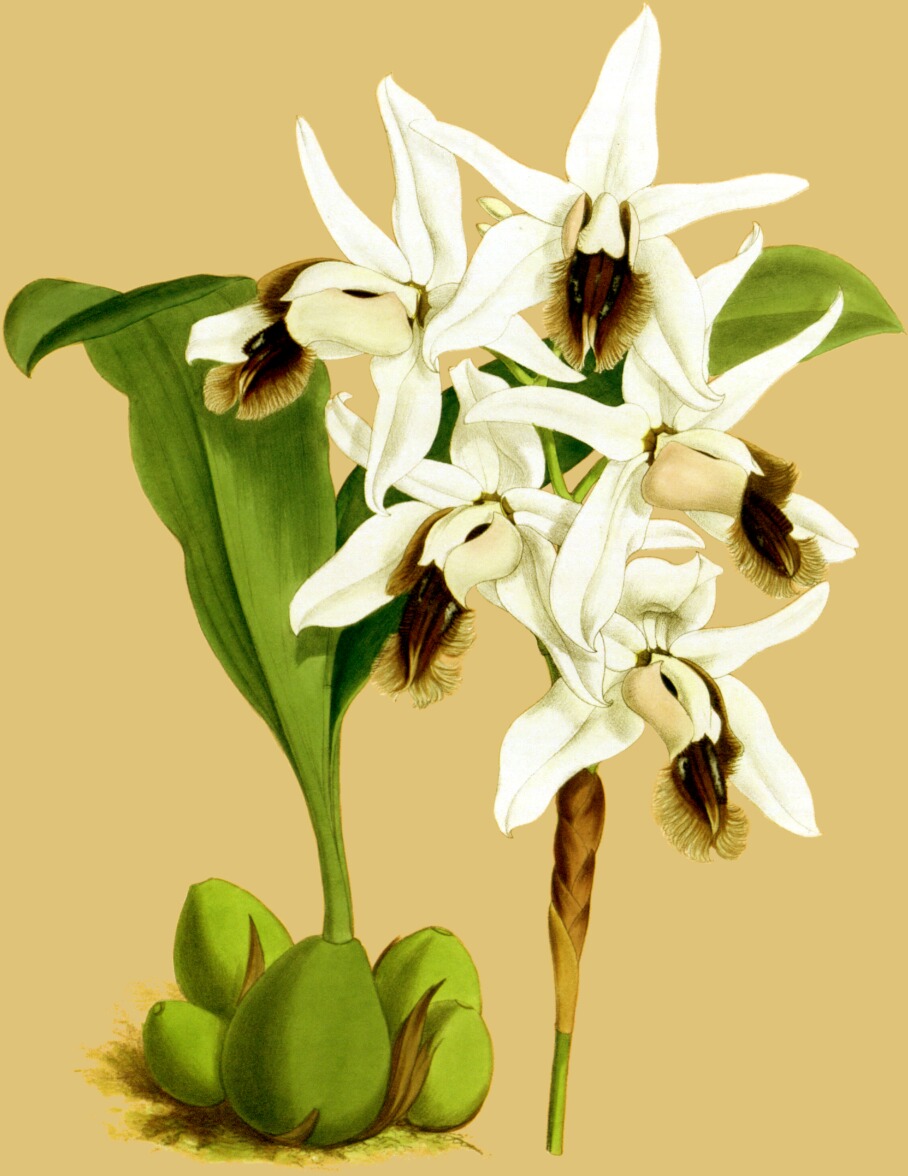
ZYGOPETALUM BURKEI. [Plate 142.] Native of Demerara.
Reading edition
ZYGOPETALUM BURKEI. [Plate 142.] Native of Demerara.
Epiphytal. Pseudobulbs clustered, narrow oblong, over two inches long, erect, shining, tetragonal, the surface furrowed, diphyllous. Leaves elongate-lanceolate acuminate, nervose, somewhat leathery in consistence. Scape radical, pale green, bearing a raceme of four or five flowers, furnished with ovate pale green bracts at the base of the pedicels. Flowers about two inches across, of a peculiar and distinctive character; sepals ovate-lanceolate, the lateral ones deflexed, bright green, with about seven wavy close-set longitudinal bands of dark umber-brown, the bars having a tendency to break up into lines of spots, wholly green outside; petals spreading, of the same form and colour as the sepals; lip unguiculate, auricled on both sides in front of the claw, obovate with a broad rounded apex, undulated margin, and furnished behind the disk with a callus or ruff of thirteen crimson plaits or ribs. Column thick, greenish, galeate, with two projecting linear auricles.
Zygopetalum Burkei, Reichenbach fil., in Gardeners’ Chronicle, N.S., xx., 684.
This new species is a very pretty free-blooming plant. It belongs to a genus that is well known to plant growers, and amongst the species of which there are some grand decorative plants; indeed, we generally find some of these plants wherever there is a stove, even if Orchids generally are not professed to be grown. Zygopetalum Mackayi, Z. maxillare, and Z. Gautieri, are the most useful. Of late some new hybrids have been introduced, namely, Z. Sedeni and Z. Clayi, which latter will be found figured at Plate 50 of our second volume. The species now under notice was introduced by the Messrs. Veitch & Sons, of Chelsea; and in their fine collection it bloomed last November, and was exhibited at South Kensington, gaining a First Class Certificate. It will be found to be a most useful species for general cultivation. We believe Messrs. Veitch’s to be the only plant that has yet flowered in this country.
Zygopetalum Burkei is a native of Demerara, and was found, it appears, by Sir Robert Schomburgk some forty years since, but had not been introduced until recently sent home by Messrs. Veitch’s collector, Mr. Burke, after whom it is named. It is an evergreen species, with long narrow erect ribbed four-cornered pseudobulbs, and light green foliage; the sepals and petals are green, spotted and barred with brown, and the lip is white, with a crest of crimson stripes on ribs. It blooms during the autumn months and lasts for several weeks in bloom.
The East India house is the most suitable place in which to cultivate it, for most of the species of Zygopetalum like the temperature therein maintained, and, 92 indeed, they thrive well in any warm stove. This new species will no doubt require as a root medium the same material as the rest of the genus, that is, rough fibrous peat and loam. As they generally have thick fleshy roots, they require an abundant supply of moisture during the growing season; but of course a less liberal supply will suffice after the growth has been completed, when the ripening process comes on.
A Wonderful Dendrobium.—Mr. Blend, gardener to S. K. Mainwaring, Esq., Otley Park, Shrewsbury, has recently flowered a grand specimen of the old and beautiful Dendrobium Paxtoni. The plant is in a 15-inch pot, has 74 growths, and produced 123 flower spikes, containing in all 1,216 flowers. The longest growth on the plant measures as much as four feet six inches. This plant is a marvel of cultivation, and we are much pleased to be able to record such a splendid example of Orchid management—B. S. W.
Odontoglossum mulus.—D. Tod, Esq., Eastwood Park, Thorliebank, by Glasgow, has sent in flowers of a fine variety of Odontoglossum mulus, which bloomed with him last April. The spike, Mr. Tod informs us, bore sixteen flowers, and although this is no great number for O. mulus, which generally comes with a large branched panicle, it must have been a fine sight, as the flowers of Mr. Tod’s variety are not only very large, but very brightly coloured.—B. S. W.
A Gigantic Orchid.—Messrs. F. Sander & Co., of St. Albans, have lately received an enormous specimen of Cattleya Skinneri, certainly the largest mass of an Orchid ever imported. The plant was found growing in the crown of a tree, near Cartago, in Costa Rica, where it was originally planted in a garden belonging to a native, by whom it has since been cultivated, so that although this plant has been found in its native habitat, it is, nevertheless, a cultivated specimen. This plant has long been known to botanical travellers, Skinner, Roezl, and others having seen it in flower. It is stated to have produced, at one time, over 1,500 flowers. Its dimensions are six feet in height by seven feet in diameter; its weight about twelve hundredweight. We understand Mr. Sander is about erecting a house for its reception, where we suppose it will figure as a piece de resistance of the establishment.—H. W.
Pl. 143. CŒLOGYNE BARBATA.
93