MASDEVALLIA HARRYANA MINIATA. [Plate 110.] Native of New Grenada.
Reading edition
MASDEVALLIA HARRYANA MINIATA. [Plate 110.] Native of New Grenada.
Epiphytal. Stems short, tufted, slender. Leaves persistent, of leathery texture, the blade spathulate, channelled at the base, keeled behind, tapering down into the petiole, which is invested by whitish brown membranaceous sheathing bracts. Scape issuing from the bract, investing the leaf base, radical, about a foot high, stiff, pale green, thickly striate-blotched with purple, with one or two distant sheathing bracts, and surmounted by the curved six-ribbed ovary, which is dotted with purple. Flowers remarkably brilliant in colour; tube about a quarter of an inch wide and upwards of half an inch long, orange-yellow, the open tube forming a yellow eye to the flower; dorsal sepal filiform, recurved, two inches long; lateral sepals deflexed falcate-ovate acute, fully two inches long by one inch wide, of a bright vermilion-red flushed with scarlet, and having the principal ribs of a rich deep crimson; petals minute, oblong-obtuse, white tinged with purple; lip still shorter, the tip recurved yellow, the disk with a deep furrow between two obtuse ridges. Column white, shorter than the petals, the winged margin extending upwards into a toothed hood.
Masdevallia Harryana miniata, Williams and Moore, supra.
This is a most charming variety of Masdevallia Harryana, being quite a new colour in this section; it is the most distinct and beautiful for its brightness of hue—one which we have not yet seen developed to such perfection of brilliancy in any other variety. It may also be noted, that when mixed with other forms of various colours it blends with them most charmingly. How exceedingly bright and beautiful it is will be seen from our figure, in which, however, it has been extremely difficult for our artist to imitate the natural tint of the flower. Our sketch was taken from a well-bloomed plant in the large collection of Masdevallias grown by W. Lee, Esq., of Downside, Leatherhead. It is a very rare as well as showy plant, and we shall be glad to see more of it, as it will assuredly be sought after.
Masdevallia Harryana miniata is a dwarf compact-growing plant, with foliage about eight inches high of a bright dark green colour. The flowers are scarlet-vermilion with a bright yellow eye. It blooms during May and June, and lasts about four weeks in full beauty.
This plant will thrive under the treatment recommended for the forms of the Harryana section in our first volume (Plate 24), where all the necessary particulars will be found. Mr. Woolford, the gardener at Downside, is a most successful cultivator, and has under his charge a house nearly 100 feet long filled with 28 Masdevallias, wherein, when we last saw them, there were many hundreds of expanded blossoms of large size and high colour. They are potted in the same way that we recommend. Mr. Woolford seems to diffuse a great deal of moisture about the house during the summer months, and the soil they are growing in is kept very moist. If anyone wants to see these lovely plants in perfection and well cultivated, this is the place at which to find them.
Orchids at The Dell, Staines.—The collection of Baron Schröder is well worthy of a visit, there being always something to see and to learn. The Baron takes such great interest in his collection that he will have good species and good varieties. He does not fill his houses with numbers of imported plants to take the chance of what he may get, but he secures at once good healthy established plants of all the choicest and best known kinds. Of course, there is a chance of getting good forms among the imported plants, but along with them one finds a great many that one does not care for, but which have occupied valuable space; besides which such plants are unsightly in a show house. A few rough imported plants spoil the appearance of a whole collection, and we know ladies prefer to see good flowers accompanied by fine green foliage, which always renders a plant more agreeable to the eye.
We noticed many fine plants here in August last, when but few Orchids are in bloom: indeed there are always good plants blooming here. A splendid house has been allotted to Cattleyas, of which there are some grand and noble specimens; we noticed several fine plants of Cattleya exoniensis, also of the best form of C. labiata, with some wonderful specimens of C. Trianæ and C. Russelliana, C. Mendelii, C. Warnerii, C. Dominiana in two varieties, and many new hybrids. Of Lælia purpurata there were fine specimens of the best varieties; also some good forms of L. elegans. There were several fine Vandas in this house. We also noticed Renanthera Lowii, showing a vigorous spike of bloom, and by the side of this was a good specimen of Cattleya crispa grandiflora with several spikes, one having nine flowers; also one of C. gigas which bore seven flowers, and had a very large lip, quite distinct in colour. Associated with this was the rare Lælia callistoglossa with a rich magenta lip, in full beauty and very showy. There were other good plants in bloom.
In the Saccolabium house there had been many fine kinds in flower. We noticed a very handsome S. Blumei giganteum with a spike two feet long and of large size—the plant and spike we have seen. There were also fine varieties of Phalænopsis violacea in bloom, and grand specimens of other rare species, also of Cattleya Eldorado, with some good Aërides, Angræcums, &c.
There were some handsome Odontoglots in bloom, and others had thrown some fine flower spikes; also some good plants of Mesospinidium vulcanicum, one with nine spikes of its richly-coloured flowers and others equally good; this plant produces a fine contrast among the white Odontoglossums, and such effective colours should be sought after, especially when, as here, associated with fine form.—B. S. W.
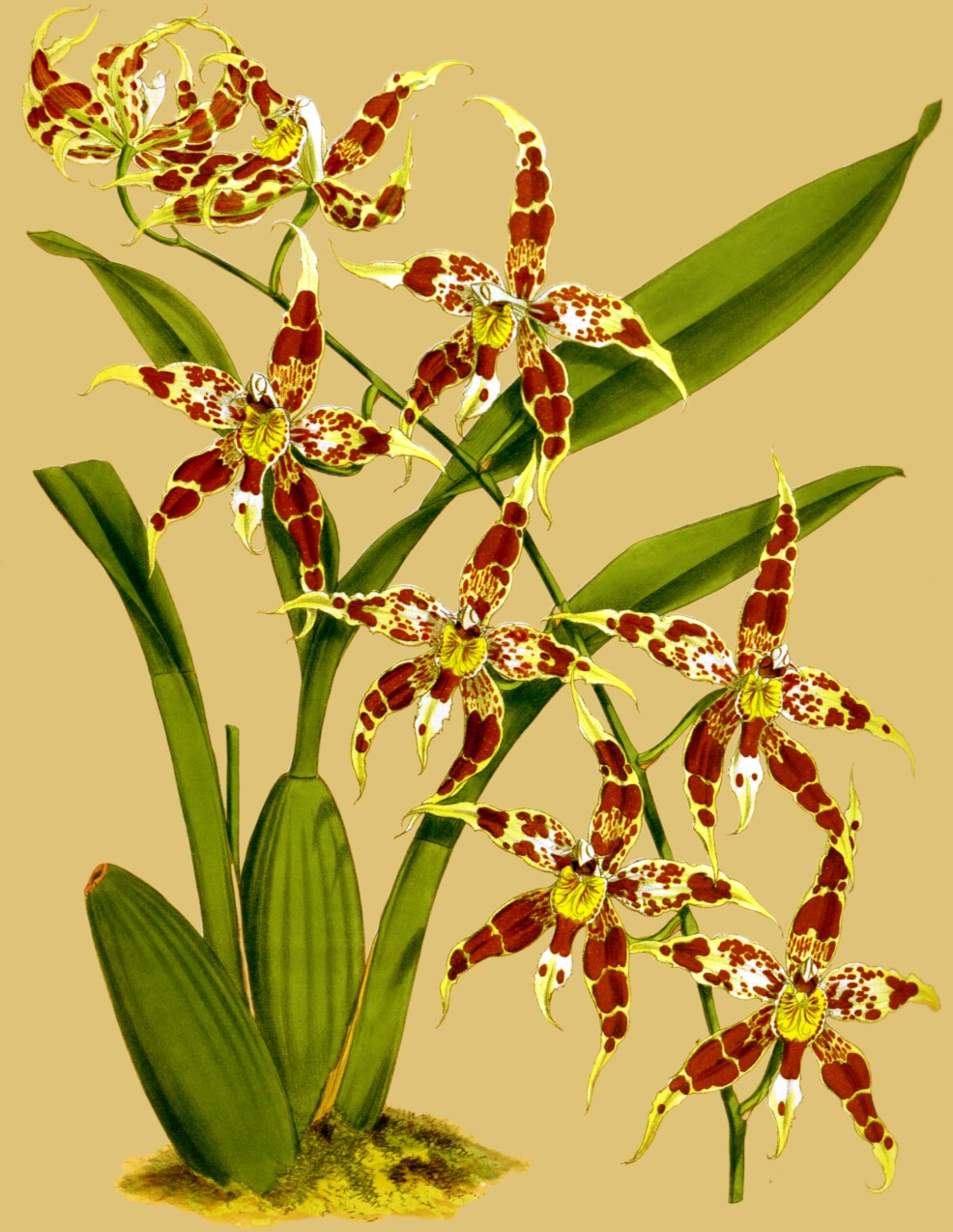
PL. 111. ODONTOGLOSSUM ELEGANS.
29