ONCIDIUM FORBESII. [Plate 104.] Native of Brazil.
Reading edition
ONCIDIUM FORBESII. [Plate 104.] Native of Brazil.
Epiphytal. Pseudobulbs oblong obtuse, compressed, sulcate, two inches long, of a dull brownish green, each bearing one leaf from the apex. Leaves lanceolate acute, leathery, eight to ten inches long. Scape radical, bearing a many-flowered panicle. Flowers large, numerous, very showy, measuring about two and a half inches in both directions, handsomely marked; sepals obovate, recurved, about an inch long, deep chestnut brown, with indistinct transverse bands and marginal indications of yellow, the lateral ones connate; petals larger, about an inch and a half long, and an inch and a quarter wide, roundish-obovate, the margin undulate, the base suddenly narrowed into a claw, the central parts wholly deep glossy chestnut-red, the edge for about a quarter of an inch in width yellow, closely marked by short irregular transverse bars of chestnut-red; lip with a longish narrow claw, and large transversely reniform deeply bilobed front segment, an inch and three fourths broad, which is coloured like the petals, the claw spotted with yellow and red, crested, the crests usually consisting of five rugged equidistant warts, the two middle of which are sometimes wanting. Column with small angulate wings, banded with lines of violet.
Oncidium Forbesii, Hooker, Botanical Magazine, t. 3705; Lindley, Folia Orchidacea, art. Oncidium, No. 60; Williams, Orchid Grower’s Manual, 5 ed., 254.
The genus Oncidium is a very large one, and there are many species well known in cultivation, but the one we now illustrate belongs to a section in which there are few that are so distinct in colour. The flowers are not so large as in O. crispum, of which there are many distinct varieties, differing in size and colour—variations which often depend on the vigour of the plants. The same may be said of O. Forbesii, the stronger the bulbs the finer the blossoms. Our sketch was taken from a well-grown plant in the collection of E. Bonny, Esq., Downs Park Road, Hackney, who is forming a choice collection of Orchids.
Oncidium Forbesii is an evergreen species, with pseudobulbs of a greenish brown colour; the foliage is of a dark green, and the flowers are chestnut-brown, with the sepals and petals irregularly margined with bright lemon-yellow. It blooms at different times of the year, and lasts for several weeks in perfection. We find the plants do well in small pans or baskets, and also on blocks of wood. When grown in pans or baskets we have found them grow freely in good fibrous peat, with pieces of charcoal on the top of the peat, as they like to work their roots in among the charcoal, and should have plenty of drainage, and but very little peat earth. When cultivated on blocks they require more water in the growing than in the resting season.
16
These plants are not long-lived under our artificial treatment. There is something wanted that we do not or cannot supply, and hence it is difficult to keep them for any long period in a thriving condition. They seem, indeed, to wear themselves out by over-flowering or other causes which are very difficult to find out. The same thing happens in the case of some other Orchids. The bulbs of these plants should, if possible, be kept from shrivelling. They often seem inclined to shrivel after they have bloomed freely, and sometimes they lose their roots, especially when they have their flower-spikes left on too long. If the plant is not in a vigorous condition, it should not be allowed to bloom. We find they do best at the coolest end of the Cattleya house, kept as near to the glass as possible, but shaded from the hot sun, with sufficient water to keep them moist during the growing season.
Insects should be assiduously kept in check, for cleanliness is a great point in the culture of all Orchids. The plants are subject to the attacks of white scale and thrips. In all cases every effort should be made to keep the roots of the plants from being eaten off, as this would soon cause the bulbs to shrivel and the plants to dwindle away.
Mr. Bull’s Exhibition of Orchids.—We have been particularly pleased with this grand Exhibition. We thus see what the perseverance, courage, and enterprise of one man can do in bringing together a magnificent show of these gorgeous flowers for the gratification of the public—a show which enables them without any personal inconvenience to gaze upon and admire the wonderful floral products of distant lands. Indeed, even if the visitors to Mr. Bull’s exhibition had travelled to their native habitats, they could not have seen the plants under the same advantages, for many of them grow on high trees and rocks almost out of sight, and the different genera are nowhere to be found associated, except artificially, as Mr. Bull has them in his Orchid house. There in the month of June we saw some thousands of blossoms of different kinds of Cattleya, Odontoglossum, Oncidium, Lælia, Vanda, Masdevallia, Anguloa, Epidendrum, Sobralia, Cypripedium, Aërides, Saccolabium, Dendrobium, Phajus, Cœlgyne, Brassia, Calanthe, Chysis, Cymbidium, Disa, Lycaste, Maxillaria, Phalænopsis, Sophronitis, Thunia, and various other genera, groups of each kind being in many cases arranged in masses of different colours; the whole being intermixed with Ferns, Palms, and other fine foliaged plants, the combined effect was grand in the extreme—as those persons who know Orchids will readily imagine, while those who are not acquainted with their varied forms and lovely colours would not possibly be able to form any idea of the wonderful display of beauty produced by such an arrangement of such materials. We often see when there are Orchids at Flower Shows that the visitors flock around them, admiring their beauties of form and colour, but in the flower tent such a glorious and gorgeous effect as that produced by Mr. Bull’s display is never realized. We could say much more in respect to this Exhibition, but space will not permit.—B. S. W.
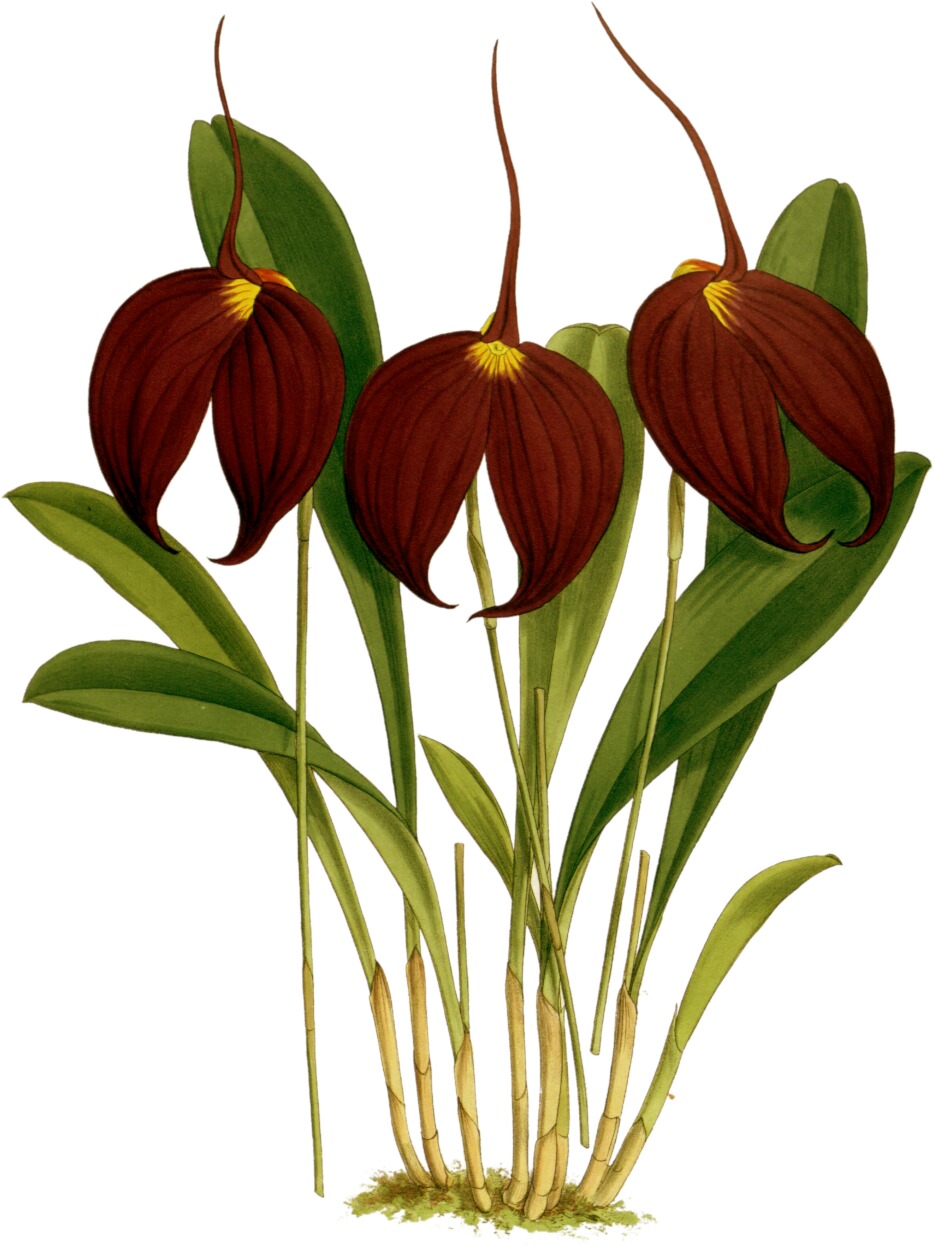
PL. 105. MASDEVALLIA HARRYANA ATROSANGUINEA.
17