CORYANTHES MACULATA PUNCTATA. [Plate 98.] Native of Demerara.
Reading edition
CORYANTHES MACULATA PUNCTATA. [Plate 98.] Native of Demerara.
Epiphytal. Pseudobulbs ovate or sometimes narrowed and elongate, furrowed, two to three inches long, tapering upwards, clustered. Leaves two, from the apex of each pseudobulb, broadly lanceolate, plicate, submembranaceous, light green, about a foot long. Scape radical, pendent, one and a half foot long, brownish purple, bearing a raceme of several flowers. Bracts large, membranaceous, ovate-lanceolate, two or three sheathing ones on the scape, and one at the base of each pedicel. Flowers large, very peculiar in form, ochraceous yellow, curiously spotted and blotched with deep wine-purple; sepals conduplicate flexuose, membranaceous, the dorsal one small, oblong, the lateral ones broad, at first spreading, but at length becoming reflexed and resembling bats’ wings, pale ochraceous yellow, the surface thickly spotted with small dots of deep wine-purple; petals oblong, erect, twisted, much smaller than the sepals, of the same colour, but having the spots larger; lip stipitate, continuous with the base of the column, cup-shaped, having a large helmet-shaped pedunculate appendage, the cup yellowish, the appendage creamy white, spotted and blotched on both surfaces with deep wine-purple, the purple colour almost covering the anterior side. Column terete, recurved, two horned at the base, two winged.
Coryanthes maculata punctata, Lindley, Folia Orchidacea, art. Coryanthes, No. 2.; Reichenbach fil., in Walpers’ Annales Botanices Systematica, vi., 598.
Coryanthes punctata, Lindley, Botanical Register, t. 1793.
Coryanthes is a most curious and interesting genus of Orchids, and but few species have yet come under our notice. We have long known C. macrantha and C. speciosa, which are two distinct kinds. That which we now figure is much like C. macrantha, with the exception that the crimson colouring is darker. Our drawing was taken from a fine specimen in the superb collection of W. McDonald, Esq., Woodlands, Perth, who is a great admirer of good Orchids.
Coryanthes maculata punctata is an evergreen plant, with short, thick pseudobulbs about two inches in height, bearing light green foliage about a foot in height. The flower spike proceeds from the base of the pseudobulbs, several flowers being produced together on the some scape; they are yellow, spotted with crimson. The plant, which blooms during October and November lasts but a few days in flower; it is, however, well worth growing on account of the extraordinary form of its flowers. Before they open they remind one of a Chinese foot; after opening they form a kind of cup having above it a pair of fleshy horns from which a liquid is distilled which drops into the cup.
4
These plants come from Demerara. They are found growing on the outside branches of trees, where they get all the light possible. They will thrive on blocks of wood, also in baskets or pots. If grown on blocks they require some good live sphagnum moss about their roots; if in baskets or pots, a little rough fibrous peat and charcoal mixed together will suit them, but they must have ample drainage as they require a good supply of water in their growing season. When at rest they should get just enough water to keep the bulbs in a plump state. We have found the warm end of the Cattleya house to suit them. These Coryanths require a good deal of care to grow them well. We used, some years ago, to grow fine specimens and exhibit them, and they were always a source of great attraction.
They are propagated by dividing the plants, leaving several old bulbs at the back of the leading one. This should be done just after they have started into growth. They must be kept free from insects which are apt to injure the young leaves as they are thin in texture. Sometimes thrips and red spiders will attack them, but they must be quickly exterminated.
Lælia purpurata.—A very fine spike of flower of this most beautiful and chaste Orchid was received by us from J. Buchanan, Esq., of Edinburgh. This plant has its sepals and petals quite flat, and holds them so till the last, whereas many of the purpuratas curl up a little after they have been open a short time. The sepals and petals are white, with a broad finely-coloured dark lip, of which the front portion is rich crimson-magenta, and the basal part paler and distinctly veined, the throat being yellow, beautifully veined with dark crimson. Each flower measured as much as seven inches across, the petals being two inches across. Mr. Grossart, the gardener, says, the flowers show well up above the foliage, which gives it a most striking appearance among the other varieties.—B. S. W.
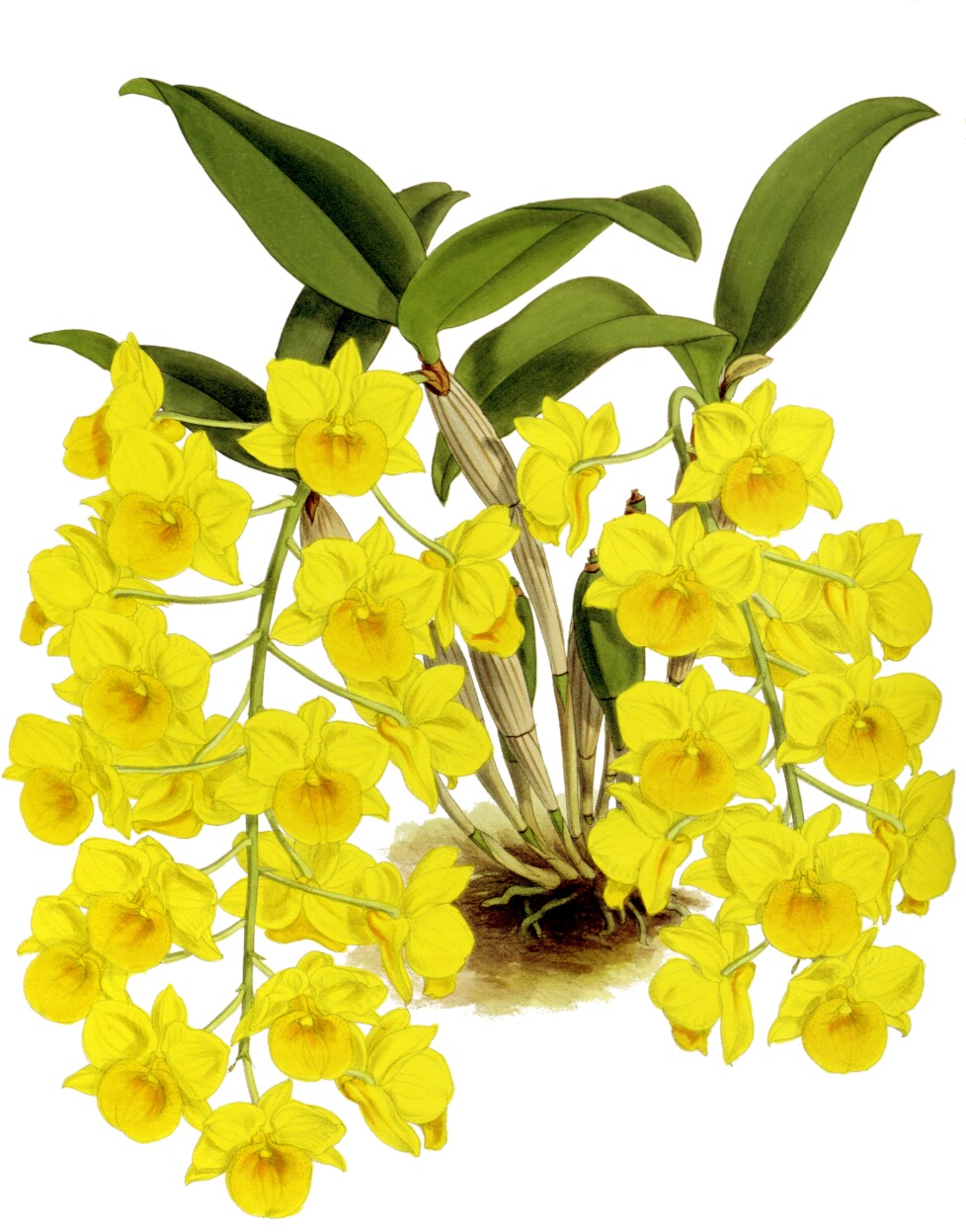
PL. 99. DENDROBIUM FARMERII AUREUM.
5