MASDEVALLIA HARRYANA ATROSANGUINEA. [Plate 105.] Native of New Grenada.
Reading edition
MASDEVALLIA HARRYANA ATROSANGUINEA. [Plate 105.] Native of New Grenada.
Epiphytal. Stems slender, short, tufted. Leaves persistent, leathery in texture, with a nerveless elongate oblong-spathulate obtuse or somewhat acute blade, which is channelled at the base, keeled behind, of a dark green colour, narrowed downwards into a short petiole, three to four inches long, grooved in front, and invested at the base by long membranous brownish sheaths. Scape erect, about a foot high, striately pencilled with purple, furnished with a few appressed sheathing bracts, bearing a solitary flower at the top. Flowers richly-coloured and strikingly handsome; tube a quarter of an inch wide and three-quarters of an inch long, dull orange-yellow stained with rosy purple in front, the mouth more closed than in some other forms; dorsal sepal upwards of two inches long, narrow nearly to the base, filiform upwards; lateral sepals deflexed, broadly and obliquely flacate-lanceolate, acuminate, two and a half inches long, and nearly an inch wide, of a rich glowing crimson flushed with magenta; petals and lip small, hidden at the base of the tube.
Masdevallia Harryana atrosanguinea, Hort. Williams.
Of the genus Masdevallia a few years ago there were but a very limited number of species known in cultivation, but it is now becoming a very comprehensive one, thanks to the perseverance or our energetic collectors, who have striven hard to bring the plants home, and have in a great measure succeeded, although with many of them the task of importation has been very difficult.
The variety we now bring before our readers is one of the best forms of the Masdevallia Harryana group. The figure was taken from a fine plant in the collection of R. Warner, Esq., Broomfield, who is a most successful grower of Masdevallias, and blooms them with fine flowers and brilliant colours. They are cultivated in pits after they have bloomed in summer, and in autumn are brought back into the Odontoglossum house, where they complete their growth and bloom in spring. They require rough fibrous peat and sphagnum moss, and a good supply of water nearly all the year round. They must never get dry, as they are found in shady places, where the atmosphere is always moist. We find them to succeed well with the same treatment as Odontoglossum Alexandræ, but not in so cool a temperature as some growers keep these plants in. They do not, however, like to be kept too close, so that a little air must always be given, avoiding cold draughts, which are injurious to all Orchids, whether grown in cool or warm houses. The rule applies in this respect in both cases.
As regards shading none of these plants like the hot sun, but they need all the light that can be given them, without exposing them to bright sunshine. The 18 blinds ought never to be let down when there is no sun, as the shade will draw them up dwindling and weakly, whereas if they have plenty of light they grow robust, and bring better flowers of a finer colour. This is the case with those at Broomfield, as Mr. Warner uses a very thin shading, and being in a fine open country place they get the pure air and clear light which is so beneficial to them. We believe the plants delight in this treatment, for we do not often see them doing so well in close places or in large towns as when they are located a few miles in the country. Most Orchids, indeed, thrive, fairly well in towns, provided their wants are attended to, but the treatment of course should be different, as when grown in close places they require more ventilation, and all the light that can be secured, whereas when grown in a country place like Broomfield, observation and experience must decide as to the necessities of the locality and its surroundings. Even then the cultivator requires much practice and forethought, in order to produce the best results, especially as the temperature varies so much in different situations: for instance, when, on the one hand, the houses are on a high hill exposed to all weathers, or, on the other hand, are in a sheltered spot on a hill-side, or in a valley, in all which localities there will be experienced considerable differences of temperature and light. The sun, moreover, varies in power. Orchid growers should find out the peculiarities of place and climate in which they are placed, and act accordingly. This is one of the great secrets in the successful cultivation of all plants, not of Orchids only; and in order to ensure success, all those points must be studied and acted on. Many growers are fully aware of these requirements, but others are not so well informed.
Masdevallias are free-growing and free-rooting plants, and are easily increased by dividing the tufts just as they are about to make their growth; but it must not be expected that these will flower well until they get established, which they will do best in small pots after being divided. The second year the growth will be stronger and as they get established larger pots may be given to them as required. Rough fibrous peat, sphagnum moss, and good drainage should be given, and the roots must be kept moist. Insects should be kept under. They are subject to attacks of green fly on their young growths and flower spikes, and of thrips on the leaves, which must be kept under, or the growth will be crippled.
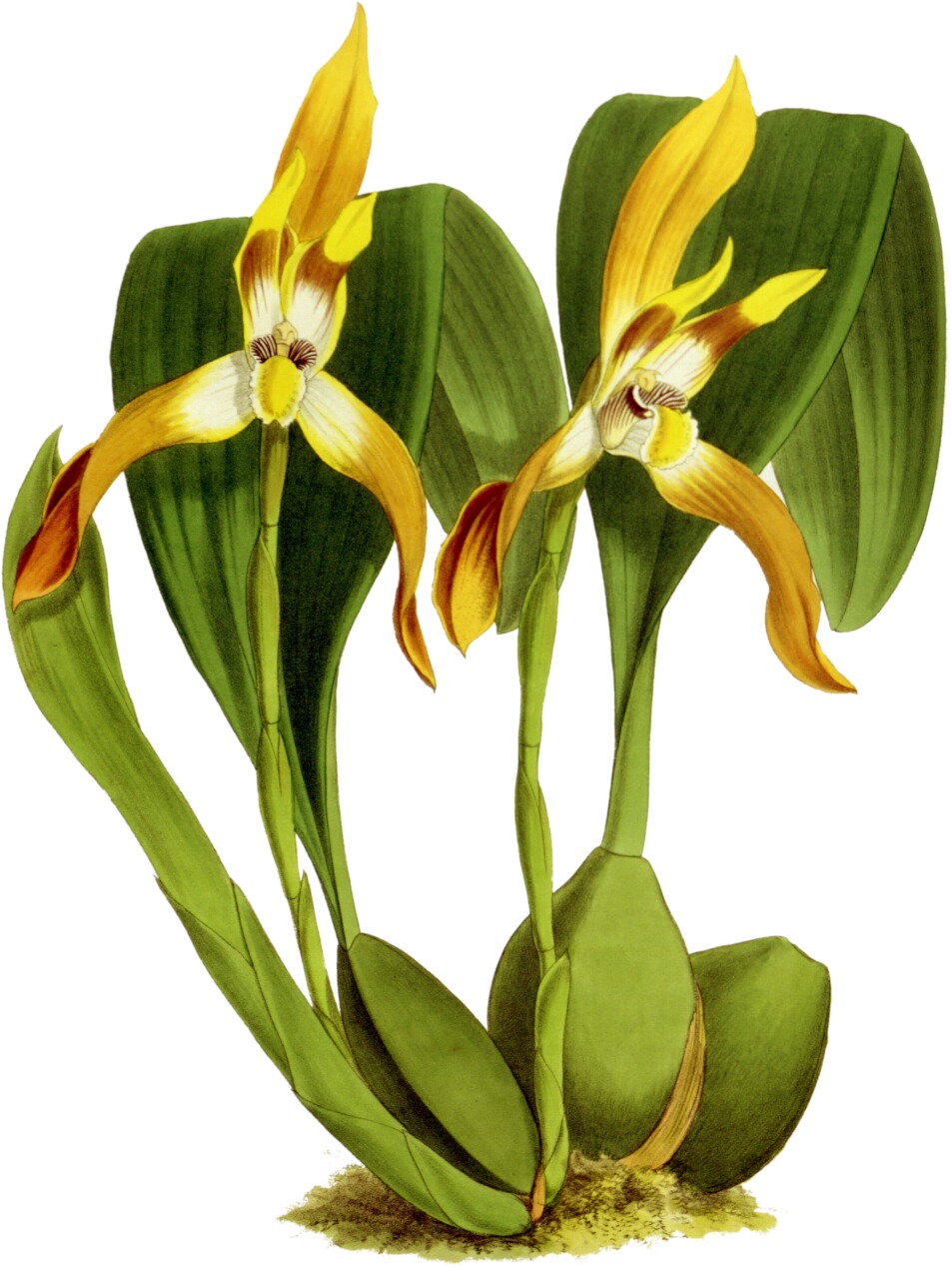
PL. 106. MAXILLARIA LUTEO-ALBA.
19